Ezekiel 15:2

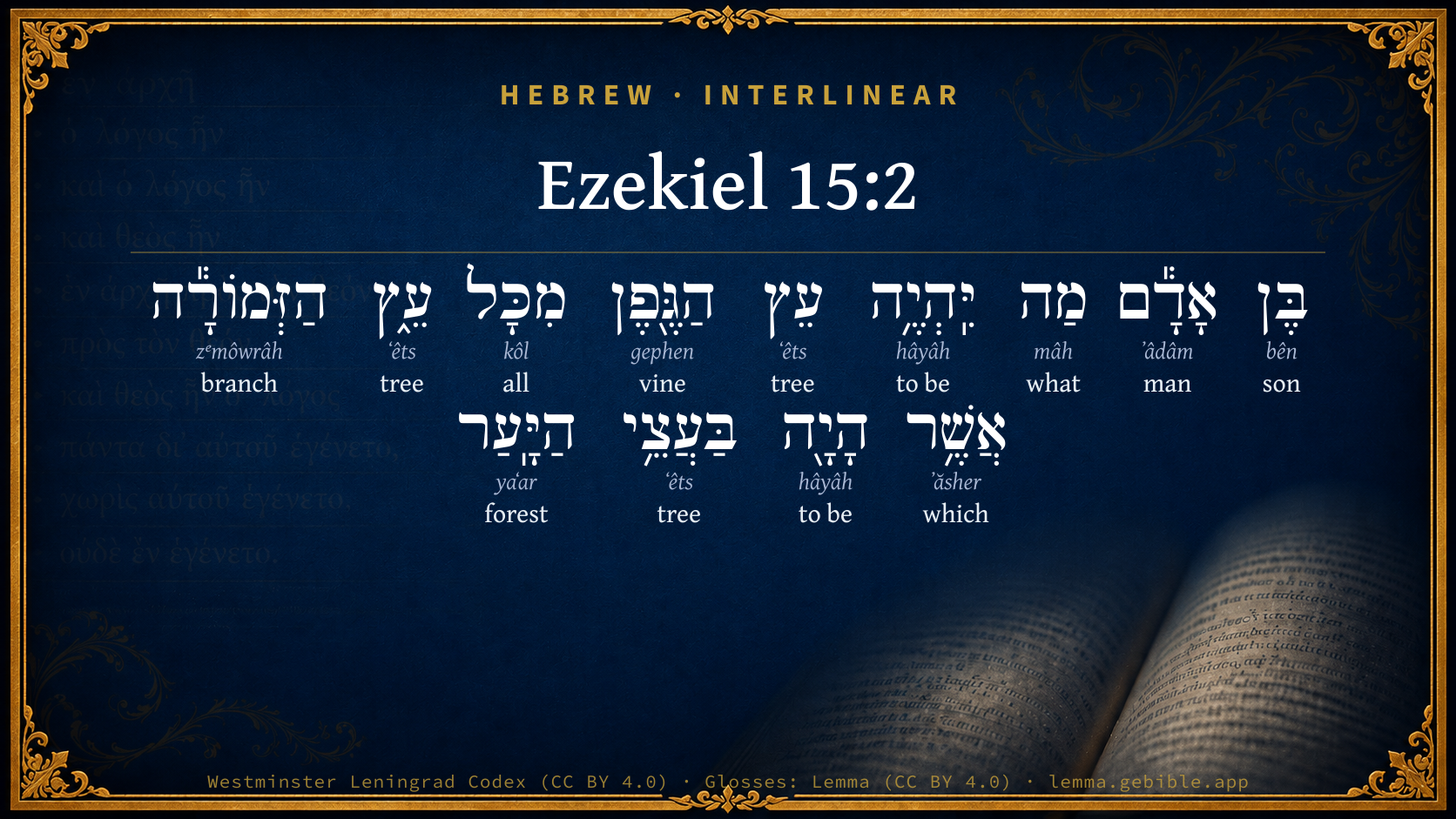
Hebrew (Westminster Leningrad Codex) Ezekiel 15:2 appears in the Hebrew Old Testament. The text above is from the Westminster Leningrad Codex. Each word links to its Strong’s number, a concise gloss, and parsing drawn from the Open Scriptures Hebrew Bible morphology. Click any word for its full Brown-Driver-Briggs (BDB) entry.
Download image
Cite this verse

Ezekiel 15:2 (World English Bible). Public Domain. Lemma interlinear Bible study tool, https://lemma.gebible.app/v/ezekiel/15/2.

Show BibTeX & RIS
BibTeX
RIS
English Translation
Son of man, what is the vine tree more than any tree, the vine-branch which is among the trees of the forest?
World English Bible · Public Domain
Download a study sheet

One document with this verse’s original text, its word-by-word gloss line, the meaning frame, cross-references with their text, attributed commentary, and full source and license credits — printable, and it pastes into notes with its structure intact.

This verse Autodidact and up

Study sheet (.html) Plain text (.txt)

A passage Seminary Student

Up to 50 verses in one chapter. A passage sheet keeps up to 6 commentary sources and 12 cross-references per verse, in the order this page ranks them, and says so on the sheet whenever that leaves anything out. Ask for a single verse and you get the Autodidact verse sheet above.

Everything on this page stays free to read, with no account — the sheet is a download of what is already on screen, not access to it.

Want to remove ads? Support Godless Engineer
Compare translations 3

The same verse in 3 English versions, stacked beneath the original-language interlinear above. Click any original word for its lexicon entry.

Each is an independent rendering of the whole verse — the interlinear is not word-aligned to these translations.

Highlighted words mark where these versions differ — a whole-verse word diff, not a word-by-word alignment.

  • World English Bible Public Domain
    Son of man, what is the vine tree more than any tree, the vine-branch which is among the trees of the forest?
  • King James Version Public Domain
    Son of man, what is the vine tree more than any tree, or than a branch which is among the trees of the forest?
  • unfoldingWord Literal Text CC BY-SA 4.0
    “Son of man, how is a vine better than any tree with branches that is among the trees in a forest?

unfoldingWord Literal Text — © unfoldingWord, licensed CC BY-SA 4.0. Word-aligned USFM3 via Door43 (git.door43.org/unfoldingWord/en_ult).

Versions to compare (up to 4)

3 of 4 selected

Show all 18 translations

Every available English version of this verse, each an independent rendering of the whole verse.

  • World English Bible Public Domain
    Son of man, what is the vine tree more than any tree, the vine-branch which is among the trees of the forest?
  • Berean Standard Bible Public Domain
    “Son of man, how does the wood of the vine surpass any other branch among the trees in the forest?
  • Majority Standard Bible Public Domain
    “Son of man, how does the wood of the vine surpass any other branch among the trees in the forest?
  • King James Version Public Domain
    Son of man, what is the vine tree more than any tree, or than a branch which is among the trees of the forest?
  • American Standard Version (1901) Public Domain
    Son of man, what is the vine-tree more than any tree, the vine-branch which is among the trees of the forest?
  • Revised Version (1885) Public Domain
    Son of man, What is the vine tree more than any tree, the vine branch which is among the trees of the forest?
  • Geneva Bible (1599) Public Domain
    Sonne of man, what commeth of the vine tree aboue all other trees? and of the vine braunch, which is among the trees of ye forest?
  • Douay-Rheims (1899) Public Domain
    Son of man, what shall be made of the wood of the vine, out of all the trees of the woods that are among the trees of the forests?
  • Young's Literal Translation Public Domain
    `Son of man, What is the vine-tree more than any tree? The vine-branch that hath been, Among trees of the forest?
  • Literal Standard Version CC BY-SA 4.0
    “Son of man, || What is the vine-tree more than any tree? The vine-branch that has been, || Among trees of the forest?
  • Unlocked Literal Bible CC BY-SA 4.0
    “Son of man, how is a vine better than any tree with branches that is among the trees in a forest?
  • unfoldingWord Literal Text CC BY-SA 4.0
    “Son of man, how is a vine better than any tree with branches that is among the trees in a forest?
  • Darby Bible Public Domain
    Son of man, what is the wood of the vine more than any wood, the vine-branch, which is among the trees of the forest?
  • World Messianic Bible Public Domain
    “Son of man, what is the vine tree more than any tree, the vine branch which is among the trees of the forest?
  • Webster's Bible Public Domain
    Son of man, What is the vine-tree more than any tree, or than a branch which is among the trees of the forest?
  • Free Bible Version CC BY-SA 4.0
    “Son of man, is wood from a vine better than the wood from any other tree in the forest?
  • Bible in Basic English Public Domain
    Son of man, what is the vine-tree more than any branching tree which is among the trees of the woods?
  • JPS Tanakh (1917) Public Domain
    'Son of man, what is the vine-tree more than any tree, the vine branch which grew up among the trees of the forest?

Literal Standard Version (2020), Covenant Press — licensed CC BY-SA 4.0. Text via the HelloAO Bible API (eBible.org). Unlocked Literal Bible (unfoldingWord) — licensed CC BY-SA 4.0. Text via the HelloAO Bible API (eBible.org). unfoldingWord Literal Text — © unfoldingWord, licensed CC BY-SA 4.0. Word-aligned USFM3 via Door43 (git.door43.org/unfoldingWord/en_ult). Free Bible Version, Dr. Jonathan Gallagher — licensed CC BY-SA 4.0. Text via the HelloAO Bible API (eBible.org).

Word by word

More ways to search: Search by grammar → Find every occurrence → Compare this word →

Practice this passage: Drill this verse → Learn its vocabulary →

הַזְּמוֹרָ֕ה
zᵉmôwrâh
H2156
“the · branch”
Particle, Definite Article + Noun, Common, Feminine, Singular, Absolute
Part of Speech
Particle + Noun
Type
Common
Gender
Feminine
Number
Singular
State
Absolute
Full BDB Definition

Origin: from H2168

TWOT: 559b

branch, twig, shoot
  1. בֶּן bên H1121 “son of” Noun, Common, Masculine, Singular, Construct
  2. אָדָ֕ם ʼâdâm H120 “man” Noun, Common, Masculine, Singular, Absolute
  3. מַה mâh H4100 “what” Particle, Interrogative
  4. יִּֽהְיֶ֥ה hâyâh H1961 “to be” Verb, Qal, Imperfect, 3rd Person, Masculine, Singular
  5. עֵץ ʻêts H6086 “tree of” Noun, Common, Masculine, Singular, Construct
  6. הַגֶּ֖פֶן gephen H1612 “the · vine” Particle, Definite Article + Noun, Common, Both, Singular, Absolute
  7. מִכָּל kôl H3605 “from · all of” Preposition + Noun, Common, Masculine, Singular, Construct
  8. עֵ֑ץ ʻêts H6086 “tree of” Noun, Common, Masculine, Singular, Construct
  9. אֲשֶׁ֥ר ʼăsher H834 “which” Particle, Relative
  10. הָיָ֖ה hâyâh H1961 “to be” Verb, Qal, Perfect, 3rd Person, Masculine, Singular
  11. בַּעֲצֵ֥י ʻêts H6086 “in/at · trees of” Preposition + Noun, Common, Masculine, Plural, Construct
  12. הַיָּֽעַר yaʻar H3293 “the · forest” Particle, Definite Article + Noun, Common, Masculine, Singular, Absolute

About this verse

These counts appear in no published source. They are computed here, from the morphology-tagged text and Lemma’s own curated glosses. What Lemma adds →

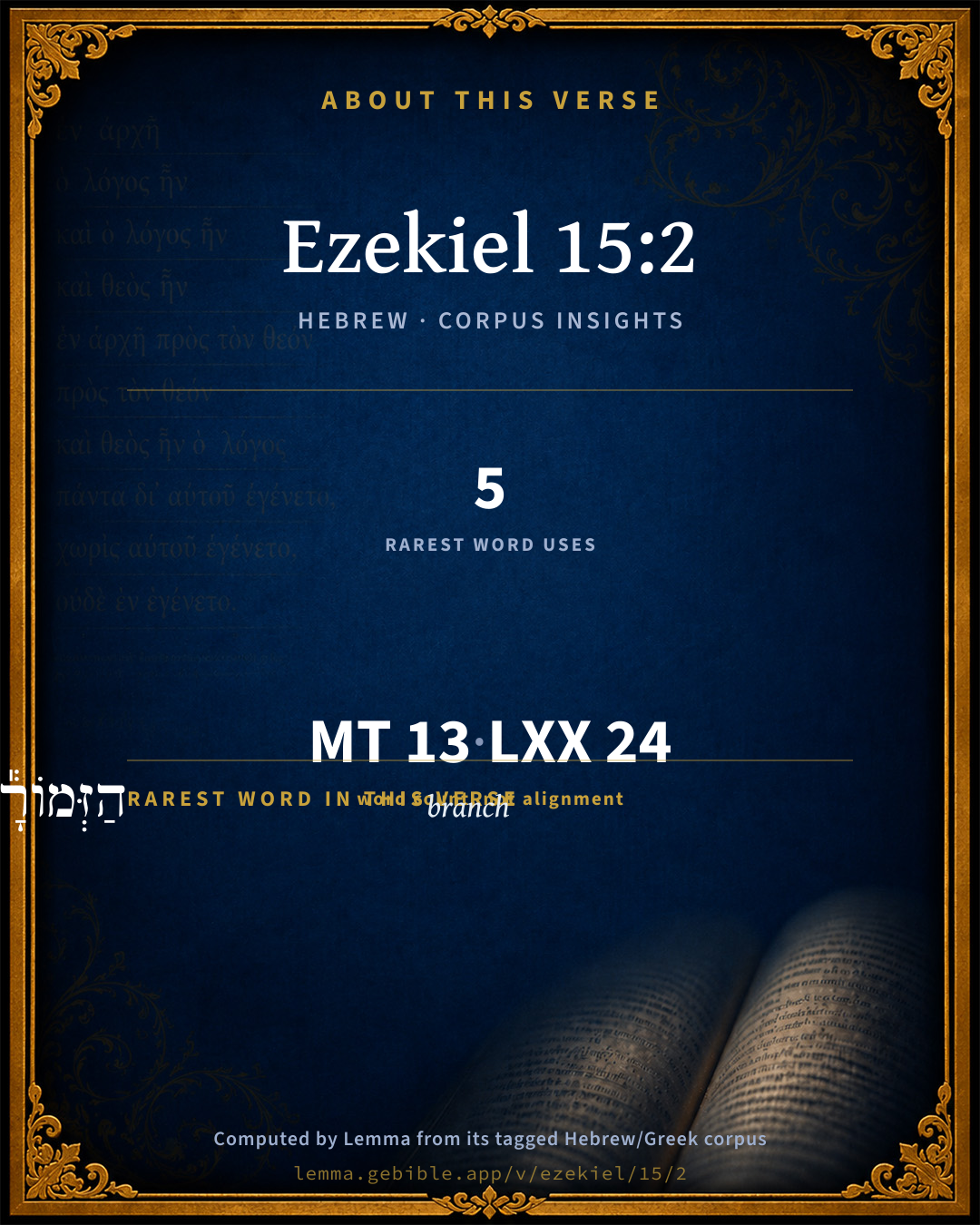
13
words
10
distinct lemmas
Prophets
section

Notable vocabulary

The rarest word here is הַזְּמוֹרָ֕ה branch H2156 — appearing just 5 times in the whole Hebrew Bible.

Shared distinctive vocabulary

הַזְּמוֹרָ֕ה branch H2156 occurs in 5 verses of the Hebrew Bible. Also found in:

Grammatical profile

  • 2 verbs
  • 9 nouns
  • 2 particles

Verb forms

  • יִּֽהְיֶ֥ה Qal · Imperfect
  • הָיָ֖ה Qal · Perfect

Repetition

Words recur within this verse — often emphatic in Hebrew:

  • עֵץ tree H6086 ×3
  • יִּֽהְיֶ֥ה to be H1961 ×2

Hebrew & Septuagint length

In English translation the verse runs 22 words from the Hebrew and 29 from the Septuagint (LXX English) — closely comparable.

A rough comparison of the two English renderings, which tokenize alike — not a word-level alignment.

Word counts can differ between the Hebrew and the Greek without any difference in meaning — e.g. the Hebrew direct-object marker אֵת has no separate Greek word, and Greek often adds the article ὁ.

In the original languages it is 13 Hebrew tokens and 24 Greek tokens — but the two are counted differently (Hebrew bundles its prefixes and suffixes into one token; the Greek is in lemma form), so that isn’t a like-for-like length.

Cross-references

17

Topical passages linked to Ezekiel 15:2 in the Treasury of Scripture Knowledge — connected by theme and wording, ordered by reader-vote popularity; previews shown in the World English Bible.

  • Hosea 10:1 Israel is a luxuriant vine that puts forth his fruit. According to the abundance of his fruit he has multiplied his altars. As their land has prospered, they have adorned their sacred stones.
  • Psalms 80:8–16 You brought a vine out of Egypt. You drove out the nations, and planted it.
  • Isaiah 5:1–7 Let me sing for my well beloved a song of my beloved about his vineyard. My beloved had a vineyard on a very fruitful hill.
  • Song of Solomon 2:15 Catch for us the foxes, The little foxes that spoil the vineyards; For our vineyards are in blossom. Beloved
  • Song of Solomon 6:11 I went down into the nut tree grove, To see the green plants of the valley, To see whether the vine budded, And the pomegranates were in flower.
  • Song of Solomon 7:12 Let's go early up to the vineyards. Let's see whether the vine has budded, Its blossom is open, And the pomegranates are in flower. There I will give you my love.
  • Song of Solomon 8:11–12 Solomon had a vineyard at Baal Hamon. He leased out the vineyard to keepers. Each was to bring a thousand shekels of silver for its fruit.
  • Jeremiah 2:21 Yet I had planted you a noble vine, wholly a right seed: how then are you turned into the degenerate branches of a foreign vine to me?
  • Luke 20:9–16 He began to tell the people this parable. "A man planted a vineyard, and rented it out to some farmers, and went into another country for a long time.
  • John 15:1–6 "I am the true vine, and my Father is the farmer.
  • Deuteronomy 32:32–33 For their vine is of the vine of Sodom, Of the fields of Gomorrah: Their grapes are grapes of gall, Their clusters are bitter:
  • Song of Solomon 2:13 The fig tree ripens her green figs. The vines are in blossom; They give forth their fragrance. Arise, my love, my beautiful one, And come away. Lover
  • Isaiah 44:23 Sing, you heavens, for Yahweh has done it; shout, you lower parts of the earth; break forth into singing, you mountains, O forest, and every tree therein: for Yahweh has redeemed Jacob, and will glorify himself in Israel.
  • Micah 3:12 Therefore Zion for your sake will be plowed like a field, And Jerusalem will become heaps of rubble, And the mountain of the temple like the high places of a forest.
  • Zechariah 11:2 Wail, fir tree, for the cedar has fallen, Because the stately ones are destroyed. Wail, you oaks of Bashan, For the strong forest has come down.
  • Matthew 21:33–41 "Hear another parable. There was a man who was a master of a household, who planted a vineyard, set a hedge about it, dug a winepress in it, built a tower, leased it out to farmers, and went into another country.
  • Mark 12:1–9 He began to speak to them in parables. "A man planted a vineyard, put a hedge around it, dug a pit for the winepress, built a tower, rented it out to a farmer, and went into another country.

Cross-references courtesy of OpenBible.info (CC BY 4.0).

Hebrew and Greek witnesses Masoretic Hebrew ↔ Greek Septuagint

The same verse in the two great witnesses to the Old Testament, shown verse-for-verse.

These are two independent witnesses, not word-aligned to each other, and the Septuagint is shown in lemma (dictionary) form.

Hebrew Ezekiel 15:2 Masoretic · Westminster Leningrad Codex

בֶּן אָדָ֕ם מַה יִּֽהְיֶ֥ה עֵץ הַגֶּ֖פֶן מִכָּל עֵ֑ץ הַזְּמוֹרָ֕ה אֲשֶׁ֥ר הָיָ֖ה בַּעֲצֵ֥י הַיָּֽעַר

Son of man, what is the vine tree more than any tree, the vine-branch which is among the trees of the forest?

World English Bible · Public Domain

Greek LXX Ezekiel 15:2 Septuagint · lemma form

καί σύ υἱός ἄνθρωπος τίς ἄν γίγνομαι ὁ ξύλον ὁ ἄμπελος ἐκ πᾶς ὁ ξύλον ὁ κλῆμα ὁ εἰμί ἐν ὁ ξύλον ὁ δρυμός

And you, son of man—of all the wood, of the branches that are among the trees of the forest, what shall be made of the wood of the vine?

LXX2012 (modern English Septuagint) · Public Domain

Hebrew: Westminster Leningrad Codex (CC BY 4.0). Greek: Septuagint (public domain); English from LXX2012 (modern English Septuagint) (Public Domain). How the Septuagint differs from the Hebrew →

Targum (Aramaic paraphrase)

1

The Targum is the ancient Jewish Aramaic paraphrase of the Hebrew Scriptures — an interpretive translation, not the Hebrew text itself. Onkelos (literal) and Pseudo-Jonathan (expansive) render the Torah, and Jonathan the Prophets. Coverage is partial: where no permissively-licensed English translation exists for a verse, only the Aramaic is shown. This is verse-level text, not a word-by-word alignment to the Hebrew.

  1. Targum Jonathan Prophets (Joshua–Malachi)
    בַּר אָדָם מַה שְׁנָא אִילַן גוּפְנָא מִכָּל אִילָנָא שַׁבֶּשְׁתָּא דַהֲוַת בְּאָעֵי חוּרְשָׁא:

    (no public-domain English translation for this verse)

    Targum Jonathan — Aramaic: “Mikraot Gedolot” (public domain). English: “Sefaria Community Translation” (CC0 1.0 (public-domain dedication)); “London "Chaldee Paraphrase," 1871” (public domain). Text via Sefaria.

Commentary

Notes on Ezekiel 15:2 from classic Christian and Jewish commentators (each source and its license shown beneath its notes). The classic Christian expositions comment on the surrounding passage and are grouped to its opening verse, so a note may address several verses; the Jewish commentaries on the Tanakh (Rashi and others) are per-verse, so they appear only where the commentator wrote on this verse.

Lemma curates 59 commentaries, every one of them public domain or Creative Commons licensed, each selected and text-cleaned for this edition rather than reprinted as found. About our sources →

Trapp's Complete Commentary

John Trapp

Eze 15:2 Son of man, What is the vine tree more than any tree, [or than] a branch which is among the trees of the forest?

Ver. 2. What is the vine tree more than any tree?] The Jews took upon them, because a "vine brought out of Egypt," and such as God’s own right hand had planted. But insomuch as they were now become fruitless and also useless "trees twice dead, plucked up by the roots," {Jdg 1:12} what had they to glory in above other nations? Surely they were therefore worse than others, because they ought to have been better. True it is that a vine in itself, considered with the fruit it beareth, is no contemptible tree. But if it be withered or pulled out of the earth, it is no way comparable to other trees or shrubs, which, when felled, are put to sundry good uses that the vine - lignum tenus, gibbosum et tortuosum - a crooked, low, writhen thing - will never serve to; as to make spears, doors, tables, ships, houses, &c.

John Trapp, A Commentary or Exposition upon All the Books of the Old and New Testament (1647–1656) — public domain. Text from a community e-Sword module.

Geneva Bible (1599)

Geneva Bible translators

Which brings forth no fruit, no more than the other trees of the forest do: meaning that if Jerusalem, which bore the name of his Church, did not bring forth fruit it would be utterly destroyed.

Geneva Bible (1599) marginal notes — public domain. Text via Bolls.life.

Adam Clarke's Commentary

Verse 2. What is the vine tree more than any tree] It is certain that the vine is esteemed only on account of its fruit. In some countries, it is true, it grows to a considerable size and thickness: but, even then, it is not of a sufficient density to work into furniture. But whatever may be said of the stock of the vine, it is the branch that the prophet speaks of here; and I scarcely know the branch of any tree in the forest more useless than is the branch of the vine. Out of it who can even make a pin to drive into a mud wall, or hang any vessel on? A vine would never be cultivated for the sake of its wood; it is really worthless but as it bears fruit. What is Israel? Good for nothing, but as God influenced them to bring forth fruit to his glory. But now that they have ceased to be fruitful, they are good for nothing, but, like a withered branch of the vine, to be burnt.

Adam Clarke's Commentary on the Bible (1810–1826) — public domain. Text from a community e-Sword/MySword module.

The Cambridge Bible for Schools and Colleges

gen. ed. J. J. S. Perowne

2. or than a branch] Perhaps: the vine-branch which is,—the words taking up “the vine tree” of previous clause. Owing to the verb the natural sense is: what shall be made of the wood of the vine among all wood, the vine branch that is among the trees of the forest? Cf. Eze_15:3. With the comparative sense the accents should be disregarded: what is the wood of the vine more than any wood of the branch which is &c. On Israel as the vine cf. Gen_49:22; Isa_5:1; Deu_32:32; Jer_2:21; Eze_17:5; Eze_19:10; Psalms 80; Hos_10:1.

The Cambridge Bible for Schools and Colleges (gen. ed. J. J. S. Perowne; Cambridge University Press, 1878–1918) — public domain. Text from a community e-Sword module.

John Gill's Exposition

Shall wood be taken thereof to do any work?.... The carpenter and joiner, the house or ship builder, are employed in; as to build houses of, make beams, rafters, floors, &c. build ships with, make masts of, &c. or any vessel or utensil for the use of man? it never is; it is not fit for any such purpose. Pliny (d) speaks of some rarities made of the wood of vines, but not things of common use; and these not of any vines, but of some peculiar ones, favoured by the air and soil

or will men take a pin of it to hang any vessel thereon? it is not fit to make a peg of to hang a hat on; and much less for anything that requires more strength.

(d) Nat. Hist. l. 14. c. 1.

John Gill's Exposition of the Whole Bible (1746–1763) — public domain (CC PDM 1.0). Text via the HelloAO Bible API.

Albert Barnes' Notes on the Bible

The vine ... - The image is grounded on a well-known figure Psa 80:8; Isa. 5. The comparison is not between the vine and other trees, but between the wood of the vine and the wood of other trees.

Albert Barnes' Notes on the Bible (1834–1885) — public domain. Text from a community e-Sword/MySword module.

Haydock's Catholic Bible Commentary

Wood. Small branches or tendrils. The vines of that country were probably small. (Calmet) --- The wild vine (Sanctius) grows very large, and the wood is durable, so that statues, pillars, and ladders were formed of it. (Pliny, [Natural History?] xiv. 1.) --- Strabo (ii., and xi.) mentions the trunk of a vine which two men could hardly clasp, and the bunch of grapes was two cubits high. But the prophet speaks of the small branches, which are fit only for the fire. (Calmet) --- God’s Church is often compared to a vine on account of its fruit, and the branches separated form her resemble the useless cuttings. (St. Augustine, tr. lxxxi. in John) (Worthington) --- See Ward’s Tree of Life, where this is set in a very striking light. In every age the Church makes fresh conquests, while heretics leave and persecute her. (Haydock)

George Leo Haydock (1774–1849), Haydock's Catholic Family Bible and Commentary, 1859 edition — public domain. Excludes Psalms (Douay-Rheims chapter numbering differs from Protestant) and Deuterocanonical books (Catholic canon only).

Matthew Poole's English Annotations

The house of Israel is often compared to a vine, which when barren or fruitless is very contemptible and unprofitable. This the prophet minds them of to humble them, and awaken them to fruitfulness; Will you boast yourselves of this?

Than a branch which is among the trees of the forest; one single branch of a tree in the forest is of more use and worth than the whole vine tree is, except for its fruit.

Matthew Poole's English Annotations on the Holy Bible (1683–1685) — public domain. Text from a community e-Sword/MySword module.

The Pulpit Commentary

What is the vine tree, etc.? The prophet"s mind had apparently been dwelling, after the close of his previous utterance, on the imagery of earlier writers, in which Israel had appeared as the vine of Jehovah (Gen_49:22; Psa_80:9; Hos_10:1 Isa 5; Deu_32:32; Jer_2:21) and to which he himself refers again in Eze_19:10. He saw how men might pervert that image to their own destruction. And he expands the parable, as our Lord does in John 15. Men might dwell, perhaps were actually dwelling, on the thought that they were branches of the true vine, and therefore could not perish. He exposes the groundlessness of that hope in tones of scornful sarcasm. If the vine did not bear fruit, or if it only brought forth wild grapes, then its special excellence was gone, and it challenged comparison with other trees only as a timber tree, and what was its worth as such? If Israel was not true to its vocation, it was poorer and weaker than the heathen nations round it. So far the general thought is clear. In dealing with details, we note that the words in italics, "or than," should disappear, and that the words should stand as in the Revised Version, What is the vine more than any tree, the vine branch which is among the trees of the forest?

The Pulpit Commentary (1880–1919), ed. H.D.M. Spence-Jones & Joseph S. Exell — public domain. Text from a community e-Sword module.

John Wesley's Explanatory Notes

The vine-tree - Israel is here compared to a vine, which, when fruitless, is utterly unprofitable. This the prophet minds them of to humble them, and awaken them to fruitfulness. A branch - One branch of a tree in the forest is of more use than the whole vine- tree is, except for its fruit.

John Wesley, Explanatory Notes Upon the Whole Bible (1754–1765) — public domain. Text via the GEBible commentary corpus.

Rashi

Rabbi Shlomo Yitzchaki (Rashi)

what will become of the vine tree out of all [other] trees How will its end be different from that of all other trees?

the branch that was among the trees of the forest Not about the vine of the vineyards, which produces fruit, am I asking you, but about the branch of a vine that grows in the forest.

Rashi on the Tanakh — English translations: “The Judaica Press complete Tanach with Rashi, translated by A. J. Rosenberg” (CC BY 4.0); “Pentateuch with Rashi's commentary by M. Rosenbaum and A.M. Silbermann, 1929-1934” (public domain); “The Metsudah Tanach series, Lakewood, N.J” (CC BY 4.0); and “The Book of Joshua, Metsudah Publications, 1997” (CC BY 4.0). Text via Sefaria.

Lesson kit

Teaching starters — assembled from the data on this page, not authored interpretation. Every prompt links to the verse data it draws on. Edit before teaching.

Ezekiel, in the Prophets, opens this verse with 13 words (10 distinct Hebrew lemmas). Its most distinctive word is zᵉmôwrâh (“branch”). A historical commentator’s framing appears above. Read the whole chapter for the surrounding context.

Discussion questions

  1. The word zᵉmôwrâh carries the sense “branch.” How does it shape the verse?
  2. How does Numbers 13:23, which shares the word «branch», read alongside this verse?
  3. What does the repetition of “tree” (3× in this one verse) do in this verse?
  4. These translations render this verse differently. What is at stake in choosing one wording over another?
  5. «יִּֽהְיֶ֥ה» is a Qal Imperfect verb. How does that grammatical form shape the action described?
  6. Compare how Trapp's Complete Commentary and Geneva Bible (1599) read this verse. Where do they agree or differ?

Things to notice

Reading settings

Reading text

Shown beneath each verse's original-language words.

Old Testament
Old Testament edition

Read the OT as the Masoretic Hebrew (MT) or the Greek Septuagint (LXX).

English shown for the Greek Septuagint (in the Hebrew ↔ Greek comparison).

Comparing translations? Open the Compare panel on any verse page to stack up to four side by side.