
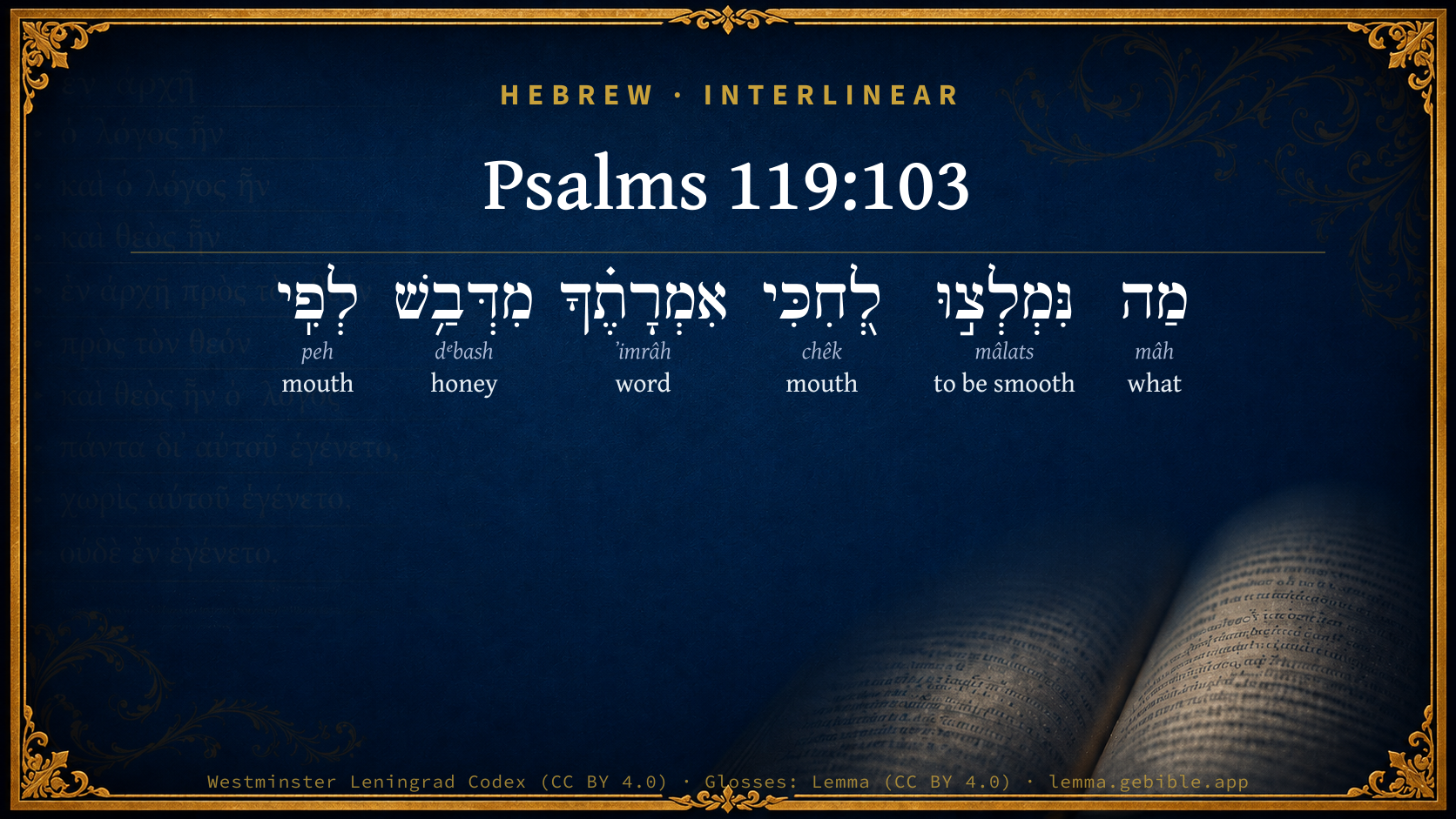
Psalms 119:103

Hebrew (Westminster Leningrad Codex) Psalms 119:103 appears in the Hebrew Old Testament. The text above is from the Westminster Leningrad Codex. Each word links to its Strong’s number, a concise gloss, and parsing drawn from the Open Scriptures Hebrew Bible morphology. Click any word for its full Brown-Driver-Briggs (BDB) entry.
Download image
Cite this verse

Psalms 119:103 (World English Bible). Public Domain. Lemma interlinear Bible study tool, https://lemma.gebible.app/v/psalms/119/103.

Show BibTeX & RIS
BibTeX
RIS
English Translation
How sweet are your promises to my taste, More than honey to my mouth!
World English Bible · Public Domain
Highlights
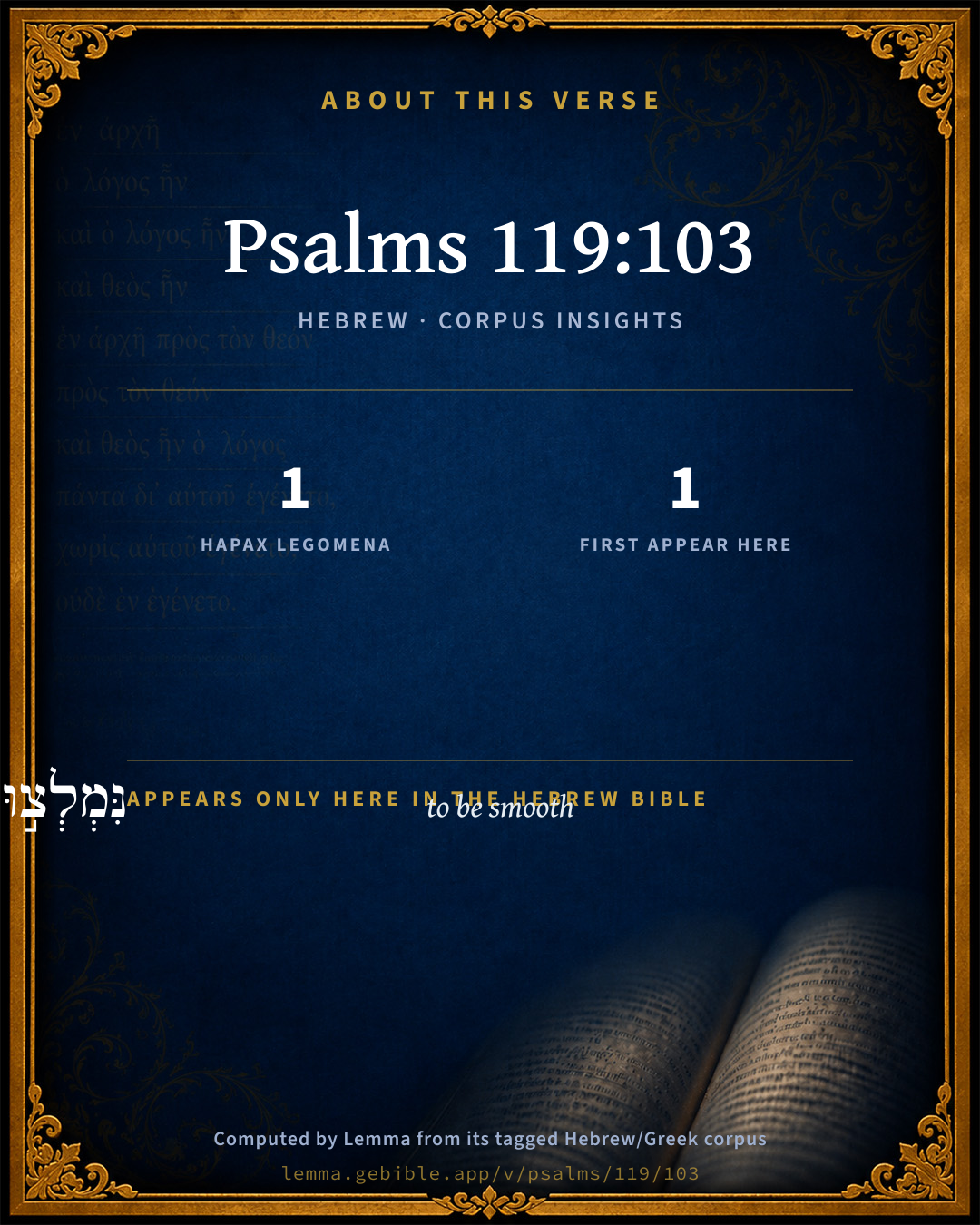
  • 1 hapax legomenon — only here in the Hebrew Bible
  • 1 first appearance in the Hebrew Bible
Full analysis ↓
Download a study sheet

One document with this verse’s original text, its word-by-word gloss line, the meaning frame, cross-references with their text, attributed commentary, and full source and license credits — printable, and it pastes into notes with its structure intact.

This verse Autodidact and up

Study sheet (.html) Plain text (.txt)

A passage Seminary Student

Up to 50 verses in one chapter. A passage sheet keeps up to 6 commentary sources and 12 cross-references per verse, in the order this page ranks them, and says so on the sheet whenever that leaves anything out. Ask for a single verse and you get the Autodidact verse sheet above.

Everything on this page stays free to read, with no account — the sheet is a download of what is already on screen, not access to it.

Want to remove ads? Support Godless Engineer
Compare translations 3

The same verse in 3 English versions, stacked beneath the original-language interlinear above. Click any original word for its lexicon entry.

Each is an independent rendering of the whole verse — the interlinear is not word-aligned to these translations.

Highlighted words mark where these versions differ — a whole-verse word diff, not a word-by-word alignment.

  • World English Bible Public Domain
    How sweet are your promises to my taste, More than honey to my mouth!
  • King James Version Public Domain
    How sweet are thy words unto my taste! yea, sweeter than honey to my mouth!
  • unfoldingWord Literal Text CC BY-SA 4.0
    How your word is sweet to my palate, more than honey to my mouth!

unfoldingWord Literal Text — © unfoldingWord, licensed CC BY-SA 4.0. Word-aligned USFM3 via Door43 (git.door43.org/unfoldingWord/en_ult).

Versions to compare (up to 4)

3 of 4 selected

Show all 17 translations

Every available English version of this verse, each an independent rendering of the whole verse.

  • World English Bible Public Domain
    How sweet are your promises to my taste, More than honey to my mouth!
  • Berean Standard Bible Public Domain
    How sweet are Your words to my taste—sweeter than honey in my mouth!
  • Majority Standard Bible Public Domain
    How sweet are Your words to my taste—sweeter than honey in my mouth!
  • King James Version Public Domain
    How sweet are thy words unto my taste! yea, sweeter than honey to my mouth!
  • American Standard Version (1901) Public Domain
    How sweet are thy words unto my taste! `Yea, sweeter' than honey to my mouth!
  • Revised Version (1885) Public Domain
    How sweet are thy words unto my taste! yea, sweeter than honey to my mouth!
  • Geneva Bible (1599) Public Domain
    Howe sweete are thy promises vnto my mouth! yea, more then hony vnto my mouth.
  • Young's Literal Translation Public Domain
    How sweet to my palate hath been Thy saying, Above honey to my mouth.
  • Literal Standard Version CC BY-SA 4.0
    How sweet Your saying has been to my palate, || Above honey to my mouth.
  • Unlocked Literal Bible CC BY-SA 4.0
    How sweet are your words to my taste, yes, sweeter than honey to my mouth!
  • unfoldingWord Literal Text CC BY-SA 4.0
    How your word is sweet to my palate, more than honey to my mouth!
  • Darby Bible Public Domain
    How sweet are thy ùwords unto my taste! more than honey to my mouth!
  • World Messianic Bible Public Domain
    How sweet are your promises to my taste, more than honey to my mouth!
  • Webster's Bible Public Domain
    How sweet are thy words to my taste! yes, sweeter than honey to my mouth!
  • Free Bible Version CC BY-SA 4.0
    Your words taste so sweet to me! They are sweeter than honey to my mouth.
  • Bible in Basic English Public Domain
    How sweet are your sayings to my taste! truly, they are sweeter than honey in my mouth!
  • JPS Tanakh (1917) Public Domain
    How sweet are Thy words unto my palate! yea, sweeter than honey to my mouth!

Literal Standard Version (2020), Covenant Press — licensed CC BY-SA 4.0. Text via the HelloAO Bible API (eBible.org). Unlocked Literal Bible (unfoldingWord) — licensed CC BY-SA 4.0. Text via the HelloAO Bible API (eBible.org). unfoldingWord Literal Text — © unfoldingWord, licensed CC BY-SA 4.0. Word-aligned USFM3 via Door43 (git.door43.org/unfoldingWord/en_ult). Free Bible Version, Dr. Jonathan Gallagher — licensed CC BY-SA 4.0. Text via the HelloAO Bible API (eBible.org).

Word by word

More ways to search: Search by grammar → Find every occurrence → Compare this word →

Practice this passage: Drill this verse → Learn its vocabulary →

About this verse

These counts appear in no published source. They are computed here, from the morphology-tagged text and Lemma’s own curated glosses. What Lemma adds →

6
words
6
distinct lemmas
Wisdom
section

Notable vocabulary

1 hapax legomenon — a word that appears only here in the entire Hebrew Bible:

  • נִּמְלְצ֣וּ to be smooth H4452

First appearance in Scripture

This word makes its first canonical appearance in the Hebrew Bible here:

  • נִּמְלְצ֣וּ to be smooth H4452

Shared distinctive vocabulary

לְ֭חִכִּי mouth H2441 occurs in 18 verses of the Hebrew Bible. Also found in:

Grammatical profile

  • 1 verb
  • 4 nouns
  • 1 particle

Verb forms

  • נִּמְלְצ֣וּ Niphal · Perfect

Hebrew & Septuagint length

In English translation the verse runs 14 words from the Hebrew and 15 from the Septuagint (LXX English) — closely comparable.

A rough comparison of the two English renderings, which tokenize alike — not a word-level alignment.

Word counts can differ between the Hebrew and the Greek without any difference in meaning — e.g. the Hebrew direct-object marker אֵת has no separate Greek word, and Greek often adds the article ὁ.

Cross-references

8

Topical passages linked to Psalms 119:103 in the Treasury of Scripture Knowledge — connected by theme and wording, ordered by reader-vote popularity; previews shown in the World English Bible.

  • Proverbs 8:11 For wisdom is better than rubies. All the things that may be desired can't be compared to it.
  • Psalms 19:10 More to be desired are they than gold, yes, than much fine gold; Sweeter also than honey and the extract of the honeycomb.
  • Proverbs 24:13–14 My son, eat honey, for it is good; The droppings of the honeycomb, which are sweet to your taste:
  • Psalms 63:5 My soul shall be satisfied as with the richest food. My mouth shall praise you with joyful lips,
  • Job 23:12 I haven't gone back from the commandment of his lips. I have treasured up the words of his mouth more than my necessary food.
  • Proverbs 3:17 Her ways are ways of pleasantness. All her paths are peace.
  • Song of Solomon 5:1 I have come into my garden, my sister, my bride. I have gathered my myrrh with my spice; I have eaten my honeycomb with my honey; I have drunk my wine with my milk. Friends Eat, friends! Drink, yes, drink abundantly, beloved. Beloved
  • Song of Solomon 1:2–4 Let him kiss me with the kisses of his mouth; For your love is better than wine.

Cross-references courtesy of OpenBible.info (CC BY 4.0).

Hebrew and Greek witnesses Masoretic Hebrew ↔ Greek Septuagint

The same verse in the two great witnesses to the Old Testament, shown verse-for-verse.

You’re reading Greek Psalm 118 (Hebrew Psalm 119). The Septuagint counts the superscription, so verse numbers can differ from the Hebrew — chapter-level alignment, not verse-by-verse. Numbering follows Rahlfs.

These are two independent witnesses, not word-aligned to each other, and the Septuagint is shown in lemma (dictionary) form.

Hebrew Psalms 119:103 Masoretic · Westminster Leningrad Codex

מַה נִּמְלְצ֣וּ לְ֭חִכִּי אִמְרָתֶ֗ךָ מִדְּבַ֥שׁ לְפִֽי

How sweet are your promises to my taste, More than honey to my mouth!

World English Bible · Public Domain

Greek LXX Greek Psalm 118:103 Septuagint · lemma form

ὡς γλυκύς ὁ λάρυγξ ἐγώ ὁ λόγιον σύ ὑπέρ μέλι καί κηρίον ὁ στόμα ἐγώ

How sweet are your oracles to my throat! more so than honey to my mouth!

LXX2012 (modern English Septuagint) · Public Domain

Hebrew: Westminster Leningrad Codex (CC BY 4.0). Greek: Septuagint (public domain); English from LXX2012 (modern English Septuagint) (Public Domain). How the Septuagint differs from the Hebrew →

Commentary

Notes on Psalms 119:103 from classic Christian and Jewish commentators (each source and its license shown beneath its notes). The classic Christian expositions comment on the surrounding passage and are grouped to its opening verse, so a note may address several verses; the Jewish commentaries on the Tanakh (Rashi and others) are per-verse, so they appear only where the commentator wrote on this verse.

Lemma curates 59 commentaries, every one of them public domain or Creative Commons licensed, each selected and text-cleaned for this edition rather than reprinted as found. About our sources →

Trapp's Complete Commentary

John Trapp

Psa 119:103 How sweet are thy words unto my taste! [yea, sweeter] than honey to my mouth!

Ver. 103. How sweet are thy words unto my taste!] Heb. to my palate; Syr. coelis gutturis mei, the roof of the mouth resembleth heaven. Epicurus was worthily blamed by Ennius for that dum palate quid sit optimum iudicabat, coeli palatium non suspexerit, while he looked so much to his palate, he looked not at all to the heavenly palace. David was no hog of his herd; he had sweetmeats to feed on that the world was not aware of.

Yea, sweeter than honey to my mouth] Mercury’s priests were wont to say, when they did eat their figs, γλυκεια η αληθεια, Truth is sweet. The comedian saith, after Solomon, ηδυ το φως, "Light is sweet." The pleasures of the mind are far beyond those of the body.

John Trapp, A Commentary or Exposition upon All the Books of the Old and New Testament (1647–1656) — public domain. Text from a community e-Sword module.

The Biblical Illustrator

Joseph S. Exell

Psa_119:103

How sweet are Thy words unto my taste! yea, sweeter than honey to my mouth!

The best Christmas fare

I like this way of describing the reception of Gods Word as a matter of eating, for a man cannot eat Gods Word without living.

There is a reality about the faith which eats; there is a something there most sure, which contains the elements of salvation, for tasting is a spiritual sense which implies nearness. This idea of tasting Gods Word contains the thought of receptiveness. A man may hear a thing and, as we say, it goes in at one ear and out at the other; but that which a man gets into his mouth till he tastes it, and it is sweet to his palate, well, he has received that. Tasting is also a personal matter. There is no possibility of my eating for you.

I. I call your attention to an exclamation. The text contains two notes of exclamation or admiration. It is evidently the utterance of one who is somewhat surprised, one who has a thought which he cannot adequately express. The thought is also one which gives much delight to the writer, for he exclaims, How sweet, etc.

1. It is a matter of wonder to many to find the Gospel so sweet when the soul first tastes it.

2. This may also be the exclamation of a soul cheered by still tasting the Gospel.

3. I reckon that this language of exclamation and admiration will also come from the most advanced saint, increasing in knowledge of the Gospel, the believer who has studied the Word of God most earnestly, and who has had the deepest experience in it. Other books are soon done with, but the Bible is never fully understood.

II. Take the text as a statement, a cool statement of matters of fact. He never speaks more than the truth even when he is most emphatic, so that I am sure that David means to tell us here that Gods words were sweet to him.

1. They were unutterably sweet: How sweet! but he does not tell us how sweet they were. There is no describing the flavours of a royal banquet, there is no picturing to a man who has not the sense of smell the fragrance of a delicious perfume; and you must personally know the sweetness of the Word of God, for to us it is positively unutterable.

2. This much, however, the psalmist does utter: he tells us that Gods words are surpassingly sweet, for, says he, They are sweeter than honey.

3. He also says that all Gods words are thus unutterably sweet to him.

4. And at all times.

III. A repetition. How sweet are Thy words unto my taste! Well, that is all right, David; we understand you. Yea, sweeter than honey to my mouth! Is not that saying the same thing twice over? Yes, and intentionally so, because Gods Word is sweet to His people in many ways, and many times over.

1. As I have already said to you, it is very sweet in its reception. When we first take it into our heart, and feed upon it, it is very precious; but, spiritually, men are something like ruminating animals, they have the power of feeding again, and again, and again, on that which they have once received.

2. But do you not think that the repetition in the text means something else, namely, that while, first of all, Christs Word is very sweet to cur taste, there is another sweetness when we get it into our mouth, not so much for our own eating, as speaking of it to others? There is great sweetness about the declaration of Gods words.

3. There is a very special sweetness about preaching Christ, in the public proclamation of His Word. (C. H. Spurgeon.)

The Scripture as honey

I. Honey is exceedingly sweet to the taste (Jdg_14:18).

II. Honey, if it be added or put into other things that are bitter, will take away in a great measure their bitterness. So when the soul is under affliction, temptation, persecution, for Christs sake, if God be pleased to add some of the sweet promises of the Word--how wonderfully is the bitter abated.

III. But notwithstanding that honey is so sweet and pleasant, yet there are some men who do not care for it. Sinners are so glutted with the filthy trash of this world that they loathe the honeycomb.

IV. Naturalists affirm that honey is of a healing nature, and serves for a great number of uses.

V. Honey is also of a purifying efficacy. (Anon.)

The Biblical Illustrator, edited by Joseph S. Exell (c. 1880s–1900s) — public domain. Text from a community e-Sword module.

Joseph Benson's Commentary

Psa 119:103-104. How sweet are thy words to my taste! — Observe, reader, there is such a thing as a spiritual taste, an inward savour and relish of divine things; such an evidence of them to ourselves, by experience, as we cannot give to others. To this taste the word of God is sweet; yea, sweeter than any of the gratifications of sense, even those that are most delicious. David here speaks as if he wanted words to express the satisfaction he took in the discoveries of the divine will and grace: he judged no pleasure to be comparable to it. Through thy precepts I get understanding — True, useful, and saving knowledge; therefore — Because that discovers to me, as the wickedness, so the folly and mischief of such practices; I hate every false way — Every thing which is contrary to that rule of truth and right, all false doctrine and worship, and all sinful courses.

Joseph Benson's Commentary on the Old and New Testaments (1811–1818) — public domain. Text from a community e-Sword module.

J. A. Alexander on Psalms

Joseph Addison Alexander

103. (Psa 119:103) How sweet to my palate are thy sayings, sweeter than honey to my mouth! As the Hebrew verb occurs only here, it is better to follow therabbinical tradition and the ancient versions, which make the idea to be that of sweetness, than the uncertain etymological deductions of the lexicons, which make it to be that of smoothness. The passive form may possibly denote that the Psalmist's relish for God's word was not a native but acquired taste. Some interpreters unreasonably give to word the sense of law, excluding that of promise altogether, whereas both must unavoidably have been suggested to a Hebrew reader. The original word means neither more nor less than that which God has said. The figures of this verse are borrowed from Psa 19:10.

Joseph Addison Alexander, The Psalms Translated and Explained (1850) — public domain. Text from a community e-Sword module.

Tyndale Open Study Notes

Tyndale Open Resources

119:103-104 Wisdom is preferable to even the finest food (19:10; 81:16). • The psalmist had already rejected the delusion offered by the way of folly (see 119:18, 78, 86, 163).

Tyndale Open Study Notes — © Tyndale Open Resources, licensed CC BY-SA 4.0. Text via the HelloAO Bible API.

Matthew Henry's Commentary

Here is, 1. The wonderful pleasure and delight which David took in the word of God; it was sweet to his taste, sweeter than honey. There is such a thing as a spiritual taste, an inward savour and relish of divine things, such an evidence of them to ourselves, by experience, as we cannot give to others. We have heard him ourselves, Joh 4:42. To this scripture-taste the word of God is sweet, very sweet, sweeter than any of the gratifications of sense, even those that are most delicious. David speaks as if he wanted words to express the satisfaction he took in the discoveries of the divine will and grace; no pleasure was comparable to it. 2. The unspeakable profit and advantage he gained by the word of God. (1.) It helped him to a good head: "Through thy precepts I get understanding to discern between truth and falsehood, good and evil, so as not to mistake either in the conduct of my own life or in advising others." (2.) It helped him to a good heart: "Therefore, because I have got understanding of the truth, I hate every false way, and am stedfastly resolved not to turn aside into it." Observe here, [1.] The way of sin is a false way; it deceives, and will ruin, all that walk in it; it is the wrong way, and yet it seems to a man right, Pro 14:12. [2.] It is the character of every good man that he hates the way of sin, and hates it because it is a false way; he not only refrains his feet from it (v. 101), but he hates it, has an antipathy to it and a dread of it. [3.] Those who hate sin as sin will hate all sin, hate every false way, because every false way leads to destruction. And, [4.] The more understanding we get by the word of God the more rooted will our hatred of sin be (for to depart from evil, that is understanding, Job 28:28), and the more ready we are in the scriptures the better furnished we are with answers to temptation.

Matthew Henry's Commentary on the Whole Bible (1708–1710) — public domain (CC PDM 1.0). Text via the HelloAO Bible API.

Adam Clarke's Commentary

Verse 103. Sweeter than honey to my mouth!] What deep communion must this man have had with his Maker! These expressions show a soul filled with God. O Christians, how vastly superior are our privileges! and alas! how vastly inferior in general, are our consolations, our communion with God, and our heavenly-mindedness!

Adam Clarke's Commentary on the Bible (1810–1826) — public domain. Text from a community e-Sword/MySword module.

John Calvin's Commentaries

103. O how sweet have been thy words to my palate! He again repeats what he had previously stated in different words, that he was so powerfully attracted by the sweetness of the Divine Law, as to have no desire after any other delight. It is possible that a man may be affected with reverence towards the Law of God; but no one will cheerfully follow it, save he who has tasted this sweetness. God requires from us no slavish service: he will have us to come to him cheerfully, and this is the very reason why the prophet commends the sweetness of God’s word so often in this psalm. If it is demanded in what sense he declares that he took such sweet delight in God’s Law, which, according to the testimony of Paul, (1 Corinthians 3:9,) does nothing else but strike fear into men, the solution is easy: The prophet does not speak of the dead letter which kills those who read it, but he comprehends the whole doctrine of the Law, the chief part of which is the free covenant of salvation. When Paul contrasts the Law with the Gospel, he speaks only of the commandments and threatening. Now if God were only to command, and to denounce the curse, the whole of his communication would, undoubtedly, be deadly. But the prophet is not here opposing the Law to the Gospel; and, therefore, he could affirm that the grace of adoption, which is offered in the Law, was sweeter to him than honey; that is to say, that no delight was to him equal to this. What I have previously said must be remembered, that the Law of God will be unsavory to us, or, at least, that it will never be so sweet to us, as to withdraw us from the pleasures of the flesh, until we have struggled manfully against our own nature, in order to subdue the carnal affections which prevail within us.

John Calvin's Commentaries (1540-1563) — public domain. Text from the Calvin Translation Society English edition (1840s-50s) via the Christian Classics Ethereal Library (ccel.org). Calvin's coverage is partial (roughly two-thirds of the Bible); uncommented books and verses are honest gaps, never fabricated. The 19th-century editor's footnotes and remarks are omitted so the notes are faithfully Calvin's own voice.

The Cambridge Bible for Schools and Colleges

gen. ed. J. J. S. Perowne

103. Cp. Psa_19:10; Job_23:12; Joh_4:32; Joh_4:34.

my taste] Lit. my palate.

The Cambridge Bible for Schools and Colleges (gen. ed. J. J. S. Perowne; Cambridge University Press, 1878–1918) — public domain. Text from a community e-Sword module.

John Gill's Exposition

I am afflicted very much,.... In a temporal sense, in his body, in his family, and by his enemies; in a spiritual sense, with the corruptions of his heart, with the temptations of Satan, and with the hidings of God's face; and what with one thing or another, he was pressed above measure, and his spirits sunk under the weight of the affliction, so that he was as a dead man; and therefore prays,

quicken me, O Lord, according unto thy word; See Gill on Psa 119:25.

John Gill's Exposition of the Whole Bible (1746–1763) — public domain (CC PDM 1.0). Text via the HelloAO Bible API.

Albert Barnes' Notes on the Bible

How sweet are thy words unto my taste ... - Margin, as in Hebrew, “palate.” The reference is to the taste, perhaps because the sense of taste was supposed to reside in the palate. The Hebrew word “may” include also the whole of the inside of the mouth. The word rendered “sweet” does not occur elsewhere. It properly means “to be smooth,” and hence, is applied to kind or agreeable words. On the sentiment here, see the notes at Psa 19:10.

Albert Barnes' Notes on the Bible (1834–1885) — public domain. Text from a community e-Sword/MySword module.

Matthew Poole's English Annotations

The study and obedience of thy words yields me more satisfaction and delight than any worldly men find in their sensual pleasures.

Matthew Poole's English Annotations on the Holy Bible (1683–1685) — public domain. Text from a community e-Sword/MySword module.

The Treasury of David

Charles H. Spurgeon

Ver. 103. How sweet are thy words into my taste. He had not only heard the words of God, but fed upon them: they affected his palate as well as his ear. God's words are many and varied, and the whole of them make up what we call "the word": David loved them each one, individually, arid the whole of them as a whole; he tasted an indescribable sweetness in them. He expresses the fact of their sweetness, but as he cannot express the degree of their sweetness he cries, "How sweet!" Being God's words they were divinely sweet to God's servant; he who put the sweetness into them had prepared the taste of his servant to discern and enjoy it. David makes no distinction between promises and precepts, doctrines and threatenings; they are all included in God's words, and all are precious in his esteem. Oh for a deep love to all that the Lord has revealed, whatever form it may take.

Yea, sweeter than honey to my mouth. When he did not only eat but also speak the word, by instructing others, he felt an increased delight in it. The sweetest of all temporal things fall short of the infinite deliciousness of the eternal word. Honey itself is outstripped of the Lord Widen the Psalmist fed on it he in sweetness by the word found it sweet; but when he bore witness of it it became sweeter still. How wise it will be on our part to keep the word on our palate by meditation and on our tongue by confession. It must be sweet to our taste when we think of it, or it will not be Sweet to our mouth when we talk of it.

Ver. 103. How sweet are thy words unto my taste! Even the words of a fellow creature of earth, how inexpressibly sweet sometimes, how beyond all calculation precious! All gold and silver would be despised in comparison with them. They come freighted with love, and the heart is enriched with them as though the breath of God had come into it. But does not this rainbow of earthly joy die gradually out? Do not the enrapturing words sooner or later become exsiccated in the memory, and may they not meet with contemptuous treatment as reminders of an earthly illusion? Indeed they do; indeed they may.

Nevertheless the heart may find its happiness, its true and undying happiness, in words. At this moment there is nothing in the whole world so much to be desired as certain words. Words of love. Words expressive of infinite love. Treasures, pleasures, honours of earth, what are they? My unsatisfied soul cries out, Give me words. Words whereby I may know the love that God has towards me. Words declaring the unchangeable attachment of the Saviour. Words purifying my heart. Emboldening me in prayer. Exhibiting to me the blissful future. Words that shall give life to my dead powers, and change me from glory to glory, as by the Spirit of the Lord. George Bowen, in "Daily Meditations, "1873.

Ver. 103. How sweet are thy words unto my taste! etc. There is given to the regenerated a new, supernatural sense, a certain divine, spiritual taste. This is in its whole nature diverse from any of the other five senses, and something is perceived by a true saint in the exercise of this new sense of mind, in spiritual and divine things, as entirely different from anything that is perceived in them by natural men, as the sweet taste of honey is diverse from the ideas men get of honey by looking on it or feeling of it. Now the beauty of holiness is that which is perceived by this spiritual sense, so diverse from all that natural men perceive in them; or, this kind of beauty is the quality that is the immediate object of this spiritual sense; this is the sweetness that is the proper object of this spiritual taste. The Scripture often represents the beauty and sweetness of holiness as the grand object of a spiritual taste and a spiritual appetite. This was the sweet food of the holy soul of Jesus Christ, Joh 4:32, 34. "I have meat to eat that ye know not of...My meat is to do the will of him that sent me, and to finish his work." I know of no part of the Holy Scriptures where the nature and evidence of true and sincere godliness are so fully and largely insisted on and delineated, as in the 119th Psalm. The Psalmist declares his design in the first verses of the psalm, keeps his eye on it all along, and pursues it to the end. The excellency of holiness is represented as the immediate object of a spiritual taste and delight. God's law, that grand expression and emanation of the holiness of God's nature, and prescription of holiness to the creature, is all along represented as the great object of the love, the complacence, and rejoicing of the gracious nature, which prizes God's commandments above gold, yea, the finest gold, and to which they are sweeter than honey, and the honeycomb; and that upon account of their holiness. The same psalmist declares that this is the sweetness that a spiritual taste relishes in God's law: Ps 19:7-10. Jonathan Edwards, 1703-1758.

Ver. 103. How sweet are thy words unto my taste! Why does he not rather say, How pleasant are thy words to my ears? than that they are sweet to his taste and his mouth? I answer: It is most meet that when God speaks by the mouth of his ministers we should be hearers, and the words of God should be the most joyous of all to our ears. But it is also the practice of the godly to converse about the words of God, and their words are so sweet to their own taste that they are more pleased and delighted than by any honey from the comb. And this is most necessary when either there is a scarcity of teachers, as with David in the wilderness or dwelling among the Philistines; or when those who hold the office of teaching, adulterate and vitiate the pure word of God. Wolfgang Musculus.

Ver. 103. That which is here called "word, "I take rather for "judgments, "partly because in the proper tongue the word is left out, and partly because he had used this word "judgments" in the verse immediately going before. But some will say, How can the judgments of God be "sweet, "which are so troublesome, fearful, and grievous? I answer, that the godly have no greater joy than when they feel either the mercies of God accomplished towards them that fear him, or his judgments showered upon the reprobates. Richard Greenham.

Ver. 103. Unto my taste. "To my mouth." That is, I take as great pleasure in talking, conferring, and persuading, thy judgments, as my mouth, or the mouth of any that loveth honey, is delighted therewith. Richard Greenham.

Ver. 103. Sweeter. As there are always among violets some that are very much sweeter than others, so among texts there are some that are more precious to us than others. Henry Ward Beecher, 1879.

Ver. 103. An affectionate wife often says, "My husband! your words are sweeter to me than honey; yes, they are sweeter than the sugar cane." "Alas! my husband is gone, "says the widow: "how sweet were his words! Honey dropped from his mouth: his words were ambrosia." Joseph Roberts.

Ver. 103. Experience in religion the source of enjoyment in it; or,

1. Tasting the word: its sweetness.

2. Declaring the word with the mouth: its greater sweetness.

Ver. 103.

1. The word is positively sweet:" sweet to my taste."

2. Comparatively sweet: "sweeter the honey."

3. Superlatively sweet: "how sweet, "etc. G.R.

Ver. 103. The comparison, setting forth the precious property of sweetness in the word: "Sweeter than honey." "Better than honey, " would not do as well. It is

1. The purest sweetness; even precepts and rebukes.

2. Uncloying sweetness.

3. Always a beneficial sweetness.

4. A specially grateful sweetness in affliction, in the hour of death. J.F.

Ver. 103. Spiritual delicacy.

1. The taste needed to relish it.

2. The life that alone is nourished by it.

3. The rare enjoyment derived from it. G.A.D.

Ver. 103.

1. It is sweet.

2. Let us enjoy it.

3. The best effects will follow. George Herbert says:

"O Book! infinite sweetness! let my heart

Suck every letter, and a honey gain,

Precious for any grief in any part;

To clear the breast, to mollify all pain."

Ver. 103. If we would taste the honey of God, we must have the palate of faith. A.R. Fausset.

Psalms 119:104*

Charles H. Spurgeon's The Treasury of David (1869–1885) — public domain. Psalms only. Text from a community e-Sword/MySword module.

The Pulpit Commentary

How sweet are thy words unto my taste! (comp. vers. 14, 16, 40, 47, etc.). The metaphor is new, but the sentiment one which pervades the psalm. Yea, sweeter than honey to my mouth. So David, in the nineteenth psalm, speaking of the judgments of God, says that they are "sweeter than honey and the honeycomb."

The Pulpit Commentary (1880–1919), ed. H.D.M. Spence-Jones & Joseph S. Exell — public domain. Text from a community e-Sword module.

unfoldingWord translationNotes

Door43 World Missions Community

How sweet are your words to my taste, yes, sweeter than honey to my mouth!

The writer delighting in what God says is spoken of as if God's words were food that tasted sweet to the writer. AT: "Your words are good and delightful!" (See: Metaphor)

I gain discernment

The abstract noun "discernment" can be stated as a verb. AT: "I learn to discern what is right" (See: Abstract Nouns)

therefore I hate every false way

Evil behavior is spoken of as if it were a false way or road. (See: Metaphor)

translationWords

discern

unfoldingWord translationNotes — © Distant Shores Media and the Door43 World Missions Community, licensed CC BY-SA 4.0. Source: git.door43.org/Door43/en_tn.

Lesson kit

Teaching starters — assembled from the data on this page, not authored interpretation. Every prompt links to the verse data it draws on. Edit before teaching.

Psalms, in the Wisdom, opens this verse with 6 words (6 distinct Hebrew lemmas). Its most distinctive word is mâlats (“to be smooth”). A historical commentator’s framing appears above. Read the whole chapter for the surrounding context.

Discussion questions

  1. What does “to be smooth” (mâlats) contribute to the verse as a whole?
  2. 1 word here appears nowhere else in the Hebrew Bible. Why might the author reach for such rare wording?
  3. This is the first place “to be smooth” appears in Scripture (first appears here). What does its debut here establish?
  4. How does Job 6:30, which shares the word «mouth», read alongside this verse?
  5. The translations on this page render this verse differently — a whole-verse word diff, not a word-by-word alignment. What might account for the different wordings?
  6. «נִּמְלְצ֣וּ» is a Niphal Perfect verb. How does that grammatical form shape the action described?
  7. Compare how Trapp's Complete Commentary and The Biblical Illustrator read this verse. Where do they agree or differ?

Things to notice

  • 1 word in this verse appears nowhere else in the Hebrew Bible.
  • 1 word makes its first canonical appearance in Scripture here.
  • These translations choose different wording for 8 words in this verse.
  • 6 distinct Hebrew lemmas span 6 words in this verse.

Reading settings

Reading text

Shown beneath each verse's original-language words.

Old Testament
Old Testament edition

Read the OT as the Masoretic Hebrew (MT) or the Greek Septuagint (LXX).

English shown for the Greek Septuagint (in the Hebrew ↔ Greek comparison).

Comparing translations? Open the Compare panel on any verse page to stack up to four side by side.