Exodus 5:4

Hebrew (Westminster Leningrad Codex) Exodus 5:4 appears in the Hebrew Old Testament. The text above is from the Westminster Leningrad Codex. Each word links to its Strong’s number, a concise gloss, and parsing drawn from the Open Scriptures Hebrew Bible morphology. Click any word for its full Brown-Driver-Briggs (BDB) entry.
Download image
Cite this verse

Exodus 5:4 (World English Bible). Public Domain. Lemma interlinear Bible study tool, https://lemma.gebible.app/v/exodus/5/4.

Show BibTeX & RIS
BibTeX
RIS
English Translation
The king of Egypt said to them, "Why do you, Moses and Aaron, take the people from their work? Get back to your burdens!"
World English Bible · Public Domain
Highlights
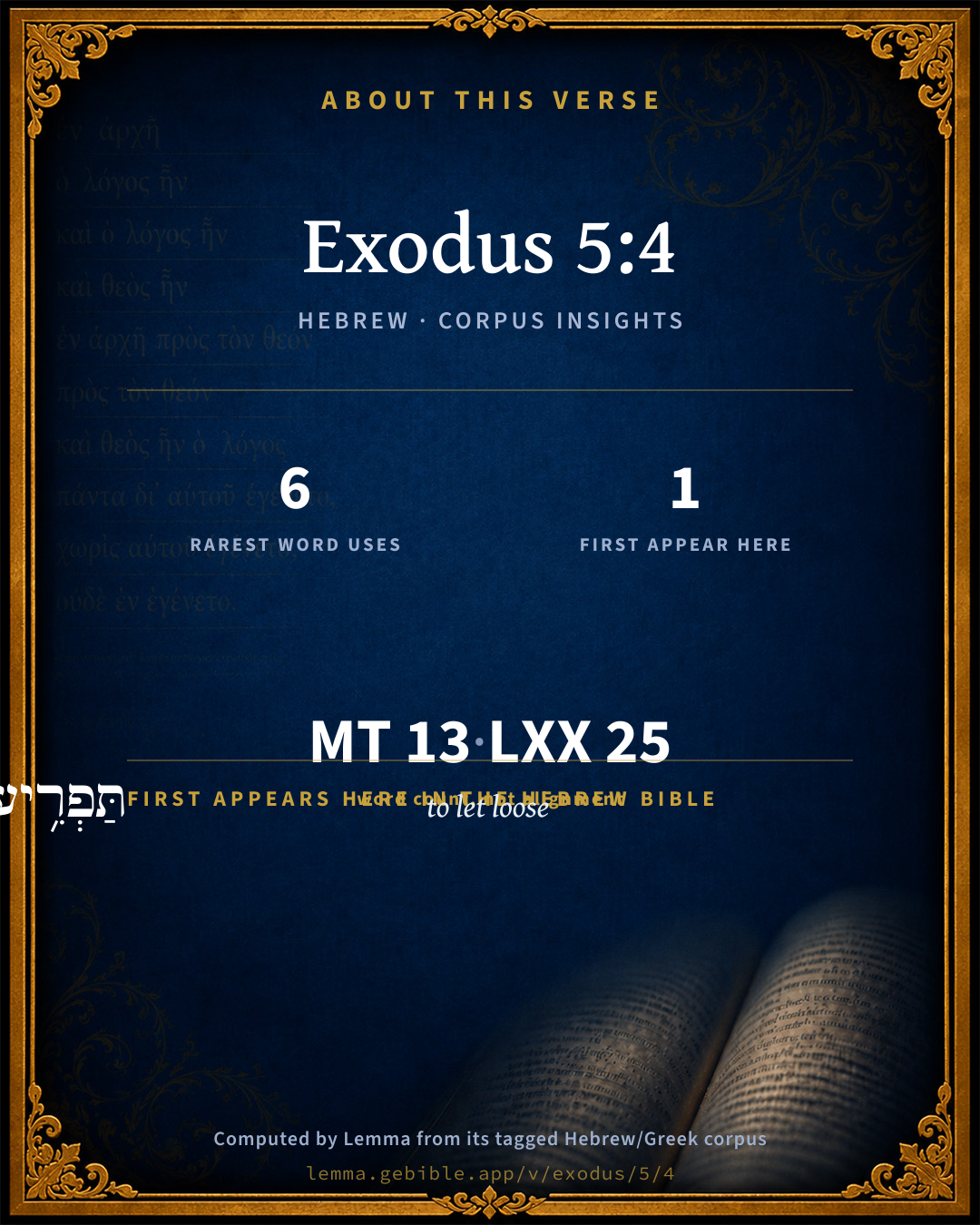
  • 1 first appearance in the Hebrew Bible
Full analysis ↓
Download a study sheet

One document with this verse’s original text, its word-by-word gloss line, the meaning frame, cross-references with their text, attributed commentary, and full source and license credits — printable, and it pastes into notes with its structure intact.

This verse Autodidact and up

Study sheet (.html) Plain text (.txt)

A passage Seminary Student

Up to 50 verses in one chapter. A passage sheet keeps up to 6 commentary sources and 12 cross-references per verse, in the order this page ranks them, and says so on the sheet whenever that leaves anything out. Ask for a single verse and you get the Autodidact verse sheet above.

Everything on this page stays free to read, with no account — the sheet is a download of what is already on screen, not access to it.

Want to remove ads? Support Godless Engineer
Compare translations 3

The same verse in 3 English versions, stacked beneath the original-language interlinear above. Click any original word for its lexicon entry.

Each is an independent rendering of the whole verse — the interlinear is not word-aligned to these translations.

Highlighted words mark where these versions differ — a whole-verse word diff, not a word-by-word alignment.

  • World English Bible Public Domain
    The king of Egypt said to them, "Why do you, Moses and Aaron, take the people from their work? Get back to your burdens!"
  • King James Version Public Domain
    And the king of Egypt said unto them, Wherefore do ye, Moses and Aaron, let the people from their works? get you unto your burdens.
  • unfoldingWord Literal Text CC BY-SA 4.0
    And the king of Egypt said to them, “Moses and Aaron, why are you causing the people to leave off from their tasks? Go to your burdens.”

unfoldingWord Literal Text — © unfoldingWord, licensed CC BY-SA 4.0. Word-aligned USFM3 via Door43 (git.door43.org/unfoldingWord/en_ult).

Versions to compare (up to 4)

3 of 4 selected

Show all 18 translations

Every available English version of this verse, each an independent rendering of the whole verse.

  • World English Bible Public Domain
    The king of Egypt said to them, "Why do you, Moses and Aaron, take the people from their work? Get back to your burdens!"
  • Berean Standard Bible Public Domain
    But the king of Egypt said to them, “Moses and Aaron, why do you draw the people away from their work? Get back to your labor!”
  • Majority Standard Bible Public Domain
    But the king of Egypt said to them, “Moses and Aaron, why do you draw the people away from their work? Get back to your labor!”
  • King James Version Public Domain
    And the king of Egypt said unto them, Wherefore do ye, Moses and Aaron, let the people from their works? get you unto your burdens.
  • American Standard Version (1901) Public Domain
    And the king of Egypt said unto them, Wherefore do ye, Moses and Aaron, loose the people from their works? get you unto your burdens.
  • Revised Version (1885) Public Domain
    And the king of Egypt said unto them, Wherefore do ye, Moses and Aaron, loose the people from their works? get you unto your burdens.
  • Geneva Bible (1599) Public Domain
    Then saide the King of Egypt vnto them, Moses and Aaron, why cause ye the people to cease from their workes? get you to your burdens.
  • Douay-Rheims (1899) Public Domain
    The king of Egypt said to them: Why do you Moses and Aaron draw off the people from their works? Get you gone to your burdens.
  • Young's Literal Translation Public Domain
    And the king of Egypt saith unto them, `Why, Moses and Aaron, do ye free the people from its works? go to your burdens.'
  • Literal Standard Version CC BY-SA 4.0
    And the king of Egypt says to them, “Why, Moses and Aaron, do you free the people from its works? Go to your burdens.”
  • Unlocked Literal Bible CC BY-SA 4.0
    But the king of Egypt said to them, “Moses and Aaron, why are you taking the people from their work? Go back to your work.”
  • unfoldingWord Literal Text CC BY-SA 4.0
    And the king of Egypt said to them, “Moses and Aaron, why are you causing the people to leave off from their tasks? Go to your burdens.”
  • Darby Bible Public Domain
    And the king of Egypt said to them, Why do ye, Moses and Aaron, wish to have the people go off from their works? Away, to your burdens!
  • World Messianic Bible Public Domain
    The king of Egypt said to them, “Why do you, Moses and Aaron, take the people from their work? Get back to your burdens!”
  • Webster's Bible Public Domain
    And the king of Egypt said to them, Why do ye, Moses and Aaron, hinder the people from their works; go you to your burdens.
  • Free Bible Version CC BY-SA 4.0
    “Moses and Aaron, why are you trying to take people away from their assigned labor?” Pharaoh asked. “Get back to work!” he ordered.
  • Bible in Basic English Public Domain
    And the king of Egypt said to them, Why do you, Moses and Aaron, take the people away from their work? get back to your work.
  • JPS Tanakh (1917) Public Domain
    And the king of Egypt said unto them: 'Wherefore do ye, Moses and Aaron, cause the people to break loose from their work? get you unto your burdens.'

Literal Standard Version (2020), Covenant Press — licensed CC BY-SA 4.0. Text via the HelloAO Bible API (eBible.org). Unlocked Literal Bible (unfoldingWord) — licensed CC BY-SA 4.0. Text via the HelloAO Bible API (eBible.org). unfoldingWord Literal Text — © unfoldingWord, licensed CC BY-SA 4.0. Word-aligned USFM3 via Door43 (git.door43.org/unfoldingWord/en_ult). Free Bible Version, Dr. Jonathan Gallagher — licensed CC BY-SA 4.0. Text via the HelloAO Bible API (eBible.org).

Word by word

More ways to search: Search by grammar → Find every occurrence → Compare this word →

Practice this passage: Drill this verse → Learn its vocabulary →

לְסִבְלֹתֵיכֶֽם
çᵉbâlâh
H5450
“to/for · burdens · your”
Preposition + Noun, Common, Feminine, Plural, Construct + Suffix, Personal, 2nd Person, Masculine, Plural
Part of Speech
Preposition + Noun
Type
Common
Gender
Feminine
Number
Plural
State
Construct
Full BDB Definition

Origin: from H5447

TWOT: 1458c

burden, forced labour, compulsory service, burden bearing
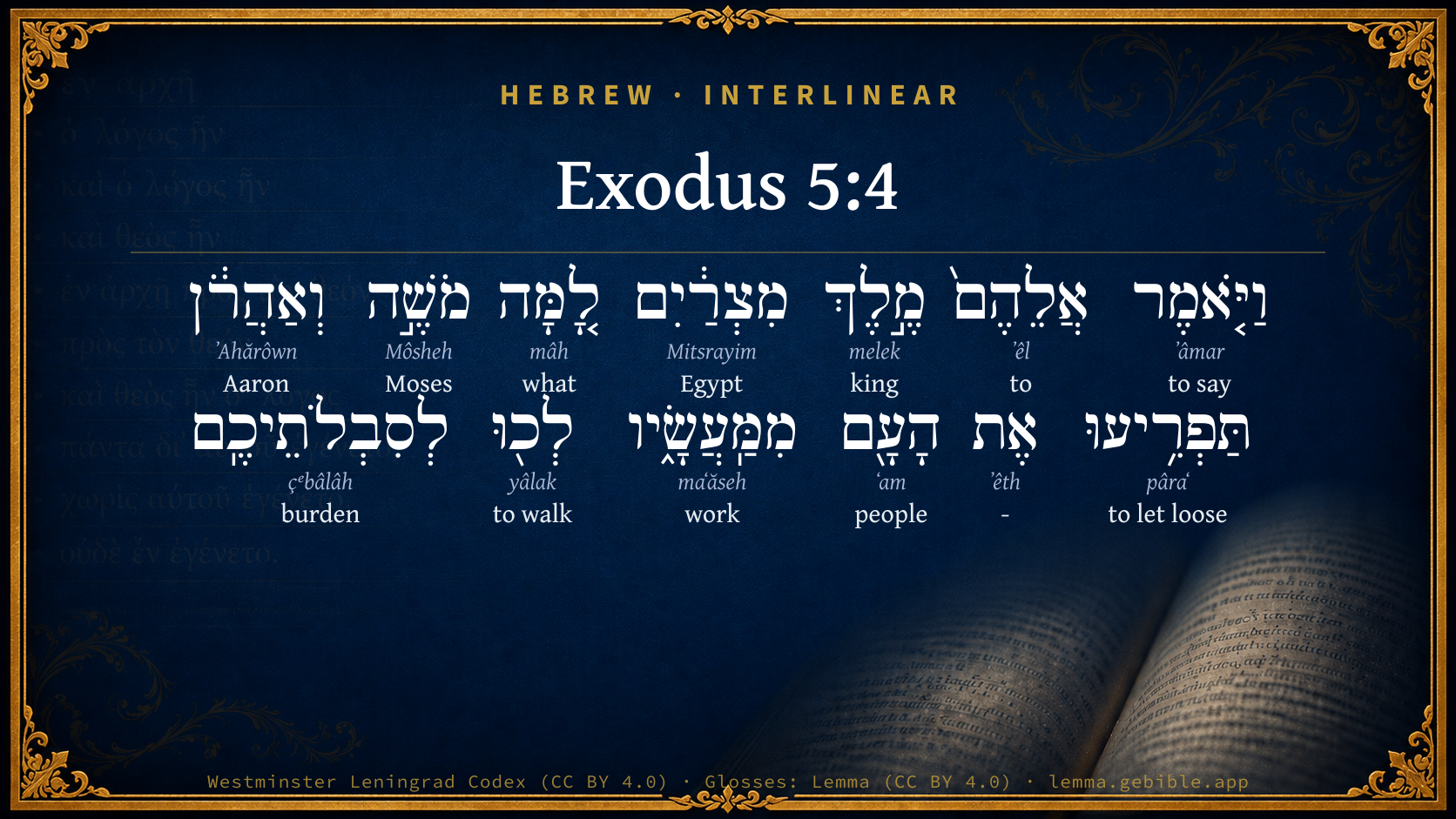
  1. וַיֹּ֤אמֶר ʼâmar H559 “and · to say” Conjunction + Verb, Qal, Sequential Imperfect, 3rd Person, Masculine, Singular
  2. אֲלֵהֶם֙ ʼêl H413 “to · them” Preposition + Suffix, Personal, 3rd Person, Masculine, Plural
  3. מֶ֣לֶךְ melek H4428 “king of” Noun, Common, Masculine, Singular, Construct
  4. מִצְרַ֔יִם Mitsrayim H4714 “Egypt” Noun, Proper
  5. לָ֚מָּה mâh H4100 “to/for · what” Preposition + Particle, Interrogative
  6. מֹשֶׁ֣ה Môsheh H4872 “Moses” Noun, Proper
  7. וְאַהֲרֹ֔ן ʼAhărôwn H175 “and · Aaron” Conjunction + Noun, Proper
  8. תַּפְרִ֥יעוּ pâraʻ H6544 “to let loose” Verb, Hiphil, Imperfect, 2nd Person, Masculine, Plural
  9. אֶת ʼêth H853 “-” Particle, Direct Object
  10. הָעָ֖ם ʻam H5971 “the · people” Particle, Definite Article + Noun, Common, Masculine, Singular, Absolute
  11. מִמַּֽעֲשָׂ֑יו maʻăseh H4639 “from · works · his” Preposition + Noun, Common, Masculine, Plural, Construct + Suffix, Personal, 3rd Person, Masculine, Singular
  12. לְכ֖וּ yâlak H3212 “walk” Verb, Qal, Imperative, 2nd Person, Masculine, Plural

About this verse

These counts appear in no published source. They are computed here, from the morphology-tagged text and Lemma’s own curated glosses. What Lemma adds →

13
words
13
distinct lemmas
Pentateuch
section

Notable vocabulary

The rarest word here is לְסִבְלֹתֵיכֶֽם burden H5450 — appearing just 6 times in the whole Hebrew Bible.

First appearance in Scripture

This word makes its first canonical appearance in the Hebrew Bible here:

  • תַּפְרִ֥יעוּ to let loose H6544

Shared distinctive vocabulary

לְסִבְלֹתֵיכֶֽם burden H5450 occurs in 6 verses of the Hebrew Bible. Also found in:

Grammatical profile

  • 3 verbs
  • 7 nouns
  • 1 preposition
  • 2 particles

Verb forms

  • וַיֹּ֤אמֶר Qal · Sequential Imperfect
  • תַּפְרִ֥יעוּ Hiphil · Imperfect
  • לְכ֖וּ Qal · Imperative

Hebrew & Septuagint length

In English translation the verse runs 24 words from the Hebrew and 27 from the Septuagint (LXX English) — closely comparable.

A rough comparison of the two English renderings, which tokenize alike — not a word-level alignment.

Word counts can differ between the Hebrew and the Greek without any difference in meaning — e.g. the Hebrew direct-object marker אֵת has no separate Greek word, and Greek often adds the article ὁ.

In the original languages it is 13 Hebrew tokens and 25 Greek tokens — but the two are counted differently (Hebrew bundles its prefixes and suffixes into one token; the Greek is in lemma form), so that isn’t a like-for-like length.

Cross-references

6

Topical passages linked to Exodus 5:4 in the Treasury of Scripture Knowledge — connected by theme and wording, ordered by reader-vote popularity; previews shown in the World English Bible.

  • Exodus 1:11 Therefore they set taskmasters over them to afflict them with their burdens. They built storage cities for Pharaoh: Pithom and Raamses.
  • Amos 7:10 Then Amaziah the priest of Beth El sent to Jeroboam king of Israel, saying, "Amos has conspired against you in the midst of the house of Israel. The land is not able to bear all his words.
  • Luke 23:2 They began to accuse him, saying, "We found this man perverting the nation, forbidding paying taxes to Caesar, and saying that he himself is Christ, a king."
  • Acts 24:5 For we have found this man to be a plague, an instigator of insurrections among all the Jews throughout the world, and a ringleader of the sect of the Nazarenes.
  • Jeremiah 38:4 Then the princes said to the king, Let this man, we pray you, be put to death; because he weakens the hands of the men of war who remain in this city, and the hands of all the people, in speaking such words to them: for this man doesn't seek the welfare of this people, but the hurt.
  • Acts 16:20–21 When they had brought them to the magistrates, they said, "These men, being Jews, are agitating our city,

Cross-references courtesy of OpenBible.info (CC BY 4.0).

Hebrew and Greek witnesses Masoretic Hebrew ↔ Greek Septuagint

The same verse in the two great witnesses to the Old Testament, shown verse-for-verse.

These are two independent witnesses, not word-aligned to each other, and the Septuagint is shown in lemma (dictionary) form.

Hebrew Exodus 5:4 Masoretic · Westminster Leningrad Codex

וַיֹּ֤אמֶר אֲלֵהֶם֙ מֶ֣לֶךְ מִצְרַ֔יִם לָ֚מָּה מֹשֶׁ֣ה וְאַהֲרֹ֔ן תַּפְרִ֥יעוּ אֶת הָעָ֖ם מִמַּֽעֲשָׂ֑יו לְכ֖וּ לְסִבְלֹתֵיכֶֽם

The king of Egypt said to them, "Why do you, Moses and Aaron, take the people from their work? Get back to your burdens!"

World English Bible · Public Domain

Greek LXX Exodus 5:4 Septuagint · lemma form

καί εἶπον αὐτός ὁ βασιλεύς αἴγυπτος ἵνα τίς μωυσῆς καί ααρων διαστρέφω ὁ λαός ἐγώ ἀπό ὁ ἔργον ἀποἔρχομαι ἕκαστος σύ πρός ὁ ἔργον αὐτός

And the king of Egypt said to them, Why do you⌃, Moses and Aaron, turn the people from their works? depart each of you to your works.

LXX2012 (modern English Septuagint) · Public Domain

Hebrew: Westminster Leningrad Codex (CC BY 4.0). Greek: Septuagint (public domain); English from LXX2012 (modern English Septuagint) (Public Domain). How the Septuagint differs from the Hebrew →

Targum (Aramaic paraphrase)

2

The Targum is the ancient Jewish Aramaic paraphrase of the Hebrew Scriptures — an interpretive translation, not the Hebrew text itself. Onkelos (literal) and Pseudo-Jonathan (expansive) render the Torah, and Jonathan the Prophets. Coverage is partial: where no permissively-licensed English translation exists for a verse, only the Aramaic is shown. This is verse-level text, not a word-by-word alignment to the Hebrew.

  1. Targum Onkelos Torah (Genesis–Deuteronomy)
    וַאֲמַר לְהוֹן מַלְכָּא דְמִצְרַיִם לְמָא משֶׁה וְאַהֲרֹן תְּבַטְלוּן יָת עַמָא מֵעוֹבָדֵהוֹן אֱזִילוּ לְפָלְחָנְכוֹן:

    (no public-domain English translation for this verse)

    Targum Onkelos — Aramaic: “Onkelos Genesis” (public domain); “Onkelos Exodus” (public domain); “Onkelos Leviticus” (public domain); “Onkelos Numbers” (public domain); “Onkelos Deuteronomy” (public domain). English: “Sefaria Community Translation” (CC0 1.0 (public-domain dedication)); “J.W. Etheridge. The Targums of Onkelos and Jonathan Ben Uzziel on the Pentateuch. London: Longmans, Green, 1862” (public domain). Text via Sefaria.

  2. Targum Pseudo-Jonathan Torah (Genesis–Deuteronomy)
    וַאֲמַר לְהוֹן מַלְכָּא דְמִצְרַיִם לְמָא משֶׁה וְאַהֲרן תְּבַטְלוּן יַת עַמָא מֵעֲבִידְתְּהוֹן אִיזִילוּ לְפוּלְחַנְכוֹן

    And the king of Mizraim said to Mosheh and Aharon, Why do you make the people cease from their labours? Go to your work.

    Targum Pseudo-Jonathan — Aramaic: “Targum Jonathan on Genesis” (public domain); “Targum Jonathan on Exodus” (public domain); “Targum Jonathan on Leviticus” (public domain); “Targum Jonathan on Numbers” (public domain); “Targum Jonathan on Deuteronomy” (public domain). English: “The Targum of Jonathan ben Uzziel, trans. J. W. Etheridge, London, 1862” (public domain). Text via Sefaria.

Commentary

Notes on Exodus 5:4 from classic Christian and Jewish commentators (each source and its license shown beneath its notes). The classic Christian expositions comment on the surrounding passage and are grouped to its opening verse, so a note may address several verses; the Jewish commentaries on the Tanakh (Rashi and others) are per-verse, so they appear only where the commentator wrote on this verse.

Lemma curates 59 commentaries, every one of them public domain or Creative Commons licensed, each selected and text-cleaned for this edition rather than reprinted as found. About our sources →

Trapp's Complete Commentary

John Trapp

Exo 5:4 And the king of Egypt said unto them, Wherefore do ye, Moses and Aaron, let the people from their works? get you unto your burdens.

Ver 4. Let the people from their works.] Moses talks of sacrifice; Pharaoh of work. Anything seems due work to a carnal mind, saving God’s service; nothing superfluous but religious duties. {a} Seneca saith the Jews cast away a seventh part of their time upon a weekly Sabbath. "To what end is this loss?" said Judas.

{a} Aug., De Civit. Dei.

John Trapp, A Commentary or Exposition upon All the Books of the Old and New Testament (1647–1656) — public domain. Text from a community e-Sword module.

The Biblical Illustrator

Joseph S. Exell

Exo_5:4

Get you unto your burdens.

Wrong judgment

Good men are often wrongly judged:--

1. In respect to their motives.

2. Actions.

3. Writings. (J. S. Exell, M. A.)

The claims of religion

You will observe that God gave a command, and Pharaoh refused either to obey the command, or to pay anything like respect unto it,

I. Let us consider what it is that God requires. In the case of Israel we see that He requires what I may sum up in three particulars.

1. He requires that they should acknowledge Him publicly as their God; that is the first principle. Let My people go, that they may hold, etc.

2. He requires of Israel that there should be a marked acceptance of His way of reconciliation. Let us go and sacrifice unto the Lord our God. From the very first when man sinned, there was Gods revealed way by which the sinner must come near to Him; and, therefore, the feast that was to be held unto Jehovah, was a feast that was to be founded upon sacrifice.

3. God requires that everything else should give way and yield to the discharge of these required duties. They were to go at once to Pharaoh, and ask his permission to go and obey Gods commands, and to sacrifice unto Him as their Lord. They were not to be withheld from doing this by their knowledge of Pharaohs tyrannical disposition. They were not to be withheld by the remembrance of their worldly duties, or of the hardships and the toils connected with these duties. Now is there anything peculiar to Israel and to Gods requirements of Israel in all this? Do we not see, underlying this narrative, a principle which is universally applicable to all those to whom Gods message comes? What doth the Lord require of us, to whom the word of this salvation is sent? Does He not demand of us acknowledgment, acceptance of His salvation, and immediate decision?

II. But now what does man think of the requirements of God? Let us answer this question by referring to the case of Pharaoh. Pharaoh said, Ye be idle; therefore ye say, let us go and do sacrifice to the Lord. Therefore now go and work. And then again, Who is the Lord, that I should obey His voice to let Israel go? I know not the Lord, neither will I let Israel go. And again, Let more work be laid upon the men, that they may labour therein, and let them not regard vain words. What is the meaning of this language? May I not render it truly, but simply, when I say that in Pharaohs mind there was an opinion that there was no need of so much religion? Let them go and work; there was no need of going to sacrifice to the Lord their God. And then when he heard Gods threatenings to those who neglected His commands, how did Pharaoh feel then? He maintains that there is no danger in neglecting the supposed commands of God in this matter. He thinks them vain words, all about Gods threatenings to those who do not acknowledge Him, and who do not accept His terms of reconciliation. All these are vain words, pay no attention to them, go and work. That was Pharaohs way of thinking. And then, further, he thought that there was no sincerity in those who professed to want to worship God. Ye are idle; therefore ye cry, Let us go and sacrifice. You do not mean to go and sacrifice; you do not want to go and sacrifice; it is your idleness, your hypocrisy. So that you will observe Pharaoh thought thus of Gods requirements; first, that there was no need of them; secondly, that there was no danger in neglecting them; and thirdly, that those who professed did not intend to worship, they did not mean what they said. Now is Pharaoh at all singular in the ideas which are thus attributed to him? Is it not still the case that an unconverted man acts in the same way as Pharaoh acted? And then when Pharaoh is reminded of the awful language in which God speaks to those who neglect His requirements, and His judgments against those who know not the Lord, and who obey not the gospel of the Lord Jesus Christ, what does Pharaoh, and what do unconverted men now say, but that in their opinion all these are vain words? Pharaoh thought they were vain words; and so do men now. (W. Cadman, M. A.)

Egyptian bondage in the metropolis

I. Now, dark as this picture is, I do not hesitate to say that it is faithfully reproduced at the present time. You may see the same thing any day in this metropolis. The bondsmen, whose lives are now made bitter with hard bondage, are the artizans who make the garments you now have on; the men, the women, the children, who minister to your fashions and your luxuries; the shopmen and shopwomen who wait on your convenience, the industrial classes in general, by whose toil this country is rich and luxurious, who are forced to spend the marrow of their strength, and make their lives short and bitter, in providing superfluities for others. The Pharaoh at whose bidding all this is done is the spirit of commerce, that lust of filthy lucre, that morbid and unbridled zeal of competition, which reigns supreme over so large a portion of the world of business.

II. Let us therefore inquire whether any remedy can be applied to these great and sore evils? Can we individually or collectively do anything towards delivering our brethren from these oppressions and wrongs? Now, it appears to me that there is but one perfect and thorough remedy, and that is the dethronement of the Pharaoh who tyrannizes so cruelly over his subjects; I mean the overthrow of that vicious commercial spirit which has enslaved the great mass of the public. If this were done, if every one traded in a fair and legitimate manner, if every one dealt by others as he would wish to be dealt by himself, if no one entered into the arena of dishonest and ruinous competition, if every employer were as determined to give fair wages to his workpeople, as to secure a fair profit to himself; if these principles were universal, then oppressions would cease in our midst, and our courts and alleys would be the abodes of happiness. But this is not to be yet. The evil and the good will be mingled together until the harvest, which is the end of the world. We can only hope at present for improvements and palliatives. Now--

1. With respect to shopkeepers, much evil might be remedied if all the members of each several trade would meet together and bind themselves by a mutual covenant not to keep their shops open beyond a certain reasonable hour.

2. To shop-assistants and operatives, I would suggest that the members of each trade or establishment might with great ]propriety express their opinions on the subject in a manly and temperate spirit to their employers.

3. And now to the large class of persons who are ordinary purchasers--the public in general--I would say, it is in supplying your wants or conveniences, that all this competition, and oppression, and cruelty is engendered. Much good might be effected by a determination on the part of purchasers never to buy after a certain reasonable hour.

III. The restricting of the hours of labour. Within just and reasonable limits would be the cause of immense benefit not only to the labouring man, but to all classes. I believe that the employers would be gainers even in a money point of view by the improvements now advocated. The men would work with more spirit and energy, because they would feel that they were men, because they would be in a much higher physical condition than when they were overtasked; they would labour with more cheerfulness and good will; the work would be done more skilfully, because with more sustained attention. There would be less drunkenness amongst the men, because in the intervals of labour they would feel less exhausted and have less craving for stimulus. Then, again, the public would be gainers. They would be better served; articles of commerce would not be cheaper possibly, but they would be better in quality, and therefore really cheaper in the end. Moreover, the country would be a gainer, by having a strong, energetic, and numerous race of labouring men, in the stead of thy present pale, jaded, and dyspeptic race. Lastly, the Church of Christ would gain many members. There is scarcely any greater hindrance to the progress of religion amongst our industrial classes than this Egyptian system of overtasking the strength. How can that man give due attention to his religious duties on Sunday who is exhausted and prostrate by a week of excessive toil? (J. Tagg, M. A.)

Folly of unwise exaction

The llama, or guanaco (Auchenia llama), is found among the recesses of the Andes. In the silver mines his utility is very great, as he frequently carries the metal from the mines in places where the declivities are so steep that neither asses nor mules can keep their footing. The burden carried by this useful animal, the camel of the New World, should not exceed from one hundred to one hundred and twenty-five pounds. If the load be too heavy he lies down, and no force or persuasion will induce him to resume his journey until the excess be removed. Thus he teaches us the uuwisdom of endeavouring to exact too much from those who are willing to serve us well. (Scientific Illustrations.)

Pharaohs complaint

That complaint has been made by a good many interested employers since the days of Pharaoh. How these evangelists do hinder trade! What a clog on business this revival is! How much money these missionary causes do divert from the shopkeepers! This Sunday-go-to-meeting notion takes the profits off of the menagerie; or of the agricultural fair! These thanksgivings and fast-days interfere wretchedly with steady work! Why cant things go on regular, week in and week out, without any bother about religion? This is the way the Pharaoh class looks at attention to Gods service. But is it the right way? (S. S. Times.)

The Biblical Illustrator, edited by Joseph S. Exell (c. 1880s–1900s) — public domain. Text from a community e-Sword module.

Joseph Benson's Commentary

Exo 5:4. Get you to your burdens — These words were not addressed to Moses and Aaron, but to the Israelites, the elders of whom went with Moses, several others also probably following him, when he went in unto Pharaoh, impatient to see what the end would be.

Joseph Benson's Commentary on the Old and New Testaments (1811–1818) — public domain. Text from a community e-Sword module.

Tyndale Open Study Notes

Tyndale Open Resources

5:4-5 Evidently the people were anticipating their promised freedom and had stopped their work.

Tyndale Open Study Notes — © Tyndale Open Resources, licensed CC BY-SA 4.0. Text via the HelloAO Bible API.

Jamieson, Fausset & Brown

Robert Jamieson, A. R. Fausset & David Brown

Wherefore do ye, Moses and Aaron, let the people from their works? &c.--Without taking any notice of what they had said, he treated them as ambitious demagogues, who were appealing to the superstitious feelings of the people, to stir up sedition and diffuse a spirit of discontent, which spreading through so vast a body of slaves, might endanger the peace of the country.

Jamieson, Fausset & Brown — Commentary Critical and Explanatory on the Whole Bible (1871) — public domain (CC PDM 1.0). Text via the HelloAO Bible API.

Adam Clarke's Commentary

Verse 4. Wherefore do ye, Moses and Aaron] He hints that the Hebrews are in a state of revolt, and charges Moses and Aaron as being ringleaders of the sedition. This unprincipled charge has been, in nearly similar circumstances, often repeated since. Men who have laboured to bring the mass of the common people from ignorance, irreligion, and general profligacy of manners, to an acquaintance with themselves and God, and to a proper knowledge of their duty to him and to each other, have been often branded as being disaffected to the state, and as movers of sedition among the people! See Clarke on Ex 5:17.

Let the people] תפריעו taphriu, from פרע para, to loose or disengage, which we translate to let, from the Anglo-Saxon [Anglo-Saxon] lettan, to hinder. Ye hinder the people from working. Get ye to your burdens. "Let religion alone, and mind your work." The language not only of tyranny, but of the basest irreligion also.

Adam Clarke's Commentary on the Bible (1810–1826) — public domain. Text from a community e-Sword/MySword module.

The Cambridge Bible for Schools and Colleges

gen. ed. J. J. S. Perowne

4. The Pharaoh regards the pilgrimage as merely an excuse for a holiday; and bids Moses and Aaron no longer unsettle the people.

burdens] Exo_1:11, Exo_2:11.

The Cambridge Bible for Schools and Colleges (gen. ed. J. J. S. Perowne; Cambridge University Press, 1878–1918) — public domain. Text from a community e-Sword module.

John Gill's Exposition

And the king of Egypt said to them,.... For he was not struck dumb, as Artapanus (g), afore cited writer, says:

wherefore do ye, Moses and Aaron, let the people from their works? as they did when they gathered them together, and wrought signs before them; which Pharaoh it seems had heard of, and had got their names very readily:

get you unto your burdens; meaning not Moses and Aaron, ordering them to go about their private and family business, but the people they represented, and on whose account they came; and it is highly probable the elders of the people, at least some of them, were with them, to whom these words might be more particularly directed. See Exo 3:18.

(g) Ut supra. (Apud Euseb. Praepar. Evangel. l. 9. c. 27. p. 434.)

John Gill's Exposition of the Whole Bible (1746–1763) — public domain (CC PDM 1.0). Text via the HelloAO Bible API.

Albert Barnes' Notes on the Bible

Let - i. e. hinder.

Albert Barnes' Notes on the Bible (1834–1885) — public domain. Text from a community e-Sword/MySword module.

Haydock's Catholic Bible Commentary

Get you. He knew not that Moses had been so long absent; and if he had known, he would not probably have treated him more mildly. (Haydock)

George Leo Haydock (1774–1849), Haydock's Catholic Family Bible and Commentary, 1859 edition — public domain. Excludes Psalms (Douay-Rheims chapter numbering differs from Protestant) and Deuterocanonical books (Catholic canon only).

Matthew Poole's English Annotations

Either,

1. Ye, the elders of Israel, who are here come with Moses and Aaron: see Exo 5:1. Or,

2. Ye, Moses and Aaron. So far am I from granting the liberty which you desire for the people, that as a just punishment upon you for your seditious attempt, I command you also to go with the rest, and to take your share in their burdens, and to perform the task which shall be required of you. And that so cruel a tyrant did not proceed further against them, must be ascribed to the mighty power of God, who governs the spirits and restrains the hands of the greatest kings when he pleaseth.

Matthew Poole's English Annotations on the Holy Bible (1683–1685) — public domain. Text from a community e-Sword/MySword module.

Whedon's Commentary on the Bible

Daniel D. Whedon

4. Wherefore do ye — Rather, Wherefore make ye the people cease from their work, by this conference with them and agitation? Then to the elders of Israel, who stood with Moses and Aaron, he says, Get you unto your burdens.

Daniel D. Whedon (gen. ed.), Commentary on the Old and New Testaments (1874–1909) — public domain. Text from a community e-Sword module.

The Pulpit Commentary

The king makes no direct reply to this appeal, but turns upon his petitioners, and charges them with an offence against the crown. Why do they, Moses and Aaron, by summoning the people to meet together, and exciting their minds with vague hopes, let the people from their works." This is damage to the crown, whoso labourers the people are, and he, the Pharaoh, will not have it. Get you all of you, people and leaders together to your appointed tasksyour burdens .

HOMILIES BY J. ORR Vers. 4-10. Increased cruelty.

View Pharaoh"s conduct as illustrative

I OF THE VIEW WHICH A WORLDLY MAN TAXES OF RELIGION. "Ye are idle" (ver. 8). This way of putting the matter was partly a pretext a tyrant"s excuse for adding to burdens already sufficiently heavy; but ithad so far a ground in Pharaoh"s real way of viewing things, that he doubtless regarded the desire to go and sacrifice as an idle, foolish notion, one which would not have come into the people"s heads had they been worked hard enough, and which it was his interest to drive out again as soon as possible. Observe in this

1. A total incapacity to understand the origin of religious aspirations. Pharaoh had no better account to give of them than that they sprang from idleness. They were the fruit of a roving, unsettled disposition. The cure for them was harder work. This is precisely how the world looks on religion. It is the unpractical dream of people whose working faculties are not in sufficiently vigorous exercise. Of a true thirsting of the soul for God the world has not the slightest comprehension.

2. A total want of sympathy with these aspirations. Indulgence in them would be idling a foolish and profitless waste of time. It is not idling to watch the markets, to speculate on stock, to read novels, to attend the Derby, to run to theatres, to spend evenings in the ball-room, to hunt, fish, shoot, or travel on the Continent, to waste hours in society gossip; but it would be idling to pray, or worship God, or engage in Christian work, or attend to the interests of the soul. To snatch an hour from business to attend a prayer-meeting would be reckoned egregious folly, and as little are the hours at one"s disposal when business is over to be spent in such "foolishness." Even the Sabbath, so far as it cannot be utilised for pleasure, is deemed a day "wasted a weariness. (Amo_8:6; Mal_2:13)

3. A total disregard of the rights of others in connection with theseaspirations. Thoroughgoing men of the world neither take pains to conceal their own contempt for religion ("vain words," ver. 9), nor trouble themselves with any scruples as to the rights of others. They will, without hesitation, take from the religiously-disposed their opportunities of serving God, if these stand in the way of their own interests. Gladly, had they the power, would they turn the Sabbath into a work-day for the many that it might become (as on the Continent) a play-day for the few. Their own domestics and workpeople are over-driven, and unscrupulously deprived of Sabbath and sanctuary privileges. Where even the plea of humanity is disregarded, the plea of religion is not likely to be allowed much weight.

II OF THE ALARMS FELT BY A TYRANT AT THE UPRISING OF FREE ASPIRATIONS IN THE SUBJECTS OF HIS TYRANNY. Pharaoh shrewdly foresaw the consequences of a further spread of these new-fangled ideas among the people. The request to go and sacrifice would not be long in being followed by a demand for freedom. Despotism and the spirit of liberty cannot coalesce. The tyrant knows that his power is put in peril the moment people begin to think for themselves to cherish dreams of freedom to be moved by religious enthusiasms. His rule can only be maintained at the cost of the extinction in his subjects of the last vestige of mental and spiritual independence. If a spiritual movement like this which sprang up in Israel begins to show itself, it must be stamped out at once, and at whatever cost of suffering and bloodshed. Whatever tends to produce such movements is looked on with hostility. This applies to all kinds of despotisms civil, ecclesiastical, industrial, social. Hence, under despotic governments, the gagging of the press, suppression of free institutions, restriction of liberty of speech, ostracism of men of public spirit, and opposition to progress and to liberal ideas generally. Hence the antagonism of the Roman Church to learning and science, with the baleful effects which have followed from that antagonism in countries where her influence is supreme (see Laveleye on "Protestantism and Catholicism in their Bearings upon the Liberty and Prosperity of Nations"; and histories of the Reformation in Spain and Italy). "It has been wittily said, that in Madrid, provided you avoid saying anything concerning government, or religion, or politics, or morals, or statesmen, or bodies of reputation, or the opera, or any other public amusement, or any one who is engaged in any business, you may print what you please, under correction of two or three censors" (McCrie). Hence the antipathy of the slave-drivers of industry those who grind the faces of the poor, making their profit out of their poverty and helplessness to the diffusion of intelligence among the masses. Hence, in slave-holding countries, the laws against teaching slaves to read, etc. The-slave-holder cannot afford to encourage the spread of intelligence, of anything which will enable his slave to realise his manhood. But tyranny of this kind is self-condemned.

1. As unnatural. It requires the extinction and suppression of everything noble and good in human nature. It sets itself in opposition to intelligence, freedom, progress, religion, and all holy and spiritual aspirations.

2. As inhuman. In consolidating its dominion, it stoops to perpetrate the grossest cruelties. Think of the work of the Inquisition! Think of the blood that has been shed on the shrine of civil liberty! Think of the George Harrises of slavery! "What business had his slave to be marching round the country, inventing machines, and holding up his head among gentlemen? He"d soon put a stop to it. He"d take him back, and put him to hoeing and digging, and see if he"d step about so smart?" ("Uncle Tom"s Cabin.") See also,

3. Its weakness. Tyranny of this kind cannot endure. Under the influence of ideas from without, a mental and moral awakening is certain to come some day, and the tyrant"s power is doomed.

III OF THE PITILESS CRUELTY OF WHICH MEN GET TO BE CAPABLE IN THE PURSUIT OF INIQUITOUS ENDS: vers. 6-9. Pharaoh was determined to keep the Hebrews in slavery; and so, to suppress this new spirit of discontent which had broken out among them, he must heat their furnace sevenfold, and heap cruelty on cruelty. He may have urged the plea of state necessity, and justified himself by the reflection that less severe measures would not have served his purpose that he was driven to cruelty by the logic of events. A vain plea in any case, and one which only a heart rendered callous by a long course of inhumanity could have brought itself to entertain. Yet Pharaoh was thus far right, that, once a career of iniquity has been entered upon, events take the matter out of the sinner"s hands, and leave him no alternative but either to abandon his evil courses, or be driven on from one cruelty to a worse. And, contemporaneously with the movement of events, there is going on a hardening of the heart, which makes the cruelty possible. It is wonderful what pitiless deeds men get to be capable of, who have others in their power, and who acknowledge no higher law than their own interests. We have only to recall the iniquities of the slave-trade, connived at by many of our most respectable merchants; the inhumanities attendant on the employment of women and young children in mines and factories, as brought to light by Parliamentary Commissions; the former semi-brutal condition of agricultural labourers; the underpaying of needle-women; the horrors of the "sweating system;" the instances of cruelty and rapacity exhibited in the emigration trade, which are described as "among the most atrocious that have ever disgraced human nature" (Chambers"s "Encyc."); the reckless disregard of the lives of sailors in their being sent to sea in heavily laden and untrustworthy ships (Plimsoll) to see how far, even in a civilised country, the thirst of gain will carry men, under circumstances where they can count upon impunity, and evade the censure of public opinion. A Pharaoh could hardly do worse. "Small manufacturers, working with insufficient capital, and in times of depression not having the wherewith to meet their engagements, are often obliged to become dependants on the wholesale houses with which they deal; and are then cruelly taken advantage of He (the manufacturer) is obliged to work at the wholesaler"s terms, and ruin almost certainly follows As was said to us by one of the larger silk-hosiers, who had watched the destruction of many of his smaller brethren may be spared for a while as a cat spares a mouse; but they are sure to be eaten up in the end "We read that in Hindostan, the ryots, when crops fall short, borrow from the Jews to buy seed, and once in their clutches are doomed. It seems that our commercial world can furnish parallels" (H. Spencer).

Learn:

1. To avoid the beginning of a course of injustice.

2. To guard against the hardening of the heart by cruelty.

3. To have an open ear to the cry of the oppressed, and a readiness tosupport every righteous measure for their protection and relief.

4. See in Pharaoh"s tyranny an image of the pitiless tyranny of Satan. He,too, is absolutely merciless in the power he obtains over us. His service is one which grows increasingly more rigorous. He, too, would have us make bricks without straw, driving us on by our lusts and passions in pursuit of ends impossible (in his service) of attainment. More acute than Pharaoh, be gets the sinner himself to believe that it is "idle" to sacrifice to God, and by this means lures him to his service, where he soon binds him in chains more terrible and galling than any which earthly tyrant ever put upon his slaves. J.O.

HOMILIES BY D. YOUNG Vers. 4-18. Pharaoh"s first response: his answer in deed.

Pharaoh has given a proud verbal refusal to the request of Moses: but he is not contented to stop with words. The first result, discouraging and discrediting of Moses" application, is still further to increase burdens and hardships already scarcely tolerable.

I CONSIDER HOW THIS ADDITIONAL SEVERITY TO ISRAEL ORIGINATED that is, how it originated as far as Pharaoh"s part in it was concerned. It came through his utterly mistaken notions as to Moses and Israel. Pharaoh, as an alert politician, was bound to inquire how it was that Moses had been led to prefer this request; and he came to the conclusion that the people had too much leisure time did their work far too easily and thus left an opportunity for the success of any designing demagogue, such as he judged Moses to be. And, indeed, Pharaoh"s conjecture showed a very plausible appearance of shrewd insight into human nature. All such readers of this narrative as utterly disbelieve the reality of Divine intervention and supremacy in human affairs, will say that Pharaoh was not far wrong; whereas he was utterly wrong. Moses went into the presence of Pharaoh because the power of God constrained him. He would have gone anywhere to escape the task, if only he could have done it with safety and self-respect. Pharaoh little knew what a profound sense of unworthiness dwelt in the breast of Moses. Other feelings might come and go, mount to flow and sink to ebb; that remained, more penetrating and subduing the more he had to do with God, and the more he had to do with Israel Pharaoh was also utterly mistaken as to the people. The request for liberty had not come from them. They of their own accord and carnal judgment would never have thought of such a request. As soon might the helpless victim of a raging beast of prey turn to it with a real expectation of mercy. The prisoner may devise many plans of escape: but he would reckon it a mere provocative of more painful and stringent captivity, if he addressed to his gaoler a formal request for liberty. Pharaoh then, in his ignorance of God, proved ignorant and mistaken in the whole of his policy. Every view is mistaken, egregiously mistaken, that leaves out the thought of God as a living, intimate, ever-watchful Power.

II CONSIDER THAT ALL THIS CRUEL TREATMENT DID NOTHING AT ALL FOR PHARAOH. If it had done anything, however little, to delay the final disaster, it would have been something to say: but it did nothing at all He treated Moses as a mere politician, and Israel as being only in a state of incipient insurrection. If such had been the reality of things, then his policy, however damnable for its cruelty, would have merited at least this admission, that there was a real adaptation of means to ends. But Pharaoh was as yet utterly unconscious of his real enemy. His mind was in a state of darkness, deep as that outward darkness which later overspread his land. All his efforts, summed up and stated in the largest way, simply came to this that he was making very bitter the temporal life of a fleeting generation. But he himself had not arrested by a single step the advance of a righteous and omnipotent God. Struggling against the visible Moses and the visible Israel, he knew nothing of how to resist the invisible God. A man may rage about, putting out all candles and lamps, leaving us for awhile in darkness, but he has not retarded the sunrise by even the minutest fragment of time. This is our glory and our comfort, if we have the spirit of Christ dwelling in us, that we are contending against one who has only carnal weapons. We are not allowed to take carnal weapons; they are of no use to us; and never should we forget that they are of no use to those who are against us. Pharaoh did not delay God"s liberating work; that work went on in all the majestic ease of its divinity, amid the smitings of the oppressor and the wailings of the oppressed. Making bricks without straw was mere child"s-play compared with the enterprise on which Pharaoh was now embarked. He might as well have gone out with the sword and spear against the pestilence and the famine, as against Israel with a mere increase of oppression and cruelty.

III THIS ADDITIONAL CRUELTY SHOWED THE IMPERATIVE NEED OF DIVINE INTERVENTION. If Pharaoh was powerless to delay the advance of God, he was very powerful to shut out interference from any other quarter. Help in God, sure and sufficient help, but help only in God, was one of the great lessons which all these painful years were meant to teach Israel. Pharaoh had unmistakable power of the human, despotic, might-makes-right sort over Israel. As the inquisitor by an easy nod signifies to give the thumbscrew another turn, so Pharaoh had only to send out his royal wish, and all the taskmasters had Israel at once in fresh agony. And just so we have to be taught by a bitter experience that as Christ is a Saviour from sin, with all its fatal fruits, so he is the only Saviour. The first attempt at a real protest and resistance against sin brings out all its power. Though the sinner"s miseries do not begin when Christ the accredited deliverer makes his first approach in deliver, there is nevertheless a distinct accession to them. Christ cannot challenge the power of sin in any of us without rousing up into intense activity the evil already working in our breasts. Pharaoh was not really a more powerful ruler after the visit of Moses than he was before; but the disposition and power then became manifest. The hearts of the generation in the midst of which Christ lived and died were not of exceptional malignity or obduracy. The generation immediately before and the generation immediately after, would have treated him in exactly the same way. But it was necessary for him to draw out sin into a full revelation of its hideous potency, in order that it might be made perfectly clear that none but himself could deal with it. True, Pharaoh was glorying in what was only a fabric of delusions and a refuge of lies; but, frail though it was, no breath of man had strength enough to blow it down. None but God could make the effectual and dissipating storm to descend upon it. Y.

The Pulpit Commentary (1880–1919), ed. H.D.M. Spence-Jones & Joseph S. Exell — public domain. Text from a community e-Sword module.

Keil & Delitzsch

C. F. Keil & F. Delitzsch

But Pharaoh would hear nothing of any worship. He believed that the wish was simply an excuse for procuring holidays for the people, or days of rest from their labours, and ordered the messengers off to their slave duties: "Get you unto your burdens." For as the people were very numerous, he would necessarily lose by their keeping holiday. He called the Israelites "the people of the land," not "as being his own property, because he was the lord of the land" (Baumgarten), but as the working class, "land-people," equivalent to "common people," in distinction from the ruling castes of the Egyptians (vid., Jer 52:25 : Eze 7:27).

Keil & Delitzsch — Biblical Commentary on the Old Testament (1861–1891) — public domain (CC PDM 1.0). Text via the HelloAO Bible API. (Old Testament only.)

Rashi

Rabbi Shlomo Yitzchaki (Rashi)

תפריעו את העם ממעשיו means ye detach and take them away from their work, because they listen to you and believe that they may refrain from the work. Similar are: (Proverbs 4:15) “פרעהו pass not by it”, i. e. keep it far from thee, pass not by it; (Proverbs 1:25) “and ye withdraw (ותפרעו) all my counsel”; (Exodus 32:25) “for it is פרע” i. e. it had removed itself from the proper path and had made itself a thing to be abhorred (but cf. Rashi on this verse where he explains the word by מגולה — נתגלה שמצו וקלונו).

לכו לסבלתיכם. GO YE UNTO YOUR BURDENS — Go to your work which you have to do at home; but it cannot signify “go to your labours as slaves”, for he was speaking to Moses and Aaron who were of the tribe of Levi, and the work of Egyptian slavery had not been imposed on the tribe of Levi. You may know that this was so, because Moses and Aaron went and came just as they pleased (Exodus Rabbah 5:16).

Rashi on the Tanakh — English translations: “The Judaica Press complete Tanach with Rashi, translated by A. J. Rosenberg” (CC BY 4.0); “Pentateuch with Rashi's commentary by M. Rosenbaum and A.M. Silbermann, 1929-1934” (public domain); “The Metsudah Tanach series, Lakewood, N.J” (CC BY 4.0); and “The Book of Joshua, Metsudah Publications, 1997” (CC BY 4.0). Text via Sefaria.

Ramban (Nachmanides)

Rabbi Moshe ben Nachman (Ramban / Nachmanides)

WHEREFORE DO YE, MOSES AND AARON…? Pharaoh asked them for their names, and he mentioned them by name in a manner indicating respect.

TAPHRI’U’ THE PEOPLE FROM THEIR WORK. Onkelos translated: t’vatlu (you cause them to idle from their work). Similarly: ‘porei’a’ (refuseth) instruction; as meaning: “taking them away.” Ramban therefore calls attention to Onkelos, who interpreted it as meaning “idle,” “making to nought all their work.” ‘vatiphr’u’ (and ye have set at nought) all my counsel., 1:25.

GET YOU TO YOUR BURDENS. If we follow the simple interpretation of Scripture, reference here is to the work for the king, since Moses and Aaron were part of the [Hebrew] people for at this time they came before him with all the people. But he did not listen to them and commanded them: “Return you all to the work.” Later when Moses and Aaron returned before Pharaoh and he said to them, Show a wonder for you, and they did so, they appeared to him like the magicians, sorcerers, and wise men, and he showed them respect. Still later, when the plagues began coming upon him, he was in dread fear of them.It appears furthermore that not all the children of Israel worked all the time for Pharaoh in mortar and in brick, for in that case they would have filled the whole land of Egypt with cities. Rather, they worked in levies, and he pressed his yoke upon them by taking many of the Israelites [into his labors].

Now Rashi explained: “Get you to your burdens, i.e., ‘to your work which you have to do in your homes.’ But [it cannot signify ‘go to your labors as slaves,’ for he was speaking to Moses and Aaron, who were of the tribe of Levi, and] the work of Egyptian slavery was not imposed upon the tribe of Levi. You may know that this was so because Moses and Aaron went and came as they pleased.” This is correct. All man’s work whether at home or in the field is so called [sebel (labor)], just as in the verse: over all the ‘sebel’ (labor) of the house of Joseph. And it is customary among all people to have wise men who teach them their laws. Therefore Pharaoh did not impose slavery upon the tribe of Levi, who were the teachers and the elders of the children of Israel, and it was all caused by G-d.I have seen in V’eileh Shemoth Rabbah: “Rabbi Yehoshua ben Levi said that the tribe of Levi was free from servile labor. Pharaoh said to them, ‘It is because you are free [from the forced labor] that you therefore say, Let us go and sacrifice to our G-d. Get ye unto your burdens for Israel.’ Another interpretation: Pharaoh said to Moses and Aaron, ‘It is enough for you that you are free! Perhaps you are displeased because you are not doing this forced labor; [if so], get ye unto your burdens.’”And Rabbi Abraham ibn Ezra explained the verse, Get ye unto your burdens, as meaning the burdens of the entire people, since Pharaoh spoke to them for all Israel.

Ramban (Nachmanides) on the Tanakh — English translation: “Commentary on the Torah by Ramban (Nachmanides). Translated and annotated by Charles B. Chavel. New York, Shilo Pub. House, 1971-1976” (CC BY 4.0). Text via Sefaria.

Lesson kit

Teaching starters — assembled from the data on this page, not authored interpretation. Every prompt links to the verse data it draws on. Edit before teaching.

Exodus, in the Pentateuch, opens this verse with 13 words (13 distinct Hebrew lemmas). Its most distinctive word is çᵉbâlâh (“burden”). A historical commentator’s framing appears above. Read the whole chapter for the surrounding context.

Discussion questions

  1. The word çᵉbâlâh carries the sense “burden.” How does it shape the verse?
  2. This is the first place “to let loose” appears in Scripture (first appears here). What does its debut here establish?
  3. How does Exodus 1:11, which shares the word «burden», read alongside this verse?
  4. These translations render this verse differently. What is at stake in choosing one wording over another?
  5. «וַיֹּ֤אמֶר» is a Qal Sequential Imperfect verb. How does that grammatical form shape the action described?
  6. Compare how Trapp's Complete Commentary and The Biblical Illustrator read this verse. Where do they agree or differ?

Things to notice

Reading settings

Reading text

Shown beneath each verse's original-language words.

Old Testament
Old Testament edition

Read the OT as the Masoretic Hebrew (MT) or the Greek Septuagint (LXX).

English shown for the Greek Septuagint (in the Hebrew ↔ Greek comparison).

Comparing translations? Open the Compare panel on any verse page to stack up to four side by side.