
Esther 9:26

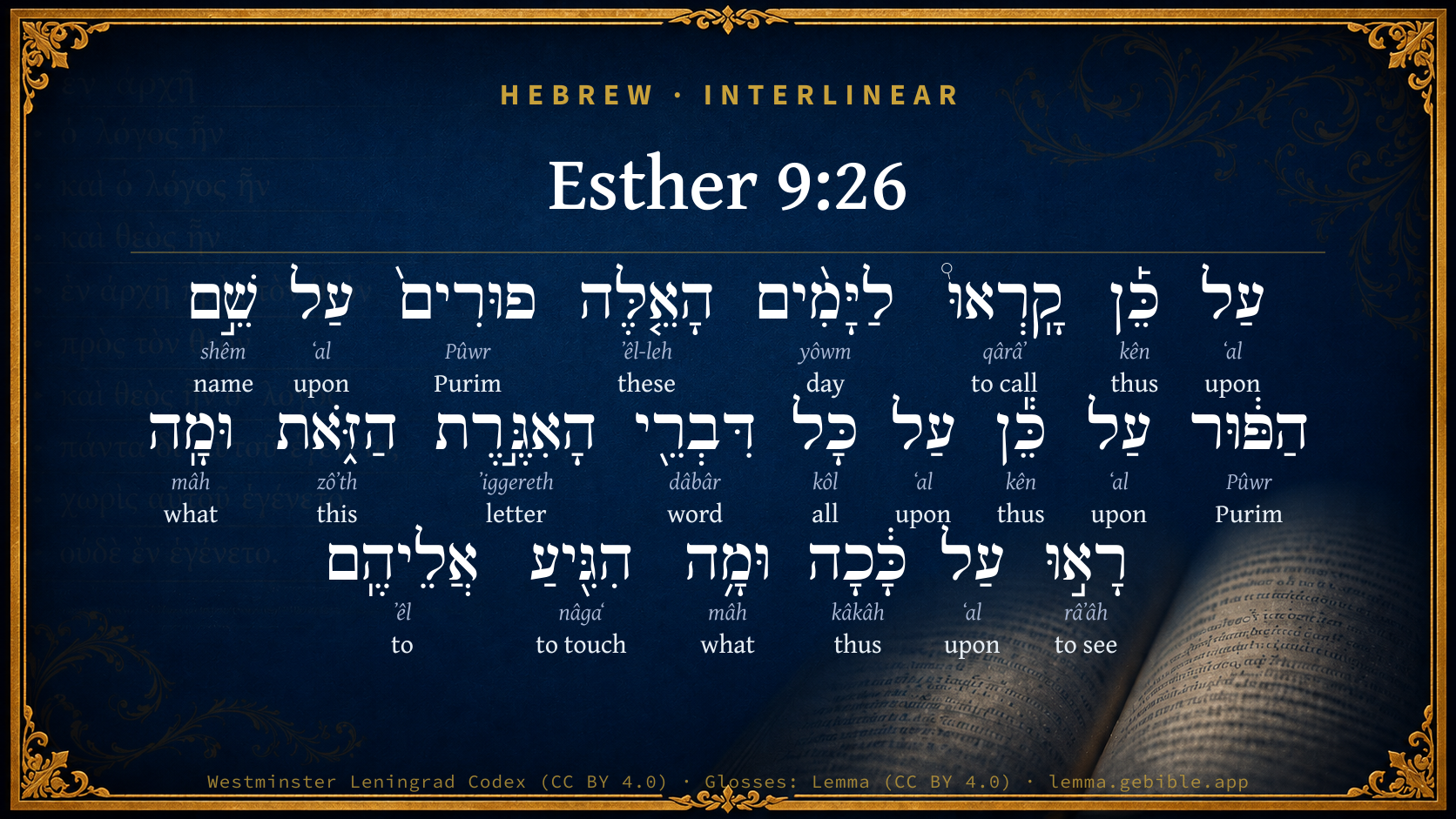
Hebrew (Westminster Leningrad Codex) Esther 9:26 appears in the Hebrew Old Testament. The text above is from the Westminster Leningrad Codex. Each word links to its Strong’s number, a concise gloss, and parsing drawn from the Open Scriptures Hebrew Bible morphology. Click any word for its full Brown-Driver-Briggs (BDB) entry.
Download image
Cite this verse

Esther 9:26 (World English Bible). Public Domain. Lemma interlinear Bible study tool, https://lemma.gebible.app/v/esther/9/26.

Show BibTeX & RIS
BibTeX
RIS
English Translation
Therefore they called these days Purim, after the name of Pur. Therefore because of all the words of this letter, and of that which they had seen concerning this matter, and that which had come to them,
World English Bible · Public Domain
Download a study sheet

One document with this verse’s original text, its word-by-word gloss line, the meaning frame, cross-references with their text, attributed commentary, and full source and license credits — printable, and it pastes into notes with its structure intact.

This verse Autodidact and up

Study sheet (.html) Plain text (.txt)

A passage Seminary Student

Up to 50 verses in one chapter. A passage sheet keeps up to 6 commentary sources and 12 cross-references per verse, in the order this page ranks them, and says so on the sheet whenever that leaves anything out. Ask for a single verse and you get the Autodidact verse sheet above.

Everything on this page stays free to read, with no account — the sheet is a download of what is already on screen, not access to it.

Want to remove ads? Support Godless Engineer
Compare translations 3

The same verse in 3 English versions, stacked beneath the original-language interlinear above. Click any original word for its lexicon entry.

Each is an independent rendering of the whole verse — the interlinear is not word-aligned to these translations.

Highlighted words mark where these versions differ — a whole-verse word diff, not a word-by-word alignment.

  • World English Bible Public Domain
    Therefore they called these days Purim, after the name of Pur. Therefore because of all the words of this letter, and of that which they had seen concerning this matter, and that which had come to them,
  • King James Version Public Domain
    Wherefore they called these days Purim after the name of Pur. Therefore for all the words of this letter, and of that which they had seen concerning this matter, and which had come unto them,
  • unfoldingWord Literal Text CC BY-SA 4.0
    Therefore, they called these days “Purim,” on account of the name of Pur. Therefore, on account of all the words of this letter and what they had seen concerning this and what had come upon them,

unfoldingWord Literal Text — © unfoldingWord, licensed CC BY-SA 4.0. Word-aligned USFM3 via Door43 (git.door43.org/unfoldingWord/en_ult).

Versions to compare (up to 4)

3 of 4 selected

Show all 18 translations

Every available English version of this verse, each an independent rendering of the whole verse.

  • World English Bible Public Domain
    Therefore they called these days Purim, after the name of Pur. Therefore because of all the words of this letter, and of that which they had seen concerning this matter, and that which had come to them,
  • Berean Standard Bible Public Domain
    Therefore these days are called Purim, from the word Pur. Because of all the instructions in this letter, and because of all they had seen and experienced,
  • Majority Standard Bible Public Domain
    Therefore these days are called Purim, from the word Pur. Because of all the instructions in this letter, and because of all they had seen and experienced,
  • King James Version Public Domain
    Wherefore they called these days Purim after the name of Pur. Therefore for all the words of this letter, and of that which they had seen concerning this matter, and which had come unto them,
  • American Standard Version (1901) Public Domain
    Wherefore they called these days Purim, after the name of Pur. Therefore because of all the words of this letter, and of that which they had seen concerning this matter, and that which had come unto them,
  • Revised Version (1885) Public Domain
    Wherefore they called these days Purim, after the name of Pur. Therefore because of all the words of this letter, and of that which they had seen concerning this matter, and that which had come unto them,
  • Geneva Bible (1599) Public Domain
    Therfore they called these dayes Purim, by the name of Pur, and because of all the wordes of this letter, and of that which they had seene besides this, and of that which had come vnto them.
  • Douay-Rheims (1899) Public Domain
    And since that time these days are called Phurim, that is, of lots: because Phur, that is, the lot, was cast into the urn. And all things that were done, are contained in the volume of this epistle, that is, of this book:
  • Young's Literal Translation Public Domain
    therefore they have called these days Purim -- by the name of the lot -- therefore, because of all the words of this letter, and what they have seen concerning this, and what hath come unto them,
  • Literal Standard Version CC BY-SA 4.0
    therefore they have called these days Purim—by the name of the lot—therefore, because of all the words of this letter, and what they have seen concerning this, and what has come to them,
  • Unlocked Literal Bible CC BY-SA 4.0
    Therefore they called these days Purim, after the name of Pur. Because of everything that was written in this letter, and everything that they had seen and that had happened to them,
  • unfoldingWord Literal Text CC BY-SA 4.0
    Therefore, they called these days “Purim,” on account of the name of Pur. Therefore, on account of all the words of this letter and what they had seen concerning this and what had come upon them,
  • Darby Bible Public Domain
    Therefore they called these days Purim after the name of Pur. Therefore, according to all the words of this letter, and for what they had seen concerning this matter and what had happened to them,
  • World Messianic Bible Public Domain
    Therefore they called these days “Purim”, from the word “Pur.” Therefore because of all the words of this letter, and of that which they had seen concerning this matter, and that which had come to them,
  • Webster's Bible Public Domain
    Wherefore they called these days Purim after the name of Pur. Therefore for all the words of this letter, and of that which they had seen concerning this matter, and which had come to them,
  • Free Bible Version CC BY-SA 4.0
    (That's why these days are called Purim, from the word Pur. ) As a result of all the instructions in Mordecai's letter, and what they'd seen, and what had happened to them,
  • Bible in Basic English Public Domain
    So these days were named Purim, after the name of Pur. And so, because of the words of this letter, and of what they had seen in connection with this business, and what had come to them,
  • JPS Tanakh (1917) Public Domain
    Wherefore they called these days Purim, after the name of pur. Therefore because of all the words of this letter, and of that which they had seen concerning this matter, and that which had come unto them,

Literal Standard Version (2020), Covenant Press — licensed CC BY-SA 4.0. Text via the HelloAO Bible API (eBible.org). Unlocked Literal Bible (unfoldingWord) — licensed CC BY-SA 4.0. Text via the HelloAO Bible API (eBible.org). unfoldingWord Literal Text — © unfoldingWord, licensed CC BY-SA 4.0. Word-aligned USFM3 via Door43 (git.door43.org/unfoldingWord/en_ult). Free Bible Version, Dr. Jonathan Gallagher — licensed CC BY-SA 4.0. Text via the HelloAO Bible API (eBible.org).

Word by word

More ways to search: Search by grammar → Find every occurrence → Compare this word →

Practice this passage: Drill this verse → Learn its vocabulary →

פוּרִים֙
Pûwr
H6332
“Purim”
Noun, Proper
Part of Speech
Noun
Type
Proper
Full BDB Definition

Origin: from H6331

TWOT: 1749

Pur or Purim = "lot" or " piece" - lot - a special feast among the post-exilic Jews, to celebrate their deliverance from Haman's destruction through queen Esther's heroic actions
  1. עַל ʻal H5921 “upon” Preposition
  2. כֵּ֡ן kên H3651 “thus” Particle, Demonstrative
  3. קָֽרְאוּ֩ qârâʼ H7121 “to call” Verb, Qal, Perfect, 3rd Person, Common, Plural
  4. לַיָּמִ֨ים yôwm H3117 “to/for the · days” Preposition, Determined + Noun, Common, Masculine, Plural, Absolute
  5. הָאֵ֤לֶּה ʼêl-leh H428 “the · these” Particle, Definite Article + Pronoun, Demonstrative, Common, Plural
  6. עַל ʻal H5921 “upon” Preposition
  7. שֵׁ֣ם shêm H8034 “name of” Noun, Common, Masculine, Singular, Construct
  8. הַפּ֔וּר Pûwr H6332 “the · Purim” Particle, Definite Article + Noun, Common, Masculine, Singular, Absolute
  9. עַל ʻal H5921 “upon” Preposition
  10. כֵּ֕ן kên H3651 “thus” Particle, Demonstrative
  11. עַל ʻal H5921 “upon” Preposition
  12. כָּל kôl H3605 “all of” Noun, Common, Masculine, Singular, Construct
  13. דִּבְרֵ֖י dâbâr H1697 “words of” Noun, Common, Masculine, Plural, Construct
  14. הָאִגֶּ֣רֶת ʼiggereth H107 “the · letter” Particle, Definite Article + Noun, Common, Feminine, Singular, Absolute
  15. הַזֹּ֑את zôʼth H2063 “the · this” Particle, Definite Article + Pronoun, Demonstrative, Feminine, Singular
  16. וּמָֽה mâh H4100 “and · what” Conjunction + Particle, Interrogative
  17. רָא֣וּ râʼâh H7200 “to see” Verb, Qal, Perfect, 3rd Person, Common, Plural
  18. עַל ʻal H5921 “upon” Preposition
  19. כָּ֔כָה kâkâh H3602 “thus” Adverb
  20. וּמָ֥ה mâh H4100 “and · what” Conjunction + Particle, Interrogative
  21. הִגִּ֖יעַ nâgaʻ H5060 “to touch” Verb, Hiphil, Perfect, 3rd Person, Masculine, Singular
  22. אֲלֵיהֶֽם ʼêl H413 “to · them” Preposition + Suffix, Personal, 3rd Person, Masculine, Plural

About this verse

These counts appear in no published source. They are computed here, from the morphology-tagged text and Lemma’s own curated glosses. What Lemma adds →

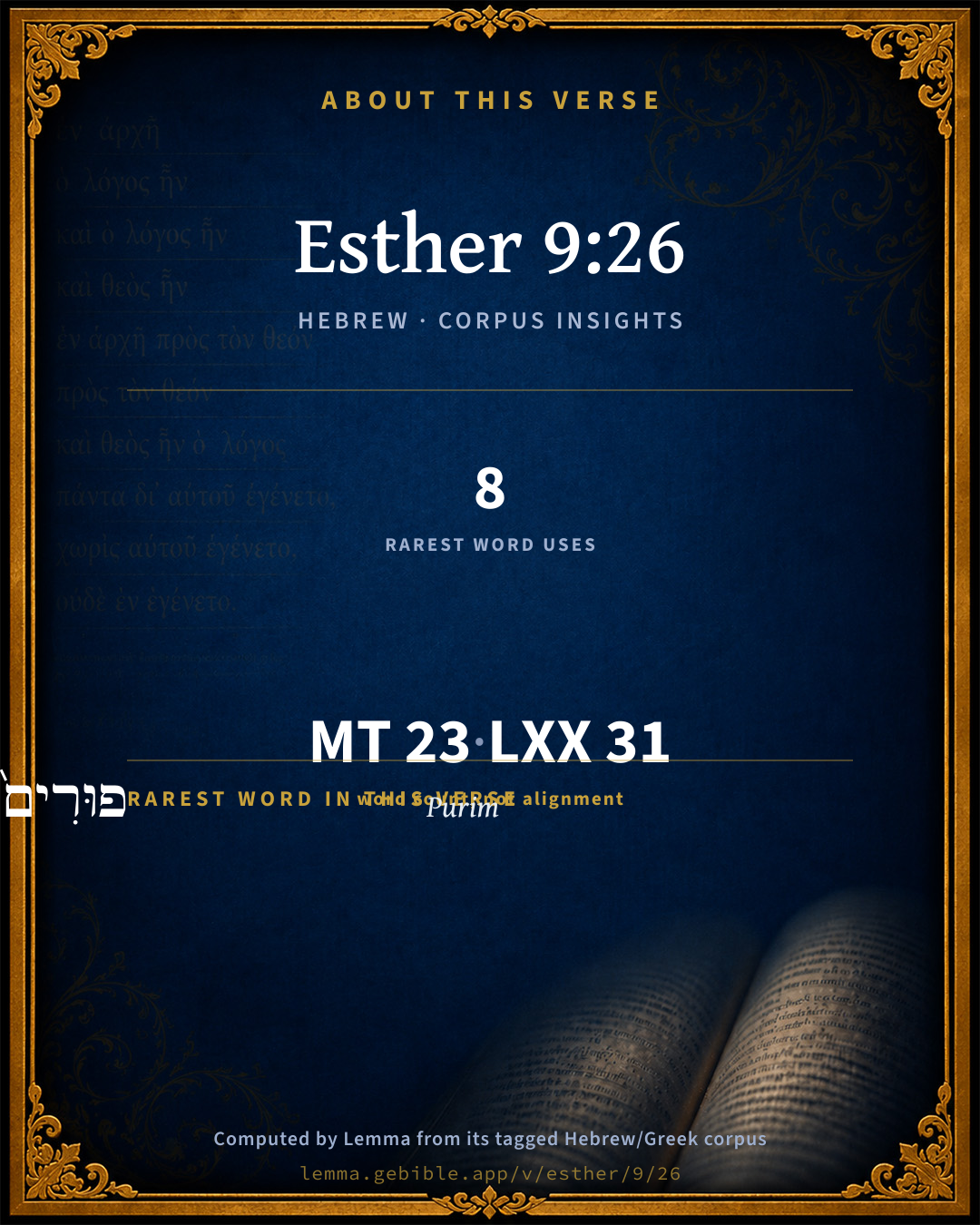
23
words
16
distinct lemmas
Historical
section

Notable vocabulary

The rarest word here is פוּרִים֙ Purim H6332 — appearing just 8 times in the whole Hebrew Bible.

Shared distinctive vocabulary

פוּרִים֙ Purim H6332 occurs in 7 verses of the Hebrew Bible. Also found in:

Grammatical profile

  • 3 verbs
  • 7 nouns
  • 2 pronouns
  • 6 prepositions
  • 1 adverb
  • 4 particles

Verb forms

  • קָֽרְאוּ֩ Qal · Perfect
  • רָא֣וּ Qal · Perfect
  • הִגִּ֖יעַ Hiphil · Perfect

Repetition

Words recur within this verse — often emphatic in Hebrew:

  • עַל upon H5921 ×5
  • כֵּ֡ן thus H3651 ×2
  • פוּרִים֙ Purim H6332 ×2
  • וּמָֽה what H4100 ×2

Hebrew & Septuagint length

In English translation the verse runs 37 words from the Hebrew and 40 from the Septuagint (LXX English) — closely comparable.

A rough comparison of the two English renderings, which tokenize alike — not a word-level alignment.

Word counts can differ between the Hebrew and the Greek without any difference in meaning — e.g. the Hebrew direct-object marker אֵת has no separate Greek word, and Greek often adds the article ὁ.

In the original languages it is 23 Hebrew tokens and 31 Greek tokens — but the two are counted differently (Hebrew bundles its prefixes and suffixes into one token; the Greek is in lemma form), so that isn’t a like-for-like length.

Cross-references

3

Topical passages linked to Esther 9:26 in the Treasury of Scripture Knowledge — connected by theme and wording, ordered by reader-vote popularity; previews shown in the World English Bible.

  • Esther 9:20 Mordecai wrote these things, and sent letters to all the Jews who were in all the provinces of the king Ahasuerus, both near and far,
  • Numbers 16:40 to be a memorial to the children of Israel, to the end that no stranger, who isn't of the seed of Aaron, comes near to burn incense before Yahweh; that he not be as Korah, and as his company: as Yahweh spoke to him by Moses.
  • Ezekiel 39:11 It shall happen in that day, that I will give to Gog a place for burial in Israel, the valley of those who pass through on the east of the sea; and it shall stop those who pass through: and there shall they bury Gog and all his multitude; and they shall call it The valley of Hamon Gog.

Cross-references courtesy of OpenBible.info (CC BY 4.0).

Hebrew and Greek witnesses Masoretic Hebrew ↔ Greek Septuagint

The same verse in the two great witnesses to the Old Testament, shown verse-for-verse.

These are two independent witnesses, not word-aligned to each other, and the Septuagint is shown in lemma (dictionary) form.

Hebrew Esther 9:26 Masoretic · Westminster Leningrad Codex

עַל כֵּ֡ן קָֽרְאוּ֩ לַיָּמִ֨ים הָאֵ֤לֶּה פוּרִים֙ עַל שֵׁ֣ם הַפּ֔וּר עַל כֵּ֕ן עַל כָּל דִּבְרֵ֖י הָאִגֶּ֣רֶת הַזֹּ֑את וּמָֽה רָא֣וּ עַל כָּ֔כָה וּמָ֥ה הִגִּ֖יעַ אֲלֵיהֶֽם

Therefore they called these days Purim, after the name of Pur. Therefore because of all the words of this letter, and of that which they had seen concerning this matter, and that which had come to them,

World English Bible · Public Domain

Greek LXX Esther 9:26 Septuagint · lemma form

διά οὗτος ἐπικαλέω ὁ ἡμέρα ἑαυτοῦ φρουραι διά ὁ κλῆρος ὅτι ὁ διάλεκτος αὐτός καλέω φρουραι διά ὁ λόγος ὁ ἐπιστολή οὗτος καί ὅσος πάσχω διά οὗτος καί ὅσος αὐτός γίγνομαι

Therefore these days were called Phrurae, because of the lots; (for in their language they are called Phrurae;) because of the words of this letter, and because of all they suffered on this account, and all that happened to them.

LXX2012 (modern English Septuagint) · Public Domain

Hebrew: Westminster Leningrad Codex (CC BY 4.0). Greek: Septuagint (public domain); English from LXX2012 (modern English Septuagint) (Public Domain). How the Septuagint differs from the Hebrew →

Commentary

Notes on Esther 9:26 from classic Christian and Jewish commentators (each source and its license shown beneath its notes). The classic Christian expositions comment on the surrounding passage and are grouped to its opening verse, so a note may address several verses; the Jewish commentaries on the Tanakh (Rashi and others) are per-verse, so they appear only where the commentator wrote on this verse.

Lemma curates 59 commentaries, every one of them public domain or Creative Commons licensed, each selected and text-cleaned for this edition rather than reprinted as found. About our sources →

Trapp's Complete Commentary

John Trapp

Est 9:26 Wherefore they called these days Purim after the name of Pur. Therefore for all the words of this letter, and [of that] which they had seen concerning this matter, and which had come unto them,

Ver. 26. Wherefore they called these days Purim] Thereby to perpetuate the memory of that mercy, worthy to be engraven in pillars of marble. This was a notable name; for it served to remind the Jews of all that God had done for them at this bout. As there is edification in the choice of fit psalms, 1Co 14:26, so in the imposing of fit names upon persons, things, and times. As the Christian Sabbath is to good purpose called the Lord’s day; and those festivities of Easter and Whitsuntide were not so fitly called Pasch and Pentecost as the feast of the Lord’s resurrection and of the sending of the Holy Ghost. It should certainly be the constant care of us all to set up marks and monuments of God’s great mercies, so to preserve the memory of them, which else will be moth eaten. Such as were Abraham’s Jehovahjireh, Jacob’s stone at Bethel, Moses’ Jehovahnissi, Aaron’s rod and pot of manna, Heb 9:4, the twelve stones pitched up in Jordan, the names of Gilgal, Ramath-Lehi, Aben Ezer; those plates nailed on the altar, Num 16:39. Hereby God shall be glorified, the Church’s enemies convinced, our faith strengthened, our joy in the Lorcl heightened, our posterity helped, and Satan prevented, who seeketh to obliterate God’s works of wonder; or at least to alienate them, and translate them upon himself, as he endeavoured to do that famous execution of Divine justice upon Sennacherib’s army, by setting Herodotus awork to tell the world in print (Herod. 1. 2) that it was Sethon, king of Egypt, and priest of Vulcan, who obtained of his god that Sennacherib’s army, coming against Egypt, should be totally routed by reason of an innumerable company of rats, sent by Vulcan, which gnawed in pieces their bowstrings, quivers, bucklers, &c., and so made way for the Egyptians to vanquish them. Herodotus addeth that also in his time there was to be seen the statue of Sennacherib, holding a rat in his hand, in Vulcan’s temple, and uttering these words, Let him that beholdeth me learn to fear God. Eμε τις εσορεων ευσεβης εστω. Lo, the god of this world hath his trophies erected, and shall the God of heaven and earth go without? Oh, let us (who have lived in an age of miracles, and seen the out goings of God for our good more than ever did any nation) offer unto him the ransom of our lives, as they did, Exo 21:30; Exo 30:12, in token that they had and held all in mere courtesy from God. Let us leave some seal, some pawn of thankfulness for deliverance from so many deaths and dangers. Otherwise heathens will rise up and condemn us. They after a shipwreck would offer something; after a fit of sickness consecrate something to their gods; after a victory set up trophies of triumph, as the Philistines did to their Dagon, the Romans to their Jupiter Capitolinus.

Therefore for all the words of this letter] In obedience to Mordecai, their godly magistrate.

And of that which they had seen concerning this matter] And especially of God made visible all along in it, yea, palpable, so that they might feel him and find him, Act 17:27, though his name be not found in all this book.

And which had come unto them] so. By report and hearsay, but from such hands as that they were fully satisfied thereof, as Haman’s lot casting, Esther’s supplicating, the king’s reading the chronicles, &c.

John Trapp, A Commentary or Exposition upon All the Books of the Old and New Testament (1647–1656) — public domain. Text from a community e-Sword module.

Joseph Benson's Commentary

Est 9:26. They called these days Purim — Namely, these two festival days; after the name Pur — A Persian word signifying a lot. For all the words of this letter, and of that which they had seen, and which had come unto them — Because of what was contained in the letter of Mordecai, and the respect which they justly bore to it; and because of what they themselves had seen, when these things happened, and God so wonderfully delivered them; and of what they heard reported concerning these matters, in the places where they could not see them, they unanimously consented to keep a yearly festival in commemoration of them, as it follows in the next verse.

Joseph Benson's Commentary on the Old and New Testaments (1811–1818) — public domain. Text from a community e-Sword module.

Tyndale Open Study Notes

Tyndale Open Resources

9:26-28 This paragraph justifies Purim as an approved Jewish festival even though Moses did not authorize it along with other festival days.

Tyndale Open Study Notes — © Tyndale Open Resources, licensed CC BY-SA 4.0. Text via the HelloAO Bible API.

Jamieson, Fausset & Brown

Robert Jamieson, A. R. Fausset & David Brown

they called these days Purim after the name of Pur--"Pur," in the Persian language, signifies "lot"; and the feast of Purim, or lots, has a reference to the time having been pitched upon by Haman through the decision of the lot. In consequence of the signal national deliverance which divine providence gave them from the infamous machinations of Haman, Mordecai ordered the Jews to commemorate that event by an anniversary festival, which was to last for two days, in accordance with the two days' war of defense they had to maintain. There was a slight difference in the time of this festival; for the Jews in the provinces, having defended themselves against their enemies on the thirteenth, devoted the fourteenth to festivity; whereas their brethren in Shushan, having extended that work over two days, did not observe their thanksgiving feast till the fifteenth. But this was remedied by authority, which fixed the fourteenth and fifteenth of Adar. It became a season of sunny memories to the universal body of the Jews; and, by the letters of Mordecai, dispersed through all parts of the Persian empire, it was established as an annual feast, the celebration of which is kept up still. On both days of the feast, the modern Jews read over the Megillah or Book of Esther in their synagogues. The copy read must not be printed, but written on vellum in the form of a roll; and the names of the ten sons of Haman are written on it a peculiar manner, being ranged, they say, like so many bodies on a gibbet. The reader must pronounce all these names in one breath. Whenever Haman's name is pronounced, they make a terrible noise in the synagogue. Some drum with their feet on the floor, and the boys have mallets with which they knock and make a noise. They prepare themselves for their carnival by a previous fast, which should continue three days, in imitation of Esther's; but they have mostly reduced it to one day [JENNINGS, Jewish Antiquities].

Next: Esther Chapter 10

Jamieson, Fausset & Brown — Commentary Critical and Explanatory on the Whole Bible (1871) — public domain (CC PDM 1.0). Text via the HelloAO Bible API.

Adam Clarke's Commentary

Verse 26. They called these days Purim] That is from [Persian] pari, the lot; because, as we have seen, Haman cast lots to find what month, and what day of the month, would be the most favourable for the accomplishment of his bloody designs against the Jews. See on Es 3:7.

And of that which they had seen] The first letter to which this second refers, must be that sent by Mordecai himself. See Es 9:20.

Adam Clarke's Commentary on the Bible (1810–1826) — public domain. Text from a community e-Sword/MySword module.

Ellicott's Commentary for English Readers

(26) Purim.—As we have already stated, the festival of Purim is still observed by the Jews, on the 14th and 15th of Adar, the day preceding being kept as a fast. At Purim, the whole Book of Esther is read through in the service in the synagogues, a custom that can be traced back at any rate to the Christian era (2Ma_15:36; Josephus, Ant. xi. 6. 13; Mishna, Bosh ha-Shanah, iii. 7).

A Bible Commentary for English Readers, edited by Charles John Ellicott (1878–1897) — public domain. Text from a community e-Sword module.

The Cambridge Bible for Schools and Colleges

gen. ed. J. J. S. Perowne

26. The Feast of Purim comes in early spring, a month before Passover. The previous day is kept as a fast in memory of the Shushan Jews’ fast (Est_4:16).

Purim, after the name of Pur] i.e. they gave the Persian word a Hebrew plural.

letter] The original (’iggereth) is a late Heb. word, probably of Assyrian origin, cognate to the Greek angareuein (ἀγγαρεύειν). See note on Est_3:13.

The Cambridge Bible for Schools and Colleges (gen. ed. J. J. S. Perowne; Cambridge University Press, 1878–1918) — public domain. Text from a community e-Sword module.

John Gill's Exposition

And that these days should be remembered, and kept throughout every generation, every family, every province, and every city,.... And accordingly these days are commemorated by them now, and by all their families, and all in their families capable of it; and these words, "every province", and "every city", are used, as Aben Ezra observes, lest a man should think he was not bound to keep this feast where there were no Jews; for, let him be where he may, he is obliged to keep it:

and that these days of Purim should not fail among the Jews; or the observance of them be neglected and cease:

nor the memorial of them perish from their seed; neither the memorial of them, nor of the reason of keeping them; wherefore on those days they read the whole book of Esther, fairly written on a roll of parchment, and are careful that none omit the reading of it; rather, they say (w), the reading and learning the law should be omitted, and all commands and service, than the reading this volume, that so all might be acquainted with this wonderful deliverance, and keep it in mind.

(w) Lebush & Schulchan, ib. (par. 1.) c. 687. sect. 2.

John Gill's Exposition of the Whole Bible (1746–1763) — public domain (CC PDM 1.0). Text via the HelloAO Bible API.

Matthew Poole's English Annotations

i.e. Both for the respect which they justly bore to Mordecai’s letter, and because they themselves had seen and felt this wonderful work of God on their behalf.

Matthew Poole's English Annotations on the Holy Bible (1683–1685) — public domain. Text from a community e-Sword/MySword module.

Whedon's Commentary on the Bible

Daniel D. Whedon

26. Wherefore — Namely, because Haman had cast Pur, or the lot, to fix on a lucky day for the destruction of the Jews. Est_9:24.

They called these days Purim — They evidently chose this name in ironical reference to the fact that Haman’s lucky day (designated by lot) was so fortunate for his enemies, and so unlucky for himself.

The words of this letter — Mordecai’s letters mentioned in Est_9:20.

Which they had seen… and which had come unto them — That is, all that they had themselves experienced of this event by being eyewitnesses and participators. The sentiment is, Mordecai’s letters and their own personal knowledge of the matter prompted them to ordain the feast of Purim.

Daniel D. Whedon (gen. ed.), Commentary on the Old and New Testaments (1874–1909) — public domain. Text from a community e-Sword module.

The Pulpit Commentary

Wherefore they called these days Purim after the name of Pur. They took the Persian word, that is, and gave it a Hebrew plural, either because the Persian method of casting involved the use of several lots, or because Haman cast "Pur" several times. (Est_3:7) For all the words of this letter. i.e. "on account of what was said in Mordecai"s letter to them" (ver. 20). And of that which they had seen, etc. "And on account of what they had themselves seen anti suffered." Mordecai"s arguments were backed up by their own personal experience, and the recollection of what "had come to them,"

The Pulpit Commentary (1880–1919), ed. H.D.M. Spence-Jones & Joseph S. Exell — public domain. Text from a community e-Sword module.

John Wesley's Explanatory Notes

Pur - This Persian word signifies a lot, because Haman had by lot determined this time to be the time of the Jews destruction.

John Wesley, Explanatory Notes Upon the Whole Bible (1754–1765) — public domain. Text via the GEBible commentary corpus.

Keil & Delitzsch

C. F. Keil & F. Delitzsch

Wherefore they called these days Purim after the name Pur. This first על־כּן refers to what precedes and states the reason, resulting from what has just been mentioned, why this festival received the name of Purim. With the second על־כּן begins a new sentence which reaches to Est 9:28, and explains how it happened that these feast-days became a general observance with all Jews; namely, that because of all the words of this letter (of Mordochai, Est 9:20), and of what they had seen concerning the matter (על־כּכה, concerning so and so), and what had come upon them (therefore for two reasons: (1) because of the written injunction of Mordochai; and (2) because they had themselves experienced this event), the Jews established, and took upon themselves, their descendants, and all who should join themselves unto them (proselytes), so that it should not fail (i.e., inviolably), to keep (to celebrate) these two days according to the writing concerning them and the time appointed thereby year by year.

Keil & Delitzsch — Biblical Commentary on the Old Testament (1861–1891) — public domain (CC PDM 1.0). Text via the HelloAO Bible API. (Old Testament only.)

unfoldingWord translationNotes

Door43 World Missions Community

they called these days Purim, after the name of Pur

To call something after something else is an idiom that means to give it the same name or a similar name. AT: "They called these days Purim, like the word Pur" (See: Idiom)

Purim

This is the name of the festival that commemorates the salvation of the Jewish people in ancient Persia from Haman's plot to destroy and kill all the Jews in a single day. (See: How to Translate Names)

the name of Pur.

It can be stated clearly what "Pur" means. AT: "the word Pur, which means 'lot.'" (See: Assumed Knowledge and Implicit Information)

These days were to be celebrated and observed

This can be stated in active form. AT: "The Jews were to celebrate and observe these days" (See: Active or Passive)

would never cease to faithfully observe

This can be stated positively. AT: "would always faithfully observe"

translationWords

descend

generation

unfoldingWord translationNotes — © Distant Shores Media and the Door43 World Missions Community, licensed CC BY-SA 4.0. Source: git.door43.org/Door43/en_tn.

Rashi

Rabbi Shlomo Yitzchaki (Rashi)

therefore, because of all the words of this letter these days were established, and therefore it was written for future generations to know.

and what they saw those who did these deeds, that they did them.

and what happened to them What did Ahasuerus see that he used the sacred vessels, and what happened to them? That Satan came and danced among them and slew Vashti. And what did Haman see that he became envious of Mordecai, and what happened to him? They hanged him and his sons. And what did Mordecai see that he did not kneel or prostrate himself, and what did Esther see that she invited Haman?

Rashi on the Tanakh — English translations: “The Judaica Press complete Tanach with Rashi, translated by A. J. Rosenberg” (CC BY 4.0); “Pentateuch with Rashi's commentary by M. Rosenbaum and A.M. Silbermann, 1929-1934” (public domain); “The Metsudah Tanach series, Lakewood, N.J” (CC BY 4.0); and “The Book of Joshua, Metsudah Publications, 1997” (CC BY 4.0). Text via Sefaria.

Lesson kit

Teaching starters — assembled from the data on this page, not authored interpretation. Every prompt links to the verse data it draws on. Edit before teaching.

Esther, in the Historical, opens this verse with 23 words (16 distinct Hebrew lemmas). Its most distinctive word is Pûwr (“Purim”). A historical commentator’s framing appears above. Read the whole chapter for the surrounding context.

Discussion questions

  1. How does “Purim” (Pûwr) shape what this verse is saying?
  2. Esther 3:7 shares the word «Purim» with this verse. How do the two illuminate each other?
  3. “upon” occurs 5× in this one verse. What is the effect of the repetition?
  4. The translations on this page render this verse differently — a whole-verse word diff, not a word-by-word alignment. What might account for the different wordings?
  5. The verb «קָֽרְאוּ֩» is Qal Perfect. How does its form color the action?
  6. Reading how Trapp's Complete Commentary and Joseph Benson's Commentary read this verse, where do the two commentators agree and where do they part?

Things to notice

Reading settings

Reading text

Shown beneath each verse's original-language words.

Old Testament
Old Testament edition

Read the OT as the Masoretic Hebrew (MT) or the Greek Septuagint (LXX).

English shown for the Greek Septuagint (in the Hebrew ↔ Greek comparison).

Comparing translations? Open the Compare panel on any verse page to stack up to four side by side.