Ezekiel 20:29

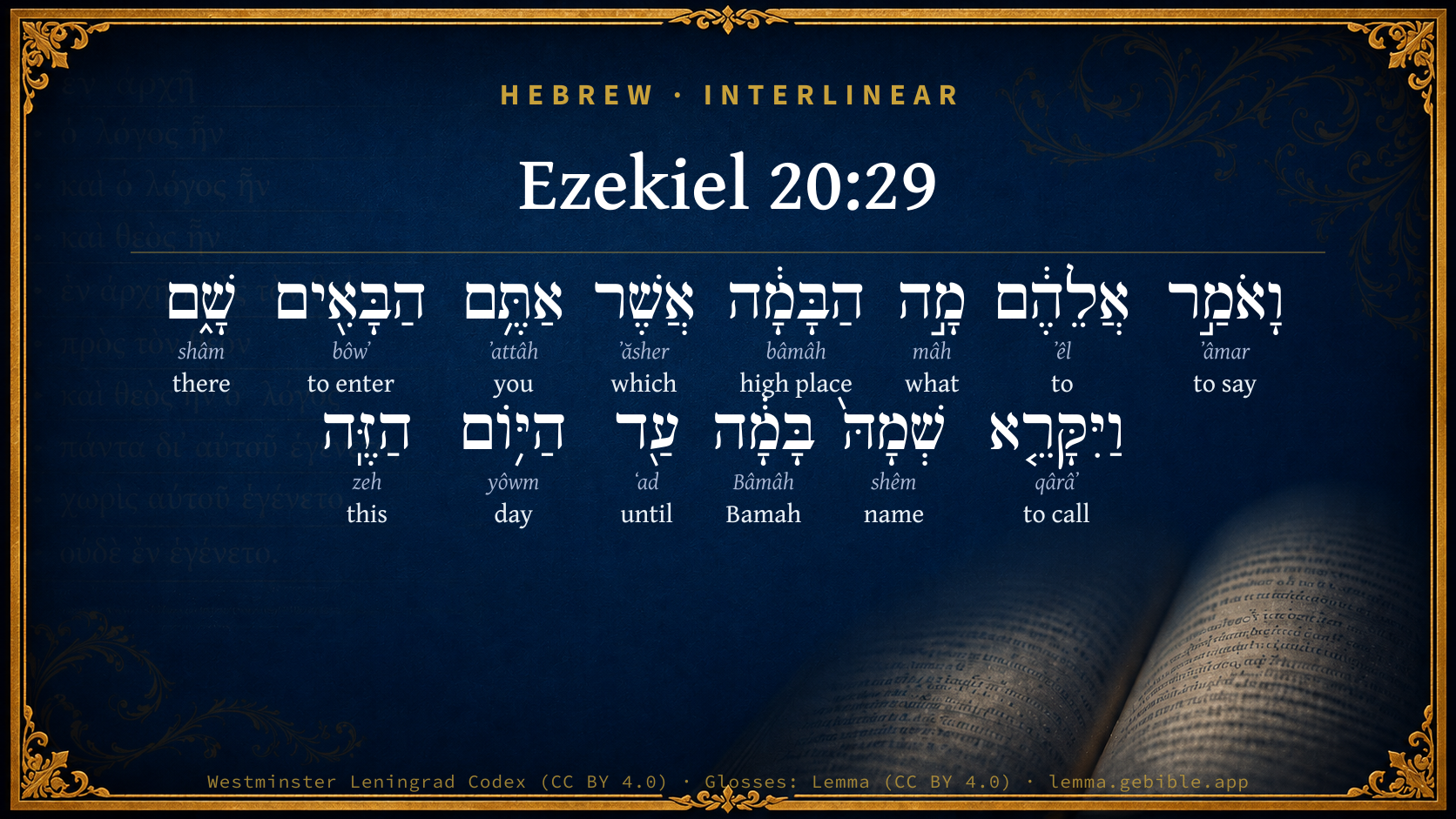
Hebrew (Westminster Leningrad Codex) Ezekiel 20:29 appears in the Hebrew Old Testament. The text above is from the Westminster Leningrad Codex. Each word links to its Strong’s number, a concise gloss, and parsing drawn from the Open Scriptures Hebrew Bible morphology. Click any word for its full Brown-Driver-Briggs (BDB) entry.
Download image
Cite this verse

Ezekiel 20:29 (World English Bible). Public Domain. Lemma interlinear Bible study tool, https://lemma.gebible.app/v/ezekiel/20/29.

Show BibTeX & RIS
BibTeX
RIS
English Translation
Then I said to them, What means the high place whereunto you go? So the name of it is called Bamah to this day.
World English Bible · Public Domain
Highlights
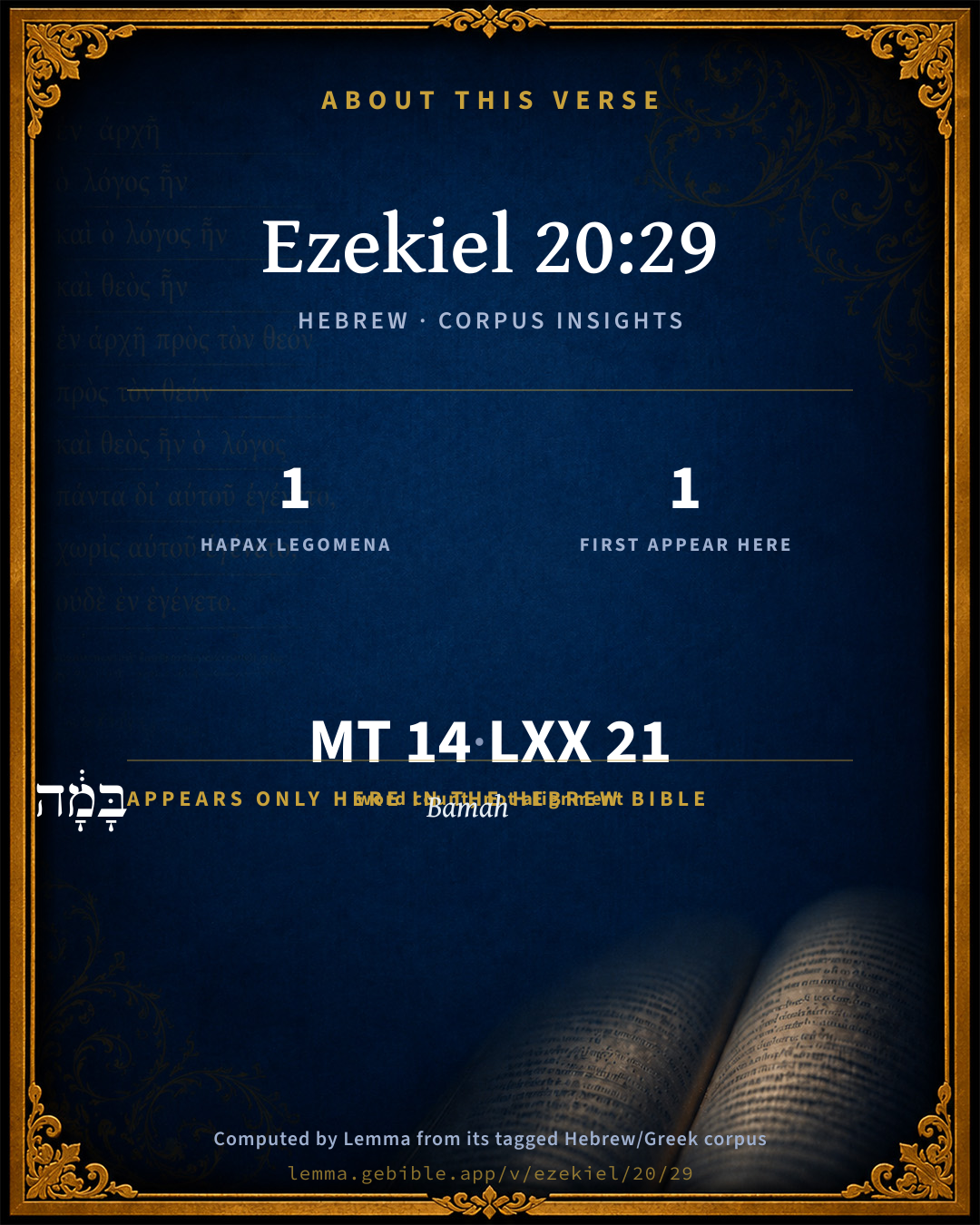
  • 1 hapax legomenon — only here in the Hebrew Bible
  • 1 first appearance in the Hebrew Bible
Full analysis ↓
Download a study sheet

One document with this verse’s original text, its word-by-word gloss line, the meaning frame, cross-references with their text, attributed commentary, and full source and license credits — printable, and it pastes into notes with its structure intact.

This verse Autodidact and up

Study sheet (.html) Plain text (.txt)

A passage Seminary Student

Up to 50 verses in one chapter. A passage sheet keeps up to 6 commentary sources and 12 cross-references per verse, in the order this page ranks them, and says so on the sheet whenever that leaves anything out. Ask for a single verse and you get the Autodidact verse sheet above.

Everything on this page stays free to read, with no account — the sheet is a download of what is already on screen, not access to it.

Want to remove ads? Support Godless Engineer
Compare translations 3

The same verse in 3 English versions, stacked beneath the original-language interlinear above. Click any original word for its lexicon entry.

Each is an independent rendering of the whole verse — the interlinear is not word-aligned to these translations.

Highlighted words mark where these versions differ — a whole-verse word diff, not a word-by-word alignment.

  • World English Bible Public Domain
    Then I said to them, What means the high place whereunto you go? So the name of it is called Bamah to this day.
  • King James Version Public Domain
    Then I said unto them, What is the high place whereunto ye go? And the name whereof is called Bamah unto this day.
  • unfoldingWord Literal Text CC BY-SA 4.0
    Then I said to them, “What is this high place where you bring offerings there?” So the name is called Bamah to this day.’

unfoldingWord Literal Text — © unfoldingWord, licensed CC BY-SA 4.0. Word-aligned USFM3 via Door43 (git.door43.org/unfoldingWord/en_ult).

Versions to compare (up to 4)

3 of 4 selected

Show all 18 translations

Every available English version of this verse, each an independent rendering of the whole verse.

  • World English Bible Public Domain
    Then I said to them, What means the high place whereunto you go? So the name of it is called Bamah to this day.
  • Berean Standard Bible Public Domain
    So I asked them: ‘What is this high place to which you go?’ (And to this day it is called Bamah.)
  • Majority Standard Bible Public Domain
    So I asked them: ‘What is this high place to which you go?’ (And to this day it is called Bamah.)
  • King James Version Public Domain
    Then I said unto them, What is the high place whereunto ye go? And the name whereof is called Bamah unto this day.
  • American Standard Version (1901) Public Domain
    Then I said unto them, What meaneth the high place whereunto ye go? So the name thereof is called Bamah unto this day.
  • Revised Version (1885) Public Domain
    Then I said unto them, What meaneth the high place whereunto ye go? So the name thereof is called Bamah unto this day.
  • Geneva Bible (1599) Public Domain
    Then I saide vnto them, What is the hie place whereunto ye goe? And the name thereof was called Bamah vnto this day.
  • Douay-Rheims (1899) Public Domain
    And I said to them: What meaneth the high place to which you go? and the name thereof was called High-place even to this day.
  • Young's Literal Translation Public Domain
    And I say unto them: What `is' the high place whither ye are going in? And its name is called `high place' to this day.
  • Literal Standard Version CC BY-SA 4.0
    And I say to them: What [is] the high place to where you are going in?” And its name is called “High Place” to this day.
  • Unlocked Literal Bible CC BY-SA 4.0
    Then I said to them, “What is this high place where you bring offerings there?” So the name is called Bamah to this day.'
  • unfoldingWord Literal Text CC BY-SA 4.0
    Then I said to them, “What is this high place where you bring offerings there?” So the name is called Bamah to this day.’
  • Darby Bible Public Domain
    And I said unto them, What is the high place whither ye go? And the name thereof is called Bamah unto this day.
  • World Messianic Bible Public Domain
    Then I said to them, ‘What does the high place where you go mean?’ So its name is called Bamah to this day.”’
  • Webster's Bible Public Domain
    Then I said to them, What is the high place to which ye go? and its name is called Bamah to this day.
  • Free Bible Version CC BY-SA 4.0
    So I asked them: ‘What's this high place you're going to?’ (Even today it's still called Bamah.)
  • Bible in Basic English Public Domain
    Then I said to them, What is this high place where you go to no purpose? And it is named Bamah to this day.
  • JPS Tanakh (1917) Public Domain
    Then I said unto them: What meaneth the high place whereunto ye go? So the name thereof is called Bamah unto this day.

Literal Standard Version (2020), Covenant Press — licensed CC BY-SA 4.0. Text via the HelloAO Bible API (eBible.org). Unlocked Literal Bible (unfoldingWord) — licensed CC BY-SA 4.0. Text via the HelloAO Bible API (eBible.org). unfoldingWord Literal Text — © unfoldingWord, licensed CC BY-SA 4.0. Word-aligned USFM3 via Door43 (git.door43.org/unfoldingWord/en_ult). Free Bible Version, Dr. Jonathan Gallagher — licensed CC BY-SA 4.0. Text via the HelloAO Bible API (eBible.org).

Word by word

More ways to search: Search by grammar → Find every occurrence → Compare this word →

Practice this passage: Drill this verse → Learn its vocabulary →

בָּמָ֔ה
Bâmâh
H1117
“Bamah”
Noun, Proper
Part of Speech
Noun
Type
Proper
Full BDB Definition

Origin: the same as H1116 , See also H1120

TWOT: None

Bamah = "high place" - a place in Palestine (of places of idolatrous worship)
  1. וָאֹמַ֣ר ʼâmar H559 “and · to say” Conjunction + Verb, Qal, Sequential Imperfect, 1st Person, Common, Singular
  2. אֲלֵהֶ֔ם ʼêl H413 “to · them” Preposition + Suffix, Personal, 3rd Person, Masculine, Plural
  3. מָ֣ה mâh H4100 “what” Particle, Interrogative
  4. הַבָּמָ֔ה bâmâh H1116 “the · high place” Particle, Definite Article + Noun, Common, Feminine, Singular, Absolute
  5. אֲשֶׁר ʼăsher H834 “which” Particle, Relative
  6. אַתֶּ֥ם ʼattâh H859 “you” Pronoun, Personal, 2nd Person, Masculine, Plural
  7. הַבָּאִ֖ים bôwʼ H935 “the · entering” Particle, Definite Article + Verb, Qal, Participle Active, Masculine, Plural, Absolute
  8. שָׁ֑ם shâm H8033 “there” Adverb
  9. וַיִּקָּרֵ֤א qârâʼ H7121 “and · to call” Conjunction + Verb, Niphal, Sequential Imperfect, 3rd Person, Masculine, Singular
  10. שְׁמָהּ֙ shêm H8034 “name · her” Noun, Common, Masculine, Singular, Construct + Suffix, Personal, 3rd Person, Feminine, Singular
  11. עַ֖ד ʻad H5704 “until” Preposition
  12. הַיּ֥וֹם yôwm H3117 “the · day” Particle, Definite Article + Noun, Common, Masculine, Singular, Absolute
  13. הַזֶּֽה zeh H2088 “the · this” Particle, Definite Article + Pronoun, Demonstrative, Masculine, Singular

About this verse

These counts appear in no published source. They are computed here, from the morphology-tagged text and Lemma’s own curated glosses. What Lemma adds →

14
words
14
distinct lemmas
Prophets
section

Notable vocabulary

1 hapax legomenon — a word that appears only here in the entire Hebrew Bible:

  • בָּמָ֔ה Bamah H1117

First appearance in Scripture

This word makes its first canonical appearance in the Hebrew Bible here:

  • בָּמָ֔ה Bamah H1117

Grammatical profile

  • 3 verbs
  • 4 nouns
  • 2 pronouns
  • 2 prepositions
  • 1 adverb
  • 2 particles

Verb forms

  • וָאֹמַ֣ר Qal · Sequential Imperfect
  • הַבָּאִ֖ים Qal · Participle Active
  • וַיִּקָּרֵ֤א Niphal · Sequential Imperfect

Hebrew & Septuagint length

In English translation the verse runs 24 words from the Hebrew and 22 from the Septuagint (LXX English) — closely comparable.

A rough comparison of the two English renderings, which tokenize alike — not a word-level alignment.

Word counts can differ between the Hebrew and the Greek without any difference in meaning — e.g. the Hebrew direct-object marker אֵת has no separate Greek word, and Greek often adds the article ὁ.

In the original languages it is 14 Hebrew tokens and 21 Greek tokens — but the two are counted differently (Hebrew bundles its prefixes and suffixes into one token; the Greek is in lemma form), so that isn’t a like-for-like length.

Cross-references

2

Topical passages linked to Ezekiel 20:29 in the Treasury of Scripture Knowledge — connected by theme and wording, ordered by reader-vote popularity; previews shown in the World English Bible.

  • Ezekiel 16:24–25 that you have built to you a vaulted place, and have made you a lofty place in every street.
  • Ezekiel 16:31 in that you build your vaulted place at the head of every way, and make your lofty place in every street, and have not been as a prostitute, in that you scorn pay.

Cross-references courtesy of OpenBible.info (CC BY 4.0).

Hebrew and Greek witnesses Masoretic Hebrew ↔ Greek Septuagint

The same verse in the two great witnesses to the Old Testament, shown verse-for-verse.

These are two independent witnesses, not word-aligned to each other, and the Septuagint is shown in lemma (dictionary) form.

Hebrew Ezekiel 20:29 Masoretic · Westminster Leningrad Codex

וָאֹמַ֣ר אֲלֵהֶ֔ם מָ֣ה הַבָּמָ֔ה אֲשֶׁר אַתֶּ֥ם הַבָּאִ֖ים שָׁ֑ם וַיִּקָּרֵ֤א שְׁמָהּ֙ בָּמָ֔ה עַ֖ד הַיּ֥וֹם הַזֶּֽה

Then I said to them, What means the high place whereunto you go? So the name of it is called Bamah to this day.

World English Bible · Public Domain

Greek LXX Ezekiel 20:29 Septuagint · lemma form

καί εἶπον πρός αὐτός τίς εἰμί αβαμα ὅτι σύ εἰςπορεύομαι ἐκεῖ καί ἐπικαλέω ὁ ὄνομα αὐτός αβαμα ἕως ὁ σήμερον ἡμέρα

And I said to them, What is Abama, that you⌃ go in there? and they called its name Abama, until this day.

LXX2012 (modern English Septuagint) · Public Domain

On this verse, John Gill's Exposition discusses the Septuagint’s reading. Read the note in Commentary ↓

Hebrew: Westminster Leningrad Codex (CC BY 4.0). Greek: Septuagint (public domain); English from LXX2012 (modern English Septuagint) (Public Domain). How the Septuagint differs from the Hebrew →

Targum (Aramaic paraphrase)

1

The Targum is the ancient Jewish Aramaic paraphrase of the Hebrew Scriptures — an interpretive translation, not the Hebrew text itself. Onkelos (literal) and Pseudo-Jonathan (expansive) render the Torah, and Jonathan the Prophets. Coverage is partial: where no permissively-licensed English translation exists for a verse, only the Aramaic is shown. This is verse-level text, not a word-by-word alignment to the Hebrew.

  1. Targum Jonathan Prophets (Joshua–Malachi)
    וַאֲמָרֵית לְהוֹן מָא בָמָתָא דְאַתּוּן אָתָן לְאִשְׁתְּטָאָה תַמָן וְאִתְקְרִי שְׁמָהּ בָּמָתָא עַד יוֹמָא הָדֵין:

    (no public-domain English translation for this verse)

    Targum Jonathan — Aramaic: “Mikraot Gedolot” (public domain). English: “Sefaria Community Translation” (CC0 1.0 (public-domain dedication)); “London "Chaldee Paraphrase," 1871” (public domain). Text via Sefaria.

Commentary

Notes on Ezekiel 20:29 from classic Christian and Jewish commentators (each source and its license shown beneath its notes). The classic Christian expositions comment on the surrounding passage and are grouped to its opening verse, so a note may address several verses; the Jewish commentaries on the Tanakh (Rashi and others) are per-verse, so they appear only where the commentator wrote on this verse.

Lemma curates 59 commentaries, every one of them public domain or Creative Commons licensed, each selected and text-cleaned for this edition rather than reprinted as found. About our sources →

Trapp's Complete Commentary

John Trapp

Eze 20:29 Then I said unto them, What [is] the high place whereunto ye go? And the name thereof is called Bamah unto this day.

Ver. 29. And the name thereof is called Bamah,] i.e., A high place; a name good enough in itself, but, as used by them, as odious to all good hearts as a brothel house is to a chaste matron. She is the worse to pass by it, and spitteth at it. So should we in like case. {Exo 23:13 Psa 16:4 Hos 2:16-17 Zec 13:2 Deu 12:2}

John Trapp, A Commentary or Exposition upon All the Books of the Old and New Testament (1647–1656) — public domain. Text from a community e-Sword module.

Geneva Bible (1599)

Geneva Bible translators

Which signifieth an high place, declaring that they vaunted themselves of their idolatry, and were not ashamed thereof, though God had commanded them expressly that they should have no altar lifted upon high by stairs, Exod. 20:26.

Geneva Bible (1599) marginal notes — public domain. Text via Bolls.life.

Jamieson, Fausset & Brown

Robert Jamieson, A. R. Fausset & David Brown

What is the high place whereunto ye go?--What is the meaning of this name? For My altar is not so called. What excellence do ye see in it, that ye go there, rather than to My temple, the only lawful place of sacrificing? The very name, "high place," convicts you of sinning, not from ignorance but perverse rebellion.

is called . . . unto this day--whereas this name ought to have been long since laid aside, along with the custom of sacrificing on high places which it represents, being borrowed from the heathen, who so called their places of sacrifice (the Greeks, for instance, called them by a cognate term, Bomoi), whereas I call mine Mizbeaach, "altar." The very name implies the place is not that sanctioned by Me, and therefore your sacrifices even to ME there (much more those you offer to idols) are only a "provocation" to Me (Eze 20:28; Deu 12:1-5). David and others, it is true, sacrificed to God on high places, but it was under exceptional circumstances, and before the altar was set up on Mount Moriah.

Jamieson, Fausset & Brown — Commentary Critical and Explanatory on the Whole Bible (1871) — public domain (CC PDM 1.0). Text via the HelloAO Bible API.

Adam Clarke's Commentary

Verse 29. What is the high place] מה הבמה mah habbamah, "what is the high place?" What is it good for? Its being a high place shows it to be a place of idolatry. I called it במה bamah, to mark it with infamy; but ye continue to frequent it, even while it is called במה bamah, to the present day!

Adam Clarke's Commentary on the Bible (1810–1826) — public domain. Text from a community e-Sword/MySword module.

John Calvin's Commentaries

Although there is no ambiguity in the Prophet’s words, yet the sentence seems frigid, and interpreters, in my judgment, have not understood the Prophet’s meaning. It may seem spiritless, that God should ask, what is the high place? But it means that they were not deceived through ignorance, since he had often cautioned them against profaning the true and genuine worship, for he often endeavored to draw them back again when he saw them wandering after their own superstitions. Hence they are continually rebuked by the prophets; and their obstinacy is the more apparent, since, nevertheless, they followed their own perverseness. But because all these reproaches were useless, God here enlarges upon their crime, since they were deaf. I have said, therefore; that is, by means of prophets. For we know how constantly the prophets discharged their duty, by urging them to worship at one altar only. For this reason the people’s wickedness was greater; whence God says, What is this? and why do you so greatly desire your high places when they displease me, and you know my commands? your ears are deaf, and obstructed by wickedness. On the whole, he asks how could such madness seize upon them as to approach these high places, since he had pointed out a place where he was to be sought and invoked. My temple, says he, is neglected; meanwhile you run to high places, and yet it is known by the name of a high place. There is no mystery in this word; but God means that no reproaches or threats of his prophets could prevent the people from worshipping on these high places. He says, then, that the name was still used, since the same dignity and religious regard for them still flourished, when their remembrance ought to be utterly abolished. If God had only once pronounced that those high places were not approved by him, all ought to have changed their course instantly: he, exclaimed against them long and vehemently by his prophets, and yet the name “high places” was constantly in everybody’s mouth; it was famous among them, as if God ought to be sought there. Now therefore we see that the Jews were condemned for too much pride, because they not only failed to desert their high places when repeatedly admonished, but they perniciously wished to oppose those places to God’s sanctuary, although they were so many pollution’s. Hence we gather the condemnation of the people’s obstinate malice, since fathers handed down the name to their sons, so that through a continued posterity they opposed these high places to the only sanctuary of God. It follows —

John Calvin's Commentaries (1540-1563) — public domain. Text from the Calvin Translation Society English edition (1840s-50s) via the Christian Classics Ethereal Library (ccel.org). Calvin's coverage is partial (roughly two-thirds of the Bible); uncommented books and verses are honest gaps, never fabricated. The 19th-century editor's footnotes and remarks are omitted so the notes are faithfully Calvin's own voice.

Ellicott's Commentary for English Readers

(29) Is called Bamah.—Bamah itself means high place. Some have fancied that the word is derived from the two words “go” and “where,” and therefore that it contains a play upon the question in the first part of the verse; but this etymology must be considered fanciful.

A Bible Commentary for English Readers, edited by Charles John Ellicott (1878–1897) — public domain. Text from a community e-Sword module.

The Cambridge Bible for Schools and Colleges

gen. ed. J. J. S. Perowne

29. The word bamah, “high-place,” has no certain etymology, though often used and at an early period, e.g. in David’s elegy on Saul (2Sa_1:19), and in Moabite (Mesha’s inscrip.). The prophet here introduces a punning and contemptuous derivation of the word. Jehovah asks “what (mah) is the high place whereunto ye go (ba),” and the prophet seems to consider the word composed of these two syllables. Some have supposed that “go” has the sense of “go in,” and that the allusion is to the immoralities practised on the high places (Amo_2:7; Hos_4:13-14). This idea does not seem expressed in the words; neither is there much probability in the conjecture that the words are borrowed by Ezek. from some older prophet (Ew.).

The prophet’s view of the generation of the exodus differs from that of earlier prophets, e.g. Hos_9:10; Jer_2:2. The generation in the wilderness was probably not a homogeneous one, and the narratives which we possess represent its conduct as various at different times. Two views might be taken of it, and Ezek. as his manner is takes the severer view.

The Cambridge Bible for Schools and Colleges (gen. ed. J. J. S. Perowne; Cambridge University Press, 1878–1918) — public domain. Text from a community e-Sword module.

John Gill's Exposition

Then I said unto them,.... By his prophets that he sent unto them:

what is the high place where, unto you go? what is the name of it? what is the use of it? to what end do you go there? is there not an altar built by my order and command to sacrifice upon is this high place better than that? does it answer a better end and purpose?

and the name thereof is called Bamah unto this day; or a high place. The Septuagint also leaves the word untranslated, and calls it Abama; and the Arabic version Abbana; so they called their altars after the Gentiles, by whom they are called nor were they ashamed of it, but persisted in so calling them, from the first use of them to the present time. These are often called, Bamah and Bamot in the books of Kings. Jarchi says it is a term of reproach, as if it was said, Bamah----in what is it to be accounted of?

John Gill's Exposition of the Whole Bible (1746–1763) — public domain (CC PDM 1.0). Text via the HelloAO Bible API.

Haydock's Catholic Bible Commentary

Called high. Hebrew, "Bamah," (Haydock) out of contempt. (Calmet) --- The Jews were so much attached to the high places, that they called the altar of the Lord by the same name. Thus heretics are convicted by the very names they use, calling sacrifice service, &c. (Worthington)

George Leo Haydock (1774–1849), Haydock's Catholic Family Bible and Commentary, 1859 edition — public domain. Excludes Psalms (Douay-Rheims chapter numbering differs from Protestant) and Deuterocanonical books (Catholic canon only).

Matthew Poole's English Annotations

Then; when they were intent upon this horrid course of sin, God pleaded by his messengers, and prophets, and law, and some faithful priests, What mean you, that ye go to the high place? should you not go to the altar of God, and bring your sacrifices to the temple? Or what God better than Abraham’s do you expect there? What profit by attending upon those sacrifices offered daily? How often have you by such-like means poured contempt on God and his law!

Whereunto ye go; leaving my temple, and the service I prescribed, and in other places, unrequited, doing their supposed duties.

Bamah; high place: the very word tells them their wickedness, that they acted against the express will of God, and framed themselves to idolaters of the nation.

Unto this day; and this they did with obstinacy continue in to the days of Josiah, 2Ch 34:3. Thus far the narrative of their great wickednesses.

Matthew Poole's English Annotations on the Holy Bible (1683–1685) — public domain. Text from a community e-Sword/MySword module.

Whedon's Commentary on the Bible

Daniel D. Whedon

29. Bamah — Hebrews, “high place.” That there is intended here some contemptuous turn upon the word cannot be doubted. “What (mah) is the high place (bamah) whereunto ye go (ba)?” Such puns upon names — often given as serious explanations of their origin — are not uncommon in the contemporaneous literature of Babylonia and Egypt. (See, e.g., p. 9, author’s Egypt According to the Monuments.) If we had a better knowledge of the Canaanitish dictionary we would probably see a sharp point here which is now hidden from our dull eyes. The name Bamah must, as Adam Clarke saw, be a veiled name of infamy. So the Church of Rome made fun of Calvin, who was bald, by calling him “Calvinus Calcus,” meaning either Calvin the bald or Calvin the schismatic. Ewald and Smend see in the word “go,” or “go into,” a reference to the literal as well as the spiritual prostitution indulged in by the Baal worshipers (as used also in Gen_16:2; Gen_19:31, etc.).

Daniel D. Whedon (gen. ed.), Commentary on the Old and New Testaments (1874–1909) — public domain. Text from a community e-Sword module.

The Pulpit Commentary

What is the high place, etc.? Bamah, in the plural Bamoth, was the Hebrew for "high place." At first it was applied to the hill on which some local sanctuary stood (1Sa_9:12; 1Ki_3:4) but was gradually extended, after the building of the temple as the one appointed sanctuary, to other places which were looked upon as sacred, and which became the scenes of an idolatrous and forbidden worship. Ezekiel emphasizes his scorn by a conjectural derivation of the word, as if derived from the two words ba ("go") and mah ("whither"); or, perhaps, What comes? (comp. Exo_16:15 for a parallel derivation of the word marones ) Taking the words in their ordinary sense, they seem to express only a slight degree of contempt. "What, then, is the place to which you go? what is the "whither" to which it leads? But I incline (with Ewald and Smend) to see in the word "go into" the meaning which it has in Gen_16:2 and Gen_19:31, and elsewhere, as a euphemism for sexual union. So later the word "Bamah" becomes a witness that those who worship in the high place go there (as in ver. 30) to commit whoredom literally and spiritually. Its name showed that it was what I have called "a chapel of prostitution". (Eze_16:24, Eze_16:25)

The Pulpit Commentary (1880–1919), ed. H.D.M. Spence-Jones & Joseph S. Exell — public domain. Text from a community e-Sword module.

John Wesley's Explanatory Notes

What - What mean you that you go to the high place? What do you find so inviting there, that you will leave God's altar, where he requires your attendance, to frequent such places as he has forbidden you to worship in? Bamah - That is, the high place.

John Wesley, Explanatory Notes Upon the Whole Bible (1754–1765) — public domain. Text via the GEBible commentary corpus.

Rashi

Rabbi Shlomo Yitzchaki (Rashi)

So its name was called Bamah A pejorative: i.e., of what (בַּמֶה) importance is it?

Rashi on the Tanakh — English translations: “The Judaica Press complete Tanach with Rashi, translated by A. J. Rosenberg” (CC BY 4.0); “Pentateuch with Rashi's commentary by M. Rosenbaum and A.M. Silbermann, 1929-1934” (public domain); “The Metsudah Tanach series, Lakewood, N.J” (CC BY 4.0); and “The Book of Joshua, Metsudah Publications, 1997” (CC BY 4.0). Text via Sefaria.

Lesson kit

Teaching starters — assembled from the data on this page, not authored interpretation. Every prompt links to the verse data it draws on. Edit before teaching.

Ezekiel, in the Prophets, opens this verse with 14 words (14 distinct Hebrew lemmas). Its most distinctive word is Bâmâh (“Bamah”). A historical commentator’s framing appears above. Read the whole chapter for the surrounding context.

Discussion questions

  1. The word Bâmâh carries the sense “Bamah.” How does it shape the verse?
  2. This verse holds 1 word here found nowhere else in the Hebrew Bible. What might the rare word draw attention to?
  3. The word “Bamah” first appears here in Scripture. What is being introduced at this debut?
  4. Ezekiel 16:24–25 shares this passage’s theme. How do the two illuminate each other?
  5. These translations render this verse differently. What is at stake in choosing one wording over another?
  6. The verb «וָאֹמַ֣ר» is Qal Sequential Imperfect. How does its form color the action?
  7. Reading how Trapp's Complete Commentary and Geneva Bible (1599) read this verse, where do the two commentators agree and where do they part?

Things to notice

Reading settings

Reading text

Shown beneath each verse's original-language words.

Old Testament
Old Testament edition

Read the OT as the Masoretic Hebrew (MT) or the Greek Septuagint (LXX).

English shown for the Greek Septuagint (in the Hebrew ↔ Greek comparison).

Comparing translations? Open the Compare panel on any verse page to stack up to four side by side.