
Job 7:19

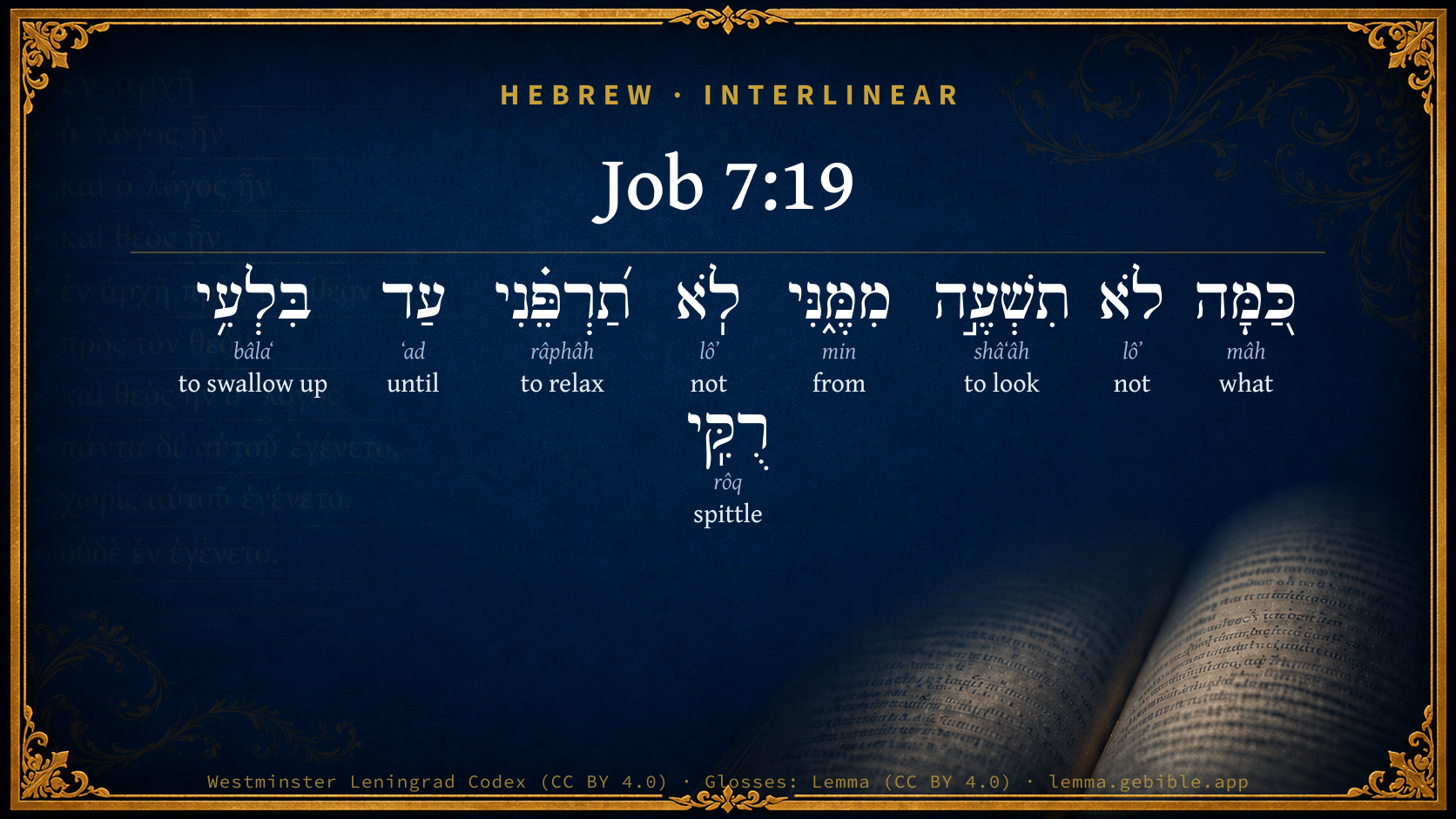
Hebrew (Westminster Leningrad Codex) Job 7:19 appears in the Hebrew Old Testament. The text above is from the Westminster Leningrad Codex. Each word links to its Strong’s number, a concise gloss, and parsing drawn from the Open Scriptures Hebrew Bible morphology. Click any word for its full Brown-Driver-Briggs (BDB) entry.
Download image
Cite this verse

Job 7:19 (World English Bible). Public Domain. Lemma interlinear Bible study tool, https://lemma.gebible.app/v/job/7/19.

Show BibTeX & RIS
BibTeX
RIS
English Translation
How long will you not look away from me, Nor leave me alone until I swallow down my spittle?
World English Bible · Public Domain
Highlights
  • 1 first appearance in the Hebrew Bible
Full analysis ↓
Download a study sheet

One document with this verse’s original text, its word-by-word gloss line, the meaning frame, cross-references with their text, attributed commentary, and full source and license credits — printable, and it pastes into notes with its structure intact.

This verse Autodidact and up

Study sheet (.html) Plain text (.txt)

A passage Seminary Student

Up to 50 verses in one chapter. A passage sheet keeps up to 6 commentary sources and 12 cross-references per verse, in the order this page ranks them, and says so on the sheet whenever that leaves anything out. Ask for a single verse and you get the Autodidact verse sheet above.

Everything on this page stays free to read, with no account — the sheet is a download of what is already on screen, not access to it.

Want to remove ads? Support Godless Engineer
Compare translations 3

The same verse in 3 English versions, stacked beneath the original-language interlinear above. Click any original word for its lexicon entry.

Each is an independent rendering of the whole verse — the interlinear is not word-aligned to these translations.

Highlighted words mark where these versions differ — a whole-verse word diff, not a word-by-word alignment.

  • World English Bible Public Domain
    How long will you not look away from me, Nor leave me alone until I swallow down my spittle?
  • King James Version Public Domain
    How long wilt thou not depart from me, nor let me alone till I swallow down my spittle?
  • unfoldingWord Literal Text CC BY-SA 4.0
    For how long will you not look away from me? Will you not slacken until I swallow my saliva?

unfoldingWord Literal Text — © unfoldingWord, licensed CC BY-SA 4.0. Word-aligned USFM3 via Door43 (git.door43.org/unfoldingWord/en_ult).

Versions to compare (up to 4)

3 of 4 selected

Show all 18 translations

Every available English version of this verse, each an independent rendering of the whole verse.

  • World English Bible Public Domain
    How long will you not look away from me, Nor leave me alone until I swallow down my spittle?
  • Berean Standard Bible Public Domain
    Will You never look away from me, or leave me alone to swallow my spittle?
  • Majority Standard Bible Public Domain
    Will You never look away from me, or leave me alone to swallow my spittle?
  • King James Version Public Domain
    How long wilt thou not depart from me, nor let me alone till I swallow down my spittle?
  • American Standard Version (1901) Public Domain
    How long wilt thou not look away from me, Nor let me alone till I swallow down my spittle?
  • Revised Version (1885) Public Domain
    How long wilt thou not look away from me, nor let me alone till I swallow down my spittle?
  • Geneva Bible (1599) Public Domain
    Howe long will it be yer thou depart from me? thou wilt not let me alone whiles I may swallowe my spettle.
  • Douay-Rheims (1899) Public Domain
    How long wilt thou not spare me, nor suffer me to swallow down my spittle?
  • Young's Literal Translation Public Domain
    How long dost Thou not look from me? Thou dost not desist till I swallow my spittle.
  • Literal Standard Version CC BY-SA 4.0
    How long do You not look from me? You do not desist until I swallow my spittle.
  • Unlocked Literal Bible CC BY-SA 4.0
    How long will it be before you look away from me, before you let me alone long enough for me to swallow down my own saliva?
  • unfoldingWord Literal Text CC BY-SA 4.0
    For how long will you not look away from me? Will you not slacken until I swallow my saliva?
  • Darby Bible Public Domain
    How long wilt thou not look away from me, nor let me alone till I swallow down my spittle?
  • World Messianic Bible Public Domain
    How long will you not look away from me, nor leave me alone until I swallow down my spittle?
  • Webster's Bible Public Domain
    How long wilt thou not depart from me, nor let me alone till I swallow my spittle?
  • Free Bible Version CC BY-SA 4.0
    Won't you ever leave me alone long enough to catch my breath?
  • Bible in Basic English Public Domain
    How long will it be before your eyes are turned away from me, so that I may have a minute's breathing-space?
  • JPS Tanakh (1917) Public Domain
    How long wilt Thou not look away from me, nor let me alone till I swallow down my spittle?

Literal Standard Version (2020), Covenant Press — licensed CC BY-SA 4.0. Text via the HelloAO Bible API (eBible.org). Unlocked Literal Bible (unfoldingWord) — licensed CC BY-SA 4.0. Text via the HelloAO Bible API (eBible.org). unfoldingWord Literal Text — © unfoldingWord, licensed CC BY-SA 4.0. Word-aligned USFM3 via Door43 (git.door43.org/unfoldingWord/en_ult). Free Bible Version, Dr. Jonathan Gallagher — licensed CC BY-SA 4.0. Text via the HelloAO Bible API (eBible.org).

Word by word

More ways to search: Search by grammar → Find every occurrence → Compare this word →

Practice this passage: Drill this verse → Learn its vocabulary →

About this verse

These counts appear in no published source. They are computed here, from the morphology-tagged text and Lemma’s own curated glosses. What Lemma adds →

9
words
8
distinct lemmas
Wisdom
section

Notable vocabulary

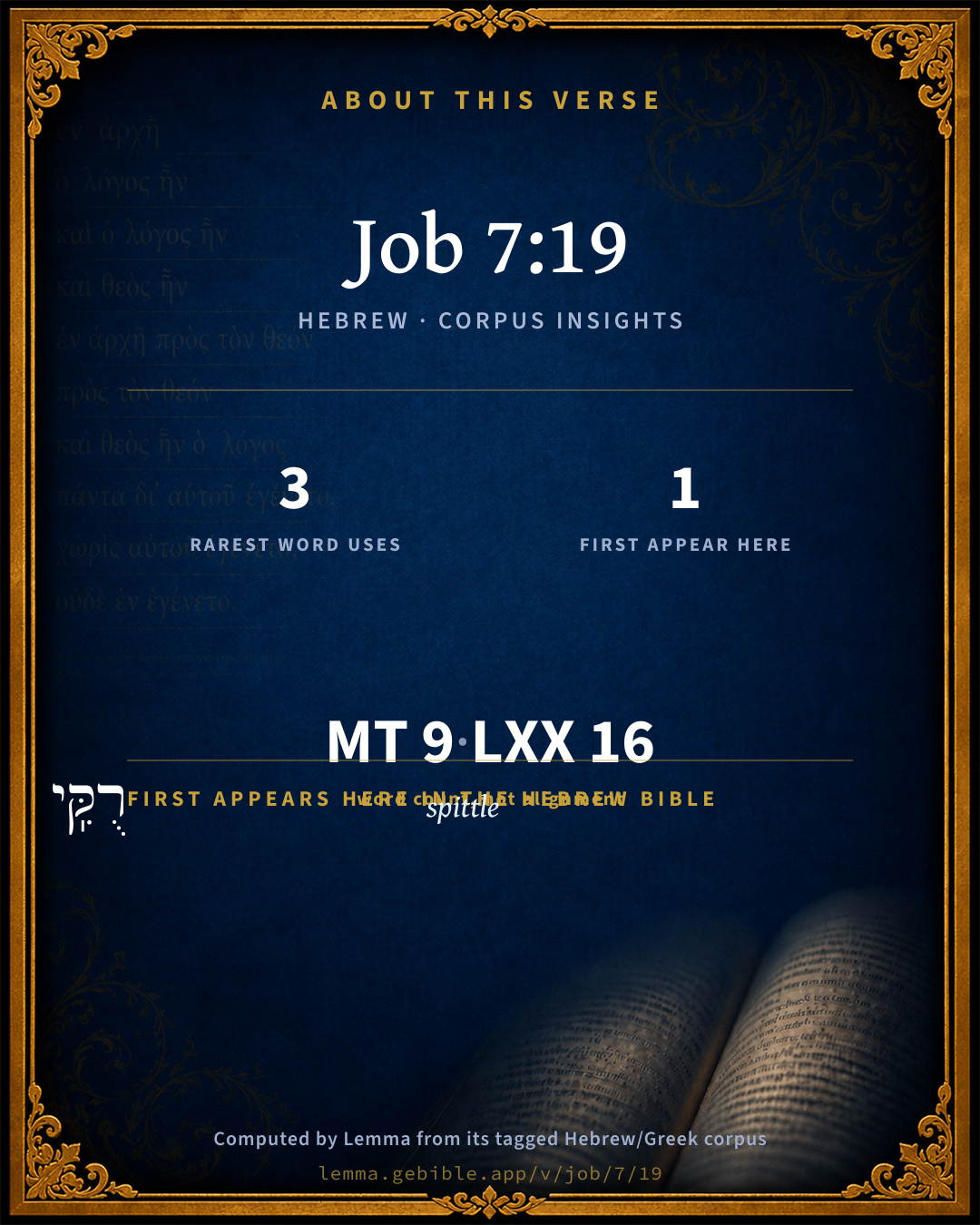
The rarest word here is רֻקִּֽי spittle H7536 — appearing just 3 times in the whole Hebrew Bible.

First appearance in Scripture

This word makes its first canonical appearance in the Hebrew Bible here:

  • רֻקִּֽי spittle H7536

Shared distinctive vocabulary

רֻקִּֽי spittle H7536 occurs in 3 verses of the Hebrew Bible. Also found in:

Grammatical profile

  • 3 verbs
  • 1 noun
  • 2 prepositions
  • 3 particles

Verb forms

  • תִשְׁעֶ֣ה Qal · Imperfect
  • תַ֝רְפֵּ֗נִי Hiphil · Imperfect
  • בִּלְעִ֥י Qal · Infinitive Construct

Repetition

A word recurs within this verse — often emphatic in Hebrew:

Hebrew & Septuagint length

In English translation the verse runs 19 words from the Hebrew and 19 from the Septuagint (LXX English) — the same length.

A rough comparison of the two English renderings, which tokenize alike — not a word-level alignment.

Word counts can differ between the Hebrew and the Greek without any difference in meaning — e.g. the Hebrew direct-object marker אֵת has no separate Greek word, and Greek often adds the article ὁ.

In the original languages it is 9 Hebrew tokens and 16 Greek tokens — but the two are counted differently (Hebrew bundles its prefixes and suffixes into one token; the Greek is in lemma form), so that isn’t a like-for-like length.

Cross-references

6

Topical passages linked to Job 7:19 in the Treasury of Scripture Knowledge — connected by theme and wording, ordered by reader-vote popularity; previews shown in the World English Bible.

  • Job 9:18 He will not allow me to take my breath, But fills me with bitterness.
  • Job 14:6 Look away from him, that he may rest, Until he shall accomplish, as a hireling, his day.
  • Psalms 13:1–3 How long, Yahweh? Will you forget me forever? How long will you hide your face from me?
  • Psalms 6:3 My soul is also in great anguish. But you, Yahweh--how long?
  • Psalms 94:3 Yahweh, how long will the wicked, How long will the wicked triumph?
  • Revelation 6:10 They cried with a loud voice, saying, "How long, Master, the holy and true, until you judge and avenge our blood on those who dwell on the earth?"

Cross-references courtesy of OpenBible.info (CC BY 4.0).

Hebrew and Greek witnesses Masoretic Hebrew ↔ Greek Septuagint

The same verse in the two great witnesses to the Old Testament, shown verse-for-verse.

These are two independent witnesses, not word-aligned to each other, and the Septuagint is shown in lemma (dictionary) form.

Hebrew Job 7:19 Masoretic · Westminster Leningrad Codex

כַּ֭מָּה לֹא תִשְׁעֶ֣ה מִמֶּ֑נִּי לֹֽא תַ֝רְפֵּ֗נִי עַד בִּלְעִ֥י רֻקִּֽי

How long will you not look away from me, Nor leave me alone until I swallow down my spittle?

World English Bible · Public Domain

Greek LXX Job 7:19 Septuagint · lemma form

ἕως τίς οὐ ἐάω ἐγώ οὐδέ προἵημι ἐγώ ἕως ἄν καταπίνω ὁ πτύελος ἐγώ ἐν ὀδύνη

How long do you not let me alone, nor let me go, until I shall swallow down my spittle?

LXX2012 (modern English Septuagint) · Public Domain

Hebrew: Westminster Leningrad Codex (CC BY 4.0). Greek: Septuagint (public domain); English from LXX2012 (modern English Septuagint) (Public Domain). How the Septuagint differs from the Hebrew →

Commentary

Notes on Job 7:19 from classic Christian and Jewish commentators (each source and its license shown beneath its notes). The classic Christian expositions comment on the surrounding passage and are grouped to its opening verse, so a note may address several verses; the Jewish commentaries on the Tanakh (Rashi and others) are per-verse, so they appear only where the commentator wrote on this verse.

Lemma curates 59 commentaries, every one of them public domain or Creative Commons licensed, each selected and text-cleaned for this edition rather than reprinted as found. About our sources →

Trapp's Complete Commentary

John Trapp

Job 7:19 How long wilt thou not depart from me, nor let me alone till I swallow down my spittle?

Ver. 19. How long wilt thou not depart from me] Here he seems desirous to be rid of God’s company, of his afflicting presence, Psa 139:10; so true is that of the apostle, Heb 12:11, "No chastening for the present seemeth to be joyous, but grievous," till patience come to have her perfect work, and men be brought to cry out, as one did under a great fit of the stone, The use, Lord, the use; not so much ease of my pain, as a good use of my suffering. This Job came to at length, no doubt; meanwhile, we have in him, as Mercer observeth, mirum ubique specimen, a wonderful instance of that conflict between flesh and spirit that is in the saints.

Yet let me alone, till I may swallow down my spittle?] That is, nor afford me the least intermission, no, not a spitting while. He will not suffer me to take my breath, Job 9:18. Jerome thinks that Job was troubled with a quinsey, or sore throat, which hindered the swallowing of his spittle; neither had he power to spit out the corrupt matter that ran down his throat. Oh what a sweet mercy is health! and how ill able are the best without special support from heaven to bear sickness! The Stoics, who said, that he who lived honestly might live cheerfully though under many bodily weaknesses, senserunt ipsi in morbis se magnificentius locutos esse quam verius, saith Wolfius; that is, when it came to their own turn to be sick, they well perceived that they had spoken rather bravely than truly.

John Trapp, A Commentary or Exposition upon All the Books of the Old and New Testament (1647–1656) — public domain. Text from a community e-Sword module.

Joseph Benson's Commentary

Job 7:19. How long wilt thou not depart from me — How long will it be ere thou withdraw thy afflicting hand from me? The Hebrew is literally, How long wilt thou not take thine eyes off me? “This,” says Dodd, “is a metaphor from combatants, who never take their eyes from off their antagonists. The figure is preserved in the next sentence, which represents a combatant seized by his adversary in such a manner as to prevent his swallowing his spittle or fetching his breath.” Till I swallow my spittle? —

For a little while: or, that I may have a breathing time: an Arabic proverb at present in use. See Schultens.

Joseph Benson's Commentary on the Old and New Testaments (1811–1818) — public domain. Text from a community e-Sword module.

Tyndale Open Study Notes

Tyndale Open Resources

7:19 Won’t you leave me alone (literally How long will you not look away from me): Job sought the opposite of the watchful care that faithful people usually seek (Num 6:25; Pss 27:9; 69:17; 80:3, 7, 19; Lam 1:9). • to swallow: This is equivalent to “a chance to catch my breath.”

Tyndale Open Study Notes — © Tyndale Open Resources, licensed CC BY-SA 4.0. Text via the HelloAO Bible API.

Jamieson, Fausset & Brown

Robert Jamieson, A. R. Fausset & David Brown

How long (like a jealous keeper) wilt thou never take thine eyes off (so the Hebrew for "depart from") me? Nor let me alone for a brief respite (literally, "so long as I take to swallow my spittle"), an Arabic proverb, like our, "till I draw my breath."

Jamieson, Fausset & Brown — Commentary Critical and Explanatory on the Whole Bible (1871) — public domain (CC PDM 1.0). Text via the HelloAO Bible API.

Adam Clarke's Commentary

Verse 19. Till I swallow down my spittle?] This is a proverbial expression, and exists among the Arabs to the present day; the very language being nearly the same. It signifies the same as, Let me draw my breath; give me a moment's space; let me have even the twinkling of an eye. I am urged by my sufferings to continue my complaint; but my strength is exhausted, my mouth dry with speaking. Suspend my sufferings even for so short a space as is necessary to swallow my spittle, that my parched tongue may be moistened, so that I may renew my complaint.

Adam Clarke's Commentary on the Bible (1810–1826) — public domain. Text from a community e-Sword/MySword module.

Ellicott's Commentary for English Readers

(19) Till I swallow down my spittle.—This is doubtless a proverbial expression, like “the twinkling of an eye,” or “while I fetch a breath.”

A Bible Commentary for English Readers, edited by Charles John Ellicott (1878–1897) — public domain. Text from a community e-Sword module.

The Cambridge Bible for Schools and Colleges

gen. ed. J. J. S. Perowne

19. depart from me] lit. look away from me; an impatient demand that God would turn away His plaguing glance; cf. “watcher of men,” Job_7:20.

swallow down my spittle] A proverbial phrase like “twinkling of an eye,” signifying a moment, as we might say “till I let over”; cf. “draw my breath,” ch. Job_9:18. To let one swallow his spittle is to give him a moment’s respite or time. The phrase is not unusual among the Arabs. In De Sacy’s Notes to Hariri, p. 164, a person tells the following: “I said to one of my Sheichs (teachers), Let me swallow my spittle; to which he replied, I will let you swallow the two Confluents (the Tigris and Euphrates).”

The Cambridge Bible for Schools and Colleges (gen. ed. J. J. S. Perowne; Cambridge University Press, 1878–1918) — public domain. Text from a community e-Sword module.

John Gill's Exposition

How long wilt thou not depart from me,.... From wrestling and contending with him, and afflicting of him; the Lord was too hard a combatant for job, and therefore he chose to be rid of him, and was impatient of it; or "look off from me" (u); so Mr. Broughton renders it, "how long wilt thou not look from me?" this is to be understood not of a look of love, which Job would never have desired to have averted from him; but a frowning and angry look, such as the Lord put on in this dispensation of his providence towards him; the allusion may be to that sharp and constant look, which antagonists in wrestling have upon each other while conflicting together, and so the metaphor before used is still carried on:

nor let me alone till I swallow down my spittle? some think Job has reference to his disease which affected his throat, that being so dried up, or having a quinsy in it, that he could not swallow his spittle, or it was with great difficulty he did it; or rather it is a proverbial expression, signifying that his afflictions were incessant, that he had no respite nor intermission, had not space enough given him to swallow down his spittle, or take his breath, as in Job 9:18; so Schultens observes, that with the Arabians this was a proverbial form of speech, when they required time for anything, "give me time to swallow my spittle"; or when they had not proper time, or any intermission, used to say, "you will not give me time to swallow my spittle"; and one being asked a multitude of questions, replied, "suffer me to swallow my spittle", that is, give me time to make an answer: or the sense is, that his antagonist in wrestling with him held him so fast, and kept him so close to it, and so twisted him about, and gave him fall upon fall, so that he had no time to swallow his spittle; or he so collared him, and gripped him, and almost throttled him, that he could not swallow it down; all which intends how closely and incessantly Job was followed with one affliction upon another, and how severe and distressing they were to him.

(u) "respicis a me?" Junius & Tremellius, Piscator, Cocceius, Schmidt, Michaelis; "avertis oculum a me?" Schultens.

John Gill's Exposition of the Whole Bible (1746–1763) — public domain (CC PDM 1.0). Text via the HelloAO Bible API.

Albert Barnes' Notes on the Bible

How long wilt thou not depart? - How long is this to continue? The same word occurs in Job 14:6. The word rendered “depart” שׁעה shâ‛âh means to look, to look around, and then to look away from anyone or anything. The idea here is, that God had fixed his eyes upon Job, and he asks with anxiety, how long this was to continue, and when he would turn his eyes away; compare the notes at Job 7:8. Schultens supposes that the metaphor here is taken from combatants, who never take their eyes from their antagonists.

Till I swallow down my spittle - For the shortest time. But there has been considerable variety in the explanation of this phrase. Herder renders it, “Until I draw my breath.” Noyes, “Until I have time to breathe;” but he acknowledges that he has substituted this for the proverb which occurs in the original. The Hebrew is literally rendered in the common version, and the proverb is retained in Arabia to the present day. The meaning is, Give me a little respite; allow me a little time; as we would say, Suffer me to breathe. “This,” says Burder, “is a proverb among the Arabians to the present day, by which they understand, Give me leave to rest after my fatigue. This is the favor which Job complains is not granted to him. There are two instances which illustrate this passage (quoted by Schultens) in Harris’s Narratives entitled the Assembly. One is of a person, who, when eagerly pressed to give an account of his travels, answered with impatience, ‘Let me swallow down my spittle, for my journey hath fatigued me.’ The other instance is of a quick return made to a person who used the proverb. ‘Suffer me, ‘ said the person importuned, ‘to swallow down my spittle;’ to which the friend replied, ‘You may, if you please, swallow down even the Tigris and the Euphrates; ‘ that is, You may take what time you please.”

The expression is proverbial, and corresponds to ours when we say, “in the twinkling of an eye,” or, “until I can catch my breath;” that is, in the briefest interval. Job addresses this language to God. There is much impatience in it, and much that a pious man should not employ; but we are to remember that Job was beset with special trials, and that he had not the views of the divine existence and perfections, the promises and the high hopes, which as Christians we have under the fuller light of revelation; and before harshly condemning him we should put ourselves in his situation, and ask ourselves how we would be likely to think and feel and speak if we were in the same circumstances.

Albert Barnes' Notes on the Bible (1834–1885) — public domain. Text from a community e-Sword/MySword module.

Matthew Poole's English Annotations

How long will it be ere thou withdraw thy afflicting hand from me?

Till I swallow down my spittle, i.e. for a little time; or that I may have a breathing time: a proverbial expression, like that Spanish proverb, I have not time or liberty to spit out my spittle. Or this expression may have respect to Job’s distempered and calamitous condition, wherewith he was so overwhelmed, that he either had not strength, or could not take heed, to spit out his spittle, as he should have done, but swallowed it down, as sick and melancholy persons often do.

Matthew Poole's English Annotations on the Holy Bible (1683–1685) — public domain. Text from a community e-Sword/MySword module.

Whedon's Commentary on the Bible

Daniel D. Whedon

19. Swallow down my spittle — A proverbial expression for the briefest interval. Just as we would say, “Let me draw my breath;” or, “In the twinkling of an eye.” Camus explains it, “Give me only time enough to swallow my spittle.” A witty retort, cited by Schultens from the Arabic, (Telebius,) will help to illustrate: “Suffer me,” said one, “to swallow down my spittle.” To this his friend replied, “You may, if you please, swallow down even Tigris and Euphrates.”

Daniel D. Whedon (gen. ed.), Commentary on the Old and New Testaments (1874–1909) — public domain. Text from a community e-Sword module.

The Pulpit Commentary

How long wilt thou not depart from me? rather, Wilt thou not look away from me? (see the Revised Version). Job does not go so far as to ask that God should "depart from" him. He knows, doubtless, that that would be the extreme of calamity. But he would have God sometimes turn away his eyes from him, and not always regard him so intently. There is something of the same tone of complaint in the psalmist"s utterance., "Thou art about my path, and about my bed, and spiest out all my ways". (Psa_139:3, Prayer-book Version) Nor let me alone till I swallow down my spittle? Even, i.e. , for the shortest space of time passible. A proverbial expression.

The Pulpit Commentary (1880–1919), ed. H.D.M. Spence-Jones & Joseph S. Exell — public domain. Text from a community e-Sword module.

John Wesley's Explanatory Notes

How long - How long will it be ere thou withdraw thy afflicting hand? Swallow - That I may have a breathing time: a proverbial expression.

John Wesley, Explanatory Notes Upon the Whole Bible (1754–1765) — public domain. Text via the GEBible commentary corpus.

unfoldingWord translationNotes

Door43 World Missions Community

How long will it be ... swallow down my own saliva?

Here Job conveys a single idea using two different rhetorical questions to emphasize his wish that God would stop watching him. AT: "Look away from me! Leave me alone long enough for me to swallow my own saliva!" (See: Parallelism and Rhetorical Question)

saliva

liquid produced in people's mouths that keeps the mouth moist and helps to swallow food

Even if I have sinned ... burden for you?

Job poses these questions to argue against God treating him unfairly. AT: "Even if I have sinned, that would do nothing to you, as you watch over people. Tell me why you have made me your target, so that I am a burden for you." (See: Rhetorical Question)

translationWords

sin

watch

burden

unfoldingWord translationNotes — © Distant Shores Media and the Door43 World Missions Community, licensed CC BY-SA 4.0. Source: git.door43.org/Door43/en_tn.

Rashi

Rabbi Shlomo Yitzchaki (Rashi)

How long For what length of time will You not desist from me, like (Exod. 5:9), “and let them not turn (ישעו) to false words.” Similarly (below 14:6), “Turn away (שעה) from him and desist.”

until I swallow my spit long enough to swallow my spit.

Rashi on the Tanakh — English translations: “The Judaica Press complete Tanach with Rashi, translated by A. J. Rosenberg” (CC BY 4.0); “Pentateuch with Rashi's commentary by M. Rosenbaum and A.M. Silbermann, 1929-1934” (public domain); “The Metsudah Tanach series, Lakewood, N.J” (CC BY 4.0); and “The Book of Joshua, Metsudah Publications, 1997” (CC BY 4.0). Text via Sefaria.

Lesson kit

Teaching starters — assembled from the data on this page, not authored interpretation. Every prompt links to the verse data it draws on. Edit before teaching.

Job, in the Wisdom, opens this verse with 9 words (8 distinct Hebrew lemmas). Its most distinctive word is rôq (“spittle”). A historical commentator’s framing appears above. Read the whole chapter for the surrounding context.

Discussion questions

  1. The word rôq carries the sense “spittle.” How does it shape the verse?
  2. The word “spittle” first appears here in Scripture. What is being introduced at this debut?
  3. Job 30:10 shares the word «spittle» with this verse. How do the two illuminate each other?
  4. “not” occurs 2× in this one verse. What is the effect of the repetition?
  5. These translations render this verse differently; the difference is in the English rendering, not the original. What questions does that raise?
  6. The verb «תִשְׁעֶ֣ה» is Qal Imperfect. How does its form color the action?
  7. Reading how Trapp's Complete Commentary and Joseph Benson's Commentary read this verse, where do the two commentators agree and where do they part?

Things to notice

Reading settings

Reading text

Shown beneath each verse's original-language words.

Old Testament
Old Testament edition

Read the OT as the Masoretic Hebrew (MT) or the Greek Septuagint (LXX).

English shown for the Greek Septuagint (in the Hebrew ↔ Greek comparison).

Comparing translations? Open the Compare panel on any verse page to stack up to four side by side.