
Ecclesiastes 5:6

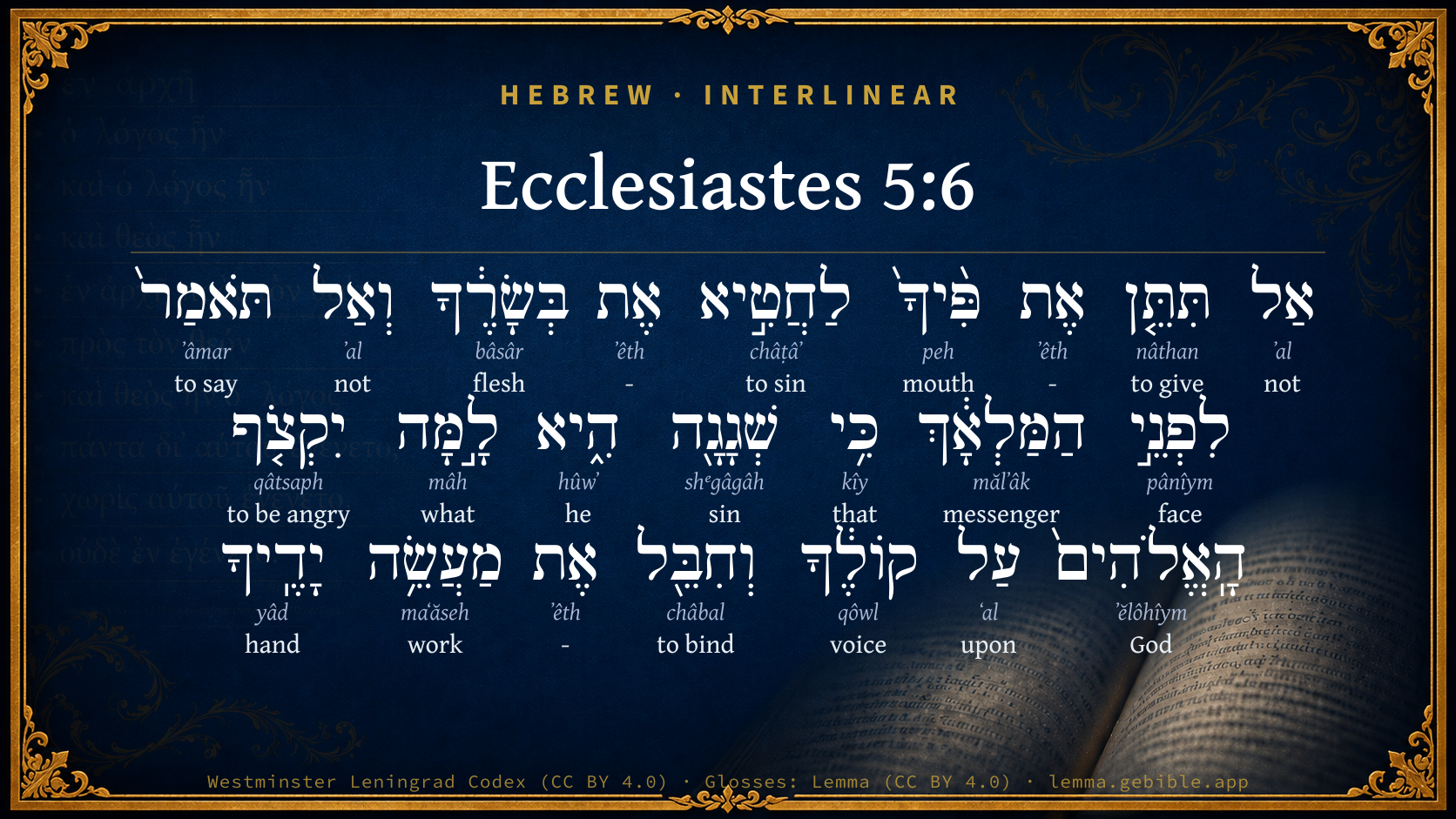
Hebrew (Westminster Leningrad Codex) Ecclesiastes 5:6 appears in the Hebrew Old Testament. The text above is from the Westminster Leningrad Codex. Each word links to its Strong’s number, a concise gloss, and parsing drawn from the Open Scriptures Hebrew Bible morphology. Click any word for its full Brown-Driver-Briggs (BDB) entry.
Download image
Cite this verse

Ecclesiastes 5:6 (World English Bible). Public Domain. Lemma interlinear Bible study tool, https://lemma.gebible.app/v/ecclesiastes/5/6.

Show BibTeX & RIS
BibTeX
RIS
English Translation
Don't allow your mouth to lead you into sin. Don't protest before the messenger that this was a mistake. Why should God be angry at your voice, and destroy the work of your hands?
World English Bible · Public Domain
Download a study sheet

One document with this verse’s original text, its word-by-word gloss line, the meaning frame, cross-references with their text, attributed commentary, and full source and license credits — printable, and it pastes into notes with its structure intact.

This verse Autodidact and up

Study sheet (.html) Plain text (.txt)

A passage Seminary Student

Up to 50 verses in one chapter. A passage sheet keeps up to 6 commentary sources and 12 cross-references per verse, in the order this page ranks them, and says so on the sheet whenever that leaves anything out. Ask for a single verse and you get the Autodidact verse sheet above.

Everything on this page stays free to read, with no account — the sheet is a download of what is already on screen, not access to it.

Want to remove ads? Support Godless Engineer
Compare translations 3

The same verse in 3 English versions, stacked beneath the original-language interlinear above. Click any original word for its lexicon entry.

Each is an independent rendering of the whole verse — the interlinear is not word-aligned to these translations.

Highlighted words mark where these versions differ — a whole-verse word diff, not a word-by-word alignment.

  • World English Bible Public Domain
    Don't allow your mouth to lead you into sin. Don't protest before the messenger that this was a mistake. Why should God be angry at your voice, and destroy the work of your hands?
  • King James Version Public Domain
    Suffer not thy mouth to cause thy flesh to sin; neither say thou before the angel, that it was an error: wherefore should God be angry at thy voice, and destroy the work of thine hands?
  • unfoldingWord Literal Text CC BY-SA 4.0
    Do not give your mouth to cause your flesh to sin, and do not say to the face of the messenger that it an unintentional sin. Why should God be angry concerning your voice and destroy the deed of your hands?

unfoldingWord Literal Text — © unfoldingWord, licensed CC BY-SA 4.0. Word-aligned USFM3 via Door43 (git.door43.org/unfoldingWord/en_ult).

Versions to compare (up to 4)

3 of 4 selected

Show all 18 translations

Every available English version of this verse, each an independent rendering of the whole verse.

  • World English Bible Public Domain
    Don't allow your mouth to lead you into sin. Don't protest before the messenger that this was a mistake. Why should God be angry at your voice, and destroy the work of your hands?
  • Berean Standard Bible Public Domain
    Do not let your mouth cause your flesh to sin, and do not tell the messenger that your vow was a mistake. Why should God be angry with your words and destroy the work of your hands?
  • Majority Standard Bible Public Domain
    Do not let your mouth cause your flesh to sin, and do not tell the messenger that your vow was a mistake. Why should God be angry with your words and destroy the work of your hands?
  • King James Version Public Domain
    Suffer not thy mouth to cause thy flesh to sin; neither say thou before the angel, that it was an error: wherefore should God be angry at thy voice, and destroy the work of thine hands?
  • American Standard Version (1901) Public Domain
    Suffer not thy mouth to cause thy flesh to sin; neither say thou before the angel, that is was an error: wherefore should God be angry at thy voice, and destroy the work of thy hands?
  • Revised Version (1885) Public Domain
    Suffer not thy mouth to cause thy flesh to sin; neither say thou before the angel, that it was an error: wherefore should God be angry at thy voice, and destroy the work of thine hands?
  • Geneva Bible (1599) Public Domain
    For in the multitude of dreames, and vanities are also many wordes: but feare thou God.
  • Douay-Rheims (1899) Public Domain
    Where there are many dreams, there are many vanities, and words without number: but do thou fear God.
  • Young's Literal Translation Public Domain
    Suffer not thy mouth to cause thy flesh to sin, nor say before the messenger, that `it `is' an error,' why is God wroth because of thy voice, and hath destroyed the work of thy hands?
  • Literal Standard Version CC BY-SA 4.0
    Do not permit your mouth to cause your flesh to sin, nor say before the messenger that it [is] ignorance. Why is God angry because of your voice and has destroyed the work of your hands?
  • Unlocked Literal Bible CC BY-SA 4.0
    Do not allow your mouth to cause your flesh to sin. Do not say to the priest's messenger, “That vow was a mistake.” Why make God angry by vowing falsely, provoking God to destroy the work of your hands?
  • unfoldingWord Literal Text CC BY-SA 4.0
    Do not give your mouth to cause your flesh to sin, and do not say to the face of the messenger that it an unintentional sin. Why should God be angry concerning your voice and destroy the deed of your hands?
  • Darby Bible Public Domain
    Suffer not thy mouth to cause thy flesh to sin; neither say thou before the angel, that it was an inadvertence. Wherefore should God be wroth at thy voice, and destroy the work of thy hands?
  • World Messianic Bible Public Domain
    Don’t allow your mouth to lead you into sin. Don’t protest before the messenger that this was a mistake. Why should God be angry at your voice, and destroy the work of your hands?
  • Webster's Bible Public Domain
    \\5:7\\For in the multitude of dreams and many words there are also divers vanities: but fear thou God.
  • Free Bible Version CC BY-SA 4.0
    Don't let your mouth cause you to sin. And don't tell the priest that your vow was a mistake, for why would you antagonize God by breaking your promise? He could bring your own curse down on you.
  • Bible in Basic English Public Domain
    Because much talk comes from dreams and things of no purpose. But let the fear of God be in you.
  • JPS Tanakh (1917) Public Domain
    (5-5) Suffer not thy mouth to bring thy flesh into guilt, neither say thou before the messenger, that it was an error; wherefore should God be angry at thy voice, and destroy the work of thy hands?

Literal Standard Version (2020), Covenant Press — licensed CC BY-SA 4.0. Text via the HelloAO Bible API (eBible.org). Unlocked Literal Bible (unfoldingWord) — licensed CC BY-SA 4.0. Text via the HelloAO Bible API (eBible.org). unfoldingWord Literal Text — © unfoldingWord, licensed CC BY-SA 4.0. Word-aligned USFM3 via Door43 (git.door43.org/unfoldingWord/en_ult). Free Bible Version, Dr. Jonathan Gallagher — licensed CC BY-SA 4.0. Text via the HelloAO Bible API (eBible.org).

Word by word

More ways to search: Search by grammar → Find every occurrence → Compare this word →

Practice this passage: Drill this verse → Learn its vocabulary →

שְׁגָגָ֖ה
shᵉgâgâh
H7684
“sin”
Noun, Common, Feminine, Singular, Absolute
Part of Speech
Noun
Type
Common
Gender
Feminine
Number
Singular
State
Absolute
Full BDB Definition

Origin: from H7683

TWOT: 2324a

sin, sin of error or inadvertence, inadvertent sin - error
  1. אַל ʼal H408 “not” Particle, Negative
  2. תִּתֵּ֤ן nâthan H5414 “to give” Verb, Qal, Jussive, 2nd Person, Masculine, Singular
  3. אֶת ʼêth H853 “-” Particle, Direct Object
  4. פִּ֨יךָ֙ peh H6310 “mouth · your” Noun, Common, Masculine, Singular, Construct + Suffix, Personal, 2nd Person, Masculine, Singular
  5. לַחֲטִ֣יא châṭâʼ H2398 “to sin” Preposition + Verb, Hiphil, Infinitive Construct
  6. אֶת ʼêth H853 “-” Particle, Direct Object
  7. בְּשָׂרֶ֔ךָ bâsâr H1320 “flesh · your” Noun, Common, Masculine, Singular, Construct + Suffix, Personal, 2nd Person, Masculine, Singular
  8. וְאַל ʼal H408 “and · not” Conjunction + Particle, Negative
  9. תֹּאמַר֙ ʼâmar H559 “to say” Verb, Qal, Jussive, 2nd Person, Masculine, Singular
  10. לִפְנֵ֣י pânîym H6440 “to/for · face(s) of” Preposition + Noun, Common, Both, Plural, Construct
  11. הַמַּלְאָ֔ךְ mălʼâk H4397 “the · messenger” Particle, Definite Article + Noun, Common, Masculine, Singular, Absolute
  12. כִּ֥י kîy H3588 “that” Conjunction
  13. הִ֑יא hûwʼ H1931 “he” Pronoun, Personal, 3rd Person, Feminine, Singular
  14. לָ֣מָּה mâh H4100 “to/for · what” Preposition + Particle, Interrogative
  15. יִקְצֹ֤ף qâtsaph H7107 “to be angry” Verb, Qal, Imperfect, 3rd Person, Masculine, Singular
  16. הָֽאֱלֹהִים֙ ʼĕlôhîym H430 “the · God(s)” Particle, Definite Article + Noun, Common, Masculine, Plural, Absolute
  17. עַל ʻal H5921 “upon” Preposition
  18. קוֹלֶ֔ךָ qôwl H6963 “voice · your” Noun, Common, Masculine, Singular, Construct + Suffix, Personal, 2nd Person, Masculine, Singular
  19. וְחִבֵּ֖ל châbal H2254 “and · to bind” Conjunction + Verb, Piel, Sequential Perfect, 3rd Person, Masculine, Singular
  20. אֶת ʼêth H853 “-” Particle, Direct Object
  21. מַעֲשֵׂ֥ה maʻăseh H4639 “work of” Noun, Common, Masculine, Singular, Construct
  22. יָדֶֽיךָ yâd H3027 “hands · your” Noun, Common, Both, Dual, Construct + Suffix, Personal, 2nd Person, Masculine, Singular

About this verse

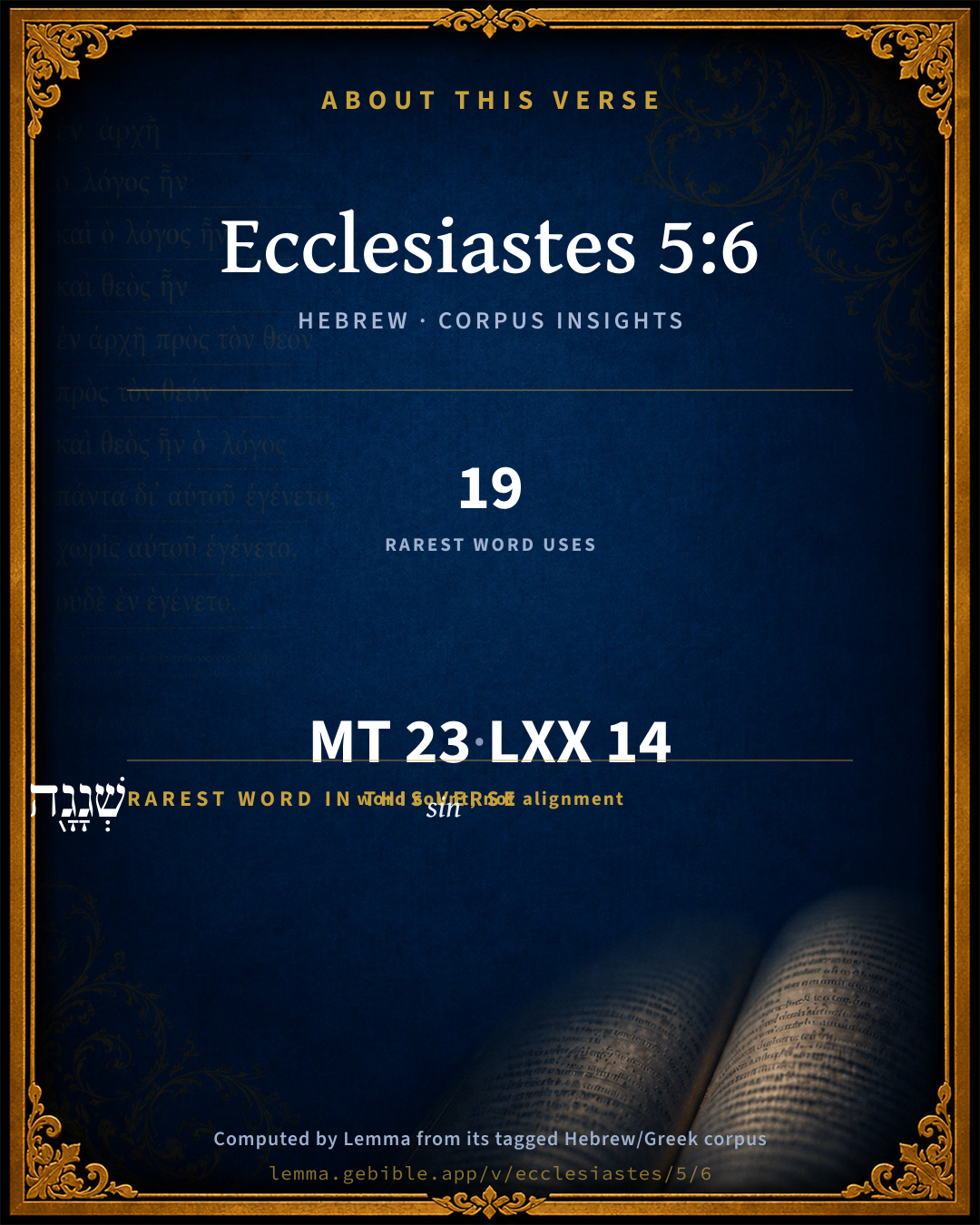
These counts appear in no published source. They are computed here, from the morphology-tagged text and Lemma’s own curated glosses. What Lemma adds →

23
words
20
distinct lemmas
Wisdom
section

Notable vocabulary

The rarest word here is שְׁגָגָ֖ה sin H7684 — appearing just 19 times in the whole Hebrew Bible.

Shared distinctive vocabulary

שְׁגָגָ֖ה sin H7684 occurs in 18 verses of the Hebrew Bible. Also found in:

Grammatical profile

  • 5 verbs
  • 9 nouns
  • 1 pronoun
  • 1 preposition
  • 1 conjunction
  • 6 particles

Verb forms

  • תִּתֵּ֤ן Qal · Jussive
  • לַחֲטִ֣יא Hiphil · Infinitive Construct
  • תֹּאמַר֙ Qal · Jussive
  • יִקְצֹ֤ף Qal · Imperfect
  • וְחִבֵּ֖ל Piel · Sequential Perfect

Repetition

A word recurs within this verse — often emphatic in Hebrew:

  • אַל not H408 ×2

Hebrew & Septuagint length

In English translation the verse runs 34 words from the Hebrew and 18 from the Septuagint (LXX English) — the Septuagint runs noticeably shorter here. See the side-by-side →

A rough comparison of the two English renderings, which tokenize alike — not a word-level alignment.

Word counts can differ between the Hebrew and the Greek without any difference in meaning — e.g. the Hebrew direct-object marker אֵת has no separate Greek word, and Greek often adds the article ὁ.

In the original languages it is 23 Hebrew tokens and 14 Greek tokens — but the two are counted differently (Hebrew bundles its prefixes and suffixes into one token; the Greek is in lemma form), so that isn’t a like-for-like length.

Cross-references

10

Topical passages linked to Ecclesiastes 5:6 in the Treasury of Scripture Knowledge — connected by theme and wording, ordered by reader-vote popularity; previews shown in the World English Bible.

  • James 1:26 If anyone among you thinks himself to be religious while he doesn't bridle his tongue, but deceives his heart, this man's religion is worthless.
  • 2 John 1:8 Watch yourselves, that we don't lose the things which we have accomplished, but that we receive a full reward.
  • James 3:2 For in many things we all stumble. If anyone doesn't stumble in word, the same is a perfect man, able to bridle the whole body also.
  • Ecclesiastes 5:1–2 Guard your steps when you go to God's house; for to draw near to listen is better than to give the sacrifice of fools, for they don't know that they do evil.
  • Malachi 2:7 For the priest's lips should keep knowledge, and they should seek the law at his mouth; for he is the messenger of Yahweh of Hosts.
  • Leviticus 5:4–6 "'Or if anyone swears rashly with his lips to do evil, or to do good, whatever it is that a man might utter rashly with an oath, and it is hidden from him; when he knows of it, then he shall be guilty of one of these.
  • Genesis 48:16 the angel who has redeemed me from all evil, bless the lads, and let my name be named on them, and the name of my fathers Abraham and Isaac. Let them grow into a multitude in the midst of the earth."
  • Numbers 15:25 The priest shall make atonement for all the congregation of the children of Israel, and they shall be forgiven; for it was an error, and they have brought their offering, an offering made by fire to Yahweh, and their sin-offering before Yahweh, for their error:
  • 1 Corinthians 3:13–15 each man's work will be revealed. For the Day will declare it, because it is revealed in fire; and the fire itself will test what sort of work each man's work is.
  • Hebrews 1:14 Aren't they all ministering spirits, sent out to do service for the sake of those who will inherit salvation?

Cross-references courtesy of OpenBible.info (CC BY 4.0).

Hebrew and Greek witnesses Masoretic Hebrew ↔ Greek Septuagint

The same verse in the two great witnesses to the Old Testament, shown verse-for-verse.

Here the Septuagint runs noticeably shorter than the Hebrew — LXX2012 (modern English Septuagint) 18 words vs World English Bible 34. A rough length comparison of the two English translations, not a word-level alignment — read both below.

These are two independent witnesses, not word-aligned to each other, and the Septuagint is shown in lemma (dictionary) form.

Hebrew Ecclesiastes 5:6 Masoretic · Westminster Leningrad Codex

אַל תִּתֵּ֤ן אֶת פִּ֨יךָ֙ לַחֲטִ֣יא אֶת בְּשָׂרֶ֔ךָ וְאַל תֹּאמַר֙ לִפְנֵ֣י הַמַּלְאָ֔ךְ כִּ֥י שְׁגָגָ֖ה הִ֑יא לָ֣מָּה יִקְצֹ֤ף הָֽאֱלֹהִים֙ עַל קוֹלֶ֔ךָ וְחִבֵּ֖ל אֶת מַעֲשֵׂ֥ה יָדֶֽיךָ

Don't allow your mouth to lead you into sin. Don't protest before the messenger that this was a mistake. Why should God be angry at your voice, and destroy the work of your hands?

World English Bible · Public Domain

Greek LXX Ecclesiastes 5:6 Septuagint · lemma form

ὅτι ἐν πλῆθος ἐνύπνιον καί ματαιότης καί λόγος πολύς ὅτι σύν ὁ θεός φοβέω

For there is evil in a multitude of dreams and vanities and many words: but fear you God.

LXX2012 (modern English Septuagint) · Public Domain

On this verse, Albert Barnes' Notes on the Bible discusses the Septuagint’s reading. Read the note in Commentary ↓

Hebrew: Westminster Leningrad Codex (CC BY 4.0). Greek: Septuagint (public domain); English from LXX2012 (modern English Septuagint) (Public Domain). How the Septuagint differs from the Hebrew →

Commentary

Notes on Ecclesiastes 5:6 from classic Christian and Jewish commentators (each source and its license shown beneath its notes). The classic Christian expositions comment on the surrounding passage and are grouped to its opening verse, so a note may address several verses; the Jewish commentaries on the Tanakh (Rashi and others) are per-verse, so they appear only where the commentator wrote on this verse.

Lemma curates 59 commentaries, every one of them public domain or Creative Commons licensed, each selected and text-cleaned for this edition rather than reprinted as found. About our sources →

Trapp's Complete Commentary

John Trapp

Ecc 5:6 Suffer not thy mouth to cause thy flesh to sin; neither say thou before the angel, that it [was] an error: wherefore should God be angry at thy voice, and destroy the work of thine hands?

Ver. 6. Suffer not thy mouth to cause thy flesh to sin.] Heb., Nec des, Give not liberty to thy mouth, which of itself is so apt to overflow and run riot in sinful and superfluous language. Rein it in therefore, and lay laws upon it, lest it "cause thy flesh to sin," thyself to become a sinner against thine own soul. Say to it in this case, as Christ did to those Pharisees in the gospel, "Why temptest thou me, thou hypocrite?" or as the witch said to Saul, that sought to her, "Wherefore layest thou a snare for my life, to cause me to die?" {1Sa 28:9} Shall my prayer become sin, and my religious vows, through non-payment, a cause of a curse? {Psa 109:7} When thou art making such an ill bargain, say to thy mouth, as Boaz said to his kinsman, "At what time thou buyest it, thou must have Ruth with it"; {Rth 4:5} so thou must have God’s curse with it - for that is the just hire of the least sin, {Rom 6:23} how much more of thy crimson crime! And let thy mouth answer, No, I may not do it; I shall mar and spoil a better inheritance; I shall anger the angel of the covenant, who, if his wrath be kindled, yea, but a little, "he will not pardon my transgression, for God’s name is in him," {Exo 23:21} who, as he is pater miserationum, "the Father of mercies," so he is Deus ultionum, "the God of recompenses." {Psa 94:1} True it is that anger is not properly in God; "Fury is not in me"; {Isa 27:4} but because he chides and smites for sin, as angry men use to do, therefore is anger here and elsewhere attributed to him, that men may stand in awe and not sin, since sin and punishment are linked together with chains of adamant.

John Trapp, A Commentary or Exposition upon All the Books of the Old and New Testament (1647–1656) — public domain. Text from a community e-Sword module.

Joseph Benson's Commentary

Ecc 5:6. Suffer not thy mouth — By any rash vow, or in any other way; to cause thy flesh to sin — That is, thyself: the word flesh being often put for the whole man; neither say thou before the angel — That is, as some interpret the expression, before the blessed angels, (the singular number being put for the plural,) who are present in the public assemblies, in which these vows were generally paid, (Psa 66:13,) where they observe men’s religious performances, (1Co 11:10,) and, as they rejoice in the conversion of a sinner, so are displeased with the sins of men. Or, 2d, Christ may be meant, the Angel of the covenant, as he is called Mal 3:1; who, even in these ancient times, acted as God’s messenger, appearing and speaking to the patriarchs and prophets in his Father’s name; and who was, and, according to his promise, is, in an especial manner, present in all religious assemblies, observing the whole conduct of all that worship in them. Or, 3d, as many think more probable, the priest, or minister of holy things, is here intended. Such persons are often called angels, or, as the Hebrew word here used is commonly rendered, messengers. And this title may be given to the priest here, because the vow made to God was to be paid to the priest, as one standing and acting in God’s name and stead; and it belonged to him, as God’s angel or ambassador, to discharge persons from their vows when there was just occasion. It was an error — I did unadvisedly in making such a vow. Wherefore should God be angry — Why wilt thou provoke God to anger by these frivolous excuses? And destroy the work of thy hands — Blast all thy labours, and particularly that work or enterprise for the success whereof thou didst make these vows.

Joseph Benson's Commentary on the Old and New Testaments (1811–1818) — public domain. Text from a community e-Sword module.

Jamieson, Fausset & Brown

Robert Jamieson, A. R. Fausset & David Brown

thy flesh--Vow not with "thy mouth" a vow (for example, fasting), which the lusts of the flesh ("body," Ecc 2:3, Margin) may tempt thee to break (Pro 20:25).

angel--the "messenger" of God (Job 33:23); minister (Rev 1:20); that is, the priest (Mal 2:7) "before" whom a breach of a vow was to be confessed (Lev 5:4-5). We, Christians, in our vows (for example, at baptism, the Lord's Supper, &c.) vow in the presence of Jesus Christ, "the angel of the covenant" (Mal 3:1), and of ministering angels as witnesses (Co1 11:10; Ti1 5:21). Extenuate not any breach of them as a slight error.

Jamieson, Fausset & Brown — Commentary Critical and Explanatory on the Whole Bible (1871) — public domain (CC PDM 1.0). Text via the HelloAO Bible API.

Adam Clarke's Commentary

Verse 6. Neither say thou before the angel, that it was an error] Nor think of saying "before the cruel angel, who shall exercise authority over thee in the judgment of the great day, that thou didst it through ignorance." - Chaldee. I believe by the angel nothing else is intended than the priest, whose business it was to take cognizance of vows and offerings. See Le 5:4-5. In Mal 2:7, the priest is called the "angel of the Lord of hosts."

Adam Clarke's Commentary on the Bible (1810–1826) — public domain. Text from a community e-Sword/MySword module.

Ellicott's Commentary for English Readers

(6) The angel.—It has been proposed to translate this word the “messenger,” or ambassador of God, and understand “the priest” (see Mal_2:7); and it has been regarded as one of the notes of later date in this book that the word should be used in such a sense. But even in the passage of Malachi there is no trace that the word “angel” had then become an ordinary name for the priest, such as would be intelligible if used in that sense without explanation from the context. Neither, again, is there reason for supposing that the priest had power to dispense with vows alleged to have been rashly undertaken. The power given him (Leviticus 27) is of a different nature. I therefore adhere to the obvious sense, which suggests that the real vow is observed and recorded by a heavenly angel. It falls in with this view that the phrase is “before the angel.” If an excuse pleaded to a priest was intended, we should have, “Say not thou to the priest.”

Error.—The word is that which describes sins of ignorance (Numbers 15). The tacit assumption in this verse, that God interposes to punish when His name is taken in vain, clearly expresses the writer’s real conviction, and shows that such a verse as Ecc_9:2 is only the statement of a speculative difficulty.

A Bible Commentary for English Readers, edited by Charles John Ellicott (1878–1897) — public domain. Text from a community e-Sword module.

The Cambridge Bible for Schools and Colleges

gen. ed. J. J. S. Perowne

6. Suffer not thy mouth to cause thy flesh to sin] The “mouth” may refer either to the thoughtless utterance of the rash vow, such as that of Jephthah (Jdg_11:30) or Saul (1Sa_14:24), or to the appetite which leads the man who has made a vow, say of the Nazarite type, to indulge in the drink or food which he had bound himself to renounce. The former meaning seems more in harmony with the context. The latter clause is translated by many Commentators to bring punishment (the expiation for sin) upon thy flesh, but the A.V. is probably correct. The “flesh” stands as in Gen_6:3; Psa_78:39, and in New Testament language (Rom_7:18; Rom_7:25), for the corrupt sensuous element in man’s nature. The context forbids the extension of the precept to sins of speech in general, as in the wider teaching of Jas_3:1-12.

neither say thou before the angel] The words have been taken by most Jewish and some Christian interpreters as referring to the “angel” in the strict sense of the term, who was believed in Rabbinic traditions to preside over the Temple or the altar, and who, it is assumed, would punish the evasion of the vow on the frivolous excuse that it had been spoken inconsiderately. 1Co_11:13 and 1Ti_5:21 are referred to as illustrations of the same thought. This interpretation, however, seems scarcely in harmony with the generally Hellenised tone of the book, and in Hag_1:13 and Mal_2:7 we have distinct evidence that the term had come to be applied to prophets and priests, as in 2Co_8:23 and Rev_1:20 it is used of ministers in the Christian Church, and this, it is obvious, gives a tenable, and, on the whole, a preferable meaning. The man comes to the priest with an offering less in value than he had vowed, or postpones the fulfilment of his vow indefinitely, and using the technical language of Num_15:25, explains that the vow had been made in ignorance, and therefore that he was not bound to fulfil it to the letter. Other commentators again (Grätz) look on the word as describing a subordinate officer of the Temple.

wherefore should God be angry at thy voice] The question is in form like those of Ezr_4:22; Ezr_7:23, and is rhetorically more emphatic than a direct assertion. The words are a more distinct assertion of a Divine Government seen in earthly rewards and punishments than the book has as yet presented. The vow made, as was common, to secure safety or prosperity, could have no other result than loss and, it might be, ruin, if it were vitiated from the first by a rashness which took refuge in dishonesty.

The Cambridge Bible for Schools and Colleges (gen. ed. J. J. S. Perowne; Cambridge University Press, 1878–1918) — public domain. Text from a community e-Sword module.

John Gill's Exposition

Suffer not thy mouth to cause thy flesh to sin,.... That is, himself, who is corrupt and depraved; either by making a rash vow, which it is not in his power to keep; or such is the corruption of his nature, and the weakness of the flesh, that he cannot keep it; or by making sinful excuses after he has made the vow, and so is guilty of lying, or false swearing, or other sins of the flesh. Jarchi by "flesh" understands his children, on whom his iniquity may be visited and punished; and the Targum interprets this punishment of the judgment or condemnation of hell; see Pro 20:25;

neither say thou before the angel that it was an error; that it was done ignorantly and through mistake: that it was not intended, and that this was not the meaning of the vow; and therefore desires to be excused performing it, or to offer a sacrifice in lieu of it. Interpreters are divided about the angel before whom such an excuse should not be made. Some think angel is put for angels in general, in whose presence, and before whom, as witnesses, vows are made; and who were signified by the cherubim in the sanctuary, where they were to be performed, and who are present in the worshipping assemblies of saints, where these things are done, Ti1 5:21; others think the guardian angel is meant, which they suppose every man has; and others that Christ, the Angel of the covenant, is designed, who is in the midst of his people, sees and knows all that is done by them, and will not admit of their excuses; but it is most probable the priest is intended, called the angel, or messenger, of the Lord of hosts, Mal 2:7; to whom such who had made vows applied to be loosed from them, acknowledging their error in making them; or to offer sacrifice for their sin of ignorance, Lev 5:4;

wherefore should God be angry at thy voice; either in making a rash and sinful vow, or in excusing that which was made;

and destroy the work of thine hands? wrought with success, for which the vow was made; and so, instead of its succeeding, is destroyed, and comes to nothing. Vows made by the Jews were chiefly about their houses, or fields, or cattle; see Lev 27:28; and so the destruction suggested may signify the curse that God would bring upon any of these, for excusing or not performing the vow made.

John Gill's Exposition of the Whole Bible (1746–1763) — public domain (CC PDM 1.0). Text via the HelloAO Bible API.

Albert Barnes' Notes on the Bible

Suffer not thy mouth ... - i. e., Do not make rash vows which may hereafter be the cause of evasion and prevarication, and remain unfulfilled.

Before the angel - The Septuagint and some other versions render “before the face of God,” meaning a spiritual being representing the presence of God, a minister of divine justice Exo 23:21, such a one as inflicted judgment upon David 2Sa 24:17. Others, with less probability, understand the angel to be a priest, and refer to Mal 2:7.

Albert Barnes' Notes on the Bible (1834–1885) — public domain. Text from a community e-Sword/MySword module.

Haydock's Catholic Bible Commentary

Number. Those who observe dreams, are filled with apprehension. The Jews were very subject to this superstition. (Calmet) --- As dreams are vain, so are many words or excuses to evade a vow. (Junius; Grotius) --- Such pretences must not be made. (St. Jerome) (Menochius)

George Leo Haydock (1774–1849), Haydock's Catholic Family Bible and Commentary, 1859 edition — public domain. Excludes Psalms (Douay-Rheims chapter numbering differs from Protestant) and Deuterocanonical books (Catholic canon only).

Matthew Poole's English Annotations

Suffer not thy mouth, by uttering any rash or foolish vow.

Thy flesh, i. e. thyself, the word flesh being oft put for the whole man, as Gen 6:12; Isa 40:5; Rom 3:20, &c. And it seems to have some emphasis here, and to intimate either,

1. That such vows were made upon fleshly or carnal, and not upon spiritual and religious motives. Or rather,

2. That the flesh or corrupt nature of man, which is oft called flesh, was exceeding prone to set itself at ease and liberty from such bonds, and to neglect the chargeable duties of religion.

The angel; either,

1. The blessed angels, the singular number being put for the plural, who are present in the public assemblies in which these vows were generally paid, Psa 66:13, where they observe both the matter and manner of men’s religious performances, as appears from 1Co 11:10, who as they rejoice in the conversion of a sinner, Luk 15:10, so are displeased with the sins of men, and especially such as are committed in or against the worship of God. Or,

2. Christ, who in the Old Testament is frequently called an angel, as hath been oft noted before, and the Angel of the covenant, Mal 3:1 because even then he acted as God’s messenger, appearing and speaking to the patriarchs and prophets in his Father’s name, as a prosignification of his future incarnation, and who is and was in a special manner present in all religious assemblies; and being omniscient and omnipresent, exactly knew and observed all the vows which men made, and whether they did perform or violate them. Or rather,

3. The priest or minister of holy things, who was to require of the people the payment of their vows, to whom all sacrifices for sins of ignorance or errors about vows or other things were to be brought, Lev 5:4,5. For such persons are oft called angels, or, as this Hebrew word is commonly rendered, messengers, as Job 33:23; Mal 2:7; Rev 1:20. And this title seems to be given to the priest here, not without some emphasis, because the vow made to God was paid to the priest as one standing and acting in God’s name and stead, and it belonged to the priest, as God’s angel or ambassador, to discharge persons from their vows when there was just occasion so to do.

That it was an error; I did foolishly and unadvisedly in making such a vow, and therefore I hope God will excuse me, and instead of that which I had vowed, accept of a sacrifice for my ignorance, according to the law for sins of ignorance, Lev 4:2; 5:15; Num 15:26.

Wherefore should God be angry, why wilt thou provoke God to anger, at thy voice? either,

1. At the vows which thou hast hastily uttered with thy mouth, as he said above. Or rather,

2. At these frivolous excuses, wherewith thou deludest thy own conscience, and vainly imaginest that thou canst deceive God himself.

Destroy the work of thine hands; blast all thy contrivances, and labours, and estate gotten by thy labours, and particularly that work or enterprise for the success whereof thou didst make these vows, which being, as thou thinkest, finished, thou refusest to pay thy vows; but know that God can quickly undo that which thou hast done, and plentifully repay thine indignities and injuries offered to him into thine own bosom.

Matthew Poole's English Annotations on the Holy Bible (1683–1685) — public domain. Text from a community e-Sword/MySword module.

Whedon's Commentary on the Bible

Daniel D. Whedon

6. Suffer not… to sin — Allusion is made to keeping negative vows. A promise to abstain from any kind of meat or drink, if broken, brings sin upon the body; as when the eye is evil the whole body is full of darkness. One is here reminded of the sin of our first parents.

Neither say thou before the angel — The Jews believed in the existence of vast numbers of angels. Of these, seven were archangels: Michael, the guardian of the Jewish people; Raphael, the angel of health; Gabriel, the messenger; Uriel, Phanuel, Raguel, and Sarakiel. They reckoned twenty-four elders or angels of the privy council, seventy angels of the council, and innumerable inferior ones. Wherever God was, angels attended him. So in his temple an angel watched the altar, and to this one the reference is here made. One is not to take a vow and afterward go back to the altar and claim that it was made by mistake and so not binding.

Thy voice — Equivalent to thy idle talk. The displeasure of God was on several occasions mentioned in the Old Testament, manifested by destroying the work of the transgressor.

Daniel D. Whedon (gen. ed.), Commentary on the Old and New Testaments (1874–1909) — public domain. Text from a community e-Sword module.

The Pulpit Commentary

Suffer not thy mouth to cause thy flesh to sin. "Thy flesh" is equivalent to "thyself," the whole personality, the idea of the flesh, as a distinct part of the man, sinning, being alien from Old Testament ontology. The injunction means Do not, by uttering rash or inconsiderate vows, which you afterwards evade or cannot fulfill, bring sin upon yourself, or, as others render, bring punishment upon yourself. Septuagint, "Suffer not thy mouth to Cause thy flesh to sin( tou wjxamarthsai thrka sou);" Vulgate, Ut peccare facias carnem tuam. Another interpretation, but not so suitable, is this Do not let thy mouth (i.e. thy appetite) lead thee to break the vow of abstinence, and indulge in meat or drink from which (as, e.g., a Nazarite) thou wast bound to abstain. Neither say thou before the angel, that it was an error. If we take "angel" (malak) in the usual sense (and there seems no very forcible reason why we should not), it must mean the angel of God in whose special charge you are placed, or the angel who was supposed to preside over the altar of worship, or that messenger of God whose duty it is to watch man"s doings and to act as the minister of punishment. (2Sa_24:16) The workings of God"s providence are often attributed to angels; and sometimes the names of God and angel are interchanged. (see Gen_16:9, 13 18:2, 3, etc.; Exo_3:2, 4 23:20, etc.) Thus the Septuagint here renders, "Say not before the face of God (pro = proswpou tou Qeou)." If this interpretation be allowed, we have an argument for the literal explanation of the much-disputed passage 1Co_11:10, dia toulouv. Thus, too, in "The Testaments of the XII Patriarchs," we have, "The Lord is witness, and his angels are witnesses, concerning the word of your mouth" ("Levi," 19). But most commentators consider that the word here means "messenger" of Jehovah, in the sense of priest, the announcer of the Divine Law, as in the unique passageggelov Mal_2:7. Traces of a similar use of a may be found in the New Testament. (Rev_1:20 Rev_2:1, etc.) According to the first interpretation, the man comes before God with his excuse; according to the second, he comes to the priest, and confesses that he was thoughtless and overhasty in making his vow, and desires to be released from it, or, at any rate, by some means to evade its fulfillment. His excuse may possibly look to the eases mentioned in Num_15:22, etc., and he may wish to urge that the vow was made in ignorance (Septuagint, Oti agnoia ejsti, "It is an ignorance"), and that therefore he was not responsible for its incomplete execution. We do not know that a priest or any officer of the temple had authority to release from the obligation of a Tow, so that the excuse made "before" him would seem to be objectless, while the evasion of a solemn promise made in the Name of God might well be said to be done in the presence of the observing and recording angel. The Vulgate rendering, Non eat providentia, makes the man account for his neglect by assuming that God takes no heed of such things; he deems the long-suffering of God to be indifference and disregard. (comp. Ecc_8:11 Ecc_9:3) The original does not bear this interpretation. Wherefore should God be angry at thy voice the words in which thy evasion and dishonesty are expressedand destroy the work of thine hands? i.e. punish thee by calamity, want of success, sickness, etc., God"s moral government being vindicated by earthly visitations.

The Pulpit Commentary (1880–1919), ed. H.D.M. Spence-Jones & Joseph S. Exell — public domain. Text from a community e-Sword module.

John Wesley's Explanatory Notes

Thy mouth - By any rash vow. Thy flesh - Thyself, the word flesh being often put for the whole man. The angel - The priest or ministers of holy things. Such persons are often called angels, or, as this Hebrew word is commonly rendered, messengers. And this title seems to be given to the priest here, because the vow made to God, was paid to the priest as one standing and acting in God's name and stead, and it belonged to him, as God's angel or ambassador, to discharge persons from their vows when there was just occasion. It was - I did unadvisedly in making such a vow. Angry - Why wilt thou provoke God to anger at these frivolous excuses? Destroy - Blast all thy labours, and particularly that work or enterprize for the success whereof thou didst make these vows.

John Wesley, Explanatory Notes Upon the Whole Bible (1754–1765) — public domain. Text via the GEBible commentary corpus.

Scofield Reference Notes

C. I. Scofield

angel

(See Scofield "Heb 1:4")

The Scofield Reference Bible (1917 edition), notes by C. I. Scofield — public domain. Text from a community e-Sword module.

unfoldingWord translationNotes

Door43 World Missions Community

Do not allow your mouth to cause your flesh to sin

Here a person's "mouth" represents a person's speech, and the person himself is represented by his "flesh." AT: "Do not let what you say cause you to sin" (See: Metonymy and Synecdoche)

Why make God angry by vowing falsely, provoking God to destroy the work of your hands?

The author uses this rhetorical question to emphasize that it is foolish to make a vow that you will not keep. This question can be written as a statement. AT: "It would be foolish to make God angry by vowing falsely, provoking God to destroy the work of your hands." (See: Rhetorical Question)

destroy the work of your hands

Here a person is represented by his "hands." AT: "destroy everything you do" (See: Synecdoche)

For in many dreams, as in many words, there is meaningless vapor

The author speaks of things as being useless and futile as if they were vapor. See how you translated "vapor" in Ecclesiastes 1:14. AT: "For many dreams and many words are as useless as vapor" (See: Metaphor)

translationWords

flesh

sin

priest

messenger

anger

works

hand

fear

unfoldingWord translationNotes — © Distant Shores Media and the Door43 World Missions Community, licensed CC BY-SA 4.0. Source: git.door43.org/Door43/en_tn.

Rashi

Rabbi Shlomo Yitzchaki (Rashi)

For despite many dreams, etc. for [despite all that,] dreams, false prophets, and many words tell you, to part with the Omnipresent.

only fear God כִּי serves as an expression of “but.” Do not obey the dreams, but fear God.

Rashi on the Tanakh — English translations: “The Judaica Press complete Tanach with Rashi, translated by A. J. Rosenberg” (CC BY 4.0); “Pentateuch with Rashi's commentary by M. Rosenbaum and A.M. Silbermann, 1929-1934” (public domain); “The Metsudah Tanach series, Lakewood, N.J” (CC BY 4.0); and “The Book of Joshua, Metsudah Publications, 1997” (CC BY 4.0). Text via Sefaria.

Lesson kit

Teaching starters — assembled from the data on this page, not authored interpretation. Every prompt links to the verse data it draws on. Edit before teaching.

Ecclesiastes, in the Wisdom, opens this verse with 23 words (20 distinct Hebrew lemmas). Its most distinctive word is shᵉgâgâh (“sin”). The Greek Septuagint runs shorter here. A historical commentator’s framing appears above. Read the whole chapter for the surrounding context.

Discussion questions

  1. How does “sin” (shᵉgâgâh) shape what this verse is saying?
  2. How does Leviticus 4:2, which shares the word «sin», read alongside this verse?
  3. What does the repetition of “not” (2× in this one verse) do in this verse?
  4. The Septuagint runs shorter here than the Hebrew. What might account for the difference?
  5. The translations on this page render this verse differently — a whole-verse word diff, not a word-by-word alignment. What might account for the different wordings?
  6. «תִּתֵּ֤ן» is a Qal Jussive verb. How does that grammatical form shape the action described?
  7. Compare how Trapp's Complete Commentary and Joseph Benson's Commentary read this verse. Where do they agree or differ?

Things to notice

Reading settings

Reading text

Shown beneath each verse's original-language words.

Old Testament
Old Testament edition

Read the OT as the Masoretic Hebrew (MT) or the Greek Septuagint (LXX).

English shown for the Greek Septuagint (in the Hebrew ↔ Greek comparison).

Comparing translations? Open the Compare panel on any verse page to stack up to four side by side.