Ecclesiastes 5:16

Hebrew (Westminster Leningrad Codex) Ecclesiastes 5:16 appears in the Hebrew Old Testament. The text above is from the Westminster Leningrad Codex. Each word links to its Strong’s number, a concise gloss, and parsing drawn from the Open Scriptures Hebrew Bible morphology. Click any word for its full Brown-Driver-Briggs (BDB) entry.
Download image
Cite this verse

Ecclesiastes 5:16 (World English Bible). Public Domain. Lemma interlinear Bible study tool, https://lemma.gebible.app/v/ecclesiastes/5/16.

Show BibTeX & RIS
BibTeX
RIS
English Translation
This also is a grievous evil, that in all points as he came, so shall he go. And what profit does he have who labors for the wind?
World English Bible · Public Domain
Download a study sheet

One document with this verse’s original text, its word-by-word gloss line, the meaning frame, cross-references with their text, attributed commentary, and full source and license credits — printable, and it pastes into notes with its structure intact.

This verse Autodidact and up

Study sheet (.html) Plain text (.txt)

A passage Seminary Student

Up to 50 verses in one chapter. A passage sheet keeps up to 6 commentary sources and 12 cross-references per verse, in the order this page ranks them, and says so on the sheet whenever that leaves anything out. Ask for a single verse and you get the Autodidact verse sheet above.

Everything on this page stays free to read, with no account — the sheet is a download of what is already on screen, not access to it.

Want to remove ads? Support Godless Engineer
Compare translations 3

The same verse in 3 English versions, stacked beneath the original-language interlinear above. Click any original word for its lexicon entry.

Each is an independent rendering of the whole verse — the interlinear is not word-aligned to these translations.

Highlighted words mark where these versions differ — a whole-verse word diff, not a word-by-word alignment.

  • World English Bible Public Domain
    This also is a grievous evil, that in all points as he came, so shall he go. And what profit does he have who labors for the wind?
  • King James Version Public Domain
    And this also is a sore evil, that in all points as he came, so shall he go: and what profit hath he that hath laboured for the wind?
  • unfoldingWord Literal Text CC BY-SA 4.0
    And also this a sickening misfortune: Just as he came, thus he will go. And what profit to him who toils for the wind?

unfoldingWord Literal Text — © unfoldingWord, licensed CC BY-SA 4.0. Word-aligned USFM3 via Door43 (git.door43.org/unfoldingWord/en_ult).

Versions to compare (up to 4)

3 of 4 selected

Show all 18 translations

Every available English version of this verse, each an independent rendering of the whole verse.

  • World English Bible Public Domain
    This also is a grievous evil, that in all points as he came, so shall he go. And what profit does he have who labors for the wind?
  • Berean Standard Bible Public Domain
    This too is a grievous evil: Exactly as a man is born, so he will depart. What does he gain as he toils for the wind?
  • Majority Standard Bible Public Domain
    This too is a grievous affliction: Exactly as a man is born, so he will depart. What does he gain as he toils for the wind?
  • King James Version Public Domain
    And this also is a sore evil, that in all points as he came, so shall he go: and what profit hath he that hath laboured for the wind?
  • American Standard Version (1901) Public Domain
    And this also is a grievous evil, that in all points as he came, so shall he go: and what profit hath he that he laboreth for the wind?
  • Revised Version (1885) Public Domain
    And this also is a grievous evil, that in all points as he came, so shall he go: and what profit hath he that he laboureth for the wind?
  • Geneva Bible (1599) Public Domain
    Also all his dayes hee eateth in darkenes with much griefe, and in his sorowe and anger.
  • Douay-Rheims (1899) Public Domain
    All the days of his life he eateth in darkness, and in many cares, and in misery, and sorrow.
  • Young's Literal Translation Public Domain
    And this also `is' a painful evil, just as he came, so he goeth, and what advantage `is' to him who laboureth for wind?
  • Literal Standard Version CC BY-SA 4.0
    And this also [is] a painful evil, just as he came, so he goes, and what advantage [is] to him who labors for wind?
  • Unlocked Literal Bible CC BY-SA 4.0
    Another evil is that as a person comes, so he goes away. So what profit is there for him who works for the wind?
  • unfoldingWord Literal Text CC BY-SA 4.0
    And also this a sickening misfortune: Just as he came, thus he will go. And what profit to him who toils for the wind?
  • Darby Bible Public Domain
    And this also is a grievous evil, that in all points as he came so doth he go away, and what profit hath he, in having laboured for the wind?
  • World Messianic Bible Public Domain
    This also is a grievous evil, that in all points as he came, so shall he go. And what profit does he have who labors for the wind?
  • Webster's Bible Public Domain
    \\5:17\\All his days also he eateth in darkness, and he hath much sorrow and wrath with his sickness.
  • Free Bible Version CC BY-SA 4.0
    This also makes me sick! What do people gain, working for the wind?
  • Bible in Basic English Public Domain
    All his days are in the dark, and he has much sorrow, pain, disease, and trouble.
  • JPS Tanakh (1917) Public Domain
    (5-15) And this also is a grievous evil, that in all points as he came, so shall he go; and what profit hath he that he laboureth for the wind?

Literal Standard Version (2020), Covenant Press — licensed CC BY-SA 4.0. Text via the HelloAO Bible API (eBible.org). Unlocked Literal Bible (unfoldingWord) — licensed CC BY-SA 4.0. Text via the HelloAO Bible API (eBible.org). unfoldingWord Literal Text — © unfoldingWord, licensed CC BY-SA 4.0. Word-aligned USFM3 via Door43 (git.door43.org/unfoldingWord/en_ult). Free Bible Version, Dr. Jonathan Gallagher — licensed CC BY-SA 4.0. Text via the HelloAO Bible API (eBible.org).

Word by word

More ways to search: Search by grammar → Find every occurrence → Compare this word →

Practice this passage: Drill this verse → Learn its vocabulary →

יִּתְר֣וֹן
yithrôwn
H3504
“profit”
Noun, Common, Masculine, Singular, Absolute
Part of Speech
Noun
Type
Common
Gender
Masculine
Number
Singular
State
Absolute
Full BDB Definition

Origin: from H3498

TWOT: 936f

advantage, profit, excellency
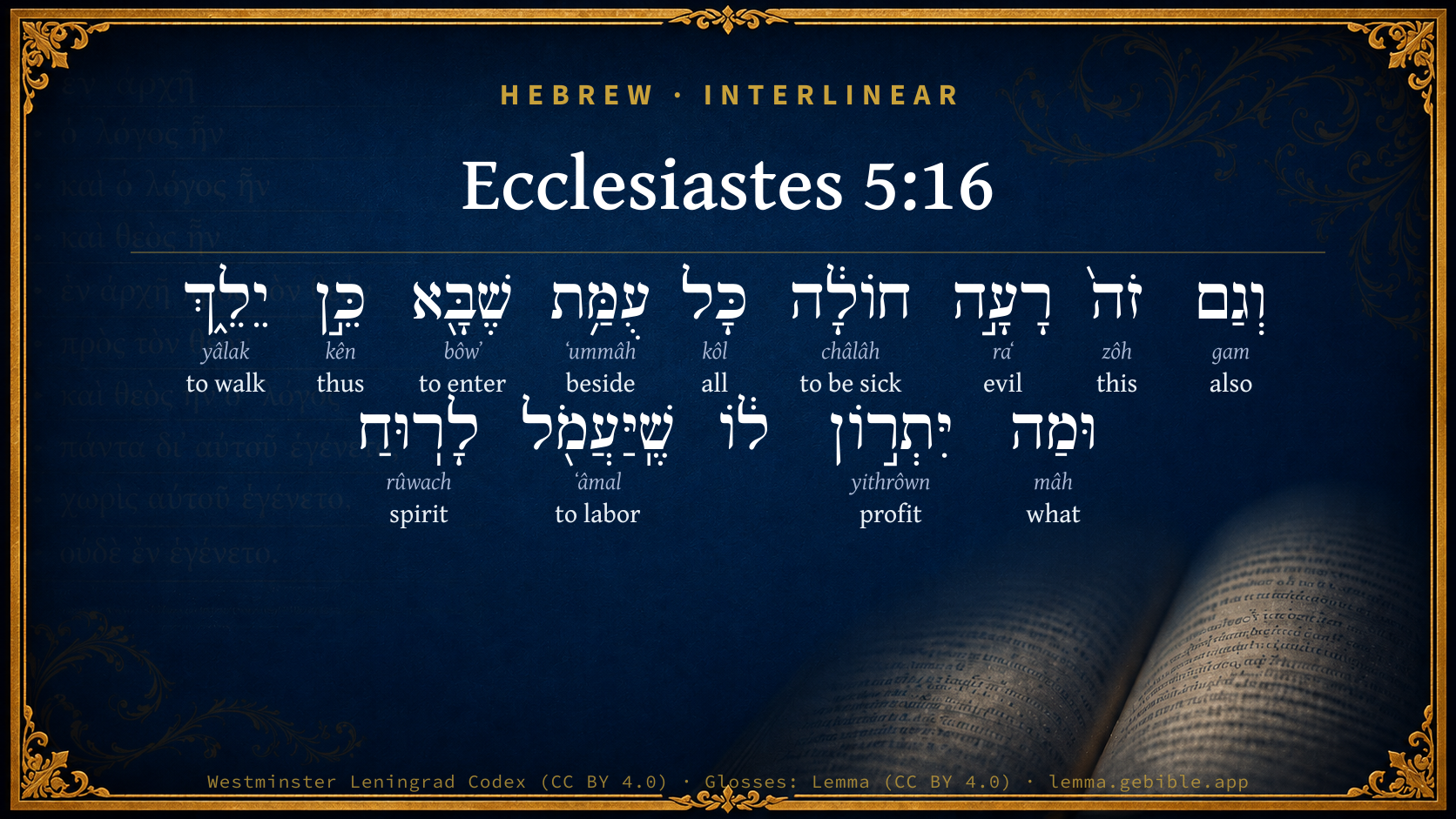
  1. וְגַם gam H1571 “and · also” Conjunction + Particle, Accusative
  2. זֹה֙ zôh H2090 “this” Pronoun, Demonstrative, Masculine, Singular
  3. רָעָ֣ה raʻ H7451 “evil” Noun, Common, Feminine, Singular, Absolute
  4. חוֹלָ֔ה châlâh H2470 “being sick” Verb, Qal, Participle Active, Feminine, Singular, Absolute
  5. כָּל kôl H3605 “like/as · all” Preposition + Preposition
  6. עֻמַּ֥ת ʻummâh H5980 “beside of” Noun, Common, Feminine, Singular, Construct
  7. שֶׁבָּ֖א bôwʼ H935 “who/which · to enter” Particle, Relative + Verb, Qal, Perfect, 3rd Person, Masculine, Singular
  8. כֵּ֣ן kên H3651 “thus” Particle, Demonstrative
  9. יֵלֵ֑ךְ yâlak H3212 “to walk” Verb, Qal, Imperfect, 3rd Person, Masculine, Singular
  10. וּמַה mâh H4100 “and · what” Conjunction + Particle, Interrogative
  11. שֶֽׁיַּעֲמֹ֖ל ʻâmal H5998 “who/which · to labor” Particle, Relative + Verb, Qal, Imperfect, 3rd Person, Masculine, Singular
  12. לָרֽוּחַ rûwach H7307 “to/for the · spirit” Preposition, Determined + Noun, Common, Both, Singular, Absolute

About this verse

These counts appear in no published source. They are computed here, from the morphology-tagged text and Lemma’s own curated glosses. What Lemma adds →

14
words
13
distinct lemmas
Wisdom
section

Notable vocabulary

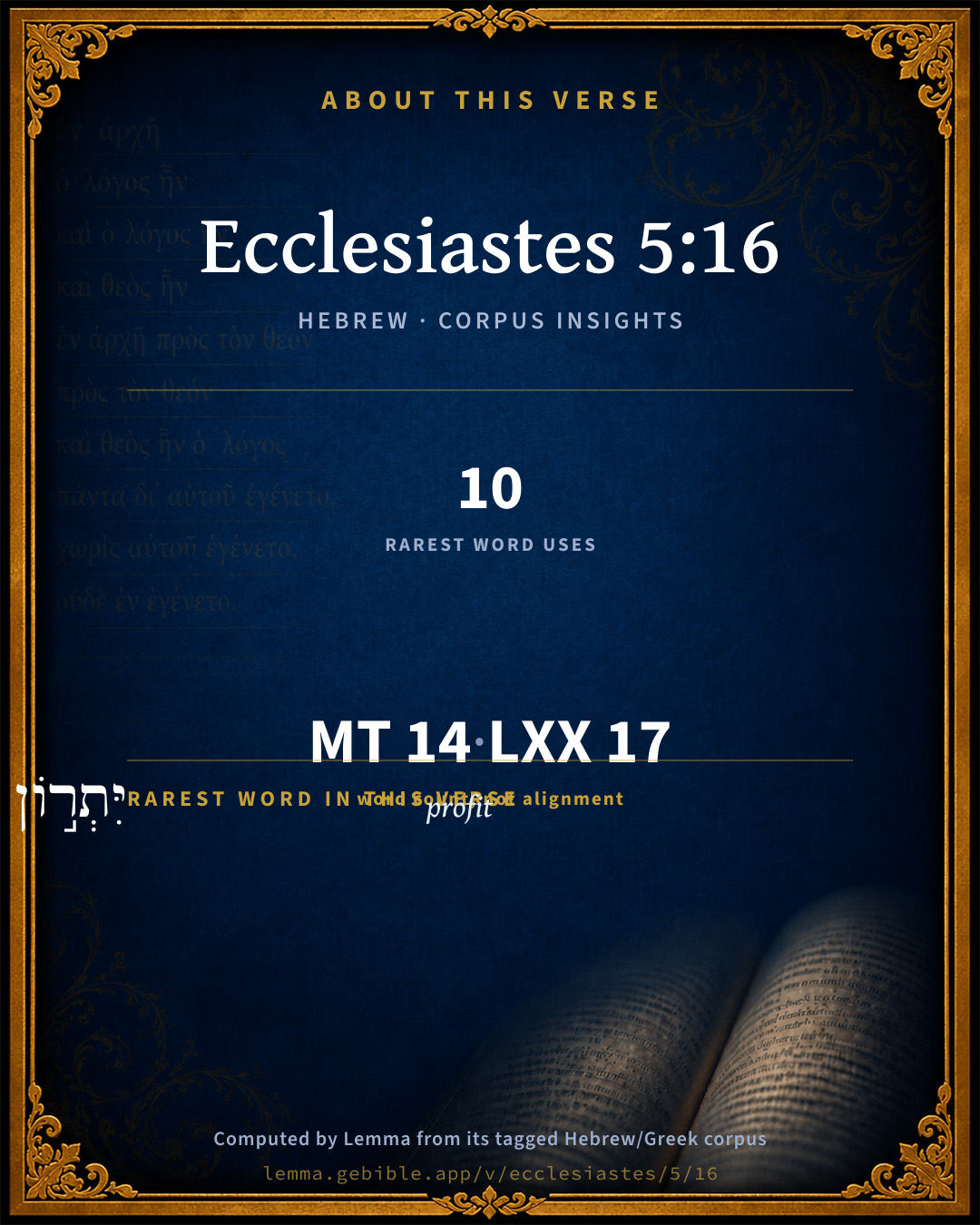
The rarest word here is יִּתְר֣וֹן profit H3504 — appearing just 10 times in the whole Hebrew Bible.

Shared distinctive vocabulary

יִּתְר֣וֹן profit H3504 occurs in 9 verses of the Hebrew Bible. Also found in:

Grammatical profile

  • 4 verbs
  • 4 nouns
  • 1 pronoun
  • 2 prepositions
  • 3 particles

Verb forms

  • חוֹלָ֔ה Qal · Participle Active
  • שֶׁבָּ֖א Qal · Perfect
  • יֵלֵ֑ךְ Qal · Imperfect
  • שֶֽׁיַּעֲמֹ֖ל Qal · Imperfect

Hebrew & Septuagint length

In English translation the verse runs 28 words from the Hebrew and 17 from the Septuagint (LXX English) — the Septuagint runs noticeably shorter here. See the side-by-side →

A rough comparison of the two English renderings, which tokenize alike — not a word-level alignment.

Word counts can differ between the Hebrew and the Greek without any difference in meaning — e.g. the Hebrew direct-object marker אֵת has no separate Greek word, and Greek often adds the article ὁ.

In the original languages it is 14 Hebrew tokens and 17 Greek tokens — but the two are counted differently (Hebrew bundles its prefixes and suffixes into one token; the Greek is in lemma form), so that isn’t a like-for-like length.

Cross-references

10

Topical passages linked to Ecclesiastes 5:16 in the Treasury of Scripture Knowledge — connected by theme and wording, ordered by reader-vote popularity; previews shown in the World English Bible.

  • Proverbs 11:29 He who troubles his own house shall inherit the wind. The foolish shall be servant to the wise of heart.
  • Ecclesiastes 1:3 What does man gain from all his labor in which he labors under the sun?
  • Mark 8:36 For what does it profit a man, to gain the whole world, and forfeit his life?
  • Ecclesiastes 5:13 There is a grievous evil which I have seen under the sun: wealth kept by its owner to his harm.
  • John 6:27 Don't work for the food which perishes, but for the food which remains to eternal life, which the Son of Man will give to you. For God the Father has sealed him."
  • 1 Samuel 12:21 and don't turn aside; for [then would you go] after vain things which can't profit nor deliver, for they are vain.
  • Ecclesiastes 2:22–23 For what has a man of all his labor, and of the striving of his heart, in which he labors under the sun?
  • Isaiah 26:18 We have been with child, we have been in pain, we have as it were brought forth wind; we have not worked any deliverance in the earth; neither have the inhabitants of the world fallen.
  • Jeremiah 2:8 The priests didn't say, Where is Yahweh? and those who handle the law didn't know me: the rulers also transgressed against me, and the prophets prophesied by Baal, and walked after things that do not profit.
  • Hosea 8:7 For they sow the wind, And they will reap the whirlwind. He has no standing grain. The stalk will yield no head. If it does yield, strangers will swallow it up.

Cross-references courtesy of OpenBible.info (CC BY 4.0).

Hebrew and Greek witnesses Masoretic Hebrew ↔ Greek Septuagint

The same verse in the two great witnesses to the Old Testament, shown verse-for-verse.

Here the Septuagint runs noticeably shorter than the Hebrew — LXX2012 (modern English Septuagint) 17 words vs World English Bible 28. A rough length comparison of the two English translations, not a word-level alignment — read both below.

These are two independent witnesses, not word-aligned to each other, and the Septuagint is shown in lemma (dictionary) form.

Hebrew Ecclesiastes 5:16 Masoretic · Westminster Leningrad Codex

וְגַם זֹה֙ רָעָ֣ה חוֹלָ֔ה כָּל עֻמַּ֥ת שֶׁבָּ֖א כֵּ֣ן יֵלֵ֑ךְ וּמַה יִּתְר֣וֹן ל֔וֹ שֶֽׁיַּעֲמֹ֖ל לָרֽוּחַ

This also is a grievous evil, that in all points as he came, so shall he go. And what profit does he have who labors for the wind?

World English Bible · Public Domain

Greek LXX Ecclesiastes 5:16 Septuagint · lemma form

καί γέ πᾶς ὁ ἡμέρα αὐτός ἐν σκότος καί πένθος καί θυμός πολύς καί ἀρρωστία καί χόλος

Yes, all his days are in darkness, and in mourning, and much sorrow, and infirmity, and wrath.

LXX2012 (modern English Septuagint) · Public Domain

On this verse, The Pulpit Commentary discusses the Septuagint’s reading. Read the note in Commentary ↓

Hebrew: Westminster Leningrad Codex (CC BY 4.0). Greek: Septuagint (public domain); English from LXX2012 (modern English Septuagint) (Public Domain). How the Septuagint differs from the Hebrew →

Commentary

Notes on Ecclesiastes 5:16 from classic Christian and Jewish commentators (each source and its license shown beneath its notes). The classic Christian expositions comment on the surrounding passage and are grouped to its opening verse, so a note may address several verses; the Jewish commentaries on the Tanakh (Rashi and others) are per-verse, so they appear only where the commentator wrote on this verse.

Lemma curates 59 commentaries, every one of them public domain or Creative Commons licensed, each selected and text-cleaned for this edition rather than reprinted as found. About our sources →

Trapp's Complete Commentary

John Trapp

Ecc 5:16 And this also [is] a sore evil, [that] in all points as he came, so shall he go: and what profit hath he that hath laboured for the wind?

Ver. 16. And this also is a sore evil.] Malum dolorificum, so it will prove; a singular vexation, a sharp corrosive, when Balaam and his bribes, Laban and his bags, Nabal and his flocks, Achan and his wedge, Belshazzar and his bulls, Herod and his harlots, Dives and his dishes, &c., shall part asunder for ever, when they shall look from their death beds, and see that terrible spectacle, death, judgment, hell, and all to be passed through by their poor souls! Oh, what a dreadful shriek gives the guilty soul at death, to see itself launching into an ocean of scalding lead, and must swim naked in it for ever! Who, therefore, unless he had rather burn with Dives than reign with Lazarus, will henceforth reach out his hand to bribery, usury, robbery, deceit, sacrilege, or any such like wickedness or worldliness, which "drown men’s souls in perdition and destruction?" {1Ti 6:9} If rich men could stave off death, or stop its mouth with a bag of gold, it were somewhat like. But that cannot be, as Henry Beaufort, that rich and wretched cardinal found by experience; as the King of Persia told Constance the Emperor, who had showed him all the glory and bravery of Rome; Mira quidem haec, said he, sed ut video, sicut in Persia, sic Romoe heroines moriuntur, {a} - i.e., These be brave things, but yet I see that as in Persia, so at Rome also, the owners of these things must needs die. Agreeable whereunto was that speech of Nugas, the Scythian monarch, to whom, when Michael Paleologus, the emperor, sent certain rich robes for a present, he asked, Nunquid calamitates, morbos, mortem depellere possent? - whether they could drive away calamities, sickness, death? - for if they could not do so they were not much to be regarded, {b}

What profit hath he that hath laboured for the wind?] i.e., For just nothing. See Hos 12:1 Jer 22:22. The Greeks expressed the same by hunting after and ‘husbanding the wind.’ {c} The apostle speaks of "beating the air," {1Co 9:26} as he doth that fights with his own shadow - that disquiets himself in vain. The four monarchies are called the "four winds of heaven." {Zec 6:3-4} And at the Pope’s enthronisation a wad of straw is set on fire before him, and one appointed to say, Sic transit gloria mundi, - The glory of this world is but a blaze or blast.

{a} Fulgent.

{b} Pachymer., Hist, lib. v.

{c} Aνεμους γεωργειν.

John Trapp, A Commentary or Exposition upon All the Books of the Old and New Testament (1647–1656) — public domain. Text from a community e-Sword module.

Tyndale Open Study Notes

Tyndale Open Resources

5:16-17 Working simply to gain possessions is like working for the wind; it leads to being frustrated, discouraged, and angry.

Tyndale Open Study Notes — © Tyndale Open Resources, licensed CC BY-SA 4.0. Text via the HelloAO Bible API.

Geneva Bible (1599)

Geneva Bible translators

In affliction and grief of mind.

Geneva Bible (1599) marginal notes — public domain. Text via Bolls.life.

Jamieson, Fausset & Brown

Robert Jamieson, A. R. Fausset & David Brown

Even supposing that he loses not his wealth before death, then at least he must go stripped of it all (Psa 49:17).

laboured for the wind-- (Hos 12:1; Co1 9:26).

Jamieson, Fausset & Brown — Commentary Critical and Explanatory on the Whole Bible (1871) — public domain (CC PDM 1.0). Text via the HelloAO Bible API.

The Cambridge Bible for Schools and Colleges

gen. ed. J. J. S. Perowne

16. what profit hath he that hath laboured for the wind?] The ever-recurring question (ch. Ecc_1:3, Ecc_2:22, Ecc_3:9) rises once again, “What profit?” In “labouring for the wind” we have a phrase almost identical with the “feeding on wind” or, as some render it, the “striving after the wind” which is the key-note of the whole book. As in Pro_11:29; Isa_26:18; Job_16:3 the “wind” is the emblem of emptiness and nothingness.

The Cambridge Bible for Schools and Colleges (gen. ed. J. J. S. Perowne; Cambridge University Press, 1878–1918) — public domain. Text from a community e-Sword module.

John Gill's Exposition

And this also is a sore evil, that in all points as he came,

so shall he go,.... This seems not to be an evil or vanity, distinct from the former; but the same repeated and confirmed, and expressed, if possible, in stronger terms, that a man is in all respects alike, when he goes out of the world, as when he came in. A man's birth is signified by "coming", that is, out of his mother's womb, and into the world; and which is a description of every man born into it, Joh 1:9; he is of the earth, earthly; comes forth like a flower, and springs up as grass; he comes not of himself, nor casually, but by means of his parents; and according to the determinate will of God, and to answer some end or other: and his death is signified by "going": a going the way of all flesh; a going out of the world; a going to the grave, the house of all living, a man's long home; it is like going from one house to another; for death is not an annihilation of man, but a remove of him from hence elsewhere; and a man's birth and death are in all points alike. This is to be understood of natural and civil things; of riches and honours, which men cannot carry with them; and with respect to them, they are as they were born, naked and stripped of them; and with respect to the body, the parts of it then are the same, though more grown; it is as naked as it was born; and a man is as much beholden to his friends for his grave as for his swaddling clothes; it becomes what it was at first, earth and dust; and as a man comes not into the world at his own will and pleasure, so neither does he go out of it at his will, but the Lord's. The Midrash interprets it thus,

"as a man comes into the world, with crying, weeping, and sighing, and without knowledge, so he goes out.''

Likewise this is only true of natural and unregenerate men as to moral things; as they are born in sin, they die in sin; with only this difference, an addition of more sin; as they come into the world without the image of God, without a righteousness, without holiness, and without the grace of God, so they go out of it without these things: but this is not true of saints and truly gracious persons; they come into the world with sin, but go out of it without it; being washed in the blood of Christ, justified by his righteousness, and all their sins expiated and pardoned through his sacrifice: they are born without a righteousness, but do not die without one; Christ has wrought out an everlasting righteousness for them; this is imputed to them; is received by faith; given them; they are found in it, living and dying; and this introduces them into heaven and happiness: they are born without holiness, but do not live and die without it; they are regenerated and sanctified by the Spirit of God, and at the moment of death made perfectly holy. This only therefore is true of men, as natural, and with respect to natural and civil things: the Targum interprets it,

"as he comes into this world void of merit, so he shall go into that;''

and what profit hath he that hath laboured for the wind? for riches, which are as unsatisfying as the wind; which are as shifting, and as swift to flee away, as that; and can no more be held, when it is the will of God they should go, and especially at death, than the wind is to be held in the fist of men; and which are as unprofitable as that in the hour of death. Particularly, what profit has a man of all his riches, which he has got by labour, when he neither makes use of them in life for his own good, nor the good of others; and when he comes to die, they leave him and stand him in no stead; and especially having been unconcerned about his immortal soul; and having been wholly taken up in the pursuit of such vain and transitory things? see Mat 16:26.

John Gill's Exposition of the Whole Bible (1746–1763) — public domain (CC PDM 1.0). Text via the HelloAO Bible API.

Haydock's Catholic Bible Commentary

Sorrow. The person whose riches have been taken away, had made a bad use of them, (Calmet) living like a miser. It would be more rational to indulge in the pleasures which they afford, though this is also vain, chap. iii. 14.

George Leo Haydock (1774–1849), Haydock's Catholic Family Bible and Commentary, 1859 edition — public domain. Excludes Psalms (Douay-Rheims chapter numbering differs from Protestant) and Deuterocanonical books (Catholic canon only).

Matthew Poole's English Annotations

This also, which I have last mentioned and shall now repeat. For the wind; for riches, which are empty and unsatisfying, uncertain and transitory, fleeing away swiftly and strongly, Pro 23:5, which no man can hold or stay in its course, all which are the properties of the wind. Compare Pro 11:29; Hos 12:1.

Matthew Poole's English Annotations on the Holy Bible (1683–1685) — public domain. Text from a community e-Sword/MySword module.

Whedon's Commentary on the Bible

Daniel D. Whedon

16. Laboured for the wind — Clearly if he had not, but had been content to lead a quiet life, without the hazards of speculation, even then he would have been obliged to leave all behind at death. Now the case seems harder, coming to that after a restless and unprosperous life.

Daniel D. Whedon (gen. ed.), Commentary on the Old and New Testaments (1874–1909) — public domain. Text from a community e-Sword module.

The Pulpit Commentary

This also is a sore evil. The thought of ver. 15 is emphatically repeated. In all points as he came; i.e. naked, helpless. And what profit hath he that laboreth for the wind? The answer is emphatically "nothing." We have had similar questions in Ecc_1:3 Ecc_2:22 Ecc_3:9. To labor for the wind is to toil with no result, like the "feeding on wind, pursuing of vanity," which is the key-note of the book. The wind is the type of all that is empty, delusive, unsubstantial. in Pro_11:29 we have the phrase, "to inherit the wind." Job calls futile arguments "words of. (Job_16:3 Job_15:2) Thus the Greek proverb jAnemouv qjran ejn diktuov to try to catch the wind:" and the Latin, "Ventos pascere," and "Ventos colere "(see Erasmus, "Adag.," s.v. "Inanis opera"). Septuagint, Kaiv hJ perisseia aujtou h+ mocqei eijv anemon; "And what is his gain for which he labors for the wind?"

The Pulpit Commentary (1880–1919), ed. H.D.M. Spence-Jones & Joseph S. Exell — public domain. Text from a community e-Sword module.

John Wesley's Explanatory Notes

The wind - For riches, which are empty and unsatisfying, uncertain and transitory, which no man can hold or stay in its course, all which are the properties of the wind.

John Wesley, Explanatory Notes Upon the Whole Bible (1754–1765) — public domain. Text via the GEBible commentary corpus.

Keil & Delitzsch

C. F. Keil & F. Delitzsch

A transition is now made to rich men as such, and the registering formula which should go before Ecc 5:14 here follows: "And this also is a sore evil: altogether exactly as he came, thus shall he depart: and what gain hath he that laboureth in the wind?" Regarding זה; and regarding כּל־ע שׁ,

(Note: I n H. written as one word: כּלעמת. Parchon (Lex. under עמת) had this form before him. In his Lex. Kimchi bears evidence in favour of the correct writing as two words.)

The writing of these first two as one word [vid. note below] accords with Ibn-Giat's view, accidentally quoted by Kimchi, that the word is compounded of כ of comparison, and the frequently occurring לעמּת always retaining its ל, and ought properly to be pointed כּלע (cf. מלּ, Kg1 7:20). עמּה signifies combination, society, one thing along with or parallel to another; and thus לעמת bears no כ, since it is itself a word of comparison, כּל־עמּת "altogether parallel," "altogether the same." The question: what kind of advantage (vid., Ecc 1:3) is to him (has he) of this that ... , carries its answer in itself. Labouring for the wind or in the wind, his labour is רוּח (רעיון) רעוּת, and thus fruitless. And, moreover, how miserable an existence is this life of labour leading to nothing!

Keil & Delitzsch — Biblical Commentary on the Old Testament (1861–1891) — public domain (CC PDM 1.0). Text via the HelloAO Bible API. (Old Testament only.)

Rashi

Rabbi Shlomo Yitzchaki (Rashi)

and sickness Heb. וְחָלְיוֹ, like וְחֹלִי, and the “vav” is superfluous, like the “vav” of (Ps. 104: 20): “beast (חֳיְתוֹ) of the forest.”

Rashi on the Tanakh — English translations: “The Judaica Press complete Tanach with Rashi, translated by A. J. Rosenberg” (CC BY 4.0); “Pentateuch with Rashi's commentary by M. Rosenbaum and A.M. Silbermann, 1929-1934” (public domain); “The Metsudah Tanach series, Lakewood, N.J” (CC BY 4.0); and “The Book of Joshua, Metsudah Publications, 1997” (CC BY 4.0). Text via Sefaria.

Lesson kit

Teaching starters — assembled from the data on this page, not authored interpretation. Every prompt links to the verse data it draws on. Edit before teaching.

Ecclesiastes, in the Wisdom, opens this verse with 14 words (13 distinct Hebrew lemmas). Its most distinctive word is yithrôwn (“profit”). The Greek Septuagint runs shorter here. A historical commentator’s framing appears above. Read the whole chapter for the surrounding context.

Discussion questions

  1. The word yithrôwn carries the sense “profit.” How does it shape the verse?
  2. Ecclesiastes 1:3 shares the word «profit» with this verse. How do the two illuminate each other?
  3. Compared with the Hebrew, the Septuagint runs shorter here. What questions does that raise?
  4. These translations render this verse differently; the difference is in the English rendering, not the original. What questions does that raise?
  5. The verb «חוֹלָ֔ה» is Qal Participle Active. How does its form color the action?
  6. Reading how Trapp's Complete Commentary and Tyndale Open Study Notes read this verse, where do the two commentators agree and where do they part?

Things to notice

Reading settings

Reading text

Shown beneath each verse's original-language words.

Old Testament
Old Testament edition

Read the OT as the Masoretic Hebrew (MT) or the Greek Septuagint (LXX).

English shown for the Greek Septuagint (in the Hebrew ↔ Greek comparison).

Comparing translations? Open the Compare panel on any verse page to stack up to four side by side.