
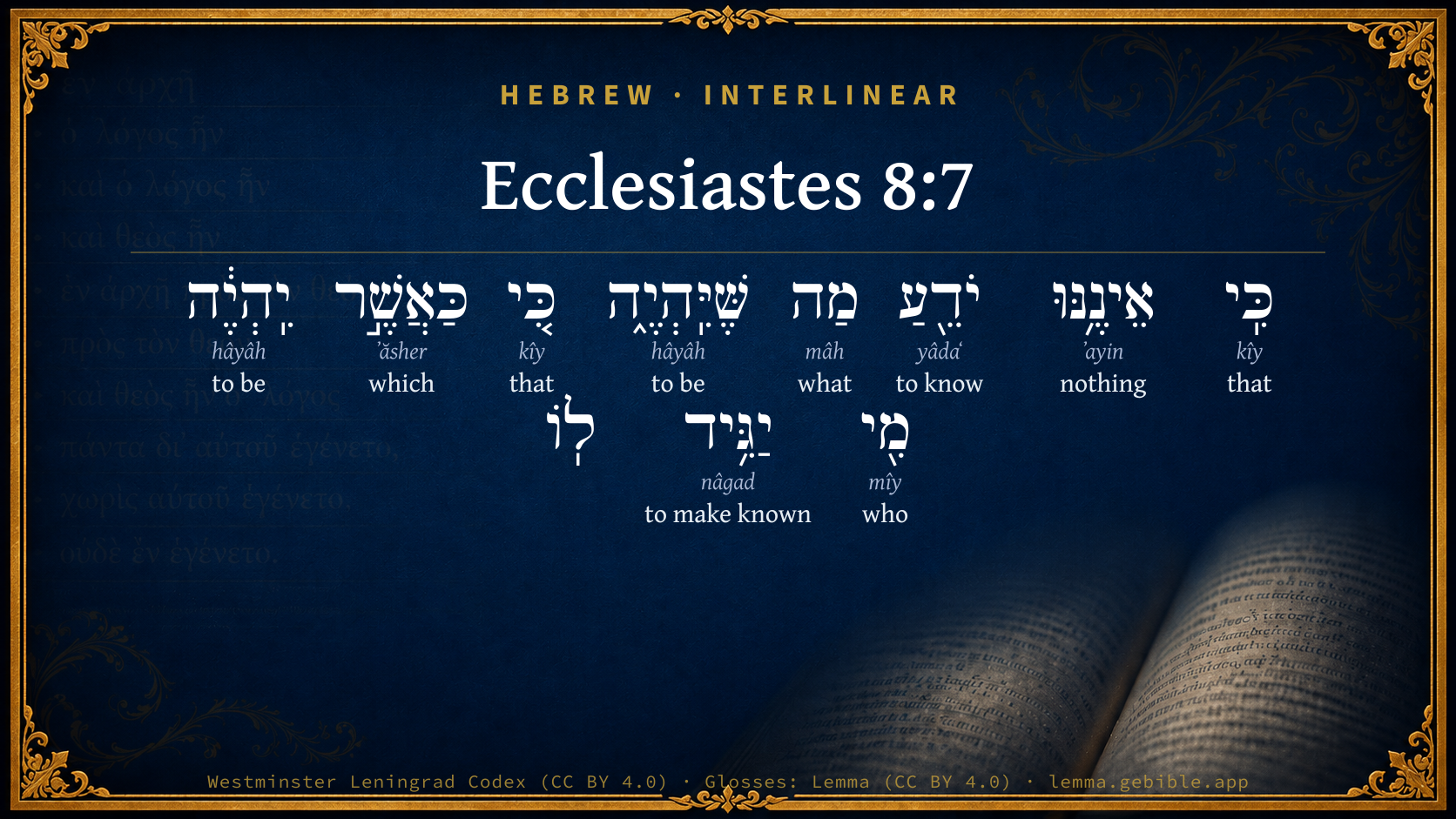
Ecclesiastes 8:7

Hebrew (Westminster Leningrad Codex) Ecclesiastes 8:7 appears in the Hebrew Old Testament. The text above is from the Westminster Leningrad Codex. Each word links to its Strong’s number, a concise gloss, and parsing drawn from the Open Scriptures Hebrew Bible morphology. Click any word for its full Brown-Driver-Briggs (BDB) entry.
Download image
Cite this verse

Ecclesiastes 8:7 (World English Bible). Public Domain. Lemma interlinear Bible study tool, https://lemma.gebible.app/v/ecclesiastes/8/7.

Show BibTeX & RIS
BibTeX
RIS
English Translation
For he doesn't know that which will be; for who can tell him how it will be?
World English Bible · Public Domain
Download a study sheet

One document with this verse’s original text, its word-by-word gloss line, the meaning frame, cross-references with their text, attributed commentary, and full source and license credits — printable, and it pastes into notes with its structure intact.

This verse Autodidact and up

Study sheet (.html) Plain text (.txt)

A passage Seminary Student

Up to 50 verses in one chapter. A passage sheet keeps up to 6 commentary sources and 12 cross-references per verse, in the order this page ranks them, and says so on the sheet whenever that leaves anything out. Ask for a single verse and you get the Autodidact verse sheet above.

Everything on this page stays free to read, with no account — the sheet is a download of what is already on screen, not access to it.

Want to remove ads? Support Godless Engineer
Compare translations 3

The same verse in 3 English versions, stacked beneath the original-language interlinear above. Click any original word for its lexicon entry.

Each is an independent rendering of the whole verse — the interlinear is not word-aligned to these translations.

Highlighted words mark where these versions differ — a whole-verse word diff, not a word-by-word alignment.

  • World English Bible Public Domain
    For he doesn't know that which will be; for who can tell him how it will be?
  • King James Version Public Domain
    For he knoweth not that which shall be: for who can tell him when it shall be?
  • unfoldingWord Literal Text CC BY-SA 4.0
    for, he is not knowing whatever that will be, for, when it will be— who will declare to him?

unfoldingWord Literal Text — © unfoldingWord, licensed CC BY-SA 4.0. Word-aligned USFM3 via Door43 (git.door43.org/unfoldingWord/en_ult).

Versions to compare (up to 4)

3 of 4 selected

Show all 18 translations

Every available English version of this verse, each an independent rendering of the whole verse.

  • World English Bible Public Domain
    For he doesn't know that which will be; for who can tell him how it will be?
  • Berean Standard Bible Public Domain
    Since no one knows what will happen, who can tell him what is to come?
  • Majority Standard Bible Public Domain
    Since no one knows what will happen, who can tell him what is to come?
  • King James Version Public Domain
    For he knoweth not that which shall be: for who can tell him when it shall be?
  • American Standard Version (1901) Public Domain
    for he knoweth not that which shall be; for who can tell him how it shall be?
  • Revised Version (1885) Public Domain
    for he knoweth not that which shall be; for who can tell him how it shall be?
  • Geneva Bible (1599) Public Domain
    For he knoweth not that which shalbe: for who can tell him when it shalbe?
  • Douay-Rheims (1899) Public Domain
    Because he is ignorant of things past, and things to come he cannot know by any messenger.
  • Young's Literal Translation Public Domain
    For he knoweth not that which shall be, for when it shall be who declareth to him?
  • Literal Standard Version CC BY-SA 4.0
    For he does not know that which will be, for when it will be who declares to him?
  • Unlocked Literal Bible CC BY-SA 4.0
    No one knows what is coming next. Who can tell him what is coming?
  • unfoldingWord Literal Text CC BY-SA 4.0
    for, he is not knowing whatever that will be, for, when it will be— who will declare to him?
  • Darby Bible Public Domain
    for he knoweth not that which shall be; for who can tell him how it shall be?
  • World Messianic Bible Public Domain
    For he doesn’t know that which will be; for who can tell him how it will be?
  • Webster's Bible Public Domain
    For he knoweth not that which shall be: for who can tell him when it shall be?
  • Free Bible Version CC BY-SA 4.0
    No one knows what's going to happen, so who can say what the future holds?
  • Bible in Basic English Public Domain
    No one is certain what is to be, and who is able to say to him when it will be?
  • JPS Tanakh (1917) Public Domain
    For he knoweth not that which shall be; for even when it cometh to pass, who shall declare it unto him?

Literal Standard Version (2020), Covenant Press — licensed CC BY-SA 4.0. Text via the HelloAO Bible API (eBible.org). Unlocked Literal Bible (unfoldingWord) — licensed CC BY-SA 4.0. Text via the HelloAO Bible API (eBible.org). unfoldingWord Literal Text — © unfoldingWord, licensed CC BY-SA 4.0. Word-aligned USFM3 via Door43 (git.door43.org/unfoldingWord/en_ult). Free Bible Version, Dr. Jonathan Gallagher — licensed CC BY-SA 4.0. Text via the HelloAO Bible API (eBible.org).

Word by word

More ways to search: Search by grammar → Find every occurrence → Compare this word →

Practice this passage: Drill this verse → Learn its vocabulary →

יַגִּ֥יד
nâgad
H5046
“to make known”
Verb, Hiphil, Imperfect, 3rd Person, Masculine, Singular
Part of Speech
Verb
Stem
Hiphil
Form
Imperfect
Person
3rd Person
Gender
Masculine
Number
Singular
Full BDB Definition

Origin: a primitive root

TWOT: 1289

to be conspicuous, tell, make known - (Hiphil) to tell, declare - to tell, announce, report - to declare, make known, expound - to inform of - to publish, declare, proclaim - to avow, acknowledge, confess - messenger (participle) - (Hophal) to be told, be announced, be reported
  1. כִּֽי kîy H3588 “that” Conjunction
  2. אֵינֶ֥נּוּ ʼayin H369 “nothing · him” Particle, Negative + Suffix, Personal, 3rd Person, Masculine, Singular
  3. יֹדֵ֖עַ yâdaʻ H3045 “knowing” Verb, Qal, Participle Active, Masculine, Singular, Absolute
  4. מַה mâh H4100 “what” Particle, Interrogative
  5. שֶּׁיִּֽהְיֶ֑ה hâyâh H1961 “who/which · to be” Particle, Relative + Verb, Qal, Imperfect, 3rd Person, Masculine, Singular
  6. כִּ֚י kîy H3588 “that” Conjunction
  7. כַּאֲשֶׁ֣ר ʼăsher H834 “like/as · which” Preposition + Particle, Relative
  8. יִֽהְיֶ֔ה hâyâh H1961 “to be” Verb, Qal, Imperfect, 3rd Person, Masculine, Singular
  9. מִ֖י mîy H4310 “who” Particle, Interrogative

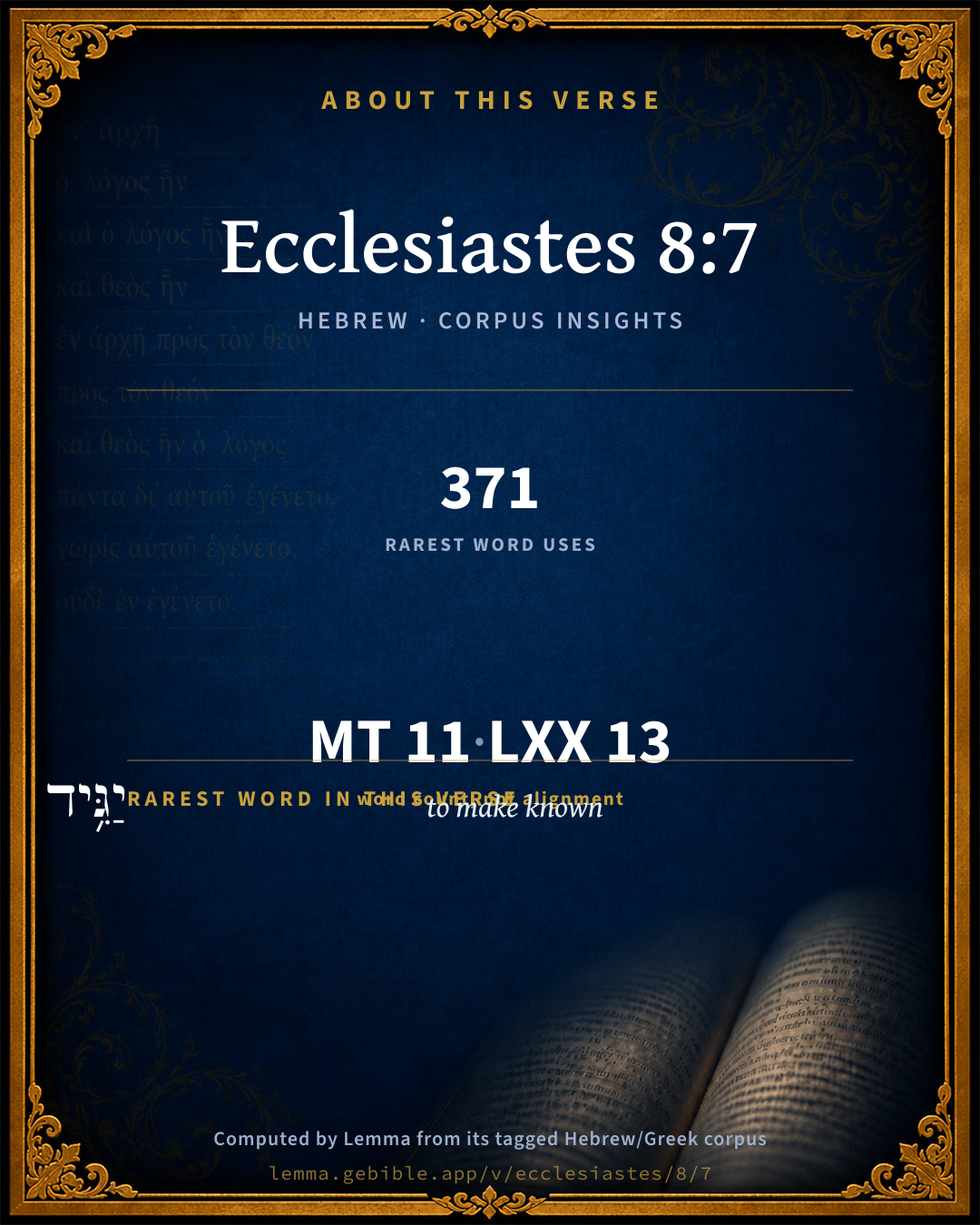
About this verse

These counts appear in no published source. They are computed here, from the morphology-tagged text and Lemma’s own curated glosses. What Lemma adds →

11
words
8
distinct lemmas
Wisdom
section

Grammatical profile

  • 4 verbs
  • 1 preposition
  • 2 conjunctions
  • 4 particles

Verb forms

  • יֹדֵ֖עַ Qal · Participle Active
  • שֶּׁיִּֽהְיֶ֑ה Qal · Imperfect
  • יִֽהְיֶ֔ה Qal · Imperfect
  • יַגִּ֥יד Hiphil · Imperfect

Repetition

Words recur within this verse — often emphatic in Hebrew:

  • שֶּׁיִּֽהְיֶ֑ה to be H1961 ×2
  • כִּֽי that H3588 ×2

Hebrew & Septuagint length

In English translation the verse runs 17 words from the Hebrew and 21 from the Septuagint (LXX English) — closely comparable.

A rough comparison of the two English renderings, which tokenize alike — not a word-level alignment.

Word counts can differ between the Hebrew and the Greek without any difference in meaning — e.g. the Hebrew direct-object marker אֵת has no separate Greek word, and Greek often adds the article ὁ.

In the original languages it is 11 Hebrew tokens and 13 Greek tokens — but the two are counted differently (Hebrew bundles its prefixes and suffixes into one token; the Greek is in lemma form), so that isn’t a like-for-like length.

Cross-references

10

Topical passages linked to Ecclesiastes 8:7 in the Treasury of Scripture Knowledge — connected by theme and wording, ordered by reader-vote popularity; previews shown in the World English Bible.

  • Ecclesiastes 10:14 A fool also multiplies words. Man doesn't know what will be; and that which will be after him, who can tell him?
  • Proverbs 24:22 For their calamity will rise suddenly; The destruction from them both--who knows?
  • Ecclesiastes 6:12 For who knows what is good for man in life, all the days of his vain life which he spends like a shadow? For who can tell a man what will be after him under the sun?
  • Ecclesiastes 9:12 For man also doesn't know his time. As the fish that are taken in an evil net, and as the birds that are caught in the snare, even so are the sons of men snared in an evil time, when it falls suddenly on them.
  • Matthew 24:50 the lord of that servant will come in a day when he doesn't expect it, and in an hour when he doesn't know it,
  • Ecclesiastes 3:22 Therefore I saw that there is nothing better, than that a man should rejoice in his works; for that is his portion: for who can bring him to see what will be after him?
  • Matthew 24:44 Therefore also be ready, for in an hour that you don't expect, the Son of Man will come.
  • Matthew 25:6–13 But at midnight there was a cry, 'Behold! The bridegroom is coming! Come out to meet him!'
  • Proverbs 29:1 He who is often rebuked and stiffens his neck Will be destroyed suddenly, with no remedy.
  • 1 Thessalonians 5:1–3 But concerning the times and the seasons, brothers, you have no need that anything be written to you.

Cross-references courtesy of OpenBible.info (CC BY 4.0).

Hebrew and Greek witnesses Masoretic Hebrew ↔ Greek Septuagint

The same verse in the two great witnesses to the Old Testament, shown verse-for-verse.

These are two independent witnesses, not word-aligned to each other, and the Septuagint is shown in lemma (dictionary) form.

Hebrew Ecclesiastes 8:7 Masoretic · Westminster Leningrad Codex

כִּֽי אֵינֶ֥נּוּ יֹדֵ֖עַ מַה שֶּׁיִּֽהְיֶ֑ה כִּ֚י כַּאֲשֶׁ֣ר יִֽהְיֶ֔ה מִ֖י יַגִּ֥יד לֽוֹ

For he doesn't know that which will be; for who can tell him how it will be?

World English Bible · Public Domain

Greek LXX Ecclesiastes 8:7 Septuagint · lemma form

ὅτι οὐ εἰμί γιγνώσκω τίς ὁ εἰμί ὅτι καθώς εἰμί τίς ἀναἀγγέλλω αὐτός

For there is no one that knows what is going to be: for who shall tell him how it shall be?

LXX2012 (modern English Septuagint) · Public Domain

On this verse, Keil & Delitzsch discusses the Septuagint’s reading. Read the note in Commentary ↓

Hebrew: Westminster Leningrad Codex (CC BY 4.0). Greek: Septuagint (public domain); English from LXX2012 (modern English Septuagint) (Public Domain). How the Septuagint differs from the Hebrew →

Commentary

Notes on Ecclesiastes 8:7 from classic Christian and Jewish commentators (each source and its license shown beneath its notes). The classic Christian expositions comment on the surrounding passage and are grouped to its opening verse, so a note may address several verses; the Jewish commentaries on the Tanakh (Rashi and others) are per-verse, so they appear only where the commentator wrote on this verse.

Lemma curates 59 commentaries, every one of them public domain or Creative Commons licensed, each selected and text-cleaned for this edition rather than reprinted as found. About our sources →

Trapp's Complete Commentary

John Trapp

Ecc 8:7 For he knoweth not that which shall be: for who can tell him when it shall be?

Ver. 7. For he knoweth not that which shall be.] Man’s misery is the greater because he cannot foresee to prevent it; but he is suddenly surprised and hit many times on the blind side, as we say.

“ Nescia mens hominum fati sortisque futurae. ”

Men are in the dark in regard to future events. God only knows them, and is thereby oft in Isaiah distinguished from the dunghill deities of the heathens. In his mercy to his people he gave them prophets to tell how long, and when these failed the Church heavily bewails it. {Psa 74:9} Howbeit a prudent man "foreseeth an evil, and hideth himself." {Pro 22:3} {See Trapp on "Pro 22:3"} By the strength of his mind, saith Ambrose, {a} he presageth what will follow, and can define what in such or such a case he ought to do. Sometimes he turns over two or three things in his mind together, of which conjecturing that either all may come to pass jointly, or this or that severally, or whether they fall out jointly or severally, he can by his understanding so order his actions as that they shall be profitable to him.

{a} Amb. De Offic., lib. i. cap. 38.

John Trapp, A Commentary or Exposition upon All the Books of the Old and New Testament (1647–1656) — public domain. Text from a community e-Sword module.

Keil & Delitzsch

C. F. Keil & F. Delitzsch

"Who is like the wise? and who understandeth the interpretation of things? The wisdom of a man maketh his face bright, and the rudeness of his face is changed." Unlike this saying: "Who is like the wise?" are the formulas חכם מי, Hos 14:9, Jer 11:11, Psa 107:43, which are compared by Hitzig and others. "Who is like the wise?" means: Who is equal to him? and this question, after the scheme מי־כמכה, Exo 15:11, presents him as one who has not his like among men. Instead of כּה the word כּחכם might be used, after לחכם, Ecc 2:16, etc. The syncope is, as at Eze 40:25, omitted, which frequently occurs, particularly in the more modern books, Eze 47:22; Ch2 10:7; Ch2 25:10; Ch2 29:27; Neh 9:19; Neh 12:38. The regular giving of Dagesh to כ after מי, with Jethib, not Mahpach, is as at Ecc 8:7 after כּי; Jethib is a disjunctive. The second question is not כּיודע, but יודע וּמי, and thus does not mean: who is like the man of understanding, but: who understands, viz., as the wise man does; thus it characterizes the incomparably excellent as such. Many interpreters (Oetinger, Ewald, Hitz., Heiligst., Burg., Elst., Zckl.) persuade themselves that דּבר פּשׁר is meant of the understanding of the proverb, 8b. The absence of the art., says Hitzig, does not mislead us: of a proverb, viz., the following; but in this manner determinate ideas may be made from all indeterminate ones. Rightly, Gesenius: explicationem ullius rei; better, as at Ecc 7:8 : cujusvis rei. Ginsburg compares נבון דּבר, Sa1 16:18, which, however, does not mean him who has the knowledge of things, but who is well acquainted with words. It is true that here also the chief idea פּשׁר first leads to the meaning verbum (according to which the lxx, Jer., the Targ., and Syr. translate; the Venet.: ἑρμηνείαν λόγου); but since the unfolding or explaining (pēshěr) refers to the actual contents of the thing spoken, verbi and rei coincide. The wise man knows how to explain difficult things, to unfold mysterious things; in short, he understands how to go to the foundation of things.

Keil & Delitzsch — Biblical Commentary on the Old Testament (1861–1891) — public domain (CC PDM 1.0). Text via the HelloAO Bible API. (Old Testament only.)

Tyndale Open Study Notes

Tyndale Open Resources

8:7-8 Since our strength, goodness, and wisdom cannot forestall calamity, turning to wickedness would certainly be futile.

Tyndale Open Study Notes — © Tyndale Open Resources, licensed CC BY-SA 4.0. Text via the HelloAO Bible API.

Jamieson, Fausset & Brown

Robert Jamieson, A. R. Fausset & David Brown

he--the sinner, by neglecting times (for example, "the accepted time, and the day of salvation, Co2 6:2), is taken by surprise by the judgment (Ecc 3:22; Ecc 6:12; Ecc 9:12). The godly wise observe the due times of things (Ecc 3:1), and so, looking for the judgment, are not taken by surprise, though not knowing the precise "when" (Th1 5:2-4); they "know the time" to all saving purposes (Rom 13:11).

Jamieson, Fausset & Brown — Commentary Critical and Explanatory on the Whole Bible (1871) — public domain (CC PDM 1.0). Text via the HelloAO Bible API.

The Cambridge Bible for Schools and Colleges

gen. ed. J. J. S. Perowne

7. For he knoweth not that which shall be] The subject of the sentence is apparently the wicked and tyrannous ruler. He goes on with infatuated blindness to the doom that lies before him. The same thought appears in the mediæval proverb, “Quem Deus vult perdere prius dementat,” or, in our modern condemnation of the rulers or the parties, who “learn nothing, and forget nothing.” The temper condemned is that (1) of the cynical egoism, which says, “Apres moi, le deluge,” (2) of those who act, because judgment is delayed, as if it would never come.

The Cambridge Bible for Schools and Colleges (gen. ed. J. J. S. Perowne; Cambridge University Press, 1878–1918) — public domain. Text from a community e-Sword module.

John Gill's Exposition

For he knoweth not that which shall be,.... Or that "it shall be" (b); that he ever shall have the opportunity again he has lost, nor what is to come hereafter; what shall be on the morrow, or what shall befall him in the remaining part of his days; what troubles and sorrows he shall meet with, or what will be the case and circumstances of his family after his death;

for who can tell him when it shall be? or "how it shall be" (c)? how it will be with him or his; no one that pretends to judicial astrology, or to the art of divination, or any such devices, can tell him what is to come; future things are only certainly known by God; none but he can tell what will certainly come to pass; see Ecc 3:22; Jarchi interprets it of a man's not considering for what God will bring him to judgment, and that no man can tell him the vengeance and punishment that will be inflicted.

(b) "quod futurum est", Pagninus, Montanus. (c) "quo modo", Junius & Tremellius, Gejerus, Rambachius, so Broughton.

John Gill's Exposition of the Whole Bible (1746–1763) — public domain (CC PDM 1.0). Text via the HelloAO Bible API.

Albert Barnes' Notes on the Bible

When - Or, as in the margin. For the meaning of this verse, compare marginal references.

Albert Barnes' Notes on the Bible (1834–1885) — public domain. Text from a community e-Sword/MySword module.

Haydock's Catholic Bible Commentary

Past. Protestants and Septuagint, "that shall be." (Haydock)

George Leo Haydock (1774–1849), Haydock's Catholic Family Bible and Commentary, 1859 edition — public domain. Excludes Psalms (Douay-Rheims chapter numbering differs from Protestant) and Deuterocanonical books (Catholic canon only).

Matthew Poole's English Annotations

Men are generally ignorant of all future events, and of the success of their endeavours, and therefore their minds are greatly disquieted, and their expectations frequently disappointed, and they fall into many mistakes and miscarriages, which they could and would prevent if they did foresee the issues of things.

Who can tell him? no wise man, no astrologer or other artist, can discover this.

Matthew Poole's English Annotations on the Holy Bible (1683–1685) — public domain. Text from a community e-Sword/MySword module.

Whedon's Commentary on the Bible

Daniel D. Whedon

7. For he knoweth not — The tyrant knoweth not, etc. He cannot see what will come of his own tyranny. The next scene in his drama has often been a dethronement, an exile, an assassination. Many such tyrants went down in ruin about the time of the Captivity; and they are always liable to terminate their fantastic tricks by some other than natural death.

Daniel D. Whedon (gen. ed.), Commentary on the Old and New Testaments (1874–1909) — public domain. Text from a community e-Sword module.

The Pulpit Commentary

For he knoweth not that which shall be. The subject may be man in general, or more probably the evil tyrant. The clause contains a third reason for patience. The despot cannot foresee the future, and goes on blindly filling up the measure of his iniquity, being unable to take any precautions against his inevitable fate. (Pro_24:22) Quem Deus vult perdere prius dementat. For who can tell him when it shall be? rather, how it shall be. The fourth portion of the argument. The infatuated man knows not the time when the blow will fall, nor, as here, the manner in which the retribution will come, the form which it will take. Septuagint," For how it shall be, who will tell him?" The Vulgate paraphrases inaccurately, Quia ignorat prae-terita, et futura nullo scire potest nuntio, "Because he knoweth not the past, and the future he can ascertain by no messenger." Vers. 7-9.

The sorrowful tale of man"s misery upon the earth.

I NO KNOWLEDGE OF THE FUTURE. Neither himself can foresee, nor can any one inform him, either what shall be or how it shall be. Man"s acquaintance with the future amounts at best to a "perhaps.

II NO EXEMPTION FROM DEATH. This great truth stated in a threefold form.

1. No man can retain his spirit, or hold it back, when the hour strikes for it to be breathed forth, any more than he can hold back the winds of heaven when the moment has arrived for them to blow.

2. No man has power over the day of his dearly, to defer it, to remove it to a dim and distant future, or to hasten it to bring it near, any more than he has power over the day of his birth. His times both of coming into and of going out from the world are in God"s hand.

3. No man can procure a discharge from the war with the king of terrors, either for himself or another, any more than a conscript could escape the battle when drawn for service by an Oriental despot. All without exception must go forth to the final conflict. (Heb_9:27)

III NO ESCAPE FROM RETRIBUTION. The wicked may hope that in some way or other it may be possible for them to evade the due reward of their transgressions; but such hope is taken from them by the fact that God will one day bring every secret thing into judgment, whether it has been good, or whether it has been evil. (Ecc_12:14)

IV NO IMMUNITY FROM OPPRESSION. Though it cannot be affirmed that all are oppressed else where were the oppressors? yet it cannot be guaranteed beforehand that any one will not be oppressed, since "there is a time wherein one man hath power over another to his hurt" (ver. 9).

LESSONS.

1. Leave the future with God, and live in the present.

2. Prepare for that day which will come on all like a thief in the night.

3. So live that the recompense of the future will be that which belongs to righteousness.

4. Avoid being an oppressor, and rather be oppressed. Ver. 10.

Before, at, and after death; or, the wicked and the good a contrast.

I BEFORE DEATH. In the character of their lives. Each lives and acts in accordance with his character of soul.

1. The wicked acts wickedly. Spends his days

(1) without religion, having no fear of God before his eyes (Psa_36:1; Rom_3:18)

(2) without morality, taking pleasure in disobedience to God"s Law; (Eph_2:2 Eph_5:6)

(3) and without hope, (Eph_2:12) having no happy outlook beyond the grave.

2. The righteous acts rightly.

(1) Worshipping in the temple of the holy;

(2) learning in the school of the holy;

(3) walking in the ways of the holy; and

(4) cherishing the hopes of the holy. These different characteristics belong to the wicked and the righteous in all ranks and classes of society.

II AT DEATH. In the style of their funerals. Both come to the grave, the house appointed for all the living, (Job_30:23) like Dives and Lazarus; (Luk_16:22) perhaps after having lived respectively as these did the wicked clothing themselves in fine linen and faring sumptuously every day; the good lying in rags and sores at the rich man"s gate, and feeding on the crumbs from the rich man"s table. But from this point their paths and experiences diverge.

1. The wicked have a burial. They are borne to the place of sepulture with pomp and pageantry, and in presence of assembled crowds are committed to the dust. Wealth and honor wait upon them to their last resting-places, and do the utmost to provide quiet and peaceful couches for their lifeless corpses. Oftentimes, if not always, is this the fortune of the ungodly who have defied the Almighty, despised religion, insulted morality, and yet increased in riches and grown great in power.

2. The good simply go away. They vanish from the scene of their sufferings and labors, no one knows when or how. Whether they nave a funeral no one cares. Certainly their departure is not marked by long trains of mourners going about the streets. Their obsequies, conducted by angels, are not observed by the passing crowds of busy men on earth. This also is a frequent lot of good men at death, though it must not be assumed that good men are never carried to their graves amid lamentations and tears (2Ch_24:16; Act_8:2)

III AFTER DEATH. In the treatment of their memories. Both pass into the unseen, and have no more knowledge of what transpires on this side the veil. But their lots upon the other side are frequently as different from each other as before.

1. The wicked are remembered. Forgotten, it may be, and forsaken by God, but not by men who admired their splendor, and perhaps envied or feared their greatness when living.

2. The good are forgotten. Remembered indeed by God, but not by men, who suffer their names to pass into oblivion; as saith the poet

The evil that men do lives after them; The good is oft interred with their bones. ("Julius Caesar," act 3. sc. 2. )

LESSONS.

1. Study to live well by acting well.

2. Seek a lodging for thy soul when it must leave thy body.

3. Commit the care of thy memory to God and good men.

4. Envy neither the present nor the future lot of the wicked.

The Pulpit Commentary (1880–1919), ed. H.D.M. Spence-Jones & Joseph S. Exell — public domain. Text from a community e-Sword module.

John Wesley's Explanatory Notes

For - Men are generally ignorant of future events, and therefore their minds are disquieted.

John Wesley, Explanatory Notes Upon the Whole Bible (1754–1765) — public domain. Text via the GEBible commentary corpus.

Rashi

Rabbi Shlomo Yitzchaki (Rashi)

For he knows not what will be When the wicked man commits a transgression, he does not put his heart to [the prospect] that the Holy One, blessed be He, is destined to bring him to judgment, and woe is to him because of that.

for how it will be the punishment. Who will tell him to confer with him and to take counsel with him and to ask permission, for it will suddenly befall him.

Rashi on the Tanakh — English translations: “The Judaica Press complete Tanach with Rashi, translated by A. J. Rosenberg” (CC BY 4.0); “Pentateuch with Rashi's commentary by M. Rosenbaum and A.M. Silbermann, 1929-1934” (public domain); “The Metsudah Tanach series, Lakewood, N.J” (CC BY 4.0); and “The Book of Joshua, Metsudah Publications, 1997” (CC BY 4.0). Text via Sefaria.

Lesson kit

Teaching starters — assembled from the data on this page, not authored interpretation. Every prompt links to the verse data it draws on. Edit before teaching.

Ecclesiastes, in the Wisdom, opens this verse with 11 words (8 distinct Hebrew lemmas). Its most distinctive word is nâgad (“to make known”). A historical commentator’s framing appears above. Read the whole chapter for the surrounding context.

Discussion questions

  1. How does “to make known” (nâgad) shape what this verse is saying?
  2. How does Ecclesiastes 10:14, which shares this passage’s theme, read alongside this verse?
  3. What does the repetition of “to be” (2× in this one verse) do in this verse?
  4. These translations render this verse differently. What is at stake in choosing one wording over another?
  5. «יֹדֵ֖עַ» is a Qal Participle Active verb. How does that grammatical form shape the action described?
  6. Compare how Trapp's Complete Commentary and Keil & Delitzsch read this verse. Where do they agree or differ?

Things to notice

Reading settings

Reading text

Shown beneath each verse's original-language words.

Old Testament
Old Testament edition

Read the OT as the Masoretic Hebrew (MT) or the Greek Septuagint (LXX).

English shown for the Greek Septuagint (in the Hebrew ↔ Greek comparison).

Comparing translations? Open the Compare panel on any verse page to stack up to four side by side.