
Ecclesiastes 1:3

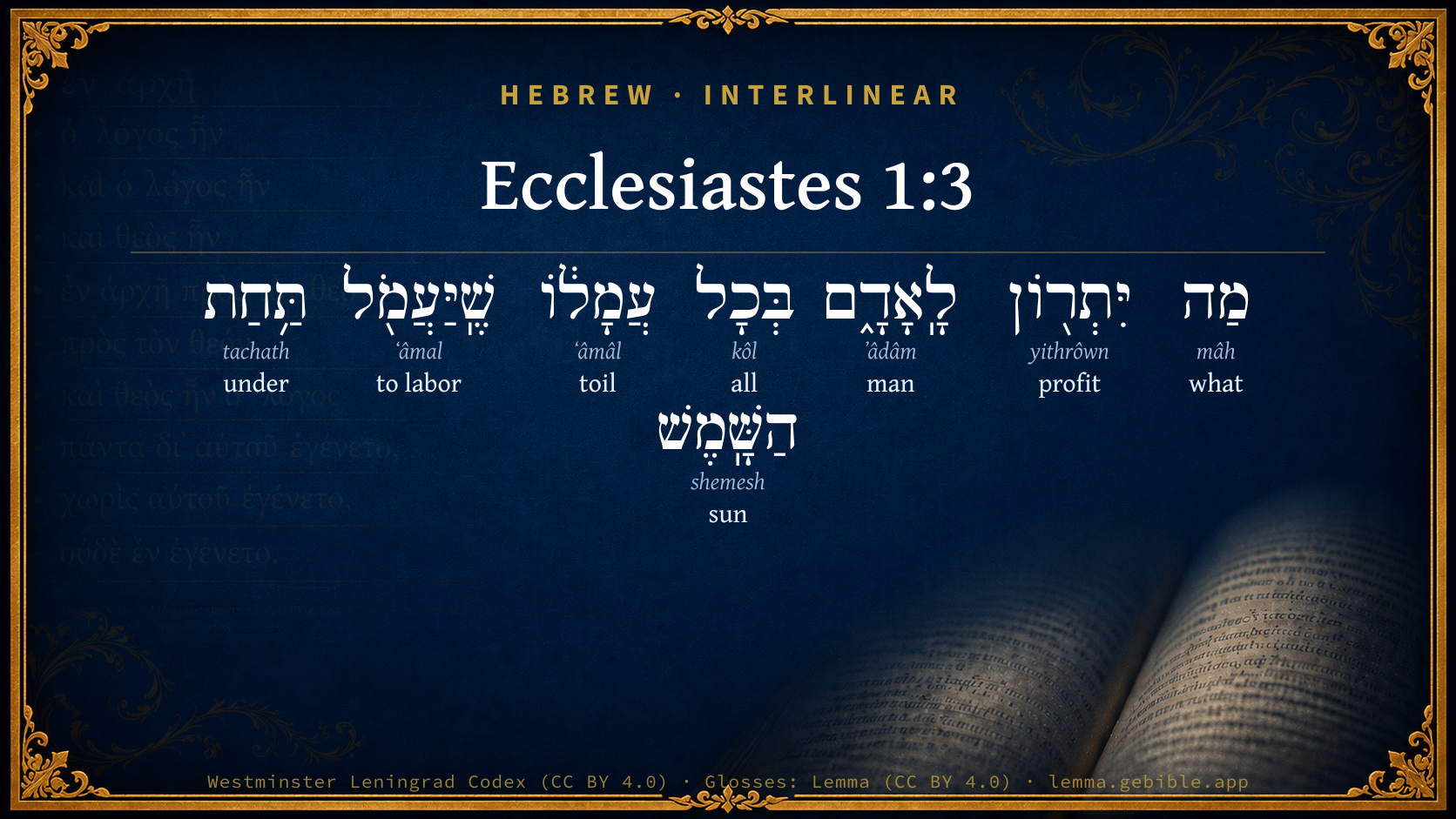
Hebrew (Westminster Leningrad Codex) Ecclesiastes 1:3 appears in the Hebrew Old Testament. The text above is from the Westminster Leningrad Codex. Each word links to its Strong’s number, a concise gloss, and parsing drawn from the Open Scriptures Hebrew Bible morphology. Click any word for its full Brown-Driver-Briggs (BDB) entry.
Download image
Cite this verse

Ecclesiastes 1:3 (World English Bible). Public Domain. Lemma interlinear Bible study tool, https://lemma.gebible.app/v/ecclesiastes/1/3.

Show BibTeX & RIS
BibTeX
RIS
English Translation
What does man gain from all his labor in which he labors under the sun?
World English Bible · Public Domain
Highlights
  • 1 first appearance in the Hebrew Bible
Full analysis ↓
Download a study sheet

One document with this verse’s original text, its word-by-word gloss line, the meaning frame, cross-references with their text, attributed commentary, and full source and license credits — printable, and it pastes into notes with its structure intact.

This verse Autodidact and up

Study sheet (.html) Plain text (.txt)

A passage Seminary Student

Up to 50 verses in one chapter. A passage sheet keeps up to 6 commentary sources and 12 cross-references per verse, in the order this page ranks them, and says so on the sheet whenever that leaves anything out. Ask for a single verse and you get the Autodidact verse sheet above.

Everything on this page stays free to read, with no account — the sheet is a download of what is already on screen, not access to it.

Want to remove ads? Support Godless Engineer
Compare translations 3

The same verse in 3 English versions, stacked beneath the original-language interlinear above. Click any original word for its lexicon entry.

Each is an independent rendering of the whole verse — the interlinear is not word-aligned to these translations.

Highlighted words mark where these versions differ — a whole-verse word diff, not a word-by-word alignment.

  • World English Bible Public Domain
    What does man gain from all his labor in which he labors under the sun?
  • King James Version Public Domain
    What profit hath a man of all his labour which he taketh under the sun?
  • unfoldingWord Literal Text CC BY-SA 4.0
    What profit to humanity in exchange for all his toil that he toils under the sun? q1

unfoldingWord Literal Text — © unfoldingWord, licensed CC BY-SA 4.0. Word-aligned USFM3 via Door43 (git.door43.org/unfoldingWord/en_ult).

Versions to compare (up to 4)

3 of 4 selected

Show all 18 translations

Every available English version of this verse, each an independent rendering of the whole verse.

  • World English Bible Public Domain
    What does man gain from all his labor in which he labors under the sun?
  • Berean Standard Bible Public Domain
    What does a man gain from all his labor, at which he toils under the sun?
  • Majority Standard Bible Public Domain
    What does a man gain from all his labor, at which he toils under the sun?
  • King James Version Public Domain
    What profit hath a man of all his labour which he taketh under the sun?
  • American Standard Version (1901) Public Domain
    What profit hath man of all his labor wherein he laboreth under the sun?
  • Revised Version (1885) Public Domain
    What profit hath man of all his labour wherein he laboureth under the sun?
  • Geneva Bible (1599) Public Domain
    What remaineth vnto man in all his trauaile, which he suffereth vnder ye sunne?
  • Douay-Rheims (1899) Public Domain
    What hath a man more of all his labour, that he taketh under the sun?
  • Young's Literal Translation Public Domain
    What advantage `is' to man by all his labour that he laboureth at under the sun?
  • Literal Standard Version CC BY-SA 4.0
    What advantage [is] to man by all his labor that he labors at under the sun?
  • Unlocked Literal Bible CC BY-SA 4.0
    What profit does mankind gain from all the work that they labor at under the sun?
  • unfoldingWord Literal Text CC BY-SA 4.0
    What profit to humanity in exchange for all his toil that he toils under the sun? q1
  • Darby Bible Public Domain
    What profit hath man of all his labour wherewith he laboureth under the sun?
  • World Messianic Bible Public Domain
    What does man gain from all his labor in which he labors under the sun?
  • Webster's Bible Public Domain
    What profit hath a man of all his labor, which he taketh under the sun?
  • Free Bible Version CC BY-SA 4.0
    What benefit do you get for slaving away in this life?
  • Bible in Basic English Public Domain
    What is a man profited by all his work which he does under the sun?
  • JPS Tanakh (1917) Public Domain
    What profit hath man of all his labour wherein he laboureth under the sun?

Literal Standard Version (2020), Covenant Press — licensed CC BY-SA 4.0. Text via the HelloAO Bible API (eBible.org). Unlocked Literal Bible (unfoldingWord) — licensed CC BY-SA 4.0. Text via the HelloAO Bible API (eBible.org). unfoldingWord Literal Text — © unfoldingWord, licensed CC BY-SA 4.0. Word-aligned USFM3 via Door43 (git.door43.org/unfoldingWord/en_ult). Free Bible Version, Dr. Jonathan Gallagher — licensed CC BY-SA 4.0. Text via the HelloAO Bible API (eBible.org).

Word by word

More ways to search: Search by grammar → Find every occurrence → Compare this word →

Practice this passage: Drill this verse → Learn its vocabulary →

About this verse

These counts appear in no published source. They are computed here, from the morphology-tagged text and Lemma’s own curated glosses. What Lemma adds →

8
words
8
distinct lemmas
Wisdom
section

Notable vocabulary

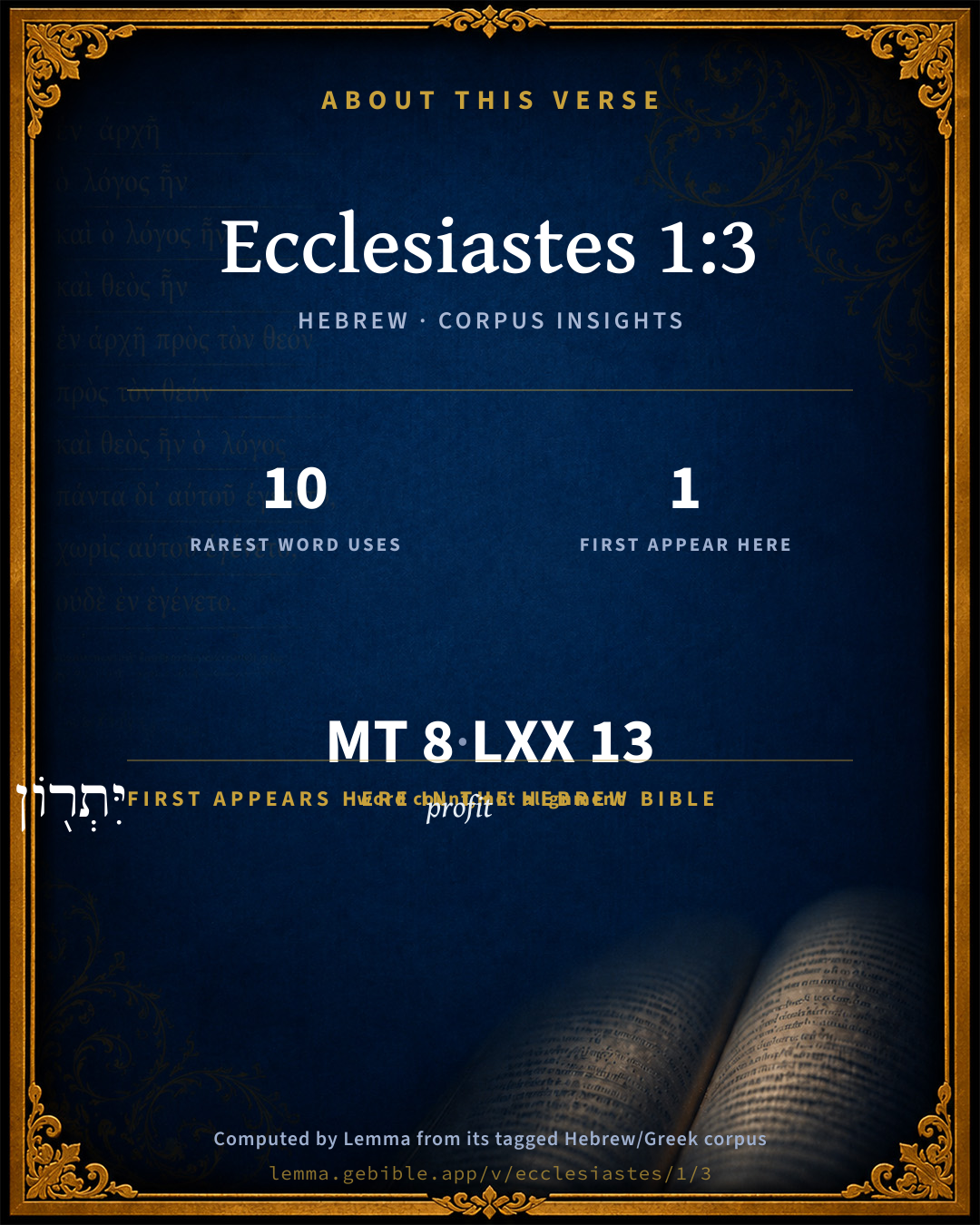
The rarest word here is יִּתְר֖וֹן profit H3504 — appearing just 10 times in the whole Hebrew Bible.

First appearance in Scripture

This word makes its first canonical appearance in the Hebrew Bible here:

  • יִּתְר֖וֹן profit H3504

Shared distinctive vocabulary

יִּתְר֖וֹן profit H3504 occurs in 9 verses of the Hebrew Bible. Also found in:

Grammatical profile

  • 1 verb
  • 5 nouns
  • 1 preposition
  • 1 particle

Verb forms

  • שֶֽׁיַּעֲמֹ֖ל Qal · Imperfect

Hebrew & Septuagint length

In English translation the verse runs 15 words from the Hebrew and 17 from the Septuagint (LXX English) — closely comparable.

A rough comparison of the two English renderings, which tokenize alike — not a word-level alignment.

Word counts can differ between the Hebrew and the Greek without any difference in meaning — e.g. the Hebrew direct-object marker אֵת has no separate Greek word, and Greek often adds the article ὁ.

In the original languages it is 8 Hebrew tokens and 13 Greek tokens — but the two are counted differently (Hebrew bundles its prefixes and suffixes into one token; the Greek is in lemma form), so that isn’t a like-for-like length.

Cross-references

21

Topical passages linked to Ecclesiastes 1:3 in the Treasury of Scripture Knowledge — connected by theme and wording, ordered by reader-vote popularity; previews shown in the World English Bible.

  • Ecclesiastes 3:9 What profit has he who works in that in which he labors?
  • Ecclesiastes 2:22 For what has a man of all his labor, and of the striving of his heart, in which he labors under the sun?
  • Ecclesiastes 5:16 This also is a grievous evil, that in all points as he came, so shall he go. And what profit does he have who labors for the wind?
  • Ecclesiastes 2:11 Then I looked at all the works that my hands had worked, and at the labor that I had labored to do; and, behold, all was vanity and a chasing after wind, and there was no profit under the sun.
  • Mark 8:36–37 For what does it profit a man, to gain the whole world, and forfeit his life?
  • Proverbs 23:4–5 Don't weary yourself to be rich. In your wisdom, show restraint.
  • John 6:27 Don't work for the food which perishes, but for the food which remains to eternal life, which the Son of Man will give to you. For God the Father has sealed him."
  • Ecclesiastes 2:19 Who knows whether he will be a wise man or a fool? Yet he will have rule over all of my labor in which I have labored, and in which I have shown myself wise under the sun. This also is vanity.
  • Isaiah 55:2 Why do you spend money for that which is not bread? and your labor for that which doesn't satisfy? listen diligently to me, and eat you that which is good, and let your soul delight itself in fatness.
  • Matthew 16:26 For what will it profit a man, if he gains the whole world, and forfeits his life? Or what will a man give in exchange for his life?
  • Ecclesiastes 8:15–17 Then I commended mirth, because a man has no better thing under the sun, than to eat, and to drink, and to be joyful: for that will accompany him in his labor all the days of his life which God has given him under the sun.
  • Habakkuk 2:13 Behold, isn't it of Yahweh of Hosts that the peoples labor for the fire, and the nations weary themselves for vanity?
  • Ecclesiastes 4:3 Yes, better than them both is him who has not yet been, who has not seen the evil work that is done under the sun.
  • Ecclesiastes 5:18 Behold, that which I have seen to be good and proper is for one to eat and to drink, and to enjoy good in all his labor, in which he labors under the sun, all the days of his life which God has given him; for this is his portion.
  • Ecclesiastes 6:12 For who knows what is good for man in life, all the days of his vain life which he spends like a shadow? For who can tell a man what will be after him under the sun?
  • Ecclesiastes 7:11 Wisdom is as good as an inheritance. Yes, it is more excellent for those who see the sun.
  • Ecclesiastes 9:3 This is an evil in all that is done under the sun, that there is one event to all: yes also, the heart of the sons of men is full of evil, and madness is in their heart while they live, and after that they go to the dead.
  • Ecclesiastes 9:6 Also their love, their hatred, and their envy has perished long ago; neither have they any more a portion forever in anything that is done under the sun.
  • Ecclesiastes 9:13 I have also seen wisdom under the sun in this way, and it seemed great to me.
  • Ecclesiastes 4:7 Then I returned and saw vanity under the sun.
  • Habakkuk 2:18 "What value does the engraved image have, that its maker has engraved it; the molten image, even the teacher of lies, that he who fashions its form trusts in it, to make mute idols?

Cross-references courtesy of OpenBible.info (CC BY 4.0).

Hebrew and Greek witnesses Masoretic Hebrew ↔ Greek Septuagint

The same verse in the two great witnesses to the Old Testament, shown verse-for-verse.

These are two independent witnesses, not word-aligned to each other, and the Septuagint is shown in lemma (dictionary) form.

Hebrew Ecclesiastes 1:3 Masoretic · Westminster Leningrad Codex

מַה יִּתְר֖וֹן לָֽאָדָ֑ם בְּכָל עֲמָל֔וֹ שֶֽׁיַּעֲמֹ֖ל תַּ֥חַת הַשָּֽׁמֶשׁ

What does man gain from all his labor in which he labors under the sun?

World English Bible · Public Domain

Greek LXX Ecclesiastes 1:3 Septuagint · lemma form

τίς περισσεία ὁ ἄνθρωπος ἐν πᾶς μόχθος αὐτός ὅς μοχθέω ὑπό ὁ ἥλιος

What advantage is there to a man in all his labor that he takes under the sun?

LXX2012 (modern English Septuagint) · Public Domain

On this verse, The Pulpit Commentary discusses the Septuagint’s reading. Read the note in Commentary ↓

Hebrew: Westminster Leningrad Codex (CC BY 4.0). Greek: Septuagint (public domain); English from LXX2012 (modern English Septuagint) (Public Domain). How the Septuagint differs from the Hebrew →

Commentary

Notes on Ecclesiastes 1:3 from classic Christian and Jewish commentators (each source and its license shown beneath its notes). The classic Christian expositions comment on the surrounding passage and are grouped to its opening verse, so a note may address several verses; the Jewish commentaries on the Tanakh (Rashi and others) are per-verse, so they appear only where the commentator wrote on this verse.

Lemma curates 59 commentaries, every one of them public domain or Creative Commons licensed, each selected and text-cleaned for this edition rather than reprinted as found. About our sources →

Trapp's Complete Commentary

John Trapp

Ecc 1:3 What profit hath a man of all his labour which he taketh under the sun?

Ver. 3. What profit hath a man?] What durable profit? Quid residui? what excess? what more than will serve to satisfy back and belly? Our life is called, "the life of our hands," {Isa 57:10} because it is maintained by the labour of our hands. Si ventri bene, si lateri, as he in Horace saith, If the belly may be filled, the back fitted, that’s all that can here be had, and that most men care to have; which if they have (some have but prisoners’ pittance, so much as will keep life and soul together), yet quid amplius? as the Vulgate renders this text, what have they more to pay them for their pains? Surely, when all the account is subducted, such a labouring man’s happiness resolved into its final issue and conclusion, there resteth nothing but ciphers. This should make us more moderate in our desires and endeavours after earthly things, since we do but "labour in the very fire, and weary ourselves for very vanity." {Heb 2:13} They that seek after the philosopher’s stone, they must use so much gold, and spend so much gold, and then they can turn as much into gold by it as they have spent in making of it; and so they have their labour for their pains. Quid emolumenti? What profit hath a man? Do we not see many take a great deal of pains to go to hell? whereinto at length they are turned as a sumpter horse is at night, after all his hard travail, with his back full of galls and bruises.

John Trapp, A Commentary or Exposition upon All the Books of the Old and New Testament (1647–1656) — public domain. Text from a community e-Sword module.

Joseph Benson's Commentary

Ecc 1:3. What profit — What real and abiding benefit? None at all. All is unprofitable as to the attainment of that happiness which all men are inquiring after. Of all his labour — Hebrew, his toilsome labour, both of body and mind, in the pursuit of riches, or pleasures, or other earthly things; under the sun — In all worldly matters, which are usually transacted in the day-time, or by the light of the sun. By this restriction he implies, that the happiness which in vain is sought for in this lower world, is really to be found in heavenly places and things.

Joseph Benson's Commentary on the Old and New Testaments (1811–1818) — public domain. Text from a community e-Sword module.

Tyndale Open Study Notes

Tyndale Open Resources

1:3 The Hebrew idiom under the sun is used twenty-nine times in Ecclesiastes. The NLT sometimes renders it with expressions such as “here on earth” (2:18) or “in this world” (2:20). It suggests a view of life that is earthbound rather than reflecting God’s perspective.

Tyndale Open Study Notes — © Tyndale Open Resources, licensed CC BY-SA 4.0. Text via the HelloAO Bible API.

Geneva Bible (1599)

Geneva Bible translators

Solomon doth not condemn man’s labor or diligence, but showeth that there is no full contentation in any thing under the heaven, nor in any creature, forasmuch as all things are transitory.

Geneva Bible (1599) marginal notes — public domain. Text via Bolls.life.

Jamieson, Fausset & Brown

Robert Jamieson, A. R. Fausset & David Brown

What profit . . . labour--that is, "What profit" as to the chief good (Mat 16:26). Labor is profitable in its proper place (Gen 2:15; Gen 3:19; Pro 14:23).

under the sun--that is, in this life, as opposed to the future world. The phrase often recurs, but only in Ecclesiastes.

Jamieson, Fausset & Brown — Commentary Critical and Explanatory on the Whole Bible (1871) — public domain (CC PDM 1.0). Text via the HelloAO Bible API.

Adam Clarke's Commentary

Verse 3. What profit hath a man] What is the sum of the real good he has gained by all his toils in life? They, in themselves, have neither made him contented nor happy.

Adam Clarke's Commentary on the Bible (1810–1826) — public domain. Text from a community e-Sword/MySword module.

Ellicott's Commentary for English Readers

(3) What profit.—The Hebrew word occurs ten times in this book (Ecc_2:11; Ecc_2:13; Ecc_3:9; Ecc_5:9; Ecc_5:16; Ecc_7:12; Ecc_10:10-11) and nowhere else in the Old Testament, but is common in post-Biblical Hebrew. The oft-recurring phrase “under the sun” is a peculiarity of this book. In other books we have “under heaven.”

(3-11) Man is perpetually toiling, yet of all his toil there remains no abiding result. The natural world exhibits a spectacle of unceasing activity, with no real progress. The sun, the winds, the waters, are all in motion, yet they do but run a round, and nothing comes of it.

A Bible Commentary for English Readers, edited by Charles John Ellicott (1878–1897) — public domain. Text from a community e-Sword module.

The Cambridge Bible for Schools and Colleges

gen. ed. J. J. S. Perowne

3. What profit hath a man] The question is, it is obvious, as in the analogous question of Mat_16:26, the most emphatic form of a negation. For “all his labour which he taketh” read all his toil which he toileth, the Hebrew giving the emphasis of the combination of the verb with its cognate substantive. The Debater sums up his experience of life in this, “There is toil, and the toil is profitless.” The word for “profit,” not meeting us elsewhere in the Hebrew of the O. T., occurs ten times in Ecclesiastes. Its strict meaning is “that which remains,”—the surplus, if any, of the balance-sheet of life. It was, probably, one of the words which the commerce of the Jews, after the Captivity, had brought into common use. The question is in substance, almost in form, identical with that of our times “Is life worth living?”

under the sun] The phrase thus used, occurring 29 times in Ecclesiastes, has nothing like it in the language of other books of the Old Testament. It is essentially Greek in character. Thus we have in Euripides, Hippol. 1220,

ὅσα τε γᾶ τρέφει

τὰν Ἅλιος αἰθομέναν δέρκεται

ἄνδρας τε.

“All creatures that the wide earth nourisheth

Which the sun looks on radiant, and mankind.”

And Theognis, 168,

τὸ δʼ ἀτρεκές, ὄλβιος αὐδεὶς

ἀνθρώπων, ὁπόσους ἤελιος καθορᾷ.

“One thing is certain, none of all mankind,

On whom the sun looks down, gains happiness.”

Our English “sublunary” may be noted as conveying an analogous idea.

The Cambridge Bible for Schools and Colleges (gen. ed. J. J. S. Perowne; Cambridge University Press, 1878–1918) — public domain. Text from a community e-Sword module.

John Gill's Exposition

What profit hath a man of all his labour which he taketh under the sun? This is a general proof of the vanity of all things, since there is no profit arises to a man of all his labour; for, though it is put by way of question, it carries in it a strong negative. All things a man enjoys he gets by labour; for man, through sin, is doomed and born unto it, Job 5:7; he gets his bread by the sweat of his brow, which is a part of the curse for sin; and the wealth and riches got by a diligent hand, with a divine blessing, are got by labour; and so all knowledge of natural and civil things is acquired through much labour and weariness of the flesh; and these are things a man labours for "under the sun", which measures out the time of his labour: when the sun riseth, man goeth forth to his labour; and, by the light and comfortable warmth of it, he performs his work with more exactness and cheerfulness; in some climates, and in some seasons, its heat, especially at noon, makes labour burdensome, which is called, bearing "the heat and burden of the day", Mat 20:12; and, when it sets, it closes the time of service and labour, and therefore the servant earnestly desires the evening shadow, Job 7:2. But now, of what profit and advantage is all this labour man takes under the sun, towards his happiness in the world above the sun? that glory and felicity, which lies in super celestial places in Christ Jesus? none at all. Or, "what remains of all his labour?" (p) as it may be rendered; that is, after death: so the Targum,

"what is there remains to a man after he is dead, of all his labour which he laboured under the sun in this world?''

nothing at all. He goes naked out of the world as he came into it; he can carry nothing away with him of all his wealth and substance he has acquired; nor any of his worldly glory, and grandeur, and titles of honour; these all die with him, his glory does not descend after him; wherefore it is a clear case that all these things are vanity of vanities; see Job 1:21. And, indeed, works of righteousness done by men, and trusted in, and by which they labour to establish a justifying righteousness, are of no profit and advantage to them in the business of justification and salvation; indeed, when these are done from right principles, and with right views, the labour in them shall not be in vain; God will not forget it; it shall have a reward of grace, though not of debt.

(p) "quid habet amplius homo?" V. L. "quid residui?" Vatablus, Piscator, Mercerus, Gejerus, Rambachius; "quantum enim homini reliquum est, post omnem saum laborem?" Tigurine version.

John Gill's Exposition of the Whole Bible (1746–1763) — public domain (CC PDM 1.0). Text via the HelloAO Bible API.

Albert Barnes' Notes on the Bible

What profit ... - The question often repeated is the great practical inquiry of the book; it receives its final answer in Ecc 12:13-14. When this question was asked, the Lord had not yet spoken Mat 11:28. The word “profit” (or pre-eminence) is opposed to “vanity.”

Hath a man - Rather, hath man.

Albert Barnes' Notes on the Bible (1834–1885) — public domain. Text from a community e-Sword/MySword module.

Haydock's Catholic Bible Commentary

Labour. People fight for a mere point; for such is the earth compared with the universe. (Seneca, q. Nat.) Hoc est punctum, &c., Matthew xvi. 26.

George Leo Haydock (1774–1849), Haydock's Catholic Family Bible and Commentary, 1859 edition — public domain. Excludes Psalms (Douay-Rheims chapter numbering differs from Protestant) and Deuterocanonical books (Catholic canon only).

Matthew Poole's English Annotations

What profit? or, as others render it, What remainder? What real and abiding benefit hath a man by it? None at all. All is unprofitable, as to the attainment of that happiness which Solomon here is, and all men in the world are, inquiring after.

His labour, Heb.

his toilsome labour, both of body and mind, in the pursuit of riches, or pleasures, or other earthly things.

Which he taketh under the sun; in all sublunary or worldly matters, which are usually transacted in the day time, or by the light of the sun. By this restriction he implies that that profit and happiness which in vain is sought for in this lower world, is really and only to be found in heavenly places and things.

Matthew Poole's English Annotations on the Holy Bible (1683–1685) — public domain. Text from a community e-Sword/MySword module.

Whedon's Commentary on the Bible

Daniel D. Whedon

3. What profit hath a man — The matter to be investigated is now plainly stated. The question is in Hebrew rhetoric a favourite substitute for the negative — “a man hath no profit” in the “toil which he toileth;” (emphatic, like “with desire have I desired.”)

Under the sun — Found in this book only of the Bible, and here some twenty-five times; is a lively equivalent to “on the earth.”

Daniel D. Whedon (gen. ed.), Commentary on the Old and New Testaments (1874–1909) — public domain. Text from a community e-Sword module.

The Pulpit Commentary

What profit hath a man of all his labor which he taketh under the sun? Here begins the elucidation of the fruitlessness of man"s ceaseless activity. The word rendered "profit" (yithron) is found only in this book, where it occurs frequently. It means "that which remains over, advantage," perisseia, as the LXX translates it. As the verb and the substantive are cognate in the following words, they are better rendered, in all his labor wherein he laboreth. So Euripides ("Androm," 134) has, Ti mocon mocqeiv, and ("And. Fragm.," 7:4), Toiv mocqousi mocqouv eujtucwv sunekponei. Man is Adam, the natural man, unenlightened by the grace of God. Under the sun is an expression peculiar to this book (comp. vers. 9, 14; Ecc_2:11, Ecc_2:17, etc.) but is not intended to contrast this present with a future life; it merely refers to what we call sublunary matters. The phrase is often tact with in the Greek poets. Eurip., "Alcest.," 151

Gunh t ajristh twn uJf hJliw makrw

By far the best of all beneath the sun." Homer, "Iliad," 4:44

Ai gaw te kaienti Naietaousi polhev ejpicqoniwn ajnqrwpwn.

Of all the cities occupied by man Beneath the sun and starry cope of heaven. (Cowper. )

Theognis, "Parcem.," 167

Olbiov oujdeipwn oJposouv hjeliov kaqora.

No mortal man On whom the sun looks down is wholly blest.

In an analogous sense we find in other passages of Scripture the terms under heaven" (ver. 13; Ecc_2:3; Exo_17:14; Luk_17:24) and "upon the earth" (Ecc_8:14, Ecc_8:16; Gen_8:17) The interrogative form of the verse conveys a strong negative, (comp. Ecc_6:8) like the Lord"s word in Mat_16:26, "What shall a man be profited, if he shall gain the whole world, and forfeit his soul?" The epilogue (Ecc_12:13) furnishes a reply to the desponding inquiry. One generation passeth away, and another generation cometh. The translation rather weakens the force of the original, which is, a generation goeth, and a generation cometh. Man is only a pilgrim on earth; he soon passes away, and his place is occupied by others. Parallelisms of this sentiment will occur to every reader. Thus Ben-Sira, "All flesh waxeth old as a garment: for the covenant from the beginning is, Thou shalt die the death. As of the green leaves on a thick tree, some fall and some grow; so is the generation of flesh and blood, one cometh to an end, and another is born. Every work rotteth and consumeth away, and the worker thereof shall go withal" (Ecc 14:17, etc.; comp. Job_10:21; Psa_39:13) The famous passage in Homer, "Iliad," 6:146, etc., is thus rendered by Lord Derby

The race of man is as the race of leaves: Of leaves, one generation by the wind Is scattered on the earth; another soon In spring"s luxuriant verdure bursts to light. So with our race: these flourish, those decay.

(Comp. ibid., 21:464, etc.; Horace, "Ars Poet.," 60.) But (and) the earth abideth forever. While the constant succession of generations of men goes on, the earth remains unchanged and immovable. If men were as permanent as is their dwelling-place, their labors might profit; but as things are, the painful contrast between the two makes itself felt. The term, "for ever," like the Greek eijv ton aijwna, does not necessarily imply eternity, but often denotes limited or conditioned duration, as when the slave is engaged to serve his master "for ever", (Exo_21:6) or the hills are called "everlasting". (Gen_49:26) This verse gives one instance of growth and decay in contrast with insensate continuance. The following verses give further examples.

Vers. 3, 4.

The vanity of man"s life.

At the very outset of his treatise, the wise man gives his readers to understand that the vanity which is ascribed to all things that are, is distinctive in an especial and obvious manner of human life. This is the most interesting of all things to observe and study, as it is the most precious to possess. And there is some danger lest, if the study of it lead to despondency, the possession of it should cease to be valued.

I THE FACTS UPON WHICH THE CONVICTION OF THE VANITY OF LIFE IS FOUNDED.

1. The unsatisfying character of human toil. Labor is the destiny of man, and is in most cases the indispensable condition of not only life itself, but of those things for the sake of which many men value life wealth, comfort, pleasure, and fame. Yet in how many cases does toil fail to secure the objects for the sake of which it is undertaken! Men labor, but reap no harvest of their painful, wearying efforts. And when the result is obtained, how commonly does it yield little or nothing of the satisfaction desired! Men toil for years, and when they attain that upon which their hearts were set, disappointment and dissatisfaction take possession of their nature.

2. The brevity of human life, and the rapid succession of the generations. The reflection of the wise man is a reflection which must have been current among men from the earliest ages No sooner has a laborious and successful man reached the summit of his ambition, grasped the object of his desire, than he is taken away from the enjoyment of that for the sake of which he was content to "scorn delights, and live laborious days." The next generation renews the quest, only to repeat the experience of disappointment. Changes and improvements take place in many details of our life; but life itself remains throughout the ages, subject to the same limitations and the same calamities, to the same uncertainties and the same close.

3. The contrast between the transitoriness of human life and the stability of the unconscious earth. It appears strange and inexplicable that man, with the great possibilities of his nature, should be so short-lived, and that the earth should outlast generation after generation of mankind. The writer of Ecclesiastes felt, as every reflecting observer must feel, the sadness of this contrast between the perpetuity of the dwelling-place and the brief sojourn of its successive inhabitants.

4. The impossibility of any generation reaping the harvest for which it has sown. The toil, the genius, the enterprise of a generation may indeed bear fruit, but it is the generation which follows that enjoys that fruit. All men labor more for posterity than for themselves. "This also is vanity.

II THE CHARACTER OF THE INFERENCE FROM THESE FACTS, VIZ. THAT LIFE IS PROFITLESS AND VAIN.

1. It is attributable to the reflecting and aspiring nature of man. A being less endowed with susceptibilities and imagination, with moral capacities and far-reaching aims and hopes, would be incapable of such emotions and such conclusions as this book expresses. The brute is content to eat and drink, to sleep, and to follow its several instincts and impulses. But of man we may say that nothing that he can be and do can give him perfect rest and satisfaction. It is owing to an innate and noble dissatisfaction that he is ever aiming at something better and higher, and that the narrow range and brief scope of human life cannot content him, cannot furnish him with all the opportunity he desires in order to acquire and to achieve.

2. It is attributable to the very nature of earthly things, which, because they are finite, are incapable of satisfying such a nature as that described. They may and do answer a high purpose when their true import is discerned when they are recognized as symbolical and significant of what is greater than themselves. But no material good, no terrestrial distinctions, can serve as "profit" of labor. If so regarded, their vanity must sooner or later be apparent. There is a divinely ordained disproportion between the spirit of man and the scenes and occupations and emoluments of earth.

APPLICATION.

1. There is in human life a continuity only discerned by the reflecting and the pious. The obvious and striking fact is the disconnection of the generations. But as evolution reveals a physical continuity, philosophy finds an intellectual and moral continuity in our race.

2. The purpose of God is unfolded to successive generations of men. The modern study of the philosophy of history has brought this fact prominently and effectively before the attention of the scholarly and thoughtful. We see this continuity and progress in the order of revelation; but all history is, in a sacred sense, a revelation of the Eternal and Unchanging.

3. It is well that what we do we should do deliberately and seriously, not for our own good merely, but for mankind, and in the truest sense for God. This will lend "profit" to the unprofitable.

4. This state is not all. Life explains school; summer explains spring; and so eternity shall explain the disappointments, perplexities, and anomalies of time. T.

The Pulpit Commentary (1880–1919), ed. H.D.M. Spence-Jones & Joseph S. Exell — public domain. Text from a community e-Sword module.

John Wesley's Explanatory Notes

What profit - What real and abiding benefit? None at all. All is unprofitable as to the attainment of that happiness which all men are enquiring after. His labour - Hebrew. his toilsome labour, both of body and mind in the pursuit of riches, or pleasures, or other earthly things. Under the sun - In all worldly matters, which are usually transacted in the day time, or by the light of the sun. By this restriction he implies that the happiness which in vain is sought for in this lower world, is really to be found in heavenly places and things.

John Wesley, Explanatory Notes Upon the Whole Bible (1754–1765) — public domain. Text via the GEBible commentary corpus.

Keil & Delitzsch

C. F. Keil & F. Delitzsch

With this verse commences the proof for this exclamation and statement: "What profit hath a man of all his labour which he laboureth in under the sun?!" An interrogative exclamation, which leads to the conclusion that never anything right, i.e., real, enduring, satisfying, comes of it.יתרון, profit, synon. with Mothar, Ecc 3:19, is peculiar to this book (= Aram. יוּתרן). A primary form, יתרון, is unknown. The punctator Simson (Cod. 102a of the Leipzig University Lib.f. 5a) rightly blames those who use ויתּרון, in a liturgical hymn, of the Day of Atonement. The word signifies that which remains over, either, as here, clear gain, profit, or that which has the pre-eminence, i.e., superiority, precedence, or is the foremost. "Under the sun" is the designation of the earth peculiar to this book, - the world of men, which we are wont to call the sublunary world. שׁ has not the force of an accusative of manner, but of the obj. The author uses the expression, "Labour wherein I have laboured," Ecc 2:19-20; Ecc 5:17, as Euripides, similarly, μοχθεῖν μόχθον. He now proceeds to justify the negative contained in the question, "What profit?"

Keil & Delitzsch — Biblical Commentary on the Old Testament (1861–1891) — public domain (CC PDM 1.0). Text via the HelloAO Bible API. (Old Testament only.)

Rashi

Rabbi Shlomo Yitzchaki (Rashi)

What profit reward and remainder.

under the sun in lieu of the Torah, which is called light, as it is stated (Prov. 6:23): “and the Torah is light.” All the toil which he does instead of engaging in the Torah—what reward is there in it?

Rashi on the Tanakh — English translations: “The Judaica Press complete Tanach with Rashi, translated by A. J. Rosenberg” (CC BY 4.0); “Pentateuch with Rashi's commentary by M. Rosenbaum and A.M. Silbermann, 1929-1934” (public domain); “The Metsudah Tanach series, Lakewood, N.J” (CC BY 4.0); and “The Book of Joshua, Metsudah Publications, 1997” (CC BY 4.0). Text via Sefaria.

Lesson kit

Teaching starters — assembled from the data on this page, not authored interpretation. Every prompt links to the verse data it draws on. Edit before teaching.

Ecclesiastes, in the Wisdom, opens this verse with 8 words (8 distinct Hebrew lemmas). Its most distinctive word is yithrôwn (“profit”). A historical commentator’s framing appears above. Read the whole chapter for the surrounding context.

Discussion questions

  1. How does “profit” (yithrôwn) shape what this verse is saying?
  2. The word “profit” first appears here in Scripture. What is being introduced at this debut?
  3. Ecclesiastes 2:11 shares the word «profit» with this verse. How do the two illuminate each other?
  4. These translations render this verse differently; the difference is in the English rendering, not the original. What questions does that raise?
  5. The verb «שֶֽׁיַּעֲמֹ֖ל» is Qal Imperfect. How does its form color the action?
  6. Reading how Trapp's Complete Commentary and Joseph Benson's Commentary read this verse, where do the two commentators agree and where do they part?

Things to notice

Reading settings

Reading text

Shown beneath each verse's original-language words.

Old Testament
Old Testament edition

Read the OT as the Masoretic Hebrew (MT) or the Greek Septuagint (LXX).

English shown for the Greek Septuagint (in the Hebrew ↔ Greek comparison).

Comparing translations? Open the Compare panel on any verse page to stack up to four side by side.