
Isaiah 22:16

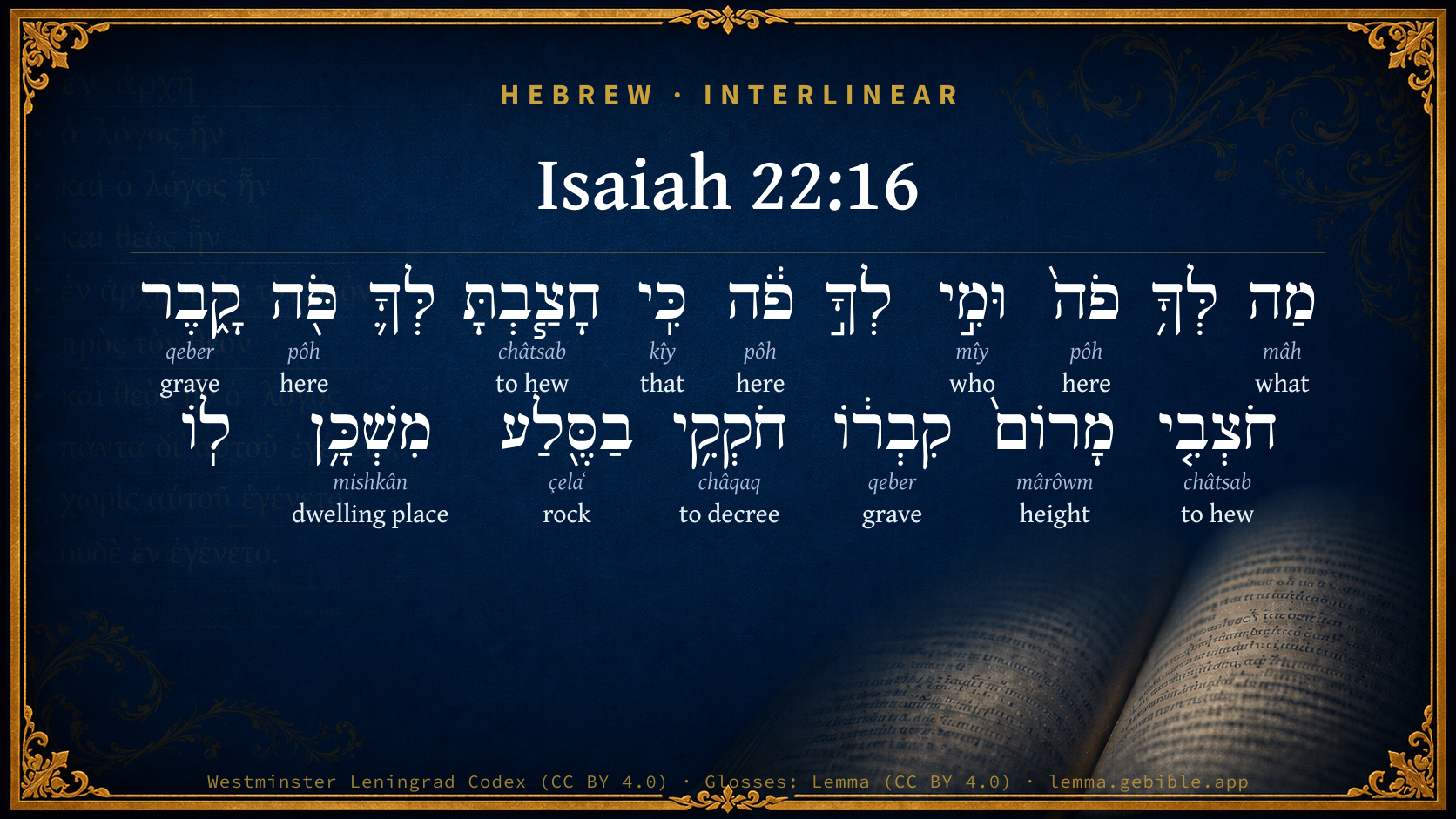
Hebrew (Westminster Leningrad Codex) Isaiah 22:16 appears in the Hebrew Old Testament. The text above is from the Westminster Leningrad Codex. Each word links to its Strong’s number, a concise gloss, and parsing drawn from the Open Scriptures Hebrew Bible morphology. Click any word for its full Brown-Driver-Briggs (BDB) entry.
Download image
Cite this verse

Isaiah 22:16 (World English Bible). Public Domain. Lemma interlinear Bible study tool, https://lemma.gebible.app/v/isaiah/22/16.

Show BibTeX & RIS
BibTeX
RIS
English Translation
"What are you doing here? and who has you here, that you have hewed out a tomb here? Cutting him out a tomb on high, chiseling a habitation for himself in the rock!"
World English Bible · Public Domain
Download a study sheet

One document with this verse’s original text, its word-by-word gloss line, the meaning frame, cross-references with their text, attributed commentary, and full source and license credits — printable, and it pastes into notes with its structure intact.

This verse Autodidact and up

Study sheet (.html) Plain text (.txt)

A passage Seminary Student

Up to 50 verses in one chapter. A passage sheet keeps up to 6 commentary sources and 12 cross-references per verse, in the order this page ranks them, and says so on the sheet whenever that leaves anything out. Ask for a single verse and you get the Autodidact verse sheet above.

Everything on this page stays free to read, with no account — the sheet is a download of what is already on screen, not access to it.

Want to remove ads? Support Godless Engineer
Compare translations 3

The same verse in 3 English versions, stacked beneath the original-language interlinear above. Click any original word for its lexicon entry.

Each is an independent rendering of the whole verse — the interlinear is not word-aligned to these translations.

Highlighted words mark where these versions differ — a whole-verse word diff, not a word-by-word alignment.

  • World English Bible Public Domain
    "What are you doing here? and who has you here, that you have hewed out a tomb here? Cutting him out a tomb on high, chiseling a habitation for himself in the rock!"
  • King James Version Public Domain
    What hast thou here? and whom hast thou here, that thou hast hewed thee out a sepulchre here, as he that heweth him out a sepulchre on high, and that graveth an habitation for himself in a rock?
  • unfoldingWord Literal Text CC BY-SA 4.0
    ‘What to you here, and who to you here, that you have hewn a tomb for yourself here, hewing one’s tomb on high, carving a dwelling for oneself in the rock?

unfoldingWord Literal Text — © unfoldingWord, licensed CC BY-SA 4.0. Word-aligned USFM3 via Door43 (git.door43.org/unfoldingWord/en_ult).

Versions to compare (up to 4)

3 of 4 selected

Show all 18 translations

Every available English version of this verse, each an independent rendering of the whole verse.

  • World English Bible Public Domain
    "What are you doing here? and who has you here, that you have hewed out a tomb here? Cutting him out a tomb on high, chiseling a habitation for himself in the rock!"
  • Berean Standard Bible Public Domain
    What are you doing here, and who authorized you to carve out a tomb for yourself here—to chisel your tomb in the height and cut your resting place in the rock?
  • Majority Standard Bible Public Domain
    What are you doing here, and who authorized you to carve out a tomb for yourself here—to chisel your tomb in the height and cut your resting place in the rock?
  • King James Version Public Domain
    What hast thou here? and whom hast thou here, that thou hast hewed thee out a sepulchre here, as he that heweth him out a sepulchre on high, and that graveth an habitation for himself in a rock?
  • American Standard Version (1901) Public Domain
    What doest thou here? and whom has thou here, that thou hast hewed thee out here a sepulchre? hewing him out a sepulchre on high, graving a habitation for himself in the rock!
  • Revised Version (1885) Public Domain
    What doest thou here? and whom hast thou here, that thou hast hewed thee out here a sepulchre? hewing him out a sepulchre on high, graving an habitation for himself in the rock!
  • Geneva Bible (1599) Public Domain
    What haste thou to doe here? and whome hast thou here? that thou shouldest here hewe thee out a sepulchre, as he that heweth out his sepulchre in an hie place, or that graueth an habitation for him selfe in a rocke?
  • Douay-Rheims (1899) Public Domain
    What dost thou here, or as if thou wert somebody here? for thou hast hewed thee out a sepulchre here, thou hast hewed out a monument carefully in a high place, a dwelling for thyself in a rock.
  • Young's Literal Translation Public Domain
    What -- to thee here? And who -- to thee here? That thou hast hewn out to thee here -- a sepulchre? Hewing on high his sepulchre, Graving in a rock a dwelling for himself.
  • Literal Standard Version CC BY-SA 4.0
    What are you [doing] here? And who has [allowed] you here? That you have hewn out a tomb for yourself here? Hewing his tomb on high, || Carving a dwelling for himself in a rock.
  • Unlocked Literal Bible CC BY-SA 4.0
    'What are you doing here and who gave you permission to cut out a tomb for yourself, hewing out a grave on the heights and carving out a resting place in the rock?'”
  • unfoldingWord Literal Text CC BY-SA 4.0
    ‘What to you here, and who to you here, that you have hewn a tomb for yourself here, hewing one’s tomb on high, carving a dwelling for oneself in the rock?
  • Darby Bible Public Domain
    What hast thou here? and whom hast thou here, that thou hast hewn thee out a sepulchre here, [as] he that heweth out his sepulchre on high, cutting out in the rock a habitation for himself?
  • World Messianic Bible Public Domain
    ‘What are you doing here? Who has you here, that you have dug out a tomb here?’ Cutting himself out a tomb on high, chiseling a habitation for himself in the rock!”
  • Webster's Bible Public Domain
    What hast thou here? and whom hast thou here, that thou hast hewed thee out a sepulcher here, as he that heweth him out a sepulcher on high, and that graveth a habitation for himself in a rock?
  • Free Bible Version CC BY-SA 4.0
    ‘What are you doing here? Who do you think you are, cutting out a tomb for yourself high up on a hill, carving out for yourself a place to rest?
  • Bible in Basic English Public Domain
    Who are you, and by what right have you made for yourself a resting-place here?
  • JPS Tanakh (1917) Public Domain
    What hast thou here, and whom hast thou here, that thou hast hewed thee out here a sepulchre, thou that hewest thee out a sepulchre on high, and gravest a habitation for thyself in the rock?

Literal Standard Version (2020), Covenant Press — licensed CC BY-SA 4.0. Text via the HelloAO Bible API (eBible.org). Unlocked Literal Bible (unfoldingWord) — licensed CC BY-SA 4.0. Text via the HelloAO Bible API (eBible.org). unfoldingWord Literal Text — © unfoldingWord, licensed CC BY-SA 4.0. Word-aligned USFM3 via Door43 (git.door43.org/unfoldingWord/en_ult). Free Bible Version, Dr. Jonathan Gallagher — licensed CC BY-SA 4.0. Text via the HelloAO Bible API (eBible.org).

Word by word

More ways to search: Search by grammar → Find every occurrence → Compare this word →

Practice this passage: Drill this verse → Learn its vocabulary →

חֹקְקִ֥י
châqaq
H2710
“decreeing”
Verb, Qal, Participle Active, Masculine, Singular, Construct
Part of Speech
Verb
Stem
Qal
Form
Participle Active
Gender
Masculine
Number
Singular
State
Construct
Full BDB Definition

Origin: a primitive root

TWOT: 728

to cut out, decree, inscribe, set, engrave, portray, govern - (Qal) - to cut in - to cut in or on, cut upon, engrave, inscribe - to trace, mark out - to engrave, inscribe (of a law) - (Poel) - to inscribe, enact, decree - one who decrees, lawgiver (participle) - (Pual) something decreed, the law (participle) - (Hophal) to be inscribed
  1. מַה mâh H4100 “what” Particle, Interrogative
  2. פֹה֙ pôh H6311 “here” Adverb
  3. וּמִ֣י mîy H4310 “and · who” Conjunction + Particle, Interrogative
  4. פֹ֔ה pôh H6311 “here” Adverb
  5. כִּֽי kîy H3588 “that” Conjunction
  6. חָצַ֧בְתָּ châtsab H2672 “to hew” Verb, Qal, Perfect, 2nd Person, Masculine, Singular
  7. פֹּ֖ה pôh H6311 “here” Adverb
  8. קָ֑בֶר qeber H6913 “grave” Noun, Common, Masculine, Singular, Absolute
  9. חֹצְבִ֤י châtsab H2672 “hewing” Verb, Qal, Participle Active, Masculine, Singular, Construct
  10. מָרוֹם֙ mârôwm H4791 “height” Noun, Common, Masculine, Singular, Absolute
  11. קִבְר֔וֹ qeber H6913 “grave · his” Noun, Common, Masculine, Singular, Construct + Suffix, Personal, 3rd Person, Masculine, Singular
  12. בַסֶּ֖לַע çelaʻ H5553 “in/at the · rock” Preposition, Determined + Noun, Common, Masculine, Singular, Absolute
  13. מִשְׁכָּ֥ן mishkân H4908 “dwelling place” Noun, Common, Masculine, Singular, Absolute

About this verse

These counts appear in no published source. They are computed here, from the morphology-tagged text and Lemma’s own curated glosses. What Lemma adds →

18
words
10
distinct lemmas
Prophets
section

Notable vocabulary

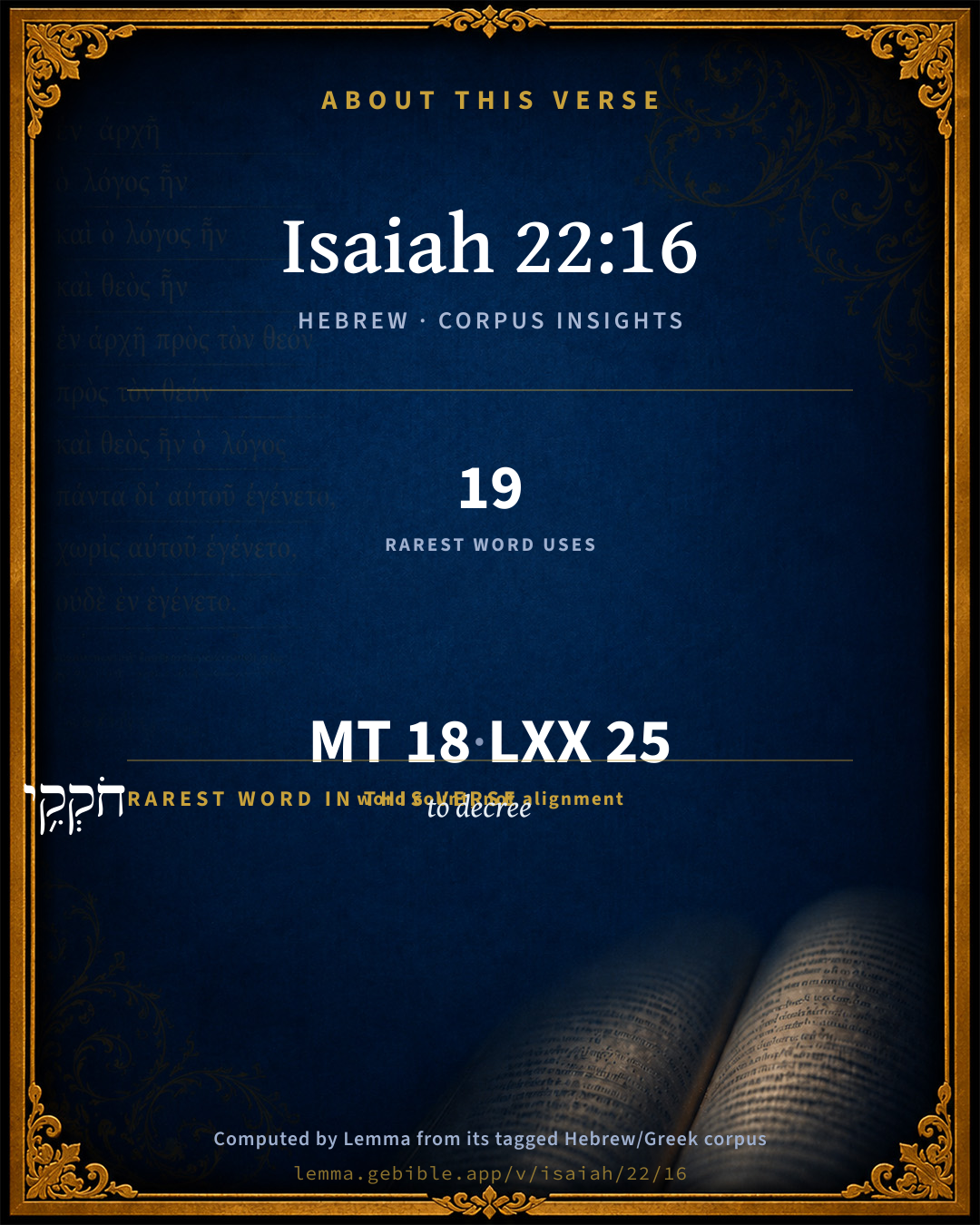
The rarest word here is חֹקְקִ֥י to decree H2710 — appearing just 19 times in the whole Hebrew Bible.

Shared distinctive vocabulary

חֹקְקִ֥י to decree H2710 occurs in 19 verses of the Hebrew Bible. Also found in:

Grammatical profile

  • 3 verbs
  • 5 nouns
  • 4 prepositions
  • 1 conjunction
  • 3 adverbs
  • 2 particles

Verb forms

  • חָצַ֧בְתָּ Qal · Perfect
  • חֹצְבִ֤י Qal · Participle Active
  • חֹקְקִ֥י Qal · Participle Active

Repetition

Words recur within this verse — often emphatic in Hebrew:

  • פֹה֙ here H6311 ×3
  • חָצַ֧בְתָּ to hew H2672 ×2
  • קָ֑בֶר grave H6913 ×2

Hebrew & Septuagint length

In English translation the verse runs 33 words from the Hebrew and 32 from the Septuagint (LXX English) — closely comparable.

A rough comparison of the two English renderings, which tokenize alike — not a word-level alignment.

Word counts can differ between the Hebrew and the Greek without any difference in meaning — e.g. the Hebrew direct-object marker אֵת has no separate Greek word, and Greek often adds the article ὁ.

In the original languages it is 18 Hebrew tokens and 25 Greek tokens — but the two are counted differently (Hebrew bundles its prefixes and suffixes into one token; the Greek is in lemma form), so that isn’t a like-for-like length.

Cross-references

7

Topical passages linked to Isaiah 22:16 in the Treasury of Scripture Knowledge — connected by theme and wording, ordered by reader-vote popularity; previews shown in the World English Bible.

  • Matthew 27:60 and laid it in his own new tomb, which he had hewn out in the rock, and he rolled a great stone to the door of the tomb, and departed.
  • 2 Samuel 18:18 Now Absalom in his lifetime had taken and reared up for himself the pillar, which is in the king's dale; for he said, I have no son to keep my name in memory: and he called the pillar after his own name; and it is called Absalom's monument, to this day.
  • 2 Chronicles 16:14 They buried him in his own tombs, which he had hewn out for himself in the city of David, and laid him in the bed which was filled with sweet odors and various kinds [of spices] prepared by the perfumers' are: and they made a very great burning for him.
  • Job 3:14 With kings and counselors of the earth, Who built up waste places for themselves;
  • Isaiah 14:18 All the kings of the nations, all of them, sleep in glory, everyone in his own house.
  • Isaiah 52:5 Now therefore, what do I here, says Yahweh, seeing that my people is taken away for nothing? those who rule over them do howl, says Yahweh, and my name continually all the day is blasphemed.
  • Micah 2:10 Arise, and depart! For this is not your resting place, Because of uncleanness that destroys, Even with a grievous destruction.

Cross-references courtesy of OpenBible.info (CC BY 4.0).

Hebrew and Greek witnesses Masoretic Hebrew ↔ Greek Septuagint

The same verse in the two great witnesses to the Old Testament, shown verse-for-verse.

These are two independent witnesses, not word-aligned to each other, and the Septuagint is shown in lemma (dictionary) form.

Hebrew Isaiah 22:16 Masoretic · Westminster Leningrad Codex

מַה לְּךָ֥ פֹה֙ וּמִ֣י לְךָ֣ פֹ֔ה כִּֽי חָצַ֧בְתָּ לְּךָ֛ פֹּ֖ה קָ֑בֶר חֹצְבִ֤י מָרוֹם֙ קִבְר֔וֹ חֹקְקִ֥י בַסֶּ֖לַע מִשְׁכָּ֥ן לֽוֹ

"What are you doing here? and who has you here, that you have hewed out a tomb here? Cutting him out a tomb on high, chiseling a habitation for himself in the rock!"

World English Bible · Public Domain

Greek LXX Isaiah 22:16 Septuagint · lemma form

τίς σύ ὧδε καί τίς σύ εἰμί ὧδε ὅτι λατομέω σεαυτοῦ ὧδε μνημεῖον καί ποιέω σεαυτοῦ ἐν ὑψηλός μνημεῖον καί γράφω σεαυτοῦ ἐν πέτρα σκηνή

and what have you to do here, that you have here hewn yourself a sepulchre, and made yourself a sepulchre on high, and have graven for yourself a dwelling in the rock?

LXX2012 (modern English Septuagint) · Public Domain

On this verse, Albert Barnes' Notes on the Bible discusses the Septuagint’s reading. Read the note in Commentary ↓

Hebrew: Westminster Leningrad Codex (CC BY 4.0). Greek: Septuagint (public domain); English from LXX2012 (modern English Septuagint) (Public Domain). How the Septuagint differs from the Hebrew →

Targum (Aramaic paraphrase)

1

The Targum is the ancient Jewish Aramaic paraphrase of the Hebrew Scriptures — an interpretive translation, not the Hebrew text itself. Onkelos (literal) and Pseudo-Jonathan (expansive) render the Torah, and Jonathan the Prophets. Coverage is partial: where no permissively-licensed English translation exists for a verse, only the Aramaic is shown. This is verse-level text, not a word-by-word alignment to the Hebrew.

  1. Targum Jonathan Prophets (Joshua–Malachi)
    וְתֵימַר לֵיהּ מַה לָךְ כָּא מַה לָךְ כְּדֵין אֲרֵי אַתְקְנִית לָךְ כָּא אֲתַר אַתְקִין בְּרוּמָא אַתְרֵהּ שַׁוֵי בְּכֵיפָּא בֵּית מְדוֹרֵהּ:

    And thou shalt say to him, What hast thou here? and what hast thou here, that thou hast prepared for thyself here a place? He hath prepared on high his place! he hath put in the rock the place of his habitation!

    Targum Jonathan — Aramaic: “Mikraot Gedolot” (public domain). English: “Sefaria Community Translation” (CC0 1.0 (public-domain dedication)); “London "Chaldee Paraphrase," 1871” (public domain). Text via Sefaria.

Commentary

Notes on Isaiah 22:16 from classic Christian and Jewish commentators (each source and its license shown beneath its notes). The classic Christian expositions comment on the surrounding passage and are grouped to its opening verse, so a note may address several verses; the Jewish commentaries on the Tanakh (Rashi and others) are per-verse, so they appear only where the commentator wrote on this verse.

Lemma curates 59 commentaries, every one of them public domain or Creative Commons licensed, each selected and text-cleaned for this edition rather than reprinted as found. About our sources →

Trapp's Complete Commentary

John Trapp

Isa 22:16 What hast thou here? and whom hast thou here, that thou hast hewed thee out a sepulchre here, [as] he that heweth him out a sepulchre on high, [and] that graveth an habitation for himself in a rock?

Ver. 16. What hast thou here?] What inheritance, possession?

And whom hast thou here?] sc., Of thy stock and kindred? {a} Art not thou a foreigner, a new man, an upstart mushroom? Why, then, dost thou cut thee out such a costly and stately sepulchre in Jerusalem, as if you were of the royal family, or as if you were sure to die here in thy nest? Will it not prove a true κενοταφιον, as the Greeks call it? Some conceive that for the safeguard of his tomb, and other trinkets, Shebna was one of those princes {2Ki 19:2} that gave the king counsel to fortify so strongly. The Hebrews say that he likewise secretly kept correspondence with the enemy, that he might have a stake in store which way soever the dice chanced to turn; yea, that he treacherously agreed with the enemy to deliver the city into his hands; and therefore it was but time to take him a link lower, as Hezekiah did upon this prophecy of Isaiah. Some add, that for betraying the city he hoped to be made king there till his death, and therefore hewed him out a mausoleum or royal sepulchre there, and that among those of the house of David, say the Rabbis.

{a} Terrae filius. Son of the earth.

John Trapp, A Commentary or Exposition upon All the Books of the Old and New Testament (1647–1656) — public domain. Text from a community e-Sword module.

Joseph Benson's Commentary

Isa 22:16-19. What hast thou here? — Or, What dost thou here? What right hast thou to this place and office? And whom hast thou here? — What relations or family? That thou hast hewed thee out a sepulchre — That thou art ambitious of raising a stately sepulchre for thyself and thine heirs? As he that heweth out a sepulchre on high — In a high and eminent place; a habitation for himself in a rock — A monument that shall preserve his memory to all succeeding times. The Lord will carry thee away with a mighty captivity — Will cause thee to be carried into captivity by a strong hand, or by the hand of a mighty man, from which, therefore, thou shalt not be able to escape. The Hebrew, משׂלשׂלן שׂלשׂלה גבר, is rendered by Dr. Waterland, will throw thee out hence with a mighty throw, and may also be rendered, will cast thee away with the casting of a mighty man, that is, with great force; and will surely cover thee — Namely, with confusion, as is here implied, and as this phrase is more fully expressed Psa 109:29. Or, this may be an allusion to the condition of mourners in general, and particularly of condemned persons, whose faces were wont to be covered. He will violently turn and toss thee like a ball — Hebrew, צנוŠ יצנפן צנפה כדור, rolling he will roll thee with the rolling of a ball; into a large country — Like a ball which is cast into a large and plain spot of ground, where, being thrown with great force, it runs far and wide. Or, to a far country, meaning probably Assyria. There shalt thou die — After having lived in obscurity. And the chariots of thy glory shall be the shame of thy lord’s house — The honour thou didst arrive at, and the chariots in which thou didst ride with so much state at Jerusalem, shall turn to thy shame, and to the reproach of those who preferred so unworthy a person. Dr. Waterland translates the verse, He will toss and whirl thee, as he were whirling a ball, &c., and there shall be thy glorious chariots, O thou shame of thy lord’s house. And I will drive thee, &c. — These are the Lord’s words; and from thy state shall he pull thee down — Namely, the Lord shall; such sudden changes of persons being very usual in these writings.

Joseph Benson's Commentary on the Old and New Testaments (1811–1818) — public domain. Text from a community e-Sword module.

Tyndale Open Study Notes

Tyndale Open Resources

22:16 Shebna was building a beautiful tomb . . . a monument. This lavish burial place was intended to last for centuries.

Tyndale Open Study Notes — © Tyndale Open Resources, licensed CC BY-SA 4.0. Text via the HelloAO Bible API.

Geneva Bible (1599)

Geneva Bible translators

Meaning, that he was a stranger, and came up of nothing.

Whereas he thought to make his name immortal by his famous sepulcher, he died most miserably among the Assyrians.

Geneva Bible (1599) marginal notes — public domain. Text via Bolls.life.

Jamieson, Fausset & Brown

Robert Jamieson, A. R. Fausset & David Brown

What . . . whom--The prophet accosts Shebna at the very place where he was building a grand sepulcher for himself and his family (compare Isa 14:18; Gen. 23:1-20; Gen 49:29; Gen 50:13). "What (business) hast thou here, and whom hast thou (of thy family, who is likely to be buried) here, that thou buildest," &c., seeing that thou art soon to be deposed from office and carried into captivity? [MAURER].

on high--Sepulchres were made in the highest rocks (Ch2 32:33, Margin).

habitation for himself--compare "his own house" (Isa 14:18).

Jamieson, Fausset & Brown — Commentary Critical and Explanatory on the Whole Bible (1871) — public domain (CC PDM 1.0). Text via the HelloAO Bible API.

Adam Clarke's Commentary

Verse 16. A sepulchre on high - in a rock] It has been observed before, on Isa 13:1, that persons of high rank in Judea, and in most parts of the east, were generally buried in large sepulchral vaults, hewn out in the rock for the use of themselves and their families. The vanity of Shebna is set forth by his being so studious and careful to have his sepulchre on high - in a lofty vault; and that probably in a high situation, that it might be more conspicuous. Hezekiah was buried, למעלה lemalah, εν αναβασει Sept.: in the chiefest, says our translation; rather, in the highest part of the sepulchres of the sons of David, to do him the more honour, 2Ch 32:33. There are some monuments still remaining in Persia of great antiquity, called Naksi Rustam, which give one a clear idea of Shebna's pompous design for his sepulchre. They consist of several sepulchres, each of them hewn in a high rock near the top; the front of the rock to the valley below is adorned with carved work in relievo, being the outside of the sepulchre. Some of these sepulchres are about thirty feet in the perpendicular from the valley, which is itself perhaps raised above half as much by the accumulation of the earth since they were made. See the description of them in Chardin, Pietro della Valle, Thevenot, and Kempfer. Diodorus Siculus, lib. xvii., mentions these ancient monuments, and calls them the sepulchres of the kings of Persia. - L.

Adam Clarke's Commentary on the Bible (1810–1826) — public domain. Text from a community e-Sword/MySword module.

Ellicott's Commentary for English Readers

(16) What hast thou here? . . .—The prophet’s indignation is roused by Shebna’s last act of arrogance. He had no “sepulchre of his fathers” to deck with fresh stateliness, and, like the kings and great ones of the earth (the kings of Sidon, the Pharaohs of Egypt, the kings of Assyria), had built one for himself, hollowed out of the wells (probably on one of the hills of Jerusalem), to be his own everlasting “habitation,” his domus œterna. So in Ecc_12:5, the grave is the “long home” of man. Rock-hewn sepulchres of this type are found on the slopes of all the hills in the neighbourhood of the holy city.

A Bible Commentary for English Readers, edited by Charles John Ellicott (1878–1897) — public domain. Text from a community e-Sword module.

The Cambridge Bible for Schools and Colleges

gen. ed. J. J. S. Perowne

16. We may imagine the meeting between Isaiah and the vizier to have taken place at the sepulchre which the latter, after the Eastern fashion, was having prepared in his lifetime. By this act the novus homo asserted his equality with the aristocracy of Jerusalem, a piece of presumption which evidently kindles the ire of the prophet.

What hast thou (to do) here? and whom (as kindred or descendants) hast thou here?] i.e. “Thou neither hast the rights of a citizen, nor canst claim to be the founder of a family.” Shebna’s grave was simply the monument of his own vulgar and ostentatious vanity.

that thou hast hewed … here] (see below)—in so conspicuous a position. That Shebna actually placed his tomb amongst those of the kings and princes of Judah is not to be assumed; but he had plainly chosen a pretentious situation.

as he that heweth …] Render: Hewing out his sepulchre on high! Graving in the rock an habitation for him! Ejaculations of unutterable scorn. The use of the third person suggests that there were bystanders.

The Cambridge Bible for Schools and Colleges (gen. ed. J. J. S. Perowne; Cambridge University Press, 1878–1918) — public domain. Text from a community e-Sword module.

John Gill's Exposition

What hast thou here?.... In the king's house, or in Jerusalem; what business hast thou here? thou art unworthy of such an office, nor shalt thou long continue in it; what inheritance hast thou here? thou art an alien from the commonwealth of Israel and hast no estate or possession in the land:

and whom hast thou here? of thy family and kindred; what ancestors hast thou? where did they live or die, and were buried? what children hast thou to succeed thee in honour and estate? or what relations to be interred, when deceased, in thy grave, that thou hast made such a provision as follows? and it may be observed, that wherever he is spoken of, the name of his father is never mentioned. Aben Ezra's gloss is, who hast thou here of thy family that can help thee? his fall and ruin being at hand:

that thou hast hewed thee out a sepulchre here; in the city of Jerusalem, or near it; the Jews say (x), among the sepulchres of the kings of the house of David; as if he thought to live and die here, and so had provided a sepulchre for himself and family, to lie in great pomp and splendour, like the kings and princes of the earth:

as he that heweth him out a sepulchre on high, and that graveth an habitation for himself in a rock; where sepulchres, as well as palaces, used to be built; see Mat 27:60 and great men, especially the Egyptians, used to build sepulchres like to palaces; though it may be observed, that the word "as" is not in the text; and the words may be understood of Shebna's hewing out a sepulchre in some high place near Jerusalem, and building a fine house upon a rock there; and which may design either one and the same thing, a grave or sepulchre being called a house, Job 30:23 or two different things, a sepulchre to be buried in when dead, and a palace to dwell in while living; and so the words may be rendered thus (y), "O he that heweth himself", &c.; "O he that graveth an habitation", &c.; so the Syriac version, "O thou that hewest thy sepulchre on high", &c.

(x) T. Bab. Sanhedrin fol. 26. 2. (y) "O caedens, &c. O statuens", &c. Junius & Tremellius.

John Gill's Exposition of the Whole Bible (1746–1763) — public domain (CC PDM 1.0). Text via the HelloAO Bible API.

Albert Barnes' Notes on the Bible

What hast thou here? - This verse contains a severe repoof of the pride and ostentation of Shebna, and of his expectation that he would be buried where be had built his own tomb. It also contains an “implied” declaration that he would not be permitted to lie there, but would be removed to a distant land to be buried in some less honorable manner. It is probable that Isaiah met him when he was at the sepulchre which he had made, and addressed this language to him there: ‘What hast thou here? What right to expect that thou wilt be buried here, or why do you erect this splendid sepulchre, as if you were a holy man, and God would allow you to lie here?’ Probably his sepulchre had been erected among the sepulchres of holy people, and perhaps in some part of the royal burying place in Jerusalem.

And whom hast thou here? - Who among the dead that are entombed here are connected with you, that you should deem yourself entitled to lie with them? If this was the royal cemetery, these words might be designed to intimate that he had no connection with the royal family; and thus his building a tomb there was an evidence of vain glory, and of an attempt to occupy a place, even in death, to which he had no title.

That thou hast hewed thee out a sepulchre here - Sepulchres were hewn or cut out of rocks (see the note at Isa 14:9). It was usual also for princes and rich people to have their sepulchres or tombs constructed while they were themselves alive (see Mat 27:60). Shebna was doubtless a man of humble birth, none of whose ancestors or family had been honored with a burial in the royal cemetery, and hence, the prophet reproves his pride in expecting to repose with the royal dead.

He that heweth him out a sepulchre on high - On some elevated place, that it might be more conspicuous. Thus Hezekiah 2Ch 32:33 was buried ‘in the chiefest of the sepulchres of the sons of David.’ Hebrew, במעלה bema‛ălēh - ‘In the highest.’ Septuagint, Ἐν ἀναβάσει en anabasei. Such sepulchres are still found in Persia. They consist of several tombs, each hewn in a high rock near the top, the front of the rock being adorned with figures in relievo. ‘Sepulchres of this kind are remarkably exemplified in the very ancient tombs excavated in the cliffs of the mountain of sepulchres at Naksh-i-Roustan, a full description of which may be found in Sir Robert Ker Porter’s “Travels.” They are excavated in an almost perpendicular cliff of about 300 feet high. There are two rows, of which the uppermost are the most ancient and interesting, presenting highly sculptured fronts about fifty-three feet broad, crowned by a representation of an act of Sabean worship. To the lowest of them, which, however, he describes as not less than sixty feet from the ground, Sir Robert could gain access only by being drawn up by means of a rope fastened around his waist, by some active natives who had contrived to clamber up to the ledge in front of the tomb. These appear to be royal sepulchres, and probably not later than the time of the kings of Persia mentioned in Scripture.’ (“Pict. Bible.”) Two objects were probably contemplated by such sepulchres. One was security from desecration. The other was ostentation - sepulchres thus excavated furnishing an opportunity for the display of architectural taste in front, and being conspicuous objects. Such sepulchres are found at Petra (see the notes at Isa 16:1), and it is probable that Shebna sought this kind of immortality. - Many a man who has done nothing to deserve celebrity by his noble deeds while living, seeks it by the magnificence of his tomb.

Albert Barnes' Notes on the Bible (1834–1885) — public domain. Text from a community e-Sword/MySword module.

Haydock's Catholic Bible Commentary

CHAPTER XXII.

George Leo Haydock (1774–1849), Haydock's Catholic Family Bible and Commentary, 1859 edition — public domain. Excludes Psalms (Douay-Rheims chapter numbering differs from Protestant) and Deuterocanonical books (Catholic canon only).

Matthew Poole's English Annotations

What hast thou here? or, What dost thou here? what right hast thou to this place and office? Whom; either,

1. What friends, in whom thou canst confide? Thou hast so ill managed thyself and thy affairs, that thou art universally hated. Or,

2. What kindred or relations? For the Jews say he was a stranger by birth; which is the more probable, because his pedigree is not mentioned in any of those places of Scripture where he is named.

Hewed thee out a sepulchre, as great and ambitious men used to do. Here; not in thine own country, the proper place for such a monument; but in Jerusalem, which should not be defiled nor disparaged with it.

On high; in a high and eminent place, as Isa 57:7. An habitation; either,

1. A sepulchre, which is called a man’s house, Job 30:23; or,

2. A dwelling-house. He erected, or is compared to one that doth erect, a stately house to live in, and a stately sepulchre to receive him when he dies. And these two are fitly joined together, because their sepulchres were commonly built in or near their houses. See Isa 14:18; Joh 19:41. In a rock; a fit place both for strength and state. Thus we read of a sepulchre hewed out of a rock, Mat 27:60.

Matthew Poole's English Annotations on the Holy Bible (1683–1685) — public domain. Text from a community e-Sword/MySword module.

The Pulpit Commentary

What hast thou here? i.e. what business, or what right? It seems, certainly, to be implied that Shebna was wholly unconnected with Jerusalem. Whom hast thou here? i.e. what relations? what family? To be justified in hewing out a large tomb, Shebna should have had a numerous family for whom graves would be needed. Otherwise, his excavation of a grand sepulcher was merely selfish and ostentatious. As he that heweth him out a sepulcher on high. Jewish tombs of any pretension were generally excavations in the solid rock, on the side of some hill or mountain, and had often a very elevated position. Tombs exist on the slopes of all the hills about Jerusalem, but are most numerous on the eastern side of the temple mount, which slopes steeply to the Kedron valley. A square-topped doorway leads into a chamber, generally square, from which recesses, six or seven feet long, two broad, and three high, are carried into the rock horizontally, either on a level with the floor, or with a platform, or shelf, halfway up one of the walls. These recesses have been called loculi. After a body had been placed in one, it was commonly closed by a stone, which fitted into the end, and thus shut off the body from the chamber. Chambers had sometimes twelve such loculi. A habitation. (Ecc_12:5) We must not suppose, however, that the Jews, like the Egyptians and Etruscans, regarded the soul as inhabiting the tomb. The soul descended into sheol; the grave was the habitation" of the body only.

Vers. 16, 17. Man"s plans for himself frustrated by God"s plan for him.

The answering New Testament case to this is our Lord"s account of the prosperous farmer, who had no room to bestow his fruits and his goods. He said to himself, "I will pull down my barns and build greater." But God said, "Thou fool, this night shall thy soul be required of thee." In the passage before us, Shebna, in the full "assurance that he will die quietly, and be buried honorably in the neighborhood of Jerusalem, proposes to build a tomb or sepulcher for himself. It would be one of the rock-hewn sepulchers on the slopes of the hills surrounding the holy city. The aristocratic families had their private sepulchers, but this Shebna was a new man, not belonging to any of the ancient families, so he had to begin a sepulcher as one part of his ambition to found a family. God"s plan for him was quite different to his plan for himself. He was to be carried away into captivity, and the fair creation of his energies would fall into ruins. "Man proposes, God disposes.

I MEN OUGHT TO MAKE PLANS. The Bible never opposes foresight, practical wisdom, reasonable ambitions, taking life with a strong hand, or the statesmanlike sagacity, that estimates public movements and prepares for inevitable changes, life man"s ship is expected to drift anyhow; the man"s hand must be always at the helm, and the man must know for what port he sails.

II MEN TOO OFTEN MAKE PLANS IN A SPIRIT OF SELFRELIANCE. As the Apostle James (Jam_4:13-15) puts it, men say, "Today or tomorrow we will go into this city, and spend a year there, and trade, and get gain." The mistake lies in that will. "Whatever happens, I will." "They that will be rich fall into temptation and a snare.

III MEN SHOULD MAKE PLANS IN THE SPIRIT OF DEPENDENCE ON GOD; and with due reference of every case to him. As James says, (Jam_4:15) "For that ye ought to say, If the Lord will, we shall both live, and do this, or that." Man"s will sometimes is strong, and carries him over and through great difficulties; but God is ever stronger than he, and grasps him with effectual restraints. R.T.

The Pulpit Commentary (1880–1919), ed. H.D.M. Spence-Jones & Joseph S. Exell — public domain. Text from a community e-Sword module.

John Wesley's Explanatory Notes

What - What right hast thou to this place and office? Whom - What kindred or relations? For the Jews say, he was a stranger by birth; which is the more probable, because his pedigree is not mentioned in any of those places of scripture where he is named. On high - In an high and eminent place. An habitation - He erected a stately house to live in, and a stately sepulchre to receive him when he died. And these two are fitly joined together, because their sepulchres were commonly built in or near their houses. A rock - A fit place both for strength and state.

John Wesley, Explanatory Notes Upon the Whole Bible (1754–1765) — public domain. Text via the GEBible commentary corpus.

J. A. Alexander on Isaiah

Joseph Addison Alexander

“What hast thou here, and whom hast thou here, that thou hast hewn thee here a sepulchre? Hewing on high his sepulchre, graving in the rock a habitation for himself!” The negation implied in the interrogation is not that he had none to protect and aid him, or that none of his kindred should be buried there because they should be banished with him, but rather that he had none buried there before him; it was not his birth-place or the home of his fathers. What interest, what part or lot, what personal or hereditary claim, hast thou in Judah? Here then refers not to the sepulchre, but to Jerusalem. The foreign form of the name Shebna, which occurs only in the history of Hezekiah, and for which no satisfactory Hebrew etymology has been proposed, seems to confirm this explanation of the first clause as representing him to be a foreigner, perhaps a heathen. Another confirmation is afforded by the otherwise unimportant circumstance, that the name of Shebna’s father is nowhere added to his own, as in the case of Eliakim and Joah (v. 20. Isa 36:3). These seem to be sufficient reasons for concluding that the Prophet is directed to upbraid him, not with seeking to be buried in the royal sepulchres although of mean extraction, but with making provision for himself and his posterity in a land to which he was an alien, and from which he was so soon to be expelled. The Prophet, after putting to him the prescribed question, was to express his own contemptuous surprise at what he saw, or to let his eyes pass from the man to the sepulchre which he was hewing, It is not necessarily implied however in this explanation that the conversation was to take place at the sepulchre. The labour and expense bestowed on ancient sepulchres (of far later date however than Isaiah’s time), is still attested by the tombs remaining at Jerusalem, Petra, and Persepolis, where some are excavated near the tops of lofty rocks in order to be less accessible, to which practice there may be allusion in the verse before us, and also in the words of 2Ch 32:33, as explained by most interpreters, viz. that Hezekiah was buried in the highest of the tombs of the sons of David. (See Robinson’s Palestine, I 516-539. II 525.) The word habitation is supposed by some to have allusion to the oriental practice of making tombs in shape (and frequently in size) like houses, by others more poetically to the idea of the grave, as a long homes (Ecc 12:5). In this case, as in many others, the ideal and material allusion may have both been present to the writer’s mind. What (is) to thee and who is to thee are the usual unavoidable periphrases for what and whom hast thou, the verb ‘to have’ being wholly wanting in this family of languages.

Joseph Addison Alexander, The Prophecies of Isaiah (1846–1847; New York: Scribner, 1870–1878) — public domain. Text from a community e-Sword module.

Rashi

Rabbi Shlomo Yitzchaki (Rashi)

What have you here Scripture denigrates him because he wished to surrender Hezekiah to the king of Assyria, as is stated in San. (26a): He wrote a note and shot it on an arrow, “Shebna and his company wish to make peace; Hezekiah and his company do not wish to make peace.”

and whom do you have here Who of your family is buried here?

he hews his grave on high For he hewed a grave for himself among the graves of the House of David, to be buried among the kings. Therefore, he says to him, “What right of heritage do you have in these graves?”

he hews (חֹצְבִי). The ‘yud’ is superfluous. Comp. (Deut. 33:16): “Who dwells (שׁוֹכְנִי) in the thornbush”; (Psalms 113:7) “He raises up (מְקִימִי) the poor man from the dust.”

Rashi on the Tanakh — English translations: “The Judaica Press complete Tanach with Rashi, translated by A. J. Rosenberg” (CC BY 4.0); “Pentateuch with Rashi's commentary by M. Rosenbaum and A.M. Silbermann, 1929-1934” (public domain); “The Metsudah Tanach series, Lakewood, N.J” (CC BY 4.0); and “The Book of Joshua, Metsudah Publications, 1997” (CC BY 4.0). Text via Sefaria.

Ibn Ezra

Rabbi Abraham ibn Ezra

What hast thou here? Why didst thou stop here? And whom hast thou here of thy family that could assist thee?

חצבת Thou hast hewed. Comp. חצובים hewed (Deut. 6:11). Thou thinkest that thou wilt always remain treasurer, and that thou wilt die in Jerusalem, and therefore thou hast already prepared a grave for thee.—Those commentators that take gravein the sense of palace are mistaken, as shown by the words there shalt thou die (ver. 18).

Ibn Ezra on the Tanakh — English translations: “Sefaria Community Translation” (CC0 1.0 (public-domain dedication)); “Yalkut, Sifsei Chachomim Chumash, Metsudah Publications, 2009” (CC BY 4.0); and “Commentary of Ibn Ezra on Isaiah - trans. by M. Friedlander, 1873” (public domain). Text via Sefaria.

Lesson kit

Teaching starters — assembled from the data on this page, not authored interpretation. Every prompt links to the verse data it draws on. Edit before teaching.

Isaiah, in the Prophets, opens this verse with 18 words (10 distinct Hebrew lemmas). Its most distinctive word is châqaq (“to decree”). A historical commentator’s framing appears above. Read the whole chapter for the surrounding context.

Discussion questions

  1. What does “to decree” (châqaq) contribute to the verse as a whole?
  2. Genesis 49:10 shares the word «to decree» with this verse. How do the two illuminate each other?
  3. “here” occurs 3× in this one verse. What is the effect of the repetition?
  4. These translations render this verse differently. What is at stake in choosing one wording over another?
  5. The verb «חָצַ֧בְתָּ» is Qal Perfect. How does its form color the action?
  6. Reading how Trapp's Complete Commentary and Joseph Benson's Commentary read this verse, where do the two commentators agree and where do they part?

Things to notice

Reading settings

Reading text

Shown beneath each verse's original-language words.

Old Testament
Old Testament edition

Read the OT as the Masoretic Hebrew (MT) or the Greek Septuagint (LXX).

English shown for the Greek Septuagint (in the Hebrew ↔ Greek comparison).

Comparing translations? Open the Compare panel on any verse page to stack up to four side by side.