
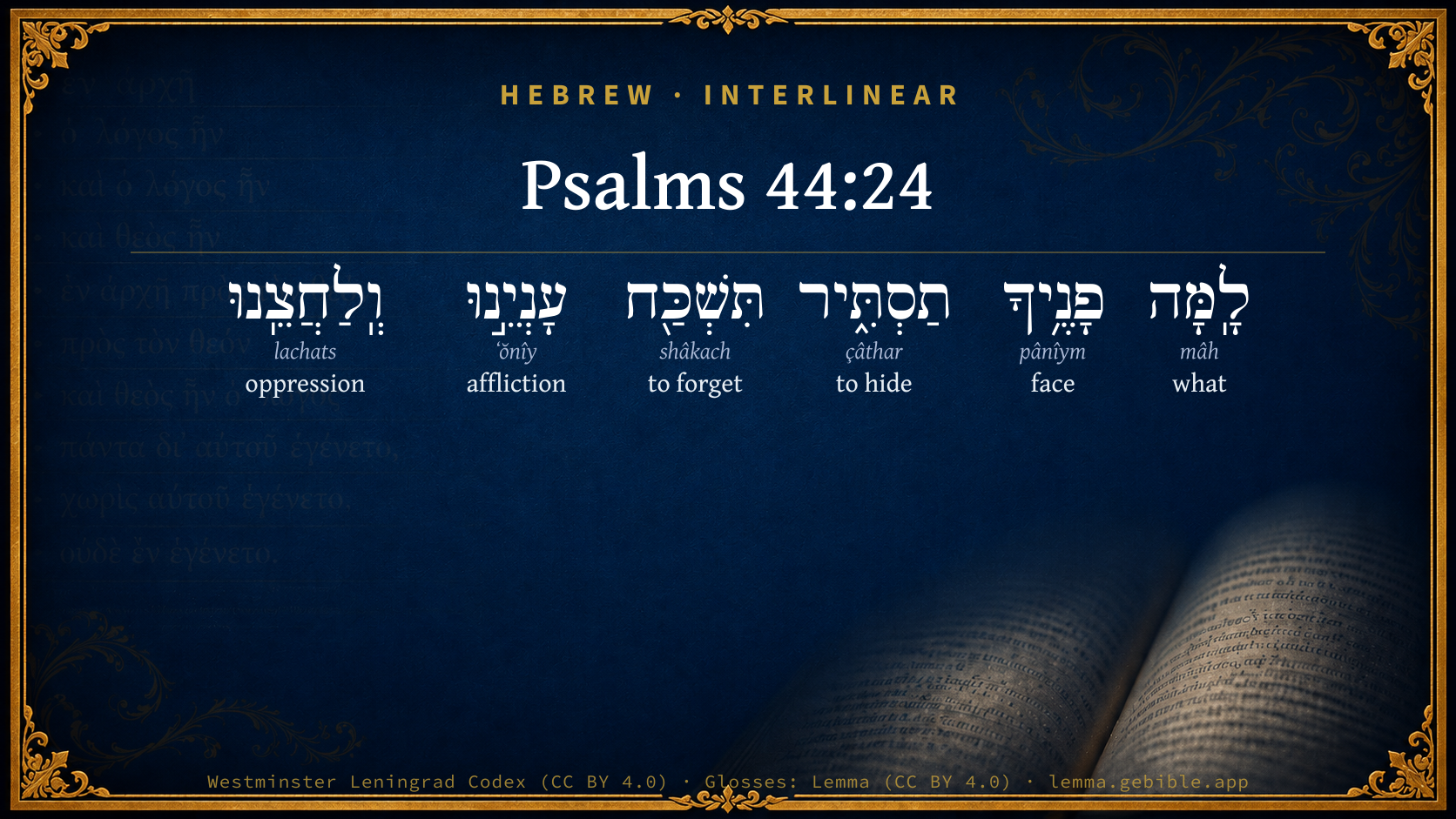
Psalms 44:24

Hebrew (Westminster Leningrad Codex) Psalms 44:24 appears in the Hebrew Old Testament. The text above is from the Westminster Leningrad Codex. Each word links to its Strong’s number, a concise gloss, and parsing drawn from the Open Scriptures Hebrew Bible morphology. Click any word for its full Brown-Driver-Briggs (BDB) entry.
Download image
Cite this verse

Psalms 44:24 (World English Bible). Public Domain. Lemma interlinear Bible study tool, https://lemma.gebible.app/v/psalms/44/24.

Show BibTeX & RIS
BibTeX
RIS
English Translation
Why do you hide your face, And forget our affliction and our oppression?
World English Bible · Public Domain
Download a study sheet

One document with this verse’s original text, its word-by-word gloss line, the meaning frame, cross-references with their text, attributed commentary, and full source and license credits — printable, and it pastes into notes with its structure intact.

This verse Autodidact and up

Study sheet (.html) Plain text (.txt)

A passage Seminary Student

Up to 50 verses in one chapter. A passage sheet keeps up to 6 commentary sources and 12 cross-references per verse, in the order this page ranks them, and says so on the sheet whenever that leaves anything out. Ask for a single verse and you get the Autodidact verse sheet above.

Everything on this page stays free to read, with no account — the sheet is a download of what is already on screen, not access to it.

Want to remove ads? Support Godless Engineer
Compare translations 3

The same verse in 3 English versions, stacked beneath the original-language interlinear above. Click any original word for its lexicon entry.

Each is an independent rendering of the whole verse — the interlinear is not word-aligned to these translations.

Highlighted words mark where these versions differ — a whole-verse word diff, not a word-by-word alignment.

  • World English Bible Public Domain
    Why do you hide your face, And forget our affliction and our oppression?
  • King James Version Public Domain
    Wherefore hidest thou thy face, and forgettest our affliction and our oppression?
  • unfoldingWord Literal Text CC BY-SA 4.0
    Why do you hide your face, forget our affliction and our oppression?

unfoldingWord Literal Text — © unfoldingWord, licensed CC BY-SA 4.0. Word-aligned USFM3 via Door43 (git.door43.org/unfoldingWord/en_ult).

Versions to compare (up to 4)

3 of 4 selected

Show all 18 translations

Every available English version of this verse, each an independent rendering of the whole verse.

  • World English Bible Public Domain
    Why do you hide your face, And forget our affliction and our oppression?
  • Berean Standard Bible Public Domain
    Why do You hide Your face and forget our affliction and oppression?
  • Majority Standard Bible Public Domain
    Why do You hide Your face and forget our affliction and oppression?
  • King James Version Public Domain
    Wherefore hidest thou thy face, and forgettest our affliction and our oppression?
  • American Standard Version (1901) Public Domain
    Wherefore hidest thou thy face, And forgettest our affliction and our oppression?
  • Revised Version (1885) Public Domain
    Wherefore hidest thou thy face, and forgettest our affliction and our oppression?
  • Geneva Bible (1599) Public Domain
    Wherefore hidest thou thy face? and forgettest our miserie and our affliction?
  • Douay-Rheims (1899) Public Domain
    Why turnest thou face away? and forgettest our want and our trouble?
  • Young's Literal Translation Public Domain
    Why Thy face hidest Thou? Thou forgettest our afflictions and our oppression,
  • Literal Standard Version CC BY-SA 4.0
    Why do You hide Your face? You forget our afflictions and our oppression,
  • Unlocked Literal Bible CC BY-SA 4.0
    Why do you hide your face and forget our affliction and our oppression?
  • unfoldingWord Literal Text CC BY-SA 4.0
    Why do you hide your face, forget our affliction and our oppression?
  • Darby Bible Public Domain
    Wherefore hidest thou thy face, [and] forgettest our affliction and our oppression?
  • World Messianic Bible Public Domain
    Why do you hide your face, and forget our affliction and our oppression?
  • Webster's Bible Public Domain
    \\44:23\\Awake, why sleepest thou, O Lord? arise, cast us not off for ever.
  • Free Bible Version CC BY-SA 4.0
    Why do you look away from us and take no notice of our suffering and misery?
  • Bible in Basic English Public Domain
    Why is your face covered, and why do you give no thought to our trouble and our cruel fate?
  • JPS Tanakh (1917) Public Domain
    (44-25) Wherefore hidest Thou Thy face, and forgettest our affliction and our oppression?

Literal Standard Version (2020), Covenant Press — licensed CC BY-SA 4.0. Text via the HelloAO Bible API (eBible.org). Unlocked Literal Bible (unfoldingWord) — licensed CC BY-SA 4.0. Text via the HelloAO Bible API (eBible.org). unfoldingWord Literal Text — © unfoldingWord, licensed CC BY-SA 4.0. Word-aligned USFM3 via Door43 (git.door43.org/unfoldingWord/en_ult). Free Bible Version, Dr. Jonathan Gallagher — licensed CC BY-SA 4.0. Text via the HelloAO Bible API (eBible.org).

Word by word

More ways to search: Search by grammar → Find every occurrence → Compare this word →

Practice this passage: Drill this verse → Learn its vocabulary →

About this verse

These counts appear in no published source. They are computed here, from the morphology-tagged text and Lemma’s own curated glosses. What Lemma adds →

6
words
6
distinct lemmas
Wisdom
section

Notable vocabulary

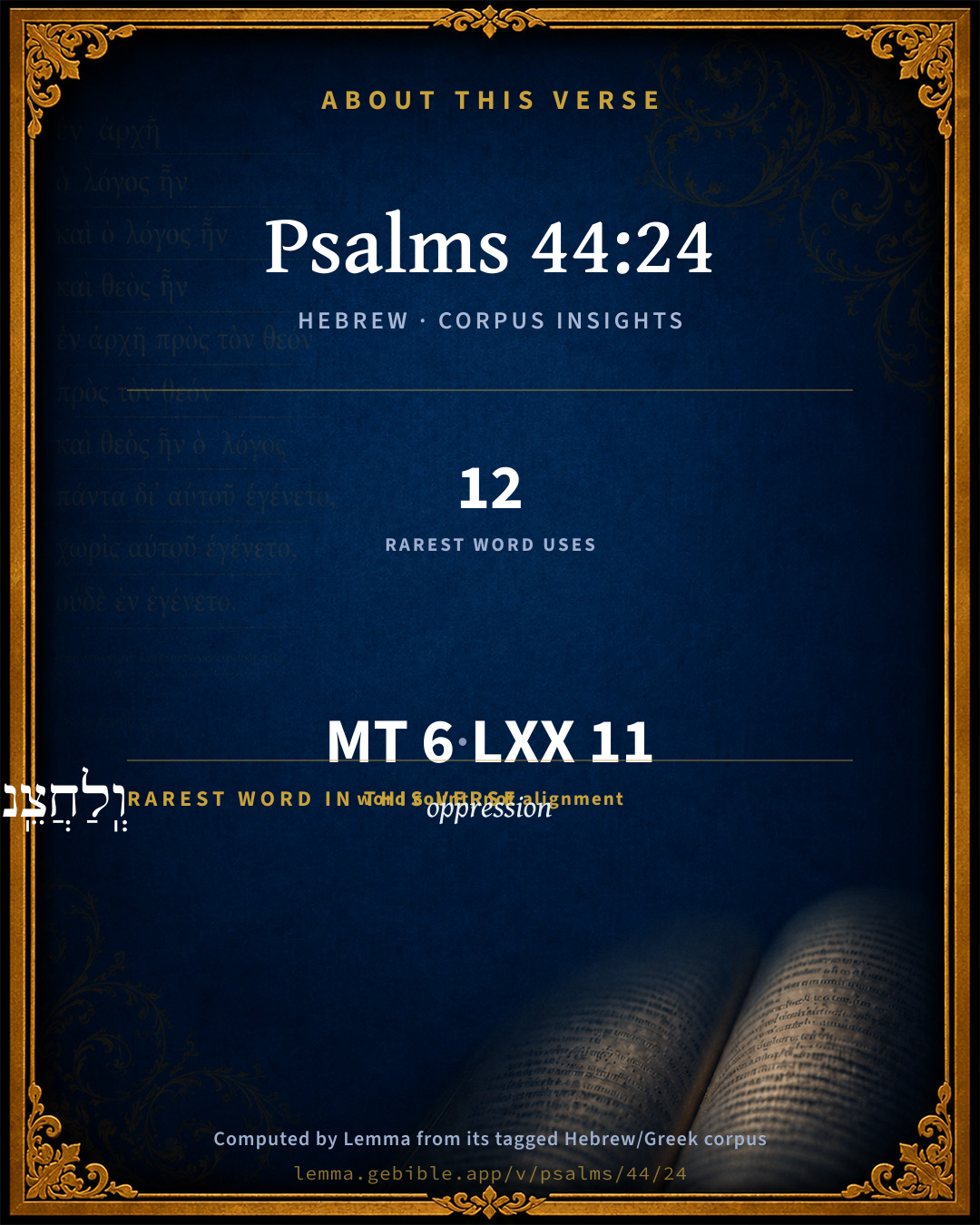
The rarest word here is וְֽלַחֲצֵֽנוּ oppression H3906 — appearing just 12 times in the whole Hebrew Bible.

Shared distinctive vocabulary

וְֽלַחֲצֵֽנוּ oppression H3906 occurs in 10 verses of the Hebrew Bible. Also found in:

Grammatical profile

  • 2 verbs
  • 3 nouns
  • 1 particle

Verb forms

  • תַסְתִּ֑יר Hiphil · Imperfect
  • תִּשְׁכַּ֖ח Qal · Imperfect

Hebrew & Septuagint length

In English translation the verse runs 13 words from the Hebrew and 13 from the Septuagint (LXX English) — the same length.

A rough comparison of the two English renderings, which tokenize alike — not a word-level alignment.

Word counts can differ between the Hebrew and the Greek without any difference in meaning — e.g. the Hebrew direct-object marker אֵת has no separate Greek word, and Greek often adds the article ὁ.

In the original languages it is 6 Hebrew tokens and 11 Greek tokens — but the two are counted differently (Hebrew bundles its prefixes and suffixes into one token; the Greek is in lemma form), so that isn’t a like-for-like length.

Cross-references

12

Topical passages linked to Psalms 44:24 in the Treasury of Scripture Knowledge — connected by theme and wording, ordered by reader-vote popularity; previews shown in the World English Bible.

  • Job 13:24 Why hide you your face, And hold me for your enemy?
  • Deuteronomy 32:20 He said, I will hide my face from them, I will see what their end shall be: For they are a very perverse generation, Children in whom is no faithfulness.
  • Psalms 42:9 I will ask God, my rock, "Why have you forgotten me? Why do I go mourning because of the oppression of the enemy?"
  • Exodus 2:23–24 It happened in the course of those many days, that the king of Egypt died, and the children of Israel sighed because of the bondage, and they cried, and their cry came up to God because of the bondage.
  • Psalms 10:1 Why do you stand far off, Yahweh? Why do you hide yourself in times of trouble?
  • Psalms 10:11 He says in his heart, "God has forgotten. He hides his face. He will never see it."
  • Psalms 13:1 How long, Yahweh? Will you forget me forever? How long will you hide your face from me?
  • Psalms 43:1–4 Vindicate me, God, and plead my cause against an ungodly nation. Oh, deliver me from deceitful and wicked men.
  • Psalms 74:23 Don't forget the voice of your adversaries. The tumult of those who rise up against you ascends continually.
  • Psalms 74:19 Don't deliver the soul of your dove to wild beasts. Don't forget the life of your poor forever.
  • Isaiah 40:27–28 Why say you, Jacob, and speak, Israel, My way is hid from Yahweh, and the justice [due] to me is passed away from my God?
  • Revelation 6:9–10 When he opened the fifth seal, I saw underneath the altar the souls of those who had been killed for the Word of God, and for the testimony of the Lamb which they had.

Cross-references courtesy of OpenBible.info (CC BY 4.0).

Hebrew and Greek witnesses Masoretic Hebrew ↔ Greek Septuagint

The same verse in the two great witnesses to the Old Testament, shown verse-for-verse.

You’re reading Greek Psalm 43 (Hebrew Psalm 44). The Septuagint counts the superscription, so verse numbers can differ from the Hebrew — chapter-level alignment, not verse-by-verse. Numbering follows Rahlfs.

These are two independent witnesses, not word-aligned to each other, and the Septuagint is shown in lemma (dictionary) form.

Hebrew Psalms 44:24 Masoretic · Westminster Leningrad Codex

לָֽמָּה פָנֶ֥יךָ תַסְתִּ֑יר תִּשְׁכַּ֖ח עָנְיֵ֣נוּ וְֽלַחֲצֵֽנוּ

Why do you hide your face, And forget our affliction and our oppression?

World English Bible · Public Domain

Greek LXX Greek Psalm 43:24 Septuagint · lemma form

ἐκἐγείρω ἵνα τίς ὑπνόω κύριος ἀναἵστημι καί μή ἀποὠθέω εἰς τέλος

Therefore turn you your face away, and forget our poverty and our affliction?

LXX2012 (modern English Septuagint) · Public Domain

Hebrew: Westminster Leningrad Codex (CC BY 4.0). Greek: Septuagint (public domain); English from LXX2012 (modern English Septuagint) (Public Domain). How the Septuagint differs from the Hebrew →

Commentary

Notes on Psalms 44:24 from classic Christian and Jewish commentators (each source and its license shown beneath its notes). The classic Christian expositions comment on the surrounding passage and are grouped to its opening verse, so a note may address several verses; the Jewish commentaries on the Tanakh (Rashi and others) are per-verse, so they appear only where the commentator wrote on this verse.

Lemma curates 59 commentaries, every one of them public domain or Creative Commons licensed, each selected and text-cleaned for this edition rather than reprinted as found. About our sources →

Trapp's Complete Commentary

John Trapp

Psa 44:24 Wherefore hidest thou thy face, [and] forgettest our affliction and our oppression?

Ver. 24. Wherefore hidest thou thy face?] God sometimes concealeth his love, as Joseph did, out of increasement of love; he retireth, but faith fetcheth him out, as the woman of Canaan did, Mar 7:24-25.

John Trapp, A Commentary or Exposition upon All the Books of the Old and New Testament (1647–1656) — public domain. Text from a community e-Sword module.

Joseph Benson's Commentary

Psa 44:24-25. Wherefore hidest thou thy face? — Dost not regard our miseries, nor afford us any pity or help? and forgettest our affliction — Actest as if thou didst forget, or overlook it, when we have not forgotten thee? Does this become thy faithfulness and goodness? For our soul is bowed down to the dust — Under prevailing grief and fear. We lie prostrate at our enemies’ feet. Our belly cleaveth unto the earth — We are not only thrown down to the earth, but we lie there. We cannot lift up ourselves, neither revive our own drooping spirits, nor recover ourselves out of our low and sad condition. And we lie exposed to be trodden on by every insulting foe.

Joseph Benson's Commentary on the Old and New Testaments (1811–1818) — public domain. Text from a community e-Sword module.

J. A. Alexander on Psalms

Joseph Addison Alexander

25. (Psa 44:24). Why wilt thou hide thy face, wilt thou forget our suffering and our persecution (or oppression)? The same thing which had just been represented by the figure of sleep is here described as a refusal to see and to remember. Both figures are employed in Psa 13:2 (1), above, in reference to precisely he same subject. These anthropomorphisms, which would be unlawful in an uninspired writer, are perfectly intelligible, and exceedingly expressive. The word translated suffering (or affliction) is generic, and includes all forms of physical evil, one of which is then specified, to wit, the suffering caused by powerful and spiteful enemies. The same word denotes oppression or persecution at the hand of wicked men, in Psa 42:10 (9), Psa 41:2. Why wilt thou forget is evidently more than why dost thou forget, for it conveys the additional idea, "Why wilt thou persist in doing as thou hast done heretofore, and art doing now?"

Joseph Addison Alexander, The Psalms Translated and Explained (1850) — public domain. Text from a community e-Sword module.

Adam Clarke's Commentary

Verse 24. Wherefore hidest thou thy face] Show us the cause why thou withdrawest from us the testimony of thy approbation.

Adam Clarke's Commentary on the Bible (1810–1826) — public domain. Text from a community e-Sword/MySword module.

The Cambridge Bible for Schools and Colleges

gen. ed. J. J. S. Perowne

24. hidest thou thy face] In anger or indifference, instead of shewing the light of Thy countenance in gracious help to Thy people (Psa_44:3; Psa_80:3).

our affliction and our oppression] Cp. Deu_26:7; Exo_3:7; Exo_3:9; 2Ki_13:4; 2Ki_14:26. The latter word occurs elsewhere in the Psalter only in Psa_42:9, Psa_43:2.

The Cambridge Bible for Schools and Colleges (gen. ed. J. J. S. Perowne; Cambridge University Press, 1878–1918) — public domain. Text from a community e-Sword module.

John Gill's Exposition

Wherefore hidest thou thy face?.... See Psa 10:1;

and forgettest our affliction and our oppression. Not that the Lord does really forget either the persons of his people, which he cannot, since they are engraven on the palms of his hands, and a book of remembrance is written for them: nor the afflictions of his people; he knows their souls in adversity; he chooses them in the furnace of affliction; he makes all afflictions work together for good, and delivers out of them. But because deliverance is not immediately wrought, and they sometimes continue long under their afflictions and oppressions, they seem to be forgotten by him, as during the ten persecutions and the long reign of antichrist.

John Gill's Exposition of the Whole Bible (1746–1763) — public domain (CC PDM 1.0). Text via the HelloAO Bible API.

Albert Barnes' Notes on the Bible

Wherefore hidest thou thy face? - See the notes at Psa 13:1. Why dost thou turn away from us, and refuse to aid us, and leave us to these unpitied sufferings?

And forgettest our affliction and our oppression - Our trials, and the wrongs that are committed against us. These are earnest appeals. They are the pleadings of the oppressed and the wronged. The language is such as man would use in addressing his fellow-men; and, when applied to God, it must be understood as such language. As used in the Psalms, it denotes earnestness, but not irreverence; it is solemn petition, not dictation; it is affectionate pleading, not complaint. It indicates depth of suffering and distress, and is the strongest language which could be employed to denote entire helplessness and dependence. At the same time, it is language which implies that the cause for which they suffered was the cause of God, and that they might properly call on him to interfere in behalf of his own friends.

Albert Barnes' Notes on the Bible (1834–1885) — public domain. Text from a community e-Sword/MySword module.

Matthew Poole's English Annotations

Hidest thou thy face, i.e. dost not regard our miseries, nor affordest us any pity or help.

Forgettest our affliction and our oppression, when we have not forgotten thee. This seems not well to become thy faithfulness and goodness.

Matthew Poole's English Annotations on the Holy Bible (1683–1685) — public domain. Text from a community e-Sword/MySword module.

The Treasury of David

Charles H. Spurgeon

Ver. 24. Wherefore hidest thou thy face, and forgettest our affliction and our oppression? Not petulantly, but piteously and inquiringly, we may question the Lord when his dealings are mysterious. We are permitted to order our case with arguments, and plead the right before the face of the august Majesty. Why, Lord, dost thou become oblivious of thy children's woes? This question is far more easily asked than answered; it is hard, indeed, in the midst of persecution to see the reason why we are left to suffer so severely.

None.

Ver. 24. Reasons for the withdrawal of divine comfort.

Psalms 44:25*

Charles H. Spurgeon's The Treasury of David (1869–1885) — public domain. Psalms only. Text from a community e-Sword/MySword module.

The Pulpit Commentary

Wherefore hidest thou thy face. (comp. Psa_13:1 Psa_27:9 Psa_69:17, etc.) And forgettest our affliction and our oppression?. (see Psa_13:1 Psa_74:19)

The Pulpit Commentary (1880–1919), ed. H.D.M. Spence-Jones & Joseph S. Exell — public domain. Text from a community e-Sword module.

Lesson kit

Teaching starters — assembled from the data on this page, not authored interpretation. Every prompt links to the verse data it draws on. Edit before teaching.

Psalms, in the Wisdom, opens this verse with 6 words (6 distinct Hebrew lemmas). Its most distinctive word is lachats (“oppression”). A historical commentator’s framing appears above. Read the whole chapter for the surrounding context.

Discussion questions

  1. What does “oppression” (lachats) contribute to the verse as a whole?
  2. Exodus 3:9 shares the word «oppression» with this verse. How do the two illuminate each other?
  3. The translations on this page render this verse differently — a whole-verse word diff, not a word-by-word alignment. What might account for the different wordings?
  4. The verb «תַסְתִּ֑יר» is Hiphil Imperfect. How does its form color the action?
  5. Reading how Trapp's Complete Commentary and Joseph Benson's Commentary read this verse, where do the two commentators agree and where do they part?

Things to notice

Reading settings

Reading text

Shown beneath each verse's original-language words.

Old Testament
Old Testament edition

Read the OT as the Masoretic Hebrew (MT) or the Greek Septuagint (LXX).

English shown for the Greek Septuagint (in the Hebrew ↔ Greek comparison).

Comparing translations? Open the Compare panel on any verse page to stack up to four side by side.