Isaiah 63:17

Hebrew (Westminster Leningrad Codex) Isaiah 63:17 appears in the Hebrew Old Testament. The text above is from the Westminster Leningrad Codex. Each word links to its Strong’s number, a concise gloss, and parsing drawn from the Open Scriptures Hebrew Bible morphology. Click any word for its full Brown-Driver-Briggs (BDB) entry.
Download image
Cite this verse

Isaiah 63:17 (World English Bible). Public Domain. Lemma interlinear Bible study tool, https://lemma.gebible.app/v/isaiah/63/17.

Show BibTeX & RIS
BibTeX
RIS
English Translation
O Yahweh, why do you make us to err from your ways, and harden our heart from your fear? Return for your servants' sake, the tribes of your inheritance.
World English Bible · Public Domain
Download a study sheet

One document with this verse’s original text, its word-by-word gloss line, the meaning frame, cross-references with their text, attributed commentary, and full source and license credits — printable, and it pastes into notes with its structure intact.

This verse Autodidact and up

Study sheet (.html) Plain text (.txt)

A passage Seminary Student

Up to 50 verses in one chapter. A passage sheet keeps up to 6 commentary sources and 12 cross-references per verse, in the order this page ranks them, and says so on the sheet whenever that leaves anything out. Ask for a single verse and you get the Autodidact verse sheet above.

Everything on this page stays free to read, with no account — the sheet is a download of what is already on screen, not access to it.

Want to remove ads? Support Godless Engineer
Compare translations 3

The same verse in 3 English versions, stacked beneath the original-language interlinear above. Click any original word for its lexicon entry.

Each is an independent rendering of the whole verse — the interlinear is not word-aligned to these translations.

Highlighted words mark where these versions differ — a whole-verse word diff, not a word-by-word alignment.

  • World English Bible Public Domain
    O Yahweh, why do you make us to err from your ways, and harden our heart from your fear? Return for your servants' sake, the tribes of your inheritance.
  • King James Version Public Domain
    O LORD, why hast thou made us to err from thy ways, and hardened our heart from thy fear? Return for thy servants' sake, the tribes of thine inheritance.
  • unfoldingWord Literal Text CC BY-SA 4.0
    Why do you make us wander, Yahweh, from your ways? do you harden our heart from fearing you? Return for the sake of your servants, the tribes of your inheritance.

unfoldingWord Literal Text — © unfoldingWord, licensed CC BY-SA 4.0. Word-aligned USFM3 via Door43 (git.door43.org/unfoldingWord/en_ult).

Versions to compare (up to 4)

3 of 4 selected

Show all 18 translations

Every available English version of this verse, each an independent rendering of the whole verse.

  • World English Bible Public Domain
    O Yahweh, why do you make us to err from your ways, and harden our heart from your fear? Return for your servants' sake, the tribes of your inheritance.
  • Berean Standard Bible Public Domain
    Why, O LORD, do You make us stray from Your ways and harden our hearts from fearing You? Return, for the sake of Your servants, the tribes of Your heritage.
  • Majority Standard Bible Public Domain
    Why, O LORD, do You make us stray from Your ways and harden our hearts from fearing You? Return, for the sake of Your servants, the tribes of Your heritage.
  • King James Version Public Domain
    O LORD, why hast thou made us to err from thy ways, and hardened our heart from thy fear? Return for thy servants' sake, the tribes of thine inheritance.
  • American Standard Version (1901) Public Domain
    O Jehovah, why dost thou make us to err from thy ways, and hardenest our heart from thy fear? Return for thy servants' sake, the tribes of thine inheritance.
  • Revised Version (1885) Public Domain
    O LORD, why dost thou make us to err from thy ways, and hardenest our heart from thy fear? Return for thy servants’ sake, the tribes of thine inheritance.
  • Geneva Bible (1599) Public Domain
    O Lord, why hast thou made vs to erre from thy wayes? and hardened our heart from thy feare? Returne for thy seruants sake, and for the tribes of thine inheritance.
  • Douay-Rheims (1899) Public Domain
    Why hast thou made us to err, O Lord, from thy ways: why hast thou hardened our heart, that we should not fear thee? return for the sake of thy servants, the tribes of thy inheritance.
  • Young's Literal Translation Public Domain
    Why causest Thou us to wander, O Jehovah, from Thy ways? Thou hardenest our heart from Thy fear, Turn back for Thy servants' sake, The tribes of Thine inheritance.
  • Literal Standard Version CC BY-SA 4.0
    Why cause us to wander, O YHWH, from Your ways? You harden our heart from Your fear, || Turn back for Your servants’ sake, || The tribes of Your inheritance.
  • Unlocked Literal Bible CC BY-SA 4.0
    Yahweh, why do you make us wander from your ways and harden our hearts, so we do not obey you? Return for your servants' sake, the tribes of your inheritance.
  • unfoldingWord Literal Text CC BY-SA 4.0
    Why do you make us wander, Yahweh, from your ways? do you harden our heart from fearing you? Return for the sake of your servants, the tribes of your inheritance.
  • Darby Bible Public Domain
    Why, O Jehovah, hast thou made us to err from thy ways, hast hardened our heart from thy fear? Return for thy servants' sake, the tribes of thine inheritance.
  • World Messianic Bible Public Domain
    O LORD, why do you make us wander from your ways, and harden our heart from your fear? Return for your servants’ sake, the tribes of your inheritance.
  • Webster's Bible Public Domain
    O LORD, why hast thou made us to err from thy ways, and hardened our heart from thy fear? Return for thy servants' sake, the tribes of thy inheritance.
  • Free Bible Version CC BY-SA 4.0
    Lord, why do you make us wander from your ways, and make us stubborn so we don't respect you? Come back to us for the sake of your servants, the tribes that belong to you.
  • Bible in Basic English Public Domain
    O Lord, why do you send us wandering from your ways, making our hearts hard, so that we have no fear of you? Come back, because of your servants, the tribes of your heritage.
  • JPS Tanakh (1917) Public Domain
    O LORD, why dost Thou make us to err from Thy ways, and hardenest our heart from Thy fear? Return for Thy servants' sake, the tribes of Thine inheritance.

Literal Standard Version (2020), Covenant Press — licensed CC BY-SA 4.0. Text via the HelloAO Bible API (eBible.org). Unlocked Literal Bible (unfoldingWord) — licensed CC BY-SA 4.0. Text via the HelloAO Bible API (eBible.org). unfoldingWord Literal Text — © unfoldingWord, licensed CC BY-SA 4.0. Word-aligned USFM3 via Door43 (git.door43.org/unfoldingWord/en_ult). Free Bible Version, Dr. Jonathan Gallagher — licensed CC BY-SA 4.0. Text via the HelloAO Bible API (eBible.org).

Word by word

More ways to search: Search by grammar → Find every occurrence → Compare this word →

Practice this passage: Drill this verse → Learn its vocabulary →

תַּקְשִׁ֥יחַ
qâshach
H7188
“to make hard”
Verb, Hiphil, Imperfect, 2nd Person, Masculine, Singular
Part of Speech
Verb
Stem
Hiphil
Form
Imperfect
Person
2nd Person
Gender
Masculine
Number
Singular
Full BDB Definition

Origin: a primitive root

TWOT: 2087

to make hard, treat hardly, treat severely - (Hiphil) - to make hard, make stubborn - to treat hardly, treat roughly
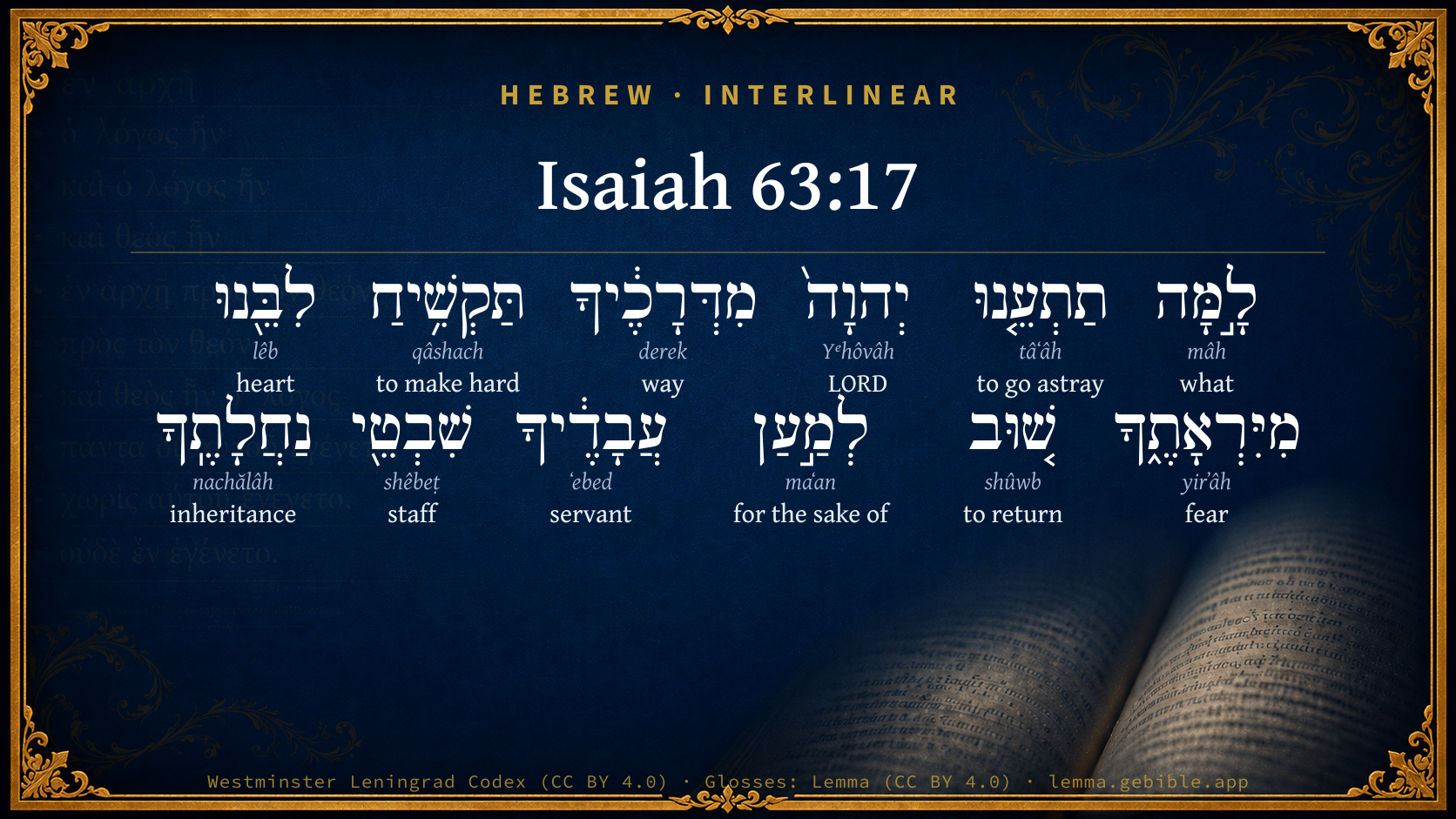
  1. לָ֣מָּה mâh H4100 “to/for · what” Preposition + Particle, Interrogative
  2. תַתְעֵ֤נוּ tâʻâh H8582 “to go astray · us” Verb, Hiphil, Imperfect, 2nd Person, Masculine, Singular + Suffix, Personal, 1st Person, Common, Plural
  3. יְהוָה֙ Yᵉhôvâh H3068 “LORD” Noun, Proper
  4. מִדְּרָכֶ֔יךָ derek H1870 “from · ways · your” Preposition + Noun, Common, Both, Plural, Construct + Suffix, Personal, 2nd Person, Masculine, Singular
  5. לִבֵּ֖נוּ lêb H3820 “heart · our” Noun, Common, Masculine, Singular, Construct + Suffix, Personal, 1st Person, Common, Plural
  6. מִיִּרְאָתֶ֑ךָ yirʼâh H3374 “from · fear · your” Preposition + Noun, Common, Feminine, Singular, Construct + Suffix, Personal, 2nd Person, Masculine, Singular
  7. שׁ֚וּב shûwb H7725 “return” Verb, Qal, Imperative, 2nd Person, Masculine, Singular
  8. לְמַ֣עַן maʻan H4616 “for the sake of” Preposition
  9. עֲבָדֶ֔יךָ ʻebed H5650 “servants · your” Noun, Common, Masculine, Plural, Construct + Suffix, Personal, 2nd Person, Masculine, Singular
  10. שִׁבְטֵ֖י shêbeṭ H7626 “staffs of” Noun, Common, Masculine, Plural, Construct
  11. נַחֲלָתֶֽךָ nachălâh H5159 “inheritance · your” Noun, Common, Feminine, Singular, Construct + Suffix, Personal, 2nd Person, Masculine, Singular

About this verse

These counts appear in no published source. They are computed here, from the morphology-tagged text and Lemma’s own curated glosses. What Lemma adds →

12
words
12
distinct lemmas
Prophets
section

Notable vocabulary

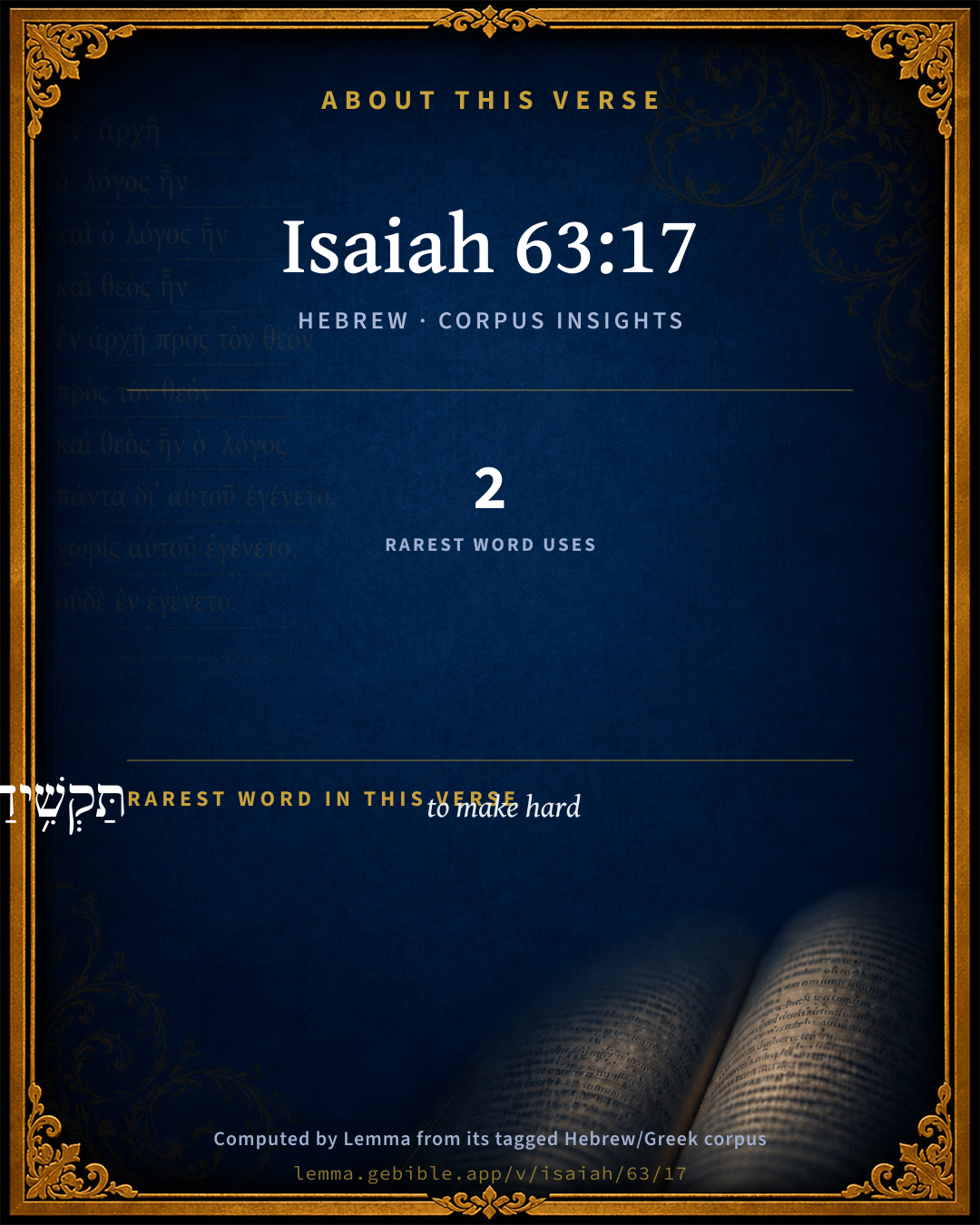
The rarest word here is תַּקְשִׁ֥יחַ to make hard H7188 — appearing just 2 times in the whole Hebrew Bible.

Shared distinctive vocabulary

תַּקְשִׁ֥יחַ to make hard H7188 occurs in 2 verses of the Hebrew Bible. Also found in:

Grammatical profile

  • 3 verbs
  • 7 nouns
  • 1 preposition
  • 1 particle

Verb forms

  • תַתְעֵ֤נוּ Hiphil · Imperfect
  • תַּקְשִׁ֥יחַ Hiphil · Imperfect
  • שׁ֚וּב Qal · Imperative

Hebrew & Septuagint length

In English translation the verse runs 29 words from the Hebrew and 37 from the Septuagint (LXX English) — closely comparable.

A rough comparison of the two English renderings, which tokenize alike — not a word-level alignment.

Word counts can differ between the Hebrew and the Greek without any difference in meaning — e.g. the Hebrew direct-object marker אֵת has no separate Greek word, and Greek often adds the article ὁ.

Cross-references

16

Topical passages linked to Isaiah 63:17 in the Treasury of Scripture Knowledge — connected by theme and wording, ordered by reader-vote popularity; previews shown in the World English Bible.

  • Isaiah 6:10 Make the heart of this people fat; Make their ears heavy, and shut their eyes; Lest they see with their eyes, And hear with their ears, And understand with their heart, And turn again, and be healed."
  • Joshua 11:20 For it was of Yahweh to harden their hearts, to come against Israel in battle, that he might utterly destroy them, that they might have no favor, but that he might destroy them, as Yahweh commanded Moses.
  • Ezekiel 14:7–9 For everyone of the house of Israel, or of the strangers who sojourn in Israel, who separates himself from me, and takes his idols into his heart, and puts the stumbling block of his iniquity before his face, and comes to the prophet to inquire for himself of me; I Yahweh will answer him by myself:
  • Deuteronomy 2:30 But Sihon king of Heshbon would not let us pass by him; for Yahweh your God hardened his spirit, and made his heart obstinate, that he might deliver him into your hand, as at this day.
  • Isaiah 29:13 The Lord said, Because this people draw near [to me], and with their mouth and with their lips to honor me, but have removed their heart far from me, and their fear of me is a commandment of men which has been taught [them];
  • Numbers 10:36 When it rested, he said, Return, Yahweh, to the ten thousands of the thousands of Israel.
  • Psalms 90:13 Relent, Yahweh! How long? Have compassion on your servants!
  • John 12:40 "He has blinded their eyes and he hardened their heart, Lest they should see with their eyes, And perceive with their heart, And would turn, And I would heal them."
  • Zechariah 1:12 Then the angel of Yahweh replied, "O Yahweh of Hosts, how long will you not have mercy on Jerusalem and on the cities of Judah, against which you have had indignation these seventy years?"
  • Romans 9:18–20 So then, he has mercy on whom he desires, and he hardens whom he desires.
  • 2 Thessalonians 2:11–12 Because of this, God sends them a working of error, that they should believe a lie;
  • Psalms 74:1–2 God, why have you rejected us forever? Why does your anger smolder against the sheep of your pasture?
  • Psalms 80:14 Turn again, we beg you, God of hosts. Look down from heaven, and see, and visit this vine,
  • Psalms 119:10 With my whole heart, I have sought you. Don't let me wander from your commandments.
  • Psalms 119:36 Turn my heart toward your statutes, Not toward selfish gain.
  • Psalms 141:4 Don't incline my heart to any evil thing, To practice deeds of wickedness with men who work iniquity. Don't let me eat of their delicacies.

Cross-references courtesy of OpenBible.info (CC BY 4.0).

Hebrew and Greek witnesses Masoretic Hebrew ↔ Greek Septuagint

The same verse in the two great witnesses to the Old Testament, shown verse-for-verse.

These are two independent witnesses, not word-aligned to each other, and the Septuagint is shown in lemma (dictionary) form.

Hebrew Isaiah 63:17 Masoretic · Westminster Leningrad Codex

לָ֣מָּה תַתְעֵ֤נוּ יְהוָה֙ מִדְּרָכֶ֔יךָ תַּקְשִׁ֥יחַ לִבֵּ֖נוּ מִיִּרְאָתֶ֑ךָ שׁ֚וּב לְמַ֣עַן עֲבָדֶ֔יךָ שִׁבְטֵ֖י נַחֲלָתֶֽךָ

O Yahweh, why do you make us to err from your ways, and harden our heart from your fear? Return for your servants' sake, the tribes of your inheritance.

World English Bible · Public Domain

Greek LXX Isaiah 63:17 Septuagint · lemma form

τίς πλανάω ἐγώ κύριος ἀπό ὁ ὁδός σύ σκληρύνω ἐγώ ὁ καρδία ὁ μή φοβέω σύ ἐπιστρέφω διά ὁ δοῦλος σύ διά ὁ φυλή ὁ κληρονομία σύ

Why have you caused us to err, O Lord, from your way? and has hardened our hearts, that we should not fear you? Return for your servants' sake, for the sake of the tribes of your inheritance,

LXX2012 (modern English Septuagint) · Public Domain

Hebrew: Westminster Leningrad Codex (CC BY 4.0). Greek: Septuagint (public domain); English from LXX2012 (modern English Septuagint) (Public Domain). How the Septuagint differs from the Hebrew →

Targum (Aramaic paraphrase)

1

The Targum is the ancient Jewish Aramaic paraphrase of the Hebrew Scriptures — an interpretive translation, not the Hebrew text itself. Onkelos (literal) and Pseudo-Jonathan (expansive) render the Torah, and Jonathan the Prophets. Coverage is partial: where no permissively-licensed English translation exists for a verse, only the Aramaic is shown. This is verse-level text, not a word-by-word alignment to the Hebrew.

  1. Targum Jonathan Prophets (Joshua–Malachi)
    לְמָה תְרַחֲקִינָנָא יְיָ לְמִטְעֵי מֵאוֹרְחָן דְתַקְנָן קֳדָמָךְ כְּעַמְמַיָא דְלֵית לְהוֹן חוּלַק בְּאוּלְפַן אוֹרַיְתָךְ לָא יִתְפְּנֵי לִבָּנָא מִדְחַלְתָּךְ אֲתֵיב שְׁכִנְתָּךְ לְעַמָךְ בְּדִיל עַבְדָךְ צַדִיקַיָא דְקַיֵמְתָּא לְהוֹן בְּמֵימְרָךְ לְמֶעְבַּד בֵּינֵיהוֹן שִׁבְטֵי אַחְסַנְתָּךְ:

    Why hast Thou cast us off, O Lord, that we should go astray from the paths which are right in Thy sight, as the nations which have no part in the instruction of Thy law? Our heart is not turned away from Thy fear: return Thy Shekinah unto Thy people, for the sake of Thy righteous servants, unto whom Thou hast sworn by Thy WORD to make the tribes amongst them Thine inheritance.

    Targum Jonathan — Aramaic: “Mikraot Gedolot” (public domain). English: “Sefaria Community Translation” (CC0 1.0 (public-domain dedication)); “London "Chaldee Paraphrase," 1871” (public domain). Text via Sefaria.

Commentary

Notes on Isaiah 63:17 from classic Christian and Jewish commentators (each source and its license shown beneath its notes). The classic Christian expositions comment on the surrounding passage and are grouped to its opening verse, so a note may address several verses; the Jewish commentaries on the Tanakh (Rashi and others) are per-verse, so they appear only where the commentator wrote on this verse.

Lemma curates 59 commentaries, every one of them public domain or Creative Commons licensed, each selected and text-cleaned for this edition rather than reprinted as found. About our sources →

Trapp's Complete Commentary

John Trapp

Isa 63:17 O LORD, why hast thou made us to err from thy ways, [and] hardened our heart from thy fear? Return for thy servants’ sake, the tribes of thine inheritance.

Ver. 17. O Lord, why hast thou made us to err from thy ways? &c., ] i.e., Given us up to error and obstinace? Why dost thou thus punish sin with sin, for the illustration of thy justice and jealousy against us, who have rebelled and vexed thine Holy Spirit? {Isa 63:10} Oh, be pleased to deal with us rather according to thy mercy. "Return for thy servants’ sake," the good people that are yet left among us; give us hearts of flesh, and lead us in the way everlasting. Here observe that God’s best children may find in themselves hardness of heart, {Hos 4:16} yet not total, but mixed with softness and tenderness in every part, so that though they resist, neglect, profit not as they might do - through pride, worldliness, voluptuousness, {Mat 13:22 Luk 21:34} hypocritical hiding of any sin, {Psa 32:3-4 Pro 28:14} letting fall the watch of the Lord {2Ch 32:25} - yet it is not done with full consent, but with reluctance now, and repentance afterwards.

The tribes of thine inheritance,] q.d., Wilt thou abhor thy people in covenant with thee, and abandon thine own inheritance? How few are there that thus urge the seal, and enter a suit with the Lord!

John Trapp, A Commentary or Exposition upon All the Books of the Old and New Testament (1647–1656) — public domain. Text from a community e-Sword module.

The Biblical Illustrator

Joseph S. Exell

Isa_63:17

O Lord, why hut Thou made us to err from Thy ways?

--

Gods anger with His people

Very singular is the plea that the sinfulness of the people is due to the excessive and protracted anger of Jehovah, who causes them to err from His ways (cf. Isa_64:5; Isa_64:7).This feeling appears to proceed from two sources; on the one hand the ancient idea that national calamity is the proof of Jehovahs anger, and on the other the lesson taught by all the prophets, that the sole cause of Jehovahs anger is the peoples sins. The writer seems unable perfectly to harmonize these principles. He accepts the verdict of Providence on the sins of the nation, but he feels also a disproportion between the offence and the punishment, which neutralizes all efforts after righteousness, unless Jehovah will relent from the fierceness of His wrath. The higher truth, that the Divine chastisement aims at the purification of the people, and is therefore a mark of love, is not yet grasped, and for this reason the Old Testament believers fall short of the liberty of the sons of God. Yet amid all these perplexities the faith of the Church holds fast to the truth of the Fatherhood of God, and appeals to the love which must be in His heart, although it be not manifest in His providential dealings. (Prof. J. Skinner, D. D.)

Gods withdrawing His presence, the correction of His Church

These are words that carry a great deal of dread in them: tremendous words as any in the Book of God. It is the true Church of God that speaks these words. They were all as an unclean thing, and their holiness all faded away as a leaf (Isa_64:6). Yet faith maintains a sense of a relation toGod; therefore they cry, Doubtless thou art our Father, etc. (Isa_63:16). And if God would help us to maintain, and not let go our interest in Him as our Father by faith, we should have a bottom and foundation to stand upon. Observe, here, the condition of the Church at that time.

1. It was a time of distress and oppression (Isa_63:18).

2. A time of deep conviction of sin (Isa_64:6-7). Well, then, suppose it be a state of great oppression, and a state of great conviction of sin what is the course that we should take? We may turn ourselves this way and that way;, but the Church is come to this, to issue all in an inquiry after, and a sense of Gods displeasure, manifesting itself by spiritual judgments.

I. WHAT IS IT TO ERR FROM THE WAYS OF GOD? The ways of God are either Gods ways towards us, or our ways towards Him, that are of His appointment. Gods ways towards us are the ways of His providence. Our ways towards God are the ways of obedience and holiness. We may err in both. The ways that God hath appointed for us to walk in towards Him are these here intended. Now we may err from thence--

1. In the inward principle.

2. In the outward order.

II. WHAT IS IT TO HAVE OUR HEARTS HARDENED FROM THE FEAR OF GOD?

1. There is a total hardening.

2. A partial hardening.

III. HOW IS GOD SAID TO CAUSE US TO ERR FROM HIS WAYS, AND TO HARDEN OUR HEARTS FROM HIS FEAR?

1. God is said to do that (and it is not an uncommon form of speech in Scripture) whose contrary He doth not do, when it might be expected, as it were, from Him. If there be a prophet that doth prophesy so and so, I the Lord have deceived that prophet (Eze_14:9), that is, I have not kept him from being deceived, but suffered him to follow the imaginations of his own heart, whereby he should be deceived. God may be said to cause us to err from HIS ways, and to harden our hearts from His fear merely negatively, in that He hath not kept us up to His ways, nor kept our hearts humble and soft in them.

2. God hardens men judicially, in a way of punish-meat. This is a total hardening.

(1) The first thing God doth, when He hardens mens hearts penally, is to give them over to their own lusts (Rom_1:24).

(2) Then He gives men up to Satan to blind them and harden them, for he is the god of this world that blinds the eyes of men.

(3) God doth judicially give up men to hardness of heart by supplying therein His providence with opportunities to draw out their lusts.

(4) In pursuit of all these, God gives them over to a reprobate mind Rom_1:28), i.e a mind that can neither judge nor approve of anything that is good.

3. God may be said to cause men to err from His ways, and to harden their hearts from His fear, by withholding, upon their provocation, some such supply of His Spirit, and actings of His grace, as they have formerly enjoyed to keep up their hearts to the ways and in the fear of God. That is the hardening here intended.

IV. WHY DOTH THE HOLY GOD DEAL THUS WITH A PROFESSING PEOPLE?

1. What provokes God to it.

(1) Unthankfulness for mercy received (verses 8-10).

(2) Inordinate cleaving to the things of the world at a most undue season.

(3) Our unprofitableness, and unsuitableness to the means of grace we have enjoyed.

2. What does God aim at in such a dispensation?

(1) To awaken us unto the consideration of what an all-seeing God He is, with whom we have to do.

(2) To awaken us.

V. WHAT WAY SHALL WE TAKE NOW FOR RETRIEVING OUR SOULS OUT OF THIS STATE AND CONDITION? One way is prescribed here. It is by prayer: Return, O Lord. The arguments here given are peculiar to the case; and we may plead them.

1. Sovereign mercy and compassion (verse 15).

2. Faith fulness in covenant (verse 16). (John Owen, D. D.)

The Biblical Illustrator, edited by Joseph S. Exell (c. 1880s–1900s) — public domain. Text from a community e-Sword module.

Joseph Benson's Commentary

Isa 63:17-19. O Lord, why hast thou made us to err — Suffered us to err; from thy ways — Thy commandments. And hardened our heart from thy fear — That is, the fear of thee? Why hast thou withdrawn thy grace, and left us to our own hardness of heart? See on Isa 6:10. Return for thy servants’ sake — Be reconciled to us for the sake of our godly progenitors, Abraham, Isaac, &c.; namely, for the sake of thy promises made to them; or rather, for our sakes, that little remnant who are thy servants: see Psa 90:13. The tribes of thine inheritance — What will thine enemies say if thou suffer us, thy people, to perish, or thine inheritance, the land of Canaan, to remain an eternal desolation? The people of thy holiness — The people set apart for thy service, distinguished from other people, and consecrated to thee; have possessed it — Namely, thine inheritance, mentioned in the former clause; but a little while — In comparison of the time promised, which was for ever. So the Jews commonly understood the grant made them of the land of Canaan. They had, however, possessed it about fourteen hundred years, but this they thought a little while. Our adversaries have trodden down thy sanctuary — The temple, called the sanctuary, from its being dedicated to God. This their adversaries, the Babylonians, had trodden down, or rather, as the prophet foresaw, would tread down. “If we understand this of the devastations made by the Romans under Titus, and by the Mohammedans since, the phrase is exactly parallel to the words of Christ, Luk 21:24, Jerusalem shall be trodden down of the Gentiles.” We are thine — We continue so; we are in covenant with thee, which they never were, and thus it is an argument they use to induce God to have compassion upon them. Thou never barest rule over them — Not in that manner thou didst over us. They were not called by thy name — Neither owned thee, nor were owned by thee. Some translate this last verse thus: “We have been for a long time as those over whom thou didst not bear rule, and who were not called by thy name.” “Thou hast rejected us altogether, and dost disregard us as if we had never had any relation to thee, nor ever were called thy people; which sense agrees very well with the present condition of the Jewish nation, that hath continued for many ages without king, or prince, or sacrifice, as the Prophet Hosea foretold, Hos 3:4.” — Lowth. “There is no doubt,” says Vitringa, “but that the calamity of the external state of the Jewish people is here described. If you compare this description with the repetition of the same calamity, Isa 63:10-11 of the next chapter, you will have no doubt that these words pertain to the Jewish people, banished as they are, and have been for a long time, from the land which, in comparison of this tedious exile, they possessed but a little while; their sanctuary and holy city being possessed and trodden down by their bitterest enemies; so that they are in such a state as to seem like people who never were the chosen and peculiar people of God.”

Joseph Benson's Commentary on the Old and New Testaments (1811–1818) — public domain. Text from a community e-Sword module.

Tyndale Open Study Notes

Tyndale Open Resources

63:17 The prophet understands that God has the power to keep his people faithful, so he asks, why have you allowed us to turn from your path? • Return and help us: God likewise has the power to call his people back to himself (Ezek 36:25-27) and to defeat all their enemies.

Tyndale Open Study Notes — © Tyndale Open Resources, licensed CC BY-SA 4.0. Text via the HelloAO Bible API.

Geneva Bible (1599)

Geneva Bible translators

By taking away the holy Spirit from us, by whom we were governed, and so for our ingratitude didst deliver us up to our own concupiscence, and didst punish sin by sin according to thy just judgment.

Meaning, for the Covenant’s sake made to Abraham, Isaac, and Jacob his servants.

Geneva Bible (1599) marginal notes — public domain. Text via Bolls.life.

Jamieson, Fausset & Brown

Robert Jamieson, A. R. Fausset & David Brown

made us to err--that is, "suffer" us to err and to be hardened in our heart. They do not mean to deny their own blameworthiness, but confess that through their own fault God gave them over to a reprobate mind (Isa 6:9-10; Psa 119:10; Rom 1:28).

Return-- (Num 10:36; Psa 90:13).

Jamieson, Fausset & Brown — Commentary Critical and Explanatory on the Whole Bible (1871) — public domain (CC PDM 1.0). Text via the HelloAO Bible API.

Adam Clarke's Commentary

Verse 17. Why hast thou made us to err] A mere Hebraism, for why hast thou permitted us to err. So, Lead us not into temptation; do not suffer us to fall into that to which we are tempted.

Adam Clarke's Commentary on the Bible (1810–1826) — public domain. Text from a community e-Sword/MySword module.

Ellicott's Commentary for English Readers

(17) Why hast thou made us to err . . .—The prophet identifies himself with his people, and speaks as in their name. Have their sins led God to abandon them, and to harden their hearts as He hardened Pharaoh’s? (Comp. Rom_9:17-22.) Are they given over as to a reprobate mind? Against that thought he finds refuge, where only men can find it, in prayer, and in pleading God’s promise and the “election of grace,” to which He at least remains faithful, though men are faithless. Conscious that they have no power without Him to return to Him, they can ask Him to return to them.

A Bible Commentary for English Readers, edited by Charles John Ellicott (1878–1897) — public domain. Text from a community e-Sword module.

The Cambridge Bible for Schools and Colleges

gen. ed. J. J. S. Perowne

17. Render: Why shouldest Thou leave us to wander, O Jehovah, from Thy ways; and harden our heart so that we fear Thee not? etc. Israel had rejected God’s guidance, and He had given them up to their sins; how long was this to last? The idea underlying this plea seems to be that the people’s faint aspirations Godward were checked and baffled by the continued evidence of Jehovah’s displeasure. Some measure of outward success was needed to guide them into the path of obedience, and no such token was vouchsafed.

hardened our heart from thy fear] so that we cannot attain to the true fear of God, i.e. true religion or piety. “Harden” in the original is a strong word, recurring only in Job_39:16.

Return for thy servants’ sake] Cf. Psa_90:13.

17–19. Expostulation with Jehovah for the hard treatment which makes righteousness and true religion impossible to the nation.

The Cambridge Bible for Schools and Colleges (gen. ed. J. J. S. Perowne; Cambridge University Press, 1878–1918) — public domain. Text from a community e-Sword module.

John Gill's Exposition

O Lord, why hast thou made us to err from thy ways, and hardened our heart from thy fear?.... These are the words, not of wicked men among the Jews, charging all their errors, hardness of heart, and wickedness they were guilty of, upon the Lord, as if he was the author and occasion of them, and led them into them; but of the truly godly, lamenting and confessing their wandering from the ways, commands, and ordinances of God, the hardness of their hearts; their want of devotion and affection for God; and their neglect of his worship; not blaming him for these things, or complaining of him as having done anything amiss or wrong; but expostulating with him, and wondering at it, that he, who was their loving and tender Father, that he should suffer them to err from his ways, and to wander from his worship, by withholding his grace and withdrawing his presence from them; by leaving them to the corruptions and hardness of their hearts; by chastising them sorely, and suffering the enemy to afflict them in such a severe manner as laid them under temptation to desert the worship of God, and cast off the fear of him. The Jews (f) interpret this of their being hardened from the fear of God, and made to err from his ways by seeing the prosperity of the wicked, and their own long captivity, troubles, and distresses:

return for thy servants' sake, the tribes of thine inheritance; or turn (g); turn from thine anger and displeasure to thy people; or, as the Targum,

"return thy Shechinah to thy people;''

thy gracious and glorious presence, which has been so long withdrawn; or "return" thy people from their captivity, the twelve tribes, thy portion and "inheritance"; and do this "for thy servants' sake"; for the sake of Abraham, Isaac, and Jacob: or because of the covenant made with them; or for the sake of all thy people, who are thy servants, and which also are the tribes of thine inheritance, return unto them.

(f) So Kimchi, Ben Melech, and R. Sol. Urbin. Ohel Moed, fol. 85. 2. (g) "convertere", V. L. Pagninus, Montanus, Calvin, Forerius.

John Gill's Exposition of the Whole Bible (1746–1763) — public domain (CC PDM 1.0). Text via the HelloAO Bible API.

Albert Barnes' Notes on the Bible

O Lord, why hast thou made us to err from thy ways? - Lowth and Noyes render this, ‘Why dost thou suffer us to wander from thy way?’ Calvin remarks on the passage, ‘The prophet uses a common form of speaking, for it is usual in the Scriptures to say that God gives the wicked over to a reprobate mind, and hardens their hearts. But when the pious thus speak, they do not intend to make God the author of error or sin, as if they were innocent - nolunt Deum erroris aut sceleris facere auctorem, quasi sint innoxii - or to take away their own blameworthiness. But they rather look deeper, and confess themselves, by their own fault, to be alienated from God, and destitute of his Spirit; and hence it happens that they are precipitated into all manner of evils. God is said to harden and blind when he delivers those who are to be blinded to Satan (Satanae excaecandos tradit), who is the minister and the executor of his wrath.’ (Commentary in loc.) This seems to be a fair account of this difficult subject.

At all events, this is the doctrine which was held by the father of the system of Calvinism; and nothing more should be charged on that system, in regard to blinding and hardening people, than is thus avowed (compare the notes at Isa 6:9-10; Mat 13:14-15). It is not to be supposed that this result took place by direct divine agency. It is not by positive power exerted to harden people and turn them away from God. No man who has any just views of God can suppose that he exerts a positive agency to make them sin, and then punishes them for it; no one who has any just views of man, and of the operations of his own mind, can doubt that a sinner is voluntary in his transgression. It is true, at the same time, that God foresaw it, and that he did not interpose to prevent it. Nay, it is true that the wickedness of people may be favored by his abused providence - as a pirate may take advantage of a fair breeze that God sends, to capture a merchant-man; and true, also, that God foresaw it would be so, and yet chose, on the whole, that the events of his providence should be so ordered.

His providential arrangements might be abused to the destruction of a few, but would tend to benefit and save many. The fresh gale that drove on one piratical vessel to crime and bloodshed, might, at the same time, convey many richly freighted ships toward the port. One might suffer; hundreds might rejoice. One pirate might be rendered successful in the commission of crime; hundreds of honest people might be benefited. The providential arrangement is not to compel people to sin, nor is it for the sake of their sinning. It is to do good, and to benefit many - though this may draw along, as a consequence, the hardening and the destruction of a few. He might, by direct agency, prevent it, as he might prevent the growth of the briers and thorns in a field; but the same arrangement, by witcholding suns and dews and rains, would also prevent the growth of flowers and grain and fruit, and turn extended fertile lands into a desert. It is better that the thorns and briers should be suffered to grow, than to convert those fields into a barren waste.

Return - That is, return to bless us.

The tribes of thine inheritance - The Jewish tribes spoken of as the heritage of God on the earth.

Albert Barnes' Notes on the Bible (1834–1885) — public domain. Text from a community e-Sword/MySword module.

Haydock's Catholic Bible Commentary

Hardened, &c. The meaning is, that God, in punishment of their great and manifold crimes, and their long abuse of his mercy and grace, had withdrawn his graces from them, and so given them up to error and hardness of heart. (Challoner) --- They had abused his patience, to sin the more. (Theodoret) --- The Jews are accustomed to attribute all to God, though they agree with us in reality God might prevent any sin. (Calmet) --- But he chooses to leave man to the free exercise of his liberty. He hardens (Haydock) "not by infusing malice, but by not shewing mercy; and those to whom he shews it not, are undeserving." (St. Augustine, ep. ad Sixt. cxciv. 14.) --- God is never the author of error. Man takes occasion from his indulgence to become obdurate. (St. Jerome) (Worthington)

George Leo Haydock (1774–1849), Haydock's Catholic Family Bible and Commentary, 1859 edition — public domain. Excludes Psalms (Douay-Rheims chapter numbering differs from Protestant) and Deuterocanonical books (Catholic canon only).

Matthew Poole's English Annotations

Made us to err from thy ways, commandments. It is the language of the godly among them being troubled, and therefore complaining that so gracious a Father should leave them to such exigences.

Made us to sin by withdrawing thy Spirit and leaving us to ourselves, Psa 81:12. It is not to be understood as if God did force them to it, but either letting loose their hearts, or by giving occasion to their hearts, being naturally too apt to apostatize by their severe afflictions: see this more cleared in the Latin Synopsis. Or, make us desperate, by leaving us so long under the oppression of the adversary, thereby casting off thy worship.

From thy fear, or fear of time, viz. as the object, Psa 5:7; or, that we may not fear thee; as seeing, that they may not see, Psa 69:23; or, thy service, Isa 29:13, so as to go after other gods.

Return for thy servants’ sake either our godly forefathers, or particularly to Abraham, Isaac, &c., viz. for the sake of thy promises made to them; or rather, our sakes, that little remnant that are thy servants, be reconciled to us, Psa 90:13; for the next words seem to be put by apposition to the former.

The tribes of thine inheritance; either,

1. The people themselves, which were divided into tribes; or, rather,

2. The land of Canaan, which God gave them as an inheritance, as appears by the next verse: q.d. What will thine enemies say if thou suffer us to perish, or thine inheritance to be destroyed. Or rods, meaning their rulers, see Isa 43:28, or heads of their tribes.

Matthew Poole's English Annotations on the Holy Bible (1683–1685) — public domain. Text from a community e-Sword/MySword module.

Whedon's Commentary on the Bible

Daniel D. Whedon

17. Made us to err… hardened our heart — Such expressions in the Bible are the simple-minded, oriental, phenomenal way of looking at the matter of God’s overruling providence, as if that were efficiently productive of evil as well as of good; as if that were the cause, not merely the occasion, of human wickedness. Yet counter expressions by the thousand, in the Bible, of that same childlikeness, of ancient simplicity in apprehension, show that the orientals no more held God to be blamed for the evil around them than they held that a solid rock wall, against which if a foolhardy man dashed his head, was to be blamed for the broken skull and consequent death. See Isa_6:9-10, and notes there.

Daniel D. Whedon (gen. ed.), Commentary on the Old and New Testaments (1874–1909) — public domain. Text from a community e-Sword module.

The Pulpit Commentary

Why hast thou made us to err from thy ways? Confession is here mingled with a kind of reproach. They have erred and strayed from God"s ways, they allow; but why has he permitted it? Why has he, the shepherd of his flock, (Isa_40:11 Isa_49:10) not restrained his wandering sheep, and kept them in his "ways "or "paths"? The reproach borders on irreverence, but is kept within the limits of piety by the affection and trust that underlie it. They are like wayward children reproaching a tender mother, not quite believing in the justice of their reproaches, but with a very confident faith in her love and in her power to aid. They entertain no doubt but that God will "return" to them, and acknowledge them as his sheep, and resume their guidance and direction. And hardened our heart, (comp. Exo_4:21 Exo_7:3 Exo_9:12 Exo_10:1) "When men have scornfully and obstinately rejected the grace of God, God withdraws it from them judicially, gives them up to their wanderings, dud makes their hearts incapable of faith" (Delitzsch). If the process has not gone very far, God may relent, and "return," and soften the proud heart, and renew in it "his fear." This is what Israel now entreats him to do. For thy servants" sake. There was always "a remnant" in the worst times, which had not" bowed the knee to Baal." This was God"s true "inheritance," which he might be expected to protect and aid.

The Pulpit Commentary (1880–1919), ed. H.D.M. Spence-Jones & Joseph S. Exell — public domain. Text from a community e-Sword module.

John Wesley's Explanatory Notes

Made us - Suffered us to err. Hardened - Suffered it to be hardened. Thy fear - The fear of thee. Servants sake - For our sakes, that little remnant that are thy servants. Inheritance - The land of Canaan, which God gave them as an inheritance.

John Wesley, Explanatory Notes Upon the Whole Bible (1754–1765) — public domain. Text via the GEBible commentary corpus.

Keil & Delitzsch

C. F. Keil & F. Delitzsch

But the in the existing state of things there was a contrast which put their faith to a severe test. "O Jehovah, why leadest Thou us astray from Thy ways, hardenest our heart, so as not to fear Thee? Return for Thy servants' sake, the tribes of Thine inheritance." When men have scornfully and obstinately rejected the grace of God, God withdraws it from them judicially, gives them up to their wanderings, and makes their heart incapable of faith (hiqshı̄ăch, which only occurs again in Job 39:16, is here equivalent to hiqshâh in Psa 95:8; Deu 2:30). The history of Israel from Isa 6:1-13 onwards has been the history of such a gradual judgment of hardening, and such a curse, eating deeper and deeper, and spreading its influence wider and wider round. The great mass are lost, but not without the possibility of deliverance for the better part of the nation, which now appeals to the mercy of God, and sighs for deliverance from this ban. Two reasons are assigned for this petition for the return of the gracious presence of God: first, that there are still "servants of Jehovah" to be found, as this prayer itself actually proves; and secondly, that the divine election of grace cannot perish.

Keil & Delitzsch — Biblical Commentary on the Old Testament (1861–1891) — public domain (CC PDM 1.0). Text via the HelloAO Bible API. (Old Testament only.)

J. A. Alexander on Isaiah

Joseph Addison Alexander

“Why wilt Thou make us wander, oh Jehovah, from Thy ways; (why) wilt Thou harden our heart from Thy fear? Return, for the sake of Thy servants, the tribes of Thy inheritance.” The earnestness of the prayer is evinced by an increasing boldness of expostulation. The particle in from Thy fear is commonly supposed to have a privative or negative meaning, so as not to fear Thee; but there is rather an allusion to the wandering just before mentioned, as if he had said, ‘and why wilt Thou make us to wander, by hardening our heart, from Thy fear?’ This last expression, as in many other cases, includes all the duties and affections of true piety. For the sense of God’s returning to His people, see above, on Isa 52:8. The tribes of Thine inheritance is an equivalent expression to Thy people, which originated in the fact that Israel, like other ancient oriental races, was divided into tribes.

Joseph Addison Alexander, The Prophecies of Isaiah (1846–1847; New York: Scribner, 1870–1878) — public domain. Text from a community e-Sword module.

Scofield Reference Notes

C. I. Scofield

fear

(See Scofield "Psa 19:9").

The Scofield Reference Bible (1917 edition), notes by C. I. Scofield — public domain. Text from a community e-Sword module.

unfoldingWord translationNotes

Door43 World Missions Community

General Information:

The people of Israel continue speaking.

Yahweh, why do you make us wander from your ways and harden our hearts, so we do not obey you?

Here the writer uses a question to express a complaint of the people to God. This question can be translated as a statement. AT: "Yahweh, you have made us wander from your ways and become stubborn so that we do not obey you." (See: Rhetorical Question)

why do you make us wander from your ways

To not do what Yahweh commands is spoken of as if a person wanders off of the correct path. AT: "why do you make do what is wrong" (See: Metaphor)

harden our hearts

This means to become resistant to Yahweh's teaching by refusing to listen and obey. Here "heart" represents their motives, feelings and desires. (See: Metaphor)

translationWords

heart

obey

servant

tribe

inherit

unfoldingWord translationNotes — © Distant Shores Media and the Door43 World Missions Community, licensed CC BY-SA 4.0. Source: git.door43.org/Door43/en_tn.

Rashi

Rabbi Shlomo Yitzchaki (Rashi)

Why do You lead us astray Since You have the power to remove the evil inclination, as it is said (Jer. 18:6): “Like clay in the potter’s hand.” Scripture states elsewhere (Ezekiel 36:26): “And I will remove the heart of stone, etc.”

You harden Heb. תַּקְשִׁיחַ, an expression of hardening the heart.

Rashi on the Tanakh — English translations: “The Judaica Press complete Tanach with Rashi, translated by A. J. Rosenberg” (CC BY 4.0); “Pentateuch with Rashi's commentary by M. Rosenbaum and A.M. Silbermann, 1929-1934” (public domain); “The Metsudah Tanach series, Lakewood, N.J” (CC BY 4.0); and “The Book of Joshua, Metsudah Publications, 1997” (CC BY 4.0). Text via Sefaria.

Ibn Ezra

Rabbi Abraham ibn Ezra

למה תתענו Why dost thou make us to err. Because God is the highest, first cause of everything, therefore He is mentioned as the cause of this erring. Others take it in a sense similar to that of the Rabbinical phrase לעשות תשובה אין מספיקין בידו he is not permitted to repent (Mishnah Aboth, 5:18). Some are of opinion that this is only the imagination of man; others, again, say that this refers to those duties only which we cannot perform during our exile. the commandments introduced by a formula like When ye be come into the land; the commandments concerning the temple and the service therein.

תקשיח Thou removest. Comp. הקשיח He hath removed (Job 39:16).

Thy servants, the patriarchs. The tribes of thine inheritance. The twelve tribes of Israel.

Ibn Ezra on the Tanakh — English translations: “Sefaria Community Translation” (CC0 1.0 (public-domain dedication)); “Yalkut, Sifsei Chachomim Chumash, Metsudah Publications, 2009” (CC BY 4.0); and “Commentary of Ibn Ezra on Isaiah - trans. by M. Friedlander, 1873” (public domain). Text via Sefaria.

Lesson kit

Teaching starters — assembled from the data on this page, not authored interpretation. Every prompt links to the verse data it draws on. Edit before teaching.

Isaiah, in the Prophets, opens this verse with 12 words (12 distinct Hebrew lemmas). Its most distinctive word is qâshach (“to make hard”). A historical commentator’s framing appears above. Read the whole chapter for the surrounding context.

Discussion questions

  1. How does “to make hard” (qâshach) shape what this verse is saying?
  2. Job 39:16 shares the word «to make hard» with this verse. How do the two illuminate each other?
  3. These translations render this verse differently. What is at stake in choosing one wording over another?
  4. The verb «תַתְעֵ֤נוּ» is Hiphil Imperfect. How does its form color the action?
  5. Reading how Trapp's Complete Commentary and The Biblical Illustrator read this verse, where do the two commentators agree and where do they part?

Things to notice

Reading settings

Reading text

Shown beneath each verse's original-language words.

Old Testament
Old Testament edition

Read the OT as the Masoretic Hebrew (MT) or the Greek Septuagint (LXX).

English shown for the Greek Septuagint (in the Hebrew ↔ Greek comparison).

Comparing translations? Open the Compare panel on any verse page to stack up to four side by side.