
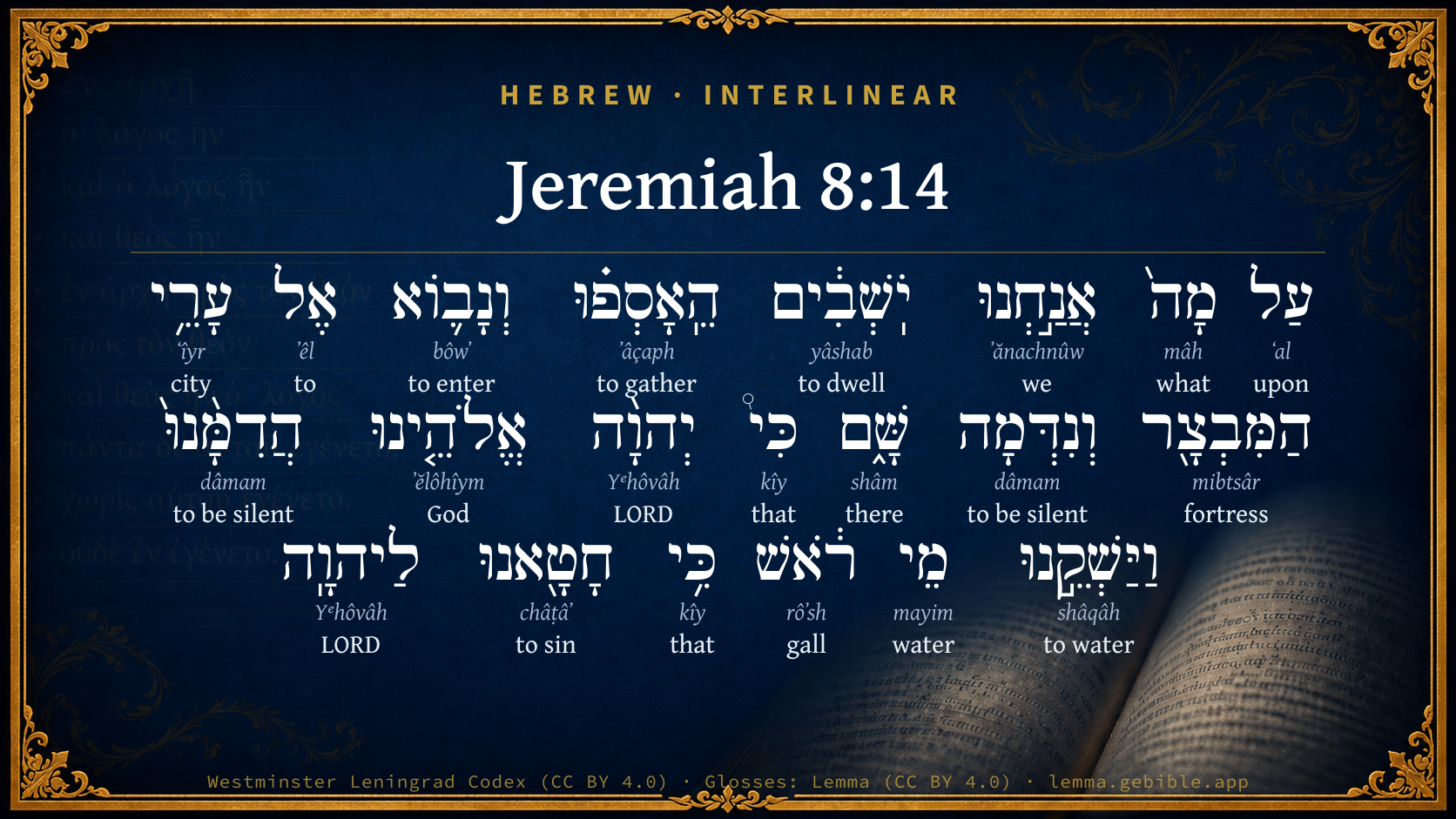
Jeremiah 8:14

Hebrew (Westminster Leningrad Codex) Jeremiah 8:14 appears in the Hebrew Old Testament. The text above is from the Westminster Leningrad Codex. Each word links to its Strong’s number, a concise gloss, and parsing drawn from the Open Scriptures Hebrew Bible morphology. Click any word for its full Brown-Driver-Briggs (BDB) entry.
Download image
Cite this verse

Jeremiah 8:14 (World English Bible). Public Domain. Lemma interlinear Bible study tool, https://lemma.gebible.app/v/jeremiah/8/14.

Show BibTeX & RIS
BibTeX
RIS
English Translation
Why do we sit still? assemble yourselves, and let us enter into the fortified cities, and let us be silent there; for Yahweh our God has put us to silence, and given us water of gall to drink, because we have sinned against Yahweh.
World English Bible · Public Domain
Download a study sheet

One document with this verse’s original text, its word-by-word gloss line, the meaning frame, cross-references with their text, attributed commentary, and full source and license credits — printable, and it pastes into notes with its structure intact.

This verse Autodidact and up

Study sheet (.html) Plain text (.txt)

A passage Seminary Student

Up to 50 verses in one chapter. A passage sheet keeps up to 6 commentary sources and 12 cross-references per verse, in the order this page ranks them, and says so on the sheet whenever that leaves anything out. Ask for a single verse and you get the Autodidact verse sheet above.

Everything on this page stays free to read, with no account — the sheet is a download of what is already on screen, not access to it.

Want to remove ads? Support Godless Engineer
Compare translations 3

The same verse in 3 English versions, stacked beneath the original-language interlinear above. Click any original word for its lexicon entry.

Each is an independent rendering of the whole verse — the interlinear is not word-aligned to these translations.

Highlighted words mark where these versions differ — a whole-verse word diff, not a word-by-word alignment.

  • World English Bible Public Domain
    Why do we sit still? assemble yourselves, and let us enter into the fortified cities, and let us be silent there; for Yahweh our God has put us to silence, and given us water of gall to drink, because we have sinned against Yahweh.
  • King James Version Public Domain
    Why do we sit still? assemble yourselves, and let us enter into the defenced cities, and let us be silent there: for the LORD our God hath put us to silence, and given us water of gall to drink, because we have sinned against the LORD.
  • unfoldingWord Literal Text CC BY-SA 4.0
    “Why we sitting? Be gathered, and let us go to the cities of fortification, and let us perish there, for Yahweh our God will cause us to perish, and has given us water of poison to drink because we have sinned against Yahweh.

unfoldingWord Literal Text — © unfoldingWord, licensed CC BY-SA 4.0. Word-aligned USFM3 via Door43 (git.door43.org/unfoldingWord/en_ult).

Versions to compare (up to 4)

3 of 4 selected

Show all 18 translations

Every available English version of this verse, each an independent rendering of the whole verse.

  • World English Bible Public Domain
    Why do we sit still? assemble yourselves, and let us enter into the fortified cities, and let us be silent there; for Yahweh our God has put us to silence, and given us water of gall to drink, because we have sinned against Yahweh.
  • Berean Standard Bible Public Domain
    Why are we just sitting here? Gather together, let us flee to the fortified cities and perish there, for the LORD our God has doomed us. He has given us poisoned water to drink, because we have sinned against the LORD.
  • Majority Standard Bible Public Domain
    Why are we just sitting here? Gather together, let us flee to the fortified cities and perish there, for the LORD our God has doomed us. He has given us poisoned water to drink, because we have sinned against the LORD.
  • King James Version Public Domain
    Why do we sit still? assemble yourselves, and let us enter into the defenced cities, and let us be silent there: for the LORD our God hath put us to silence, and given us water of gall to drink, because we have sinned against the LORD.
  • American Standard Version (1901) Public Domain
    Why do we sit still? assemble yourselves, and let us enter into the fortified cities, and let us be silent there; for Jehovah our God hath put us to silence, and given us water of gall to drink, because we have sinned against Jehovah.
  • Revised Version (1885) Public Domain
    Why do we sit still? assemble yourselves, and let us enter into the defenced cities, and let us be silent there: for the LORD our God hath put us to silence, and given us water of gall to drink, because we have sinned against the LORD.
  • Geneva Bible (1599) Public Domain
    Why doe we stay? assemble your selues, and let vs enter into the strong cities, and let vs be quiet there: for the Lord our God hath put vs to silence and giuen vs water with gall to drinke, because we haue sinned against the Lord.
  • Douay-Rheims (1899) Public Domain
    Why do we sit still? assemble yourselves, and let us enter into the fenced city, and let us be silent there: for the Lord our God hath put us to silence, and hath given us water of gall to drink: for we have sinned against the Lord.
  • Young's Literal Translation Public Domain
    Wherefore are we sitting still? Be gathered, and we go in to the fenced cities, And we are silent there, For Jehovah our God hath made us silent, Yea, He causeth us to drink water of gall, For we have sinned against Jehovah.
  • Literal Standard Version CC BY-SA 4.0
    Why are we sitting still? Be gathered, and we go into the fortified cities, || And we are silent there, || For our God YHWH has made us silent, || Indeed, He causes us to drink water of gall, || For we have sinned against YHWH.
  • Unlocked Literal Bible CC BY-SA 4.0
    Why are we sitting here? Come together; let us go to the fortified cities, and we will become silent there in death. For Yahweh our God will silence us. He will make us drink poison, since we have sinned against him.
  • unfoldingWord Literal Text CC BY-SA 4.0
    “Why we sitting? Be gathered, and let us go to the cities of fortification, and let us perish there, for Yahweh our God will cause us to perish, and has given us water of poison to drink because we have sinned against Yahweh.
  • Darby Bible Public Domain
    Why do we sit still? Assemble yourselves, and let us enter into the fenced cities, and let us be silent there: for Jehovah our God hath put us to silence, and given us water of gall to drink, because we have sinned against Jehovah.
  • World Messianic Bible Public Domain
    “Why do we sit still? Assemble yourselves! Let’s enter into the fortified cities, and let’s be silent there; for the LORD our God has put us to silence, and given us poisoned water to drink, because we have sinned against the LORD.
  • Webster's Bible Public Domain
    Why do we sit still? assemble yourselves, and let us enter into the fortified cities, and let us be silent there: for the LORD our God hath put us to silence, and given us water of gall to drink, because we have sinned against the LORD.
  • Free Bible Version CC BY-SA 4.0
    The people say, “Why are we sitting around here? Let's get together and run to the fortified towns. We can die there, for the Lord our God is killing us by giving us poisoned water to drink, because we sinned against him.
  • Bible in Basic English Public Domain
    Why are we seated doing nothing? come together, and let us go to the walled towns, and let destruction overtake us there, for the Lord our God has sent destruction on us, and given us bitter water for our drink, because we have done evil against the Lord.
  • JPS Tanakh (1917) Public Domain
    'Why do we sit still? Assemble yourselves, and let us enter into the fortified cities, and let us be cut off there; for the LORD our God hath cut us off, and given us water of gall to drink, because we have sinned against the LORD.

Literal Standard Version (2020), Covenant Press — licensed CC BY-SA 4.0. Text via the HelloAO Bible API (eBible.org). Unlocked Literal Bible (unfoldingWord) — licensed CC BY-SA 4.0. Text via the HelloAO Bible API (eBible.org). unfoldingWord Literal Text — © unfoldingWord, licensed CC BY-SA 4.0. Word-aligned USFM3 via Door43 (git.door43.org/unfoldingWord/en_ult). Free Bible Version, Dr. Jonathan Gallagher — licensed CC BY-SA 4.0. Text via the HelloAO Bible API (eBible.org).

Word by word

More ways to search: Search by grammar → Find every occurrence → Compare this word →

Practice this passage: Drill this verse → Learn its vocabulary →

רֹ֔אשׁ
rôʼsh
H7219
“gall”
Noun, Common, Masculine, Singular, Absolute
Part of Speech
Noun
Type
Common
Gender
Masculine
Number
Singular
State
Absolute
Full BDB Definition

Origin: apparently the same as H7218

TWOT: 2098

gall, venom, bitter, poisonous
  1. עַל ʻal H5921 “upon” Preposition
  2. מָה֙ mâh H4100 “what” Particle, Interrogative
  3. אֲנַ֣חְנוּ ʼănachnûw H587 “we” Pronoun, Personal, 1st Person, Common, Plural
  4. יֹֽשְׁבִ֔ים yâshab H3427 “dwelling” Verb, Qal, Participle Active, Masculine, Plural, Absolute
  5. הֵֽאָסְפ֗וּ ʼâçaph H622 “gather” Verb, Niphal, Imperative, 2nd Person, Masculine, Plural
  6. וְנָב֛וֹא bôwʼ H935 “and · to enter” Conjunction + Verb, Qal, Cohortative, 1st Person, Common, Plural
  7. אֶל ʼêl H413 “to” Preposition
  8. עָרֵ֥י ʻîyr H5892 “cities of” Noun, Common, Feminine, Plural, Construct
  9. הַמִּבְצָ֖ר mibtsâr H4013 “the · fortress” Particle, Definite Article + Noun, Common, Masculine, Singular, Absolute
  10. וְנִדְּמָה dâmam H1826 “and · to be silent” Conjunction + Verb, Qal, Cohortative, 1st Person, Common, Plural
  11. שָּׁ֑ם shâm H8033 “there” Adverb
  12. כִּי֩ kîy H3588 “that” Conjunction
  13. יְהוָ֨ה Yᵉhôvâh H3068 “LORD” Noun, Proper
  14. אֱלֹהֵ֤ינוּ ʼĕlôhîym H430 “God(s) · our” Noun, Common, Masculine, Plural, Construct + Suffix, Personal, 1st Person, Common, Plural
  15. הֲדִמָּ֨נוּ֙ dâmam H1826 “to be silent · us” Verb, Hiphil, Perfect, 3rd Person, Masculine, Singular + Suffix, Personal, 1st Person, Common, Plural
  16. וַיַּשְׁקֵ֣נוּ shâqâh H8248 “and · to water · us” Conjunction + Verb, Hiphil, Sequential Imperfect, 3rd Person, Masculine, Singular + Suffix, Personal, 1st Person, Common, Plural
  17. מֵי mayim H4325 “water(s) of” Noun, Common, Masculine, Plural, Construct
  18. כִּ֥י kîy H3588 “that” Conjunction
  19. חָטָ֖אנוּ châṭâʼ H2398 “to sin” Verb, Qal, Perfect, 1st Person, Common, Plural
  20. לַיהוָֽה Yᵉhôvâh H3068 “to/for · LORD” Preposition + Noun, Proper

About this verse

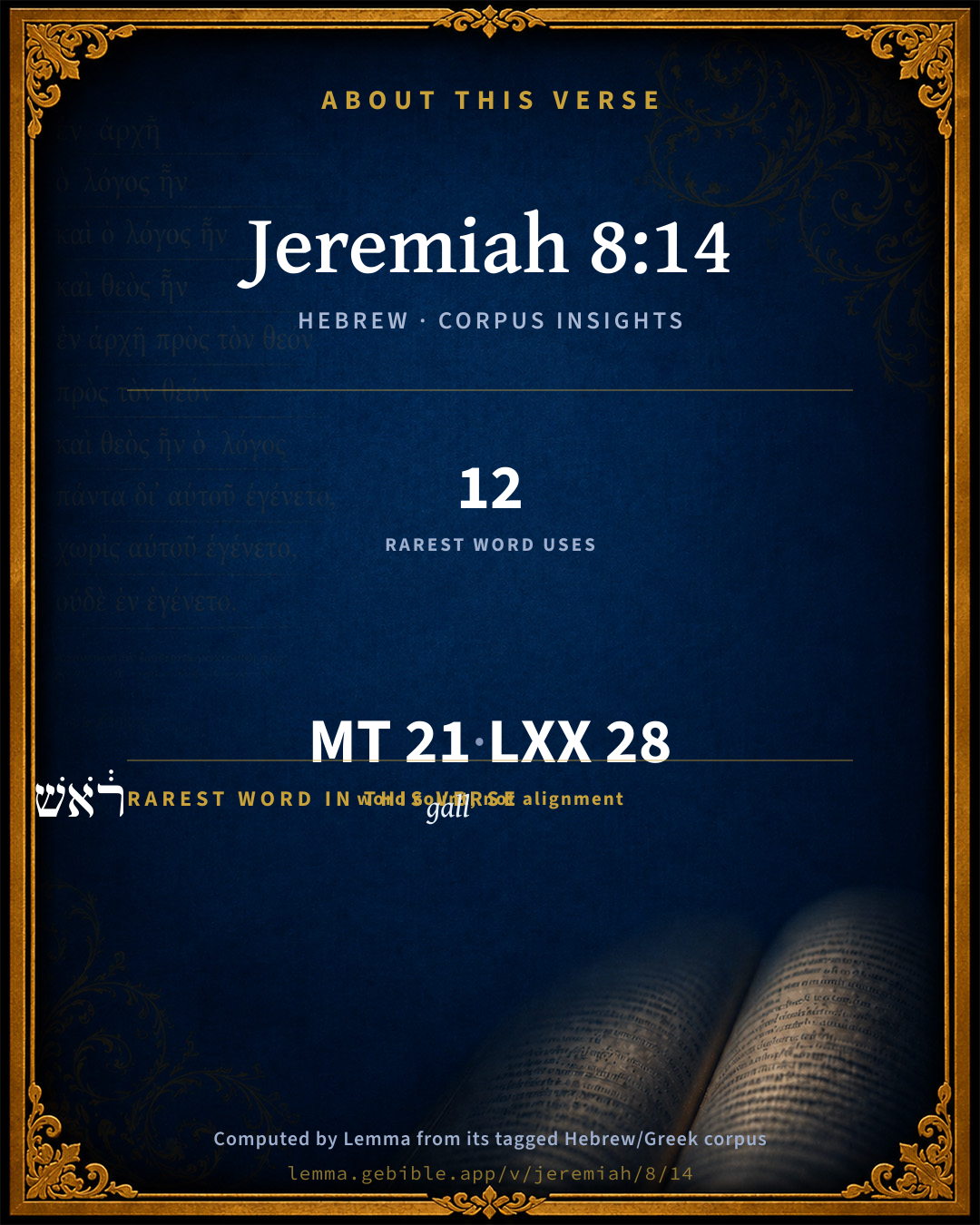
These counts appear in no published source. They are computed here, from the morphology-tagged text and Lemma’s own curated glosses. What Lemma adds →

21
words
18
distinct lemmas
Prophets
section

Notable vocabulary

The rarest word here is רֹ֔אשׁ gall H7219 — appearing just 12 times in the whole Hebrew Bible.

Shared distinctive vocabulary

רֹ֔אשׁ gall H7219 occurs in 12 verses of the Hebrew Bible. Also found in:

Grammatical profile

  • 7 verbs
  • 7 nouns
  • 1 pronoun
  • 2 prepositions
  • 2 conjunctions
  • 1 adverb
  • 1 particle

Verb forms

  • יֹֽשְׁבִ֔ים Qal · Participle Active
  • הֵֽאָסְפ֗וּ Niphal · Imperative
  • וְנָב֛וֹא Qal · Cohortative
  • וְנִדְּמָה Qal · Cohortative
  • הֲדִמָּ֨נוּ֙ Hiphil · Perfect
  • וַיַּשְׁקֵ֣נוּ Hiphil · Sequential Imperfect
  • חָטָ֖אנוּ Qal · Perfect

Repetition

Words recur within this verse — often emphatic in Hebrew:

  • וְנִדְּמָה to be silent H1826 ×2
  • יְהוָ֨ה LORD H3068 ×2
  • כִּי֩ that H3588 ×2

Hebrew & Septuagint length

In the original languages it is 21 Hebrew tokens and 28 Greek tokens — but the two are counted differently (Hebrew bundles its prefixes and suffixes into one token; the Greek is in lemma form), so that isn’t a like-for-like length.

Cross-references

19

Topical passages linked to Jeremiah 8:14 in the Treasury of Scripture Knowledge — connected by theme and wording, ordered by reader-vote popularity; previews shown in the World English Bible.

  • Jeremiah 23:15 Therefore thus says Yahweh of Hosts concerning the prophets: Behold, I will feed them with wormwood, and make them drink the water of gall; for from the prophets of Jerusalem is ungodliness gone forth into all the land.
  • Jeremiah 9:15 therefore thus says Yahweh of Hosts, the God of Israel, Behold, I will feed them, even this people, with wormwood, and give them water of gall to drink.
  • Psalms 69:21 They also gave me gall for my food. In my thirst, they gave me vinegar to drink.
  • Jeremiah 35:11 But it happened, when Nebuchadrezzar king of Babylon came up into the land, that we said, Come, and let us go to Jerusalem for fear of the army of the Chaldeans, and for fear of the army of the Syrians; so we dwell at Jerusalem.
  • Lamentations 3:19 Remember my affliction and my misery, the wormwood and the gall.
  • Deuteronomy 29:18 lest there should be among you man, or woman, or family, or tribe, whose heart turns away this day from Yahweh our God, to go to serve the gods of those nations; lest there should be among you a root that bears gall and wormwood;
  • Deuteronomy 32:32 For their vine is of the vine of Sodom, Of the fields of Gomorrah: Their grapes are grapes of gall, Their clusters are bitter:
  • 2 Samuel 20:6 David said to Abishai, Now will Sheba the son of Bichri do us more harm than did Absalom: take your lord's servants, and pursue after him, lest he get him fortified cities, and escape out of our sight.
  • Matthew 27:34 They gave him sour wine to drink mixed with gall. When he had tasted it, he would not drink.
  • Leviticus 10:3 Then Moses said to Aaron, "This is what Yahweh spoke of, saying, "'I will show myself holy to those who come near me, And before all the people I will be glorified.'" Aaron held his peace.
  • Numbers 5:18–24 The priest shall set the woman before Yahweh, and let the hair of the woman's head go loose, and put the meal offering of memorial in her hands, which is the meal offering of jealousy. The priest shall have in his hand the water of bitterness that brings a curse.
  • 2 Kings 7:3–4 Now there were four leprous men at the entrance of the gate: and they said one to another, Why sit we here until we die?
  • Psalms 39:2 I was mute with silence. I held my peace, even from good. My sorrow was stirred.
  • Jeremiah 4:5–6 Declare you in Judah, and publish in Jerusalem; and say, Blow you the trumpet in the land: cry aloud and say, Assemble yourselves, and let us go into the fortified cities.
  • Jeremiah 14:20 We acknowledge, Yahweh, our wickedness, and the iniquity of our fathers; for we have sinned against you.
  • Lamentations 3:27–28 It is good for a man that he bear the yoke in his youth.
  • Amos 6:10 "When a man's relative carries him, even he who burns him, to bring bodies out of the house, and asks him who is in the innermost parts of the house, 'Is there yet any with you?' And he says, 'No;' then he will say, 'Hush! Indeed we must not mention the name of Yahweh.'
  • Habakkuk 2:20 But Yahweh is in his holy temple. Let all the earth be silent before him!"
  • Zechariah 2:13 Be silent, all flesh, before Yahweh; for he has roused himself from his holy habitation!"

Cross-references courtesy of OpenBible.info (CC BY 4.0).

Hebrew and Greek witnesses Masoretic Hebrew ↔ Greek Septuagint

The same verse in the two great witnesses to the Old Testament, shown verse-for-verse.

These are two independent witnesses, not word-aligned to each other, and the Septuagint is shown in lemma (dictionary) form.

Hebrew Jeremiah 8:14 Masoretic · Westminster Leningrad Codex

עַל מָה֙ אֲנַ֣חְנוּ יֹֽשְׁבִ֔ים הֵֽאָסְפ֗וּ וְנָב֛וֹא אֶל עָרֵ֥י הַמִּבְצָ֖ר וְנִדְּמָה שָּׁ֑ם כִּי֩ יְהוָ֨ה אֱלֹהֵ֤ינוּ הֲדִמָּ֨נוּ֙ וַיַּשְׁקֵ֣נוּ מֵי רֹ֔אשׁ כִּ֥י חָטָ֖אנוּ לַיהוָֽה

Why do we sit still? assemble yourselves, and let us enter into the fortified cities, and let us be silent there; for Yahweh our God has put us to silence, and given us water of gall to drink, because we have sinned against Yahweh.

World English Bible · Public Domain

Greek LXX Structure differs

In the Septuagint, Jeremiah is about an eighth shorter than the Hebrew and arranges its material differently — the Oracles Against the Nations (Hebrew chapters 46–51) appear in the middle of the Greek book, after 25:13. Because the chapter and verse boundaries do not line up, a verse-for-verse comparison with the Hebrew is not shown.

A verse-for-verse comparison isn’t shown here because the chapters and verses don’t line up. Switch to the LXX edition with the MT / LXX toggle above to read the Greek directly.

Hebrew: Westminster Leningrad Codex (CC BY 4.0). Greek: Septuagint (public domain); English from a public-domain English Septuagint. How the Septuagint differs from the Hebrew →

Targum (Aramaic paraphrase)

1

The Targum is the ancient Jewish Aramaic paraphrase of the Hebrew Scriptures — an interpretive translation, not the Hebrew text itself. Onkelos (literal) and Pseudo-Jonathan (expansive) render the Torah, and Jonathan the Prophets. Coverage is partial: where no permissively-licensed English translation exists for a verse, only the Aramaic is shown. This is verse-level text, not a word-by-word alignment to the Hebrew.

  1. Targum Jonathan Prophets (Joshua–Malachi)
    עַל מָה אֲנַחְנָא יָתְבוּן אִתְכְּנָשׁוּ וְנֵיעוֹל לְקִרְוִין כְּרִיכָן וְנִשְׁתּוֹק תַּמָן אֲרֵי יְיָ אֱלָהָנָא אַיְתִי עֲלָנָא תְּבַר וְאַבְהֲתָנָא וְאַשְׁקָנָא כָּס דִלְוָט בִּישׁ כְּרֵישֵׁי חֵיוָן אֲרֵי חַבְנָא קֳדָם יְיָ:

    (no public-domain English translation for this verse)

    Targum Jonathan — Aramaic: “Mikraot Gedolot” (public domain). English: “Sefaria Community Translation” (CC0 1.0 (public-domain dedication)); “London "Chaldee Paraphrase," 1871” (public domain). Text via Sefaria.

Commentary

Notes on Jeremiah 8:14 from classic Christian and Jewish commentators (each source and its license shown beneath its notes). The classic Christian expositions comment on the surrounding passage and are grouped to its opening verse, so a note may address several verses; the Jewish commentaries on the Tanakh (Rashi and others) are per-verse, so they appear only where the commentator wrote on this verse.

Lemma curates 59 commentaries, every one of them public domain or Creative Commons licensed, each selected and text-cleaned for this edition rather than reprinted as found. About our sources →

Trapp's Complete Commentary

John Trapp

Jer 8:14 Why do we sit still? assemble yourselves, and let us enter into the defenced cities, and let us be silent there: for the LORD our God hath put us to silence, and given us water of gall to drink, because we have sinned against the LORD.

Ver. 14. Why do we sit still?] Here the people speak (see on Jer 8:13), being grievously frightened upon the coming of the Chaldees, and thereupon consulting what course to take; but all would not do. {Jer 8:16}

Let us be silent.] Sic silent pavidi mures coram fele. So they were as a panic struck mouse in the eyes of a cat.

For the Lord our God hath put us to silence.] Hath expelled our courage and stopped our mouths.

And hath given us water of gall to drink.] Succum cicutae, juice of hemlock, our bane, our death’s draught; so that now we know, by woeful experience, what an evil and bitter thing sin is; for a drop of honey we have now a sea of gall.

John Trapp, A Commentary or Exposition upon All the Books of the Old and New Testament (1647–1656) — public domain. Text from a community e-Sword module.

Joseph Benson's Commentary

Jer 8:14-15. Let us enter into the defenced cities — In these verses the prophet seems to turn to and address his countrymen by way of apostrophe; and, as one of the people that dwelt in the open towns, advises those that were in the like situation to retire with him into some of the fortified cities, and there wait the event with patience; since there was nothing but terror abroad, and the noise of the enemy who had already begun to ravage the country. By this the prophet signifies, that when the Chaldeans should come, there would be no hope of safety left but in fleeing to fortified places, and that none would dare to stay in the open country. He speaks of the thing as already present, because it was soon to happen, and it was represented to him, in his vision, as already present. Let us be silent there, for the Lord hath put us to silence — This may mean, that God had suffered the forces of the king of Judah to be so diminished that they were not able to defend the country and open towns, but must of necessity keep themselves cooped up in their fortified cities, and leave the country to be ravaged everywhere by the Chaldeans. And given us water of gall to drink — Hath brought us into grievous calamities for the punishment of our sins. We looked for peace — We were willing to believe the false prophets, who foretold prosperous times. For a time of health — Or, for a time in which we should be cured; that is, for a time of peace, in which we might recover our strength.

Joseph Benson's Commentary on the Old and New Testaments (1811–1818) — public domain. Text from a community e-Sword module.

Keil & Delitzsch

C. F. Keil & F. Delitzsch

The horrors of the approaching visitation. - Jer 8:14. "Why do we sit still? Assemble yourselves, and let us go into the defenced cities, and perish there; for Jahveh our God hath decreed our ruin, and given us water of gall to drink, because we have sinned against Jahveh. Jer 8:15. We looked for safety, and there is no good; for a time of healing, and behold terrors. Jer 8:16. From Dan is heard the snorting of his horses; at the loud neighing of his steeds the whole earth trembles: they come, and devour the land and its fulness, the city and those that dwell therein. Jer 8:17. For, behold, I send among you serpents, vipers, of which there is no charming, which shall sting you, saith Jahve. Jer 8:18. Oh my comfort in sorrow, in me my heart grows too sock. Jer 8:19. Behold, loud sounds the cry of the daughter from out of a far country: 'Is Jahveh not in Zion, nor her King in her?' Why provoked they me with their images, with vanities of a foreign land? Jer 8:20. Past is the harvest, ended is the fruit-gathering, and we are not saved. Jer 8:21. For the breaking of the daughter of my people am I broken, am in mourning; horror hath taken hold on me. Jer 8:22. Is there no balm in Gilead, or no physician there? why then is no plaister laid upon the daughter of my people? V. 23. Oh that my head were waters, and mine eyes a fountain of tears! then would I weep day and night for the slain of the daughter of my people."

In spirit the prophet sees the enemy forcing his way into the country, and the inhabitants fleeing into the fortified cities. This he represents to his hearers with graphic and dramatic effect. In Jer 8:14 the citizens of Judah are made to speak, calling on one another to flee and give up hope of being saved. "Why do we sit still?" i.e., remain calmly where we are? We will withdraw into the strong cities (cf. Jer 4:5), and perish there by famine and disease (נדּמה for נדּמּה, imperf. Niph., from דּמם: cf. Gesen. 67, 5, Rem. 11; in Niph. be destroyed, perish). The fortresses cannot save them from ruin, since they will be besieged and taken by the enemy. For our sin against Him, God has decreed our ruin. The Hiph. from דמם, prop. put to silence, bring to ruin, here with the force of a decree. מי ראשׁ, bitter waters; ראשׁ or רושׁ, Deu 32:32, is a plant with a very bitter taste, and so, since bitterness and poison were to the Jews closely connected, a poisonous plant; see on Deu 29:17. So they call the bitter suffering from the ruin at hand which they must undergo. Cf. the similar figure of the cup of the anger of Jahveh, Jer 25:15.

Jer 8:15

Instead of peace and safety hoped for, there is calamity and terror. The infin. abs. קוּה is used emphatically for the imperf.: We looked for safety, and no good has come to us: for healing, sc. of our injuries, and instead comes terror, by reason of the appearance of the foe in the land. This hope has been awakened and cherished in the people by false prophets (see on Jer 4:10), and now, to their sore suffering, they must feel the contrary of it. The same idea is repeated in Jer 14:19. מרפּה is a mis-spelling of מרפּא, Jer 14:19, etc.

Jer 8:16

From the northern borders of Canaan (from Dan; see on Jer 4:15) is already heard the dreadful tumult of the advancing enemy, the snorting of his horses. The suffix in סוּסיו refers to the enemy, whose invasion is threatened in Jer 6:22, and is here presumed as known. אבּיריו, his strong ones, here, as in Jer 47:3; Jer 50:11, a poetical name for strong horses, stallions; elsewhere for strong animals, e.g., Psa 22:13; Psa 50:13. The whole earth, not the whole land. With "devour the land," cf. Jer 5:17. עיר and ארץ have an indefinite comprehensive force; town and country on which the enemy is marching.

Jer 8:17

The terribleness of these enemies is heightened by a new figure. They are compared to snakes of the most venomous description, which cannot be made innocuous by any charming, whose sting is fatal. "Vipers" is in apposition to "serpents;" serpents, namely basilisks. צפעני is, acc. to Aq. and Vulg. on Isa 11:8, serpens regulus, the basilisk, a small and very venomous species of viper, of which there is no charming. Cf. for the figure, Cant. 10:11; and fore the enemies' cruelty thereby expressed, cf. Jer 6:23; Isa 13:18.

Jer 8:18-22

The hopeless ruin of his people cuts the prophet to the very heart. In Jer 8:18 -23 his sore oppressed heart finds itself vent in bitter lamentations. Oh my comfort in sorrow! is the cry of sore affliction. This may be seen from the second half of the verse, the sense of which is clear: sick (faint) is my heart upon me. עלי shows that the sickness of heart is a sore burden on him, crushes him down; cf. Ew. 217, i. "My comfort" is accordingly vocative: Oh my comfort concerning the sorrow! Usually מי יתּן is supplied: Oh that I had, that there were for me comfort! The sense suits, but the ellipse is without parallel. It is simpler to take the words as an exclamation: the special force of it, that he knows not when to seek comfort, may be gathered from the context. For other far-fetched explanations, see in Ros. ad h. l. The grief which cuts so deeply into his heart that he sighs for relief, is caused by his already hearing in spirit the mourning cry of his people as they go away into captivity.

Jer 8:19-20

From a far country he hears the people complain: Is Jahveh not in Zion? is He no longer the King of His people there? The suffix in מלכּהּ refers to "daughter of my people," and the King is Jahveh; cf. Isa 33:22. They ask whether Jahveh is no longer King in Zion, that He may release His people from captivity and bring them back to Zion. To this the voice of God replies with the counter-question: Why have they provoked me with their idolatry, sc. so that I had to give them over into the power of the heathen for punishment? "Images" is expounded by the apposition: vanities (no-gods; for הבל, see on Jer 2:5) of a foreign land. Because they have chosen the empty idols from abroad (Isa 14:22) as their gods, Jahveh, the almighty God of Zion, has cast them out into a far country amidst strange people. The people goes on to complain in Jer 8:20 : Past is the harvest...and we are not saved. As Schnur. remarked, these words have something of the proverb about them. As a country-man, hoping for a good harvest, falls into despair as to his chances, so the people have been in vain looking for its rescue and deliverance. The events, or combinations of events, to which it looked for its rescue are gone by without bringing any such result. Many ancient commentators, following Rashi, have given too special a significance to this verse in applying it to the assistance expected from Egypt in the time of Jehoiakim or Zedekiah. Hitz. is yet more mistaken when he takes the saying to refer to an unproductive harvest. From Jer 8:19 we see that the words are spoken by the people while it pines in exile, which sets its hopes of being saved not in the productiveness of the harvest, but in a happy turn of the political situation.

Jer 8:21-22

The hopeless case of the people and kingdom moves the seer so deeply, that he bursts forth with the cry: For the breaking of my people I am broken (the Hoph. השׁבּרתּי, of the breaking of the heart, only here; in this sig. usu. the Niph., e.g., Jer 38:7. Horror hath taken hold on me, is stronger than: Anguish hath taken hold on me, Jer 6:24, Mic 4:9. Help is nowhere to be found. This thought is in Jer 8:22 clothed in the question: Is there no balm in Gilead, or no physician there? "There" points back to Gilead. Graf's remark, that "it is not known that the physicians were got from that quarter," shows nothing more than that its author has mistaken the figurative force of the words. צרי, balsam, is mentioned in Gen 37:25 as an article of commerce carried by Midianite merchants to Egypt (cf. Eze 27:17), but is hardly the real balsam from Mecca (amyris opobalsamum), which during the Roman sovereignty was grown under culture in the gardens of Jericho, and which only succeeds in a climate little short of tropical. It was more likely the resina of the ancients, a gum procured from the terebinth or mastic tree (lentiscus, σχῖνος), which, acc. to Plin. h. nat. xxiv. 22, was held in esteem as a medicament for wounds (resolvitur resina ad vulnerum usus et malagmata oleo). Acc. to our passage and Jer 46:11, cf. Gen 37:25, it was procured chiefly from Gilead; cf. Movers, Phniz. ii. 3, S. 220ff., and the remarks on Gen 37:25. To these questions a negative answer is given. From this we explain the introduction of a further question with כּי: if there were balm in Gilead, and a physician there, then a plaister would have been laid on the daughter of my people, which is not the case. As to עלתה , lit., a plaister comes upon, see on Jer 30:17.

Keil & Delitzsch — Biblical Commentary on the Old Testament (1861–1891) — public domain (CC PDM 1.0). Text via the HelloAO Bible API. (Old Testament only.)

Tyndale Open Study Notes

Tyndale Open Resources

8:14-15 These people had heard Jeremiah publicly deliver the decree of the Lord; they now realized that they deserved their punishment because they had sinned against the Lord. Though their doom was sealed, they still did not seek forgiveness for their sins.

Tyndale Open Study Notes — © Tyndale Open Resources, licensed CC BY-SA 4.0. Text via the HelloAO Bible API.

Geneva Bible (1599)

Geneva Bible translators

That is, hath brought us into extreme affliction, and thus they shall not attribute this plague to fortune, but to God’s just judgment, Jer. 9:15 and 23:15.

He speaketh in the person of the people, who when the enemy cometh, will turn about to hide themselves, and acknowledge that it is God’s hand.

Geneva Bible (1599) marginal notes — public domain. Text via Bolls.life.

Jamieson, Fausset & Brown

Robert Jamieson, A. R. Fausset & David Brown

assemble--for defense.

let us be silent--not assault the enemy, but merely defend ourselves in quiet, until the storm blow over.

put us to silence--brought us to that state that we can no longer resist the foe; implying silent despair.

water of gall--literally, "water of the poisonous plant," perhaps the poppy (Jer 9:15; Jer 23:15).

Jamieson, Fausset & Brown — Commentary Critical and Explanatory on the Whole Bible (1871) — public domain (CC PDM 1.0). Text via the HelloAO Bible API.

John Calvin's Commentaries

This verse, and those which follow, are explained in different ways; but I will briefly shew the meaning of the Prophet. I have no doubt but that he speaks here in the name of the whole people. The Prophet, then, in these words, represents what occupied their minds, and the counsels which the Jews adopted: and further, there is no doubt but that he shews in these words that they, as hypocrites are wont to do, had recourse to expedients, by which they thought they could protect themselves from God’s wrath. For they who think that the Prophet spoke his own sentiments are greatly mistaken: on the contrary, he relates here the purposes which the Jews formed; and at the same time he reproves their hardness in turning here and there, and in thinking that they could turn aside the judgment of God; for hypocrites, unless constrained, never ascend to the first cause; that is, they never acknowledge nor regard the hand of him who strikes them, as it is said in another place. (Isaiah 9:13.) They indeed feel their evils, and seek to apply remedies; but they stop at the nearest reliefs, without seeking to pacify God and to return into favor with him; and when the smallest hope is given them, they think themselves to be safe, if they betake themselves to this or that hiding-place.

This feeling is what the Prophet describes: Why do we sit? or, “Why do we rest?” But the word here means to sit still: Why do we then sit still? as though they had accused themselves of sloth or idleness: “What means this our slothfulness? we sit still in the villages, which are exposed to the violence of enemies: gather then yourselves, and let us enter into fortified cities; we shall rest there.” They thought that they should be safe, if they entered into fortified cities. Then, on the other hand, Jeremiah shews how foolishly they trusted to such refuges. Surely, he says, our God hath made us silent He had said before ונדמה-שם, vanudame-shem, “and we shall there rest.” The verb, means to rest, and to be silent. He repeats the same word, “Surely, our God hath made us to be silent;” but in a different sense. There is then a striking allusion in the verb דמה, dame, or the sameness of sound. “Jehovah hath made us to be silent, “or to rest; or, he hath cut us off, for in Hiphil, it has this meaning.

We hence see, that on the one hand is declared what might have given some comfort to the Jews, for there were fortified cities which might have protected them from the assaults of enemies; but, on the other hand, the Prophet shews that they were greatly mistaken, for God would make them to rest in a different manner, as he would reduce them to nothing; for the dead are said to rest, or to be silent. In short, he means a quiet state when speaking in the name of the people; but he refers to destruction when speaking by God’s command.

He afterwards confirms the same thing in a metaphorical language, God will give them the waters of gall, or, poisoned waters: and he adds, Because they have acted impiously against Jehovah We may learn from this last part, that the Prophet is now performing the duty of his office. The people indeed never willingly allowed that they were suffering punishment justly due to their sins; but the Prophet here reproves them for hoping to be safe by fleeing to fortified cities, as though God could not follow them there. He then says that God’s vengeance would closely pursue them, and that wherever they fled, they would still be exposed to evils, for they carried with them their impieties, which would draw upon them the wrath of God. It follows —

John Calvin's Commentaries (1540-1563) — public domain. Text from the Calvin Translation Society English edition (1840s-50s) via the Christian Classics Ethereal Library (ccel.org). Calvin's coverage is partial (roughly two-thirds of the Bible); uncommented books and verses are honest gaps, never fabricated. The 19th-century editor's footnotes and remarks are omitted so the notes are faithfully Calvin's own voice.

Ellicott's Commentary for English Readers

(14) Why do we sit still? . . .—The cry of the people in answer to the threatening of Jehovah is brought in by the prophet with a startling dramatic vividness. They are ready to flee into the defenced cities, as the prophet had told them in Jer_4:5, but it is without hope. They are going into the silence as of death, for to that silence Jehovah himself has brought them.

Water of gall.—The idea implied is that of poison as well as bitterness. It is uncertain what the “gall-plant” was; possibly, from its connection with “grapes” or “clusters,” as in Deu_32:32, belladonna or colocynth is meant. Others have suggested the poppy, and this is in part confirmed by the narcotic properties implied in Mat_27:34. In Deu_29:18 it is joined with “wormwood.”

A Bible Commentary for English Readers, edited by Charles John Ellicott (1878–1897) — public domain. Text from a community e-Sword module.

The Cambridge Bible for Schools and Colleges

gen. ed. J. J. S. Perowne

14. be silent … put us to silence] better, as mg. perish … caused us to perish. Cp. 1Sa_2:9.

water of gall] a plant yielding some bitter flavour reminding of gall. It is mentioned also Jer_9:15, Jer_23:15; Deu_29:18 (Matthew 17), Jer_32:32; Psa_69:21; Lam_3:5; Lam_3:19; Hos_10:4 (“hemlock”). It cannot be identified with any certainty.

14, 15. The people in their straits address one another. Cp. Jer_4:5.

The Cambridge Bible for Schools and Colleges (gen. ed. J. J. S. Perowne; Cambridge University Press, 1878–1918) — public domain. Text from a community e-Sword module.

John Gill's Exposition

We looked for peace,.... Outward prosperity, affluence of temporal blessings, peace with enemies, and safety from them, which the false prophets had given them reason to expect; or which last they concluded and hoped for, from their being in the defenced cities:

but no good came; they were disappointed in their expectation; the good that was promised them, and they looked for, never came, but all the reverse:

and for a time of health; or, of healing (l); the political wounds of the commonwealth of Israel:

and behold trouble! or "terror" (m); at the approach of the enemy, described in the following verses. The Targum is,

"a time of pardon of offences, and, lo, a punishment of sins.''

Healing, in Scripture, signifies pardon of sin; see Psa 41:4.

(l) "medelae, vel sanationis", Pagninus, Montanus, Vatablus, Schmidt. (m) "terror", Pagninus, Montanus, Junius & Tremellius, Schmdit.

John Gill's Exposition of the Whole Bible (1746–1763) — public domain (CC PDM 1.0). Text via the HelloAO Bible API.

Albert Barnes' Notes on the Bible

The people rouse one another to exertion. “Why,” they ask, “do we remain here to be overwhelmed?” They are ready now to follow the command given (see the marginal reference), but with the conviction that all hope is over.

Let us be silent there - Rather, let us perish there, literally “be put to silence.”

Water of gall - i. e., poison. The word rendered “gall” was probably the belladonna, or night-shade, to the “berries” of which the grapes of Israel were compared.

Albert Barnes' Notes on the Bible (1834–1885) — public domain. Text from a community e-Sword/MySword module.

Haydock's Catholic Bible Commentary

Silent, in utter destruction, 1 Kings ii. 9. We cannot be in a worse condition.

George Leo Haydock (1774–1849), Haydock's Catholic Family Bible and Commentary, 1859 edition — public domain. Excludes Psalms (Douay-Rheims chapter numbering differs from Protestant) and Deuterocanonical books (Catholic canon only).

Matthew Poole's English Annotations

Why do we sit still? the people at length seem to bethink themselves, and thus to bespeak each other. Let us enter into the defenced cities; in the scattered villages there is no safety for us, let us retire into places of greater security, Mat 24:16-18; possibly they thought they might be secured there, as they had been before in the time of Sennacherib.

Let us be silent there; keep close within our walls, say or do nothing to provoke the enemy; but sit down and bewail the desperateness of our condition, Lam 3:28,29, or tremblingly expect the issue of this sad war, for there is no possibility of making head against such an enemy, that bears down all before them.

The Lord our God hath put us to silence: they now begin to perceive that the hand of God is in all this, and that therefore they have not a word to say, as if they were wronged; God hath put them to shame: much less courage to oppose the Babylonians; their heart fails them, they are as men in a great terror and consternation; God hath put us to silence, let us be silent.

Water of gall; or, poison; probably the name of some poisonous herb, with the juice or infusion whereof they were wont to kill persons, as hemlock, nightshade &c. See Hos 10:4. It notes those bitter destructive judgments that God was bringing upon them, Jer 9:15, which did spring from that bitter root of their sinning against him, as in the next words.

Matthew Poole's English Annotations on the Holy Bible (1683–1685) — public domain. Text from a community e-Sword/MySword module.

Whedon's Commentary on the Bible

Daniel D. Whedon

14. Let us be silent, etc. — Better, let us perish, for Jehovah our God hath caused us to perish.

Gall — The name of a poisonous plant which cannot be unmistakably identified. From the fact that it is mentioned in Deu_32:32, as having berries, some have not improbably conjectured that the nightshade is intended.

Daniel D. Whedon (gen. ed.), Commentary on the Old and New Testaments (1874–1909) — public domain. Text from a community e-Sword module.

The Pulpit Commentary

Why do we sit still? The prophet transports us by a stroke of his pea into the midst of the fulfillment of his prophecy. The people of the country districts are represented as urging each other to flight. True, it is the resource of despair. No defensed cities can defend them against the judgment of Jehovah. Let us be silent; rather, let us perish; literally, let us be put to silence. Hath put us to silence; rather, hath caused us to perish; i.e. hath decreed our destruction. Water of gall; a phrase characteristic of our prophet. (see Jer_9:14 Jer_23:15) It is a little difficult to find a rendering which shall suit all the passages in which rosh (gall) is mentioned. In Deu_32:33 (and so Job_20:16) it is clearly used for "venom" in general; and yet in Ver. 32 of the same chapter it obviously means a plant. Another general application of the term seems to have been to bitterness in general, the ideas of bitterness and poisonousness being taken as interchangeable. The Authorized Version may therefore stand.

Vers. 14, 15. Despair.

I DESPAIR WILL ARISE ON THE PERCEPTION THAT THERE IS NO WAY OF ESCAPE FROM RUIN. The miserable Jews are pictured as first sitting still helplessly, and then rousing themselves to enter the fenced cities, only to find that death awaits them there as surely as in the open plain. People are too ready to believe that "something will turn up," and so hold on, in confidence and indifference, till their eyes are suddenly opened, and they see room for nothing but despair.

II DESPAIR WILL ARISE ON THE RECOGNITION OF THE WRATH OF GOD. The Jews are to see that their God has put them to silence. Philistines, Egyptians, Assyrians, Chaldeans, might all be resisted; but who shall resist God? Men can only fight against God with confidence until they perceive him fighting against them. Then hope is madness.

III DESPAIR WILL BE HEIGHTENED BY THE SENSE OF GUILT. The Jews are to see that their calamity is the punishment of sin. It is deserved. It is justly given. Men hope on while they refuse to admit their sin; but conviction of sin is fatal to hope.

IV DESPAIR MAY FOLLOW A CONFIDENT HOPE. The Jews had looked for peace and for a time of health. Yet none came. Hope may be very bright and yet very delusive. The splendor of the sunrise contains little promise that the day will close without storms. Subjective confidence is no guarantee of objective truth. Things are not the more true because we believe them very firmly. We may feel safe and be in danger. A peaceful death is no security for a joyful resurrection. It is little that a man has overcome the fear of death; the important question is whether he has removed the ground for that fear. The faith that saves is not confidence in our own security, but submissive and obedient trust in Christ.

V THE POSSIBILITY OF DESPAIR IS REVEALED, NOT TO PRODUCE IT, BUT TO WARN Us FROM IT. If it were inevitable, or, being experienced, invincible, it would be cruel to prepare any for it. Why not let the poor doomed wretch enjoy his brief hour of sunshine before he is sent "to dwell in solemn shades of endless night?" But the revelations of a possibly dark future are given in mercy to warn us from sowing the seeds of despair and to point to the way of escape. No soul need despair since there is One who "is able to save them to the uttermost that come unto God by him". (Heb_7:25)

The Pulpit Commentary (1880–1919), ed. H.D.M. Spence-Jones & Joseph S. Exell — public domain. Text from a community e-Sword module.

John Wesley's Explanatory Notes

Why - The people at length seem to bethink themselves, and thus to bespeak each other. Silent - Keep close within our walls.

John Wesley, Explanatory Notes Upon the Whole Bible (1754–1765) — public domain. Text via the GEBible commentary corpus.

unfoldingWord translationNotes

Door43 World Missions Community

Connecting Statement:

Yahweh continues his message by telling us what the people of Judah will say at the time of their punishment.

General Information:

The words "we," "us" and "our" refer to the people of Judah.

Why are we sitting here?

This question is asked to motivate action. It can be translated as a statement. AT: "We should not stay here." (See: Rhetorical Question)

Come together; let us go to the fortified cities

The "fortified cities" were cities with high walls and strong defenses. See how you translated the similar phrases in Jeremiah 4:5.

we will become silent there in death

Here "become silent" means to die. AT: "let us die there" or "let us wait for our enemies to kill us there" (See: Metaphor)

For Yahweh our God will silence us

Here "silence" is a metaphor for condemning to death. AT: "because Yahweh our God has condemned us to die" (See: Metaphor)

He will make us drink poison

This is an idiom for Yahweh's judgment on his people. (See: Idiom)

but there will be nothing good

"but nothing good will happen"

but see

"but understand"

translationWords

die

sin

peace

cure

terror

unfoldingWord translationNotes — © Distant Shores Media and the Door43 World Missions Community, licensed CC BY-SA 4.0. Source: git.door43.org/Door43/en_tn.

Rashi

Rabbi Shlomo Yitzchaki (Rashi)

and there let us sit in silence And let us be silent there. Let us sit there silent and mournful.

poisoned water Jonathan renders: the cup of the curse, like the venom of serpents. The venom of the serpents is the poison that is in his teeth.

Rashi on the Tanakh — English translations: “The Judaica Press complete Tanach with Rashi, translated by A. J. Rosenberg” (CC BY 4.0); “Pentateuch with Rashi's commentary by M. Rosenbaum and A.M. Silbermann, 1929-1934” (public domain); “The Metsudah Tanach series, Lakewood, N.J” (CC BY 4.0); and “The Book of Joshua, Metsudah Publications, 1997” (CC BY 4.0). Text via Sefaria.

Lesson kit

Teaching starters — assembled from the data on this page, not authored interpretation. Every prompt links to the verse data it draws on. Edit before teaching.

Jeremiah, in the Prophets, opens this verse with 21 words (18 distinct Hebrew lemmas). Its most distinctive word is rôʼsh (“gall”). A historical commentator’s framing appears above. Read the whole chapter for the surrounding context.

Discussion questions

  1. How does “gall” (rôʼsh) shape what this verse is saying?
  2. Deuteronomy 29:18 shares the word «gall» with this verse. How do the two illuminate each other?
  3. “to be silent” occurs 2× in this one verse. What is the effect of the repetition?
  4. These translations render this verse differently. What is at stake in choosing one wording over another?
  5. The verb «יֹֽשְׁבִ֔ים» is Qal Participle Active. How does its form color the action?
  6. Reading how Trapp's Complete Commentary and Joseph Benson's Commentary read this verse, where do the two commentators agree and where do they part?

Things to notice

Reading settings

Reading text

Shown beneath each verse's original-language words.

Old Testament
Old Testament edition

Read the OT as the Masoretic Hebrew (MT) or the Greek Septuagint (LXX).

English shown for the Greek Septuagint (in the Hebrew ↔ Greek comparison).

Comparing translations? Open the Compare panel on any verse page to stack up to four side by side.