
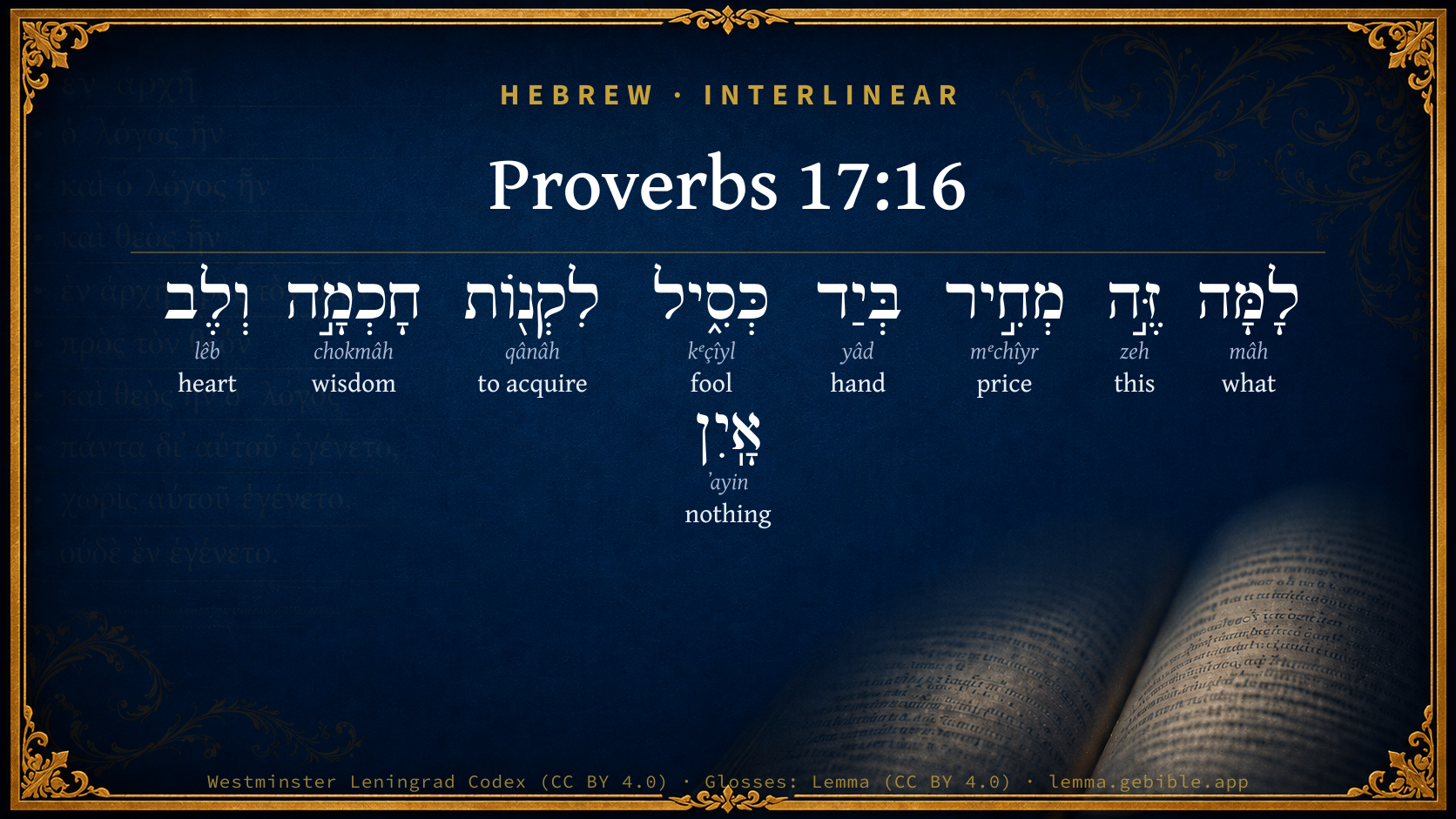
Proverbs 17:16

Hebrew (Westminster Leningrad Codex) Proverbs 17:16 appears in the Hebrew Old Testament. The text above is from the Westminster Leningrad Codex. Each word links to its Strong’s number, a concise gloss, and parsing drawn from the Open Scriptures Hebrew Bible morphology. Click any word for its full Brown-Driver-Briggs (BDB) entry.
Download image
Cite this verse

Proverbs 17:16 (World English Bible). Public Domain. Lemma interlinear Bible study tool, https://lemma.gebible.app/v/proverbs/17/16.

Show BibTeX & RIS
BibTeX
RIS
English Translation
Why is there money in the hand of a fool to buy wisdom, Seeing he has no understanding?
World English Bible · Public Domain
Download a study sheet

One document with this verse’s original text, its word-by-word gloss line, the meaning frame, cross-references with their text, attributed commentary, and full source and license credits — printable, and it pastes into notes with its structure intact.

This verse Autodidact and up

Study sheet (.html) Plain text (.txt)

A passage Seminary Student

Up to 50 verses in one chapter. A passage sheet keeps up to 6 commentary sources and 12 cross-references per verse, in the order this page ranks them, and says so on the sheet whenever that leaves anything out. Ask for a single verse and you get the Autodidact verse sheet above.

Everything on this page stays free to read, with no account — the sheet is a download of what is already on screen, not access to it.

Want to remove ads? Support Godless Engineer
Compare translations 3

The same verse in 3 English versions, stacked beneath the original-language interlinear above. Click any original word for its lexicon entry.

Each is an independent rendering of the whole verse — the interlinear is not word-aligned to these translations.

Highlighted words mark where these versions differ — a whole-verse word diff, not a word-by-word alignment.

  • World English Bible Public Domain
    Why is there money in the hand of a fool to buy wisdom, Seeing he has no understanding?
  • King James Version Public Domain
    Wherefore is there a price in the hand of a fool to get wisdom, seeing he hath no heart to it?
  • unfoldingWord Literal Text CC BY-SA 4.0
    Why this: A payment in the hand of a stupid one to acquire wisdom, but there is no heart?

unfoldingWord Literal Text — © unfoldingWord, licensed CC BY-SA 4.0. Word-aligned USFM3 via Door43 (git.door43.org/unfoldingWord/en_ult).

Versions to compare (up to 4)

3 of 4 selected

Show all 18 translations

Every available English version of this verse, each an independent rendering of the whole verse.

  • World English Bible Public Domain
    Why is there money in the hand of a fool to buy wisdom, Seeing he has no understanding?
  • Berean Standard Bible Public Domain
    Why should the fool have money in his hand with no intention of buying wisdom?
  • Majority Standard Bible Public Domain
    Why should the fool have money in his hand with no intention of buying wisdom?
  • King James Version Public Domain
    Wherefore is there a price in the hand of a fool to get wisdom, seeing he hath no heart to it?
  • American Standard Version (1901) Public Domain
    Wherefore is there a price in the hand of a fool to buy wisdom, Seeing he hath no understanding?
  • Revised Version (1885) Public Domain
    Wherefore is there a price in the hand of a fool to buy wisdom, seeing he hath no understanding?
  • Geneva Bible (1599) Public Domain
    Wherefore is there a price in the hand of the foole to get wisdome, and he hath none heart?
  • Douay-Rheims (1899) Public Domain
    What doth it avail a fool to have riches, seeing he cannot buy wisdom? He that maketh his house high, seeketh a downfall: and he that refuseth to learn, shall fall into evils.
  • Young's Literal Translation Public Domain
    Why `is' this -- a price in the hand of a fool to buy wisdom, And a heart there is none?
  • Literal Standard Version CC BY-SA 4.0
    Why [is] this—a price in the hand of a fool to buy wisdom, || And a heart—there is none?
  • Unlocked Literal Bible CC BY-SA 4.0
    Why should a fool pay money to learn about wisdom, when he has no ability to learn it?
  • unfoldingWord Literal Text CC BY-SA 4.0
    Why this: A payment in the hand of a stupid one to acquire wisdom, but there is no heart?
  • Darby Bible Public Domain
    To what purpose is there a price in the hand of a fool to get wisdom, seeing [he] hath no sense?
  • World Messianic Bible Public Domain
    Why is there money in the hand of a fool to buy wisdom, since he has no understanding?
  • Webster's Bible Public Domain
    Why is there a price in the hand of a fool to get wisdom, seeing he hath no heart to it?
  • Free Bible Version CC BY-SA 4.0
    Is there any point in stupid people trying to buy wisdom when they don't want to learn?
  • Bible in Basic English Public Domain
    How will money in the hand of the foolish get him wisdom, seeing that he has no sense?
  • JPS Tanakh (1917) Public Domain
    Wherefore is there a price in the hand of a fool to buy wisdom, seeing he hath no understanding?

Literal Standard Version (2020), Covenant Press — licensed CC BY-SA 4.0. Text via the HelloAO Bible API (eBible.org). Unlocked Literal Bible (unfoldingWord) — licensed CC BY-SA 4.0. Text via the HelloAO Bible API (eBible.org). unfoldingWord Literal Text — © unfoldingWord, licensed CC BY-SA 4.0. Word-aligned USFM3 via Door43 (git.door43.org/unfoldingWord/en_ult). Free Bible Version, Dr. Jonathan Gallagher — licensed CC BY-SA 4.0. Text via the HelloAO Bible API (eBible.org).

Word by word

More ways to search: Search by grammar → Find every occurrence → Compare this word →

Practice this passage: Drill this verse → Learn its vocabulary →

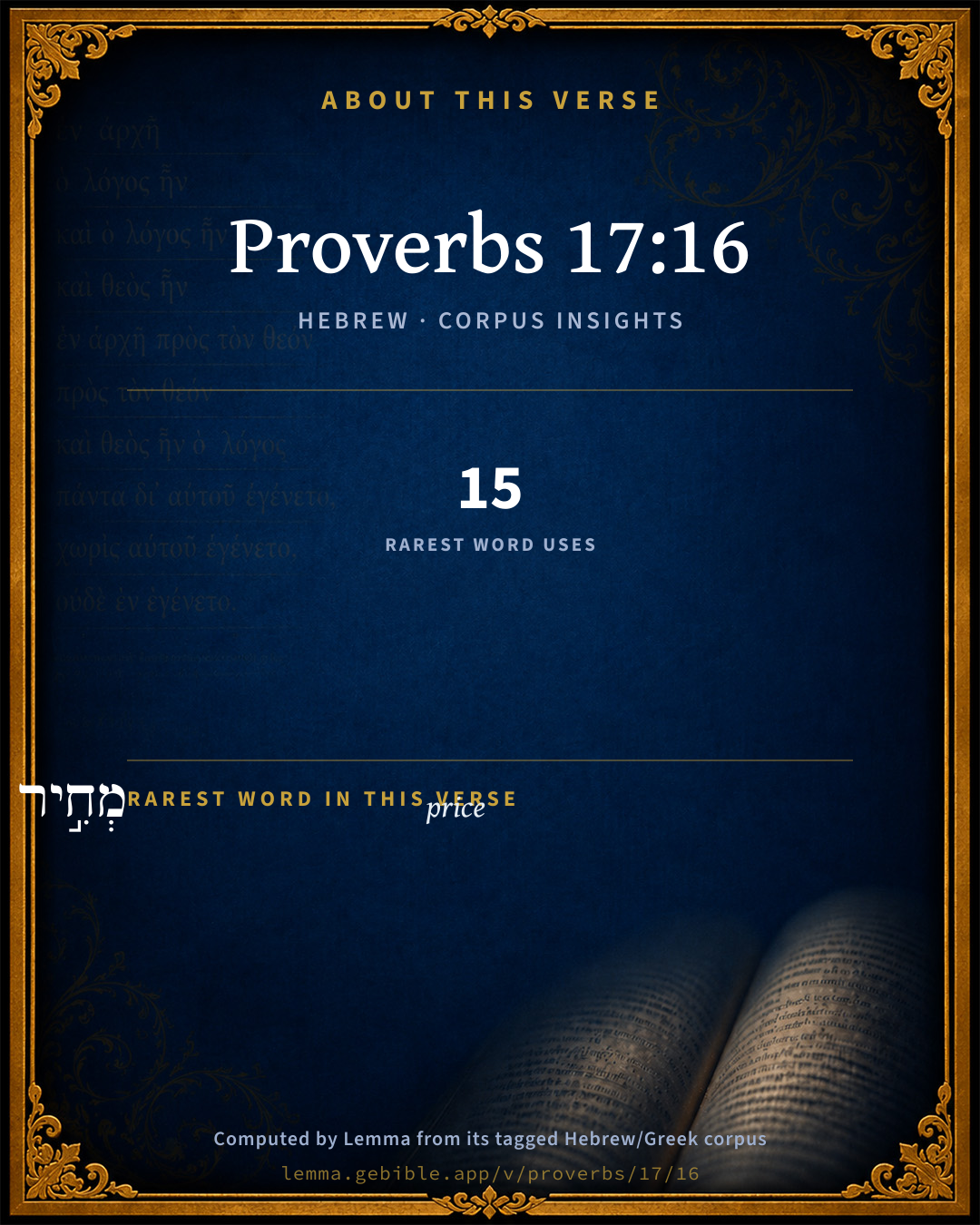
About this verse

These counts appear in no published source. They are computed here, from the morphology-tagged text and Lemma’s own curated glosses. What Lemma adds →

9
words
9
distinct lemmas
Wisdom
section

Notable vocabulary

The rarest word here is מְחִ֣יר price H4242 — appearing just 15 times in the whole Hebrew Bible.

Shared distinctive vocabulary

מְחִ֣יר price H4242 occurs in 15 verses of the Hebrew Bible. Also found in:

Grammatical profile

  • 1 verb
  • 4 nouns
  • 1 adjective
  • 1 pronoun
  • 2 particles

Verb forms

  • לִקְנ֖וֹת Qal · Infinitive Construct

Hebrew & Septuagint length

In English translation the verse runs 18 words from the Hebrew and 35 from the Septuagint (LXX English) — the Septuagint runs noticeably longer here. See the side-by-side →

A rough comparison of the two English renderings, which tokenize alike — not a word-level alignment.

Word counts can differ between the Hebrew and the Greek without any difference in meaning — e.g. the Hebrew direct-object marker אֵת has no separate Greek word, and Greek often adds the article ὁ.

Cross-references

15

Topical passages linked to Proverbs 17:16 in the Treasury of Scripture Knowledge — connected by theme and wording, ordered by reader-vote popularity; previews shown in the World English Bible.

  • Proverbs 21:25–26 The desire of the sluggard kills him, For his hands refuse to labor.
  • Proverbs 23:23 Buy the truth, and don't sell it: Get wisdom, discipline, and understanding.
  • Deuteronomy 5:29 Oh that there were such a heart in them, that they would fear me, and keep all my commandments always, that it might be well with them, and with their children forever!
  • Proverbs 8:4–5 "To you men, I call! I send my voice to the sons of mankind.
  • Proverbs 18:15 The heart of the discerning gets knowledge. The ear of the wise seeks knowledge.
  • Acts 28:26–27 saying, 'Go to this people, and say, In hearing, you will hear, But will in no way understand. In seeing, you will see, But will in no way perceive.
  • 2 Corinthians 6:1 Working together, we entreat also that you not receive the grace of God in vain,
  • Psalms 81:11–13 But my people didn't listen to my voice. Israel desired none of me.
  • Proverbs 1:22–23 "How long, you simple ones, will you love simplicity? How long will mockers delight themselves in mockery, And fools hate knowledge?
  • Proverbs 9:4–6 "Whoever is simple, let him turn in here!" As for him who is void of understanding, she says to him,
  • Proverbs 14:6 A scoffer seeks wisdom, and doesn't find it, But knowledge comes easily to a discerning person.
  • Isaiah 55:1–3 Ho, everyone who thirsts, come you to the waters, and he who has no money; come you, buy, and eat; yes, come, buy wine and milk without money and without price.
  • Hosea 4:11 Prostitution, wine, and new wine take away understanding.
  • John 3:20 For everyone who does evil hates the light, and doesn't come to the light, lest his works would be exposed.
  • Acts 13:46 Paul and Barnabas spoke out boldly, and said, "It was necessary that God's word should be spoken to you first. Since indeed you thrust it from you, and judge yourselves unworthy of eternal life, behold, we turn to the Gentiles.

Cross-references courtesy of OpenBible.info (CC BY 4.0).

Hebrew and Greek witnesses Masoretic Hebrew ↔ Greek Septuagint

The same verse in the two great witnesses to the Old Testament, shown verse-for-verse.

Here the Septuagint runs noticeably longer than the Hebrew — LXX2012 (modern English Septuagint) 35 words vs World English Bible 18. A rough length comparison of the two English translations, not a word-level alignment — read both below.

These are two independent witnesses, not word-aligned to each other, and the Septuagint is shown in lemma (dictionary) form.

Hebrew Proverbs 17:16 Masoretic · Westminster Leningrad Codex

לָמָּה זֶּ֣ה מְחִ֣יר בְּיַד כְּסִ֑יל לִקְנ֖וֹת חָכְמָ֣ה וְלֶב אָֽיִן

Why is there money in the hand of a fool to buy wisdom, Seeing he has no understanding?

World English Bible · Public Domain

Greek LXX Proverbs 17:16 Septuagint · lemma form

ἵνα τίς ὑποἄρχω χρῆμα ἄφρων κτάομαι γάρ σοφία ἀκάρδιος οὐ δύναμαι ὅς ὑψηλός ποιέω ὁ ἑαυτοῦ οἶκος ζητέω συντριβή ὁ δέ σκολιάζω ὁ μανθάνω ἐνπίπτω εἰς κακός

Why has the fool wealth? for a senseless man will not be able to purchase wisdom. He that exalts his own house seeks ruin; and he that turns aside from instruction shall fall into mischief.

LXX2012 (modern English Septuagint) · Public Domain

On this verse, Keil & Delitzsch discusses the Septuagint’s reading. Read the note in Commentary ↓

Hebrew: Westminster Leningrad Codex (CC BY 4.0). Greek: Septuagint (public domain); English from LXX2012 (modern English Septuagint) (Public Domain). How the Septuagint differs from the Hebrew →

Commentary

Notes on Proverbs 17:16 from classic Christian and Jewish commentators (each source and its license shown beneath its notes). The classic Christian expositions comment on the surrounding passage and are grouped to its opening verse, so a note may address several verses; the Jewish commentaries on the Tanakh (Rashi and others) are per-verse, so they appear only where the commentator wrote on this verse.

Lemma curates 59 commentaries, every one of them public domain or Creative Commons licensed, each selected and text-cleaned for this edition rather than reprinted as found. About our sources →

Trapp's Complete Commentary

John Trapp

Pro 17:16 Wherefore [is there] a price in the hand of a fool to get wisdom, seeing [he hath] no heart [to it]?

Ver. 16. Wherefore is there a price in the hand of a fool? &c.] Wealth without wit is ill bestowed. Think the same of good natural parts, either of body or mind; so for authority, opportunity, and other advantages. Whereto serve they, if not rightly improved and employed? Certainly they will prove no better than Uriah’s letters to those that have them; or as that sword which Hector gave Ajax; which so long as he used against his enemies, served for help and defence, but after he began to abuse it to the harm of harmless beasts, it turned into his own bowels. This will be a bodkin at thy heart one day, ‘I might have been saved, but I woefully let slip those opportunities that God had thrust into my hands, and wilfully cut the throat of mine own poor soul, by an impenitent continuance in sinful courses, against so many dissuasives.’ Oh the spirit of fornication, that hath so besotted the minds of the most, that they have no heart to look after heaven while it is to be had, but trifle and fool away their own salvation!

John Trapp, A Commentary or Exposition upon All the Books of the Old and New Testament (1647–1656) — public domain. Text from a community e-Sword module.

The Biblical Illustrator

Joseph S. Exell

Pro_17:16

Wherefore is there a price in the hand of fool to get wisdom, seeing he hath no heart to it?

Opportunities of youth

The term fool is not used in the modern sense of a man without reason; but rather in the sense of an unreasoning man. The term is applied much as we apply the term wicked man. The figure in the text is one drawn from commerce. It represents a man who has been given a sum which he is to invest. He spends part of it in dissipation, part in unwise and unprofitable commodities, and some part in shadows and cheats and pretences; and when he has expended that sum he is a bankrupt. Wicked or foolish men have committed to them a price or a capital, and what is the use if they have no heart to use it right? What good does it do them if they do not employ it as they should? The idea that men are sent into this world for a purpose, and that they are equipped for the accomplishment of that purpose, is given in both the Testaments. Men comprehensively have committed to them, in bodily organs, and in their mental equipment, a power singularly complex, but wise and efficient, and as compared with the agencies of nature in its adaptations to the work of life, surpassing the human frame itself. Natural laws are the great agencies of nature that are being used or fructified by the volition of man. Each man stands at the centre of a sphere of possibilities where he, through knowledge, may come to control natural law and work in his limited sphere as God works in the infinite sphere. Then there is the good name and fame which descends to many of us from our parents. There is a presumption that stock and blood will tell, and that a good father will have good children. It is invaluable to a young man beginning life to have the kindly expectation, the generous sympathy and goodwill of those to whom he comes. What a price is put into the hands of the young in our time in the matter of education; if a man has a heart for knowledge, if he has an ambition to acquire it, and if he is quick to discern, the eye, the ear, every sense becomes the minister of education. Alas! that there should be so many who care nothing for it! Closely connected with this is the capital of bodily health. Good health is a wonderful help to morality, to nobility of character, and to calmness and decision of judgment and action. Next is the capacity of industry. I believe fervently in enterprise, but I also believe fervently in the good old-fashioned notions about patient industry. Every person has that in him by which he can win a moderate success in life by simply doing, day by day, the right things, however humble a sphere he may be in. To many have also been given the invaluable qualities of integrity, honour, and fidelity. These are very valuable from a commercial point of view. A man who is honest, and truthful, and full of integrity, when he has finally been proved, has everybody engineering for him. Then look upon life as a very solemn thing. God has given you one life, and has put capital into your hands, and sent you into this world to buy immortality. Do not squander that price. Listen to the voice of wisdom. (H. Ward Beecher.)

Means and abilities to get wisdom

We may define wisdom to be a right apprehension of those things that are best for us, and a diligent pursuit of them by such means as are agreeable to the laws of piety and virtue. Men have sometimes abilities and opportunities to act wisely for themselves, but neglect them, and have no heart to make their just advantages of them.

1. A man of good natural faculties and endowments of mind may be said to have the price of wisdom in his hand, when he hath no heart to it.

2. This price may be understood of the schools of good education and learning. Those who are brought up in such places often act the part of fools.

3. Riches are in many respects the price of wisdom, in that they enable their owners to buy books, to hire teachers, and to be at leisure to spend their time in the study of useful learning.

4. Men of great power and authority have the price of wisdom in their hands.

5. We have a noble price put into our hands to get wisdom, in the ordinances of religion and means of grace we enjoy. These advantages are the portion of every Christian. But these opportunities are sadly often in the hands of those who have no heart to make use of them. This appears--

(1) From the want of zeal in attending public worship; and--

(2) From the errors and vices of our common conversation.

We often condemn our own mismanagement of the talents which God has given us, and look back with much regret upon those opportunities which have slipped through our hands. But the power is often given without the will, so that we suffer many opportunities to pass away and be lost without improving them to any good purpose. (W. Reading, M. A.)

The Biblical Illustrator, edited by Joseph S. Exell (c. 1880s–1900s) — public domain. Text from a community e-Sword module.

Joseph Benson's Commentary

Pro 17:16. Wherefore is there a price in the hand of a fool, &c. — The Hebrew is literally, Wherefore is this? A price in the hand of a fool to procure wisdom, and not a heart? The question implies, that the price is unworthily placed, and that it is to no purpose, or benefit of the possessor. All the ancient translators interpret the word מחיר, here rendered price, of possessions, or riches, of which the same word is used Isa 55:1, and elsewhere. It comprehends all opportunities and abilities of getting wisdom; seeing he hath no heart to it — Neither discretion to discern the worth of it, nor any sincere desire to get it. Observe, reader, this price, these abilities and opportunities to gain wisdom, are put into all our hands; we have rational souls, the means of grace, the aids of the Holy Spirit, liberty of access to God by prayer, time and opportunity, perhaps also we have good parents, relations, friends, ministers, books to assist us. A sufficient price, therefore, is put into our hands, wherewith to procure wisdom, a talent, or talents rather, of inestimable value; and surely we shall be inexcusable, and cannot escape condemnation and wrath, if we die without it.

Joseph Benson's Commentary on the Old and New Testaments (1811–1818) — public domain. Text from a community e-Sword module.

The Preacher's Complete Homiletical Commentary

Joseph S. Exell (gen. ed.)

MAIN HOMILETICS OF Pro_17:16

NEGLECTED OPPORTUNITIES

I. One of the uses which ought to be made of wealth. Men ought to use it to “get wisdom.” It is obvious that a wealthy man has more opportunities of gaining knowledge than a poor man has, and an increase of knowledge ought to make a man wiser. A rich man’s wealth gives him access to the wisdom of the great minds of past ages, and it often obtains for him the companionship of the most learned men of his own generation. It enables him to gain a knowledge of the world on which he lives and of the men who people it; by travel he can stand face to face with all the glorious works of God in nature, and he can mingle with men of various races and see human nature in all its various phases. And these experiences ought to make him a wise man. Wealth is given to men for this purpose, among others, to make them intellectually and morally better—for although spiritual blessings cannot be purchased for money, yet where the grace of God is in the heart, the “price in the hand” will increase a man’s opportunities of growing in the knowledge of God and in the practice of godliness. Those who are “rich in this world” may and ought to lay “up in store for themselves a good foundation against the time to come, that they may lay hold on eternal life” (1Ti_1:17-19). Their wealth ought not to be a hindrance but a help to high spiritual attainments. When we use bread rightly we get strength out of it; when we use water rightly we get refreshment out of it; when we use light rightly we get guidance out of it; and when the gift of wealth is rightly used, men get wisdom out of it.

II. Wealth bestowed, where we can give no reason for its bestowal. Wealth in the hand of a fool seems thrown away. If we saw a bundle of bank-notes in the hands of an infant we should at once say they were in the wrong hand; but many a princely fortune is at the disposal of men who are as incapable now of putting it to a good use, as they were when they were children. Neither the head nor the heart are capable of guiding the hand—there is neither moral nor intellectual capability to make the riches the means of blessing even the possessor. “Wherefore,” then, “is there a price in the hand of a fool to get wisdom,” especially when there are so many men in poverty who would make the best possible use of riches? We cannot answer the question. Even the wise man does not attempt to solve the problem. Men daily come face to face with facts connected with human existence which they cannot explain. In some of these they can see adaptation; although they cannot tell how it is that the thing is so, they can discern a fitness in its being so. But there are other facts in the government of God for which we can assign no reason, and the “price in the hand of a fool” is one of them. The Divine Ruler of men’s destinies fulfils His wise purposes in ways and by means which often perplex His finite creatures.”

OUTLINES AND SUGGESTIVE COMMENTS

We understand the term “a price,” as signifying whatever puts it in anyone’s power to acquire the particular object. The phraseology is borrowed from the market. Any article, we are wont to say, may be had there, if a man has but the price to pay for it. What the “price” is to the article wanted, the means of acquiring are to “wisdom.” When we wish to put any article of ordinary merchandise within a person’s power, we furnish that person with the price at which it is valued. There are cases, however, in which this may not be enough. The price may be in a man’s hand, and yet the article may not be within his reach, not, at the time, to be had. Happily, it is never so with the wisdom here spoken of. If the means are possessed of acquiring it, it may always be acquired. It is in the hand of God himself; and He is never either at a distance that we cannot repair to Him, or unwilling to bestow it upon us when we come to Him for it—bestow it, I say, for we must remember, with regard to divine wisdom, that, in a literal sense, it cannot be purchased. It must be had “without money and without price.” It is not to be “gotten for gold.” Why is it, then, that in so many cases in which “the price is in the hand to get wisdom,” the means of securing it possessed, its lessons remained unlearned, the mind ignorant, the heart unimproved?… Here is the answer—the only one that can with truth be given,—there has been “no heart to it.” The principle is of wide application, and might be largely illustrated … There is no maxim more thoroughly established by experience, than that a man cannot excel in anything to which his heart does not lie. When do men succeed best in the pursuit of any object? Is it not when they have a heart to it? What is it that keeps all men astir in the pursuit and acquisition of wealth? Is it not that they have a heart to it? How do men acquire celebrity in any of the departments of science or of art? Is it not when they have a heart to it?—some measure of enthusiastic eagerness and persevering delight in the pursuit?… I put it to your consciences,—whether there be anything else whatever, that keeps you from the knowledge and the fear of God, wherein true religion consists, than your having no heart to them? Talk not to me of inability:—your inability is entirely moral, and consists in nothing else whatever than your “having no heart” to that which is good. And is this not criminal? If not, then there is no sin nor crime on earth, in hell, in the universe; nor is the existence or the conception of such a thing as moral evil possible. The want of heart to that which is good, is the very essence of all that is sinful. You offer anything but a valid excuse for your want of religion, when you say you “have no heart to it.” You plead in excuse the very essence of your guilt. If you desired to fear God, and could not help the contrary, your inability might be something in your behalf. But the thing cannot be. To desire to fear God, and not to be able, is a contradiction in terms. The having of the desire is the having of the principle. There can be no desiring to fear without fearing, no desiring to love without loving.—Wardlaw.

No means can make a man wise who wanteth a good will to learn heavenly wisdom. Ishmael had good education, and Ahithophel had quick capacity, and the fool spoken of in the Gospel had great wealth, and none of all these attained to any grace. One of them was strong, and another witty, and another wealthy, but never a one wise and godly. Judas had as good a teacher as Peter, or any other apostle, and had as good company, and saw as many miracles; and yet they having good hearts became worthy and excellent persons, and he having a false heart became a traitor and a devil.—Dod.

Wherefore serve good natural parts, either of body or mind; or authority, opportunity, or other advantages, if they be not rightly improved and employed? Certainly they will prove no better than Uriah’s letters to those that have them; or as the sword which Hector gave to Ajax, which, so long as he used it against his enemies, served for help and defence, but after he began to abuse it, turned into his own bowels. This will be a bodkin at thy heart one day: “I might have been saved, but I woefully let slip those opportunities which God had thrust into my hand.” Trapp.

The Preacher's Complete Homiletical Commentary (gen. ed. Joseph S. Exell; Funk & Wagnalls, c. 1892) — public domain (pre-1929). A full-Bible homiletical/sermon-outline anthology covering 65 of 66 books (2 John is absent from the source module). Text from a community e-Sword module.

Keil & Delitzsch

C. F. Keil & F. Delitzsch

We take Pro 17:16-21 together. This group beings with a proverb of the heartless, and ends with one of the perverse-hearted; and between these there are not wanting noticeable points of contact between the proverbs that follow one another.

Pro 17:16

16 Why the ready money in the hand of the fool;

To get wisdom when he has yet no heart?

The question is made pointed by זה, thus not: why the ready money when...? Is it to obtain wisdom? - the whole is but one question, the reason of which is founded in לבו אין (thus to be accented with Mugrash going before).

(Note: If we write ולב־ with Makkeph, then we have to accentuate לקנות חכמה with Tarcha Munach, because the Silluk word in this writing has not two syllables before the tone. This sequence of accents if found in the Codd. Ven. 1521, 1615, Basel 1619, while most editions have לקנות חכמה ולב־אין, which is false. But according to MSS we have ולב without Makkeph, and that is right according to the Makkeph rules of the metrical Accentuationssystem; vid., Torath Emeth, p. 40.)

The fool, perhaps, even makes some endeavours, for he goes to the school of the wise, to follow out their admonitions, קנה חכמה (Pro 4:5, etc.), and it costs him something (Pro 4:7), but all to no purpose, for he has no heart. By this it is not meant that knowledge, for which he pays his honorarium, remains, it may be, in his head, but goes not to his heart, and thus becomes an unfruitful theory; but the heart is equivalent to the understanding, in the sense in which the heart appears as the previous condition to the attainment of wisdom (Pro 18:15), and as something to be gained before all (Pro 15:32), viz., understanding, as the fitting intellectual and practical habitus to the reception, the appropriation, and realization of wisdom, the ability rightly to comprehend the fulness of the communicated knowledge, and to adopt it as an independent possession, that which the Greek called νοῦς, as in that "golden proverb" of Democrates: πολλοὶ πολυμαθέες νοῦν οὐκ ἔχουσι, or as in Luk 24:25, where it is said that the Lord opened τὸν νοῦν of His disciples to understand the Scriptures. In the lxx a distich follows Pro 17:16, which is made up of 19b and 20b, and contains a varied translation of these two lines.

Pro 17:17

17 At all times the right friend shows himself loving;

And as a brother is he born for adversity.

Brother is more than friend, he stands to one nearer than a friend does, Psa 35:14; but the relation of a friend may deepen itself into a spiritual, moral brotherhood, Psa 18:24, and there is no name of friend that sounds dearer than אחי, Sa2 1:26. 17a and 17b are, according to this, related to each other climactically. The friend meant in 17a is a true friend. Of no other is it said that he loves בּכל־עת, i.e., makes his love manifest; and also the article in הרע not only here gives to the word more body, but stamps it as an ideal-word: the friend who corresponds to the idea of such an one.

(Note: The Arab. grammarians say that the article in this case stands, l'astfrâgh khsânas âljnas, as an exhaustive expression of all essential properties of the genus, i.e., to express the full ideal realization of the idea in that which is named.)

The inf. of the Hiph., in the sense "to associate" (Ewald), cannot therefore be הרע, because רע is not derived from רעע, but from רעה. Thus there exists no contrast between 17a and 17b, so that the love of a friend is thought of, in contradistinction to that of a brother, as without permanency (Fl.); but 17b means that the true friend shows himself in the time of need, and that thus the friendship becomes closer, like that between brothers. The statements do not refer to two kinds of friends; this is seen from the circumstance that אח has not the article, as הרע has. It is not the subj. but pred., as אדם, Job 11:12 : sooner is a wild ass born or born again as a man. The meaning of הוּלד there, as at Psa 87:5., borders on the notion of regenerari; here the idea is not essentially much less, for by the saying that the friend is born in the time of need, as a brother, is meant that he then for the first time shows himself as a friend, he receives the right status or baptism of such an one, and is, as it were, born into personal brotherly relationship to the sorely-tried friend. The translation comprobatur (Jerome) and erfunden [is found out] (Luther) obliterates the peculiar and thus intentional expression, for נולד is not at all a metaphor used for passing into the light - the two passages in Proverbs and in Job have not their parallel. לצרה is not equivalent to בּצרה (cf. Psa 9:10; Psa 10:1), for the interchange of the prep. in 17a and 17b would then be without any apparent reason. But Hitzig's translation also: as a brother he is born of adversity, is impossible, for ל after נודל and ילּד always designates that for which the birth is an advantage, not that from which it proceeds. Thus ל will be that of the purpose: for the purpose of the need, - not indeed to suffer (Job 5:7) on account of it, but to bear it in sympathy, and to help to bear it. Rightly Fleischer: frater autem ad aerumnam (sc. levandam et removendam) nascitur. The lxx gives this sense to the ל: ἀδελφοὶ δὲ ἐν ἀνάγκαις χρήσιμοι ἔστωσαν, τοῦτο γὰρ χάριν γεννῶνται.

Pro 17:18

18 A man void of understanding is he who striketh hands,

Who becometh surety with his neighbour.

Cf. Pro 6:1-5, where the warning against suretyship is given at large, and the reasons for it are adduced. It is incorrect to translate (Gesen., Hitzig, and others) לפני רעהוּ, with the lxx, Jerome, the Syr., Targ., and Luther, "for his neighbour;" to become surety for any one is ערב ל, Pro 6:1, or, with the object. accus. Pro 11:15, another suitable prep. is בּעד; but לפני never means pro (ὑπέρ), for at Sa1 1:16 it means "to the person," and Sa2 3:31, "before Abner's corpse (bier)." רעהוּ is thus here the person with whom the suretyship is entered into; he can be called the רע of him who gives bail, so much the more as the reception of the bail supposes that both are well known to each other. Here also Fleischer rightly translates: apud alterum (sc. creditorem pro debitore).

Pro 17:19

19 He loveth sin who loveth strife;

He who maketh high his doors seeketh destruction.

A synthetic distich. Bttcher finds the reason of the pairing of these two lines in the relationship between a mouth and a door (cf. Mic 7:6, פּתחי פיך). Hitzig goes further, and supposes that 19b figuratively expresses what boastfulness brings upon itself. Against Geier, Schultens, and others, who understand פּתחו directly of the mouth, he rightly remarks that הגדּיל פה is not heard of, and that הגדּיל פה taht dn would be used instead. But the two lines harmonize, without this interchangeable reference of os and ostium. Zanksucht [quarrelsomeness] and Prunksucht [ostentation] are related as the symptoms of selfishness. But both bear their sentence in themselves. He who has pleasure in quarrelling has pleasure in evil, for he commits himself to the way of great sinning, and draws others along with him; and he who cannot have the door of his house high enough and splendid enough, prepares thereby for himself, against his will, the destruction of his house. An old Hebrew proverb says, כל העוסק בבנין יתמסכן, aedificandi nimis studiosus ad mendicitatem redigitur. Both parts of this verse refer to one and the same individual, for the insanum aedificandi studium goes only too often hand in hand with unjust and heartless litigation.

Pro 17:20

20 He that is of a false heart findeth no good;

And he that goeth astray with his tongue falleth into evil.

Regarding עקּשׁ־לב, vid., Pro 11:20. In the parallel member, נהפּך בּלשׁונו is he who twists or winds (vid., at Pro 2:12) with his tongue, going about concealing and falsifying the truth. The phrase ונהפּך (the connecting form before a word with a prep.) is syntactically possible, but the Masora designates the word, in contradistinction to ונהפּך, pointed with Pathach, Lev 13:16, with לית as unicum, thus requires ונהפּך, as is also found in Codd. The contrast of רעה is here טוב, also neut., as Pro 13:21, cf. Pro 16:20, and רע, Pro 13:17.

Pro 17:21

The first three parts of the old Solomonic Book of Proverbs ((1) Prov 10-12; (2) 13:1-15:19; (3) 15:20-17:20) are now followed by the fourth part. We recognise it as striking the same keynote as Pro 10:1. In Pro 17:21 it resounds once more, here commencing a part; there, Pro 10:1, beginning the second group of proverbs. The first closes, as it begins, with a proverb of the fool.

21 He that begetteth a fool, it is to his sorrow;

And the father of a fool hath no joy.

It is admissible to supply ילדו, developing itself from ילד, before לתוּגה לו (vid., regarding this passive formation, at Pro 10:1, cf. Pro 14:13), as at Isa 66:3, מעלה (Fl.: in maerorem sibi genuit h. e. ideo videtur genuisse ut sibi maerorem crearet); but not less admissible is it to interpret לתוגה לו as a noun-clause corresponding to the ולא־ישׂמח (thus to be written with Makkeph): it brings grief to him. According as one understands this as an expectation, or as a consequence, ילד, as at Pro 23:24, is rendered either qui gignit or qui genuit. With נבל, seldom occurring in the Book of Proverbs (only here and at Pro 17:7), כּסיל, occurring not unfrequently, is interchanged. Schultens rightly defines the latter etymologically: marcidus h. e. qui ad virtutem, pietatem, vigorem omnem vitae spiritualis medullitus emarcuit; and the former: elumbis et mollitie segnitieve fractus, the intellectually heavy and sluggish (cf. Arab. kasal, laziness; kaslân, the lazy).

(Note: Nldeke's assertion (Art. Orion in Schenkel's Bibel-Lexicon) that the Arab. kasal corresponds to the Hebr. כּשׁל proceeds from the twofold supposition, that the meaning to be lazy underlies the meaning to totter (vid., also Dietrich in Gesenius' Heb. Wrterbuch), and that the Hebr. ס must correspond with the Arab. š. The former supposition is untenable, the latter is far removed (cf. e.g., כּסּא and kursı̂, ספר and sifr, מסכּן and miskı̂n). The verb כּשׁל, Aram. תּקל, is unknown in the Arab.)

Keil & Delitzsch — Biblical Commentary on the Old Testament (1861–1891) — public domain (CC PDM 1.0). Text via the HelloAO Bible API. (Old Testament only.)

Geneva Bible (1599)

Geneva Bible translators

What availeth it the wicked to be rich, seeing he setteth not his mind to wisdom?

Geneva Bible (1599) marginal notes — public domain. Text via Bolls.life.

Matthew Henry's Commentary

Two things are here spoken of with astonishment: - 1. God's great goodness to foolish man, in putting a price into his hand to get wisdom, to get knowledge and grace to fit him for both worlds. We have rational souls, the means of grace, the strivings of the Spirit, access to God by prayer; we have time and opportunity. He that has a good estate (so some understand it) has advantages thereby of getting wisdom by purchasing instruction. Good parents, relations, ministers, friends, are helps to get wisdom. It is a price, therefore of value, a talent. It is a price in the hand, in possession; the word is nigh thee. It is a price for getting; it is for our own advantage; it is for getting wisdom, the very thing which, being fools, we have most need of. We have reason to wonder that God should so consider our necessity, and should entrust us with such advantages, though he foresaw we should not make a right improvement of them. 2. Man's great wickedness, his neglect of God's favour and his own interest, which is very absurd and unaccountable: He has no heart to it, not to the wisdom that is to be got, nor to the price in the use of which it may be got. He has no heart, no skill, nor will, nor courage, to improve his advantages. He has set his heart upon other things, so that he has no heart to his duty or the great concerns of his soul. Wherefore should a price be thrown away and lost upon one so undeserving of it?

Matthew Henry's Commentary on the Whole Bible (1708–1710) — public domain (CC PDM 1.0). Text via the HelloAO Bible API.

Jamieson, Fausset & Brown

Robert Jamieson, A. R. Fausset & David Brown

Though wealth cannot buy wisdom for those who do not love it, yet wisdom procures wealth (Pro 3:16; Pro 14:24).

Jamieson, Fausset & Brown — Commentary Critical and Explanatory on the Whole Bible (1871) — public domain (CC PDM 1.0). Text via the HelloAO Bible API.

Ellicott's Commentary for English Readers

(16) Wherefore is there a price . . .—He will still remain a fool, though he has paid high for instruction, if he has no capacity for taking it in.

A Bible Commentary for English Readers, edited by Charles John Ellicott (1878–1897) — public domain. Text from a community e-Sword module.

The Cambridge Bible for Schools and Colleges

gen. ed. J. J. S. Perowne

16. heart] i.e. understanding, R.V.; see Pro_15:32, note. We might almost render, capacity. Wisdom cannot be bought for a price: it can only be assimilated by a wise, or wisdom-loving heart. Its words are φωνᾶντα συνετοῖσι; its teachers teach, πνευματικοῖς πνευματικὰ συγκρίνοντες, “interpreting spiritual things to spiritual men” (as some translate 1Co_2:13). So was Incarnate Wisdom wont to cry, “Who hath ears to hear let him hear” (Mat_13:9 ff.; comp. Rev_2:11; Rev_2:17; Rev_2:29; Rev_3:6; Rev_3:13; Rev_3:22).

The Cambridge Bible for Schools and Colleges (gen. ed. J. J. S. Perowne; Cambridge University Press, 1878–1918) — public domain. Text from a community e-Sword module.

John Gill's Exposition

Wherefore is there a price in the hand of a fool to get wisdom,.... Natural wisdom and knowledge. By this "price" may be meant money, riches, worldly substance, of which a foolish man is possessed; by means of which he might purchase useful books for the improvement of his mind, and procure himself instructors that might be very useful to him; but instead of seeking after that which he most wants, and making use of his substance to furnish him with it, he spends it on his back and belly, in fine clothes and luxurious living; in rioting and drunkenness, in chambering and wantonness, at balls and plays, in taverns and brothel houses: or spiritual wisdom and knowledge; the means of which are reading the word, hearing the Gospel, frequent opportunities of attendance on a Gospel ministry, in season and out of season, and conversation with Gospel ministers and other Christians; but, instead of making use of these, he neglects, slights, and despises them. And it is asked, with some degree of indignation and admiration, why or to what purpose a fool is favoured with such means;

seeing he hath no heart to it? to wisdom; he does not desire it, nor to make use of the price or means, in order to obtain it; all is lost upon him; and it is hard to account for it why he should have this price, when he makes such an ill use of it.

John Gill's Exposition of the Whole Bible (1746–1763) — public domain (CC PDM 1.0). Text via the HelloAO Bible API.

Albert Barnes' Notes on the Bible

More literally: Why is there a price in the hand of a fool? Is it to get wisdom when he has no heart for it? No money will avail without the understanding heart.

Albert Barnes' Notes on the Bible (1834–1885) — public domain. Text from a community e-Sword/MySword module.

Haydock's Catholic Bible Commentary

He, &c., is not here in Hebrew, though it be equivalently (ver. 19.) where the Septuagint are silent. (Calmet)

George Leo Haydock (1774–1849), Haydock's Catholic Family Bible and Commentary, 1859 edition — public domain. Excludes Psalms (Douay-Rheims chapter numbering differs from Protestant) and Deuterocanonical books (Catholic canon only).

Matthew Poole's English Annotations

Wherefore? the question implies that it is unworthily placed, and that it is to no purpose or benefit of the possessor.

A price; possessions or riches, as all the ancient translators render it, of which this word is used, Isa 55:1, and elsewhere, under which all opportunities and abilities of getting it are comprehended.

To get wisdom; for the obtaining whereof rich men have many and great advantages above others.

No heart to it; neither common discretion to discern the worth of wisdom, and his advantage to get it; nor any sincere desire to get it; for the heart is commonly used in Scripture both for the understanding, and for the will and affections.

Matthew Poole's English Annotations on the Holy Bible (1683–1685) — public domain. Text from a community e-Sword/MySword module.

Whedon's Commentary on the Bible

Daniel D. Whedon

16. A price, etc. — The ancient interpreters understood מחיר, (mehhir,) price, in the sense of wealth, estate. Taken in this sense the proverb might be translated: “Why is this? an estate in the hands of a fool, to acquire wisdom! and he no heart!”

Heart — Possibly in the sense of taste or capacity. It sometimes happens that men of no intellectual culture or taste become rich, and, having an indefinite notion of the excellence and value of learning as securing respect in society, would be willing to pay a large sum for it if money could buy it. But their age, and previous want of culture, render them incapable of obtaining it. So, also, a man of wealth is willing sometimes to expend large sums on a son or daughter to secure for them the accomplishments of an education, for which they have neither taste nor capacity. Money will not buy brains. There must be “heart” — taste, capacity, application. Comp. Psa_32:9; Jer_5:21.

Daniel D. Whedon (gen. ed.), Commentary on the Old and New Testaments (1874–1909) — public domain. Text from a community e-Sword module.

The Pulpit Commentary

Wherefore is there a price in the hand of a fool to get wisdom? A fool thinks that there is a royal road to wisdom, and that it, like other things, is to be purchased with reentry. Vulgate, Quid prodest stulto habere divitias, cum sapientiam emere non possit? The rabbis in later time were not allowed to take fees for teaching; but it was customary to make offerings to seers and wise men, when their services were engaged or their advice was asked. (see the case of Saul and Samuel, 1Sa_9:7, 1Sa_9:8) The last clause gives the reason why it is useless for a fool to try to learn wisdom even at a large expenditure on teachers. Seeing he hath no heart to it; i.e. no capability for receiving it; his mental digestion cannot assimilate it. The heart, as we have already noticed, is regarded as the seat of the understanding. Thus the LXX, "Why doth a fool have wealth? for a man without heart cannot acquire wisdom." In the Gospel Christ calls his disciples "fools and slow of heart to believe what the prophets had written, and himself opened their mind (to ), that they might understand the Scriptures". (Luk_24:25, Luk_24:45) The Septuagint and Vulgate here introduce a distich derived from portions of vers. 19, 20, "He who raises his house high seeketh destruction; and he who perversely declineth from learning (o de skoliazwn tou mayein ) shall fall into evils.

Vers. 16, 24. Use and neglect.

"There is everything in use," we say. And certainly a man"s position at any time depends far less upon his bestowments and advantages than upon the use he has made of them. The wise man, in these verses, laments the fact that the price of wisdom should so often be in the hand of a man who fails to turn it to account (ver. 16), and that the foolish man wastes his capacities by directing them to things at a distance instead of giving his attention to that which is within his reach. The facts of human life abundantly justify the lament.

I THE PRESENCE OF OPPORTUNITY. The price of wisdom, and also of worth and of usefulness, is "in our hand." It is not afar off, that we should ask Who will ascend to the height or travel across the sea to find and fetch it? Opportunity is amongst and even "within us." We find it in:

1. Our natural capacities; here represented by the eyes of a man (ver. 24). We have the power of vision, not only bodily, but mental and spiritual. God has given us the faculty of perception, of observation, of intuition; we can see what is before us our interest, our duty, our possibilities.

2. Our various advantages; the education we receive, the friends and kindred who surround us, the literature which is at our command, the resources we inherit, the openings and facilities that are offered us as we move on into life. These are "the price" wherewith we may "buy wisdom" and happiness, usefulness and power. "The gift of God" is a valuable opportunity. (see Joh_4:10)

II OUR FOOLISH AND GUILTY NEGLECT OF IT. Those who have the very fairest chance of attaining to wisdom and usefulness sometimes wantonly throw it away. The foolish boy, at the best school in the land, will refuse to learn, and comes out a dunce. The foolish apprentice, with the best sources of technical or professional knowledge at his command, wastes his hours in frivolity, and when his time is up is utterly unfit for the occupation of his life. Information of what is happening all over the world may now be had for a penny a day, and, what is far more precious, the knowledge of the will of God as revealed in the life and by the lips of Jesus Christ may be had for two pence; but, with "the price of wisdom" at these figures, there are those who know nothing of the hopes or struggles of mankind, and nothing of the way to eternal life. Duty, secular and sacred, is immediately before the eyes of the foolish, but their gaze is fixed upon anything and everything else; they are dreaming, by day and by night, of impossible or of hopelessly improbable fortune, and while they might be patiently and successfully building up a good estate, the chances of life are slipping through their hands. Such neglect of God-given opportunity is:

1. A most serious sin. It is the act of hiding our talent in the earth which calls forth the strong condemnation, "Thou wicked and slothful servant". (Mat_25:24-26)

2. The greatest possible folly. It is a practical renunciation of the fair heritage of life which our heavenly Father offers us; it is the act of flinging the price of wisdom "into the waste.

III OUR WISE USE OF IT. The wise man is he who makes the most and the best he can make of that which is within his reach, that which is "before his face." He does not spend time in looking and longing for that which is "at the ends of the earth;" he sets himself to cultivate the patch of ground, however small and poor, that is just outside his door. He puts out his talents, however mean they may be. He works his capital, however small it may be. He reads well his books, however limited his library may be. He tries to serve others, however narrow his sphere may be. So doing, he is in the way of constant growth and of a large reward. C. (Mat_25:20-24)

The Pulpit Commentary (1880–1919), ed. H.D.M. Spence-Jones & Joseph S. Exell — public domain. Text from a community e-Sword module.

John Wesley's Explanatory Notes

A price - Opportunities and abilities of getting it. No heart - Neither discretion to discern the worth of wisdom, nor any sincere desire to get it.

John Wesley, Explanatory Notes Upon the Whole Bible (1754–1765) — public domain. Text via the GEBible commentary corpus.

Bridges on Proverbs

Charles Bridges

A question of wonder and indignation! We often find this reckless infatuation in temporal things. A young man will spend a large income at the university in the professed purchase of wisdom, and yet idle away all his time! Is not the price manifestly in the hand of a fool, who has no heart to the advantages? The thoughtless rake might be warned even by his worldly friends, involving himself in debt, injuring his constitution, blasting his character. Is not this throwing away a valuable price by reckless folly?

Yet much more affecting is it to see the picture of this folly in religion. Why is a fool so blessed, seeing he hath no heart to improve his blessings? Birth, religious privileges, talents, time, influence, opportunity — all are a price to get wisdom. If the fool throws it away, the account of unprofitableness seals his sentencze. (Mat 25:24-30 .) The grand price of inestimable value is in our hands.†1 Yet how many thousand fools have no heart to buy, would rather lose it, than labour for it; rather go sleeping to hell, than toiling to heaven! The remnant of the ten tribes despised the opportunity put within their reach of coming up to the feast of the LORD.†2 The town where Jesus was brought up,†3 the cities where he wrought his miracles,†4 willfully despised the price of wisdom. The Gadarenes threw away the pearl.†5 Herod eyed it with curiosity;†6 Pilate with indifference;†7 the Jews with scorn.†8 The rich youth preferred his own "goodly pearls" to it.†9 Felix hoped to turn it to his own selfish purpose.†10 Agrippa dared not purchase it.†11 Were not all these pictures of the fool, that every day meets our eye? ’That which "is more precious than rubies" (Pro 3:15 ) is to him more worthless than a pebble. That which "is more sweet than honey," is tasteless as the white of an egg.’†12 He lives for himself, as if there was no God in the world. His heart is given to the world, as if it could be a God to him, or could fill up God’s vacant place in his heart! Yet thus the realities of eternity — the mighty things of the Gospel — things that should drink up our spirits, are like "a tale that is told." Enough that they should have a place in our creed, though never in our hearts. The world is preferred to heaven, time to eternity; and the immortal soul, for which such a cost has been paid, and such prospects prepared, perishes in folly. But lingerers will stop short of heaven. And will it not be a sword in the awakened conscience — ’I might have been enriched, had I not wasted the golden opportunities of salvation, and fooled away the glorious days of the Son of man?’ Yea — will not this be the sting of the never-dying worm — ’Had I come to Christ when I might, I should not have been in this place of torment. I would not come then.†13 I cannot come now’†14 ’Lord, save me’ — cries the pious Howe — ’from trifling with the things of eternity.’†15

But if I have a heart to this wisdom, there can be no doubt the price will get it. I shall find Him whom my soul needeth above all, and desires to love above all; whose lovely names are not empty names, but full of truth. Brother — Husband — Savior — would but the fool ponder, might not the picture attract his heart; as One "able to promote him to honour," to give him an infinite compensation for toil or loss; whose very upbraidings are pity, whose strivings are tenderness; whose rebukes are love, whose smile is heaven.

Footnotes:

†1 Pro 8:4-5; Pro 9:4-6 . Isa 55:1-3 . Rom 10:8 . Rev 3:20 .

†2 2Ch 30:10 .

†3 Luk 4:28.

†4 Mat 11:21.

†5 Mat 8:34.

†6 Luk 23:8. Compare Act 17:21-32 .

†7 Joh 18:38.

†8 Act 13:46.

†9 Mar 10:22.

†10 Act 24:25-27.

†11 Act 26:28.

†12 Lawson.

†13 Mat 23:37. Joh 5:40 .

†14 Mat 25:10. Luk 13:25-28 ; Luk 16:26 .

†15 Works, iii. 130.

Charles Bridges, An Exposition of the Book of Proverbs (1846) — public domain. Text from a community e-Sword module.

Kretzmann's Popular Commentary

Paul E. Kretzmann

v. 16. Wherefore is there a price in the hand of a fool to get wisdom, believing that money will purchase knowledge or earthly gold, understanding, seeing he hath no heart to it? this fact being the real difficulty so far as the fool is concerned and shutting him out from true wisdom.

Paul E. Kretzmann, Popular Commentary of the Bible (1921–1924) — public domain. Text from a community e-Sword module.

Rashi

Rabbi Shlomo Yitzchaki (Rashi)

Why is there a price in the fool’s hand to buy wisdom To learn the Torah.

when the heart is not here In his heart, he has no intention of fulfilling it, and he learns only to gain a reputation.

Rashi on the Tanakh — English translations: “The Judaica Press complete Tanach with Rashi, translated by A. J. Rosenberg” (CC BY 4.0); “Pentateuch with Rashi's commentary by M. Rosenbaum and A.M. Silbermann, 1929-1934” (public domain); “The Metsudah Tanach series, Lakewood, N.J” (CC BY 4.0); and “The Book of Joshua, Metsudah Publications, 1997” (CC BY 4.0). Text via Sefaria.

Lesson kit

Teaching starters — assembled from the data on this page, not authored interpretation. Every prompt links to the verse data it draws on. Edit before teaching.

Proverbs, in the Wisdom, opens this verse with 9 words (9 distinct Hebrew lemmas). Its most distinctive word is mᵉchîyr (“price”). The Greek Septuagint runs longer here. A historical commentator’s framing appears above. Read the whole chapter for the surrounding context.

Discussion questions

  1. What does “price” (mᵉchîyr) contribute to the verse as a whole?
  2. Deuteronomy 23:18 shares the word «price» with this verse. How do the two illuminate each other?
  3. Compared with the Hebrew, the Septuagint runs longer here. What questions does that raise?
  4. These translations render this verse differently. What is at stake in choosing one wording over another?
  5. The verb «לִקְנ֖וֹת» is Qal Infinitive Construct. How does its form color the action?
  6. Reading how Trapp's Complete Commentary and The Biblical Illustrator read this verse, where do the two commentators agree and where do they part?

Things to notice

Reading settings

Reading text

Shown beneath each verse's original-language words.

Old Testament
Old Testament edition

Read the OT as the Masoretic Hebrew (MT) or the Greek Septuagint (LXX).

English shown for the Greek Septuagint (in the Hebrew ↔ Greek comparison).

Comparing translations? Open the Compare panel on any verse page to stack up to four side by side.