
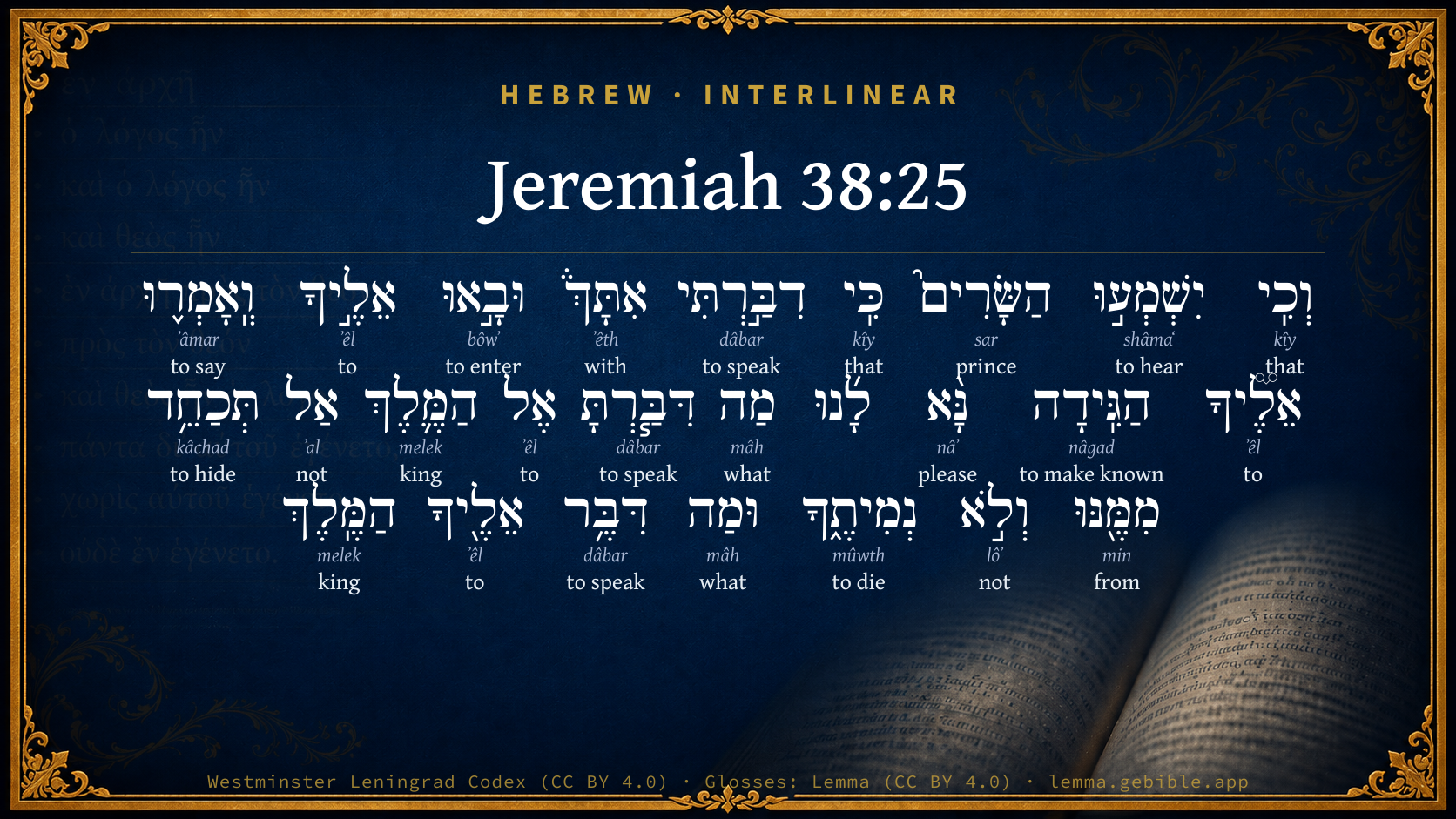
Jeremiah 38:25

Hebrew (Westminster Leningrad Codex) Jeremiah 38:25 appears in the Hebrew Old Testament. The text above is from the Westminster Leningrad Codex. Each word links to its Strong’s number, a concise gloss, and parsing drawn from the Open Scriptures Hebrew Bible morphology. Click any word for its full Brown-Driver-Briggs (BDB) entry.
Download image
Cite this verse

Jeremiah 38:25 (World English Bible). Public Domain. Lemma interlinear Bible study tool, https://lemma.gebible.app/v/jeremiah/38/25.

Show BibTeX & RIS
BibTeX
RIS
English Translation
But if the princes hear that I have talked with you, and they come to you, and tell you, Declare to us now what you have said to the king; don't hide it from us, and we will not put you to death; also what the king said to you:
World English Bible · Public Domain
Download a study sheet

One document with this verse’s original text, its word-by-word gloss line, the meaning frame, cross-references with their text, attributed commentary, and full source and license credits — printable, and it pastes into notes with its structure intact.

This verse Autodidact and up

Study sheet (.html) Plain text (.txt)

A passage Seminary Student

Up to 50 verses in one chapter. A passage sheet keeps up to 6 commentary sources and 12 cross-references per verse, in the order this page ranks them, and says so on the sheet whenever that leaves anything out. Ask for a single verse and you get the Autodidact verse sheet above.

Everything on this page stays free to read, with no account — the sheet is a download of what is already on screen, not access to it.

Want to remove ads? Support Godless Engineer
Compare translations 3

The same verse in 3 English versions, stacked beneath the original-language interlinear above. Click any original word for its lexicon entry.

Each is an independent rendering of the whole verse — the interlinear is not word-aligned to these translations.

Highlighted words mark where these versions differ — a whole-verse word diff, not a word-by-word alignment.

  • World English Bible Public Domain
    But if the princes hear that I have talked with you, and they come to you, and tell you, Declare to us now what you have said to the king; don't hide it from us, and we will not put you to death; also what the king said to you:
  • King James Version Public Domain
    But if the princes hear that I have talked with thee, and they come unto thee, and say unto thee, Declare unto us now what thou hast said unto the king, hide it not from us, and we will not put thee to death; also what the king said unto thee:
  • unfoldingWord Literal Text CC BY-SA 4.0
    If the officials hear that I have talked with you, and if they come and say to you, ‘Tell us what you said to the king and do not hide it from us, or we will kill you,’

unfoldingWord Literal Text — © unfoldingWord, licensed CC BY-SA 4.0. Word-aligned USFM3 via Door43 (git.door43.org/unfoldingWord/en_ult).

Versions to compare (up to 4)

3 of 4 selected

Show all 18 translations

Every available English version of this verse, each an independent rendering of the whole verse.

  • World English Bible Public Domain
    But if the princes hear that I have talked with you, and they come to you, and tell you, Declare to us now what you have said to the king; don't hide it from us, and we will not put you to death; also what the king said to you:
  • Berean Standard Bible Public Domain
    If the officials hear that I have spoken with you, and they come and demand of you, ‘Tell us what you said to the king and what he said to you; do not hide it from us, or we will kill you,’
  • Majority Standard Bible Public Domain
    If the officials hear that I have spoken with you, and they come and demand of you, ‘Tell us what you said to the king and what he said to you; do not hide it from us, or we will kill you,’
  • King James Version Public Domain
    But if the princes hear that I have talked with thee, and they come unto thee, and say unto thee, Declare unto us now what thou hast said unto the king, hide it not from us, and we will not put thee to death; also what the king said unto thee:
  • American Standard Version (1901) Public Domain
    But if the princes hear that I have talked with thee, and they come unto thee, and say unto thee, Declare unto us now what thou hast said unto the king; hide it not from us, and we will not put thee to death; also what the king said unto thee:
  • Revised Version (1885) Public Domain
    But if the princes hear that I have talked with thee, and they come unto thee, and say unto thee, Declare unto us now what thou hast said unto the king; hide it not from us, and we will not put thee to death: also what the king said unto thee:
  • Geneva Bible (1599) Public Domain
    But if ye princes vnderstand that I haue talked with thee, and they come vnto thee, and say vnto thee, Declare vnto vs nowe, what thou hast sayde vnto the King, hide it not from vs, and we will not slay thee: also what the King sayd vnto thee,
  • Douay-Rheims (1899) Public Domain
    But if the princes shall hear that I have spoken with thee, and shall come to thee, and say to thee: Tell us what thou hast said to the king, hide it not from us, and we will not kill thee: and also what the king said to thee:
  • Young's Literal Translation Public Domain
    and when the heads hear that I have spoken with thee, and they have come in unto thee, and have said unto thee, Declare to us, we pray thee, what thou didst speak unto the king, do not hide `it' from us, and we do not put thee to death, and what the king spake unto thee,
  • Literal Standard Version CC BY-SA 4.0
    and when the heads hear that I have spoken with you, and they have come to you, and have said to you, Now declare to us what you spoke to the king, do not hide [it] from us, and we do not put you to death, and what the king spoke to you,
  • Unlocked Literal Bible CC BY-SA 4.0
    If the officials hear that I have talked with you, and if they come and say to you, 'Tell us what you said to the king and do not hide it from us, or we will kill you,'
  • unfoldingWord Literal Text CC BY-SA 4.0
    If the officials hear that I have talked with you, and if they come and say to you, ‘Tell us what you said to the king and do not hide it from us, or we will kill you,’
  • Darby Bible Public Domain
    And if the princes hear that I have talked with thee, and they come unto thee, and say unto thee, Declare unto us now what thou hast said unto the king, hide it not from us, and we will not put thee to death; and what hath the king said unto thee?
  • World Messianic Bible Public Domain
    But if the princes hear that I have talked with you, and they come to you, and tell you, ‘Declare to us now what you have said to the king; don’t hide it from us, and we will not put you to death; also tell us what the king said to you;’
  • Webster's Bible Public Domain
    But if the princes hear that I have talked with thee, and they come to thee, and say to thee, Declare to us now what thou hast said to the king, hide it not from us, and we will not put thee to death; also what the king said to thee:
  • Free Bible Version CC BY-SA 4.0
    If the officers find out that I've talked with you, and they come and ask you, ‘Tell us what you and the king were talking about! Don't hide anything from us, or we'll kill you;’
  • Bible in Basic English Public Domain
    But if it comes to the ears of the rulers that I have been talking with you, and they come and say to you, Give us word now of what you have said to the king and what the king said to you, keeping nothing back and we will not put you to death;
  • JPS Tanakh (1917) Public Domain
    But if the princes hear that I have talked with thee, and they come unto thee, and say unto thee: Declare unto us now what thou hast said unto the king; hide it not from us, and we will not put thee to death; also what the king said unto thee;

Literal Standard Version (2020), Covenant Press — licensed CC BY-SA 4.0. Text via the HelloAO Bible API (eBible.org). Unlocked Literal Bible (unfoldingWord) — licensed CC BY-SA 4.0. Text via the HelloAO Bible API (eBible.org). unfoldingWord Literal Text — © unfoldingWord, licensed CC BY-SA 4.0. Word-aligned USFM3 via Door43 (git.door43.org/unfoldingWord/en_ult). Free Bible Version, Dr. Jonathan Gallagher — licensed CC BY-SA 4.0. Text via the HelloAO Bible API (eBible.org).

Word by word

More ways to search: Search by grammar → Find every occurrence → Compare this word →

Practice this passage: Drill this verse → Learn its vocabulary →

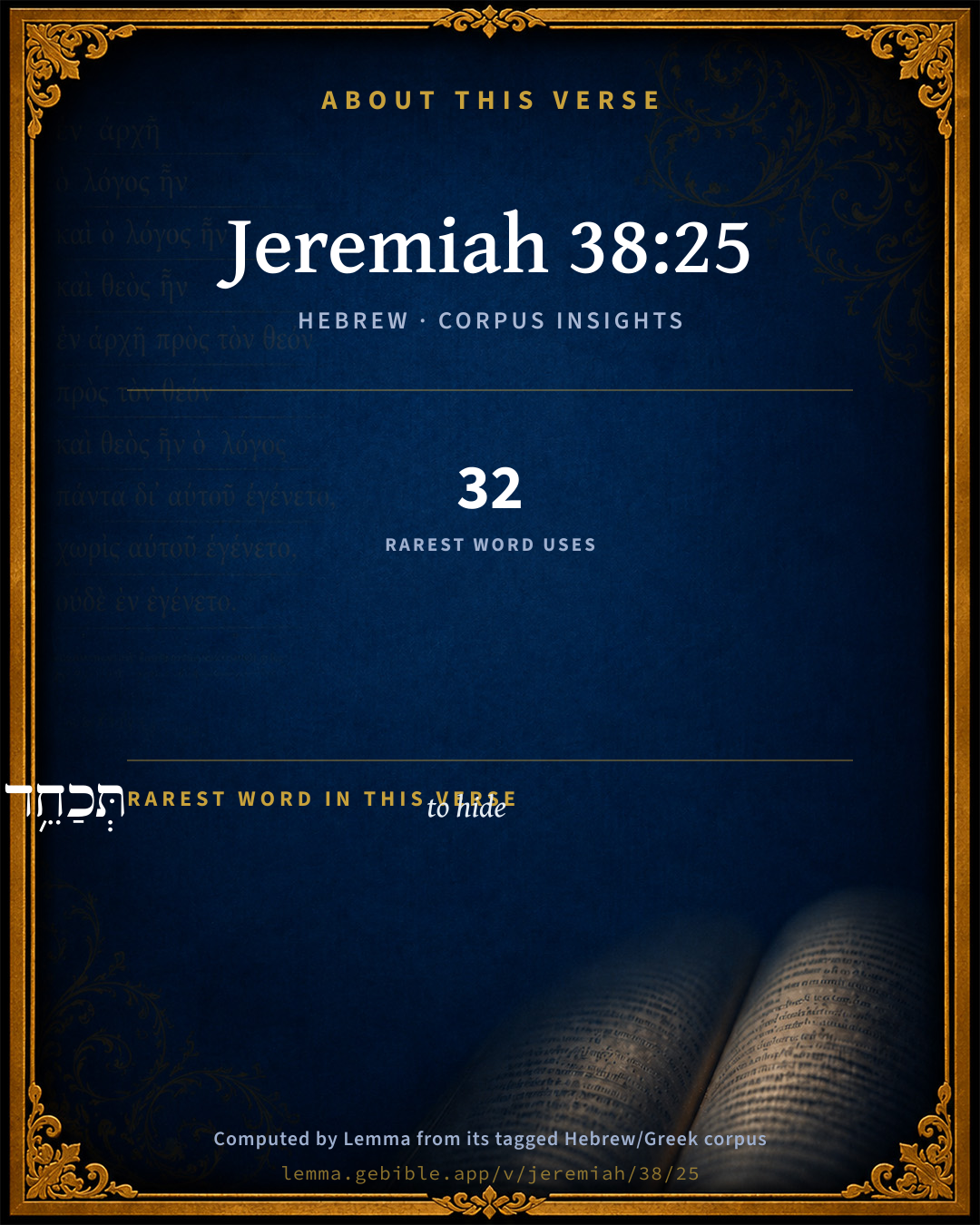
תְּכַחֵ֥ד
kâchad
H3582
“to hide”
Verb, Piel, Jussive, 2nd Person, Masculine, Singular
Part of Speech
Verb
Stem
Piel
Form
Jussive
Person
2nd Person
Gender
Masculine
Number
Singular
Full BDB Definition

Origin: a primitive root

TWOT: 972

to hide, conceal, cut off, cut down, make desolate, kick - (Niphal) - to be hidden - to be effaced, be destroyed, be cut off - (Piel) to cover, hide - (Hiphil) - to hide - to efface, annihilate
  1. וְכִֽי kîy H3588 “and · that” Conjunction + Conjunction
  2. יִשְׁמְע֣וּ shâmaʻ H8085 “to hear” Verb, Qal, Imperfect, 3rd Person, Masculine, Plural
  3. הַשָּׂרִים֮ sar H8269 “the · princes” Particle, Definite Article + Noun, Common, Masculine, Plural, Absolute
  4. כִּֽי kîy H3588 “that” Conjunction
  5. דִבַּ֣רְתִּי dâbar H1696 “to speak” Verb, Piel, Perfect, 1st Person, Common, Singular
  6. אִתָּךְ֒ ʼêth H854 “with · you” Preposition + Suffix, Personal, 2nd Person, Feminine, Singular
  7. וּבָ֣אוּ bôwʼ H935 “and · to enter” Conjunction + Verb, Qal, Sequential Perfect, 3rd Person, Common, Plural
  8. אֵלֶ֣יךָ ʼêl H413 “to · you” Preposition + Suffix, Personal, 2nd Person, Masculine, Singular
  9. וְֽאָמְר֪וּ ʼâmar H559 “and · to say” Conjunction + Verb, Qal, Sequential Perfect, 3rd Person, Common, Plural
  10. אֵלֶ֟יךָ ʼêl H413 “to · you” Preposition + Suffix, Personal, 2nd Person, Masculine, Singular
  11. הַגִּֽידָה nâgad H5046 “make known” Verb, Hiphil, Imperative, 2nd Person, Masculine, Singular + Suffix, h
  12. נָּ֨א nâʼ H4994 “please” Particle, Interjection
  13. מַה mâh H4100 “what” Particle, Interrogative
  14. דִּבַּ֧רְתָּ dâbar H1696 “to speak” Verb, Piel, Perfect, 2nd Person, Masculine, Singular
  15. אֶל ʼêl H413 “to” Preposition
  16. הַמֶּ֛לֶךְ melek H4428 “the · king” Particle, Definite Article + Noun, Common, Masculine, Singular, Absolute
  17. אַל ʼal H408 “not” Particle, Negative
  18. מִמֶּ֖נּוּ min H4480 “from · us” Preposition + Suffix, Personal, 1st Person, Common, Plural
  19. וְלֹ֣א lôʼ H3808 “and · not” Conjunction + Particle, Negative
  20. נְמִיתֶ֑ךָ mûwth H4191 “to die · you” Verb, Hiphil, Imperfect, 1st Person, Common, Plural + Suffix, Personal, 2nd Person, Masculine, Singular
  21. וּמַה mâh H4100 “and · what” Conjunction + Particle, Interrogative
  22. דִּבֶּ֥ר dâbar H1696 “to speak” Verb, Piel, Perfect, 3rd Person, Masculine, Singular
  23. אֵלֶ֖יךָ ʼêl H413 “to · you” Preposition + Suffix, Personal, 2nd Person, Masculine, Singular
  24. הַמֶּֽלֶךְ melek H4428 “the · king” Particle, Definite Article + Noun, Common, Masculine, Singular, Absolute

About this verse

These counts appear in no published source. They are computed here, from the morphology-tagged text and Lemma’s own curated glosses. What Lemma adds →

26
words
17
distinct lemmas
Prophets
section

Shared distinctive vocabulary

תְּכַחֵ֥ד to hide H3582 occurs in 30 verses of the Hebrew Bible. Also found in:

Grammatical profile

  • 9 verbs
  • 3 nouns
  • 7 prepositions
  • 2 conjunctions
  • 5 particles

Verb forms

  • יִשְׁמְע֣וּ Qal · Imperfect
  • דִבַּ֣רְתִּי Piel · Perfect
  • וּבָ֣אוּ Qal · Sequential Perfect
  • וְֽאָמְר֪וּ Qal · Sequential Perfect
  • הַגִּֽידָה Hiphil · Imperative
  • דִּבַּ֧רְתָּ Piel · Perfect
  • תְּכַחֵ֥ד Piel · Jussive
  • נְמִיתֶ֑ךָ Hiphil · Imperfect
  • דִּבֶּ֥ר Piel · Perfect

Repetition

Words recur within this verse — often emphatic in Hebrew:

  • דִבַּ֣רְתִּי to speak H1696 ×3
  • הַמֶּ֛לֶךְ king H4428 ×2
  • אֵלֶ֣יךָ to H413 ×4
  • וְכִֽי that H3588 ×2
  • מַה what H4100 ×2

Cross-references

2

Topical passages linked to Jeremiah 38:25 in the Treasury of Scripture Knowledge — connected by theme and wording, ordered by reader-vote popularity; previews shown in the World English Bible.

  • Jeremiah 38:4–6 Then the princes said to the king, Let this man, we pray you, be put to death; because he weakens the hands of the men of war who remain in this city, and the hands of all the people, in speaking such words to them: for this man doesn't seek the welfare of this people, but the hurt.
  • Jeremiah 38:27 Then came all the princes to Jeremiah, and asked him; and he told them according to all these words that the king had commanded. So they left off speaking with him; for the matter was not perceived.

Cross-references courtesy of OpenBible.info (CC BY 4.0).

Hebrew and Greek witnesses Masoretic Hebrew ↔ Greek Septuagint

The same verse in the two great witnesses to the Old Testament, shown verse-for-verse.

These are two independent witnesses, not word-aligned to each other, and the Septuagint is shown in lemma (dictionary) form.

Hebrew Jeremiah 38:25 Masoretic · Westminster Leningrad Codex

וְכִֽי יִשְׁמְע֣וּ הַשָּׂרִים֮ כִּֽי דִבַּ֣רְתִּי אִתָּךְ֒ וּבָ֣אוּ אֵלֶ֣יךָ וְֽאָמְר֪וּ אֵלֶ֟יךָ הַגִּֽידָה נָּ֨א לָ֜נוּ מַה דִּבַּ֧רְתָּ אֶל הַמֶּ֛לֶךְ אַל תְּכַחֵ֥ד מִמֶּ֖נּוּ וְלֹ֣א נְמִיתֶ֑ךָ וּמַה דִּבֶּ֥ר אֵלֶ֖יךָ הַמֶּֽלֶךְ

But if the princes hear that I have talked with you, and they come to you, and tell you, Declare to us now what you have said to the king; don't hide it from us, and we will not put you to death; also what the king said to you:

World English Bible · Public Domain

Greek LXX Structure differs

In the Septuagint, Jeremiah is about an eighth shorter than the Hebrew and arranges its material differently — the Oracles Against the Nations (Hebrew chapters 46–51) appear in the middle of the Greek book, after 25:13. Because the chapter and verse boundaries do not line up, a verse-for-verse comparison with the Hebrew is not shown.

A verse-for-verse comparison isn’t shown here because the chapters and verses don’t line up. Switch to the LXX edition with the MT / LXX toggle above to read the Greek directly.

Hebrew: Westminster Leningrad Codex (CC BY 4.0). Greek: Septuagint (public domain); English from a public-domain English Septuagint. How the Septuagint differs from the Hebrew →

Targum (Aramaic paraphrase)

1

The Targum is the ancient Jewish Aramaic paraphrase of the Hebrew Scriptures — an interpretive translation, not the Hebrew text itself. Onkelos (literal) and Pseudo-Jonathan (expansive) render the Torah, and Jonathan the Prophets. Coverage is partial: where no permissively-licensed English translation exists for a verse, only the Aramaic is shown. This is verse-level text, not a word-by-word alignment to the Hebrew.

  1. Targum Jonathan Prophets (Joshua–Malachi)
    וַאֲרֵי יִשְׁמְעוּן רַבְרְבַיָא אֲרֵי מַלְלִית עִמָךְ וְיֵתוּן לְוָתָךְ וְיֵימְרוּן לָךְ חַוֵי כְעַן לָנָא מַה מַלְלִית עִם מַלְכָּא לָא תְכַסֵי מִנָנָא וְלָא נִקְטְלִינָךְ וּמַה מַלֵיל עִמָךְ מַלְכָּא:

    (no public-domain English translation for this verse)

    Targum Jonathan — Aramaic: “Mikraot Gedolot” (public domain). English: “Sefaria Community Translation” (CC0 1.0 (public-domain dedication)); “London "Chaldee Paraphrase," 1871” (public domain). Text via Sefaria.

Commentary

Notes on Jeremiah 38:25 from classic Christian and Jewish commentators (each source and its license shown beneath its notes). The classic Christian expositions comment on the surrounding passage and are grouped to its opening verse, so a note may address several verses; the Jewish commentaries on the Tanakh (Rashi and others) are per-verse, so they appear only where the commentator wrote on this verse.

Lemma curates 59 commentaries, every one of them public domain or Creative Commons licensed, each selected and text-cleaned for this edition rather than reprinted as found. About our sources →

Trapp's Complete Commentary

John Trapp

Jer 38:25 But if the princes hear that I have talked with thee, and they come unto thee, and say unto thee, Declare unto us now what thou hast said unto the king, hide it not from us, and we will not put thee to death; also what the king said unto thee:

Ver. 25. But if the princes hear.] In such fear stood he of his princes, and might truly say, as the Assyrian once did, Are not my princes altogether kings? {Isa 10:8} or as the Emperor of Germany did, I am king of kings, meaning that the princes of his empire would do what they wished for all him. Zedekiah was only an image of a king.

John Trapp, A Commentary or Exposition upon All the Books of the Old and New Testament (1647–1656) — public domain. Text from a community e-Sword module.

Jamieson, Fausset & Brown

Robert Jamieson, A. R. Fausset & David Brown

Kings are often such only in title; they are really under the power of their subjects.

Jamieson, Fausset & Brown — Commentary Critical and Explanatory on the Whole Bible (1871) — public domain (CC PDM 1.0). Text via the HelloAO Bible API.

John Calvin's Commentaries

Here again Zedekiah shews his anxiety, lest Jeremiah should be apprehended, were the princes unexpectedly to assail him; for he might in this respect have stumbled, though admonished. Then the king intimated to him what to answer, in case the counselors came to him and made inquiry respecting their intercourse. He then advised him simply to say, that he entreated him not to send him back to the filthy pit, where he almost perished. The miserable servitude of the king appears now still evident; for he feared his own counselors, lest they should revolt from him. he might easily have made a spontaneous surrender of himself, but he dared not, lest he should be killed by them in a tumult; and yet, on the other hand, he feared lest the princes should despise him, and so redeem themselves by the sacrifice of his life.

We see in what straits he was, but God rendered to him a just recompense for his obstinacy. It was indeed a miserable thing to hear that the king’ was thus oppressed on every side, but the cause of all this ought ever to be borne in mind; which was, that he had despised God and his Prophet. He then deserved to be in this state of anxiety, to fear death on every side, and not to be able to extricate himself from those cares and perplexities which tormented him.

Let us then learn to cast all our cares on God, so that our life may be safe, and that we may have calm and tranquil minds: otherwise what is written in the Law must necessarily happen to us,

“Our life will hang on a thread, so that we shall say in the morning, Who will give us to see the evening? and in the evening, How can we live to the morning?” (Deuteronomy 28:66, 67)

Lest then the same thing happen to us as to this miserable king, let us learn to re-cumb on God, for this is the only way to obtain peace.

For though Zedekiah set before Jeremiah the danger which he might bring on himself, if he confessed what took place between them, he yet had a regard no doubt to his own safety, for his care for the Prophet was not very great. If, then, he says, the princes will hear that I have spoken to him, etc. We see here, that as kings very curiously inquire into the sayings and actions of all, so they in their turn are exposed to innumerable spies, who observe all their secret proceedings. Zedekiah, as we have already seen, left his palace, sought some secret place, and at the third entrance called to him Jeremiah. This place might be deemed in some measure secret, yet he knew that he was observed even by his own servants.

Thus kings, while they seek immoderate splendor, renounce the main good, which ought to be preferred to all other things. For it is commonly said that liberty is an invaluable gift, and it is very true: but were we to seek for liberty among mankind, we should by no means find it in courts; for all there are slaves, and slavery begins with the most elevated. Kings, then, while they thus seek from their height to look down on all mankind, are placed, as it were, in a theater, and the eyes of all turn to them, so that no liberty remains for them; and they who hang on their favor are also in constant fear. This, then, ought to be noticed by us; for there is no one who does not seek splendor; but yet we know how anxious is the life of princes. Their external appearance is indeed very flattering; but we do not see what inward torments harass them. When, therefore, it is said of Zedekiah, that he could not have a secret conference, it hence appears that kings are by no means free.

John Calvin's Commentaries (1540-1563) — public domain. Text from the Calvin Translation Society English edition (1840s-50s) via the Christian Classics Ethereal Library (ccel.org). Calvin's coverage is partial (roughly two-thirds of the Bible); uncommented books and verses are honest gaps, never fabricated. The 19th-century editor's footnotes and remarks are omitted so the notes are faithfully Calvin's own voice.

John Gill's Exposition

But if the princes hear that I have talked to thee,.... Which the king suspected they would; and could hardly think but somebody or other would see him and the prophet talking together; who would be officious enough to go and acquaint the princes with it, though he had endeavoured to be as private as possible; however, to provide against the worst, he instructs Jeremiah what to say to them, should they hear of their being together:

and they come unto thee: as he did not doubt but they would, as soon as ever they had notice of it:

and say unto thee, declare unto us now what thou hast said unto the king; hide it not from us, and we will not put thee to death; also what the king said unto thee: the king knew how inquisitive they would be, and sift the prophet to the bottom, to know both what the prophet said to the king, about the state of affairs respecting the Chaldeans, and the surrender of the city to them, which they supposed to be the subject of the discourse; and what were the king's thoughts about it, and his determinations concerning it; and in order to make the prophet easy, and more free and open to tell the whole matter, he suggests they would promise him his life should not be taken away.

John Gill's Exposition of the Whole Bible (1746–1763) — public domain (CC PDM 1.0). Text via the HelloAO Bible API.

Matthew Poole's English Annotations

It could hardly be imagined that Zedekiah should have this private discourse with Jeremiah, but some or other of his courtiers would take notice of it; but yet it argues that this poor prince was in a miserable subjection to them, that he could discourse with nobody but they must come and inquire what he said.

Matthew Poole's English Annotations on the Holy Bible (1683–1685) — public domain. Text from a community e-Sword/MySword module.

Lesson kit

Teaching starters — assembled from the data on this page, not authored interpretation. Every prompt links to the verse data it draws on. Edit before teaching.

Jeremiah, in the Prophets, opens this verse with 26 words (17 distinct Hebrew lemmas). Its most distinctive word is kâchad (“to hide”). A historical commentator’s framing appears above. Read the whole chapter for the surrounding context.

Discussion questions

  1. The word kâchad carries the sense “to hide.” How does it shape the verse?
  2. How does Genesis 47:18, which shares the word «to hide», read alongside this verse?
  3. What does the repetition of “to speak” (3× in this one verse) do in this verse?
  4. The translations on this page render this verse differently — a whole-verse word diff, not a word-by-word alignment. What might account for the different wordings?
  5. «יִשְׁמְע֣וּ» is a Qal Imperfect verb. How does that grammatical form shape the action described?
  6. Compare how Trapp's Complete Commentary and Jamieson, Fausset & Brown read this verse. Where do they agree or differ?

Things to notice

Reading settings

Reading text

Shown beneath each verse's original-language words.

Old Testament
Old Testament edition

Read the OT as the Masoretic Hebrew (MT) or the Greek Septuagint (LXX).

English shown for the Greek Septuagint (in the Hebrew ↔ Greek comparison).

Comparing translations? Open the Compare panel on any verse page to stack up to four side by side.