
Jeremiah 6:20

Hebrew (Westminster Leningrad Codex) Jeremiah 6:20 appears in the Hebrew Old Testament. The text above is from the Westminster Leningrad Codex. Each word links to its Strong’s number, a concise gloss, and parsing drawn from the Open Scriptures Hebrew Bible morphology. Click any word for its full Brown-Driver-Briggs (BDB) entry.
Download image
Cite this verse

Jeremiah 6:20 (World English Bible). Public Domain. Lemma interlinear Bible study tool, https://lemma.gebible.app/v/jeremiah/6/20.

Show BibTeX & RIS
BibTeX
RIS
English Translation
To what purpose comes there to me frankincense from Sheba, and the sweet cane from a far country? your burnt offerings are not acceptable, nor your sacrifices pleasing to me.
World English Bible · Public Domain
Download a study sheet

One document with this verse’s original text, its word-by-word gloss line, the meaning frame, cross-references with their text, attributed commentary, and full source and license credits — printable, and it pastes into notes with its structure intact.

This verse Autodidact and up

Study sheet (.html) Plain text (.txt)

A passage Seminary Student

Up to 50 verses in one chapter. A passage sheet keeps up to 6 commentary sources and 12 cross-references per verse, in the order this page ranks them, and says so on the sheet whenever that leaves anything out. Ask for a single verse and you get the Autodidact verse sheet above.

Everything on this page stays free to read, with no account — the sheet is a download of what is already on screen, not access to it.

Want to remove ads? Support Godless Engineer
Compare translations 3

The same verse in 3 English versions, stacked beneath the original-language interlinear above. Click any original word for its lexicon entry.

Each is an independent rendering of the whole verse — the interlinear is not word-aligned to these translations.

Highlighted words mark where these versions differ — a whole-verse word diff, not a word-by-word alignment.

  • World English Bible Public Domain
    To what purpose comes there to me frankincense from Sheba, and the sweet cane from a far country? your burnt offerings are not acceptable, nor your sacrifices pleasing to me.
  • King James Version Public Domain
    To what purpose cometh there to me incense from Sheba, and the sweet cane from a far country? your burnt offerings are not acceptable, nor your sacrifices sweet unto me.
  • unfoldingWord Literal Text CC BY-SA 4.0
    What this to me, frankincense coming from Sheba? Or reed perfume from a distant land? Your burnt offerings not acceptable, and your sacrifices are not pleasing to me.

unfoldingWord Literal Text — © unfoldingWord, licensed CC BY-SA 4.0. Word-aligned USFM3 via Door43 (git.door43.org/unfoldingWord/en_ult).

Versions to compare (up to 4)

3 of 4 selected

Show all 18 translations

Every available English version of this verse, each an independent rendering of the whole verse.

  • World English Bible Public Domain
    To what purpose comes there to me frankincense from Sheba, and the sweet cane from a far country? your burnt offerings are not acceptable, nor your sacrifices pleasing to me.
  • Berean Standard Bible Public Domain
    What use to Me is frankincense from Sheba or sweet cane from a distant land? Your burnt offerings are not acceptable; your sacrifices do not please Me.”
  • Majority Standard Bible Public Domain
    What use to Me is frankincense from Sheba or sweet cane from a distant land? Your burnt offerings are not acceptable; your sacrifices do not please Me.”
  • King James Version Public Domain
    To what purpose cometh there to me incense from Sheba, and the sweet cane from a far country? your burnt offerings are not acceptable, nor your sacrifices sweet unto me.
  • American Standard Version (1901) Public Domain
    To what purpose cometh there to me frankincense from Sheba, and the sweet cane from a far country? your burnt-offerings are not acceptable, nor your sacrifices pleasing unto me.
  • Revised Version (1885) Public Domain
    To what purpose cometh there to me frankincense from Sheba, and the sweet cane from a far country? your burnt offerings are not acceptable, nor your sacrifices pleasing unto me.
  • Geneva Bible (1599) Public Domain
    To what purpose bringest thou mee incense from Sheba, and sweete calamus from a farre countrey? Your burnt offerings are not pleasant, nor your sacrifices sweete vnto me.
  • Douay-Rheims (1899) Public Domain
    To what purpose do you bring me frankincense from Saba, and the sweet smelling cane from a far country? your holocausts are not acceptable, nor are your sacrifices pleasing to me.
  • Young's Literal Translation Public Domain
    Why `is' this to Me? frankincense from Sheba cometh, And the sweet cane from a land afar off, Your burnt-offerings `are' not for acceptance, And your sacrifices have not been sweet to Me.
  • Literal Standard Version CC BY-SA 4.0
    Why [is] this to Me? Frankincense comes from Sheba, || And the sweet cane from a far-off land, || Your burnt-offerings [are] not for acceptance, || And your sacrifices have not been sweet to Me.”
  • Unlocked Literal Bible CC BY-SA 4.0
    “What does this frankincense going up from Sheba mean to me? Or these sweet smells from a distant land? Your burnt offerings are not acceptable to me, nor are your sacrifices.
  • unfoldingWord Literal Text CC BY-SA 4.0
    What this to me, frankincense coming from Sheba? Or reed perfume from a distant land? Your burnt offerings not acceptable, and your sacrifices are not pleasing to me.
  • Darby Bible Public Domain
    To what purpose should there come to me incense from Sheba, and the sweet cane from a far country? Your burnt-offerings are not acceptable, nor are your sacrifices pleasing unto me.
  • World Messianic Bible Public Domain
    To what purpose does frankincense from Sheba come to me, and the sweet cane from a far country? Your burnt offerings are not acceptable, and your sacrifices are not pleasing to me.”
  • Webster's Bible Public Domain
    To what purpose cometh there to me incense from Sheba, and the sweet cane from a distant country? your burnt-offerings are not acceptable, nor your sacrifices sweet to me.
  • Free Bible Version CC BY-SA 4.0
    What's the point of offering me frankincense from Sheba or sweet calamus from a faraway land? I don't accept your burnt offerings; I'm not pleased with your sacrifices.
  • Bible in Basic English Public Domain
    To what purpose does sweet perfume come to me from Sheba, and spices from a far country? your burned offerings give me no pleasure, your offerings of beasts are not pleasing to me.
  • JPS Tanakh (1917) Public Domain
    To what purpose is to Me the frankincense that cometh from Sheba, and the sweet cane, from a far country? Your burnt-offerings are not acceptable, nor your sacrifices pleasing unto Me.

Literal Standard Version (2020), Covenant Press — licensed CC BY-SA 4.0. Text via the HelloAO Bible API (eBible.org). Unlocked Literal Bible (unfoldingWord) — licensed CC BY-SA 4.0. Text via the HelloAO Bible API (eBible.org). unfoldingWord Literal Text — © unfoldingWord, licensed CC BY-SA 4.0. Word-aligned USFM3 via Door43 (git.door43.org/unfoldingWord/en_ult). Free Bible Version, Dr. Jonathan Gallagher — licensed CC BY-SA 4.0. Text via the HelloAO Bible API (eBible.org).

Word by word

More ways to search: Search by grammar → Find every occurrence → Compare this word →

Practice this passage: Drill this verse → Learn its vocabulary →

עָ֥רְבוּ
ʻârêb
H6149
“to be pleasant”
Verb, Qal, Perfect, 3rd Person, Common, Plural
Part of Speech
Verb
Stem
Qal
Form
Perfect
Person
3rd Person
Gender
Common
Number
Plural
Full BDB Definition

Origin: a primitive root [identical with H614 idea of close association]; to be agreeable

TWOT: 1687a

(Qal) to be pleasant, be sweet, be pleasing - (TWOT) sweet, pleasant
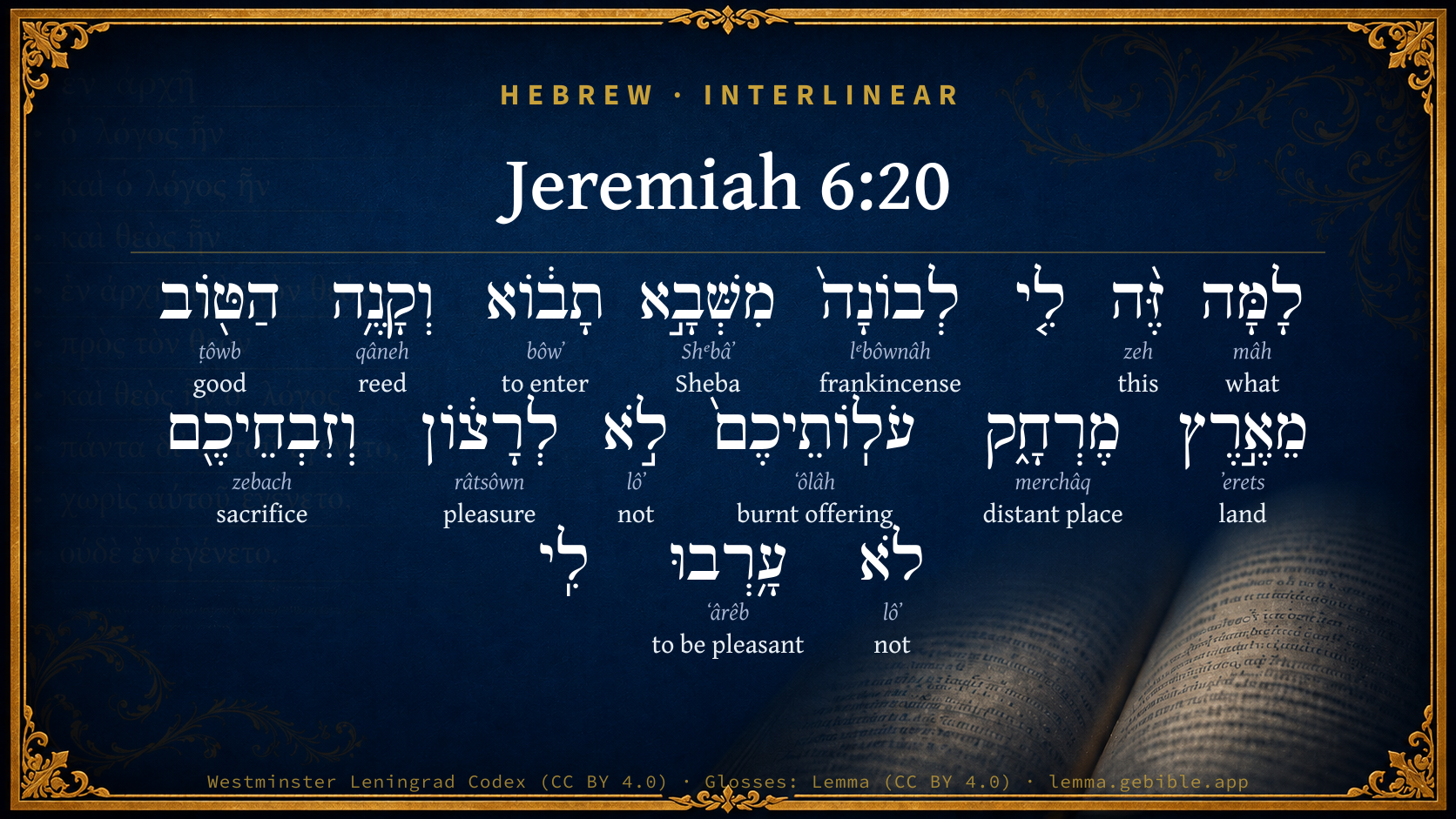
  1. לָמָּה mâh H4100 “to/for · what” Preposition + Particle, Interrogative
  2. זֶּ֨ה zeh H2088 “this” Pronoun, Demonstrative, Masculine, Singular
  3. לְבוֹנָה֙ lᵉbôwnâh H3828 “frankincense” Noun, Common, Feminine, Singular, Absolute
  4. מִשְּׁבָ֣א Shᵉbâʼ H7614 “from · Sheba” Preposition + Noun, Proper
  5. תָב֔וֹא bôwʼ H935 “to enter” Verb, Qal, Imperfect, 3rd Person, Feminine, Singular
  6. וְקָנֶ֥ה qâneh H7070 “and · reed” Conjunction + Noun, Common, Masculine, Singular, Absolute
  7. הַטּ֖וֹב ṭôwb H2896 “the · good” Particle, Definite Article + Adjective, Adjective, Masculine, Singular, Absolute
  8. מֵאֶ֣רֶץ ʼerets H776 “from · land of” Preposition + Noun, Common, Both, Singular, Construct
  9. מֶרְחָ֑ק merchâq H4801 “distant place” Noun, Common, Masculine, Singular, Absolute
  10. עֹלֽוֹתֵיכֶם֙ ʻôlâh H5930 “burnt offerings · your” Noun, Common, Feminine, Plural, Construct + Suffix, Personal, 2nd Person, Masculine, Plural
  11. לֹ֣א lôʼ H3808 “not” Particle, Negative
  12. לְרָצ֔וֹן râtsôwn H7522 “to/for · pleasure” Preposition + Noun, Common, Masculine, Singular, Absolute
  13. וְזִבְחֵיכֶ֖ם zebach H2077 “and · sacrifices · your” Conjunction + Noun, Common, Masculine, Plural, Construct + Suffix, Personal, 2nd Person, Masculine, Plural
  14. לֹא lôʼ H3808 “not” Particle, Negative

About this verse

These counts appear in no published source. They are computed here, from the morphology-tagged text and Lemma’s own curated glosses. What Lemma adds →

17
words
14
distinct lemmas
Prophets
section

Notable vocabulary

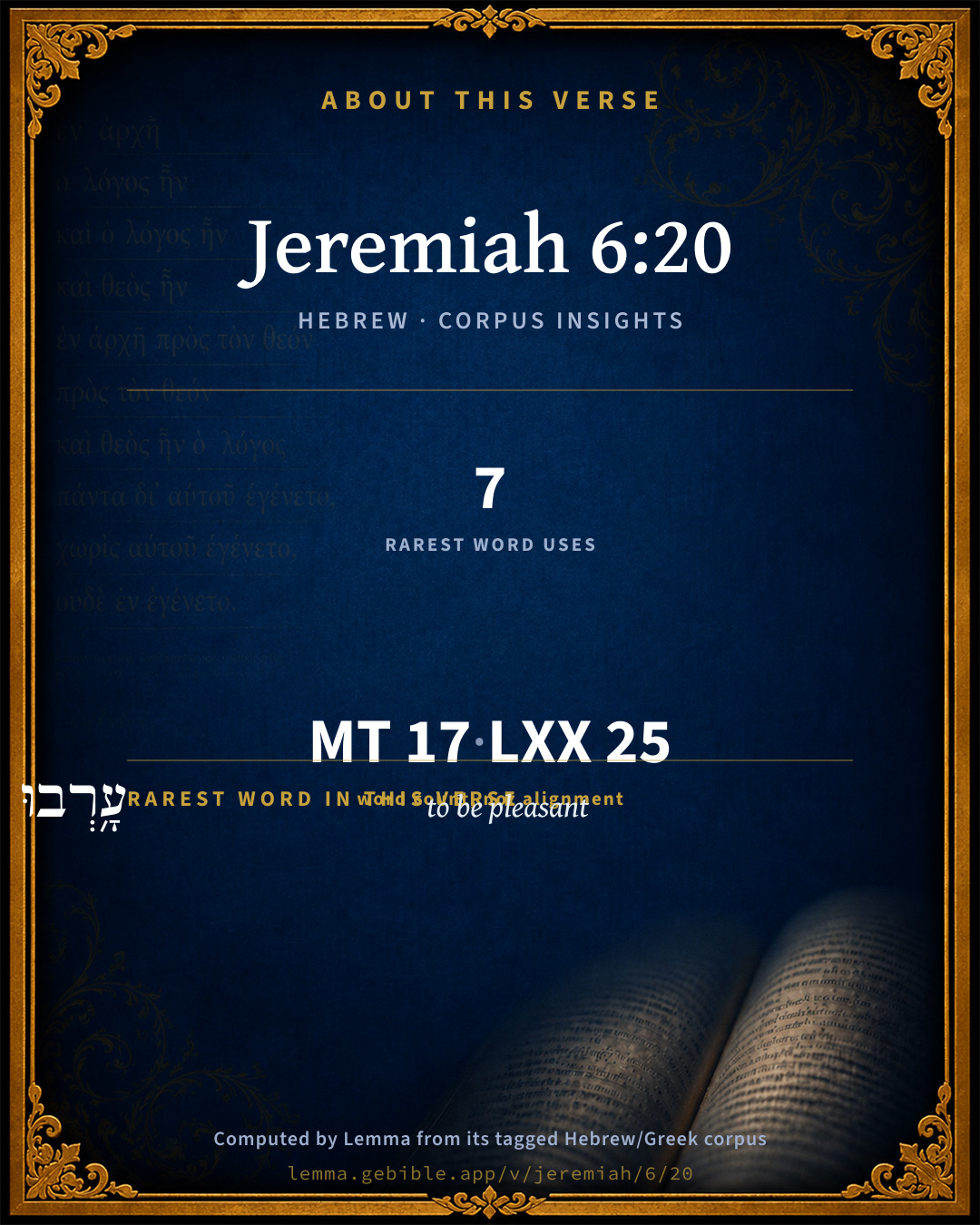
The rarest word here is עָ֥רְבוּ to be pleasant H6149 — appearing just 7 times in the whole Hebrew Bible.

Shared distinctive vocabulary

עָ֥רְבוּ to be pleasant H6149 occurs in 7 verses of the Hebrew Bible. Also found in:

Grammatical profile

  • 2 verbs
  • 8 nouns
  • 1 adjective
  • 1 pronoun
  • 2 prepositions
  • 3 particles

Verb forms

  • תָב֔וֹא Qal · Imperfect
  • עָ֥רְבוּ Qal · Perfect

Repetition

A word recurs within this verse — often emphatic in Hebrew:

Hebrew & Septuagint length

In the original languages it is 17 Hebrew tokens and 25 Greek tokens — but the two are counted differently (Hebrew bundles its prefixes and suffixes into one token; the Greek is in lemma form), so that isn’t a like-for-like length.

Cross-references

16

Topical passages linked to Jeremiah 6:20 in the Treasury of Scripture Knowledge — connected by theme and wording, ordered by reader-vote popularity; previews shown in the World English Bible.

  • Isaiah 1:11 "What are the multitude of your sacrifices to me?," says Yahweh. "I have had enough of the burnt offerings of rams, And the fat of fed animals. I don't delight in the blood of bulls, Or of lambs, Or of male goats.
  • Psalms 40:6 Sacrifice and offering you didn't desire. You have opened my ears: Burnt offering and sin offering you have not required.
  • Isaiah 60:6 The multitude of camels shall cover you, the dromedaries of Midian and Ephah; all they from Sheba shall come; they shall bring gold and frankincense, and shall proclaim the praises of Yahweh.
  • Amos 5:21–22 I hate, I despise your feasts, And I can't stand your solemn assemblies.
  • Micah 6:6–8 How shall I come before Yahweh, And bow myself before the exalted God? Shall I come before him with burnt offerings, With calves a year old?
  • Exodus 30:23 "Also take fine spices: of liquid myrrh, five hundred shekels; and of fragrant cinnamon half as much, even two hundred and fifty; and of fragrant cane, two hundred and fifty;
  • Psalms 50:7–13 "Hear, my people, and I will speak; Israel, and I will testify against you. I am God, your God.
  • Isaiah 43:23–24 You have not brought me of your sheep for burnt offerings; neither have you honored me with your sacrifices. I have not burdened you with offerings, nor wearied you with frankincense.
  • Isaiah 66:3 He who kills an ox is as he who kills a man; he who sacrifices a lamb, as he who breaks a dog's neck; he who offers an offering, [as he who offers] pig's blood; he who burns frankincense, as he who blesses an idol. Yes, they have chosen their own ways, and their soul delights in their abominations:
  • Jeremiah 7:21–23 Thus says Yahweh of Hosts, the God of Israel: Add your burnt offerings to your sacrifices, and eat you flesh.
  • 1 Kings 10:1–2 When the queen of Sheba heard of the fame of Solomon concerning the name of Yahweh, she came to prove him with hard questions.
  • 1 Kings 10:10 She gave the king one hundred twenty talents of gold, and of spices very great store, and precious stones: there came no more such abundance of spices as these which the queen of Sheba gave to king Solomon.
  • Psalms 50:16–17 But to the wicked God says, "What right do you have to declare my statutes, That you have taken my covenant on your lips,
  • Psalms 66:3 Tell God, "How awesome are your deeds! Through the greatness of your power, your enemies submit themselves to you.
  • Ezekiel 20:39 As for you, house of Israel, thus says the Lord Yahweh: Go you, serve everyone his idols, and hereafter also, if you will not listen to me; but my holy name shall you no more profane with your gifts, and with your idols.
  • Ezekiel 27:22 The traffickers of Sheba and Raamah, they were your traffickers; they traded for your wares with the chief of all spices, and with all precious stones, and gold.

Cross-references courtesy of OpenBible.info (CC BY 4.0).

Hebrew and Greek witnesses Masoretic Hebrew ↔ Greek Septuagint

The same verse in the two great witnesses to the Old Testament, shown verse-for-verse.

These are two independent witnesses, not word-aligned to each other, and the Septuagint is shown in lemma (dictionary) form.

Hebrew Jeremiah 6:20 Masoretic · Westminster Leningrad Codex

לָמָּה זֶּ֨ה לִ֤י לְבוֹנָה֙ מִשְּׁבָ֣א תָב֔וֹא וְקָנֶ֥ה הַטּ֖וֹב מֵאֶ֣רֶץ מֶרְחָ֑ק עֹלֽוֹתֵיכֶם֙ לֹ֣א לְרָצ֔וֹן וְזִבְחֵיכֶ֖ם לֹא עָ֥רְבוּ לִֽי

To what purpose comes there to me frankincense from Sheba, and the sweet cane from a far country? your burnt offerings are not acceptable, nor your sacrifices pleasing to me.

World English Bible · Public Domain

Greek LXX Structure differs

In the Septuagint, Jeremiah is about an eighth shorter than the Hebrew and arranges its material differently — the Oracles Against the Nations (Hebrew chapters 46–51) appear in the middle of the Greek book, after 25:13. Because the chapter and verse boundaries do not line up, a verse-for-verse comparison with the Hebrew is not shown.

A verse-for-verse comparison isn’t shown here because the chapters and verses don’t line up. Switch to the LXX edition with the MT / LXX toggle above to read the Greek directly.

On this verse, Trapp's Complete Commentary discusses the Septuagint’s reading. Read the note in Commentary ↓

Hebrew: Westminster Leningrad Codex (CC BY 4.0). Greek: Septuagint (public domain); English from a public-domain English Septuagint. How the Septuagint differs from the Hebrew →

Targum (Aramaic paraphrase)

1

The Targum is the ancient Jewish Aramaic paraphrase of the Hebrew Scriptures — an interpretive translation, not the Hebrew text itself. Onkelos (literal) and Pseudo-Jonathan (expansive) render the Torah, and Jonathan the Prophets. Coverage is partial: where no permissively-licensed English translation exists for a verse, only the Aramaic is shown. This is verse-level text, not a word-by-word alignment to the Hebrew.

  1. Targum Jonathan Prophets (Joshua–Malachi)
    לְמָא דְנַן קֳדָמַי לְבוֹנְתָא דְמִשְׁבָא תֵיתֵי וְקָנֵי טַבְתָא מֵאַרַע רְחִיקָא עֲלָוָתְכוֹן לָא לְרַעֲוָא וְנִכְסַת קוּדְשֵׁיכוֹן לָא יִתְקַבְּלוּן קֳדָמָי:

    (no public-domain English translation for this verse)

    Targum Jonathan — Aramaic: “Mikraot Gedolot” (public domain). English: “Sefaria Community Translation” (CC0 1.0 (public-domain dedication)); “London "Chaldee Paraphrase," 1871” (public domain). Text via Sefaria.

Commentary

Notes on Jeremiah 6:20 from classic Christian and Jewish commentators (each source and its license shown beneath its notes). The classic Christian expositions comment on the surrounding passage and are grouped to its opening verse, so a note may address several verses; the Jewish commentaries on the Tanakh (Rashi and others) are per-verse, so they appear only where the commentator wrote on this verse.

Lemma curates 59 commentaries, every one of them public domain or Creative Commons licensed, each selected and text-cleaned for this edition rather than reprinted as found. About our sources →

Trapp's Complete Commentary

John Trapp

Jer 6:20 To what purpose cometh there to me incense from Sheba, and the sweet cane from a far country? your burnt offerings [are] not acceptable, nor your sacrifices sweet unto me.

Ver. 20. To what purpose cometh there to me incense?] Cui bono, so long as it smelleth of the foul hand that offereth it, so long as you think to bribe me with it? See Isa 1:14.

From Sheba.] Whence the Greeks seem to have their word σεβειν, to worship; and the Arabians call God - the adequate object of divine worship - Sabim, and a mystery, Saba.

And the sweet cane.] Heb., Cane the good. The Septuagint render it cinnamon; and the Vulgate, calamus; of which see Pliny, lib. xii. cap. 22.

From a far country.] From India, saith Jerome. Haec omnia bene in nostros Papistas quadrabunt.

John Trapp, A Commentary or Exposition upon All the Books of the Old and New Testament (1647–1656) — public domain. Text from a community e-Sword module.

The Biblical Illustrator

Joseph S. Exell

Jer_6:20

Your burnt offerings are not acceptable.

Waste worship

I. The manifest failure of these Jewish offerings.

1. By these their consecration was to be furthered. But they were foul.

2. By these their repentance was to be awakened. But they sinned shamefully.

3. By these their minds were to be directed to the Messiah. But, in their arrogance and care for mere externals, they lost sight of spiritual lessons.

4. By these God was to be pleased and propitiated. The text indicates their complete miscarriage in this respect.

II. The indignant question and repudiation.

1. God thrusts from Himself the offensive temple offerings. He demands the heart. Nothing is sweet to God without love.

2. God stigmatises them as purposeless and waste.

3. Worship that offends God is waste, but also something more. Heart hardening. Judgment. Punishment.

Lessons--

1. The most important matter about our spiritual things is their acceptableness with God.

2. Our best energies are needed, not for externals, but internals. (W. B. Haynes.)

Ostentatiousness of hypocrisy

Drones make more noise than bees, though they make neither honey nor wax. (J. Trapp.)

The Biblical Illustrator, edited by Joseph S. Exell (c. 1880s–1900s) — public domain. Text from a community e-Sword module.

Joseph Benson's Commentary

Jer 6:20. To what purpose — incense from Sheba? — Sheba was a part of Arabia Felix, and famous for its spices and perfumes, Isa 9:6. Here the prophet reproves the hypocrisy of the Jews, who sought to cover their inward corruption by the external shows of religion; which the prophets often declare to be of no value, when they do not proceed from a devout mind. See Jer 7:21-22; Isa 1:11. And the sweet cane from a far country — Respecting which, see on Isa 43:24. A far country seems equivalent with Sheba before mentioned, whose queen is said, Mat 12:42, to have come from the uttermost parts of the earth, namely, from the southern extremity of the peninsula of Arabia, which, with respect to Judea, was a far country, and at the extreme parts of the earth, or bordering upon the ocean on the south.

Joseph Benson's Commentary on the Old and New Testaments (1811–1818) — public domain. Text from a community e-Sword module.

Tyndale Open Study Notes

Tyndale Open Resources

6:20 The offerings of expensive frankincense and fragrant perfumes were repulsive to the Lord because of his people’s rebellion (7:21-23; Exod 30:23; Pss 40:6; 50:7-9; Isa 1:11; 43:24; 66:3; Amos 5:21; Mic 6:6-7).

Tyndale Open Study Notes — © Tyndale Open Resources, licensed CC BY-SA 4.0. Text via the HelloAO Bible API.

Geneva Bible (1599)

Geneva Bible translators

Read Isa. 1:11 and Amos 5:21.

Geneva Bible (1599) marginal notes — public domain. Text via Bolls.life.

Adam Clarke's Commentary

Verse 20. Incense frown Sheba] Sheba was in Arabia, famous for the best incense. It was situated towards the southern extremity of the peninsula of Arabia; and was, in respect of Judea, a far country.

And the sweet cane from a far country] The calamus aromaticus, which, when dried and pulverized, yields a very fine aromatic smell; see on Isa 43:24. This was employed in making the holy anointing oil. See Ex 30:23.

Adam Clarke's Commentary on the Bible (1810–1826) — public domain. Text from a community e-Sword/MySword module.

John Calvin's Commentaries

The Prophet here replies to those hypocrites, who thought that they made an expiation when they had offered incense and sacrifices, as though that was all that was necessary in serving God: and hence we shall hereafter see, that the Temple had become the den of thieves; for when they sedulously offered incense every day and performed other ceremonies, they thought that God was pacified. Thus hypocrites ever mock God with their fopperies and regard God as extremely cruel, when not satisfied with external display. This was a perpetual evil, with which the prophets had to contend: and hence the notion is often found referred to by our Prophet,

“I desired not sacrifices; I commanded not your fathers, when I stretched forth my hand to bring them out of Egypt, to offer burnt — offerings to me, but only to obey my voice,” (Jeremiah 7:21, 22)

So we find in other prophets: the Psalmist says,

“If I hunger, I will not tell thee,” (Psalm 50:12)

It is said also by Micah,

“What does God require of thee, but to humble thyself before him? He seeks not thousands of rams nor thousands of oxen from thy herds,” (Micah 6:7)

And we see at this day, that men cannot be rightly taught, except we carry on war against that external splendor with which they will have God to be satisfied. As then men deceive themselves with such trifles, it is necessary to shew that all those things which hypocrites obtrude on God, without sincerity of heart, are frivolous trumperies. This is the import of what is here taught.

There is, then, no doubt but that the Jews punctually offered their sacrifices, and observed the legal rites. All this might have appeared very commendable; but God gives this answer, To what purpose does frankincense come to me from the Sabeans, and a sweet cane (that is, odoriferous) from a far country? Thus the Prophet here anticipates hypocrites, that he might not leave them — what they might have objected: for while they spent a large sum of money on their forms of worship, they thought that God was as it were bound to them: and where they also bestowed much labor, they supposed that their’ toil could not be superfluous or useless. And under the Papacy we observe the same thing: when any one builds a splendid church, and adorns it with gold and silver and supplies it with rich furniture, and then provides a revenue for saying masses, he thinks that lie holds in his hands all the keys of the kingdom of heaven, so that he can push in even against the will of God. Similar is the madness of the Papists, when they undertake pilgrimages: when they labor and toil, they think that every step they take must be numbered before God, and that God would be unjust, were he not to approve of what is offered to him with so much trouble. Such was also the conceit of the Jews. As their incense, brought from the Sa-beans, that is, from the east, even from Persia, was precious, and cost a considerable sum of money, they wished that this should be deemed a satisfaction for all their sins; and they looked for the same benefit from the cane: as the most odoriferous cane was bought at, a high price, they expected that it would be of account before God, and that it would avail to compensate for their punishment. This is the folly which God here treats with contempt. “What are they to me, “he says, “your expenses? I indeed count as nothing all that ye spend in buying incense and sweet cane.” And then he speaks of the Sabeans and of a far country.

He afterwards adds, Please me do not your burnt — offerings, and your sacrifices are not acceptable Under one kind Jeremiah includes the whole worship according to the law; and yet it had been divinely appointed: this is indeed true, but for another purpose. Fasting does not of itself displease God; but it becomes an abomination to him, when it is thought to be a meritorious work, or when some holiness is connected with it. The same is true as to sacrifices; for they who sought to pacify God by victims robbed Christ of his honor: it was to transfer the favor, which comes from Christ, to a calf or to a goat: and what a sacrilege was this, and how abominable? When, therefore, the Jews set such a high value on their sacrifices, they sought first childishly to trifle with God, as though these were expiations to pacify him; and then to offer burnt — offerings, to slay an animal, for pacifying God, was to change his nature; and lastly, it was, as I have said, to rob Christ of his honor: for expiation is to be sought by no other means than through his blood, by which we are cleansed from every stain through the Holy Spirit, who sprinkles it on our hearts. But when this was attributed to sacrifices, they substituted the victim, or the ram, for Christ, according to what has been stated.

Now there ought to have been in sacrifices the exercise of the duty of repentance: but when they became more and more hardened, and thought that by their ceremonies they obtained a greater license to sin, and that God required no more from them, as though they had settled matters with him, they completely neutralized the design of God: for sacrifices, as it has been already said, had been enjoined for this end, — that they might exercise penitence.

We now then see that this answer given by Jeremiah was not in vain, — that their sacrifices did not please God. There is a severer language used elsewhere, — that God nauseated them, that he was wearied in bearing them, that he was constrained to be troubled with them, while they thus profaned his name. (Isaiah 1:14.) The meaning here is the same, — that God never required sacrifices for their own sake, but for another end; and also, that all external rites are of themselves mere trumperies and mockeries, nay, a profanation of God’s name; so that they could not pacify him, but, on the contrary, provoke his wrath. It follows —

John Calvin's Commentaries (1540-1563) — public domain. Text from the Calvin Translation Society English edition (1840s-50s) via the Christian Classics Ethereal Library (ccel.org). Calvin's coverage is partial (roughly two-thirds of the Bible); uncommented books and verses are honest gaps, never fabricated. The 19th-century editor's footnotes and remarks are omitted so the notes are faithfully Calvin's own voice.

Ellicott's Commentary for English Readers

(20) Incense from Sheba.—The land that had a proverbial fame both for gold and frankincense (Isa_60:6; Eze_27:22), the thus Sabæum of Virg., Æn. i. 416, 417. So Milton, Par. Lost, 4—

“Sabæan odours from the spicy shores

Of Araby the blest.”

So the Queen of Sheba brought spices and gold (1Ki_10:10).

The sweet cane.—Literally, the good cane, or, as in Exo_30:23, sweet calamus (comp. Isa_43:24; Son_4:14), numbered among the ingredients of the Temple incense. The LXX. renders it by “cinnamon.” It came from the “far country” of India The whole passage is a reproduction of the thought of Isa_1:11-13.

A Bible Commentary for English Readers, edited by Charles John Ellicott (1878–1897) — public domain. Text from a community e-Sword module.

The Cambridge Bible for Schools and Colleges

gen. ed. J. J. S. Perowne

20. For the uselessness of ceremonial without obedience, cp. Isa_1:11; Hos_6:6; Amo_5:21 ff.; Mic_6:6; Psa_50:13 f.

frankincense from Sheba] Cp. Isa_60:6, and “Centumque Sabaeo Ture calent arae” (Aen. I. 416–7). The word occurs only in the later portions of O.T., viz. Jer_17:26, Jer_41:5 (in Jer_7:9 and Jer_44:21 the word is different); Exo_30:34; Lev_2:1 and six times besides; Num_5:15 (all P), Isa_43:23; Isa_60:6; Isa_66:3; 1Ch_9:29; Ca. Jer_3:6, Jer_4:6; Jer_4:14.

cane] mg. calamus (Exo_30:23; Eze_27:19; Ca. Jer_4:14). It was used as an ingredient in the making of incense, and probably the “far country” was India. Du. and Co. think that Jeremiah is not attacking the sacrificial system, but the new-fangled ritual fashions. But this involves the precarious assumption that the latter part of the v. is the work of a supplementer.

The Cambridge Bible for Schools and Colleges (gen. ed. J. J. S. Perowne; Cambridge University Press, 1878–1918) — public domain. Text from a community e-Sword module.

John Gill's Exposition

To what purpose cometh there to me incense from Sheba,.... In Persia or Arabia, from whence incense was brought, and perhaps the best; see Isa 60:6, and yet the offering of this was of no esteem with God, when the words of the prophet, and the law of his mouth, were despised; see Isa 1:13,

and the sweet cane from a far country? either from the same place, Sheba, which was a country afar off, Joe 3:8, or from India, as Jerom interprets it; this was one of the spices in the anointing oil, Exo 30:23 and though this was of divine appointment, and an omission of it is complained of, Isa 43:24 yet when this was brought with a hypocritical heart, and to atone for neglects of the moral law, and sins committed against that, it was rejected by the Lord:

your burnt, offerings are not acceptable, nor your sacrifices sweet unto me: being offered up with a wicked mind, and without faith in Christ, and in order to expiate the guilt of black crimes unrepented of, and continued in; they were not grateful to God, nor could he smell a sweet savour in them, but loathed and abhorred them; see Isa 1:11.

John Gill's Exposition of the Whole Bible (1746–1763) — public domain (CC PDM 1.0). Text via the HelloAO Bible API.

Albert Barnes' Notes on the Bible

The sweet cane - The same as the scented cane of Exo 30:23 (see the note).

Your burnt offerings - The rejection of ritual observances is proclaimed by the two prophets Isaiah and Jeremiah, who chiefly assisted the two pious kings, Hezekiah and Josiah, in restoring the temple-service. God rejects not the ceremonial service, but the substitution of it for personal holiness and morality. Compare 1Sa 15:22; Isa 1:11; Mic 6:6-8.

Albert Barnes' Notes on the Bible (1834–1885) — public domain. Text from a community e-Sword/MySword module.

Haydock's Catholic Bible Commentary

To me. For want of proper dispositions; otherwise the offerings of the best things were enjoined, and commendable. The Jews are taught not to depend on external observances, while they neglect the heart. (Calmet)

George Leo Haydock (1774–1849), Haydock's Catholic Family Bible and Commentary, 1859 edition — public domain. Excludes Psalms (Douay-Rheims chapter numbering differs from Protestant) and Deuterocanonical books (Catholic canon only).

Matthew Poole's English Annotations

To what purpose? an interrogation of expostulation and contempt, wherein God by the prophet meets with their hypocrisy, who pleased themselves with their outward oblations and sacrifices, and thought God would be pleased with them too; but he tells them plainly they are to no purpose; as he speaks particularly in the close of the verse, Jer 7:21,22; Eze 20:39.

Incense from Sheba: that this was the product of Sheba, a country in Arabia Felix, to which country frankincense was peculiar, See Poole "Isa 60:6". The sweet cane, or, cane, i.e. good, or the best cane; the article ה hath the force of a superlative, for cane that is good; the Hebrews have no degrees of comparison; the same that is mentioned as an ingredient in the holy oil, Exo 30:23. See Isa 43:24.

From a far country; not that it was brought from the remotest parts of the world, as from India, as some; for it was known to the Jews in Moses’s time, Exo 30:23; but because it grew not in their own land, but was fetched or brought to them from Sheba, Isa 60:6, where it did grow, as Diodorus testifies, lib. 3. p. 125, and Strabo, lib. 16; 1Ki 10:2, compared with Joe 3:8; who is called the queen of the south, and to come from the uttermost parts of the earth, Mat 12:42, because the South Sea did bound the country. To what purpose art thou at this trouble and charge to fetch these ingredients for thy incense?

Are not acceptable; not likely to atone me; they will not be for acceptance; I cannot take delight in them, Hos 9:4, as the next expression: q.d. Away with these childish trifles, whereby you think to pacify me. By these species he understands the whole legal worship.

Matthew Poole's English Annotations on the Holy Bible (1683–1685) — public domain. Text from a community e-Sword/MySword module.

Whedon's Commentary on the Bible

Daniel D. Whedon

20. To what purpose, etc — “It is remarkable that this rejection of ritual observances is made by the two prophets (Isaiah and Jeremiah) who chiefly assisted the two pious kings (Hezekiah and Josiah) in restoring the temple service. God rejects not the ceremonial service, but the substitution of it for personal holiness and morality. If it be the expression of love and piety present in the heart, it is the beauty of holiness; if it take the place of love and duty, it is an abomination.” — DEAN SMITH, in loc.

Daniel D. Whedon (gen. ed.), Commentary on the Old and New Testaments (1874–1909) — public domain. Text from a community e-Sword module.

The Pulpit Commentary

To what purpose... incense from Sheba? This is the answer to an implied objection on the part of the Jews, that they have faithfully fulfilled their core-menial obligations. "To obey is better than sacrifice"; (1Sa_15:22) "And what doth the Lord require of thee, but to do justly, and to love mercy, and to walk humbly with thy God?" (Mic_6:8; comp. Isa_1:11 Amo_5:21-24 Hos_6:6 Mic_6:6-8) All these passages must be read in the light of the prophets" circumstances. A purely formal, petrified religion compelled them to attack the existing priesthood, and a holy indignation cannot stop to measure its language. Incense from Sheba; frankincense from south-west Arabia. This was required for the holy incense, (Exo_30:34) and as an addition to the minkhah, or "meal offering." Sweet cane. The "sweet calamus" of Exo_30:23, which was imported from India. It was an ingredient in the holy anointing oil (Exodus, loc. cit.). Not to be confounded with the sugar-cane.

Worthless sacrifices.

I SACRIFICES ARE WORTHLESS WHEN THEY ARE NOT OFFERED IN THE RIGHT SPIRIT. The mere gifts are of no use to God. (Psa_50:8-13) They are only valuable as expressing the thoughts and feelings of the giver. Religious services are simply good as the outward expression of worship.

1. Sacrifices are worthless when they are not prompted by spiritual devotion; religious services are unacceptable when they are only external performances. The true sacrifice must be of the will, i.e . self-dedication.

2. Sacrifices are worthless when they are accompanied by immorality of conduct. Worship at church is a mockery if daily conduct in the world is corrupt. (Isa_1:15)

II WORTHLESS SACRIFICES MAY HAVE ALL THE EXTERNAL CHARACTERISTICS OF ACCEPTABLE SACRIFICES.

1. They may be offered to God. There may be a real intention to approach God, yet this is vain if the heart is wrong.

2. They may be accord ing to prescribed order. The formally obedient Jews were rigidly subservient to the ordinance of the authorized ritual.

3. They may be costly incense from Sheba, sweet cane from India. But men cannot buy acceptance with God by signing heavy checks.

III THE OFFERING OF WORTHLESS SACRIFICES IS A SERIOUS FAULT.

1. It is an insult to God. Better offer nothing than the worthless gift when all he really asks for, the heart, is withheld.

2. It is a source of self-delusion. The offering being given, the conscience feels relieved, false pride is stimulated, and the real spiritual condition is hidden. People have a vague feeling that they have done a good thing in attending church, in sitting out a service, in mechanically following the forms of worship. Yet, as this is really utterly worthless, the impression of self-complacency it produces is highly injurious.

Abhorred sacrifices.

I THERE ARE SUCH. (Cf. text; Ps 1; etc.)

II THEY MAY HAVE MANY OF THE CHARACTERISTICS OF ACCEPTABLE SACRIFICES.

1. Costly "Incense from Sheba.

2. Regular.

3. Correct.

III BUT YET THEY ARE ABHORRED OF GOD. "To what purpose," etc.? (Cf. our Lord"s denunciations of hypocrites.) This because

1. They lack sincerity.

2. They yield no fruit in holy obedience.

3. They cause the Name and worship of God to be hated of men.

4. They render more hopeless the true repentance of the offerer.

IV WHEREFORE ARE THEY OFFERED?

1. Conscience will not allow men to throw off all regard for religion.

2. Custom demands it.

3. Worldly interests are served by it.

4. There is a secret reliance upon them as furthering their good before God.

V WHAT DO SUCH FACTS TEACH US? Not to throw aside outward forms of worship: many do this on the ground of insincerity often associated with them. But to see that whilst we worship outwardly we worship also in spirit and in truth. To measure the worth of our worship by its power over our conduct. To join on all our poor, marred offerings, which is all that at the best they are, with the perfect sacrifice which Christ has offered for us all. C.

Sweet and fragrant things made abominable to God.

I OBSERVE THE TROUBLE WHICH MEN WHO ARE REALLY UNGODLY MAY TAKE IN CONNECTION WITH RELIGION. Real religion means, of course, a great deal of trouble and self-denial, watchfulness and prayer. But when there is only the appearance of religion, there may also be much trouble, considerable time may be appropriated, and there may be considerable expenditure of money. So it was here. Materials for holy service were brought from a far country, and, being probably expensive in themselves, they would become more expensive still by the distance they had to be brought. The expense would also look greater because it was on articles which were not manifestly a necessity of life. Men must spend money for food and raiment and a roof to shelter them, and out of the money so spent they plainly get something; but here, in return for all the trouble and cost of getting the incense, etc., to Jerusalem, there is a very plain intimation that the offering of it does not effect the slightest good, does not in the least improve the position of those who offer. And this very rejection by Jehovah makes us see more clearly the trouble these people took. For we may be sure that the word through Jeremiah would not stop them in their offerings, useless as they were. The less there is of intelligent and pure devotion in religion, the more there is of superstitious, terrified clinging to habitual outward forms; and the same kind of action continues still, in many ways and in all communions. People without any real love to God in their hearts, or real submission to him, go through a great deal in the way of forms and ceremonies, and delude themselves with the notion that somehow they will be the better for it all.

II OBSERVE THE CERTAINTY THAT THIS TROUBLE IS ALL IN VAIN. Those who bring the offerings are not left in even the slightest doubt. They have not the excuse of being able to say that in some way or other, which they do not understand, there will come a benefit out of their offerings. There is a refusal in the most decided and solemn way. Although these gifts may find their way into the house of God, and the altar itself be used in connection with them, they are not therefore accepted. They are just as much refused as a gift would be if the bringer of it had the door of the house where he brought it slammed in his face.

III THE REASON OF THE REFUSAL. Though not here expressed, the reason, from what is said elsewhere, is perfectly plain. These gifts, sweet and fragrant as they are in themselves, become an insult because of the men who bring them Growing in their natural place, they play their part in adding to the beauty and perfume of God"s world; but now the fragrant has become as it were stinking, because of the defiled hands through which it has passed. What men bring to God they must bring with clean hands and a pure heart. The great use of these gifts with their pleasant qualities was to signify what was sweet and fragrant and devoted in the hearts of the people. But when God knew that the gifts were bestowed through superstition or formality, or through the fear lest neglect might bring disaster on some cherished scheme, how could he accept these gifts? Consider further how, in many instances at least, the money was got that procured these gifts. They were the fruits of robbery, fraud, and oppression. When we read how some of the spoils of conquest in ancient times not infrequently went to enrich an idol temple, how thankful we should be that in God"s Word there is such plain dealing with those who think that some great gift to religious uses can condone their wickedness. Then, of course, in such cases the greater the expense of a man"s religion the greater also was the amount that had to be gotten in wrongful ways. The Pharisee extortioner had to give several extra turns to the screw in order that he might get just that special sum which was needed to keep up his reputation as a religious man. Y.

The Pulpit Commentary (1880–1919), ed. H.D.M. Spence-Jones & Joseph S. Exell — public domain. Text from a community e-Sword module.

John Wesley's Explanatory Notes

Sheba - A country in Arabia Faelix, to which country frankincense was peculiar. The sweet cane - The same that is mentioned as an ingredient in the holy oil, Exod. xxx, 23. To what purpose art thou at this trouble and charge to fetch these ingredients for thy incense.

John Wesley, Explanatory Notes Upon the Whole Bible (1754–1765) — public domain. Text via the GEBible commentary corpus.

unfoldingWord translationNotes

Door43 World Missions Community

What does this frankincense going up from Sheba mean to me? Or these sweet smells from a distant land?

God uses these questions to rebuke the people. AT: "Frankincense from Sheba and sweet smelling cane from a distant land mean nothing to me." or "I do not want your burnt offerings of frankincense from Sheba or sweet smelling cane from a distant land." (See: Rhetorical Question)

these sweet smells

People would burn sweet smelling cane as an offering to God.

are not acceptable to me

"do not please me" or "do not make me happy"

See, I

"Pay attention, because what I am about to say is both true and important: I"

I am about to place a stumbling block against this people

"I am about to put obstacles in front of this people." Yahweh speaks of the troubles that he will make happen to the people of Israel as if they were a blocks that people stumble over. (See: Metaphor)

They will stumble over it

Here "stumble over it" represents being harmed by the troubles. (See: Metaphor)

fathers and sons together

The phrase "will stumble" is understood from the previous phrase. AT: "fathers and sons will both stumble" or "fathers and sons will both be hurt" (See: Ellipsis)

Inhabitants and their neighbors

"Neighbors and their friends"

a people is coming

Their purpose can be made clear. AT: "a people is coming to attack you" or "an army is coming" (See: Assumed Knowledge and Implicit Information)

a great nation

Here "nation" represents the army of the nation. AT: "the army of a great nation" (See: Synecdoche)

is being stirred up from the farthest parts of the earth

Being "stirred up" represents preparing to do something. AT: "is being prepared to come from a distant land" (See: Metaphor)

translationWords

frankincense

Sheba

burnt offering

sacrifice

stumbling block

people of God

stumble

neighbor

perish

Yahweh

people group

nation

unfoldingWord translationNotes — © Distant Shores Media and the Door43 World Missions Community, licensed CC BY-SA 4.0. Source: git.door43.org/Door43/en_tn.

Rashi

Rabbi Shlomo Yitzchaki (Rashi)

Why do I need frankincense that you offer up to Me, that comes from Sheba?

are not pleasant Heb. ערבוּ.

Rashi on the Tanakh — English translations: “The Judaica Press complete Tanach with Rashi, translated by A. J. Rosenberg” (CC BY 4.0); “Pentateuch with Rashi's commentary by M. Rosenbaum and A.M. Silbermann, 1929-1934” (public domain); “The Metsudah Tanach series, Lakewood, N.J” (CC BY 4.0); and “The Book of Joshua, Metsudah Publications, 1997” (CC BY 4.0). Text via Sefaria.

Lesson kit

Teaching starters — assembled from the data on this page, not authored interpretation. Every prompt links to the verse data it draws on. Edit before teaching.

Jeremiah, in the Prophets, opens this verse with 17 words (14 distinct Hebrew lemmas). Its most distinctive word is ʻârêb (“to be pleasant”). A historical commentator’s framing appears above. Read the whole chapter for the surrounding context.

Discussion questions

  1. What does “to be pleasant” (ʻârêb) contribute to the verse as a whole?
  2. How does Psalms 104:34, which shares the word «to be pleasant», read alongside this verse?
  3. What does the repetition of “not” (2× in this one verse) do in this verse?
  4. These translations render this verse differently; the difference is in the English rendering, not the original. What questions does that raise?
  5. «תָב֔וֹא» is a Qal Imperfect verb. How does that grammatical form shape the action described?
  6. Compare how Trapp's Complete Commentary and The Biblical Illustrator read this verse. Where do they agree or differ?

Things to notice

Reading settings

Reading text

Shown beneath each verse's original-language words.

Old Testament
Old Testament edition

Read the OT as the Masoretic Hebrew (MT) or the Greek Septuagint (LXX).

English shown for the Greek Septuagint (in the Hebrew ↔ Greek comparison).

Comparing translations? Open the Compare panel on any verse page to stack up to four side by side.