
Lamentations 3:39

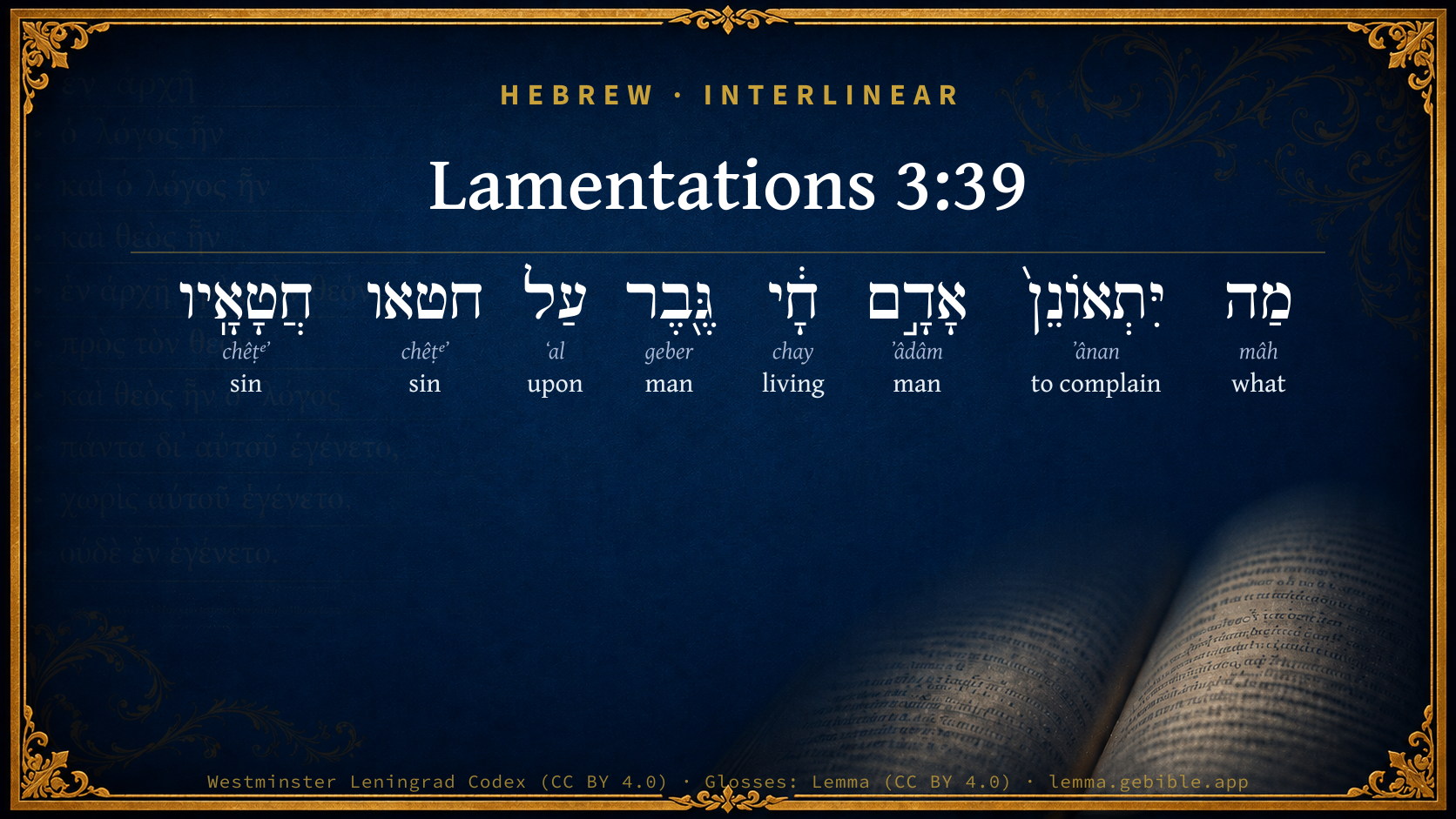
Hebrew (Westminster Leningrad Codex) Lamentations 3:39 appears in the Hebrew Old Testament. The text above is from the Westminster Leningrad Codex. Each word links to its Strong’s number, a concise gloss, and parsing drawn from the Open Scriptures Hebrew Bible morphology. Click any word for its full Brown-Driver-Briggs (BDB) entry.
Download image
Cite this verse

Lamentations 3:39 (World English Bible). Public Domain. Lemma interlinear Bible study tool, https://lemma.gebible.app/v/lamentations/3/39.

Show BibTeX & RIS
BibTeX
RIS
English Translation
Why does a living man complain, a man for the punishment of his sins?
World English Bible · Public Domain
Download a study sheet

One document with this verse’s original text, its word-by-word gloss line, the meaning frame, cross-references with their text, attributed commentary, and full source and license credits — printable, and it pastes into notes with its structure intact.

This verse Autodidact and up

Study sheet (.html) Plain text (.txt)

A passage Seminary Student

Up to 50 verses in one chapter. A passage sheet keeps up to 6 commentary sources and 12 cross-references per verse, in the order this page ranks them, and says so on the sheet whenever that leaves anything out. Ask for a single verse and you get the Autodidact verse sheet above.

Everything on this page stays free to read, with no account — the sheet is a download of what is already on screen, not access to it.

Want to remove ads? Support Godless Engineer
Compare translations 3

The same verse in 3 English versions, stacked beneath the original-language interlinear above. Click any original word for its lexicon entry.

Each is an independent rendering of the whole verse — the interlinear is not word-aligned to these translations.

Highlighted words mark where these versions differ — a whole-verse word diff, not a word-by-word alignment.

  • World English Bible Public Domain
    Why does a living man complain, a man for the punishment of his sins?
  • King James Version Public Domain
    Wherefore doth a living man complain, a man for the punishment of his sins?
  • unfoldingWord Literal Text CC BY-SA 4.0
    Why should a living man complain, a man about his sins? NUN

unfoldingWord Literal Text — © unfoldingWord, licensed CC BY-SA 4.0. Word-aligned USFM3 via Door43 (git.door43.org/unfoldingWord/en_ult).

Versions to compare (up to 4)

3 of 4 selected

Show all 18 translations

Every available English version of this verse, each an independent rendering of the whole verse.

  • World English Bible Public Domain
    Why does a living man complain, a man for the punishment of his sins?
  • Berean Standard Bible Public Domain
    Why should any mortal man complain, in view of his sins?
  • Majority Standard Bible Public Domain
    Why should any mortal man complain, in view of his sins?
  • King James Version Public Domain
    Wherefore doth a living man complain, a man for the punishment of his sins?
  • American Standard Version (1901) Public Domain
    Wherefore doth a living man complain, a man for the punishment of his sins?
  • Revised Version (1885) Public Domain
    Wherefore doth a living man complain, a man for the punishment of his sins?
  • Geneva Bible (1599) Public Domain
    Wherefore then is the liuing man sorowfull? man suffreth for his sinne.
  • Douay-Rheims (1899) Public Domain
    Mem. Why hath a living man murmured, man suffering for his sins?
  • Young's Literal Translation Public Domain
    What -- sigh habitually doth a living man, A man for his sin?
  • Literal Standard Version CC BY-SA 4.0
    Why does a living man sigh habitually, || A man for his sin?
  • Unlocked Literal Bible CC BY-SA 4.0
    How can any person alive complain? How can a person complain about the punishment for his sins?
  • unfoldingWord Literal Text CC BY-SA 4.0
    Why should a living man complain, a man about his sins? NUN
  • Darby Bible Public Domain
    Wherefore doth a living man complain, a man for the punishment of his sins?
  • World Messianic Bible Public Domain
    Why should a living man complain, a man for the punishment of his sins?
  • Webster's Bible Public Domain
    Why doth a living man complain, a man for the punishment of his sins?
  • Free Bible Version CC BY-SA 4.0
    Why should any human being complain about the results of their sins?
  • Bible in Basic English Public Domain
    What protest may a living man make, even a man about the punishment of his sin?
  • JPS Tanakh (1917) Public Domain
    Wherefore doth a living man complain, a strong man because of his sins?

Literal Standard Version (2020), Covenant Press — licensed CC BY-SA 4.0. Text via the HelloAO Bible API (eBible.org). Unlocked Literal Bible (unfoldingWord) — licensed CC BY-SA 4.0. Text via the HelloAO Bible API (eBible.org). unfoldingWord Literal Text — © unfoldingWord, licensed CC BY-SA 4.0. Word-aligned USFM3 via Door43 (git.door43.org/unfoldingWord/en_ult). Free Bible Version, Dr. Jonathan Gallagher — licensed CC BY-SA 4.0. Text via the HelloAO Bible API (eBible.org).

Word by word

More ways to search: Search by grammar → Find every occurrence → Compare this word →

Practice this passage: Drill this verse → Learn its vocabulary →

About this verse

These counts appear in no published source. They are computed here, from the morphology-tagged text and Lemma’s own curated glosses. What Lemma adds →

8
words
7
distinct lemmas
Prophets
section

Notable vocabulary

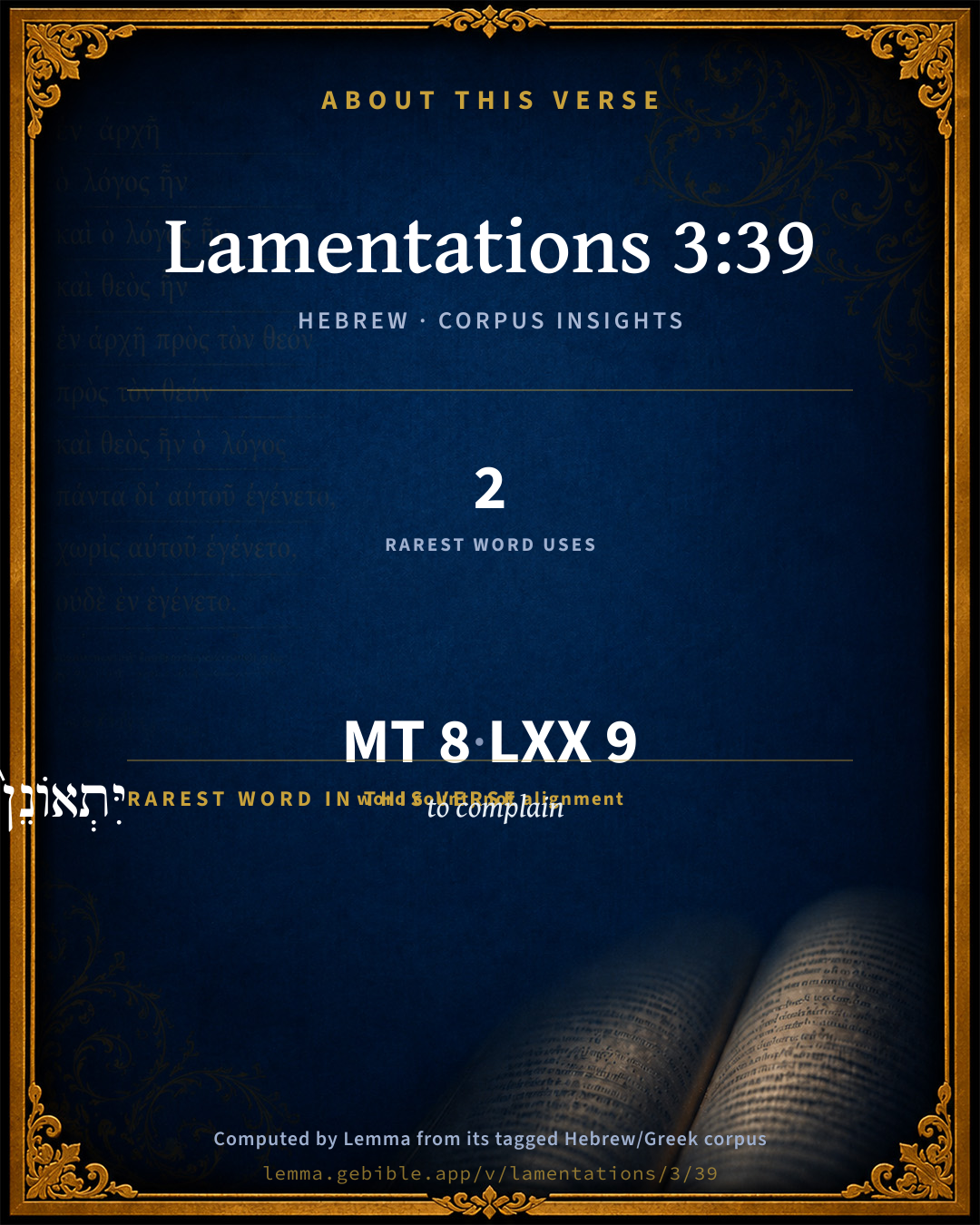
The rarest word here is יִּתְאוֹנֵן֙ to complain H596 — appearing just 2 times in the whole Hebrew Bible.

Shared distinctive vocabulary

יִּתְאוֹנֵן֙ to complain H596 occurs in 2 verses of the Hebrew Bible. Also found in:

Grammatical profile

  • 1 verb
  • 4 nouns
  • 1 adjective
  • 1 preposition
  • 1 particle

Verb forms

  • יִּתְאוֹנֵן֙ Hithpolel · Imperfect

Repetition

A word recurs within this verse — often emphatic in Hebrew:

Hebrew & Septuagint length

In English translation the verse runs 14 words from the Hebrew and 12 from the Septuagint (LXX English) — closely comparable.

A rough comparison of the two English renderings, which tokenize alike — not a word-level alignment.

Word counts can differ between the Hebrew and the Greek without any difference in meaning — e.g. the Hebrew direct-object marker אֵת has no separate Greek word, and Greek often adds the article ὁ.

In the original languages it is 8 Hebrew tokens and 9 Greek tokens — but the two are counted differently (Hebrew bundles its prefixes and suffixes into one token; the Greek is in lemma form), so that isn’t a like-for-like length.

Cross-references

23

Topical passages linked to Lamentations 3:39 in the Treasury of Scripture Knowledge — connected by theme and wording, ordered by reader-vote popularity; previews shown in the World English Bible.

  • Proverbs 19:3 The foolishness of man subverts his way; His heart rages against Yahweh.
  • Micah 7:9 I will bear the indignation of Yahweh, Because I have sinned against him, Until he pleads my case, and executes judgment for me. He will bring me forth to the light. I will see his righteousness.
  • Genesis 4:5–7 but he didn't respect Cain and his offering. Cain was very angry, and the expression on his face fell.
  • Jeremiah 30:15 Why cry you for your hurt? your pain is incurable: for the greatness of your iniquity, because your sins were increased, I have done these things to you.
  • Genesis 4:13–14 Cain said to Yahweh, "My punishment is greater than I can bear.
  • Leviticus 26:41 I also walked contrary to them, and brought them into the land of their enemies: if then their uncircumcised heart is humbled, and they then accept the punishment of their iniquity;
  • Leviticus 26:43 The land also will be left by them, and will enjoy its sabbaths while it lies desolate without them: and they will accept the punishment of their iniquity; because, even because they rejected my ordinances, and their soul abhorred my statutes.
  • Numbers 11:11 Moses said to Yahweh, Why have you dealt ill with your servant? and why haven't I found favor in your sight, that you lay the burden of all this people on me?
  • Numbers 17:12 The children of Israel spoke to Moses, saying, Behold, we perish, we are undone, we are all undone.
  • Joshua 7:6–13 Joshua tore his clothes, and fell to the earth on his face before the ark of Yahweh until the evening, he and the elders of Israel; and they put dust on their heads.
  • 2 Samuel 6:7–8 The anger of Yahweh was kindled against Uzzah; and God struck him there for his error; and there he died by the ark of God.
  • 2 Kings 3:13 Elisha said to the king of Israel, What have I to do with you? get you to the prophets of your father, and to the prophets of your mother. The king of Israel said to him, No; for Yahweh has called these three kings together to deliver them into the hand of Moab.
  • 2 Kings 6:32 But Elisha was sitting in his house, and the elders were sitting with him; and [the king] sent a man from before him: but before the messenger came to him, he said to the elders, See you how this son of a murderer has sent to take away my head? behold, when the messenger comes, shut the door, and hold the door fast against him: isn't the sound of his master's feet behind him?
  • Ezra 9:13 After all that is come on us for our evil deeds, and for our great guilt, seeing that you our God have punished us less than our iniquities deserve, and have given us such a remnant,
  • Job 11:6 That he would show you the secrets of wisdom! For true wisdom has two sides. Know therefore that God exacts of you less than your iniquity deserves.
  • Isaiah 38:17–19 Behold, [it was] for [my] peace [that] I had great bitterness: But you have in love to my soul delivered it from the pit of corruption; For you have cast all my sins behind your back.
  • Isaiah 51:20 Your sons have fainted, they lie at the head of all the streets, as an antelope in a net; they are full of the wrath of Yahweh, the rebuke of your God.
  • Lamentations 3:22 [It is of] Yahweh's loving kindnesses that we are not consumed, because his compassion doesn't fail.
  • Jonah 2:3–4 For you threw me into the depths, In the heart of the seas. The flood was all around me. All your waves and your billows passed over me.
  • Jonah 4:8–9 It happened, when the sun arose, that God prepared a sultry east wind; and the sun beat on Jonah's head, so that he fainted, and requested for himself that he might die, and said, "It is better for me to die than to live."
  • Hebrews 12:5–12 and you have forgotten the exhortation which reasons with you as with children, "My son, don't take lightly the chastening of the Lord, Nor faint when you are reproved by him;
  • Numbers 16:41 But on the next day all the congregation of the children of Israel murmured against Moses and against Aaron, saying, You have killed the people of Yahweh.
  • Revelation 16:9 People were scorched with great heat, and people blasphemed the name of God who has the power over these plagues. They didn't repent and give him glory.

Cross-references courtesy of OpenBible.info (CC BY 4.0).

Hebrew and Greek witnesses Masoretic Hebrew ↔ Greek Septuagint

The same verse in the two great witnesses to the Old Testament, shown verse-for-verse.

These are two independent witnesses, not word-aligned to each other, and the Septuagint is shown in lemma (dictionary) form.

Hebrew Lamentations 3:39 Masoretic · Westminster Leningrad Codex

מַה יִּתְאוֹנֵן֙ אָדָ֣ם חָ֔י גֶּ֖בֶר עַל חטאו חֲטָאָֽיו

Why does a living man complain, a man for the punishment of his sins?

World English Bible · Public Domain

Greek LXX Lamentations 3:39 Septuagint · lemma form

τίς γογγύζω ἄνθρωπος ζάω ἀνήρ περί ὁ ἁμαρτία αὐτός

MEM. Why should a living man complain, a man concerning his sin?

LXX2012 (modern English Septuagint) · Public Domain

Hebrew: Westminster Leningrad Codex (CC BY 4.0). Greek: Septuagint (public domain); English from LXX2012 (modern English Septuagint) (Public Domain). How the Septuagint differs from the Hebrew →

Commentary

Notes on Lamentations 3:39 from classic Christian and Jewish commentators (each source and its license shown beneath its notes). The classic Christian expositions comment on the surrounding passage and are grouped to its opening verse, so a note may address several verses; the Jewish commentaries on the Tanakh (Rashi and others) are per-verse, so they appear only where the commentator wrote on this verse.

Lemma curates 59 commentaries, every one of them public domain or Creative Commons licensed, each selected and text-cleaned for this edition rather than reprinted as found. About our sources →

Trapp's Complete Commentary

John Trapp

Lam 3:39 Wherefore doth a living man complain, a man for the punishment of his sins?

Ver. 39. Wherefore doth a living man complain?] Mourn immoderately, or murmur causelessly. 1. If he mourn, let him mourn for his sin as the cause of his suffering; let him revenge upon that. 2. If he be tempted to murmur, let him remember that he is yet alive, and that is more than his part cometh to, since it is the Lord’s mercy that he is not consumed, and sent packing hence to hell. Life in any sense is a sweet mercy, even that which to the afflicted may seem a lifeless life. {as Pro 15:15} Let this patient us, that we are yet alive.

A man for the punishment of his sins.] Heb., Man for his sin. For sin doth as naturally draw and suck punishments to it as the loadstone doth iron or turpentine fire; wherefore also the same word in Hebrew signifieth both.

John Trapp, A Commentary or Exposition upon All the Books of the Old and New Testament (1647–1656) — public domain. Text from a community e-Sword module.

Joseph Benson's Commentary

Lam 3:39. Wherefore, &c. — The prophet here seems to check and blame himself for the complaints he had made in the former part of the chapter, wherein he appeared to reflect upon God as unkind and severe. And from the doctrine of God’s sovereign and universal providence, which he had asserted in the last two verses, he draws this inference, Wherefore doth a living man complain? a man for the punishment of his sins? — No calamity or trouble befalls us, but what is the due reward of our sins; and is designed as a chastisement for them, in order to our purification and amendment, or for the trial of our grace, and in order to the exercise and increase of it. If we view our afflictions in this light, it will prevent all murmuring and repining against the providence of God. We shall learn to be patient and resigned under his chastising hand, and even thankful that he condescends to correct and try us for our profit, and by preserving us alive in the body still gives us space for repentance. “There seems,” says Blaney, “to be a peculiar emphasis laid on the words חי, [living,] and גבר, [man,] in this passage. גברis said to denote a man, because of his excellence and superiority over all other earthly beings. While a man therefore lives, and is possessed of those privileges of his nature, whatever he undergoes must be less than his sins have deserved, because death, which implies the loss of all those privileges, is the allotted wages of sin.” Mark well, reader, though we may pour out our complaints before God, we must never complain against or of God. How cogent are the reasons here suggested against such a conduct! We are men, let us herein show ourselves men. Shall a man complain? Shall a reasonable creature act contrary to all reason, and an immortal being forget or disregard his immortality? Shall he be so insensible of the value of the privileges of his nature, and of his obligations to God for them, as to abuse them to God’s dishonour, instead of using them to his glory? Shall he take upon him to censure or call in question the dispensations of infinite wisdom, justice, and goodness toward him, and act as if he thought he knew better than his Maker what is good for him? Shall a living man complain — a man who has a thousand times forfeited his life, with all the blessings of it, but to whom it is still continued, and with it many of its comforts, and particularly the means of attaining life everlasting — a hope, or a foundation whereon to build a hope, of felicity and glory for ever? A man for the punishment of his sins? A punishment infinitely less than his sins have deserved? and a punishment, or chastisement, rather, which the omniscient God knows to be absolutely necessary to bring him to repentance and reformation, if he will by any means whatever be brought thereto? Surely, reader, if we be suffering for our sins, instead of spending our time in complaining and repining, we ought to be employed in repenting and reforming, and, that we may have at least one evidence that God is reconciled to us, we should endeavour to reconcile ourselves to his holy and gracious will. Or, to consider the matter in another point of view: Are we punished for our sins? It is then our wisdom to submit, and kiss the rod; for if we still walk contrary to God, he will punish us still seven times more, for when he judgeth he will overcome; but if we accommodate ourselves to him, though we be chastened of the Lord, we shall not be condemned with the world.

Joseph Benson's Commentary on the Old and New Testaments (1811–1818) — public domain. Text from a community e-Sword module.

Geneva Bible (1599)

Geneva Bible translators

When God afflicteth him.

Geneva Bible (1599) marginal notes — public domain. Text via Bolls.life.

Jamieson, Fausset & Brown

Robert Jamieson, A. R. Fausset & David Brown

living--and so having a time yet given him by God for repentance. If sin were punished as it deserves, life itself would be forfeited by the sinner. "Complaining" (murmuring) ill becomes him who enjoys such a favor as life (Pro 19:3).

for the punishment of his sins--Instead of blaming God for his sufferings, he ought to recognize in them God's righteousness and the just rewards of his own sin.

Jamieson, Fausset & Brown — Commentary Critical and Explanatory on the Whole Bible (1871) — public domain (CC PDM 1.0). Text via the HelloAO Bible API.

Adam Clarke's Commentary

Verse 39. Wherefore doth a living man complain] He who has his life still lent to him has small cause of complaint. How great soever his affliction may be, he is still alive; therefore, he may seek and find mercy unto eternal life. Of this, death would deprive him; therefore let not a living man complain.

Adam Clarke's Commentary on the Bible (1810–1826) — public domain. Text from a community e-Sword/MySword module.

John Calvin's Commentaries

Some explain the verb יתאונן, itaunen, by giving it the sense of lying, “Why should man lie?” others, “Why should man murmur?” But I see not what sense there can be in rendering it lying or murmuring. Others translate thus, “Why should man harden himself?” but it is a mere conjecture. Now, this verb sometimes means to weary one’s self, in Hithpael. So in the eleventh chapter of Numbers, “The people murmured,” as some render the words; but I think differently; nor is there a doubt but that Moses meant that the people were wearied, so that they in a manner pined away; and this meaning is the most suitable here. For the Prophet had before rebuked those who imagined that God, having relinquished the care of the world, led an inactive and easy life in heaven; but now, in order to rouse the minds of all, he points out the remedy for this madness, even that men should not willingly weary themselves in their sins, but acknowledge that their wickedness is shewn to them whenever any adversity comes upon them. And surely men would not be so infatuated as to exclude God from the government of the world, were they to know themselves and seriously to call to mind their own deeds and words; for God would soon exhibit to them sure and notorious examples of his judgment. Whence then comes it, that we are so dull and stupid in considering the works of God? nay, that we think that God is like a spectre or an idol? even because we rot in our sins and contract a voluntary dullness; for we champ the bit, according to the old proverb.

We now, then, perceive why the Prophet joins this sentence, Why does a living man weary himself? and a man in his sins? for as long as men thus remain in their own dregs, they will never acknowledge God as the judge of the world, and thus they always go astray through their own perverse imaginations. If, then, we wish to dissipate all the mists which prevent us from seeing God’s providence, (that is, by the eyes of faith,) let every one be his own witness and the judge of his own life, and carefully examine himself; it will then immediately occur to us, that God is not without reason angry with us, and that we are afflicted with so many adversities, because our sins will come forth before us. We here see the cause of that madness which makes men to exclude God’s providence from human affairs, even because they look not on themselves, but torment themselves without any benefit and become wearied in their sins, and do not raise up their eyes to God. The rest, connected with our subject, I must defer till to-morrow.

John Calvin's Commentaries (1540-1563) — public domain. Text from the Calvin Translation Society English edition (1840s-50s) via the Christian Classics Ethereal Library (ccel.org). Calvin's coverage is partial (roughly two-thirds of the Bible); uncommented books and verses are honest gaps, never fabricated. The 19th-century editor's footnotes and remarks are omitted so the notes are faithfully Calvin's own voice.

Ellicott's Commentary for English Readers

(39) Wherefore doth a living man . . .—Better, Why doth a man who lives? i.e., whose life is spared him (comp. Jer_45:5), with all its possibilities of good, complain of sufferings which, however unjust as far as those who cause them are concerned, are, in relation to the sufferer, the just punishment of his own sins?

A Bible Commentary for English Readers, edited by Charles John Ellicott (1878–1897) — public domain. Text from a community e-Sword module.

The Cambridge Bible for Schools and Colleges

gen. ed. J. J. S. Perowne

39. The E.VV., making the whole line to be a question, are more in consonance with the construction of the two earlier members of the group, than is the other proposed rendering, viz. Of what should a living man complain? Each (should complain) of his sins. In that case we should require mourn rather than “complain.”

living] i.e. why should a man murmur at misfortunes, when they are due to him for his sin?

a man … his sins] mg. (less well) a man that is in his sins.

The Cambridge Bible for Schools and Colleges (gen. ed. J. J. S. Perowne; Cambridge University Press, 1878–1918) — public domain. Text from a community e-Sword module.

John Gill's Exposition

Thou hast covered with anger,.... Either himself; not as a tender father, that cannot bear to see the affliction of a child; this does not suit with anger; but rather as one greatly displeased, in whose face anger appears, being covered with it; or who covers his face with it, that he may not be seen, withdrawing his gracious presence; or hast put anger as a wall between thee and us, as Jarchi: so that there was no coming nigh to him: or else it means covering his people with it; so the Targum,

"thou hast covered "us" with anger;''

denoting the largeness and abundance of afflictions upon them; they were as it were covered with them, as tokens of the divine displeasure; one wave and billow after another passing over them. Sanctius thinks the allusion is to the covering of the faces of condemned malefactors, as a token of their being guilty:

and persecuted us; the Targum adds, in captivity; that is, pursued and followed us with fresh instances of anger and resentment; to have men to be persecutors is bad, but to have God to be a persecutor is dreadful:

thou hast slain, thou hast not pitied; had suffered them to be stain by the sword of the enemy, and had shown no compassion to them; See Gill on Lam 2:21; here, and in some following verses, the prophet, or the people he represents, are got to complaining again; though before he had checked himself for it; so hard it is under afflictions to put in practice what should be done by ourselves and others.

John Gill's Exposition of the Whole Bible (1746–1763) — public domain (CC PDM 1.0). Text via the HelloAO Bible API.

Haydock's Catholic Bible Commentary

Sins? If all happened by inevitable necessity, or according to the laws of Providence, why should any one complain?

George Leo Haydock (1774–1849), Haydock's Catholic Family Bible and Commentary, 1859 edition — public domain. Excludes Psalms (Douay-Rheims chapter numbering differs from Protestant) and Deuterocanonical books (Catholic canon only).

Matthew Poole's English Annotations

This verse admits of various senses, caused from the various interpretation of the Hebrew word, which we translate complain, which also signifies to mourn or grieve; so some render it, Why doth a living man grieve or vex himself? But the word is noted most generally to signify complaining or murmuring. The word also which we translate

sin sometimes signifieth that oblique act which we call sin; and those who interpret the former grieve or vex, thus understand the word translated sin, supplying some such words as these, Let him mourn for his sin. Why doth he mourn for his afflictions and plagues? let him rather spend his tears upon his sins. But the word also signifies the guilt of sin, or obligation to death, which it layeth men under: Sin lieth at the door, Gen 4:7; so also Gen 20:9; and also any punishment brought upon men for sin, Gen 4:13, where we translate it punishment. This sense our translators follow. The prophet then, in the person of the Jews, checks himself in his complaints for their punishments from the consideration, that nothing had befallen them but what was the just reward of their sins.

Matthew Poole's English Annotations on the Holy Bible (1683–1685) — public domain. Text from a community e-Sword/MySword module.

Whedon's Commentary on the Bible

Daniel D. Whedon

39. Living man — “Living” is emphatic. There is some difficulty as to the last clause of this verse, which has led to different translations. The word rendered punishment of his sins, has for its first and ordinary meaning sin; then the punishment for sin. The better rendering, then, seems to be, Why doth a living man complain? Let him sorrow for his sin.

Daniel D. Whedon (gen. ed.), Commentary on the Old and New Testaments (1874–1909) — public domain. Text from a community e-Sword module.

The Pulpit Commentary

Wherefore cloth a living man complain, etc.? The God of whom the poet speaks is the Searcher of hearts. Why, then, should a man complain when he knows that he deserves his punishment? The close of the verse should run, (Let ) a man (rather sigh) over his sins.

Why murmur?

The world is full of complaints and murmuring. It sometimes is observable that those whose lot is peculiarly fortunate, whose circumstances are peculiarly favourable, are foremost in complaint when anything occurs to them which does not fall in with their expectations, which does not correspond with their desires. On the other hand, we now and again meet with the poor, the suffering, the friendless, who display a cheerful, uncomplaining disposition.

I ALL PUNISHMENT IS DESERVED BY THOSE UPON WHOM IT IS INFLICTED. Conscience testifies to this. God hath not "rewarded us according to our iniquities." No afflicted one can plead innocence, can justly affirm that he has been treated with undue severity. For this reason affliction should be endured in silence and with submission.

II WHEN GOD CHASTISES HE DOES SO IN EQUITY, AND NOT IN INJUSTICE OR CAPRICE, The heathen attribute to arbitrary and fickle deities, even to malevolent deities, many of their misfortunes. But to us God is "righteous in all his works." To rebel against him is to question the wisdom of the only Wise, the justice of the supremely Righteous. The afflicted should look through the chastisement to the hand which inflicts it.

III TO REBEL AGAINST GOD IS TO RESIST HIS. PURPOSES OF COMPASSION WHICH INTEND our need. Observe that murmuring is not only wrong, it is most inexpedient. A complaining spirit is inconsistent with the disposition which alone can receive the wholesome lessons and discipline of sorrow and can turn them to highest and lasting profit. T.

The Pulpit Commentary (1880–1919), ed. H.D.M. Spence-Jones & Joseph S. Exell — public domain. Text from a community e-Sword module.

John Wesley's Explanatory Notes

Wherefore - The Jews, check themselves in their complaints from the consideration, that nothing had befallen them, but what was the just reward of their sins.

John Wesley, Explanatory Notes Upon the Whole Bible (1754–1765) — public domain. Text via the GEBible commentary corpus.

Lesson kit

Teaching starters — assembled from the data on this page, not authored interpretation. Every prompt links to the verse data it draws on. Edit before teaching.

Lamentations, in the Prophets, opens this verse with 8 words (7 distinct Hebrew lemmas). Its most distinctive word is ʼânan (“to complain”). A historical commentator’s framing appears above. Read the whole chapter for the surrounding context.

Discussion questions

  1. How does “to complain” (ʼânan) shape what this verse is saying?
  2. Numbers 11:1 shares the word «to complain» with this verse. How do the two illuminate each other?
  3. “sin” occurs 2× in this one verse. What is the effect of the repetition?
  4. These translations render this verse differently; the difference is in the English rendering, not the original. What questions does that raise?
  5. The verb «יִּתְאוֹנֵן֙» is Hithpolel Imperfect. How does its form color the action?
  6. Reading how Trapp's Complete Commentary and Joseph Benson's Commentary read this verse, where do the two commentators agree and where do they part?

Things to notice

Reading settings

Reading text

Shown beneath each verse's original-language words.

Old Testament
Old Testament edition

Read the OT as the Masoretic Hebrew (MT) or the Greek Septuagint (LXX).

English shown for the Greek Septuagint (in the Hebrew ↔ Greek comparison).

Comparing translations? Open the Compare panel on any verse page to stack up to four side by side.