Ezekiel 37:18

Hebrew (Westminster Leningrad Codex) Ezekiel 37:18 appears in the Hebrew Old Testament. The text above is from the Westminster Leningrad Codex. Each word links to its Strong’s number, a concise gloss, and parsing drawn from the Open Scriptures Hebrew Bible morphology. Click any word for its full Brown-Driver-Briggs (BDB) entry.
Download image
Cite this verse

Ezekiel 37:18 (World English Bible). Public Domain. Lemma interlinear Bible study tool, https://lemma.gebible.app/v/ezekiel/37/18.

Show BibTeX & RIS
BibTeX
RIS
English Translation
When the children of your people shall speak to you, saying, Will you not show us what you mean by these?
World English Bible · Public Domain
Download a study sheet

One document with this verse’s original text, its word-by-word gloss line, the meaning frame, cross-references with their text, attributed commentary, and full source and license credits — printable, and it pastes into notes with its structure intact.

This verse Autodidact and up

Study sheet (.html) Plain text (.txt)

A passage Seminary Student

Up to 50 verses in one chapter. A passage sheet keeps up to 6 commentary sources and 12 cross-references per verse, in the order this page ranks them, and says so on the sheet whenever that leaves anything out. Ask for a single verse and you get the Autodidact verse sheet above.

Everything on this page stays free to read, with no account — the sheet is a download of what is already on screen, not access to it.

Want to remove ads? Support Godless Engineer
Compare translations 3

The same verse in 3 English versions, stacked beneath the original-language interlinear above. Click any original word for its lexicon entry.

Each is an independent rendering of the whole verse — the interlinear is not word-aligned to these translations.

Highlighted words mark where these versions differ — a whole-verse word diff, not a word-by-word alignment.

  • World English Bible Public Domain
    When the children of your people shall speak to you, saying, Will you not show us what you mean by these?
  • King James Version Public Domain
    And when the children of thy people shall speak unto thee, saying, Wilt thou not shew us what thou meanest by these?
  • unfoldingWord Literal Text CC BY-SA 4.0
    When your people speak to you and say, ‘Will you not tell us what these things of yours mean?’

unfoldingWord Literal Text — © unfoldingWord, licensed CC BY-SA 4.0. Word-aligned USFM3 via Door43 (git.door43.org/unfoldingWord/en_ult).

Versions to compare (up to 4)

3 of 4 selected

Show all 18 translations

Every available English version of this verse, each an independent rendering of the whole verse.

  • World English Bible Public Domain
    When the children of your people shall speak to you, saying, Will you not show us what you mean by these?
  • Berean Standard Bible Public Domain
    When your people ask you, ‘Won’t you explain to us what you mean by these?’
  • Majority Standard Bible Public Domain
    When your people ask you, ‘Won’t you explain to us what you mean by these?’
  • King James Version Public Domain
    And when the children of thy people shall speak unto thee, saying, Wilt thou not shew us what thou meanest by these?
  • American Standard Version (1901) Public Domain
    And when the children of thy people shall speak unto thee, saying, Wilt thou not show us what thou meanest by these?
  • Revised Version (1885) Public Domain
    And when the children of thy people shall speak unto thee, saying, Wilt thou not shew us what thou meanest by these?
  • Geneva Bible (1599) Public Domain
    And when the children of thy people shall speake vnto thee, saying, Wilt thou not shewe vs what thou meanest by these?
  • Douay-Rheims (1899) Public Domain
    And when the children of thy people shall speak to thee, saying: Wilt thou not tell us what thou meanest by this?
  • Young's Literal Translation Public Domain
    `And when sons of thy people speak unto thee, saying, Dost thou not declare to us what these `are' to thee?
  • Literal Standard Version CC BY-SA 4.0
    And when sons of your people speak to you, saying, Do you not declare to us what these [are] to you?
  • Unlocked Literal Bible CC BY-SA 4.0
    When your people speak to you and say, 'Will you not tell us what these things of yours mean?'
  • unfoldingWord Literal Text CC BY-SA 4.0
    When your people speak to you and say, ‘Will you not tell us what these things of yours mean?’
  • Darby Bible Public Domain
    And when the children of my people speak unto thee, saying, Wilt thou not declare unto us what thou meanest by these?
  • World Messianic Bible Public Domain
    “When the children of your people speak to you, saying, ‘Won’t you show us what you mean by these?’
  • Webster's Bible Public Domain
    And when the children of thy people shall speak to thee, saying, Wilt thou not show us what thou meanest by these?
  • Free Bible Version CC BY-SA 4.0
    When your people come and ask you, ‘Are you going to explain what this is all about?’
  • Bible in Basic English Public Domain
    And when the children of your people say to you, Will you not make clear to us what these things have to do with us?
  • JPS Tanakh (1917) Public Domain
    And when the children of thy people shall speak unto thee, saying: Wilt thou not tell us what thou meanest by these?

Literal Standard Version (2020), Covenant Press — licensed CC BY-SA 4.0. Text via the HelloAO Bible API (eBible.org). Unlocked Literal Bible (unfoldingWord) — licensed CC BY-SA 4.0. Text via the HelloAO Bible API (eBible.org). unfoldingWord Literal Text — © unfoldingWord, licensed CC BY-SA 4.0. Word-aligned USFM3 via Door43 (git.door43.org/unfoldingWord/en_ult). Free Bible Version, Dr. Jonathan Gallagher — licensed CC BY-SA 4.0. Text via the HelloAO Bible API (eBible.org).

Word by word

More ways to search: Search by grammar → Find every occurrence → Compare this word →

Practice this passage: Drill this verse → Learn its vocabulary →

תַגִּ֥יד
nâgad
H5046
“to make known”
Verb, Hiphil, Imperfect, 2nd Person, Masculine, Singular
Part of Speech
Verb
Stem
Hiphil
Form
Imperfect
Person
2nd Person
Gender
Masculine
Number
Singular
Full BDB Definition

Origin: a primitive root

TWOT: 1289

to be conspicuous, tell, make known - (Hiphil) to tell, declare - to tell, announce, report - to declare, make known, expound - to inform of - to publish, declare, proclaim - to avow, acknowledge, confess - messenger (participle) - (Hophal) to be told, be announced, be reported
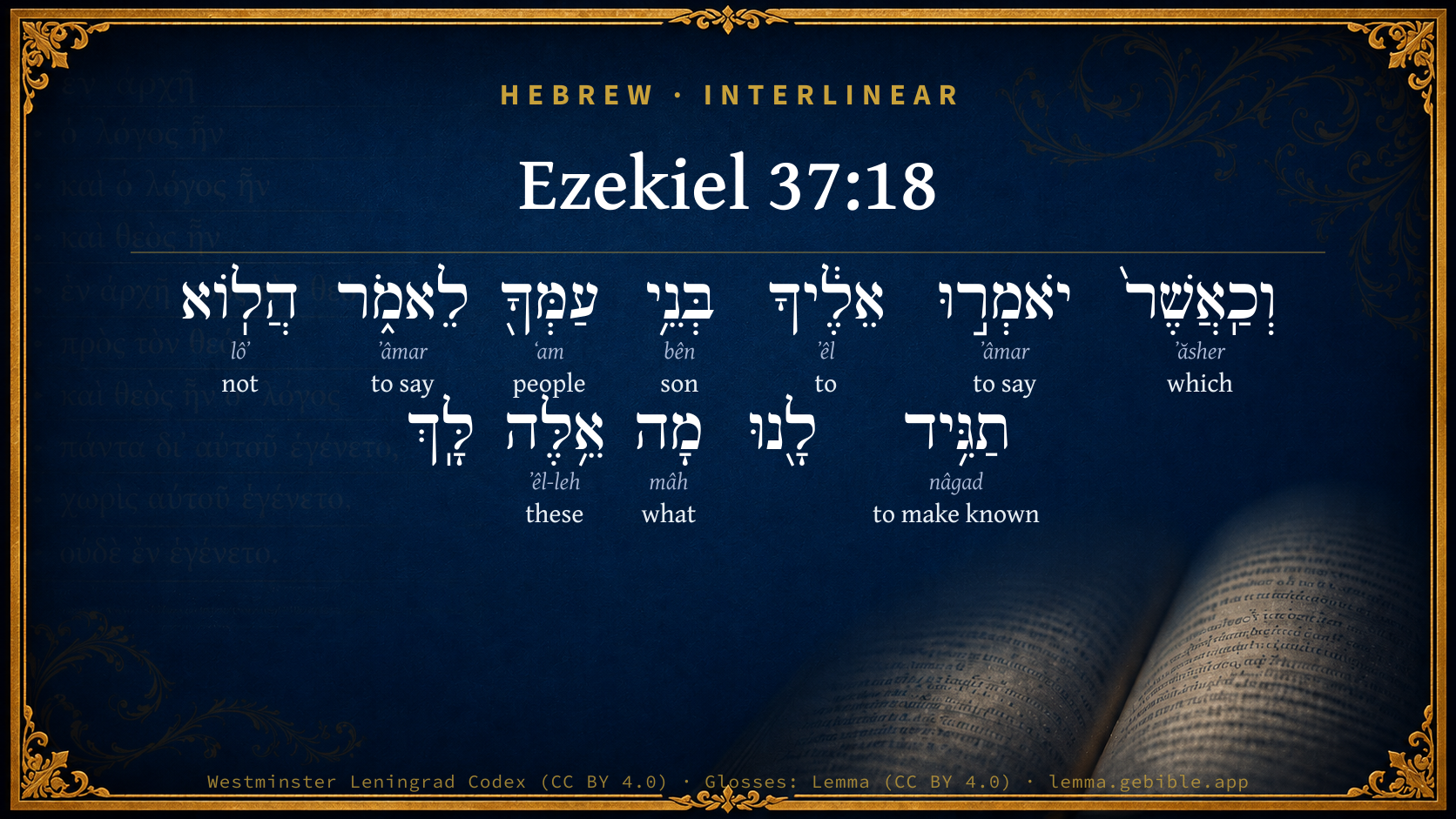
  1. וְכַֽאֲשֶׁר֙ ʼăsher H834 “and · like/as · which” Conjunction + Preposition + Particle, Relative
  2. יֹאמְר֣וּ ʼâmar H559 “to say” Verb, Qal, Imperfect, 3rd Person, Masculine, Plural
  3. אֵלֶ֔יךָ ʼêl H413 “to · you” Preposition + Suffix, Personal, 2nd Person, Masculine, Singular
  4. בְּנֵ֥י bên H1121 “sons of” Noun, Common, Masculine, Plural, Construct
  5. עַמְּךָ֖ ʻam H5971 “people · your” Noun, Common, Masculine, Singular, Construct + Suffix, Personal, 2nd Person, Masculine, Singular
  6. לֵאמֹ֑ר ʼâmar H559 “to say” Preposition + Verb, Qal, Infinitive Construct
  7. הֲלֽוֹא lôʼ H3808 “not” Particle, Interrogative + Particle, Negative
  8. מָה mâh H4100 “what” Particle, Interrogative
  9. אֵ֥לֶּה ʼêl-leh H428 “these” Pronoun, Demonstrative, Common, Plural

About this verse

These counts appear in no published source. They are computed here, from the morphology-tagged text and Lemma’s own curated glosses. What Lemma adds →

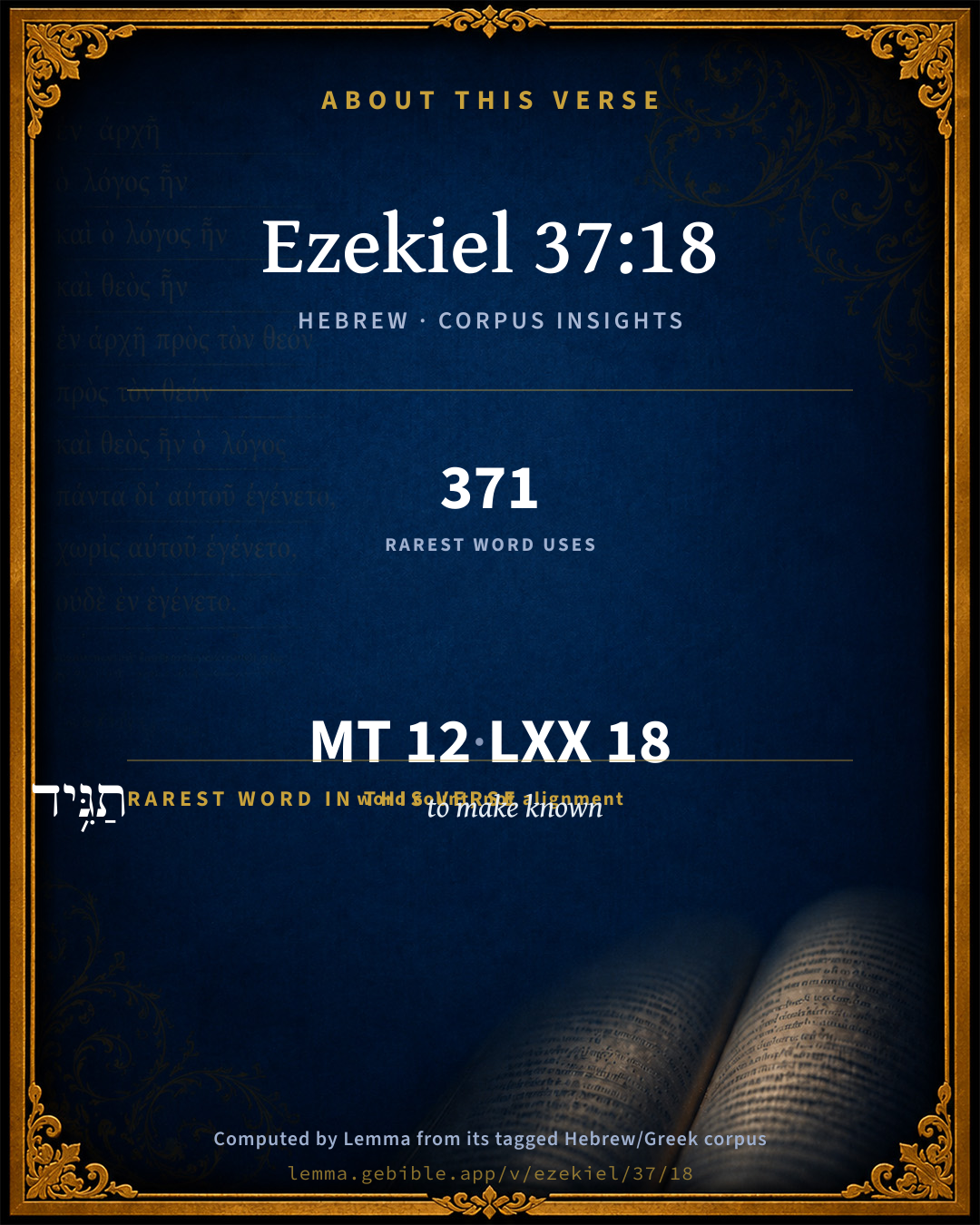
12
words
9
distinct lemmas
Prophets
section

Grammatical profile

  • 3 verbs
  • 2 nouns
  • 1 pronoun
  • 3 prepositions
  • 3 particles

Verb forms

  • יֹאמְר֣וּ Qal · Imperfect
  • לֵאמֹ֑ר Qal · Infinitive Construct
  • תַגִּ֥יד Hiphil · Imperfect

Repetition

A word recurs within this verse — often emphatic in Hebrew:

  • יֹאמְר֣וּ to say H559 ×2

Hebrew & Septuagint length

In English translation the verse runs 21 words from the Hebrew and 27 from the Septuagint (LXX English) — closely comparable.

A rough comparison of the two English renderings, which tokenize alike — not a word-level alignment.

Word counts can differ between the Hebrew and the Greek without any difference in meaning — e.g. the Hebrew direct-object marker אֵת has no separate Greek word, and Greek often adds the article ὁ.

In the original languages it is 12 Hebrew tokens and 18 Greek tokens — but the two are counted differently (Hebrew bundles its prefixes and suffixes into one token; the Greek is in lemma form), so that isn’t a like-for-like length.

Cross-references

4

Topical passages linked to Ezekiel 37:18 in the Treasury of Scripture Knowledge — connected by theme and wording, ordered by reader-vote popularity; previews shown in the World English Bible.

  • Ezekiel 24:19 The people said to me, Won't you tell us what these things are to us, that you do so?
  • Ezekiel 12:9 Son of man, has not the house of Israel, the rebellious house, said to you, What do you?
  • Ezekiel 17:12 Say now to the rebellious house, Don't you know what these things mean? tell them, Behold, the king of Babylon came to Jerusalem, and took the king of it, and the princes of it, and brought them to him to Babylon:
  • Ezekiel 20:49 Then said I, Ah Lord Yahweh! they say of me, Isn't he a speaker of parables?

Cross-references courtesy of OpenBible.info (CC BY 4.0).

Hebrew and Greek witnesses Masoretic Hebrew ↔ Greek Septuagint

The same verse in the two great witnesses to the Old Testament, shown verse-for-verse.

These are two independent witnesses, not word-aligned to each other, and the Septuagint is shown in lemma (dictionary) form.

Hebrew Ezekiel 37:18 Masoretic · Westminster Leningrad Codex

וְכַֽאֲשֶׁר֙ יֹאמְר֣וּ אֵלֶ֔יךָ בְּנֵ֥י עַמְּךָ֖ לֵאמֹ֑ר הֲלֽוֹא תַגִּ֥יד לָ֖נוּ מָה אֵ֥לֶּה לָּֽךְ

When the children of your people shall speak to you, saying, Will you not show us what you mean by these?

World English Bible · Public Domain

Greek LXX Ezekiel 37:18 Septuagint · lemma form

καί εἰμί ὅταν λέγω πρός σύ ὁ υἱός ὁ λαός σύ οὐ ἀναἀγγέλλω ἐγώ τίς εἰμί οὗτος σύ

And it shall come to pass, when the children of your people shall say to you, Will you not tell us what you meanest by these things?

LXX2012 (modern English Septuagint) · Public Domain

On this verse, The Pulpit Commentary discusses the Septuagint’s reading. Read the note in Commentary ↓

Hebrew: Westminster Leningrad Codex (CC BY 4.0). Greek: Septuagint (public domain); English from LXX2012 (modern English Septuagint) (Public Domain). How the Septuagint differs from the Hebrew →

Targum (Aramaic paraphrase)

1

The Targum is the ancient Jewish Aramaic paraphrase of the Hebrew Scriptures — an interpretive translation, not the Hebrew text itself. Onkelos (literal) and Pseudo-Jonathan (expansive) render the Torah, and Jonathan the Prophets. Coverage is partial: where no permissively-licensed English translation exists for a verse, only the Aramaic is shown. This is verse-level text, not a word-by-word alignment to the Hebrew.

  1. Targum Jonathan Prophets (Joshua–Malachi)
    וְכַד יֵימְרוּן לָךְ בְּנֵי עַמָךְ לְמֵימָר הֲלָא תְחַוֵי לָנָא מָה אִלֵין לָךְ:

    (no public-domain English translation for this verse)

    Targum Jonathan — Aramaic: “Mikraot Gedolot” (public domain). English: “Sefaria Community Translation” (CC0 1.0 (public-domain dedication)); “London "Chaldee Paraphrase," 1871” (public domain). Text via Sefaria.

Commentary

Notes on Ezekiel 37:18 from classic Christian and Jewish commentators (each source and its license shown beneath its notes). The classic Christian expositions comment on the surrounding passage and are grouped to its opening verse, so a note may address several verses; the Jewish commentaries on the Tanakh (Rashi and others) are per-verse, so they appear only where the commentator wrote on this verse.

Lemma curates 59 commentaries, every one of them public domain or Creative Commons licensed, each selected and text-cleaned for this edition rather than reprinted as found. About our sources →

Trapp's Complete Commentary

John Trapp

Eze 37:18 And when the children of thy people shall speak unto thee, saying, Wilt thou not shew us what thou [meanest] by these?

Ver. 18. Wilt thou not show us what thou meanest by these?] People, though they should not be question sick, as some in St Paul’s time were, {1Ti 6:4} yet they should be inquisitive after truth according to godliness. {Tit 1:1}

John Trapp, A Commentary or Exposition upon All the Books of the Old and New Testament (1647–1656) — public domain. Text from a community e-Sword module.

Joseph Benson's Commentary

Eze 37:18-20. Wilt thou not show us what thou meanest — Ezekiel foretold many things by signs; and the Jews were very inquisitive into the meaning of them: but sometimes their curiosity proceeded rather from a secret contempt of the prophet and his predictions, than a real desire of information. Say, I will take the stick of Joseph — On which Joseph’s name was written, and which represents Joseph, that is, the kingdom of the ten tribes; which is in the hand of Ephraim — Of which Ephraim is the head. They shall be one in my hand — I will make them one nation, and appoint one king to rule over them, namely, Christ the Messiah. And the sticks, &c., shall be before their eyes — Thou shalt place the sticks, or rods, thus joined together, before their eyes, as a visible token or pledge of the truth of what I enjoin thee to speak to them in the following words.

Joseph Benson's Commentary on the Old and New Testaments (1811–1818) — public domain. Text from a community e-Sword module.

Jamieson, Fausset & Brown

Robert Jamieson, A. R. Fausset & David Brown

God does not explain the symbolical prophecy until the Jews have been stimulated by the type to consult the prophet.

Jamieson, Fausset & Brown — Commentary Critical and Explanatory on the Whole Bible (1871) — public domain (CC PDM 1.0). Text via the HelloAO Bible API.

John Gill's Exposition

And when the children of thy people shall speak unto thee, saying,.... The children of Israel and Judah in captivity, of which people Ezekiel was and to whom he was sent as a prophet; who seeing him take two sticks, and write on them, and then join them together, would naturally put such a question to him:

wilt thou not show us what thou meanest by these? for they concluded he had some meaning in it, and that it was not a mere childish diversion and amusement; and therefore would desire that he would let them know what it was: whether they would ask this seriously or in banter, out of curiosity or in contempt, as they sometimes did; it matters not, he was to give them an answer, as follows; though, by the manner of their putting the question, it looks as if they were doubtful whether he would or not; since they had treated him in a sneering way on such like occasions before.

John Gill's Exposition of the Whole Bible (1746–1763) — public domain (CC PDM 1.0). Text via the HelloAO Bible API.

Matthew Poole's English Annotations

When; so soon as.

The children of thy people; to whom thou art watchman by office, and near of kin by natural descent.

Wilt thou not? there was some reason why they might doubt whether he would, because they had carried it so, frowardly toward him; therefore they request it by an interrogatory, Wilt thou not? We shall never know the meaning unless thou unfold it; wilt thou not do it then?

Matthew Poole's English Annotations on the Holy Bible (1683–1685) — public domain. Text from a community e-Sword/MySword module.

The Pulpit Commentary

Vers. 18-20. Wilt thou not show us what thou meanest by these? literally, what these (two pieces of wood) are to thee. The suggestion that such a request would be preferred to Ezekiel makes it clear he was meant to perform the symbolic action in public. That his countrymen should fail to understand this action accorded with their proverbial dullness of apprehension. (comp. Eze_12:9 Eze_24:19) In explanation, the prophet was enjoined to say unto them, while holding the sticks in his hand, that just as he had made the sticks one in his hand, so would God make one in his hand the two kingdoms symbolized by the sticks. The union of the sticks was to be Ezekiel"s work (ver. 17, "in thy hand"); the union of the kingdoms should be Jehovah"s (ver. 19, "in my hand"). The separation of the kingdoms had been Ephraim"s doing ("in the hand of Ephraim"); their combination should be God"s ("in my hand"). Their severance had been effected, on the part of Ephraim, by an unlawful breaking off from the house of Judah, and the establishment of an independent kingdom; their unification should be brought about by the putting down of Ephraim, and the confirming of the crown rights of Judah. The translation, And will put them with him, even with the stick of Judah, signifying "And will put the tribes of Israel with him." i.e. the tribe of Judah, supported by the LXX, and preferred by Ewald, Smend, and others, is superior to that of the Revised Version margin, "And will put them together with it, unto or, " to be" the stick of Judah." Keil s rendering, "I will take the stick of Joseph... and the tribes of Israel his companions, which I put thereon literally, "and I put them," viz. the tribes, "upon it," i.e. the stick of Joseph with the stick of Judah," is too involved.

The Pulpit Commentary (1880–1919), ed. H.D.M. Spence-Jones & Joseph S. Exell — public domain. Text from a community e-Sword module.

unfoldingWord translationNotes

Door43 World Missions Community

General Information:

Yahweh continues speaking to Ezekiel.

what these things of yours mean

"what your sticks mean" or "why you have these sticks"

Behold!

This tells the reader to pay special attention to what follows. AT: "Look!" or "Listen!" or "Pay attention to what I am about to tell you!"

the branch of Joseph

"the stick of Joseph." This represents the kingdom of Israel. (See: Metonymy)

that is in the hand of Ephraim

The word "hand" refers to power. AT: "that is in the power of Ephraim" or "that the tribe of Ephraim rules over" (See: Metonymy)

the tribes of Israel his companions

"the other tribes of Israel who are his companions" or "the other tribes of Israel who are part of that kingdom"

the branch of Judah

"the stick of Judah." This represents the kingdom of Judah. (See: Metonymy)

before their eyes

Here the people are represented by their "eyes" to emphasize what they see. AT: "while they watched you" (See: Synecdoche)

translationWords

Lord Yahweh

tribe

hand

unfoldingWord translationNotes — © Distant Shores Media and the Door43 World Missions Community, licensed CC BY-SA 4.0. Source: git.door43.org/Door43/en_tn.

Lesson kit

Teaching starters — assembled from the data on this page, not authored interpretation. Every prompt links to the verse data it draws on. Edit before teaching.

Ezekiel, in the Prophets, opens this verse with 12 words (9 distinct Hebrew lemmas). Its most distinctive word is nâgad (“to make known”). A historical commentator’s framing appears above. Read the whole chapter for the surrounding context.

Discussion questions

  1. What does “to make known” (nâgad) contribute to the verse as a whole?
  2. Ezekiel 24:19 shares this passage’s theme. How do the two illuminate each other?
  3. “to say” occurs 2× in this one verse. What is the effect of the repetition?
  4. These translations render this verse differently. What is at stake in choosing one wording over another?
  5. The verb «יֹאמְר֣וּ» is Qal Imperfect. How does its form color the action?
  6. Reading how Trapp's Complete Commentary and Joseph Benson's Commentary read this verse, where do the two commentators agree and where do they part?

Things to notice

Reading settings

Reading text

Shown beneath each verse's original-language words.

Old Testament
Old Testament edition

Read the OT as the Masoretic Hebrew (MT) or the Greek Septuagint (LXX).

English shown for the Greek Septuagint (in the Hebrew ↔ Greek comparison).

Comparing translations? Open the Compare panel on any verse page to stack up to four side by side.