
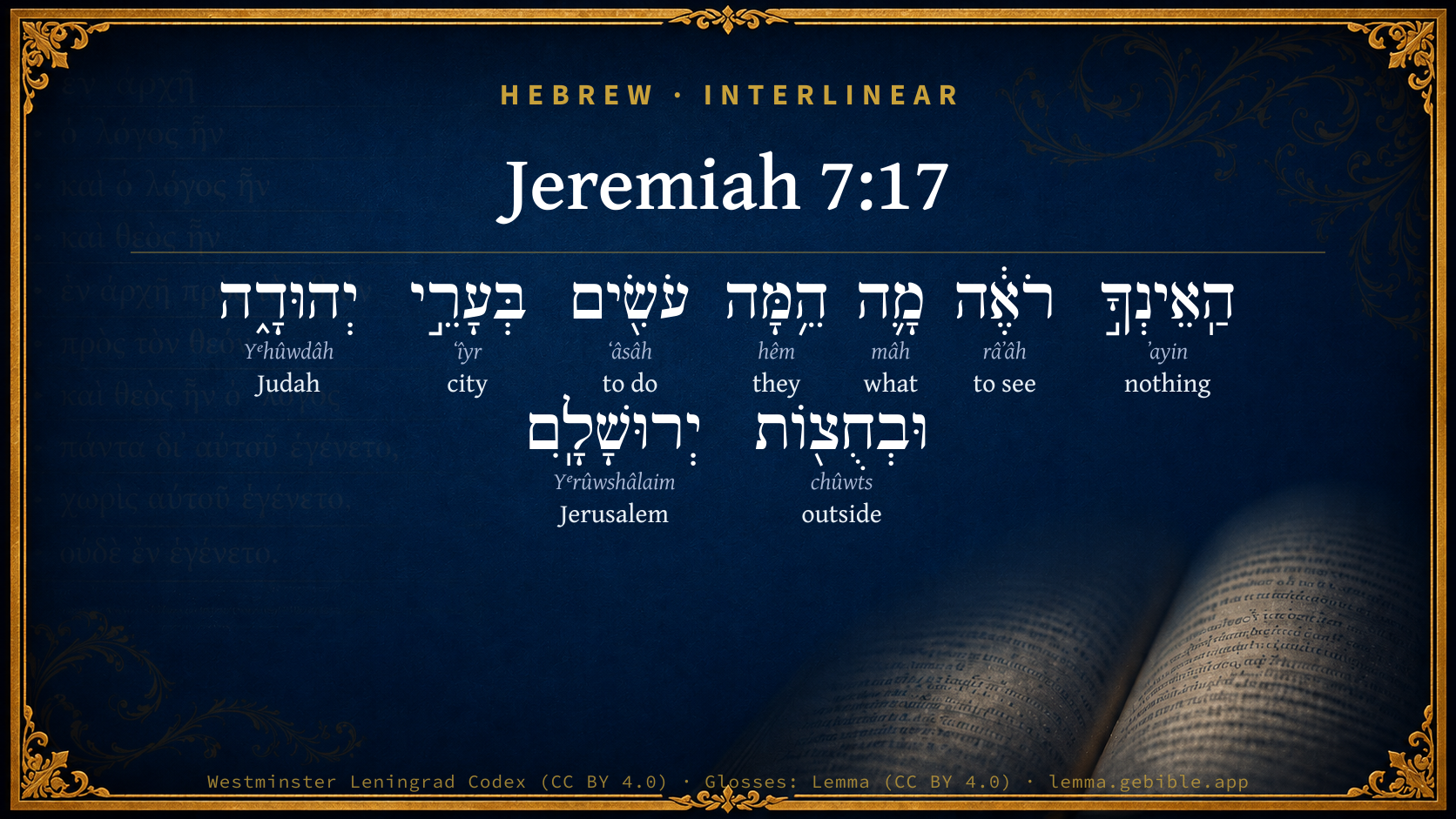
Jeremiah 7:17

Hebrew (Westminster Leningrad Codex) Jeremiah 7:17 appears in the Hebrew Old Testament. The text above is from the Westminster Leningrad Codex. Each word links to its Strong’s number, a concise gloss, and parsing drawn from the Open Scriptures Hebrew Bible morphology. Click any word for its full Brown-Driver-Briggs (BDB) entry.
Download image
Cite this verse

Jeremiah 7:17 (World English Bible). Public Domain. Lemma interlinear Bible study tool, https://lemma.gebible.app/v/jeremiah/7/17.

Show BibTeX & RIS
BibTeX
RIS
English Translation
Don't you see what they do in the cities of Judah and in the streets of Jerusalem?
World English Bible · Public Domain
Download a study sheet

One document with this verse’s original text, its word-by-word gloss line, the meaning frame, cross-references with their text, attributed commentary, and full source and license credits — printable, and it pastes into notes with its structure intact.

This verse Autodidact and up

Study sheet (.html) Plain text (.txt)

A passage Seminary Student

Up to 50 verses in one chapter. A passage sheet keeps up to 6 commentary sources and 12 cross-references per verse, in the order this page ranks them, and says so on the sheet whenever that leaves anything out. Ask for a single verse and you get the Autodidact verse sheet above.

Everything on this page stays free to read, with no account — the sheet is a download of what is already on screen, not access to it.

Want to remove ads? Support Godless Engineer
Compare translations 3

The same verse in 3 English versions, stacked beneath the original-language interlinear above. Click any original word for its lexicon entry.

Each is an independent rendering of the whole verse — the interlinear is not word-aligned to these translations.

Highlighted words mark where these versions differ — a whole-verse word diff, not a word-by-word alignment.

  • World English Bible Public Domain
    Don't you see what they do in the cities of Judah and in the streets of Jerusalem?
  • King James Version Public Domain
    Seest thou not what they do in the cities of Judah and in the streets of Jerusalem?
  • unfoldingWord Literal Text CC BY-SA 4.0
    Do you not see what they are doing in the cities of Judah and in the streets of Jerusalem?

unfoldingWord Literal Text — © unfoldingWord, licensed CC BY-SA 4.0. Word-aligned USFM3 via Door43 (git.door43.org/unfoldingWord/en_ult).

Versions to compare (up to 4)

3 of 4 selected

Show all 18 translations

Every available English version of this verse, each an independent rendering of the whole verse.

  • World English Bible Public Domain
    Don't you see what they do in the cities of Judah and in the streets of Jerusalem?
  • Berean Standard Bible Public Domain
    Do you not see what they are doing in the cities of Judah and in the streets of Jerusalem?
  • Majority Standard Bible Public Domain
    Do you not see what they are doing in the cities of Judah and in the streets of Jerusalem?
  • King James Version Public Domain
    Seest thou not what they do in the cities of Judah and in the streets of Jerusalem?
  • American Standard Version (1901) Public Domain
    Seest thou not what they do in the cities of Judah and in the streets of Jerusalem?
  • Revised Version (1885) Public Domain
    Seest thou not what they do in the cities of Judah and in the streets of Jerusalem?
  • Geneva Bible (1599) Public Domain
    Seest thou not what they doe in the cities of Iudah and in the streetes of Ierusalem?
  • Douay-Rheims (1899) Public Domain
    Seest thou not what they do in the cities of Juda, and in the streets of Jerusalem?
  • Young's Literal Translation Public Domain
    Art thou not seeing what they are doing In cities of Judah, and in streets of Jerusalem?
  • Literal Standard Version CC BY-SA 4.0
    Are you not seeing what they are doing || In cities of Judah, and in streets of Jerusalem?
  • Unlocked Literal Bible CC BY-SA 4.0
    Do you not see what they are doing in the cities of Judah and in the streets of Jerusalem?
  • unfoldingWord Literal Text CC BY-SA 4.0
    Do you not see what they are doing in the cities of Judah and in the streets of Jerusalem?
  • Darby Bible Public Domain
    Seest thou not what they do in the cities of Judah, and in the streets of Jerusalem?
  • World Messianic Bible Public Domain
    Don’t you see what they do in the cities of Judah and in the streets of Jerusalem?
  • Webster's Bible Public Domain
    Seest thou not what they do in the cities of Judah and in the streets of Jerusalem?
  • Free Bible Version CC BY-SA 4.0
    Can't you see how they're behaving in the towns of Judah and in the streets of Jerusalem?
  • Bible in Basic English Public Domain
    Do you not see what they are doing in the towns of Judah and in the streets of Jerusalem?
  • JPS Tanakh (1917) Public Domain
    Seest thou not what they do in the cities of Judah and in the streets of Jerusalem?

Literal Standard Version (2020), Covenant Press — licensed CC BY-SA 4.0. Text via the HelloAO Bible API (eBible.org). Unlocked Literal Bible (unfoldingWord) — licensed CC BY-SA 4.0. Text via the HelloAO Bible API (eBible.org). unfoldingWord Literal Text — © unfoldingWord, licensed CC BY-SA 4.0. Word-aligned USFM3 via Door43 (git.door43.org/unfoldingWord/en_ult). Free Bible Version, Dr. Jonathan Gallagher — licensed CC BY-SA 4.0. Text via the HelloAO Bible API (eBible.org).

Word by word

More ways to search: Search by grammar → Find every occurrence → Compare this word →

Practice this passage: Drill this verse → Learn its vocabulary →

וּבְחֻצ֖וֹת
chûwts
H2351
“and · in/at · streets of”
Conjunction + Preposition + Noun, Common, Masculine, Plural, Construct
Part of Speech
Conjunction + Preposition + Noun
Type
Common
Gender
Masculine
Number
Plural
State
Construct
Full BDB Definition

Origin: (both forms fem. in the pl.) from an unused root meaning to sever

TWOT: 627a

outside, outward, street, the outside
  1. הַֽאֵינְךָ֣ ʼayin H369 “nothing · you” Particle, Interrogative + Particle, Negative + Suffix, Personal, 2nd Person, Masculine, Singular
  2. רֹאֶ֔ה râʼâh H7200 “seeing” Verb, Qal, Participle Active, Masculine, Singular, Absolute
  3. מָ֛ה mâh H4100 “what” Particle, Interrogative
  4. הֵ֥מָּה hêm H1992 “they” Pronoun, Personal, 3rd Person, Masculine, Plural
  5. עֹשִׂ֖ים ʻâsâh H6213 “doing” Verb, Qal, Participle Active, Masculine, Plural, Absolute
  6. בְּעָרֵ֣י ʻîyr H5892 “in/at · cities of” Preposition + Noun, Common, Feminine, Plural, Construct
  7. יְהוּדָ֑ה Yᵉhûwdâh H3063 “Judah” Noun, Proper
  8. יְרוּשָׁלִָֽם Yᵉrûwshâlaim H3389 “Jerusalem” Noun, Proper

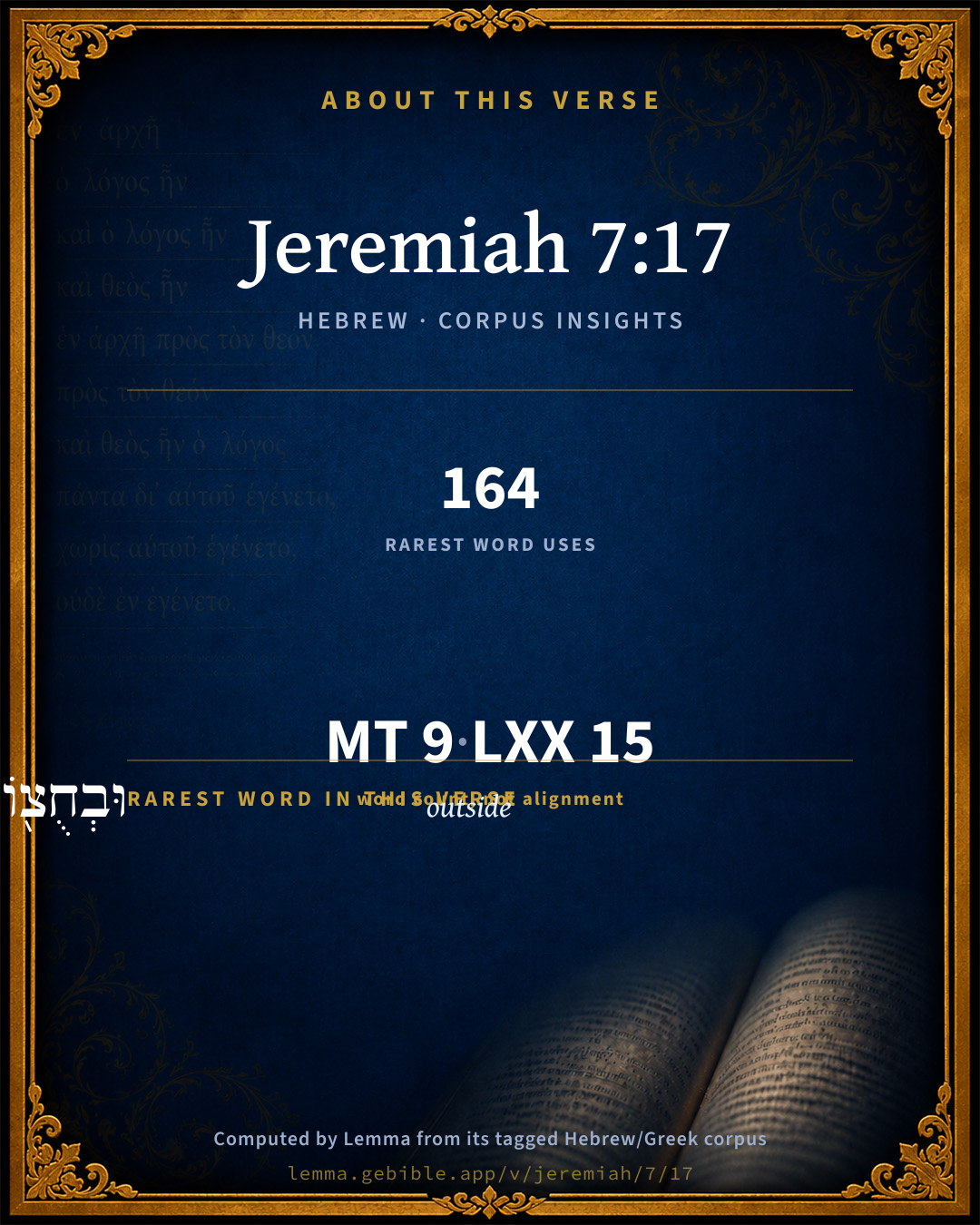
About this verse

These counts appear in no published source. They are computed here, from the morphology-tagged text and Lemma’s own curated glosses. What Lemma adds →

9
words
9
distinct lemmas
Prophets
section

Grammatical profile

  • 2 verbs
  • 4 nouns
  • 1 pronoun
  • 2 particles

Verb forms

  • רֹאֶ֔ה Qal · Participle Active
  • עֹשִׂ֖ים Qal · Participle Active

Hebrew & Septuagint length

In the original languages it is 9 Hebrew tokens and 15 Greek tokens — but the two are counted differently (Hebrew bundles its prefixes and suffixes into one token; the Greek is in lemma form), so that isn’t a like-for-like length.

Cross-references

3

Topical passages linked to Jeremiah 7:17 in the Treasury of Scripture Knowledge — connected by theme and wording, ordered by reader-vote popularity; previews shown in the World English Bible.

  • Ezekiel 8:6–18 He said to me, Son of man, see you what they do? even the great abominations that the house of Israel do commit here, that I should go far off from my sanctuary? but you shall again see yet other great abominations.
  • Ezekiel 14:23 They shall comfort you, when you see their way and their doings; and you shall know that I have not done without cause all that I have done in it, says the Lord Yahweh.
  • Jeremiah 6:27 I have made you a tester of metals [and] a fortress among my people; that you may know and try their way.

Cross-references courtesy of OpenBible.info (CC BY 4.0).

Hebrew and Greek witnesses Masoretic Hebrew ↔ Greek Septuagint

The same verse in the two great witnesses to the Old Testament, shown verse-for-verse.

These are two independent witnesses, not word-aligned to each other, and the Septuagint is shown in lemma (dictionary) form.

Hebrew Jeremiah 7:17 Masoretic · Westminster Leningrad Codex

הַֽאֵינְךָ֣ רֹאֶ֔ה מָ֛ה הֵ֥מָּה עֹשִׂ֖ים בְּעָרֵ֣י יְהוּדָ֑ה וּבְחֻצ֖וֹת יְרוּשָׁלִָֽם

Don't you see what they do in the cities of Judah and in the streets of Jerusalem?

World English Bible · Public Domain

Greek LXX Structure differs

In the Septuagint, Jeremiah is about an eighth shorter than the Hebrew and arranges its material differently — the Oracles Against the Nations (Hebrew chapters 46–51) appear in the middle of the Greek book, after 25:13. Because the chapter and verse boundaries do not line up, a verse-for-verse comparison with the Hebrew is not shown.

A verse-for-verse comparison isn’t shown here because the chapters and verses don’t line up. Switch to the LXX edition with the MT / LXX toggle above to read the Greek directly.

Hebrew: Westminster Leningrad Codex (CC BY 4.0). Greek: Septuagint (public domain); English from a public-domain English Septuagint. How the Septuagint differs from the Hebrew →

Targum (Aramaic paraphrase)

1

The Targum is the ancient Jewish Aramaic paraphrase of the Hebrew Scriptures — an interpretive translation, not the Hebrew text itself. Onkelos (literal) and Pseudo-Jonathan (expansive) render the Torah, and Jonathan the Prophets. Coverage is partial: where no permissively-licensed English translation exists for a verse, only the Aramaic is shown. This is verse-level text, not a word-by-word alignment to the Hebrew.

  1. Targum Jonathan Prophets (Joshua–Malachi)
    הֲלֵית אַתְּ חָזֵי מָא דְאִינוּן עָבְדִין בְּקִרְוַיָא דְבֵית יְהוּדָה וּבְשׁוּקֵי יְרוּשְׁלֵם:

    (no public-domain English translation for this verse)

    Targum Jonathan — Aramaic: “Mikraot Gedolot” (public domain). English: “Sefaria Community Translation” (CC0 1.0 (public-domain dedication)); “London "Chaldee Paraphrase," 1871” (public domain). Text via Sefaria.

Commentary

Notes on Jeremiah 7:17 from classic Christian and Jewish commentators (each source and its license shown beneath its notes). The classic Christian expositions comment on the surrounding passage and are grouped to its opening verse, so a note may address several verses; the Jewish commentaries on the Tanakh (Rashi and others) are per-verse, so they appear only where the commentator wrote on this verse.

Lemma curates 59 commentaries, every one of them public domain or Creative Commons licensed, each selected and text-cleaned for this edition rather than reprinted as found. About our sources →

Trapp's Complete Commentary

John Trapp

Jer 7:17 Seest thou not what they do in the cities of Judah and in the streets of Jerusalem?

Ver. 17. Seest thou not what they do?] {a} And hast thou yet a heart to pray for them? and should I yet have a heart to pity them? There is only this hope left sometimes, that something God will yield to the prayers of his people, even when he is most bitterly bent against them.

“ Flectitur iratus, voce rogante, Deus. ”

{a} Ratio additur quasi digito ad Ieremiam extenso.

John Trapp, A Commentary or Exposition upon All the Books of the Old and New Testament (1647–1656) — public domain. Text from a community e-Sword module.

The Biblical Illustrator

Joseph S. Exell

Jer_7:17-18

Seest thou not what they do in the streets of Jerusalem?

The streets of the city

I. As an index to character.

1. The streets are the pulse of commercial prosperity. The man who goes from a dull, sluggish place to a city of great business activity must quicken his pace, or get run over.

2. The street on which a man lives is no index to his character. It does not even indicate the amount of money he has. Not a few proud families stint their table to pay their rent on a costly street, in order to make or keep up appearances. Their fine street, to those who know the facts, is an index of their pretensions. Another man who has plenty of money lives on a cheap street, because he is too niggardly to pay rent for more comfortable quarters. To those who know him the street is an index of his meanness. A Christian man may choose to live on a cheap street, because he prefers to save money with which to do good. His street indicates self-denying liberality.

3. What can be seen on the streets of a city, however, is to a great extent an index of the character of its people. Dirty streets suggest dirty morals. If indecent handbills pollute the streets of a city, it indicates either sinful apathy, or a very low moral tone.

II. As a test of character. To walk down one of our streets is to some men like going into a furnace. Their moral courage is tested at nearly every step. There is within them a demon of drink that can be waked from his sleep by the smell of a beer barrel. A deep-sea diver laid his hand on something soft, and curious to know what it was, he took hold of it to examine it. Fatal curiosity! The long tentacles of an octopus reached out and grasped him in its deadly embrace. The friends above, feeling the struggle, drew him to the surface, to find only a corpse still in the clutches of the monster. Many a young man has come from his pure country home to the great city, and, prompted by a curiosity excited by the signs on the streets, has entered one of these homes of the devil fish. Soon its slimy tentacles are wrapped around him, soul and body. (A. C. Dixon, D. D.)

The streets and their story

The prophet evidently knew what was going on in the city. He had gone up and down the streets by night and by day, and had seen the sins and iniquities of the people. The great city of Jerusalem lay like a putrid sore, filled with all manner of pollution and corruption. The time had come for a warning. Hiding no detail of its iniquity, he catalogued before the sin-laden people the awful record of their sin, and launched against their filthiness and impenitence the sentence of the condemnation of God. It was no pleasant task. To sing in sweeter strains the adoration of God and the beauties of holiness had been a far more gladsome work--but to sing of holiness in such a city had been like singing of springs amid the sands of the arid desert. Moreover, the Word of God had commanded, again and again, Cry aloud, spare not lift up thy voice like a trumpet, etc. I suppose an over-cautious but easy-going city cried out against the prophet who left his harp to throttle sin. I suppose its wicked inhabitants had a great many sneers and scoffs for the preacher who ventured to look in upon their wickedness; but he heard Gods Word and he did it; he called things by their right names, and shook above them the thunderstorm of Divine wrath and the penalties of the broken law. Sin must be assailed in the name of God. Its colours must he shown, clear of the prism tints by which it dazzles and deceives. Its wages, hidden too often behind the screens of shame and misery, must be brought to light, and men warned in the name of facts, in the name of experience, in the name of God, against the man traps of hell. I want to show you sin as it is and it always must be, and from its actual facts of awful misery I want to read a warning. The old legends ten of a dual life that walks the earth; how in the shades of night, when all else is slumber bound and still, another life comes out and fills the night with weird events. The elf folk, hidden all day in earth caves and crannies, now come out and fill the sleeping earth with a weird, unnatural life. The old legend has a sort of awful reality here in our darkened streets, for when the day is spent, and the life of business sinks to rest, and the great buildings darken into shadow, another life comes out and passes to and fro in the darkened streets and plies its concerns in the silent shadows. It is a life of sin and of shame. We pause a moment, and watch and listen. Now and then a belated passer-by hastens with hurried step, but it is almost noiseless--this night life on these silent streets. Here and there, there are figures standing within the shadows. A young man emerges from the building, where late accounts have kept him long after the hours of accustomed toil. A dozen steps, and he is accosted; there is a rustle and a voice, and then maybe a womans laugh ringing out with strange echo in the darkness. They loiter along with slow step, and together are lost to our view, and the night covers up this silent trap of hell, whose snares are spread for unwary feet. A little further and we drive hurriedly across the glare, where the crowds flow along the great night arteries of the city--a motley crowd, vastly differing from the daylight throng. There are hundreds of young men, scores of young women, whose days are spent in shops and behind counters, and whose nights court ruin in the streets. The air is noisy and the lights are dazzling; here and yonder are those brilliantly lighted stairs that lead up into apparent gloom, for all the curtained windows show by their darkness. It is the old story: The idle brain is the devils workshop. The life that simply works to live, and that only six hours, if six hours will keep the body, courts the devil for his master. And yet, go out among the thousands of young men in this city tonight, and let us question them as to the object of life, and you may well wonder at the multitudes who only live to live. No thought of anything above the body, no glimpse of anything beyond the sky--an animal life, serving only appetite and seeking only pleasure. Oh, is that all of life? To spend the day in toil, the night in empty pleasure; our days for nothing, and our future in eternal poverty of soul. Oh, hear me preach the gospel of yourself, your better self; its possibilities, its powers, its future. Think what you may be, and then be it, by Gods grace, and cheat the devil as you save your soul. I marked most of all in these streets the presence of death. They were full of dead men, of dead women, of corpses, walking, talking, jesting in loathsome death. Do you remember Valjeans dream in Les Miserables? How, conscious of his crime, he slept, and sleep revealed to him the death of sin. He dreamed he was at Romainville, a little garden park near Paris, full of flowers and music and pleasure. But as he in his dream comes to this domain of revelry, the flowers, and the trees, and the very sky, all are of the colour of ashes. Leaning against a wall he finds a man at the corner where two streets meet. Why is all so still? The man seems to hear not and makes no reply. In amazement Valjean wanders on through vacant rooms and courts and through the gardens, all the colour of ashes, and finds everywhere silence by the fountains, in the pavilions, everywhere these silent men and women, who have no answer to his questions. In horror he endeavours to fly from the ashen abode of terror, when, looking back, he finds all the inhabitants of the lifeless town suddenly clustering about him, and their ashen lips open, they cry to him, Do you not know that you have been dead for a long time? And with a cry Valjean wakens and feels his sin. So I saw in these ways of sin dead men all about me. Beneath that silken robe and sparkling necklace, loathsome death; behind that laugh and empty jest, a dead man; walking, talking, drinking, feasting, and yet dead. Dead in sin, helpless in habits chains, snared in the man traps of hell. (T. E. Green, D. D.)

Home missions

First, glance at the circumstances and conduct of the Jewish people, which gave rise to the language of the text. During the days of Jeremiah, and of all the later prophets, they appear to have sunk into the very depths of national degeneracy. The sanctions of the Divine authority, and the terrors of Divine indignation, were equally disregarded with the promises and protection of the Most High. The prophet would have awakened them to a sense of their criminality and danger; but in vain. He interceded in secret for the reversal of that righteous sentence by which they were doomed to prove the folly and misery of their own ways; but this also was without effect. While his voice was still tremulously pleading for their forgiveness, and the saint and patriot blended in every gushing tear, and every irrepressible emotion,--the mandate of almighty justice, tempted too far and wearied of forbearance, imposed an awful interdict--Pray not thou for this people, etc. How happy that no such solemn prohibition rests upon ourselves; but that we may pour forth our utmost fervour in supplicating for mercy upon those who are ready to perish! How unspeakable the happiness of reflecting, too, that we have an Advocate on high, whose plea can never be thus silenced. What was the particular nature of their idolatry at this season we know not,--or by what offerings they sought to propitiate and honour that mysterious divinity which they worshipped as the queen of heaven; but that it was a service accompanied with whatever was fitted to inflame the jealousy and provoke the retribution of the God of Israel, the tenor of this book and of their subsequent calamities suffers us not to question. But there is one reflection forced upon our minds by the mention of this subject, which is perpetually arising in the perusal of these sacred documents,--how inveterate and how wonderful is the depravity of the human intellect, as well as the corruption of the human heart! How great, too, is the compassion, of God!--how impressive and encouraging the illustration of His long-suffering! He remembered that they were but dust, etc. This is the compassion and long-suffering which we are called every day to recognise, amidst provocations and unfaithfulness which would have wearied out all other grace but the grace of Omnipotence, and which no might could restrain itself from punishing but that which upholds the mountains and which grasps the thunderbolt. Its very power alone is our security. We cannot meditate upon these facts without one other suggestion,--how great is the necessity for continued zeal and diligence, on the part of good men, to counteract to the uttermost the evils, not only of their own hearts and conduct, but of those among whom they dwell The condition of men at large forces itself on our notice, as one of universal calamity and peril,--Seest thou not what they do? Let us suppose the spectator one from a distant region, an inhabitant of one of the remoter provinces of intellectual being,--acquainted with the character, and reposing with joyful confidence in the presiding power, of the Creator,--but unread in the history of man. He has heard of redemption, and is desirous to explore it; but he knows not yet the state of those for whom it was designed. And he is permitted this momentary inspection of the human system, that he may gather from it the elements of heavenly truth, and the manifold wisdom of God. Alas! how perplexed and intricate would all appear! What numberless anomalies, difficulties, and causes of shame and wonder, would everywhere astonish and overwhelm him! For what end would such a system seem to have been constructed, or wherefore still upheld, or tending to what result, or interpretative of what purposes, or susceptible of resolution into its contradictory phenomena by what reconciling and all-commanding principles, or calculated to excite what other sentiment except the melancholy apostrophe, Wherefore hast Thou made all men in vain! Descending from the contemplation of the whole, he would consider each several particular with the intensity of interest which that stupendous but appalling spectacle had summoned into being. And first, he would probably be arrested with the secular condition of mankind, and their extreme differences in the nature and degrees of social happiness. The effect would be as painful as the scene was intricate. He would shrink and tremble, as if within the boundaries of chaos, or the empire of darkness and of blind misrule. He would next consider their religious state. And now, what would be the agitation of his feelings, or in what explanation of such strange appearances could he find or seek relief? Here, he would sicken at the sight of gross and grovelling idolatries; there, at the bewildering glare of cruel yet invincible delusions; and elsewhere, at the reveries and dreamy visions of a spurious philosophy, neutralising at once every claim of human duty, and every attribute of God. Nothing would seem to him so terrible as our exposure to the jealousy and wrath of our Creator; nor anything so unfathomable as the mystery of His compassion. Outraged, defied, forgotten; His being denied by some, His noblest characters mocked, falsified, contemned by others; His best gifts perverted to the vilest purposes, His gentle inflictions misinterpreted or impiously repelled, His forbearance converted into an argument to set aside His veracity, His glorious mad terrible name, eve where it is not unknown, employed only to add force to blasphemy, or emphasis to imprecation and falsehood:--what could the stranger anticipate but the kindling up of His fury, while its flame should burn unto the lowest hell! Thus prepared--how would he dart his eager eye toward the scenes of mens future and everlasting habitation! To what, he would ask himself, can all be hastening onwards? Where must this pilgrimage of sin and folly end? Conceive now of the surprise and the delight with which he would hear of the means provided for the restoration of men. That astonished spectator is no creation merely of the fancy. Many a watcher, and many a holy one, looks down upon the scene, and wonders. All that environs us is revealed, in a light of which we are strangely unconscious, to innumerable witnesses. We walk ourselves, at every step, beneath their gaze. And it is their judgment, not ours, respecting the dependencies and results of moral action, which shall be confirmed in the decisions of the last day. (R. S. MAll, LL. D.)

The Biblical Illustrator, edited by Joseph S. Exell (c. 1880s–1900s) — public domain. Text from a community e-Sword module.

Joseph Benson's Commentary

Jer 7:17-19. Seest thou not what they do in the cities of Judah — Thou canst not pass along the streets, but thou must needs be an eye witness of their abominations, committed openly and publicly in the face of the sun, without either shame or fear; and in the streets of Jerusalem — In both city and country. This intimates both that their sins were evident and could not be denied, and that the sinners were impudent and would not be reclaimed: they committed their wickedness even in the prophet’s presence and under his eye; he saw what they did, and yet they did it; which was an affront to his office, and to God, whose minister he was, and bid defiance to both. The children gather wood — Here God shows how busily they were employed, from the youngest to the oldest, for their idolatry. Every one in the family did something toward it. To make cakes to the queen of heaven — That is, the moon, either in an image, or in the original, or both. They worshipped her probably under the name of Astarte, or Ashtaroth, being in love, it seems, with the brightness with which they saw the moon walk, and thinking themselves indebted to her for her benign influences, or fearing her malignant ones, Job 32:26. The worship of the moon was much in use among the heathen nations, and, as appears from Jer 44:17-19, many of the Jews were so attached to it, that they could not be reclaimed from it: no, not when destruction had come upon their country for that and other species of idolatry. We may observe, that the word מלכת, here rendered queen, may signify regency, as Blaney translates it, and therefore may include the whole host of heaven: but queen is the more common and proper signification of the word, and most probably here means the moon only: they, however, worshipped the sun and stars also. That they may provoke me to anger — Which is the direct tendency of their sin, though they may not propose to themselves such an end in the committing it. Do they provoke me to anger? — Do they think to grieve me, and trouble my infinite and eternal mind, as if they could hurt me by their wickedness? They are deceived: I am without passion, and can be without their offerings. Do they not provoke themselves, &c. — Will they not themselves feel the hurt, and reap the fruits of their conduct? Will not the arrow which they shoot against heaven recoil upon their own guilty heads? Will not their sins turn at last to their own utter confusion?

Joseph Benson's Commentary on the Old and New Testaments (1811–1818) — public domain. Text from a community e-Sword module.

Tyndale Open Study Notes

Tyndale Open Resources

7:17-18 Pagan worship had become a family affair; each member of a family provided some part of the ritual. The object of their worship was Ashtoreth, the Queen of Heaven, the mother goddess of the Canaanites with her family of deities (see 44:17-19).

Tyndale Open Study Notes — © Tyndale Open Resources, licensed CC BY-SA 4.0. Text via the HelloAO Bible API.

Jamieson, Fausset & Brown

Robert Jamieson, A. R. Fausset & David Brown

Jehovah leaves it to Jeremiah himself to decide, is there not good reason that prayers should not be heard in behalf of such rebels?

Jamieson, Fausset & Brown — Commentary Critical and Explanatory on the Whole Bible (1871) — public domain (CC PDM 1.0). Text via the HelloAO Bible API.

John Calvin's Commentaries

Here God shews first why he ought to be implacable towards the people: for the command to the Prophet not to pray for them seems at the first hearing to be very severe; and it might have been objected and said, “What if they repent? Is there no hope of pardon?” God shews that they were past remedy — How so? He says, Dost thou not see? Here he refers the examination of the cause to his servant Jeremiah; as though he had said, “There is no reason for thee to contend with me; open thine own eyes, and consider how they have fallen; for children gather wood, and fathers kindle the fire, and women knead dough.” Some render the last words, “Women are busy with the paste;” but literally, “they set the dough, “la paste God intimates here shortly, that the whole people were become corrupt, as though they had wickedly conspired together, so that men, women, and children, were all led away into idolatry as by a mad impulse; for he speaks here only of their superstitions. He had before charged them with adulteries, murders, and plunders; but he now condemns them for having wholly profaned God’s worship, and at the same time shews the fruit of their impiety — that they all strove to outdo one another by an insane rivalship.

John Calvin's Commentaries (1540-1563) — public domain. Text from the Calvin Translation Society English edition (1840s-50s) via the Christian Classics Ethereal Library (ccel.org). Calvin's coverage is partial (roughly two-thirds of the Bible); uncommented books and verses are honest gaps, never fabricated. The 19th-century editor's footnotes and remarks are omitted so the notes are faithfully Calvin's own voice.

Ellicott's Commentary for English Readers

(17) Seest thou not . . .?—We enter on one of the darker regions of Jewish idolatry, such as Ezekiel (Jeremiah 8) saw in vision. A foreign worship of the basest kind was practised, not only in secret, but in the open places.

A Bible Commentary for English Readers, edited by Charles John Ellicott (1878–1897) — public domain. Text from a community e-Sword module.

John Gill's Exposition

Seest thou not what they do in the cities Judah,.... Not in one city only, but in all of and particularly the chief of them; as follows:

and in the streets of Jerusalem? these words, with what is said next, show the reason why the prophet was forbid to pray for this people, and the Lord was so provoked with them as to cast them out of his sight; and he appeals to the prophet, and to what he saw, or which he might see; for what was done was done not in secret, but openly, in the very streets of the city; by which he might be sufficiently convinced it was but just with God to do what he determined to do with them.

John Gill's Exposition of the Whole Bible (1746–1763) — public domain (CC PDM 1.0). Text via the HelloAO Bible API.

Albert Barnes' Notes on the Bible

The proof of the hopeless immorality of the people is this, that they worship pagan deities

(1) generally in the cities of Judah, and not in the capital only; and

(2) publicly in the streets of Jerusalem. Such public idolatry could have been practiced only in the reign of a king like Jehoiakim.

Albert Barnes' Notes on the Bible (1834–1885) — public domain. Text from a community e-Sword/MySword module.

Matthew Poole's English Annotations

q.d. How canst thou pass along the streets but thou must needs be an eye witness of their abominations, to thy no small trouble and sorrow? as Sodom was to Lot, 2Pe 2:8; therefore how canst thou plead with me on their behalf? How canst thou either pray for them, or I pity them?

In the cities of Judah, and in the streets of Jerusalem; in city and country. See Jer 2:28; 11:13.

Matthew Poole's English Annotations on the Holy Bible (1683–1685) — public domain. Text from a community e-Sword/MySword module.

The Pulpit Commentary

In the streets. A climax. Them is no sense of shame left.

Vers. 17-20. Idolatry a detailed insult to Jehovah.

This is frequently stated in the Bible. It must be the case from the very nature of the worship of false gods. It is a denial and robbery of the true God. But the description here given helps us to realize more completely the intense sinfulness of the worship of idols, because of the circumstances attending it.

I AGGRAVATING CIRCUMSTANCES.

1. It was done publicly in the streets of Jerusalem and the cities of Judah. God was displaced from the land he had given. The place that was consecrated by the faith and worship of the saints and the ceaseless mercies of Jehovah is desecrated by the orgies and profanities of heathenism. The worship of the "queen of heaven" (the female representative Astarte of the nature principle, of which Baal is the male principle) could not but be public. As the Baal worshippers poured forth their libations to the sun-god in broad day, so the worshippers of the moon made no secret of their devotions. It was done literally and perforce "in the face of heaven." And celebrations of the most obscene description mingled with their sacrifices. Yet was there no shame.

2. It absorbed the attention and energies of the people. Here is a picture of a whole family, from the eldest to the least, occupied in tasks connected with the worship of Astarte. How different from the perfunctory or imperfect service rendered to Jehovah! No time was left for the true worship. And is it not just so today under new forms and conditions? The idolatry of pleasure, gain, ambition, personal and social ideals, does it not absorb the minds and bodies of its devotees? How little time is left for Christian duty and sacrifice! How weary and useless are those faculties which are professedly placed at the service of God! Our life-work is too often in the market-place, in the forum of personal display and self-seeking, etc., instead of the service of Jesus and the house of God.

3. It involved the waste of the natural products of the land.

II THE DELIBERATE INTENTION. There was not wanting this expressed defiance. The idea is that they would annoy and exasperate Jehovah with impunity to themselves, as mean natures delight in awakening the jealousy, etc., of others. In this way they showed how completely they misunderstood the relations of Jehovah with his world and his people, his command over the forces of nature, and his power of retaliation through the ordinary laws of nature.

III ITS RECOMPENSE.

1. According to natural laws. Affecting, therefore, the objects they required for their sacrifices to Astarte, and cutting off the supplies requisite for man and beast.

2. To their own confusion. God will be unaffected; they themselves wilt be put to shame. The idolater and atheist are their own worst enemies.

3. Not to be escaped or ended. They are playing with fire. It will soon find its proper objects in themselves and their profaned offerings. Nor will they be able to quench that which they have kindled. So helpless will transgressors ever be. In the least of the calamities that they provoke upon themselves there is a beginning of penal fires and eternal miseries. M.

The Pulpit Commentary (1880–1919), ed. H.D.M. Spence-Jones & Joseph S. Exell — public domain. Text from a community e-Sword module.

Lesson kit

Teaching starters — assembled from the data on this page, not authored interpretation. Every prompt links to the verse data it draws on. Edit before teaching.

Jeremiah, in the Prophets, opens this verse with 9 words (9 distinct Hebrew lemmas). Its most distinctive word is chûwts (“outside”). A historical commentator’s framing appears above. Read the whole chapter for the surrounding context.

Discussion questions

  1. What does “outside” (chûwts) contribute to the verse as a whole?
  2. Ezekiel 8:6–18 shares this passage’s theme. How do the two illuminate each other?
  3. These translations render this verse differently; the difference is in the English rendering, not the original. What questions does that raise?
  4. The verb «רֹאֶ֔ה» is Qal Participle Active. How does its form color the action?
  5. Reading how Trapp's Complete Commentary and The Biblical Illustrator read this verse, where do the two commentators agree and where do they part?

Things to notice

Reading settings

Reading text

Shown beneath each verse's original-language words.

Old Testament
Old Testament edition

Read the OT as the Masoretic Hebrew (MT) or the Greek Septuagint (LXX).

English shown for the Greek Septuagint (in the Hebrew ↔ Greek comparison).

Comparing translations? Open the Compare panel on any verse page to stack up to four side by side.