
Jeremiah 40:15

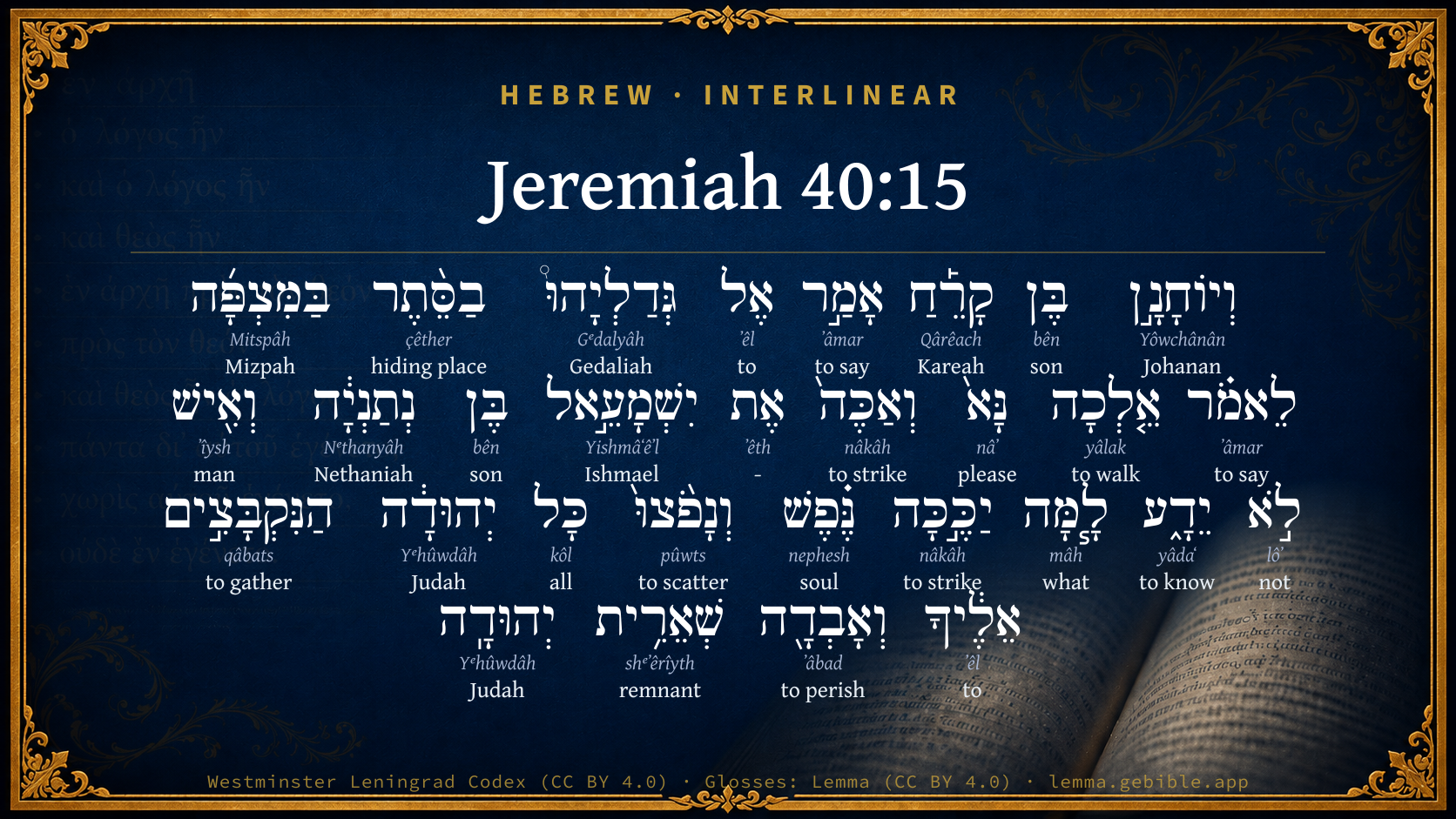
Hebrew (Westminster Leningrad Codex) Jeremiah 40:15 appears in the Hebrew Old Testament. The text above is from the Westminster Leningrad Codex. Each word links to its Strong’s number, a concise gloss, and parsing drawn from the Open Scriptures Hebrew Bible morphology. Click any word for its full Brown-Driver-Briggs (BDB) entry.
Download image
Cite this verse

Jeremiah 40:15 (World English Bible). Public Domain. Lemma interlinear Bible study tool, https://lemma.gebible.app/v/jeremiah/40/15.

Show BibTeX & RIS
BibTeX
RIS
English Translation
Then Johanan the son of Kareah spoke to Gedaliah in Mizpah secretly, saying, Please let me go, and I will kill Ishmael the son of Nethaniah, and no man shall know it: why should he take your life, that all the Jews who are gathered to you should be scattered, and the remnant of Judah perish?
World English Bible · Public Domain
Download a study sheet

One document with this verse’s original text, its word-by-word gloss line, the meaning frame, cross-references with their text, attributed commentary, and full source and license credits — printable, and it pastes into notes with its structure intact.

This verse Autodidact and up

Study sheet (.html) Plain text (.txt)

A passage Seminary Student

Up to 50 verses in one chapter. A passage sheet keeps up to 6 commentary sources and 12 cross-references per verse, in the order this page ranks them, and says so on the sheet whenever that leaves anything out. Ask for a single verse and you get the Autodidact verse sheet above.

Everything on this page stays free to read, with no account — the sheet is a download of what is already on screen, not access to it.

Want to remove ads? Support Godless Engineer
Compare translations 3

The same verse in 3 English versions, stacked beneath the original-language interlinear above. Click any original word for its lexicon entry.

Each is an independent rendering of the whole verse — the interlinear is not word-aligned to these translations.

Highlighted words mark where these versions differ — a whole-verse word diff, not a word-by-word alignment.

  • World English Bible Public Domain
    Then Johanan the son of Kareah spoke to Gedaliah in Mizpah secretly, saying, Please let me go, and I will kill Ishmael the son of Nethaniah, and no man shall know it: why should he take your life, that all the Jews who are gathered to you should be scattered, and the remnant of Judah perish?
  • King James Version Public Domain
    Then Johanan the son of Kareah spake to Gedaliah in Mizpah secretly saying, Let me go, I pray thee, and I will slay Ishmael the son of Nethaniah, and no man shall know it: wherefore should he slay thee, that all the Jews which are gathered unto thee should be scattered, and the remnant in Judah perish?
  • unfoldingWord Literal Text CC BY-SA 4.0
    So Johanan son of Kareah spoke privately to Gedaliah in Mizpah and said, “Allow me to go kill Ishmael son of Nethaniah. No one will suspect me. Why should he kill you? Why allow all of Judah that has been gathered to you to be scattered and the remnant of Judah destroyed?”

unfoldingWord Literal Text — © unfoldingWord, licensed CC BY-SA 4.0. Word-aligned USFM3 via Door43 (git.door43.org/unfoldingWord/en_ult).

Versions to compare (up to 4)

3 of 4 selected

Show all 18 translations

Every available English version of this verse, each an independent rendering of the whole verse.

  • World English Bible Public Domain
    Then Johanan the son of Kareah spoke to Gedaliah in Mizpah secretly, saying, Please let me go, and I will kill Ishmael the son of Nethaniah, and no man shall know it: why should he take your life, that all the Jews who are gathered to you should be scattered, and the remnant of Judah perish?
  • Berean Standard Bible Public Domain
    Then Johanan son of Kareah spoke privately to Gedaliah at Mizpah. “Let me go and kill Ishmael son of Nethaniah,” he said. “No one will know it. Why should he take your life and scatter all the people of Judah who have gathered to you, so that the remnant of Judah would perish?”
  • Majority Standard Bible Public Domain
    Then Johanan son of Kareah spoke privately to Gedaliah at Mizpah. “Let me go and kill Ishmael son of Nethaniah,” he said. “No one will know it. Why should he take your life and scatter all the people of Judah who have gathered to you, so that the remnant of Judah would perish?”
  • King James Version Public Domain
    Then Johanan the son of Kareah spake to Gedaliah in Mizpah secretly saying, Let me go, I pray thee, and I will slay Ishmael the son of Nethaniah, and no man shall know it: wherefore should he slay thee, that all the Jews which are gathered unto thee should be scattered, and the remnant in Judah perish?
  • American Standard Version (1901) Public Domain
    Then Johanan the son of Kareah spake to Gedaliah in Mizpah secretly, saying, Let me go, I pray thee, and I will slay Ishmael the son of Nethaniah, and no man shall know it: wherefore should he take thy life, that all the Jews that are gathered unto thee should be scattered, and the remnant of Judah perish?
  • Revised Version (1885) Public Domain
    Then Johanan the son of Kareah spake to Gedaliah in Mizpah secretly, saying, Let me go, I pray thee, and I will slay Ishmael the son of Nethaniah, and no man shall know it: wherefore should he take thy life, that all the Jews which are gathered unto thee should be scattered, and the remnant of Judah perish?
  • Geneva Bible (1599) Public Domain
    Then Iohanan the sonne of Kareah spake to Gedaliah in Mizpah secretly, saying, Let me goe, I pray thee, and I will slay Ishmael the sonne of Nethaniah, and no man shall know it. Wherefore should he kill thee, that all the Iewes, which are gathered vnto thee, shoulde be scattered, and the remnant in Iudah perish?
  • Douay-Rheims (1899) Public Domain
    But Johanan the son of Caree, spoke to Oodolias privately in Masphath, saying: I will go, and I will kill Ismahel the son of Nathanias, and no man shall know it, lest he kill thee, and all the Jews be scattered, that are gathered unto thee, and the remnant of Juda perish.
  • Young's Literal Translation Public Domain
    And Johanan son of Kareah hath spoken unto Gedaliah in secret, in Mizpah, saying, `Let me go, I pray thee, and I smite Ishmael son of Nethaniah, and no one doth know; why doth he smite thy soul? and scattered have been all Judah who are gathered unto thee, and perished hath the remnant of Judah.'
  • Literal Standard Version CC BY-SA 4.0
    And Johanan son of Kareah has spoken to Gedaliah in secret, in Mizpah, saying, “Please let me go, and I strike Ishmael son of Nethaniah, and no one knows; why does he strike your soul? And all Judah who are gathered to you have been scattered, and the remnant of Judah has perished.”
  • Unlocked Literal Bible CC BY-SA 4.0
    So Johanan son of Kareah spoke privately to Gedaliah in Mizpah and said, “Allow me to go kill Ishmael son of Nethaniah. No one will suspect me. Why should he kill you? Why allow all of Judah that has been gathered to you to be scattered and the remnant of Judah destroyed?”
  • unfoldingWord Literal Text CC BY-SA 4.0
    So Johanan son of Kareah spoke privately to Gedaliah in Mizpah and said, “Allow me to go kill Ishmael son of Nethaniah. No one will suspect me. Why should he kill you? Why allow all of Judah that has been gathered to you to be scattered and the remnant of Judah destroyed?”
  • Darby Bible Public Domain
    And Johanan the son of Kareah spoke to Gedaliah in Mizpah secretly, saying, Let me go, I pray thee, and I will smite Ishmael the son of Nethaniah and no man shall know it: why should he take thy life, and all they of Judah who are gathered unto thee be scattered, and the remnant of Judah perish?
  • World Messianic Bible Public Domain
    Then Yochanan the son of Kareah spoke to Gedaliah in Mizpah secretly, saying, “Please let me go, and I will kill Ishmael the son of Nethaniah, and no man will know it. Why should he take your life, that all the Jews who are gathered to you should be scattered, and the remnant of Judah perish?”
  • Webster's Bible Public Domain
    Then Johanan the son of Kareah spoke to Gedaliah in Mizpah secretly, saying, Let me go, I pray thee, and I will slay Ishmael the son of Nethaniah, and no man shall know it: why should he slay thee, that all the Jews who are gathered to thee should be scattered, and the remnant of Judah perish?
  • Free Bible Version CC BY-SA 4.0
    Johanan went and talked privately to Gedaliah at Mizpah. “Let me go and kill Ishmael son of Nethaniah,” he told him. “No one will find out. Why should he be allowed to kill you? All the people of Judah who have joined you would be scattered, so that even those who have survived here would be killed!”
  • Bible in Basic English Public Domain
    Then Johanan, the son of Kareah, said to Gedaliah in Mizpah secretly, Let me now go and put Ishmael, the son of Nethaniah, to death without anyone's knowledge: why let him take your life so that all the Jews who have come together to you may be sent in flight, and the rest of the men of Judah come to an end?
  • JPS Tanakh (1917) Public Domain
    Then Johanan the son of Kareah spoke to Gedaliah in Mizpah secretly, saying: 'Let me go, I pray thee, and I will slay Ishmael the son of Nethaniah, and no man shall know it; wherefore should he take thy life, that all the Jews that are gathered unto thee should be scattered, and the remnant of Judah perish?'

Literal Standard Version (2020), Covenant Press — licensed CC BY-SA 4.0. Text via the HelloAO Bible API (eBible.org). Unlocked Literal Bible (unfoldingWord) — licensed CC BY-SA 4.0. Text via the HelloAO Bible API (eBible.org). unfoldingWord Literal Text — © unfoldingWord, licensed CC BY-SA 4.0. Word-aligned USFM3 via Door43 (git.door43.org/unfoldingWord/en_ult). Free Bible Version, Dr. Jonathan Gallagher — licensed CC BY-SA 4.0. Text via the HelloAO Bible API (eBible.org).

Word by word

More ways to search: Search by grammar → Find every occurrence → Compare this word →

Practice this passage: Drill this verse → Learn its vocabulary →

קָרֵ֡חַ
Qârêach
H7143
“Kareah”
Noun, Proper
Part of Speech
Noun
Type
Proper
Full BDB Definition

Origin: from H7139

TWOT: None

Kareah = "bald" - father of Johanan and Jonathan who supported Gedaliah's authority and avenged his murder
  1. וְיוֹחָנָ֣ן Yôwchânân H3110 “and · Johanan” Conjunction + Noun, Proper
  2. בֶּן bên H1121 “son of” Noun, Common, Masculine, Singular, Construct
  3. אָמַ֣ר ʼâmar H559 “to say” Verb, Qal, Perfect, 3rd Person, Masculine, Singular
  4. אֶל ʼêl H413 “to” Preposition
  5. גְּדַלְיָהוּ֩ Gᵉdalyâh H1436 “Gedaliah” Noun, Proper
  6. בַסֵּ֨תֶר çêther H5643 “in/at the · hiding place” Preposition, Determined + Noun, Common, Masculine, Singular, Absolute
  7. בַּמִּצְפָּ֜ה Mitspâh H4709 “in/at the · Mizpah” Preposition, Determined + Noun, Proper
  8. לֵאמֹ֗ר ʼâmar H559 “to say” Preposition + Verb, Qal, Infinitive Construct
  9. אֵ֤לְכָה yâlak H3212 “to walk” Verb, Qal, Cohortative, 1st Person, Common, Singular
  10. נָּא֙ nâʼ H4994 “please” Particle, Interjection
  11. וְאַכֶּה֙ nâkâh H5221 “and · to strike” Conjunction + Verb, Hiphil, Cohortative, 1st Person, Common, Singular
  12. אֶת ʼêth H853 “-” Particle, Direct Object
  13. יִשְׁמָעֵ֣אל Yishmâʻêʼl H3458 “Ishmael” Noun, Proper
  14. בֶּן bên H1121 “son of” Noun, Common, Masculine, Singular, Construct
  15. נְתַנְיָ֔ה Nᵉthanyâh H5418 “Nethaniah” Noun, Proper
  16. וְאִ֖ישׁ ʼîysh H376 “and · man” Conjunction + Noun, Common, Masculine, Singular, Absolute
  17. לֹ֣א lôʼ H3808 “not” Particle, Negative
  18. יֵדָ֑ע yâdaʻ H3045 “to know” Verb, Qal, Imperfect, 3rd Person, Masculine, Singular
  19. לָ֧מָּה mâh H4100 “to/for · what” Preposition + Particle, Interrogative
  20. יַכֶּ֣כָּה nâkâh H5221 “to strike · you” Verb, Hiphil, Imperfect, 3rd Person, Masculine, Singular + Suffix, Personal, 2nd Person, Masculine, Singular
  21. נֶּ֗פֶשׁ nephesh H5315 “soul” Noun, Common, Both, Singular, Absolute
  22. וְנָפֹ֨צוּ֙ pûwts H6327 “and · to scatter” Conjunction + Verb, Niphal, Sequential Perfect, 3rd Person, Common, Plural
  23. כָּל kôl H3605 “all of” Noun, Common, Masculine, Singular, Construct
  24. יְהוּדָ֔ה Yᵉhûwdâh H3063 “Judah” Noun, Proper
  25. הַנִּקְבָּצִ֣ים qâbats H6908 “the · gathered” Particle, Definite Article + Verb, Niphal, Participle Passive, Masculine, Plural, Absolute
  26. אֵלֶ֔יךָ ʼêl H413 “to · you” Preposition + Suffix, Personal, 2nd Person, Masculine, Singular
  27. וְאָבְדָ֖ה ʼâbad H6 “and · to perish” Conjunction + Verb, Qal, Sequential Perfect, 3rd Person, Feminine, Singular
  28. שְׁאֵרִ֥ית shᵉʼêrîyth H7611 “remnant of” Noun, Common, Feminine, Singular, Construct
  29. יְהוּדָֽה Yᵉhûwdâh H3063 “Judah” Noun, Proper

About this verse

These counts appear in no published source. They are computed here, from the morphology-tagged text and Lemma’s own curated glosses. What Lemma adds →

30
words
25
distinct lemmas
Prophets
section

Notable vocabulary

The rarest word here is קָרֵ֡חַ Kareah H7143 — appearing just 14 times in the whole Hebrew Bible.

Shared distinctive vocabulary

קָרֵ֡חַ Kareah H7143 occurs in 14 verses of the Hebrew Bible. Also found in:

Grammatical profile

  • 9 verbs
  • 15 nouns
  • 2 prepositions
  • 4 particles

Verb forms

  • אָמַ֣ר Qal · Perfect
  • לֵאמֹ֗ר Qal · Infinitive Construct
  • אֵ֤לְכָה Qal · Cohortative
  • וְאַכֶּה֙ Hiphil · Cohortative
  • יֵדָ֑ע Qal · Imperfect
  • יַכֶּ֣כָּה Hiphil · Imperfect
  • וְנָפֹ֨צוּ֙ Niphal · Sequential Perfect
  • הַנִּקְבָּצִ֣ים Niphal · Participle Passive
  • וְאָבְדָ֖ה Qal · Sequential Perfect

Repetition

Words recur within this verse — often emphatic in Hebrew:

  • בֶּן son H1121 ×2
  • אָמַ֣ר to say H559 ×2
  • וְאַכֶּה֙ to strike H5221 ×2
  • יְהוּדָ֔ה Judah H3063 ×2
  • אֶל to H413 ×2

Cross-references

9

Topical passages linked to Jeremiah 40:15 in the Treasury of Scripture Knowledge — connected by theme and wording, ordered by reader-vote popularity; previews shown in the World English Bible.

  • 1 Samuel 26:8 Then said Abishai to David, God has delivered up your enemy into your hand this day: now therefore please let me strike him with the spear to the earth at one stroke, and I will not strike him the second time.
  • 2 Samuel 21:17 But Abishai the son of Zeruiah helped him, and struck the Philistine, and killed him. Then the men of David swore to him, saying, You shall go no more out with us to battle, that you don't quench the lamp of Israel.
  • 1 Samuel 24:4 The men of David said to him, Behold, the day of which Yahweh said to you, Behold, I will deliver your enemy into your hand, and you shall do to him as it shall seem good to you. Then David arose, and cut off the skirt of Saul's robe secretly.
  • 2 Samuel 18:3 But the people said, You shall not go forth: for if we flee away, they will not care for us; neither if half of us die, will they care for us: but you are worth ten thousand of us; therefore now it is better that you are ready to help us out of the city.
  • Job 31:31 If the men of my tent have not said, 'Who can find one who has not been filled with his meat?'
  • Jeremiah 12:3–4 But you, Yahweh, know me; you see me, and try my heart toward you: pull them out like sheep for the slaughter, and prepare them for the day of slaughter.
  • Jeremiah 42:2 and said to Jeremiah the prophet, Let, we pray you, our supplication be presented before you, and pray for us to Yahweh your God, even for all this remnant; for we are left but a few of many, as your eyes do see us:
  • Ezekiel 33:24–29 Son of man, they who inhabit those waste places in the land of Israel speak, saying, Abraham was one, and he inherited the land: but we are many; the land is given us for inheritance.
  • John 11:50 nor do you consider that it is advantageous for us that one man should die for the people, and that the whole nation not perish."

Cross-references courtesy of OpenBible.info (CC BY 4.0).

Hebrew and Greek witnesses Masoretic Hebrew ↔ Greek Septuagint

The same verse in the two great witnesses to the Old Testament, shown verse-for-verse.

These are two independent witnesses, not word-aligned to each other, and the Septuagint is shown in lemma (dictionary) form.

Hebrew Jeremiah 40:15 Masoretic · Westminster Leningrad Codex

וְיוֹחָנָ֣ן בֶּן קָרֵ֡חַ אָמַ֣ר אֶל גְּדַלְיָהוּ֩ בַסֵּ֨תֶר בַּמִּצְפָּ֜ה לֵאמֹ֗ר אֵ֤לְכָה נָּא֙ וְאַכֶּה֙ אֶת יִשְׁמָעֵ֣אל בֶּן נְתַנְיָ֔ה וְאִ֖ישׁ לֹ֣א יֵדָ֑ע לָ֧מָּה יַכֶּ֣כָּה נֶּ֗פֶשׁ וְנָפֹ֨צוּ֙ כָּל יְהוּדָ֔ה הַנִּקְבָּצִ֣ים אֵלֶ֔יךָ וְאָבְדָ֖ה שְׁאֵרִ֥ית יְהוּדָֽה

Then Johanan the son of Kareah spoke to Gedaliah in Mizpah secretly, saying, Please let me go, and I will kill Ishmael the son of Nethaniah, and no man shall know it: why should he take your life, that all the Jews who are gathered to you should be scattered, and the remnant of Judah perish?

World English Bible · Public Domain

Greek LXX Structure differs

In the Septuagint, Jeremiah is about an eighth shorter than the Hebrew and arranges its material differently — the Oracles Against the Nations (Hebrew chapters 46–51) appear in the middle of the Greek book, after 25:13. Because the chapter and verse boundaries do not line up, a verse-for-verse comparison with the Hebrew is not shown.

A verse-for-verse comparison isn’t shown here because the chapters and verses don’t line up. Switch to the LXX edition with the MT / LXX toggle above to read the Greek directly.

Hebrew: Westminster Leningrad Codex (CC BY 4.0). Greek: Septuagint (public domain); English from a public-domain English Septuagint. How the Septuagint differs from the Hebrew →

Targum (Aramaic paraphrase)

1

The Targum is the ancient Jewish Aramaic paraphrase of the Hebrew Scriptures — an interpretive translation, not the Hebrew text itself. Onkelos (literal) and Pseudo-Jonathan (expansive) render the Torah, and Jonathan the Prophets. Coverage is partial: where no permissively-licensed English translation exists for a verse, only the Aramaic is shown. This is verse-level text, not a word-by-word alignment to the Hebrew.

  1. Targum Jonathan Prophets (Joshua–Malachi)
    וְיוֹחָנָן בַּר קָרֵחַ אֲמַר לִגְדַלְיָה בְסִתְרָא בְּמִצְפְּיָא לְמֵימָר אֱזֵיל כְּעַן וְאֶמְחֵי יַת יִשְׁמָעֵאל בַּר נְתַנְיָה וֶאֱנַשׁ לָא יְדַע לְמָה יְקַטְלִינָךְ נְפַשׁ וְיִתְבַּדְרוּן כָּל דְבֵית יְהוּדָה דְאִתְכְּנִישׁוּ לְוָתָךְ וְיוֹבֵיד שְׁאָרָא דְבֵית יְהוּדָה:

    (no public-domain English translation for this verse)

    Targum Jonathan — Aramaic: “Mikraot Gedolot” (public domain). English: “Sefaria Community Translation” (CC0 1.0 (public-domain dedication)); “London "Chaldee Paraphrase," 1871” (public domain). Text via Sefaria.

Commentary

Notes on Jeremiah 40:15 from classic Christian and Jewish commentators (each source and its license shown beneath its notes). The classic Christian expositions comment on the surrounding passage and are grouped to its opening verse, so a note may address several verses; the Jewish commentaries on the Tanakh (Rashi and others) are per-verse, so they appear only where the commentator wrote on this verse.

Lemma curates 59 commentaries, every one of them public domain or Creative Commons licensed, each selected and text-cleaned for this edition rather than reprinted as found. About our sources →

Trapp's Complete Commentary

John Trapp

Jer 40:15 Then Johanan the son of Kareah spake to Gedaliah in Mizpah secretly, saying, Let me go, I pray thee, and I will slay Ishmael the son of Nethaniah, and no man shall know [it]: wherefore should he slay thee, that all the Jews which are gathered unto thee should be scattered, and the remnant in Judah perish?

Ver. 15. Let me go, I pray thee, and I will slay Ishmael.] He offereth his service for the slaying of Ishmael, and it had been happy he had done it, sed immodico obsequio sibi fidem derogat, his forwardness rendereth him suspected. Gedaliah seemeth to have been of our Queen Elizabeth’s temper, who was heard to profess, that she could believe nothing of her people that parents would not believe of their children. {a}

{a} Camden.

John Trapp, A Commentary or Exposition upon All the Books of the Old and New Testament (1647–1656) — public domain. Text from a community e-Sword module.

The Cambridge Bible for Schools and Colleges

gen. ed. J. J. S. Perowne

15. the remnant of Judah perish] Johanan no doubt hoped to influence a high-minded man like Gedaliah by this argument that on his life depended the welfare of those who remained yet in the country.

The Cambridge Bible for Schools and Colleges (gen. ed. J. J. S. Perowne; Cambridge University Press, 1878–1918) — public domain. Text from a community e-Sword module.

John Gill's Exposition

Then Johanan the son of Kareah spake to Gedaliah in Mizpah secretly,.... Partly that he might, as he thought, more easily prevail upon him, and persuade him to believe the information given; and partly for the sake of the proposal he had to make to him, which it was not proper should be publicly made:

saying, let me go, I pray thee, and I will slay Ishmael the son of Nethaniah, and no man shall know it; that he had slain him, or that Gedaliah had given him leave to do it:

wherefore should he slay thee, that all the Jews that are gathered unto thee should be scattered, and the remnant in Judah perish? suggesting, that it was not barely his losing his own life, which is, and ought to be, precious to every man, and should be carefully preserved, but it would be a public loss; the people, being without a governor, would disperse here and there, fearing their own lives and property would not be safe under a murderer; and that the Chaldeans would be so incensed by such an action, as to come and revenge his death on them; and thus being scattered about, some one way, and some another, would be no more under any form of government as a body politic, and so perish as such, at least; and thus all their hopes, which began to revive, of their beings commonwealth again, would be lost: with this argument Johanan hoped to prevail on Gedaliah to give him leave to slay the conspirator.

John Gill's Exposition of the Whole Bible (1746–1763) — public domain (CC PDM 1.0). Text via the HelloAO Bible API.

Matthew Poole's English Annotations

Discerning that Gedaliah took no great notice of his word spoken to him in the presence of the other captains, he goeth to him secretly, offereth him his service to prevent the stroke, if he might have commission from him; mindeth him that if he did not value his own life, yet he ought to consider in what a condition the people would be in case he were cut off; they were now but a small remnant, and then that remnant also would perish.

Matthew Poole's English Annotations on the Holy Bible (1683–1685) — public domain. Text from a community e-Sword/MySword module.

unfoldingWord translationNotes

Door43 World Missions Community

Johanan ... Kareah

See how you translated these men's names in Jeremiah 40:8. (See: How to Translate Names)

Gedaliah

See how you translated this name in Jeremiah 39:14.

Ishmael ... Nethaniah

See how you translated these men's names in Jeremiah 40:8.

No one will suspect me

"No one will think that I did it"

Why should he kill you?

Johanan uses a rhetorical question to try to change Gedaliah's thinking. It can be translated as a statement. AT: "You should not allow him to kill you." (See: Rhetorical Question)

Why allow all of Judah that has been gathered to you to be scattered and the remnant of Judah destroyed?

Johanan uses a rhetorical question to try to get Gedaliah to think about what will happen if Gedaliah does what Gedaliah is planning to do. AT: "If you do this, all of Judah that has been gathered to you will be scattered and the remnant of Judah will be destroyed." (See: Rhetorical Question)

all of Judah

The word "all" is a generalization. AT: "many of the people of Judah" (See: Hyperbole and Generalization)

that has been gathered to you

This can be translated in active form. AT: "who have come to you" or "whom Yahweh has brought to you" (See: Active or Passive)

to be scattered

This can be translated in active form. AT: "to have the Chaldeans scatter them" or "to flee away to many different lands" (See: Active or Passive)

the remnant of Judah destroyed

This can be translated in active form. AT: "allow the Chaldeans to destroy the remnant of Judah" or "and allow the remnant of Judah to perish" (See: Active or Passive and Ellipsis)

remnant of Judah

"remnant of the people of Judah." See how you translated this in Jeremiah 40:11.

Ahikam

See how you translated this name in Jeremiah 26:24.

translationWords

Mizpah

remnant

kingdom of Judah

unfoldingWord translationNotes — © Distant Shores Media and the Door43 World Missions Community, licensed CC BY-SA 4.0. Source: git.door43.org/Door43/en_tn.

Lesson kit

Teaching starters — assembled from the data on this page, not authored interpretation. Every prompt links to the verse data it draws on. Edit before teaching.

Jeremiah, in the Prophets, opens this verse with 30 words (25 distinct Hebrew lemmas). Its most distinctive word is Qârêach (“Kareah”). A historical commentator’s framing appears above. Read the whole chapter for the surrounding context.

Discussion questions

  1. What does “Kareah” (Qârêach) contribute to the verse as a whole?
  2. How does 2 Kings 25:23, which shares the word «Kareah», read alongside this verse?
  3. What does the repetition of “son” (2× in this one verse) do in this verse?
  4. These translations render this verse differently. What is at stake in choosing one wording over another?
  5. «אָמַ֣ר» is a Qal Perfect verb. How does that grammatical form shape the action described?
  6. Compare how Trapp's Complete Commentary and The Cambridge Bible for Schools and Colleges read this verse. Where do they agree or differ?

Things to notice

Reading settings

Reading text

Shown beneath each verse's original-language words.

Old Testament
Old Testament edition

Read the OT as the Masoretic Hebrew (MT) or the Greek Septuagint (LXX).

English shown for the Greek Septuagint (in the Hebrew ↔ Greek comparison).

Comparing translations? Open the Compare panel on any verse page to stack up to four side by side.