

Psalms 120:3

Hebrew (Westminster Leningrad Codex) Psalms 120:3 appears in the Hebrew Old Testament. The text above is from the Westminster Leningrad Codex. Each word links to its Strong’s number, a concise gloss, and parsing drawn from the Open Scriptures Hebrew Bible morphology. Click any word for its full Brown-Driver-Briggs (BDB) entry.
Download image
Cite this verse

Psalms 120:3 (World English Bible). Public Domain. Lemma interlinear Bible study tool, https://lemma.gebible.app/v/psalms/120/3.

Show BibTeX & RIS
BibTeX
RIS
English Translation
What will be given to you, and what will be done more to you, You deceitful tongue?
World English Bible · Public Domain
Download a study sheet

One document with this verse’s original text, its word-by-word gloss line, the meaning frame, cross-references with their text, attributed commentary, and full source and license credits — printable, and it pastes into notes with its structure intact.

This verse Autodidact and up

Study sheet (.html) Plain text (.txt)

A passage Seminary Student

Up to 50 verses in one chapter. A passage sheet keeps up to 6 commentary sources and 12 cross-references per verse, in the order this page ranks them, and says so on the sheet whenever that leaves anything out. Ask for a single verse and you get the Autodidact verse sheet above.

Everything on this page stays free to read, with no account — the sheet is a download of what is already on screen, not access to it.

Want to remove ads? Support Godless Engineer
Compare translations 3

The same verse in 3 English versions, stacked beneath the original-language interlinear above. Click any original word for its lexicon entry.

Each is an independent rendering of the whole verse — the interlinear is not word-aligned to these translations.

Highlighted words mark where these versions differ — a whole-verse word diff, not a word-by-word alignment.

  • World English Bible Public Domain
    What will be given to you, and what will be done more to you, You deceitful tongue?
  • King James Version Public Domain
    What shall be given unto thee? or what shall be done unto thee, thou false tongue?
  • unfoldingWord Literal Text CC BY-SA 4.0
    What will he give to you, and what will he add to you, O tongue of deceit?

unfoldingWord Literal Text — © unfoldingWord, licensed CC BY-SA 4.0. Word-aligned USFM3 via Door43 (git.door43.org/unfoldingWord/en_ult).

Versions to compare (up to 4)

3 of 4 selected

Show all 18 translations

Every available English version of this verse, each an independent rendering of the whole verse.

  • World English Bible Public Domain
    What will be given to you, and what will be done more to you, You deceitful tongue?
  • Berean Standard Bible Public Domain
    What will He do to you, and what will be added to you, O deceitful tongue?
  • Majority Standard Bible Public Domain
    What will He do to you, and what will be added to you, O deceitful tongue?
  • King James Version Public Domain
    What shall be given unto thee? or what shall be done unto thee, thou false tongue?
  • American Standard Version (1901) Public Domain
    What shall be given unto thee, and what shall be done more unto thee, Thou deceitful tongue?
  • Revised Version (1885) Public Domain
    What shall be given unto thee, and what shall be done more unto thee, thou deceitful tongue?
  • Geneva Bible (1599) Public Domain
    What doeth thy deceitfull tongue bring vnto thee? or what doeth it auaile thee?
  • Douay-Rheims (1899) Public Domain
    For they that work iniquity, have not walked in his ways.
  • Young's Literal Translation Public Domain
    What doth He give to thee? And what doth He add to thee? O deceitful tongue!
  • Literal Standard Version CC BY-SA 4.0
    What does He give to you? And what does He add to you? O deceitful tongue!
  • Unlocked Literal Bible CC BY-SA 4.0
    How will he punish you, and what more will he do to you, you who have a lying tongue?
  • unfoldingWord Literal Text CC BY-SA 4.0
    What will he give to you, and what will he add to you, O tongue of deceit?
  • Darby Bible Public Domain
    What shall be given unto thee, what shall be added unto thee, thou deceitful tongue?
  • World Messianic Bible Public Domain
    What will be given to you, and what will be done more to you, you deceitful tongue?
  • Webster's Bible Public Domain
    What shall be given to thee? or what shall be done to thee, thou false tongue?
  • Free Bible Version CC BY-SA 4.0
    What will the Lord do to you, you liars? How will he punish you?
  • Bible in Basic English Public Domain
    What punishment will he give you? what more will he do to you, you false tongue?
  • JPS Tanakh (1917) Public Domain
    What shall be given unto thee, and what shall be done more unto thee, thou deceitful tongue?

Literal Standard Version (2020), Covenant Press — licensed CC BY-SA 4.0. Text via the HelloAO Bible API (eBible.org). Unlocked Literal Bible (unfoldingWord) — licensed CC BY-SA 4.0. Text via the HelloAO Bible API (eBible.org). unfoldingWord Literal Text — © unfoldingWord, licensed CC BY-SA 4.0. Word-aligned USFM3 via Door43 (git.door43.org/unfoldingWord/en_ult). Free Bible Version, Dr. Jonathan Gallagher — licensed CC BY-SA 4.0. Text via the HelloAO Bible API (eBible.org).

Word by word

More ways to search: Search by grammar → Find every occurrence → Compare this word →

Practice this passage: Drill this verse → Learn its vocabulary →

About this verse

These counts appear in no published source. They are computed here, from the morphology-tagged text and Lemma’s own curated glosses. What Lemma adds →

8
words
5
distinct lemmas
Wisdom
section

Notable vocabulary

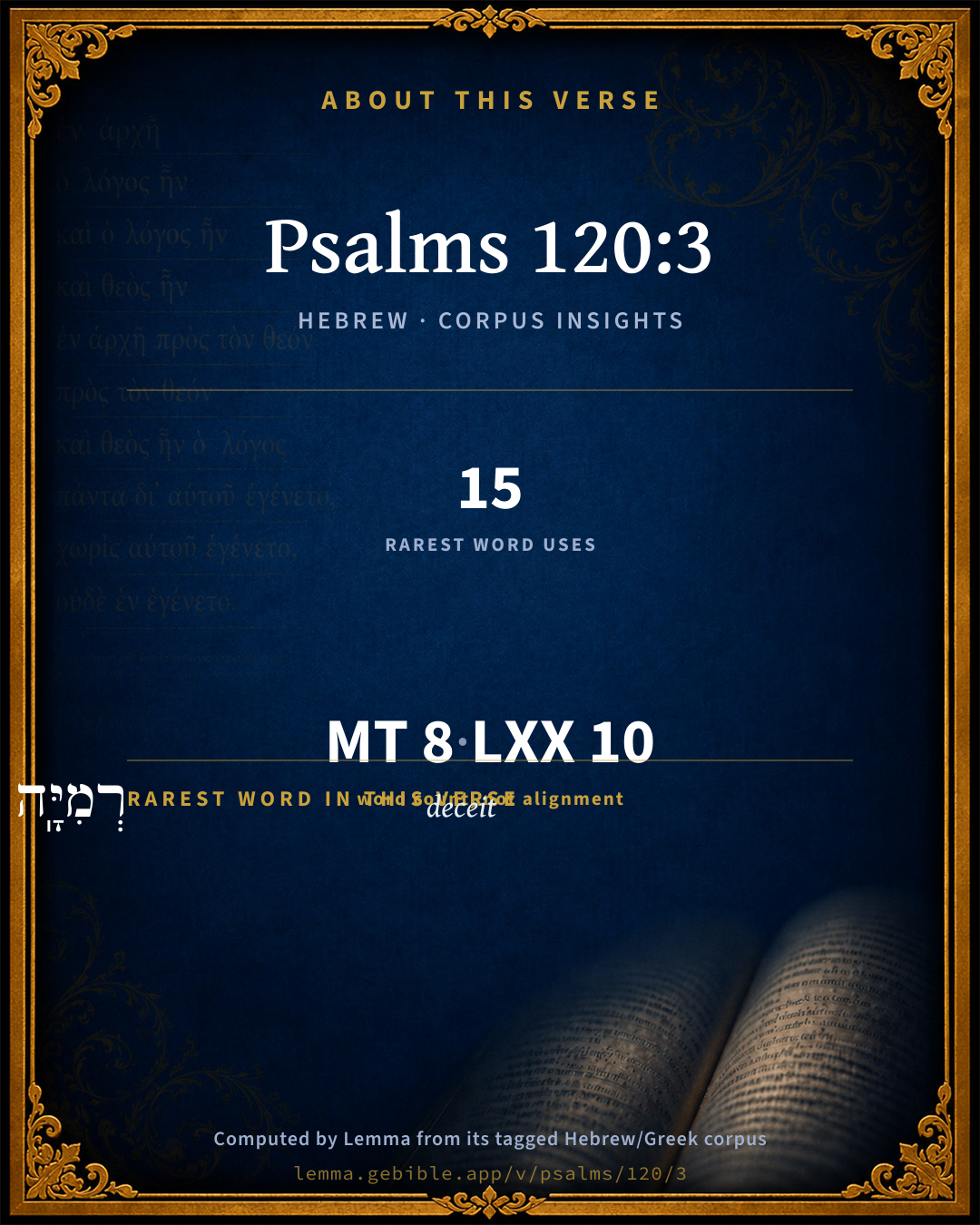
The rarest word here is רְמִיָּֽה deceit H7423 — appearing just 15 times in the whole Hebrew Bible.

Shared distinctive vocabulary

רְמִיָּֽה deceit H7423 occurs in 15 verses of the Hebrew Bible. Also found in:

Grammatical profile

  • 2 verbs
  • 2 nouns
  • 2 prepositions
  • 2 particles

Verb forms

  • יִּתֵּ֣ן Qal · Imperfect
  • יֹּסִ֥יף Hiphil · Imperfect

Repetition

A word recurs within this verse — often emphatic in Hebrew:

Hebrew & Septuagint length

In English translation the verse runs 17 words from the Hebrew and 17 from the Septuagint (LXX English) — the same length.

A rough comparison of the two English renderings, which tokenize alike — not a word-level alignment.

Word counts can differ between the Hebrew and the Greek without any difference in meaning — e.g. the Hebrew direct-object marker אֵת has no separate Greek word, and Greek often adds the article ὁ.

In the original languages it is 8 Hebrew tokens and 10 Greek tokens — but the two are counted differently (Hebrew bundles its prefixes and suffixes into one token; the Greek is in lemma form), so that isn’t a like-for-like length.

Cross-references

3

Topical passages linked to Psalms 120:3 in the Treasury of Scripture Knowledge — connected by theme and wording, ordered by reader-vote popularity; previews shown in the World English Bible.

  • Job 27:8 For what is the hope of the godless, when he is cut off, When God takes away his life?
  • Matthew 16:26 For what will it profit a man, if he gains the whole world, and forfeits his life? Or what will a man give in exchange for his life?
  • Romans 6:21 What fruit then did you have at that time in the things of which you are now ashamed? For the end of those things is death.

Cross-references courtesy of OpenBible.info (CC BY 4.0).

Hebrew and Greek witnesses Masoretic Hebrew ↔ Greek Septuagint

The same verse in the two great witnesses to the Old Testament, shown verse-for-verse.

You’re reading Greek Psalm 119 (Hebrew Psalm 120). The Septuagint counts the superscription, so verse numbers can differ from the Hebrew — chapter-level alignment, not verse-by-verse. Numbering follows Rahlfs.

These are two independent witnesses, not word-aligned to each other, and the Septuagint is shown in lemma (dictionary) form.

Hebrew Psalms 120:3 Masoretic · Westminster Leningrad Codex

מַה יִּתֵּ֣ן לְ֭ךָ וּמַה יֹּסִ֥יף לָ֗ךְ לָשׁ֥וֹן רְמִיָּֽה

What will be given to you, and what will be done more to you, You deceitful tongue?

World English Bible · Public Domain

Greek LXX Greek Psalm 119:3 Septuagint · lemma form

τίς δίδωμι σύ καί τίς προςτίθημι σύ πρός γλῶσσα δόλιος

What should be given to you, and what should be added to you, for your crafty tongue?

LXX2012 (modern English Septuagint) · Public Domain

Hebrew: Westminster Leningrad Codex (CC BY 4.0). Greek: Septuagint (public domain); English from LXX2012 (modern English Septuagint) (Public Domain). How the Septuagint differs from the Hebrew →

Commentary

Notes on Psalms 120:3 from classic Christian and Jewish commentators (each source and its license shown beneath its notes). The classic Christian expositions comment on the surrounding passage and are grouped to its opening verse, so a note may address several verses; the Jewish commentaries on the Tanakh (Rashi and others) are per-verse, so they appear only where the commentator wrote on this verse.

Lemma curates 59 commentaries, every one of them public domain or Creative Commons licensed, each selected and text-cleaned for this edition rather than reprinted as found. About our sources →

Trapp's Complete Commentary

John Trapp

Psa 120:3 What shall be given unto thee? or what shall be done unto thee, thou false tongue?

Ver. 3. What shall be given unto thee? &c.] That is (as Austin senseth it), what remedy is there for thee? q.d. None at all. Contra sycophantarum morsum non est remedium, saith Seneca. But others better, what gain gettest thou what profit makest thou of thy lying and slandering? Hurt thou mayest another, but not help thyself. Thou art not like the maid whom Avicen speaketh of, who feeding herself with poison, was herself healthy, yet infected others with her venomous breath; but rather like the traitor of whom Augustus said, I like the treason, but hate the traitor. The slander is oft applauded when the slanderer is abhorred.

Or what shall be done unto thee, &c.] Heb. added; Nihil praeter plagas durissimas, as Psa 120:4.

Thou false tongue?] This he seemeth to say to Doeg, who is here called a false fellow and a liar, though he spake but the truth against the Lord’s priests, because not for any love to the truth, nor for respect of justice, nor of the bettering either of Saul or the priests, but only to prejudice these and to incense the other.

John Trapp, A Commentary or Exposition upon All the Books of the Old and New Testament (1647–1656) — public domain. Text from a community e-Sword module.

J. A. Alexander on Psalms

Joseph Addison Alexander

3. (Psa 120:3) What will he give to thee, and what will he add to thee, thou tongue of fraud? Having complained to God of the false tongue, the ideal speaker turns to it as actually present, and addresses it directly, speaking of God in the third person. The meaning of the question is, what recompence can you expect from an infinitely righteous God for these malignant calumnies? The peculiar form of the interrogation is derived from that of an ancient oath, The Lord do so to me and more also, literally and so add, i.e. further do, or in addition to the thing in question. See 1Sa 3:17; 1Sa 14:44. As explained by this allusion, the words have a new force. What good or evil may be imprecated on thee, as the consequence of these malicious falsehoods.

Joseph Addison Alexander, The Psalms Translated and Explained (1850) — public domain. Text from a community e-Sword module.

Tyndale Open Study Notes

Tyndale Open Resources

120:3-4 The psalmist dialogues with the liars who surround him. He feels reassured that the Lord will judge them. • The Divine Warrior (see 7:12-13; 11:4-6) will throw sharp arrows and glowing coals on the liars.

Tyndale Open Study Notes — © Tyndale Open Resources, licensed CC BY-SA 4.0. Text via the HelloAO Bible API.

Geneva Bible (1599)

Geneva Bible translators

He assured himself that God would turn their craft to their own destruction.

Geneva Bible (1599) marginal notes — public domain. Text via Bolls.life.

Adam Clarke's Commentary

Verse 3. What shall be given unto thee?] Thou art worthy of the heaviest punishments.

Adam Clarke's Commentary on the Bible (1810–1826) — public domain. Text from a community e-Sword/MySword module.

John Calvin's Commentaries

3. What shall the tongue of deceit give thee? The Psalmist here addresses himself in particular to his traducers.

“Comme s’il avoit desia le triomphe contre toute la bande de scs ennemis.” — Fr. “As if he had already triumphed over the whole host of his enemies.”

John Calvin's Commentaries (1540-1563) — public domain. Text from the Calvin Translation Society English edition (1840s-50s) via the Christian Classics Ethereal Library (ccel.org). Calvin's coverage is partial (roughly two-thirds of the Bible); uncommented books and verses are honest gaps, never fabricated. The 19th-century editor's footnotes and remarks are omitted so the notes are faithfully Calvin's own voice.

Ellicott's Commentary for English Readers

(3) What shall . . .?—Literally, What will he give to thee, and what will he add to thee, deceitful tongue? where it is better, as in the Authorised Version, to take the subject as indefinite, and so render by the passive. Thus we get in substance the following question: “What more can be added to thee (i.e., in the way of epithet), besides lying and false, thou deceitful tongue?” the answer is given by suggesting the usual metaphors of malicious speech, “the warrior’s sharpened arrows” (Jer_9:8; Psa_57:4); “fire” (Jas_3:6). Only here both images are elaborated. For the Hebrew word give with the sense of comparison, see 1Sa_1:16, “Count (Heb., give) not thine handmaid for a daughter of Belial.” Gesenius compares the use of the Greek τιθένμι, instead of νομίζειν. So, too, the word “add” has a similar sense (1Ki_10:7; see margin).

A Bible Commentary for English Readers, edited by Charles John Ellicott (1878–1897) — public domain. Text from a community e-Sword module.

The Cambridge Bible for Schools and Colleges

gen. ed. J. J. S. Perowne

3, 4. What should he give thee, and what should he add to thee, thou deceitful tongue? Arrows of a warrior sharpened, with glowing coals of broom. The tongue, or rather its owner, is addressed. God is the subject of the verbs, and the form of expression is suggested by the familiar formula, “So God do to thee and more also” (1Sa_3:17), lit. “So shall God do to thee and so shall he add.” Psa_120:4 is the answer to the question. The just retribution which is to overtake the deceitful man is described in terms suggested by his offence (cp. Psa_7:12 ff.). He has shot his arrows of slander or false accusation at the innocent, but a mightier than he, even God Himself, will pierce him with the arrows of His judgement: he has kindled the fire of strife by his falsehoods, but the lightnings of Divine wrath will consume him. For the comparison of the evil tongue to a bow which shoots arrows of falsehood see Jer_9:3; Pro_26:18 f.; cp. too Jer_9:8, “Their tongue is a murderous arrow”: its power of mischief is described as fire in Pro_16:27 (cp. Jas_3:6). Glowing coals are a metaphor for Divine judgements in Psa_140:10.

This is the simplest and most natural explanation. Several other explanations have however been proposed, e.g. (1) “What profit will thy false tongue bring thee, O slanderer? It is as sharp arrows” &c., but this seems to lack point. (2) Others suppose that God is addressed and that the tongue is the subject of the sentence: “What profit can the deceitful tongue bring to Thee?”—a sarcastic question, like that in Job_10:3 ff. Can it be that Jehovah tolerates the deceitful man, because thereby He gains some advantage? Psa_120:4 will then be an equally sarcastic answer. The gain that accrues from his existence is mischief and strife. But apart from grammatical difficulties, such an idea is unsuited to the context.

coals of juniper] Heb. rôthem, broom, from which the Arabs still manufacture charcoal of the finest quality, which makes the hottest fire and retains heat for the longest time.

The Cambridge Bible for Schools and Colleges (gen. ed. J. J. S. Perowne; Cambridge University Press, 1878–1918) — public domain. Text from a community e-Sword module.

John Gill's Exposition

Sharp arrows of the mighty, with coals of juniper. Some think these words describe lying lips, and a false tongue; which are like arrows, sharp ones, sent out from a bow drawn with a mighty hand, which come with great force, suddenly and swiftly, and do much mischief; see Psa 11:2; and to "coals of juniper", very distressing and tormenting; the tongue being a fire, set on fire of hell, and sets on fire the course of nature; and throws out devouring words, which consume like fire, Jam 3:6. But rather the punishment of an evil tongue from the Lord is intended, whose sore judgments are often compared to arrows, Deu 32:23; because they come from above, and bring swift and sudden destruction with them; and are very sharp in the hearts of his enemies; are very severe and cutting, and come with power irresistible, being the arrows of the Almighty, Job 6:4; see Jer 50:9; and these may be compared to "coals of juniper", which are very vehement and strong, and very lasting and durable. Jerom (w) and Isidore (x) say they will last a whole year; and the Midrash on the place reports of two men, who had prepared food with them, and at the end of a year returned and found them burning, and warmed their feet at them. These fitly express the lake of fire and brimstone, the portion of liars; whose fire is very strong, and flames devouring, being kindled by the breath of the Lord of hosts, like a stream of brimstone: and the fire of hell is everlasting; its burnings are everlasting burnings; a worm that dieth not, a fire that is not quenched; the smoke of the torments of which ascend for ever and ever, Isa 30:23. The Targum speaks of these arrows as lightnings from above, and of the coals of juniper as kindled in hell below; and they are interpreted of hell in the Talmud (y).

(w) Ad Fabiolam de 42. Mans. tom. 3. fol. 15. I. (x) Origin. l. 17. c. 7. Schindler. col. 1776. (y) T. Bab. Eracin, c. 3. fol. 15. 2.

John Gill's Exposition of the Whole Bible (1746–1763) — public domain (CC PDM 1.0). Text via the HelloAO Bible API.

Albert Barnes' Notes on the Bible

What shall be given unto thee? - Margin, “What shall the deceitful tongue give unto thee;” or, “what shall it profit thee?” Luther, “What can the false tongue do?” Others render this, “How will God punish thee?” Others, “What will he (God) give to thee?” That is, What recompence can you expect from God for these malignant calumnies? A literal translation of this verse would be, “What shall the tongue of deceit give to thee, and what shall it add to thee?” - referring to the offender himself. The essential idea is, What will be the result of such conduct? What must be expected to follow from it? That is, either

(a) from the unprofitableness of such a course; or

(b) from the natural consequences to one’s reputation and happiness; or

(c) from the judgment of God.

The answer to these questions is found in Psa 120:4.

Or what shall be done unto thee? - Margin, as in Hebrew, “added.” What must be the consequence of this? what will follow?

Thou false tongue - This may be either an address to the tongue itself, or, as above, the word “tongue” may be used as the nominative to the verbs in the sentence. The sense is not materially affected either way.

Albert Barnes' Notes on the Bible (1834–1885) — public domain. Text from a community e-Sword/MySword module.

Matthew Poole's English Annotations

What shall be given unto thee, whosoever thou art who art guilty of these practices? He applies himself severally to the consciences of every one of them. Or he designs Doeg or some other person in Saul’s court eminent for this wickedness. The sense may be this, It is true, thou dost me some mischief; but what benefit dost thou get by it, if all thy accounts be cast up? For although thou mayst thereby obtain some favour and advantage from Saul, yet thou wilt assuredly bring upon thyself the curse and vengeance of God; and then thou wilt be no gainer by the bargain. And to do mischief to another without benefit to thyself, is an inhuman and diabolical wickedness.

Matthew Poole's English Annotations on the Holy Bible (1683–1685) — public domain. Text from a community e-Sword/MySword module.

The Treasury of David

Charles H. Spurgeon

Ver. 3. What shall be given unto thee? What is the expected guerdon of slander? It ought to be something great to make it worth while to work in so foul an atmosphere and to ruin one's soul. Could a thousand worlds be bribe enough for such villainous deeds? The liar shall have no welcome recompense: he shall meet with his deserts; but what shall they be? What punishment can equal his crime? The Psalmist seems lost to suggest a fitting punishment. It is the worst of offencesthis detraction, calumny, and slander. Judgment sharp and crushing would be measured out to it if men were visited for their transgressions. But what punishment could be heavy enough? What form shall the chastisement take? O liar, "what shall be given unto thee?"

Or what shall be done unto thee, thou false tongue? How shalt thou be visited? The law of retaliation can hardly meet the case, since none can slander the slanderer, he is too black to be blackened; neither would any of us blacken him if we could. Wretched being! He fights with weapons which true men cannot touch. Like the cuttlefish, he surrounds himself with an inky blackness into which honest men cannot penetrate. Like the foul skunk, he emits an odour of falsehood which cannot be endured by the true; and therefore he often escapes, unchastised by those whom he has most injured. His crime, in a certain sense, becomes his shield; men do not care to encounter so base a foe. But what will God do with lying tongues? He has uttered his most terrible threats against them, and he will terribly execute them in due time.

Ver. 3. What shall be given unto thee? or what shall be done unto thee, thou false tongue? What dost thou expect, "thou false tongue, "in pleading a bad cause? What fee or reward hast thou for being an accuser instead of an advocate? What shall it profit thee (as we put it in the margin); what shalt thou gain by thy deceitful tongue? or (as our margin hath it again), "What shall the deceitful tongue give unto thee, "that thou goest about slandering thy brother, and tearing his good name? Hath thy deceitful tongue houses or lands to give thee? hath it any treasures of gold and silver to bestow upon thee? Surely, as itself is so it gives only "Sharp arrows of the mighty, with coals of juniper" as the next verse intimates... The tongue indeed will speak often in these cases gratis, or without a fee; but it never doth without danger and damage to the speaker. As such speakers shoot arrows, like the arrows of the mighty, and as they scatter coals, like the coals of juniper, so they usually get an arrow in their own sides, and not only burn their fingers, but heap coals of fire upon their own heads. Ungodly men will do mischief to other men purely for mischief's sake: yet when once mischief is done it proves most mischievous to the doers of it; and while they hold their brethren's heaviness a profit, though they are never the better, they shall feel and find themselves in a short time much the worse. Joseph Caryl.

Ver. 3,4. What shall be given? Intimating that his enemy expected some great reward for his malice against David; but, saith the Psalmist, he shall have "sharp arrows of the Almighty, with coals of juniper"; as if he had said, "Whatever reward he have from men, this shall be his reward from God". John Jackson, in "The Morning Exercises", 1661.

Ver. 3,4. The victim of slander, in these heavy complaints he has just uttered, may be indulging in excess, which pious friends are represented as coming forward to reprove by reminding him how little a true servant of God can be really injured by slander. Hence, as in the margin of our Bibles, the psalm assumes the dramatic form, and represents his fellow worshippers as asking the complainer: What evil, O servant of God, can the false tongue give to thee! Nursling of Omnipotence, what can it do to thee... The answer of suffering nature and bleeding peace still returns: "It is like the sharp arrows of the mighty, like coals of juniper". An arrow from the bow of a mighty warrior, that flies unseen and unsuspected to its mark, and whose presence is only known when it quivers in the victim's heart, not unaptly represents the silent and deadly flight of slander; while the fire which the desert pilgrim kindles on the sand, from the dry roots of the juniper, a wood which, of all that are known to him, throws out the fiercest and most continued heat, is not less powerfully descriptive of the intense pain and the lasting injury of a false and malicious tongue. Robert Nisbet.

Ver. 3,4. Coals of juniper, these "shall be given unto thee". As if he had said, thou shalt have the hottest coals, such coals as will maintain heat longest, implying that the hottest and most lasting wrath of God should be their portion. Some naturalists say that coals of juniper raked up in the ashes will keep fire a whole year; but I stay not upon this. Joseph Caryl.

Ver. 3. The rewards of calumny. What can they be? What ought they to be? What have they been?

Ver. 3.

1. What the reviler does for others.

2. What he does to himself.

3. What God will do with him.

Psalms 120:4*

Charles H. Spurgeon's The Treasury of David (1869–1885) — public domain. Psalms only. Text from a community e-Sword/MySword module.

Whedon's Commentary on the Bible

Daniel D. Whedon

3. What shall be given… thee—It is more natural and consistent to take this grammatically obscure verse as an address to the tongue of guile: “What shall be given thee?” or rather, “What shall he [God] give to thee?” that is, as a punishment. The question is put sarcastically, and the anticipated answer is brought out in the next verse.

Daniel D. Whedon (gen. ed.), Commentary on the Old and New Testaments (1874–1909) — public domain. Text from a community e-Sword module.

The Pulpit Commentary

What shall be given unto thee? rather, what shall he (i.e. God) give to thee? Or, in other words What punishment will God inflict on thee for thy false speaking? Or what shall be done unto thee? literally, or what shall he add to thee? Compare the common phrase, "God do so unto me, and more also". (1Sa_3:17 1Sa_14:44) Thou false tongue. The "false tongue" is apostrophized, as if it were a living person.

Sins of the tongue.

"Thou deceitful tongue." Describing this tongue, the psalmist adds, "It is as the sharp arrows of the mighty man, as coals of broom." The sin specially in the view of the psalmist is that of the slanderer. What shall be done to him? "The law of retaliation can hardly meet the case, since none can slander the slanderer, he is too black to be blackened; neither would any of us blacken him if we could. Wretched being! He fights with weapons which true men cannot touch. Like the cuttlefish, he surrounds himself with an inky blackness into which honest men cannot penetrate. Like the foul skunk, he emits an odor of falsehood which cannot be endured by the true; and therefore he often escapes unchastised by those whom he has most injured. His crime, in a certain sense, becomes his shield; men do not care to encounter so base a foe. But what will God do with lying tongues? He has uttered his most terrible threats against them, and he will terribly execute them in due time" (Spurgeon). "From gossips, tale-bearers, writers of anonymous letters, forgers of newspaper paragraphs, and all lie-mongers, good Lord, deliver us!

(1) A man may sin with his tongue against himself, and seriously injure his own success in life.

(2) A man may sin with his tongue against God, misrepresenting him, his truth, his working, or his people. Or

(3) a man may sin with his tongue against his neighbor. Then his wrong doings and sayings may be classed under the term slander, the peculiarity of which is that it has enough truth in it to carry it, and enough lie in it to make it mischievous.

I THE GENESIS OF SLANDER. As a fixed disposition. It comes out of failing to teach the child always strictly to match statement with fact. It comes out of failing to gain full self-control. It comes from letting feeling rule language. It comes from the disposition which finds pleasure in the suffering of others (see cruelty of children to animals). It comes from envy at the success of others.

II THE OCCASIONS OF SLANDER. These are often merely times of idle gossip. They may be times of jealousy or revenge. They may be only the delight a man has in mischief-making.

III THE PUNISHMENT OF SLANDER. It comes in the deterioration of the slanderer"s own character; in the lost confidence and love of his neighbor; and in the just judgment of God. R.T.

The deceitful tongue.

"Lips are soft; but when they are lying lips they suck away the life of character, and are as murderous as razors. Lips should never be red with the blood of honest men"s reputes, nor salved with malicious falsehoods. Some seem to lie for lying"s sake, it is their sport and spirit. The faculty of speech becomes a curse when it is degraded into a mean weapon for smiting men behind their backs. Those who fawn and flatter, and all the while have enmity in their hearts, are wicked beings; they are the seed of the devil, and he worketh in them after his own deceptive nature." "Ungodly men will do mischief to other men purely for mischief"s sake; yet when once mischief is done it proves most mischievous to the doers of it; and while they hold their brethren"s heaviness a profit, though they are never the Better, they shall feel and find themselves in a short time much the worse" (Caryl).

I THE TONGUE IS SHARPER THAN AN ARROW.

1. It is shot in private.

2. It is tipped with poison.

3. It is polished with seeming kindness.

4. It is aimed at the tenderest part.

II THE TONGUE IS MORE DESTRUCTIVE THAN FIRE.

1. Its scandals spread with greater rapidity.

2. They consume that which other fires cannot touch.

3. They are less easily quenched.

"The tongue," says an apostle, "is a fire... and setteth on fire the course of nature; and it is set on fire of hell." A fiery dart of the wicked one. (Outline by George Rogers) R.T.

The Pulpit Commentary (1880–1919), ed. H.D.M. Spence-Jones & Joseph S. Exell — public domain. Text from a community e-Sword module.

unfoldingWord translationNotes

Door43 World Missions Community

How will he punish you, and what more will he do to you, you who have a lying tongue?

The writer asks this as a leading question to explain what God will do to liars. This question can be translated as a statement. AT: "This is how God will punish you, and this is what he will do to you, you who have a lying tongue." (See: Rhetorical Question)

you who have a lying tongue

Here "a lying tongue" represents the person who speaks lies. AT: "you who tell lies" (See: Synecdoche)

He will punish you with the arrows of a warrior

The writer speaks of God severely punishing liars as if God were shooting them with arrows. AT: "He will punish you severely, as if he were shooting you with warrior's arrows" (See: Metaphor)

sharpened over burning coals of the broom tree

This refers to how people forged the tip of the arrow in a fire. This can be stated in active form. AT: "that he sharpened over burning coals of the broom tree" (See: Active or Passive)

translationWords

bow and arrow

unfoldingWord translationNotes — © Distant Shores Media and the Door43 World Missions Community, licensed CC BY-SA 4.0. Source: git.door43.org/Door43/en_tn.

Rashi

Rabbi Shlomo Yitzchaki (Rashi)

What can He give you [What can] the Holy One, blessed be He [give you]?

and what can He add to you [What] safeguard and walls? Behold you are placed within two walls.

Rashi on the Tanakh — English translations: “The Judaica Press complete Tanach with Rashi, translated by A. J. Rosenberg” (CC BY 4.0); “Pentateuch with Rashi's commentary by M. Rosenbaum and A.M. Silbermann, 1929-1934” (public domain); “The Metsudah Tanach series, Lakewood, N.J” (CC BY 4.0); and “The Book of Joshua, Metsudah Publications, 1997” (CC BY 4.0). Text via Sefaria.

Lesson kit

Teaching starters — assembled from the data on this page, not authored interpretation. Every prompt links to the verse data it draws on. Edit before teaching.

Psalms, in the Wisdom, opens this verse with 8 words (5 distinct Hebrew lemmas). Its most distinctive word is rᵉmîyâh (“deceit”). A historical commentator’s framing appears above. Read the whole chapter for the surrounding context.

Discussion questions

  1. How does “deceit” (rᵉmîyâh) shape what this verse is saying?
  2. Job 13:7 shares the word «deceit» with this verse. How do the two illuminate each other?
  3. “what” occurs 2× in this one verse. What is the effect of the repetition?
  4. These translations render this verse differently; the difference is in the English rendering, not the original. What questions does that raise?
  5. The verb «יִּתֵּ֣ן» is Qal Imperfect. How does its form color the action?
  6. Reading how Trapp's Complete Commentary and J. A. Alexander on Psalms read this verse, where do the two commentators agree and where do they part?

Things to notice

Reading settings

Reading text

Shown beneath each verse's original-language words.

Old Testament
Old Testament edition

Read the OT as the Masoretic Hebrew (MT) or the Greek Septuagint (LXX).

English shown for the Greek Septuagint (in the Hebrew ↔ Greek comparison).

Comparing translations? Open the Compare panel on any verse page to stack up to four side by side.