
Isaiah 52:5

Hebrew (Westminster Leningrad Codex) Isaiah 52:5 appears in the Hebrew Old Testament. The text above is from the Westminster Leningrad Codex. Each word links to its Strong’s number, a concise gloss, and parsing drawn from the Open Scriptures Hebrew Bible morphology. Click any word for its full Brown-Driver-Briggs (BDB) entry.
Download image
Cite this verse

Isaiah 52:5 (World English Bible). Public Domain. Lemma interlinear Bible study tool, https://lemma.gebible.app/v/isaiah/52/5.

Show BibTeX & RIS
BibTeX
RIS
English Translation
Now therefore, what do I here, says Yahweh, seeing that my people is taken away for nothing? those who rule over them do howl, says Yahweh, and my name continually all the day is blasphemed.
World English Bible · Public Domain
Download a study sheet

One document with this verse’s original text, its word-by-word gloss line, the meaning frame, cross-references with their text, attributed commentary, and full source and license credits — printable, and it pastes into notes with its structure intact.

This verse Autodidact and up

Study sheet (.html) Plain text (.txt)

A passage Seminary Student

Up to 50 verses in one chapter. A passage sheet keeps up to 6 commentary sources and 12 cross-references per verse, in the order this page ranks them, and says so on the sheet whenever that leaves anything out. Ask for a single verse and you get the Autodidact verse sheet above.

Everything on this page stays free to read, with no account — the sheet is a download of what is already on screen, not access to it.

Want to remove ads? Support Godless Engineer
Compare translations 3

The same verse in 3 English versions, stacked beneath the original-language interlinear above. Click any original word for its lexicon entry.

Each is an independent rendering of the whole verse — the interlinear is not word-aligned to these translations.

Highlighted words mark where these versions differ — a whole-verse word diff, not a word-by-word alignment.

  • World English Bible Public Domain
    Now therefore, what do I here, says Yahweh, seeing that my people is taken away for nothing? those who rule over them do howl, says Yahweh, and my name continually all the day is blasphemed.
  • King James Version Public Domain
    Now therefore, what have I here, saith the LORD, that my people is taken away for nought? they that rule over them make them to howl, saith the LORD; and my name continually every day is blasphemed.
  • unfoldingWord Literal Text CC BY-SA 4.0
    And now, what to me here?”—the declaration of Yahweh— “For my people is taken for nothing. Its rulers howl”—the declaration of Yahweh— “and continually, all of the day, my name is being despised.

unfoldingWord Literal Text — © unfoldingWord, licensed CC BY-SA 4.0. Word-aligned USFM3 via Door43 (git.door43.org/unfoldingWord/en_ult).

Versions to compare (up to 4)

3 of 4 selected

Show all 18 translations

Every available English version of this verse, each an independent rendering of the whole verse.

  • World English Bible Public Domain
    Now therefore, what do I here, says Yahweh, seeing that my people is taken away for nothing? those who rule over them do howl, says Yahweh, and my name continually all the day is blasphemed.
  • Berean Standard Bible Public Domain
    And now what have I here? declares the LORD. For My people have been taken without cause; those who rule them taunt, declares the LORD, and My name is blasphemed continually all day long.
  • Majority Standard Bible Public Domain
    And now what have I here? declares the LORD. For My people have been taken without cause; those who rule them taunt, declares the LORD, and My name is blasphemed continually all day long.
  • King James Version Public Domain
    Now therefore, what have I here, saith the LORD, that my people is taken away for nought? they that rule over them make them to howl, saith the LORD; and my name continually every day is blasphemed.
  • American Standard Version (1901) Public Domain
    Now therefore, what do I here, saith Jehovah, seeing that my people is taken away for nought? they that rule over them do howl, saith Jehovah, and my name continually all the day is blasphemed.
  • Revised Version (1885) Public Domain
    Now therefore, what do I here, saith the LORD, seeing that my people is taken away for nought? they that rule over them do howl, saith the LORD, and my name continually all the day is blasphemed.
  • Geneva Bible (1599) Public Domain
    Nowe therefore what haue I here, saith the Lord, that my people is taken away for naught, and they that rule ouer them, make them to howle, saith the Lord? and my Name all the day continually is blasphemed?
  • Douay-Rheims (1899) Public Domain
    And now what have I here, saith the Lord: for my people is taken away gratis. They that rule over them treat them unjustly, saith the Lord, and my name is continually blasphemed all the day long.
  • Young's Literal Translation Public Domain
    And now, what -- to Me here, An affirmation of Jehovah, That taken is My people for nought? Its rulers cause howling, -- an affirmation of Jehovah, And continually all the day My name is despised.
  • Literal Standard Version CC BY-SA 4.0
    And now, what [have] I here,” || A declaration of YHWH, || “That My people are taken for nothing? Its rulers cause howling,” || A declaration of YHWH, || “And My Name is continually despised all the day.
  • Unlocked Literal Bible CC BY-SA 4.0
    Now what do I have here—this is Yahweh's declaration—seeing that my people are taken away for nothing? Those who rule over them mock—this is Yahweh's declaration—and my name is blasphemed continually all day long.
  • unfoldingWord Literal Text CC BY-SA 4.0
    And now, what to me here?”—the declaration of Yahweh— “For my people is taken for nothing. Its rulers howl”—the declaration of Yahweh— “and continually, all of the day, my name is being despised.
  • Darby Bible Public Domain
    and now, what have I here, saith Jehovah, that my people hath been taken away for nought? They that rule over them make them to howl, saith Jehovah; and continually all the day is my name scorned.
  • World Messianic Bible Public Domain
    “Now therefore, what do I do here,” says the LORD, “seeing that my people are taken away for nothing? Those who rule over them mock,” says the LORD, “and my name is blasphemed continually all day long.
  • Webster's Bible Public Domain
    Now therefore, what have I here, saith the LORD, that my people is taken away for naught? they that rule over them make them to howl, saith the LORD; and my name continually every day is blasphemed.
  • Free Bible Version CC BY-SA 4.0
    What do I have to do now? asks the Lord. My people have been taken into captivity for no reason. Those who rule them mock them, and I'm treated with contempt that whole time, says the Lord.
  • Bible in Basic English Public Domain
    Now then, what have I here? says the Lord, for my people are taken away without cause; they are made waste and give cries of sorrow, says the Lord, and all the day the nations put shame on my name.
  • JPS Tanakh (1917) Public Domain
    Now therefore, what do I here, saith the LORD, seeing that My people is taken away for nought? They that rule over them do howl, saith the LORD, and My name continually all the day is blasphemed.

Literal Standard Version (2020), Covenant Press — licensed CC BY-SA 4.0. Text via the HelloAO Bible API (eBible.org). Unlocked Literal Bible (unfoldingWord) — licensed CC BY-SA 4.0. Text via the HelloAO Bible API (eBible.org). unfoldingWord Literal Text — © unfoldingWord, licensed CC BY-SA 4.0. Word-aligned USFM3 via Door43 (git.door43.org/unfoldingWord/en_ult). Free Bible Version, Dr. Jonathan Gallagher — licensed CC BY-SA 4.0. Text via the HelloAO Bible API (eBible.org).

Word by word

More ways to search: Search by grammar → Find every occurrence → Compare this word →

Practice this passage: Drill this verse → Learn its vocabulary →

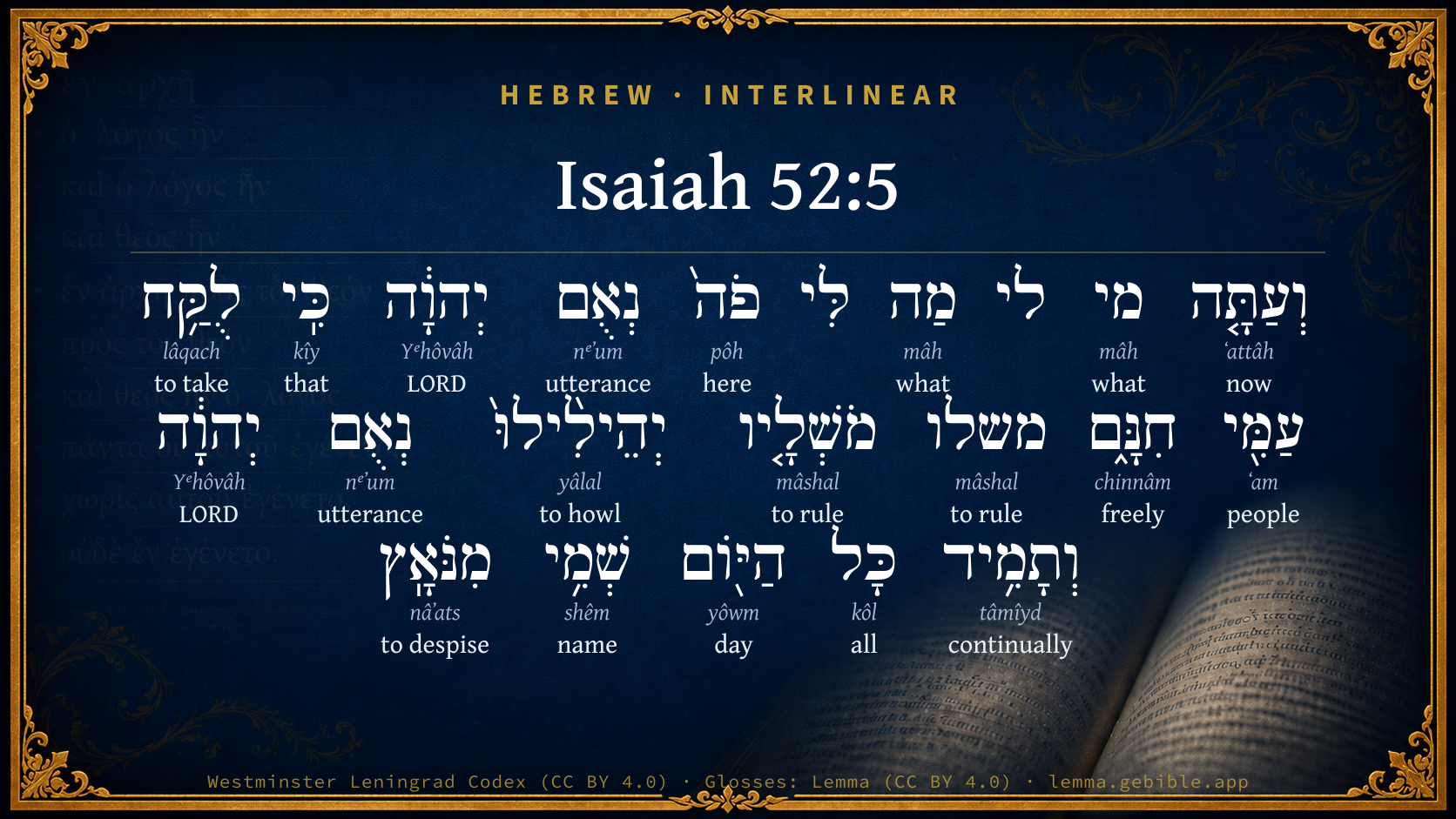
מִנֹּאָֽץ
nâʼats
H5006
“from · to despise”
Verb, Hithpolel, Participle Passive, Masculine, Singular, Absolute
Part of Speech
Verb
Stem
Hithpolel
Form
Participle Passive
Gender
Masculine
Number
Singular
State
Absolute
Full BDB Definition

Origin: a primitive root

TWOT: 1274

to spurn, contemn, despise, abhor - (Qal) to spurn, contemn - (Piel) - to spurn - to cause to contemn - (Hiphil) to spurn - (Hithpolel) to be contemned
  1. וְעַתָּ֤ה ʻattâh H6258 “and · now” Conjunction + Adverb
  2. מי mâh H4100 “what” Particle, Interrogative
  3. מַה mâh H4100 “what” Particle, Interrogative
  4. פֹה֙ pôh H6311 “here” Adverb
  5. נְאֻם nᵉʼum H5002 “utterance of” Noun, Common, Masculine, Singular, Construct
  6. יְהוָ֔ה Yᵉhôvâh H3068 “LORD” Noun, Proper
  7. כִּֽי kîy H3588 “that” Conjunction
  8. לֻקַּ֥ח lâqach H3947 “to take” Verb, Pual, Perfect, 3rd Person, Masculine, Singular
  9. עַמִּ֖י ʻam H5971 “people · my” Noun, Common, Masculine, Singular, Construct + Suffix, Personal, 1st Person, Common, Singular
  10. חִנָּ֑ם chinnâm H2600 “freely” Adverb
  11. משלו mâshal H4910 “ruling · him” Verb, Qal, Participle Active, Masculine, Singular, Construct + Suffix, Personal, 3rd Person, Masculine, Singular
  12. מֹשְׁלָ֤יו mâshal H4910 “ruling · him” Verb, Qal, Participle Active, Masculine, Plural, Construct + Suffix, Personal, 3rd Person, Masculine, Singular
  13. יְהֵילִ֨ילוּ֙ yâlal H3213 “to howl” Verb, Hiphil, Imperfect, 3rd Person, Masculine, Plural
  14. נְאֻם nᵉʼum H5002 “utterance of” Noun, Common, Masculine, Singular, Construct
  15. יְהוָ֔ה Yᵉhôvâh H3068 “LORD” Noun, Proper
  16. וְתָמִ֥יד tâmîyd H8548 “and · continually” Conjunction + Noun, Common, Masculine, Singular, Absolute
  17. כָּל kôl H3605 “all of” Noun, Common, Masculine, Singular, Construct
  18. הַיּ֖וֹם yôwm H3117 “the · day” Particle, Definite Article + Noun, Common, Masculine, Singular, Absolute
  19. שְׁמִ֥י shêm H8034 “name · my” Noun, Common, Masculine, Singular, Construct + Suffix, Personal, 1st Person, Common, Singular

About this verse

These counts appear in no published source. They are computed here, from the morphology-tagged text and Lemma’s own curated glosses. What Lemma adds →

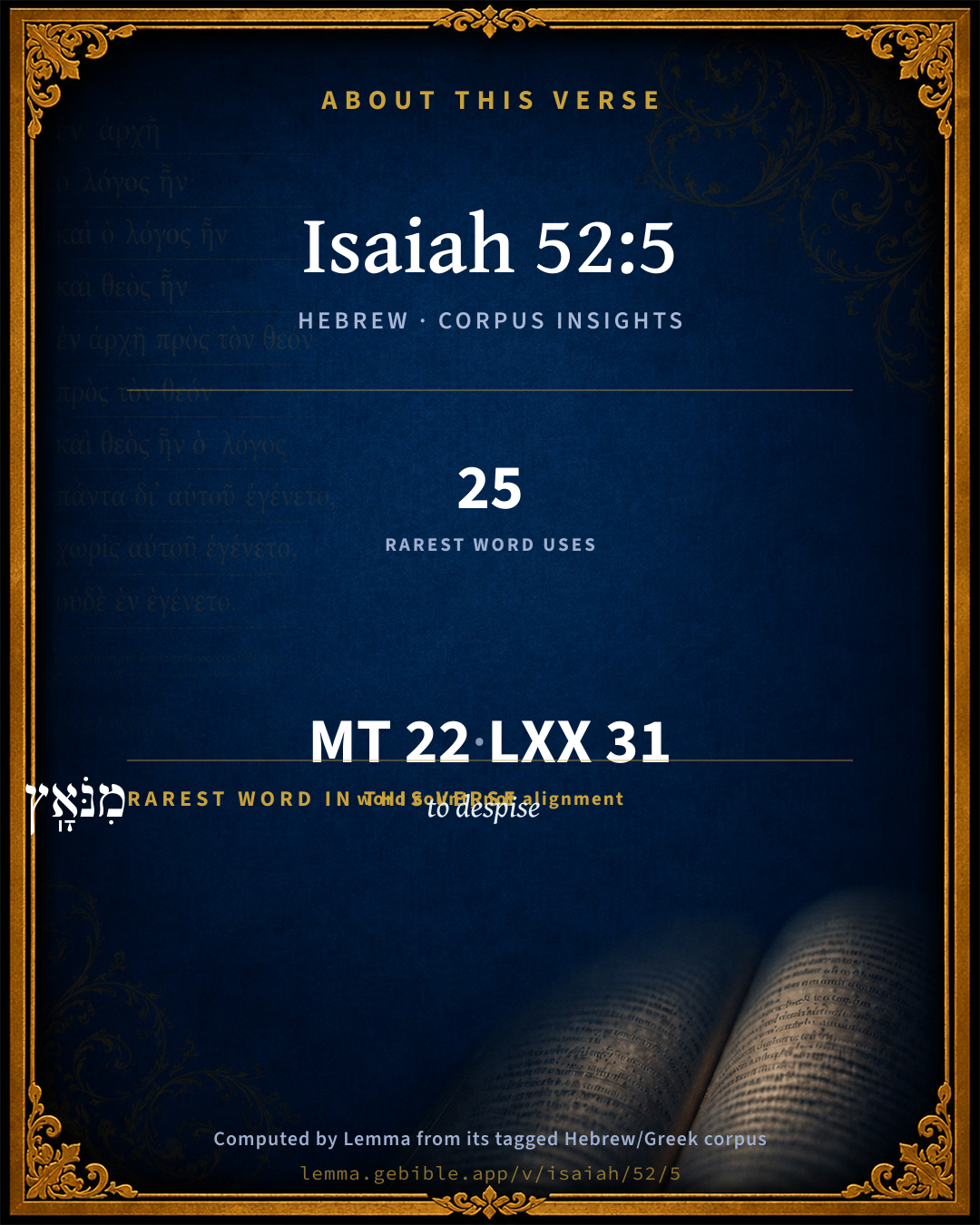
22
words
16
distinct lemmas
Prophets
section

Notable vocabulary

The rarest word here is מִנֹּאָֽץ to despise H5006 — appearing just 25 times in the whole Hebrew Bible.

Shared distinctive vocabulary

מִנֹּאָֽץ to despise H5006 occurs in 24 verses of the Hebrew Bible. Also found in:

Grammatical profile

  • 5 verbs
  • 9 nouns
  • 2 prepositions
  • 1 conjunction
  • 3 adverbs
  • 2 particles

Verb forms

  • לֻקַּ֥ח Pual · Perfect
  • משלו Qal · Participle Active
  • מֹשְׁלָ֤יו Qal · Participle Active
  • יְהֵילִ֨ילוּ֙ Hiphil · Imperfect
  • מִנֹּאָֽץ Hithpolel · Participle Passive

Repetition

Words recur within this verse — often emphatic in Hebrew:

  • נְאֻם utterance H5002 ×2
  • יְהוָ֔ה LORD H3068 ×2
  • משלו to rule H4910 ×2
  • מי what H4100 ×2

Hebrew & Septuagint length

In English translation the verse runs 35 words from the Hebrew and 37 from the Septuagint (LXX English) — closely comparable.

A rough comparison of the two English renderings, which tokenize alike — not a word-level alignment.

Word counts can differ between the Hebrew and the Greek without any difference in meaning — e.g. the Hebrew direct-object marker אֵת has no separate Greek word, and Greek often adds the article ὁ.

In the original languages it is 22 Hebrew tokens and 31 Greek tokens — but the two are counted differently (Hebrew bundles its prefixes and suffixes into one token; the Greek is in lemma form), so that isn’t a like-for-like length.

Cross-references

26

Topical passages linked to Isaiah 52:5 in the Treasury of Scripture Knowledge — connected by theme and wording, ordered by reader-vote popularity; previews shown in the World English Bible.

  • Romans 2:24 For "the name of God is blasphemed among the Gentiles because of you," just as it is written.
  • Exodus 1:13–16 The Egyptians ruthlessly made the children of Israel serve,
  • Exodus 2:23–24 It happened in the course of those many days, that the king of Egypt died, and the children of Israel sighed because of the bondage, and they cried, and their cry came up to God because of the bondage.
  • Exodus 3:7 Yahweh said, "I have surely seen the affliction of my people who are in Egypt, and have heard their cry because of their taskmasters, for I know their sorrows.
  • Judges 18:3 When they were by the house of Micah, they knew the voice of the young man the Levite; and they turned aside there, and said to him, Who brought you here? and what do you in this place? and what have you here?
  • Psalms 44:12 You sell your people for nothing, And have gained nothing from their sale.
  • Psalms 44:16 At the taunt of one who reproaches and verbally abuses, Because of the enemy and the avenger.
  • Psalms 74:10 How long, God, shall the adversary reproach? Shall the enemy blaspheme your name forever?
  • Psalms 74:18 Remember this, that the enemy has mocked you, Yahweh. Foolish people have blasphemed your name.
  • Psalms 74:22–23 Arise, God! Plead your own cause. Remember how the foolish man mocks you all day.
  • Psalms 137:1–2 By the rivers of Babylon, there we sat down. Yes, we wept, when we remembered Zion.
  • Isaiah 22:16 "What are you doing here? and who has you here, that you have hewed out a tomb here? Cutting him out a tomb on high, chiseling a habitation for himself in the rock!"
  • Isaiah 37:6 Isaiah said to them, Thus shall you tell your master, Thus says Yahweh, Don't be afraid of the words that you have heard, with which the servants of the king of Assyria have blasphemed me.
  • Isaiah 37:28 But I know your sitting down, and your going out, and your coming in, and your raging against me.
  • Isaiah 47:6 I was angry with my people, I profaned my inheritance, and gave them into your hand: you did show them no mercy; on the aged have you very heavily laid your yoke.
  • Isaiah 51:20 Your sons have fainted, they lie at the head of all the streets, as an antelope in a net; they are full of the wrath of Yahweh, the rebuke of your God.
  • Isaiah 51:23 and I will put it into the hand of those who afflict you, who have said to your soul, Bow down, that we may go over; and you have laid your back as the ground, and as the street, to those who go over.
  • Isaiah 52:3 For thus says Yahweh, You were sold for nothing; and you shall be redeemed without money.
  • Jeremiah 50:17 Israel is a hunted sheep; the lions have driven him away: first, the king of Assyria devoured him; and now at last Nebuchadrezzar king of Babylon has broken his bones.
  • Lamentations 1:21 They have heard that I sigh; there is none to comfort me; All my enemies have heard of my trouble; they are glad that you have done it: You will bring the day that you have proclaimed, and they shall be like me.
  • Lamentations 2:3 He has cut off in fierce anger all the horn of Israel; He has drawn back his right hand from before the enemy: He has burned up Jacob like a flaming fire, which devours round about.
  • Lamentations 5:13–15 The young men bare the mill; The children stumbled under the wood.
  • Ezekiel 20:9 But I worked for my name's sake, that it should not be profaned in the sight of the nations, among which they were, in whose sight I made myself known to them, in bringing them forth out of the land of Egypt.
  • Ezekiel 20:14 But I worked for my name's sake, that it should not be profaned in the sight of the nations, in whose sight I brought them out.
  • Ezekiel 36:20–23 When they came to the nations, where they went, they profaned my holy name; in that men said of them, These are the people of Yahweh, and are gone forth out of his land.
  • Zephaniah 1:10 In that day, says Yahweh, there will be the noise of a cry from the fish gate, a wailing from the second quarter, and a great crashing from the hills.

Cross-references courtesy of OpenBible.info (CC BY 4.0).

Hebrew and Greek witnesses Masoretic Hebrew ↔ Greek Septuagint

The same verse in the two great witnesses to the Old Testament, shown verse-for-verse.

These are two independent witnesses, not word-aligned to each other, and the Septuagint is shown in lemma (dictionary) form.

Hebrew Isaiah 52:5 Masoretic · Westminster Leningrad Codex

וְעַתָּ֤ה מי לי מַה לִּי פֹה֙ נְאֻם יְהוָ֔ה כִּֽי לֻקַּ֥ח עַמִּ֖י חִנָּ֑ם משלו מֹשְׁלָ֤יו יְהֵילִ֨ילוּ֙ נְאֻם יְהוָ֔ה וְתָמִ֥יד כָּל הַיּ֖וֹם שְׁמִ֥י מִנֹּאָֽץ

Now therefore, what do I here, says Yahweh, seeing that my people is taken away for nothing? those who rule over them do howl, says Yahweh, and my name continually all the day is blasphemed.

World English Bible · Public Domain

Greek LXX Isaiah 52:5 Septuagint · lemma form

καί νῦν τίς ὧδε εἰμί ὅδε λέγω κύριος ὅτι λαμβάνω ὁ λαός ἐγώ δωρεά θαυμάζω καί ὀλολύζω ὅδε λέγω κύριος διά σύ διά πᾶς ὁ ὄνομα ἐγώ βλασφημέω ἐν ὁ ἔθνος

And now why are you⌃ here? Thus says the Lord, Because my people was taken for nothing, wonder you⌃ and howl. Thus says the Lord, On account of you my name is continually blasphemed among the Gentiles.

LXX2012 (modern English Septuagint) · Public Domain

On this verse, John Gill's Exposition discusses the Septuagint’s reading. Read the note in Commentary ↓

Hebrew: Westminster Leningrad Codex (CC BY 4.0). Greek: Septuagint (public domain); English from LXX2012 (modern English Septuagint) (Public Domain). How the Septuagint differs from the Hebrew →

Targum (Aramaic paraphrase)

1

The Targum is the ancient Jewish Aramaic paraphrase of the Hebrew Scriptures — an interpretive translation, not the Hebrew text itself. Onkelos (literal) and Pseudo-Jonathan (expansive) render the Torah, and Jonathan the Prophets. Coverage is partial: where no permissively-licensed English translation exists for a verse, only the Aramaic is shown. This is verse-level text, not a word-by-word alignment to the Hebrew.

  1. Targum Jonathan Prophets (Joshua–Malachi)
    וּכְעַן עֲתִידְנָא לְמִפְרַק אֲמַר יְיָ אֲרֵי אִזְדַבַּן עַמִי מַגָן עַמְמַיָא דִשְׁלִיטוּ בְהוֹן מִשְׁתַּבְּחִין אֲמַר יְיָ וּתְדִירָא כָּל יוֹמָא עַל פּוּלְחָן שְׁמִי מַרְגְזִין:

    Therefore now I am ready to redeem them, saith the Lord; for my people was sold for nought; the nations that ruled over them boasted, saith the Lord; and they continually, all the day, provoke them to anger, because of the worship of my name.

    Targum Jonathan — Aramaic: “Mikraot Gedolot” (public domain). English: “Sefaria Community Translation” (CC0 1.0 (public-domain dedication)); “London "Chaldee Paraphrase," 1871” (public domain). Text via Sefaria.

Commentary

Notes on Isaiah 52:5 from classic Christian and Jewish commentators (each source and its license shown beneath its notes). The classic Christian expositions comment on the surrounding passage and are grouped to its opening verse, so a note may address several verses; the Jewish commentaries on the Tanakh (Rashi and others) are per-verse, so they appear only where the commentator wrote on this verse.

Lemma curates 59 commentaries, every one of them public domain or Creative Commons licensed, each selected and text-cleaned for this edition rather than reprinted as found. About our sources →

Trapp's Complete Commentary

John Trapp

Isa 52:5 Now therefore, what have I here, saith the LORD, that my people is taken away for nought? they that rule over them make them to howl, saith the LORD; and my name continually every day [is] blasphemed.

Ver. 5. Now, therefore, what have I here?] Cui bono? To what purpose or profit? For what wealth or worth suffer I my poor people to lie captives here at Babylon? Or, as others {a} sense it, what make I here any longer at Jerusalem when my poor people are in durance at Babylon? Why hasten I not to help them out?

They that rule over them, make them to howl,] i.e., The Chaldeans, and after them the Romans, and then the scribes and Pharisees, by "binding heavy burdens grievous to be borne, and laying them on men’s consciences." {Mat 23:4}

And my name continually every day (or, all the day long) is blasphemed.] That is all I get by the bargain.

{a} Piscator.

John Trapp, A Commentary or Exposition upon All the Books of the Old and New Testament (1647–1656) — public domain. Text from a community e-Sword module.

The Biblical Illustrator

Joseph S. Exell

Isa_52:5

My name continually every day is blasphemed.

--

God pitiful, yet indignant

1. The captives are so dispirited that they cannot praise Him; but, instead of that, they are continually howling, which grieves Him, and moves His pity.

2. The natives are so insolent that they will not praise Him; but, instead of that, they are continually blaspheming, which affronts Him and moves His anger. (M. Henry.)

Blasphemy

I. ITS NATURE.

II. ITS GUILT.

III. ITS AWFUL PREVALENCE.

IV. ITS CERTAIN PUNISHMENT. (J. Lyre, D. D.)

Blaspheming Gods name

I. WHAT IS MEANT BY THE NAME OF THE LORD? His perfections, titles, etc.

II. THE VARIOUS WAYS IN WHICH IT IS BLASPHEMED.

1. By denying His existence (Psa_10:4; Psa_14:1; Psa_53:1).

2. By denying His sovereignty (Job_21:14-15; Exo_5:2).

3. By denying His truth (Gen_3:4; Isa_36:15; 2Pe_3:3-4).

4. By denying His power (2Ki_7:2; 2Ki_18:30; 2Ki_18:32-35; Psa_78:19-20).

5. By denying His omnipotence and omniscience (Job_22:13-14; Psa_10:11; Psa_73:11; Psa_94:7; Isa_29:15; Eze_8:12).

6. By accusing Him of injustice (Jer_12:1; Eze_18:25; Mal_2:17; Mal_3:15).

7. By murmuring against His dispensations (Isa_45:9; Exo_14:11-12).

8. By false swearing, oaths and curses, etc.

III. THE EXCUSES USUALLY MADE FOR IT. Ignorance, custom, example, surprise, passion, confirmation of what is said, meaning no harm, inconsistencies of professors, etc. (2Sa_12:14; Eze_36:20; Rom_2:24; 2Pe_2:2).

IV. THE EVIL CONSEQUENCES OF IT. Destroys the little remains of the fear of God. Leads to the disobedience of all His commands. Sets a horrid example to others, especially to the young.

V. THE POWERFUL ARGUMENTS AGAINST IT. The Lord is our glorious and lawful Sovereign, who sees and hears all things. He is a holy and jealous God, before whose bar we must appear, He is fully able to punish, and has assured us that He will (2Ki_19:22; 2Ki_19:28, Isa_37:23; Isa_37:36-38;Eze_20:27; Eze_20:33; Eze_35:12-14). (A. Tucker.)

The Biblical Illustrator, edited by Joseph S. Exell (c. 1880s–1900s) — public domain. Text from a community e-Sword module.

The Preacher's Complete Homiletical Commentary

Joseph S. Exell (gen. ed.)

BLASPHEMY

Isa_52:5. My name continually every day is blasphemed.

The proud and oppressive Babylonians delighted to add to the sorrows of the exiled Jews, by reproaching the name of their God, and by saying that He was unable to defend them and their city from ruin. This sin is awfully prevalent.

I. What is meant by the “name” of the Lord? His perfections, titles, word, &c.

II. The various ways in which it is blasphemed.

1. By denying His existence (Psa_10:4; Psa_14:1; Psa_53:1).

2. By denying His sovereignty (Job_21:14-15; Exo_5:2).

3. By denying His truth (Gen_3:4; Isa_36:15; 2Pe_3:3-4).

4. By denying His power (2Ki_7:2; Psa_78:19-20; Isa_36:15; Isa_36:18-20, and 2Ki_18:30; 2Ki_18:32-35).

5. By denying His omnipresence and omniscience (Job_22:13-14; Psa_10:11; Psa_73:11; Psa_94:7; Isa_29:15; Eze_8:12).

6. By accusing Him of injustice (Jer_12:1; Eze_18:25; Eze_33:17; Mal_2:17; Mal_3:15).

7. By murmuring against His dispensations (Isa_45:9; Exo_14:11-12).

8. By false swearing, oaths, and curses, &c.

III. The excuses usually made for it. Ignorance, custom, example, surprise, passion, confirmation of what is said, meaning no harm, inconsistencies of professors, &c. (2 Samuel 12, 14; Eze_36:20; Rom_2:24; 2Pe_2:2).

IV. The evil consequences of it. Destroys the little remains of the fear of God. Leads to the disobedience of all His commands. Sets a horrid example to others, especially to the young, &c.

V. The powerful arguments against it. “The Lord” is our glorious and lawful Sovereign, who sees and hears all things. He is a holy and jealous God, before whose bar we must appear. He is fully able to punish, and has assured us that He will (2Ki_19:22; 2Ki_19:28; Isa_37:23; Isa_37:36-38; Eze_20:27; Eze_20:33; Eze_35:12-14).—Alfred Tucker.

Blasphemy. I. Its nature. II. Its guilt. III. Its awful prevalence. IV. Its certain punishment.—J. Lyth, D.D.

The Preacher's Complete Homiletical Commentary (gen. ed. Joseph S. Exell; Funk & Wagnalls, c. 1892) — public domain (pre-1929). A full-Bible homiletical/sermon-outline anthology covering 65 of 66 books (2 John is absent from the source module). Text from a community e-Sword module.

Tyndale Open Study Notes

Tyndale Open Resources

52:5 The oppressors would shout in exultation because they believed they had conquered not only Israel but also its God. • My name is blasphemed all day long: The condition of God’s people affects God’s reputation in the eyes of the watching world (see 37:6, 23; 48:11).

Tyndale Open Study Notes — © Tyndale Open Resources, licensed CC BY-SA 4.0. Text via the HelloAO Bible API.

Geneva Bible (1599)

Geneva Bible translators

To wit, by the wicked, which think that I have no power to deliver them.

Geneva Bible (1599) marginal notes — public domain. Text via Bolls.life.

Jamieson, Fausset & Brown

Robert Jamieson, A. R. Fausset & David Brown

what have I here--that is, what am I called on to do? The fact "that My people is taken away (into captivity; Isa 49:24-25) for naught" (by gratuitous oppression, Isa 52:4; also Isa 52:3, and see on Isa 52:3) demands My interposition.

they that rule--or "tyrannize," namely, Babylon, literal and mystical.

make . . . to howl--or, raise a cry of exultation over them [MAURER].

blasphemed--namely, in Babylon: God's reason for delivering His people, not their goodness, but for the sake of His holy name (Eze 20:9, Eze 20:14).

Jamieson, Fausset & Brown — Commentary Critical and Explanatory on the Whole Bible (1871) — public domain (CC PDM 1.0). Text via the HelloAO Bible API.

Adam Clarke's Commentary

Verse 5. They that rule over them - "They that are lords over them"] For משלו moshelo, singular, in the text, more than a hundred and twenty MSS. (De Rossi says, codices innumeri, "numberless copies") have משליו moshelaiv, plural, according to the Masoretical correction in the margin; which shows that the Masoretes often superstitiously retained apparent mistakes in the text, even when they had sufficient evidence to authorize the introduction of the true reading.

Make them to howl - "Make their boast of it"] For יהילילו yeheililu, "make them to howl," five MSS., (two ancient,) have יהללו yehalelu, "make their boast;" which is confirmed by the Chaldee paraphrast, who renders it משתבחין mishtabbechin. Ulaloo is not only the cry itself, but also the name of the funeral song of the Irish. The Arabs have a cry very much resembling this.

Adam Clarke's Commentary on the Bible (1810–1826) — public domain. Text from a community e-Sword/MySword module.

Ellicott's Commentary for English Readers

(5) What have I here . . .?—i.e., What have I to do? As in Gen_11:4, Jehovah is represented as deliberating after the manner of men. Again the people have been gratuitously, wantonly attacked; and their groans mingle with the taunting blasphemies of their conquerors. Has not the time come for Him to vindicate His outraged Majesty?

A Bible Commentary for English Readers, edited by Charles John Ellicott (1878–1897) — public domain. Text from a community e-Sword module.

The Cambridge Bible for Schools and Colleges

gen. ed. J. J. S. Perowne

5. Now therefore] Rather, But now, accentuating the gravity of the present situation. Exile and oppression were indeed no new experiences for Israel (Isa_52:4), but no such overwhelming disaster as this had ever befallen it hitherto.

what have I here &c.] The sentence may be variously understood. The main idea obviously is that the state of things described in what follows is not to be endured, being inconsistent with the honour of Jehovah. The formula “What is there to me?” expresses a strong sense of incongruity between what is and what ought to be (see Isa_3:15, Isa_22:1; Isa_22:16), and we may render either, “What am I about (Isa_22:1) here (in Babylonia)?” or, more generally, “What do I find here?” i.e. in the existing position of affairs, as contrasted with the historic parallels in Isa_52:4. The last is perhaps to be preferred. The meaning can hardly be, “What have I to do here (ch. Isa_22:16) now that my people is taken away?”

that (better for) my people is taken away] destroyed outright (ch. Isa_53:8).

they that rule over them (the Chaldæans) make them to howl (R.V. do howl)] The R.V. rightly avoids the causative sense of the verb, which has no support in usage. On the other hand, it is nowhere else used of a shout of exultation, as it must be here; comp. with Gesenius and others, “laetis ululare triumphis” (Lucan, 6, 261). In Syriac also the word appears occasionally to undergo a similar modification.

my name … is blasphemed] lit. despised. (The form should probably be pointed as part. Pual.) The meaning is that the calamities of Israel were attributed by the heathen to the impotence of their God, and thus the majesty of Jehovah was impaired,—a thought frequently expressed by Ezekiel (see Eze_36:20 &c.). The words are cited in Rom_2:24.

continually all the day] (R.V.), as ch. Isa_51:13.

The Cambridge Bible for Schools and Colleges (gen. ed. J. J. S. Perowne; Cambridge University Press, 1878–1918) — public domain. Text from a community e-Sword module.

John Gill's Exposition

Now therefore what have I here, saith the Lord, that my people is taken away for nought?.... Or what do I get by it, that my people should be taken and held in captivity without cause? I am no gainer, but a loser by it, as it afterwards appears; and therefore why should I sit still, and delay the deliverance of my people any longer? but as I have delivered Israel out of Egypt, and the Jews from Babylon, so will I deliver my people out of mystical Babylon, spiritually called Sodom and Egypt.

They that rule over them cause them to howl, saith the Lord; they that hath carried them captive, and exercised a tyrannical power over them, cause them to howl under their bondage and slavery, as the Israelites formerly in Egypt; wherefore the Lord is moved with compassion to them, and since neither he nor they were gainers, but losers by their captivity, he determines to deliver them: or it may be rendered, "they cause its rulers to howl" (i), or his rulers howl; not the common people only, but their governors, civil and ecclesiastical; so Aben Ezra interprets it not of Heathen rulers, but of the great men of Israel:

and my name continually every day is blasphemed; by ascribing their extent of power and authority, their dominions and conquests, not to the Lord, but to their idols, whom they worship, to such or such a saint; opening their mouths in blasphemy against God, his name and tabernacle, and his people, Rev 13:5. The Targum is,

"and always, all the day, because of the worship of my name, they provoke.''

The Septuagint is, "for you always my name is blasphemed among the Gentiles"; see Rom 2:24.

(i) "dominatores ejus ululare facient", Montanus; "dominus ipsius ejulant", Junius & Tremellius, Vitringa; "ululant", Piscator; "qui habent potestatem in eum ejulant", Cocceius.

John Gill's Exposition of the Whole Bible (1746–1763) — public domain (CC PDM 1.0). Text via the HelloAO Bible API.

Albert Barnes' Notes on the Bible

Now, therefore, what have I here? - In Babylon, referring to the captivity of the Jews there. The idea is, that a state of things existed there which demanded his interposition as really as it did when his people had been oppressed by the Egyptians, or by the Assyrian. His people had been taken away for nought; they were subject to cruel oppressions; and his own name was continually blasphemed. In this state of things, it is inferred, that he would certainly come to their rescue, and that his own perfections as well as their welfare demanded that he should interpose to redeem them. The phrase, ‘what have I here?’ is equivalent to saying, what shall I do? what am I properly called on to do? or what reason is there now in Babylon for my interposition to rescue my people? It is implied, that such was the state of things, that God felt that there was something that demanded his interposition.

That my people is taken away for nought - This was one thing existing in Babylon that demanded his interposition. His people had been made captive by the Chaldeans, and were now suffering under their oppressions. This had been done ‘for nought;’ that is, it had been done without any just claim. It was on their part a mere act of gross and severe oppression, and this demanded the interposition of a righteous God.

They that rule over them make them to howl - Lowth renders this, ‘They that are lords over them make their boast of it.’ Noyes renders it, ‘And their tyrants exult.’ The Septuagint renders it, ‘My people are taken away for nought: wonder ye, and raise a mournful cry’ (ὀλολύζετε ololuzete). Jerome renders it, ‘Their lords act unjustly, and they therefore howl when they are delivered to torments.’ Aben Ezra supposes that by ‘their lords’ here, or those who rule over them, are meant the rulers of the Jewish people, and that the idea is, that they lament and howl over the calamities and oppressions of the people. But it is probable, after all, that our translators have given the true sense of the text, and that the idea is, that they were suffering such grievous oppressions in Babylon as to make them lift up the cry of lamentation and of grief. This was a reason why God should interpose as he had done in former times, and bring deliverance.

And my name continually every day is blasphemed - That is, in Babylon. The proud and oppressive Babylonians delight to add to the sorrows of the exiles by reproaching the name of their God, and by saying that he was unable to defend them and their city from ruin. This is the third reason why God would interpose to rescue them. The three reasons in this verse are, that they had been taken away for nought; that they were suffering grievous and painful oppression; and that the name of God was reproached. On all these accounts he felt that he had something to do in Babylon, and that his interposition was demanded.

Albert Barnes' Notes on the Bible (1834–1885) — public domain. Text from a community e-Sword/MySword module.

Haydock's Catholic Bible Commentary

Long, by the Chaldeans, weak Jews, and strangers, who misconstrue my conduct towards my people, and represent it as the effect of injustice, or of weakness.

George Leo Haydock (1774–1849), Haydock's Catholic Family Bible and Commentary, 1859 edition — public domain. Excludes Psalms (Douay-Rheims chapter numbering differs from Protestant) and Deuterocanonical books (Catholic canon only).

Matthew Poole's English Annotations

What have I here? Heb. What to me here? the sense is either,

1. What do I here? Why do I sit still here, and not go to Babylon to punish the Babylonians, and to deliver my people? Or,

2. What honour have I by suffering this injury to be done to my people?

Is taken away, were carried away captive by the Babylonians,

for nought; without any provocation or pretence of right. See before on Isa 52:3. They that rule over then, who by their office are obliged to deal justly and tenderly with their subjects,

make them to howl, by their tyrannical and unmerciful usage of them.

My name continually every day is blasphemed; instead of that praise and service which the Babylonians owe me for all their successes and conquests, they blaspheme me, as if I wanted either power or good-will to save my people out of their hands.

Matthew Poole's English Annotations on the Holy Bible (1683–1685) — public domain. Text from a community e-Sword/MySword module.

The Pulpit Commentary

What have I here? rather, what have r to do here? i.e. what is the task before me the work that I have to perform? There are three principal considerations by which the answer to this question has to be determined.

(1) The Babylonians have obtained possession of the Israelites without purchase for nought;

(2) they use their authority harshly and brutally; and

(3) they continually blaspheme the Name of Jehovah. All three are grounds for bringing the captivity to an end, and coming forward with the cry of a deliverer, "Here I am." Make them to howl; rather, howl; i.e. insult over the captives with shouts and yells of triumph. The prophet is speaking of the Babylonian oppressors, not of the native "rulers," who exercised a certain amount of authority over the captives (see Delitzsch and Cheyne). My Name... is blasphemed. Cruel taskmasters vexed the captives by insulting their God.

The Pulpit Commentary (1880–1919), ed. H.D.M. Spence-Jones & Joseph S. Exell — public domain. Text from a community e-Sword module.

John Wesley's Explanatory Notes

What have I - Why do I sit still here, and not go to Babylon to punish the Babylonians, and to deliver my people? For nought - Without any provocation, or pretense of right. Howl - By their unmerciful usage. Blasphemed - The Babylonians blasphemed me as if I wanted either power or good will to save my people out of their hands.

John Wesley, Explanatory Notes Upon the Whole Bible (1754–1765) — public domain. Text via the GEBible commentary corpus.

J. A. Alexander on Isaiah

Joseph Addison Alexander

“And now, what is there to me here (what have I here), saith Jehovah, that my people is taken away for nothing, its rulers howl, saith Jehovah, and continually, all the day, my name is blasphemed?” Some understand ‘now’ strictly as meaning ‘at the present time’, in opposition to the ancient times when Israel suffered at the hands of Egypt and Assyria. The same antithesis may be obtained by giving now a modified sense so as to mean in the present case, as distinguished from the two already mentioned. It would even be admissible to give the now its logical sense as substantially meaning since these things are so, although such a departure from the proper import of the word is by no means necessary. The other adverb, here, admits of no less various explanations. Some older writers understand it to mean heaven as the customary residence of God (1Ki 8:30). Some suppose it to mean Babylon, while others, with a bolder departure from the strict sense, understand it as equivalent to in the present case, viz. that of the Babylonian exile; which, however, even if correct in substance, is rather a paraphrase than a translation. With the meaning put upon this adverb varies the interpretation of the whole phrase, ‘what have I here?’ If ‘here’ means ‘in Babylon’, the sense would seem to be, ‘what else have I to do here but to free my people?’ If it mean ‘in heaven’, then the question is, ‘what is there to detain me here from going to the rescue of my people?’ If it mean ‘in the present case’, whether this be referred to the Babylonish exile or more generally understood, the best explanation of the question is, ‘what have I gained in this case, any more than in the others, since my people are still taken from me without any compensation?’ The conclusion implied, though not expressed, is that in this as in the other instances referred to, a regard to His own honor, metaphorically represented as His interest, requires that He should interpose for the deliverance of his people. The next clause likewise has been very variously explained. Among the vast majority of writers who retain the common meaning of the word translated ‘rulers’, the question chiefly in dispute is whether it denotes the native rulers of the Jews themselves, as in Isa 28:14, or their foreign oppressors, as in Isa 49:7. Most interpreters, however, seem disposed to understand it as meaning his foreign oppressors. The form of expression in the last clause is copied by Ezekiel (Eze 36:20; Eze 36:23), but applied to a different subject; and from that place, rather than the one before us, the Apostle quotes in Rom 2:24.

Joseph Addison Alexander, The Prophecies of Isaiah (1846–1847; New York: Scribner, 1870–1878) — public domain. Text from a community e-Sword module.

unfoldingWord translationNotes

Door43 World Missions Community

Now what do I have here ... seeing that my people are taken away for nothing?

Yahweh uses a question to make the people pay attention to what he is about to say. This rhetorical question can be translated as a statement. AT: "Now look at what is happening ... my people are again taken away for nothing." (See: Rhetorical Question)

this is Yahweh's declaration

Yahweh speaks of himself by name to express the certainty of what he is declaring. Translate as in Isaiah 30:1. AT: "this is what Yahweh has declared" or "this is what I, Yahweh, have declared" (See: First, Second, or Third Person)

seeing that my people are taken away for nothing

This can be stated in active form. AT: "I see the enemy taking my people away for nothing" (See: Active or Passive)

for nothing

Possible meanings are 1) "for nothing" means the Babylonians took the people unjustly and without cause or 2) this continues the metaphor from Isaiah 52:3 where Yahweh is spoken of as if he owned the people of Israel and could give them away for nothing. (See: Metaphor)

Those who rule over them mock

This refers to the Babylonians who have conquered the people. However, some versions have, "Those who rule over them wail." For these versions, this passage refers to the leaders of the Israelites in captivity.

my name is blasphemed continually all day long

Here "name" represents Yahweh's reputation. This can be stated in active form. AT: "those who watch the enemy take away my people are continually saying evil things about me" (See: Metonymy and Active or Passive)

Therefore my people will know my name

Here "name" represents Yahweh's reputation. AT: "Therefore my people will truly know who I am" (See: Metonymy)

translationWords

Yahweh

declare

people of God

name

slander

know

unfoldingWord translationNotes — © Distant Shores Media and the Door43 World Missions Community, licensed CC BY-SA 4.0. Source: git.door43.org/Door43/en_tn.

Rashi

Rabbi Shlomo Yitzchaki (Rashi)

And now, what have I here Why do I stay and detain My children here?

boast Heb. יְהֵילִילוּ, Boast saying, “Our hand was powerful.”

is blasphemed Blasphemes itself, and this is an instance similar to (Num 7:89) “And he heard the voice speaking to him.”

Rashi on the Tanakh — English translations: “The Judaica Press complete Tanach with Rashi, translated by A. J. Rosenberg” (CC BY 4.0); “Pentateuch with Rashi's commentary by M. Rosenbaum and A.M. Silbermann, 1929-1934” (public domain); “The Metsudah Tanach series, Lakewood, N.J” (CC BY 4.0); and “The Book of Joshua, Metsudah Publications, 1997” (CC BY 4.0). Text via Sefaria.

Ibn Ezra

Rabbi Abraham ibn Ezra

מה לי פה What have I here, any more. It is an anthropomorphism. It might also mean, what reason have I to be silent,

that my people is taken away for nought by Babylon, Edom, and other nations.

ומשליו And they that rule over them, that is, the princes of Israel, or His poets; comp. המשלים they that speak in proverbs (Num. 21:27).

יהילילו Hoẇl. The ה, the characteristic of the Hiphil, is here not omitted, as is usually the case.

מתנאץ═מנאץ Is blasphemed. The Dagesh in נ compensates for the omitted ת.

Ibn Ezra on the Tanakh — English translations: “Sefaria Community Translation” (CC0 1.0 (public-domain dedication)); “Yalkut, Sifsei Chachomim Chumash, Metsudah Publications, 2009” (CC BY 4.0); and “Commentary of Ibn Ezra on Isaiah - trans. by M. Friedlander, 1873” (public domain). Text via Sefaria.

Lesson kit

Teaching starters — assembled from the data on this page, not authored interpretation. Every prompt links to the verse data it draws on. Edit before teaching.

Isaiah, in the Prophets, opens this verse with 22 words (16 distinct Hebrew lemmas). Its most distinctive word is nâʼats (“to despise”). A historical commentator’s framing appears above. Read the whole chapter for the surrounding context.

Discussion questions

  1. What does “to despise” (nâʼats) contribute to the verse as a whole?
  2. How does Numbers 14:11, which shares the word «to despise», read alongside this verse?
  3. What does the repetition of “utterance” (2× in this one verse) do in this verse?
  4. These translations render this verse differently. What is at stake in choosing one wording over another?
  5. «לֻקַּ֥ח» is a Pual Perfect verb. How does that grammatical form shape the action described?
  6. Compare how Trapp's Complete Commentary and The Biblical Illustrator read this verse. Where do they agree or differ?

Things to notice

Reading settings

Reading text

Shown beneath each verse's original-language words.

Old Testament
Old Testament edition

Read the OT as the Masoretic Hebrew (MT) or the Greek Septuagint (LXX).

English shown for the Greek Septuagint (in the Hebrew ↔ Greek comparison).

Comparing translations? Open the Compare panel on any verse page to stack up to four side by side.