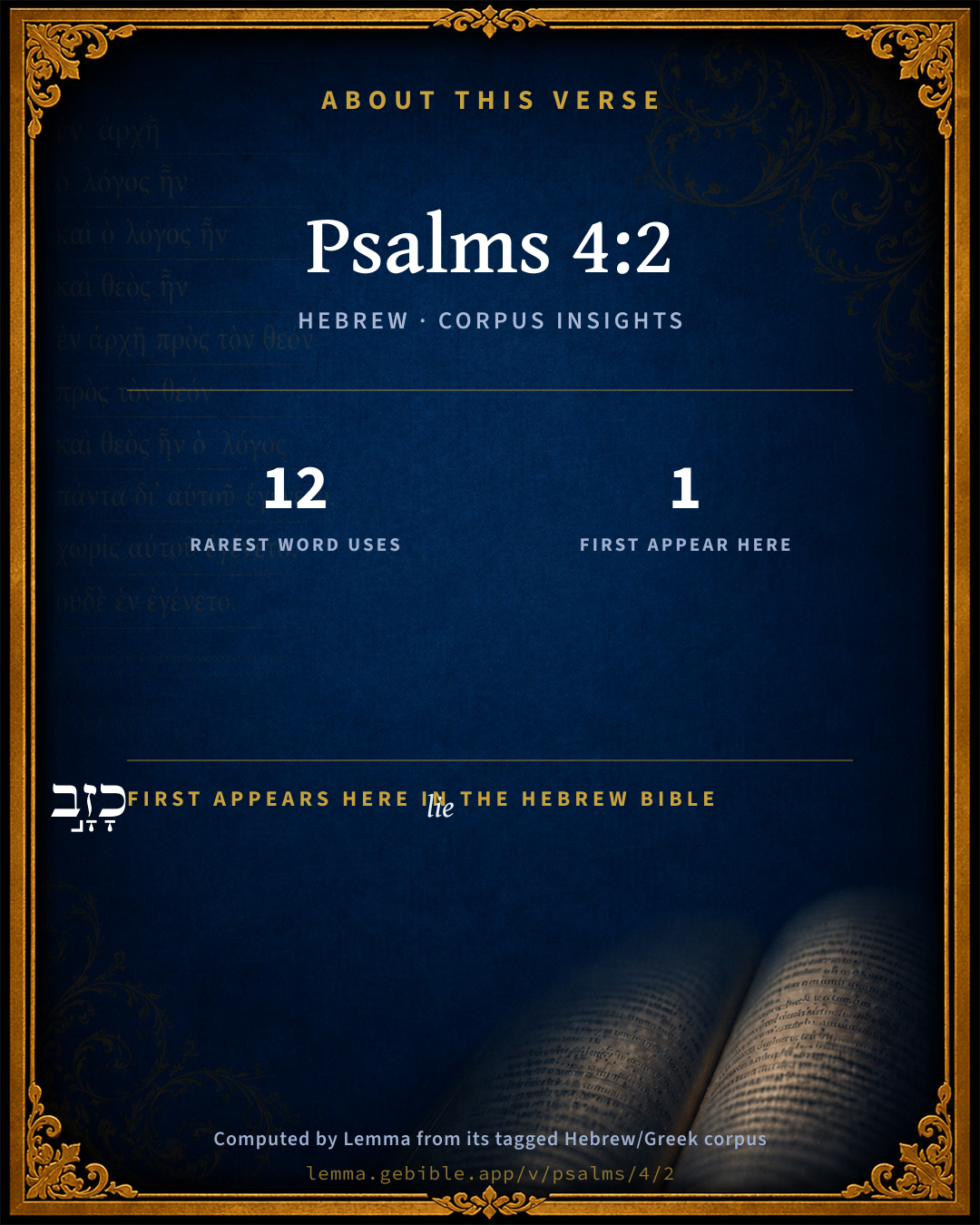
Psalms 4:2

Hebrew (Westminster Leningrad Codex) Psalms 4:2 appears in the Hebrew Old Testament. The text above is from the Westminster Leningrad Codex. Each word links to its Strong’s number, a concise gloss, and parsing drawn from the Open Scriptures Hebrew Bible morphology. Click any word for its full Brown-Driver-Briggs (BDB) entry.
Download image
Cite this verse

Psalms 4:2 (World English Bible). Public Domain. Lemma interlinear Bible study tool, https://lemma.gebible.app/v/psalms/4/2.

Show BibTeX & RIS
BibTeX
RIS
English Translation
You sons of men, how long shall my glory be turned into dishonor? Will you love vanity, and seek after falsehood? Selah.
World English Bible · Public Domain
Highlights
  • 1 first appearance in the Hebrew Bible
Full analysis ↓
Download a study sheet

One document with this verse’s original text, its word-by-word gloss line, the meaning frame, cross-references with their text, attributed commentary, and full source and license credits — printable, and it pastes into notes with its structure intact.

This verse Autodidact and up

Study sheet (.html) Plain text (.txt)

A passage Seminary Student

Up to 50 verses in one chapter. A passage sheet keeps up to 6 commentary sources and 12 cross-references per verse, in the order this page ranks them, and says so on the sheet whenever that leaves anything out. Ask for a single verse and you get the Autodidact verse sheet above.

Everything on this page stays free to read, with no account — the sheet is a download of what is already on screen, not access to it.

Want to remove ads? Support Godless Engineer
Compare translations 3

The same verse in 3 English versions, stacked beneath the original-language interlinear above. Click any original word for its lexicon entry.

Each is an independent rendering of the whole verse — the interlinear is not word-aligned to these translations.

Highlighted words mark where these versions differ — a whole-verse word diff, not a word-by-word alignment.

  • World English Bible Public Domain
    You sons of men, how long shall my glory be turned into dishonor? Will you love vanity, and seek after falsehood? Selah.
  • King James Version Public Domain
    O ye sons of men, how long will ye turn my glory into shame? how long will ye love vanity, and seek after leasing? Selah.
  • unfoldingWord Literal Text CC BY-SA 4.0
    Son of man, until when my glory become shame? will you love futility, will you seek falsehood? Selah

unfoldingWord Literal Text — © unfoldingWord, licensed CC BY-SA 4.0. Word-aligned USFM3 via Door43 (git.door43.org/unfoldingWord/en_ult).

Versions to compare (up to 4)

3 of 4 selected

Show all 18 translations

Every available English version of this verse, each an independent rendering of the whole verse.

  • World English Bible Public Domain
    You sons of men, how long shall my glory be turned into dishonor? Will you love vanity, and seek after falsehood? Selah.
  • Berean Standard Bible Public Domain
    How long, O men, will my honor be maligned? How long will you love vanity and seek after lies? Selah
  • Majority Standard Bible Public Domain
    How long, O men, will my honor be maligned? How long will you love vanity and seek after lies? Selah
  • King James Version Public Domain
    O ye sons of men, how long will ye turn my glory into shame? how long will ye love vanity, and seek after leasing? Selah.
  • American Standard Version (1901) Public Domain
    O ye sons of men, how long shall my glory be turned into dishonor? `How long' will ye love vanity, and seek after falsehood? Selah
  • Revised Version (1885) Public Domain
    O ye sons of men, how long shall my glory be turned into dishonour? how long will ye love vanity, and seek after falsehood? Selah
  • Geneva Bible (1599) Public Domain
    O ye sonnes of men, howe long will yee turne my glory into shame, louing vanitie, and seeking lyes? Selah.
  • Douay-Rheims (1899) Public Domain
    When I called upon him, the God of my justice heard me: when I was in distress, thou hast enlarged me. Have mercy on me: and hear my prayer.
  • Young's Literal Translation Public Domain
    Sons of men! till when `is' my glory for shame? Ye love a vain thing, ye seek a lie. Selah.
  • Literal Standard Version CC BY-SA 4.0
    Sons of men! Until when [is] my glory for shame? You love a vain thing, you seek a lie. Selah.
  • Unlocked Literal Bible CC BY-SA 4.0
    You people, how long will you turn my honor into shame? How long will you love that which is worthless and seek after lies? Selah
  • unfoldingWord Literal Text CC BY-SA 4.0
    Son of man, until when my glory become shame? will you love futility, will you seek falsehood? Selah
  • Darby Bible Public Domain
    Ye sons of men, till when is my glory [to be put] to shame? [How long] will ye love vanity, will ye seek after a lie? Selah.
  • World Messianic Bible Public Domain
    You sons of men, how long shall my glory be turned into dishonor? Will you love vanity and seek after falsehood? Selah.
  • Webster's Bible Public Domain
    \\4:1\\To the chief Musician on Neginoth, A Psalm of David. Hear me when I call, O God of my righteousness: thou hast enlarged me when I was in distress; have mercy upon me, and hear my prayer.
  • Free Bible Version CC BY-SA 4.0
    How long will you people ruin my reputation? How long will you love what is worthless and tell lies? Selah.
  • Bible in Basic English Public Domain
    O you sons of men, how long will you go on turning my glory into shame? how long will you give your love to foolish things, going after what is false? (Selah.)
  • JPS Tanakh (1917) Public Domain
    (4-3) O ye sons of men, how long shall my glory be put to shame, in that ye love vanity, and seek after falsehood? Selah

Literal Standard Version (2020), Covenant Press — licensed CC BY-SA 4.0. Text via the HelloAO Bible API (eBible.org). Unlocked Literal Bible (unfoldingWord) — licensed CC BY-SA 4.0. Text via the HelloAO Bible API (eBible.org). unfoldingWord Literal Text — © unfoldingWord, licensed CC BY-SA 4.0. Word-aligned USFM3 via Door43 (git.door43.org/unfoldingWord/en_ult). Free Bible Version, Dr. Jonathan Gallagher — licensed CC BY-SA 4.0. Text via the HelloAO Bible API (eBible.org).

Word by word

More ways to search: Search by grammar → Find every occurrence → Compare this word →

Practice this passage: Drill this verse → Learn its vocabulary →

About this verse

These counts appear in no published source. They are computed here, from the morphology-tagged text and Lemma’s own curated glosses. What Lemma adds →

11
words
11
distinct lemmas
Wisdom
section

Notable vocabulary

The rarest word here is רִ֑יק emptiness H7385 — appearing just 12 times in the whole Hebrew Bible.

First appearance in Scripture

This word makes its first canonical appearance in the Hebrew Bible here:

Shared distinctive vocabulary

רִ֑יק emptiness H7385 occurs in 12 verses of the Hebrew Bible. Also found in:

Grammatical profile

  • 2 verbs
  • 6 nouns
  • 1 preposition
  • 2 particles

Verb forms

  • תֶּאֱהָב֣וּן Qal · Imperfect
  • תְּבַקְשׁ֖וּ Piel · Imperfect

Hebrew & Septuagint length

In English translation the verse runs 22 words from the Hebrew and 22 from the Septuagint (LXX English) — the same length.

A rough comparison of the two English renderings, which tokenize alike — not a word-level alignment.

Word counts can differ between the Hebrew and the Greek without any difference in meaning — e.g. the Hebrew direct-object marker אֵת has no separate Greek word, and Greek often adds the article ὁ.

Cross-references

27

Topical passages linked to Psalms 4:2 in the Treasury of Scripture Knowledge — connected by theme and wording, ordered by reader-vote popularity; previews shown in the World English Bible.

  • Proverbs 1:22 "How long, you simple ones, will you love simplicity? How long will mockers delight themselves in mockery, And fools hate knowledge?
  • Hosea 4:7 As they were multiplied, so they sinned against me. I will change their glory into shame.
  • Psalms 3:3 But you, Yahweh, are a shield around me, My glory, and the one who lifts up my head.
  • Psalms 5:6 You will destroy those who speak lies. Yahweh abhors the blood-thirsty and deceitful man.
  • Psalms 106:20 Thus they exchanged their glory For an image of a bull that eats grass.
  • Jeremiah 2:11 Has a nation changed [its] gods, which yet are no gods? but my people have changed their glory for that which does not profit.
  • 1 Samuel 12:21 and don't turn aside; for [then would you go] after vain things which can't profit nor deliver, for they are vain.
  • Ecclesiastes 8:11 Because sentence against an evil work is not executed speedily, therefore the heart of the sons of men is fully set in them to do evil.
  • Ephesians 4:25 Therefore, putting away falsehood, speak truth each one with his neighbor. For we are members one of another.
  • Psalms 2:1 Why do the nations rage, And the peoples plot a vain thing?
  • Psalms 14:6 You frustrate the plan of the poor, Because Yahweh is his refuge.
  • Psalms 31:6 I hate those who regard lying vanities, But I trust in Yahweh.
  • Psalms 58:1 Do you indeed speak righteousness, silent ones? Do you judge blamelessly, you sons of men?
  • Psalms 58:3 The wicked go astray from the womb. They are wayward as soon as they are born, speaking lies.
  • Psalms 63:11 But the king shall rejoice in God. Everyone who swears by him will praise him, For the mouth of those who speak lies shall be silenced.
  • Isaiah 20:5 They shall be dismayed and confounded, because of Ethiopia their expectation, and of Egypt their glory.
  • Isaiah 45:17 [But] Israel shall be saved by Yahweh with an everlasting salvation: you shall not be disappointed nor confounded world without end.
  • Isaiah 59:4 None sues in righteousness, and none pleads in truth: they trust in vanity, and speak lies; they conceive mischief, and bring forth iniquity.
  • Jeremiah 9:3 They bend their tongue, [as it were] their bow, for falsehood; and they are grown strong in the land, but not for truth: for they proceed from evil to evil, and they don't know me, says Yahweh.
  • Jonah 2:8 Those who regard lying vanities forsake their own mercy.
  • Exodus 10:3 Moses and Aaron went in to Pharaoh, and said to him, "This is what Yahweh, the God of the Hebrews, says: 'How long will you refuse to humble yourself before me? Let my people go, that they may serve me.
  • Numbers 14:11 Yahweh said to Moses, How long will this people despise me? and how long will they not believe in me, for all the signs which I have worked among them?
  • Psalms 57:4 My soul is among lions. I lie among those who are set on fire, Even the sons of men, whose teeth are spears and arrows, And their tongue a sharp sword.
  • Psalms 72:2 He will judge your people with righteousness, And your poor with justice.
  • Ecclesiastes 9:3 This is an evil in all that is done under the sun, that there is one event to all: yes also, the heart of the sons of men is full of evil, and madness is in their heart while they live, and after that they go to the dead.
  • Jeremiah 2:5 thus says Yahweh, What unrighteousness have your fathers found in me, that they have gone far from me, and have walked after vanity, and are become vain?
  • 1 Corinthians 1:31 that, according as it is written, "He who boasts, let him boast in the Lord."

Cross-references courtesy of OpenBible.info (CC BY 4.0).

Hebrew and Greek witnesses Masoretic Hebrew ↔ Greek Septuagint

The same verse in the two great witnesses to the Old Testament, shown verse-for-verse.

You’re reading Greek Psalm 4 (Hebrew Psalm 4). The Septuagint counts the superscription, so verse numbers can differ from the Hebrew — chapter-level alignment, not verse-by-verse. Numbering follows Rahlfs.

These are two independent witnesses, not word-aligned to each other, and the Septuagint is shown in lemma (dictionary) form.

Hebrew Psalms 4:2 Masoretic · Westminster Leningrad Codex

בְּנֵ֥י אִ֡ישׁ עַד מֶ֬ה כְבוֹדִ֣י לִ֭כְלִמָּה תֶּאֱהָב֣וּן רִ֑יק תְּבַקְשׁ֖וּ כָזָ֣ב סֶֽלָה

You sons of men, how long shall my glory be turned into dishonor? Will you love vanity, and seek after falsehood? Selah.

World English Bible · Public Domain

Greek LXX Greek Psalm 4:2 Septuagint · lemma form

ἐν ὁ ἐπικαλέω ἐγώ εἰςἀκούω ἐγώ ὁ θεός ὁ δικαιοσύνη ἐγώ ἐν θλῖψις πλατύνω ἐγώ οἰκτείρω ἐγώ καί εἰςἀκούω ὁ προσευχή ἐγώ

O you⌃ sons of men, how long will you⌃ be slow of heart? therefore do you⌃ love vanity, and seek falsehood? Pause.

LXX2012 (modern English Septuagint) · Public Domain

On this verse, Ellicott's Commentary for English Readers discusses the Septuagint’s reading. Read the note in Commentary ↓

Hebrew: Westminster Leningrad Codex (CC BY 4.0). Greek: Septuagint (public domain); English from LXX2012 (modern English Septuagint) (Public Domain). How the Septuagint differs from the Hebrew →

Commentary

Notes on Psalms 4:2 from classic Christian and Jewish commentators (each source and its license shown beneath its notes). The classic Christian expositions comment on the surrounding passage and are grouped to its opening verse, so a note may address several verses; the Jewish commentaries on the Tanakh (Rashi and others) are per-verse, so they appear only where the commentator wrote on this verse.

Lemma curates 59 commentaries, every one of them public domain or Creative Commons licensed, each selected and text-cleaned for this edition rather than reprinted as found. About our sources →

Trapp's Complete Commentary

John Trapp

Psa 4:2 O ye sons of men, how long [will ye turn] my glory into shame? [how long] will ye love vanity, [and] seek after leasing? Selah.

Ver. 2. O ye sons of men] Ye nobles, Psa 49:1-2, who think to carry all before you with those big looks, and bubbles of words: ye who are potent at court, and therefore insolent above measure. David, having poured out his heart to God in prayer, takes heart of grace thus freely to bespeak these great ones his enemies.

How long will ye turn my glory into shame?] i.e. Attempt to put me beside the kingdom, whereunto God hath designed and destined me? You think, belike, to jeer me out of my right, and, by casting upon me cart loads of calunmies and contumelies, to make me desist, and hang up my hopes. But it is otherwise, believe it. Psa 14:6-7, "Ye have shamed the counsel of the poor, because the Lord is his refuge." But will he therefore stop praying? No; for in the next words he falls on, and says, "Oh that the salvation of Israel were come out of Zion!" &c.

How long will ye love vanity? &c.] i.e. Trouble yourselves to no purpose, while ye plot and plough mischief to him who is blessed, and shall be blessed, ingratiis vestris? You love, you seek; that is, you both inwardly affect wickedness and outwardly act it; but all in vain.

John Trapp, A Commentary or Exposition upon All the Books of the Old and New Testament (1647–1656) — public domain. Text from a community e-Sword module.

Joseph Benson's Commentary

Psa 4:2. Ye sons of men — David is considered here by many commentators as addressing not mankind in general, but only princes, potentates, and persons of high degree. And perhaps, the phrase, sons of men, may often bear that sense in the Old Testament. But it must be observed, the Hebrew here, בני אישׁ, benee ish, signifies, sons of man, and not sons of men, and seems evidently to be of the same import as the phrase, sons of Adam, and if so, must include all mankind. Nor is there any proof from the context, or any part of the Psalm, that he is addressing merely those great men among the Jews or Israelites who revolted from him under Absalom, or even that he had Absalom’s rebellion particularly in his view when he composed this Psalm. He rather seems to be addressing the generality of his countrymen, or, rather, all into whose hands the Psalm might come, on subjects of infinite concern to all. How long will ye turn my glory into shame? — Or, as the Hebrew is literally rendered, How long shall my glory be for a shame? that is, be made by you a matter of reproach and scorn. And by his glory he probably meant, not only that honour which God had conferred upon him in advancing him to the throne, which, when he was in great straits and dangers, his enemies might possibly reproach and make the subject of derision; but also, and especially, the glory of God and his Messiah. For, as Dr. Horne justly observes, “If the Israelitish monarch conceived he had just cause to expostulate with his enemies for despising the royal majesty with which Jehovah had invested his anointed, of how much severer reproof shall they be thought worthy who blaspheme the essential glory of (God and) King Messiah, which shines forth by his gospel in his church.” But are not these rather to be considered as the words of God himself, here reasoning with sinners, by the psalmist, and calling them to repentance? As if he had said, You that go on in the neglect of God and his worship, and in contempt of the kingdom of Christ and his government, consider what you do. You not only disgrace yourselves, debase the dignity of your nature, the excellence of those powers with which you are endued; but you dishonour me, your Maker, and turn my glory, and that of my Son, your Messiah, into shame. Or, if they be David’s words, they may still be interpreted to the same sense, for his God was his glory, as he calls him Psa 3:3. Idolaters are charged with changing the glory of God into shame, Rom 1:23. And all wilful sinners do so by disobeying the commands of his law, despising the offers of his grace, and giving that affection and service to the creature which are due to God only. Those that profane God’s holy name, that ridicule his word and ordinances; and, while they profess to know him, by works deny him, do what in them lies to turn his glory into shame. How long will ye love vanity, and seek after leasing? — That is, lying or a lie. You are yourselves vain, and desire and pursue vain things, and you love to be and do so. You set your hearts upon that which will prove, at last, vanity and a lie. They that love the world and seek the things that are beneath, that please themselves with the delights of sense, and choose for their portion the wealth of this world, love vanity, and seek lies, for these things will deceive and so ruin them. How long will you do this? Will you never be wise for yourselves, never consider your duty and interest? When shall it once be? Jer 13:27.

Joseph Benson's Commentary on the Old and New Testaments (1811–1818) — public domain. Text from a community e-Sword module.

Tyndale Open Study Notes

Tyndale Open Resources

4:2 The opponents of the godly place their hope in delusions, treachery, and idolatry. • my reputation (or my glory): The honor of the psalmist, or possibly of the Lord, is at stake.

Tyndale Open Study Notes — © Tyndale Open Resources, licensed CC BY-SA 4.0. Text via the HelloAO Bible API.

Geneva Bible (1599)

Geneva Bible translators

Though your enterprises please your never so much, yet God will bring them to nought.

Ye that think yourselves noble in this world.

Geneva Bible (1599) marginal notes — public domain. Text via Bolls.life.

Jamieson, Fausset & Brown

Robert Jamieson, A. R. Fausset & David Brown

sons of men--men of note or prominence (compare Ch2 21:9).

turn my glory--or, "royal dignity."

into shame--or, "reproach."

vanity--a foolish and hopeless enterprise (Psa 2:1).

leasing--a lie.

Jamieson, Fausset & Brown — Commentary Critical and Explanatory on the Whole Bible (1871) — public domain (CC PDM 1.0). Text via the HelloAO Bible API.

Adam Clarke's Commentary

Verse 2. O ye sons of men] בני איש beney ish, ye powerful men-ye who are now at the head of affairs, or who are leaders of the multitude.

Love vanity] The poor, empty, shallow-brained, pretty-faced Absalom; whose prospects are all vain, and whose promises are all empty!

Seek after leasing?] This is a Saxon word, from [Anglo-Saxon], falsehood, from [A.S.], to lie. Cardmarden has adopted this word in his translation, Rouen, 1566. It is in none of the Bibles previously to that time, nor in any after, as far as my own collection affords me evidence; and appears to have been borrowed by King James's translators from the above.

Selah.] Mark this! See what the end will be!

Adam Clarke's Commentary on the Bible (1810–1826) — public domain. Text from a community e-Sword/MySword module.

John Calvin's Commentaries

2. O ye sons of men. The happy result of the prayer of David was, that resuming courage, he was able not only to repel the fury of his enemies, but also to challenge them on his part, and fearlessly to despise all their machinations. That our confidence, therefore, may remain unshaken, we ought not, when assailed by the wicked, to enter into conflict without being furnished like David with the same armor. The sum is, that since God was determined to defend David by his own power, it was in vain for all the men in the world to endeavor to destroy him; however great the power which they otherwise might have of doing him injury. By calling those whom he addresses the sons, not of Adam, or of some common persons but of men, he seems by the way to reprove their pride. “Le mot Hebrieu ne signifie pas simplement Homme, mais homme viril at robuste; en quoy il semble taxer, en passant, leur arrogance.” — Fr. The Hebrew word signifies not simply man, but a strong and robust man; and by this word he seems, in passing, to rebuke their arrogance.

How long will ye love vanity? In these words, he partly reproaches his enemies for the wicked and perverse passions with which he saw them to be impelled, although they falsely pretended to be actuated by a godly zeal; and he partly derides their folly in flattering themselves with the hope of success while fighting against God. And it is a most pointed rebuke. Even when the ungodly rush headlong into all manner of wickedness with the grossest “D’une malice si evidente qu’on la pourroit toucher au doigt.” — Fr. With a malice so evident that one could touch it with the finger.

John Calvin's Commentaries (1540-1563) — public domain. Text from the Calvin Translation Society English edition (1840s-50s) via the Christian Classics Ethereal Library (ccel.org). Calvin's coverage is partial (roughly two-thirds of the Bible); uncommented books and verses are honest gaps, never fabricated. The 19th-century editor's footnotes and remarks are omitted so the notes are faithfully Calvin's own voice.

Ellicott's Commentary for English Readers

(2)Sons of men.—A literal rendering of a Hebrew phrase generally interpreted as “men of high degree.” Luther translates “gentlemen” (see Psa_49:2), where it is “high,” as contrasted with “low.” (Comp. Psa_62:9, “men of high degree.”)

How long?—Literally, how long to shame my glory? which, after the analogy of Psa_37:26, “his seed is for a blessing,” must mean How long shall my glory be for shame (opprobrio)? The LXX. and Vulg. follow a different and probably correct reading: “How long will ye be heavy (or slow) of heart? “They also indicate that an interrogative has dropped out before the second clause, so that it is rightly supplied by the Authorised Version.

Seek after.—In Hebrew the intensive conjugation, to seek earnestly, or again and again.

Leasing—i.e., lying. (Comp. Psa_4:6.) So in Wycliffe’s New Testament: “Whanne he speketh leesing, he speketh of his own; for he is a lere, and is fader of it” (Joh_8:44). “Lesyngmongers” (1Ti_1:10). Chaucer uses the word; and it is common in Piers Ploughman. Shakespeare also knows the word:—

“Now Mercury indue thee with leasing,

For thou speakest well of fools.”—Twelfth Night.

(See Bible Educator, iv. 3,) Milton’s translation is—

“To love, to seek, to prize

Things false and vain, and nothing else but lies.”

For “Selah,” see Note, Psa_3:2.

From this verse we gather that the report of the calumny uttered against him in Jerusalem had reached the king’s ears.

A Bible Commentary for English Readers, edited by Charles John Ellicott (1878–1897) — public domain. Text from a community e-Sword module.

The Cambridge Bible for Schools and Colleges

gen. ed. J. J. S. Perowne

2. O ye sons of men] From appealing to God he turns to remonstrate with the rebels, and singles out the leaders from the general mass. The phrase used is bnç îsh, which in Psa_49:2 is rendered ‘high,’ and in Psa_62:9, ‘men of high degree,’ in opposition to bnç âdâm, rendered ‘low’ and ‘men of low degree.’ At the same time by calling them ‘sons of men’ he contrasts them with God, the defender of his cause.

my glory] There is no need to inquire whether David’s personal honour or his royal dignity is meant. Both are included, for both were defamed and insulted. But it was an aggravation of the rebels’ offence that the king had a special ‘glory’ as the representative of Jehovah. Cp. Psa_3:3, note.

vanity … leasing] The rebellion is a vain thing, destined to end in failure, like the threatened uprising of the nations (Psa_2:1): it is a lie, for it is based on the false principle of personal ambition setting itself up against the divinely appointed king. Cp. Isa_28:15; Isa_28:17. Another possible interpretation would refer the words to the false imputations and underhand intrigues by which Absalom and his confederates sought to tarnish David’s reputation and undermine his authority. Cp. 2Sa_15:2 ff. But the verbs used (love … seek) point rather to the end desired than to the means employed.

leasing] R.V. falsehood. Leasing (Psa_5:6) is an obsolete word for a lie: from A.S. leás, empty, and so false: used by Chaucer, Spenser, and Shakespeare. Cp. Faerie Queene, 11. 11. 10:

“Slaunderous reproches, and fowle infamies,

Leasinges, backbytinges.”

The Cambridge Bible for Schools and Colleges (gen. ed. J. J. S. Perowne; Cambridge University Press, 1878–1918) — public domain. Text from a community e-Sword module.

John Gill's Exposition

O ye sons of men,.... Meaning great men, the nobles of Israel; and so the Jewish interpreters (k) generally explain it; such as Ahithophel, and others, who were in the conspiracy with Absalom, Sa2 15:12, and so they were the kings and princes of the earth, and the rulers of the Jewish sanhedrim, the chief priests and elders, who were the enemies of Christ; and such, generally speaking, have been the persecutors of the saints; these men of power and authority, of dignity and honour, and who were in high places, and boasted of their titles and grandeur, the psalmist addresses by way of expostulation in the following words;

how long will ye turn my glory into shame? Meaning either God, who was his glory, Psa 3:3; whom they reproached when they said there was no help for him in him; or his tongue, the instrument of praise, and the songs of praise he expressed by it, Psa 7:8; which they jeered and scoffed at: or rather his royal glory and majesty, which they attempted to vail by casting him down from his excellency, by dethroning him, and setting up Absalom in his room. So the Jews endeavoured to turn the glory of Christ into shame, which lay in his being the only begotten of the Father; by denying his sonship, by condemning him to death; because he said he was the Son of God; and by mocking at him under that character on the cross; and also by their spitting upon, buffeting, and crucifying the Lord of glory; by reproaching his Gospel, ministers, and people; and by not acknowledging him as the Messiah, and submitting to his righteousness. And wicked men do as much as in them lies to turn the glory of the saints into shame, by aspersing their character, taking away their good name and reputation among men; by reproaching and reviling them, and speaking all manner of evil of them; and by persecuting them in the most violent manner;

how long will ye love vanity; or "a vain thing" (l). Such as the placing of Absalom upon the throne, on which their hearts were set; and such was the vain imagination of the Jews, with which they pleased themselves, that Jesus should die, and his name perish; and such are all the attempts of wicked men to ruin and destroy the people and interest of Christ; for no weapon formed against them shall prosper;

and seek after leasing? Or "a lie" (m); or that which fails and deceives, as a lie does: and such were all the counsels and designs of the great men of Israel against David: and so the Jews may be said to seek after a lie, when they seek after another Messiah besides Jesus of Nazareth: for every other proves a "Bar Cozbi", that is, the son of a lie; as the false Messiah in Adrian's time was called by themselves. And so do all such as seek after and embrace false doctrines, errors, and heresies, and are given up to believe them. Now the psalmist suggests that these great men were obstinate, and continued in these sinful practices; and that in the issue all their efforts would be vain and fruitless; and which he further strengthens by observing to them what follows.

Selah; on this word; see Gill on Psa 3:2.

(k) Jarchi, Aben Ezra, Kimchi, & Ben Melech in loc. (l) "inane", Pagninus, Montanus, Vatablus, Cocceius; "inanem rem", Piscator. (m) "mendacium", Pagninus, Montanus, Tigurine version, Junius & Tremellius, Piscator, &c.

John Gill's Exposition of the Whole Bible (1746–1763) — public domain (CC PDM 1.0). Text via the HelloAO Bible API.

Albert Barnes' Notes on the Bible

O ye sons of men - Turning from God to men; from Him in whom he hoped for protection to those who were engaged in persecuting him. We are not, of course, to suppose that they were present with him, but this is an earnest, poetic remonstrance, “as if” they were with him. The reference is doubtless to Absalom and his followers; and he calls them “sons of men,” as having human feelings, passions, and purposes, in strong distinction from that righteous God to whom he had just made his solemn appeal. God was holy, true, and just, and he might appeal to Him; they were ambitious and wicked, and from them he had nothing to hope. He looked upon God as righteous altogether; he looked upon them as altogether depraved and wicked. God he regarded as his just Protector; them he regarded as seeking only to wrong and crush him.

How long - The phrase used here might refer either to “time” or to “extent.” How long in regard to “time,” - or to what “degree” or “extent” will you thus persecute me? The former, however, seems to be the true signification.

Will ye turn my glory into shame - My honor, or what becomes my rank and station. If this refers to the rebellion in the time of Absalom, the allusion is to the fact that his enemies were endeavoring to rob him of his scepter and his crown, and to reduce him to the lowest condition of beggary and want; and he asks with earnestness how long they intended to do him so great injustice and wrong.

Will ye love vanity - Compare the notes at Psa 2:1. That is, how long will you act as if you were in love with a vain and impracticable thing; a thing which “must” be hopeless in the end. The idea is, that God had chosen him, and anointed him, and had determined that he should be king Psa 4:3, and therefore, that their efforts “must be” ultimately unsuccessful. The object at which they were aiming could not be accomplished, and he asks how long they would thus engage in what must, from the nature of the case, be fruitless.

And seek after leasing - The word “leasing” is the Old English word for “lie.” The idea here is, that they were pursuing a course which would yet prove to be a delusion - the hope of overturning his throne. The same question, in other respects, may be asked now. Men are seeking that which cannot be accomplished, and are acting under the influence of a lie. What else are the promises of permanent happiness in the pursuits of pleasure and ambition? What else are their attempts to overthrow religion and virtue in the world?

Selah - See the notes at Psa 3:2.

Albert Barnes' Notes on the Bible (1834–1885) — public domain. Text from a community e-Sword/MySword module.

Matthew Poole's English Annotations

O ye sons of men, i.e. princes and potentates, as this Hebrew phrase seems and is thought to signify, who are engaged with Saul or Absalom against me.

Will ye turn my glory into shame? or, shall my glory be for a shame, i.e. be made by you matter of reproach and scorn? By his glory probably he means that high honour and royal majesty which God had either promised to him, or conferred upon him; wherein, when he was in great straits and dangers, they might possibly reproach him in some sort as this: Is this the man, whom God so highly loves, and honours, and will exalt, who now flees from one mountain or cave to another, who runs away to the Philistines, whom his own son hath banished out of the land? Is this the effect of his glorying and boasting of God’s favour and promises?

Love vanity, i.e. affect and pursue these courses and designs of opposing me and my kingdom, which you will certainly find to be vain, and to no purpose.

Leasing or, lying; the same thing with vanity; these two words being promiscuously used, as Psa 62:9. Only this seems to add some emphasis, and to intimate the fair hopes and promising probabilities of success which they had, and which aggravate their disappointment. Or by lying he may design those horrid calumnies, which the partisans either of Saul or Absalom had raised against him, and which they joined with their other endeavours to make him odious to all the people, and so the better to effect his ruin.

Matthew Poole's English Annotations on the Holy Bible (1683–1685) — public domain. Text from a community e-Sword/MySword module.

The Treasury of David

Charles H. Spurgeon

Ver. 2. O ye sons of men, how long will ye turn my glory into shame? etc. We might imagine every syllable of this precious Psalm used by our Master some evening, when about to leave the temple for the day, and retiring to his wonted rest at Bethany (Ps 4:8), after another fruitless expostulation with the men of Israel. And we may read it still as the very utterance of his heart, longing over man, and delighting in God. But, further, not only is this the utterance of the Head, it is also the language of one of his members in full sympathy with him in holy feeling. This is a Psalm with which the righteous may make their dwellings resound, morning and evening, as they cast a sad look over a world that rejects God's grace. They may sing it while they cling more and more every day to Jehovah, as their all-sufficient heritage, now and in the age to come. They may sing it, too, in the happy confidence of faith and hope, when the evening of the world's day is coming, and may then fall asleep in the certainty of what shall greet their eyes on the resurrection morning

"Sleeping embosomed in his grace,

Till morning-shadows flee.

Andrew A. Bonar, 1859

Ver. 2. Love vanity. They that love sin, love vanity; they chase a bubble, they lean upon a reed, their hope is as a spider's web.

Leasing. This is an old Saxon word signifying falsehood.

Ver. 2. How long will ye love vanity, and seek after leasing? "Vanity of vanities, and all is vanity." This our first parents found, and therefore named their second son Abel, or vanity. Solomon, that had tried these things, and could best tell the vanity of them, he preacheth this sermon over again and again. "Vanity of vanities, and all is vanity." It is sad to think how many thousands there be that can say with the preacher, "Vanity of vanities, all is vanity;" nay, swear it, and yet follow after these things as if there were no other glory, nor felicity, but what is to be found in these things they call vanity. Such men will sell Christ, heaven, and their souls, for a trifle, that call these things vanity, but do not cordially believe them to be vanity, but set their hearts upon them as if they were their crown, the top of all their royalty and glory. Oh! let your souls dwell upon the vanity of all things here below, till your hearts so thoroughly convinced and persuaded of the vanity of them, as to trample upon them, and make them a footstool for Christ to get up, and ride in a holy triumph in your hearts.

Gilemex, king of Vandals, led in triumph by Belisarius, cried out, "Vanity of vanities, all is vanity." The fancy of Lucian, who placeth Charon on the top of a high hill, viewing all the affairs of men living, and looking on their greatest cities as little bird's nests, is very pleasant. Oh, the imperfection, the ingratitude, the levity, the inconstancy, the perfidiousness of those creatures we most servilely affect! Ah, did we but weigh man's pain with his payment, his crosses with his mercies, his miseries with his pleasures, we should then see that there is nothing got by the bargain, and conclude, "Vanity of vanities, all is vanity." Chrysostom said once, "That if he were the fittest in the world to preach a sermon to the whole world, gathered together in one congregation, and had some high mountain for his pulpit, from whence he might have a prospect of all the world in his view, and were furnished with a voice of brass, a voice as loud as the trumpets of the archangel, that all the world might hear him, he would choose to preach upon no other text than that in the Psalms, O mortal men, 'How long will ye love vanity, and follow after leasing?'" Thomas Brooks, 1608-1680.

Ver. 2. Love vanity. Men's affections are according to their principles; and every one loves that most without him which is most suitable to somewhat within him: liking is founded in likeness, and has therefore that word put upon it. It is so in whatsoever we can imagine; whether in temporals or spirituals, as to the things of this life, or of a better. Men's love is according to some working and impression upon their own spirits. And so it is here in the point of vanity; those which are vain persons, they delight in vain things; as children, they love such matters as are most agreeable to their childish dispositions, and as do suit them in that particular. Out of the heart comes all kind of evil. Thomas Horton, 1675.

Ver. 2. Depravity of man as evinced

(1) by continuance in despising Christ, (2) by loving vanity in his heart, and (3) seeking lies in his daily life.

Ver. 2. The length of the sinner's sin. "How long?" May be bounded by repentance, shall be by death, and yet shall continue in eternity.

Ver. 3. But know. Fools will not learn, and therefore they must again and again be told the same thing, especially when it is such a bitter truth which is to be taught them, viz.: the fact that the godly are the chosen of God, and are, by distinguishing grace, set apart and separated from among men. Election is a doctrine which unrenewed men cannot endure, but nevertheless, it is a glorious and well-attested truth, and one which should comfort the tempted believer. Election is the guarantee of complete salvation, and an argument for success at the throne of grace. He who chose us for himself will surely hear our prayer. The Lord's elect shall not be condemned, nor shall their cry be unheard. David was king by divine decree, and we are the Lord's people in the same manner: let us tell our enemies to their faces, that they fight against God and destiny, when they strive to overthrow our souls. O beloved, when you are on your knees, the fact of your being set apart as God's own peculiar treasure, should give you courage and inspire you with fervency and faith. "Shall not God avenge his own elect, which cry day and night unto him?" Since he chose to love us he cannot but choose to hear us.

Ver. 3. The Lord hath set apart him that is godly for himself. When God chooseth a man, he chooseth him for himself; for himself to converse with, to communicate himself unto him as a friend, a companion, and his delight. Now, it is holiness that makes us fit to live with the holy God for ever, since without it we cannot see him (Heb 12:14), which is God's main aim, and more than our being his children; as one must be supposed a man, one of mankind, having a soul reasonable, ere we can suppose him capable of adoption, or to be another man's heir. As therefore it was the main first design in God's eye, before the consideration of our happiness, let it be so in ours. Thomas Goodwin, 1600-1679.

Charles H. Spurgeon's The Treasury of David (1869–1885) — public domain. Psalms only. Text from a community e-Sword/MySword module.

Whedon's Commentary on the Bible

Daniel D. Whedon

2. Sons of men—The Hebrew denotes men of rank, as distinguished from the other form, for the common people. Literally, the former is sons of אישׁ, (ish,) and the latter the sons of אדם, (adam.) The distinction is well brought out in Psa_49:3, and Psa_62:9, where ish is translated high and high degree, and adam, low and low degree. In this David warns the leaders of the rebellion.

Turn my glory into shame—Treat my kingly rights and dignity with dishonour and contempt.

Leasing—Lying.

Daniel D. Whedon (gen. ed.), Commentary on the Old and New Testaments (1874–1909) — public domain. Text from a community e-Sword module.

The Pulpit Commentary

O ye sons of men. "Sons of men beney ish is not a mere periphrasis for "men." It is a title of some honour and dignity. Kay translates, "sons of the brave;" but that is scarcely the meaning. The phrase is rather equivalent to our "sirs" ("Speaker"s Commentary."). How long will ye turn my glory into shame? By your misconduct. See the clause which follows. The appeal is, perhaps, to Joab, Abishai, and others of David s own party, whoso proceedings were a disgrace to his reign, and tended to bring their master to shame rather than to honour. How long will ye love vanity, and seek after leasing? i.e. after lying. Joab"s treachery and falsehood were notorious. (2Sa_3:27 2Sa_20:8-10)

The Pulpit Commentary (1880–1919), ed. H.D.M. Spence-Jones & Joseph S. Exell — public domain. Text from a community e-Sword module.

John Wesley's Explanatory Notes

My glory - By his glory probably he means that honour which God had conferred upon him. Vanity - Wickedness. Lying - Those calumnies which they raised against him, to make him odious to all the people.

John Wesley, Explanatory Notes Upon the Whole Bible (1754–1765) — public domain. Text via the GEBible commentary corpus.

Keil & Delitzsch

C. F. Keil & F. Delitzsch

(Heb.: 4:3-4) Righteous in his relation to God he turns rebukingly towards those who contemn his whose honour is God's honour, viz., to the partisans of Absolom. In contrast with בּני אדם, men who are lost in the multitude, בּני אישׁ denotes such as stand prominently forward out of the multitude; passages like Psa 49:3; Psa 62:10; Pro 8:4; Isa 2:9; Isa 5:15, show this distinction. In this and the preceding Psalm David makes as little mention of his degenerate son as he does of the deluded king in the Psalms belonging to the period of his persecution by Saul. The address is directed to the aristocratic party, whose tool Absolom has become. To these he days: till when (עד־מה beside the non-guttural which follows with Segol, without any manifest reason, as in Psa 10:13; Isa 1:5; Jer 16:10), i.e., how long shall my honour become a mockery, namely to you and by you, just as we can also say in Latin quousque tandem dignitas mea ludibrio? The two following members are circumstantial clauses subordinate to the principal clause with עד־מה (similar to Isa 1:5; Ew. 341, b). The energetic fut. with Nun parag. does not usually stand at the head of independent clauses; it is therefore to be rendered: since ye love ריק, that which is empty - the proper name for their high rank is hollow appearance - how long will ye pursue after כּזב, falsehood?-they seek to find out every possible lying pretext, in order to trail the honour of the legitimate king in the dust. The assertion that the personal honour of David, not his kingly dignity, is meant by כּבודי, separates what is inseparable. They are eager to injure his official at the same time as his personal reputation. Therefore David appeals in opposition to them (Psa 4:4) not only to the divine choice, but also to his personal relationship to God, on which that choice is based. The ו of וּדעוּ is, as in Kg2 4:41, the ו of sequence: so know then. The Hiph. חפלה (from פּלה = פּלא, cogn. פּלל, prop. to divide) to make a separation, make a distinction Exo 9:4; Exo 11:7, then to distinguish in an extraordinary and remarkable way Exo 8:18, and to show Psa 17:7, cf. Psa 31:22, so that consequently what is meant is not the mere selection (בּחר), but the remarkable selection to a remarkable position of honour (lxx, Vulg. mirificavit, Windberg translation of the Psalms gewunderlichet). לו belongs to the verb, as in Psa 135:4, and the principal accent lies on חסיד: he whom Jahve Himself, not men, has thus remarkably distinguished is a חסיד, a pious man, i.e., either, like the Syriac חסידא = רהימא: God's favourite, or, according to the biblical usage of the language (cf. Psa 12:2 with Isa 17:1), in an active signification like פּליט, פּריץ, and the like: a lover of God, from חסד (root חס Arab. ḥs, stringere, whence ḥassa to curry, maḥassa a curry-comb) prop. to feel one's self drawn, i.e., strongly affected (comp. ḥiss is mental impression), in Hebrew, of a strong ardent affection. As a חסיד he does not call upon God in vain, but finds a ready hearing. Their undertaking consequently runs counter to the miraculously evidenced will of God and must fail by reason of the loving relationship in which the dethroned and debased one stands to God.

Keil & Delitzsch — Biblical Commentary on the Old Testament (1861–1891) — public domain (CC PDM 1.0). Text via the HelloAO Bible API. (Old Testament only.)

J. A. Alexander on Psalms

Joseph Addison Alexander

2. The psalm opens with a prayer for deliverance founded on previous experience of God's mercy. In my calling, when I call, hear me, in the pregnant sense of hearing favourably, hear and answer me, grant me what I ask. O my God of righteousness, my righteous God! Compare my hill of holiness, Psa 2:6, and his hill of holiness, Psa 3:5. The appeal to God, as a God of righteousness, implies the justice of the Psalmist's cause, and spews that he asks nothing inconsistent with God's holiness. The same rule should govern all our prayers, which must be impious if they ask God to deny himself. The mercy here asked is no new or untried favour. It is because he has experienced it before that he dares to ask it now. In the pressure, or confinement, a common figure for distress, which I have heretofore experienced, thou hast widened, or made room for me, the corresponding figure for relief. All he asks is that this may be repeated. Have mercy upon me, or be gracious unto me, now as in former times, and hear my prayer. This appeal to former mercies, as a ground for claiming new ones, is characteristic of the Bible and of true religion. Among men past favours may forbid all further expectations; but no such rule applies to the divine compassions. The more we draw from this source, the more copious and exhaustless it becomes.

Joseph Addison Alexander, The Psalms Translated and Explained (1850) — public domain. Text from a community e-Sword module.

unfoldingWord translationNotes

Door43 World Missions Community

General Information:

David sings this part of the song as if he is speaking to his enemies.

You people, how long will you turn my honor into shame?

David uses this question to rebuke his enemies. AT: "You people continually turn my honor into shame!" (See: Rhetorical Question)

turn my honor into shame

Shaming him instead of honoring him is spoken of as making his honor become shame. AT: "shame me instead of honoring me" or "bring me shame when you should be honoring me"

How long will you love that which is worthless and seek after lies?

David uses this question to rebuke his enemies. AT: "You continue to love things that are worthless and seek after lies." (See: Rhetorical Question)

love that which is worthless ... seek after lies

These two phrases are very similar in meaning. The lies are worthless. AT: "love worthless lies" (See: Parallelism)

Yahweh sets apart the godly for himself

"Yahweh chooses godly people for himself"

translationWords

people group

honor

shame

love

selah

Yahweh

set apart

godly

unfoldingWord translationNotes — © Distant Shores Media and the Door43 World Missions Community, licensed CC BY-SA 4.0. Source: git.door43.org/Door43/en_tn.

Rashi

Rabbi Shlomo Yitzchaki (Rashi)

in my distress You have relieved me in the days that have passed over me. From now on, be gracious to me and hearken to my prayer.

Rashi on the Tanakh — English translations: “The Judaica Press complete Tanach with Rashi, translated by A. J. Rosenberg” (CC BY 4.0); “Pentateuch with Rashi's commentary by M. Rosenbaum and A.M. Silbermann, 1929-1934” (public domain); “The Metsudah Tanach series, Lakewood, N.J” (CC BY 4.0); and “The Book of Joshua, Metsudah Publications, 1997” (CC BY 4.0). Text via Sefaria.

Radak

Rabbi David Kimhi (Radak)

Answer me when I call, O God (Judge) of my righteousness: – It is certain that this Psalm likewise was uttered (by David) in his flight before Absalom; and he says, Answer me when I call, O God (Judge) of my righteousness, for Thou knowest that with me is the right, and with him who is against me the wrong and the violence; and Thou, Lord, art Judge over us. For in every instance where אלהים (‘Elohim) occurs it has the meaning “judge,” as we have interpreted the verse “Verily there is a God (Judge) that judges in the earth” (Ps. 58:12). And men who are judges are so called: “The cause of both parties shall come before the ’Elohim (judges)” (Exod. 22:8); “Then his master shall bring him unto ’Elohim (the judges)” (ibid. 21:6).

Thou hast set me at large when I was in distress: Thou hast set me at large for “Thou shalt set me at large,” as we have explained that in the prophetical writings a past tense is used in place of a future, for the thing is as if it had already happened. So the Holy Spirit was making a revelation upon his tongue, and he says Thou hast set me at large. Be gracious unto me and hear my prayer.

Radak on the Tanakh — English translations: “Sefaria Community Translation” (CC0 1.0 (public-domain dedication)); “Eliyahu Munk, HaChut Hameshulash” (CC BY 4.0); “Rabbi Mike Feuer, Jerusalem Anthology” (CC BY 4.0); and “R. David Kimhi on the first book of Psalms, Translated by R.G. Finch, London, 1919” (public domain). Text via Sefaria.

Ibn Ezra

Rabbi Abraham ibn Ezra

When I call (בְּקָרְאִי - be-kor'i): And the meaning of O God, my vindicator (אֱלֹהֵי צִדְקִי - Elokei tzidki, lit. "God of my righteousness") is: You are the primary cause (ha-sibbah ha-rishonah) for showing/revealing my righteousness (le-har'ot tzidki).

And [regarding the word] in distress (בַּצָּר - ba-tzar): [The word tzar here is] a noun (shem davar - 'a word for a thing'), similar to [phrases like (Psalm 18:7) or (Psalm 66:14)] "in distress (ba-tzar) to me" [meaning "I was in distress"].

Ibn Ezra on the Tanakh — English translations: “Sefaria Community Translation” (CC0 1.0 (public-domain dedication)); “Yalkut, Sifsei Chachomim Chumash, Metsudah Publications, 2009” (CC BY 4.0); and “Commentary of Ibn Ezra on Isaiah - trans. by M. Friedlander, 1873” (public domain). Text via Sefaria.

Lesson kit

Teaching starters — assembled from the data on this page, not authored interpretation. Every prompt links to the verse data it draws on. Edit before teaching.

Psalms, in the Wisdom, opens this verse with 11 words (11 distinct Hebrew lemmas). Its most distinctive word is rîyq (“emptiness”). A historical commentator’s framing appears above. Read the whole chapter for the surrounding context.

Discussion questions

  1. What does “emptiness” (rîyq) contribute to the verse as a whole?
  2. The word “lie” first appears here in Scripture. What is being introduced at this debut?
  3. Leviticus 26:16 shares the word «emptiness» with this verse. How do the two illuminate each other?
  4. The translations on this page render this verse differently — a whole-verse word diff, not a word-by-word alignment. What might account for the different wordings?
  5. The verb «תֶּאֱהָב֣וּן» is Qal Imperfect. How does its form color the action?
  6. Reading how Trapp's Complete Commentary and Joseph Benson's Commentary read this verse, where do the two commentators agree and where do they part?

Things to notice

Reading settings

Reading text

Shown beneath each verse's original-language words.

Old Testament
Old Testament edition

Read the OT as the Masoretic Hebrew (MT) or the Greek Septuagint (LXX).

English shown for the Greek Septuagint (in the Hebrew ↔ Greek comparison).

Comparing translations? Open the Compare panel on any verse page to stack up to four side by side.