Ruth 1:11

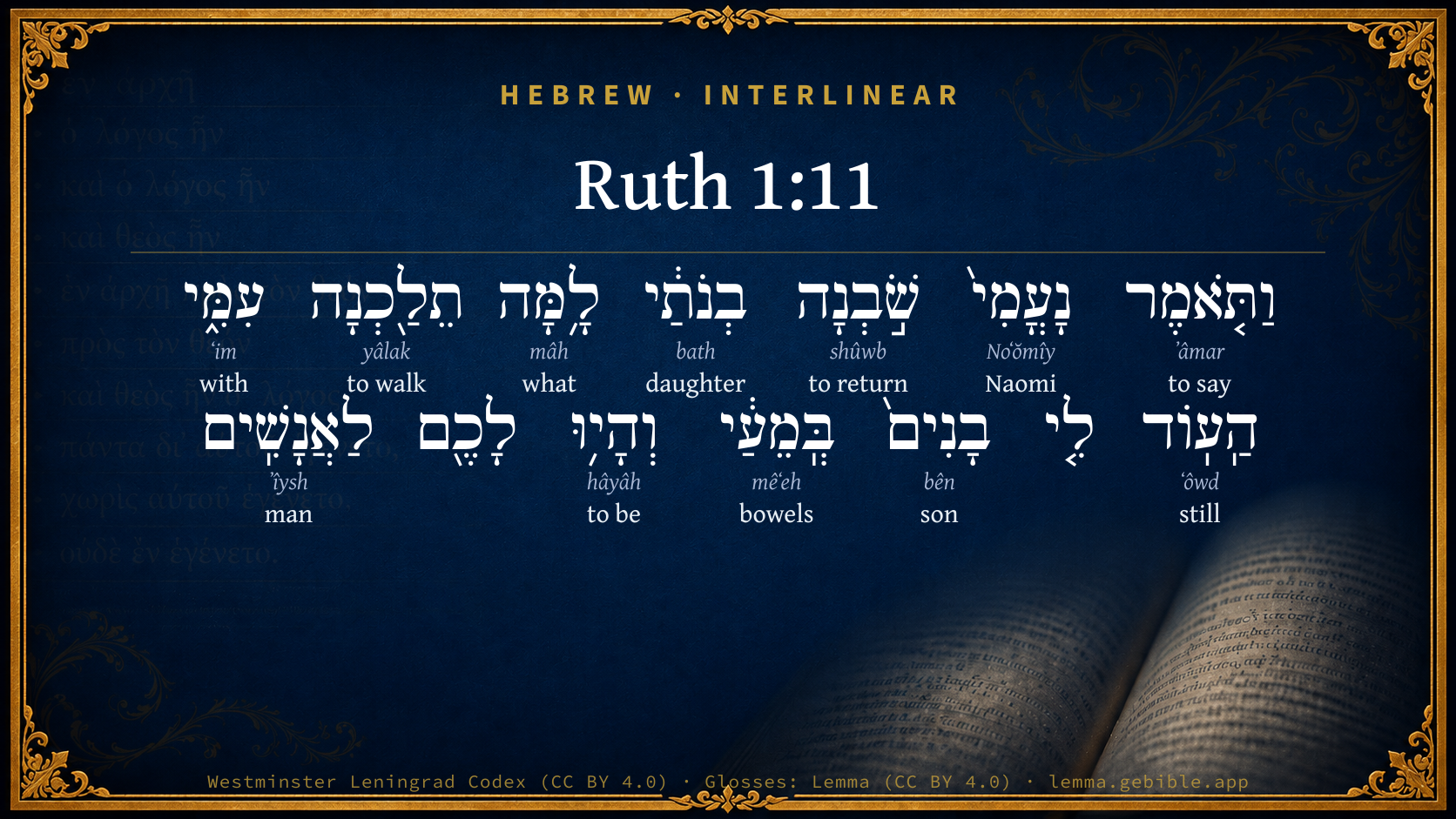
Hebrew (Westminster Leningrad Codex) Ruth 1:11 appears in the Hebrew Old Testament. The text above is from the Westminster Leningrad Codex. Each word links to its Strong’s number, a concise gloss, and parsing drawn from the Open Scriptures Hebrew Bible morphology. Click any word for its full Brown-Driver-Briggs (BDB) entry.
Download image
Cite this verse

Ruth 1:11 (World English Bible). Public Domain. Lemma interlinear Bible study tool, https://lemma.gebible.app/v/ruth/1/11.

Show BibTeX & RIS
BibTeX
RIS
English Translation
Naomi said, Turn again, my daughters: why will you go with me? have I yet sons in my womb, that they may be your husbands?
World English Bible · Public Domain
Download a study sheet

One document with this verse’s original text, its word-by-word gloss line, the meaning frame, cross-references with their text, attributed commentary, and full source and license credits — printable, and it pastes into notes with its structure intact.

This verse Autodidact and up

Study sheet (.html) Plain text (.txt)

A passage Seminary Student

Up to 50 verses in one chapter. A passage sheet keeps up to 6 commentary sources and 12 cross-references per verse, in the order this page ranks them, and says so on the sheet whenever that leaves anything out. Ask for a single verse and you get the Autodidact verse sheet above.

Everything on this page stays free to read, with no account — the sheet is a download of what is already on screen, not access to it.

Want to remove ads? Support Godless Engineer
Compare translations 3

The same verse in 3 English versions, stacked beneath the original-language interlinear above. Click any original word for its lexicon entry.

Each is an independent rendering of the whole verse — the interlinear is not word-aligned to these translations.

Highlighted words mark where these versions differ — a whole-verse word diff, not a word-by-word alignment.

  • World English Bible Public Domain
    Naomi said, Turn again, my daughters: why will you go with me? have I yet sons in my womb, that they may be your husbands?
  • King James Version Public Domain
    And Naomi said, Turn again, my daughters: why will ye go with me? are there yet any more sons in my womb, that they may be your husbands?
  • unfoldingWord Literal Text CC BY-SA 4.0
    But Naomi said, “Turn back, my daughters! Why would you go with me? Do I still have sons in my womb, that they may become husbands for you?

unfoldingWord Literal Text — © unfoldingWord, licensed CC BY-SA 4.0. Word-aligned USFM3 via Door43 (git.door43.org/unfoldingWord/en_ult).

Versions to compare (up to 4)

3 of 4 selected

Show all 18 translations

Every available English version of this verse, each an independent rendering of the whole verse.

  • World English Bible Public Domain
    Naomi said, Turn again, my daughters: why will you go with me? have I yet sons in my womb, that they may be your husbands?
  • Berean Standard Bible Public Domain
    But Naomi replied, “Return home, my daughters. Why would you go with me? Are there still sons in my womb to become your husbands?
  • Majority Standard Bible Public Domain
    But Naomi replied, “Return home, my daughters. Why would you go with me? Are there still sons in my womb to become your husbands?
  • King James Version Public Domain
    And Naomi said, Turn again, my daughters: why will ye go with me? are there yet any more sons in my womb, that they may be your husbands?
  • American Standard Version (1901) Public Domain
    And Naomi said, Turn again, my daughters: why will ye go with me? have I yet sons in my womb, that they may be your husbands?
  • Revised Version (1885) Public Domain
    And Naomi said, Turn again, my daughters: why will ye go with me? have I yet sons in my womb, that they may be your husbands?
  • Geneva Bible (1599) Public Domain
    But Naomi saide, Turne againe, my daughters: for what cause will you go with me? are there any more sonnes in my wombe, that they may bee your husbands?
  • Douay-Rheims (1899) Public Domain
    But she answered them: Return, my daughters: why come ye with me? have I any more sons in my womb, that you may hope for husbands of me?
  • Young's Literal Translation Public Domain
    And Naomi saith, `Turn back, my daughters; why do ye go with me? are there yet to me sons in my bowels that they have been to you for husbands?
  • Literal Standard Version CC BY-SA 4.0
    And Naomi says, “Turn back, my daughters; why do you go with me? Are there yet to me sons in my bowels that they have been to you for husbands?
  • Unlocked Literal Bible CC BY-SA 4.0
    But Naomi said, “Turn back, my daughters! Why will you go with me? Do I still have sons in my womb for you, so that they may become your husbands?
  • unfoldingWord Literal Text CC BY-SA 4.0
    But Naomi said, “Turn back, my daughters! Why would you go with me? Do I still have sons in my womb, that they may become husbands for you?
  • Darby Bible Public Domain
    And Naomi said, Return, my daughters: why will ye go with me? Are there yet sons in my womb, that they could be your husbands?
  • World Messianic Bible Public Domain
    Naomi said, “Go back, my daughters. Why do you want to go with me? Do I still have sons in my womb, that they may be your husbands?
  • Webster's Bible Public Domain
    And Naomi said, Turn again, my daughters: why will ye go with me? shall I bear more sons, that they may be your husbands?
  • Free Bible Version CC BY-SA 4.0
    “Why do you want to go back with me?” Naomi asked. “I'm not able to have any more sons for you to marry.
  • Bible in Basic English Public Domain
    But Naomi said, Go back, my daughters; why will you come with me? Have I more sons in my body, to become your husbands?
  • JPS Tanakh (1917) Public Domain
    And Naomi said: 'Turn back, my daughters; why will ye go with me? have I yet sons in my womb, that they may be your husbands?

Literal Standard Version (2020), Covenant Press — licensed CC BY-SA 4.0. Text via the HelloAO Bible API (eBible.org). Unlocked Literal Bible (unfoldingWord) — licensed CC BY-SA 4.0. Text via the HelloAO Bible API (eBible.org). unfoldingWord Literal Text — © unfoldingWord, licensed CC BY-SA 4.0. Word-aligned USFM3 via Door43 (git.door43.org/unfoldingWord/en_ult). Free Bible Version, Dr. Jonathan Gallagher — licensed CC BY-SA 4.0. Text via the HelloAO Bible API (eBible.org).

Word by word

More ways to search: Search by grammar → Find every occurrence → Compare this word →

Practice this passage: Drill this verse → Learn its vocabulary →

נָעֳמִי֙
Noʻŏmîy
H5281
“Naomi”
Noun, Proper
Part of Speech
Noun
Type
Proper
Full BDB Definition

Origin: from H5278

TWOT: None

Naomi = "my delight" - wife of Elimelech, mother of Mahlon and Chilion, and mother-in-law of Ruth and Orpah
  1. וַתֹּ֤אמֶר ʼâmar H559 “and · to say” Conjunction + Verb, Qal, Sequential Imperfect, 3rd Person, Feminine, Singular
  2. שֹׁ֣בְנָה shûwb H7725 “return” Verb, Qal, Imperative, 2nd Person, Feminine, Plural
  3. בְנֹתַ֔י bath H1323 “daughters · my” Noun, Common, Feminine, Plural, Construct + Suffix, Personal, 1st Person, Common, Singular
  4. לָ֥מָּה mâh H4100 “to/for · what” Preposition + Particle, Interrogative
  5. תֵלַ֖כְנָה yâlak H3212 “to walk” Verb, Qal, Imperfect, 2nd Person, Feminine, Plural
  6. עִמִּ֑י ʻim H5973 “with · me” Preposition + Suffix, Personal, 1st Person, Common, Singular
  7. הַֽעֽוֹד ʻôwd H5750 “still” Particle, Interrogative + Adverb
  8. בָנִים֙ bên H1121 “sons” Noun, Common, Masculine, Plural, Absolute
  9. בְּֽמֵעַ֔י mêʻeh H4578 “in/at · bowels · my” Preposition + Noun, Common, Masculine, Plural, Construct + Suffix, Personal, 1st Person, Common, Singular
  10. וְהָי֥וּ hâyâh H1961 “and · to be” Conjunction + Verb, Qal, Sequential Perfect, 3rd Person, Common, Plural
  11. לַאֲנָשִֽׁים ʼîysh H376 “to/for · men” Preposition + Noun, Common, Masculine, Plural, Absolute

About this verse

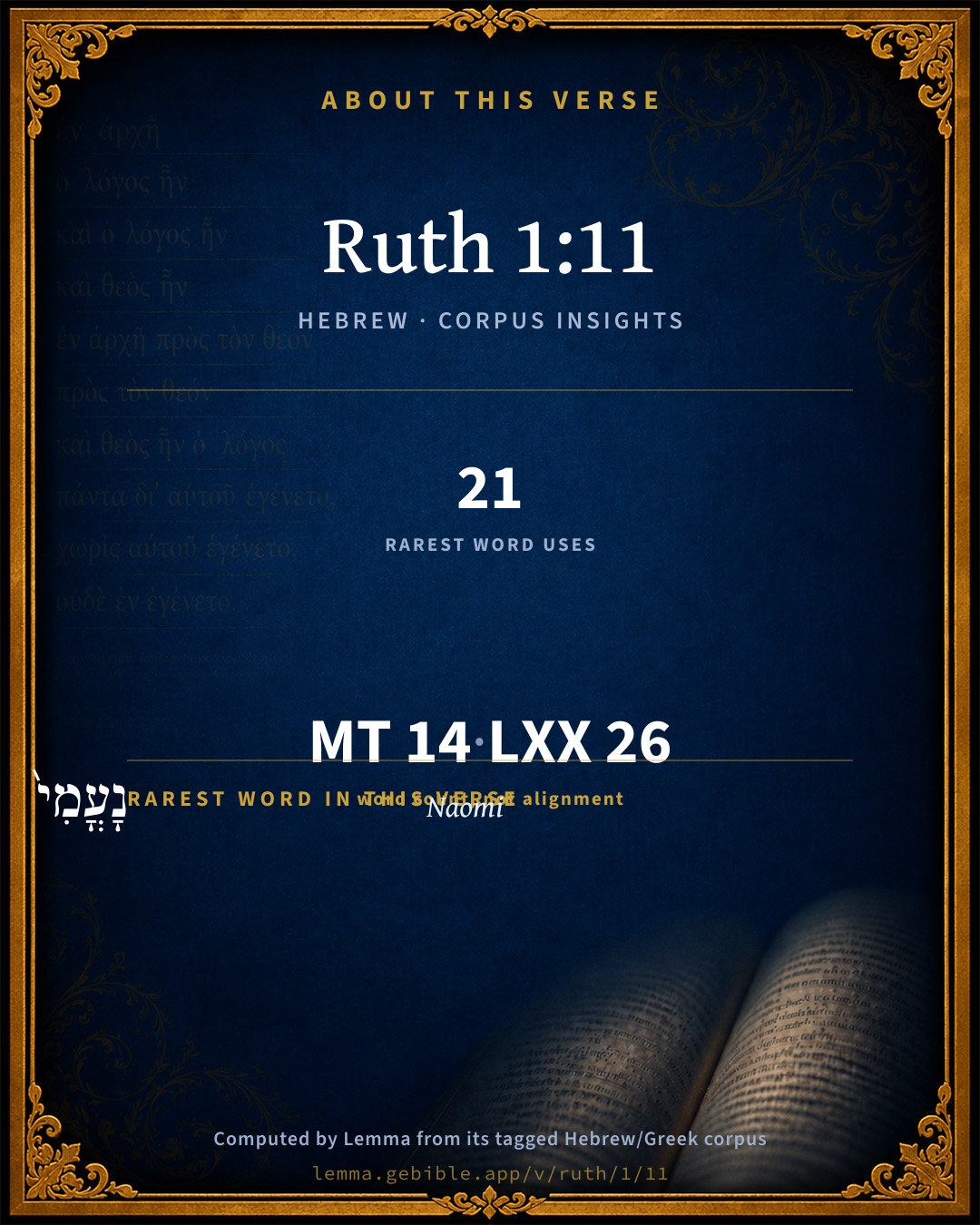
These counts appear in no published source. They are computed here, from the morphology-tagged text and Lemma’s own curated glosses. What Lemma adds →

14
words
12
distinct lemmas
Historical
section

Notable vocabulary

The rarest word here is נָעֳמִי֙ Naomi H5281 — appearing just 21 times in the whole Hebrew Bible.

Shared distinctive vocabulary

נָעֳמִי֙ Naomi H5281 occurs in 20 verses of the Hebrew Bible. Also found in:

Grammatical profile

  • 4 verbs
  • 5 nouns
  • 3 prepositions
  • 1 adverb
  • 1 particle

Verb forms

  • וַתֹּ֤אמֶר Qal · Sequential Imperfect
  • שֹׁ֣בְנָה Qal · Imperative
  • תֵלַ֖כְנָה Qal · Imperfect
  • וְהָי֥וּ Qal · Sequential Perfect

Hebrew & Septuagint length

In English translation the verse runs 25 words from the Hebrew and 25 from the Septuagint (LXX English) — the same length.

A rough comparison of the two English renderings, which tokenize alike — not a word-level alignment.

Word counts can differ between the Hebrew and the Greek without any difference in meaning — e.g. the Hebrew direct-object marker אֵת has no separate Greek word, and Greek often adds the article ὁ.

In the original languages it is 14 Hebrew tokens and 26 Greek tokens — but the two are counted differently (Hebrew bundles its prefixes and suffixes into one token; the Greek is in lemma form), so that isn’t a like-for-like length.

Cross-references

2

Topical passages linked to Ruth 1:11 in the Treasury of Scripture Knowledge — connected by theme and wording, ordered by reader-vote popularity; previews shown in the World English Bible.

  • Deuteronomy 25:5 If brothers dwell together, and one of them die, and have no son, the wife of the dead shall not be married outside to a stranger: her husband's brother shall go in to her, and take her to him as wife, and perform the duty of a husband's brother to her.
  • Genesis 38:11 Then Judah said to Tamar, his daughter-in-law, "Remain a widow in your father's house, until Shelah, my son, is grown up;" for he said, "Lest he also die, like his brothers." Tamar went and lived in her father's house.

Cross-references courtesy of OpenBible.info (CC BY 4.0).

Hebrew and Greek witnesses Masoretic Hebrew ↔ Greek Septuagint

The same verse in the two great witnesses to the Old Testament, shown verse-for-verse.

These are two independent witnesses, not word-aligned to each other, and the Septuagint is shown in lemma (dictionary) form.

Hebrew Ruth 1:11 Masoretic · Westminster Leningrad Codex

וַתֹּ֤אמֶר נָעֳמִי֙ שֹׁ֣בְנָה בְנֹתַ֔י לָ֥מָּה תֵלַ֖כְנָה עִמִּ֑י הַֽעֽוֹד לִ֤י בָנִים֙ בְּֽמֵעַ֔י וְהָי֥וּ לָכֶ֖ם לַאֲנָשִֽׁים

Naomi said, Turn again, my daughters: why will you go with me? have I yet sons in my womb, that they may be your husbands?

World English Bible · Public Domain

Greek LXX Ruth 1:11 Septuagint · lemma form

καί εἶπον νωεμιν ἐπιστρέφω δή θυγάτηρ ἐγώ καί ἵνα τίς πορεύομαι μετά ἐγώ μή ἔτι ἐγώ υἱός ἐν ὁ κοιλία ἐγώ καί εἰμί σύ εἰς ἀνήρ

And Noemin said, Return now, my daughters; and why do you⌃ go with me? have I yet sons in my womb to be your husbands?

LXX2012 (modern English Septuagint) · Public Domain

On this verse, The Preacher's Complete Homiletical Commentary discusses the Septuagint’s reading. Read the note in Commentary ↓

Hebrew: Westminster Leningrad Codex (CC BY 4.0). Greek: Septuagint (public domain); English from LXX2012 (modern English Septuagint) (Public Domain). How the Septuagint differs from the Hebrew →

Commentary

Notes on Ruth 1:11 from classic Christian and Jewish commentators (each source and its license shown beneath its notes). The classic Christian expositions comment on the surrounding passage and are grouped to its opening verse, so a note may address several verses; the Jewish commentaries on the Tanakh (Rashi and others) are per-verse, so they appear only where the commentator wrote on this verse.

Lemma curates 59 commentaries, every one of them public domain or Creative Commons licensed, each selected and text-cleaned for this edition rather than reprinted as found. About our sources →

Trapp's Complete Commentary

John Trapp

Rth 1:11 And Naomi said, Turn again, my daughters: why will ye go with me? [are] there yet [any more] sons in my womb, that they may be your husbands?

Ver. 11. Turn again, my daughters.] Though she were but their step-mother, yet, as one stepped in to be instead of a natural mother, she calleth them her daughters. It is good policy to preserve an opinion of our love in the hearts of those whom we would persuade to any good, and to speak them fair.

Why will ye go with me?] q.d., Go not, unless ye be first of a well-knit resolution, lest all too late ye come in with a fool’s, Had I known. Those that intend for heaven must not dream of a delicacy: but, being to build the tower of godliness, let them consider first, and cast up what it will cost them, lest they with shame give over in the midst, and "lose the things that they have wrought": but that they may "receive a full reward." {2Jn 1:8}

Are there yet any more sons in my womb?] If you aim at worldly advantage, or are acted by sinful selflove in this your enterprise, I have not for you, nor am likely to accommodate you. See Luk 9:57. Sed vix diligitur Iesus propter Iesum, saith a father. Poor Christ is slighted.

John Trapp, A Commentary or Exposition upon All the Books of the Old and New Testament (1647–1656) — public domain. Text from a community e-Sword module.

The Biblical Illustrator

Joseph S. Exell

Rth_1:11-13

It grieveth me much for your sakes that the hand of the Lord is gone out against me.

Naomis parting address

This is a great aggravation of the afflictions of many parents, that their children are involved with themselves. They could bear poverty, they could bear reproach, they could bear death itself, had they none who depended on them for bread and for respectability in the world. God has the same right to rule over the fruit of our bodies as over ourselves, and to allot to them their share of the good or the bad things of this world. It is bitterest of all, when we have reason to think that our sins have provoked God to punish us in the persons of our friends, or to inflict those strokes which our friends must feel as heavily as ourselves. Let us beware of ever exposing ourselves to such heart-piercing reflections by conduct that may bring down Gods displeasure upon our families. Gods people may sometimes, without good reason, think that the hand of the Lord is gone forth against them, in the calamities which befall their families or friends. Our afflictions are hard enough to be borne by us, without the addition of groundless reflections against ourselves. At the same time, the error is much more common of insensibility to the Divine displeasure, when it has been really kindled by our sins, than of vexing ourselves with unjust suspicions of Gods anger. There is one thing that still remains to be considered concerning this parting speech of Naomi to her daughters-in-law. Why did she dissuade them from going with her to the land of Judah, where the true God was well known, and persuade them to return to a country of abominable idolaters? We are not bound to justify all that Naomi spake or did. But, in charity to that good woman, we ought to believe that, for years past, she had been endeavouring, by her practice and her converse, to recommend to her young friends the worship of the God of Israel. If they were truly turned from the error of their ways, nothing that is here said was likely to drive them back to their own country. They might have been disgusted even with Naomis own conduct, if she had not fairly told them what inconveniences they were to encounter in going to her land, and to her people. Our Lord very plainly told His followers what they were to expect in His service. The foxes have holes, etc. We may, however, observe, that Christ usually administered proper antidotes against the fears which the doctrine of the Cross might excite in the minds of His hearers. It may be doubted whether Naomi, in the dejection of her spirits, did not overlook the powerful consolations which might have encouraged her young friends to follow her into the land of Israel, and would have more than compensated all the inconveniences to which they would have been exposed in a strange land. Doubtless she had often spoken of those privileges to them in former times; but as yet they had not learned their nature, and perhaps Naomi now despaired of ever being able to give them a perfect idea of it. (G. Lawson.)

The Biblical Illustrator, edited by Joseph S. Exell (c. 1880s–1900s) — public domain. Text from a community e-Sword module.

The Preacher's Complete Homiletical Commentary

Joseph S. Exell (gen. ed.)

CRITICAL AND EXEGETICAL NOTES.—Are there yet sons? etc. In allusion to the custom of a man raising posterity to his deceased brother by taking his widow (Adam Clarke, Jarci, Wright, Keil). Probably this custom obtained among other nations (Patrick, Scott). Known among the Gentiles before it was given to Israel (Gill, Speaker’s Com.) (cf. Gen_38:8; Gen_38:26; Deu_25:5). That law respects a brother by the father’s side, and not by the mother’s only (Aben Ezra, Carpzov). Not binding on a brother as yet unborn (Gill, Carpzov, etc.). Evidently, however, extended beyond the brother in the strict sense, and applied to the nearest relative, Boaz (Speaker’s Com.) Deu_25:5, probably to be understood in this wider sense. Turn again [return] go [to your own people] (Targum). If I should say. Rather, suppose that I should say I have hope that I were even to be married this very night, and were even to bear children (Bishop Horsley). In English we might imitate the sentence thus: For (let us suppose) I say I have hope; I have a husband; I have children; will you, etc. (Lange). Another reference to a Levirate marriage, possibly. So Keil, Wright, etc. Not so Rosenmuller, Carpzov. (See on Rth_1:11.) If I should have an husband, etc. If I were with an husband, etc. And should also bear sons. Shall I yet have any more sons that I may give them to you? (Syriac.) Perhaps you think that I will marry, and that sons will be born to me (Arabic).

Rth_1:13. Would ye tarry. For לָחֵן read the masculine לחֹם (Houbigant, Bishop Horsley). Rather to be taken adverbially, as “therefore.” “Would you therefore wait,” etc. (Maurer, Rosen., Gesen., Bertheau, Wright). The rendering of the English version (after Sept., Vulg.), “for them” is very improbable (Lange). Omit “for them,” and translate “under these circumstances,” or briefly “then” (Lange). Would ye tarry on these accounts, for these reasons? (Wordsworth.) Would you stay [for them (omit)] from having? etc. Would you therefore shut yourself up, so as not to have an husband? (Wright.) עָגַן From the Chaldean, “to keep back,” “to shut up” (Wright). Does not occur elsewhere in Hebrew. As virgins before their marriage lived in seclusion, so widows who were betrothed to children, while waiting for their coming of age, should keep themselves at home, lest any suspicion should attach to them (Le Clere). And will you be hindered from being married? (Syriac.) Will you be kept back by them from marrying? (LXX.) It grieveth me much. It is much more (Lange), far more bitter to me than to you (Wright, etc.). For it has gone much more bitterly with me than with you (Keil). As in the Authorized Version (Gesen., Bertheau). It may be a trial to you to leave me, but it is a still greater trial to me to be deprived of you; but it must be done, since, etc. (Tremellius, Junius). The LXX. has υπερ υμας, not υπερ υμων; and so Syriac, Arabic (comp. Gen_19:9). You may have husbands and children, but I can never expect to have either (Wordsworth). The hand of the Lord. Generally signifies the means whereby He accomplishes His counsels (Topsell).

Rth_1:11-13

Theme—THE SECOND TRIAL OF AFFECTION

“I have lived long enough: my way of life

Is fallen into the scar, the yellow leaf:

And that which should accompany old age,

As honour, love, obedience, troops of friends,

I must not look to have.”—Shakespeare.

“Our voluntary service He requires,

Not our necessitated; such with Him

Finds no acceptance, nor can find; for how

Can hearts not free be tried whether they serve

Willing or no?”—Milton.

Rth_1:11.—And Naomi said, Turn again, my daughters, etc.

Rth_1:12.—Turn again … go; for I am too old, etc.

Rth_1:13.—Would ye tarry for them [Heb. therefore,] etc.?

Here we see in Naomi the same non-proselytising spirit which characterizes her descendants down to the present day (Anon.). Scarcely so. Rather the spirit which would convince before it converts, which loves too well to persuade unwisely, which knows that a conversion made outwardly and in seeming only, is but the beginning of a future apostacy.

Note. (a) To decide any important question on wrong issues or false expectations is inevitably to find the ground hollow under our feet by-and-by.

(b) Love which deals faithfully with us in such moments is likely to prove faithful to us hereafter. It may wound, but it does so with good reasons (Pro_27:6).

(c) Love can say “no” sometimes, even when no means “separation.”

With Naomi, in fairness to them, she says “return,”—but in her affection she calls them “daughters.” She can do the latter, but she can do nothing more. They could enter into her house, but not into Israel’s national life (Lange). This the key to what follows. In her own mind, if they go forward with her, the prospect, humanly speaking, is hopeless.

Notice. Grief often says many really unnecessary things in order to conceal others which it dares not say (Lange). When she says that there is no hope for them in herself [i.e., in husbands being born them through her], she implies there will be none elsewhere in Israel. At best they could only be as widows shut up (see Crit. Notes), waiting for a husband never to be born. A dreary prospect even to Naomi. The climax of grief shows itself in the climax of impossibilities adduced (Lange).

We have—

I. A test of true love. If they go forward,

(1) They must die to their own interests. Do not indulge romantic hopes—visionary expectation which can only end in disappointment (Lawson). What her sons had done in Moab was not customary in Israel (Lange). She loves them too much to deceive them,—would rather part with them than do this, or even allow them to deceive themselves; if they go with her, they must go forward with a similar and kindred spirit of self-denial. Note. Thoughts ripened into resolves by serious consideration are likely to be kept (M. Henry).

So Christ dealt with His disciples. He said, “Foxes have holes,” etc. (cf. Luk_9:23-24; Luk_9:58). So a faithful pastor will deal with young converts.

The test here plain, sincerely meant, and founded, as the issue shews, upon good reasons. Naomi’s words follow, and are in agreement with the outward circumstances. We see, too, that they follow the leadings of Divine Providence. To do the one is often, and if we could rightly read the outward circumstances would always be, to do the other.

Note. (a) God sometimes hedges up the path so that there is nothing before us but the strait gate of self-denial. Especially is this true of the spiritual life. Stript of all, we enter the kingdom of God. The gate strait, the way narrow.

“Heaven’s gates are not so highly arched

As princes’ palaces. They that enter there

Must enter on their knees.”

(b) To be joined to the hope of the true Israel of God, we must be ready to deny ourselves of everything else. Esau sold his hope for a mess of pottage. So Orpah.

Again,

(2) If these young women are to go forward with Naomi, love itself must bring its own and only reward. Not a single inducement is held out, not a single promise made. Naomi would be theirs, nothing more. It is this that sends Orpah back, but suffers Ruth to go onward. And why? Orpah saw herself, while Ruth saw only the beloved one (Lange). She went with Naomi, though alone, because she loved Naomi alone.

How true all this is of a real affection for Christ! In love as in life He will be the first and the last. (Comp. Mat_6:24, with Mat_23:10; Joh_21:15; Joh_21:22.)

We love not Christ at all, unless we love Him above all (Augustine). Compare the Saviour’s description of the stony-ground hearer (Mat_13:20-21), as seen in the conduct of the Jews (Joh_6:60-66), with the words of Simon Peter on that occasion (Joh_6:67-69).

We have—

II. A test of character and motives. Free will is essential to virtue; and that free will may be fairly exercised, there must be no concealment. It must be able to sit down and count the cost. One test is not sufficient. Naomi’s words search Orpah through and through, from many sides and in many ways. Did she desire “rest in the house of a husband”? (Rth_1:9.) Hitherto this may have seemed possible to her in going forward. Not so now, and she must see it! A dreary blank hopelessness in this direction, the secret of Orpah’s return to Moab.

Of this return notice—

(1) Persuasions which fall in with our own desires are readily accepted.

(2) And that until these come we have not been truly and really tested.

(3) The strongest and purest motives are the only enduring ones.

So in Christian life. Time, and circumstances, and the unfolding of events around us, must and will come in to test the momentary decision for Christ.

Note. This is God’s ordinary and deliberate plan in dealing with men in life.

If heaven could be won by a single struggle, by a single determination, the work would be easy. But experience does for us what Naomi did for these. The test possibly not very severe at first,—the victory on our side (cf. Rth_1:8-10). Sooner or later we are met by a prospect as blank on the human side as this (Luk_9:23; Mar_10:21). What then of our better resolutions and vows?

We have here—

III. A test involving the deepest and most solemn issues.

(1) Decisive between God and Chemosh. So Orpah understood it, for she went back “to her gods.” So Ruth understood it (Rth_1:16).

Note. (a) The human love is made the pivot on which a higher affection turns and hangs—the human selfishness or unselfishness decisive of more lasting questions. A principle connected with this, love for the creature leading to and shewing a capacity for, love to the Creator (cf. 1Jn_4:20). More particularly must this be seen in a lasting and unselfish affection for the godly.

Note. (b) We may love the image of Christ in His servants, though we have not yet understood the full meaning of our affection. This Ruth’s position. Her affections leaned in that direction, and she was ready to embrace all it involved (Rth_1:16-17). Another extreme of character shrinks from all contact with Christ’s disciples. A third type exists, in those who love God’s people but merely on the human side. This Orpah’s danger. Note. Earthly affections are frail at best, and often mingled unconsciously with much that is selfish. Such characters fail ignominiously in moments like these.

(2) Decisive seemingly for time and eternity. A choice of mere outward circumstances may involve issues which are to last throughout eternity. Opah took Moab and all that Moab implied and included; Ruth, Israel. This last test seems at first a trifling one; judge it by its results! So always in spiritual things. When we choose the lower path, what is it but that we turn our back upon a higher? The momentary action decisive, the tendency fatal. Christ would give to the world the kingdom of heaven, but they will have the kingdom of earth, and here they part (Luther).

Bernard on this—

I. That in giving counsel to or fro, it is good so to speak as may declare love and respect to the parties.

II. That it was a custom among the Jews, for parents and children to speak most commonly one to another in the nearest and dearest terms of love.

III. That it is a point of wisdom to ask ourselves, Why we will do this or that thing, before we undertake it, or resolve upon it.

IV. That the true, honest-hearted, and such as fear God, in the kind offers of their friends, deal truly with them, and will not lead them into vain hopes.

V. That worldly respects are not the motives which should induce any to join themselves with God’s people.

VI. That the wise will not make promises rashly for others, nor persuade to more than they well know.

On the point of marriage, as taught here—

I. That while a woman hath hope of children she may marry.

II. The marriage is for them that are grown up for it and are marriageable.

III. That it is not good for such as intend to marry to defer off too long.

IV. That a godly and wise mother-in-law cannot only be willing, but also will persuade her children-in-law should marry again.

“Till this advice was given, the soundness and sincerity of Ruth’s religion did not appear; nor did the rottenness of Orpah’s profession discover itself.”—Macgowan.

“Naomi would not willingly leave her widowed daughters-in-law in Moab. Though she apparently discourages them, it is with the manifest design that they should go with her upon motives that should be permanent and not disappointing.”—Tyng.

“She discharges her difficult task with infinite delicacy. They, of course, had no thought of marrying any sons that might be born to the widowed Naomi. Such a thought could not possibly have entered into their minds. Why then does Naomi lay such emphasis on the utter unlikelihood of her having sons, and of their waiting for them even if she should have them? Simply to convey to them that, if they went with her, they mould have no hope but in herself.”—Cox.

“The surprising delicacy with which this is done is such as to shew clearly how truly a religious love educates and refines. The ultimate cause of the grief occasioned by the separation lies after all solely in the fact that Ruth and Orpah are Moabitesses. Naomi could not bear to tell them that if they, as daughters of Moab, went with her to Israel, they would find themselves in a less hospitable situation than they had hitherto enjoyed. She is too tender to remind these good children of the fact that Israel does not sanction connections with Moab.”—Lange.

“Orpah and Ruth are themselves aware of all that Naomi says to them in these verses. In wishing to go with her, they cannot possibly have a thought of building hopes on sons as yet to be born to Naomi by another marriage. But—and this is what Naomi would make them feel—any other hope than this vain one, they as Moabitish women could nut have in Israel. If I myself—she gives them to understand—could yet have sons, I would take you with me. My home would then be your home too. To me you are deardanghters-in-law, whether in Israel or in Moab, but other prospects have you none. She heaps up improbabilities in order to indicate in this veiled manner that this was nevertheless the only possible ground of hope for them in Israel.”—Lange (condensed).

“We see these young travellers meet with many discouragements to their return. How earnestly Naomi argues with them to search what manner of spirit they were of! How kindly she presses them to go back and find their shelter and their rest among the friends they were leaving! How she presses upon their remembrance that she has nothing to offer them, no hopes, no promises to hold out of present or prospective worldly gain! How she mingles the expressions of her gratitude and her grief in order the more effectually to impress them with a conviction of the earthly poverty of her journey! Again and again she kissed them in token of farewell. Again and again they wept in protestation of their fidelity and determination. How affecting and how promising seems such an interview! Read again these pathetic verses. Did Naomi really wish to discourage them? Did she really desire them to go back? Was she willing to leave them in Moab? Did Orpah gratify her more than Ruth? Far from this. She would try their faith and affection. She would know what was in their heart. She would see how long and how truly she might trust them hereafter. And therefore she lays before them the sorrows of the journey and the barrenness of the earthly prospect.”—Tyng.

“We cannot [but] notice here what seems an interesting fact—the thorough tolerance of Naomi. She indicates not the slightest shadow of intolerant dictation or overbearing advice, the most obnoxious form that advice can take. She recognizes in the two, when then say they will return with her, their indefeasible right, though her own children by marriage, at least to think and to decide for themselves. She felt her business was to give them clear and trustworthy information, but not to exercise even maternal influence in precipitating what they might blame her for when they came to taste the possible bitterness of her position, and to experience poverty, it might be, with the knowledge of the true and living God. She sets to us a most righteous example. Never try to coerce the judgment, or to force the conscience, even of the nearest and dearest; a victory gained at such expense is worse than a defeat. Respect the intellect, revere the conscience; say what you would like, urge what you would prefer, but leave to each individual connected with you perfect liberty to decide and act for themselves. To tempt, to coerce, or compel by fear, or by reward, or by force, is to intrude your hand into the holy place which the human conscience is, even in its aberration,—to lay a rude hand, as it were, upon the ark of God, and to assume prerogatives for yourself which God alone is exclusively competent to exercise.

“As there was to be no coercion or violence on the part of Naomi, there was on the other hand to be no concealment. There are two ways of bringing another over to what we like; we may either coerce the person, which is most criminal, or we may conceal—which is most dishonest—the actual state of things, and draw over to us unawares one who will afterwards, on discovering facts as they are, repent and regret the step. Naomi was candid. She shews them that there was no earthly prospect whatever of bettering their condition.”—Dr. Cumming.

“I cannot think very highly of Naomi’s character when I see the advice she gave to her daughters. She loved them, it is true; but her love was of too carnal a nature; for she had more respect to their temporal welfare than to the welfare of their souls. Should not the advice of Moses to Hobab have been hers to both of them, “Come with me, and God will do you good”? (Num_10:29-32.) Naomi, thou hast given us a picture too often realized in the present day: in her we see a mother more anxious about the providing of husbands for her daughters than the saving of their souls.”—Simeon.

“A Jesuit might raise the question, is it wise to tell the whole truth under circumstances like these? The Christian conscience is satisfied in knowing that it cannot be sinful.”—B.

Theme.—RESIGNATION IN SUFFERING

“Oh, ’Tis good

To wait submissive at Thy holy throne,

To leave petitions at Thy feet, and bear

Thy frowns and silence with a patient soul.”—WATTS.

Nay, my daughters; for it grieveth me … that the hand of the Lord is gone out against me.

Three widows remaining, the solemn and affecting monuments that God will not be forgotten. Here is the end of all the wanderings of the past! Naomi’s sorrow, bitter as it is, intensified by the helplessness of those who have shared her calamities with her, her afflictions finding an increasing heaviness because of her unselfish desires for their welfare. [Some translate, “It is far more bitter to me than to you,” or, “It has gone much more bitterly with me than with you.”] God has reduced me to such mean services that I can do nothing for you (Gill). Note. (a) To a gracious spirit it is an increase of sorrow to see others involved in the fruit of our sins. The heaviest burden of many a parent’s heart explained in this (cf. 2Sa_12:15-23). Even a monarch’s crown brings no exemption from the law (2Sa_24:17). (b) True love takes to heart a friend’s afflictions in its own troubles (Bernard). Human life, alas! shews too often the other extreme, a hardness and callousness of heart to all the expressions of Divine displeasure as they concern ourselves, and a total insensibility to the result of our sin, as it may affect others. (c) Calamities like these not only bring sorrow for the dead, but grief for the living.

Notice,

I. The source of this affliction. Men generally see in details like these (Rth_1:1-5) the natural and ordinary sequence of events. Naomi saw something else beyond and behind, infinitely more worthy of note. Her loss proceeded from no other by-causes, but from the hand of God (Fuller). As the showers come from the clouds, so her afflictions from the Lord (Topsell). Why doubt this, though they had stolen upon her a thousand times more naturally, gently, and insensibly, were that possible? Stoics ascribe calamities to inevitable fate; Epicureans and atheists, to blind fate; Philistines, to chance; Christians, to that One by whom the very hairs of our head are all numbered (Macgowan). Note. This is one of the distinguishing marks of God’s children in all ages. Afflictions come of the Divine hand. Their measure, their continuance, their purpose, all appointed of Him “with whom we have to do.”

A caution necessary here. God’s people may sometimes without good reason think that the hand of the Lord is gone forth against them (Lawson). Job thought so when the hand of Satan had despoiled him of his substance and his children (Job_1:12; Job_1:21; Job_2:6; Job_2:10). So also there is a slothful way of giving assent to Divine judgments. We say it is His hand when it is the hand of our own sloth and folly. Eli, with a resignation which would have been beautiful under other circumstances, said, “It is the hand of the Lord” (1Sa_3:18). Note. This a common phrase in the mouth of the wicked. Under this covert we often hide our impatience as well as our sinful carelessness.

II. The spirit in which afflictions should be borne. (a) With resignation. Naomi does not complain. Seems to bow to the inevitable future. Doubtless found comfort in the fact that it was the hand of the Lord—that God, with whom is mercy, and not another, had wounded her heart. Note. Every other way of receiving chastisement folly and madness (Act_9:5; Isa_1:5; Rom_2:4-5). (b) With candour. She acknowledged evidently the sinful cause of all the discipline through which she has passed as in herself—“the hand of the Lord has gone out against me.” Otherwise the passage reads like an accusation against God. Note. Some have even represented life in this way as a conflict with God (cf. Job_9:34; Job_13:21; Job_16:12-21, etc.). A terrible thought, if true, and there is a sense in which it is true of the wicked. Naomi, however, looked upon her afflictions as a judgment for lingering in the country of Moab (M. Henry). (c) With wise thought-fulness. She obeys and returns (M. Henry). (d) With unselfish care and regret for the evil estate of others. Grief too often hardens the heart to all other sorrow outside our own. It is not so here. Naomi’s gentle unselfish spirit shines out conspicuous among the Old Testament saints. It grieveth me much for your sakes.

Topsell on this:—

First, that all our afflictions come from the Lord, that He might chastise His own, and confound the ungodly (Job 34, 36). Neither the godly escape, nor the wicked go scot-free (Deu_31:18). This the confession of Moses and of David, a man more exercised in trouble than all the world beside (Psa_119:71).

Secondly, that the godly are so patient in all their tribulations, even from this consideration, that the Lord’s hand afflicteth them (2Sa_16:10-12; Job_2:10).

Bernard on this:—

I. The most godly sometimes take their afflictions very heavily (Job 3; Jer_20:9-12).

II. Afflictions are the more grievous for friends wrapped therein, so as one cannot help another.

III. That all afflictions come by the power and providence of God—as by a hand upon us (Lam_1:12-17; Amo_3:6; Amo_4:6-11; 2Ch_15:6).

IV. That the godly in common calamities take themselves to be especially chastised. This good woman applied the whole cross to herself. They think upon their own sins, and not upon other men’s misdeeds.

“And if there be some things which we believe to be inflicted by the Lord, to whom can we render our patience better than to the Lord? Nay, He teacheth us to rejoice moreover, and to be glad in that we are thought worthy of Divine chastisement. As many as I love, saith He, I chastise. Oh, blessed is that servant on whose amendment the Lord is bent; with whom He deigneth to be angry; whom He deceiveth not by hiding His admonitions from him!”—Tertullian.

“Patience … adorneth the woman, approveth the man; is loved in the boy, praised in the young man, respected in the old; is beautiful in every sex, in every age. Come now, let us describe her form and her demeanour. She hath a countenance serene and placid; a forehead smooth, contracted with no wrinkle of grief or of anger, her brows evenly and cheerfully relaxed, her eyes cast down in humility, not in melancholy. Her mouth beareth the seal of honourable silence. Her colour is such as those have who are free from care and crime.”—Tertullian.

“God Almighty in mercy makes this world unpleasing to good men by affliction, that they may set the less value upon it. This is the voice of the rod, and of Him that hath appointed it, which every wise man ought to hear and answer with all obedience, submission, and thankfulness; and when affliction hath wrought this effect, its business is in a good measure ended, and for the most part it is thereupon eased or removed.”—Hale.

“ ‘Oh,’ saith the people, ‘God hath justly sent this plague for the corruption of the magistrates.’ ‘It is justly inflicted,’ saith the magistrate, ‘for the disobedience of the people.’ ‘Herein,’ saith the poor man, ‘God hath met with the oppression and extortion of the rich. ‘Herein,’ saith the rich man, ‘God hath paid home the muttering and the repining of the poor.’ ‘Now,’ saith the prodigal, ‘God punisheth the covetousness of old men.’ ‘Now,’ saith the old man, ‘He scourgeth the prodigality of such as be young.’ Far otherwise Naomi, who, though the arrows of God did glance and rebound, to the wounding of Orpah and Ruth, yet she thought herself was the mark at which God did level His shafts. ‘the hand of the Lord is gone out against me.’ ”—Fuller.

“We are never nearer to God than when we are lowest in our own estimation; and never more pleasing to Him than when we abhor ourselves, and repent in dust and ashes.”—Charles.

“To be dejected is natural; but to be overcome by dejection is madness, and folly, and unmanly weakness. You may grieve and weep, but give not way to despondency, nor indulge in complaints. Weep as wept your master over Lazarus, observing the just limits of sorrow which it is not proper to pass.”—Chrysostom.

“He who possesses religion finds a providence not more truly in the history of the world than in his own family history; the rainbow which hangs a glistening circle in the heights of heaven is also formed by the same sun in the dewdrop of a lowly flower.”—Jean Paul Richter.

“Disappointments meet us at every turn; where we expected we should be particularly favoured with helps and advantages.… we behold ourselves left destitute; so that we have no more a place of refuge upon earth, no more a dear counsellor or friend who is as our own soul. By this means we are compelled, as Noah’s dove was, by the wide watery waste which did not afford a single resting-place, to fly to the Ark, and to take shelter there.”—Venn.

“Be still in sorrow! As God wills!

Let that thy motto be;

Submissive ’neath His strokes receive

His image stamped on thee.

Be still in God! Who rests on Him,

Enduring peace shall know,

And with a spirit glad and free,

Through night and grief shall go.”

Sturm.

“And if in our unworthiness

Thy sacrificial wine we press;

If from Thy ordeal’s heated bars,

Our feet are seamed with crimson scars,

Thy will be done!

Strike, Thou the Master, we Thy keys,

The anthem of the destinies,

The minor of Thy loftier strain,

Our hearts shall breathe the old refrain.

Thy will be done!”

Whittier.

“The good we have enjoyed from Heaven’s free will;

And shall we murmur to endure the ill?”

Dryden.

The Preacher's Complete Homiletical Commentary (gen. ed. Joseph S. Exell; Funk & Wagnalls, c. 1892) — public domain (pre-1929). A full-Bible homiletical/sermon-outline anthology covering 65 of 66 books (2 John is absent from the source module). Text from a community e-Sword module.

Jamieson, Fausset & Brown

Robert Jamieson, A. R. Fausset & David Brown

are there yet any more sons in my womb, that they may be your husbands?--This alludes to the ancient custom (Gen 38:26) afterwards expressly sanctioned by the law of Moses (Deu 25:5), which required a younger son to marry the widow of his deceased brother.

Jamieson, Fausset & Brown — Commentary Critical and Explanatory on the Whole Bible (1871) — public domain (CC PDM 1.0). Text via the HelloAO Bible API.

Adam Clarke's Commentary

Verse 11. Are there yet any more sons] This was spoken in allusion to the custom, that when a married brother died without leaving posterity, his brother should take his widow; and the children of such a marriage were accounted the children of the deceased brother. There is something very persuasive and affecting in the address of Naomi to her daughters-in-law. Let us observe the particulars: -

1. She intimates that she had no other sons to give them.

2. That she was not with child; so there could be no expectation.

3. That she was too old to have a husband.

4. That though she should marry that night, and have children, yet they could not wait till such sons were marriageable; she therefore begs them to return to their own country where they might be comfortably settled among their own kindred.

Adam Clarke's Commentary on the Bible (1810–1826) — public domain. Text from a community e-Sword/MySword module.

Ellicott's Commentary for English Readers

(11) The advice of Naomi thus far is insufficient to shake the affectionate resolve of the two women. She then paints the loneliness of her lot. She has no more sons, and can hope for none; nay, if sons were to be even now born to her, what good would that do them? Still her lot is worse than theirs. They, in spite of their great loss, are young, and from their mothers’ houses they may again go forth to homes of their own. She, old, childless, and solitary, must wend her weary way back to live unaided as best she may.

A Bible Commentary for English Readers, edited by Charles John Ellicott (1878–1897) — public domain. Text from a community e-Sword module.

The Cambridge Bible for Schools and Colleges

gen. ed. J. J. S. Perowne

11. have I yet sons … that they may be your husbands?] Alluding to the custom of levirate marriage, i. e. marriage with a brother in law (Lat. levir) after the husband’s death. The law on the subject is given in Deu_25:5-10; cf. St Mat_22:24.

The Cambridge Bible for Schools and Colleges (gen. ed. J. J. S. Perowne; Cambridge University Press, 1878–1918) — public domain. Text from a community e-Sword module.

John Gill's Exposition

And Naomi said, turn again, my daughters,.... Supposing this resolution of theirs only arose from a natural affection, and not from any love to the God or people of Israel; at least doubting whether it was so or not, and willing to try whether anyone, or both of them, were really from a principle of religion inclined to go with her; and desirous that they would thoroughly consider what they did, lest they should repent and apostatize, and bring a reproach upon the true religion:

why will ye go with me? what reason can you give? this she said in order to get out of them if there was any real inclination in them to the true worship and service of God; though she keeps out that from her own questions put to them as follows, that it might come purely from themselves:

are there yet any more sons in my womb, that they may be your husbands? is there any likelihood that I should ever have any sons to be instead of husbands, or really husbands to you? can it be thought that at my age, supposing I had an husband, or an husband's brother to marry me, that there is in me a natural power of conceiving and bearing children? this therefore can surely be no inducement to you to go along with me; for some, as Jarchi, think she refers to the law of a husband's brother marrying his widow, and raising up seed to him, which was known among the Gentiles before it was given to Israel; see Gen 38:8, to which Aben Ezra rightly objects, that that law respects a brother by the father's side, and not by the mother's only; to which may be added, that this law was not binding on a brother unborn, but on one that was living before the death of his brother; besides if this law had been in her mind, it would rather have furnished out an encouraging reason them to go with her, since there were kinsmen of her sons, to whom they might be married, as one of them afterwards was.

John Gill's Exposition of the Whole Bible (1746–1763) — public domain (CC PDM 1.0). Text via the HelloAO Bible API.

Albert Barnes' Notes on the Bible

See marginal references and notes. The Levirate law probably existed among the Moabites, and in Israel extended beyond the brother in the strict sense, and applied to the nearest relations, since Boaz was only the kinsman of Elimelech Rth 3:12.

Albert Barnes' Notes on the Bible (1834–1885) — public domain. Text from a community e-Sword/MySword module.

Haydock's Catholic Bible Commentary

Of me. Hence it appears that the Rabbins are under a mistake, when they say that those children who are born after the death of their brothers, are not obliged to take their widows.

George Leo Haydock (1774–1849), Haydock's Catholic Family Bible and Commentary, 1859 edition — public domain. Excludes Psalms (Douay-Rheims chapter numbering differs from Protestant) and Deuterocanonical books (Catholic canon only).

Matthew Poole's English Annotations

According to the ancient custom, Ge 38, and the express law of God, Deu 25:5, which doubtless she had acquainted them with before, among other branches of the Jewish religion, wherein she did instruct them.

Matthew Poole's English Annotations on the Holy Bible (1683–1685) — public domain. Text from a community e-Sword/MySword module.

Whedon's Commentary on the Bible

Daniel D. Whedon

11. Why will ye go with me — What purpose will it serve for you to accompany me further? What object of self-interest can ye have?

Are there yet any more sons — This is said in allusion to the levirate law, which made it the duty of a person to marry his deceased brother’s widow and thus preserve his brother’s name and family. See the law, as detailed in Deu_25:5-10, and note at the beginning of chap. 3. Naomi here reminds Ruth and Orpah, in the spirit of her age and country, that she has no more sons for them.

Daniel D. Whedon (gen. ed.), Commentary on the Old and New Testaments (1874–1909) — public domain. Text from a community e-Sword module.

The Pulpit Commentary

And Naomi said, Turn back, my daughters. To what purpose should you go with me? Have I yet sons in my womb, that might be husbands to you? According to the old Levirate law a survival of rude and barbarous times Orpah and Ruth, having had husbands who died without issue, would have been entitled to claim marriage with their husbands" brothers, if such surviving brothers there had been. (see Deu_25:5-9 Mat_22:24-28) And if the surviving brothers were too young to be married, the widows, if they chose, might wait on till they reached maturity. (see Ge 38) It is in the light of these customs that we are to read Naomi"s remonstrance"s. The phraseology in the second interrogation is very primitive, and primitively "agglutinative." "Are there yet to be sons in my womb, and they shall be to you for husbands?" (see on ver. 1).

The Pulpit Commentary (1880–1919), ed. H.D.M. Spence-Jones & Joseph S. Exell — public domain. Text from a community e-Sword module.

John Wesley's Explanatory Notes

Your husbands - According to the ancient custom, Gen. xxxviii, 8, and the express law of God, Deut. xxv, 5, which doubtless she had acquainted them with before, among other branches of the Jewish religion.

John Wesley, Explanatory Notes Upon the Whole Bible (1754–1765) — public domain. Text via the GEBible commentary corpus.

Keil & Delitzsch

C. F. Keil & F. Delitzsch

Naomi endeavoured to dissuade them from this resolution, by setting before them the fact, that if they went with her, there would be no hope of their being married again, and enjoying the pleasures of life once more. "Have I yet sons in my womb, that they may be your husbands?" Her meaning is: I am not pregnant with sons, upon whom, as the younger brothers of Mahlon and Chilion, there would rest the obligation of marrying you, according to the Levitate law (Deu 25:5; Gen 38:8). And not only have I no such hope as this, but, continues Naomi, in Rut 1:12, Rut 1:13, I have no prospect of having a husband and being blessed with children: "for I am too old to have a husband;" year, even if I could think of this altogether improbable thing as taking place, and assume the impossible as possible; "If I should say, I have hope (of having a husband), yea, if I should have a husband to-night, and should even bear sons, would ye then wait till they were grown, would ye then abstain from having husbands?" The כּי (if) before אמרתּי refers to both the perfects which follow. להן is the third pers. plur. neuter suffix הן with the prefix ל, as in Job 30:24, where הן is pointed with seghol, on account of the toned syllable which follows, as here in pause in Rut 1:9 : lit. in these things, in that case, and hence in the sense of therefore = לכן, as in Chaldee (e.g., Dan 2:6, Dan 2:9,Dan 2:24, etc.). תּעגנה (vid., Isa 60:4, and Ewald, 195, a.), from עגן ἁπ. λεγ. in Hebrew, which signifies in Aramaean to hold back, shut in; hence in the Talmud עגוּנה, a woman who lived retired in her own house without a husband. Naomi supposes three cases in Rut 1:12, of which each is more improbable, or rather more impossible, than the one before; and even if the impossible circumstance should be possible, that she should bear sons that very night, she could not in that case expect or advise her daughters-in-law to wait till these sons were grown up and could marry them, according to the Levirate law. In this there was involved the strongest persuasion to her daughters-in-law to give up their intention of going with her into the land of Judah, and a most urgent appeal to return to their mothers' houses, where, as young widows without children, they would not be altogether without the prospect of marrying again. One possible case Naomi left without notice, namely, that her daughters-in-law might be able to obtain other husbands in Judah itself. She did not hint at this, in the first place, and perhaps chiefly, from delicacy on account of the Moabitish descent of her daughters-in-law, in which she saw that there would be an obstacle to their being married in the land of Judah; and secondly, because Naomi could not do anything herself to bring about such a connection, and wished to confine herself therefore to the one point of making it clear to her daughters that in her present state it was altogether out of her power to provide connubial and domestic happiness for them in the land of Judah. She therefore merely fixed her mind upon the different possibilities of a Levirate marriage.

(Note: The objections raised by J. B. Carpzov against explaining Rut 1:12 and Rut 1:13 as referring to a Levirate marriage, - namely, that this is not to be thought of, because a Levirate marriage was simply binding upon brothers of the deceased by the same father and mother, and upon brothers who were living when he died, and not upon those born afterwards-have been overthrown by Bertheau as being partly without foundation, and partly beside the mark. In the first place, the law relating to the Levirate marriage speaks only of brothers of the deceased, by which, according to the design of this institution, we must certainly think of sons by one father, but not necessarily the sons by the same mother. Secondly, the law does indeed expressly require marriage with the sister-in-law only of a brother who should be in existence when her husband died, but it does not distinctly exclude a brother born afterwards; and this is the more evident from the fact that, according to the account in Gen 38:11, this duty was binding upon brothers who were not grown up at the time, as soon as they should be old enough to marry. Lastly, Naomi merely says, in Rut 1:12, that she was not with child by her deceased husband; and when she does take into consideration, in Rut 1:12 and Rut 1:13, the possibility of a future pregnancy, she might even then be simply thinking of an alliance with some brother of her deceased husband, and therefore of sons who would legally be regarded as sons of Elimelech. When Carpzov therefore defines the meaning of her words in this manner, "I have indeed no more children to hope for, to whom I could marry you in time, and I have no command over others," the first thought does not exhaust the meaning of the words, and the last is altogether foreign to the text.)

בּנתי אל, "not my daughters," i.e., do not go with me; "for it has gone much more bitterly with me than with you." מרר relates to her mournful lot. מכּם is comparative, "before you;" not "it grieveth me much on your account," for which עליכם would be used, as in Sa2 1:26. Moreover, this thought would not be in harmony with the following clause: "for the hand of the Lord has gone out against me," i.e., the Lord has sorely smitten me, namely by taking away not only my husband, but also my two sons.

Keil & Delitzsch — Biblical Commentary on the Old Testament (1861–1891) — public domain (CC PDM 1.0). Text via the HelloAO Bible API. (Old Testament only.)

unfoldingWord translationNotes

Door43 World Missions Community

Why will you go with me?

This is a rhetorical question. AT: "It does not make sense for you to go with me." or "You should not go with me." (See: Rhetorical Question)

Do I still have sons in my womb for you, so that they may become your husbands?

Naomi uses this question to say she cannot have other sons for them to marry. AT: "Obviously it is not possible for me to have any more sons who could become your husbands." (See: Rhetorical Question)

too old to have a husband

The reason a husband would be important can be stated clearly. AT: "too old to marry again and bear more children" (See: Assumed Knowledge and Implicit Information)

give birth to sons

"bear children" or "deliver baby boys"

would you therefore wait until they were grown? Would you choose not to marry a husband?

These are rhetorical questions, which do not expect an answer. AT: "you would not wait until they were grown up so that you could marry them. You would choose to marry a husband now." (See: Rhetorical Question)

It is exceedingly bitter to me

Bitterness is a metaphor for grief, and what grieves her can be stated clearly. AT: "It greatly grieves me that you have no husbands" (See: Metaphor or Assumed Knowledge and Implicit Information)

the hand of Yahweh has gone out against me

The word "hand" refers to Yahweh's power or influence. AT: "Yahweh has caused terrible things to happen to me" (See: Metonymy)

translationWords

son

Yahweh

unfoldingWord translationNotes — © Distant Shores Media and the Door43 World Missions Community, licensed CC BY-SA 4.0. Source: git.door43.org/Door43/en_tn.

Ibn Ezra

Rabbi Abraham ibn Ezra

"Are there yet any more sons in my womb?" Many of our colleagues thought that this response was directed at those who deny (the custom), not realizing that our ancestors transmitted that levirate marriage (yibbum) applies to brothers from the father, not from the mother. She was simply saying to them, if I had sons in my womb, I would give them to you in place of the deceased. This is a manner of affection, not according to the practice of levirate marriage.

Ibn Ezra on the Tanakh — English translations: “Sefaria Community Translation” (CC0 1.0 (public-domain dedication)); “Yalkut, Sifsei Chachomim Chumash, Metsudah Publications, 2009” (CC BY 4.0); and “Commentary of Ibn Ezra on Isaiah - trans. by M. Friedlander, 1873” (public domain). Text via Sefaria.

Lesson kit

Teaching starters — assembled from the data on this page, not authored interpretation. Every prompt links to the verse data it draws on. Edit before teaching.

Ruth, in the Historical, opens this verse with 14 words (12 distinct Hebrew lemmas). Its most distinctive word is Noʻŏmîy (“Naomi”). A historical commentator’s framing appears above. Read the whole chapter for the surrounding context.

Discussion questions

  1. The word Noʻŏmîy carries the sense “Naomi.” How does it shape the verse?
  2. Ruth 1:2 shares the word «Naomi» with this verse. How do the two illuminate each other?
  3. These translations render this verse differently; the difference is in the English rendering, not the original. What questions does that raise?
  4. The verb «וַתֹּ֤אמֶר» is Qal Sequential Imperfect. How does its form color the action?
  5. Reading how Trapp's Complete Commentary and The Biblical Illustrator read this verse, where do the two commentators agree and where do they part?

Things to notice

Reading settings

Reading text

Shown beneath each verse's original-language words.

Old Testament
Old Testament edition

Read the OT as the Masoretic Hebrew (MT) or the Greek Septuagint (LXX).

English shown for the Greek Septuagint (in the Hebrew ↔ Greek comparison).

Comparing translations? Open the Compare panel on any verse page to stack up to four side by side.