
Jeremiah 24:3

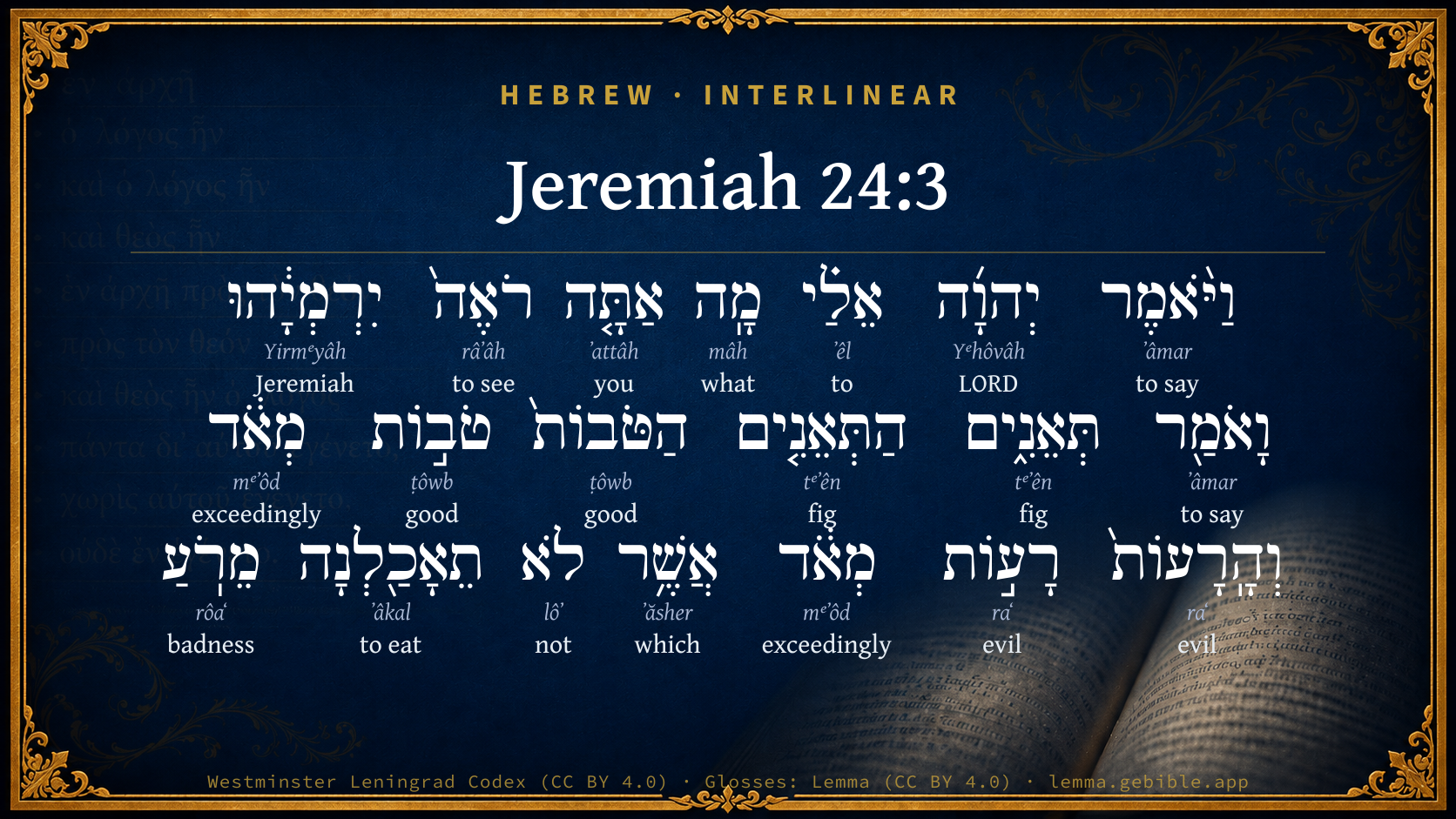
Hebrew (Westminster Leningrad Codex) Jeremiah 24:3 appears in the Hebrew Old Testament. The text above is from the Westminster Leningrad Codex. Each word links to its Strong’s number, a concise gloss, and parsing drawn from the Open Scriptures Hebrew Bible morphology. Click any word for its full Brown-Driver-Briggs (BDB) entry.
Download image
Cite this verse

Jeremiah 24:3 (World English Bible). Public Domain. Lemma interlinear Bible study tool, https://lemma.gebible.app/v/jeremiah/24/3.

Show BibTeX & RIS
BibTeX
RIS
English Translation
Then said Yahweh to me, What see you, Jeremiah? I said, Figs; the good figs, very good; and the bad, very bad, that can't be eaten, they are so bad.
World English Bible · Public Domain
Download a study sheet

One document with this verse’s original text, its word-by-word gloss line, the meaning frame, cross-references with their text, attributed commentary, and full source and license credits — printable, and it pastes into notes with its structure intact.

This verse Autodidact and up

Study sheet (.html) Plain text (.txt)

A passage Seminary Student

Up to 50 verses in one chapter. A passage sheet keeps up to 6 commentary sources and 12 cross-references per verse, in the order this page ranks them, and says so on the sheet whenever that leaves anything out. Ask for a single verse and you get the Autodidact verse sheet above.

Everything on this page stays free to read, with no account — the sheet is a download of what is already on screen, not access to it.

Want to remove ads? Support Godless Engineer
Compare translations 3

The same verse in 3 English versions, stacked beneath the original-language interlinear above. Click any original word for its lexicon entry.

Each is an independent rendering of the whole verse — the interlinear is not word-aligned to these translations.

Highlighted words mark where these versions differ — a whole-verse word diff, not a word-by-word alignment.

  • World English Bible Public Domain
    Then said Yahweh to me, What see you, Jeremiah? I said, Figs; the good figs, very good; and the bad, very bad, that can't be eaten, they are so bad.
  • King James Version Public Domain
    Then said the LORD unto me, What seest thou, Jeremiah? And I said, Figs; the good figs, very good; and the evil, very evil, that cannot be eaten, they are so evil.
  • unfoldingWord Literal Text CC BY-SA 4.0
    And said Yahweh to me, “What are you seeing, Jeremiah?” And I said, “Figs. The good figs very good, and the bad are very bad, that they cannot be eaten from badness.”

unfoldingWord Literal Text — © unfoldingWord, licensed CC BY-SA 4.0. Word-aligned USFM3 via Door43 (git.door43.org/unfoldingWord/en_ult).

Versions to compare (up to 4)

3 of 4 selected

Show all 18 translations

Every available English version of this verse, each an independent rendering of the whole verse.

  • World English Bible Public Domain
    Then said Yahweh to me, What see you, Jeremiah? I said, Figs; the good figs, very good; and the bad, very bad, that can't be eaten, they are so bad.
  • Berean Standard Bible Public Domain
    “Jeremiah,” the LORD asked, “what do you see?” “Figs!” I replied. “The good figs are very good, but the bad figs are very bad, so bad they cannot be eaten.”
  • Majority Standard Bible Public Domain
    “Jeremiah,” the LORD asked, “what do you see?” “Figs!” I replied. “The good figs are very good, but the bad figs are very bad, so bad they cannot be eaten.”
  • King James Version Public Domain
    Then said the LORD unto me, What seest thou, Jeremiah? And I said, Figs; the good figs, very good; and the evil, very evil, that cannot be eaten, they are so evil.
  • American Standard Version (1901) Public Domain
    Then said Jehovah unto me, What seest thou, Jeremiah? And I said, Figs; the good figs, very good; and the bad, very bad, that cannot be eaten, they are so bad.
  • Revised Version (1885) Public Domain
    Then said the LORD unto me, What seest thou, Jeremiah? And I said, Figs; the good figs, very good; and the bad, very bad, that cannot be eaten, they are so bad.
  • Geneva Bible (1599) Public Domain
    Then saide the Lord vnto mee, What seest thou, Ieremiah? And I said, Figges: ye good figges verie good, and the naughtie verie naughtie, which cannot be eaten, they are so euill.
  • Douay-Rheims (1899) Public Domain
    And the Lord said to me: What seest thou, Jeremias? And I said: Figs, the good figs, very good: and the bad figs, very bad, which cannot be eaten because they are bad.
  • Young's Literal Translation Public Domain
    And Jehovah saith unto me, `What art thou seeing, Jeremiah?' and I say, `Figs, the good figs `are' very good, and the bad `are' very bad, that are not eaten for badness.'
  • Literal Standard Version CC BY-SA 4.0
    And YHWH says to me, “What are you seeing, Jeremiah?” And I say, “Figs, the good figs [are] very good, and the bad [are] very bad, that are not eaten because of badness.”
  • Unlocked Literal Bible CC BY-SA 4.0
    Yahweh said to me, “What do you see, Jeremiah?” I said, “Figs. Figs that are very good and figs that are so very bad they cannot be eaten.”
  • unfoldingWord Literal Text CC BY-SA 4.0
    And said Yahweh to me, “What are you seeing, Jeremiah?” And I said, “Figs. The good figs very good, and the bad are very bad, that they cannot be eaten from badness.”
  • Darby Bible Public Domain
    And Jehovah said unto me, What seest thou, Jeremiah? And I said, Figs: the good figs very good; and the bad very bad, which cannot be eaten for badness.
  • World Messianic Bible Public Domain
    Then the LORD asked me, “What do you see, Jeremiah?” I said, “Figs. The good figs are very good, and the bad are very bad, so bad that they can’t be eaten.”
  • Webster's Bible Public Domain
    Then said the LORD to me, What seest thou, Jeremiah? and I said, Figs; the good figs, very good; and the bad, very bad, that cannot be eaten, they are so bad.
  • Free Bible Version CC BY-SA 4.0
    “Jeremiah,” the Lord asked, “what can you see?” “I see figs!” I replied. “The good figs look very good, but the bad figs look very bad, so bad they can't be eaten.”
  • Bible in Basic English Public Domain
    Then the Lord said to me, What do you see, Jeremiah? And I said, Figs; the good figs are very good, and the bad very bad, and of no use for food, they are so bad.
  • JPS Tanakh (1917) Public Domain
    Then said the LORD unto me: 'What seest thou, Jeremiah?' And I said: 'Figs; the good figs, very good; and the bad, very bad, that cannot be eaten, they are so bad.'

Literal Standard Version (2020), Covenant Press — licensed CC BY-SA 4.0. Text via the HelloAO Bible API (eBible.org). Unlocked Literal Bible (unfoldingWord) — licensed CC BY-SA 4.0. Text via the HelloAO Bible API (eBible.org). unfoldingWord Literal Text — © unfoldingWord, licensed CC BY-SA 4.0. Word-aligned USFM3 via Door43 (git.door43.org/unfoldingWord/en_ult). Free Bible Version, Dr. Jonathan Gallagher — licensed CC BY-SA 4.0. Text via the HelloAO Bible API (eBible.org).

Word by word

More ways to search: Search by grammar → Find every occurrence → Compare this word →

Practice this passage: Drill this verse → Learn its vocabulary →

מֵרֹֽעַ
rôaʻ
H7455
“from · badness”
Preposition + Noun, Common, Masculine, Singular, Absolute
Part of Speech
Preposition + Noun
Type
Common
Gender
Masculine
Number
Singular
State
Absolute
Full BDB Definition

Origin: from H7489

TWOT: 2191b

badness, evil - badness, bad quality - wilfulness - evil, badness (ethical) - sadness
  1. וַיֹּ֨אמֶר ʼâmar H559 “and · to say” Conjunction + Verb, Qal, Sequential Imperfect, 3rd Person, Masculine, Singular
  2. יְהוָ֜ה Yᵉhôvâh H3068 “LORD” Noun, Proper
  3. אֵלַ֗י ʼêl H413 “to · me” Preposition + Suffix, Personal, 1st Person, Common, Singular
  4. מָֽה mâh H4100 “what” Particle, Interrogative
  5. אַתָּ֤ה ʼattâh H859 “you” Pronoun, Personal, 2nd Person, Masculine, Singular
  6. רֹאֶה֙ râʼâh H7200 “seeing” Verb, Qal, Participle Active, Masculine, Singular, Absolute
  7. יִרְמְיָ֔הוּ Yirmᵉyâh H3414 “Jeremiah” Noun, Proper
  8. וָאֹמַ֖ר ʼâmar H559 “and · to say” Conjunction + Verb, Qal, Sequential Imperfect, 1st Person, Common, Singular
  9. תְּאֵנִ֑ים tᵉʼên H8384 “figs” Noun, Common, Feminine, Plural, Absolute
  10. הַתְּאֵנִ֤ים tᵉʼên H8384 “the · figs” Particle, Definite Article + Noun, Common, Feminine, Plural, Absolute
  11. הַטֹּבוֹת֙ ṭôwb H2896 “the · good” Particle, Definite Article + Adjective, Adjective, Feminine, Plural, Absolute
  12. טֹב֣וֹת ṭôwb H2896 “good” Adjective, Adjective, Feminine, Plural, Absolute
  13. מְאֹ֔ד mᵉʼôd H3966 “exceedingly” Adverb
  14. וְהָֽרָעוֹת֙ raʻ H7451 “and · the · evil” Conjunction + Particle, Definite Article + Adjective, Adjective, Feminine, Plural, Absolute
  15. רָע֣וֹת raʻ H7451 “evil” Adjective, Adjective, Feminine, Plural, Absolute
  16. מְאֹ֔ד mᵉʼôd H3966 “exceedingly” Adverb
  17. אֲשֶׁ֥ר ʼăsher H834 “which” Particle, Relative
  18. לֹא lôʼ H3808 “not” Particle, Negative
  19. תֵאָכַ֖לְנָה ʼâkal H398 “to eat” Verb, Niphal, Imperfect, 3rd Person, Feminine, Plural

About this verse

These counts appear in no published source. They are computed here, from the morphology-tagged text and Lemma’s own curated glosses. What Lemma adds →

20
words
15
distinct lemmas
Prophets
section

Notable vocabulary

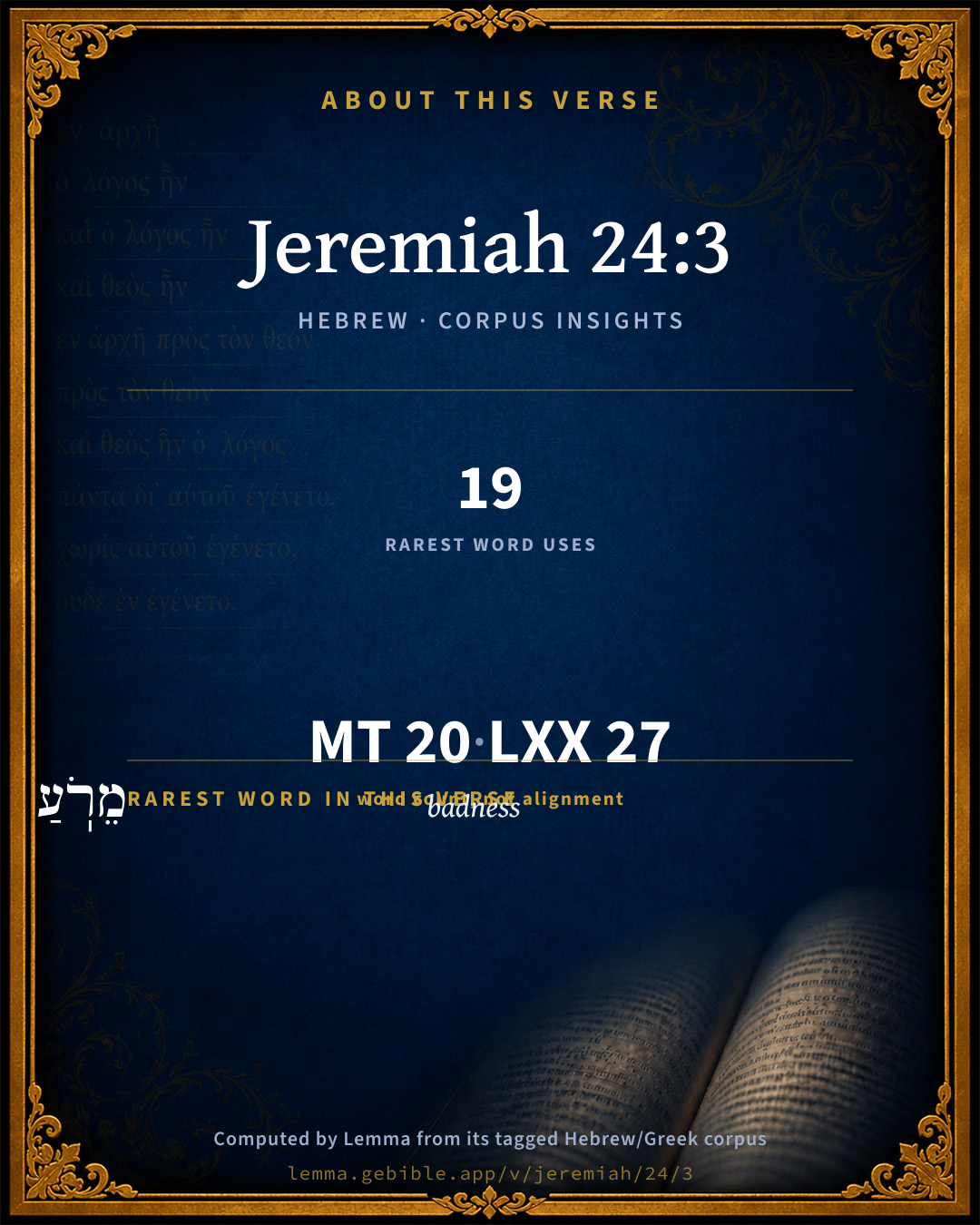
The rarest word here is מֵרֹֽעַ badness H7455 — appearing just 19 times in the whole Hebrew Bible.

Shared distinctive vocabulary

מֵרֹֽעַ badness H7455 occurs in 19 verses of the Hebrew Bible. Also found in:

Grammatical profile

  • 4 verbs
  • 5 nouns
  • 4 adjectives
  • 1 pronoun
  • 1 preposition
  • 2 adverbs
  • 3 particles

Verb forms

  • וַיֹּ֨אמֶר Qal · Sequential Imperfect
  • רֹאֶה֙ Qal · Participle Active
  • וָאֹמַ֖ר Qal · Sequential Imperfect
  • תֵאָכַ֖לְנָה Niphal · Imperfect

Repetition

Words recur within this verse — often emphatic in Hebrew:

  • וַיֹּ֨אמֶר to say H559 ×2
  • תְּאֵנִ֑ים fig H8384 ×2
  • הַטֹּבוֹת֙ good H2896 ×2
  • מְאֹ֔ד exceedingly H3966 ×2
  • וְהָֽרָעוֹת֙ evil H7451 ×2

Hebrew & Septuagint length

In the original languages it is 20 Hebrew tokens and 27 Greek tokens — but the two are counted differently (Hebrew bundles its prefixes and suffixes into one token; the Greek is in lemma form), so that isn’t a like-for-like length.

Cross-references

7

Topical passages linked to Jeremiah 24:3 in the Treasury of Scripture Knowledge — connected by theme and wording, ordered by reader-vote popularity; previews shown in the World English Bible.

  • Amos 8:2 He said, "Amos, what do you see?" I said, "A basket of summer fruit." Then Yahweh said to me, "The end has come on my people Israel. I will not again pass by them any more.
  • Jeremiah 1:11–14 Moreover the word of Yahweh came to me, saying, Jeremiah, what see you? I said, I see a rod of an almond tree.
  • Zechariah 4:2 He said to me, "What do you see?" I said, "I have seen, and, behold, a lampstand all of gold, with its bowl on the top of it, and its seven lamps thereon; there are seven pipes to each of the lamps, which are on the top of it;
  • Zechariah 5:5–11 Then the angel who talked with me came forward, and said to me, "Lift up now your eyes, and see what is this that is appearing."
  • Matthew 25:32–33 Before him all the nations will be gathered, and he will separate them one from another, as a shepherd separates the sheep from the goats.
  • 1 Samuel 9:9 (In earlier times in Israel, when a man went to inquire of God, thus he said, Come, and let us go to the seer; for he who is now called a Prophet was before called a Seer.)
  • Amos 7:8 Yahweh said to me, "Amos, what do you see?" I said, "A plumb line." Then the Lord said, "Behold, I will set a plumb line in the midst of my people Israel. I will not again pass by them any more.

Cross-references courtesy of OpenBible.info (CC BY 4.0).

Hebrew and Greek witnesses Masoretic Hebrew ↔ Greek Septuagint

The same verse in the two great witnesses to the Old Testament, shown verse-for-verse.

These are two independent witnesses, not word-aligned to each other, and the Septuagint is shown in lemma (dictionary) form.

Hebrew Jeremiah 24:3 Masoretic · Westminster Leningrad Codex

וַיֹּ֨אמֶר יְהוָ֜ה אֵלַ֗י מָֽה אַתָּ֤ה רֹאֶה֙ יִרְמְיָ֔הוּ וָאֹמַ֖ר תְּאֵנִ֑ים הַתְּאֵנִ֤ים הַטֹּבוֹת֙ טֹב֣וֹת מְאֹ֔ד וְהָֽרָעוֹת֙ רָע֣וֹת מְאֹ֔ד אֲשֶׁ֥ר לֹא תֵאָכַ֖לְנָה מֵרֹֽעַ

Then said Yahweh to me, What see you, Jeremiah? I said, Figs; the good figs, very good; and the bad, very bad, that can't be eaten, they are so bad.

World English Bible · Public Domain

Greek LXX Structure differs

In the Septuagint, Jeremiah is about an eighth shorter than the Hebrew and arranges its material differently — the Oracles Against the Nations (Hebrew chapters 46–51) appear in the middle of the Greek book, after 25:13. Because the chapter and verse boundaries do not line up, a verse-for-verse comparison with the Hebrew is not shown.

A verse-for-verse comparison isn’t shown here because the chapters and verses don’t line up. Switch to the LXX edition with the MT / LXX toggle above to read the Greek directly.

Hebrew: Westminster Leningrad Codex (CC BY 4.0). Greek: Septuagint (public domain); English from a public-domain English Septuagint. How the Septuagint differs from the Hebrew →

Targum (Aramaic paraphrase)

1

The Targum is the ancient Jewish Aramaic paraphrase of the Hebrew Scriptures — an interpretive translation, not the Hebrew text itself. Onkelos (literal) and Pseudo-Jonathan (expansive) render the Torah, and Jonathan the Prophets. Coverage is partial: where no permissively-licensed English translation exists for a verse, only the Aramaic is shown. This is verse-level text, not a word-by-word alignment to the Hebrew.

  1. Targum Jonathan Prophets (Joshua–Malachi)
    וַאֲמַר יְיָ לִי מָה אַתְּ חָזֵי יִרְמְיָה וַאֲמָרִית תֵּינִין תֵּינַיָא טָבְתָא טָבָן לַחֲדָא וּדְבִישִׁין בִּישִׁין לַחֲדָא דְלָא מִתְאַכְלִין מִבִּישׁוּ:

    (no public-domain English translation for this verse)

    Targum Jonathan — Aramaic: “Mikraot Gedolot” (public domain). English: “Sefaria Community Translation” (CC0 1.0 (public-domain dedication)); “London "Chaldee Paraphrase," 1871” (public domain). Text via Sefaria.

Commentary

Notes on Jeremiah 24:3 from classic Christian and Jewish commentators (each source and its license shown beneath its notes). The classic Christian expositions comment on the surrounding passage and are grouped to its opening verse, so a note may address several verses; the Jewish commentaries on the Tanakh (Rashi and others) are per-verse, so they appear only where the commentator wrote on this verse.

Lemma curates 59 commentaries, every one of them public domain or Creative Commons licensed, each selected and text-cleaned for this edition rather than reprinted as found. About our sources →

Trapp's Complete Commentary

John Trapp

Jer 24:3 Then said the LORD unto me, What seest thou, Jeremiah? And I said, Figs; the good figs, very good; and the evil, very evil, that cannot be eaten, they are so evil.

Ver. 3. What seest thou, Jeremiah?] See on Jer 1:11.

The good figs, very good.] See on Jer 24:2.

John Trapp, A Commentary or Exposition upon All the Books of the Old and New Testament (1647–1656) — public domain. Text from a community e-Sword module.

John Calvin's Commentaries

In the last Lecture we began to explain the meaning of the vision which the Prophet relates. We said that the miserable exiles whose condition might have appeared to be the worst, are yet compared to good figs, and that those who still remained in the country are compared to bad and bitter figs. We have explained why God shewed this vision to his servant Jeremiah, even because the captives might have otherwise been driven to despair, especially through the weariness of delay, for they saw that their brethren were still in possession of the inheritance granted them by God, while they were driven into a far country, and as it were disinherited, so that no one could regard them as God’s people. As then despair might have overwhelmed their minds, God designed to give them some comfort. On the other hand, those who remained in the land not only exulted over the miserable exiles, but also abused the forbearance of God, so that they obstinately resisted all threatenings, and thus hardened themselves more and more against God’s judgment, hence God declares what was remotest from what was commonly thought, that they had a better lot who lived captives in Babylon than those who remained quietly as it were in their own nest.

John Calvin's Commentaries (1540-1563) — public domain. Text from the Calvin Translation Society English edition (1840s-50s) via the Christian Classics Ethereal Library (ccel.org). Calvin's coverage is partial (roughly two-thirds of the Bible); uncommented books and verses are honest gaps, never fabricated. The 19th-century editor's footnotes and remarks are omitted so the notes are faithfully Calvin's own voice.

Ellicott's Commentary for English Readers

(3) What seest thou, Jeremiah?—The question is asked as if to force the symbol as strongly as possible on the prophet’s mind, leaving him to wait till another word of the Lord should come and reveal its true interpretation. We are reminded, as he must have been, of the vision and the question which had first called him to his work as a prophet (Jer_1:11).

A Bible Commentary for English Readers, edited by Charles John Ellicott (1878–1897) — public domain. Text from a community e-Sword module.

John Gill's Exposition

Then said the Lord unto me, what seest thou, Jeremiah?.... This question is put, in order that, upon his answer to it, he might have an explication of the vision:

and I said, figs; the good figs, very good; and the evil, very evil,

that cannot be eaten, they are so evil; or "so bad", or "because of badness" (b); which may be applied to mankind in general; who may be distinguished into good and bad: those that are good, who are made so by the grace of God; for none are so by nature, or of themselves; they are very good: they have many good things in them; they have a good heart, a new and a clean heart, and a right spirit created in them; they have a good understanding of spiritual things; they have a good will to that which is good, and good affections for God and Christ, and divine things; they have the good Spirit of God and his graces in them, and Christ and his word dwelling in them: and they do good things, and are prepared for every good work; they are good to others; pleasantly and acceptably good to God through Christ; and profitably good to their fellow saints and fellow creatures. On the other hand, those that are bad are exceeding bad; as they are by nature children of wrath, unclean, corrupt, loathsome, and abominable in the sight of God; so they are from their youth upward, and continue so, and are never otherwise; all in them, and that comes from them, are evil; their hearts are desperately wicked, the thoughts and imaginations of their hearts are evil continually; their words are idle, corrupt, and filthy, and all their actions sinful; there is no good in them, nor any done by them; they are good for nothing; they are of no use to God, to themselves, or others; sin has made them like itself, exceeding sinful: and now between these two sorts there is no medium; though all sins are not alike; and some in a comparative sense may be called greater or lesser sinners; yet all are exceeding bad, even the least: they are all of the same nature, and have the same wicked hearts; though some may be outwardly righteous before men; and hypocrites and formal professors are worst of all. There never were but two sorts of persons in the world; the seed of the woman, and the seed of the serpent; the children of God, and the children of the devil; and so things will appear hereafter at the great day; the one will be placed at Christ's right hand as good and righteous men, the other at his left hand as wicked, and will have separate states to all eternity: and so those figs are explained in the Talmud (c); the good figs, they are the perfect righteous; the bad figs, they are the perfect wicked.

(b) "prae pravitate", Junius & Tremellius, Piscator, Cocceius; "prae malitia", Schmidt. (c) T. Bab. Erubim, fol. 21. 2.

John Gill's Exposition of the Whole Bible (1746–1763) — public domain (CC PDM 1.0). Text via the HelloAO Bible API.

Matthew Poole's English Annotations

God having caused the prophet to have such a visible object appear to him, asked him what he saw as Jer 1:11.

Matthew Poole's English Annotations on the Holy Bible (1683–1685) — public domain. Text from a community e-Sword/MySword module.

Keil & Delitzsch

C. F. Keil & F. Delitzsch

The question: what seest thou? serves merely to give the object seen greater prominence, and does not imply the possibility of seeing wrong (Ng.).

Keil & Delitzsch — Biblical Commentary on the Old Testament (1861–1891) — public domain (CC PDM 1.0). Text via the HelloAO Bible API. (Old Testament only.)

Lesson kit

Teaching starters — assembled from the data on this page, not authored interpretation. Every prompt links to the verse data it draws on. Edit before teaching.

Jeremiah, in the Prophets, opens this verse with 20 words (15 distinct Hebrew lemmas). Its most distinctive word is rôaʻ (“badness”). A historical commentator’s framing appears above. Read the whole chapter for the surrounding context.

Discussion questions

  1. What does “badness” (rôaʻ) contribute to the verse as a whole?
  2. Genesis 41:19 shares the word «badness» with this verse. How do the two illuminate each other?
  3. “to say” occurs 2× in this one verse. What is the effect of the repetition?
  4. These translations render this verse differently; the difference is in the English rendering, not the original. What questions does that raise?
  5. The verb «וַיֹּ֨אמֶר» is Qal Sequential Imperfect. How does its form color the action?
  6. Reading how Trapp's Complete Commentary and John Calvin's Commentaries read this verse, where do the two commentators agree and where do they part?

Things to notice

Reading settings

Reading text

Shown beneath each verse's original-language words.

Old Testament
Old Testament edition

Read the OT as the Masoretic Hebrew (MT) or the Greek Septuagint (LXX).

English shown for the Greek Septuagint (in the Hebrew ↔ Greek comparison).

Comparing translations? Open the Compare panel on any verse page to stack up to four side by side.