
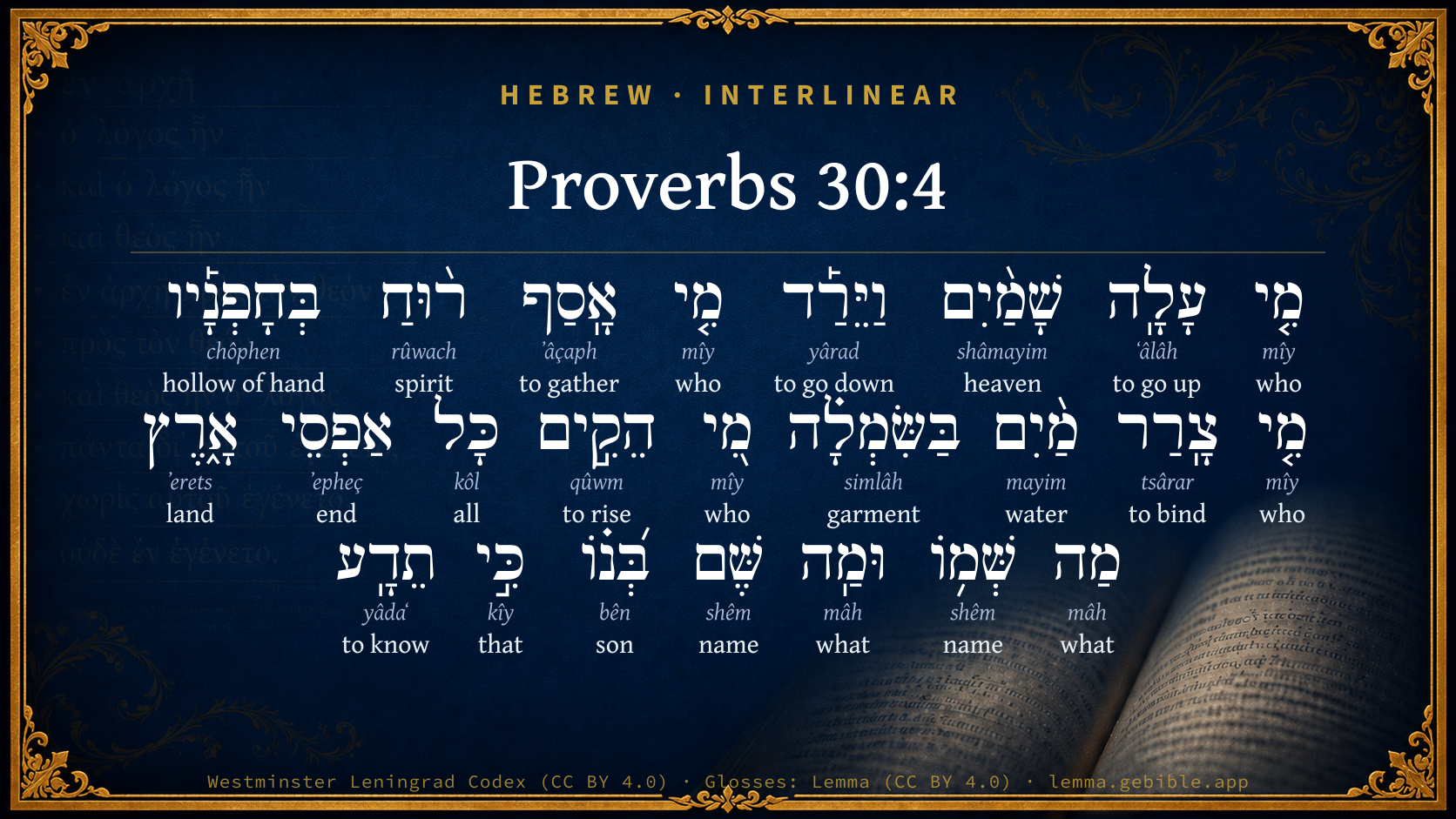
Proverbs 30:4

Hebrew (Westminster Leningrad Codex) Proverbs 30:4 appears in the Hebrew Old Testament. The text above is from the Westminster Leningrad Codex. Each word links to its Strong’s number, a concise gloss, and parsing drawn from the Open Scriptures Hebrew Bible morphology. Click any word for its full Brown-Driver-Briggs (BDB) entry.
Download image
Cite this verse

Proverbs 30:4 (World English Bible). Public Domain. Lemma interlinear Bible study tool, https://lemma.gebible.app/v/proverbs/30/4.

Show BibTeX & RIS
BibTeX
RIS
English Translation
Who has ascended up into heaven, and descended? Who has gathered the wind in his fists? Who has bound the waters in his garment? Who has established all the ends of the earth? What is his name, and what is his son's name, if you know?
World English Bible · Public Domain
Download a study sheet

One document with this verse’s original text, its word-by-word gloss line, the meaning frame, cross-references with their text, attributed commentary, and full source and license credits — printable, and it pastes into notes with its structure intact.

This verse Autodidact and up

Study sheet (.html) Plain text (.txt)

A passage Seminary Student

Up to 50 verses in one chapter. A passage sheet keeps up to 6 commentary sources and 12 cross-references per verse, in the order this page ranks them, and says so on the sheet whenever that leaves anything out. Ask for a single verse and you get the Autodidact verse sheet above.

Everything on this page stays free to read, with no account — the sheet is a download of what is already on screen, not access to it.

Want to remove ads? Support Godless Engineer
Compare translations 3

The same verse in 3 English versions, stacked beneath the original-language interlinear above. Click any original word for its lexicon entry.

Each is an independent rendering of the whole verse — the interlinear is not word-aligned to these translations.

Highlighted words mark where these versions differ — a whole-verse word diff, not a word-by-word alignment.

  • World English Bible Public Domain
    Who has ascended up into heaven, and descended? Who has gathered the wind in his fists? Who has bound the waters in his garment? Who has established all the ends of the earth? What is his name, and what is his son's name, if you know?
  • King James Version Public Domain
    Who hath ascended up into heaven, or descended? who hath gathered the wind in his fists? who hath bound the waters in a garment? who hath established all the ends of the earth? what is his name, and what is his son's name, if thou canst tell?
  • unfoldingWord Literal Text CC BY-SA 4.0
    Who has ascended heaven and descended? Who has gathered the wind in the hollow of his hands? Who has wrapped waters in the cloak? Who has raised up all the ends of the earth? What his name? And what the name of his son? Surely you know!

unfoldingWord Literal Text — © unfoldingWord, licensed CC BY-SA 4.0. Word-aligned USFM3 via Door43 (git.door43.org/unfoldingWord/en_ult).

Versions to compare (up to 4)

3 of 4 selected

Show all 18 translations

Every available English version of this verse, each an independent rendering of the whole verse.

  • World English Bible Public Domain
    Who has ascended up into heaven, and descended? Who has gathered the wind in his fists? Who has bound the waters in his garment? Who has established all the ends of the earth? What is his name, and what is his son's name, if you know?
  • Berean Standard Bible Public Domain
    Who has ascended to heaven and come down? Who has gathered the wind in His hands? Who has bound up the waters in His cloak? Who has established all the ends of the earth? What is His name, and what is the name of His Son—surely you know!
  • Majority Standard Bible Public Domain
    Who has ascended to heaven and come down? Who has gathered the wind in His hands? Who has bound up the waters in His cloak? Who has established all the ends of the earth? What is His name, and what is the name of His Son—surely you know!
  • King James Version Public Domain
    Who hath ascended up into heaven, or descended? who hath gathered the wind in his fists? who hath bound the waters in a garment? who hath established all the ends of the earth? what is his name, and what is his son's name, if thou canst tell?
  • American Standard Version (1901) Public Domain
    Who hath ascended up into heaven, and descended? Who hath gathered the wind in his fists? Who hath bound the waters in his garment? Who hath established all the ends of the earth? What is his name, and what is his son's name, if thou knowest?
  • Revised Version (1885) Public Domain
    Who hath ascended up into heaven, and descended? who hath gathered the wind in his fists? who hath bound the waters in his garment? who hath established all the ends of the earth? what is his name, and what is his son’s name, if thou knowest?
  • Geneva Bible (1599) Public Domain
    Who hath ascended vp to heauen, and descended? Who hath gathered the winde in his fist? Who hath bound the waters in a garment? Who hath established all the endes of the world? What is his name, and what is his sonnes name, if thou canst tell?
  • Douay-Rheims (1899) Public Domain
    Who hath ascended up into heaven, and descended? who hath held the wind in his hands? who hath bound up the waters together as in a garment? who hath raised up all the borders of the earth? what is his name, and what is the name of his son, if thou knowest?
  • Young's Literal Translation Public Domain
    Who went up to heaven, and cometh down? Who hath gathered the wind in his fists? Who hath bound waters in a garment? Who established all ends of the earth? What `is' His name? and what His son's name? Surely thou knowest!
  • Literal Standard Version CC BY-SA 4.0
    Who went up to the heavens, and comes down? Who has gathered the wind in His fists? Who has bound waters in a garment? Who established all ends of the earth? What [is] His Name? And what [is] His Son’s Name? Surely you know!
  • Unlocked Literal Bible CC BY-SA 4.0
    Who has gone up to heaven and come down? Who has gathered up the wind in the hollow of his hands? Who has gathered up the waters in a cloak? Who has established all the ends of the earth? What is his name, and what is the name of his son? Surely you know!
  • unfoldingWord Literal Text CC BY-SA 4.0
    Who has ascended heaven and descended? Who has gathered the wind in the hollow of his hands? Who has wrapped waters in the cloak? Who has raised up all the ends of the earth? What his name? And what the name of his son? Surely you know!
  • Darby Bible Public Domain
    Who hath ascended up into the heavens, and descended? Who hath gathered the wind in his fists? Who hath bound the waters in a mantle? Who hath established all the ends of the earth? What is his name, and what is his son's name, if thou knowest?
  • World Messianic Bible Public Domain
    Who has ascended up into heaven, and descended? Who has gathered the wind in his fists? Who has bound the waters in his garment? Who has established all the ends of the earth? What is his name, and what is his son’s name, if you know?
  • Webster's Bible Public Domain
    Who hath ascended into heaven, or descended? who hath gathered the wind in his fists? who hath bound the waters in a garment? who hath established all the ends of the earth? what is his name, and what is his son's name, if thou canst tell?
  • Free Bible Version CC BY-SA 4.0
    Who has gone up to heaven, and come down? Who holds the winds in the palm of his hands? Who has wrapped up the waters in his cloak? Who has set the earth's boundaries? What is his name, and what is his son's name? Are you sure you don't know?
  • Bible in Basic English Public Domain
    Who has gone up to heaven and come down? who has taken the winds in his hands, prisoning the waters in his robe? by whom have all the ends of the earth been fixed? what is his name, and what is his son's name, if you are able to say?
  • JPS Tanakh (1917) Public Domain
    Who hath ascended up into heaven, and descended? Who hath gathered the wind in his fists? Who hath bound the waters in his garment? Who hath established all the ends of the earth? What is his name, and what is his son's name, if thou knowest?

Literal Standard Version (2020), Covenant Press — licensed CC BY-SA 4.0. Text via the HelloAO Bible API (eBible.org). Unlocked Literal Bible (unfoldingWord) — licensed CC BY-SA 4.0. Text via the HelloAO Bible API (eBible.org). unfoldingWord Literal Text — © unfoldingWord, licensed CC BY-SA 4.0. Word-aligned USFM3 via Door43 (git.door43.org/unfoldingWord/en_ult). Free Bible Version, Dr. Jonathan Gallagher — licensed CC BY-SA 4.0. Text via the HelloAO Bible API (eBible.org).

Word by word

More ways to search: Search by grammar → Find every occurrence → Compare this word →

Practice this passage: Drill this verse → Learn its vocabulary →

בְּחָפְנָ֡יו
chôphen
H2651
“in/at · handfuls · his”
Preposition + Noun, Common, Masculine, Dual, Construct + Suffix, Personal, 3rd Person, Masculine, Singular
Part of Speech
Preposition + Noun
Type
Common
Gender
Masculine
Number
Dual
State
Construct
Full BDB Definition

Origin: from an unused root of uncertain signification

TWOT: 709a

handfuls, hollow of the hand
  1. מִ֤י mîy H4310 “who” Particle, Interrogative
  2. עָלָֽה ʻâlâh H5927 “to go up” Verb, Qal, Perfect, 3rd Person, Masculine, Singular
  3. שָׁמַ֨יִם shâmayim H8064 “heaven(s)” Noun, Common, Masculine, Plural, Absolute
  4. וַיֵּרַ֡ד yârad H3381 “and · to go down” Conjunction + Verb, Qal, Sequential Imperfect, 3rd Person, Masculine, Singular
  5. מִ֤י mîy H4310 “who” Particle, Interrogative
  6. אָֽסַף ʼâçaph H622 “to gather” Verb, Qal, Perfect, 3rd Person, Masculine, Singular
  7. ר֨וּחַ rûwach H7307 “spirit” Noun, Common, Both, Singular, Absolute
  8. מִ֤י mîy H4310 “who” Particle, Interrogative
  9. צָֽרַר tsârar H6887 “to bind” Verb, Qal, Perfect, 3rd Person, Masculine, Singular
  10. מַ֨יִם mayim H4325 “water(s)” Noun, Common, Masculine, Plural, Absolute
  11. בַּשִּׂמְלָ֗ה simlâh H8071 “in/at the · garment” Preposition, Determined + Noun, Common, Feminine, Singular, Absolute
  12. מִ֭י mîy H4310 “who” Particle, Interrogative
  13. הֵקִ֣ים qûwm H6965 “to rise” Verb, Hiphil, Perfect, 3rd Person, Masculine, Singular
  14. כָּל kôl H3605 “all of” Noun, Common, Masculine, Singular, Construct
  15. אַפְסֵי ʼepheç H657 “ends of” Noun, Common, Masculine, Plural, Construct
  16. אָ֑רֶץ ʼerets H776 “land” Noun, Common, Both, Singular, Absolute
  17. מַה mâh H4100 “what” Particle, Interrogative
  18. שְּׁמ֥וֹ shêm H8034 “name · his” Noun, Common, Masculine, Singular, Construct + Suffix, Personal, 3rd Person, Masculine, Singular
  19. וּמַֽה mâh H4100 “and · what” Conjunction + Particle, Interrogative
  20. שֶּׁם shêm H8034 “name of” Noun, Common, Masculine, Singular, Construct
  21. בְּ֝נ֗וֹ bên H1121 “son · his” Noun, Common, Masculine, Singular, Construct + Suffix, Personal, 3rd Person, Masculine, Singular
  22. כִּ֣י kîy H3588 “that” Conjunction
  23. תֵדָֽע yâdaʻ H3045 “to know” Verb, Qal, Imperfect, 2nd Person, Masculine, Singular

About this verse

These counts appear in no published source. They are computed here, from the morphology-tagged text and Lemma’s own curated glosses. What Lemma adds →

24
words
19
distinct lemmas
Wisdom
section

Notable vocabulary

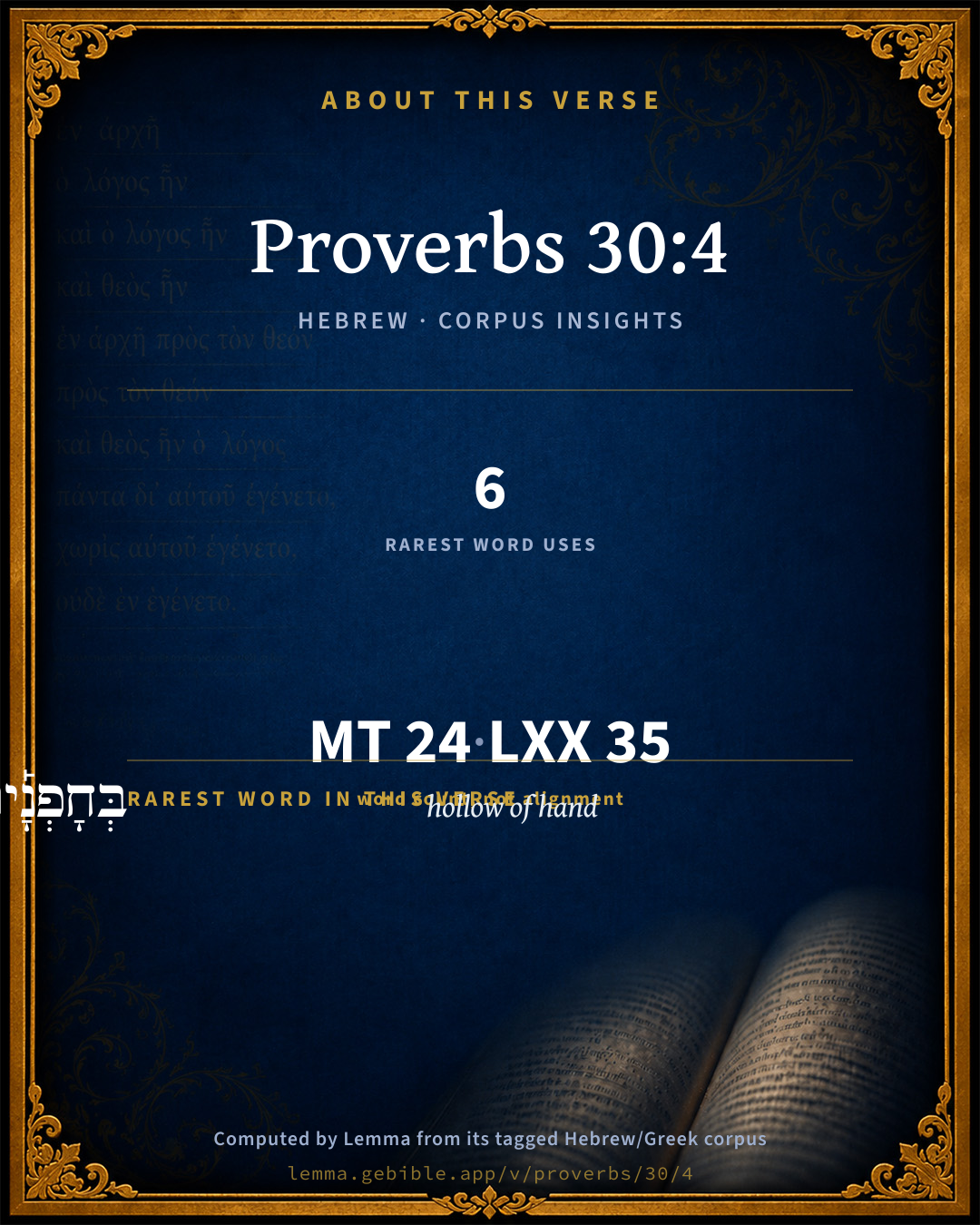
The rarest word here is בְּחָפְנָ֡יו hollow of hand H2651 — appearing just 6 times in the whole Hebrew Bible.

Shared distinctive vocabulary

בְּחָפְנָ֡יו hollow of hand H2651 occurs in 6 verses of the Hebrew Bible. Also found in:

Grammatical profile

  • 6 verbs
  • 11 nouns
  • 1 conjunction
  • 6 particles

Verb forms

  • עָלָֽה Qal · Perfect
  • וַיֵּרַ֡ד Qal · Sequential Imperfect
  • אָֽסַף Qal · Perfect
  • צָֽרַר Qal · Perfect
  • הֵקִ֣ים Hiphil · Perfect
  • תֵדָֽע Qal · Imperfect

Repetition

Words recur within this verse — often emphatic in Hebrew:

  • שְּׁמ֥וֹ name H8034 ×2
  • מִ֤י who H4310 ×4
  • מַה what H4100 ×2

Hebrew & Septuagint length

In English translation the verse runs 46 words from the Hebrew and 48 from the Septuagint (LXX English) — closely comparable.

A rough comparison of the two English renderings, which tokenize alike — not a word-level alignment.

Word counts can differ between the Hebrew and the Greek without any difference in meaning — e.g. the Hebrew direct-object marker אֵת has no separate Greek word, and Greek often adds the article ὁ.

In the original languages it is 24 Hebrew tokens and 35 Greek tokens — but the two are counted differently (Hebrew bundles its prefixes and suffixes into one token; the Greek is in lemma form), so that isn’t a like-for-like length.

Cross-references

26

Topical passages linked to Proverbs 30:4 in the Treasury of Scripture Knowledge — connected by theme and wording, ordered by reader-vote popularity; previews shown in the World English Bible.

  • John 3:13 No one has ascended into heaven, but he who descended out of heaven, the Son of Man, who is in heaven.
  • Job 26:8 He binds up the waters in his thick clouds, And the cloud is not burst under them.
  • Ephesians 4:8–10 Therefore he says, "When he ascended on high, he led captivity captive, and gave gifts to men."
  • Deuteronomy 30:12 It is not in heaven, that you should say, Who shall go up for us to heaven, and bring it to us, and make us to hear it, that we may do it?
  • Isaiah 7:14 Therefore the Lord himself will give you a sign. Behold, the virgin will conceive, and bear a son, and shall call his name Immanuel.
  • Isaiah 9:6 For to us a child is born, to us a son is given; and the government shall be on his shoulder: and his name shall be called Wonderful, Counselor, Mighty God, Everlasting Father, Prince of Peace.
  • Matthew 1:21–23 She shall bring forth a son. You shall call his name Jesus, for it is he who shall save his people from their sins."
  • Isaiah 40:12–31 Who has measured the waters in the hollow of his hand, and meted out the sky with the span, and comprehended the dust of the earth in a measure, and weighed the mountains in scales, and the hills in a balance?
  • Revelation 19:12 His eyes are a flame of fire, and on his head are many crowns. He has names written and a name written which no one knows but he himself.
  • Exodus 34:5–7 Yahweh descended in the cloud, and stood with him there, and proclaimed the name of Yahweh.
  • Job 38:4–41 "Where were you when I laid the foundations of the earth? Declare, if you have understanding.
  • Deuteronomy 28:58 If you will not observe to do all the words of this law that are written in this book, that you may fear this glorious and fearful name, YAHWEH YOUR GOD;
  • Psalms 2:7 I will tell of the decree. Yahweh said to me, "You are my son. Today I have become your father.
  • Psalms 104:2–35 He covers himself with light as with a garment. He stretches out the heavens like a curtain.
  • Romans 10:6 But the righteousness which is of faith says this, "Don't say in your heart, 'Who will ascend into heaven?' (that is, to bring Christ down);
  • Exodus 3:13–15 Moses said to God, "Behold, when I come to the children of Israel, and tell them, 'The God of your fathers has sent me to you;' and they ask me, 'What is his name?' What should I tell them?"
  • Psalms 68:18 You have ascended on high. You have led away captives. You have received gifts among men, Yes, among the rebellious also, that Yah God might dwell there.
  • Isaiah 53:8 By oppression and judgment he was taken away; and as for his generation, who [among them] considered that he was cut off out of the land of the living for the disobedience of my people to whom the stroke [was due]?
  • Exodus 6:3 and I appeared to Abraham, to Isaac, and to Jacob, as God Almighty; but by my name Yahweh I was not known to them.
  • Judges 13:18 The angel of Yahweh said to him, Why do you ask after my name, seeing it is wonderful?
  • Genesis 32:29 Jacob asked him, "Please tell me your name." He said, "Why is it that you ask what my name is?" He blessed him there.
  • Psalms 22:27 All the ends of the earth shall remember and turn to Yahweh. All the relatives of the nations shall worship before you.
  • Psalms 24:2 For he has founded it on the seas, And established it on the floods.
  • Jeremiah 23:6 In his days Judah shall be saved, and Israel shall dwell safely; and this is his name by which he shall be called: Yahweh our righteousness.
  • Matthew 11:27 All things have been delivered to me by my Father. No one knows the Son, except the Father; neither does anyone know the Father, except the Son, and he to whom the Son desires to reveal him.
  • Luke 10:22 Turning to the disciples, he said, "All things have been delivered to me by my Father. No one knows who the Son is, except the Father, and who the Father is, except the Son, and he to whomever the Son desires to reveal him."

Cross-references courtesy of OpenBible.info (CC BY 4.0).

Hebrew and Greek witnesses Masoretic Hebrew ↔ Greek Septuagint

The same verse in the two great witnesses to the Old Testament, shown verse-for-verse.

These are two independent witnesses, not word-aligned to each other, and the Septuagint is shown in lemma (dictionary) form.

Hebrew Proverbs 30:4 Masoretic · Westminster Leningrad Codex

מִ֤י עָלָֽה שָׁמַ֨יִם וַיֵּרַ֡ד מִ֤י אָֽסַף ר֨וּחַ בְּחָפְנָ֡יו מִ֤י צָֽרַר מַ֨יִם בַּשִּׂמְלָ֗ה מִ֭י הֵקִ֣ים כָּל אַפְסֵי אָ֑רֶץ מַה שְּׁמ֥וֹ וּמַֽה שֶּׁם בְּ֝נ֗וֹ כִּ֣י תֵדָֽע

Who has ascended up into heaven, and descended? Who has gathered the wind in his fists? Who has bound the waters in his garment? Who has established all the ends of the earth? What is his name, and what is his son's name, if you know?

World English Bible · Public Domain

Greek LXX Proverbs 30:4 Septuagint · lemma form

τίς ἀναβαίνω εἰς ὁ οὐρανός καί καταβαίνω τίς συνἄγω ἄνεμος ἐν κόλπος τίς συνστρέφω ὕδωρ ἐν ἱμάτιον τίς κρατέω πᾶς ὁ ἄκρος ὁ γῆ τίς ὄνομα αὐτός ἤ τίς ὄνομα ὁ τέκνον αὐτός ἵνα γιγνώσκω

Who has gone up to heaven, and come down? who has gathered the winds in his bosom? who has wrapped up the waters in a garment? who has dominion of all the ends of the earth? what is his name? or what is the name of his children?

LXX2012 (modern English Septuagint) · Public Domain

On this verse, Adam Clarke's Commentary discusses the Septuagint’s reading. Read the note in Commentary ↓

Hebrew: Westminster Leningrad Codex (CC BY 4.0). Greek: Septuagint (public domain); English from LXX2012 (modern English Septuagint) (Public Domain). How the Septuagint differs from the Hebrew →

Commentary

Notes on Proverbs 30:4 from classic Christian and Jewish commentators (each source and its license shown beneath its notes). The classic Christian expositions comment on the surrounding passage and are grouped to its opening verse, so a note may address several verses; the Jewish commentaries on the Tanakh (Rashi and others) are per-verse, so they appear only where the commentator wrote on this verse.

Lemma curates 59 commentaries, every one of them public domain or Creative Commons licensed, each selected and text-cleaned for this edition rather than reprinted as found. About our sources →

Trapp's Complete Commentary

John Trapp

Pro 30:4 Who hath ascended up into heaven, or descended? who hath gathered the wind in his fists? who hath bound the waters in a garment? who hath established all the ends of the earth? what [is] his name, and what [is] his son’s name, if thou canst tell?

Ver. 4. Who hath ascended up into heaven, or descended?] Who but the Son of man which is in heaven? {Joh 3:13} who but the holy angels upon that Son of man, the ladder of life? {Joh 1:51} who but those that have, in some measure, the knowledge of those holy ones, {Pro 30:3} the knowledge of God in Christ, which is life eternal, {Joh 17:3} heaven aforehand? Holy Agur holds it out to us here that to "know heavenly things" is to "ascend into heaven." Even Aristotle {a} saith that a little knowledge, though but conjectural, about heavenly things, is to be preferred above much knowledge, though certain, about inferior things, and yet he knew no heaven beyond the moveable heavens, neither acknowledged any body, or time, or place, or vacuum there. The truth is, no natural knowledge can be had of the third heaven, nor any help by human arts, for it is neither aspectable nor moveable. As no man hath seen God at any time, so, nor heaven, the throne of God, only "the only begotten Son of God which is in the bosom of the Father," he hath declared both him and heaven, {Joh 1:18} as that there are many mansions, crowns, sceptres, kingdoms, glories, beauties, angelical entertainments, beatific visions, sweetest varieties, felicities, eternities. And yet all this, or whatsoever more can be said of heaven’s happiness, is not the one half, as she said of Solomon’s magnificence, of what we shall find in that city of pearl. To express it is as impossible as to compass the heavens with a span, or contain the ocean in a nutshell. Let there be continual ascensions thither in our hearts; let us lift up hearts and hands to God in the heavens, and he will shortly send his chariots for us, as Joseph did for his father, fetch us riding upon the clouds, convoy us by his angels through the air, as through the enemy’s country, and puts us into that panegyries, that general assembly, and solemn celebrity of holy and happy souls. {Heb 12:23} As in the mean space, how should we every day take a turn or two with Christ upon Mount Tabor? - get up to the top of Pisgah with Moses, and take a prospect of heaven? - turn every solemnity into a school of divinity? Say, as Fulgentius, when he saw the nobility of Rome sit mounted in their bravery, Si talis est Roma terrestris qualis est Roma coelestis? If Rome be such a glorious place, what is heaven? What music may we think there is in heaven? said another good soul, when he sat and heard a good concert of music. This, this is the principal end and most profitable use of all creatures, Cum scalae nobis et alae fiant, When they become ladders and wings to us to mount up to heaven.

Who hath gathered the wind in his fists? &c.] None but God, the great wonder worker, the right Aeolus, that "bringeth the winds out of his treasures," {Psa 135:7} and bids them at his pleasure "Peace, be still." We read of a whirlwind raised by the devil, {Job 1:19} and of a tempest, laid by the magicians (Herodotus, in Polymnia). But it cannot be said {as 1Ki 19:11} that "God was not in that wind"; for he hath the royalty of all the creatures, though he suffer the devil to play rex sometimes, for ends best known to himself.

Who hath bound the waters in a garment?] Those above the firmament, in clouds - through which they distil and drop down, as water would do if bound up in a garment - those below, in channels and bottles, as the Psalmist hath it. Water is naturally above the earth, as the garment above the body, and would, but for the providence of God, prove as the shirt made for the murdering of Agamemnon, where the head had no issue out, &c. {See Trapp on "Gen 1:7"}

What is his name?] God is above all name, to speak properly. When Manoah inquires after his name, the answer is, "It is Wonderful"; that is, I am called as I am called; but such is thy weakness that it passeth thy conception; this ocean will not be measured by thy musselshell. Multa nomina et lumina sibi finxerunt infideles. The heathens had many names for their dunghill deities; but the Africans called an "unknown god" whom they worshipped, Amen, that is, Heus tu quis est? Hark, who art thou? as Plutarch relateth. {b}

And what is his son’s name?] Christ hath many names in Holy Scripture, as Isa 9:6-7. So "Jehovah, our righteousness"; "Messiah the Prince," {Dan 9:25} whereunto answereth in the New Testament, "the Lord Christ"; but "who can declare his generation?" {Isa 53:8} whether that eternal generation, or that in the fulness of time, the mystery whereof was beyond words? Our safest eloquence here will be our silence, our greatest knowledge a learned ignorance. Only we have here a clear testimony of the distinction of the persons, and that the Son is coequal and consubstantial with the Father, since he is also, as the Father, above all name and notion.

If thou canst tell.] But so can none: "No man knoweth the Son but the Father; neither doth any man know the Father but the Son, and he to whom the Son will reveal him." {Mat 11:27} The Son is so like the Father here, that if you know the one, ye cannot but know the other. {Joh 14:7-9} Milk is not so like milk. Non tam ovum ovo simile. He is "the brightness of his Father’s glory, and the express image of his person." {Heb 1:3} {See Trapp on "Heb 1:1-14; Heb 3:1-19"} And if we desire a glass wherein to behold the face of God the Father, and of his Son, here is one held forth in the next verse.

{a} De Coelo, text. 99.

{b} Lib. de Isid. et Osirid.

John Trapp, A Commentary or Exposition upon All the Books of the Old and New Testament (1647–1656) — public domain. Text from a community e-Sword module.

Joseph Benson's Commentary

Pro 30:4. Who hath ascended, &c. — What mere man hath ascended into heaven to learn the mind of God, who dwells there? None have. And descended — To teach men below what he had learned above. No man can fully know and teach us these things unless he hath been in heaven, and sent down from thence to the earth for that end. Who hath gathered the wind in his fists — To hold them in, or let them out at his pleasure? And none but he who made and governs all creatures, can know and teach these things. The waters — Those above, the clouds, and those below, the sea, which God keeps as it were within doors, and the waters which he shuts up in the bowels of the earth. The ends of the earth — The whole earth, from one end to another, which God upholdeth in the air by the word of his power. If thou canst tell — If thou thinkest there be any man who can do these things, produce his name; or, if he be dead, the name of any of his posterity.

Joseph Benson's Commentary on the Old and New Testaments (1811–1818) — public domain. Text from a community e-Sword module.

Tyndale Open Study Notes

Tyndale Open Resources

30:4-6 In contrast to Agur’s ignorance and powerlessness stands the strength and wisdom of God (cp. Ps 18:30). This is good news to Agur, who understands that God is a shield to all who come to him for protection.

Tyndale Open Study Notes — © Tyndale Open Resources, licensed CC BY-SA 4.0. Text via the HelloAO Bible API.

Geneva Bible (1599)

Geneva Bible translators

Meaning, to know the secrets of God, as though he would say, None.

Geneva Bible (1599) marginal notes — public domain. Text via Bolls.life.

Adam Clarke's Commentary

Verse 4. Who hath ascended up into heaven, or descended?] Calmet paraphrases this passage thus: "Who hath descended, c. In order to show the truth of what he was about to say, he observes: I have not the science of the saints for how could I have acquired it? Who is he who could attain to that? Who has ascended to heaven to learn that science, and who has descended in order to publish it? Is the science of salvation one of those things that can be apprehended only by study? Is it not a pure gift of the goodness of God? Moses, after having shown to the people the will of God, said to them: 'This commandment which I command thee this day is not hidden from thee; neither is it far off. It is not in heaven, that thou shouldest say, Who shall go up for us to heaven, and bring it unto us, that we may hear it, and do it?' De 30:11-12. The person whose words we are here examining speaks a knowledge more sublime than that contained in the simple laws of the Lord, common to all the people of Israel. He speaks of the sublime science of the designs of God, of his ways, and of his secrets; and in this sense he affirms he has no knowledge."

Who hath gathered the wind in his fists?] It is as difficult for a mortal man to acquire this Divine science by his own reason and strength, as to collect the winds in his fists. And who can command the spirit of prophecy, so that he can have it whensoever he pleases?

What is his name?] Show me the nature of this Supreme Being. Point out his eternity, omniscience, omnipresence, omnipotence; comprehend and describe him, if thou canst.

What is his son's name] Some copies of the Septuagint have η τι ονομα τοις τικνοιο αυτου; "Or the name of his sons;" meaning, I suppose, the holy angels, called his saints or holy ones, Pr 30:3.

The Arabic has, What is his name? [Arabic] and what is the name of his father? him who begat him. But the Chaldee, the Syriac, and the Vulgate, read as the Hebrew.

Many are of opinion that Agur refers here to the first and second persons of the ever-blessed TRINITY. It may be so; but who would venture to rest the proof of that most glorious doctrine upon such a text, to say nothing of the obscure author? The doctrine is true, sublimely true; but many doctrines have suffered in controversy, by improper texts being urged in their favour. Every lover of God and truth should be very choice in his selections, when he comes forward in behalf of the more mysterious doctrines of the Bible. Quote nothing that is not clear: advance nothing that does not tell. When we are obliged to spend a world of critical labour, in order to establish the sense of a text which we intend to allege in favour of the doctrine we wish to support, we may rest assured that we are going the wrong way to work. Those who indiscriminately amass every text of Scripture they think bears upon the subject they defend, give their adversaries great advantage against them. I see many a sacred doctrine suffering through the bad judgment of its friends every day. The Godhead of Christ, salvation by faith, the great atoning sacrifice, and other essential doctrines of this class, are all suffering in this way. My heart says, with deep concern,

Non tali auxilio, nec defensoribus istis,

Tempus eget.

When truth is assailed by all kinds of weapons, handled by the most powerful foes, injudicious defenders may be ranked among its enemies. To such we may innocently say,

"Keep your cabins; you do assist the storm."

Adam Clarke's Commentary on the Bible (1810–1826) — public domain. Text from a community e-Sword/MySword module.

Ellicott's Commentary for English Readers

(4) Who hath ascended up into heaven . . .—The reason of Agur’s sadness is here declared. He feels himself far off from possessing anything that may be called knowledge of God or of His works. (Comp. Gal_4:9; 1Co_13:12.) The questions in this verse are intended to bring out the nothingness of man as compared with the might of the Creator of the Universe; they resemble Job 38-41, and Isa_40:12 sqq.

Who hath bound the waters in a garment?—Stretching out the clouds as a “curtain” (Psa_104:2; Isa_40:22), to keep the rain from falling upon the earth. (Comp. Job_26:8.)

What is his name?—We may call Him the Self-existing (Jehovah), Powerful (Shaddai), Strong (El). Awful (Eloah) Being; we may describe Him as merciful, gracious, etc. (Exo_34:5 sqq.), but no words will describe Him adequately, for not till the next life shall we see Him as He is (1Jn_3:2), and He has been pleased to reveal Himself only partially to us.

What is his son’s name?—See the description of wisdom in Pro_8:22 sqq., and the notes there.

A Bible Commentary for English Readers, edited by Charles John Ellicott (1878–1897) — public domain. Text from a community e-Sword module.

The Cambridge Bible for Schools and Colleges

gen. ed. J. J. S. Perowne

4. ascended … descended] That he should go there and learn, and come back again to earth and tell what is done there. Comp. Joh_3:13 : “No man hath risen into the region of absolute and eternal truth, so as to look upon it face to face, and in the possession of that knowledge declare it to men.” Bp Westcott. It is something of this conviction that calls forth the deeply humble confession of Pro_30:2-3; but it leads not to agnosticism, but to the reverent yet trustful acknowledgement of “the Holy One” who knows all. Comp. for the following questions, Isa_40:12-17; Job_38:41.

a garment] “The wonder of the clouds, floating reservoirs of water, which do not burst underneath the weight of waters which they contain. Men bind up water in skins or bottles; God binds up the rain-floods in the thin, gauzy texture of the changing cloud, which yet by His power does not rend under its burden of waters.” Job_26:8, note in this Series.

his name … his son’s name] Can you describe Him, and can you tell whether He is absolutely alone, or has He imparted His nature and attributes to any other, who may in any sense be called His “Son”? The question is of deep interest, betokening the early yearnings, awakened by the Divine Spirit in the spirit of man, which were to find “when the fulness of the time came” their complete satisfaction in the great revelation of Sonship in the Gospel.

The wise Teacher “has meditated on the wonderful facts of the physical world; he has watched the great trees sway under the touch of the invisible wind, and the waves rise up in their might, lashing the shores, but vainly essaying to pass their appointed boundaries; he has considered the vast expanse of the earth, and enquired on what foundations does it rest, and where are its limits? He cannot question the ‘eternal power and divinity,’ which alone can account for this ordered universe. He has not, like many thinkers, ancient and modern, ‘dropped a plummet down the broad deep universe, and cried, No God.’ He knows that there is a God; there must be an intelligence able to conceive, coupled with a power able to realise, this mighty mechanism. But Who is it? What is His name, or His Son’s name? Here are the footsteps of the Creator; but where is the Creator Himself?” Horton.

Pro_30:5-6. From the uncertainty of human speculation he finds relief in the certainty of Divine revelation.

The Cambridge Bible for Schools and Colleges (gen. ed. J. J. S. Perowne; Cambridge University Press, 1878–1918) — public domain. Text from a community e-Sword module.

John Gill's Exposition

Who hath ascended up into heaven, or descended?.... That has been thither to fetch knowledge of God and divine things, and has returned to communicate it. Enoch was taken up to heaven before this time: and Elijah, as is very probable, after; but neither of them returned again, to inform mortals what was to be seen, known, and enjoyed there: since, the Apostle Paul was caught up into the third heaven, and came back again; but then the things he heard were such as it was not lawful for a man to utter: and indeed, since the coming of Christ there is no need of any further revelation to be made nor of any such expedition, in order to obtain it, Rom 10:6. And, properly speaking, there never was any besides him, whose names are Ithiel and Ucal, that ever did this: he lay in the bosom of the Father, and was privy to his whole mind and will; he descended from heaven to earth not by local motion, but, by assumption of nature; and when he had made known his Father's will, and done his work, he ascended far above all heavens, and received gifts for men; to fill his churches and ministers with them, in order to communicate and improve spiritual and divine knowledge; and therefore, with great propriety and pertinence, he applies these words to himself, Joh 3:13;

who hath gathered the wind in his fists? not any mere creature; not any man or set of men; it is not in the power of any, either men or angels, to restrain or let loose the winds at pleasure; nor has Satan, though called the prince of the power of the air, that is, of the devils in the air, any such command of them; none but he that made them can command them to blow, or be still; even he who brings them out of his treasures, and his own son, whom the wind and seas obeyed; see Psa 135:7; The Heathens (w) themselves are so sensible of this, that the power of the winds only belongs to God, that they have framed a deity they call Aeolus; whom the supreme Being has made a kind of steward or store keeper of the winds, and given him a power to still or raise them as he pleases (x);

who hath bound the waters in a garment? either the waters above, which are bound in the thick clouds as in a garment which hold them from pouring out; or the waters of the sea, which are as easily managed by the Lord as an infant by its parent, and is wrapped about with a swaddling band, Job 26:8. But can any creature do this? none but the mighty God; and his almighty Son the Ithiel and Ucal, who clothes the heavens with blackness, and makes sackcloth their covering: even he who is the Redeemer of this people, and has the tongue of the learned, to speak a word in season to them Isa 50:2;

who hath established all the ends of the earth? fixed the boundaries of the several parts of the world, Europe, Asia, Africa, and America, and the several countries in them? settled the foundations of the earth, and secured the banks and borders of it from the raging of the sea? None but these next mentioned; see Job 38:4;

what is his name, and what is his son's name, if thou canst tell? if thou surest it is a mere man that does all these things tell his name; or, if he be dead, say what is the name of his son or of any of his family; so Jarchi and others interpret it: or rather, since it is the Lord alone and his own proper Son, to whom these things can he ascribed say what is his name; that is, his nature and perfections which are incomprehensible and ineffable; otherwise he is known by his name Jehovah and especially as his name is proclaimed in Christ and manifested by him and in his Gospel: and seeing he has a son of the same nature with him, and possessed of the same perfections, co-essential, and co-existent, and every way equal to him, and a distinct person from him, say what is his nature and perfections also; declare his generation and the manner of it; his divine filiation, and in what class it is; things which are out of the reach of human capacity, and not to be expressed by the tongue of men and angels; see Mat 11:27. Otherwise, though his name for a while was a secret, and he was only called the seed of the woman and of Abraham, Gen 3:15; yet he had many names given him under the Old Testament; as Shiloh, Immanuel, the Wonderful, Counsellor, the mighty God, the everlasting Father, and Prince of peace; the Lord our righteousness, and the Man, the Branch: and under the New Testament, Jesus the Saviour, Christ the Anointed; the Head of the church, the Judge of the world; the Word of God, and King of kings, and Lord of lords. This Scripture is a proof of Christ's being the eternal Son of God; of his equality with his divine Father as such, their name and nature being alike ineffable; of his co-existence with his Father as such; and of his omnipresence and omnipotence, expressed by the phrases here used of ascending, &c. and of his distinct personality from the Father; the same question being distinctly put of him as of the Father. Some render the last clause, "dost thou know?" (y) thou dost not know God and his Son, their being and perfections are not to be known by the light of nature, only by revelation, and but imperfectly.

(w) , &c. Homer. Odyss. 10. v. 21, 22. "Aeole, namque tibi divum pater atque hominum rex, et mulcere dedit fluctus, et tollere vento", Virgil Aeneid. l. v. 69, 70. (x) See a Sermon of mine, called "Christ the Saviour from the Tempest", p. 17, 18. (y) "ad nosti?" Noldius, p. 393. No. 1337.

John Gill's Exposition of the Whole Bible (1746–1763) — public domain (CC PDM 1.0). Text via the HelloAO Bible API.

Albert Barnes' Notes on the Bible

Man is to be humbled to the dust by the thought of the glory of God as seen in the visible creation.

Who hath ascended up into heaven, or descended? - The thought is obviously that of the all-embracing Providence of God, taking in at once the greatest and the least, the highest and the lowest. The mysteries of the winds and of the waters baffle men’s researches.

What is his son’s name - The primary thought is that man knows so little of the divine nature that he cannot tell whether he may transfer to it the human relationships with which he is familiar, or must rest in the thought of a unity indivisible and incommunicable. If there is such an Only-begotten of the Father (compare Pro 8:30), then His nature, until revealed, must be as incomprehensible by us as that of the Father Himself.

Albert Barnes' Notes on the Bible (1834–1885) — public domain. Text from a community e-Sword/MySword module.

Haydock's Catholic Bible Commentary

Descended. How then could I acquire such a sublime science? (Deuteronomy xxx. 11.) (Calmet) --- Christ alone could impart it, (John iii. 13.; Haydock) who is the perfect wisdom. (Worthington) --- Hands. Septuagint, "breast." (Haydock) --- It is no less difficult to fathom the designs of Providence. Some understand the "spirit" of prophecy to be here meant. --- Son. Septuagint, "children." But many Greek copies, and all the interpreters, have Son, which the Fathers explain of the second person of the blessed Trinity, specified [in] chap. viii. 22. (Calmet)

George Leo Haydock (1774–1849), Haydock's Catholic Family Bible and Commentary, 1859 edition — public domain. Excludes Psalms (Douay-Rheims chapter numbering differs from Protestant) and Deuterocanonical books (Catholic canon only).

Matthew Poole's English Annotations

Who? what mere man? None at all; and therefore I may truly say, that I have not that which no mortal man ever yet had.

Hath ascended up into heaven; there to learn the mind of God who dwells there, and that wisdom which is from above.

Or descended; or rather, and descended, to teach men below what he had learned above. The meaning of the place is, No man can fully know and teach us these things unless he hath been in heaven, and sent down from thence to the earth to that end; whence our Saviour Christ justly applies these words to himself, Joh 3:13, and appropriates this work of declaring God’s nature and will to men to himself, upon this account, that he alone was in his Father’s bosom, Joh 1:18.

Hath gathered the wind in his fists, to hold them in, or let them out, and rule them at his pleasure. Where is there a man that can do this? And none but he who made and governs all the creatures can know and teach these things. The waters; those above in the clouds, and those below, the sea, which God keeps as it were within doors, and in a garment and swaddling-band, as it is expressed, Job 38:8,9; and the waters which he shuts up in the bowels of the earth.

All the ends of the earth; the whole earth, from one end to another, which God upholdeth in the air by the word of his power, and secureth from the rage of the sea, by the banks and shores wherewith he hath begirt it for that purpose.

What is his name, and what is his son’s name, if thou canst tell? The sense is either,

1. Seeing it is apparent that no man hath this power, and consequently this knowledge, but that this is the prerogative of the great God, declare, if thou art able, his name, i.e. his nature and perfections, and the eternal generation and the perfections of his Son. Or rather,

2. If thou thinkest there be any such man who can do these things, I challenge thee to produce his name; or if he be long since dead, and gone out of the world, the name of any of his posterity that can assure us that their progenitor was such a person; which because thou canst not do, I must conclude that none can thoroughly understand this matter but the blessed God, and his Son Christ, and they to whom God shall reveal it by Christ.

Matthew Poole's English Annotations on the Holy Bible (1683–1685) — public domain. Text from a community e-Sword/MySword module.

Whedon's Commentary on the Bible

Daniel D. Whedon

4. Ascended up — The object of this passage is, probably, like that of many similar ones, to impress the mind with the incomprehensible greatness of the divine Author of all existence, his majesty, his omnipotence, his omniscience, his inscrutable perfections, and his unapproachable glory. So in Job_11:7-8 : “Canst thou by searching find out God? canst thou find out the Almighty unto perfection? It is as high as heaven; what canst thou do? deeper than hell; what canst thou know? The measure thereof is longer than the earth, and broader than the sea.” So, also, Paul, in Rom_11:33-35 : “Oh the depth of the riches both of the wisdom and knowledge of God! how unsearchable are his judgments, and his ways past finding out! For who hath known the mind of the Lord? or who hath been his counsellor? or who hath first given to him, and it shall be recompensed unto him again?” There are also many similar passages in the Psalms. It is the language of the emotions, of poetry, labouring to express — rather, feeling utterly incompetent to express — the glory of the divine character, and giving up in despair. Compare Job_15:8; also the whole of Job 37, 41, and Job_38:4; Psa_104:3; Isa_40:12; Jer_23:18; 1Co_2:16.

Bound the waters in a garment — Some expositors understand this of the waters “above the firmament,” (Gen_1:7;) that is, in the atmosphere. Others, with more plausibility, of the waters of the ocean, which are in sundry places presented under the idea of being straitened, confined within their appropriate limits, by divine statute. Compare Proverbs 8:39. The assertion is gratuitous, that the inspired Hebrew writers regarded the רקיע, (rakia’h,) the expanse, improperly rendered by the Greek στερεωμα, stereoma, and the Latin, firmamentum, as a solid pavement by which the waters were held up. Figurative expressions, such as “the windows of heaven,” do not prove it, any more than similar forms found in our own literature would prove to a reader a thousand years hence that we had the same idea.

Established all the ends of the earth — אפסי ארצ, (aphse-arets,) ends, extremities, or boundaries of the earth, that is, of the land as distinguished from the waters. The two clauses may be translated thus: Who hath folded up (compressed) the waters in the mantle? Who hath constituted (ordered, ordained) all the boundaries of the land? An allusion, probably, to Gen_1:9; “And God said, Let the waters under the heaven be gathered together unto one place, and let the dry land appear.” It is remarkable that יקוו, (yikkavu,) gathered together, has the same radical meaning as the above, namely, that of being bound up or folded together. (See Gesenius on the word קוה, (kavah.) There is a reference in the verse, first, to the visible heavens, or what the Hebrews called the second heavens — the place of the heavenly bodies, sun and stars; secondly, to the first heavens — the atmosphere, the region of the air, wind, which he gathers in his hand, or controls; thirdly, to the water and land as being adjusted and bounded by his ordinance — the sea, to which be has given its decree that the waters should not pass his commandment, limit.

The earth — Land, to which he has appointed the foundations. Now follows the great question,

What is his name — Tell me, that is, according to a well-known Hebraism, What is He, who is He, what must He be, who performeth such wonders in the heavens above, and in the earth beneath, and in the waters that are under or within the earth? Or, if thou canst declare to me nothing of himself, knowest thou the name of any one related to him, as for instance, a son, of whom we may inquire? As if he had said, If thou knowest any way or means by which we may attain to a knowledge of this ineffably glorious Being, tell me, O tell me!

Thus the majority of expositors understand this remarkable language. The sense is a good one, and yet, perhaps, it is scarcely satisfactory. A mind having somewhat the same yearnings as are here expressed may still ask: Is there not something more in it? May there not be also under these anxious interrogations, made under the divine afflatus, a foreshadowing of the glorious Son of God, the יהוה, or יהוה, (Yehovah, or Yahveh,) the coming one, for whose appearing, as the revealer of God, (Joh_1:18,) so many prophets and righteous men of ancient times intensely looked as the hope of humanity: “Searching what, or what manner of time the Spirit of Christ which was in them did signify.” Thus much, at least, the passage may show; that the idea of divine relations — I will not say persons, but relations — of paternity and filiation, does not seem to have been altogether foreign, nor appeared wholly absurd, to the mind of ancient sages like Agur, who is nevertheless clearly monotheistic in his conceptions of the great Author of our being. And if the expression should mean all that some interpreters, both ancient and modern, believe, it would seem to find a corresponding voice in the words of the Deliverer himself. Compare a few passages: “No man hath ascended up to heaven, but he that came down from heaven, even the Son of man which is in heaven.” Joh_3:13. “No man knoweth the Son, but the Father; neither knoweth any man the Father, save the Son, and he to whomsoever the Son will reveal him.”

Mat_11:27. To the same purport are the words of the Baptist: “No man hath seen God at any time; the only begotten Son, which is in the bosom of the Father, he hath declared him.” Joh_1:18. Nor should it be forgotten that David had, probably before Agur, in an ode unquestionably Messianic, used the word, בן, (ben,) son, and its equivalent, בר, (bar,) “Thou art my Son.” Psa_2:7. “Kiss the Son.” Psa_2:12. His son’s name — Most of the ancient Versions correspond to the Hebrew here; but the Septuagint has the plural sons, and the Arabic has, “What is the name of his father.”

Daniel D. Whedon (gen. ed.), Commentary on the Old and New Testaments (1874–1909) — public domain. Text from a community e-Sword module.

The Pulpit Commentary

The questions contained in this verse are such as compelled Agur to acknowledge his ignorance and nothingness before the thought of the glory and power of the great Creator. We may compare Job 38, etc. Who hath ascended up into heaven, or descended? Who is he that hath his seat in heaven, and doeth works on earth? Who is he whose universal providence is felt and experienced? Where is this mysterious Being who hides himself from human ken? Christ has said something like this, "No man hath ascended up to heaven, but he that came down from heaven, even the Son of man which is in heaven"; (Joh_3:13) and St. Paul. (Eph_4:9) In biblical language God is said to come down from heaven in order to punish, to aid, to reveal his will, etc.; (Gen_11:7 Psa_18:9, etc.) and he returns to heaven when this intervention is finished. (Gen_17:22 Gen_35:13) Who hath gathered the wind in his fists? Who hath the control of the viewless wind, so as to restrain it or release it at his pleasure? (Psa_135:7 Amo_4:13) Septuagint, "Who hath gathered the winds in his bosom (kolw )?" Who hath bound the waters in a garment? The waters are the clouds which cover the vault of heaven, and are held, as it were, in a garment, so that, in spite of the weight which they contain, they fall not upon the earth. As Job says Job_26:8), "He bindeth up the waters in his thick clouds; and the cloud is not rent under them." And again, (Job_38:37) "Who can number the clouds by wisdom? or who can pour out the bottles of heaven?" So the psalmist, "Thou coveredst it the earth with the deep as with a vesture". (Psa_104:6) (See above, Pro_8:27, etc.) Who hath established all the ends of the earth? Who hath consolidated the foundations, and defined the limits, of the remotest regions of the earth? (comp. Job_38:4, etc.) The answer to these four questions is "Almighty God." He alone can order and control the forces of nature. What is his name, and what is his son"s name, if thou canst tell? or, if thou knowest. It is not enough to acknowledge the power and operation and providence of this mysterious Being; Agur longs to know more of his nature, his essence. He must have personality; he is not an abstraction, a force, a quality; he is a Person. What, then, is his name, the name which expresses what he is in himself? Men have different appellations for this Supreme Being, according as they regard one or other of his attributes: is there one name that comprehends all, which gives an adequate account of the incomprehensible Creator? The question cannot be answered affirmatively in this life. "We know that if he shall be manifested, we shall be like him; for we shall see him even as he is". (1Jn_3:2) The further question, "What is his son"s name?" has given some difficulty. The LXX has, "What is the name of his children (toiv teknoiv autou )?" as if there was reference to Israel, the special children of God. But the original does not bear out this interpretation, which is also opposed to the idea of the enigma proposed. The inquiry might mean Are we to apply to the Supreme Being the same notion of natural relationship with which we are familiar in the human family? But this seems a low and unworthy conception. Or the "son" might be primeval man (Job_15:7) or the sage; but the answer would not be satisfactory, and would not tend to solve the great question. There are two replies which can be made to Agur"s interrogation. Looking to the marvellous description of Wisdom in Pro_8:22, etc., we may consider Wisdom to be a denotation of the Son of God, and the inquirer desires to know the name and nature of this personage, of whose existence he was certified. Or he may have arrived at a knowledge of the only begotten Son of God, as the idea of the Logos is more or less developed in the Book of Wisdom, in Philo"s treatises, and in the Alexandrian school; and longs for more perfect knowledge. This, indeed, is hidden: "He hath name written, which no one knoweth but he himself". (Rev_19:12) It is useless to put such question to a fellow man; no human mind can fathom the nature of the Godhead, or trace out its operations (Ecc 18:4, etc.).

The Pulpit Commentary (1880–1919), ed. H.D.M. Spence-Jones & Joseph S. Exell — public domain. Text from a community e-Sword module.

John Wesley's Explanatory Notes

Who - What mere man? None at all. Ascended - To learn the mind of God who dwells there. Descended - To teach men below what he had learned above. No man can fully know and teach us these things unless he hath been in heaven, and sent down from thence to the earth for that end. In his fists - To hold them in, or let them out at his pleasure? And none but he who made and governs all creatures, can know and teach these things. The waters - Those above the clouds, and those below, the sea which God keeps as it were within doors, and the water which he shuts up in the bowels of the earth. The earth - The whole earth from one end to another, which God upholdeth in the air, by the word of his power. If - If thou thinkest there be any man who can do these things, produce his name; or if he be dead, the name of any of his posterity.

John Wesley, Explanatory Notes Upon the Whole Bible (1754–1765) — public domain. Text via the GEBible commentary corpus.

Keil & Delitzsch

C. F. Keil & F. Delitzsch

4 Who hath ascended to the heavens and descended?

Who hath grasped the wind in his fists?

Who hath bound up the waters in a garment?

Who hath set right all the ends of the earth?

What is his name, and what his son's name, if thou knowest?

The first question here, 'מי וגו, is limited by Pazer; עלה־שׁמים has Metheg in the third syllable before the tone. The second question is at least shut off by Pazer, but, contrary to the rule, that Pazer does not repeat itself in a verse; Cod. Erfurt. 2, and several older editions, have for בחפניו more correctly בחפניו with Rebia. So much for the interpunction. חפנים are properly not the two fists, for the fist - that is, the hand gathered into a ball, pugnus - is called אגרף; while, on the contrary, חפן (in all the three dialects) denotes the palm of the hand, vola (vid., Lev 16:12); yet here the hands are represented after they have seized the thing as shut, and thus certainly as fists. The dual points to the dualism of the streams of air produced by the disturbance of the equilibrium; he who rules this movement has, as it were, the north or east wind in one first, and the south or west wind in the other, to let it forth according to his pleasure from this prison (Isa 24:22). The third question is explained by Job 26:8; the שׂמלה (from שׂמל, comprehendere) is a figure of the clouds which contain the upper waters, as Job 38:37, the bottles of heaven. "All the ends of the earth" are as at five other places, e.g., Psa 22:28, the most distant, most remote parts of the earth; the setting up of all these most remote boundaries (margines) of the earth is equivalent to the making fast and forming the limits to which the earth extends (Psa 74:17), the determining of the compass of the earth and the form of its figures. כּי תדע is in symphony with Job 38:5, cf. Job 38:18. The question is here formed as it is there, when Jahve brings home to the consciousness of Job human weakness and ignorance. But there are here two possible significations of the fourfold question. Either it aims at the answer: No man, but a Being highly exalted above all creatures, so that the question מה־שּׁמו [what his name?] refers to the name of this Being. Or the question is primarily meant of men: What man has the ability? - if there is one, then name him! In both cases מי עלה is not meant, after Pro 24:28, in the modal sense, quis ascenderit, but as the following ויּרד requires, in the nearest indicative sense, quis ascendit. But the choice between these two possible interpretations is very difficult. The first question is historical: Who has gone to heaven and (as a consequence, then) come down from it again? It lies nearest thus to interpret it according to the consecutio temporum. By this interpretation, and this representation of the going up before the descending again, the interrogator does not appear to think of God, but in contrast to himself, to whom the divine is transcendent, of some other man of whom the contrary is true. Is there at all, he asks, a man who can comprehend and penetrate by his power and his knowledge the heavens and the earth, the air and the water, i.e., the nature and the inner condition of the visible and invisible world, the quantity and extent of the elements, and the like? Name to me this man, if thou knowest one, by his name, and designate him to me exactly by his family - I would turn to him to learn from him what I have hitherto striven in vain to find. But there is not such an one. Thus: as I fell myself limited in my knowledge, so there is not at all any man who can claim limitless knnen and kennen ability and knowledge. Thus casually Aben Ezra explains, and also Rashi, Arama, and others, but without holding fast to this in its purity; for in the interpretation of the question, "Who hath ascended?" the reference to Moses is mixed up with it, after the Midrash and Sohar (Parasha, ויקהל, to Exo 35:1), to pass by other obscurities and difficulties introduced. Among the moderns, this explanation, according to which all aims at the answer, "there is no man to whom this appertains," has no exponent worth naming. And, indeed, as favourable as is the quis ascendit in coelos ac rursus descendit, so unfavourable is the quis constituit omnes terminos terrae, for this question appears not as implying that it asks after the man who has accomplished this; but the thought, according to all appearance, underlies it, that such an one must be a being without an equal, after whose name inquiry is made. One will then have to judge עלה and וירד after Gen 28:12; the ascending and descending are compared to our German "auf und neider" up and down, for which we do not use the phrase "nieder und auf," and is the expression of free, expanded, unrestrained presence in both regions; perhaps, since וירד is historical, as Psa 18:10, the speaker has the traditional origin of the creation in mind, according to which the earth arose into being earlier than the starry heavens above. Thus the four questions refer (as e.g., also Isa 40:12) to Him who has done and who does all that, to Him who is not Himself to be comprehended as His works are, and as He shows Himself in the greatness and wonderfulness of these, must be exalted above them all, and mysterious. If the inhabitant of the earth looks up to the blue heavens streaming in the golden sunlight, or sown with the stars of night; if he considers the interchange of the seasons, and feels the sudden rising of the wind; if he sees the upper waters clothed in fleecy clouds, and yet held fast within them floating over him; if he lets his eye sweep the horizon all around him to the ends of the earth, built up upon nothing in the open world-space (Job 26:7): the conclusion comes to him that he has before him in the whole the work of an everywhere present Being, of an all-wise omnipotent Worker - it is the Being whom he has just named as אל, the absolute Power, and as the קדשׁים, exalted above all created beings, with their troubles and limitations; but this knowledge gained vi causalitatis, vi eminentiae, and vi negationis, does not satisfy yet his spirit, and does not bring him so near to this Being as is to him a personal necessity, so that if he can in some measure answer the fourfold מי, yet there always presses upon him the question מה־שׁמו, what is his name, i.e., the name which dissolves the secret of this Being above all beings, and unfolds the mystery of the wonder above all wonders. That this Being must be a person the fourfold מי presupposes; but the question, "What is his name?" expresses the longing to know the name of this supernatural personality, not any kind of name which is given to him by men, but the name which covers him, which is the appropriate personal immediate expression of his being. The further question, "And what the name of his son?" denotes, according to Hitzig, that the inquirer strives after an adequate knowledge, such as one may have of a human being. But he would not have ventured this question if he did not suppose that God was not a monas unity who was without manifoldness in Himself. The lxx translates: ἣ τί ὄνομα τοῖς τέκνοις αὐτοῦ (בּנו), perhaps not without the influence of the old synagogue reference testified to in the Midrash and Sohar of בנו to Israel, God's first-born; but this interpretation is opposed to the spirit of this חידה (intricate speech, enigma). Also in general the interrogator cannot seek to know what man stands in this relation of a son to the Creator of all things, for that would be an ethical question which does not accord with this metaphysical one. Geier has combined this ומה־שׁם־בנו with viii.; and that the interrogator, if he meant the חכמה, ought to have used the phrase ומה־שׁם־בּתּו, says nothing against this, for also in אמון, Pro 8:30, whether it means foster-child or artifex, workmaster, the feminine determination disappears. Not Ewald alone finds here the idea of the Logos, as the first-born Son of God, revealing itself, on which at a later time the Palestinian doctrine of מימרא דיהוה imprinted itself in Alexandria;

(Note: Vid., Apologetik (1869), p. 432ff.)

but also J. D. Michaelis felt himself constrained to recognise here the N.T. doctrine of the Son of God announcing itself from afar. And why might not this be possible? The Rig-Veda contains two similar questions, x. 81, 4: "Which was the primeval forest, or what the tree from which one framed the heavens and the earth? Surely, ye wise men, ye ought in your souls to make inquiry whereon he stood when he raised the wind!" And i. 164, 4: "Who has seen the first-born? Where was the life, the blood, the soul of the world? Who came thither to ask this from any one who knew it?"

(Note: Cited by Lyra in Beweis des Glaubens Jahrg. 1869, p. 230. The second of these passages is thus translated by Wilson (Rig-Veda-Sanhit, London, 1854, vol. ii. p. 127): "Who has seen the primeval (being) at the time of his being born? What is that endowed with substance which the unsubstantial sustains? From earth are the breath and blood, but where is the soul? Who may repair to the sage to ask this?")

Jewish interpreters also interpret בנו of the causa media of the creation of the world. Arama, in his work עקדת יצחק, sect. xvi., suggests that by בנו we are to understand the primordial element, as the Sankhya-philosophy understands by the first-born there in the Rig, the Prakṛiti, i.e., the primeval material. R. Levi b. Gerson (Ralbag) comes nearer to the truth when he explains בנו as meaning the cause caused by the supreme cause, in other words: the principium principaiatum of the creation of the world. We say: the inquirer meant the demiurgic might which went forth from God, and which waited on the Son of God as a servant in the creation of the world; the same might which in chap. 8 is called Wisdom, and is described as God's beloved Son. But with the name after which inquiry is made, the relation is as with the "more excellent name than the angels," Heb 1:4.

(Note: The Comm. there remarks: It is the heavenly whole name of the highly exalted One, the שׁם המפורשׁ, nomen explicitum, which here on this side has entered into no human heart, and can be uttered by no human tongue, the ὄνομα ὁ οὑδεὶς οῖδεν εἰ μὴ ὁ αὐτός, Rev 19:12.)

It is manifestly not the name בן, since the inquiry is made after the name of the בן; but the same is the case also with the name חכמה, or, since this does not harmonize, according to its grammatical gender, with the form of the question, the name דבר (מימר); but it is the name which belongs to the first and only-begotten Son of God, not merely according to creative analogies, but according to His true being. The inquirer would know God, the creator of the world, and His Son, the mediator in the creation of the world, according to their natures. If thou knowest, says he, turning himself to man, his equal, what the essential names of both are, tell them to me! But who can name them! The nature of the Godhead is hidden, as from the inquirer, so from every one else. On this side of eternity it is beyond the reach of human knowledge.

The solemn confession introduced by נאם is now closed. Ewald sees herein the discourse of a sceptical mocker at religion; and Elster, the discourse of a meditating doubter; in Pro 30:5, and on, the answer ought then to follow, which is given to one thus speaking: his withdrawal from the standpoint of faith in the revelation of God, and the challenge to subordinate his own speculative thinking to the authority of the word of God. But this interpretation of the statement depends on the symbolical rendering of the supposed personal names איתיאל and אכל, and, besides, the dialogue is indicated by nothing; the beginning of the answer ought to have been marked, like the beginning of that to which it is a reply. The confession, 1b-4, is not that of a man who does not find himself in the right condition, but such as one who is thirsting after God must renounce: the thought of a man does not penetrate to the essence of God (Job 11:7-9); even the ways of God remain inscrutable to man (Sir. 18:3; Rom 11:33); the Godhead remains, for our thought, in immeasurable height and depth; and though a relative knowledge of God is possible, yet the dogmatic thesis, Deum quidem cognoscimus, sed non comprehendimus, i.e., non perfecte cognoscimus quia est infinitus,

(Note: Vid., Luthardt's Kimpendium der Dogmatik, 27.)

even over against the positive revelation, remains unchanged. Thus nothing is wanting to make Pro 30:1-4 a complete whole; and what follows does not belong to that section as an organic part of it.

Keil & Delitzsch — Biblical Commentary on the Old Testament (1861–1891) — public domain (CC PDM 1.0). Text via the HelloAO Bible API. (Old Testament only.)

Bridges on Proverbs

Charles Bridges

Can we wonder that Agur should have acknowledged his brutishness, now that he was contemplating the majesty of God, so wondrous in his works, so incomprehensible in his nature? The eye was blinded by the dazzling blaze of the sun. To behold Jehovah ascending and descending in his own glorious person;†1 afterward in the person of his dear Son†2 (for in his great work was not his Father’s name in him?†3); to see him holding the loose winds as firmly as a man might hold in his fists;†4 to see his almighty control of the waters,†5 and his establishment of the ends of the earth†6 — this is a sight, that might make the highest and wisest of men sink into nothingness before him. Who hath done this, none can doubt. The challenge is thrown out as a demonstration that it was God alone. ’Shew me the man, that can or dare arrogate this power to himself.’†7

But when we pass from the works to their great Maker, truly it is an overwhelming view — What is his name, if thou canst tell? "Canst thou by searching find out God? Canst thou find out the Almighty unto perfection? He dwelleth in the light, which no man can approach unto, whom no man hath seen, nor can see."†8 How can we express him in words, or conceive of him in thought? Child of God! "Be still, and know that he is God." (Psa 46:10 .) Restrain thy reason. Humble thy faith. "Lay thine hand upon thy mouth." Lie in the dust before him. "O the depth!" (Rom 11:33 ) — open only to him whose "understanding is infinite."†9

But how does the mystery increase! What is his name, if thou canst tell? And who can tell? "No one knoweth the Son, but the Father." (Mat 11:27 .) Yet there is a Son in the Eternal Godhead; a Son, not begotten in time, but from eternity (Pro 8:22-30 ); his name therefore, not as some would have it, a component part of his humiliation, but the manifestation of his Godhead: co-existent with his Father in the same ineffable nature, yet personally distinct.†10 What is his name? and what his Son’s name? Sovereignty — Omnipresence — Omnipotence is his. He too controls the winds and waters,†11 and establishes the earth,†12 as one, who is in the visible "form of God, and thinketh it not robbery to be equal with God." (Php 2:6 .)

What is his name? The secret name is easily spelt. (Rev 19:12-13 .) But the mystery is hid. We must not enquire too curiously.†13 Be careful that we stop, where Revelation stops. Beyond this bound, every step is a trespass "on forbidden ground," intruding into those things which we have not seen, "vainly puffed up by our fleshly mind." (Col 2:8 .) Many however are so bewitched by their own fancy, that they conceive themselves to understand this name. They think far higher of their wisdom than Agur did, and are at no loss at all to explain what they conceive in their proud ignorance to be the full meaning of the inscrutable subject. But the genuine disciple acknowledges the nature of the Son to be alike incomprehensible with that of the Father. He humbly lies at his feet, and thankfully adores the mystery, which he cannot "by searching find out." (Job 11:7 .)

Yet what Revelation hath brought up to us from these untraceable depths are pearls of great price. Let us reverently gather them for the enriching of our souls. So far as our Divine Teacher leads us by the hand, let us diligently follow him. Within his bounds let us freely expatiate, through the length and breadth of the land. The wholesome dread of being "wise above that which is written," must not damp the holy ardor to be wise and wiser continually in that which is written. ’Curiously to inquire is rashness; to believe is piety; to know indeed is life eternal.’†14 Unsearchable as he is in his greatness; yet so near is he to us, that we can rest in his bosom. Yours — Christian — is the unspeakable privilege to be one with him, who is One with God. And therefore, if you tell his name, as you are bound to tell what is revealed, is it not all that is infinitely great, combined with the endearing relations — Husband — Brother — Savior — King?

Footnotes:

†1 Gen 11:7; Gen 17:22 ; Gen 18:21 . Exo 3:8 .

†2 Joh 1:51; Joh 3:13 ; Joh 6:62 . Eph 4:9-10 .

†3 Joh 10:30, Joh 10:38 ; Joh 14:10 . Compare Exo 23:21 .

†4 Job 28:25. Compare Psa 104:3 ; Psa 135:7 . The Heathens dreamed of a lower Deity, whom Jupiter appointed as storekeeper, to still or raise the winds at his pleasures. Hom. Odyss. K. 21, 22. Virg. Æn. i. 69, 70.

†5 Job 26:8; Job 38:8-11 . Isa 40:12 . Jer 5:22 .

†6 Job 26:7; Job 38:5 . Psa 93:1 ; Psa 119:90 .

†7 Bishop Hall.

†8 Job 11:7-9. 1Ti 6:16 . Compare Job 38:3-4 .

†9 Psa 147:5. Isa 40:28 .

†10 ’We have a full and clear testimony of the distinction of persons, and that the Son is equal to the Father, and of the same substance with him.’ Lavater. See Scott in loco. Mr. Holden considers this interpretation to be ’natural and unforced, and very suitable to the context.’

†11 Mat 8:26; Mat 14:32 .

†12 Heb 1:3.

†13 Gen 32:29. Jdg 13:18 .

†14 Bernard.

Charles Bridges, An Exposition of the Book of Proverbs (1846) — public domain. Text from a community e-Sword module.

unfoldingWord translationNotes

Door43 World Missions Community

Who has ... down? Who has ... hands? Who has ... cloak? Who has ... earth?

The writer asks these questions to get the reader thinking about how much greater Yahweh is than people. AT: "No person has ever ... down. No person has ever ... hands. No person has ever ... cloak. No person has ever ... earth." or "Who has ... down? Who has ... hands? Who has ... cloak? Who has ... earth? No one has ever done any of these things." (See: Rhetorical Question)

heaven

where God lives

gathered up the wind in the hollow of his hands

The writer speaks of the wind as if it were something that a person could catch and hold in his hand. AT: "has caught the wind in his hands" (See: Metaphor)

the hollow of his hands

the way his hands are shaped when he is scooping up, for example, water or sand. "his cupped hands"

gathered up

brought small scattered objects into a pile so they can be lifted

has established all the ends of the earth

"has set up the limits for where the earth ends" or "has marked the boundaries for the ends of the earth"

What is his name, and what is the name of his son?

The writer uses these questions to command the reader to give an answer. AT: "Tell me his name and the name of his son, if you know them." (See: Rhetorical Question)

Surely you know!

The writer uses irony to show that neither he nor the reader know any person who can do what the "who" in the earlier questions can do. AT: "I do not think you really know anyone who can do those things." (See: Irony)

translationWords

heaven

water

earth

name

unfoldingWord translationNotes — © Distant Shores Media and the Door43 World Missions Community, licensed CC BY-SA 4.0. Source: git.door43.org/Door43/en_tn.

Rashi

Rabbi Shlomo Yitzchaki (Rashi)

Who ascended to heaven like Moses?

Who gathered wind The soot of the furnace.

Who wrapped the waters (Ex. 15:8): “The depths were congealed”; (ad loc.): “The floods stood upright like a heap,” through Moses’s prayer.

Who established the Tabernacle, through whose establishment all the ends of the earth were firmly established. In this way, it is expounded in the Pesikta.

What is his name and what is the name of his son If you say that there already was one like him, tell me what his son’s name is; i.e., what family is descended from him, and we will know who he is.

if you know if you know who he is. Now how did you not fear to transgress His words?

Rashi on the Tanakh — English translations: “The Judaica Press complete Tanach with Rashi, translated by A. J. Rosenberg” (CC BY 4.0); “Pentateuch with Rashi's commentary by M. Rosenbaum and A.M. Silbermann, 1929-1934” (public domain); “The Metsudah Tanach series, Lakewood, N.J” (CC BY 4.0); and “The Book of Joshua, Metsudah Publications, 1997” (CC BY 4.0). Text via Sefaria.

Ibn Ezra

Rabbi Abraham ibn Ezra

Who is it who ascended to heaven and descended? — that is to say, that he has power to go up to the high heavens and descend to earth which is of a depth I do not know with all my wisdom.

With his palms — that the listener understand that his palms and his hands are his will or his cunning, that is to say that he would gather the wind that it not blow out.

Who bundled the waters — as if he bundled them in clouds, which are like a cloak, to rain down on the land.

All the earth's ceasings — that they not fail, and the ceasings are the ends which stand upon the void.

What is his name — for their sons did not reach their name and their knowledge, even I, as I am one of them! and now I ask two things of you.

What is his name and what is his son's name — that he know it in his wisdom.

For you know — you, Itiel, a man or his son, tell me one name of theirs that you know. And the meaning: he cannot know it, and no creations know His wisdom.

Ibn Ezra on the Tanakh — English translations: “Sefaria Community Translation” (CC0 1.0 (public-domain dedication)); “Yalkut, Sifsei Chachomim Chumash, Metsudah Publications, 2009” (CC BY 4.0); and “Commentary of Ibn Ezra on Isaiah - trans. by M. Friedlander, 1873” (public domain). Text via Sefaria.

Lesson kit

Teaching starters — assembled from the data on this page, not authored interpretation. Every prompt links to the verse data it draws on. Edit before teaching.

Proverbs, in the Wisdom, opens this verse with 24 words (19 distinct Hebrew lemmas). Its most distinctive word is chôphen (“hollow of hand”). A historical commentator’s framing appears above. Read the whole chapter for the surrounding context.

Discussion questions

  1. The word chôphen carries the sense “hollow of hand.” How does it shape the verse?
  2. Exodus 9:8 shares the word «hollow of hand» with this verse. How do the two illuminate each other?
  3. “name” occurs 2× in this one verse. What is the effect of the repetition?
  4. These translations render this verse differently. What is at stake in choosing one wording over another?
  5. The verb «עָלָֽה» is Qal Perfect. How does its form color the action?
  6. Reading how Trapp's Complete Commentary and Joseph Benson's Commentary read this verse, where do the two commentators agree and where do they part?

Things to notice

Reading settings

Reading text

Shown beneath each verse's original-language words.

Old Testament
Old Testament edition

Read the OT as the Masoretic Hebrew (MT) or the Greek Septuagint (LXX).

English shown for the Greek Septuagint (in the Hebrew ↔ Greek comparison).

Comparing translations? Open the Compare panel on any verse page to stack up to four side by side.