
Psalms 39:4

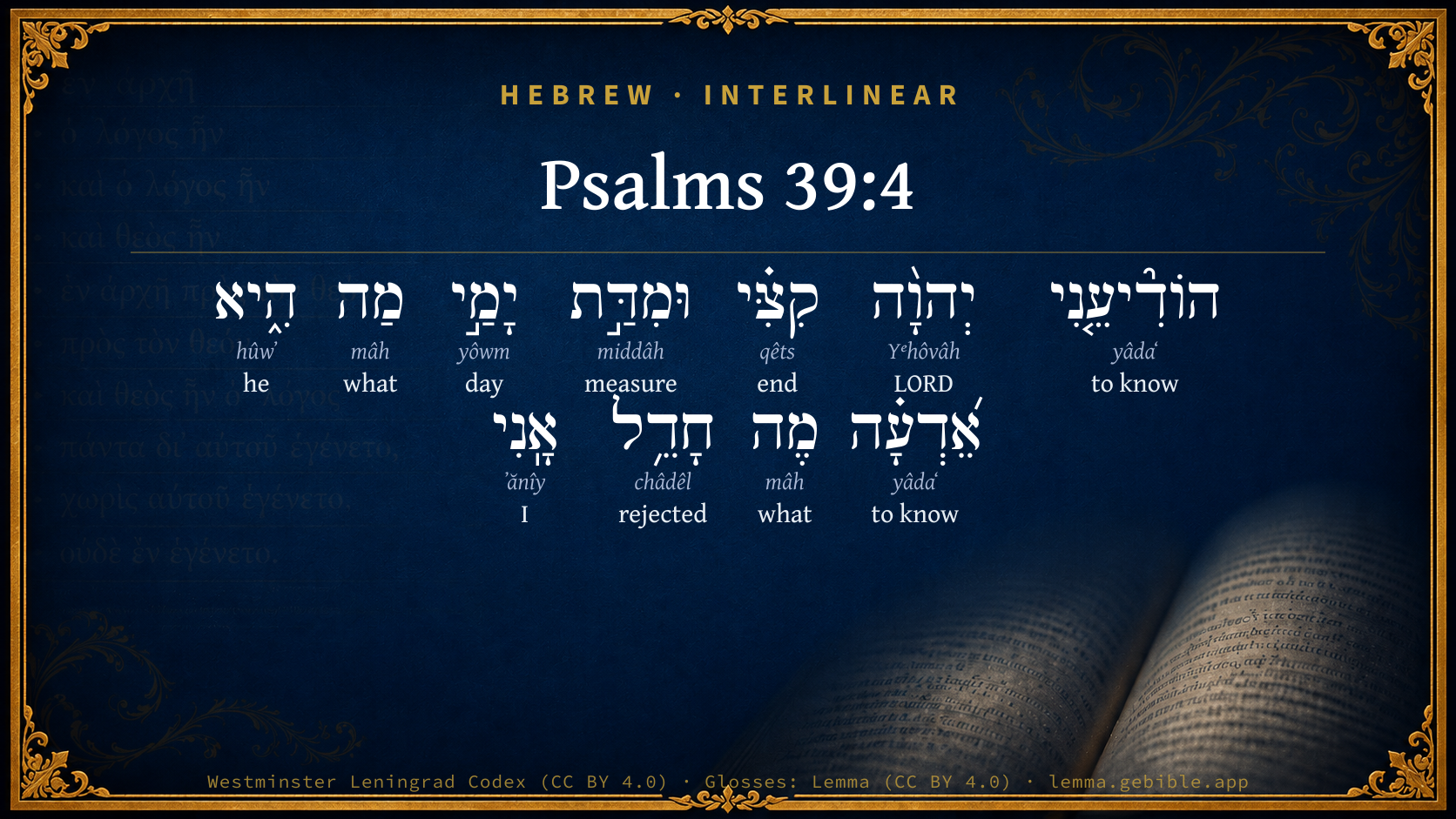
Hebrew (Westminster Leningrad Codex) Psalms 39:4 appears in the Hebrew Old Testament. The text above is from the Westminster Leningrad Codex. Each word links to its Strong’s number, a concise gloss, and parsing drawn from the Open Scriptures Hebrew Bible morphology. Click any word for its full Brown-Driver-Briggs (BDB) entry.
Download image
Cite this verse

Psalms 39:4 (World English Bible). Public Domain. Lemma interlinear Bible study tool, https://lemma.gebible.app/v/psalms/39/4.

Show BibTeX & RIS
BibTeX
RIS
English Translation
"Yahweh, show me my end, What is the measure of my days. Let me know how frail I am.
World English Bible · Public Domain
Highlights
  • 1 first appearance in the Hebrew Bible
Full analysis ↓
Download a study sheet

One document with this verse’s original text, its word-by-word gloss line, the meaning frame, cross-references with their text, attributed commentary, and full source and license credits — printable, and it pastes into notes with its structure intact.

This verse Autodidact and up

Study sheet (.html) Plain text (.txt)

A passage Seminary Student

Up to 50 verses in one chapter. A passage sheet keeps up to 6 commentary sources and 12 cross-references per verse, in the order this page ranks them, and says so on the sheet whenever that leaves anything out. Ask for a single verse and you get the Autodidact verse sheet above.

Everything on this page stays free to read, with no account — the sheet is a download of what is already on screen, not access to it.

Want to remove ads? Support Godless Engineer
Compare translations 3

The same verse in 3 English versions, stacked beneath the original-language interlinear above. Click any original word for its lexicon entry.

Each is an independent rendering of the whole verse — the interlinear is not word-aligned to these translations.

Highlighted words mark where these versions differ — a whole-verse word diff, not a word-by-word alignment.

  • World English Bible Public Domain
    "Yahweh, show me my end, What is the measure of my days. Let me know how frail I am.
  • King James Version Public Domain
    LORD, make me to know mine end, and the measure of my days, what it is: that I may know how frail I am.
  • unfoldingWord Literal Text CC BY-SA 4.0
    “Make me know my end, Yahweh, and the measure of my days, what it. May I know how transient I

unfoldingWord Literal Text — © unfoldingWord, licensed CC BY-SA 4.0. Word-aligned USFM3 via Door43 (git.door43.org/unfoldingWord/en_ult).

Versions to compare (up to 4)

3 of 4 selected

Show all 18 translations

Every available English version of this verse, each an independent rendering of the whole verse.

  • World English Bible Public Domain
    "Yahweh, show me my end, What is the measure of my days. Let me know how frail I am.
  • Berean Standard Bible Public Domain
    “Show me, O LORD, my end and the measure of my days. Let me know how fleeting my life is.
  • Majority Standard Bible Public Domain
    “Show me, O LORD, my end and the measure of my days. Let me know how fleeting my life is.
  • King James Version Public Domain
    LORD, make me to know mine end, and the measure of my days, what it is: that I may know how frail I am.
  • American Standard Version (1901) Public Domain
    Jehovah, make me to know mine end, And the measure of my days, what it is; Let me know how frail I am.
  • Revised Version (1885) Public Domain
    LORD, make me to know mine end, and the measure of my days, what it is; let me know how frail I am.
  • Geneva Bible (1599) Public Domain
    Lord, let me know mine ende, and the measure of my dayes, what it is: let mee knowe howe long I haue to liue.
  • Douay-Rheims (1899) Public Domain
    My heart grew hot within me: and in my meditation a fire shall flame out.
  • Young's Literal Translation Public Domain
    `Cause me to know, O Jehovah, mine end, And the measure of my days -- what it `is',' I know how frail I `am'.
  • Literal Standard Version CC BY-SA 4.0
    “Cause me to know, O YHWH, my end, || And the measure of my days—what it [is],” || I know how frail I [am].
  • Unlocked Literal Bible CC BY-SA 4.0
    “Yahweh, make me know when will be the end of my life and the extent of my days. Show me how transient I am.
  • unfoldingWord Literal Text CC BY-SA 4.0
    “Make me know my end, Yahweh, and the measure of my days, what it. May I know how transient I
  • Darby Bible Public Domain
    Make me to know, Jehovah, mine end, and the measure of my days, what it is: I shall know how frail I am.
  • World Messianic Bible Public Domain
    “LORD, show me my end, what is the measure of my days. Let me know how frail I am.
  • Webster's Bible Public Domain
    \\39:3\\My heart was hot within me, while I was musing the fire burned: then I spoke with my tongue.
  • Free Bible Version CC BY-SA 4.0
    Lord, remind me. How short is my life? How long do I have? Remind me how quickly my life will pass.
  • Bible in Basic English Public Domain
    Lord, give me knowledge of my end, and of the measure of my days, so that I may see how feeble I am.
  • JPS Tanakh (1917) Public Domain
    (39-5) 'LORD, make me to know mine end, and the measure of my days, what it is; let me know how short-lived I am.

Literal Standard Version (2020), Covenant Press — licensed CC BY-SA 4.0. Text via the HelloAO Bible API (eBible.org). Unlocked Literal Bible (unfoldingWord) — licensed CC BY-SA 4.0. Text via the HelloAO Bible API (eBible.org). unfoldingWord Literal Text — © unfoldingWord, licensed CC BY-SA 4.0. Word-aligned USFM3 via Door43 (git.door43.org/unfoldingWord/en_ult). Free Bible Version, Dr. Jonathan Gallagher — licensed CC BY-SA 4.0. Text via the HelloAO Bible API (eBible.org).

Word by word

More ways to search: Search by grammar → Find every occurrence → Compare this word →

Practice this passage: Drill this verse → Learn its vocabulary →

חָדֵ֥ל
châdêl
H2310
“rejected”
Adjective, Adjective, Masculine, Singular, Absolute
Part of Speech
Adjective
Type
Adjective
Gender
Masculine
Number
Singular
State
Absolute
Full BDB Definition

Origin: from H2308

TWOT: 609b

rejected, forbearing, transient, fleeting, lacking
  1. הוֹדִ֘יעֵ֤נִי yâdaʻ H3045 “know · me” Verb, Hiphil, Imperative, 2nd Person, Masculine, Singular + Suffix, Personal, 1st Person, Common, Singular
  2. יְהוָ֨ה Yᵉhôvâh H3068 “LORD” Noun, Proper
  3. קִצִּ֗י qêts H7093 “end · my” Noun, Common, Masculine, Singular, Construct + Suffix, Personal, 1st Person, Common, Singular
  4. וּמִדַּ֣ת middâh H4060 “and · measure of” Conjunction + Noun, Common, Feminine, Singular, Construct
  5. יָמַ֣י yôwm H3117 “days · my” Noun, Common, Masculine, Plural, Construct + Suffix, Personal, 1st Person, Common, Singular
  6. מַה mâh H4100 “what” Particle, Interrogative
  7. הִ֑יא hûwʼ H1931 “he” Pronoun, Personal, 3rd Person, Feminine, Singular
  8. אֵ֝דְעָ֗ה yâdaʻ H3045 “to know” Verb, Qal, Cohortative, 1st Person, Common, Singular
  9. מֶה mâh H4100 “what” Particle, Interrogative
  10. אָֽנִי ʼănîy H589 “I” Pronoun, Personal, 1st Person, Common, Singular

About this verse

These counts appear in no published source. They are computed here, from the morphology-tagged text and Lemma’s own curated glosses. What Lemma adds →

11
words
9
distinct lemmas
Wisdom
section

Notable vocabulary

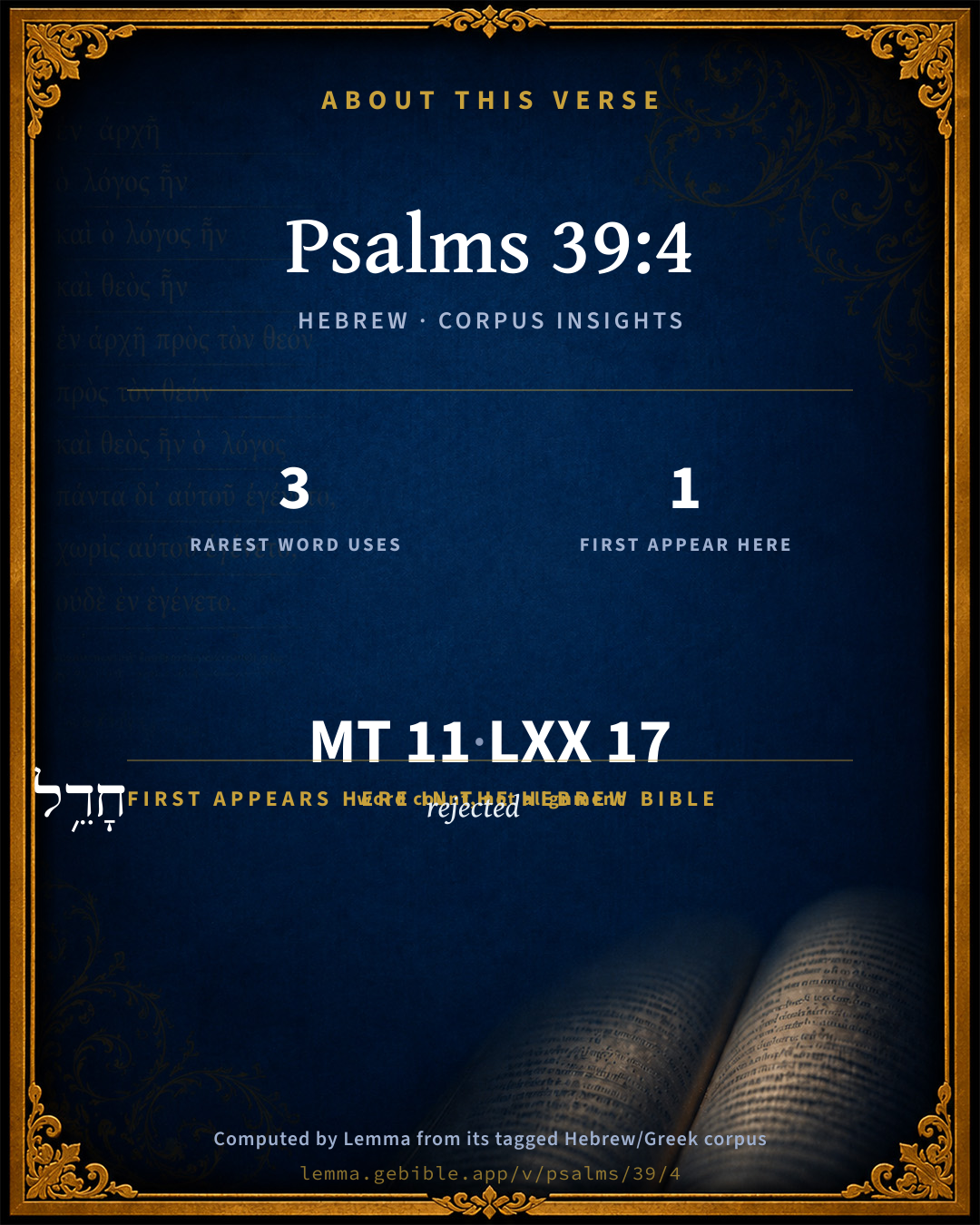
The rarest word here is חָדֵ֥ל rejected H2310 — appearing just 3 times in the whole Hebrew Bible.

First appearance in Scripture

This word makes its first canonical appearance in the Hebrew Bible here:

  • חָדֵ֥ל rejected H2310

Shared distinctive vocabulary

חָדֵ֥ל rejected H2310 occurs in 3 verses of the Hebrew Bible. Also found in:

Grammatical profile

  • 2 verbs
  • 4 nouns
  • 1 adjective
  • 2 pronouns
  • 2 particles

Verb forms

  • הוֹדִ֘יעֵ֤נִי Hiphil · Imperative
  • אֵ֝דְעָ֗ה Qal · Cohortative

Repetition

Words recur within this verse — often emphatic in Hebrew:

  • הוֹדִ֘יעֵ֤נִי to know H3045 ×2
  • מַה what H4100 ×2

Hebrew & Septuagint length

In English translation the verse runs 19 words from the Hebrew and 24 from the Septuagint (LXX English) — closely comparable.

A rough comparison of the two English renderings, which tokenize alike — not a word-level alignment.

Word counts can differ between the Hebrew and the Greek without any difference in meaning — e.g. the Hebrew direct-object marker אֵת has no separate Greek word, and Greek often adds the article ὁ.

In the original languages it is 11 Hebrew tokens and 17 Greek tokens — but the two are counted differently (Hebrew bundles its prefixes and suffixes into one token; the Greek is in lemma form), so that isn’t a like-for-like length.

Cross-references

4

Topical passages linked to Psalms 39:4 in the Treasury of Scripture Knowledge — connected by theme and wording, ordered by reader-vote popularity; previews shown in the World English Bible.

  • Psalms 90:12 So teach us to number our days, That we may gain a heart of wisdom.
  • Psalms 103:14 For he knows how we are made. He remembers that we are dust.
  • Job 14:13 "Oh that you would hide me in Sheol, That you would keep me secret, until your wrath is past, That you would appoint me a set time, and remember me!
  • Psalms 119:84 How many are the days of your servant? When will you execute judgment on those who persecute me?

Cross-references courtesy of OpenBible.info (CC BY 4.0).

Hebrew and Greek witnesses Masoretic Hebrew ↔ Greek Septuagint

The same verse in the two great witnesses to the Old Testament, shown verse-for-verse.

You’re reading Greek Psalm 38 (Hebrew Psalm 39). The Septuagint counts the superscription, so verse numbers can differ from the Hebrew — chapter-level alignment, not verse-by-verse. Numbering follows Rahlfs.

These are two independent witnesses, not word-aligned to each other, and the Septuagint is shown in lemma (dictionary) form.

Hebrew Psalms 39:4 Masoretic · Westminster Leningrad Codex

הוֹדִ֘יעֵ֤נִי יְהוָ֨ה קִצִּ֗י וּמִדַּ֣ת יָמַ֣י מַה הִ֑יא אֵ֝דְעָ֗ה מֶה חָדֵ֥ל אָֽנִי

"Yahweh, show me my end, What is the measure of my days. Let me know how frail I am.

World English Bible · Public Domain

Greek LXX Greek Psalm 38:4 Septuagint · lemma form

θερμαίνω ὁ καρδία ἐγώ ἐντός ἐγώ καί ἐν ὁ μελέτη ἐγώ ἐκκαίω πῦρ λαλέω ἐν γλῶσσα ἐγώ

O Lord, make me to know my end, and the number of my days, what it is; that I may know what I lack.

LXX2012 (modern English Septuagint) · Public Domain

On this verse, Ellicott's Commentary for English Readers discusses the Septuagint’s reading. Read the note in Commentary ↓

Hebrew: Westminster Leningrad Codex (CC BY 4.0). Greek: Septuagint (public domain); English from LXX2012 (modern English Septuagint) (Public Domain). How the Septuagint differs from the Hebrew →

Commentary

Notes on Psalms 39:4 from classic Christian and Jewish commentators (each source and its license shown beneath its notes). The classic Christian expositions comment on the surrounding passage and are grouped to its opening verse, so a note may address several verses; the Jewish commentaries on the Tanakh (Rashi and others) are per-verse, so they appear only where the commentator wrote on this verse.

Lemma curates 59 commentaries, every one of them public domain or Creative Commons licensed, each selected and text-cleaned for this edition rather than reprinted as found. About our sources →

Trapp's Complete Commentary

John Trapp

Psa 39:4 LORD, make me to know mine end, and the measure of my days, what it [is; that] I may know how frail I [am].

Ver. 4. Lord, make me to know mine end] This Austin expoundeth of heaven, the end of all his troubles, which he now sighed after. But Vatablus, Calvin, and most modern interpreters conceive that David doth here ingenuously confess that he grudged against God; considering the greatness of his grief and the shortness of his life.

And the measure of my days] An ad malorum quae perfero compensationem sufficiant, whether they are likely to be enough to make me amends for nay grievous sufferings. This he seemeth to speak either out of impatience, or curiosity, at least.

That I may know how frail I am] How soon ceasing and short lived. Quam durabilis sum (Trem.). Vatablus hath it, quam mundanus sim, how long I am like to be a man of this world, this vale of misery and valley of tears.

John Trapp, A Commentary or Exposition upon All the Books of the Old and New Testament (1647–1656) — public domain. Text from a community e-Sword module.

The Biblical Illustrator

Joseph S. Exell

Psa_39:4

My heart was but within me; while I was musing, the fire burned: then spake I with my tongue, Lord, make me to know mine end, and the measure of my days, what it is, that I may know how frail I am.

A sense of our frailty a subject for prayer

Bishop Horsley says that David, moved by a godly contrition, pours forth this prayer, that he might know his end and the measure of his days.

I. Why should contrition lead to such a prayer? David speaks not of forgiveness, though that is what the contrite heart first asks for. But he does not here pray even for this. Apparently he does not, but really he does. For the prayer to be taught how frail we are, is virtually a prayer that we may be made holier, more averse from sin, and more devoted to the great end of our being. That it is this is shown--

1. By the fact that the interval between the evil work and the execution of the sentence against it causes the hearts of men to be steadfastly set in them to do evil. If penalty followed immediately on crime, men would not dare to sin as now they fearlessly do. They trust themselves to the hope that delay in punishment ever inspires. There is a sort of unacknowledged idea that what is protracted and indefinite will never take effect. A thousand things may intervene to prevent execution.

2. Or there is at work another, and not wholly different feeling. It is confessed that sin must be repented and forsaken, seeing that otherwise there will come a fearful retribution hereafter; but it is imagined that life will yet afford many opportunities, so that it is safe, or at least not imminently dangerous, to persist a while longer in criminal indulgence, which keeps up the sinner in this his procrastination. If you could practically overthrow this his theory, and substitute for it the persuasion, that in the midst of life he is in death, he would be almost compelled, by his felt exposure to danger, to make provision for the coming eternity, on the threshold of which he may be at any moment standing, and which may be upon him, in its awfulness and unchangeableness, ere he draw another breath. How many still believe the ancient lie with which the tempter deceived Eve, Ye shall not surely die. How few live as strangers and pilgrims here on earth. Instead of that there is a great settling themselves down, as if earth were their home; a slackness in religious duties, as if there were no great cause for diligence; a deferring of many sacrifices and performances, as though the case were not urgent; and this, too, where the parties not only avouch themselves careful for the soul, but are clearly to be distinguished from the great mass around them, by a general endeavour to do the will of their God. And what should we say is needed, in order to the correcting these errors and inconsistencies? What, at least, would be a mighty engine in producing greater steadfastness in the righteous, greater abstraction from earth, greater devotedness to religion? We reply without hesitation--a deep conviction of the uncertainty of life. Had men such conviction they could not live, as now they do, so entangled in the world, so eager in its service. It would warn him back from the inordinate pursuit of earthly things.

II. But note the petition itself. What a curious fact it is that such a petition should be offered unto God. Its terms are explicit enough, at least there can be little doubt as to its drift. He does not mean that God should show him the exact measure of his days and the precise number of them tie had yet to live. Such a petition would be unlawful, for it would be an intrusion into those secret things which belong only unto God. But that which the psalmist seeks to know is, the frailty of his life. This is the drift and scope of the petition, that he may have an abiding sense of the shortness and uncertainty of life. Now, is it not strange that such a prayer should be offered? I do not ask God to make me know that such and such substances are poisonous when all example testifies that they are; or that the weather is variable, when I have such continual proof of it. I do not pray to know anything, which I know indubitably from books, or testimony, or observation. Why, then, pray to be made to know how frail I am? It seems like praying to be made to know that the sun rises and sets; that storms may suddenly overcast the sky, or that any other thing may happen which we already know is wont to happen. And yet David, who was as little likely as we are to shut his eyes to well-known truths--he offers up this prayer, Lord, make me to know mine end, etc. I cannot but draw a lesson from this for ones own ministerial guidance in the discharge of the ministerial office. If there is one thing more than another I would desire to have impressed on all classes of my hearers, it is the simple, self-evident, universally confessed truth, that they are frail beings liable at any moment to death, and certain at no very distant time to be removed to another, even to an invisible world. I have already shown you that there is little needed, beyond the abiding consciousness of this truth, to produce in those who have hitherto neglected religion, an earnest heedfulness to the things of eternity; and in others, who have devoted themselves to God, an increased and increasing diligence in the culture of personal holiness. So that it will naturally be one great aim of the minister to gain power for the truth of the uncertainty of life; to withdraw it from the mass of facts, which are acknowledged rather than felt, and to place it amongst those which influence the conduct. How is tie to proceed in the accomplishment of this aim? You know very well what is ordinarily tried; and if reason sit in judgment on the matter, it might possibly pronounce it best fitted to succeed. There are arrayed all the affecting evidences that can be gathered together of human frailty. But, however fair and admirable in theory, is this course practically effective when the fact of which we desire to produce conviction is the uncertainty of life? Alas! no. The universal testimony from ministerial experience, is that a well wrought sermon on the frailty of life is commonly ineffectual to the making men on the watch for the approaches of death. Here it is that our text comes in with a great lesson. It does but echo this result of ministerial experience. The psalmist prays to be made to know his frailty; as though quite aware that meditation and observation would never bring it home to him, notwithstanding that it seemed impossible for him to shut his eyes to the fact. And if it be a thing for prayer, it is evident enough that all meditations amongst the tombs, and all musings over the dead, will be practically of no avail, except as they bring men to their knees. Here, then, is the great lesson which, as a minister, [ gather from the text. I wish to impress on you your frailty, and entreat you to let this be part of your daily prayer to the Almighty--Make me to know mine end, and the measure of my days, what it is; that I may know how frail I am. (Henry Melvill, B. D.)

Reflections for the New Year

I. That human life must terminate. The knowledge and belief that our times are in Gods hand have a powerful influence in making us humble, self-denied, watchful and holy. The return of day and night, the revolution of the heavenly bodies, the beating of our hearts, the circulation of the blood, every clock in our chamber, and every watch we carry, all proclaim the affecting truth, that our days are hastening to an end.

II. That the measure of our days is determined by God. The sovereignty of the Most High is eminently discovered in the various admeasurements of human life.

III. That the knowledge of our end, and of the measure, of our days is of great practical utility in the Christian life. That I may know how frail I am.

IV. That God alone can teach us the end, the measure, and the value of the present life. Lord, make me to know mine end, etc. This is a lesson which the wisdom of men cannot teach. We bear, we confess the general truth that all must die; but we act as if it were not true, as if it never were to be interpreted of ourselves I But when God teaches us our end, He inspires us with other views. No person can be indifferent to death and mortality when God is his teacher. (Christian Magazine.)

Make me to know mine end

From this prayer it would appear that men are prone to forget their end. Why do men forget their last end?

I. Negatively.

1. Not because there can be any doubt as to its importance. What a momentous event is death! The termination of our earthly connection, and our introduction into a state, mysterious, retributive, probably unalterable.

2. Not because men have no reminders of it. If you see a painting, the artist is in his grave--a book, the author is no more--a portrait, the subject is gone to dust.

3. Not because there is the slightest hope of avoiding it. It is appointed unto all men once to die.

II. Positively.

1. An instinctive repugnance to it. All men dread 2:2. The difficulty of realizing it. We cannot possibly know what it is to die. It is a knowledge that can only be got by experience.

3. The commonness of the occurrence. If only a few in a whole country died in the course of a year, and one or two in our neighbourhood, the strangeness might affect us.

4. The general hope of longevity.

5. The soul engrossing power of worldly things. What shall we eat, what shall we drink, wherewithal shall we be clothed? This is the all absorbing question. But why should men consider their latter end?

(1) To moderate their attachment to earthly things.

(2) To stimulate preparation for a higher state.

(3) To enable us to welcome it when it comes. (Homilist.)

Brief life is here our portion

Some see a kind of pettishness in this verse, the fruit of impatience under the chastening hand of God. But it is not for us to upbraid the psalmist, for what is his impatience compared to ours? David prays, Make me to know mine end. But was his frailty a secret that he could not discover? We may be sure that he knew it in part, but he wanted to know it after a more perfect way; with that spiritual enlightenment which God alone could communicate. Thus he would know--

I. His end. Do we know this?

1. Its certainty. I must die. There is no discharge in that war. Is that fact realized by us?

2. It will be our end. Not a halt, but a finale. Mine end for all things beneath the sun--sin, sorrow, service, opportunity for doing and getting good. Think of the accompaniments of our end, the last scenes here in which we shall take part. Picture it all to your minds so far as you can. Rehearse it so far as you may. And think of its results. Then it is that though we end here, we enter on the most solemn part of our existence. Whither wilt thou go? To be with Christ, or amongst the lost--which? We need to be made to know our end, made to believe in it firmly, realize it vividly, so as to be prepared for it whenever it comes.

II. The measure of his days. It is only the days of God that cannot be counted. Ours can, as poor men count their sheep, because they are so few. But the fact that man is sinful makes it blessed that his days should be few. Would we have a Voltaire for ever stalking about this world, or such as he? Let us measure our days so as not to waste them.

III. His frailty. We are like travellers on a road across which there is a deep gulf. Some know it, but most forget it. Those in the front ranks fall into it, and the others will, but as yet they think not of it. So we all go on until we come to that fatal step which will plunge us into eternity. (C. H. Spurgeon.)

The Biblical Illustrator, edited by Joseph S. Exell (c. 1880s–1900s) — public domain. Text from a community e-Sword module.

Joseph Benson's Commentary

Psa 39:4. Lord, make me to know mine end — The end of my life, as is evident from the following words; and the measure of my days, what it is — How short it is; or, how near is the period of the days of my life; that I may know how frail I am — Hebrew, מה חדל אני, meh-chadeel ani, quam desinens sire, quam cito desinam esse, quam parum durem, what a transient, momentary being I am, how soon I shall cease to be, how little a while I shall continue, namely, on earth. He does not mean, Lord, let me know exactly how long I shall live, and when I shall die. He could not in faith ask this, God having nowhere promised his people such knowledge, but having in wisdom locked it up among the secret things which belong not to us, and which it would not be good for us to know; but his meaning is, Give me wisdom and grace to consider my end, and how short the measure of my days will be, and to improve what I know concerning it. The living know they shall die, but few so reflect on this as to make a right use of this knowledge. Bishop Patrick thus paraphrases his words: “Lord, I do not murmur nor repine at my sufferings; but that I may be able to bear them still patiently, make me sensible, I humbly beseech thee, how short this frail life is, and how soon it will have an end; that, duly considering this, I may be the less concerned about the miseries I endure, which will end together with it.” Thus, “wearied with the contradiction of sinners, and sickening at the prospect of so much wretchedness in the valley of weeping, the soul” of the pious Christian “looks forward to her departure from hence, praying for such a sense of the shortness of human life as may enable her to bear the sorrows of this world, and excite her to prepare for the joys of a better.”

Joseph Benson's Commentary on the Old and New Testaments (1811–1818) — public domain. Text from a community e-Sword module.

J. A. Alexander on Psalms

Joseph Addison Alexander

5. (Psa 39:4). (O) Jehovah, my end, and the measure of my days, what it is; let me know when I shall cease. According to thMake me to know, e view already taken of the first part of the psalm, this is not a prayer to be made duly sensible of the brevity of life, which would have been superfluous, but an impatient wish to know how soon its sufferings are to cease. The same sentiment is amplified in Job 6:8-12; Job 7:7; Job 14:13; Job 16:21-22. The last clause may also be translated, let me know how ceasing, i.e. frail or short-lived, I (am). But the general drift of the passage favours the construction, let me know (at) what (point), or (at) what (time) I (am) ceasing, or about to cease. The indefinite pronoun until what (point), until when, how long? The verbal adjective, as in other cases, is only a less usual participial form.

Joseph Addison Alexander, The Psalms Translated and Explained (1850) — public domain. Text from a community e-Sword module.

Tyndale Open Study Notes

Tyndale Open Resources

39:4-6 Because of his suffering and sin, the psalmist concludes that life is meaningless and fleeting (see Job 7:7-10; Isa 40:6-8). He had expected a wicked life to have those qualities (see Pss 37:2, 20; 103:15-16), but now whether a person is godly or not seems to be irrelevant.

39:4-5 how fleeting my life is: This perspective comes out of suffering (see 78:39; 89:47-48; 90:3-10). The human lifetime is but a moment to God (90:4), as temporary as a breath (see 39:11; 144:4).

Tyndale Open Study Notes — © Tyndale Open Resources, licensed CC BY-SA 4.0. Text via the HelloAO Bible API.

Jamieson, Fausset & Brown

Robert Jamieson, A. R. Fausset & David Brown

Some take these words as those of fretting, but they are not essentially such. The tinge of discontent arises from the character of his suppressed emotions. But, addressing God, they are softened and subdued.

make me to know mine end--experimentally appreciate.

how frail I am--literally, "when I shall cease."

Jamieson, Fausset & Brown — Commentary Critical and Explanatory on the Whole Bible (1871) — public domain (CC PDM 1.0). Text via the HelloAO Bible API.

Adam Clarke's Commentary

Verse 4. Lord, make me to know mine end] I am weary of life; I wish to know the measure of my days, that I may see how long I have to suffer, and how frail I am. I wish to know what is wanting to make up the number of the days I have to live.

Adam Clarke's Commentary on the Bible (1810–1826) — public domain. Text from a community e-Sword/MySword module.

John Calvin's Commentaries

4. O Jehovah! cause me to know my end. It appears from this, that David was transported by an improper and sinful excess of passion, seeing he finds fault with God. This will appear still more clearly from the following verses. It is true, indeed, that in what follows he introduces pious and becoming prayers, but here he complains, that, being a mortal man, whose life is frail and transitory, he is not treated more mildly by God. Of this, and similar complaints, the discourses of Job are almost full. It is, therefore, not without anger and resentment that David speaks in this manner: “O God, since thou art acting with so much severity towards me, at least make me to know how long thou hast appointed me to live. But is it so, that my life is but a moment, why then dost thou act with so great rigour? and why dost thou accumulate upon my head such a load of miseries, as if I had yet many ages to live? What does it profit me to have been born, if I must pass the period of my existence, which is so brief, in misery, and oppressed with a continued succession of calamities?”

Accordingly, this verse should be read in connection with the following one. Behold, thou hast made my days as a hand-breadth. A hand-breadth is the measure of four fingers, and is here taken for a very small measure; as if it had been said, the life of man flies swiftly away, and the end of it, as it were, touches the beginning. Hence the Psalmist concludes that all men are only vanity before God. As to the meaning of the words, he does not ask that the brevity of human life should be shown to him, as if he knew it not. There is in this language a kind of irony, as if he had said, Let us count the number of the years which still remain to me on earth, and will they be a sufficient recompense for the miseries which I endure? Some render the word חדל, chedel, mundane; and others temporal, that is to say, that which endures only for a time. But the latter rendering is not appropriate in this place: for David does not as yet expressly declare the shortness of his life, but continues to speak on that subject ambiguously. If the word mundane is adopted, the sense will be, Show me whether thou wilt prolong my life to the end of the world. But in my judgment, the translation which I have followed is much more appropriate; and, besides, there may have been a transposition of the letters ד, daleth, and ל, lamed, making the word chedel for cheled. It may, however, very properly be taken for an age or period of life. When he says that his age is, as it were, nothing before God, in order to excite God so much the more to pity and compassion, he appeals to him as a witness of his frailty, intimating, that it is not a thing unknown to him how transitory and passing the life of man is. The expression, wholly or altogether vanity, implies that among the whole human race there is nothing but vanity. He declares this of men, even whilst they are standing; that is to say, when, being in the prime and vigor of life, they wish to be held in estimation, and seem to themselves to be men possessed of considerable influence and power. It was the pangs of sorrow which forced David to give utterance to these complaints; but it is to be observed, that it is chiefly when men are sore oppressed by adversity that they are made to feel their nothingness in the sight of God. Prosperity so intoxicates them, that, forgetful of their condition, and sunk in insensibility, they dream of an immortal state on earth. It is very profitable for us to know our own frailty, but we must beware lest, on account of it, we fall into such a state of sorrow as may lead us to murmur and repine. David speaks truly and wisely in declaring, that man, even when he seems to have risen to the highest state of greatness, is only like the bubble which rises upon the water, blown up by the wind; but he is in fault when he takes occasion from this to complain of God. Let us, therefore, so feel the misery of our present condition, as that, however cast down and afflicted, we may, as humble suppliants, lift up our eyes to God, and implore his mercy. This we find David does a little after, having corrected himself; for he does not continue to indulge in rash and inconsiderate lamentations, but lifting up his soul in the exercise of faith, he attains heavenly consolation.

John Calvin's Commentaries (1540-1563) — public domain. Text from the Calvin Translation Society English edition (1840s-50s) via the Christian Classics Ethereal Library (ccel.org). Calvin's coverage is partial (roughly two-thirds of the Bible); uncommented books and verses are honest gaps, never fabricated. The 19th-century editor's footnotes and remarks are omitted so the notes are faithfully Calvin's own voice.

Ellicott's Commentary for English Readers

(4) Rhythmically and from every other reason the psalm onward from this verse must be treated as the utterance to which the poet’s feelings have at length driven him.

How frail I am.—This is to be preferred to the margin, which follows the LXX. and Vulg. The Hebrew word, from a root meaning to “leave off,” though in Isa_53:3 it means “forsaken,” here, as in Eze_3:27, is active, and implies “ceasing to live.”

A Bible Commentary for English Readers, edited by Charles John Ellicott (1878–1897) — public domain. Text from a community e-Sword module.

The Cambridge Bible for Schools and Colleges

gen. ed. J. J. S. Perowne

4. His prayer is not that he may know how much of life is left him; as the P.B.V. that I may be certified how long I have to live, paraphrasing the LXX. ἵνα γνῶ τί ὑστερῶ ἐγώ: ut sciam quid desit mihi, Vulg.: but that he may realise how surely life must end, and how brief it must be at best. What it is = how short it is.

that I may know] Better, as R.V., let me know. Frail, lit, ceasing, transitory.

4–6. Silence has proved impossible. He must give vent to his emotions, and he breaks out into a prayer that he may be taught so to understand the frailty of his life and the vanity of human aims, that he may be led back from selfish, envious, murmuring thoughts, to rest in submission to God’s will. Cp. Psa_90:12.

The Cambridge Bible for Schools and Colleges (gen. ed. J. J. S. Perowne; Cambridge University Press, 1878–1918) — public domain. Text from a community e-Sword module.

John Gill's Exposition

Lord, make me to know mine end,.... Not Christ, the end of the law for righteousness, as Jerom interprets it; nor how long he should live, how many days, months, and years more; for though they are known of God, they are not to be known by men; but either the end of his afflictions, or his, latter end, his mortal state, that he might be more thoughtful of that, and so less concerned about worldly things, his own external happiness, or that of others; or rather his death; see Job 6:11; and his sense is, that he might know death experimentally; or that he might die: this he said in a sinful passionate way, as impatient of his afflictions and exercises; and in the same way the following expressions are to be understood;

and the measure of my days, what it is; being desirous to come to the end of it; otherwise he knew it was but as an hand's breadth, as he says in Psa 39:5;

that I may know how frail I am; or "what time I have here"; or "when I shall cease to be" (u); or, as the Targum is, "when I shall cease from the world"; so common it is for the saints themselves, in an angry or impatient fit, to desire death; see Job 7:15; and a very rare and difficult thing it is to wish for it from right principles, and with right views, as the Apostle Paul did, Phi 1:23.

(u) "quanti aevi ego", Montanus; "quamdiu roundanus ero", Vatablus; "quam brevis temporis sim", Musculus.

John Gill's Exposition of the Whole Bible (1746–1763) — public domain (CC PDM 1.0). Text via the HelloAO Bible API.

Albert Barnes' Notes on the Bible

Lord, make me to know mine end - This expresses evidently the substance of those anxious and troubled thoughts Psa 39:1-2 to which he had been unwilling to give utterance. His thoughts turned on the shortness of life; on the mystery of the divine arrangement by which it had been made so short; and on the fact that so many troubles and sorrows had been crowded into a life so frail and so soon to terminate. With some impatience, and with a consciousness that he had been indulging feelings on this subject which were not proper, and which would do injury if they were expressed “before men,” he now pours out these feelings before God, and asks what is to be the end of this; how long this is to continue; when his own sorrows will cease. It was an impatient desire to know when the end would be, with a spirit of insubmission to the arrangements of Providence by which his life had been made so brief, and by which so much suffering had been appointed.

And the measure of my days, what it is - How long I am to live; how long I am to bear these accumulated sorrows.

That I may know how frail I am - Margin: “What time I have here.” Prof. Alexander renders this: “when I shall cease.” So DeWette. The Hebrew word used here - חדל châdêl - means “ceasing to be;” hence, “frail;” then, destitute, left, forsaken. An exact translation would be, “that I may know at what (time) or (point) I am ceasing, or about to cease.” It is equivalent to a prayer that he might know when these sufferings - when a life so full of sorrow - would come to an end. The language is an expression of impatience; the utterance of a feeling which the psalmist knew was not right in itself, and which would do injury if expressed before men, but which the intensity of his feelings would not permit him to restrain, and to which he, therefore, gives utterance before God. Similar expressions of impatience in view of the sufferings of a life so short as this, and with so little to alleviate its sorrows, may be seen much amplified in Job 3:1-26; Job 6:4-12; Job 7:7; Job 14:1-13. Before we blame the sacred writers for the indulgence of these feelings, let us carefully examine our own hearts, and recall what has passed through our own minds in view of the mysteries of the divine administration; and let us remember that one great object of the Bible is to record the actual feelings of men - not to vindicate them, but to show what human nature is even in the best circumstances, and what the human heart is when as yet but partially sanctified.

Albert Barnes' Notes on the Bible (1834–1885) — public domain. Text from a community e-Sword/MySword module.

Matthew Poole's English Annotations

This verse contains either,

1. A correction of himself for his impatient motions or speeches, and his retirement to God for relief under these perplexing and sadding thoughts. Or,

2. A declaration of the words which he spake.

Make me to know; either,

1. Practically, so as to prepare for it. Or,

2. Experimentally, as words of knowledge are oft used. And so this is a secret desire of death, that he might be free from such torments as made his life a burden to him. Or,

3. By revelation; that I may have some prospect or foreknowledge when my calamities will be ended; which argued impatience, and an unwillingness to wait long for deliverance.

My end, i.e. the end of my life, as is evident from the following words.

What it is; how long or short it is, or the utmost extent or period of the days of my life.

How frail I am; or, how long (or, how little, for the word may be and is by divers interpreters taken both ways) time I have or shall continue here.

Matthew Poole's English Annotations on the Holy Bible (1683–1685) — public domain. Text from a community e-Sword/MySword module.

The Treasury of David

Charles H. Spurgeon

Ver. 4. Lord. It is well that the vent of his soul was toward God and not towards man. Oh! if my swelling heart must speak, Lord let it speak with thee; even if there be too much of natural heat in what I say, thou wilt be more patient with me than man, and upon thy purity it can cast no stain; whereas if I speak to my fellows, they may harshly rebuke me or else learn evil from my petulance. Make me to know mine end. Did he mean the same as Elias in his agony, "Let me die, I am no better than my father"? Perhaps so. At any rate, he rashly and petulantly desired to know the end of his wretched life, that he might begin to reckon the days till death should put a finish to his woe. Impatience would pry between the folded leaves. As if there were no other comfort to be had, unbelief would fain hide itself in the grave and sleep itself into oblivion. David was neither the first nor the last who have spoken unadvisedly in prayer. Yet, there is a better meaning: the psalmist would know more of the shortness of life, that he might better bear its transient ills, and herein we may safely kneel with him, uttering the same petition. That there is no end to its misery is the hell of hell; that there is an end to life's sorrow is the hope of all who have a hope beyond the grave. God is the best teacher of the divine philosophy which looks for an expected end. They who see death through the Lord's glass, see a fair sight, which makes them forget the evil of life in foreseeing the end of life. And the measure of my days. David would fain be assured that his days would be soon over and his trials with them; he would be taught anew that life is measured out to us by wisdom, and is not a matter of chance. As the trader measures his cloth by inches, and ells, and yards, so with scrupulous accuracy is life measured out to man. That I may know how frail I am, or when I shall cease to be. Alas! poor human nature, dear as life is, man quarrels with God at such a rate that he would sooner cease to be than bear the Lord's appointment. Such pettishness in a saint! Let us wait till we are in a like position, and we shall do no better. The ship on the stocks wonders that the barque springs a leak, but when it has tried the high seas, it marvels that its timbers hold together in such storms. David's case is not recorded for our imitation, but for our learning.

Ver. 4. Lord, make me to know mine end, etc. But did not David know this? Yes, he knew it, and yet he desires to know it. It is very fit we should ask of God that he would make us to know the things that we do know; I mean, that what we know emptily and barely, we may know spiritually and fruitfully, and if there be any measure of this knowledge, that it may increase and grow more...We know we must die, and that it is no long course to the utmost period of life; yet our hearts are little instructed by this knowledge. Robert Leighton.

Ver. 4. Lord, make me to know mine end. David would know his end, not so much his deaththe end consuming, as Christ the Lord of lifethe end and perfection of all our desires; or know it, not for vain science, but in his experience feel the reward of his patience. Though thy chastisement be sharp, it will be but short, and therein sweet; thou shalt lie still and be quiet, thou shalt sleep and be at rest, Job 3:13, 17-19. How few and evil soever thy days be in the world, by patience and rolling thyself upon God they will prove unto thee both long enough and good. Edmund Layfielde.

Ver. 4. Lord, make me to know mine end, etc. Seeing that both sorrow and joy are both able to kill you, and your life hangeth upon so small a thread, that the least gnat in the air can choke you, as it choked a pope of Rome; a little hair in your milk strangle you, as it did a councillor in Rome; a stone of a raisin stop your breath, as it did the breath of Anacreon: put not the evil day far from you, which the ordinance of God hath put so near; "Remember you Creator in time, before the days come wherein you shall say, We have no pleasure in them; "walk not always with your faces to the east, sometimes have an eye to the west, where the sun goeth down; sit not ever in the prow of the ship, sometimes go to the stern; "stand in your watchtowers, "as the creature doth Ro 8:19, and wait for the hour of your deliverance; provide your armies before that dreadful king cometh to fight against you with his greater forces; order your houses before you die, that is, dispose of your bodies and souls, and all the implements of them both; let not your eyes be gadding after pleasure, nor your ear itching after rumours, nor your minds wandering in the fields, when death is in your houses; your bodies are not brass, nor your strength the strength of stones, your life none inheritance, your breath no more than as the vapour and smoke of the chimney within your nostrils, or as a stranger within your gates, coming and going again, not to return any more till the day of final redemption. John King.

Ver. 4. Lord, make me to know mine end, etc. It is worthy your notice, that passage you read of in Scripture, 1Sa 10:2. Samuel, when he had anointed Saul king, and the people had chosen him, what signal doth he give him, to confirm him anointed? It was to go to Rachel's sepulchre. Now the reason is this, that he might not be glutted with the preferments and honours he was entering upon. The emperors of Constantinople, in their inaugurations, on their coronation days, had a mason come and show them several marble stones, and ask them to choose which of these should be made ready for their grave stones. And so we read of Joseph of Arimathea, that he had his tomb in his garden, to check the pleasures of the place. Christopher Love.

Ver. 4. How frail I am. Between Walsall and Iretsy, in Cheshire, is a house built in 1636, of thick oak framework, filled in with brick. Over the window of the tap room is still legible, cut in the oak, the following Latin inscription: Fleres si scires unum tua tempora mensem; rides cum non scis si sit forsitan una dies. The sense of which is: "You would weep if you knew that your life was limited to one month, yet you laugh while you know not but it may be restricted to a day." How sad the thought, that with this silent monitor, this truthful sermon before their very eyes, numbers have revelled in soul destructive inebriation! And yet this is but a likeness of what we see constantly about us. Quoted in a Monthly Periodical.

Ver. 4. Make me to know mine end.

1. What we may desire to know about our end. Not its date, place, circumstances, but

1. Its nature. Will it be the end of saint or sinner?

2. Its certainty.

3. Its nearness.

4. Its issues.

5. Its requirements. In the shape of attention, preparation, passport.

2. Why ask God to make us know it? Because the knowledge is important, difficult to acquire, and can be effectually imparted by the Lord only. W. Jackson.

Ver. 4. David prays,

1. That he may be enabled continually to keep in view the end of life: all things should be judged by their end. "Then understood I their end." Life may be honourable, and cheerful, and virtuous here; but the end! What will it be?

2. That he may be diligent in the performance of all the duties of this life. The measure of his days, how short, how much to be done, how little time to do it in!

3. He prays that he may gain much instruction and benefit from the frailties of life. That I may know, etc. My frailties may make me more humble, more diligent, while I am able for active service; more dependent upon divine strength, more patient and submissive to the divine will, more ripe for heaven.

G. Rogers.

Psalms 39:5*

Charles H. Spurgeon's The Treasury of David (1869–1885) — public domain. Psalms only. Text from a community e-Sword/MySword module.

Whedon's Commentary on the Bible

Daniel D. Whedon

4. Make me to know mine end—The first utterance gives expression to the thought which was uppermost. He would know why he should be thus cut off in the midst of his days, as one not fit to live, and that, if such were the will of God, he might duly act with reference thereto.

How frail—How passing away, transitory. Margin, “what time I have here.” See Psa_89:47

Daniel D. Whedon (gen. ed.), Commentary on the Old and New Testaments (1874–1909) — public domain. Text from a community e-Sword module.

The Pulpit Commentary

Lord, make me to know mine end, and the number of my days. This is not exactly the request of Job, who desired to be at once cut off, (Job_6:9 Job_7:15 Job_14:13) but it is a request conceived in the same spirit. The psalmist is weary of life, expects nothing from it, feels that it is "altogether vanity." He asks, therefore, not exactly for death, hut that it may be told him how long he will have to endure the wretched life that he is leading. He anticipates no relief except in death, and feels, at any rate for the time, that he would welcome death as a deliverer. That I may know how frail I am. So most moderns; but Hengstenberg denies that ldj can ever mean "frail," and falls back upon the old rendering, "that I may know when I shall cease to be," which certainly gives a very good sense.

A wise prayer.

"Lord, make me to know mine end," etc. The writer of this most beautiful, though most sorrowful, psalm opens to us his inmost heart. The inspiring Spirit speaks through one of like passions with ourselves. His-own sorrows had taught him sympathy. Looking at human life, he seems to see one vast funeral procession, in which business and pleasure seem alike vain. Yet he shrinks from uttering his pent-up feelings, lest he appear to the ungodly to be blaming God. So he turns to God and pours out his grief in prayer.

I THIS SEEMS AN UNNECESSARY PRAYER AT LEAST AT FIRST SIGHT. If any truth is obvious, it is this of the brevity and frailty of life. Brief at longest, (Psa_90:10) especially if we reckon the time spent in sleep or dissipated in numberless trifles (ver. 5); frail, ever carrying within it the germs of decay and dissolution. Utterly uncertain the strongest life may in a moment snap like a thread or be torn like a tree from its root. Who knows not all this?

II YET IT IS A VERY NEEDFUL AND WISE PRAYER. For there is no truth so obvious and certain which men take so little to heart. "All men think all men mortal but themselves." The picture Charles Dickens has drawn of the lawyer who is for ever harping on the duty of making your will in health, and who dies intestate, is very true to human nature. The psalmist"s prayer is not for everybody else, but for himself me... my days." How account for this blind insensibility of men to the certainty of the future this "walking in a vain show"? It seems unaccountable, yet so ingrained, nothing less than Divine teaching will cure it.

III THE TEACHING HERE PRAYED FOR IS NOT TO INFORM US OF THE FACT, WHICH EVERYBODY KNOWS AND FORGETS, BUT TO ENABLE US TO LEARN ITS LESSONS. Not mere knowledge, but wisdom.

1. Do not anchor your hope on a life so frail, or store your treasure in a world you may leave to-morrow must leave soon. (ver. 6 Mat_6:19-21)

2. Do not leave to-day"s work to be done to-morrow. A certain eminent statesman is said to have made it a rule to "do nothing to-day which you can put off till to-morrow." This has two great disadvantages:

a. To-morrow will have its own burden, without being double-weighted.

b. You may not be here to-morrow to do it. (Joh_9:4)

3. Cast the care of the unknown future on God. The frailest thread of life cannot break in his hand unless he wills. (Mat_10:22-31)

4. Live as pilgrims, "like unto men who wait for their Lord" (ver. 12). If you are a believer in Jesus, a child of God by faith, then the keys of life and death are in the hands once nailed for you to the cross, of which he says, "Neither shall any pluck them out of my hand". (Joh_10:28) Death will but come as his messenger. Learn to look full in the dark angel"s face and smile, and you will see an answering smile. (Heb_13:14 2Co_5:1, 2Co_5:8)

The Pulpit Commentary (1880–1919), ed. H.D.M. Spence-Jones & Joseph S. Exell — public domain. Text from a community e-Sword module.

John Wesley's Explanatory Notes

My end - Make me sensible of the shortness and uncertainly of life, and the near approach of death.

John Wesley, Explanatory Notes Upon the Whole Bible (1754–1765) — public domain. Text via the GEBible commentary corpus.

Keil & Delitzsch

C. F. Keil & F. Delitzsch

(Heb.: 39:5-7) He prays God to set the transitoriness of earthly life clearly before his eyes (cf. Psa 90:12); for if life is only a few spans long, then even his suffering and the prosperity of the ungodly will last only a short time. Oh that God would then grant him to know his end (Job 6:11), i.e., the end of his life, which is at the same time the end of his affliction, and the measure of his days, how it is with this (מה, interrog. extenuantis, as in Psa 8:5), in order that he may become fully conscious of his own frailty! Hupfeld corrects the text to אני מה־חלד, after the analogy of Psa 89:48, because חדל cannot signify "frail." But חדל signifies that which leaves off and ceases, and consequently in this connection, finite and transitory or frail. מה, quam, in connection with an adjective, as in Psa 8:2; Psa 31:20; Psa 36:8; Psa 66:3; Psa 133:1. By הן (the customary form of introducing the propositio minor, Lev 10:18; Lev 25:20) the preceding petition is supported. God has, indeed, made the days, i.e., the lifetime, of a man טפחות, handbreadths, i.e., He has allotted to it only the short extension of a few handbreadths (cf. ימים, a few days, e.g., Isa 65:20), of which nine make a yard (cf. πήχυιος χρόνος in Mimnermus, and Sa1 20:3); the duration of human life (on חלד vid., Psa 17:14) is as a vanishing nothing before God the eternal One. The particle אך is originally affirmative, and starting from that sense becomes restrictive; just as רק is originally restrictive and then affirmative. Sometimes also, as is commonly the case with אכן, the affirmative signification passes over into the adversative (cf. verum, verum enim vero). In our passage, agreeably to the restrictive sense, it is to be explained thus: nothing but mere nothingness (cf. Psa 45:14; Jam 1:2) is every man נצּב, standing firmly, i.e., though he stand never so firmly, though he be never so stedfast (Zac 11:16). Here the music rises to tones of bitter lament, and the song continues in Psa 39:7 with the same theme. צלם, belonging to the same root as צל, signifies a shadow-outline, an image; the בּ is, as in Psa 35:2, Beth essentiae: he walks about consisting only of an unsubstantial shadow. Only הבל, breath-like, or after the manner of breath (Psa 144:4), from empty, vain motives and with vain results, do they make a disturbance (pausal fut. energicum, as in Psa 36:8); and he who restlessly and noisily exerts himself knows not who will suddenly snatch together, i.e., take altogether greedily to himself, the many things that he heaps up (צבר, as in Job 27:16); cf. Isa 33:4, and on - ām = αὐτά, Lev 15:10 (in connection with which אלה הדברים, cf. Isa 42:16, is in the mind of the speaker).

Keil & Delitzsch — Biblical Commentary on the Old Testament (1861–1891) — public domain (CC PDM 1.0). Text via the HelloAO Bible API. (Old Testament only.)

unfoldingWord translationNotes

Door43 World Missions Community

the end of my life ... the extent of my days

These phrases mean basically the same thing. (See: Parallelism)

Show me how transient I am

"Show me how brief my life is" or "Show me how soon I will die"

only the width of my hand

The writer speaks of his lifespan is if it could be measured by the width of his hand. AT: "only a very short time" (See: Metaphor)

my lifetime is like nothing before you

This simile states that the length of the writer's life is so short that it does not exist. This is an exaggeration to stress how short it is. AT: "the length of my life is barely any time at all" (See: Simile and Hyperbole and Generalization)

Surely every man is a single breath

Life is short, and the psalmist speaks of it here as if it were only as long as the time it takes for a person to breathe one breath. AT: "The time that humans live is as short as a single breath of a person" (See: Metaphor)

translationWords

Yahweh

life

hand

selah

unfoldingWord translationNotes — © Distant Shores Media and the Door43 World Missions Community, licensed CC BY-SA 4.0. Source: git.door43.org/Door43/en_tn.

Lesson kit

Teaching starters — assembled from the data on this page, not authored interpretation. Every prompt links to the verse data it draws on. Edit before teaching.

Psalms, in the Wisdom, opens this verse with 11 words (9 distinct Hebrew lemmas). Its most distinctive word is châdêl (“rejected”). A historical commentator’s framing appears above. Read the whole chapter for the surrounding context.

Discussion questions

  1. The word châdêl carries the sense “rejected.” How does it shape the verse?
  2. The word “rejected” first appears here in Scripture. What is being introduced at this debut?
  3. Isaiah 53:3 shares the word «rejected» with this verse. How do the two illuminate each other?
  4. “to know” occurs 2× in this one verse. What is the effect of the repetition?
  5. The translations on this page render this verse differently — a whole-verse word diff, not a word-by-word alignment. What might account for the different wordings?
  6. The verb «הוֹדִ֘יעֵ֤נִי» is Hiphil Imperative. How does its form color the action?
  7. Reading how Trapp's Complete Commentary and The Biblical Illustrator read this verse, where do the two commentators agree and where do they part?

Things to notice

Reading settings

Reading text

Shown beneath each verse's original-language words.

Old Testament
Old Testament edition

Read the OT as the Masoretic Hebrew (MT) or the Greek Septuagint (LXX).

English shown for the Greek Septuagint (in the Hebrew ↔ Greek comparison).

Comparing translations? Open the Compare panel on any verse page to stack up to four side by side.