Jeremiah 22:23

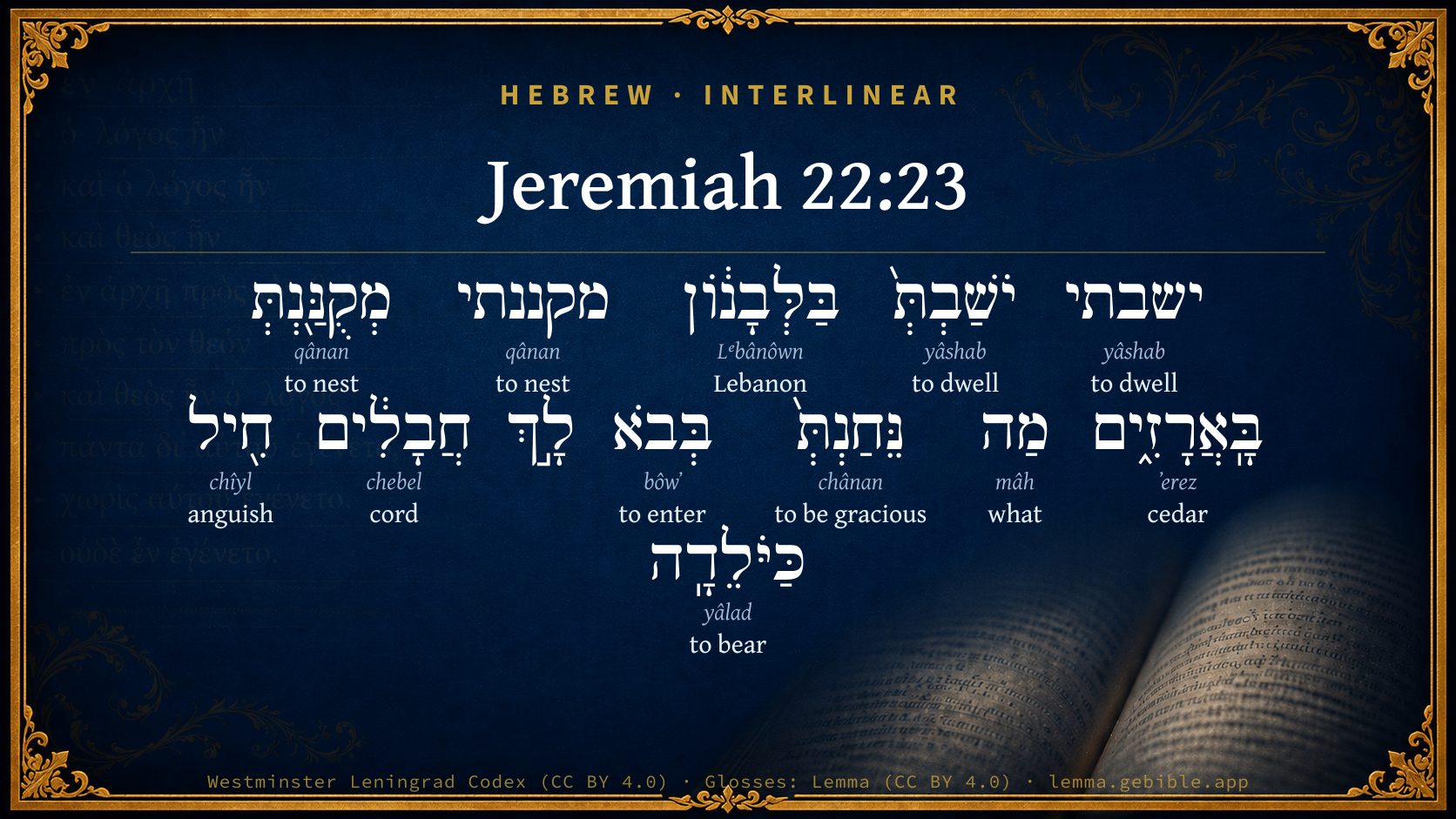
Hebrew (Westminster Leningrad Codex) Jeremiah 22:23 appears in the Hebrew Old Testament. The text above is from the Westminster Leningrad Codex. Each word links to its Strong’s number, a concise gloss, and parsing drawn from the Open Scriptures Hebrew Bible morphology. Click any word for its full Brown-Driver-Briggs (BDB) entry.
Download image
Cite this verse

Jeremiah 22:23 (World English Bible). Public Domain. Lemma interlinear Bible study tool, https://lemma.gebible.app/v/jeremiah/22/23.

Show BibTeX & RIS
BibTeX
RIS
English Translation
Inhabitant of Lebanon, who makes your nest in the cedars, how greatly to be pitied shall you be when pangs come on you, the pain as of a woman in travail!
World English Bible · Public Domain
Download a study sheet

One document with this verse’s original text, its word-by-word gloss line, the meaning frame, cross-references with their text, attributed commentary, and full source and license credits — printable, and it pastes into notes with its structure intact.

This verse Autodidact and up

Study sheet (.html) Plain text (.txt)

A passage Seminary Student

Up to 50 verses in one chapter. A passage sheet keeps up to 6 commentary sources and 12 cross-references per verse, in the order this page ranks them, and says so on the sheet whenever that leaves anything out. Ask for a single verse and you get the Autodidact verse sheet above.

Everything on this page stays free to read, with no account — the sheet is a download of what is already on screen, not access to it.

Want to remove ads? Support Godless Engineer
Compare translations 3

The same verse in 3 English versions, stacked beneath the original-language interlinear above. Click any original word for its lexicon entry.

Each is an independent rendering of the whole verse — the interlinear is not word-aligned to these translations.

Highlighted words mark where these versions differ — a whole-verse word diff, not a word-by-word alignment.

  • World English Bible Public Domain
    Inhabitant of Lebanon, who makes your nest in the cedars, how greatly to be pitied shall you be when pangs come on you, the pain as of a woman in travail!
  • King James Version Public Domain
    O inhabitant of Lebanon, that makest thy nest in the cedars, how gracious shalt thou be when pangs come upon thee, the pain as of a woman in travail!
  • unfoldingWord Literal Text CC BY-SA 4.0
    You who are dwelling in Lebanon, you who are nesting in the cedars, how you will be pitied when pangs come to you, pain like the one giving birth!

unfoldingWord Literal Text — © unfoldingWord, licensed CC BY-SA 4.0. Word-aligned USFM3 via Door43 (git.door43.org/unfoldingWord/en_ult).

Versions to compare (up to 4)

3 of 4 selected

Show all 18 translations

Every available English version of this verse, each an independent rendering of the whole verse.

  • World English Bible Public Domain
    Inhabitant of Lebanon, who makes your nest in the cedars, how greatly to be pitied shall you be when pangs come on you, the pain as of a woman in travail!
  • Berean Standard Bible Public Domain
    O inhabitant of Lebanon, nestled in the cedars, how you will groan when pangs of anguish come upon you, agony like a woman in labor.”
  • Majority Standard Bible Public Domain
    O inhabitant of Lebanon, nestled in the cedars, how you will groan when pangs of anguish come upon you, agony like a woman in labor.”
  • King James Version Public Domain
    O inhabitant of Lebanon, that makest thy nest in the cedars, how gracious shalt thou be when pangs come upon thee, the pain as of a woman in travail!
  • American Standard Version (1901) Public Domain
    O inhabitant of Lebanon, that makest thy nest in the cedars, how greatly to be pitied shalt thou be when pangs come upon thee, the pain as of a woman in travail!
  • Revised Version (1885) Public Domain
    O inhabitant of Lebanon, that makest thy nest in the cedars, how greatly to be pitied shalt thou be when pangs come upon thee, the pain as of a woman in travail!
  • Geneva Bible (1599) Public Domain
    Thou that dwellest in Lebanon, and makest thy nest in the cedars, howe beautiful shalt thou be when sorowes come vpon thee, as the sorowe of a woman in trauaile?
  • Douay-Rheims (1899) Public Domain
    Thou that sittest in Libanus, and makest thy nest in the cedars, how hast thou mourned when sorrows came upon thee, as the pains of a woman in labour?
  • Young's Literal Translation Public Domain
    O dweller in Lebanon, making a nest among cedars, How gracious hast thou been when pangs come to thee, Pain -- as of a travailing woman.
  • Literal Standard Version CC BY-SA 4.0
    O dweller in Lebanon, making a nest among cedars, || How gracious have you been when pangs come to you, || Pain—as of a travailing woman.”
  • Unlocked Literal Bible CC BY-SA 4.0
    You who live in 'Lebanon,' who is nestled in cedar buildings, how you will be pitied when the labor pains come upon you, pain like that of a woman in labor!”
  • unfoldingWord Literal Text CC BY-SA 4.0
    You who are dwelling in Lebanon, you who are nesting in the cedars, how you will be pitied when pangs come to you, pain like the one giving birth!
  • Darby Bible Public Domain
    Thou inhabitress of Lebanon, that makest thy nest in the cedars, how pitiful shalt thou be when pangs come upon thee, pain as of a woman in travail!
  • World Messianic Bible Public Domain
    Inhabitant of Lebanon, who makes your nest in the cedars, how greatly to be pitied you will be when pangs come on you, the pain as of a woman in travail!
  • Webster's Bible Public Domain
    O inhabitant of Lebanon, that makest thy nest in the cedars, how gracious shalt thou be when pangs come upon thee, the pain as of a woman in travail!
  • Free Bible Version CC BY-SA 4.0
    You who live in “Lebanon” in your cedar nest, how much you're going to groan when agonizing pains hit you like a woman in labor.
  • Bible in Basic English Public Domain
    O you who are living in Lebanon, making your living-place in the cedars, how greatly to be pitied will you be when pains come on you, as on a woman in childbirth!
  • JPS Tanakh (1917) Public Domain
    O inhabitant of Lebanon, that art nestled in the cedars, how gracious shalt thou be when pangs come upon thee, the pain as of a woman in travail!

Literal Standard Version (2020), Covenant Press — licensed CC BY-SA 4.0. Text via the HelloAO Bible API (eBible.org). Unlocked Literal Bible (unfoldingWord) — licensed CC BY-SA 4.0. Text via the HelloAO Bible API (eBible.org). unfoldingWord Literal Text — © unfoldingWord, licensed CC BY-SA 4.0. Word-aligned USFM3 via Door43 (git.door43.org/unfoldingWord/en_ult). Free Bible Version, Dr. Jonathan Gallagher — licensed CC BY-SA 4.0. Text via the HelloAO Bible API (eBible.org).

Word by word

More ways to search: Search by grammar → Find every occurrence → Compare this word →

Practice this passage: Drill this verse → Learn its vocabulary →

מקננתי
qânan
H7077
“nested”
Verb, Pual, Participle Passive, Feminine, Singular, Absolute
Part of Speech
Verb
Stem
Pual
Form
Participle Passive
Gender
Feminine
Number
Singular
State
Absolute
Full BDB Definition

Origin: a primitive root

TWOT: 2042

to make a nest - (Piel) to make a nest - (Pual) to be nested
  1. ישבתי yâshab H3427 “dwelling” Verb, Qal, Participle Active, Feminine, Singular, Absolute
  2. יֹשַׁבְתְּ֙ yâshab H3427 “dwelling” Verb, Qal, Participle Active, Feminine, Singular, Construct
  3. בַּלְּבָנ֔וֹן Lᵉbânôwn H3844 “in/at the · Lebanon” Preposition, Determined + Noun, Proper
  4. מְקֻנַּ֖נְתְּ qânan H7077 “nested” Verb, Pual, Participle Passive, Feminine, Singular, Absolute
  5. בָּֽאֲרָזִ֑ים ʼerez H730 “in/at the · cedars” Preposition, Determined + Noun, Common, Masculine, Plural, Absolute
  6. מַה mâh H4100 “what” Particle, Interrogative
  7. נֵּחַנְתְּ֙ chânan H2603 “to be gracious” Verb, Niphal, Perfect, 2nd Person, Feminine, Singular
  8. בְּבֹא bôwʼ H935 “in/at · to enter” Preposition + Verb, Qal, Infinitive Construct
  9. חֲבָלִ֔ים chebel H2256 “cords” Noun, Common, Masculine, Plural, Absolute
  10. חִ֖יל chîyl H2427 “anguish” Noun, Common, Masculine, Singular, Absolute
  11. כַּיֹּלֵדָֽה yâlad H3205 “like/as the · bearing” Preposition, Determined + Verb, Qal, Participle Active, Feminine, Singular, Absolute

About this verse

These counts appear in no published source. They are computed here, from the morphology-tagged text and Lemma’s own curated glosses. What Lemma adds →

13
words
10
distinct lemmas
Prophets
section

Notable vocabulary

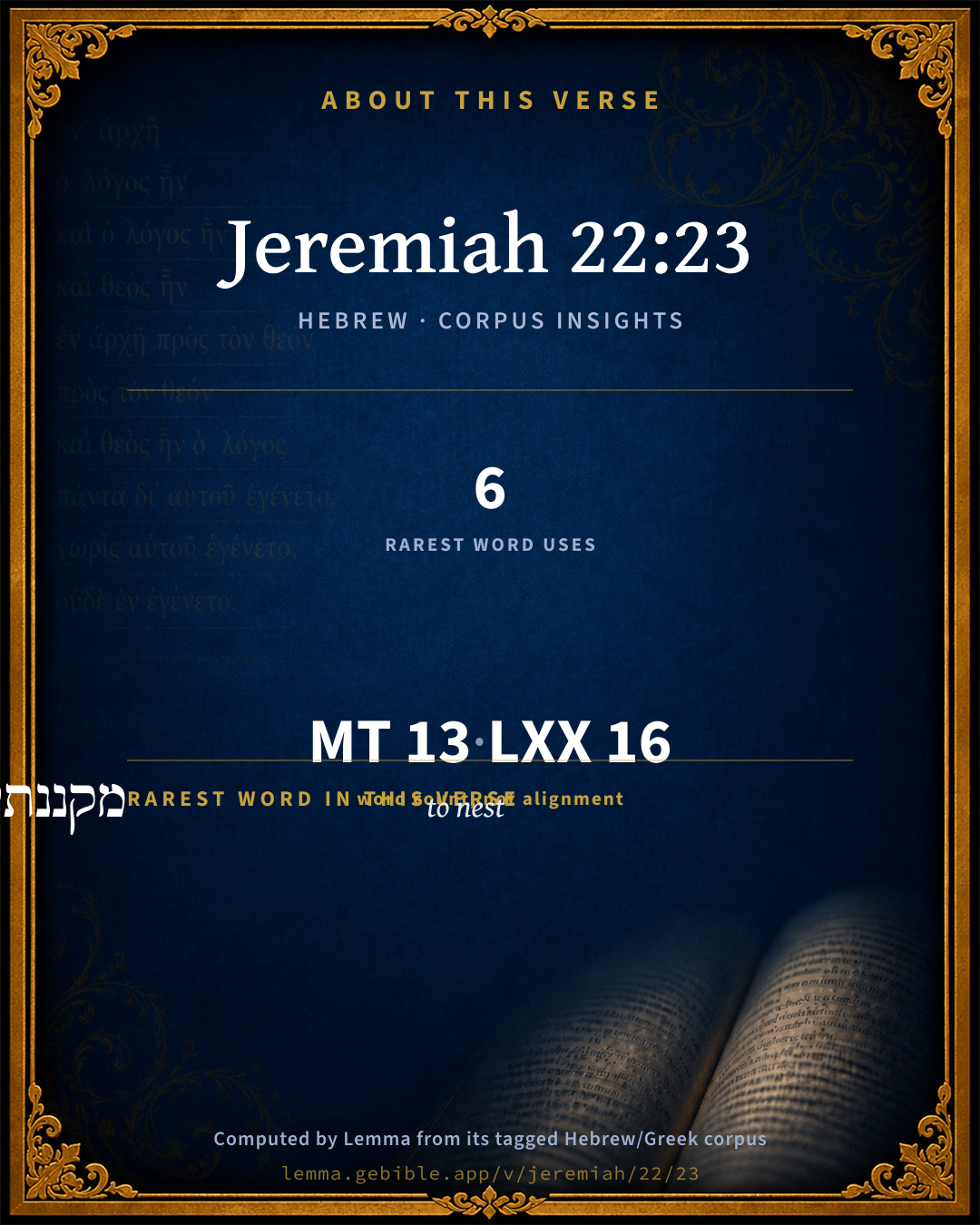
The rarest word here is מקננתי to nest H7077 — appearing just 6 times in the whole Hebrew Bible.

Shared distinctive vocabulary

מקננתי to nest H7077 occurs in 5 verses of the Hebrew Bible. Also found in:

Grammatical profile

  • 7 verbs
  • 4 nouns
  • 1 preposition
  • 1 particle

Verb forms

  • ישבתי Qal · Participle Active
  • יֹשַׁבְתְּ֙ Qal · Participle Active
  • מקננתי Pual · Participle Passive
  • מְקֻנַּ֖נְתְּ Pual · Participle Passive
  • נֵּחַנְתְּ֙ Niphal · Perfect
  • בְּבֹא Qal · Infinitive Construct
  • כַּיֹּלֵדָֽה Qal · Participle Active

Repetition

Words recur within this verse — often emphatic in Hebrew:

  • ישבתי to dwell H3427 ×2
  • מקננתי to nest H7077 ×2

Hebrew & Septuagint length

In the original languages it is 13 Hebrew tokens and 16 Greek tokens — but the two are counted differently (Hebrew bundles its prefixes and suffixes into one token; the Greek is in lemma form), so that isn’t a like-for-like length.

Cross-references

16

Topical passages linked to Jeremiah 22:23 in the Treasury of Scripture Knowledge — connected by theme and wording, ordered by reader-vote popularity; previews shown in the World English Bible.

  • Jeremiah 6:24 We have heard the report of it; our hands wax feeble: anguish has taken hold of us, [and] pangs as of a woman in travail.
  • Jeremiah 4:30–31 You, when you are made desolate, what will you do? Though you clothe yourself with scarlet, though you deck you with ornaments of gold, though you enlarge your eyes with paint, in vain do you make yourself beautiful; [your] lovers despise you, they seek your life.
  • Jeremiah 22:6 For thus says Yahweh concerning the house of the king of Judah: You are Gilead to me, [and] the head of Lebanon; [yet] surely I will make you a wilderness, [and] cities which are not inhabited.
  • Numbers 24:21 He looked at the Kenite, and took up his parable, and said, Strong is your dwelling-place, Your nest is set in the rock.
  • Jeremiah 3:21 A voice is heard on the bare heights, the weeping [and] the petitions of the children of Israel; because they have perverted their way, they have forgotten Yahweh their God.
  • Jeremiah 21:13 Behold, I am against you, O inhabitant of the valley, [and] of the rock of the plain, says Yahweh; you that say, Who shall come down against us? or who shall enter into our habitations?
  • Jeremiah 30:5–6 For thus says Yahweh: We have heard a voice of trembling, of fear, and not of peace.
  • Jeremiah 48:28 You inhabitants of Moab, leave the cities, and dwell in the rock; and be like the dove that makes her nest over the mouth of the abyss.
  • Jeremiah 49:16 As for your terror, the pride of your heart has deceived you, O you who dwell in the clefts of the rock, who hold the height of the hill: though you should make your nest as high as the eagle, I will bring you down from there, says Yahweh.
  • Jeremiah 50:4–5 In those days, and in that time, says Yahweh, the children of Israel shall come, they and the children of Judah together; they shall go on their way weeping, and shall seek Yahweh their God.
  • Hosea 5:15–6:1 I will go and return to my place, until they acknowledge their offense, And seek my face. In their affliction they will seek me earnestly."
  • Hosea 7:14 They haven't cried to me with their heart, But they howl on their beds. They assemble themselves for grain and new wine. They turn away from me.
  • Amos 9:2 Though they dig into Sheol, there my hand will take them; and though they climb up to heaven, there I will bring them down.
  • Obadiah 1:4 Though you mount on high as the eagle, and though your nest is set among the stars, I will bring you down from there, says Yahweh.
  • Habakkuk 2:9 Woe to him who gets an evil gain for his house, that he may set his nest on high, that he may be delivered from the hand of evil!
  • Zechariah 11:1–2 Open your doors, Lebanon, That the fire may devour your cedars.

Cross-references courtesy of OpenBible.info (CC BY 4.0).

Hebrew and Greek witnesses Masoretic Hebrew ↔ Greek Septuagint

The same verse in the two great witnesses to the Old Testament, shown verse-for-verse.

These are two independent witnesses, not word-aligned to each other, and the Septuagint is shown in lemma (dictionary) form.

Hebrew Jeremiah 22:23 Masoretic · Westminster Leningrad Codex

ישבתי יֹשַׁבְתְּ֙ בַּלְּבָנ֔וֹן מקננתי מְקֻנַּ֖נְתְּ בָּֽאֲרָזִ֑ים מַה נֵּחַנְתְּ֙ בְּבֹא לָ֣ךְ חֲבָלִ֔ים חִ֖יל כַּיֹּלֵדָֽה

Inhabitant of Lebanon, who makes your nest in the cedars, how greatly to be pitied shall you be when pangs come on you, the pain as of a woman in travail!

World English Bible · Public Domain

Greek LXX Structure differs

In the Septuagint, Jeremiah is about an eighth shorter than the Hebrew and arranges its material differently — the Oracles Against the Nations (Hebrew chapters 46–51) appear in the middle of the Greek book, after 25:13. Because the chapter and verse boundaries do not line up, a verse-for-verse comparison with the Hebrew is not shown.

A verse-for-verse comparison isn’t shown here because the chapters and verses don’t line up. Switch to the LXX edition with the MT / LXX toggle above to read the Greek directly.

On this verse, The Cambridge Bible for Schools and Colleges discusses the Septuagint’s reading. Read the note in Commentary ↓

Hebrew: Westminster Leningrad Codex (CC BY 4.0). Greek: Septuagint (public domain); English from a public-domain English Septuagint. How the Septuagint differs from the Hebrew →

Targum (Aramaic paraphrase)

1

The Targum is the ancient Jewish Aramaic paraphrase of the Hebrew Scriptures — an interpretive translation, not the Hebrew text itself. Onkelos (literal) and Pseudo-Jonathan (expansive) render the Torah, and Jonathan the Prophets. Coverage is partial: where no permissively-licensed English translation exists for a verse, only the Aramaic is shown. This is verse-level text, not a word-by-word alignment to the Hebrew.

  1. Targum Jonathan Prophets (Joshua–Malachi)
    דְיָתְבָא בְּבֵית מַקְדְשָׁא בֵּינֵי מַלְכַיָא מְרַבְיָא בְנָהָא מָה תַּעְבְּדוּן בְּמֵיתֵי לָךְ עָקָא וְזִיעַ הָא כְּחֶבְלִין לְיָלֵידְתָּא:

    (no public-domain English translation for this verse)

    Targum Jonathan — Aramaic: “Mikraot Gedolot” (public domain). English: “Sefaria Community Translation” (CC0 1.0 (public-domain dedication)); “London "Chaldee Paraphrase," 1871” (public domain). Text via Sefaria.

Commentary

Notes on Jeremiah 22:23 from classic Christian and Jewish commentators (each source and its license shown beneath its notes). The classic Christian expositions comment on the surrounding passage and are grouped to its opening verse, so a note may address several verses; the Jewish commentaries on the Tanakh (Rashi and others) are per-verse, so they appear only where the commentator wrote on this verse.

Lemma curates 59 commentaries, every one of them public domain or Creative Commons licensed, each selected and text-cleaned for this edition rather than reprinted as found. About our sources →

Trapp's Complete Commentary

John Trapp

Jer 22:23 O inhabitant of Lebanon, that makest thy nest in the cedars, how gracious shalt thou be when pangs come upon thee, the pain as of a woman in travail!

Ver. 23. O inhabitant of Lebanon.] Heb., O inhabitress - that is, O Jerusalem, who hast perched thyseff aloft, and pridest thyself in thy strength and stateliness.

How gracious shalt thou be!] i.e., How ridiculous, when thy lofty and stately rooms wherein thou art roosted shall be to thee but as groaning rooms to women in travail.

John Trapp, A Commentary or Exposition upon All the Books of the Old and New Testament (1647–1656) — public domain. Text from a community e-Sword module.

The Biblical Illustrator

Joseph S. Exell

Jer_22:23

O inhabitant of Lebanon, that makest thy nest in the cedars.

The nest in the cedars

The inhabitant of Lebanon, that maketh his nest in the cedars, is an illustration of all those who, in the pride and security of the present, are blind to the uncertainties of the future.

I. Why is it that Gods message takes such little hold of the heart? He pours out all His love in pleading with men. Seek ye My face. Has the answer gone up from your heart, Thy face, Lord, will I seek? If not, why not? Are you making a nest for yourself among the cedars? dreaming yourself to be secure, and, like the false Church in the Apocalypse, saying to yourself, I shall see no sorrow? What is the ground of your security? Has the hand of diligence surrounded you with comforts? The cheerful home, the well-spread table, the smiling faces of children,--are these your portion? Oh, how often are these things as the nest in the cedars! Or the nest may be of another kind--framed out of self-righteousness and moral excellence. In short, whatever it be which holds back the heart from Christ, and prompts the vain hope that all will be well at last, though there be no conscious faith, nor any evidence of a converted heart, that is your nest among the cedars. Though now heedless to the call of God, the storm must ere long burst on the cedar, and rive it to its roots, laying in the dust the nest that seemed so safe in its towering branches. Disappointment, loss, disaster, trial, death, the judgment,--what are these in their turn but just the lightning flash which strips the cedar of its foliage, and leaves the nest exposed to the scorching of the summers heat, and the withering of the winters frost? What are they all but Gods instruments for shivering into ruins the miserable refuges in which men seek shelter and comfort amid the experiences of time, and in the prospect of eternity?

II. When the cedars are fallen, how bitter the disappointment! The world, its business, its pleasures, its cares, its struggles, its joys, its sorrows,--all are fast vanishing. Snap the cedars go! and meanwhile there is dismay at the review of the past, and the still darker prospect of the future! Behind, a life spent with the form of godliness, but entirely without God. Before, is death, the sifting of the judgment, eternity. Behind, a life given up to earth and earthly things. Before, an immortality, over the far-reaching expanse of which no star of hope sheds a gleam of life and peace. Can we wonder if the soul shrinks back in alarm, if dark forebodings haunt the spirit, and prayers, and regrets, and vows, and promises blend together as the outward expression of anxiety and fear?

III. Where can you build your hopes and not find them shattered and broken by disappointment. Not among the cedars, but in the hollow of that Rock of Ages, which defies the howling of the tempest, and the sweep of the hurricane--which stands forth calm and stately in its strength, amid the shocks of time, and shall lift its head unshaken, even when the earth and all that is in it shall be dissolved and broken up. The memory of guilt and shortcoming, and the record of transgression are terrible, hut to the humble and believing Christian they can bring neither harm nor hurt. He that dwelleth in the secret place of the Most High shall abide beneath the shadow of the Almighty. (R. Allen, M. A.)

A sure refuge

I. The insufficiency of every human aid, as illustrated by the prophet in the example of the inhabitant of Lebanon. Lebanon was a noble and a stately mountain, the pride and the ornament of the Eastern world. Its summit was crested with eternal snows, while its sides were adorned with forests of the graceful and goodly cedar. Beneath were slopes of rich pasturage, on which were fed unnumbered flocks and herds. Rivulets gushed from the fissures, and separated among the hills, which afforded refreshment to the fainting traveller, and maintained in native purity of freshness the verdure of the mountain side. No image could more expressively convey to the mind of an Israelite all that man most highly esteems of grandeur, magnificence, and beauty. But the idea of security is also implied. In many human ills, money, as the wise man says, is a defence; and the rich man, in a land of commerce like our own, is as the inhabitant of Lebanon, compared with the dweller in the plain below. The winds may rage, and the storm beat; but his airy dwelling place is unmoved. The enemy may spread themselves over the plain; but his house of defence is the munitions of rocks. How enviable a condition! you will say, But Ah! the things that are impossible with men, are possible with God. Lightning from heaven above may blast the towering cedar; the earthquake muttering from beneath may rend the solid rock: or even when the wave reposes without a ripple or an undulation on the surface of the mountain lake, the stroke of death may come suddenly, the strong mans fortress may be powerless in an instant, as a woman in her travail, or as the infant just struggling into birth.

II. For all who will seek it there is a sure refuge, whatever may be the danger, and an invincible arm of defence, whoever may be we adversary. St. Paul indeed said, in reference to the times of fiery persecution in which his own lot was cast, that if in this life only they had hope in Christ, believers were of all men most miserable; but what was then the present distress, has happily passed away, and godliness is now truly profitable unto all things, having promise of the life that now is, and of that which is to come. All creation is redolent of joy and peace to the true believer in Christ Jesus. He knows, that God hath made with him an everlasting covenant, ordered in all things and sure; that all His ways are mercy and truth, unto such as keep His covenant and His testimonies; and that no truly good thing will He withhold from them that walk uprightly. So long, then, as prosperity continues, enjoyment is enhanced by thankfulness; and when adversity comes upon him, suffering is lightened by faith. The light affliction, which is upon him, will, he knows, work for him a far more exceeding and eternal weight of glory, etc. (T. Dale, M. A.)

The Biblical Illustrator, edited by Joseph S. Exell (c. 1880s–1900s) — public domain. Text from a community e-Sword module.

Joseph Benson's Commentary

Jer 22:23. O inhabitant of Lebanon — O thou that inhabitest the city which for pleasantness and delight may be compared to Lebanon. Or he alludes to the stately buildings of Jerusalem, elsewhere compared to the tall cedars of a forest: see note on Jer 21:14. That makest thy nest in the cedars — Who livest in houses built of cedars. How gracious shalt thou be — Or rather, how humble, or suppliant, wilt thou be, when pangs come upon thee — Those pangs of affliction which shall suddenly oppress thee, whereas before thou wast too proud to hearken to any advice that was offered. The Hebrew, מה נחנתי, is rendered by Buxtorff, quam gratulaberis tibi, How wilt thou gratulate thyself when pangs, &c., understanding it as spoken ironically.

Joseph Benson's Commentary on the Old and New Testaments (1811–1818) — public domain. Text from a community e-Sword module.

Geneva Bible (1599)

Geneva Bible translators

Thou that art built of the fair Cedar trees of Lebanon.

Geneva Bible (1599) marginal notes — public domain. Text via Bolls.life.

Jamieson, Fausset & Brown

Robert Jamieson, A. R. Fausset & David Brown

inhabitant of Lebanon--namely, Jerusalem, whose temple, palaces, and principal habitations were built of cedars of Lebanon.

how gracious--irony. How graciously thou wilt be treated by the Chaldees, when they come on thee suddenly, as pangs on a woman in travail (Jer 6:24)! Nay, all thy fine buildings will win no favor for thee from them. MAURER translates, "How shalt thou be to be pitied!"

Jamieson, Fausset & Brown — Commentary Critical and Explanatory on the Whole Bible (1871) — public domain (CC PDM 1.0). Text via the HelloAO Bible API.

Adam Clarke's Commentary

Verse 23. How gracious shalt thou be] A strong irony.

Adam Clarke's Commentary on the Bible (1810–1826) — public domain. Text from a community e-Sword/MySword module.

John Calvin's Commentaries

The Prophet confirms the same thing in other words; and hence it appears how difficult it is to shake off from men their false confidence, when they give themselves up to earthly things. As soon, then, as false confidence strikes its roots into the hearts of men, they cannot be moved either by any threatenings or by any dangers; even though death itself were hanging over them, they yet remain unconcerned: and hence Isaiah upbraids them and says, That they had made a covenant with death. (Isaiah 28:15.) This was the reason why the Prophet here multiplied words and used greater vehemence; it was for the purpose of correcting that perverseness which prevailed among the Jews; for they thought themselves beyond the reach of those darts which God’s hands would throw.

He therefore says, that they had set their seat on Lebanon, and made their nest among the cedars Some interpreters understand this figuratively of the cedar houses in which they dwelt; that is, that they ornamented their houses or palaces, as we have seen, with boards of cedar. But I take the words more simply, — That they considered Lebanon as an impregnable stronghold, and that he compares them to birds which choose the highest cedars to make their nests in. The meaning is, that the Jews were so blinded by their pride, that they thought that they had Lebanon as a safe refuge, and also that they imagined that they had nests as it were in its cedars. But there is no doubt but that the Prophet, in mentioning this one particular, meant to include all those false and vain confidences with which the Jews were inebriated. But he speaks by way of concession, as though he had said, that the Jews were not terrified by God’s threatenings, because they cast their eyes on Lebanon and on its lofty cedars.

But how gracious, he says, wilt thou be; that is, what grace wilt thou find, when sorrows shall come upon thee, the pain as of one in travail The Prophet expresses here what often occurs in Scripture, that when the ungodly say, “Peace and safety,” sudden ruin comes on them. (1 Thessalonians 5:3.) He then does not allow that the Jews gained anything by thinking that they would have a quiet station on Lebanon, and by having their nests in the cedars, for God would bring on them sudden pains like those of women, who, while laughing and full of mirth, are in a moment seized with the pangs of childbearing. Jeremiah now says, that a similar thing would happen to the Jews. I touch but lightly on this point, while yet it is worthy of long and careful meditation. Let us then know, that nothing is more intolerable to God than when we promise to ourselves a quiet rest while he proclaims war against us, and while we, as it were designedly, daily provoke him. It follows —

John Calvin's Commentaries (1540-1563) — public domain. Text from the Calvin Translation Society English edition (1840s-50s) via the Christian Classics Ethereal Library (ccel.org). Calvin's coverage is partial (roughly two-thirds of the Bible); uncommented books and verses are honest gaps, never fabricated. The 19th-century editor's footnotes and remarks are omitted so the notes are faithfully Calvin's own voice.

Ellicott's Commentary for English Readers

(23) O, inhabitant of Lebanon.—The phrase develops the thought of Jer_22:6. The king, in his cedar-palace, is as one who has made Lebanon his home, literally and figuratively (see Note on Jer_22:7), and is as an eagle nestling in the cedar.

How gracious shalt thou be . . .!—Better, how wilt thou sigh! or, how wilt thou groan! as connected with the pangs of travail. No pomp or majesty could save the royal house from the inevitable doom.

A Bible Commentary for English Readers, edited by Charles John Ellicott (1878–1897) — public domain. Text from a community e-Sword module.

The Cambridge Bible for Schools and Colleges

gen. ed. J. J. S. Perowne

23. “Judah has been as confident of safety as a bird that had fixed its nest far away from men in the cedars on the heights of Lebanon.” Pe.

inhabitant] For mg. inhabitress see on Jer_21:13.

how greatly to be pitied] The mg. how wilt thou groan is probably the right reading (so LXX, Syr. and Targ. The MT. is a not unnatural corruption arising from a transposition of two consonants).

The Cambridge Bible for Schools and Colleges (gen. ed. J. J. S. Perowne; Cambridge University Press, 1878–1918) — public domain. Text from a community e-Sword module.

John Gill's Exposition

O inhabitant of Lebanon,.... Jerusalem is meant, and the inhabitants of it, so called, because they lived near Lebanon, or in that land in which Lebanon was; or rather because they dwelt in houses made of the wood of Lebanon; and which stood as thick as the trees in the forest of Lebanon; and where they thought themselves safe and secure, according to the next clause; not but that there were inhabitants of the mountain of Lebanon, called Druses; and there were towns and villages on it, inhabited by people, as there are to this day. After four hours and a half travelling up the ascent, from the foot of the mountain, there is, as travellers (z) inform us, a small pretty village, called Eden; and besides that, at some distance from it, another called Canobine, where there is a convent of the Maronites, and is the seat of their patriarch; and near it a valley of that name, full of hermitages, cells and monasteries; but the former are here meant;

that makest thy nests in the cedars; in towns, palaces, and houses, covered, ceiled, raftered, and wainscotted with cedars; here they lived at ease and security, as birds in a nest. The Targum is,

"who dwellest in the house of the sanctuary, and among kings? nourishing thy children;''

how gracious shalt thou be when pangs come upon thee, the pain as of a woman in travail? that is, either thou wilt seek grace and favour at the hand of God, and make supplication to him; thou wilt then be an humble supplicant, when in distress, though now proud and haughty (a): or what favour wilt thou then find among those that come to waste and destroy thee? This refers to the calamity coming upon them by the Chaldeans, as the following words show:

(z) Maundrell's Journey from Aleppo, &c. p. 142, 143. Thevenot's Travels, part 1. B. 2. c. 60. p. 221. (a) "quam gratiam habuisti, vel quomodo precata es", Vatablus; "quam afficieris gratia", Piscator; "quantum gratiae invenies", Schmidt.

John Gill's Exposition of the Whole Bible (1746–1763) — public domain (CC PDM 1.0). Text via the HelloAO Bible API.

Albert Barnes' Notes on the Bible

Lebanon is the usual metaphor for anything splendid. and is here put for Jerusalem, but with special reference to the kings whose pride it was to dwell in palaces roofed with cedar Jer 22:14.

How gracious shalt thou be - Or, How wilt thou groan!

Albert Barnes' Notes on the Bible (1834–1885) — public domain. Text from a community e-Sword/MySword module.

Matthew Poole's English Annotations

Jerusalem, which is called an

inhabitant of Lebanon, either because their houses were built of wood cut down out of the forest of Lebanon, or because they lived in as great plenty and delight as if they lived in Lebanon, or because they thought the mountain of Lebanon was a certain refuge to them. They are said to

make their nest in the cedars, either because their houses were built of the cedars of Lebanon, or because of the security they promised themselves from that forest and mountain, so full of and famous for cedars. What favour wilt thou find when my judgments shall come upon thee, as suddenly and as smartly as the pains of a woman in travail come upon her! a similitude often made use of by this prophet, to express the suddenness, unavoidableness, and greatness of judgments, Jer 4:31; 6:24; 13:21; 30:6; 49:24; 50:43; and so in other scriptures, Psa 48:6; Mic 4:9; 1Th 5:3.

Matthew Poole's English Annotations on the Holy Bible (1683–1685) — public domain. Text from a community e-Sword/MySword module.

Whedon's Commentary on the Bible

Daniel D. Whedon

23. Inhabitant of Lebanon — That is, Jerusalem, so called in double allusion to her buildings of cedar and her sense of loftiness and security.

How gracious — Rather, how wilt thou groan!

Daniel D. Whedon (gen. ed.), Commentary on the Old and New Testaments (1874–1909) — public domain. Text from a community e-Sword module.

The Pulpit Commentary

O inhabitant rather, O inhabitressof Lebanon. It is the people of Jerusalem which is meant; the "Lebanon" are the palaces of cedar-wood which together are called" the house of the King of Judah" (ver. 6). How gracious shalt thou be; rather, How wilt thou sigh!

The Pulpit Commentary (1880–1919), ed. H.D.M. Spence-Jones & Joseph S. Exell — public domain. Text from a community e-Sword module.

John Wesley's Explanatory Notes

Lebanon - Jerusalem is called an inhabitant of Lebanon, because their houses were built of wood cut down out of the forest of Lebanon. Cedars - Their houses were built of the Cedars of Lebanon. How gracious - What favour wilt thou find when my judgments come upon thee, as the pains of a woman in travail come upon her.

John Wesley, Explanatory Notes Upon the Whole Bible (1754–1765) — public domain. Text via the GEBible commentary corpus.

Rashi

Rabbi Shlomo Yitzchaki (Rashi)

who nest in the cedars For you placed your nest in the towers of the cedar houses to build wide houses.

how gracious shall you be What grace have you found because of the height of your towers, in the eyes of your plunderers, when birth pangs come upon you. And Menahem interpreted נֵחַנְתְּ as an expression of camping, but Dunash interpreted it as an expression of grace.

Rashi on the Tanakh — English translations: “The Judaica Press complete Tanach with Rashi, translated by A. J. Rosenberg” (CC BY 4.0); “Pentateuch with Rashi's commentary by M. Rosenbaum and A.M. Silbermann, 1929-1934” (public domain); “The Metsudah Tanach series, Lakewood, N.J” (CC BY 4.0); and “The Book of Joshua, Metsudah Publications, 1997” (CC BY 4.0). Text via Sefaria.

Lesson kit

Teaching starters — assembled from the data on this page, not authored interpretation. Every prompt links to the verse data it draws on. Edit before teaching.

Jeremiah, in the Prophets, opens this verse with 13 words (10 distinct Hebrew lemmas). Its most distinctive word is qânan (“to nest”). A historical commentator’s framing appears above. Read the whole chapter for the surrounding context.

Discussion questions

  1. How does “to nest” (qânan) shape what this verse is saying?
  2. Psalms 104:17 shares the word «to nest» with this verse. How do the two illuminate each other?
  3. “to dwell” occurs 2× in this one verse. What is the effect of the repetition?
  4. These translations render this verse differently. What is at stake in choosing one wording over another?
  5. The verb «ישבתי» is Qal Participle Active. How does its form color the action?
  6. Reading how Trapp's Complete Commentary and The Biblical Illustrator read this verse, where do the two commentators agree and where do they part?

Things to notice

Reading settings

Reading text

Shown beneath each verse's original-language words.

Old Testament
Old Testament edition

Read the OT as the Masoretic Hebrew (MT) or the Greek Septuagint (LXX).

English shown for the Greek Septuagint (in the Hebrew ↔ Greek comparison).

Comparing translations? Open the Compare panel on any verse page to stack up to four side by side.