
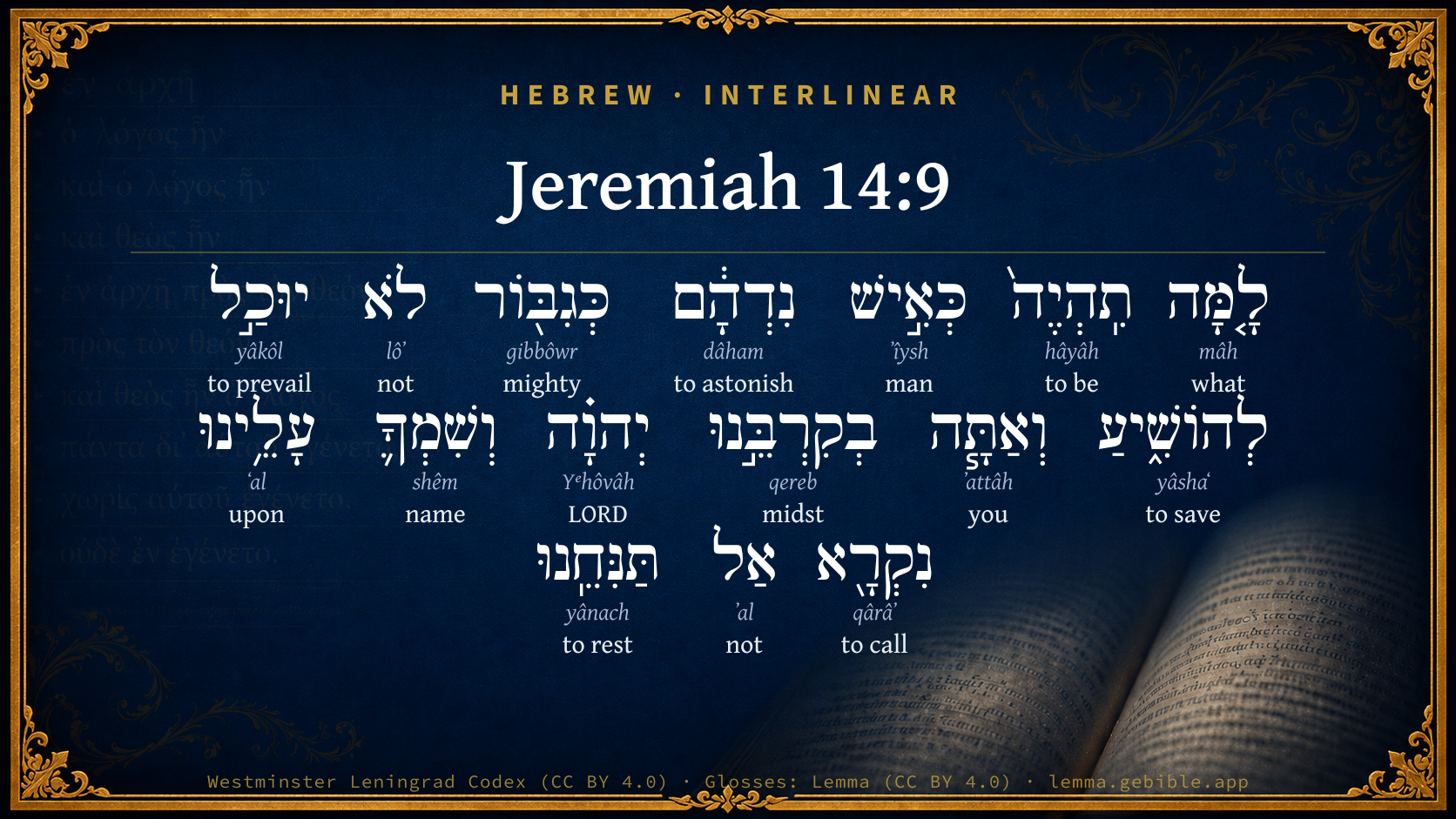
Jeremiah 14:9

Hebrew (Westminster Leningrad Codex) Jeremiah 14:9 appears in the Hebrew Old Testament. The text above is from the Westminster Leningrad Codex. Each word links to its Strong’s number, a concise gloss, and parsing drawn from the Open Scriptures Hebrew Bible morphology. Click any word for its full Brown-Driver-Briggs (BDB) entry.
Download image
Cite this verse

Jeremiah 14:9 (World English Bible). Public Domain. Lemma interlinear Bible study tool, https://lemma.gebible.app/v/jeremiah/14/9.

Show BibTeX & RIS
BibTeX
RIS
English Translation
Why should you be like a scared man, as a mighty man who can't save? yet you, Yahweh, are in the midst of us, and we are called by your name; don't leave us.
World English Bible · Public Domain
Highlights
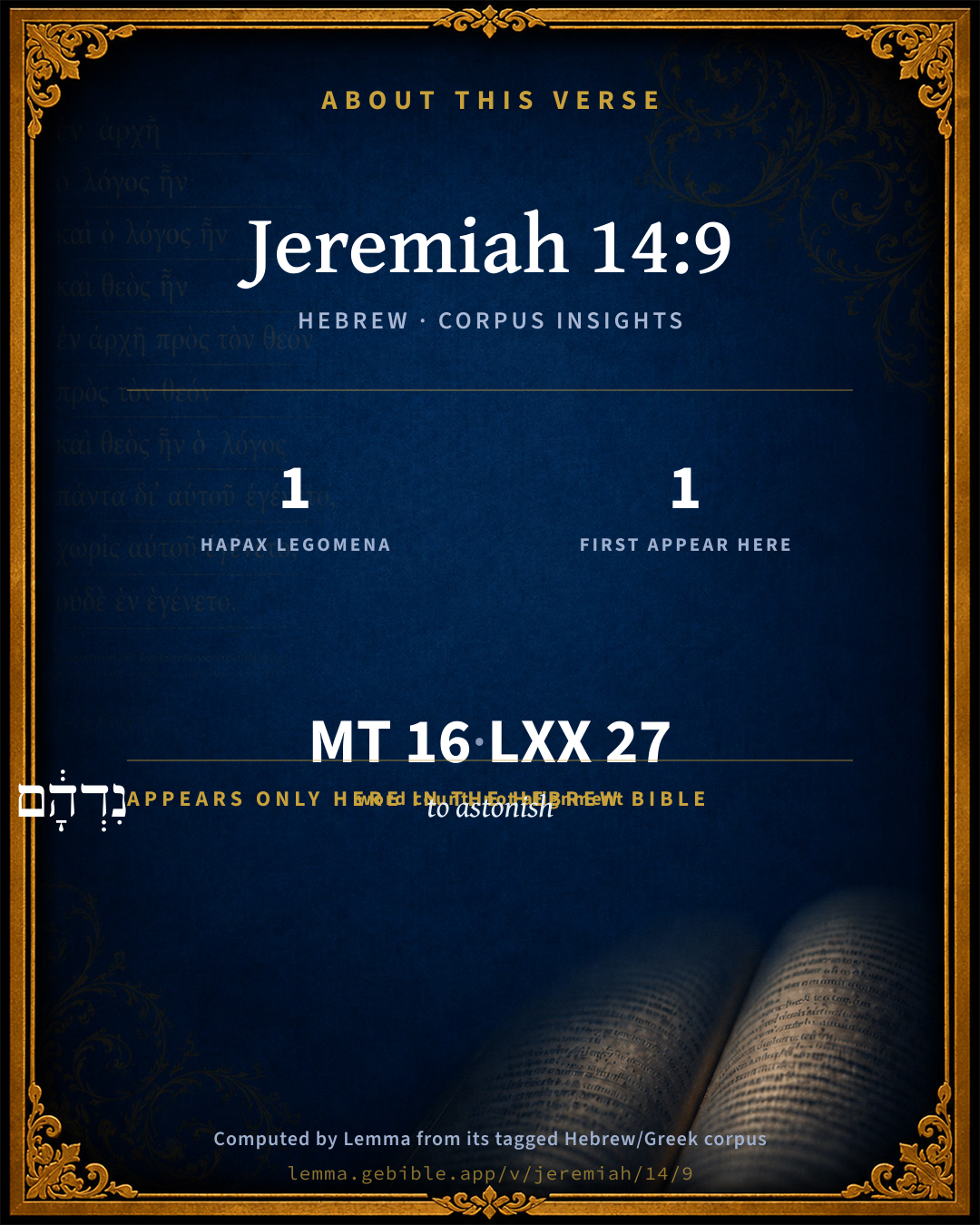
  • 1 hapax legomenon — only here in the Hebrew Bible
  • 1 first appearance in the Hebrew Bible
Full analysis ↓
Download a study sheet

One document with this verse’s original text, its word-by-word gloss line, the meaning frame, cross-references with their text, attributed commentary, and full source and license credits — printable, and it pastes into notes with its structure intact.

This verse Autodidact and up

Study sheet (.html) Plain text (.txt)

A passage Seminary Student

Up to 50 verses in one chapter. A passage sheet keeps up to 6 commentary sources and 12 cross-references per verse, in the order this page ranks them, and says so on the sheet whenever that leaves anything out. Ask for a single verse and you get the Autodidact verse sheet above.

Everything on this page stays free to read, with no account — the sheet is a download of what is already on screen, not access to it.

Want to remove ads? Support Godless Engineer
Compare translations 3

The same verse in 3 English versions, stacked beneath the original-language interlinear above. Click any original word for its lexicon entry.

Each is an independent rendering of the whole verse — the interlinear is not word-aligned to these translations.

Highlighted words mark where these versions differ — a whole-verse word diff, not a word-by-word alignment.

  • World English Bible Public Domain
    Why should you be like a scared man, as a mighty man who can't save? yet you, Yahweh, are in the midst of us, and we are called by your name; don't leave us.
  • King James Version Public Domain
    Why shouldest thou be as a man astonied, as a mighty man that cannot save? yet thou, O LORD, art in the midst of us, and we are called by thy name; leave us not.
  • unfoldingWord Literal Text CC BY-SA 4.0
    Why should you be like a man being confused, like a mighty one who is not able to save? Yet you in our midst, Yahweh, and your name is called over us; do not leave us!

unfoldingWord Literal Text — © unfoldingWord, licensed CC BY-SA 4.0. Word-aligned USFM3 via Door43 (git.door43.org/unfoldingWord/en_ult).

Versions to compare (up to 4)

3 of 4 selected

Show all 18 translations

Every available English version of this verse, each an independent rendering of the whole verse.

  • World English Bible Public Domain
    Why should you be like a scared man, as a mighty man who can't save? yet you, Yahweh, are in the midst of us, and we are called by your name; don't leave us.
  • Berean Standard Bible Public Domain
    Why are You like a man taken by surprise, like a warrior powerless to save? Yet You are among us, O LORD, and we are called by Your name. Do not forsake us!
  • Majority Standard Bible Public Domain
    Why are You like a man taken by surprise, like a warrior powerless to save? Yet You are among us, O LORD, and we are called by Your name. Do not forsake us!
  • King James Version Public Domain
    Why shouldest thou be as a man astonied, as a mighty man that cannot save? yet thou, O LORD, art in the midst of us, and we are called by thy name; leave us not.
  • American Standard Version (1901) Public Domain
    Why shouldest thou be as a man affrighted, as a mighty man that cannot save? yet thou, O Jehovah, art in the midst of us, and we are called by thy name; leave us not.
  • Revised Version (1885) Public Domain
    Why shouldest thou be as a man astonied, as a mighty man that cannot save? yet thou, O LORD, art in the midst of us, and we are called by thy name; leave us not.
  • Geneva Bible (1599) Public Domain
    Why art thou as a man astonied, and as a strong man that cannot helpe? yet thou, O Lord, art in the middes of vs, and thy Name is called vpon vs: forsake vs not.
  • Douay-Rheims (1899) Public Domain
    Why wilt thou be as a wandering man, as a mighty man that cannot save? but thou, O Lord, art among us, and thy name is called upon by us, forsake us not.
  • Young's Literal Translation Public Domain
    Why art Thou as one dumb? As a mighty one not able to save? And Thou `art' in our midst, O Jehovah, And Thy name over us is called, leave us not.
  • Literal Standard Version CC BY-SA 4.0
    Why are You as one mute? As a mighty one not able to save? And You [are] in our midst, O YHWH, || And Your Name is called over us, || Do not leave us.
  • Unlocked Literal Bible CC BY-SA 4.0
    Why are you like someone who is astounded, or like a warrior who has no power to rescue? You are in our midst, Yahweh, and your name is called over us. Do not leave us!
  • unfoldingWord Literal Text CC BY-SA 4.0
    Why should you be like a man being confused, like a mighty one who is not able to save? Yet you in our midst, Yahweh, and your name is called over us; do not leave us!
  • Darby Bible Public Domain
    Why wilt thou be as a man astonished, as a mighty man that cannot save? Yet thou, Jehovah, art in the midst of us, and we are called by thy name: leave us not.
  • World Messianic Bible Public Domain
    Why should you be like a scared man, as a mighty man who can’t save? Yet you, LORD, are in the middle of us, and we are called by your name. Don’t leave us.
  • Webster's Bible Public Domain
    Why shouldst thou be as a man astonished, as a mighty man that cannot save? yet thou, O LORD, art in the midst of us, and we are called by thy name; leave us not.
  • Free Bible Version CC BY-SA 4.0
    Why do you act like someone caught unawares, like a powerful warrior who can't help? You are here among us, Lord, and we are known as your people. Please don't give up on us!
  • Bible in Basic English Public Domain
    Why are you like a man surprised, like a man of war who is not able to give help? but you, O Lord, are with us, and we are named by your name; do not go away from us.
  • JPS Tanakh (1917) Public Domain
    Why shouldest thou be as a man overcome, as a mighty man that cannot save? Yet Thou, O LORD, art in the midst of us, and Thy name is called upon us; leave us not.

Literal Standard Version (2020), Covenant Press — licensed CC BY-SA 4.0. Text via the HelloAO Bible API (eBible.org). Unlocked Literal Bible (unfoldingWord) — licensed CC BY-SA 4.0. Text via the HelloAO Bible API (eBible.org). unfoldingWord Literal Text — © unfoldingWord, licensed CC BY-SA 4.0. Word-aligned USFM3 via Door43 (git.door43.org/unfoldingWord/en_ult). Free Bible Version, Dr. Jonathan Gallagher — licensed CC BY-SA 4.0. Text via the HelloAO Bible API (eBible.org).

Word by word

More ways to search: Search by grammar → Find every occurrence → Compare this word →

Practice this passage: Drill this verse → Learn its vocabulary →

נִדְהָ֔ם
dâham
H1724
“astonishing”
Verb, Niphal, Participle Active, Masculine, Singular, Absolute
Part of Speech
Verb
Stem
Niphal
Form
Participle Active
Gender
Masculine
Number
Singular
State
Absolute
Full BDB Definition

Origin: a primitive root (compare H1740 )

TWOT: 407

to astonish, astound - (Niphal) astounded (participle)
  1. לָ֤מָּה mâh H4100 “to/for · what” Preposition + Particle, Interrogative
  2. תִֽהְיֶה֙ hâyâh H1961 “to be” Verb, Qal, Imperfect, 2nd Person, Masculine, Singular
  3. כְּאִ֣ישׁ ʼîysh H376 “like/as · man” Preposition + Noun, Common, Masculine, Singular, Absolute
  4. כְּגִבּ֖וֹר gibbôwr H1368 “like/as · mighty” Preposition + Adjective, Adjective, Masculine, Singular, Absolute
  5. לֹא lôʼ H3808 “not” Particle, Negative
  6. יוּכַ֣ל yâkôl H3201 “to prevail” Verb, Qal, Imperfect, 3rd Person, Masculine, Singular
  7. לְהוֹשִׁ֑יעַ yâshaʻ H3467 “to save” Preposition + Verb, Hiphil, Infinitive Construct
  8. וְאַתָּ֧ה ʼattâh H859 “and · you” Conjunction + Pronoun, Personal, 2nd Person, Masculine, Singular
  9. בְקִרְבֵּ֣נוּ qereb H7130 “in/at · midst · our” Preposition + Noun, Common, Masculine, Singular, Construct + Suffix, Personal, 1st Person, Common, Plural
  10. יְהוָ֗ה Yᵉhôvâh H3068 “LORD” Noun, Proper
  11. וְשִׁמְךָ֛ shêm H8034 “and · name · your” Conjunction + Noun, Common, Masculine, Singular, Construct + Suffix, Personal, 2nd Person, Masculine, Singular
  12. עָלֵ֥ינוּ ʻal H5921 “upon · us” Preposition + Suffix, Personal, 1st Person, Common, Plural
  13. נִקְרָ֖א qârâʼ H7121 “to call” Verb, Niphal, Perfect, 3rd Person, Masculine, Singular
  14. אַל ʼal H408 “not” Particle, Negative
  15. תַּנִּחֵֽנוּ yânach H3240 “to rest · us” Verb, Hiphil, Jussive, 2nd Person, Masculine, Singular + Suffix, Personal, 1st Person, Common, Plural

About this verse

These counts appear in no published source. They are computed here, from the morphology-tagged text and Lemma’s own curated glosses. What Lemma adds →

16
words
16
distinct lemmas
Prophets
section

Notable vocabulary

1 hapax legomenon — a word that appears only here in the entire Hebrew Bible:

  • נִדְהָ֔ם to astonish H1724

First appearance in Scripture

This word makes its first canonical appearance in the Hebrew Bible here:

  • נִדְהָ֔ם to astonish H1724

Grammatical profile

  • 6 verbs
  • 4 nouns
  • 1 adjective
  • 1 pronoun
  • 1 preposition
  • 3 particles

Verb forms

  • תִֽהְיֶה֙ Qal · Imperfect
  • נִדְהָ֔ם Niphal · Participle Active
  • יוּכַ֣ל Qal · Imperfect
  • לְהוֹשִׁ֑יעַ Hiphil · Infinitive Construct
  • נִקְרָ֖א Niphal · Perfect
  • תַּנִּחֵֽנוּ Hiphil · Jussive

Hebrew & Septuagint length

In the original languages it is 16 Hebrew tokens and 27 Greek tokens — but the two are counted differently (Hebrew bundles its prefixes and suffixes into one token; the Greek is in lemma form), so that isn’t a like-for-like length.

Cross-references

21

Topical passages linked to Jeremiah 14:9 in the Treasury of Scripture Knowledge — connected by theme and wording, ordered by reader-vote popularity; previews shown in the World English Bible.

  • Isaiah 59:1 Behold, Yahweh's hand is not shortened, that it can't save; neither his ear heavy, that it can't hear:
  • Isaiah 63:19 We are become as they over whom you never bear rule, as those who were not called by your name.
  • Numbers 11:23 Yahweh said to Moses, Has Yahweh's hand grown short? now shall you see whether my word shall happen to you or not.
  • Numbers 14:15–16 Now if you shall kill this people as one man, then the nations which have heard the fame of you will speak, saying,
  • Psalms 46:5 God is in her midst. She shall not be moved. God will help her at dawn.
  • Jeremiah 15:16 Your words were found, and I ate them; and your words were to me a joy and the rejoicing of my heart: for I am called by your name, Yahweh, God of hosts.
  • Exodus 29:45–46 I will dwell among the children of Israel, and will be their God.
  • Isaiah 50:1–2 Thus says Yahweh, Where is the bill of your mother's divorce, with which I have put her away? or which of my creditors is it to whom I have sold you? Behold, for your iniquities were you sold, and for your transgressions was your mother put away.
  • Daniel 9:18–19 My God, turn your ear, and hear; open your eyes, and see our desolations, and the city which is called by your name: for we do not present our petitions before you for our righteousness, but for your great mercies' sake.
  • 2 Corinthians 6:16 What agreement has a temple of God with idols? For you are a temple of the living God. Even as God said, "I will dwell in them, and walk in them; and I will be their God, and they will be my people."
  • Hebrews 13:5 Be free from the love of money, content with such things as you have, for he has said, "I will in no way leave you, neither will I in any way forsake you."
  • Leviticus 26:11–12 I will set my tent among you: and my soul won't abhor you.
  • Deuteronomy 23:14 for Yahweh your God walks in the midst of your camp, to deliver you, and to give up your enemies before you; therefore shall your camp be holy, that he may not see an unclean thing in you, and turn away from you.
  • 1 Samuel 12:22 For Yahweh will not forsake his people for his great name's sake, because it has pleased Yahweh to make you a people to himself.
  • Psalms 27:9 Don't hide your face from me. Don't put your servant away in anger. You have been my help. Don't abandon me, Neither forsake me, God of my salvation.
  • Psalms 44:23–26 Wake up! Why do you sleep, Lord? Arise! Don't reject us forever.
  • Isaiah 12:6 Cry aloud and shout, you inhabitant of Zion; for great in the midst of you is the Holy One of Israel!"
  • Isaiah 51:9 Awake, awake, put on strength, arm of Yahweh; awake, as in the days of old, the generations of ancient times. Isn't it you who did cut Rahab in pieces, who pierced the monster?
  • Jeremiah 8:19 Behold, the voice of the cry of the daughter of my people from a land that is very far off: isn't Yahweh in Zion? Isn't her King in her? Why have they provoked me to anger with their engraved images, and with foreign vanities?
  • Zechariah 2:5 For I,' says Yahweh, 'will be to her a wall of fire around it, and I will be the glory in the midst of her.
  • Revelation 21:3 I heard a loud voice out of heaven saying, "Behold, God's dwelling is with people, and he will dwell with them, and they will be his people, and God himself will be with them as their God.

Cross-references courtesy of OpenBible.info (CC BY 4.0).

Hebrew and Greek witnesses Masoretic Hebrew ↔ Greek Septuagint

The same verse in the two great witnesses to the Old Testament, shown verse-for-verse.

These are two independent witnesses, not word-aligned to each other, and the Septuagint is shown in lemma (dictionary) form.

Hebrew Jeremiah 14:9 Masoretic · Westminster Leningrad Codex

לָ֤מָּה תִֽהְיֶה֙ כְּאִ֣ישׁ נִדְהָ֔ם כְּגִבּ֖וֹר לֹא יוּכַ֣ל לְהוֹשִׁ֑יעַ וְאַתָּ֧ה בְקִרְבֵּ֣נוּ יְהוָ֗ה וְשִׁמְךָ֛ עָלֵ֥ינוּ נִקְרָ֖א אַל תַּנִּחֵֽנוּ

Why should you be like a scared man, as a mighty man who can't save? yet you, Yahweh, are in the midst of us, and we are called by your name; don't leave us.

World English Bible · Public Domain

Greek LXX Structure differs

In the Septuagint, Jeremiah is about an eighth shorter than the Hebrew and arranges its material differently — the Oracles Against the Nations (Hebrew chapters 46–51) appear in the middle of the Greek book, after 25:13. Because the chapter and verse boundaries do not line up, a verse-for-verse comparison with the Hebrew is not shown.

A verse-for-verse comparison isn’t shown here because the chapters and verses don’t line up. Switch to the LXX edition with the MT / LXX toggle above to read the Greek directly.

On this verse, The Cambridge Bible for Schools and Colleges discusses the Septuagint’s reading. Read the note in Commentary ↓

Hebrew: Westminster Leningrad Codex (CC BY 4.0). Greek: Septuagint (public domain); English from a public-domain English Septuagint. How the Septuagint differs from the Hebrew →

Targum (Aramaic paraphrase)

1

The Targum is the ancient Jewish Aramaic paraphrase of the Hebrew Scriptures — an interpretive translation, not the Hebrew text itself. Onkelos (literal) and Pseudo-Jonathan (expansive) render the Torah, and Jonathan the Prophets. Coverage is partial: where no permissively-licensed English translation exists for a verse, only the Aramaic is shown. This is verse-level text, not a word-by-word alignment to the Hebrew.

  1. Targum Jonathan Prophets (Joshua–Malachi)
    לְמָה יֵיחוֹל רוּגְזָךְ עֲלָנָא וַאֲנַחְנָא מְטַלְטְלִין וּשְׁבִיקִין וְאַתְּ גִבַּר יָכִיל לְמִפְרַק וְאַתְּ שְׁכִינְתָּךְ בֵּינְנָא יְיָ וּשְׁמָךְ עֲלָנָא אִתְקְרֵי לָא תִשְׁבְּקִינָנָא:

    (no public-domain English translation for this verse)

    Targum Jonathan — Aramaic: “Mikraot Gedolot” (public domain). English: “Sefaria Community Translation” (CC0 1.0 (public-domain dedication)); “London "Chaldee Paraphrase," 1871” (public domain). Text via Sefaria.

Commentary

Notes on Jeremiah 14:9 from classic Christian and Jewish commentators (each source and its license shown beneath its notes). The classic Christian expositions comment on the surrounding passage and are grouped to its opening verse, so a note may address several verses; the Jewish commentaries on the Tanakh (Rashi and others) are per-verse, so they appear only where the commentator wrote on this verse.

Lemma curates 59 commentaries, every one of them public domain or Creative Commons licensed, each selected and text-cleaned for this edition rather than reprinted as found. About our sources →

Trapp's Complete Commentary

John Trapp

Jer 14:9 Why shouldest thou be as a man astonied, as a mighty man [that] cannot save? yet thou, O LORD, [art] in the midst of us, and we are called by thy name; leave us not.

Ver. 9. Why shouldest thou be as a man astonished?] That knows not which way to take: first he goes one way, and by and by he returns again. Tremellius rendereth it ut vir fatiscens, as one that fainteth, hath done his utmost, and can do no more.

Yet thou, O Lord, art in the midst of us; leave us not.] Extingui lucem nec patiare tuam. This was to "stir up himself to take hold of God."

John Trapp, A Commentary or Exposition upon All the Books of the Old and New Testament (1647–1656) — public domain. Text from a community e-Sword module.

The Biblical Illustrator

Joseph S. Exell

Jer_14:9

Why shouldst Thou be . . . as a mighty man that cannot save?

God rendered powerless by man

A strong man may be rendered powerless by a reel of cotton being wound around him. Each thread so brittle, yet all together is irresistible. So a large number of inconsistencies and insincerities may make God powerless to help you, or to work mightily through you to the salvation of others. He may be in the midst of you, and you may be called by His name; great issues for His kingdom and glory may seem at stake; mighty possibilities within your reach! and yet He is as a mighty man that cannot save. There is might enough in God to save the weakest and sinfullest of His children; and you are unsaved because of the limitations you have placed upon Him.

1. You are not absolutely willing to be delivered from your sins.

2. You do not entirely believe in His power and will.

3. You have not definitely handed the whole matter over to Him, and believed that He has accepted the charge.

4. Or--and this is perhaps the deepest reason of all--you have formed your own ideas of Divine truth, and of the possible Christian life. And having formed your own conception of the true ideal of Christianity, you have thenceforth lived within the limitations of your ideal, which is bounded by human wisdom and human thought. And so you never come to a thorough knowledge of the indwelling of Christ, or what He is prepared to do for you; or, catching a glimpse of it from afar, you are not sufficiently delivered from the reasonings and workings of your mind to give Him that opportunity for which He waits and yearns. (F. B. Meyer, B. A.)

O Lord . . . leave us not.

A universal prayer

I. For all seasons.

1. Times of joy. Our prosperity will ruin us, if God be not with us.

2. Times of adversity.

3. Times of labour.

4. Times of perplexity.

II. For all saints.

1. All need to pray thus. For all deserve to be abandoned.

2. All must pray thus. For all desire continuance of His presence.

3. All will pray thus. For all know the bitterness of soul consequent upon His withdrawal

III. Always answered.

1. For it is according to His will.

2. For it honours His name. (R. A. Griffin.)

The Biblical Illustrator, edited by Joseph S. Exell (c. 1880s–1900s) — public domain. Text from a community e-Sword module.

Geneva Bible (1599)

Geneva Bible translators

As one that hath strength to help, and yet is afraid to put to his hand.

Geneva Bible (1599) marginal notes — public domain. Text via Bolls.life.

Jamieson, Fausset & Brown

Robert Jamieson, A. R. Fausset & David Brown

astonied--like a "mighty man," at other times able to help (Isa 59:1), but now stunned by a sudden calamity so as to disappoint the hopes drawn from him.

art in the midst of us-- (Exo 29:45-46; Lev 26:11-12).

called by thy name-- (Dan 9:18-19) as Thine own peculiar people (Deu 9:29).

Jamieson, Fausset & Brown — Commentary Critical and Explanatory on the Whole Bible (1871) — public domain (CC PDM 1.0). Text via the HelloAO Bible API.

Adam Clarke's Commentary

Verse 9. Yet thou, O Lord, art in the midst of us] Thy ark, temple, and sacred rites, are all here; and thou thyself, who art every where present, art here also: but alas! thou dost not reveal thyself as the Father of mercies, who forgivest iniquity, transgression, and sin.

We are called by thy name; leave us not.] Let us call thee our Father, and say thou to us, "Ye are my sons and daughters!" O leave us not!

Adam Clarke's Commentary on the Bible (1810–1826) — public domain. Text from a community e-Sword/MySword module.

John Calvin's Commentaries

As to the words which follow, Why shouldest thou be as a man astonished or terrified? I take “terrified” for an uncultivated person, as we say in our language, homme savage It is then added, As a giant who cannot save; that is, a strong helper, but of no skin, who possesses great strength, but fails, because he is rendered useless by his own bulk. And so the Prophet says, that it would be a strange thing, that God should be as a strong man, anxious to bring help and yet should do nothing.

After having said these things, he subjoins the contrast to which I have referred, But thou art in the midst of us, Jehovah, thy name is called on us, forsake us not We now see that the Prophet dismisses all other reasons and betakes himself to God’s gratuitous covenant only, and recumbs on his mercy. Thou art, he says, in the midst of us God had bound himself by his own compact, for no one else could have bound him. Then he says, Thy name is called on us Could the people boast of anything of their own in being thus called? By no means; but that they were so called depended on a gratuitous covenant. As then the Prophet did cast away every merit in works, and every trust in satisfactions, there remained nothing for him but the promise of God, which was itself founded on the free good pleasure of God. Let us hence learn, whenever we pray to God, not to bring forward our own satisfactions, which are nothing but filthy things, abominable to God, but to allege only his own name and promise, even the covenant, which he has made with us in his only — begotten Son, and confirmed by his blood.

John Calvin's Commentaries (1540-1563) — public domain. Text from the Calvin Translation Society English edition (1840s-50s) via the Christian Classics Ethereal Library (ccel.org). Calvin's coverage is partial (roughly two-thirds of the Bible); uncommented books and verses are honest gaps, never fabricated. The 19th-century editor's footnotes and remarks are omitted so the notes are faithfully Calvin's own voice.

Ellicott's Commentary for English Readers

(9) As a man astonied.—The word so rendered is not found elsewhere, but cognate words in Arabic have the meaning of being startled and perplexed.

Thou, O Lord, art in the midst of us.—After all, then, so the prophet’s reviving faith tells him, Jehovah is more than the passing guest. He abides still among His people. He is as a mighty man, strong to save, though as yet He refrains from action.

We are called by thy name.—Literally, as in the margin, Thy name is called upon us, i.e. (as in Isa_4:1; Isa_63:19; Isa_65:1), “we are still recognised as Thine, the people of Jehovah.”

A Bible Commentary for English Readers, edited by Charles John Ellicott (1878–1897) — public domain. Text from a community e-Sword module.

The Cambridge Bible for Schools and Colleges

gen. ed. J. J. S. Perowne

9. astonied] rather, by a very slight change in one Heb. letter, asleep. So LXX. For the thought cp. Psa_35:23; Psa_44:23; Psa_78:65.

a mighty man] a warrior. So in Jer_20:11.

we are called by thy name] See on Jer_7:10.

The Cambridge Bible for Schools and Colleges (gen. ed. J. J. S. Perowne; Cambridge University Press, 1878–1918) — public domain. Text from a community e-Sword module.

John Gill's Exposition

Why shouldest thou be as a man astonied,.... Astonished, and so surprised as not to know what to say or do; or "asleep", as the Septuagint; taking no notice of us, and being altogether unconcerned what becomes of us; or, as one "dumb" (i); that will give no answer to our prayers:

as a mighty man that cannot save? who, though he is able to save, yet, through want of a heart or will, does not exert his power:

yet thou, O Lord, art in the midst of us; having his residence and dwelling in the temple at Jerusalem; and therefore was not a stranger and foreigner among them; and this carries in it an entreaty and an argument that he would not in his providence conduct towards them in such manner as though he was:

and we are called by thy name; the people of God, the Israel of God, and the like:

leave us not; in our distress and trouble, but deliver us out of it.

(i) "obmutefactus", Fosterus, Mercerus,

John Gill's Exposition of the Whole Bible (1746–1763) — public domain (CC PDM 1.0). Text via the HelloAO Bible API.

Albert Barnes' Notes on the Bible

Astonied - The word may possibly mean “one who is taken by surprise and loses his presence of mind.”

Albert Barnes' Notes on the Bible (1834–1885) — public domain. Text from a community e-Sword/MySword module.

Haydock's Catholic Bible Commentary

Wandering. Septuagint, "sleeping;" (Haydock) or as a boaster, who thinks himself strong. (Worthington) --- Upon us. Shall strangers rule over thy people?

George Leo Haydock (1774–1849), Haydock's Catholic Family Bible and Commentary, 1859 edition — public domain. Excludes Psalms (Douay-Rheims chapter numbering differs from Protestant) and Deuterocanonical books (Catholic canon only).

Matthew Poole's English Annotations

Astonied; the Hebrew word here used being found in no place of holy writ but this, hath given interpreters a liberty to translate it variously, sleepy, weak, astonished, frighted, like a man in such disorder, through some great passions, that he is able to do nothing.

As a mighty man that cannot save; like a man who in his own nature is strong and mighty enough, but through sickness or passion is so weakened, that he cannot put forth any strength for the succour and relief of his friends.

Yet (saith the prophet)

thou art in the midst of us; that is, we have thy temple, to which thou hast promised thy special presence; or rather it is to be understood of the whole land, according to what God had declared, Num 5:3; 35:34, Defile not the land which ye shall inhabit, wherein I dwell: for I the Lord dwell among the children of Israel.

We are called by thy name; that is, we are called the Lord’s people, and that not only by others, amongst whom we have that repute, but by thyself. God often calleth his people in Scripture his people, his portion. Therefore he begs that God would not leave them; he means as to that special providence by which he had formerly watched over them, and cared for them, and been a protection to them; nor as to his ordinances, and his special gracious presence with them in his temple.

Matthew Poole's English Annotations on the Holy Bible (1683–1685) — public domain. Text from a community e-Sword/MySword module.

Whedon's Commentary on the Bible

Daniel D. Whedon

9. Astonished — The original occurs only here. The meaning is thought to be, taken by surprise; the conception being of one who has lost his presence of mind and is consequently without power. The Septuagint seems to be based on a different reading, and gives “slumbering.” Yet thou, O Lord, etc. — How pathetic and how genuine are these words of prayer.

Leave us not — Lay us not down, let us not sink.

Daniel D. Whedon (gen. ed.), Commentary on the Old and New Testaments (1874–1909) — public domain. Text from a community e-Sword module.

The Pulpit Commentary

As a man astonished; rather (comparing the Arabic dahama), as one struck dumb. But Dr. Payne Smith, with much reason, is more than half inclined to follow the Septuagint reading, equivalent to "as one in a deep sleep." Leave us not; literally, lay us not down; as if a burden of which the bearer is tired.

The Pulpit Commentary (1880–1919), ed. H.D.M. Spence-Jones & Joseph S. Exell — public domain. Text from a community e-Sword module.

John Wesley's Explanatory Notes

Astonished - In such disorder through some great passion, that he is able to do nothing. A mighty man - Like a man who in his own nature is strong, but through sickness so weakened, that he cannot put forth any strength for the succor of his friends. Yet - Yet (saith the prophet) thou art in the midst of us; of the whole land, according to what God had declared, Num. v, 3; xxxv, 34. Defile not the land which ye shall inhabit, wherein I dwell: for I the Lord dwell among the children of Israel.

John Wesley, Explanatory Notes Upon the Whole Bible (1754–1765) — public domain. Text via the GEBible commentary corpus.

Keil & Delitzsch

C. F. Keil & F. Delitzsch

The pleader makes further appeal to God's almighty power. It is impossible that Jahveh can let Himself look like a man at his wit's end or a nerveless warrior, as He would seem to be if He should not give help to His people in their present need. Since the time of A. Schultens the ἁπ. λεγ. נדהם is rendered, after the Arab. dahama, to make an unforeseen attack, by stupefactus, attonitus, one who, by reason of a sudden mischance, has lost his presence of mind and is helpless. This is in keeping with the next comparison, that with a warrior who has no strength to help. The passage closes with an appeal to the relation of grace which Jahveh sustains towards His people. ואתּה comes in adversatively: yet art Thou in our midst, i.e., present to Thy people. Thy name is named upon us, i.e., Thou hast revealed Thyself to us in Thy being as God of salvation; see on Jer 7:10. אל־תּנּחנוּ, lit., lay us not down, i.e., let us not sink.

Keil & Delitzsch — Biblical Commentary on the Old Testament (1861–1891) — public domain (CC PDM 1.0). Text via the HelloAO Bible API. (Old Testament only.)

Rashi

Rabbi Shlomo Yitzchaki (Rashi)

overcome (d’cru in O.F.) diminished, waned, who withdraws his hand from the battle, and some say (recroyant in O.F.), tiring out, resigned.

and Your name is called upon us Therefore, by doing this, it is no longer honor for you.

forsake us Its explanation is like תַעַזְבֵנוּ, forsake us.

Rashi on the Tanakh — English translations: “The Judaica Press complete Tanach with Rashi, translated by A. J. Rosenberg” (CC BY 4.0); “Pentateuch with Rashi's commentary by M. Rosenbaum and A.M. Silbermann, 1929-1934” (public domain); “The Metsudah Tanach series, Lakewood, N.J” (CC BY 4.0); and “The Book of Joshua, Metsudah Publications, 1997” (CC BY 4.0). Text via Sefaria.

Lesson kit

Teaching starters — assembled from the data on this page, not authored interpretation. Every prompt links to the verse data it draws on. Edit before teaching.

Jeremiah, in the Prophets, opens this verse with 16 words (16 distinct Hebrew lemmas). Its most distinctive word is dâham (“to astonish”). A historical commentator’s framing appears above. Read the whole chapter for the surrounding context.

Discussion questions

  1. What does “to astonish” (dâham) contribute to the verse as a whole?
  2. 1 word here appears nowhere else in the Hebrew Bible. Why might the author reach for such rare wording?
  3. This is the first place “to astonish” appears in Scripture (first appears here). What does its debut here establish?
  4. How does Isaiah 59:1, which shares this passage’s theme, read alongside this verse?
  5. These translations render this verse differently. What is at stake in choosing one wording over another?
  6. «תִֽהְיֶה֙» is a Qal Imperfect verb. How does that grammatical form shape the action described?
  7. Compare how Trapp's Complete Commentary and The Biblical Illustrator read this verse. Where do they agree or differ?

Things to notice

Reading settings

Reading text

Shown beneath each verse's original-language words.

Old Testament
Old Testament edition

Read the OT as the Masoretic Hebrew (MT) or the Greek Septuagint (LXX).

English shown for the Greek Septuagint (in the Hebrew ↔ Greek comparison).

Comparing translations? Open the Compare panel on any verse page to stack up to four side by side.