
Jeremiah 2:23

Hebrew (Westminster Leningrad Codex) Jeremiah 2:23 appears in the Hebrew Old Testament. The text above is from the Westminster Leningrad Codex. Each word links to its Strong’s number, a concise gloss, and parsing drawn from the Open Scriptures Hebrew Bible morphology. Click any word for its full Brown-Driver-Briggs (BDB) entry.
Download image
Cite this verse

Jeremiah 2:23 (World English Bible). Public Domain. Lemma interlinear Bible study tool, https://lemma.gebible.app/v/jeremiah/2/23.

Show BibTeX & RIS
BibTeX
RIS
English Translation
How can you say, I am not defiled, I have not gone after the Baals? see your way in the valley, know what you have done: [you are] a swift dromedary traversing her ways;
World English Bible · Public Domain
Highlights
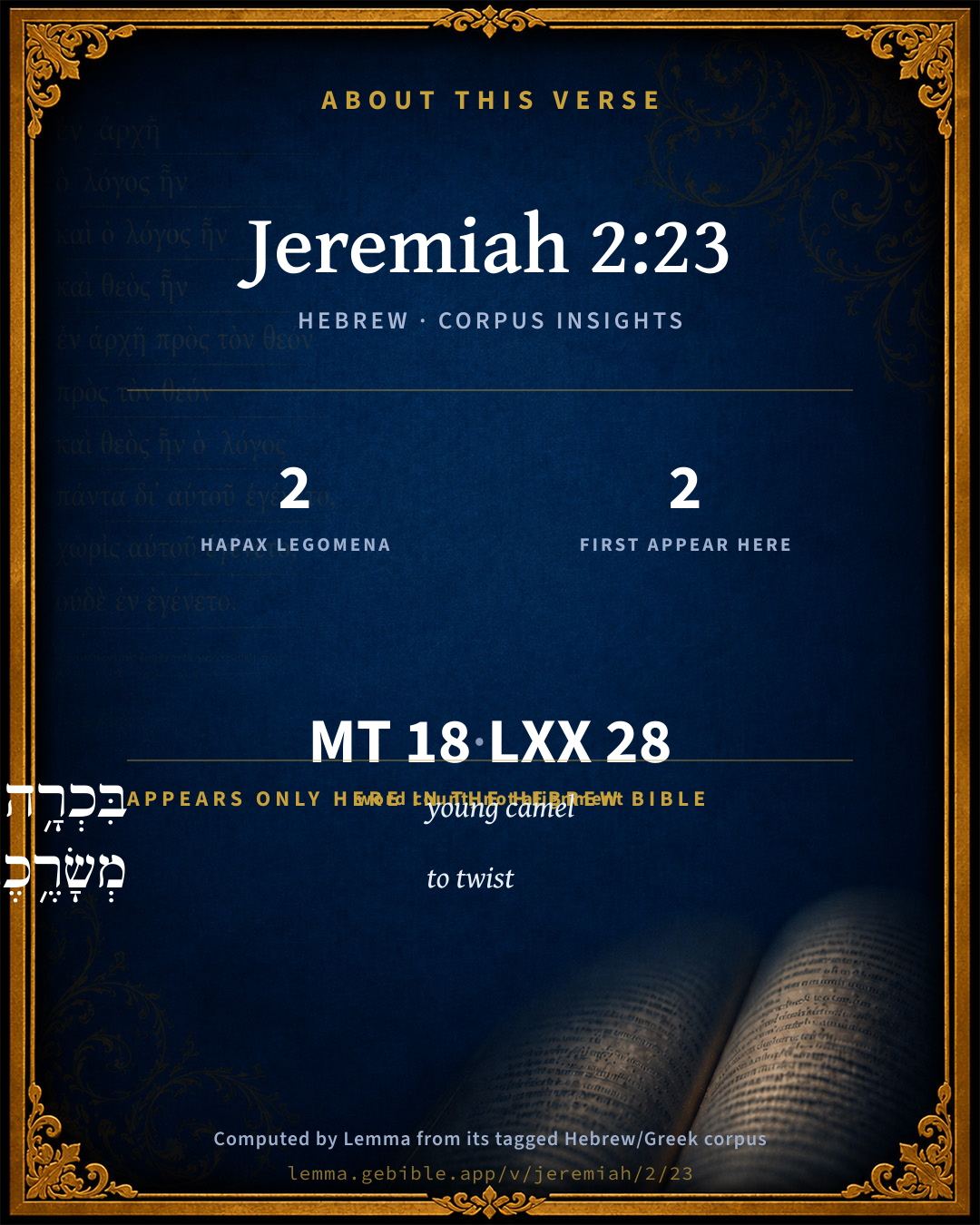
  • 2 hapax legomena — only here in the Hebrew Bible
  • 2 first appearances in the Hebrew Bible
Full analysis ↓
Download a study sheet

One document with this verse’s original text, its word-by-word gloss line, the meaning frame, cross-references with their text, attributed commentary, and full source and license credits — printable, and it pastes into notes with its structure intact.

This verse Autodidact and up

Study sheet (.html) Plain text (.txt)

A passage Seminary Student

Up to 50 verses in one chapter. A passage sheet keeps up to 6 commentary sources and 12 cross-references per verse, in the order this page ranks them, and says so on the sheet whenever that leaves anything out. Ask for a single verse and you get the Autodidact verse sheet above.

Everything on this page stays free to read, with no account — the sheet is a download of what is already on screen, not access to it.

Want to remove ads? Support Godless Engineer
Compare translations 3

The same verse in 3 English versions, stacked beneath the original-language interlinear above. Click any original word for its lexicon entry.

Each is an independent rendering of the whole verse — the interlinear is not word-aligned to these translations.

Highlighted words mark where these versions differ — a whole-verse word diff, not a word-by-word alignment.

  • World English Bible Public Domain
    How can you say, I am not defiled, I have not gone after the Baals? see your way in the valley, know what you have done: [you are] a swift dromedary traversing her ways;
  • King James Version Public Domain
    How canst thou say, I am not polluted, I have not gone after Baalim? see thy way in the valley, know what thou hast done: thou art a swift dromedary traversing her ways;
  • unfoldingWord Literal Text CC BY-SA 4.0
    How can you say, ‘I am not defiled; I have not walked after the Baals’? See your path in the valleys! Know what you have done —a swift female camel entangling her ways,

unfoldingWord Literal Text — © unfoldingWord, licensed CC BY-SA 4.0. Word-aligned USFM3 via Door43 (git.door43.org/unfoldingWord/en_ult).

Versions to compare (up to 4)

3 of 4 selected

Show all 18 translations

Every available English version of this verse, each an independent rendering of the whole verse.

  • World English Bible Public Domain
    How can you say, I am not defiled, I have not gone after the Baals? see your way in the valley, know what you have done: [you are] a swift dromedary traversing her ways;
  • Berean Standard Bible Public Domain
    “How can you say, ‘I am not defiled; I have not run after the Baals’? Look at your behavior in the valley; acknowledge what you have done. You are a swift young she-camel galloping here and there,
  • Majority Standard Bible Public Domain
    “How can you say, ‘I am not defiled; I have not run after the Baals’? Look at your behavior in the valley; acknowledge what you have done. You are a swift young she-camel galloping here and there,
  • King James Version Public Domain
    How canst thou say, I am not polluted, I have not gone after Baalim? see thy way in the valley, know what thou hast done: thou art a swift dromedary traversing her ways;
  • American Standard Version (1901) Public Domain
    How canst thou say, I am not defiled, I have not gone after the Baalim? see thy way in the valley, know what thou hast done: `thou art' a swift dromedary traversing her ways;
  • Revised Version (1885) Public Domain
    How canst thou say, I am not defiled, I have not gone after the Baalim? see thy way in the valley, know what thou hast done: thou art a swift dromedary traversing her ways;
  • Geneva Bible (1599) Public Domain
    Howe canst thou say, I am not polluted, neither haue I followed Baalim? beholde thy waies in the valley, and know, what thou hast done: thou art like a swift dromedarie, that runneth by his waies.
  • Douay-Rheims (1899) Public Domain
    How canst thou say: I am not polluted, and I have not walked after Baalim? see thy ways in the valley, know what thou hast done: as a swift runner pursuing his course.
  • Young's Literal Translation Public Domain
    How sayest thou, `I have not been defiled, After the Baalim I have not gone?' See thy way in a valley, know what thou hast done, A swift dromedary winding her ways,
  • Literal Standard Version CC BY-SA 4.0
    “How can you say, I have not been defiled, || I have not gone after the Ba‘alim? See your way in a valley, know what you have done, || A swift dromedary winding her ways,
  • Unlocked Literal Bible CC BY-SA 4.0
    How can you say, 'I am not defiled! I have not walked after the Baals'? Look at what you did in the valleys! Consider what you have done—you are a swift female camel running here and there,
  • unfoldingWord Literal Text CC BY-SA 4.0
    How can you say, ‘I am not defiled; I have not walked after the Baals’? See your path in the valleys! Know what you have done —a swift female camel entangling her ways,
  • Darby Bible Public Domain
    How sayest thou, I am not defiled, I have not gone after the Baals? See thy way in the valley, acknowledge what thou hast done -- a swift dromedary traversing her ways!
  • World Messianic Bible Public Domain
    “How can you say, ‘I am not defiled. I have not gone after the Baals’? See your way in the valley. Know what you have done. You are a swift dromedary traversing her ways,
  • Webster's Bible Public Domain
    How canst thou say, I am not polluted, I have not gone after Baalim? see thy way in the valley, know what thou hast done: thou art a swift dromedary traversing her ways;
  • Free Bible Version CC BY-SA 4.0
    How dare you say, “I'm not unclean! I haven't gone to worship the Baals!” Look at what you've been doing down in the valley. Admit what you've done! You're a young female camel, racing around everywhere.
  • Bible in Basic English Public Domain
    How are you able to say, I am not unclean, I have not gone after the Baals? see your way in the valley, be clear about what you have done: you are a quick-footed camel twisting her way in and out;
  • JPS Tanakh (1917) Public Domain
    How canst thou say: 'I am not defiled, I have not gone after the Baalim'? See thy way in the Valley, know what thou hast done; thou art a swift young camel traversing her ways;

Literal Standard Version (2020), Covenant Press — licensed CC BY-SA 4.0. Text via the HelloAO Bible API (eBible.org). Unlocked Literal Bible (unfoldingWord) — licensed CC BY-SA 4.0. Text via the HelloAO Bible API (eBible.org). unfoldingWord Literal Text — © unfoldingWord, licensed CC BY-SA 4.0. Word-aligned USFM3 via Door43 (git.door43.org/unfoldingWord/en_ult). Free Bible Version, Dr. Jonathan Gallagher — licensed CC BY-SA 4.0. Text via the HelloAO Bible API (eBible.org).

Word by word

More ways to search: Search by grammar → Find every occurrence → Compare this word →

Practice this passage: Drill this verse → Learn its vocabulary →

בִּכְרָ֥ה
bikrâh
H1072
“young camel”
Noun, Common, Feminine, Singular, Absolute
Part of Speech
Noun
Type
Common
Gender
Feminine
Number
Singular
State
Absolute
Full BDB Definition

Origin: from H1070

TWOT: 244b

a young female camel, young camel, dromedary
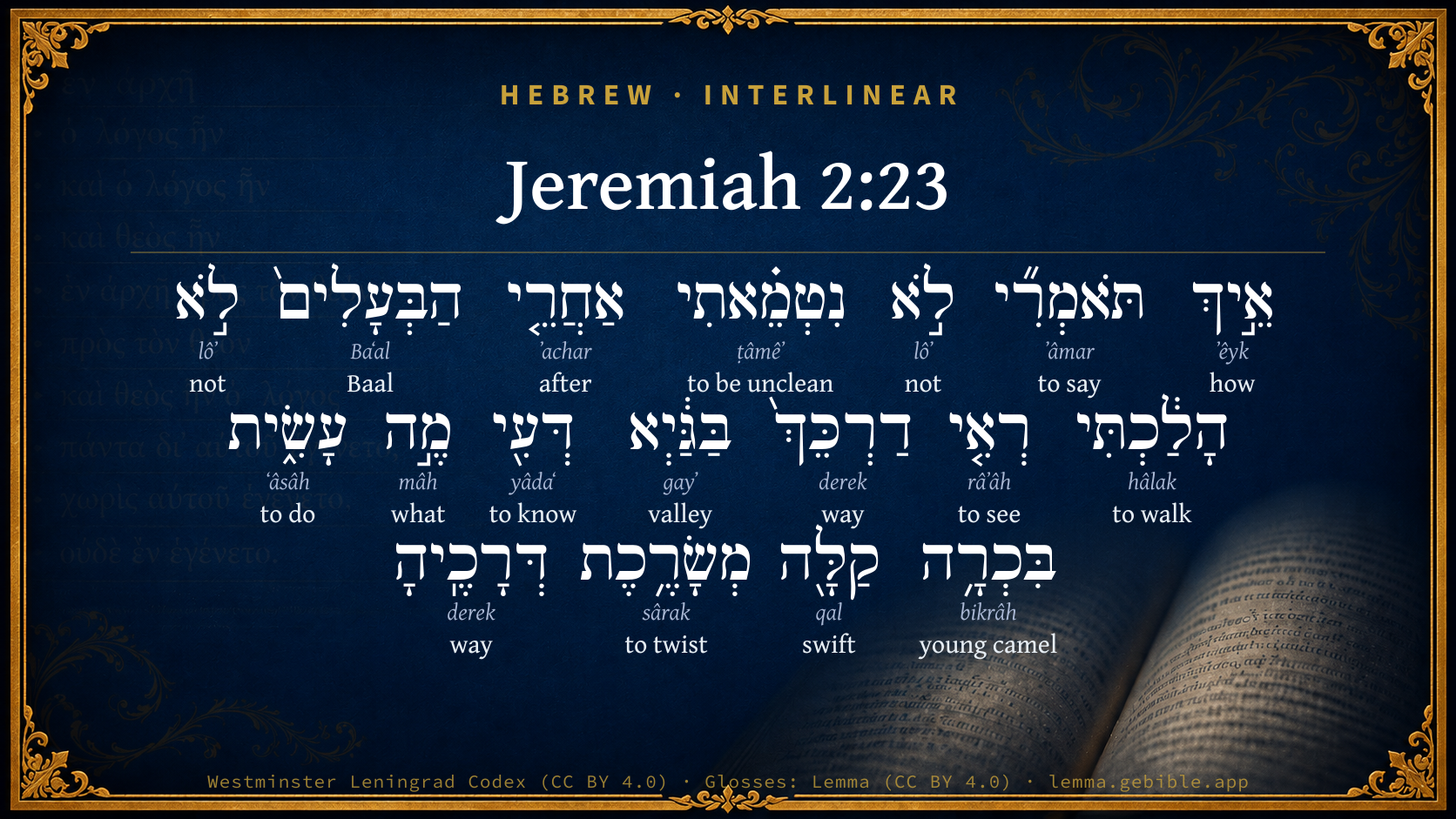
  1. אֵ֣יךְ ʼêyk H349 “how” Particle, Interrogative
  2. תֹּאמְרִ֞י ʼâmar H559 “to say” Verb, Qal, Imperfect, 2nd Person, Feminine, Singular
  3. לֹ֣א lôʼ H3808 “not” Particle, Negative
  4. נִטְמֵ֗אתִי ṭâmêʼ H2930 “to be unclean” Verb, Niphal, Perfect, 1st Person, Common, Singular
  5. אַחֲרֵ֤י ʼachar H310 “after” Preposition
  6. הַבְּעָלִים֙ Baʻal H1168 “the · Baal” Particle, Definite Article + Noun, Proper
  7. לֹ֣א lôʼ H3808 “not” Particle, Negative
  8. הָלַ֔כְתִּי hâlak H1980 “to walk” Verb, Qal, Perfect, 1st Person, Common, Singular
  9. רְאִ֤י râʼâh H7200 “see” Verb, Qal, Imperative, 2nd Person, Feminine, Singular
  10. דַרְכֵּךְ֙ derek H1870 “way · your” Noun, Common, Both, Singular, Construct + Suffix, Personal, 2nd Person, Feminine, Singular
  11. בַּגַּ֔יְא gayʼ H1516 “in/at the · valley” Preposition, Determined + Noun, Common, Both, Singular, Absolute
  12. דְּעִ֖י yâdaʻ H3045 “know” Verb, Qal, Imperative, 2nd Person, Feminine, Singular
  13. מֶ֣ה mâh H4100 “what” Particle, Interrogative
  14. עָשִׂ֑ית ʻâsâh H6213 “to do” Verb, Qal, Perfect, 2nd Person, Feminine, Singular
  15. קַלָּ֖ה qal H7031 “swift” Adjective, Adjective, Feminine, Singular, Absolute
  16. מְשָׂרֶ֥כֶת sârak H8308 “twisting” Verb, Piel, Participle Active, Feminine, Singular, Absolute
  17. דְּרָכֶֽיהָ derek H1870 “ways · her” Noun, Common, Both, Plural, Construct + Suffix, Personal, 3rd Person, Feminine, Singular

About this verse

These counts appear in no published source. They are computed here, from the morphology-tagged text and Lemma’s own curated glosses. What Lemma adds →

18
words
16
distinct lemmas
Prophets
section

Notable vocabulary

2 hapax legomena — words that appear only here in the entire Hebrew Bible:

  • בִּכְרָ֥ה young camel H1072
  • מְשָׂרֶ֥כֶת to twist H8308

First appearance in Scripture

These words make their first canonical appearance in the Hebrew Bible here:

  • בִּכְרָ֥ה young camel H1072
  • מְשָׂרֶ֥כֶת to twist H8308

Shared distinctive vocabulary

קַלָּ֖ה swift H7031 occurs in 13 verses of the Hebrew Bible. Also found in:

Grammatical profile

  • 7 verbs
  • 5 nouns
  • 1 adjective
  • 1 preposition
  • 4 particles

Verb forms

  • תֹּאמְרִ֞י Qal · Imperfect
  • נִטְמֵ֗אתִי Niphal · Perfect
  • הָלַ֔כְתִּי Qal · Perfect
  • רְאִ֤י Qal · Imperative
  • דְּעִ֖י Qal · Imperative
  • עָשִׂ֑ית Qal · Perfect
  • מְשָׂרֶ֥כֶת Piel · Participle Active

Repetition

Words recur within this verse — often emphatic in Hebrew:

  • דַרְכֵּךְ֙ way H1870 ×2
  • לֹ֣א not H3808 ×2

Hebrew & Septuagint length

In the original languages it is 18 Hebrew tokens and 28 Greek tokens — but the two are counted differently (Hebrew bundles its prefixes and suffixes into one token; the Greek is in lemma form), so that isn’t a like-for-like length.

Cross-references

20

Topical passages linked to Jeremiah 2:23 in the Treasury of Scripture Knowledge — connected by theme and wording, ordered by reader-vote popularity; previews shown in the World English Bible.

  • Jeremiah 7:31 They have built the high places of Topheth, which is in the valley of the son of Hinnom, to burn their sons and their daughters in the fire; which I didn't command, neither came it into my mind.
  • Proverbs 30:12 There is a generation that is pure in their own eyes, Yet are not washed from their filthiness.
  • Genesis 3:12–13 The man said, "The woman whom you gave to be with me, she gave me of the tree, and I ate."
  • 1 Samuel 15:13–14 Samuel came to Saul; and Saul said to him, Blessed are you by Yahweh: I have performed the commandment of Yahweh.
  • Esther 8:16 The Jews had light and gladness, and joy and honor.
  • Psalms 36:2 For he flatters himself in his own eyes, Too much to detect and hate his sin.
  • Psalms 50:21 You have done these things, and I kept silent. You thought that the "I AM" was just like you. I will rebuke you, and accuse you in front of your eyes.
  • Proverbs 28:13 He who conceals his sins doesn't prosper, But whoever confesses and renounces them finds mercy.
  • Proverbs 30:20 So is the way of an adulterous woman: She eats and wipes her mouth, And says, 'I have done nothing wrong.'
  • Isaiah 57:5–6 you who inflame yourselves among the oaks, under every green tree; who kill the children in the valleys, under the clefts of the rocks?
  • Jeremiah 2:33–35 How trimmest you your way to seek love! therefore even the wicked women have you taught your ways.
  • Jeremiah 3:2 Lift up your eyes to the bare heights, and see; where have you not been lain with? By the ways have you sat for them, as an Arabian in the wilderness; and you have polluted the land with your prostitution and with your wickedness.
  • Jeremiah 9:14 but have walked after the stubbornness of their own heart, and after the Baals, which their fathers taught them;
  • Jeremiah 31:22 How long will you go here and there, you backsliding daughter? for Yahweh has created a new thing in the earth: a woman shall encompass a man.
  • Ezekiel 16:1–63 Again the word of Yahweh came to me, saying,
  • Ezekiel 23:1–49 The word of Yahweh came again to me, saying,
  • Luke 10:29 But he, desiring to justify himself, asked Jesus, "Who is my neighbor?"
  • Romans 3:19 Now we know that whatever things the law says, it speaks to those who are under the law, that every mouth may be closed, and all the world may be brought under the judgment of God.
  • 1 John 1:8–10 If we say that we have no sin, we deceive ourselves, and the truth is not in us.
  • Revelation 3:17–18 Because you say, 'I am rich, and have gotten riches, and have need of nothing;' and don't know that you are the wretched one, miserable, poor, blind, and naked;

Cross-references courtesy of OpenBible.info (CC BY 4.0).

Hebrew and Greek witnesses Masoretic Hebrew ↔ Greek Septuagint

The same verse in the two great witnesses to the Old Testament, shown verse-for-verse.

These are two independent witnesses, not word-aligned to each other, and the Septuagint is shown in lemma (dictionary) form.

Hebrew Jeremiah 2:23 Masoretic · Westminster Leningrad Codex

אֵ֣יךְ תֹּאמְרִ֞י לֹ֣א נִטְמֵ֗אתִי אַחֲרֵ֤י הַבְּעָלִים֙ לֹ֣א הָלַ֔כְתִּי רְאִ֤י דַרְכֵּךְ֙ בַּגַּ֔יְא דְּעִ֖י מֶ֣ה עָשִׂ֑ית בִּכְרָ֥ה קַלָּ֖ה מְשָׂרֶ֥כֶת דְּרָכֶֽיהָ

How can you say, I am not defiled, I have not gone after the Baals? see your way in the valley, know what you have done: [you are] a swift dromedary traversing her ways;

World English Bible · Public Domain

Greek LXX Structure differs

In the Septuagint, Jeremiah is about an eighth shorter than the Hebrew and arranges its material differently — the Oracles Against the Nations (Hebrew chapters 46–51) appear in the middle of the Greek book, after 25:13. Because the chapter and verse boundaries do not line up, a verse-for-verse comparison with the Hebrew is not shown.

A verse-for-verse comparison isn’t shown here because the chapters and verses don’t line up. Switch to the LXX edition with the MT / LXX toggle above to read the Greek directly.

On this verse, Joseph Benson's Commentary discusses the Septuagint’s reading. Read the note in Commentary ↓

Hebrew: Westminster Leningrad Codex (CC BY 4.0). Greek: Septuagint (public domain); English from a public-domain English Septuagint. How the Septuagint differs from the Hebrew →

Targum (Aramaic paraphrase)

1

The Targum is the ancient Jewish Aramaic paraphrase of the Hebrew Scriptures — an interpretive translation, not the Hebrew text itself. Onkelos (literal) and Pseudo-Jonathan (expansive) render the Torah, and Jonathan the Prophets. Coverage is partial: where no permissively-licensed English translation exists for a verse, only the Aramaic is shown. This is verse-level text, not a word-by-word alignment to the Hebrew.

  1. Targum Jonathan Prophets (Joshua–Malachi)
    אֵיכְדֵין תֵּימְרִין לָא אִסְתְּאֲבֵית וּבָתַר טַעֲוַת עַמְמַיָא לָא הַלְכֵית זְקוּפִי עֵינַיִךְ עַל אוֹרְחָתִיךְ כַּד הֲוֵית יָתְבָא בְחֵילְתָּא לְקָבֵיל בֵּית פְּעוֹר דְעִי מָא עֲבַדְתְּ הֲוֵית דַמְיָא לְיַנְקָא קַלִילָא דִמְקַלְקְלָא אוֹרְחָתָהָא:

    (no public-domain English translation for this verse)

    Targum Jonathan — Aramaic: “Mikraot Gedolot” (public domain). English: “Sefaria Community Translation” (CC0 1.0 (public-domain dedication)); “London "Chaldee Paraphrase," 1871” (public domain). Text via Sefaria.

Commentary

Notes on Jeremiah 2:23 from classic Christian and Jewish commentators (each source and its license shown beneath its notes). The classic Christian expositions comment on the surrounding passage and are grouped to its opening verse, so a note may address several verses; the Jewish commentaries on the Tanakh (Rashi and others) are per-verse, so they appear only where the commentator wrote on this verse.

Lemma curates 59 commentaries, every one of them public domain or Creative Commons licensed, each selected and text-cleaned for this edition rather than reprinted as found. About our sources →

Trapp's Complete Commentary

John Trapp

Jer 2:23 How canst thou say, I am not polluted, I have not gone after Baalim? see thy way in the valley, know what thou hast done: [thou art] a swift dromedary traversing her ways;

Ver. 23. How canst thou say, I am not polluted?] q.d., With what face? but that sin hath woaded an impudence in thy face.

I have not gone after Baalim.] The whole crew of heathen deities - lords or masters, the word signifieth - which Cicero {a} saith were but men; their temples were their sepulchres, and their religion superstition. He further wisheth that he could as easily discern the true religion as discover the false.

See thy way in the valley.] Of Ben-Hinnom, where thou hast sacrificed thy children to Moloch, thy chief Baal - that is, say some, to the sun, as to the universal cause, strongly concurring to the generation of their children so sacrificed. {b}

Thou art a swift dromedary.] That runneth amadding after her mate; so dost thou after idols. Compare 1Co 12:2.

{a} De Nat. Deor.

{b} Sol et homo generant hominem.

John Trapp, A Commentary or Exposition upon All the Books of the Old and New Testament (1647–1656) — public domain. Text from a community e-Sword module.

The Biblical Illustrator

Joseph S. Exell

Jer_2:23-30

How canst thou say, I am not polluted.

Self-vindicating sinners reproved

I. The self-vindicating ways of sinners.

1. Direct denial (Gen_4:9).

2. Vain excuse (1Sa_15:13-15).

3. Hypocritical palliation (Gen_3:11-13).

II. God substantiates His charge against His offending people.

1. By an appeal to fact.

2. By a most apt comparison.

Dromedary and wild ass, when seeking their mate, are so bent upon attainment of desire, that efforts to catch them are vain; no one will weary himself with so fruitless a labour. But when their time of pregnancy has advanced, they fall comparatively an easy prey to the pursuer. So, to little purpose that you are followed with invitations and entreaties: you will not hear the voice of the charmer, etc. (C. Simeon, M. A.)

Know what thou hast done.

What hast thou Done?

Look at thy life in the light of--

1. Gods Divine purpose.

2. Your social position, and the circumstances by which you have been surrounded.

3. The responsibilities of the domestic relationship.

4. Your relationship to the best and tenderest of fathers.

5. The tender dealings of the Holy Spirit.

6. Your relationship with Him who, because He loved you, was content to hang upon the Cross. (W. H. M. H. Aitken, M. A.)

The Biblical Illustrator, edited by Joseph S. Exell (c. 1880s–1900s) — public domain. Text from a community e-Sword module.

Joseph Benson's Commentary

Jer 2:23-24. How canst thou say, I am not polluted? — With what face canst thou go about to excuse thyself, or deny what is so evident, and so truly charged upon thee? see Jer 2:20. I have not gone after Baalim — The word is plural, because meant to comprehend all their idols; being a name usually given to several of them, as Baal-peor, Num 25:3; Baal-zebub, 2Ki 1:16. Because they had the temple, and sacrifices offered therein, &c., they still persuaded themselves that they worshipped the true God, though they joined their idolatries with his worship. Thus the Papists, though they make use of idols in their worship, yet pretend they are not idolaters. See thy way in the valley — Whether of Hinnom, (where they burned their children in sacrifice,) or in any valleys where thou hast been frequent in thy idolatries. Know what thou hast done — Look on, and consider thy ways. Thou art a swift dromedary, traversing her ways — Or, as a swift dromedary. The prophet compares their fondness for a variety of idols to the eagerness with which, in the time of breeding, the swift dromedaries are wont to traverse the plain, and run to and fro in every direction. “And the impossibility of restraining one of those fleet animals, when hurried away by the impetuous call of nature, is represented as a parallel to that unbridled lust and eagerness with which the people of Judah ran after the gratification of their passion for idolatry, called spiritual whoredom.” — Blaney. A wild ass — Or, as a wild ass; used to the wilderness — Another similitude, for the more lively description of the same thing. That snuffeth up the wind at her pleasure — This should rather be rendered, When she snuffeth up the wind in her lust; meaning the time when the female asses seek the males by the wind, smelling them afar off. In her occasion — When she is desirous of the male; who can turn her away? — She bears down all opposition. All that seek her will not weary themselves — They will not bestow their labour in vain, but will let her take her course, and wait their time and opportunity for taking her. In her month they shall find her — Hebrew, בחדשׁה, which Blaney renders, when her heat is over; or, in her renewal, deriving the noun from the verb חדשׁ, to renew. “That is,” says he, “when the heat is abated, and she begins to come about again to the same state as before the fit came on. The LXX. seem so to have understood it: εν τη ταπεινωσει αυτης ευρησουσιν αυτην, ‘when she is humbled, they shall find her.’ And perhaps it was designed to insinuate to the Jews, by way of reproach, that they were less governable than even the brute beast, which, after having followed the bent of appetite for a little time, would cool again, and return quietly home to her owners: but the idolatrous fit in them seemed never to abate, nor to suffer the people to return to their duty. Or else it may mean, that when their affairs took a new turn, and became adverse, then would be the time when, being humbled, they would again have recourse to the true God who alone could save them.” The expression, in her month, is explained in the margin of our ancient Bible to mean, when she is with foal, an interpretation which many commentators follow. Thus Henry: “They that seek her will have a little patience till she is big with young, heavy, and unwieldy; and then they shall find her, and she cannot outrun them.” And he thus applies it: “The time will come when the most fierce will be tamed, and the most wanton will be manageable: when distress and anguish come upon them, then their ears will be open to discipline; that is the month in which you may find them.” Psa 141:5-6.

Joseph Benson's Commentary on the Old and New Testaments (1811–1818) — public domain. Text from a community e-Sword module.

Tyndale Open Study Notes

Tyndale Open Resources

2:23–3:5 Instead of acting like a faithful wife, Israel behaved like a wild animal in heat (2:23-25), a thief (2:26-30), and a prostitute (2:31–3:5).

2:23 The people protested that it was not true that they were Baal worshipers (cp. 2:25). Archaeologists have found small plaques showing an Asherah (female goddess) and a male god resembling Baal, but their inscriptions bear the name of the Lord (Yahweh). Baal worship was apparently sometimes disguised as worship of Israel’s God.

Tyndale Open Study Notes — © Tyndale Open Resources, licensed CC BY-SA 4.0. Text via the HelloAO Bible API.

Geneva Bible (1599)

Geneva Bible translators

Meaning, that hypocrites deny that they worship the idols, but that they honor God in them, and therefore they call their doings, God’s service.

He compareth the idolaters to these beasts, because they never cease running to and fro: for both valleys and hills are full of their idolatry.

Geneva Bible (1599) marginal notes — public domain. Text via Bolls.life.

Jamieson, Fausset & Brown

Robert Jamieson, A. R. Fausset & David Brown

(Pro 30:12).

Baalim--plural, to express manifold excellency: compare Elohim.

see--consider.

the valley--namely, of Hinnom, or Tophet, south and east of Jerusalem: rendered infamous by the human sacrifices to Moloch in it (compare Jer 19:2, Jer 19:6, Jer 19:13-14; Jer 32:35; see on Isa 30:33).

thou art--omit. The substantive that follows in this verse (and also that in Jer 2:24) is in apposition with the preceding "thou."

dromedary--rather, a "young she-camel."

traversing--literally, "enfolding"; making its ways complicated by wandering hither and thither, lusting after the male. Compare as to the Jews' spiritual lust, Hos 2:6-7.

Jamieson, Fausset & Brown — Commentary Critical and Explanatory on the Whole Bible (1871) — public domain (CC PDM 1.0). Text via the HelloAO Bible API.

Adam Clarke's Commentary

Verse 23. See thy way in the valley] The valley of Hinnom, where they offered their own children to Moloch, an idol of the Ammonites.

A swift dromedary traversing her ways] Dr. Blayney translates, "A fleet dromedary that hath taken to company with her."

Dr. Dahler rather paraphrases, thus: -

Semblable a une dromedaire en chaleur,

Qui court d'une tote a l'autre.

"Like to a dromedary in her desire for the male,

Which runs hither and thither."

This is an energetic comparison; and shows the unbridled attachment of those bad people to idolatry, and the abominable practices by which it was usually accompanied.

Adam Clarke's Commentary on the Bible (1810–1826) — public domain. Text from a community e-Sword/MySword module.

John Calvin's Commentaries

Jeremiah goes on here with his reproof, and dissipates the clouds of hypocrites, under which they thought themselves to be sufficiently concealed: for hypocrites, when they allege their fallacious pretences, think themselves already hidden from the eyes of God and from the judgment of all men. Hence the Prophet here sharply condemns this supine self — security, and says, How darest thou to boast that thou art not polluted? How darest thou to say, that thou hast not walked after Baalim? that is, after strange gods. I have already said, that by this word were meant inferior gods: for though the Jews acknowledged one Supreme Being, yet they sought for themselves patrons; and hence arose, as it is usual, a great number of gods. The superstitious never lapsed into that degree of impiety and madness, but that they ever confessed that there is some supreme Deity; but they added some inferior gods. And thus they had their Baalim and patrons, like the Papists, who call their patrons saints, for they dare not in their delusions to call them gods. Such was the sophistry of the Jews.

How then, he says, canst thou excuse thyself, and say, that thou hast not walked after Baalim? See, he adds, thy ways, see what thou hast done in the valley, and know at length that thou hast been like a swift dromedary The Prophet could not have fully expressed the furious passions which then raged in the Jews without comparing them to dromedaries: and as he addresses the people in the feminine gender, the female dromedary is mentioned. I consider that she is called swift, not only on account of the celerity of her course, but on account of her impetuous lust, as we shall presently see.

Now this passage teaches us, that the people had become so hardened, that they insolently rejected all reproofs given them by the prophets. Their impiety was openly manifest, and yet they ever dared to allege excuses, for the purpose of shewing that the prophets unjustly condemned them. Nor are we to wonder that such contumacy prevailed in that ancient people, since at this day we find that the Papists, with no less perverseness, resist the clear light of truth. For however gross and shameful their idolatry appears, they yet think that they evade the charge by merely saying, that their statues and images are not idols, and that the people of Israel were, indeed, condemned for inventing statues for themselves, but that they did this, because they were prone to superstition. Hence they cry against us, and say, that the worship which prevails among them is unjustly calumniated. We see, and even children know, that under the Papacy every kind of superstition prevails; and yet they seek to appear innocent, and free from every blame. The same was the case formerly: and as the temple continued, and the people offered sacrifices there, and as some kind of religion remained, whenever the prophets reproved the impious corruptions, which were blended with and vitiated the pure worship of God, and which were called adulteries, as they everywhere declare, “What!” they said, “Do we not worship God?” This very perverseness is what the Prophet now condemns by saying, How darest thou to say, I am not polluted, I have not walked after Baalim? So the Papists say at this day, “Do we not believe in one God? Have we devised for ourselves various gods? Yet they rob God of all his power, and dishonor him in a thousand ways: and at the same time they assert against us, with a meretricious mouth and an iron front, that they worship the one true God. The case was exactly the same with the Jews: but the Prophet here proves their boasting to be vain and grossly false, See, he says, thy ways in the valley; see what thou, a swift dromedary, hast done As they could not be overcome by reasons, their willfulness being so great, the Prophet compares them to wild animals: “Ye are,” he says, “like lascivious dromedaries, which are so carried away by lust, that they forget everything while pursuing their own courses.” It follows —

John Calvin's Commentaries (1540-1563) — public domain. Text from the Calvin Translation Society English edition (1840s-50s) via the Christian Classics Ethereal Library (ccel.org). Calvin's coverage is partial (roughly two-thirds of the Bible); uncommented books and verses are honest gaps, never fabricated. The 19th-century editor's footnotes and remarks are omitted so the notes are faithfully Calvin's own voice.

Ellicott's Commentary for English Readers

(23) How canst thou say . . .?—The prophet hears, as it were, the voice of the accused criminal, with its plea of “not guilty.” Had not the worship of Jehovah been restored by Josiah? Had he not, acting on Hilkiah’s counsels, suppressed Baal-worship (2Ki_23:4-5; 2Ch_34:4)? The answer to such pleas is to point to the rites that were still practised openly or in secret. In the “valley” of Ben-Hinnom, which Josiah had defiled (2Ki_23:10), the horrid ritual of Molech (Lev_18:21; Lev_20:2) was still in use (Jer_7:31), reviving, we may believe, on the death of Josiah; and this, though not actually the worship of Baal, was at least as evil, and probably, in the confluence of many forms of worship which marked the last days of the monarchy of Judah, was closely associated and practically identified with it, both by the prophet and the people (Jer_19:5; Jer_32:35).

A swift dromedary.—Better, she-camel, the Hebrew word not pointing to any specific difference. The words paint with an almost terrible vividness the eager, restless state of the daughter of Zion in its harlot-like lust for the false gods of the heathen. The female camel, in the uncontrollable violence of its brute passion, moving to and fro with panting eagerness—that was now the fit image for her who had once been the betrothed of Jehovah.

A Bible Commentary for English Readers, edited by Charles John Ellicott (1878–1897) — public domain. Text from a community e-Sword module.

The Cambridge Bible for Schools and Colleges

gen. ed. J. J. S. Perowne

23. If we may assume that this utterance relates to the time before Josiah’s reforms, the people could not deny that their worship at the high places included observances outside those belonging to Jehovah. They maintained, however, that it was to Him and not to the Baals, that their service was all the time actually rendered. The prophet here replies that in adopting heathen rites they ipso facto, whatever intention they might plead, rendered their worship abhorrent to the God of Israel.

Baalim] The Hebrew plural. See on Jer_2:8.

the valley] The valley of Hinnom; see on Jer_7:31. It was devoted under idolatrous kings to impure sacrifices and human offerings to Molech, who no doubt was one of the gods called collectively Baalim. (Cp. Jer_7:31 f., Jer_19:5, Jer_32:35.) The valley was defiled by Josiah in order that such sacrifices might cease, and here dead bodies of men and animals were cast. From the Hebrew word in a Greek dress (Gehenna) comes one of the names for the place of future punishment, of which this valley was considered by the later Jews a symbol, and which some of them believed to contain the entrance to hell.

dromedary] better, as mg. young camel. The Hebrew denotes a female that has not yet had a foal.

traversing] (lit. entangling) running quickly hither and thither in the eagerness of her passion, crossing and recrossing her own course. So Israel runs now here now there, ever in search of a fresh object of devotion, and forsaking her lawful Spouse.

The Cambridge Bible for Schools and Colleges (gen. ed. J. J. S. Perowne; Cambridge University Press, 1878–1918) — public domain. Text from a community e-Sword module.

John Gill's Exposition

A wild ass used to the wilderness,.... That is, one that has been brought up in the wilderness, and has been accustomed to live, and run, and range about there; as men in general are compared to this creature for its ignorance, stupidity, folly, stubbornness, and unteachableness, Job 11:12, so the Jewish people are represented as like unto it, for its wantonness and lust:

that snuffeth up the wind at her pleasure; draws it in at her nostrils, and snuffs it up; or opens her mouth, and takes it in with her breath; drinks it in, and swallows it up at her pleasure: or, "with the desire of her soul" (c); it being grateful and delightful to her. Some read this clause in connection with rendered "in her occasion"; and differently translate it. The Targum takes it to have the signification of "dragons"; or whales; and renders it,

"drinking the wind as a dragon;''

and so Jarchi, who compares it with Jer 14:6 "they snuffed up the wind like dragons"; and so the Syriac version, "thou hast drawn up the wind like a wild dog"; others render it, "gathering the wind of her occasion"; or, "of her meeting" (d); taking it in, and snuffing it up, as she occasionally met with it in running. The Vulgate Latin version is, "she drew the wind of her love"; it is reported of the wild ass, that it can smell its mate afar off, and, by the wind it snuffs, knows where it is; for which purpose it runs up the hills and mountains to get the scent, which, when it has, its lust is so violent that there is no stopping of it till it comes to the place where its mate is: wherefore it follows,

in her occasion who can turn her away? when this violent fit is upon her, there is no turning her away from pursuing the enjoyment of it; which is expressive of the eager desire of the Jews after the worshipping of idols, how bent upon it, and not to be reclaimed from it:

all they that seek her will not weary themselves; knowing that they can not overtake her, or stop her in her career, or hinder her gratification of her lust. This may be understood either of those who sought to commit spiritual adultery or idolatry with the Jews, they need not weary themselves, being easy to be found by them; or of the prophets that sought to reclaim them, who, perceiving how stubborn, and untractable, and irreclaimable they were, would not weary themselves with their admonitions and reproofs, seeing they were in vain:

in her month they shall find her; not that this creature sleeps one whole month in a year, as Jarchi dreams, when it may be easily taken; but the sense is, that when it is with young, and in the last month, and so is heavy with its burden, it may easily be found and taken; so when the people of Israel should have filled up the measure of their iniquity, and the judgment of God was fallen and lay heavy upon them; then those that sought to return them from their evil ways might find them, and hope to succeed in reclaiming them, and bringing them to repentance; agreeably the Septuagint render it, "in her humiliation"; when chastised and humbled by the Lord for her sins. This is not to be understood of the month of Ab, in which Jerusalem was destroyed, both by Nebuchadnezzar and Titus; in which month the Jews are sure to be found confessing their sins, and humbling themselves, as Kimchi, Abarbinel, and Ben Melech interpret it; nor of the new moon, as others; at everyone of which, those who sought to join with them in idolatrous practices might be sure to find them at them.

(c) "in, vel pro desiderio animae suae", Pagninus, Montanus, Junius & Tremellius, Vatablus, Schmidt. (d) "ventum occasionis suae", Pagninus Montanus; "veatum occursus sui", Calvin.

John Gill's Exposition of the Whole Bible (1746–1763) — public domain (CC PDM 1.0). Text via the HelloAO Bible API.

Albert Barnes' Notes on the Bible

In their defense of themselves (compare Jer 2:35), the people probably appealed to the maintenance of the daily sacrifice, and the Mosaic ritual: and even more confidently perhaps to Josiah’s splendid restoration of the temple, and to the suppression of the open worship of Baal. All such pleas availed little as long as the rites of Moloch were still privately practiced.

Thy way in the valley - i. e., of Hinnom (see 2Ki 23:10 note). From the time of Ahaz it had been the seat of the worship of Moloch, and the prophet more than once identifies Moloch with Baal. “Way” is put metaphorically for “conduct, doings.”

Traversing - Interlacing her ways. The word describes the tangled mazes of the dromedary’s course, as she runs here and there in the heat of her passion.

Albert Barnes' Notes on the Bible (1834–1885) — public domain. Text from a community e-Sword/MySword module.

Haydock's Catholic Bible Commentary

Valley of Hinnom, under the very walls of Jerusalem. (Calmet) --- Runner. Hebrew, "dromedary," which takes its name from its swiftness. (Haydock) --- The female camel continues all day with the male, and cannot be approached. (Aristotle; Pliny, [Natural History?] x. 63.) --- Juda is represented as no less libidinous. (Calmet)

George Leo Haydock (1774–1849), Haydock's Catholic Family Bible and Commentary, 1859 edition — public domain. Excludes Psalms (Douay-Rheims chapter numbering differs from Protestant) and Deuterocanonical books (Catholic canon only).

Matthew Poole's English Annotations

How canst thou say? with what face canst thou go about to excuse thyself, or deny what is so evident, and so truly charged upon thee? Jer 2:20.

I have not gone after Baalim: the word is plural, as comprehensive of all their idols, Hos 11:2, and is a name usually given to several of them, as Baal-zebub, 2Ki 1:16, and Baal-peor, Num 25:3, and therefore their worshipping of many. Because they had the temple and sacrifices, &c., they still persuaded themselves that they worshipped the true God, though they joined their idolatries with it; as the papists though they make use of idols in worship, yet would not be accounted idolaters.

Thy way; the filthiness thou hast left behind thee, whereby thou mayst be traced, where thou leftest, as it were, thy footsteps, and monuments of thy frequent idolatries.

Thy way in the valley; thy frequent course in the valleys, whether of Hinnom, where they burnt their children’s bones in sacrifice, Jer 7:31, or in any valleys where thou hast been frequent in thy idolatries; it seems to be thus largely taken.

Know what thou hast done; look on and consider thy ways, as Jer 2:19.

Thou art a swift dromedary; or, thou art as, &c.; or, O dromedary, a beast much used by carriers in Arabia, being rife there. See on Isa 60:6.

Traversing; a metaphor taken from creatures that are hunted, that keep no direct path; alluding to the nature of the she dromedary, which in gendering time runs capering this way, and crossing that way, making many vagaries to find out sometimes one male, sometimes another, without any rule or order; setting forth hereby the disposition of this people, that were so mad upon their idols, that they ran sometimes after this, and sometimes after that, called wandering, Jer 2:20, and that with great eagerness, fitly termed traversing, much like the description of a whore, Pro 7:11,12; the word being no where found but here, and being derived from a word that signifies a shoe-latchet, If any be curious, let the learned consult Synop. Critic., and the English reader the English Annotations on the place.

Matthew Poole's English Annotations on the Holy Bible (1683–1685) — public domain. Text from a community e-Sword/MySword module.

Whedon's Commentary on the Bible

Daniel D. Whedon

23, 24. I am not polluted — New and most significant imagery is employed to illustrate the insane lust of idolatry. The reckless greed of the people for the excitements of the false worship is figured by the swift dromedary traversing her ways, and the wild ass running herself weary in her heat.

Thy way in the valley — Is probably an allusion to the valley of Ben-Hinnom, to the south of Jerusalem, where the rites of Moloch were celebrated, and which had become infamous as the place where human sacrifices were offered. It was fitly a type of hell and its ever-burning fire.

Swift dromedary — Rather, camel-filly. The adjective suggests the animal heat which is the main feature of the comparison. “Traversing” — that is, crossing, or interweaving; a graphic picture of urgent, unregulated haste.

Wild ass — Emblem of unbridled licentiousness. See Job_24:5; Job_39:5.

Snuffeth up wind… occasion… her month — All these terms point to the one feature of the comparison — the passionate heat of the animal.

Daniel D. Whedon (gen. ed.), Commentary on the Old and New Testaments (1874–1909) — public domain. Text from a community e-Sword module.

The Pulpit Commentary

How canst thou say, etc.? This is not a mere rhetorical fiction equivalent to "or if thou shouldst perhaps say," but probably represents an objection really made by the inhabitants of the kingdom of Judah. Their fault was not in neglecting the public worship of Jehovah in his appointed temple, but in super-adding to this, idolatrous rites inconsistent with the spiritual religion taught by Jeremiah. The people did not, it seems, regard this as tantamount to "following Baalim," just as some converts to Christianity in our own foreign missions might exclaim against being accused of apostasy, because they secretly carry on certain heathen practices. The prophet, however, applies a more rigorous test to their conduct. Baalim; the plural of Baal, used for "other gods". (Jer_1:16; comp. on ver. 8) Thy way in the valley. The valley in this context can only be that of Hinnom, (see on Jer_7:31) which from the time of Ahaz had been defiled with the rites of "Moloch, horrid king" (see "Paradise Lost," 1:392-396). Thou art a swift dromedary. Ewald would attach this half of the verse to ver. 24; and there is something to be said for this plan. Swift dromedary is, properly speaking, in the vocative. The ardor of the people for idolatry is expressed by the comparison of it to the uncontrollable instinct of brute beasts. The word rendered "dromedary" is in the feminine gender; it means strictly the young she-camel which has not yet had a foal. Traversing her ways; rather, interlacing her ways; i.e. running backwards and forwards at the impulse of passion.

Vers. 26-28. The shameless shame of idolatry.

I ITS DEGRADING INFLUENCE. It violates all morality. Is repeatedly affronted by the discoveries which are made of its wickedness and folly. It affects the whole nation from the highest and the best. The reason is debased and set at naught.

II CALAMITY IS THE TEST OF ITS PRETENSIONS. Whilst things go well with the idolater he forgets God or consciously dishonors him. But when he is overtaken with the consequences of his evil deeds he is not ashamed to call upon God. The unreasonableness and inconsistency of this conduct are no barrier to it. Beneath the unbelief and worldliness of men there is a tacit belief in the goodness and power of God. In prosperity they are idolaters, in adversity they find their way back to the God they had despised. This is the universal and permanent inconsistency of the world life. M.

The Pulpit Commentary (1880–1919), ed. H.D.M. Spence-Jones & Joseph S. Exell — public domain. Text from a community e-Sword module.

John Wesley's Explanatory Notes

Baalim - The word is plural, as comprehensive of all their idols. Thy way - The filthiness thou hast left behind thee, whereby thou mayst be traced. Valley - Whether of Hinnom where they burnt their children in sacrifice, or in any valleys where thou hast been frequent in thy idolatries. Traversing - A metaphor taken from creatures that are hunted, that keep no direct path.

John Wesley, Explanatory Notes Upon the Whole Bible (1754–1765) — public domain. Text via the GEBible commentary corpus.

unfoldingWord translationNotes

Door43 World Missions Community

How can you say, 'I ... have not walked after the Baals'?

God uses this question to rebuke his people for saying that they have not worshiped the Baals. AT: "You lie when you say, 'I ... have not walked after the Baals.' (See: Rhetorical Question)

walked after

This is a metaphor for serving or worshiping. (See: Metaphor)

you are a swift female camel running here and there

God speaks of Israel worshiping other gods as if they were like a female camel running in different directions looking for a male camel to mate with. AT: "You are like a swift female camel running back and forth looking for a male camel to mate with" (See: Metaphor)

swift

able to run quickly

a wild donkey accustomed to the wilderness, in her heat sniffing the wind

God speaks of Israel worshiping other gods as if they were a wild female donkey running to find male donkeys. AT: "You are like a young female donkey that lives in the desert. When she wants to mate she is out of control and constantly sniffs the breeze to find a mate" (See: Metaphor)

in her heat

This phrase is an idiom referring to the time when a female donkey wants to mate with male donkeys. AT: "when she wants to mate" (See: Idiom)

Who can restrain her lust?

This question is used to emphasize that no one can control a female donkey when she is wants to mate with a male donkey. AT: "No one can turn her around when she wants to mate." (See: Rhetorical Question)

You must restrain your feet from becoming bare and your throat from being thirsty!

God speaks of Israel wanting to worship other gods as if they were running around in the desert looking for those gods. AT: "I have told you to stop running here and there chasing after false gods, because all that it does is wear out your sandals and make you very thirsty" (See: Metaphor)

It is hopeless

"There is no hope for us to restrain ourselves." This implies that they cannot stop themselves from running after other gods. AT: "We cannot stop ourselves" (See: Assumed Knowledge and Implicit Information)

No, I love strangers and go after them!

Here "strangers" represents foreign gods, and "go after them" represents worshiping them. AT: "We must follow after foreign gods and worship them!'" (See: Metaphor)

translationWords

defile

Baal

understand

camel

donkey

desert

love

unfoldingWord translationNotes — © Distant Shores Media and the Door43 World Missions Community, licensed CC BY-SA 4.0. Source: git.door43.org/Door43/en_tn.

Rashi

Rabbi Shlomo Yitzchaki (Rashi)

See your way in the valley See what you have done opposite Beth-Peor, and until now you adhere to that way like a swift she camel clinging to her ways.

young she-camel Heb. בכרה, a young female camel, that loves to wander. “The young camels (בכרי) of Midian” (Isa. 60:6) is translated “and they are young camels,” as we find in Sanhedrin 52a: There are many old camels laden with the skins of young camels (הוגני).

clinging Adhering to the ways of her youth, an expression similar to: “it would have clung (מסריך סריך)” (Chullin 51a). This may be associated with “a shoe thong (שרוך נעל)” (Gen. 14:23). She binds the ways of her youth in her heart.

Rashi on the Tanakh — English translations: “The Judaica Press complete Tanach with Rashi, translated by A. J. Rosenberg” (CC BY 4.0); “Pentateuch with Rashi's commentary by M. Rosenbaum and A.M. Silbermann, 1929-1934” (public domain); “The Metsudah Tanach series, Lakewood, N.J” (CC BY 4.0); and “The Book of Joshua, Metsudah Publications, 1997” (CC BY 4.0). Text via Sefaria.

Lesson kit

Teaching starters — assembled from the data on this page, not authored interpretation. Every prompt links to the verse data it draws on. Edit before teaching.

Jeremiah, in the Prophets, opens this verse with 18 words (16 distinct Hebrew lemmas). Its most distinctive word is bikrâh (“young camel”). A historical commentator’s framing appears above. Read the whole chapter for the surrounding context.

Discussion questions

  1. How does “young camel” (bikrâh) shape what this verse is saying?
  2. This verse holds 2 words here found nowhere else in the Hebrew Bible. What might the rare words draw attention to?
  3. 2 words here appear for the first time in Scripture. What is being introduced at this debut?
  4. 2 Samuel 2:18 shares the word «swift» with this verse. How do the two illuminate each other?
  5. “way” occurs 2× in this one verse. What is the effect of the repetition?
  6. The translations on this page render this verse differently — a whole-verse word diff, not a word-by-word alignment. What might account for the different wordings?
  7. The verb «תֹּאמְרִ֞י» is Qal Imperfect. How does its form color the action?
  8. Reading how Trapp's Complete Commentary and The Biblical Illustrator read this verse, where do the two commentators agree and where do they part?

Things to notice

  • 2 words in this verse appear nowhere else in the Hebrew Bible.
  • 2 words make their first canonical appearance in Scripture here.
  • This verse counts 18 Hebrew ↔ 28 Greek words.
  • These translations choose different wording for 18 words in this verse.
  • “way” occurs 2× in this single verse.

Reading settings

Reading text

Shown beneath each verse's original-language words.

Old Testament
Old Testament edition

Read the OT as the Masoretic Hebrew (MT) or the Greek Septuagint (LXX).

English shown for the Greek Septuagint (in the Hebrew ↔ Greek comparison).

Comparing translations? Open the Compare panel on any verse page to stack up to four side by side.