Psalms 30:9

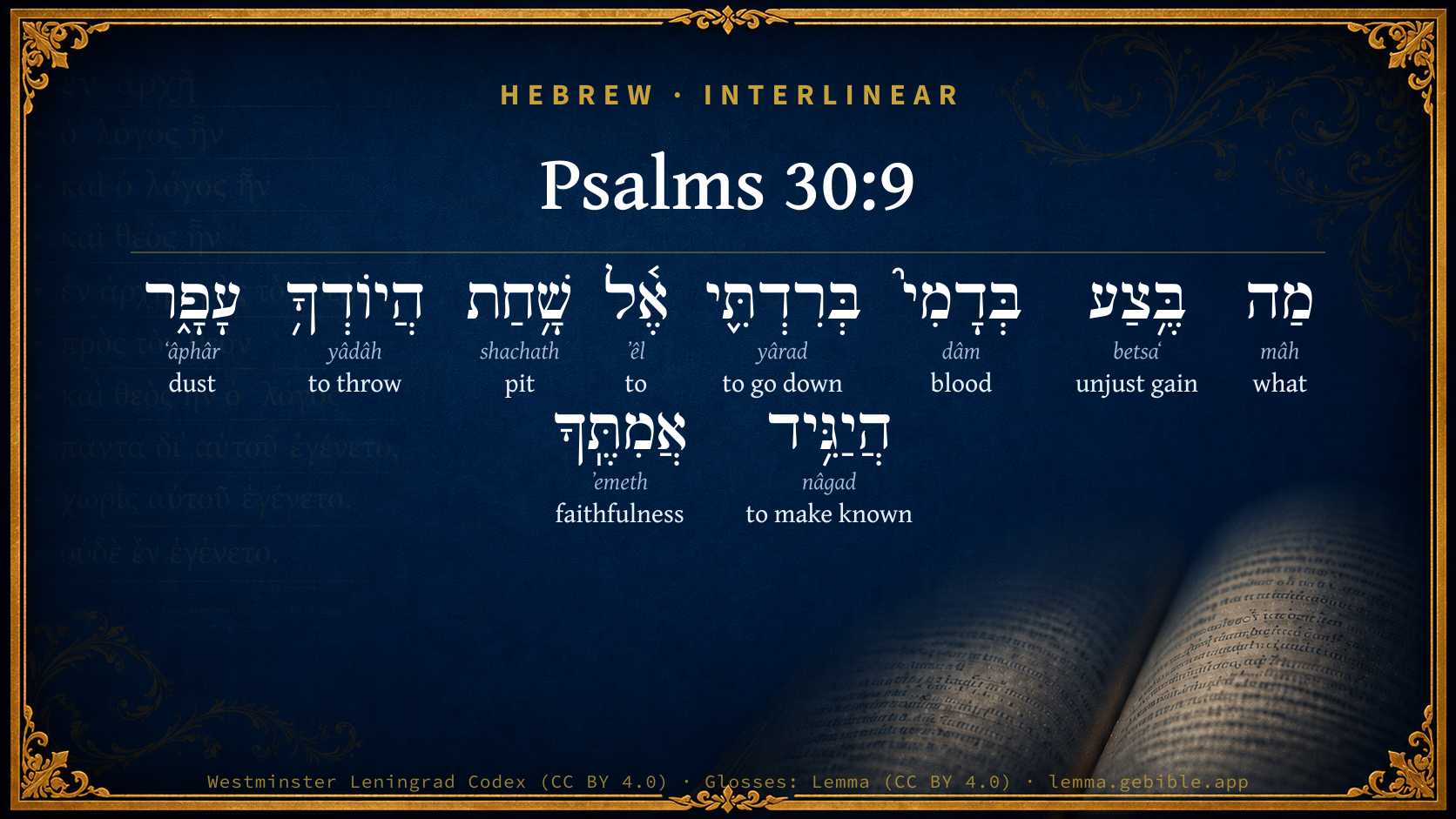
Hebrew (Westminster Leningrad Codex) Psalms 30:9 appears in the Hebrew Old Testament. The text above is from the Westminster Leningrad Codex. Each word links to its Strong’s number, a concise gloss, and parsing drawn from the Open Scriptures Hebrew Bible morphology. Click any word for its full Brown-Driver-Briggs (BDB) entry.
Download image
Cite this verse

Psalms 30:9 (World English Bible). Public Domain. Lemma interlinear Bible study tool, https://lemma.gebible.app/v/psalms/30/9.

Show BibTeX & RIS
BibTeX
RIS
English Translation
"What profit is there in my destruction, if I go down to the pit? Shall the dust praise you? Shall it declare your truth?
World English Bible · Public Domain
Download a study sheet

One document with this verse’s original text, its word-by-word gloss line, the meaning frame, cross-references with their text, attributed commentary, and full source and license credits — printable, and it pastes into notes with its structure intact.

This verse Autodidact and up

Study sheet (.html) Plain text (.txt)

A passage Seminary Student

Up to 50 verses in one chapter. A passage sheet keeps up to 6 commentary sources and 12 cross-references per verse, in the order this page ranks them, and says so on the sheet whenever that leaves anything out. Ask for a single verse and you get the Autodidact verse sheet above.

Everything on this page stays free to read, with no account — the sheet is a download of what is already on screen, not access to it.

Want to remove ads? Support Godless Engineer
Compare translations 3

The same verse in 3 English versions, stacked beneath the original-language interlinear above. Click any original word for its lexicon entry.

Each is an independent rendering of the whole verse — the interlinear is not word-aligned to these translations.

Highlighted words mark where these versions differ — a whole-verse word diff, not a word-by-word alignment.

  • World English Bible Public Domain
    "What profit is there in my destruction, if I go down to the pit? Shall the dust praise you? Shall it declare your truth?
  • King James Version Public Domain
    What profit is there in my blood, when I go down to the pit? Shall the dust praise thee? shall it declare thy truth?
  • unfoldingWord Literal Text CC BY-SA 4.0
    “What profit in my blood, in my descent to the pit? Will the dust praise you? Will it declare your faithfulness?

unfoldingWord Literal Text — © unfoldingWord, licensed CC BY-SA 4.0. Word-aligned USFM3 via Door43 (git.door43.org/unfoldingWord/en_ult).

Versions to compare (up to 4)

3 of 4 selected

Show all 18 translations

Every available English version of this verse, each an independent rendering of the whole verse.

  • World English Bible Public Domain
    "What profit is there in my destruction, if I go down to the pit? Shall the dust praise you? Shall it declare your truth?
  • Berean Standard Bible Public Domain
    “What gain is there in my bloodshed, in my descent to the Pit? Will the dust praise You? Will it proclaim Your faithfulness?
  • Majority Standard Bible Public Domain
    “What gain is there in my bloodshed, in my descent to the Pit? Will the dust praise You? Will it proclaim Your faithfulness?
  • King James Version Public Domain
    What profit is there in my blood, when I go down to the pit? Shall the dust praise thee? shall it declare thy truth?
  • American Standard Version (1901) Public Domain
    What profit is there in my blood, when I go down to the pit? Shall the dust praise thee? shall it declare thy truth?
  • Revised Version (1885) Public Domain
    What profit is there in my blood, when I go down to the pit? Shall the dust praise thee? shall it declare thy truth?
  • Geneva Bible (1599) Public Domain
    What profite is there in my blood, when I go downe to the pit? shall the dust giue thankes vnto thee? or shall it declare thy trueth?
  • Douay-Rheims (1899) Public Domain
    To thee, O Lord, will I cry: and I will make supplication to my God.
  • Young's Literal Translation Public Domain
    `What gain `is' in my blood? In my going down unto corruption? Doth dust thank Thee? doth it declare Thy truth?
  • Literal Standard Version CC BY-SA 4.0
    “What gain [is] in my blood? In my going down to corruption? Does dust thank You? Does it declare Your truth?
  • Unlocked Literal Bible CC BY-SA 4.0
    What advantage is there in my death, if I go down to the grave? Will the dust praise you? Will it declare your trustworthiness?
  • unfoldingWord Literal Text CC BY-SA 4.0
    “What profit in my blood, in my descent to the pit? Will the dust praise you? Will it declare your faithfulness?
  • Darby Bible Public Domain
    What profit is there in my blood, in my going down to the pit? shall the dust praise thee? shall it declare thy truth?
  • World Messianic Bible Public Domain
    “What profit is there in my destruction, if I go down to the pit? Shall the dust praise you? Shall it declare your truth?
  • Webster's Bible Public Domain
    \\30:8\\I cried to thee, O LORD; and to the LORD I made supplication.
  • Free Bible Version CC BY-SA 4.0
    What would you gain if I die, if I go down into the pit of death? Would my dust praise you? Would it tell of your trustworthiness?
  • Bible in Basic English Public Domain
    What profit is there in my blood if I go down into the underworld? will the dust give you praise, or be a witness to your help?
  • JPS Tanakh (1917) Public Domain
    (30-10) 'What profit is there in my blood, when I go down to the pit? Shall the dust praise Thee? shall it declare Thy truth?

Literal Standard Version (2020), Covenant Press — licensed CC BY-SA 4.0. Text via the HelloAO Bible API (eBible.org). Unlocked Literal Bible (unfoldingWord) — licensed CC BY-SA 4.0. Text via the HelloAO Bible API (eBible.org). unfoldingWord Literal Text — © unfoldingWord, licensed CC BY-SA 4.0. Word-aligned USFM3 via Door43 (git.door43.org/unfoldingWord/en_ult). Free Bible Version, Dr. Jonathan Gallagher — licensed CC BY-SA 4.0. Text via the HelloAO Bible API (eBible.org).

Word by word

More ways to search: Search by grammar → Find every occurrence → Compare this word →

Practice this passage: Drill this verse → Learn its vocabulary →

בֶּ֥צַע
betsaʻ
H1215
“unjust gain”
Noun, Common, Masculine, Singular, Absolute
Part of Speech
Noun
Type
Common
Gender
Masculine
Number
Singular
State
Absolute
Full BDB Definition

Origin: from H1214

TWOT: 267a

profit, unjust gain, gain (profit) acquired by violence
  1. מַה mâh H4100 “what” Particle, Interrogative
  2. בְּדָמִי֮ dâm H1818 “in/at · blood · my” Preposition + Noun, Common, Masculine, Singular, Construct + Suffix, Personal, 1st Person, Common, Singular
  3. בְּרִדְתִּ֪י yârad H3381 “in/at · to go down · me” Preposition + Verb, Qal, Infinitive Construct + Suffix, Personal, 1st Person, Common, Singular
  4. אֶ֫ל ʼêl H413 “to” Preposition
  5. שָׁ֥חַת shachath H7845 “pit” Noun, Common, Feminine, Singular, Absolute
  6. הֲיוֹדְךָ֥ yâdâh H3034 “to throw · you” Particle, Interrogative + Verb, Hiphil, Imperfect, 3rd Person, Masculine, Singular + Suffix, Personal, 2nd Person, Masculine, Singular
  7. עָפָ֑ר ʻâphâr H6083 “dust” Noun, Common, Masculine, Singular, Absolute
  8. הֲיַגִּ֥יד nâgad H5046 “to make known” Particle, Interrogative + Verb, Hiphil, Imperfect, 3rd Person, Masculine, Singular
  9. אֲמִתֶּֽךָ ʼemeth H571 “faithfulness · your” Noun, Common, Feminine, Singular, Construct + Suffix, Personal, 2nd Person, Masculine, Singular

About this verse

These counts appear in no published source. They are computed here, from the morphology-tagged text and Lemma’s own curated glosses. What Lemma adds →

10
words
10
distinct lemmas
Wisdom
section

Notable vocabulary

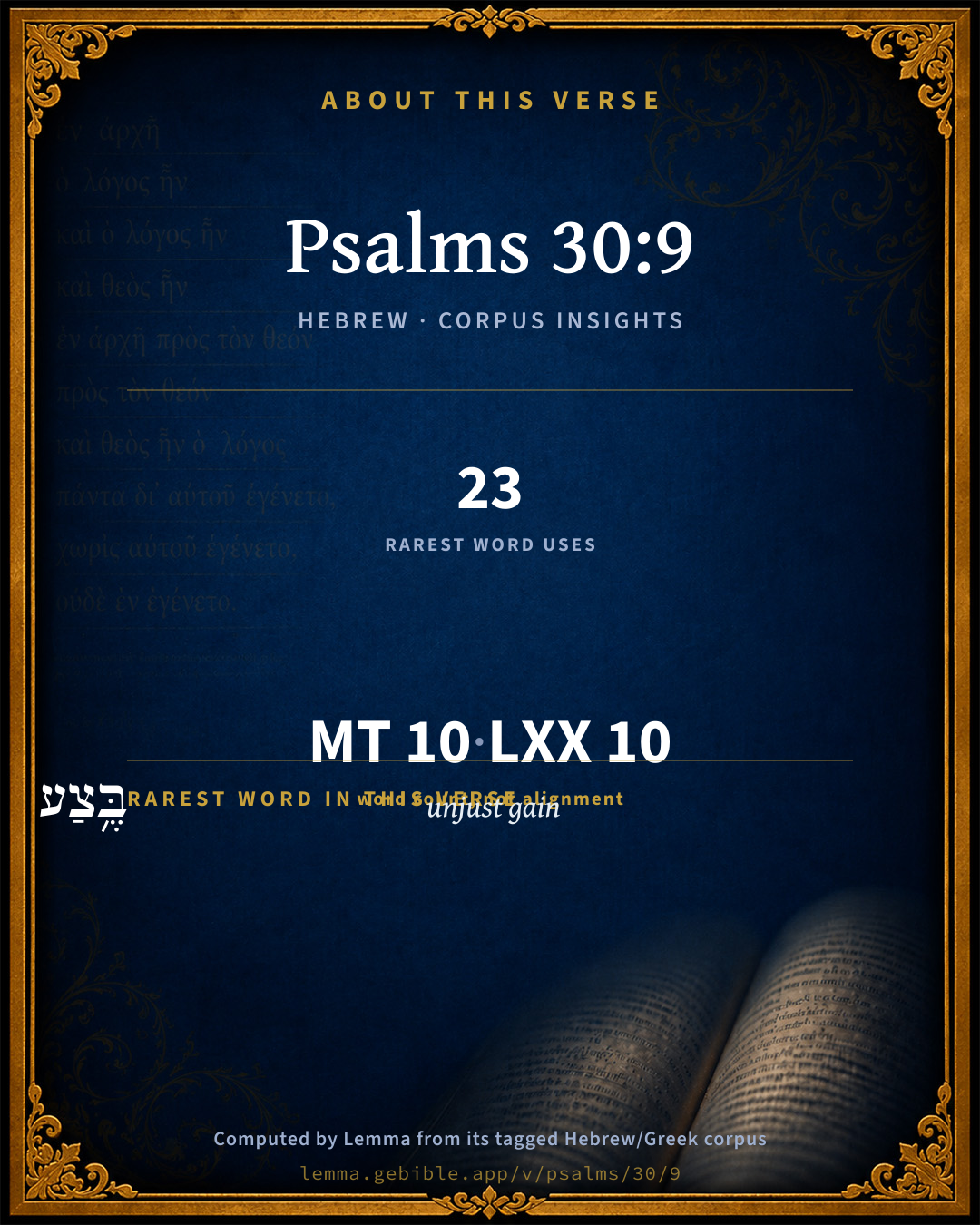
The rarest word here is בֶּ֥צַע unjust gain H1215 — appearing just 23 times in the whole Hebrew Bible.

Shared distinctive vocabulary

בֶּ֥צַע unjust gain H1215 occurs in 23 verses of the Hebrew Bible. Also found in:

Grammatical profile

  • 3 verbs
  • 5 nouns
  • 1 preposition
  • 1 particle

Verb forms

  • בְּרִדְתִּ֪י Qal · Infinitive Construct
  • הֲיוֹדְךָ֥ Hiphil · Imperfect
  • הֲיַגִּ֥יד Hiphil · Imperfect

Hebrew & Septuagint length

In English translation the verse runs 24 words from the Hebrew and 26 from the Septuagint (LXX English) — closely comparable.

A rough comparison of the two English renderings, which tokenize alike — not a word-level alignment.

Word counts can differ between the Hebrew and the Greek without any difference in meaning — e.g. the Hebrew direct-object marker אֵת has no separate Greek word, and Greek often adds the article ὁ.

In the original languages it is 10 Hebrew tokens and 10 Greek tokens — but the two are counted differently (Hebrew bundles its prefixes and suffixes into one token; the Greek is in lemma form), so that isn’t a like-for-like length.

Cross-references

6

Topical passages linked to Psalms 30:9 in the Treasury of Scripture Knowledge — connected by theme and wording, ordered by reader-vote popularity; previews shown in the World English Bible.

  • Psalms 6:5 For in death there is no memory of you. In Sheol, who shall give you thanks?
  • Psalms 115:17–18 The dead don't praise Yah, Neither any who go down into silence;
  • Isaiah 38:18 For Sheol can't praise you, death can't celebrate you: Those who go down into the pit can't hope for your truth.
  • Psalms 88:10–12 Do you show wonders to the dead? Do the dead rise up and praise you? Selah.
  • Psalms 118:17 I will not die, but live, And declare Yah's works.
  • Ecclesiastes 9:10 Whatever your hand finds to do, do it with your might; for there is no work, nor device, nor knowledge, nor wisdom, in Sheol, where you are going.

Cross-references courtesy of OpenBible.info (CC BY 4.0).

Hebrew and Greek witnesses Masoretic Hebrew ↔ Greek Septuagint

The same verse in the two great witnesses to the Old Testament, shown verse-for-verse.

You’re reading Greek Psalm 29 (Hebrew Psalm 30). The Septuagint counts the superscription, so verse numbers can differ from the Hebrew — chapter-level alignment, not verse-by-verse. Numbering follows Rahlfs.

These are two independent witnesses, not word-aligned to each other, and the Septuagint is shown in lemma (dictionary) form.

Hebrew Psalms 30:9 Masoretic · Westminster Leningrad Codex

מַה בֶּ֥צַע בְּדָמִי֮ בְּרִדְתִּ֪י אֶ֫ל שָׁ֥חַת הֲיוֹדְךָ֥ עָפָ֑ר הֲיַגִּ֥יד אֲמִתֶּֽךָ

"What profit is there in my destruction, if I go down to the pit? Shall the dust praise you? Shall it declare your truth?

World English Bible · Public Domain

Greek LXX Greek Psalm 29:9 Septuagint · lemma form

πρός σύ κύριος κράζω καί πρός ὁ θεός ἐγώ δέω

What profit is there in my blood, when I go down to destruction? Shall the dust give praise to you? or shall it declare your truth?

LXX2012 (modern English Septuagint) · Public Domain

Hebrew: Westminster Leningrad Codex (CC BY 4.0). Greek: Septuagint (public domain); English from LXX2012 (modern English Septuagint) (Public Domain). How the Septuagint differs from the Hebrew →

Commentary

Notes on Psalms 30:9 from classic Christian and Jewish commentators (each source and its license shown beneath its notes). The classic Christian expositions comment on the surrounding passage and are grouped to its opening verse, so a note may address several verses; the Jewish commentaries on the Tanakh (Rashi and others) are per-verse, so they appear only where the commentator wrote on this verse.

Lemma curates 59 commentaries, every one of them public domain or Creative Commons licensed, each selected and text-cleaned for this edition rather than reprinted as found. About our sources →

Trapp's Complete Commentary

John Trapp

Psa 30:9 What profit [is there] in my blood, when I go down to the pit? Shall the dust praise thee? shall it declare thy truth?

Ver. 9. What profit is there in my blood, &c.] i.e. In my life, say some; q.d. To what purpose have I lived, since religion is not yet settled? In my death (say others, and better), violent death especially, and out of thy favour? Now, all believers have ever abhorred such a kind of death before they were reconciled to God, and had a true feeling of his grace (Diodati).

Shall the dust praise thee? &c.] See Psa 6:6. {See Trapp on "Psa 6:6"}

John Trapp, A Commentary or Exposition upon All the Books of the Old and New Testament (1647–1656) — public domain. Text from a community e-Sword module.

Joseph Benson's Commentary

Psa 30:9. What profit is there in my blood — In my violent, or immature death? What advantage will it be to thee, or thy cause and people, or to any of mankind? When I go down to the pit — When I die, and my body is laid in the grave; shall the dust praise thee? — The words, thus pointed, have a propriety and force which do not immediately appear in the common version. “The psalmist expostulates with God, that the suffering him to fall by the sword of the enemy,” or to be cut off in any other way in the beginning of his reign, “would be of no benefit to his people, nor to the cause of religion; as he would hereby be prevented from publicly celebrating the praises of God, and making those regulations in the solemnities of his worship, which he purposed to make, if God should spare his life and give him the victory.” — Chandler and Dodd.

Joseph Benson's Commentary on the Old and New Testaments (1811–1818) — public domain. Text from a community e-Sword module.

J. A. Alexander on Psalms

Joseph Addison Alexander

10. (Psa 30:9). What profit (is there) in my blood, in my descending to corruption (or the grave)? Will dust praise (or thank) thee? Will it tell thy truth? This argument in favour of his being heard and rescued is the same as that in Psa 6:6 (5), and reappears in Psa 88:11-13 (10-12), and in Hezekiah's psalm, Isa 38:18-19, both of which are obvious imitations of David. For the twofold etymology and sense, see above, on Psa 16:10. —Dust, the lifeless and disorganised remains of the body.—Tell thy truth, attest the truth of thy promises by reciting their fulfilment, and so bear witness to the divine veracity and faithfulness. The questions of course imply negation. "My destruction can be no advantage to the divine glory, but must rather involve a loss of praise."

Joseph Addison Alexander, The Psalms Translated and Explained (1850) — public domain. Text from a community e-Sword module.

Geneva Bible (1599)

Geneva Bible translators

David meaneth that the dead are not profitable to the Congregation of the Lord here in the earth: therefore he would live to praise his Name, which is the end of man’s creation.

Geneva Bible (1599) marginal notes — public domain. Text via Bolls.life.

Adam Clarke's Commentary

Verse 9. What profit is there in my blood] My being cut off will not magnify thy mercy. Let not the sword, therefore, come against me. If spared and pardoned, I will declare thy truth; I will tell to all men what a merciful and gracious Lord I have found. Hear, therefore, O Lord; Ps 30:10.

Adam Clarke's Commentary on the Bible (1810–1826) — public domain. Text from a community e-Sword/MySword module.

John Calvin's Commentaries

9. What profit is there in my blood? Some explain the verse after this manner: What will it avail me to have lived, unless thou prolongest my life till I shall have finished the course of my vocation? But this exposition seems too strained, especially as the term blood here signifies death, not life: as if David had said, What profit wilt thou derive from my death? This interpretation is farther confirmed by the following clause, where he complains that his lifeless body will then be useless for celebrating the praises of God. And he seems expressly to mention the truth of God, to intimate that it would be unsuitable to the character of God to take him out of the world by an untimely death, before God had accomplished the promise which he had made to him concerning his future heir. As there is a mutual relation between God’s promises and our faith, truth is, as it were, the medium by which God openly shows that he does not merely make liberal promises to us in words, to feed us with empty hopes, and afterwards to disappoint us. Moreover, to obtain a longer life, David draws an argument from the praises of God, to celebrate which we are born and nourished: as if he had said, For what purpose hast thou created me, O God! but that through the whole course of my life I may be a witness and a herald of thy grace to set forth the glory of thy name? But my death will cut short the continuance of this exercise, and reduce me to eternal silence. A question, however, arises here, Does not, it may be said, the death of true believers glorify God as well as their life? We answer, David speaks not simply of death, but adds a circumstance which I have already treated of in the sixth Psalm. As God had promised him a successor, the hope of living longer being taken from him, he had good reason to be afraid lest this promise should be frustrated by his death, and was therefore compelled to exclaim, What profit is there in my blood? It highly concerned the glory of God that he should be preserved alive, until by obtaining his desire, he should be able to bear witness to God’s faithfulness in completely fulfilling his promise to him. By inquiring in the end of the verse, Shall the dust praise thee? he does not mean that the dead are altogether deprived of power to praise God, as I have already shown in the sixth Psalm. If the faithful, while encumbered with a burden of flesh, exercise themselves in this pious duty, how should they desist from it when they are disencumbered, and set free from the restraints of the body? It ought to be observed, therefore, that David does not professedly treat of what the dead do, or how they are occupied, but considers only the purpose for which we live in this world, which is this, that we may mutually show forth to one another the glory of God. Having been employed in this exercise to the end of our life, death at length comes upon us and shuts our mouth.

John Calvin's Commentaries (1540-1563) — public domain. Text from the Calvin Translation Society English edition (1840s-50s) via the Christian Classics Ethereal Library (ccel.org). Calvin's coverage is partial (roughly two-thirds of the Bible); uncommented books and verses are honest gaps, never fabricated. The 19th-century editor's footnotes and remarks are omitted so the notes are faithfully Calvin's own voice.

Ellicott's Commentary for English Readers

(9) What profit . . .—i.e., to God. For the conception of death as breaking the covenant relation between Israel and Jehovah, and so causing loss to Him as well as to them (for Sheôl had its own king or shepherd, Death) by putting an end to all religious service, comp. Hezekiah’s song; Isa_38:18. Comp. also Psa_6:5, and note Psa_88:11.) Plainly as yet no hope, not even a dim one, had arisen of praising God beyond the grave. The vision of the New Jerusalem, with the countless throngs of redeemed with harps and palms, was yet for the future.

A Bible Commentary for English Readers, edited by Charles John Ellicott (1878–1897) — public domain. Text from a community e-Sword module.

The Cambridge Bible for Schools and Colleges

gen. ed. J. J. S. Perowne

9. What advantage would it be to Thee to slay me? Nay, Thou wouldest lose Thy servant’s praises. For the form of the question cp. Job_22:3. The same motive is appealed to in Hezekiah’s prayer, Isa_38:18-19. Cp. Psa_6:5; Psa_88:10 ff; Psa_115:17. On this gloomy view of death as the interruption of communion with God, see Introd. p. xciii ff.

the dust] Not the dust into which the body is dissolved, but the grave, as in Psa_22:15; Psa_22:29.

thy truth] God’s faithfulness (Psa_25:5), which is the object of the praises of the faithful.

The Cambridge Bible for Schools and Colleges (gen. ed. J. J. S. Perowne; Cambridge University Press, 1878–1918) — public domain. Text from a community e-Sword module.

John Gill's Exposition

What profit is there in my blood?.... Should that be shed, and he die by the hands of his enemies, through divine permission: death is not profitable to a man's self by way of merit; it does not atone for sin, satisfy justice, and merit heaven; even the death of martyrs, and of such who shed their blood, died in the cause of Christ, and for his sake, is not meritorious; it does not profit in such sense: there is profit in no blood but in the blood of Christ, by which peace is made, pardon procured, and redemption obtained. Indeed death is consequentially profitable to good men; it is an outlet of all sorrows and afflictions, and the inlet of joy and happiness; it is the saints' passage to heaven, and upon it they are immediately with Christ, and rest from their labours: nor is there profit in the blood of the saints to them that shed it; for when inquisition is made for it, vengeance will be taken on them who have shed it, and blood will be given them to drink, as will be particularly to antichrist: nor is there any profit in it to the Lord himself; which seems to be what is chiefly designed, since it is used by the psalmist as an argument with him in prayer, that he might not be left by him, and to his enemies, so as to perish, since no glory could accrue to God by it from them; they would not give him thanks for it, but ascribe it to themselves, and say their own hand had done it; so far, the psalmist suggests, would his death be from being profitable to God, that it would rather be a loss to the interest of religion; since he had not as yet fully restored religion, and settled the pure worship of God in order, and made the preparations for the building the house of God he intended. God may be glorified in the death of his people; either by their dying in the faith of interest in him; or by suffering death for his name's sake; but, in a strict sense, there is nothing either in life or death in which man can be profitable unto God; see Job 22:2; some understand this of life; because the life is in the blood: as if the sense was, of what advantage is life to me? it would have been better for the if I had never been born, had had no life and being at all, if I must for ever be banished from thy presence, and go down to the pit of hell, which they suppose is designed in the following phrase;

when I go down to the pit; though the grave seems rather to be meant, and the former sense is best;

shall the dust praise thee? that is, men, whose original is dust, being reduced to dust again, as the body at death, when laid in the grave, and corrupted there, is; this lifeless dust cannot praise the Lord: the soul indeed dies not with the body; nor does it sleep in the grave with it; nor is it unemployed in heaven; but is continually engaged in the high praises of God: but the sense of the psalmist is, that should he die, and be buried, and be reduced to dust, he should no more praise the Lord in the land of the living, among men, to the glory of divine grace and goodness; so that this revenue of his glory would be lost. Shall it declare thy truth? either the truth of the Gospel, which lies in the word of God; or rather the faithfulness of God in the performance of his promises; see Psa 40:10.

John Gill's Exposition of the Whole Bible (1746–1763) — public domain (CC PDM 1.0). Text via the HelloAO Bible API.

Albert Barnes' Notes on the Bible

What proof is there in my blood - That is, What profit or advantage would there be to thee if I should die? What would be “gained” by it? The argument which the psalmist urges is that he could better serve God by his life than by his death; that his death, by removing him from the earth, would prevent his rendering the service which he might by his life. The same argument is presented also in Psa 6:5 (see the notes at that verse), and is found again in Psa 88:10-12, and in the hymn of Hezekiah, Isa 38:18-19. See the notes at that passage. The prayer used here is to be understood, not as a prayer at the time of the composition of the psalm, but as that which the psalmist employed at the time when he thought his mountain stood strong, and when God saw suitable to humble him by some calamity - perhaps by a dangerous illness, Psa 30:6-7.

When I go down to the pit? - To the grave; or, If I should go down to the grave. See the notes at Psa 30:3.

Shall the dust praise thee? - That which turns to dust; the lifeless remains. See the notes at Psa 6:5.

Shall it declare thy truth? - Can a lifeless body stand up in defense of the truth, or make that truth known to the living? This shows on what his heart was really set, or what was the prevailing desire of his soul. It was to make known the truth of God; to celebrate his praise; to bring others to an acquaintance with him. It cannot be denied that the statement here made is founded on obscure views, or on a misconception of the condition of the soul after death - a misconception which we are enabled to correct by the clearer light of the Christian religion; but still there is a truth here of great importance. It is, that whatever we are to do for making known the character and perfections of God on earth - for bringing others to the knowledge of the truth, and saving their souls - is to be done before we go down to the grave. whatever we may do to honor God in the future world - in the vast eternity on which we enter at death - yet all that we are to do in this respect on earth is to be accomplished before the eyes are closed, and the lips are made mute in death. We shall not return to do what we have omitted to do on earth; we shall not come back to repair the evils of an inconsistent life; we shall not revisit the world to check the progress of error that we may have maintained; we shall not return to warn the sinners whom we neglected to warn. Our work on earth will be soon done - and done finally and forever. If we are to offer prayer for the salvation of our children, neighbors, or friends, it is to be done in this world; if we are to admonish and warn the wicked, it is to be done here; if we are to do anything by personal effort for the spread of the Gospel, it is to be done before we die. Whatever we may do in heaven, these things are not to be done there, for when we close our eyes in death, our personal efforts for the salvation of men will cease for ever.

Albert Barnes' Notes on the Bible (1834–1885) — public domain. Text from a community e-Sword/MySword module.

Matthew Poole's English Annotations

What profit is there, to wit, unto thee? as the latter part of the verse explains it. What wilt thou gain by it?

In my blood, i.e. in my violent death, as blood is frequently used, as Gen 37:26; Num 35:33; Jos 20:3; 1Sa 25:26,33; Mt 27:6.

When I go down to the pit; when I die. See Poole "Psa 30:3". Shall they that are dead, or gone down into the dust, celebrate thy faithfulness and goodness in the land of the living? Or shall my dust or dead corpse praise thee? No, Lord, shouldst thou cut me off in the beginning of my reign, thy name would lose the praises which many will return to thee for my life, and be exposed to reproaches, as if thou hadst not kept thy word with me; and I should lose those opportunities of praising thy name, and serving my generations, which I prize above my life.

Matthew Poole's English Annotations on the Holy Bible (1683–1685) — public domain. Text from a community e-Sword/MySword module.

The Treasury of David

Charles H. Spurgeon

Ver. 9. In this verse we learn the form and method of David's prayer. It was an argument with God, an urging of reasons, a pleading of his cause. It was not a statement of doctrinal opinions, nor a narration of experience, much less a sly hit at other people under pretence of praying to God, although all these things and worse have been substituted for holy supplication at certain prayer meetings. He wrestled with the angel of the covenant with vehement pleadings, and therefore he prevailed. Head and heart, judgment and affections, memory and intellect were all at work to spread the case aright before the Lord of love. What profit is there in my blood, when I go down to the pit? Wilt thou not lose a songster from thy choir, and one who loves to magnify thee? Shall the dust praise thee? shall it declare thy truth? Will there not be one witness the less to thy faithfulness and veracity? Spare, then, thy poor unworthy one for thine own name sake!

Ver. 9. What profit is there in my blood, when I go down to the pit? Implying that he would willingly die, if he could thereby do any real service to God, or his country. Php 2:17. But he saw not what good could be done by his dying in the bed of sickness, as might be if he had died in the bed of honour. Lord, saith he, wilt thou sell one of "thine own people for nought, and not increase thy wealth by the price?" Ps 44:12. Matthew Henry.

Ver. 9. What profit is there in my blood, etc. The little gain that the Lord would have by denying his people in the mercies they request, may also be used as a plea in prayer. David begs his own life of God, using this plea, What profit is there in my blood? So did the captive church plead Ps 44:12; "Thou sellest thy people for nought, and dost not increase thy wealth by their price." So then, poor saints of God when they come and tell the Lord in their prayers that indeed he may condemn, or confound, or cut or cast them off; he may continue to frown upon them; he may deny such and such requests of theirs, for such and such just causes in them; but what will he gain thereby? He may gain many praises, etc., by hearing them, and helping them; but what good will it do him to see them oppressed by the enemies of their souls? or what delight would it be to him to see them sighing and sinking, and fainting under sad pressures, etc.? this is an allowed and a very successful kind of pleading. Thomas Cobbet.

Ver. 9. Shall the dust praise thee? Can any number be sufficient to praise thee? Can there ever be mouths enough to declare thy truth? And may not I make onea sinful one I knowbut yet one in the number, if thou be pleased to spare me from descending into the pit? Sir Richard Baker.

Ver. 9. Prayer that is likely to prevail with God must be argumentative. God loves to have us plead with him and overcome him with arguments in prayer. Thomas Watson.

Ver. 9. (first clause). Arguments with God for continued life and renewed favour.

Ver. 9. (last clause). The resurrection, a time in which the dust shall praise God, and declare his truth.

Psalms 30:10*

Charles H. Spurgeon's The Treasury of David (1869–1885) — public domain. Psalms only. Text from a community e-Sword/MySword module.

Whedon's Commentary on the Bible

Daniel D. Whedon

9. What profit… in my blood—He now repeats (Psa_30:8-10) the argument and urgency of his prayer while in affliction. “Blood” is to be taken in the sense of bloodshed, equal to violent death, as Gen_37:26; Gen_37:31, and elsewhere. What gain is there in my violent death, seeing that I confess and repent my wrong?

To the pit—To the grave.

Shall the dust praise thee— “Dust” is an intensive advance from “pit.” For the argument involved, see note on Psa_6:5

Daniel D. Whedon (gen. ed.), Commentary on the Old and New Testaments (1874–1909) — public domain. Text from a community e-Sword module.

The Pulpit Commentary

What profit is there in my blood, when I go down to the pit! What advantage wilt thou derive from my death, if thou killest me, either by the plague, which may as well fasten upon me as upon any one else, or by the misery and mental strain of seeing my subjects, my innocent sheep, suffer? God has "no pleasure in the death of him that dieth", (Eze_18:32) and certainly can obtain no profit from the destruction of any of his creatures. Shall the dust praise thee?. (comp. Psa_6:5 Psa_88:10 Psa_115:17 Isa_38:18) In death, so far as the power of death extends, there can be no action; the lips cease to move, and therefore cannot hymn God"s praise the "dust" is inanimate, and, while it remains dust, cannot speak. What the freed soul may do, the psalmist does not consider. Very little was known under the old dispensation concerning the intermediate state. Shall it declare thy truth? The dust certainly could not do this, unless revivified and formed into another living body.

A noble view of life.

"Shall the dust praise thee?" etc. We must not take this cry of bitter anguish as an utterance of unbelief or irreligion. On the contrary, it contains a noble and religions view of life. Life, in the psalmist"s view, is a scene and season in which to glorify God. His quarrel with death is that it cuts short this opportunity; silences the tongue of testimony and the lips of praise; arrests the busy worker, and buries his vigorous energies in the dust. Here, then, is

I THE CHURCH"S COMPLAINT AGAINST DEATH. There is no piety in ignoring mysteries, though there may be impiety either in our presumptuous attempts to explain them, or more presumptuous denials that there can be an explanation perfectly consistent with God"s wisdom, justice, and goodness. We must not rashly try to lilt the veil or rend it; but as we worship before it we feel that it is a veil. (Isa_45:15) God is a Sovereign, but not a Tyrant. Absolute obedience and trust are his due; but he will not crush either our reason or our conscience. (Jer_12:1) Among the imperishable monuments which the Bible has placed over the graves of the good and wise and faithful, are not only those of such as were garnered like the ripe shock; but of others who came forth as a flower, and were cut down; not only Abraham, Israel, David, Daniel; but Abel, Josiah, Stephen, James. Such cases are not rare exceptions, but so frequent in every age of the Church"s history as to suggest the thought that there must be some deep, permanent, prevailing reason why so many priceless lives are cut short in their prime, and the Church of Christ and the world made poor by the loss of such vast stores of unspent service.

II THE ENIGMA OF LIFE. For those who reject the gospel the insoluble enigma. Close your Bible. Suppose, in the history of our race, no Incarnation, no Atonement, no Resurrection; in our calendar, no Christmas, Good Friday, Easter. Then, what is human life? A vast funeral procession; not in ordered march, with the grey heads always in the van. A confused blind hurry, in which not one of the crowd can tell but the next step may be into darkness and dust. Now the babe is snatched, now the mother. The child in his play, the youth in his pride and hope, the bride with her wreath; the man of ripe power and rich experience, whose fall is like Samson"s, bringing down the pillars on which the house rested, What does it mean? There are those who try to borrow the moral force and motive power of Christianity, while rejecting its facts, who are ready with an answer. "Man," they say," is immortal in his work. All that is best of us survives." No more, we reply, than what is worst. "The evil that men do lives after them." Noblest enterprises are rudely made abortive by death. The statesman, reformer, philanthropist (as dying Mirabeau said), cannot "bequeath his head". (Job_14:19, last clause)

III THE GOSPEL SUPPLIES THE KEY TO THE ENIGMA, THE REPLY TO THE QUESTION. Yes. The dust shall praise God; the grave does declare his truth.

1. From the open, empty tomb of Jesus comes the message of comfort, hope, life. Death is abolished. (2Ti_1:10 1Co_15:20)

2. Every Christian grave praises God, bearing witness to the faith which conquered death and robbed the grave of terror; (Psa_23:4 2Co_5:1, 2Co_5:6) in the recognition and comfort of Christian mourners; (1Th_5:13) in the promise of the Lord. (Joh_6:39 Rev_1:18) Patience! "Fear not, only believe." The promise shall be fulfilled. Death shall be destroyed. (Joh_5:28, 29 Php_3:20, 21 1Co_15:52, 1Co_15:53, 1Co_15:55)

Meantime, who can doubt that the work which seems to us often so roughly and untimely broken off, is but raised to a higher sphere? They who seem to enter into rest before their time do so because the Lord has made their place ready. (Joh_14:2)

The Pulpit Commentary (1880–1919), ed. H.D.M. Spence-Jones & Joseph S. Exell — public domain. Text from a community e-Sword module.

John Wesley's Explanatory Notes

Profit - What wilt thou gain by it? The dust - Shall they that are dead celebrate thy goodness in the land of the living? Or, shall my dust praise thee?

John Wesley, Explanatory Notes Upon the Whole Bible (1754–1765) — public domain. Text via the GEBible commentary corpus.

unfoldingWord translationNotes

Door43 World Missions Community

What advantage is there in my death, if I go down to the grave?

The writer uses this question to emphasize that he would be of no value to God if he were dead. AT: "There is no advantage if I die and go down to the grave." (See: Rhetorical Question)

Will the dust praise you? Will it declare your trustworthiness?

The writer uses these questions to emphasize that his dead and decayed body cannot praise God. AT: "The dust will certainly not praise you or tell others about how trustworthy you are." (See: Rhetorical Question)

the dust

This refers to the body of the writer which will decay and become dust when he is dead. AT: "my decayed body" (See: Metonymy)

translationWords

die

grave

trust

mercy

unfoldingWord translationNotes — © Distant Shores Media and the Door43 World Missions Community, licensed CC BY-SA 4.0. Source: git.door43.org/Door43/en_tn.

Rashi

Rabbi Shlomo Yitzchaki (Rashi)

To You, O Lord, I would call I would call to You and supplicate constantly, saying before You: “What gain is there in my blood, etc.,” and You heard my voice and turned my lament into dancing for me.

Rashi on the Tanakh — English translations: “The Judaica Press complete Tanach with Rashi, translated by A. J. Rosenberg” (CC BY 4.0); “Pentateuch with Rashi's commentary by M. Rosenbaum and A.M. Silbermann, 1929-1934” (public domain); “The Metsudah Tanach series, Lakewood, N.J” (CC BY 4.0); and “The Book of Joshua, Metsudah Publications, 1997” (CC BY 4.0). Text via Sefaria.

Lesson kit

Teaching starters — assembled from the data on this page, not authored interpretation. Every prompt links to the verse data it draws on. Edit before teaching.

Psalms, in the Wisdom, opens this verse with 10 words (10 distinct Hebrew lemmas). Its most distinctive word is betsaʻ (“unjust gain”). A historical commentator’s framing appears above. Read the whole chapter for the surrounding context.

Discussion questions

  1. The word betsaʻ carries the sense “unjust gain.” How does it shape the verse?
  2. Genesis 37:26 shares the word «unjust gain» with this verse. How do the two illuminate each other?
  3. These translations render this verse differently. What is at stake in choosing one wording over another?
  4. The verb «בְּרִדְתִּ֪י» is Qal Infinitive Construct. How does its form color the action?
  5. Reading how Trapp's Complete Commentary and Joseph Benson's Commentary read this verse, where do the two commentators agree and where do they part?

Things to notice

Reading settings

Reading text

Shown beneath each verse's original-language words.

Old Testament
Old Testament edition

Read the OT as the Masoretic Hebrew (MT) or the Greek Septuagint (LXX).

English shown for the Greek Septuagint (in the Hebrew ↔ Greek comparison).

Comparing translations? Open the Compare panel on any verse page to stack up to four side by side.