
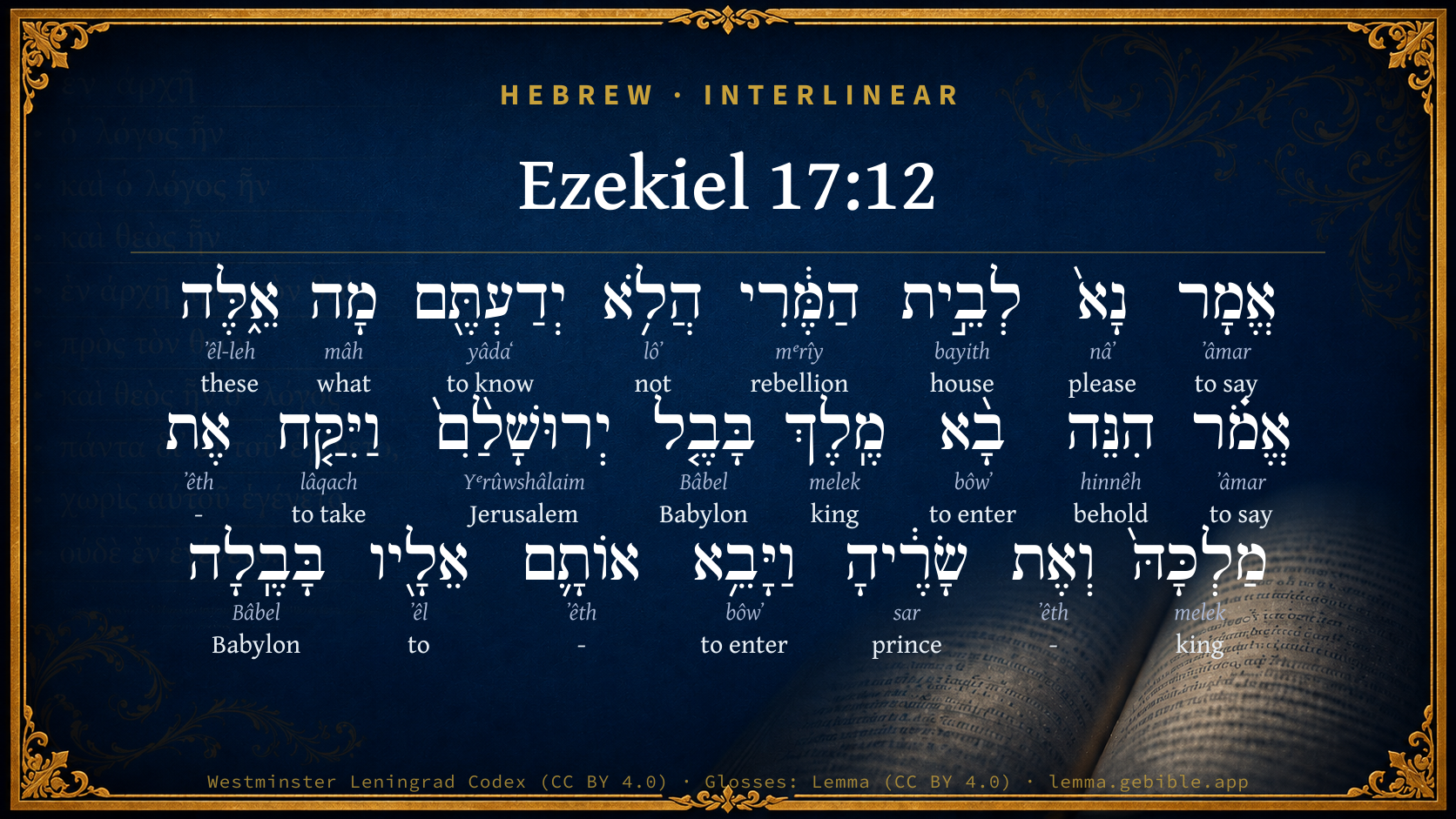
Ezekiel 17:12

Hebrew (Westminster Leningrad Codex) Ezekiel 17:12 appears in the Hebrew Old Testament. The text above is from the Westminster Leningrad Codex. Each word links to its Strong’s number, a concise gloss, and parsing drawn from the Open Scriptures Hebrew Bible morphology. Click any word for its full Brown-Driver-Briggs (BDB) entry.
Download image
Cite this verse

Ezekiel 17:12 (World English Bible). Public Domain. Lemma interlinear Bible study tool, https://lemma.gebible.app/v/ezekiel/17/12.

Show BibTeX & RIS
BibTeX
RIS
English Translation
Say now to the rebellious house, Don't you know what these things mean? tell them, Behold, the king of Babylon came to Jerusalem, and took the king of it, and the princes of it, and brought them to him to Babylon:
World English Bible · Public Domain
Download a study sheet

One document with this verse’s original text, its word-by-word gloss line, the meaning frame, cross-references with their text, attributed commentary, and full source and license credits — printable, and it pastes into notes with its structure intact.

This verse Autodidact and up

Study sheet (.html) Plain text (.txt)

A passage Seminary Student

Up to 50 verses in one chapter. A passage sheet keeps up to 6 commentary sources and 12 cross-references per verse, in the order this page ranks them, and says so on the sheet whenever that leaves anything out. Ask for a single verse and you get the Autodidact verse sheet above.

Everything on this page stays free to read, with no account — the sheet is a download of what is already on screen, not access to it.

Want to remove ads? Support Godless Engineer
Compare translations 3

The same verse in 3 English versions, stacked beneath the original-language interlinear above. Click any original word for its lexicon entry.

Each is an independent rendering of the whole verse — the interlinear is not word-aligned to these translations.

Highlighted words mark where these versions differ — a whole-verse word diff, not a word-by-word alignment.

  • World English Bible Public Domain
    Say now to the rebellious house, Don't you know what these things mean? tell them, Behold, the king of Babylon came to Jerusalem, and took the king of it, and the princes of it, and brought them to him to Babylon:
  • King James Version Public Domain
    Say now to the rebellious house, Know ye not what these things mean? tell them, Behold, the king of Babylon is come to Jerusalem, and hath taken the king thereof, and the princes thereof, and led them with him to Babylon;
  • unfoldingWord Literal Text CC BY-SA 4.0
    “Speak to the rebellious house, ‘Do you not know what these things mean? Behold! The king of Babylon came to Jerusalem and took her king and her princes and brought them to him in Babylon.

unfoldingWord Literal Text — © unfoldingWord, licensed CC BY-SA 4.0. Word-aligned USFM3 via Door43 (git.door43.org/unfoldingWord/en_ult).

Versions to compare (up to 4)

3 of 4 selected

Show all 18 translations

Every available English version of this verse, each an independent rendering of the whole verse.

  • World English Bible Public Domain
    Say now to the rebellious house, Don't you know what these things mean? tell them, Behold, the king of Babylon came to Jerusalem, and took the king of it, and the princes of it, and brought them to him to Babylon:
  • Berean Standard Bible Public Domain
    “Now say to this rebellious house: ‘Do you not know what these things mean?’ Tell them, ‘Behold, the king of Babylon came to Jerusalem, carried off its king and officials, and brought them back with him to Babylon.
  • Majority Standard Bible Public Domain
    “Now say to this rebellious house: ‘Do you not know what these things mean?’ Tell them, ‘Behold, the king of Babylon came to Jerusalem, carried off its king and officials, and brought them back with him to Babylon.
  • King James Version Public Domain
    Say now to the rebellious house, Know ye not what these things mean? tell them, Behold, the king of Babylon is come to Jerusalem, and hath taken the king thereof, and the princes thereof, and led them with him to Babylon;
  • American Standard Version (1901) Public Domain
    Say now to the rebellious house, Know ye not what these things mean? tell them, Behold, the king of Babylon came to Jerusalem, and took the king thereof, and the princes thereof, and brought them to him to Babylon:
  • Revised Version (1885) Public Domain
    Say now to the rebellious house, Know ye not what these things mean? tell them, Behold, the king of Babylon came to Jerusalem, and took the king thereof, and the princes thereof, and brought them to him to Babylon;
  • Geneva Bible (1599) Public Domain
    Say now to this rebellious house, Know ye not, what these things meane? tell them, Behold, the King of Babel is come to Ierusalem, and hath taken the King thereof, and the princes thereof, and led them with him to Babel,
  • Douay-Rheims (1899) Public Domain
    Say to the provoking house: Know you not what these things mean? Tell them: Behold the king of Babylon cometh to Jerusalem: and he shall take away the king and the princes thereof, and carry them with him to Babylon.
  • Young's Literal Translation Public Domain
    `Say, I pray thee, to the rebellious house, Have ye not known what these `are'? Say, Lo, come hath the king of Babylon to Jerusalem, And he taketh its king, and its princes, And bringeth them to himself to Babylon.
  • Literal Standard Version CC BY-SA 4.0
    “Now say to the house of rebellion, || Have you not known what these [are]? Say, Behold, the king of Babylon has come to Jerusalem, || And he takes its king, and its princes, || And brings them to himself to Babylon.
  • Unlocked Literal Bible CC BY-SA 4.0
    “Speak to the rebellious house, 'Do you not know what these things mean? Behold! The king of Babylon came to Jerusalem and took her king and her princes and brought them to him in Babylon.
  • unfoldingWord Literal Text CC BY-SA 4.0
    “Speak to the rebellious house, ‘Do you not know what these things mean? Behold! The king of Babylon came to Jerusalem and took her king and her princes and brought them to him in Babylon.
  • Darby Bible Public Domain
    Say now to the rebellious house, Know ye not what these things are? Say, Behold, the king of Babylon came to Jerusalem, and took its king and its princes, and led them with him to Babylon.
  • World Messianic Bible Public Domain
    “Say now to the rebellious house, ‘Don’t you know what these things mean?’ Tell them, ‘Behold, the king of Babylon came to Jerusalem, and took its king, and its princes, and brought them to him to Babylon.
  • Webster's Bible Public Domain
    Say now to the rebellious house, Know ye not what these things mean? tell them, Behold, the king of Babylon hath come to Jerusalem, and hath taken its king, and its princes, and led them with him to Babylon;
  • Free Bible Version CC BY-SA 4.0
    “Tell these rebellious people: ‘Don't you know what this riddle means?’ Explain to them, ‘Look, the king of Babylon came to Jerusalem, made its king and officials his prisoners, and took them back with him to Babylon.
  • Bible in Basic English Public Domain
    Say now to this uncontrolled people, Are these things not clear to you? Say to them, See, the king of Babylon came to Jerusalem and took its king and its rulers away with him to Babylon;
  • JPS Tanakh (1917) Public Domain
    'Say now to the rebellious house: Know ye not what these things mean? tell them: Behold, the king of Babylon came to Jerusalem, and took the king thereof, and the princes thereof, and brought them to him to Babylon;

Literal Standard Version (2020), Covenant Press — licensed CC BY-SA 4.0. Text via the HelloAO Bible API (eBible.org). Unlocked Literal Bible (unfoldingWord) — licensed CC BY-SA 4.0. Text via the HelloAO Bible API (eBible.org). unfoldingWord Literal Text — © unfoldingWord, licensed CC BY-SA 4.0. Word-aligned USFM3 via Door43 (git.door43.org/unfoldingWord/en_ult). Free Bible Version, Dr. Jonathan Gallagher — licensed CC BY-SA 4.0. Text via the HelloAO Bible API (eBible.org).

Word by word

More ways to search: Search by grammar → Find every occurrence → Compare this word →

Practice this passage: Drill this verse → Learn its vocabulary →

הַמֶּ֔רִי
mᵉrîy
H4805
“the · rebellion”
Particle, Definite Article + Noun, Common, Masculine, Singular, Absolute
Part of Speech
Particle + Noun
Type
Common
Gender
Masculine
Number
Singular
State
Absolute
Full BDB Definition

Origin: from H4784

TWOT: 1242a

rebellion - rebellion - rebellious (in construct)
  1. אֱמָר ʼâmar H559 “say” Verb, Qal, Imperative, 2nd Person, Masculine, Singular
  2. נָא֙ nâʼ H4994 “please” Particle, Exhortation
  3. לְבֵ֣ית bayith H1004 “to/for · house of” Preposition + Noun, Common, Masculine, Singular, Construct
  4. הֲלֹ֥א lôʼ H3808 “not” Particle, Interrogative + Particle, Negative
  5. יְדַעְתֶּ֖ם yâdaʻ H3045 “to know” Verb, Qal, Perfect, 2nd Person, Masculine, Plural
  6. מָה mâh H4100 “what” Particle, Interrogative
  7. אֵ֑לֶּה ʼêl-leh H428 “these” Pronoun, Demonstrative, Common, Plural
  8. אֱמֹ֗ר ʼâmar H559 “say” Verb, Qal, Imperative, 2nd Person, Masculine, Singular
  9. הִנֵּה hinnêh H2009 “behold” Particle, Demonstrative
  10. בָ֨א bôwʼ H935 “to enter” Verb, Qal, Perfect, 3rd Person, Masculine, Singular
  11. מֶֽלֶךְ melek H4428 “king of” Noun, Common, Masculine, Singular, Construct
  12. בָּבֶ֤ל Bâbel H894 “Babylon” Noun, Proper
  13. יְרוּשָׁלִַ֨ם֙ Yᵉrûwshâlaim H3389 “Jerusalem” Noun, Proper
  14. וַיִּקַּ֤ח lâqach H3947 “and · to take” Conjunction + Verb, Qal, Sequential Imperfect, 3rd Person, Masculine, Singular
  15. אֶת ʼêth H853 “-” Particle, Direct Object
  16. מַלְכָּהּ֙ melek H4428 “king · her” Noun, Common, Masculine, Singular, Construct + Suffix, Personal, 3rd Person, Feminine, Singular
  17. וְאֶת ʼêth H853 “and · -” Conjunction + Particle, Direct Object
  18. שָׂרֶ֔יהָ sar H8269 “princes · her” Noun, Common, Masculine, Plural, Construct + Suffix, Personal, 3rd Person, Feminine, Singular
  19. וַיָּבֵ֥א bôwʼ H935 “and · to enter” Conjunction + Verb, Hiphil, Sequential Imperfect, 3rd Person, Masculine, Singular
  20. אוֹתָ֛ם ʼêth H853 “- · them” Particle, Direct Object + Suffix, Personal, 3rd Person, Masculine, Plural
  21. אֵלָ֖יו ʼêl H413 “to · him” Preposition + Suffix, Personal, 3rd Person, Masculine, Singular
  22. בָּבֶֽלָה Bâbel H894 “Babylon · toward” Noun, Proper + Suffix, Demonstrative

About this verse

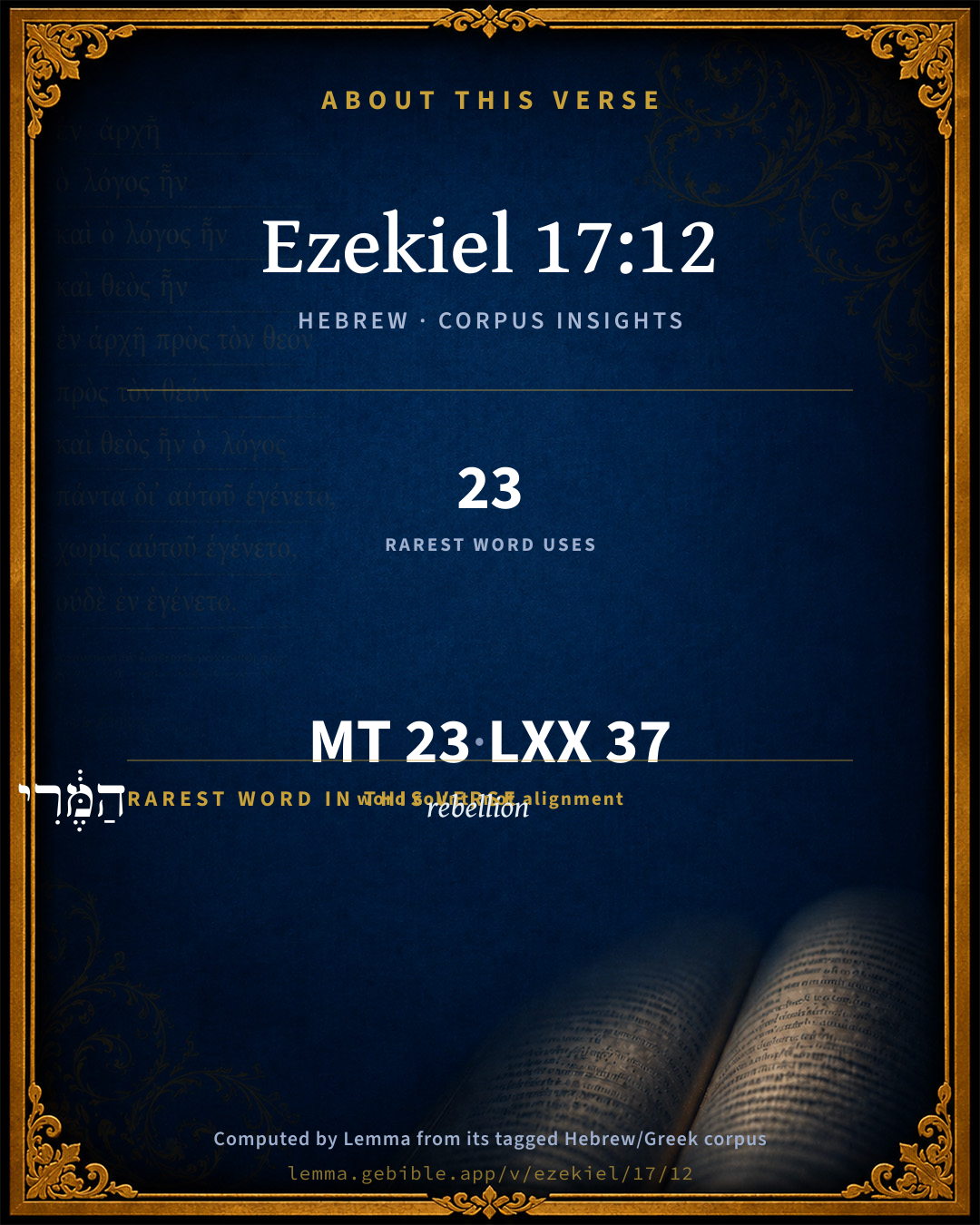
These counts appear in no published source. They are computed here, from the morphology-tagged text and Lemma’s own curated glosses. What Lemma adds →

23
words
17
distinct lemmas
Prophets
section

Notable vocabulary

The rarest word here is הַמֶּ֔רִי rebellion H4805 — appearing just 23 times in the whole Hebrew Bible.

Shared distinctive vocabulary

הַמֶּ֔רִי rebellion H4805 occurs in 21 verses of the Hebrew Bible. Also found in:

Grammatical profile

  • 6 verbs
  • 8 nouns
  • 1 pronoun
  • 1 preposition
  • 7 particles

Verb forms

  • אֱמָר Qal · Imperative
  • יְדַעְתֶּ֖ם Qal · Perfect
  • אֱמֹ֗ר Qal · Imperative
  • בָ֨א Qal · Perfect
  • וַיִּקַּ֤ח Qal · Sequential Imperfect
  • וַיָּבֵ֥א Hiphil · Sequential Imperfect

Repetition

Words recur within this verse — often emphatic in Hebrew:

  • אֱמָר to say H559 ×2
  • בָ֨א to enter H935 ×2
  • מֶֽלֶךְ king H4428 ×2
  • בָּבֶ֤ל Babylon H894 ×2

Hebrew & Septuagint length

In English translation the verse runs 41 words from the Hebrew and 44 from the Septuagint (LXX English) — closely comparable.

A rough comparison of the two English renderings, which tokenize alike — not a word-level alignment.

Word counts can differ between the Hebrew and the Greek without any difference in meaning — e.g. the Hebrew direct-object marker אֵת has no separate Greek word, and Greek often adds the article ὁ.

In the original languages it is 23 Hebrew tokens and 37 Greek tokens — but the two are counted differently (Hebrew bundles its prefixes and suffixes into one token; the Greek is in lemma form), so that isn’t a like-for-like length.

Cross-references

23

Topical passages linked to Ezekiel 17:12 in the Treasury of Scripture Knowledge — connected by theme and wording, ordered by reader-vote popularity; previews shown in the World English Bible.

  • Ezekiel 24:19 The people said to me, Won't you tell us what these things are to us, that you do so?
  • Ezekiel 1:2 In the fifth [day] of the month, which was the fifth year of king Jehoiachin's captivity,
  • Ezekiel 17:3 and say, Thus says the Lord Yahweh: A great eagle with great wings and long feathers, full of feathers, which had various colors, came to Lebanon, and took the top of the cedar:
  • Exodus 12:26 It will happen, when your children ask you, 'What do you mean by this service?'
  • Deuteronomy 6:20 When your son asks you in time to come, saying, What mean the testimonies, and the statutes, and the ordinances, which Yahweh our God has commanded you?
  • Joshua 4:6 that this may be a sign among you, that when your children ask in time to come, saying, What do you mean by these stones?
  • Joshua 4:21 He spoke to the children of Israel, saying, When your children shall ask their fathers in time to come, saying, What mean these stones?
  • 2 Kings 24:10–16 At that time the servants of Nebuchadnezzar king of Babylon came up to Jerusalem, and the city was besieged.
  • 2 Chronicles 36:9–10 Jehoiachin was eight years old when he began to reign; and he reigned three months and ten days in Jerusalem: and he did that which was evil in the sight of Yahweh.
  • Isaiah 1:2 Hear, heavens, And listen, earth; for Yahweh has spoken: I have nourished and brought up children, And they have rebelled against me.
  • Isaiah 39:7 Of your sons who shall issue from you, whom you shall father, shall they take away; and they shall be eunuchs in the palace of the king of Babylon.
  • Jeremiah 22:24–28 As I live, says Yahweh, though Coniah the son of Jehoiakim king of Judah were the signet on my right hand, yet would I pluck you there;
  • Jeremiah 52:31–34 It happened in the seven and thirtieth year of the captivity of Jehoiachin king of Judah, in the twelfth month, in the five and twentieth day of the month, that Evilmerodach king of Babylon, in the [first] year of his reign, lifted up the head of Jehoiachin king of Judah, and brought him forth out of prison;
  • Ezekiel 2:3–5 He said to me, Son of man, I send you to the children of Israel, to nations that are rebellious, which have rebelled against me: they and their fathers have transgressed against me even to this very day.
  • Ezekiel 2:8 But you, son of man, hear what I tell you; don't be you rebellious like that rebellious house: open your mouth, and eat that which I give you.
  • Ezekiel 3:9 As an adamant harder than flint have I made your forehead: don't be afraid of them, neither be dismayed at their looks, though they are a rebellious house.
  • Ezekiel 12:9–11 Son of man, has not the house of Israel, the rebellious house, said to you, What do you?
  • Matthew 13:51 Jesus said to them, "Have you understood all these things?" They answered him, "Yes, Lord."
  • Matthew 15:16–17 So Jesus said, "Do you also still not understand?
  • Matthew 16:11 How is it that you don't perceive that I didn't speak to you concerning bread? But beware of the yeast of the Pharisees and Sadducees."
  • Mark 4:13 He said to them, "Don't you understand this parable? How will you understand all of the parables?
  • Luke 9:45 But they didn't understand this saying. It was concealed from them, that they should not perceive it, and they were afraid to ask him about this saying.
  • Acts 8:30 Philip ran to him, and heard him reading Isaiah the prophet, and said, "Do you understand what you are reading?"

Cross-references courtesy of OpenBible.info (CC BY 4.0).

Hebrew and Greek witnesses Masoretic Hebrew ↔ Greek Septuagint

The same verse in the two great witnesses to the Old Testament, shown verse-for-verse.

These are two independent witnesses, not word-aligned to each other, and the Septuagint is shown in lemma (dictionary) form.

Hebrew Ezekiel 17:12 Masoretic · Westminster Leningrad Codex

אֱמָר נָא֙ לְבֵ֣ית הַמֶּ֔רִי הֲלֹ֥א יְדַעְתֶּ֖ם מָה אֵ֑לֶּה אֱמֹ֗ר הִנֵּה בָ֨א מֶֽלֶךְ בָּבֶ֤ל יְרוּשָׁלִַ֨ם֙ וַיִּקַּ֤ח אֶת מַלְכָּהּ֙ וְאֶת שָׂרֶ֔יהָ וַיָּבֵ֥א אוֹתָ֛ם אֵלָ֖יו בָּבֶֽלָה

Say now to the rebellious house, Don't you know what these things mean? tell them, Behold, the king of Babylon came to Jerusalem, and took the king of it, and the princes of it, and brought them to him to Babylon:

World English Bible · Public Domain

Greek LXX Ezekiel 17:12 Septuagint · lemma form

υἱός ἄνθρωπος εἶπον δή πρός ὁ οἶκος ὁ παραπικραίνω οὐ ἐπιἵστημι τίς εἰμί οὗτος εἶπον ὅταν ἔρχομαι βασιλεύς βαβυλών ἐπί ἰερουσαλήμ καί λαμβάνω ὁ βασιλεύς αὐτός καί ὁ ἄρχων αὐτός καί ἄγω αὐτός πρός ἑαυτοῦ εἰς βαβυλών

Son of man, say now to the provoking house, Know you⌃ not what these things were? say to them, Whenever the king of Babylon shall come against Jerusalem, then he shall take her king and her princes, and shall take them home to Babylon.

LXX2012 (modern English Septuagint) · Public Domain

Hebrew: Westminster Leningrad Codex (CC BY 4.0). Greek: Septuagint (public domain); English from LXX2012 (modern English Septuagint) (Public Domain). How the Septuagint differs from the Hebrew →

Targum (Aramaic paraphrase)

1

The Targum is the ancient Jewish Aramaic paraphrase of the Hebrew Scriptures — an interpretive translation, not the Hebrew text itself. Onkelos (literal) and Pseudo-Jonathan (expansive) render the Torah, and Jonathan the Prophets. Coverage is partial: where no permissively-licensed English translation exists for a verse, only the Aramaic is shown. This is verse-level text, not a word-by-word alignment to the Hebrew.

  1. Targum Jonathan Prophets (Joshua–Malachi)
    אֱמַר כְּעַן לְעַמָא סַרְבָנָא הֲלָא יְדַעְתּוּן מָה אִלֵין אֱמַר הָא אָתָא מַלְכָּא דְבָבֶל לִירוּשְׁלֵם וּדְבַר יַת מַלְכָּהּ וְיַת רַבְרְבָהָא וְאוֹבִיל יַתְהוֹן לְוָתֵה לְבָבֶל:

    (no public-domain English translation for this verse)

    Targum Jonathan — Aramaic: “Mikraot Gedolot” (public domain). English: “Sefaria Community Translation” (CC0 1.0 (public-domain dedication)); “London "Chaldee Paraphrase," 1871” (public domain). Text via Sefaria.

Commentary

Notes on Ezekiel 17:12 from classic Christian and Jewish commentators (each source and its license shown beneath its notes). The classic Christian expositions comment on the surrounding passage and are grouped to its opening verse, so a note may address several verses; the Jewish commentaries on the Tanakh (Rashi and others) are per-verse, so they appear only where the commentator wrote on this verse.

Lemma curates 59 commentaries, every one of them public domain or Creative Commons licensed, each selected and text-cleaned for this edition rather than reprinted as found. About our sources →

Trapp's Complete Commentary

John Trapp

Eze 17:12 Say now to the rebellious house, Know ye not what these [things mean]? tell [them], Behold, the king of Babylon is come to Jerusalem, and hath taken the king thereof, and the princes thereof, and led them with him to Babylon;

Ver. 12. Know ye not what these things mean?] q.d., It is much you should not. There is no such great difficulty in the parable, but that ye are self-blinded, and will not see far off; either your wits serve you not in the things of God, or if they do, you will make believe otherwise. Are ye not, therefore, rightly called a "rebellious house"

Tell them.] For their learnings, and that they may be left without excuse. See on Eze 17:4.

John Trapp, A Commentary or Exposition upon All the Books of the Old and New Testament (1647–1656) — public domain. Text from a community e-Sword module.

Joseph Benson's Commentary

Eze 17:12-14. Say now to the rebellious house — To the house of Judah, which have been and still are rebellious against me, and are now entering into a rebellion against Nebuchadnezzar. This is God’s order to his prophet to explain the riddle. Know ye not what these things mean? — Will you not apply your minds to understand what God speaks to you? And that whether he directs his speech to you in plain words, or delivers his mind in riddles and parables? Behold, the king of Babylon is come — Or rather, did come, or came to Jerusalem — Namely, some time before the delivery of this prophecy: and hath taken the king thereof, and the princes thereof — Namely, Jeconiah and all his princes and officers: see 2Ki 24:12. And hath led them with him to Babylon — Judging them unfit to be trusted any more with any office or power in their own country. And hath taken of the king’s seed — Hath taken from among the royal seed Mattaniah, Jehoiakim’s brother, and advanced him to the throne in Jerusalem, 2Ki 24:17; and made a covenant with him — A solemn agreement, on terms acceded to and approved by Mattaniah; and hath taken an oath of him — An oath of fealty: when Nebuchadnezzar caused Mattaniah to enter into this covenant and oath, he changed his name to Zedekiah, which word signifies, the justice of God, to express that God would avenge the crime of this restored captive, if he should break the covenant into which he had entered, and perjure himself: see note on 2Ki 24:17. He hath also taken the mighty of the land — Namely, as hostages for Zedekiah’s performance of the covenant agreed on. That the kingdom might be base — Or rather, humble; that it might be kept in subjection and obedience. Zedekiah being made only a tributary king, consequently was not in as honourable a condition as his predecessors had been in; but yet the keeping of his covenant was the only means, under present circumstances, to support himself and his government.

Joseph Benson's Commentary on the Old and New Testaments (1811–1818) — public domain. Text from a community e-Sword module.

Geneva Bible (1599)

Geneva Bible translators

That is, Jeconiah, 2 Kings 24:15.

Geneva Bible (1599) marginal notes — public domain. Text via Bolls.life.

Jamieson, Fausset & Brown

Robert Jamieson, A. R. Fausset & David Brown

Know ye not--He upbraided them with moral, leading to intellectual, stupidity.

hath taken the king--Jeconiah or Jehoiachin (Kg2 24:11, Kg2 24:12-16).

Jamieson, Fausset & Brown — Commentary Critical and Explanatory on the Whole Bible (1871) — public domain (CC PDM 1.0). Text via the HelloAO Bible API.

Adam Clarke's Commentary

Verse 12. Know ye not what these things mean?] They are explained in this and the following verses.

Adam Clarke's Commentary on the Bible (1810–1826) — public domain. Text from a community e-Sword/MySword module.

The Cambridge Bible for Schools and Colleges

gen. ed. J. J. S. Perowne

11–21. Interpretation of the riddle

12. the rebellious house] i.e. Israel, ch. Eze_2:5.

king of Babylon is come] Better past tenses throughout: came … and took; so Eze_17:13 and took. On the captivity of Jehoiachin, cf. 2Ki_24:11 seq.; Jer_24:1; Jer_29:1.

The Cambridge Bible for Schools and Colleges (gen. ed. J. J. S. Perowne; Cambridge University Press, 1878–1918) — public domain. Text from a community e-Sword module.

John Gill's Exposition

That the kingdom might be base,.... Low or humble; its king but a viceroy, a tributary to the king of Babylon; and the subjects obliged to a tax, payable to him; and this is intended by the vine being of "low stature", Eze 17:6;

that it might not lift up itself; above other neighbouring kingdoms and states; and particularly that it might not rebel against Nebuchadnezzar, but be kept in a dependence on him, and subjection to him:

but that by keeping of his covenant it might stand; continue a kingdom, and Zedekiah king of it; so that it was for their good that such a covenant was made, and it was their interest to keep it; for, had it not been made, it would have ceased to have been a kingdom, and would have become a province of the Babylonian monarchy, and have been put under the government of one of Nebuchadnezzar's princes or captains; and, should they break it, would endanger the ruin of their state, as the event showed. In the Hebrew text it is, "to keep his covenant, to make it stand"; or, "to stand to it" (y); that is, as it should seem, to make the covenant stand firm. The Targum is,

"that it might keep his covenant, and serve him;''

Nebuchadnezzar.

(y) "ad custodiendum pactum ejus, ad astandum ei", Montanus; "ad servandum foedus suum, ad consistendumm", Starckius.

John Gill's Exposition of the Whole Bible (1746–1763) — public domain (CC PDM 1.0). Text via the HelloAO Bible API.

Haydock's Catholic Bible Commentary

Shall, or, "hath taken," &c., (Challoner) as also (ver. 13.) Sedecias was seized five years after, chap. viii. 1. Jechonias, the princes, mighty warriors, (ver. 13.) and expert artists, had been taken away six years before, with the prophet. Protestants, "is come,...and hath taken," &c. (Haydock)

George Leo Haydock (1774–1849), Haydock's Catholic Family Bible and Commentary, 1859 edition — public domain. Excludes Psalms (Douay-Rheims chapter numbering differs from Protestant) and Deuterocanonical books (Catholic canon only).

Matthew Poole's English Annotations

Say now: this is the order God gives to his prophet to explain the riddle.

To the rebellious house; to the house of Judah, which have been, and still are, rebellious against me, and are now entering into rebellion against Nebuchadnezzar.

Know ye not? are ye so blockish that you do not know what is meant? or are you so secure that you will not consider it, but run on your own ruin?

The king of Babylon, Nebuchadnezzar, is that first great eagle with part of his power.

Jerusalem is the Lebanon which he is come to.

The king thereof; the king of Israel, and his seed, and nobles are the branches and twigs cropped off, these are taken, conquered, made captives.

Led them with him; judging them unfit to be trusted any more, he will, though in chains, carry them to Babylon.

Matthew Poole's English Annotations on the Holy Bible (1683–1685) — public domain. Text from a community e-Sword/MySword module.

Whedon's Commentary on the Bible

Daniel D. Whedon

THE RIDDLE EXPLAINED, Eze_17:11-24.

12. Is come — Literally, came.

Hath taken — Literally, took (also Eze_17:13).

Daniel D. Whedon (gen. ed.), Commentary on the Old and New Testaments (1874–1909) — public domain. Text from a community e-Sword module.

The Pulpit Commentary

Vers. 12, 13. The parable has been spoken. Ezekiel, after the pause implied in ver. 11, now becomes its interpreter. And that interpretation is to be addressed to the "rebellious house" (Eze_2:3, Eze_2:6) among whom he lived. Probably even among the exiles of Tel-Abib there were some who cherished hopes of the success of the Egyptian alliance, and of the downfall of the power of Babylon as its outcome. The tenses are better in the indefinite past "took," "brought," and so on in ver. 13. The history of Jeconiah"s deportation and of Zedekiah"s oath of fealty (2Ch_36:13) is recapitulated. He dwells specially on the fact that the mighty of the land had been carried off with Jecoutah. It was Nebuchadnezzar"s policy to deprive the kingdom of all its elements of strength to leave it "bare." Even masons. smiths, and carpenters were carried off, lest they should be used for warlike preparations. (2Ki_24:16) It could not lift itself up. It was enough if "by keeping its covenant" it was allowed to stand.

The Pulpit Commentary (1880–1919), ed. H.D.M. Spence-Jones & Joseph S. Exell — public domain. Text from a community e-Sword module.

Rashi

Rabbi Shlomo Yitzchaki (Rashi)

what these are What this riddle is, and he explained it to them.

took away its king and its princes They are the “lofty top of the cedar,” Jehoiakim and his princes.

to Babylon That is the “city of traffickers.”

Rashi on the Tanakh — English translations: “The Judaica Press complete Tanach with Rashi, translated by A. J. Rosenberg” (CC BY 4.0); “Pentateuch with Rashi's commentary by M. Rosenbaum and A.M. Silbermann, 1929-1934” (public domain); “The Metsudah Tanach series, Lakewood, N.J” (CC BY 4.0); and “The Book of Joshua, Metsudah Publications, 1997” (CC BY 4.0). Text via Sefaria.

Lesson kit

Teaching starters — assembled from the data on this page, not authored interpretation. Every prompt links to the verse data it draws on. Edit before teaching.

Ezekiel, in the Prophets, opens this verse with 23 words (17 distinct Hebrew lemmas). Its most distinctive word is mᵉrîy (“rebellion”). A historical commentator’s framing appears above. Read the whole chapter for the surrounding context.

Discussion questions

  1. How does “rebellion” (mᵉrîy) shape what this verse is saying?
  2. Numbers 17:10 shares the word «rebellion» with this verse. How do the two illuminate each other?
  3. “to say” occurs 2× in this one verse. What is the effect of the repetition?
  4. These translations render this verse differently; the difference is in the English rendering, not the original. What questions does that raise?
  5. The verb «אֱמָר» is Qal Imperative. How does its form color the action?
  6. Reading how Trapp's Complete Commentary and Joseph Benson's Commentary read this verse, where do the two commentators agree and where do they part?

Things to notice

Reading settings

Reading text

Shown beneath each verse's original-language words.

Old Testament
Old Testament edition

Read the OT as the Masoretic Hebrew (MT) or the Greek Septuagint (LXX).

English shown for the Greek Septuagint (in the Hebrew ↔ Greek comparison).

Comparing translations? Open the Compare panel on any verse page to stack up to four side by side.