
Jeremiah 5:15

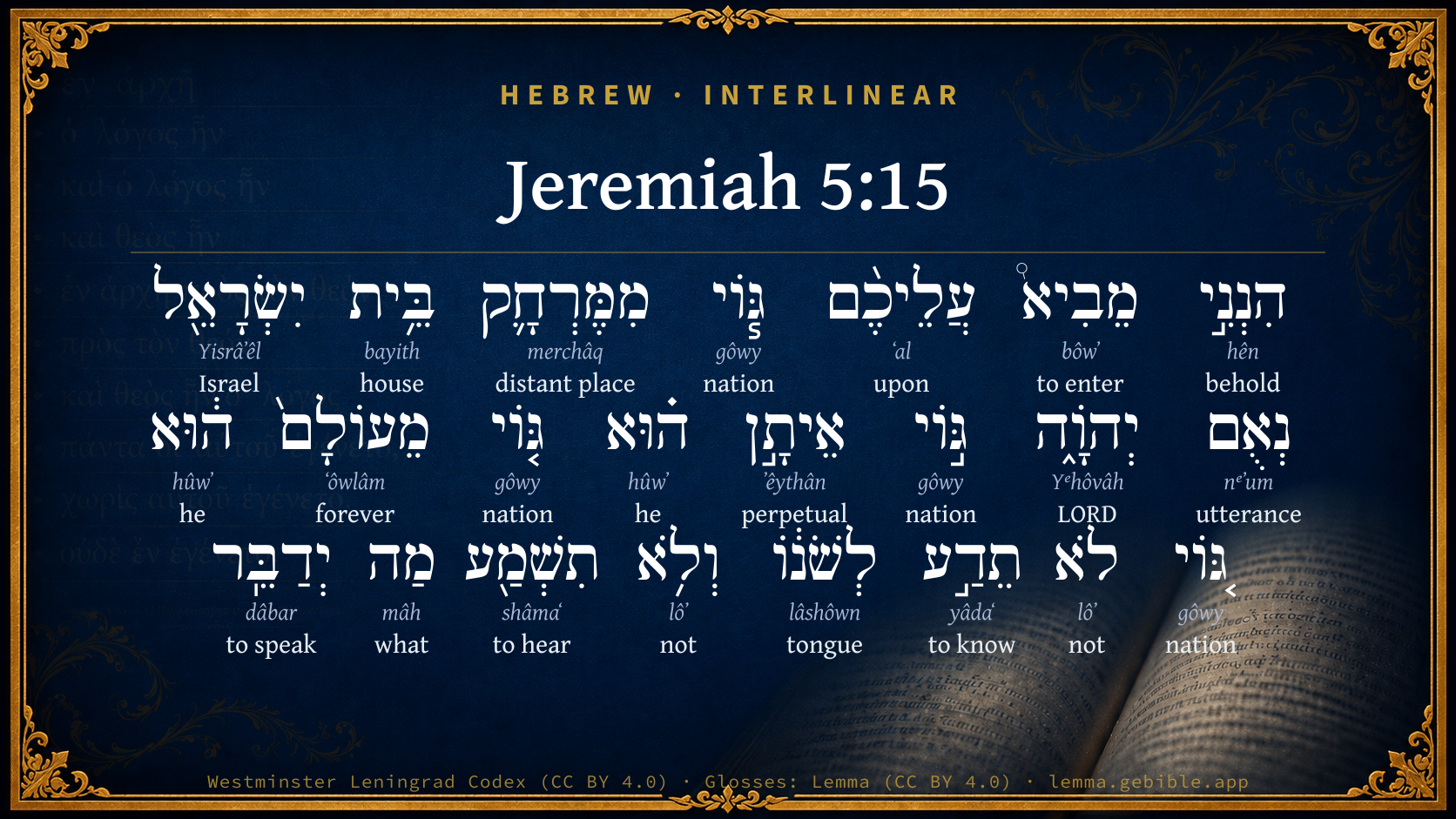
Hebrew (Westminster Leningrad Codex) Jeremiah 5:15 appears in the Hebrew Old Testament. The text above is from the Westminster Leningrad Codex. Each word links to its Strong’s number, a concise gloss, and parsing drawn from the Open Scriptures Hebrew Bible morphology. Click any word for its full Brown-Driver-Briggs (BDB) entry.
Download image
Cite this verse

Jeremiah 5:15 (World English Bible). Public Domain. Lemma interlinear Bible study tool, https://lemma.gebible.app/v/jeremiah/5/15.

Show BibTeX & RIS
BibTeX
RIS
English Translation
Behold, I will bring a nation on you from far, house of Israel, says Yahweh: it is a mighty nation, it is an ancient nation, a nation whose language you don't know, neither understand what they say.
World English Bible · Public Domain
Download a study sheet

One document with this verse’s original text, its word-by-word gloss line, the meaning frame, cross-references with their text, attributed commentary, and full source and license credits — printable, and it pastes into notes with its structure intact.

This verse Autodidact and up

Study sheet (.html) Plain text (.txt)

A passage Seminary Student

Up to 50 verses in one chapter. A passage sheet keeps up to 6 commentary sources and 12 cross-references per verse, in the order this page ranks them, and says so on the sheet whenever that leaves anything out. Ask for a single verse and you get the Autodidact verse sheet above.

Everything on this page stays free to read, with no account — the sheet is a download of what is already on screen, not access to it.

Want to remove ads? Support Godless Engineer
Compare translations 3

The same verse in 3 English versions, stacked beneath the original-language interlinear above. Click any original word for its lexicon entry.

Each is an independent rendering of the whole verse — the interlinear is not word-aligned to these translations.

Highlighted words mark where these versions differ — a whole-verse word diff, not a word-by-word alignment.

  • World English Bible Public Domain
    Behold, I will bring a nation on you from far, house of Israel, says Yahweh: it is a mighty nation, it is an ancient nation, a nation whose language you don't know, neither understand what they say.
  • King James Version Public Domain
    Lo, I will bring a nation upon you from far, O house of Israel, saith the LORD: it is a mighty nation, it is an ancient nation, a nation whose language thou knowest not, neither understandest what they say.
  • unfoldingWord Literal Text CC BY-SA 4.0
    Behold! I shall bring a nation against you from far away, house of Israel —the declaration of Yahweh— it a lasting nation; it a nation from ancient times! A nation whose tongue you do not know, and you will not understand what they speak.

unfoldingWord Literal Text — © unfoldingWord, licensed CC BY-SA 4.0. Word-aligned USFM3 via Door43 (git.door43.org/unfoldingWord/en_ult).

Versions to compare (up to 4)

3 of 4 selected

Show all 18 translations

Every available English version of this verse, each an independent rendering of the whole verse.

  • World English Bible Public Domain
    Behold, I will bring a nation on you from far, house of Israel, says Yahweh: it is a mighty nation, it is an ancient nation, a nation whose language you don't know, neither understand what they say.
  • Berean Standard Bible Public Domain
    Behold, I am bringing a distant nation against you, O house of Israel,” declares the LORD. “It is an established nation, an ancient nation, a nation whose language you do not know and whose speech you do not understand.
  • Majority Standard Bible Public Domain
    Behold, I am bringing a distant nation against you, O house of Israel,” declares the LORD. “It is an established nation, an ancient nation, a nation whose language you do not know and whose speech you do not understand.
  • King James Version Public Domain
    Lo, I will bring a nation upon you from far, O house of Israel, saith the LORD: it is a mighty nation, it is an ancient nation, a nation whose language thou knowest not, neither understandest what they say.
  • American Standard Version (1901) Public Domain
    Lo, I will bring a nation upon you from far, O house of Israel, saith Jehovah: it is a mighty nation, it is an ancient nation, a nation whose language thou knowest not, neither understandest what they say.
  • Revised Version (1885) Public Domain
    Lo, I will bring a nation upon you from far, O house of Israel, saith the LORD: it is a mighty nation, it is an ancient nation, a nation whose language thou knowest not, neither understandest what they say.
  • Geneva Bible (1599) Public Domain
    Loe, I will bring a nation vpon you from farre, O house of Israel, saith the Lord, which is a mightie nation, and an ancient nation, a nation whose language thou knowest not, neither vnderstandest what they say.
  • Douay-Rheims (1899) Public Domain
    Behold I will bring upon you a nation from afar, O house of Israel, saith the Lord: a strong nation, an ancient nation, a nation whose language thou shalt not know, nor understand what they say.
  • Young's Literal Translation Public Domain
    Lo, I am bringing against you a nation from afar, O house of Israel, an affirmation of Jehovah, A nation -- strong it `is', a nation -- from of old it `is', A nation -- thou knowest not its tongue, Nor understandest what it speaketh.
  • Literal Standard Version CC BY-SA 4.0
    Behold, I am bringing against you a nation from afar, || O house of Israel,” || A declaration of YHWH, || “It [is] a strong nation, || It [is] an ancient nation, || A nation whose tongue you do not know, || Nor understand what it speaks.
  • Unlocked Literal Bible CC BY-SA 4.0
    Behold! I am about to bring a nation against you from far away, house of Israel—this is Yahweh's declaration— it is a lasting nation, an ancient nation! It is a nation whose language you do not know, nor will you understand what they say.
  • unfoldingWord Literal Text CC BY-SA 4.0
    Behold! I shall bring a nation against you from far away, house of Israel —the declaration of Yahweh— it a lasting nation; it a nation from ancient times! A nation whose tongue you do not know, and you will not understand what they speak.
  • Darby Bible Public Domain
    Behold, I bring a nation upon you from afar, house of Israel, saith Jehovah: it is a mighty nation, it is an ancient nation, a nation whose language thou knowest not, neither understandest thou what they say.
  • World Messianic Bible Public Domain
    Behold, I will bring a nation on you from far away, house of Israel,” says the LORD. “It is a mighty nation. It is an ancient nation, a nation whose language you don’t know and don’t understand what they say.
  • Webster's Bible Public Domain
    Lo, I will bring a nation upon you from far, O house of Israel, saith the LORD: it is a mighty nation, it is an ancient nation, a nation whose language thou knowest not, neither understandest what they say.
  • Free Bible Version CC BY-SA 4.0
    Look! I am bringing a nation from far away to attack you, people of Israel, declares the Lord. It's a powerful nation that has existed for a long time; it's a nation whose language you don't know, and when they speak you can't understand them.
  • Bible in Basic English Public Domain
    See, I will send you a nation from far away, O people of Israel, says the Lord; a strong nation and an old nation, a nation whose language is strange to you, so that you may not get the sense of their words.
  • JPS Tanakh (1917) Public Domain
    Lo, I will bring a nation upon you from far, O house of Israel, saith the LORD; it is an enduring nation, it is an ancient nation, a nation whose language thou knowest not, neither understandest what they say.

Literal Standard Version (2020), Covenant Press — licensed CC BY-SA 4.0. Text via the HelloAO Bible API (eBible.org). Unlocked Literal Bible (unfoldingWord) — licensed CC BY-SA 4.0. Text via the HelloAO Bible API (eBible.org). unfoldingWord Literal Text — © unfoldingWord, licensed CC BY-SA 4.0. Word-aligned USFM3 via Door43 (git.door43.org/unfoldingWord/en_ult). Free Bible Version, Dr. Jonathan Gallagher — licensed CC BY-SA 4.0. Text via the HelloAO Bible API (eBible.org).

Word by word

More ways to search: Search by grammar → Find every occurrence → Compare this word →

Practice this passage: Drill this verse → Learn its vocabulary →

אֵיתָ֣ן
ʼêythân
H386
“perpetual”
Adjective, Adjective, Masculine, Singular, Absolute
Part of Speech
Adjective
Type
Adjective
Gender
Masculine
Number
Singular
State
Absolute
Full BDB Definition

Origin: from an unused root (meaning to continue)

TWOT: 935a

perpetual, constant, perennial, ever-flowing - ever-flowing (of a stream) - permanence, permanent, enduring (figuratively)
  1. הִנְנִ֣י hên H2005 “behold · me” Particle, Demonstrative + Suffix, Personal, 1st Person, Common, Singular
  2. מֵבִיא֩ bôwʼ H935 “entering” Verb, Hiphil, Participle Active, Masculine, Singular, Absolute
  3. עֲלֵיכֶ֨ם ʻal H5921 “upon · you” Preposition + Suffix, Personal, 2nd Person, Masculine, Plural
  4. גּ֧וֹי gôwy H1471 “nation” Noun, Common, Masculine, Singular, Absolute
  5. מִמֶּרְחָ֛ק merchâq H4801 “from · distant place” Preposition + Noun, Common, Masculine, Singular, Absolute
  6. בֵּ֥ית bayith H1004 “house of” Noun, Common, Masculine, Singular, Construct
  7. יִשְׂרָאֵ֖ל Yisrâʼêl H3478 “Israel” Noun, Proper
  8. נְאֻם nᵉʼum H5002 “utterance of” Noun, Common, Masculine, Singular, Construct
  9. יְהֹוָ֑ה Yᵉhôvâh H3068 “LORD” Noun, Proper
  10. גּ֣וֹי gôwy H1471 “nation” Noun, Common, Masculine, Singular, Absolute
  11. ה֗וּא hûwʼ H1931 “he” Pronoun, Personal, 3rd Person, Masculine, Singular
  12. גּ֤וֹי gôwy H1471 “nation” Noun, Common, Masculine, Singular, Absolute
  13. מֵעוֹלָם֙ ʻôwlâm H5769 “from · forever” Preposition + Noun, Common, Masculine, Singular, Absolute
  14. ה֔וּא hûwʼ H1931 “he” Pronoun, Personal, 3rd Person, Masculine, Singular
  15. גּ֚וֹי gôwy H1471 “nation” Noun, Common, Masculine, Singular, Absolute
  16. לֹא lôʼ H3808 “not” Particle, Negative
  17. תֵדַ֣ע yâdaʻ H3045 “to know” Verb, Qal, Imperfect, 2nd Person, Masculine, Singular
  18. לְשֹׁנ֔וֹ lâshôwn H3956 “tongue · his” Noun, Common, Both, Singular, Construct + Suffix, Personal, 3rd Person, Masculine, Singular
  19. וְלֹ֥א lôʼ H3808 “and · not” Conjunction + Particle, Negative
  20. תִשְׁמַ֖ע shâmaʻ H8085 “to hear” Verb, Qal, Imperfect, 2nd Person, Masculine, Singular
  21. מַה mâh H4100 “what” Particle, Interrogative
  22. יְדַבֵּֽר dâbar H1696 “to speak” Verb, Piel, Imperfect, 3rd Person, Masculine, Singular

About this verse

These counts appear in no published source. They are computed here, from the morphology-tagged text and Lemma’s own curated glosses. What Lemma adds →

23
words
18
distinct lemmas
Prophets
section

Notable vocabulary

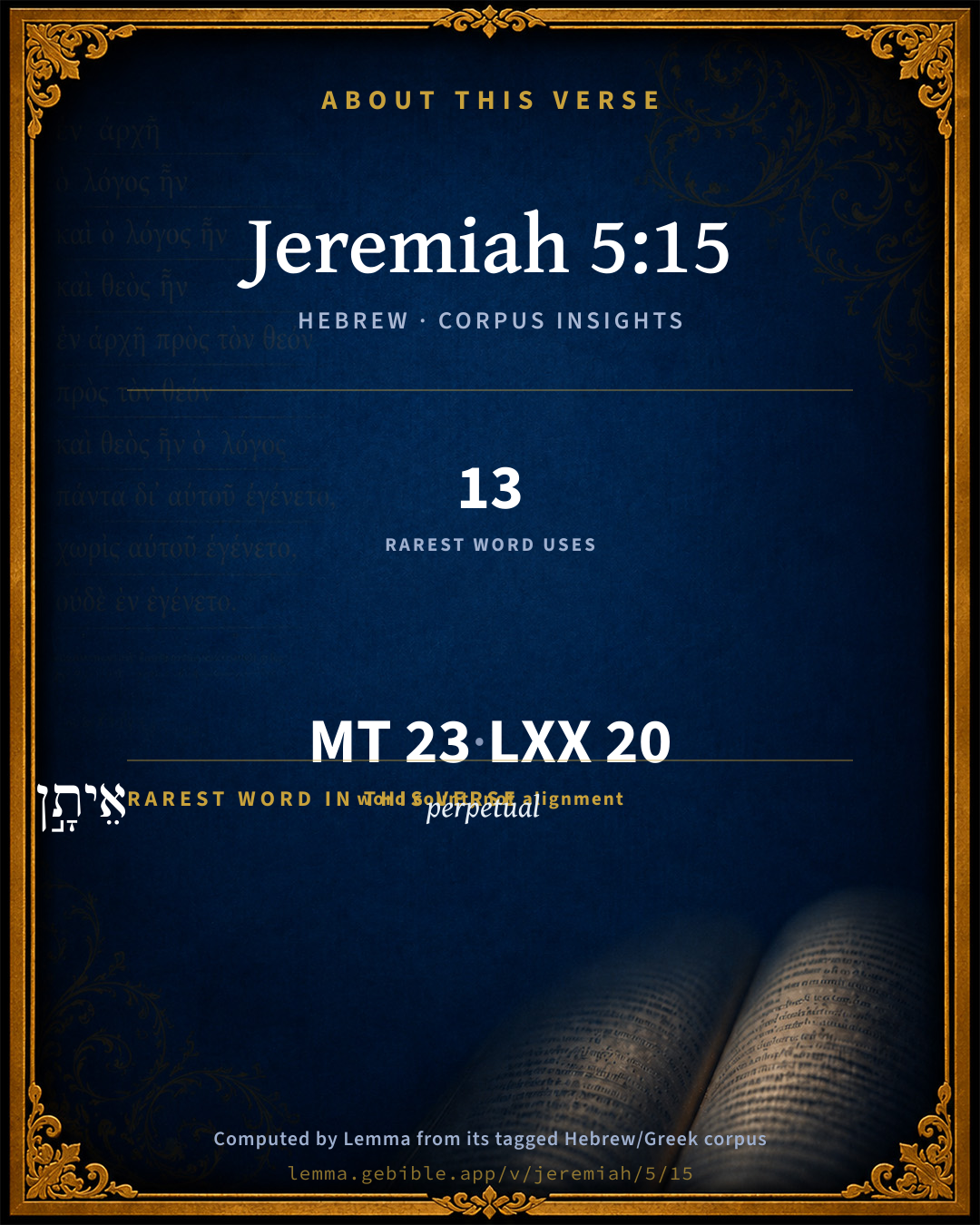
The rarest word here is אֵיתָ֣ן perpetual H386 — appearing just 13 times in the whole Hebrew Bible.

Shared distinctive vocabulary

אֵיתָ֣ן perpetual H386 occurs in 13 verses of the Hebrew Bible. Also found in:

Grammatical profile

  • 4 verbs
  • 11 nouns
  • 1 adjective
  • 2 pronouns
  • 1 preposition
  • 4 particles

Verb forms

  • מֵבִיא֩ Hiphil · Participle Active
  • תֵדַ֣ע Qal · Imperfect
  • תִשְׁמַ֖ע Qal · Imperfect
  • יְדַבֵּֽר Piel · Imperfect

Repetition

Words recur within this verse — often emphatic in Hebrew:

  • גּ֧וֹי nation H1471 ×4
  • ה֗וּא he H1931 ×2
  • לֹא not H3808 ×2

Hebrew & Septuagint length

In the original languages it is 23 Hebrew tokens and 20 Greek tokens — but the two are counted differently (Hebrew bundles its prefixes and suffixes into one token; the Greek is in lemma form), so that isn’t a like-for-like length.

Cross-references

20

Topical passages linked to Jeremiah 5:15 in the Treasury of Scripture Knowledge — connected by theme and wording, ordered by reader-vote popularity; previews shown in the World English Bible.

  • Deuteronomy 28:49 Yahweh will bring a nation against you from far, from the end of the earth, as the eagle flies; a nation whose language you shall not understand;
  • Jeremiah 4:16 make you mention to the nations; behold, publish against Jerusalem, [that] watchers come from a far country, and give out their voice against the cities of Judah.
  • Isaiah 5:26 He will lift up a banner to the nations from far, And he will whistle for them from the end of the earth. Behold, they will come speedily and swiftly.
  • Isaiah 28:11 No, but by [men of] strange lips and with another language will he speak to this people;
  • Isaiah 33:19 You shall not see the fierce people, a people of a deep speech that you can not comprehend, of a strange language that you can not understand.
  • Jeremiah 25:9 behold, I will send and take all the families of the north, says Yahweh, and [I will send] to Nebuchadrezzar the king of Babylon, my servant, and will bring them against this land, and against the inhabitants of it, and against all these nations round about; and I will utterly destroy them, and make them an astonishment, and a hissing, and perpetual desolations.
  • Jeremiah 1:15 For, behold, I will call all the families of the kingdoms of the north, says Yahweh; and they shall come, and they shall set everyone his throne at the entrance of the gates of Jerusalem, and against all the walls of it round about, and against all the cities of Judah.
  • Isaiah 5:7 For the vineyard of Yahweh of Hosts is the house of Israel, And the men of Judah his pleasant plant: And he looked for justice, but, behold, oppression; For righteousness, but, behold, a cry of distress.
  • Jeremiah 5:11 For the house of Israel and the house of Judah have dealt very treacherously against me, says Yahweh.
  • Jeremiah 6:22 Thus says Yahweh, Behold, a people comes from the north country; and a great nation shall be stirred up from the uttermost parts of the earth.
  • Habakkuk 1:5–10 "Look among the nations, watch, and wonder marvelously; for I am working a work in your days, which you will not believe though it is told you.
  • 1 Corinthians 14:21 In the law it is written, "By men of strange languages and by the lips of strangers I will speak to this people. Not even thus will they hear me, says the Lord."
  • Isaiah 29:3 I will encamp against you round about, and will lay siege against you with posted troops, and I will raise siege works against you.
  • Isaiah 29:6 She shall be visited of Yahweh of Hosts with thunder, and with earthquake, and great noise, with whirlwind and tempest, and the flame of a devouring fire.
  • Jeremiah 2:26 As the thief is ashamed when he is found, so is the house of Israel ashamed; they, their kings, their princes, and their priests, and their prophets;
  • Jeremiah 9:26 Egypt, and Judah, and Edom, and the children of Ammon, and Moab, and all that have the corners [of their hair] cut off, who dwell in the wilderness; for all the nations are uncircumcised, and all the house of Israel are uncircumcised in heart.
  • Ezekiel 18:31 Cast away from you all your transgressions, in which you have transgressed; and make you a new heart and a new spirit: for why will you die, house of Israel?
  • Daniel 2:37–38 You, O king, are king of kings, to whom the God of heaven has given the kingdom, the power, and the strength, and the glory;
  • Matthew 3:9–10 Don't think to yourselves, 'We have Abraham for our father,' for I tell you that God is able to raise up children to Abraham from these stones.
  • Daniel 7:7 After this I saw in the night-visions, and, behold, a fourth animal, awesome and powerful, and strong exceedingly; and it had great iron teeth; it devoured and broke in pieces, and stamped the residue with its feet: and it was diverse from all the animals that were before it; and it had ten horns.

Cross-references courtesy of OpenBible.info (CC BY 4.0).

Hebrew and Greek witnesses Masoretic Hebrew ↔ Greek Septuagint

The same verse in the two great witnesses to the Old Testament, shown verse-for-verse.

These are two independent witnesses, not word-aligned to each other, and the Septuagint is shown in lemma (dictionary) form.

Hebrew Jeremiah 5:15 Masoretic · Westminster Leningrad Codex

הִנְנִ֣י מֵבִיא֩ עֲלֵיכֶ֨ם גּ֧וֹי מִמֶּרְחָ֛ק בֵּ֥ית יִשְׂרָאֵ֖ל נְאֻם יְהֹוָ֑ה גּ֣וֹי אֵיתָ֣ן ה֗וּא גּ֤וֹי מֵעוֹלָם֙ ה֔וּא גּ֚וֹי לֹא תֵדַ֣ע לְשֹׁנ֔וֹ וְלֹ֥א תִשְׁמַ֖ע מַה יְדַבֵּֽר

Behold, I will bring a nation on you from far, house of Israel, says Yahweh: it is a mighty nation, it is an ancient nation, a nation whose language you don't know, neither understand what they say.

World English Bible · Public Domain

Greek LXX Structure differs

In the Septuagint, Jeremiah is about an eighth shorter than the Hebrew and arranges its material differently — the Oracles Against the Nations (Hebrew chapters 46–51) appear in the middle of the Greek book, after 25:13. Because the chapter and verse boundaries do not line up, a verse-for-verse comparison with the Hebrew is not shown.

A verse-for-verse comparison isn’t shown here because the chapters and verses don’t line up. Switch to the LXX edition with the MT / LXX toggle above to read the Greek directly.

On this verse, The Cambridge Bible for Schools and Colleges discusses the Septuagint’s reading. Read the note in Commentary ↓

Hebrew: Westminster Leningrad Codex (CC BY 4.0). Greek: Septuagint (public domain); English from a public-domain English Septuagint. How the Septuagint differs from the Hebrew →

Targum (Aramaic paraphrase)

1

The Targum is the ancient Jewish Aramaic paraphrase of the Hebrew Scriptures — an interpretive translation, not the Hebrew text itself. Onkelos (literal) and Pseudo-Jonathan (expansive) render the Torah, and Jonathan the Prophets. Coverage is partial: where no permissively-licensed English translation exists for a verse, only the Aramaic is shown. This is verse-level text, not a word-by-word alignment to the Hebrew.

  1. Targum Jonathan Prophets (Joshua–Malachi)
    הָא אֲנָא מַיְתִי עֲלֵיכוֹן עַם מֵרָחִיק בֵּית יִשְׂרָאֵל אֲמַר יְיָ עַם תַּקִיף הוּא עַמָא דְמֵעַלְמָא הוּא עַמָא לָא תִידַע לִישָׁנֵיהּ וְלָא תִשְׁמַע מַה דִימַלֵיל:

    (no public-domain English translation for this verse)

    Targum Jonathan — Aramaic: “Mikraot Gedolot” (public domain). English: “Sefaria Community Translation” (CC0 1.0 (public-domain dedication)); “London "Chaldee Paraphrase," 1871” (public domain). Text via Sefaria.

Commentary

Notes on Jeremiah 5:15 from classic Christian and Jewish commentators (each source and its license shown beneath its notes). The classic Christian expositions comment on the surrounding passage and are grouped to its opening verse, so a note may address several verses; the Jewish commentaries on the Tanakh (Rashi and others) are per-verse, so they appear only where the commentator wrote on this verse.

Lemma curates 59 commentaries, every one of them public domain or Creative Commons licensed, each selected and text-cleaned for this edition rather than reprinted as found. About our sources →

Trapp's Complete Commentary

John Trapp

Jer 5:15 Lo, I will bring a nation upon you from far, O house of Israel, saith the LORD: it [is] a mighty nation, it [is] an ancient nation, a nation whose language thou knowest not, neither understandest what they say.

Ver. 15. It is a mighty nation, it is an ancient nation.] As ancient as Nimrod, the first founder of that first of the four monarchies. {Gen 10:8} Hence Babylon is called "the land of Nimrod," {Mic 5:6} whom the poets call Saturn, and his son and successor, Jupiter, Belus.

A nation whose language thou knowest not.] For the Babylonians spake Syriac, {Dan 2:4} as did also the Jews afterwards - viz., after the captivity in Babylon, where they learned of it, and lost their own language.

John Trapp, A Commentary or Exposition upon All the Books of the Old and New Testament (1647–1656) — public domain. Text from a community e-Sword module.

Tyndale Open Study Notes

Tyndale Open Resources

5:15 The Babylonian language was a Semitic language like Hebrew, but the Israelites did not understand it.

Tyndale Open Study Notes — © Tyndale Open Resources, licensed CC BY-SA 4.0. Text via the HelloAO Bible API.

Geneva Bible (1599)

Geneva Bible translators

To wit, the Babylonians and Chaldeans.

Geneva Bible (1599) marginal notes — public domain. Text via Bolls.life.

Jamieson, Fausset & Brown

Robert Jamieson, A. R. Fausset & David Brown

(Jer 1:15; Jer 6:22). Alluding to Deu 28:49, &c.

Israel--that is, Judah.

mighty--from an Arabic root, "enduring." The fourfold repetition of "nation" heightens the force.

ancient--The Chaldeans came originally from the Carduchian and Armenian mountains north of Mesopotamia, whence they immigrated into Babylonia; like all mountaineers, they were brave and hardy (see on Isa 23:13).

language . . . knowest not-- Isa 36:11 shows that Aramaic was not understood by the "multitude," but only by the educated classes [MAURER]. HENDERSON refers it to the original language of the Babylonians, which, he thinks, they brought with them from their native hills, akin to the Persic, not to the Aramaic, or any other Semitic tongue, the parent of the modern Kurd.

Jamieson, Fausset & Brown — Commentary Critical and Explanatory on the Whole Bible (1871) — public domain (CC PDM 1.0). Text via the HelloAO Bible API.

Adam Clarke's Commentary

Verse 15. I will bring a nation] The Scythians, says Dahler; the Babylonians, whose antiquity was great, that empire being founded by Nimrod.

Whose language thou knowest not] The Chaldee, which, though a dialect of the Hebrew, is so very different in its words and construction that in hearing it spoken they could not possibly collect the meaning of what was said.

Adam Clarke's Commentary on the Bible (1810–1826) — public domain. Text from a community e-Sword/MySword module.

John Calvin's Commentaries

The Prophet shews here how the people would become like straw or dry wood; for God would bring a sure calamity which they did not fear. But the context is to be here observed: the Prophet had said, that the word in his mouth would be like fire; he now transfers this to the Assyrians and Chaldeans. Now these things have the appearance of being inconsistent; but we have already shewn that all the scourges of God depended on the power of his word: when, therefore, the city was cut off by the Assyrians and Chaldeans, then the fire from the mouth of Jeremiah broke forth to destroy the city and the people.

In short, Jeremiah intimates, that when the enemies came, no account was to be made of their strength nor of their forces, and that they would not bring with them any aids for the war, but that there would be the execution of what he had said, of what had proceeded from his mouth; for we shall elsewhere see that he was sent by God to besiege the city; but with what forces? He was alone and unarmed; this is true; but this siege was not understood by the wicked and reprobate, yet it was not without its effect; for as the Prophet spoke, so God executed what had proceeded from his mouth. We hence see that the Chaldeans proceeded as it were from the mouth of the Prophet, like willing enemies, who throw darts to demolish the walls of a city, who east stones and upset the walls by warlike engines, or like those who at this day use other warlike machines, by which they demolish cities. What then are all these instruments of war? They are the fire which God casts forth by the mouth of his servants; and the truth which had been declared by them, has accompanying it all those engines of war which can destroy not only one city and one people, but the whole world, when it shall so please him.

I bring then upon you a nation from far We have said elsewhere why the Prophet refers to long distance, even because the Jews thought that there was no danger nigh them from nations so remote, as though we were to speak of the Turks at this day, “Oh! they have to fight with other nations: let those who are near them contend with the Turks, for we may live three or four ages in quietness.” We see such indifference prevailing in the present day. Hence the Prophet, in order to deprive the Jews of this vain confidence, says that this nation was near at hand, though coming from remote quarters.

He says that they were a hard, or a strong nation, and a nation from antiquity He means not simply that it was brave through age, but that it was hard and ferocious; for he says afterwards that they were all גברים, geberim, that is, valiant. He then calls it a hard nation, because it was cruel, and he afterwards mentions the barbarity of that nation. But he says first that it was from antiquity: for it generates spirits more ferocious, when a nation has ruled for a long time, and from a period out of memory: this very antiquity is wont to inflate the minds of men with pride, and to render them more ferocious. He says then, that it was from antiquity

He afterwards speaks of its barbarity: Thou wilt not, he says, understand its language, nor wilt thou hear what it speaks By language, we know, not only words, but also feelings are communicated. Language is the expression of the mind, as it is commonly said, and it is therefore the bond of society. Had there been no language, in what would men differ from brute beasts? One would barbarously treat another; there would indeed be no humanity among them. As then language conciliates men one towards another, the Prophet, in order to terrify the Jews, says that that nation would be barbarous, for there would be no communication made with it by means of a language. Hence it followed that there would be no pity to spare the conquered, no, not if they implored a hundred times; nor could they be heard, who were miserable, and such as might obtain some favor, if they were understood.

John Calvin's Commentaries (1540-1563) — public domain. Text from the Calvin Translation Society English edition (1840s-50s) via the Christian Classics Ethereal Library (ccel.org). Calvin's coverage is partial (roughly two-thirds of the Bible); uncommented books and verses are honest gaps, never fabricated. The 19th-century editor's footnotes and remarks are omitted so the notes are faithfully Calvin's own voice.

Ellicott's Commentary for English Readers

(15) O house of Israel.—Apparently, as there is no contrast with Judah, in its wider sense, as including the whole body of the twelve tribes.

A mighty nation.—The strict force of the adjective is that of “lasting, enduring,” as of mountains (Mic_6:2) and rivers (Amo_5:24; Psa_74:15).

Whose language thou knowest not.—To the Jew, as to the Greek, the thought of being subject to a people of alien speech, a “barbarian,” added a new element of bitterness. Compare Isa_28:11; Deu_28:49.

A Bible Commentary for English Readers, edited by Charles John Ellicott (1878–1897) — public domain. Text from a community e-Sword module.

The Cambridge Bible for Schools and Colleges

gen. ed. J. J. S. Perowne

15. Although the description suits the Babylonians (cp. Isa_5:26 of the Assyrians; also Isa_28:11; Isa_33:19), we need not suppose that it is altered in phraseology from its original application which was doubtless to the Scythians (see Intr. i. § 3). “Jeremiah may well have thought of the Scythians as a primaeval people like the Nephilim.” Pe.

The LXX shew a considerable amount of omission and variation as compared with MT., but there is hardly sufficient ground for doubting the trustworthiness of the latter.

mighty] The word in MT. is primarily used of a stream which flows continuously. Hence, mg. enduring, imperishable. Cp. Amo_5:24 mg. “overflowing.”

whose language thou knowest not] Cp. Deu_28:49. Appeals for mercy would be fruitless when made in a tongue not understood by the stranger.

The Cambridge Bible for Schools and Colleges (gen. ed. J. J. S. Perowne; Cambridge University Press, 1878–1918) — public domain. Text from a community e-Sword module.

John Gill's Exposition

Lo, I will bring a nation upon you from far,.... From Babylon, as in Jer 4:16,

O house of Israel, saith the Lord; though the house of Israel is generally taken for the ten tribes, especially when distinguished from the house of Judah; yet here it seems to design the Jews, the posterity of Jacob, or Israel in the land of Judea; for Israel, or the ten tribes, were carried captive into Assyria before this time:

it is a mighty nation; strong and powerful; so mighty that they would not be able to oppose them, and stand before them: "it is an ancient nation"; the Babylonish monarchy was the most ancient; it began in the times of Nimrod, Gen 10:10 and therefore must be a nation of great power and experience that had so long subsisted, and consequently must be formidable to others:

a nation whose language thou knowest not; which was the Syriac language: this, it is plain, was not known by the common people among the Jews in Hezekiah's time, though some of the chief men understood it; wherefore Rabshakeh, the king of Assyria's general, would not deliver his railing speech in the Syriac language, which only the princes understood; but in the Hebrew language, the language of the common people, Kg2 18:26, though, after the captivity, this language was understood by the Jews, and was commonly spoken by them, as it was in our Lord's time:

neither understandest what they say; so would be barbarians to each other; nor could they expect any mercy from them, or that quarters would be given them, when their petitions for favour and life could not be understood.

John Gill's Exposition of the Whole Bible (1746–1763) — public domain (CC PDM 1.0). Text via the HelloAO Bible API.

Albert Barnes' Notes on the Bible

Israel is not put here for the ten tribes, but for the whole house of Jacob, of which Judah was now the representative.

Mighty - “permanent, enduring.” The word is the usual epithet of the rocks Num 24:21, and of ever-flowing streams Deu 21:4, Hebrew). It describes therefore a nation, whose empire is firm as a rock, and ever rolling onward like a mighty river. The epithet “ancient” refers simply to time.

Whose laguage thou knowest not - This would render them more pitiless, as they would not understand their cries for mercy.

Albert Barnes' Notes on the Bible (1834–1885) — public domain. Text from a community e-Sword/MySword module.

Haydock's Catholic Bible Commentary

Ancient. Nemrod founded the empire of Ninive and of Babylon, Genesis x. 10. Nabopolassar had succeeded to the ancient Assyrian and Chaldean sovereigns. Under his son, Nabuchodonosor, the dominions were much enlarged. --- Say. 4 Kings xviii. 26.

George Leo Haydock (1774–1849), Haydock's Catholic Family Bible and Commentary, 1859 edition — public domain. Excludes Psalms (Douay-Rheims chapter numbering differs from Protestant) and Deuterocanonical books (Catholic canon only).

Matthew Poole's English Annotations

From far, viz. from Chaldea. House of Israel: by these are meant Judah; for Israel, properly so called, viz. the ten tribes, were in captivity before; see on Jer 4:1; called the house of Israel, not only because they descended from Jacob, but because they were the chief of that stock·

It is a mighty nation; it is both potent, or, as the word is, rough and harsh, and of great antiquity, ever since the laying the first foundation of Babylon by Nimrod, about one hundred and seventy years after the flood; and hence it is called the land of Nimrod, Mic 5:6. And this doth much add to their cruelty, that they have had dominion and rule in their hands so long, and whereby they have not only grown more proud and haughty, but having been brought up so long in ways of blood and slaughter, they must needs by this time become skilful to destroy.

Neither understandest what they say; which makes thy case much more desperate. It is a great disadvantage when persons understand not one another. They will neither understand thy entreaties, nor thou their offers, being both unintelligible and inexorable, which will render thy condition much more sad and perplexed; speech being that by which the affection is readily communicated, and is the bond of human society: hence this was part of the judgment threatened, Deu 28:36,49,50, the Jews not well understanding the Syrian tongue, which the Chaldeans spake, having had no converse with them before the captivity. It was this put a stop to all converse at the building of Babel.

Matthew Poole's English Annotations on the Holy Bible (1683–1685) — public domain. Text from a community e-Sword/MySword module.

Whedon's Commentary on the Bible

Daniel D. Whedon

15. House of Israel — Judah, which now represents the true Israel of God.

Mighty nation… ancient nation — The Babylonian. “Mighty” — rather, firm, enduring. The epithet “ancient” is well vindicated by the statement in Gen_10:10, that this nation was founded by Nimrod. This makes the people Hamitic in origin, a fact which has been denied, (Bunsen,) but has been of late fully demonstrated. In this, Homer (Odys. 1:23, 24) agrees with Moses, for he represents the Ethiopians as being both east and west of the Arabian Gulf. That their language is strange is brought in to heighten the force of the description by creating a sense of mystery and distance.

Daniel D. Whedon (gen. ed.), Commentary on the Old and New Testaments (1874–1909) — public domain. Text from a community e-Sword module.

The Pulpit Commentary

O house of Israel. After the captivity of the ten tribes, Judah became the sole representative of the people of Israel. (scrap. Jer_2:26) A mighty nation. The Authorized Version certainly gives apart of the meaning. The Hebrew word rendered "mighty" (ethan), rather, "perennial," is the epithet of rocks and mountains; (Num_24:21 Mic_6:2) of a pasture; (Jer_49:19) of rivers. (Deu_21:4 Psa_74:15) As applied in the present instance, it seems to describe the inexhaustible resources of a young nation. Render here, ever replenished; i.e. ever drawing anew from its central fountain of strength. Does not this aptly convey the impression which a long-civilized nation (and the Jews, who have been called "rude," were only so by comparison with the Egyptians and Assyrians) must derive from the tumultuous incursions of nomad hosts? The description-will therefore fit the Scythians; but it is not inappropriate to the Chaldeans, if we take into account the composite nature of their armies. An ancient nation; i.e. one which still occupies its primeval seat in the north, (Jer_6:22) undisturbed by invaders. Whose language thou knowest not. So Isaiah of the Assyrians, "(a people) of a stammering tongue, that thou canst not understand." The Jews were no philologists, and were as unlikely to notice the fundamental affinity of Hebrew and Assyrian as an ancient Greek to observe the connection between his own language and the Persian. When the combatants were to each other barbaroi , mercy could hardly be expected. The sequence of vers. 49 and 50 in Deuteronomy 28 speaks volumes.

The Pulpit Commentary (1880–1919), ed. H.D.M. Spence-Jones & Joseph S. Exell — public domain. Text from a community e-Sword module.

John Wesley's Explanatory Notes

Israel - By these are meant Judah; for Israel were in captivity before: called the house of Israel, not only because they descended from Jacob, but because they were the chief of that stock.

John Wesley, Explanatory Notes Upon the Whole Bible (1754–1765) — public domain. Text via the GEBible commentary corpus.

Rashi

Rabbi Shlomo Yitzchaki (Rashi)

mighty Heb. איתן, strong.

It is an ancient nation From days of yore it began to rebel against Me, in the generation of separation in the land of Shinar.

Rashi on the Tanakh — English translations: “The Judaica Press complete Tanach with Rashi, translated by A. J. Rosenberg” (CC BY 4.0); “Pentateuch with Rashi's commentary by M. Rosenbaum and A.M. Silbermann, 1929-1934” (public domain); “The Metsudah Tanach series, Lakewood, N.J” (CC BY 4.0); and “The Book of Joshua, Metsudah Publications, 1997” (CC BY 4.0). Text via Sefaria.

Lesson kit

Teaching starters — assembled from the data on this page, not authored interpretation. Every prompt links to the verse data it draws on. Edit before teaching.

Jeremiah, in the Prophets, opens this verse with 23 words (18 distinct Hebrew lemmas). Its most distinctive word is ʼêythân (“perpetual”). A historical commentator’s framing appears above. Read the whole chapter for the surrounding context.

Discussion questions

  1. What does “perpetual” (ʼêythân) contribute to the verse as a whole?
  2. Genesis 49:24 shares the word «perpetual» with this verse. How do the two illuminate each other?
  3. “nation” occurs 4× in this one verse. What is the effect of the repetition?
  4. The translations on this page render this verse differently — a whole-verse word diff, not a word-by-word alignment. What might account for the different wordings?
  5. The verb «מֵבִיא֩» is Hiphil Participle Active. How does its form color the action?
  6. Reading how Trapp's Complete Commentary and Tyndale Open Study Notes read this verse, where do the two commentators agree and where do they part?

Things to notice

Reading settings

Reading text

Shown beneath each verse's original-language words.

Old Testament
Old Testament edition

Read the OT as the Masoretic Hebrew (MT) or the Greek Septuagint (LXX).

English shown for the Greek Septuagint (in the Hebrew ↔ Greek comparison).

Comparing translations? Open the Compare panel on any verse page to stack up to four side by side.