Jeremiah 2:33

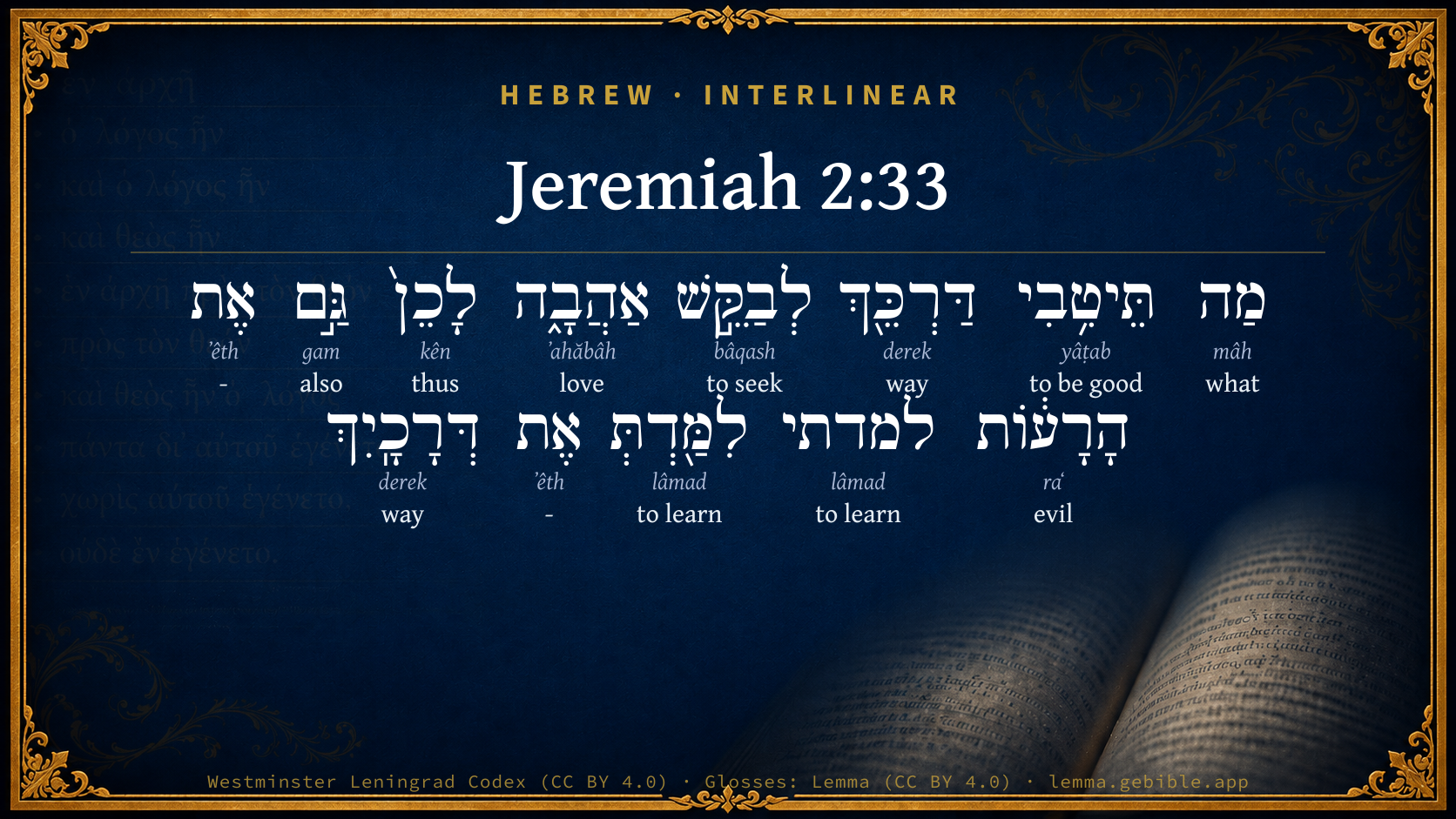
Hebrew (Westminster Leningrad Codex) Jeremiah 2:33 appears in the Hebrew Old Testament. The text above is from the Westminster Leningrad Codex. Each word links to its Strong’s number, a concise gloss, and parsing drawn from the Open Scriptures Hebrew Bible morphology. Click any word for its full Brown-Driver-Briggs (BDB) entry.
Download image
Cite this verse

Jeremiah 2:33 (World English Bible). Public Domain. Lemma interlinear Bible study tool, https://lemma.gebible.app/v/jeremiah/2/33.

Show BibTeX & RIS
BibTeX
RIS
English Translation
How trimmest you your way to seek love! therefore even the wicked women have you taught your ways.
World English Bible · Public Domain
Download a study sheet

One document with this verse’s original text, its word-by-word gloss line, the meaning frame, cross-references with their text, attributed commentary, and full source and license credits — printable, and it pastes into notes with its structure intact.

This verse Autodidact and up

Study sheet (.html) Plain text (.txt)

A passage Seminary Student

Up to 50 verses in one chapter. A passage sheet keeps up to 6 commentary sources and 12 cross-references per verse, in the order this page ranks them, and says so on the sheet whenever that leaves anything out. Ask for a single verse and you get the Autodidact verse sheet above.

Everything on this page stays free to read, with no account — the sheet is a download of what is already on screen, not access to it.

Want to remove ads? Support Godless Engineer
Compare translations 3

The same verse in 3 English versions, stacked beneath the original-language interlinear above. Click any original word for its lexicon entry.

Each is an independent rendering of the whole verse — the interlinear is not word-aligned to these translations.

Highlighted words mark where these versions differ — a whole-verse word diff, not a word-by-word alignment.

  • World English Bible Public Domain
    How trimmest you your way to seek love! therefore even the wicked women have you taught your ways.
  • King James Version Public Domain
    Why trimmest thou thy way to seek love? therefore hast thou also taught the wicked ones thy ways.
  • unfoldingWord Literal Text CC BY-SA 4.0
    How well you make your way to seek love, so even the wicked women you taught your ways.

unfoldingWord Literal Text — © unfoldingWord, licensed CC BY-SA 4.0. Word-aligned USFM3 via Door43 (git.door43.org/unfoldingWord/en_ult).

Versions to compare (up to 4)

3 of 4 selected

Show all 18 translations

Every available English version of this verse, each an independent rendering of the whole verse.

  • World English Bible Public Domain
    How trimmest you your way to seek love! therefore even the wicked women have you taught your ways.
  • Berean Standard Bible Public Domain
    How skillfully you pursue love! Even the most immoral of women could learn from your ways.
  • Majority Standard Bible Public Domain
    How skillfully you pursue love! Even the most immoral of women could learn from your ways.
  • King James Version Public Domain
    Why trimmest thou thy way to seek love? therefore hast thou also taught the wicked ones thy ways.
  • American Standard Version (1901) Public Domain
    How trimmest thou thy way to seek love! therefore even the wicked women hast thou taught thy ways.
  • Revised Version (1885) Public Domain
    How trimmest thou thy way to seek love! therefore even the wicked women hast thou taught thy ways.
  • Geneva Bible (1599) Public Domain
    Why doest thou prepare thy way, to seeke amitie? euen therefore will I teach thee, that thy waies are wickednesse.
  • Douay-Rheims (1899) Public Domain
    Why dost thou endeavor to shew thy way good to seek my love, thou who has also taught thy malices to be thy ways,
  • Young's Literal Translation Public Domain
    What -- dost thou make pleasing thy ways to seek love? Therefore even the wicked thou hast taught thy ways.
  • Literal Standard Version CC BY-SA 4.0
    Why do you make your ways pleasing to seek love? Therefore you have even taught the wicked your ways.
  • Unlocked Literal Bible CC BY-SA 4.0
    How well you make your way to look for love. You have even taught your ways to wicked women.
  • unfoldingWord Literal Text CC BY-SA 4.0
    How well you make your way to seek love, so even the wicked women you taught your ways.
  • Darby Bible Public Domain
    How dost thou trim thy way to seek love! Therefore hast thou also accustomed thy ways to wickedness.
  • World Messianic Bible Public Domain
    How well you prepare your way to seek love! Therefore you have even taught the wicked women your ways.
  • Webster's Bible Public Domain
    Why trimmest thou thy way to seek love? therefore hast thou also taught the wicked ones thy ways.
  • Free Bible Version CC BY-SA 4.0
    How cleverly you look for your lovers! Even prostitutes could learn something from you!
  • Bible in Basic English Public Domain
    With what care are your ways ordered when you are looking for love! so... your ways.
  • JPS Tanakh (1917) Public Domain
    How trimmest thou thy way to seek love! Therefore — even the wicked women hast thou taught thy ways;

Literal Standard Version (2020), Covenant Press — licensed CC BY-SA 4.0. Text via the HelloAO Bible API (eBible.org). Unlocked Literal Bible (unfoldingWord) — licensed CC BY-SA 4.0. Text via the HelloAO Bible API (eBible.org). unfoldingWord Literal Text — © unfoldingWord, licensed CC BY-SA 4.0. Word-aligned USFM3 via Door43 (git.door43.org/unfoldingWord/en_ult). Free Bible Version, Dr. Jonathan Gallagher — licensed CC BY-SA 4.0. Text via the HelloAO Bible API (eBible.org).

Word by word

More ways to search: Search by grammar → Find every occurrence → Compare this word →

Practice this passage: Drill this verse → Learn its vocabulary →

אַהֲבָ֑ה
ʼahăbâh
H160
“love”
Noun, Common, Feminine, Singular, Absolute
Part of Speech
Noun
Type
Common
Gender
Feminine
Number
Singular
State
Absolute
Full BDB Definition

Origin: f of H158

TWOT: 29c

love - human love for human object - of man toward man - of man toward himself - between man and woman - sexual desire - God's love to His people
  1. מַה mâh H4100 “what” Particle, Interrogative
  2. תֵּיטִ֥בִי yâṭab H3190 “to be good” Verb, Hiphil, Imperfect, 2nd Person, Feminine, Singular
  3. דַּרְכֵּ֖ךְ derek H1870 “way · your” Noun, Common, Both, Singular, Construct + Suffix, Personal, 2nd Person, Feminine, Singular
  4. לְבַקֵּ֣שׁ bâqash H1245 “to seek” Preposition + Verb, Piel, Infinitive Construct
  5. לָכֵן֙ kên H3651 “to/for · thus” Preposition + Adverb
  6. גַּ֣ם gam H1571 “also” Particle, Accusative
  7. אֶת ʼêth H853 “-” Particle, Direct Object
  8. הָרָע֔וֹת raʻ H7451 “the · evils” Particle, Definite Article + Noun, Common, Feminine, Plural, Absolute
  9. למדתי lâmad H3925 “to learn” Verb, Piel, Perfect, 1st Person, Common, Singular
  10. לִמַּ֖דְתְּ lâmad H3925 “to learn” Verb, Piel, Perfect, 1st Person, Common, Singular
  11. אֶת ʼêth H853 “-” Particle, Direct Object
  12. דְּרָכָֽיִךְ derek H1870 “ways · your” Noun, Common, Both, Plural, Construct + Suffix, Personal, 2nd Person, Feminine, Singular

About this verse

These counts appear in no published source. They are computed here, from the morphology-tagged text and Lemma’s own curated glosses. What Lemma adds →

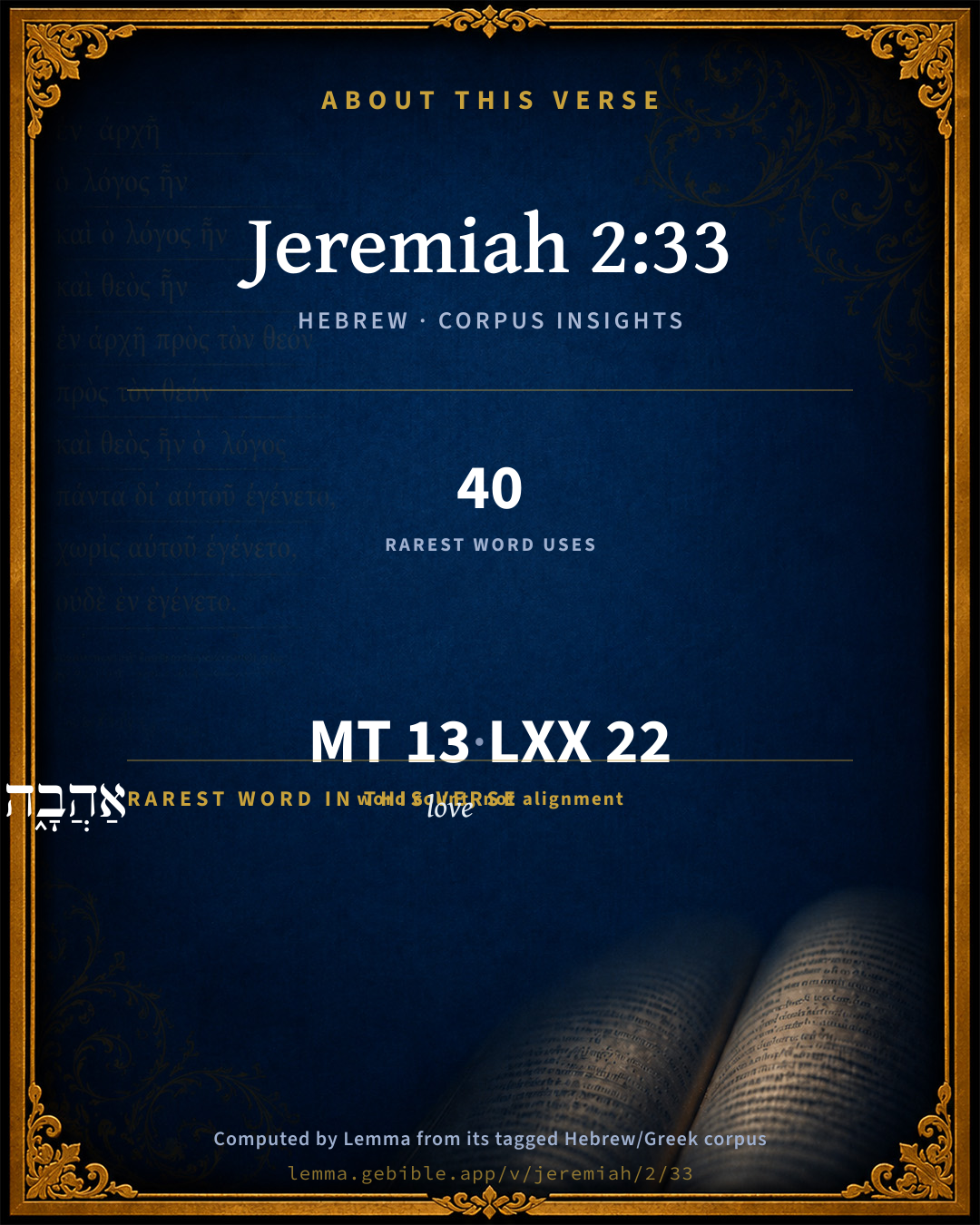
13
words
10
distinct lemmas
Prophets
section

Shared distinctive vocabulary

אַהֲבָ֑ה love H160 occurs in 37 verses of the Hebrew Bible. Also found in:

Grammatical profile

  • 4 verbs
  • 4 nouns
  • 1 adverb
  • 4 particles

Verb forms

  • תֵּיטִ֥בִי Hiphil · Imperfect
  • לְבַקֵּ֣שׁ Piel · Infinitive Construct
  • למדתי Piel · Perfect
  • לִמַּ֖דְתְּ Piel · Perfect

Repetition

Words recur within this verse — often emphatic in Hebrew:

  • דַּרְכֵּ֖ךְ way H1870 ×2
  • למדתי to learn H3925 ×2

Hebrew & Septuagint length

In the original languages it is 13 Hebrew tokens and 22 Greek tokens — but the two are counted differently (Hebrew bundles its prefixes and suffixes into one token; the Greek is in lemma form), so that isn’t a like-for-like length.

Cross-references

10

Topical passages linked to Jeremiah 2:33 in the Treasury of Scripture Knowledge — connected by theme and wording, ordered by reader-vote popularity; previews shown in the World English Bible.

  • Isaiah 57:7–10 On a high and lofty mountain have you set your bed; there also you went up to offer sacrifice.
  • Ezekiel 16:47 Yet have you not walked in their ways, nor done after their abominations; but, as [if that were] a very little [thing], you were more corrupt than they in all your ways.
  • 2 Chronicles 33:9 Manasseh seduced Judah and the inhabitants of Jerusalem, so that they did evil more than did the nations whom Yahweh destroyed before the children of Israel.
  • Jeremiah 2:23 How can you say, I am not defiled, I have not gone after the Baals? see your way in the valley, know what you have done: [you are] a swift dromedary traversing her ways;
  • Jeremiah 2:36 Why go you about so much to change your way? you shall be ashamed of Egypt also, as you were ashamed of Assyria.
  • Jeremiah 3:1–2 They say, If a man put away his wife, and she go from him, and become another man's, will he return to her again? Won't that land be greatly polluted? But you have played the prostitute with many lovers; yet return again to me, says Yahweh.
  • Ezekiel 16:27 See therefore, I have stretched out my hand over you, and have diminished your ordinary [food], and delivered you to the will of those who hate you, the daughters of the Philistines, who are ashamed of your lewd way.
  • Ezekiel 16:51–52 Neither has Samaria committed half of your sins; but you have multiplied your abominations more than they, and have justified your sisters by all your abominations which you have done.
  • Hosea 2:5–7 For their mother has played the prostitute. She who conceived them has done shamefully; For she said, 'I will go after my lovers, Who give me my bread and my water, My wool and my flax, My oil and my drink.'
  • Hosea 2:13 I will visit on her the days of the Baals, To which she burned incense, When she decked herself with her earrings and her jewels, And went after her lovers, And forgot me," says Yahweh.

Cross-references courtesy of OpenBible.info (CC BY 4.0).

Hebrew and Greek witnesses Masoretic Hebrew ↔ Greek Septuagint

The same verse in the two great witnesses to the Old Testament, shown verse-for-verse.

These are two independent witnesses, not word-aligned to each other, and the Septuagint is shown in lemma (dictionary) form.

Hebrew Jeremiah 2:33 Masoretic · Westminster Leningrad Codex

מַה תֵּיטִ֥בִי דַּרְכֵּ֖ךְ לְבַקֵּ֣שׁ אַהֲבָ֑ה לָכֵן֙ גַּ֣ם אֶת הָרָע֔וֹת למדתי לִמַּ֖דְתְּ אֶת דְּרָכָֽיִךְ

How trimmest you your way to seek love! therefore even the wicked women have you taught your ways.

World English Bible · Public Domain

Greek LXX Structure differs

In the Septuagint, Jeremiah is about an eighth shorter than the Hebrew and arranges its material differently — the Oracles Against the Nations (Hebrew chapters 46–51) appear in the middle of the Greek book, after 25:13. Because the chapter and verse boundaries do not line up, a verse-for-verse comparison with the Hebrew is not shown.

A verse-for-verse comparison isn’t shown here because the chapters and verses don’t line up. Switch to the LXX edition with the MT / LXX toggle above to read the Greek directly.

On this verse, Joseph Benson's Commentary discusses the Septuagint’s reading. Read the note in Commentary ↓

Hebrew: Westminster Leningrad Codex (CC BY 4.0). Greek: Septuagint (public domain); English from a public-domain English Septuagint. How the Septuagint differs from the Hebrew →

Targum (Aramaic paraphrase)

1

The Targum is the ancient Jewish Aramaic paraphrase of the Hebrew Scriptures — an interpretive translation, not the Hebrew text itself. Onkelos (literal) and Pseudo-Jonathan (expansive) render the Torah, and Jonathan the Prophets. Coverage is partial: where no permissively-licensed English translation exists for a verse, only the Aramaic is shown. This is verse-level text, not a word-by-word alignment to the Hebrew.

  1. Targum Jonathan Prophets (Joshua–Malachi)
    מַה אַתְּ מִשְׁתַּפְרָא בְּאוֹרְחָתַיִךְ לְמֶעְבַד רַחֲמֵי לְאִתְחַבְּרָא בְּעַמְמַיָא בְּכֵן אַף יַת בִּישָׁן אַלֵיפְתְּ מִן אוֹרְחָתַיִךְ:

    (no public-domain English translation for this verse)

    Targum Jonathan — Aramaic: “Mikraot Gedolot” (public domain). English: “Sefaria Community Translation” (CC0 1.0 (public-domain dedication)); “London "Chaldee Paraphrase," 1871” (public domain). Text via Sefaria.

Commentary

Notes on Jeremiah 2:33 from classic Christian and Jewish commentators (each source and its license shown beneath its notes). The classic Christian expositions comment on the surrounding passage and are grouped to its opening verse, so a note may address several verses; the Jewish commentaries on the Tanakh (Rashi and others) are per-verse, so they appear only where the commentator wrote on this verse.

Lemma curates 59 commentaries, every one of them public domain or Creative Commons licensed, each selected and text-cleaned for this edition rather than reprinted as found. About our sources →

Trapp's Complete Commentary

John Trapp

Jer 2:33 Why trimmest thou thy way to seek love? therefore hast thou also taught the wicked ones thy ways.

Ver. 33. Why trimmest thou thy way to seek love?] Cur bonificas? so Calvin rendereth it why dost thou make good thy way? that is, set a good gloss upon it, even the best side outwards. The same word is used of Jezebel’s dressing her head. {2Ki 9:30} What need this whorish trick and trimming, if all were right with thee?

“ Iactas vaenales, quas vis obtrudere, merces. ”

Therefore also hast thou taught the wicked ones thy way.] Heb., The wicked women - for the word is feminine - those she-sinners may learn immodesty of thee, who are meretricissimae. And for this it is that thou art pointed at with the finger as it were. {Jer 2:34-35}

John Trapp, A Commentary or Exposition upon All the Books of the Old and New Testament (1647–1656) — public domain. Text from a community e-Sword module.

Joseph Benson's Commentary

Jer 2:33-34. Why trimmest thou thy way to seek love — “The prophet,” says Lowth, “alludes to the practices of common harlots, who deck themselves, and use all inveigling arts, that they may recommend themselves to their gallants; in like manner,” the prophet intimates, “the Jews tried all methods to gain the friendship and assistance of foreign idolaters, who are called their lovers:” see Jer 3:1; Jer 22:22. Houbigant’s translation of this verse is, “Why dost thou strew thy way, that thou mayest find lovers; and teachest thy ways to thy companions?” The original word, rendered trimmest, תישׂבי, properly means, to make good, right, or agreeable. Noldius expounds the clause, “Why dost thou justify thy ways, or insist upon thy innocence?” And the French interpret the verse, “Why wouldest thou justify thy conduct, to enter into favour with me? so long as thou hast taught to others the evil which thou hast done; and while (Jer 2:34) in thy skirts,” &c. Also in thy skirts is found the blood of the souls, &c. — This would be better rendered, Also in thy skirts is found the blood of poor and innocent persons, for by souls is meant persons; and by the blood being found in their skirts, the prophet means their committing murders and oppressions, secretly, perhaps; but their guilt was as manifest as though the blood of the persons slain had been found sprinkled upon their garments. The LXX. render the clause εν ταις χερσι σου ευρεθησαν αιματα ψυχων αθωων, in thy hands have been found the blood of innocent souls, or persons. Their sacrificing of their little children to their idols, as well as their oppressing and murdering of adult persons, is intended to be comprised here. I have not found it by secret search — The LXX., with whom all the ancient versions agree, render the clause ουκ εν διορυγμασιν ευρον αυτους, I have not found them in digged holes, or ditches, but upon all these. The LXX. and Syriac render על כל אלה, here, upon every oak. “The meaning of which,” says Blaney, “is this: In the law it is commanded, (Lev 17:13,) that the blood of animals killed in hunting should be covered with dust, in order, no doubt, to create a horror at the sight of blood. In allusion to this command, it is urged against Jerusalem, (Eze 24:7,) that she had not only shed blood in the midst of her, but that she had set it upon the top of a rock, and poured it not upon the ground to cover it with dust; that is, she had seemed to glory in the crime, by doing it in the most open and audacious manner, so as to challenge God’s vengeance. In like manner it is said here, that God had not discovered the blood that was shed in holes under ground, but that it was sprinkled upon every oak before which their inhuman sacrifices had been performed.”

Joseph Benson's Commentary on the Old and New Testaments (1811–1818) — public domain. Text from a community e-Sword module.

Keil & Delitzsch

C. F. Keil & F. Delitzsch

In Jer 2:33 the style of address is ironical. How good thou makest thy way! i.e., how well thou knowest to choose out and follow the right way to seek love. היטיב דּרך sig. usually: strive after a good walk and conversation; cf. Jer 7:3, Jer 7:5; Jer 18:11, etc.; here, on the other hand, to take the right way for gaining the end in view. "Love" here is seen from the context to be love to the idols, intrigues with the heathen and their gods. Seek love = strive to gain the love of the false gods. To attain this end thou hast taught thy ways misdeeds, i.e., accustomed thy ways to misdeeds, forsaken the commandments of thy God which demand righteousness and the purifying of one's life, and accommodated thyself to the immoral practices of the heathen. הרעות, with the article as in Jer 3:5, the evil deeds which are undisguisedly visible; not: the evils, the misfortunes which follow thee closely, as Hitz. interprets in the face of the context. For in Jer 2:34 we have indisputable evidence that the matter in hand is not evils and misfortunes, but evil deeds or misdemeanours; since there the cleaving of the blood of innocent souls to the hems of the garments is mentioned as one of the basest "evils," and as such is introduced by the גּם of gradation. The "blood of souls" is the blood of innocent murdered men, which clings to the skirts of the murderers' clothes. כּנפים are the skirts of the flowing garment, Eze 5:3; Sa1 15:27; Zac 8:23. The plural נמצאוּ before דּם is explained by the fact that נפשׁות is the principal idea. אביונים are not merely those who live in straitened circumstances, but pious oppressed ones as contrasted with powerful transgressors and oppressors; cf. Ps. 40:18; Psa 72:13., Psa 86:1-2, etc. By the next clause greater prominence is given to the fact that they were slain being innocent. The words: not בּמּחתּרת, at housebreaking, thou tookest them, contain an allusion to the law in Exo 22:1 and onwards; according to which the killing of a thief caught in the act of breaking in was not a cause of blood-guiltiness. The thought runs thus: The poor ones thou hast slain were no thieves or robbers whom thou hadst a right to slay, but guiltless pious men; and the killing of them is a crime worthy of death. Exo 21:12. The last words כּי על כּל־אלּה are obscure, and have been very variously interpreted. Changes upon the text are not to the purpose. For we get no help from the reading of the lxx, of the Syr. and Arab., which seem to have read אלּה as אלה, and which have translated δρυΐ́ oak or terebinth; since "upon every oak" gives no rational meaning. Nor from the connection of the words with the next verse (Venem., Schnur., Ros., and others): yet with all this, or in spite of all this, thou saidst; since neither does כּי mean yet, nor can the ו before תאמרי, in this connection, introduce the sequel thought. The words manifestly belong to what goes before, and contain a contrast: not in breaking in by night thou tookest them, but upon, or on account of all this. על in the sig. upon gives a suitable sense only if, with Abarb., Ew., Ng., we refer אלּה to בּכנפיך and take מצאתים as 1st pers.: I found it (the blood of the slain souls) not on the place where the murder took place, but upon all these, sc. lappets of the clothes, i.e., borne openly for display. But even without dwelling on the fact that מחתּרת does not mean the scene of a murder or breaking in, this explanation is wrecked on the unmistakeably manifest allusion to the law, אם בּמּחתּרת ימּצא הגּנּב, Exo 21:1, which is ignored, or at least obscured, by that view. The allusion to this passage of the law shows that מצאתים is not 1st but 2nd pers., and that the suffix refers to the innocent poor who were slain. Therefore, with Hitz. and Graf, we take על כּל־ אלּה in the sig. "on account of all this," and refer the "all this" to the idolatry before mentioned. Consequently the words bear this meaning: Not for a crime thou killedst the poor, but because of thine apostasy from God and thy fornication with the idols, their blood cleaves to thy raiment. the words seem, as Calv. surmised, to point to the persecution and slaying of the prophets spoken of in Jer 2:30, namely, to the innocent blood with which the godless king Manasseh filled Jerusalem, Kg2 21:16; Kg2 24:4; seeking as he did to crush out all opposition to the abominations of idolatry, and finding in his way the prophets and the godly of the land, who by their words and their lives lifted up their common testimony against the idolaters and their abandoned practices.

Keil & Delitzsch — Biblical Commentary on the Old Testament (1861–1891) — public domain (CC PDM 1.0). Text via the HelloAO Bible API. (Old Testament only.)

Tyndale Open Study Notes

Tyndale Open Resources

2:33-34 The Israelites would plot and scheme with their lovers, their neighbors with powerful armies, by making treaties to gain the protection that the Lord had already promised them. God considered this an act of prostitution that left a stain of blood on Israel’s character. Like their pagan neighbors, Israel now crushed its own innocent and poor (7:6; 2 Kgs 21:16; 24:4).

Tyndale Open Study Notes — © Tyndale Open Resources, licensed CC BY-SA 4.0. Text via the HelloAO Bible API.

Geneva Bible (1599)

Geneva Bible translators

With strangers.

Geneva Bible (1599) marginal notes — public domain. Text via Bolls.life.

Jamieson, Fausset & Brown

Robert Jamieson, A. R. Fausset & David Brown

Why trimmest--MAURER translates, "How skilfully thou dost prepare thy way," &c. But see Kg2 9:30. "Trimmest" best suits the image of one decking herself as a harlot.

way--course of life.

therefore--accordingly. Or else, "nay, thou hast even," &c.

also . . . wicked ones--even the wicked harlots, that is, (laying aside the metaphor) even the Gentiles who are wicked, thou teachest to be still more so [GROTIUS].

Jamieson, Fausset & Brown — Commentary Critical and Explanatory on the Whole Bible (1871) — public domain (CC PDM 1.0). Text via the HelloAO Bible API.

Adam Clarke's Commentary

Verse 33. Why trimmest thou thy way] Ye have used a multitude of artifices to gain alliances with the neighbouring idolatrous nations.

Hast thou also taught the wicked ones thy ways.] Ye have made even these idolaters worse than they were before. Dr. Blayney translates, "Therefore have I taught calamity thy ways." A prosopopoeia: "I have instructed calamity where to find thee." Thou shalt not escape punishment.

Adam Clarke's Commentary on the Bible (1810–1826) — public domain. Text from a community e-Sword/MySword module.

John Calvin's Commentaries

This verse is differently explained: but the Prophet simply means; that the Jews were like lascivious women, who not only despise their husbands at home, but ramble here and there in all directions, and also paint their faces and seek for themselves all the charms of wantonness. He says that the Jews had acted in this way; and hence he says that they made beautiful their ways The verb in Hebrew has a wide meaning: it means to prepare, to conciliate favor. But its import here is, as though the Prophet had said, “Why dost thou disguise and paint thyself like strumpets, who use many artifices to allure young men and to inflame their lusts? why then dost thou undertake so much labor to gain a meretricious hire?” We shall hereafter see why he says this; for he upbraids them for applying to the Assyrians and the Egyptians.

It was a common thing with the Prophets to compare the people to lovers; for the Jews, while they ought to have been firmly attached to God, (like a chaste woman, who does not turn her eyes here and there, nor gad about, but has respect to her husband alone,) thought to seek safety now from the Assyrians, then from the Egyptians. This sinful disposition is then what the Prophet here condemns; and hence he speaks of them metaphorically as of an adulterous woman, who despises her husband and rambles after any she can find, and seeks wanton and silly young men in all places, and subjects herself to the gratification of all. We now then understand what the Prophet means.

The words must be noticed: he says, Why makest thou fine thy ways? But he refers here to the care which a wanton woman takes to adorn her person, as though he had said, “Why dost thou thus prepare thyself? and why dost thou seek for thyself what is splendid and elegant, that thy appearance may deceive the eyes of the simple?” For the Jews might have remained safe and secure under God’s protection, and might have been so without any calamity. As a husband is content with the beauty of his wife, and seeks no adventitious and refined elegancies; so God required nothing from that people except fidelity, like a husband, who requires chastity in his wife. The meaning then is, — “As a wife, really attached to her husband, has no need to undergo much labor, for she knows that her own native beauty pleases him, nor does she labor much to gain the heart of her husband, for the best recommendation is her chastity; so ye might have lived without any trouble by only serving me and keeping my law: but now what is your chastity? ye are like wanton women, who labor to gain the hearts of adulterers; for as they burn with lust, so there is no end nor limits to their attempts to seek embellishments; and they torment themselves, only that they might attach adulterers to themselves. Such then are ye (says God;) for ye spend much care and labor in seeking for yourselves strange lovers.”

He afterwards adds, Therefore thou hast also taught lewdnesses He alludes to the words he had before used, Thou hast made fine (or fair) thy ways: and now he says, thou hast also taught wickednesses by thy ways He declares that the Jews were worse than the Assyrians and the Egyptians, as a lascivious woman is far worse than all the adulterers whom she captivates as her paramours. For when a young man is not deceived, and the devil does not apply the fagot, he may continue chaste and pure; but when an impudent and wanton woman entices him, it is all over with him. The Prophet then says, that the Assyrians and the Egyptians were innocent when compared with his own nation. How so? “Because they have been led away,” he says, “by your allurements, like young men, who are destroyed by the fallacious ornaments of strumpets; for it is the same as though they had fallen into snares: the evil then has proceeded from you, and the fault lies with you.

We now understand the Prophet’s meaning: for he condemns the Jews, because they afforded an occasion of evil both to the Assyrians and to the Egyptians, while they of their own accord sought their favor. It now follows —

John Calvin's Commentaries (1540-1563) — public domain. Text from the Calvin Translation Society English edition (1840s-50s) via the Christian Classics Ethereal Library (ccel.org). Calvin's coverage is partial (roughly two-thirds of the Bible); uncommented books and verses are honest gaps, never fabricated. The 19th-century editor's footnotes and remarks are omitted so the notes are faithfully Calvin's own voice.

Ellicott's Commentary for English Readers

(33) Why trimmest thou thy way . . .?—The verb is the same as that rendered “amend” in Jer_7:3; Jer_7:5, and was probably often on the lips of those who made a show of reformation. Here it is used with a scornful irony, “What means this reform, this show of amendment of thy ways, which leads only to a further indulgence in adulterous love?”

Hast thou also taught the wicked ones thy ways.—Better, hast thou also taught thy ways wickednesses. The professed change for the better was really for the worse.

A Bible Commentary for English Readers, edited by Charles John Ellicott (1878–1897) — public domain. Text from a community e-Sword module.

The Cambridge Bible for Schools and Colleges

gen. ed. J. J. S. Perowne

33. How trimmest thou thy way] lit. How thou makest thy way good! i.e. How cleverly thou goest about (to reach an immoral object)!

even the wicked women, etc.] even experts in immorality can learn fresh wickedness from thee. LXX (“thou hast done wickedly in corrupting thy ways”) very possibly represents a text superior to MT.

The Cambridge Bible for Schools and Colleges (gen. ed. J. J. S. Perowne; Cambridge University Press, 1878–1918) — public domain. Text from a community e-Sword module.

John Gill's Exposition

Also in thy skirts is found the blood of the souls of the poor innocents,.... Either of the innocent infants of poor persons, who were sacrificed to Moloch; or of the poor prophets of the Lord, whom they slew, because they faithfully reproved them for their sins; and the blood of those being found in their skirts is expressive of the publicness and notoriety of their sin, and also of the large quantity of blood shed, inasmuch as the skirts of their garments were filled with it, as if they had trod and walked in blood; see Isa 63:3.

I have not found it by secret search; or, "by digging" (q); there was no need to dig for it; it lay above ground; it was upon their skirts, public enough: or, "in ditches", as the Septuagint and Vulgate Latin (r) versions; as when murders are privately and secretly committed; but these were done openly. Some read the words, "thou didst not find them with a digging instrument" (s); so Jarchi interprets the words,

"you did not find them with a digging instrument, or in digging, when you slew them;''

you did not find them prepared as thieves to break up your houses, or digging down your walls, and breaking through into your houses, then you would have been justified by the law in slaying them, Exo 22:2, but this was not the case:

but upon all these; upon all their skirts, and not in ditches, or under ground; or, "for all these"; thou hast so done; not for their sins, for theft, or any other; but for their faithful reproofs and rebukes; so Jarchi, for all these words with which they reproved thee; or for all these, the idols on whose account, in the worship of them, the blood of the innocents was shed.

(q) "in suffossione", Vatablus, Calvin, De Dieu; "effossione", Junius & Tremellius; "perfossione", Schmidt. (r) , Sept. "in fossis", V. L. (s) "Cum perfossorio", Pagninus, Montanus; "sub. instrumento", Grotius; "terebro", Cocceius.

John Gill's Exposition of the Whole Bible (1746–1763) — public domain (CC PDM 1.0). Text via the HelloAO Bible API.

Albert Barnes' Notes on the Bible

Why trimmest thou thy way - literally, “Why makest thou thy way good,” a phrase used here of the pains taken by the Jews to learn the idolatries of foreign nations.

The wicked ones ... - Or, “therefore thou hast taught” thy ways wickednesses.”

Albert Barnes' Notes on the Bible (1834–1885) — public domain. Text from a community e-Sword/MySword module.

Haydock's Catholic Bible Commentary

Thou who. Hebrew, "Therefore have I." (Calmet) --- Protestants, "hast thou also taught the wicked ones thy ways." (Haydock) --- Thou hast opened a school of vice.

George Leo Haydock (1774–1849), Haydock's Catholic Family Bible and Commentary, 1859 edition — public domain. Excludes Psalms (Douay-Rheims chapter numbering differs from Protestant) and Deuterocanonical books (Catholic canon only).

Matthew Poole's English Annotations

Why trimmest, or deckest, Eze 23:40, thinking thereby to entice others to thy help? thus is the word used, Jer 4:30. Or, Why dost thou use so much art and skill, and take so much pains, to go and send here and there to contract a friendship with foreign people, and to bring them to thy embraces, Isa 57:9,10, or thinking to set a good face or gloss upon the matter, and excuse thyself, as if thou couldst delude God, whereas all thou dost is to get acquaintance with other idolaters?

To seek love, i.e. to commit filthiness with thy idols; a synecdoche of the kind.

Therefore hast thou also taught the wicked ones, i.e. thou art become so vile, that even strumpets themselves may come to learn of thee, 2Ch 33:9. Or by thy example; nations that have been vile enough of themselves, by thy example are become more vile.

Thy ways, i.e. thy actions; a metaphor.

Matthew Poole's English Annotations on the Holy Bible (1683–1685) — public domain. Text from a community e-Sword/MySword module.

The Pulpit Commentary

Why trimmest thou thy way I rather, H ow well thou contrivest thy way, etc.? Therefore hast thou also taught, etc. The meaning which floated before our trans-labors seems to be this: so utterly immoral is thy course of life, that even the worst of women "wicked ones" is in the feminine have been able to learn something from thee" (so the great Dutch scholar, De Dieu, in 1548). But a more natural rendering is, "Therefore i.e. to gain thine ends thou hast accustomed thy ways to those evil things." Nemo repente fuit tupissimus. It required a deliberate "accustoming," or "training" (such is the literal meaning of limad), to produce such a habit (exiv ) as is here rebuked.

The Pulpit Commentary (1880–1919), ed. H.D.M. Spence-Jones & Joseph S. Exell — public domain. Text from a community e-Sword module.

John Wesley's Explanatory Notes

Trimmest - Or, deckest, Ezek xxiii, 40, thinking thereby to entice others to thy help. Taught - Nations that have been vile enough of themselves, by thy example are become more vile.

John Wesley, Explanatory Notes Upon the Whole Bible (1754–1765) — public domain. Text via the GEBible commentary corpus.

Rashi

Rabbi Shlomo Yitzchaki (Rashi)

How you adorn Heb. תיטבי. You adorn yourself to greet your adulterers. Comp. “And she adorned her head” (I Kings 9:30) concerning Jezebel in the section dealing with Jehu.

even to the most evil you accustomed You searched throughout all the evil ways to learn the most corrupt of them all. גם is an expression of ‘even.’

verily Heb. לכן, an expression of a true oath. Verily, to the most evil way of all the ways you accustomed yourself.

you accustomed Heb. למדת, lit. you taught.

Rashi on the Tanakh — English translations: “The Judaica Press complete Tanach with Rashi, translated by A. J. Rosenberg” (CC BY 4.0); “Pentateuch with Rashi's commentary by M. Rosenbaum and A.M. Silbermann, 1929-1934” (public domain); “The Metsudah Tanach series, Lakewood, N.J” (CC BY 4.0); and “The Book of Joshua, Metsudah Publications, 1997” (CC BY 4.0). Text via Sefaria.

Lesson kit

Teaching starters — assembled from the data on this page, not authored interpretation. Every prompt links to the verse data it draws on. Edit before teaching.

Jeremiah, in the Prophets, opens this verse with 13 words (10 distinct Hebrew lemmas). Its most distinctive word is ʼahăbâh (“love”). A historical commentator’s framing appears above. Read the whole chapter for the surrounding context.

Discussion questions

  1. How does “love” (ʼahăbâh) shape what this verse is saying?
  2. How does Deuteronomy 7:8, which shares the word «love», read alongside this verse?
  3. What does the repetition of “way” (2× in this one verse) do in this verse?
  4. These translations render this verse differently; the difference is in the English rendering, not the original. What questions does that raise?
  5. «תֵּיטִ֥בִי» is a Hiphil Imperfect verb. How does that grammatical form shape the action described?
  6. Compare how Trapp's Complete Commentary and Joseph Benson's Commentary read this verse. Where do they agree or differ?

Things to notice

Reading settings

Reading text

Shown beneath each verse's original-language words.

Old Testament
Old Testament edition

Read the OT as the Masoretic Hebrew (MT) or the Greek Septuagint (LXX).

English shown for the Greek Septuagint (in the Hebrew ↔ Greek comparison).

Comparing translations? Open the Compare panel on any verse page to stack up to four side by side.