
Ecclesiastes 6:12

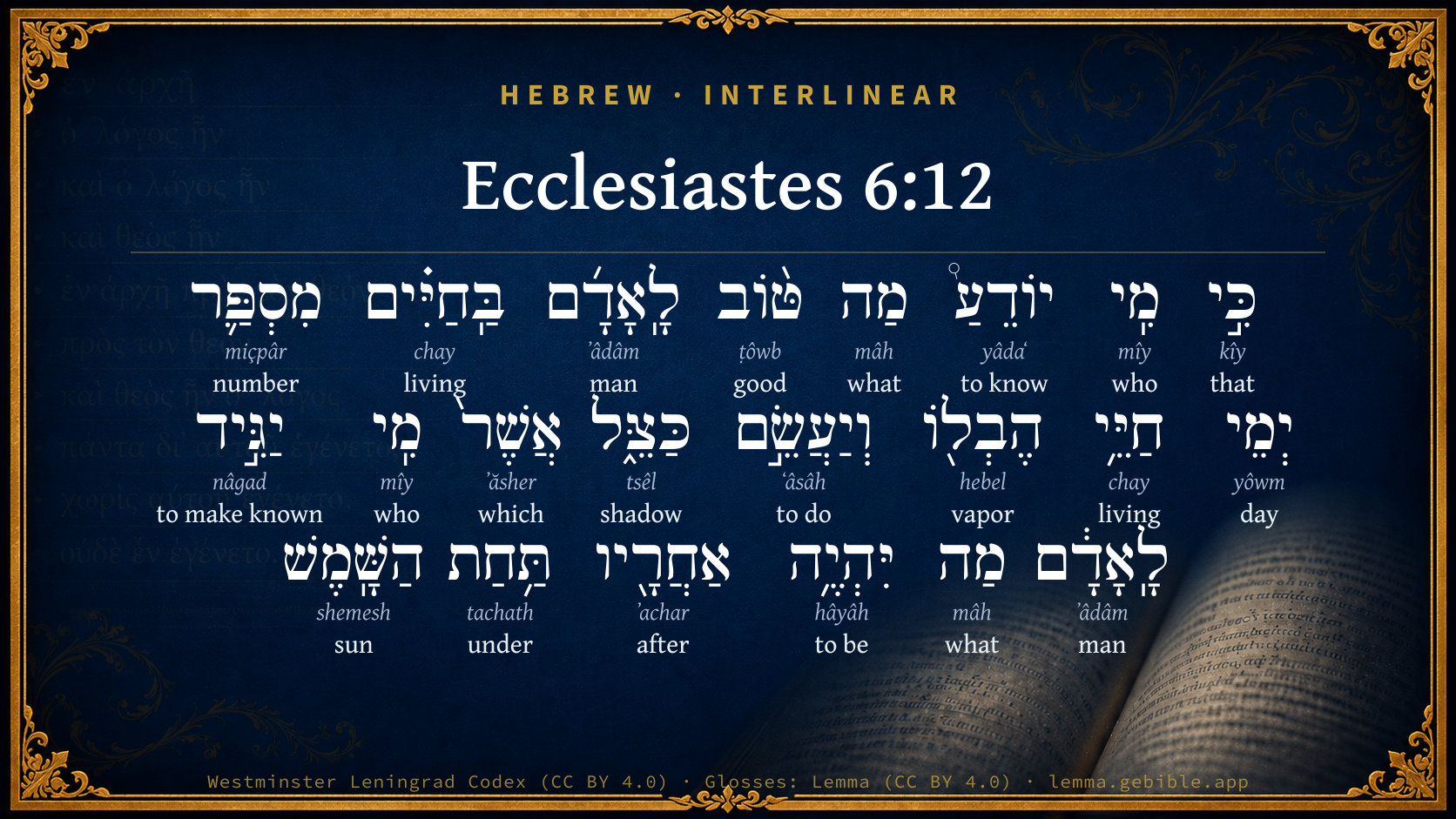
Hebrew (Westminster Leningrad Codex) Ecclesiastes 6:12 appears in the Hebrew Old Testament. The text above is from the Westminster Leningrad Codex. Each word links to its Strong’s number, a concise gloss, and parsing drawn from the Open Scriptures Hebrew Bible morphology. Click any word for its full Brown-Driver-Briggs (BDB) entry.
Download image
Cite this verse

Ecclesiastes 6:12 (World English Bible). Public Domain. Lemma interlinear Bible study tool, https://lemma.gebible.app/v/ecclesiastes/6/12.

Show BibTeX & RIS
BibTeX
RIS
English Translation
For who knows what is good for man in life, all the days of his vain life which he spends like a shadow? For who can tell a man what will be after him under the sun?
World English Bible · Public Domain
Download a study sheet

One document with this verse’s original text, its word-by-word gloss line, the meaning frame, cross-references with their text, attributed commentary, and full source and license credits — printable, and it pastes into notes with its structure intact.

This verse Autodidact and up

Study sheet (.html) Plain text (.txt)

A passage Seminary Student

Up to 50 verses in one chapter. A passage sheet keeps up to 6 commentary sources and 12 cross-references per verse, in the order this page ranks them, and says so on the sheet whenever that leaves anything out. Ask for a single verse and you get the Autodidact verse sheet above.

Everything on this page stays free to read, with no account — the sheet is a download of what is already on screen, not access to it.

Want to remove ads? Support Godless Engineer
Compare translations 3

The same verse in 3 English versions, stacked beneath the original-language interlinear above. Click any original word for its lexicon entry.

Each is an independent rendering of the whole verse — the interlinear is not word-aligned to these translations.

Highlighted words mark where these versions differ — a whole-verse word diff, not a word-by-word alignment.

  • World English Bible Public Domain
    For who knows what is good for man in life, all the days of his vain life which he spends like a shadow? For who can tell a man what will be after him under the sun?
  • King James Version Public Domain
    For who knoweth what is good for man in this life, all the days of his vain life which he spendeth as a shadow? for who can tell a man what shall be after him under the sun?
  • unfoldingWord Literal Text CC BY-SA 4.0
    For who is knowing what good for humanity in life the number of the days of his vaporous life? And he makes them like the shadow. For who will declare to humanity what will be after him under the sun?

unfoldingWord Literal Text — © unfoldingWord, licensed CC BY-SA 4.0. Word-aligned USFM3 via Door43 (git.door43.org/unfoldingWord/en_ult).

Versions to compare (up to 4)

3 of 4 selected

Show all 16 translations

Every available English version of this verse, each an independent rendering of the whole verse.

  • World English Bible Public Domain
    For who knows what is good for man in life, all the days of his vain life which he spends like a shadow? For who can tell a man what will be after him under the sun?
  • Berean Standard Bible Public Domain
    For who knows what is good for a man during the few days in which he passes through his fleeting life like a shadow? Who can tell a man what will come after him under the sun?
  • Majority Standard Bible Public Domain
    For who knows what is good for a man during the few days in which he passes through his fleeting life like a shadow? Who can tell a man what will come after him under the sun?
  • King James Version Public Domain
    For who knoweth what is good for man in this life, all the days of his vain life which he spendeth as a shadow? for who can tell a man what shall be after him under the sun?
  • American Standard Version (1901) Public Domain
    For who knoweth what is good for man in `his' life, all the days of his vain life which he spendeth as a shadow? for who can tell a man what shall be after him under the sun?
  • Revised Version (1885) Public Domain
    For who knoweth what is good for man in his life, all the days of his vain life which he spendeth as a shadow? for who can tell a man what shall be after him under the sun?
  • Young's Literal Translation Public Domain
    For who knoweth what `is' good for a man in life, the number of the days of the life of his vanity, and he maketh them as a shadow? for who declareth to man what is after him under the sun?
  • Literal Standard Version CC BY-SA 4.0
    For who knows what [is] good for a man in life, the number of the days of the life of his vanity, and he makes them as a shadow? For who declares to man what is after him under the sun?
  • Unlocked Literal Bible CC BY-SA 4.0
    For who knows what is good for man in his life during his futile, numbered days through which he passes like a shadow? Who can tell a man what will come under the sun after he passes?
  • unfoldingWord Literal Text CC BY-SA 4.0
    For who is knowing what good for humanity in life the number of the days of his vaporous life? And he makes them like the shadow. For who will declare to humanity what will be after him under the sun?
  • Darby Bible Public Domain
    For who knoweth what is good for man in life, all the days of his vain life which he spendeth as a shadow? for who can tell man what shall be after him under the sun?
  • World Messianic Bible Public Domain
    For who knows what is good for man in life, all the days of his vain life which he spends like a shadow? For who can tell a man what will be after him under the sun?
  • Webster's Bible Public Domain
    For who knoweth what is good for man in this life, all the days of his vain life which he spendeth as a shadow? for who can tell a man what shall be after him under the sun?
  • Free Bible Version CC BY-SA 4.0
    Who knows what's best for us and our lives? During our short lives that pass like shadows we have many unanswered questions. And who can tell us what will happen when we're gone?
  • Bible in Basic English Public Domain
    Who is able to say what is good for man in life all the days of his foolish life which he goes through like a shade? who will say what is to be after him under the sun?
  • JPS Tanakh (1917) Public Domain
    For who knoweth what is good for man in his life, all the days of his vain life which he spendeth as a shadow? for who can tell a man what shall be after him under the sun?

Literal Standard Version (2020), Covenant Press — licensed CC BY-SA 4.0. Text via the HelloAO Bible API (eBible.org). Unlocked Literal Bible (unfoldingWord) — licensed CC BY-SA 4.0. Text via the HelloAO Bible API (eBible.org). unfoldingWord Literal Text — © unfoldingWord, licensed CC BY-SA 4.0. Word-aligned USFM3 via Door43 (git.door43.org/unfoldingWord/en_ult). Free Bible Version, Dr. Jonathan Gallagher — licensed CC BY-SA 4.0. Text via the HelloAO Bible API (eBible.org).

Word by word

More ways to search: Search by grammar → Find every occurrence → Compare this word →

Practice this passage: Drill this verse → Learn its vocabulary →

כַּצֵּ֑ל
tsêl
H6738
“like/as the · shadow”
Preposition, Determined + Noun, Common, Masculine, Singular, Absolute
Part of Speech
Preposition + Noun
Type
Common
Gender
Masculine
Number
Singular
State
Absolute
Full BDB Definition

Origin: from H6751

TWOT: 1921a

shadow, shade - shadow (on dial) - shadow, shade (as protection) - shadow (symbolic of transitoriness of life)
  1. כִּ֣י kîy H3588 “that” Conjunction
  2. מִֽי mîy H4310 “who” Particle, Interrogative
  3. יוֹדֵעַ֩ yâdaʻ H3045 “knowing” Verb, Qal, Participle Active, Masculine, Singular, Absolute
  4. מַה mâh H4100 “what” Particle, Interrogative
  5. טּ֨וֹב ṭôwb H2896 “good” Adjective, Adjective, Masculine, Singular, Absolute
  6. לָֽאָדָ֜ם ʼâdâm H120 “to/for the · man” Preposition, Determined + Noun, Common, Masculine, Singular, Absolute
  7. בַּֽחַיִּ֗ים chay H2416 “in/at the · living things” Preposition, Determined + Noun, Common, Masculine, Plural, Absolute
  8. מִסְפַּ֛ר miçpâr H4557 “number of” Noun, Common, Masculine, Singular, Construct
  9. יְמֵי yôwm H3117 “days of” Noun, Common, Masculine, Plural, Construct
  10. חַיֵּ֥י chay H2416 “living things of” Noun, Common, Masculine, Plural, Construct
  11. הֶבְל֖וֹ hebel H1892 “vapor · his” Noun, Common, Masculine, Singular, Construct + Suffix, Personal, 3rd Person, Masculine, Singular
  12. וְיַעֲשֵׂ֣ם ʻâsâh H6213 “and · to do · them” Conjunction + Verb, Qal, Imperfect, 3rd Person, Masculine, Singular + Suffix, Personal, 3rd Person, Masculine, Plural
  13. אֲשֶׁר֙ ʼăsher H834 “which” Particle, Relative
  14. מִֽי mîy H4310 “who” Particle, Interrogative
  15. יַגִּ֣יד nâgad H5046 “to make known” Verb, Hiphil, Imperfect, 3rd Person, Masculine, Singular
  16. לָֽאָדָ֔ם ʼâdâm H120 “to/for the · man” Preposition, Determined + Noun, Common, Masculine, Singular, Absolute
  17. מַה mâh H4100 “what” Particle, Interrogative
  18. יִּהְיֶ֥ה hâyâh H1961 “to be” Verb, Qal, Imperfect, 3rd Person, Masculine, Singular
  19. אַחֲרָ֖יו ʼachar H310 “after · him” Preposition + Suffix, Personal, 3rd Person, Masculine, Singular
  20. תַּ֥חַת tachath H8478 “under” Preposition
  21. הַשָּֽׁמֶשׁ shemesh H8121 “the · sun” Particle, Definite Article + Noun, Common, Both, Singular, Absolute

About this verse

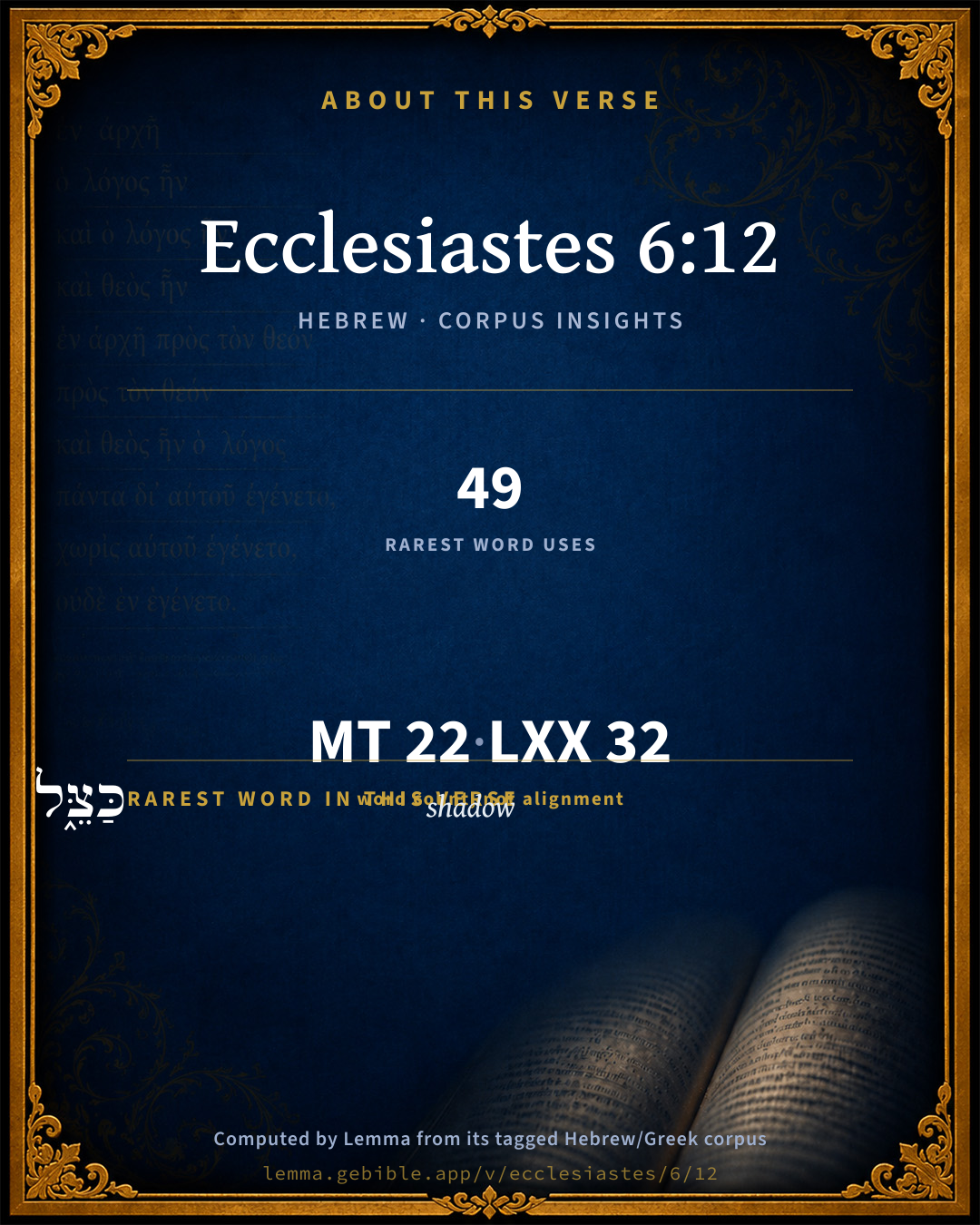
These counts appear in no published source. They are computed here, from the morphology-tagged text and Lemma’s own curated glosses. What Lemma adds →

22
words
18
distinct lemmas
Wisdom
section

Shared distinctive vocabulary

כַּצֵּ֑ל shadow H6738 occurs in 47 verses of the Hebrew Bible. Also found in:

Grammatical profile

  • 4 verbs
  • 9 nouns
  • 1 adjective
  • 2 prepositions
  • 1 conjunction
  • 5 particles

Verb forms

  • יוֹדֵעַ֩ Qal · Participle Active
  • וְיַעֲשֵׂ֣ם Qal · Imperfect
  • יַגִּ֣יד Hiphil · Imperfect
  • יִּהְיֶ֥ה Qal · Imperfect

Repetition

Words recur within this verse — often emphatic in Hebrew:

  • לָֽאָדָ֜ם man H120 ×2
  • בַּֽחַיִּ֗ים living H2416 ×2
  • מִֽי who H4310 ×2
  • מַה what H4100 ×2

Hebrew & Septuagint length

In the original languages it is 22 Hebrew tokens and 32 Greek tokens — but the two are counted differently (Hebrew bundles its prefixes and suffixes into one token; the Greek is in lemma form), so that isn’t a like-for-like length.

Cross-references

23

Topical passages linked to Ecclesiastes 6:12 in the Treasury of Scripture Knowledge — connected by theme and wording, ordered by reader-vote popularity; previews shown in the World English Bible.

  • James 4:14 Whereas you don't know what your life will be like tomorrow. For what is your life? For you are a vapor, that appears for a little time, and then vanishes away.
  • Job 14:2 He comes forth like a flower, and is cut down. He also flees like a shadow, and doesn't continue.
  • Ecclesiastes 3:22 Therefore I saw that there is nothing better, than that a man should rejoice in his works; for that is his portion: for who can bring him to see what will be after him?
  • Psalms 144:4 Man is like a breath. His days are like a shadow that passes away.
  • Lamentations 3:24–27 Yahweh is my portion, says my soul; therefore will I hope in him.
  • Psalms 39:5–6 Behold, you have made my days handbreadths. My lifetime is as nothing before you. Surely every man stands as a breath." Selah.
  • 1 Chronicles 29:15 For we are strangers before you, and foreigners, as all our fathers were: our days on the earth are as a shadow, and there is no abiding.
  • Job 8:9 (For we are but of yesterday, and know nothing, Because our days on earth are a shadow.)
  • Ecclesiastes 8:7 For he doesn't know that which will be; for who can tell him how it will be?
  • Ecclesiastes 8:13 But it shall not be well with the wicked, neither shall he lengthen days like a shadow; because he doesn't fear God.
  • Job 14:21 His sons come to honor, and he doesn't know it; They are brought low, but he doesn't perceive it of them.
  • Psalms 4:6 Many say, "Who will show us any good?" Yahweh, let the light of your face shine on us.
  • Psalms 17:15 As for me, I shall see your face in righteousness; I shall be satisfied, when I awake, with seeing your form.
  • Psalms 90:10–12 The days of our years are seventy, Or even by reason of strength eighty years; Yet their pride is but labor and sorrow, For it passes quickly, and we fly away.
  • Psalms 102:11 My days are like a long shadow. I have withered like grass.
  • Psalms 109:23 I fade away like an evening shadow. I am shaken off like a locust.
  • Ecclesiastes 2:3 I searched in my heart how to cheer my flesh with wine, my heart yet guiding me with wisdom, and how to lay hold of folly, until I might see what it was good for the sons of men that they should do under heaven all the days of their lives.
  • Ecclesiastes 9:6 Also their love, their hatred, and their envy has perished long ago; neither have they any more a portion forever in anything that is done under the sun.
  • Ecclesiastes 12:13 This is the end of the matter. All has been heard. Fear God, and keep his commandments; for this is the whole duty of man.
  • Psalms 16:5 Yahweh assigned my portion and my cup. You made my lot secure.
  • Psalms 47:4 He chooses our inheritance for us, The glory of Jacob whom he loved. Selah.
  • Psalms 89:47 Remember how short my time is! For what vanity have you created all the children of men!
  • Micah 6:8 He has shown you, O man, what is good. What does Yahweh require of you, but to act justly, To love mercy, and to walk humbly with your God?

Cross-references courtesy of OpenBible.info (CC BY 4.0).

Hebrew and Greek witnesses Masoretic Hebrew ↔ Greek Septuagint

The same verse in the two great witnesses to the Old Testament, shown verse-for-verse.

These are two independent witnesses, not word-aligned to each other, and the Septuagint is shown in lemma (dictionary) form.

Hebrew Ecclesiastes 6:12 Masoretic · Westminster Leningrad Codex

כִּ֣י מִֽי יוֹדֵעַ֩ מַה טּ֨וֹב לָֽאָדָ֜ם בַּֽחַיִּ֗ים מִסְפַּ֛ר יְמֵי חַיֵּ֥י הֶבְל֖וֹ וְיַעֲשֵׂ֣ם כַּצֵּ֑ל אֲשֶׁר֙ מִֽי יַגִּ֣יד לָֽאָדָ֔ם מַה יִּהְיֶ֥ה אַחֲרָ֖יו תַּ֥חַת הַשָּֽׁמֶשׁ

For who knows what is good for man in life, all the days of his vain life which he spends like a shadow? For who can tell a man what will be after him under the sun?

World English Bible · Public Domain

Greek LXX Ecclesiastes 6:12 Septuagint · lemma form

ὅτι τίς οἶδα τίς ἀγαθός ὁ ἄνθρωπος ἐν ὁ ζωή ἀριθμός ἡμέρα ζωή ματαιότης αὐτός καί ποιέω αὐτός ἐν σκιά ὅτι τίς ἀποἀγγέλλω ὁ ἄνθρωπος τίς εἰμί ὀπίσω αὐτός ὑπό ὁ ἥλιος

No English rendering of this Greek verse — the small residue in the structurally divergent books.

On this verse, Keil & Delitzsch discusses the Septuagint’s reading. Read the note in Commentary ↓

Hebrew: Westminster Leningrad Codex (CC BY 4.0). Greek: Septuagint (public domain); English from a public-domain English Septuagint. How the Septuagint differs from the Hebrew →

Commentary

Notes on Ecclesiastes 6:12 from classic Christian and Jewish commentators (each source and its license shown beneath its notes). The classic Christian expositions comment on the surrounding passage and are grouped to its opening verse, so a note may address several verses; the Jewish commentaries on the Tanakh (Rashi and others) are per-verse, so they appear only where the commentator wrote on this verse.

Lemma curates 59 commentaries, every one of them public domain or Creative Commons licensed, each selected and text-cleaned for this edition rather than reprinted as found. About our sources →

Trapp's Complete Commentary

John Trapp

Ecc 6:12 For who knoweth what [is] good for man in [this] life, all the days of his vain life which he spendeth as a shadow? for who can tell a man what shall be after him under the sun?

Ver. 12. For who knoweth what is good for man.] He may think this and that to be good, but is, mostly, mistaken and disappointed. Ambrose hath well observed, that other creatures are led by the instinct of nature to that which is good for them. The lion, when he is sick, cures himself by devouring an ape; the bear, by devouring ants; the wounded deer, by feeding upon dittany, {a} &c.; tu ignoras, O homo, remedia tua, but thou, O man, knowest not what is good for thee. "He hath showed thee, O man, what is good," saith the prophet; "and what doth the Lord require of thee, but this" - instead of raking riches together - "to do justly, and to love mercy, and" - instead of contending with him - "to humble thyself to walk with thy God." {Mic 6:8}

For who can tell a man what shall be after him?] When the worms shall be scrambling for his body, the devils, haply, for his soul, and his friends for his goods. A false Jesuit published in print, some years after Queen Elizabeth’s death, that she died despairing, and that she wished she might, after her death, hang a while in the air, to see what striving would be for her kingdom. {b} I loved the man, said Ambrose of Theodosius, for this, that when he died, he was more affected with care of the Church’s good, than of his own. {c}

{a} A labiate plant, Origanum Dictamnus, called also Dictamnus Creticus or dittany of Crete; formerly famous for its alleged medicinal virtues.

{b} Camden’s Elisabeth.

{c} Dilexi virum qui cum corpore solveretur magis de Ecclesiarum statu, &c.

John Trapp, A Commentary or Exposition upon All the Books of the Old and New Testament (1647–1656) — public domain. Text from a community e-Sword module.

The Biblical Illustrator

Joseph S. Exell

Ecc_6:12

For who knoweth what is good for man in this life, all the days of his vain life which he spendeth as a shadow?

for who can tell a man what shall be after him under the sun?

The known and the unknown

I. Our life which we do know.

1. We do know something about our present life, and what we do know about it should humble us in the presence Of God, for, first, it is very short. Solomon here says nothing about the years of our life, he only counts it by days. The older a man grows, the shorter his life seems to be; and it was because Jacob was so old, and had seen so many days, that he called them few and evil. Children and youths appear to have lived a long while; men seem to have lived only a short time; older men an even shorter period; but the oldest man reckons his days the shortest of all. The calculations about time are very singular, for length seems to turn to shortness. Well, then, since I am such an ephemeral creature, the insect of an hour, an aphis creeping on the bay leaf of existence, how dare I think of contending with Thee, my God, who wast long before the mountains were brought forth, and who wilt be when mountains are gone for ever?

2. Our life, besides being very short, is singularly uncertain. Do not let us forget this fact, for if the thought be unpleasant to us, it is because there is something wrong within. The child of God, when he is right with his Father, forgets the uncertainty, and remembers that all things are certain in the eternal purpose of God, and that all changes are wisely ordained, and therefore the uncertainty causes him no distress. Yet should this truth make us live with much caution, and tenderness, and watchfulness.

3. Yet again, our life is not only short and uncertain, but, while we have it, it is singularly unsubstantial. Many things which we gain for ourselves with much care are very unsatisfying. Have you never heard the rich man confess that it is so? Have you never heard the scholar, who has won many degrees, and stood at the head of his profession, declare that the more he knew the less he felt that he knew? Verily, every man at his best state is altogether vanity. Now, look ye; it ill becomes us, whose lives are so uncertain, and whose lives at the best are so unsubstantial, to begin to contend with Him in whose hand our breath is, and whose are all our ways. It were better far for us at once to submit ourselves to Him, and to learn that in Him we live, and move, and have our being. It were well for us also to give the Lord all this poor life, be it what it may, to be used in His service, and to be spent for His glory.

II. What is best for us is not known to us. Suppose we ask the question, Which is the better for a man in this life--wealth or poverty?--what will be the answer? Wealth--the eye is dazzled with it; it brings many comforts and luxuries; yet there is a passage of Scripture as true now as when the Master first uttered it, How hard is it for them that trust in riches to enter into the kingdom of God. Who knows, then, that wealth is a good thing? Do any choose poverty? There is as much to be said concerning the evils and the disadvantages of poverty as there is to be said on the other side. He that lacks bread is often tempted to envy, and to many other sins which he might not have committed if he had not been in that state. It is not for you or for me to be able to balance the answer to this question, Who knoweth what is good for man in this life,--wealth or poverty? There was a wise man who said, Give me neither poverty nor riches, and he seemed to have hit the golden mean. Now, take another question,--that of health or sickness: What is good for man in this life? It seems at first that it must be good for a man to enjoy the best of health, and the most sprightly vigour, does it not? We all wish for it, and we are allowed to do so. Nobody thinks that sickness and disease can really be in themselves a blessing. Yet have I seen some gentle, holy, devout, matured spirits that could not have come from any garden but that which was walled around with disease, and grief, and woe. The gravers best art has been spent upon them, the graving tool has been very sharp, and the hammer has smitten them very terribly. They had never been such marvels of the Masters grace if it had not been for their sorrows. Yet I doubt not that there are other spirits who have been brought nearer to God in their gladsomeness, saints who, for very gratitude to God for their overflowing delights, and the mercies of this life, and the health of their bodies, have been drawn and bound more closely to their God. So is it with regard to publicity or obscurity. There are some persons whose graces are best seen in public, and they minister for the good of others; they have to be thankful that God has placed them in a position where they are seen, for it has led them to watchfulness and carefulness. The vows of God have been upon them, and they have been helped in their way to heaven by the very responsibilities of their public position. But, sometimes, I have wished that I might be a violet, that I might shed my perfume in some lowly spot hidden by leaves. Yet I do not doubt that obscurity has its ills as well, and that many a man would fain escape from it. Who knoweth what is good for man in this life? All depends upon your being where God puts you. Any man is safe if he is where God would have him to be, and if he trembles for his own safety, and clings to the Strong for strength; but those who think that their position gives them immunity from danger are in peril already from their fancied security. I believe that the same question might be asked concerning Christian experience: Who knoweth what is good for man in this life? It must be good to be full of high joys,--to rise to the loftiest heights of holiness and blessedness, must it not? Yes, yes, but it may be good to go down into the very deeps, and to know the plague of your own heart, and to feel the scourging of your Fathers rod. Who knoweth what is good for man in this life? A mixed experience may be better than one uniform level either of height or depth.

III. The text mentions another form of our ignorance, and it is this, what shall be after us is not known to us: for who can tell a man what shall be after him under the sun?

1. The question may mean, Who can tell a man what he will yet go through in this life? He is now well-to-do, he is prosperous, he is healthy; but who can tell him what is yet to come to him? No one; therefore, let not the rich man glory in the wealth which may take to itself wings and fly away. Let not the man who is honoured by his fellows reckon that the applause of men is any more substantial than a vapour.

2. But I think that the text has its main bearing on what will happen after death. That we must leave in the Lords hands; it is not for us to know what will be done when we are called away from the earth. (C. H. Spurgeon.)

The secret of a happy life

The question of the text has been repeated many a time since the days of Solomon, and various replies have been given by teachers who have claimed to be the leaders of men. The Stoic has replied,--The chief good for man in this life is to take everything just as it comes, and maintain stolid indifference,--be like a cold, unmoved statue amid the storms or amid the sunshine of life. The Epicure replies,--Eat and drink and be merry; indulge your senses, and banish all thought and care about the future. The Miser replies,--Get all you can, and give as little as you can; heap up riches, and treasure up the choicest thing earth can yield--gold. The Ascetic says,--Treat the world with disdain and scorn, retreat from it, and trample upon all its associations and joys. Let us answer the question of the text in the light of the New Testament, and we shall see that it is good for man in this life--

I. To experience reconciliation to God. The prodigal could not be happy while away from his father, while at variance with him; and man cannot be happy away from God, while at variance with Him. Enmity in the heart is a disturber of joy; and for a man to have enmity in his heart against God cannot be good, cannot conduce to joy. It is good for a man to surrender himself, and be on the Lords side; then, instead of discord, there will be harmony in his heart; instead of conflict, there will be peace in his mind.

II. To exercise resignation to God. A man cannot have a happy life who denies God, or who harbours doubt about His goodness and wisdom, whose will runs counter to the Divine will. This is the mind that was in Christ; He surrendered to the will of His Father constantly and entirely.

III. To expect restitution from God. We shall only find rest and joy by believing in the final triumph of goodness, in the ultimate reconciliation of all the apparent discrepancies of the now. These things comprise the good for man in this life, and will make human existence not only tolerable, but happy. (F. W. Brown.)

On our ignorance of good and evil in this life

Let us inquire what account can be given of our present ignorance, respecting what is good for us in this life; whether nothing be left, but only to wander in uncertainty amidst this darkness, and to lament it as the sad consequence of our fallen state; or whether such instructions may not be derived from it, as give ground for acknowledging that by this, as by all its other appointments, the wisdom of Providence brings real good out of seeming evil.

I. Illustrate the doctrine of the text. When we review the course of human affairs, one of the first objects which everywhere attracts our notice is the mistaken judgment of men concerning their own interest. The sore evil which Solomon long ago remarked with respect to riches, of their being kept by the owners thereof to their hurt, takes place equally with respect to dominion and power, and all the splendid objects and high stations of life. We every day behold men climbing, by painful steps, to that dangerous height which, in the end, renders their fall more severe, and their ruin more conspicuous. But it is not to high stations that the doctrine of the text is limited. Around us, we everywhere behold a busy multitude. Restless and uneasy in their present situation, they are incessantly employed in accomplishing a change of it; and as soon as their wish is fulfilled, we discern, by their behaviour, that they are as dissatisfied as they were before. Where they expected to have found a paradise, they find a desert. The man of business pines for leisure. The leisure for which he had longed proves an irksome gloom; and, through want of employment, he languishes, sickens, and dies. The man of retirement fancies no state to be so happy as that of active life. But he has not engaged long in the tumults and contests of the world, until he finds cause to look back with regret on the calm hours of his former privacy and retreat. Beauty, wit, eloquence, and fame, are eagerly desired by persons in every rank of life. They are the parents fondest wish for his child; the ambition of the young, and the admiration of the old. And yet in what numberless instances have they proved, to those who possessed them, no other than shining snares; seductions to vice, instigations to folly, and, in the end, sources of misery?

II. The fact then being undoubtedly certain that it is common for men to be deceived in their prospects of happiness, let us next inquire into the causes of that deception. Let us attend to those peculiar circumstances in our state, which render us such incompetent judges of future good or evil in this life.

1. We are not sufficiently acquainted with ourselves to foresee our future feelings. Our minds, like our bodies, undergo great alteration, from the situations into which they are thrown, and the progressive stages of life through which they pass. Hence, concerning any condition which is yet untried, we conjecture with much uncertainty.

2. But next, supposing our knowledge of ourselves sufficient to direct us in the choice of happiness, yet still we are liable to err, from our ignorance of the connections which subsist between our own condition and that of others.

3. Farther, as we are ignorant of the events which will arise from the combination of our circumstances with those of others, so we are equally ignorant of the influence which the present transactions of our life may have upon those which are future.

4. Supposing every other incapacity to be removed, our ignorance of the dangers to which our spiritual state is exposed would disqualify us for judging soundly concerning our true happiness. Can you esteem him prosperous who is raised to a situation which flatters his passions, but which corrupts his principles, disorders his temper, and, finally, oversets his virtue? In the ardour of pursuit, how little are these effects foreseen! And yet how often are they accomplished by a change of condition! Latent corruptions are called forth; seeds of guilt are quickened into life; a growth of crimes arises, which, had it not been for the fatal culture of prosperity, would never have seen the light.

III. Instead of only lamenting this ignorance, let us consider how it ought to be improved; what duties it suggests, and what wise ends it was intended by Providence to promote.

1. Let this doctrine teach us to proceed with caution and circumspection through a world where evil so frequently lurks under the form of good.

2. Let our ignorance of what is good or evil correct anxiety about worldly success.

3. Let our ignorance of good and evil determine us to follow Providence, and to resign ourselves to God. Study to acquire an interest in the Divine favour; and you may safely surrender yourselves to the Divine administration.

4. Let our ignorance of what is good for us in this life prevent our taking any unlawful step in order to compass our most favourite designs.

5. Let our imperfect knowledge of what is good or evil attach us the more to those few things concerning which there can be no doubt of their being truly good.

6. Let our ignorance of what is good or evil here below lead our thoughts and desires to a better world. (H. Blair, D. D.)

Object of human life

What is the use, the meaning of my life? For what purpose was it given? To what end shall it aim? Is life an instrument ministering to some solid purpose, or a fleeting phantasmagoria, that leaves no lasting result? Such, substantially, was the inquiry of the Preacher three thousand years ago, and which demands an answer still from every new generation and living man. Have any of you been willing to go on, without settling, or even starting, this great query; willing to sail in this frail boat of our mortality down the stream of years, without knowing whither, or desiring any port? If you reflect, you cannot proceed in this ignorant and accidental way. Commune with your own heart, and you will not be satisfied till some object rise broad as the horizon before you, embracing all lesser occupations and pursuits in its glorious compass, and enabling you, by clear and continual reference, to shape every daily trifle and detail, otherwise worthless or perhaps unmeaning, towards its accomplishment. To this single point I would hold your attention, to decide whether such an object be yours; for in the want of it lies, if anywhere, mans great fault, fatal error, unpardonable sin. The principle may be put into various forms of statement. You may recur to the old Preachers language, or you may say with the modern catechism, that the chief end of man is to glorify God, and enjoy Him for ever. You may speak in the phrase, rightly understood, of the philosophy of our time, Self-culture: or in the phrase, profoundly interpreted of the philanthropy of our time, Reform. All these mean essentially the same thing, requiring in the analysis the same elements. This solution of our problem carries us into no fanatical austerity, does not abolish the minor callings and aims of activity, of study, or traffic, or mechanical skill, in this world. It but leavens them with a higher spirit, and turns them to a nobler influence. It polarizes the wandering and aimless affairs of time and sense, makes all our dealings not only serve temporary purposes, but, in their effects on our hearts, point to permanent results. It puts a new question into our mouth, which the changeling slave of temporal expedients and little ends does not think to ask,--a question that rightly comes up with every transaction we engage in, every conversation we hold, every plan we form, every measure we execute,--Are we promoting here in this very thing, however great or trifling it may look, the object of life? If not promoting, but defeating this object, it bide us beware and abstain. It does not shut us up in a narrow place of hermit stiffness and seclusion, but goes with us over the broad ocean of worldly business, only asking that it may stand a Divine pilot at the helm. It lays no bar upon pleasure, tasted with an innocent moderation, but it converts pleasure itself from the foe into the friend and servant, as it well may be the true friend and faithful servant, of virtue. It does not condemn the acquisition of wealth as a means which may accomplish the very ends of religion; but it inquires with a searching whisper at the very confessional of mans spirit, and which, beside God, only the man himself can hear, whether the heart is given to wealth, delighting in it, with supreme habitual desire; or, on the contrary, as a steward regarding it as Gods loan, as a worshipper proffering it for his sacrifice; while, on the wings of its chief and ardent aspiration, itself ever rises to him as the Infinite Good, takes the breath of His Spirit in return for the incense of its praise, and, from the elevation of its prayer, brings down the counsels of His majestic law upon its mortal conduct. (G A. Bartol.)

.

The Biblical Illustrator, edited by Joseph S. Exell (c. 1880s–1900s) — public domain. Text from a community e-Sword module.

Tyndale Open Study Notes

Tyndale Open Resources

6:12 who knows? Who can tell? These questions have already been answered. Our days can best be spent in wise living and in enjoying our work and God’s gifts (2:13-14, 24; 3:22; 5:18). What will happen on this earth is what has already happened (1:9, 10; 3:15). • like a shadow: Cp. Pss 39:4-6; 90:3-6, 10-12; 109:23; 144:4.

Tyndale Open Study Notes — © Tyndale Open Resources, licensed CC BY-SA 4.0. Text via the HelloAO Bible API.

Jamieson, Fausset & Brown

Robert Jamieson, A. R. Fausset & David Brown

For who knoweth, &c.--The ungodly know not what is really "good" during life, nor "what shall be after them," that is, what will be the event of their undertakings (Ecc 3:22; Ecc 8:7). The godly might be tempted to "contend with God" (Ecc 6:10) as to His dispensations; but they cannot fully know the wise purposes served by them now and hereafter. Their sufferings from the oppressors are more really good for them than cloudless prosperity; sinners are being allowed to fill up their measure of guilt. Retribution in part vindicates God's ways even now. The judgment shall make all clear. In Ecc. 7:1-29, he states what is good, in answer to this verse.

Next: Ecclesiastes Chapter 7

Jamieson, Fausset & Brown — Commentary Critical and Explanatory on the Whole Bible (1871) — public domain (CC PDM 1.0). Text via the HelloAO Bible API.

Adam Clarke's Commentary

Verse 12. For who knoweth what is good for man in this life] Those things which we deem good are often evil. And those which we think evil are often good. So ignorant are we, that we run the greatest hazard in making a choice. It is better to leave ourselves and our concerns in the hands of the Lord, than to keep them in our own.

For who can tell a man what shall be after him] Futurity is with God. While he lives, man wishes to know what is before him. When he is about to die, he wishes to know what will be after him. All this is vanity; God, because he is merciful, will reveal neither.

Adam Clarke's Commentary on the Bible (1810–1826) — public domain. Text from a community e-Sword/MySword module.

Ellicott's Commentary for English Readers

(12) As a shadow.—Ecc_8:13; Job_14:2.

A Bible Commentary for English Readers, edited by Charles John Ellicott (1878–1897) — public domain. Text from a community e-Sword module.

The Cambridge Bible for Schools and Colleges

gen. ed. J. J. S. Perowne

12. who knoweth what is good for man] We have once more the distinctive formula of Pyrrhonism. “Who knows?” was the sceptic’s question, then as at all times. See note on ch. Ecc_3:21. After all discussions on the supreme good, some pointing to pleasure, and some to virtue, and some to apathy, who can give a definite and decisive answer? Life remained after all vain, and not worth living. See again the poem of Omar Khayyam in the Appendix.

which he spendeth as a shadow] The thought was so natural as to be all but universal. It had been uttered by Job (Ecc_8:9), and by David (1Ch_29:15). It was uttered also by Sophocles:

ὁρῶ γὰρ ἡμᾶς οὐδὲν ὄντας ἄλλο, πλὴν

εἴδωλʼ, ὅσοιπερ ζῶμεν, ἢ κούφην σκιάν.

“In this I see that we, all we that live,

Are but vain shadows, unsubstantial dreams.”

Aias, 127.

for who can tell a man] Man’s ignorance of the future, of what may become of children or estate, is, as before in chs. Ecc_2:18-19; Ecc_4:7, another element in the “vanity” of human life. Granted that it is long and prosperous to the end, still the man is vexed or harassed with the thought that his work may be all undone, his treasures wasted, his plans frustrated.

The Cambridge Bible for Schools and Colleges (gen. ed. J. J. S. Perowne; Cambridge University Press, 1878–1918) — public domain. Text from a community e-Sword module.

John Gill's Exposition

For who knoweth what is good for man in this life?.... To be in a higher or lower station of life, to live in grandeur or meanness, to be rich or poor, learned or unlearned; since that which seems most agreeable to human nature is at, ended with so much vanity, the occasion of so much sin, and often issues in ruin and misery, that no man knows what is best for him; and therefore it is the wisest way to be content with what a man has, and enjoy it in the most comfortable manner, and use it to the best ends and purposes he can. The Targum is,

"for who is he that knows what is good for a man in this world, but to study in the law, which is the life of the world?''

so the Midrash,

all the days of his vain life, which he spendeth as a shadow? or "the number of the days of vain life, which he makes as a shadow" (d); that is, which God makes as a "shadow", as Cocceius observes; makes to pass away swiftly: this is a description of the vanity, brevity, and uncertainty of human life; it consists of days, rather than of months and years; and those such as are easily numbered, and which pass away suddenly and swiftly, like a shadow that has no substance and reality in it, and leaves nothing behind it; or like a bird that flies away, as Jarchi, and is seen no more; such is the life of man, a most vain life, vanity itself; so it may be rendered, "the number of the days of the life of his vanity" (e); since therefore he has so short a time to enjoy anything in, it is hard to say what is best for him to have, and the rather since he is quite ignorant of what is to come;

for who can tell a man what shall be after him under the sun? he does not know himself, nor can any man inform him, what will become of his wealth and riches after his death, which he has got together; who shall enjoy them, and how long and what use will be made of them, either to their own good, or the good of others.

(d) "et facit eos at umbram", Cocceius. (e) "numero dierum vitae", ("vitarum", Montanus), "vanitatis suae", Pagninus, Rambachius.

Next: Ecclesiastes Chapter 7

John Gill's Exposition of the Whole Bible (1746–1763) — public domain (CC PDM 1.0). Text via the HelloAO Bible API.

Albert Barnes' Notes on the Bible

After him - i. e., On earth, in his own present sphere of action, after his departure hence (compare Ecc 2:19; Ecc 3:22).

Albert Barnes' Notes on the Bible (1834–1885) — public domain. Text from a community e-Sword/MySword module.

Matthew Poole's English Annotations

Who knoweth what is good for man? no man certainly knows what is best for him here, whether to be high or low, rich or poor, because those great things which men generally desire and pursue are very frequently the occasions of men’s utter ruin, as hath been noted again and again in this book.

Vain life; life itself, which is the foundation of all men’s comforts and enjoyments here, is a vain, and uncertain, and transitory thing, and therefore all things which depend. upon it must needs be so too.

A shadow; which, whilst it abides, hath nothing real, and solid, or substantial in it, and doth speedily pass away, and leaves no sign behind it. And as no man can be happy with these things whilst he liveth and enjoyeth them, so he can have no content in leaving them to others, because he knoweth not either who shall possess them, or how the future owners will use or abuse them, or what mischief they may do by them, either to others, or even to themselves.

Matthew Poole's English Annotations on the Holy Bible (1683–1685) — public domain. Text from a community e-Sword/MySword module.

Whedon's Commentary on the Bible

Daniel D. Whedon

12. All the days — That is, the fixed number of his days. The shadow is a frequent illustration in oriental poetry. Sometimes it adorns some sentiment of shelter and refreshment, as is natural in lands where the sun is hot and trees are few. At others, as here, it enforces the idea of swift passage, as when a cloud is driven by the wind across the face of the sun, and its shadow flies along the field. If man knows not what is good for him in this brief life, how can he know what will be [so] after him? Therefore — such is the sentiment — let us limit our inquiry, and ask what a brief, plain, every-day prudence can do for us.

Daniel D. Whedon (gen. ed.), Commentary on the Old and New Testaments (1874–1909) — public domain. Text from a community e-Sword module.

The Pulpit Commentary

This verse in the Greek and Latin versions, as in some copies of the Hebrew, is divorced from its natural place, as the conclusion of the paragraph, vers. 10, 11, and is arranged as the commencement of Ec 7. Plainly, the Divine prescience of vers. 10, 11 is closely connected with the question of man"s ultimate good and his ignorance of the future, enunciated in this verse. For who knoweth what is good for man in this life? Such discussions are profitless, for man knows not what is his real good whether pleasure, apathy, or virtue, as philosophers would put it. To decide such questions he must be able to foresee results, which is denied him. The interrogative "Who knows?" is equivalent to an emphatic negative, as Ecc_3:21, and is a common rhetorical form which surely need not be attributed to Pyrrhonism (Plumptre) All the days of his vain life which he spendeth as a shadow. These words amplify and explain the term "in life" of the preceding clause. They may be rendered literally, During the number of the days of the life (Ecc_5:18) of his vanity, and he passeth them as a shadow. A life of vanity is one that yields no good result, full of empty aims, unsatisfied wishes, unfulfilled purposes. It is the man who is here compared to the shadow, not his life. So Job_14:2, "He fleeth as a shadow, and continueth not," He soon passes away, and leaves no trace behind him. The thought is common. "Ye Revised Version) are a vapor," says St. James, (Jam_4:14) "that appeareth for a little time, and then vanisheth away." Plumptre well quotes Soph., "Ajax," 125

Jorw gar hJmav oujden ontav allo plhn Eidwl osoiper zwmen h) koufhn skian

In this I see that we, all we that live, Are but vain shadows, unsubstantial dreams.

To which we may add Pind., "Pyth.," 8:95

jEpameroi ti de tiv tid ou tiv skiav onar Anqrwpov.

Ye creatures of a day! What is the great man what the poor? Naught but a shadowy dream.

The comparison of man"s life to a shadow or vapor is equally general (Ecc_8:13; 1Ch_29:15; Psa_102:11 Psa_144:4 RAPC Wis 2:5; Jam_4:14) The verb used for "spendeth" is asah, "to do or make," which recalls the Greek phrase, cronon poiein Act_15:33, etc.; Demosth., "De Fals. Leg.," p. 392, 17), and the Latin, dies facere (Cic., "Ad Attic.," 5:20. 1); but we need not trace Greek influence in the employment of the expression here. For who can tell a man what shall be after him under the sun? This does not refer to the life beyond the grave, but to the future in the present world, as the words, "under the sun," imply. (comp. Ecc_3:22 Ecc_7:14) To know what is best for him, to arrange his present life according to his own wishes and plans, to be able to depend upon his own counsel for all the actions and designs which he undertakes, man should know what is to be after him, what result his labors will have, who and what kind of heir will inherit his property, whether he will leave children to carry on his name, and other facts of the like nature; but as this is all hidden from him, his duty and his happiness is to acquiesce in the Divine government, to enjoy with moderation the goods of life, and to be content with the modified satisfaction which is accorded to him by Divine beneficence.

Who can tell?" a sermon on human ignorance.

I THINGS THAT LIE BEYOND THE SCOPE OF HUMAN KNOWLEDGE.

1. The nature of the duty. "Can thou by searching find out God," etc.? (Job_11:7) To define God as Spirit, (Joh_4:24) to characterize him as Love (1Jn_4:8, 1Jn_4:16) or as Light, (1Jn_1:5) to ascribe to him attributes of omnipotence, omnipresence, omniscience, etc., is not so much to explain his essence as to declare it to be something that lies beyond the bounds of our finite understanding. (Psa_139:6)

2. The mystery of the Incarnation. "Great is the mystery of godliness: God was manifest in the flesh". (1Ti_3:16) To show that Jesus Christ must have been "Emmanuel, God with us", (Mat_1:23) may not surpass the powers of man; to give an adequate exhibition of the way in which in Christ the human and Divine natures were and are united does. The best proof of this lies in the number of the theories of the Incarnation.

3. The contents of the atonement. That Christ, as a matter of fact, bore the sins of men so as to expiate their guilt and destroy their power, one can tell from the general tenor of Scripture declarations on the subject (Mat_26:28; Rom_3:24; 2Co_5:21; 1Ti_2:6 1Pe_2:24; 1Jn_2:2) but what it was in Christ"s "obedience unto death" that constituted the propitiation is one of those "secret things" that belong to God.

4. The movements of the Spirit. "Thou canst not tell whence it the wind cometh, or whither it goeth; so is every one that is born of the Spirit". (Joh_3:8) That the Holy Spirit is the Author of regeneration and of inspiration is perfectly patent to the understanding of the Christian. The theory that shall adequately explain how the Spirit renews or inspires the soul has not yet been elaborated.

5. The events of the future. "Who can tell a man what shall be after him under the sun?" or even what shall be on the morrow? (Pro_27:1)

II THINGS THAT LIE WITHIN THE SCOPE OF HUMAN KNOWLEDGE.

1. The character of God. The Ninevites could not tell whether Jehovah would be gracious to them; (Jon_3:9) we can tell from the revelation of Scripture, and especially from the teaching of Christ, that God is Love, and willeth not the death of any.

2. The Divinity of Christ. Human reason is perfectly competent to decide upon the question whether Jesus of Nazareth belonged to the category of common men, or whether he was a new order of man broken in upon the ordinary line of the race. The evidence for such a decision has been provided, and any one who seriously wishes can arrive at a just conclusion.

3. The work of the Savior. This also has been fully discovered in the Scripture. Christ came to reveal the Father, (Joh_14:9) to atone for sin, (Mat_20:28) to exemplify holiness, (1Pe_2:21) and to establish the kingdom of heaven upon earth. (Rev_1:6)

4. The fruits of the Spirit. If a man cannot always judge whether the Spirit is in his own or another"s heart, he should be at no loss to tell whether the Spirit"s fruits, which are love, joy, peace, etc., (Gal_5:22) are discernible in his or his neighbor"s life.

5. The goals of the future. If the separate incidents that shall hereafter occur in any individual"s life be concealed from view, the two termini, towards one or other of which every individual is moving heaven or hell have been clearly revealed.

The Pulpit Commentary (1880–1919), ed. H.D.M. Spence-Jones & Joseph S. Exell — public domain. Text from a community e-Sword module.

John Wesley's Explanatory Notes

Who knoweth - No man certainly knows what is better for him here, whether to be high or low, rich or poor. Vain life - Life itself is a vain and uncertain thing, and therefore all things which depend on it must be so too. While - While it abides, hath nothing solid, or substantial in it, and which speedily passes away, and leaves no sign behind it. For - And as no man can be happy with these things while he lives, so he can have no content in leaving them to others, because he knows not either who shall possess them, or how the future owners will use or abuse them.

John Wesley, Explanatory Notes Upon the Whole Bible (1754–1765) — public domain. Text via the GEBible commentary corpus.

Keil & Delitzsch

C. F. Keil & F. Delitzsch

Man ought to fear God, and also, without dispute and murmuring, submit to His sway: "For who knoweth what is good for man in life during the number of the days of his vain life, and which he spendeth like a shadow? No one can certainly show a man what shall be after him under the sun." We translate אשׁר only by "ja" ("certainly"), because in Germ. no interrogative can follow "dieweil" ("because"). The clause with asher (as at Ecc 4:9; Ecc 8:11; Ecc 10:15; cf. Song, under Sol 5:2), according to its meaning not different from ki, is related in the way of proof to that beginning with ki. Man is placed in our presence. To be able to say to him what is good for him, - i.e., what position he must take in life, what direction he must give to his activity, what decision he must adopt in difficult and important cases, - we ought not only to be able to penetrate his future, but, generally, the future; but, as Tropfen drops in the stream of history, we are poor Trpfe simpletons, who are hedged up within the present. Regarding the accus. of duration, וגו מספּר, pointing to the brevity of human life, vid., at Ecc 2:3. With הבלו, the attribute of breath-like transitiveness is assigned to life (as at Ecc 7:15; Ecc 9:9) (as already in the name given to Abel, the second son of Adam), which is continued by כּ ויע with the force of a relative clause, which is frequently the case after preceding part. attrib., e.g., Isa 5:23. We translate: which he spendeth like the (1) shadow [in the nom.] (after Ecc 8:13; Job 14:2); not: like a shadow [in the accus.]; for although the days of life are also likened to a shadow, Psa 144:4, etc., yet this use of עשׂה does not accord therewith, which, without being a Graecism (Zirkel, Grtz), harmonises with the Greek phrase, ποιεῖν χρόνον, Act 15:33; cf. Pro 13:23, lxx (also with the Lat. facere dies of Cicero, etc.). Thus also in the Syr. and Palest.-Aram. lacad is used of time, in the sense of transigere. Aharav does not mean: after his present condition (Zckl.); but, as at Ecc 3:22; Ecc 7:14 : after he has passed away from this scene. Luzz. explains it correctly: Whether his children will remain in life? Whether the wealth he has wearied himself in acquiring will remain and be useful to them? But these are only illustrations. The author means to say, that a man can say, neither to himself nor to another, what in definite cases is the real advantage; because, in order to say this, he must be able to look far into the future beyond the limits of the individual life of man, which is only a small member of a great whole.

Keil & Delitzsch — Biblical Commentary on the Old Testament (1861–1891) — public domain (CC PDM 1.0). Text via the HelloAO Bible API. (Old Testament only.)

Rashi

Rabbi Shlomo Yitzchaki (Rashi)

For who knows For who knows good deeds and what man should do during his life, so that it should be good for him in the everlasting world?

the number of the days of his life of vanity which are few in number.

that he do them those deeds, in the short time that he lives, for this time is as short as the shadow of a passing bird, and although Solomon said, “like a shadow,” in general, and did not specify whether the shadow of a palm tree, or the shadow of a wall, which are permanent, his father David had already specified (Ps. 144:4): “his days are as a fleeting shadow.” This is the shadow of a flying bird. It is interpreted in this manner in the Midrash (Ecc. Rabbah).

for who will tell man how the wealth that he gathered from oppression will remain for his sons after him under the sun?

Rashi on the Tanakh — English translations: “The Judaica Press complete Tanach with Rashi, translated by A. J. Rosenberg” (CC BY 4.0); “Pentateuch with Rashi's commentary by M. Rosenbaum and A.M. Silbermann, 1929-1934” (public domain); “The Metsudah Tanach series, Lakewood, N.J” (CC BY 4.0); and “The Book of Joshua, Metsudah Publications, 1997” (CC BY 4.0). Text via Sefaria.

Lesson kit

Teaching starters — assembled from the data on this page, not authored interpretation. Every prompt links to the verse data it draws on. Edit before teaching.

Ecclesiastes, in the Wisdom, opens this verse with 22 words (18 distinct Hebrew lemmas). Its most distinctive word is tsêl (“shadow”). A historical commentator’s framing appears above. Read the whole chapter for the surrounding context.

Discussion questions

  1. What does “shadow” (tsêl) contribute to the verse as a whole?
  2. How does Genesis 19:8, which shares the word «shadow», read alongside this verse?
  3. What does the repetition of “man” (2× in this one verse) do in this verse?
  4. These translations render this verse differently. What is at stake in choosing one wording over another?
  5. «יוֹדֵעַ֩» is a Qal Participle Active verb. How does that grammatical form shape the action described?
  6. Compare how Trapp's Complete Commentary and The Biblical Illustrator read this verse. Where do they agree or differ?

Things to notice

Reading settings

Reading text

Shown beneath each verse's original-language words.

Old Testament
Old Testament edition

Read the OT as the Masoretic Hebrew (MT) or the Greek Septuagint (LXX).

English shown for the Greek Septuagint (in the Hebrew ↔ Greek comparison).

Comparing translations? Open the Compare panel on any verse page to stack up to four side by side.