
Jeremiah 16:10

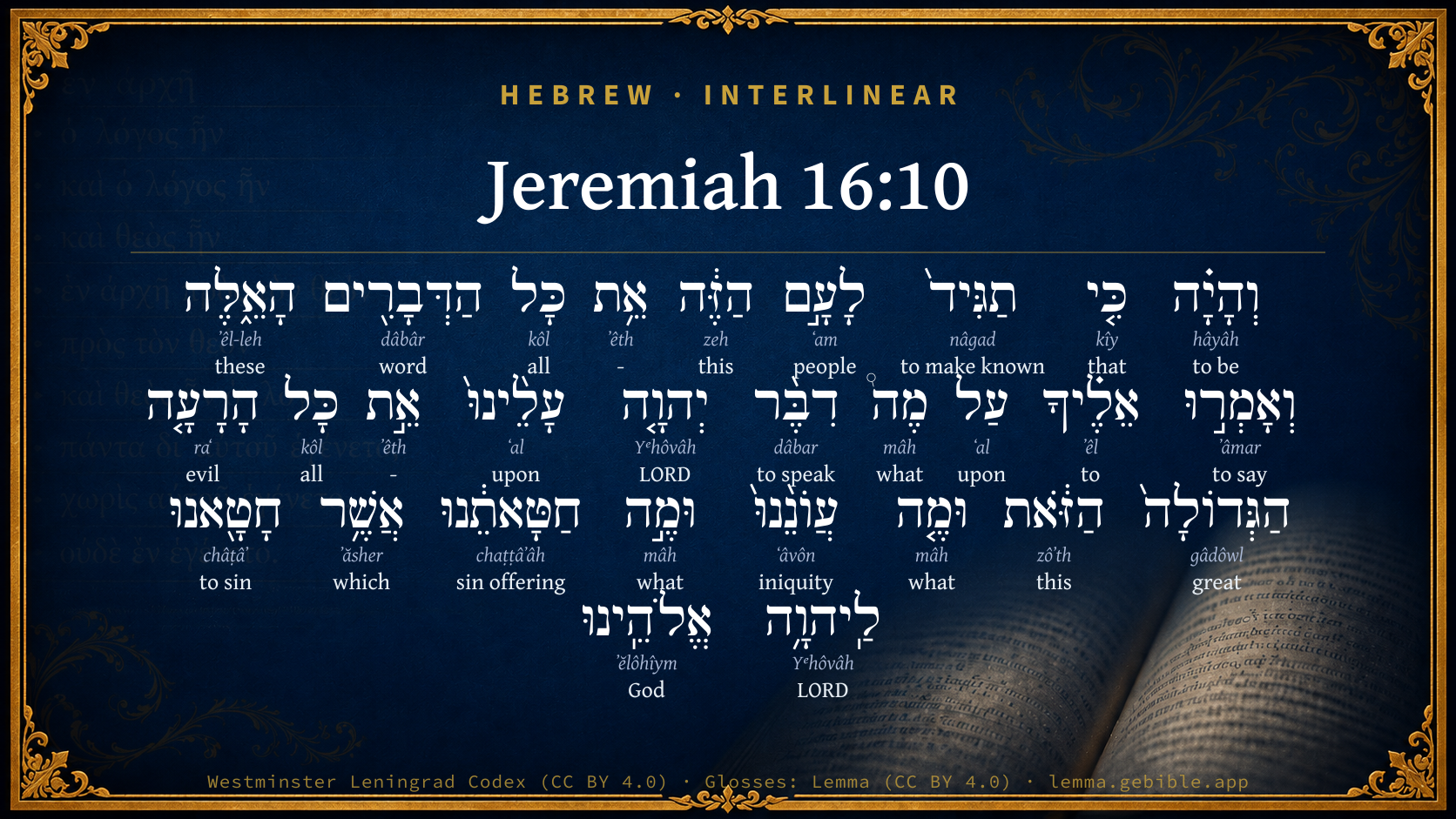
Hebrew (Westminster Leningrad Codex) Jeremiah 16:10 appears in the Hebrew Old Testament. The text above is from the Westminster Leningrad Codex. Each word links to its Strong’s number, a concise gloss, and parsing drawn from the Open Scriptures Hebrew Bible morphology. Click any word for its full Brown-Driver-Briggs (BDB) entry.
Download image
Cite this verse

Jeremiah 16:10 (World English Bible). Public Domain. Lemma interlinear Bible study tool, https://lemma.gebible.app/v/jeremiah/16/10.

Show BibTeX & RIS
BibTeX
RIS
English Translation
It shall happen, when you shall show this people all these words, and they shall tell you, Why has Yahweh pronounced all this great evil against us? or what is our iniquity? or what is our sin that we have committed against Yahweh our God?
World English Bible · Public Domain
Download a study sheet

One document with this verse’s original text, its word-by-word gloss line, the meaning frame, cross-references with their text, attributed commentary, and full source and license credits — printable, and it pastes into notes with its structure intact.

This verse Autodidact and up

Study sheet (.html) Plain text (.txt)

A passage Seminary Student

Up to 50 verses in one chapter. A passage sheet keeps up to 6 commentary sources and 12 cross-references per verse, in the order this page ranks them, and says so on the sheet whenever that leaves anything out. Ask for a single verse and you get the Autodidact verse sheet above.

Everything on this page stays free to read, with no account — the sheet is a download of what is already on screen, not access to it.

Want to remove ads? Support Godless Engineer
Compare translations 3

The same verse in 3 English versions, stacked beneath the original-language interlinear above. Click any original word for its lexicon entry.

Each is an independent rendering of the whole verse — the interlinear is not word-aligned to these translations.

Highlighted words mark where these versions differ — a whole-verse word diff, not a word-by-word alignment.

  • World English Bible Public Domain
    It shall happen, when you shall show this people all these words, and they shall tell you, Why has Yahweh pronounced all this great evil against us? or what is our iniquity? or what is our sin that we have committed against Yahweh our God?
  • King James Version Public Domain
    And it shall come to pass, when thou shalt shew this people all these words, and they shall say unto thee, Wherefore hath the LORD pronounced all this great evil against us? or what is our iniquity? or what is our sin that we have committed against the LORD our God?
  • unfoldingWord Literal Text CC BY-SA 4.0
    And it will happen that when you tell this people all of these words, and they say to you, ‘Why has Yahweh spoken all this great disaster concerning us and what our iniquity and what our sin that we have sinned against Yahweh our God?’

unfoldingWord Literal Text — © unfoldingWord, licensed CC BY-SA 4.0. Word-aligned USFM3 via Door43 (git.door43.org/unfoldingWord/en_ult).

Versions to compare (up to 4)

3 of 4 selected

Show all 18 translations

Every available English version of this verse, each an independent rendering of the whole verse.

  • World English Bible Public Domain
    It shall happen, when you shall show this people all these words, and they shall tell you, Why has Yahweh pronounced all this great evil against us? or what is our iniquity? or what is our sin that we have committed against Yahweh our God?
  • Berean Standard Bible Public Domain
    When you tell these people all these things, they will ask you, ‘Why has the LORD pronounced all this great disaster against us? What is our guilt? What is the sin that we have committed against the LORD our God?’
  • Majority Standard Bible Public Domain
    When you tell these people all these things, they will ask you, ‘Why has the LORD pronounced all this great disaster against us? What is our iniquity? What is the sin that we have committed against the LORD our God?’
  • King James Version Public Domain
    And it shall come to pass, when thou shalt shew this people all these words, and they shall say unto thee, Wherefore hath the LORD pronounced all this great evil against us? or what is our iniquity? or what is our sin that we have committed against the LORD our God?
  • American Standard Version (1901) Public Domain
    And it shall come to pass, when thou shalt show this people all these words, and they shall say unto thee, Wherefore hath Jehovah pronounced all this great evil against us? or what is our iniquity? or what is our sin that we have committed against Jehovah our God?
  • Revised Version (1885) Public Domain
    And it shall come to pass, when thou shalt shew this people all these words, and they shall say unto thee, Wherefore hath the LORD pronounced all this great evil against us? or what is our iniquity? or what is our sin that we have committed against the LORD our God?
  • Geneva Bible (1599) Public Domain
    And when thou shalt shewe this people all these wordes, and they shall say vnto thee, Wherefore hath the Lord pronounced all this great plague against vs? or what is our iniquitie? and what is our sinne that we haue committed against the Lord our God?
  • Douay-Rheims (1899) Public Domain
    And when thou shalt tell this people all these words, and they shall say to thee: Wherefore hath the Lord pronounced against us all this great evil? what is our iniquity? and what is our sin, that we have sinned against the Lord our God?
  • Young's Literal Translation Public Domain
    And it hath come to pass when thou declarest to this people all these words, and they have said unto thee, `For what hath Jehovah spoken against us all this great evil? yea, what `is' our iniquity, and what our sin, that we have sinned against Jehovah our God?'
  • Literal Standard Version CC BY-SA 4.0
    And it has come to pass, || When you declare all these words to this people, || And they have said to you, || Why has YHWH spoken all this great evil against us? Indeed, what [is] our iniquity, and what [is] our sin, || That we have sinned against our God YHWH?
  • Unlocked Literal Bible CC BY-SA 4.0
    Then it will happen that you will report all these words to this people, and they will say to you, 'Why has Yahweh decreed all this great disaster against us? What is our iniquity and sin that we sinned against Yahweh our God?'
  • unfoldingWord Literal Text CC BY-SA 4.0
    And it will happen that when you tell this people all of these words, and they say to you, ‘Why has Yahweh spoken all this great disaster concerning us and what our iniquity and what our sin that we have sinned against Yahweh our God?’
  • Darby Bible Public Domain
    And it shall come to pass, when thou shalt declare unto this people all these words, and they shall say unto thee, Wherefore hath Jehovah pronounced all this great evil against us? and what is our iniquity? and what is our sin which we have committed against Jehovah our God?
  • World Messianic Bible Public Domain
    It will happen, when you tell this people all these words, and they ask you, ‘Why has the LORD pronounced all this great evil against us?’ or ‘What is our iniquity?’ or ‘What is our sin that we have committed against the LORD our God?’
  • Webster's Bible Public Domain
    And it shall come to pass, when thou shalt show this people all these words, and they shall say to thee, Why hath the LORD pronounced all this great evil against us? or what is our iniquity? or what is our sin that we have committed against the LORD our God?
  • Free Bible Version CC BY-SA 4.0
    When you explain all this to them they'll ask you, “Why has the Lord ordered that such a terrible disaster should happen to us? What did we do wrong? What sin have we committed against the Lord our God?”
  • Bible in Basic English Public Domain
    And it will be, that when you say all these words to the people, then they will say to you, Why has the Lord done all this evil against us? what is our wrongdoing and what is our sin which we have done against the Lord our God?
  • JPS Tanakh (1917) Public Domain
    And it shall come to pass, when thou shalt tell this people all these words, and they shall say unto thee: 'Wherefore hath the LORD pronounced all this great evil against us? or what is our iniquity? or what is our sin that we have committed against the LORD our God?'

Literal Standard Version (2020), Covenant Press — licensed CC BY-SA 4.0. Text via the HelloAO Bible API (eBible.org). Unlocked Literal Bible (unfoldingWord) — licensed CC BY-SA 4.0. Text via the HelloAO Bible API (eBible.org). unfoldingWord Literal Text — © unfoldingWord, licensed CC BY-SA 4.0. Word-aligned USFM3 via Door43 (git.door43.org/unfoldingWord/en_ult). Free Bible Version, Dr. Jonathan Gallagher — licensed CC BY-SA 4.0. Text via the HelloAO Bible API (eBible.org).

Word by word

More ways to search: Search by grammar → Find every occurrence → Compare this word →

Practice this passage: Drill this verse → Learn its vocabulary →

עֲוֺנֵ֨נוּ֙
ʻâvôn
H5771
“iniquity · our”
Noun, Common, Both, Singular, Construct + Suffix, Personal, 1st Person, Common, Plural
Part of Speech
Noun
Type
Common
Gender
Both
Number
Singular
State
Construct
Full BDB Definition

Origin: from H5753

TWOT: 1577a

perversity, depravity, iniquity, guilt or punishment of iniquity - iniquity - guilt of iniquity, guilt (as great), guilt (of condition) - consequence of or punishment for iniquity
  1. וְהָיָ֗ה hâyâh H1961 “and · to be” Conjunction + Verb, Qal, Sequential Perfect, 3rd Person, Masculine, Singular
  2. כִּ֤י kîy H3588 “that” Conjunction
  3. תַגִּיד֙ nâgad H5046 “to make known” Verb, Hiphil, Imperfect, 2nd Person, Masculine, Singular
  4. לָעָ֣ם ʻam H5971 “to/for the · people” Preposition, Determined + Noun, Common, Masculine, Singular, Absolute
  5. הַזֶּ֔ה zeh H2088 “the · this” Particle, Definite Article + Pronoun, Demonstrative, Masculine, Singular
  6. אֵ֥ת ʼêth H853 “-” Particle, Direct Object
  7. כָּל kôl H3605 “all of” Noun, Common, Masculine, Singular, Construct
  8. הַדְּבָרִ֖ים dâbâr H1697 “the · words” Particle, Definite Article + Noun, Common, Masculine, Plural, Absolute
  9. הָאֵ֑לֶּה ʼêl-leh H428 “the · these” Particle, Definite Article + Pronoun, Demonstrative, Common, Plural
  10. וְאָמְר֣וּ ʼâmar H559 “and · to say” Conjunction + Verb, Qal, Sequential Perfect, 3rd Person, Common, Plural
  11. אֵלֶ֗יךָ ʼêl H413 “to · you” Preposition + Suffix, Personal, 2nd Person, Masculine, Singular
  12. עַל ʻal H5921 “upon” Preposition
  13. מֶה֩ mâh H4100 “what” Particle, Interrogative
  14. דִבֶּ֨ר dâbar H1696 “to speak” Verb, Piel, Perfect, 3rd Person, Masculine, Singular
  15. יְהוָ֤ה Yᵉhôvâh H3068 “LORD” Noun, Proper
  16. עָלֵ֨ינוּ֙ ʻal H5921 “upon · us” Preposition + Suffix, Personal, 1st Person, Common, Plural
  17. אֵ֣ת ʼêth H853 “-” Particle, Direct Object
  18. כָּל kôl H3605 “all of” Noun, Common, Masculine, Singular, Construct
  19. הָרָעָ֤ה raʻ H7451 “the · evil” Particle, Definite Article + Noun, Common, Feminine, Singular, Absolute
  20. הַגְּדוֹלָה֙ gâdôwl H1419 “the · great” Particle, Definite Article + Adjective, Adjective, Feminine, Singular, Absolute
  21. הַזֹּ֔את zôʼth H2063 “the · this” Particle, Definite Article + Pronoun, Demonstrative, Feminine, Singular
  22. וּמֶ֤ה mâh H4100 “and · what” Conjunction + Particle, Interrogative
  23. וּמֶ֣ה mâh H4100 “and · what” Conjunction + Particle, Interrogative
  24. חַטָּאתֵ֔נוּ chaṭṭâʼâh H2403 “sin offering · our” Noun, Common, Feminine, Singular, Construct + Suffix, Personal, 1st Person, Common, Plural
  25. אֲשֶׁ֥ר ʼăsher H834 “which” Particle, Relative
  26. חָטָ֖אנוּ châṭâʼ H2398 “to sin” Verb, Qal, Perfect, 1st Person, Common, Plural
  27. לַֽיהוָ֥ה Yᵉhôvâh H3068 “to/for · LORD” Preposition + Noun, Proper
  28. אֱלֹהֵֽינוּ ʼĕlôhîym H430 “God(s) · our” Noun, Common, Masculine, Plural, Construct + Suffix, Personal, 1st Person, Common, Plural

About this verse

These counts appear in no published source. They are computed here, from the morphology-tagged text and Lemma’s own curated glosses. What Lemma adds →

29
words
23
distinct lemmas
Prophets
section

Grammatical profile

  • 5 verbs
  • 10 nouns
  • 1 adjective
  • 3 pronouns
  • 3 prepositions
  • 1 conjunction
  • 6 particles

Verb forms

  • וְהָיָ֗ה Qal · Sequential Perfect
  • תַגִּיד֙ Hiphil · Imperfect
  • וְאָמְר֣וּ Qal · Sequential Perfect
  • דִבֶּ֨ר Piel · Perfect
  • חָטָ֖אנוּ Qal · Perfect

Repetition

Words recur within this verse — often emphatic in Hebrew:

  • כָּל all H3605 ×2
  • עַל upon H5921 ×2
  • יְהוָ֤ה LORD H3068 ×2
  • מֶה֩ what H4100 ×3

Hebrew & Septuagint length

In the original languages it is 29 Hebrew tokens and 41 Greek tokens — but the two are counted differently (Hebrew bundles its prefixes and suffixes into one token; the Greek is in lemma form), so that isn’t a like-for-like length.

Cross-references

7

Topical passages linked to Jeremiah 16:10 in the Treasury of Scripture Knowledge — connected by theme and wording, ordered by reader-vote popularity; previews shown in the World English Bible.

  • Jeremiah 5:19 It shall happen, when you shall say, Why has Yahweh our God done all these things to us? then shall you say to them, Like as you have forsaken me, and served foreign gods in your land, so shall you serve strangers in a land that is not yours.
  • Deuteronomy 29:24–25 even all the nations shall say, Why has Yahweh done thus to this land? what means the heat of this great anger?
  • 1 Kings 9:8–9 Though this house is so high, yet shall everyone who passes by it be astonished, and shall hiss; and they shall say, Why has Yahweh done thus to this land, and to this house?
  • Jeremiah 13:22 If you say in your heart, Why are these things come on me? for the greatness of your iniquity are your skirts uncovered, and your heels suffer violence.
  • Jeremiah 2:35 Yet you said, I am innocent; surely his anger is turned away from me. Behold, I will enter into judgment with you, because you say, I have not sinned.
  • Jeremiah 22:8–9 Many nations shall pass by this city, and they shall say every man to his neighbor, Why has Yahweh done thus to this great city?
  • Hosea 12:8 Ephraim said, "Surely I have become rich, I have found myself wealth. In all my wealth they won't find in me any iniquity that is sin."

Cross-references courtesy of OpenBible.info (CC BY 4.0).

Hebrew and Greek witnesses Masoretic Hebrew ↔ Greek Septuagint

The same verse in the two great witnesses to the Old Testament, shown verse-for-verse.

These are two independent witnesses, not word-aligned to each other, and the Septuagint is shown in lemma (dictionary) form.

Hebrew Jeremiah 16:10 Masoretic · Westminster Leningrad Codex

וְהָיָ֗ה כִּ֤י תַגִּיד֙ לָעָ֣ם הַזֶּ֔ה אֵ֥ת כָּל הַדְּבָרִ֖ים הָאֵ֑לֶּה וְאָמְר֣וּ אֵלֶ֗יךָ עַל מֶה֩ דִבֶּ֨ר יְהוָ֤ה עָלֵ֨ינוּ֙ אֵ֣ת כָּל הָרָעָ֤ה הַגְּדוֹלָה֙ הַזֹּ֔את וּמֶ֤ה עֲוֺנֵ֨נוּ֙ וּמֶ֣ה חַטָּאתֵ֔נוּ אֲשֶׁ֥ר חָטָ֖אנוּ לַֽיהוָ֥ה אֱלֹהֵֽינוּ

It shall happen, when you shall show this people all these words, and they shall tell you, Why has Yahweh pronounced all this great evil against us? or what is our iniquity? or what is our sin that we have committed against Yahweh our God?

World English Bible · Public Domain

Greek LXX Structure differs

In the Septuagint, Jeremiah is about an eighth shorter than the Hebrew and arranges its material differently — the Oracles Against the Nations (Hebrew chapters 46–51) appear in the middle of the Greek book, after 25:13. Because the chapter and verse boundaries do not line up, a verse-for-verse comparison with the Hebrew is not shown.

A verse-for-verse comparison isn’t shown here because the chapters and verses don’t line up. Switch to the LXX edition with the MT / LXX toggle above to read the Greek directly.

Hebrew: Westminster Leningrad Codex (CC BY 4.0). Greek: Septuagint (public domain); English from a public-domain English Septuagint. How the Septuagint differs from the Hebrew →

Targum (Aramaic paraphrase)

1

The Targum is the ancient Jewish Aramaic paraphrase of the Hebrew Scriptures — an interpretive translation, not the Hebrew text itself. Onkelos (literal) and Pseudo-Jonathan (expansive) render the Torah, and Jonathan the Prophets. Coverage is partial: where no permissively-licensed English translation exists for a verse, only the Aramaic is shown. This is verse-level text, not a word-by-word alignment to the Hebrew.

  1. Targum Jonathan Prophets (Joshua–Malachi)
    וִיהֵי אֲרֵי תְחַוֵי לְעַמָא הָדֵין יַת כָּל פִּתְגָמַיָא הָאִלֵין וְיֵמְרוּן לָךְ עַל מַה גְזַר יְיָ עֲלָנָא יַת קַל בִּישְׁתָּא רַבְּתָא הָדָא וּמַה חוֹבָנָא וּמַה סוּרְחָנָנָא דְחַבְנָא קֳדָם יְיָ אֱלָהָנָא:

    (no public-domain English translation for this verse)

    Targum Jonathan — Aramaic: “Mikraot Gedolot” (public domain). English: “Sefaria Community Translation” (CC0 1.0 (public-domain dedication)); “London "Chaldee Paraphrase," 1871” (public domain). Text via Sefaria.

Commentary

Notes on Jeremiah 16:10 from classic Christian and Jewish commentators (each source and its license shown beneath its notes). The classic Christian expositions comment on the surrounding passage and are grouped to its opening verse, so a note may address several verses; the Jewish commentaries on the Tanakh (Rashi and others) are per-verse, so they appear only where the commentator wrote on this verse.

Lemma curates 59 commentaries, every one of them public domain or Creative Commons licensed, each selected and text-cleaned for this edition rather than reprinted as found. About our sources →

Matthew Henry's Commentary

Here is, 1. An enquiry made into the reasons why God would bring those judgments upon them (Jer 16:10): When thou shalt show this people all these words, the words of this curse, they will say unto thee, Wherefore has the Lord pronounced all this great evil against us? One would hope that there were some among them that asked this question with a humble penitent heart, desiring to know what was the sin for which God contended with them, that they might cast it away and prevent the judgment: "Show us the Jonah that raises the storm and we will throw it overboard." But it seems here to be the language of those who quarrelled at the word of God, and challenged him to show what they had done which might deserve so severe a punishment: "What is our iniquity? Or what is our sin? What crime have we even been guilty of, proportionable to such a sentence?" Instead of humbling and condemning themselves, they stand upon their own justification and insinuate that God did them wrong in pronouncing this evil against them, that he laid upon them more than was right, and that they had reason to enter into judgment with God, Job 34:23. Note, It is amazing to see how hardly sinners are brought to justify God and judge themselves when they are in trouble, and to own the iniquity and the sin that have procured them the trouble. 2. A plain and full answer given to this enquiry. Do they ask the prophet why, and for what reason, God is thus angry with them? He shall not stop their mouths by telling them that they may be sure there is a sufficient reason, the righteous God is never angry without cause, without good cause; but he must tell them particularly what is the cause, that they may be convinced and humbled, or at least that God may be justified. Let them know then, (1.) That God visited upon them the iniquities of their fathers (Jer 16:11): Your fathers have forsaken me, and have not kept my law. They shook off divine institutions and grew weary of them (they thought them too plain, too mean), and then they walked after other gods, whose worship was more gay and pompous; and, being fond of variety and novelty, they served them and worshipped them; and this was the sin which God had said, in the second commandment, he would visit upon their children, who kept up these idolatrous usages, because they received them by tradition from their fathers, Pe1 1:18. (2.) That God reckoned with them for their own iniquities (Jer 16:12): "You have made your fathers' sin your own, and have become obnoxious to the punishment which in their days was deferred, for you have done worse than your fathers." If they had made a good use of their fathers' reprieve, and had been led by the patience of God to repentance, they would have fared the better for it and the judgment would have been prevented, the reprieve turned into a national pardon; but, making an ill use of it, and being hardened by it in their sins, they fared the worse for it, and, the reprieve having expired, an addition was made to the sentence and it was executed with the more severity. They were more impudent and obstinate in sin than their fathers, walked every one after the imagination of his own heart, made that their guide and rule and were resolved to follow that, on purpose that they might not hearken to God and his prophets. They designedly suffered their own lusts and passions to be noisy, that they might drown the voice of their consciences. No wonder then that God has taken up this resolution concerning them (Jer 16:13): "I will cast you out of this land, this land of light, this valley of vision. Since you will not hearken to me, you shall not hear me; you shall be hurried away, not into a neighbouring country which you have formerly had some acquaintance and correspondence with, but into a far country, a land that you know not, neither you nor your fathers, in which you have no interest, nor can expect to meet with any comfortable society, to be an allay to your misery." Justly were those banished into a strange land who doted upon strange gods, which neither they nor their fathers knew, Deu 32:17. Two things would make their case there very miserable, and both of them relate to the soul, the better part; the greatest calamities of their captivity were those which affected that and debarred that from its bliss. [1.] "It is the happiness of the soul to be employed in the service of God; but there shall you serve other gods day and night; that is, you shall be in continual temptation to serve them and perhaps compelled to do it by your cruel task-masters; and, when you are forced to worship idols, you will be as sick of such worship as ever you were fond of it when it was forbidden you by your godly kings." See how God often makes men's sin their punishment, and fills the backslider in heart with his own ways. "You shall have no public worship at all but the worship of idols, and then you will think with regret how you slighted the worship of the true God." [2.] "It is the happiness of the soul to have some tokens of the lovingkindness of God, but you shall go to a strange land, where I will not show you favour." If they had had God's favour, that would have made even the land of their captivity a pleasant land; but, if they lie under his wrath, the yoke of their oppression will be intolerable to them.

Matthew Henry's Commentary on the Whole Bible (1708–1710) — public domain (CC PDM 1.0). Text via the HelloAO Bible API.

Trapp's Complete Commentary

John Trapp

Jer 16:10 And it shall come to pass, when thou shalt shew this people all these words, and they shall say unto thee, Wherefore hath the LORD pronounced all this great evil against us? or what [is] our iniquity? or what [is] our sin that we have committed against the LORD our God?

Ver. 10. And they shall say unto thee, Wherefore?] This is still the guise of hypocrites, to justify themselves, and quarrel the preacher that reproveth them. See Jer 5:19.

What is our iniquity?] Nature showeth no sin; it is no causeless complaint of a grave divine, that some deal with their souls as others do with their bodies. When their beauty is decayed, they desire to hide it from themselves by false glasses, and from others by painting; so their sins from themselves by false glosses, and from others by excuses.

John Trapp, A Commentary or Exposition upon All the Books of the Old and New Testament (1647–1656) — public domain. Text from a community e-Sword module.

Whedon's Commentary on the Bible

Daniel D. Whedon

THE CAUSE OF THE COMING JUDGMENT, Jer_16:10-15.

10-13. Wherefore hath, etc. — God’s ways need to be explained. Even with the utmost care it is not always possible to prevent wrong interpretations. Hence, when the people, by their inquiries, made either in complaint or with desire to know the truth, shall open the way, the prophet is commanded to explain God’s dealings toward them. God’s real purpose in all things pertaining to this universe is a moral one. Take out this element from man’s history, and all would be a hopeless enigma.

Imagination — Rather, stubbornness.

Land that ye know not — Not geographical ignorance is meant, but lack of experience. They know it not, because they have not been there.

Daniel D. Whedon (gen. ed.), Commentary on the Old and New Testaments (1874–1909) — public domain. Text from a community e-Sword module.

Keil & Delitzsch

C. F. Keil & F. Delitzsch

"And when thou showest this people all these things, and they say unto thee, Wherefore hath Jahveh pronounced all this great evil against us, and what is our transgression, and what our sin that we have committed against Jahveh our God? Jer 16:11. Then say thou to them, Because your fathers have forsaken me, saith Jahveh, and have walked after other gods, and served them, and worshipped them, and have forsaken me, and not kept my law; Jer 16:12. And ye did yet worse than your fathers; and behold, ye walk each after the stubbornness of his evil heart, hearkening not unto me. Jer 16:13. Therefore I cast you out of this land into the land which he know not, neither ye nor your fathers, and there may ye serve other gods day and night, because I will show you no favour. Jer 16:14. Therefore, behold, the days come, saith Jahveh, that it shall no more be said, By the life of Jahveh, that brought up the sons of Israel out of the land of Egypt, Jer 16:15. But, By the life of Jahveh, that brought the sons of Israel out of the land of the north, and out of all the lands whither I had driven them, and I bring them again into their land that I gave to their fathers."

The turn of the discourse in Jer 16:10 and Jer 16:11 is like that in Jer 5:19. With Jer 16:11 cf. Jer 11:8, Jer 11:10; Jer 7:24; with "ye did yet worse," etc., cf. Kg1 14:9; and on "after the stubbornness," cf. on Kg1 3:17. The apodosis begins with "therefore I cast you out." On this head cf. Jer 7:15; Jer 9:15, and Jer 22:26. The article in על־הארץ, Graf quite unnecessarily insists on having cancelled, as out of place. It is explained sufficiently by the fact, that the land, of which mention has so often been made, is looked on as a specific one, and is characterized by the following relative clause, as one unknown to the people. Besides, the "ye know not" is not meant of geographical ignorance, but, as is often the case with ידע, the knowledge is that obtained by direct experience. They know not the land, because they have never been there. "There ye may serve them," Ros. justly characterizes as concessio cum ironia: there ye may serve, as long as ye will, the gods whom ye have so longed after. The irony is especially marked in the "day and night." Here Jeremiah has in mind Deu 4:28; Deu 28:36, Deu 28:63. אשׁר is causal, giving the grounds of the threat, "I cast you out." The form חנינה is hap leg . - In Jer 16:14 and Jer 16:15 the prophet opens to the people a view of ultimate redemption from the affliction amidst the heathen, into which, for their sin, they will be cast. By and by men will swear no more by Jahveh who redeemed them out of Egypt, but by Jahveh who has brought them again from the land of the north and the other lands into which they have been thrust forth. In this is implied that this second deliverance will be a blessing which shall outshine the former blessing of redemption from Egypt. But just as this deliverance will excel the earlier one, so much the greater will the affliction of Israel in the northern land be than the Egyptian bondage had been. On this point Ros. throws especial weight, remarking that the aim of these verses is not so much to give promise of coming salvation, as to announce instare illis atrocius malum, quam illud Aegyptiacum, eamque quam mox sint subituri servitutem multo fore duriorem, quam olim Aegyptiaca fuerit. But though this idea does lie implicite in the words, yet we must not fail to be sure that the prospect held out of a future deliverance of Israel from the lands into which it is soon to be scattered, and of its restoration again to the land of its fathers, has, in the first and foremost place, a comforting import, and that it is intended to preserve the godly from despair under the catastrophe which is now awaiting them.

(Note: Calvin has excellently brought out both moments, and has thus expounded the thought of the passage: "Scitis unde patres vestri exierint, nempe e fornace aenea, quemadmodum alibi loquitur (xi. 4) et quasi ex profunda morte; itaque redemptio illa debuit esse memorabilis usque ad finem mundi. Sed jam Deus conjiciet vos in abyssum, quae longe profundior erit illa Aegypti tyrannide, e qua erepti sunt patres vestri; nam si inde vos redimat, erit miraculum longe excellentius ad posteros, ut fere exstinguat vel saltem obscuret memoriam prioris illius redemptionis.")

לכן is not nevertheless, but, as universally, therefore; and the train of thought is as follows: Because the Lord will, for their idolatry, cast forth His people into the lands of the heathen, just for that very reason will their redemption from exile not fail to follow, and this deliverance surpass in gloriousness the greatest of all former deeds of blessing, the rescue of Israel from Egypt. The prospect of future redemption given amidst announcements of judgment cannot be surprising in Jeremiah, who elsewhere also interweaves the like happy forecastings with his most solemn threatenings; cf. Jer 4:27; Jer 5:10, Jer 5:18, with Jer 3:14., Jer 23:3., etc. "This ray of light, falling suddenly into the darkness, does not take us more by surprise than 'I will not make a full end,' Jer 4:27. There is therefore no reason for regarding these two verses as interpolations from Jer 23:7-8" (Graf).

Keil & Delitzsch — Biblical Commentary on the Old Testament (1861–1891) — public domain (CC PDM 1.0). Text via the HelloAO Bible API. (Old Testament only.)

Tyndale Open Study Notes

Tyndale Open Resources

16:10 The Lord told Jeremiah to expect questions from the people that would express their self-righteousness and their belief that the Lord should never harm them.

Tyndale Open Study Notes — © Tyndale Open Resources, licensed CC BY-SA 4.0. Text via the HelloAO Bible API.

Geneva Bible (1599)

Geneva Bible translators

Because the wicked are always rebellious, and dissemble their own sins, and murmur against God’s judgments, as though he had no just cause to punish them, he showeth him what to answer.

Geneva Bible (1599) marginal notes — public domain. Text via Bolls.life.

Jamieson, Fausset & Brown

Robert Jamieson, A. R. Fausset & David Brown

(Deu 29:24; Kg1 9:8-9).

Jamieson, Fausset & Brown — Commentary Critical and Explanatory on the Whole Bible (1871) — public domain (CC PDM 1.0). Text via the HelloAO Bible API.

John Calvin's Commentaries

He shews here what we have seen elsewhere, — that the people flattered themselves in their vices, so that they could not be turned by any admonitions, nor be led by any means to repentance. It was a great blindness, nay, even madness, not to examine themselves, when they were smitten by the hand of God; for conscience ought to have been to them like a thousand witnesses, immediately condemning them; but hardly any one was found who examined his own life; and then, though God proved them guilty, hardly one in a hundred winingly and humbly submitted to his judgment; but the greater part murmured and made a clamor, whenever they felt the scourges of God. This evil, as Jeremiah shews, prevailed among the people; and he shewed the same in the fifth chapter.

Hence it is that God says, When thou shalt declare these words to this people, and they shall say, Wherefore has Jehovah spoken all this great evil against us; what is our iniquity? what is our sin, that he so rages against us, as though we had acted wickedly against him? God no doubt intended to obviate in time what that perverse people might have said, for he knew that they possessed an untameable disposition. As then he knew that they would be so refractory as to receive no reproof, he confirms his own Prophet, as though he had said, “There is no reason for their perverseness to discourage thee; for they will immediately oppose thee, and treat thee as one doing them a grievous wrong; they will expostulate with thee and deny that they ought to be deemed guilty of so great crimes; if then they will thus petulantly cast aside thy threatenings, there is no reason for thee to be disheartened, for thou shalt have an answer ready for them.”

We now see how hypocrites gained nothing, either by their evasions, or by wantonly rising against God and his Prophets. At the same time all teachers are reminded here of their duty, not to vacinate when they have to do with proud and intractable men. As it appeared elsewhere, where God commanded his Prophet to put on a brazen front, that he might boldly encounter all the insults of the people; (Jeremiah 1:18) the same is the case here, they shall say to thee, that is, when thou threatenest them, they will not winingly give way, but they will contend as though thou didst accuse them unjustly, for they will say, “What is our sin? what is our iniquity? what is the wickedness which we have committed against Jehovah our God, that he should declare this great evil against us?” Thus we see that hypocrites vent their rage not only against God’s servants, but against God himself, not indeed that they profess openly and plainly to do so. But what is the effect when they cannot bear to be corrected by God’s hand, but resist and shew that they do not endure correction with a resigned mind? do they not sufficiently prove that they rebel against God?

But Jeremiah here graphically describes the character of those who struggled with God, for they dared not wholly to deny that they were wicked, but they extenuated as far as they could their sin, like Cain, who ventured not to assert that he was innocent, for he was conscious of having done wrong; and the voice of God, “Where is thy brother?” strengthened the voice of conscience, but in the meantime he ceased not to utter this complaint,

“Greater is my punishment than I can bear.” (Genesis 4:9, 13)

So also Jeremiah introduces the people as speaking, “O, what is our iniquity? and what is the sin which we have committed against Jehovah our God, that he should speak this great evil against us?” They say not that they were wholly without fault, they only object that the atrocity of their sins was not so great as to cause God to be so angry with them, and to visit them with so grievous a punishment. They then exaggerated the punishment, that they might obtain some covering for themselves; and yet they did not say that they were innocent or free from every fault, but they speak of their iniquities and sins as though they had said, “We indeed confess that there is something which God may reprehend, but we do not acknowledge such a mass of sins and iniquities as to cause him thus to thunder against us.”

John Calvin's Commentaries (1540-1563) — public domain. Text from the Calvin Translation Society English edition (1840s-50s) via the Christian Classics Ethereal Library (ccel.org). Calvin's coverage is partial (roughly two-thirds of the Bible); uncommented books and verses are honest gaps, never fabricated. The 19th-century editor's footnotes and remarks are omitted so the notes are faithfully Calvin's own voice.

Ellicott's Commentary for English Readers

(10) What is our iniquity? . . .—Now, as before (Jer_5:19), the threatenings of judgment are met with words of real or affected wonder. “What have we done to call for all this? In what are we worse than our fathers, or than other nations?” All prophets had more or less to encounter the same hardness. It reaches its highest form in the reiterated questions of the same type in Malachi 1, 2.

A Bible Commentary for English Readers, edited by Charles John Ellicott (1878–1897) — public domain. Text from a community e-Sword module.

The Cambridge Bible for Schools and Colleges

gen. ed. J. J. S. Perowne

10. Cp. Jer_5:19, Jer_13:22.

10–13. See introd. summary to section.

The Cambridge Bible for Schools and Colleges (gen. ed. J. J. S. Perowne; Cambridge University Press, 1878–1918) — public domain. Text from a community e-Sword module.

John Gill's Exposition

Then shalt thou say unto them,.... In answer to their questions; not in a general way, but by observing to them particular sins, and those gross ones, they had been guilty of:

because your fathers have forsaken me, saith the Lord; that is, his worship, as the Targum; they had quitted his service, and left attending on his word and ordinances; and therefore it was but just with him to forsake them, and give them up into the hands of their enemies:

and have walked after other gods, and have served them, and have worshipped them; were guilty of gross idolatry, serving and worshipping the creature more than and besides the Creator; even idols of gold, and silver, and brass, and wood, and stone, which were no gods; for there is no other true God besides the Lord; and which they were well informed of, and therefore their sin was the greater to leave him and worship them; and which sin, because of the heinousness of it, is repeated:

and have forsaken me, and have not kept my law; they forsook his worship, as the Targum, and did not observe the law of the decalogue or ten commandments; especially the two first of them, which required the worship of the one true God, and forbid the worshipping of others; and which threatened the visiting such iniquities of fathers upon the children, to the third and fourth generation, of such that hated the Lord; and such were these persons, as follows.

John Gill's Exposition of the Whole Bible (1746–1763) — public domain (CC PDM 1.0). Text via the HelloAO Bible API.

Matthew Poole's English Annotations

When thou shalt show this people all these words, or all these things; when thou shalt be observed by this people to refuse marriage, and to go to the houses of mourners, according to the custom, to eat or to drink with mourners, to make them to forget their sorrows, or to go into the house of feasting for jollity and mirth, and they shall ask the reason of thy singularity in this behaviour, and thou shalt give them the reason of it, according as I have instructed thee; and they shall pretend to be at a loss to know the reason why God is so severe against them, for what sin or iniquity it is, thinking perhaps that Manasseh’s or Jehoiakim’s commanding them to worship idols would excuse them, and only leave their superiors guilty; for otherwise, while there was such plain idolatry amongst them, they could not be ignorant of cause sufficient that God had, considering the multiplied threats in the law.

Matthew Poole's English Annotations on the Holy Bible (1683–1685) — public domain. Text from a community e-Sword/MySword module.

The Pulpit Commentary

Vers. 10-13. The destiny of sinners a self-created one.

I AS IT IS IN ITSELF. It is a fearful prospect which is here held out to the unbelieving Jews. They are to experience a complete change of condition. The land of promise, national independence and honor, family purity and happiness, and the institution and ordinances of true religion are to be forfeited. The land to which they are to be exiled is unfamiliar to them full of strange scenes and customs; a scene of bondage and tyranny. This is but an illustration of the eternal destiny of sinners. Much must necessarily be vague in their conceptions of it, but it will be a greater change from their present circumstances and experiences than can be imagined. The parable of the rich man and Lazarus teaches that there will be a complete reversal of relations and conditions. How impossible for the lost to reconcile themselves to circumstances so different from those to which they have been accustomed! Their nature will be wholly enslaved, and the best service they can render will be exacted for objects unworthy of it and known to be so. Hell, so far as Scripture allusion to it can be understood, is represented as abnormal, unnatural, a state in which the soul shall be filled with fruitless reset, and sink into lower and still lower deeps of degradation and misery. It is depicted as a strange and sunless land, irradiated by no celestial smile and no sunrise of hope.

II AS THE SINNER REGARDS IT. The picture drawn by Jeremiah is vague and yet terribly suggestive. It is so foreign to the experience and expectation of his hearers that they look upon it with incredulity and astonishment. Instead of evoking from them expressions of repentance and fear concerning the way in which they are walking, it provokes questions that exhibit the callous indifference and self-deception of hardened hearts. They cannot conceive of such a fate awaiting them. What have they done? Is it just that their conduct should be so dealt with? If any offence had been committed, surely it was out of all proportion to such a judgment, and so on. Is not this the attitude of the sinner today? The more awful the future predicted for him the more secure he feels in himself now. He fails to trace the definite line of connection between the germ and the fruit of his sin. It is a part of his infatuation to misapprehend the law of the Divine reward and punishment, and even the real outlines and proportions of the Divine character.

1. A destiny in his view so disproportionate to his offence becomes incredible. And just as the Jew could not conceive of the features and characteristics of the life upon which he was to enter when this prophecy should be fulfilled, the transgressor now fails to realize the position he must occupy when circumstance will depend only upon character. Passing consequences may be seen and partly estimated, but the final outcome of it all is, because of its very nature and extent, unreal to him.

2. The future of the sinner is strange and unreal to him, and therefore fails to impress him as it ought.

III AS EXPLAINED BY GOD. This is one of the main purposes of revelation, viz. to connect the present with the future and to interpret their relations. Whilst it is true that every sinner already contains within himself the elements of his future punishment, it is also true that of himself he could not forecast the actual extent or nature of the destiny he is working out. It is necessary, therefore, both for emphasis and enlightenment, to supplement experience with revelation.

1. Their punishment was but the natural development of their sin. The latter was of old date. Their fathers forsook Jehovah, did not keep his Law, and went after other gods. The tendency was inherited by themselves, and in aggravated degree: "Ye have done worse than your fathers." They now paid more attention and honor to idols than to Jehovah, and when this is the case it cannot last long. The veil of decency will be cast aside; the real character will betray itself, and shame will cease. They became more and more "sold under sin." The vices of a false religion weakened their character and made them a ready prey to the ambition and rapacity of their neighbors. The same law is apparent in spiritual destiny. Let the sinner be warned. He may be sure his sin will find him out.

2. It was but right that they should be so punished, as they had added to their ancestral offence an intolerable personal aggravation. The terms of the covenant were flagrantly violated, and they had forfeited the land by their moral unfitness to occupy it. If an earthly country could be so hallowed as not to admit of being occupied by unclean idolaters, how much less possible must it be for confirmed sinners to stand in the presence of God amidst the multitudes of redeemed! Heaven would be bell to such persons.

3. The spiritual condition that was so dealt with presented no ground for consideration. God said, I will show you no favor." It was a deliberate sin, and there were no signs of repentance. The day of grace, however, was with them whilst the prophet spoke. So is it represented to be with the preaching of the gospel. Whilst God calls to us his mercy still continues. "Now is the accepted time; ... now is the day of salvation." But in that day present obstinacy will be the worst condemnation. "I called, and ye refused," etc. M.

Vers. 10-13. Conscience dead.

Conscience is given us of God, to serve as a faithful sentry, warning of the approach of sin and summoning the energies of our souls to resist and reject the intruder. Or as a just judge to unhesitatingly condemn sin, let it be wrapped up in what specious disguise it may. It is the Ithuriel"s spear which, the moment it touches any moral action, compels such action to reveal itself of what sort it is. Oh, the unspeakable blessing of an enlightened, healthful conscience that will not suffer sin, any sin, even the least, without prompt and powerful protest! God help us all diligently to guard, profoundly to reverence and faithfully to obey this inward monitor, this true bearer of "the light which lighteth every man that cometh into the world." But these verses reveal a condition of things in which conscience is dead. It has lost all power of perception, its voice is hushed, or rather, what is worse, it sees and speaks falsely. It is a mockery of life, which would be grotesque were it not so profoundly sad. A caricature and parody of what it once was, its powers utterly perverted, bent, warped, so that they "call evil good, and good evil." Note

I THE FACT. How else can such a question as this of ver. 10 be accounted for? Was not their sin clear as the sun at noonday? Had it not been for years crying aloud to God for vengeance? Had it not been condemned by all the servants of God, by the written Law of God, by all the voices of God in long succession? And yet these people are asking, "Wherefore hath the Lord pronounced all this great evil against us." It is as if the convicts in our prisons were to begin to ask why they were so treated, and to profess ignorance of their having done aught amiss. But in such ease we should say they were playing the hypocrite, pretending an innocence to which they well knew they had no claim. In this case, however, there is no hypocrisy. The question, monstrous as it seems to us, is asked in all good faith. The prophet of God is bidden to give it a serious answer, not to denounce those who ask it as a set of conscious hypocrites. Just as in Mat_25:44, which is a portentous parallel indeed, the condemned there are heard asking when they had been guilty of the sins laid to their charge. It is evident in that case and in this, not that they were consciously liars, but that conscience was simply dead within them. The writer knew also of one who had cruelly defrauded a large number of people, who, believing him to be an eminently religious man, had entrusted to him their hard-earned savings, with all of which he had made away; but, when brought to justice, condemned, and imprisoned, he could not be got to confess that he had done wrong, but would keep quoting, in regard to himself, texts which tell of the afflictions of the righteous, and how "whom the Lord loveth he chasteneth.

II THE CAUSE. Conscience is starved by neglect of that seeking of God"s grace which is its nutriment and strength. And it is stunned by repeated acts of sin. Men can and do nibble, if we may so speak, at conscience, and gradually rid themselves of it. The clamor of sin drowns the still, small voice, and its protests, perpetually unheeded, are at last withdrawn. So that at length men find themselves able to do evil and think nothing of it; the little rift that sin first made has widened and widened until the whole torrent of waters bursts through, for the faithful dyke that held them back has been gradually destroyed, and so now the whole nature of the man is overwhelmed, submerged beneath the deluge of sin. And, what is most sad, the man feels, no more than do the sunken cities and towns that tie at the bottom of the Zuyder Zee, the rush of the waves that for centuries have rolled over them.

III THE CURE. Thank God there is one. The sharp surgery of God"s judgments arouse the deadened conscience. The rags, the hunger, the degradation of the prodigal woke up his conscience and brought him "to himself." And so it was with the Jewish people. God"s judgments made them hate and abhor, as they have done ever since, the idolatries which brought those judgments upon them. It would be dreadful to think that God had no resources whereby, in full harmony with its freedom, he could bring into due subjection and order "the unruly wills of sinful men." Can we conceive of God having created a force greater than himself, which can forever defy him, and ever maintain, as Milton"s Satan in hell, a rebellious though wretched rule? God knew how to convert Israel, Saul, the penitent thief, ourselves, and we may trust him to find means whereby at length to Jesus every knee shall be made to bow. Vers. 14 and 15 contemplate a converted Israel. (cf. also Isa_30:18 Mat_27:33-39) But let a man tremble at the thought of compelling God to deal with him thus. Let him beware how he wastes his conscience, lest it turn against him and suffer him to sin unrestrained. C.

The Pulpit Commentary (1880–1919), ed. H.D.M. Spence-Jones & Joseph S. Exell — public domain. Text from a community e-Sword module.

Kretzmann's Popular Commentary

Paul E. Kretzmann

Reasons for the Captivity

v. 10. And it shall come to pass, when thou shall show this people all these words, declaring to them the judgment of the Lord, and they shall say unto thee, Wherefore hath the Lord pronounced all this great evil against us? this being asked with a great show of pretended innocence, or what is our iniquity? or what is our sin that we have committed against the Lord, our God? the implied assertion being that they were being threatened without a cause,

v. 11. then shalt thou say unto them, Because your fathers have forsaken Me, saith the Lord, and have walked after other gods, thus habitually indulging in idolatry, and have served them, and have worshiped them, and have, on the other hand, forsaken Me, and have not kept My Law.

v. 12. And ye have done worse than your fathers; for, behold, ye walk every one after the imagination of his evil heart, in deliberate stubbornness, that they may not hearken unto Me, or, "that ye hearken not unto Me," obstinately ignoring His Word;

v. 13. therefore will I cast you out of this land into a land that ye know not, neither ye nor your fathers, a country altogether strange to them, and there shall ye serve other gods day and night, without intermission; where I will not show you favor. This is a form of holy irony: what they willingly did in their own country, they would be obliged to do in the land of their captivity; because they voluntarily forsook the true God at home, they would be prevented from serving Him elsewhere. At the same time the Lord opens up before the eyes of Judah a way of redemption, the thought of which was intended to keep His people from despair.

v. 14. Therefore, behold, the days come, saith the Lord, that it shall no more be said, according to the asseveration which had been common in Judah these many centuries. The Lord liveth that brought up the children of Israel out of the land of Egypt, this being a very emphatic statement,

v. 15. but, The Lord liveth that brought up the children of Israel from the land of the North, from Babylon, and from all the lands whither He had driven them, from the lands of their exile; and I will bring them again into their land that I gave unto their fathers, this promise being like a ray of light in the midst of extreme darkness. This thought is expanded still more in the next paragraph.

v. 16. Behold, I will send for many fishers, saith the Lord, whose nets would enfold large multitudes to take them captive, and they shall fish them; and after will I send for many hunters, and they shall hunt them from every mountain and from every hill and out of the holes of the rocks, this indicating the extent in which the sentence of captivity was carried out.

v. 17. For Mine eyes are upon all their ways, observing their entire conduct; they are not hid from My face, neither is their iniquity hid from Mine eyes, they are unable to conceal it before His omniscient gaze.

v. 18. And first, that is, to begin with, I will recompense their iniquity and their sin double, in twice the measure in which they committed their wicked deeds; because they have defiled My land, desecrating the country which was considered hallowed to Him; they have filled Mine inheritance, what He had given them to possess as their own, with the carcasses of their detestable and abominable things, with their dead and loathsome idols.

v. 19. O Lord, so the prophet now addresses Jehovah, the God of the covenant, in expressing his own hope and that of all true Israelites concerning the return of the people to the true God, my Strength and my fortress, his Protection against the enemies, and my Refuge in the day of affliction, the Gentiles shall come unto Thee from the ends of the earth, thus joining the believers in Israel in their recognition of the vanity of their own idols, and shall say, Surely our fathers have inherited lies, vanity, and things wherein there is no profit, the trouble in which they found themselves bringing them to this realization. This admission on the part of the Gentiles is now substantiated by the prophet.

v. 20. Shall a man make gods unto himself, and they are no gods? The question has the strength of a most emphatic denial, of a stern rebuke to the men of Judah for their idolatrous ways. Moreover, the Lord expresses His emphatic agreement with this statement of Jeremiah.

v. 21. Therefore, behold, I will this once cause them to know, in the impending catastrophe, I will cause them to know Mine hand and My might, as it descends upon them in anger; and they shall know that My name is "The Lord," that He alone is God in truth. Cf Eze 12:15; Exo 3:14. Many a person has since that time been brought to a realization of the same truth by similar stern measures of the Lord.

Paul E. Kretzmann, Popular Commentary of the Bible (1921–1924) — public domain. Text from a community e-Sword module.

unfoldingWord translationNotes

Door43 World Missions Community

this is Yahweh's declaration

Yahweh speaks of himself by name to express the certainty of what he is declaring. See how you translated this in Jeremiah 1:8. AT: "this is what Yahweh has declared" or "this is what I, Yahweh, have declared" (See: First, Second, or Third Person)

worshiped and bowed down to them

The words "bowed down to" mean basically the same thing as "worshiped" and describe the posture that people used in worship. God said essentially the same thing twice for emphasis. (See: Parallelism)

translationWords

word

people group

decree

iniquity

sin

declare

false god

worship

bow

law

unfoldingWord translationNotes — © Distant Shores Media and the Door43 World Missions Community, licensed CC BY-SA 4.0. Source: git.door43.org/Door43/en_tn.

Lesson kit

Teaching starters — assembled from the data on this page, not authored interpretation. Every prompt links to the verse data it draws on. Edit before teaching.

Jeremiah, in the Prophets, opens this verse with 29 words (23 distinct Hebrew lemmas). Its most distinctive word is ʻâvôn (“iniquity”). A historical commentator’s framing appears above. Read the whole chapter for the surrounding context.

Discussion questions

  1. What does “iniquity” (ʻâvôn) contribute to the verse as a whole?
  2. How does Jeremiah 5:19, which shares this passage’s theme, read alongside this verse?
  3. What does the repetition of “all” (2× in this one verse) do in this verse?
  4. These translations render this verse differently; the difference is in the English rendering, not the original. What questions does that raise?
  5. «וְהָיָ֗ה» is a Qal Sequential Perfect verb. How does that grammatical form shape the action described?
  6. Compare how Matthew Henry's Commentary and Trapp's Complete Commentary read this verse. Where do they agree or differ?

Things to notice

Reading settings

Reading text

Shown beneath each verse's original-language words.

Old Testament
Old Testament edition

Read the OT as the Masoretic Hebrew (MT) or the Greek Septuagint (LXX).

English shown for the Greek Septuagint (in the Hebrew ↔ Greek comparison).

Comparing translations? Open the Compare panel on any verse page to stack up to four side by side.