
Proverbs 5:20

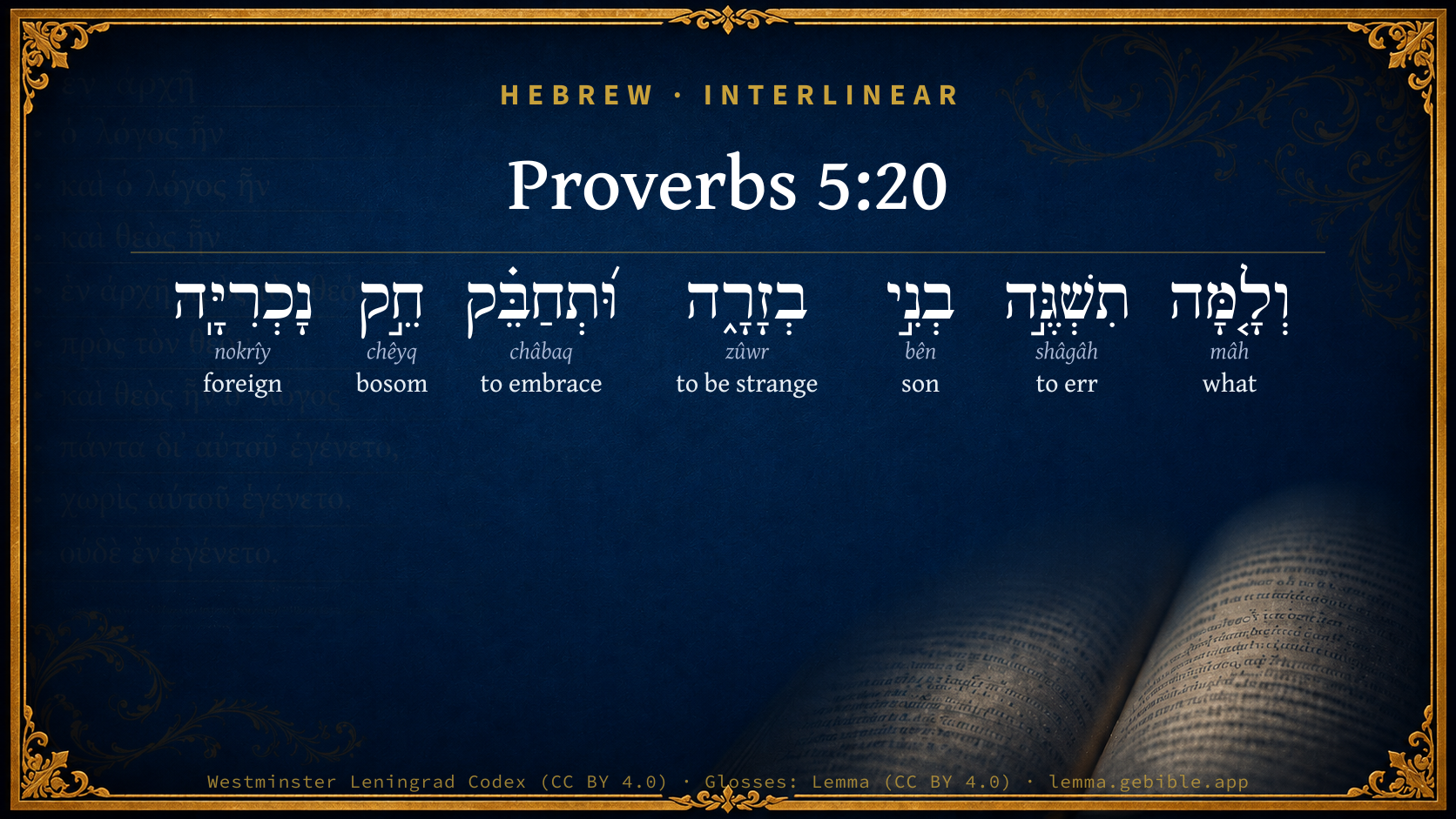
Hebrew (Westminster Leningrad Codex) Proverbs 5:20 appears in the Hebrew Old Testament. The text above is from the Westminster Leningrad Codex. Each word links to its Strong’s number, a concise gloss, and parsing drawn from the Open Scriptures Hebrew Bible morphology. Click any word for its full Brown-Driver-Briggs (BDB) entry.
Download image
Cite this verse

Proverbs 5:20 (World English Bible). Public Domain. Lemma interlinear Bible study tool, https://lemma.gebible.app/v/proverbs/5/20.

Show BibTeX & RIS
BibTeX
RIS
English Translation
For why should you, my son, be captivated with an adulteress? Why embrace the bosom of another?
World English Bible · Public Domain
Download a study sheet

One document with this verse’s original text, its word-by-word gloss line, the meaning frame, cross-references with their text, attributed commentary, and full source and license credits — printable, and it pastes into notes with its structure intact.

This verse Autodidact and up

Study sheet (.html) Plain text (.txt)

A passage Seminary Student

Up to 50 verses in one chapter. A passage sheet keeps up to 6 commentary sources and 12 cross-references per verse, in the order this page ranks them, and says so on the sheet whenever that leaves anything out. Ask for a single verse and you get the Autodidact verse sheet above.

Everything on this page stays free to read, with no account — the sheet is a download of what is already on screen, not access to it.

Want to remove ads? Support Godless Engineer
Compare translations 3

The same verse in 3 English versions, stacked beneath the original-language interlinear above. Click any original word for its lexicon entry.

Each is an independent rendering of the whole verse — the interlinear is not word-aligned to these translations.

Highlighted words mark where these versions differ — a whole-verse word diff, not a word-by-word alignment.

  • World English Bible Public Domain
    For why should you, my son, be captivated with an adulteress? Why embrace the bosom of another?
  • King James Version Public Domain
    And why wilt thou, my son, be ravished with a strange woman, and embrace the bosom of a stranger?
  • unfoldingWord Literal Text CC BY-SA 4.0
    And why would you stagger, my son, with a strange woman, or embrace the bosom of a foreign woman?

unfoldingWord Literal Text — © unfoldingWord, licensed CC BY-SA 4.0. Word-aligned USFM3 via Door43 (git.door43.org/unfoldingWord/en_ult).

Versions to compare (up to 4)

3 of 4 selected

Show all 18 translations

Every available English version of this verse, each an independent rendering of the whole verse.

  • World English Bible Public Domain
    For why should you, my son, be captivated with an adulteress? Why embrace the bosom of another?
  • Berean Standard Bible Public Domain
    Why be captivated, my son, by an adulteress, or embrace the bosom of a stranger?
  • Majority Standard Bible Public Domain
    Why be captivated, my son, by an adulteress, or embrace the bosom of a stranger?
  • King James Version Public Domain
    And why wilt thou, my son, be ravished with a strange woman, and embrace the bosom of a stranger?
  • American Standard Version (1901) Public Domain
    For why shouldest thou, my son, be ravished with a strange woman, And embrace the bosom of a foreigner?
  • Revised Version (1885) Public Domain
    For why shouldest thou, my son, be ravished with a strange woman, and embrace the bosom of a stranger?
  • Geneva Bible (1599) Public Domain
    For why shouldest thou delite, my sonne, in a strange woman, or embrace the bosome of a stranger?
  • Douay-Rheims (1899) Public Domain
    Why art thou seduced, my son, by a strange woman, and art cherished in the bosom of another?
  • Young's Literal Translation Public Domain
    And why dost thou magnify thyself, My son, with a stranger? And embrace the bosom of a strange woman?
  • Literal Standard Version CC BY-SA 4.0
    And why do you magnify yourself, || My son, with a stranger? And embrace the bosom of a strange woman?
  • Unlocked Literal Bible CC BY-SA 4.0
    For why should you, my son, be captivated by an adulteress; why should you embrace the breasts of an immoral woman?
  • unfoldingWord Literal Text CC BY-SA 4.0
    And why would you stagger, my son, with a strange woman, or embrace the bosom of a foreign woman?
  • Darby Bible Public Domain
    And why shouldest thou, my son, be ravished with a strange woman, and embrace the bosom of a stranger?
  • World Messianic Bible Public Domain
    For why should you, my son, be captivated with an adulteress? Why embrace the bosom of another?
  • Webster's Bible Public Domain
    And why wilt thou, my son, be ravished with a strange woman, and embrace the bosom of a stranger?
  • Free Bible Version CC BY-SA 4.0
    Why, my son, become intoxicated with an immoral woman? Why embrace the breasts of a woman who acts like a prostitute?
  • Bible in Basic English Public Domain
    Why let yourself, my son, go out of the way with a strange woman, and take another woman in your arms?
  • JPS Tanakh (1917) Public Domain
    Why then wilt thou, my son, be ravished with a strange woman, and embrace the bosom of an alien?

Literal Standard Version (2020), Covenant Press — licensed CC BY-SA 4.0. Text via the HelloAO Bible API (eBible.org). Unlocked Literal Bible (unfoldingWord) — licensed CC BY-SA 4.0. Text via the HelloAO Bible API (eBible.org). unfoldingWord Literal Text — © unfoldingWord, licensed CC BY-SA 4.0. Word-aligned USFM3 via Door43 (git.door43.org/unfoldingWord/en_ult). Free Bible Version, Dr. Jonathan Gallagher — licensed CC BY-SA 4.0. Text via the HelloAO Bible API (eBible.org).

Word by word

More ways to search: Search by grammar → Find every occurrence → Compare this word →

Practice this passage: Drill this verse → Learn its vocabulary →

About this verse

These counts appear in no published source. They are computed here, from the morphology-tagged text and Lemma’s own curated glosses. What Lemma adds →

7
words
7
distinct lemmas
Wisdom
section

Notable vocabulary

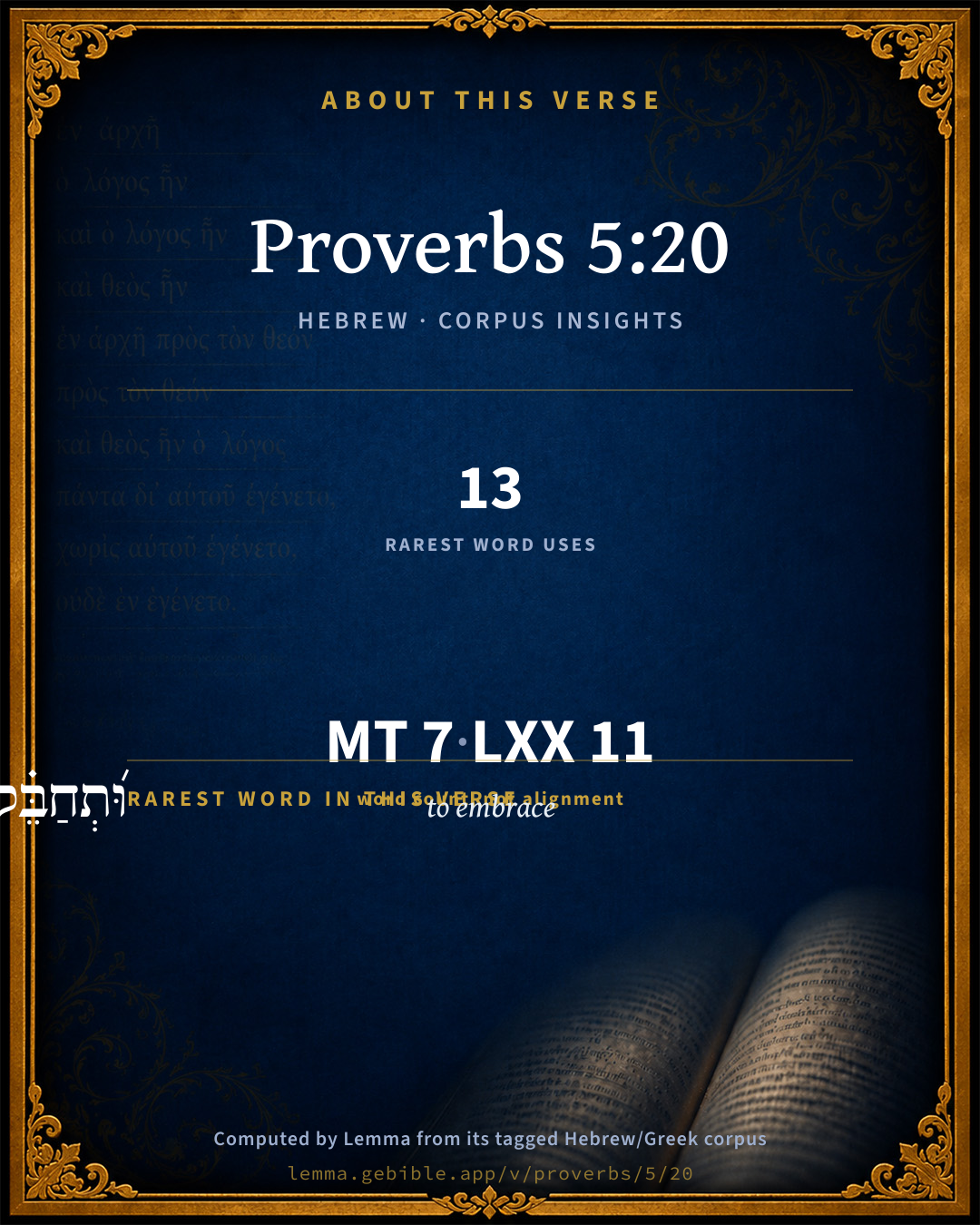
The rarest word here is וּ֝תְחַבֵּ֗ק to embrace H2263 — appearing just 13 times in the whole Hebrew Bible.

Shared distinctive vocabulary

וּ֝תְחַבֵּ֗ק to embrace H2263 occurs in 12 verses of the Hebrew Bible. Also found in:

Grammatical profile

  • 2 verbs
  • 2 nouns
  • 2 adjectives
  • 1 particle

Verb forms

  • תִשְׁגֶּ֣ה Qal · Imperfect
  • וּ֝תְחַבֵּ֗ק Piel · Imperfect

Hebrew & Septuagint length

In English translation the verse runs 17 words from the Hebrew and 19 from the Septuagint (LXX English) — closely comparable.

A rough comparison of the two English renderings, which tokenize alike — not a word-level alignment.

Word counts can differ between the Hebrew and the Greek without any difference in meaning — e.g. the Hebrew direct-object marker אֵת has no separate Greek word, and Greek often adds the article ὁ.

In the original languages it is 7 Hebrew tokens and 11 Greek tokens — but the two are counted differently (Hebrew bundles its prefixes and suffixes into one token; the Greek is in lemma form), so that isn’t a like-for-like length.

Cross-references

7

Topical passages linked to Proverbs 5:20 in the Treasury of Scripture Knowledge — connected by theme and wording, ordered by reader-vote popularity; previews shown in the World English Bible.

  • Proverbs 6:24 To keep you from the immoral woman, From the flattery of the wayward wife's tongue.
  • Proverbs 7:5 That they may keep you from the strange woman, From the foreigner who flatters with her words.
  • 1 Kings 11:1 Now king Solomon loved many foreign women, together with the daughter of Pharaoh, women of the Moabites, Ammonites, Edomites, Sidonians, and Hittites;
  • Proverbs 22:14 The mouth of an adulteress is a deep pit: He who is under Yahweh's wrath will fall into it.
  • Proverbs 23:27–28 For a prostitute is a deep pit; And a wayward wife is a narrow well.
  • Proverbs 23:33 Your eyes will see strange things, And your mind will imagine confusing things.
  • Proverbs 2:16–19 To deliver you from the strange woman, Even from the foreigner who flatters with her words;

Cross-references courtesy of OpenBible.info (CC BY 4.0).

Hebrew and Greek witnesses Masoretic Hebrew ↔ Greek Septuagint

The same verse in the two great witnesses to the Old Testament, shown verse-for-verse.

These are two independent witnesses, not word-aligned to each other, and the Septuagint is shown in lemma (dictionary) form.

Hebrew Proverbs 5:20 Masoretic · Westminster Leningrad Codex

וְלָ֤מָּה תִשְׁגֶּ֣ה בְנִ֣י בְזָרָ֑ה וּ֝תְחַבֵּ֗ק חֵ֣ק נָכְרִיָּֽה

For why should you, my son, be captivated with an adulteress? Why embrace the bosom of another?

World English Bible · Public Domain

Greek LXX Proverbs 5:20 Septuagint · lemma form

μή πολύς εἰμί πρός ἀλλότριος μηδέ συνἔχω ἀγκάλη ὁ μή ἴδιος

Be not intimate with a strange woman, neither fold yourself in the arms of a woman not your own.

LXX2012 (modern English Septuagint) · Public Domain

Hebrew: Westminster Leningrad Codex (CC BY 4.0). Greek: Septuagint (public domain); English from LXX2012 (modern English Septuagint) (Public Domain). How the Septuagint differs from the Hebrew →

Commentary

Notes on Proverbs 5:20 from classic Christian and Jewish commentators (each source and its license shown beneath its notes). The classic Christian expositions comment on the surrounding passage and are grouped to its opening verse, so a note may address several verses; the Jewish commentaries on the Tanakh (Rashi and others) are per-verse, so they appear only where the commentator wrote on this verse.

Lemma curates 59 commentaries, every one of them public domain or Creative Commons licensed, each selected and text-cleaned for this edition rather than reprinted as found. About our sources →

Trapp's Complete Commentary

John Trapp

Pro 5:20 And why wilt thou, my son, be ravished with a strange woman, and embrace the bosom of a stranger?

Ver. 20. And why wilt thou, my son?] The premises considered, there is no reason for it, but all against it. Nothing is more irrational than irreligion, and yet nothing more usual with the devil than to persuade his vassals that there is some sense in sinning, and that they have reason to be mad. And, truly, though there were no devil, yet our corrupt nature would act Satan’s part against itself; it would have a supply of wickedness - as a serpent hath of poison - from itself. It hath a spring within to feed it. Nitimur in vetitum semper, petimusque negata. Nothing would serve the rich man’s turn but the poor man’s lamb. If Ahab may not have Naboth’s vineyard, he hath nothing. The more God forbids any sin, the more we bid for it. {Rom 7:8} ‘Nay, but we will have a king,’ said they, when they had nothing else to say why they would.

John Trapp, A Commentary or Exposition upon All the Books of the Old and New Testament (1647–1656) — public domain. Text from a community e-Sword module.

Joseph Benson's Commentary

Pro 5:20-21. And why wilt thou be ravished with a strange woman? — Consider a little, and deny, if thou canst, that it is an unaccountable folly to seek that satisfaction and comfort in a vile harlot, which thou mayest enjoy more pleasantly, securely, and constantly, as well as more innocently, in a pious wife of thine own people. For the ways of man are before the Lord — “From whom no one can hide his most private actions, but he plainly sees and weighs all that a person doth, wheresoever he be; and will exactly proportion rewards and punishments according as he behaves himself.”

Joseph Benson's Commentary on the Old and New Testaments (1811–1818) — public domain. Text from a community e-Sword module.

Geneva Bible (1599)

Geneva Bible translators

Or, go astray with a stranger?

Geneva Bible (1599) marginal notes — public domain. Text via Bolls.life.

John Gill's Exposition

And why wilt thou, my son, be ravished with a strange woman,.... Or "err with her" (y); after all those inconveniences and miseries that follow upon a conversation with a harlot, and all those advantages of a marriage state set before thee; why wilt thou be, so foolish and mad as to have a fondness for an harlot and dote upon her, and neglect entering into a marriage state, or forsake the wife of youth? and yet though things are so clearly stated and aptly represented, and the expostulation made in the most tender and affectionate manner; it is suggested as if after all it would not be attended unto, but a harlot be preferred to a wife of youth, a filthy beast to a loving hind, and dirty puddles of water in a ditch to running streams from a well or fountain;

and embrace the bosom of a stranger? that is not thy wife; a description of unlawful love and impure embraces, which are dissuaded from.

(y) "Errares", Junius & Tremellius, Piscator; "aberrares", Cocceius.

John Gill's Exposition of the Whole Bible (1746–1763) — public domain (CC PDM 1.0). Text via the HelloAO Bible API.

Albert Barnes' Notes on the Bible

Emphasis is laid (see the Pro 2:16 note) upon the origin of the beguiler.

Albert Barnes' Notes on the Bible (1834–1885) — public domain. Text from a community e-Sword/MySword module.

Matthew Poole's English Annotations

Why wilt thou destroy and damn thyself for those delights which thou mayst enjoy without sin or danger?

Matthew Poole's English Annotations on the Holy Bible (1683–1685) — public domain. Text from a community e-Sword/MySword module.

Whedon's Commentary on the Bible

Daniel D. Whedon

THOMPSON, Land and Book, volume i, page 252.

20. Why… be ravished — For why shouldest thou be fascinated with the love of a strange woman? a strong and affectionate remonstrance against such folly, as an unnecessary and baneful indulgence.

Daniel D. Whedon (gen. ed.), Commentary on the Old and New Testaments (1874–1909) — public domain. Text from a community e-Sword module.

The Pulpit Commentary

Vers. 20, 21. The adulterer to be restrained by the fact of Gods omniscience and the Divine punishment. Vers. 20 and 21 should apparently be taken together. The teaching assumes a higher tone, and rises from the lower law which regulates fidelity to the wife, based upon personal attractions, to the higher law, which brings the husband"s conduct into relation with the duty he owes to Jehovah. Not merely is his conduct to be regulated by love and affection alone, but it is to be fashioned by the reflection or consciousness that the Supreme Being presides over all, and takes cognizance of human action. Without losing sight that the marriage contract has its own peculiar obligations, the fact is insisted upon that all a man"s ways are open to the eyes of the Lord.

And why; i.e. what inducement is there, what reason can be given, for conjugal infidelity, except the lewd and immoral promptings of the lower nature, except sensuality in its lowest form? Ravished. The verb shagah recurs, but in a lower sense, as indicating "the foolish delirium of the libertine hastening after the harlot" (Zockler). With a strange woman (Hebrew, b"zarah); i.e. with a harlot. On zarah, see Pro_2:16 and Pro_7:5. The b (B) localizes the sources of the intoxication. Embrace (Hebrew, t"khab-bek). On this verb, see Pro_4:8. The bosom of a stranger (Hebrew, kheh nok"riyyah). A parallel expression having the same force as its counterpart. The more usual form of khek is kheyk, and means "the bosom" of a person. In Pro_16:33 it is used of the lap, and in Pro_17:23 and Pro_21:14 for the bosom or folds of a garment.

The Pulpit Commentary (1880–1919), ed. H.D.M. Spence-Jones & Joseph S. Exell — public domain. Text from a community e-Sword module.

Bridges on Proverbs

Charles Bridges

With such a view as we have had of the deadly enticement of sin on the one hand (Pro 5:9-11 ), and the calm happiness provided on the other by the ordinance of God (Pro 5:15-19 ), surely none but the infatuated would leave the wholesome fountain for the poisoned and forbidden spring. If he were not stupified, would he slight the "honourable" state of marriage (Heb 13:4 ), to embrace the bosom of a stranger, ’loveless, joyless, unendeared?’ Would not the thought, that the ways of man are before the LORD, arrest him in his course?†1 But no. Practical atheism is the root of human depravity. (Psa 14:1-3 .) The eye of man, even of a child, is a check upon him (Job 24:15 . Isa 29:15 ); but the thought of an all-seeing God, even if it enters his mind (Psa 10:4 ), inspires no alarm, conviction, or restraint. Oh! if men would but read — would but believe — their Bibles, how would this solemn truth — he pondereth all his goings — flash upon their consciences! Not only does he see and mark them as the Omniscient God (Job 31:4 . Psa 139:1-4 ); but he ponders them as the just Judge. (Pro 16:2 . 1Sa 2:3 . Dan 5:27 .) Not one is hidden from his piercing eye. (Heb 4:13 .) "He will bring every secret thing to judgment." (Ecc 12:14 .) He "will be a swift witness against the adulterers. No unclean person shall enter into his kingdom." (Mal 3:2 . Eph 5:5 .)

But if no regard to reason, or to the all-seeing Eye, will restrain the sinner, let him think of the trouble that he is bringing upon himself. God needs no chains or prison to bring him under his hand. Wherever he goes, his sins go with him, as cords to hold him for judgment. (Pro 11:3, Pro 11:5-6 ; Pro 29:6 . 1Sa 28:5-10 .) Does he think that he can give them up when he pleases? Repetition forms the habit. The habit becomes a ruling principle. ’Every lust deals with him, as Delilah with Samson — not only robs him of his strength, but leaves him fast bound.’†2 Shutting his eyes against the light, he dies without instruction (Pro 5:12 . Pro 1:29 ; Pro 10:21 . Job 4:21 ; Job 36:12 . Hos 4:14, Hos 4:17 ) — The greatness of his folly leads him astray — to perdition. (2Pe 2:14-15 .)

But is there no remedy for this deadly curse? Thanks be to God! cleansing is provided for the impure (Zec 13:1 . 1Co 6:11 ); "deliverance is proclaimed to the captive." (Isa 61:1 .) Blessed Savior! cleanse the leper in thy precious fountain. Perform thy mighty commission. Set the captive free.

Footnotes:

†1 Job 34:21-22. Psa 94:6-9 . Jer 13:25-27 ; Jer 16:17 ; Jer 29:23 . Hos 7:2 . See some striking thoughts in Mede’s Sermon on Pro 4:23 .

†2 Archbishop Tillotson quoted in Nicholl’s Commentary. Jdg 16:19-21 . ’Thus I,’ — said Augustine — adverting to this hateful sin — ’delighted with the disease of the flesh, and with the deadly sweetness of it, drew my shackles along with me, much afraid to have them knocked off; and, as if my wound had been too hard rubbed by it, I put back my friends’ good persuasions, as it were the hand of one that would unchain me.’ — Confess. b. vi. c. 12. Compare Pro 23:29-35 .

Charles Bridges, An Exposition of the Book of Proverbs (1846) — public domain. Text from a community e-Sword module.

unfoldingWord translationNotes

Door43 World Missions Community

For why should you, my son, be captivated by an adulteress; why should you embrace the breasts of an immoral woman?

The writer asks these rhetorical questions to emphasize that his son must not do these things. AT: "My son, do not be captivated by an adulteress! Do not embrace the breasts of an immoral woman!" (See: Rhetorical Question)

be captivated by an adulteress

Intense excitement that arises from the desire for a woman is spoken of as if he were being held captive by that woman. This can be stated in active form. AT: "allow an adulteress to captivate you" or "allow an adulteress to fascinate you" (See: Active or Passive)

why should you embrace the breasts of an immoral woman

Here the word "breasts" represents the immoral woman and her sexual attractiveness. AT: "why should you embrace an immoral woman" (See: Synecdoche)

an immoral woman

Possible meanings are 1) "a woman who is not your wife" or 2) "a woman who is another man's wife."

sees everything ... watches all the paths

These two phrases mean the same thing and emphasize that God knows everything that everyone does. (See: Parallelism)

all the paths he takes

The writer speaks of a person's actions or lifestyle as if it were a path on which the person walks. AT: "everywhere he goes" or "everything he does" (See: Metaphor)

translationWords

adultery

Yahweh

unfoldingWord translationNotes — © Distant Shores Media and the Door43 World Missions Community, licensed CC BY-SA 4.0. Source: git.door43.org/Door43/en_tn.

Lesson kit

Teaching starters — assembled from the data on this page, not authored interpretation. Every prompt links to the verse data it draws on. Edit before teaching.

Proverbs, in the Wisdom, opens this verse with 7 words (7 distinct Hebrew lemmas). Its most distinctive word is châbaq (“to embrace”). A historical commentator’s framing appears above. Read the whole chapter for the surrounding context.

Discussion questions

  1. What does “to embrace” (châbaq) contribute to the verse as a whole?
  2. Genesis 29:13 shares the word «to embrace» with this verse. How do the two illuminate each other?
  3. The translations on this page render this verse differently — a whole-verse word diff, not a word-by-word alignment. What might account for the different wordings?
  4. The verb «תִשְׁגֶּ֣ה» is Qal Imperfect. How does its form color the action?
  5. Reading how Trapp's Complete Commentary and Joseph Benson's Commentary read this verse, where do the two commentators agree and where do they part?

Things to notice

Reading settings

Reading text

Shown beneath each verse's original-language words.

Old Testament
Old Testament edition

Read the OT as the Masoretic Hebrew (MT) or the Greek Septuagint (LXX).

English shown for the Greek Septuagint (in the Hebrew ↔ Greek comparison).

Comparing translations? Open the Compare panel on any verse page to stack up to four side by side.