
Jeremiah 9:12

Hebrew (Westminster Leningrad Codex) Jeremiah 9:12 appears in the Hebrew Old Testament. The text above is from the Westminster Leningrad Codex. Each word links to its Strong’s number, a concise gloss, and parsing drawn from the Open Scriptures Hebrew Bible morphology. Click any word for its full Brown-Driver-Briggs (BDB) entry.
Download image
Cite this verse

Jeremiah 9:12 (World English Bible). Public Domain. Lemma interlinear Bible study tool, https://lemma.gebible.app/v/jeremiah/9/12.

Show BibTeX & RIS
BibTeX
RIS
English Translation
Who is the wise man, that may understand this? and [who is] he to whom the mouth of Yahweh has spoken, that he may declare it? why is the land perished and burned up like a wilderness, so that none passes through?
World English Bible · Public Domain
Download a study sheet

One document with this verse’s original text, its word-by-word gloss line, the meaning frame, cross-references with their text, attributed commentary, and full source and license credits — printable, and it pastes into notes with its structure intact.

This verse Autodidact and up

Study sheet (.html) Plain text (.txt)

A passage Seminary Student

Up to 50 verses in one chapter. A passage sheet keeps up to 6 commentary sources and 12 cross-references per verse, in the order this page ranks them, and says so on the sheet whenever that leaves anything out. Ask for a single verse and you get the Autodidact verse sheet above.

Everything on this page stays free to read, with no account — the sheet is a download of what is already on screen, not access to it.

Want to remove ads? Support Godless Engineer
Compare translations 3

The same verse in 3 English versions, stacked beneath the original-language interlinear above. Click any original word for its lexicon entry.

Each is an independent rendering of the whole verse — the interlinear is not word-aligned to these translations.

Highlighted words mark where these versions differ — a whole-verse word diff, not a word-by-word alignment.

  • World English Bible Public Domain
    Who is the wise man, that may understand this? and [who is] he to whom the mouth of Yahweh has spoken, that he may declare it? why is the land perished and burned up like a wilderness, so that none passes through?
  • King James Version Public Domain
    Who is the wise man, that may understand this? and who is he to whom the mouth of the LORD hath spoken, that he may declare it, for what the land perisheth and is burned up like a wilderness, that none passeth through?
  • unfoldingWord Literal Text CC BY-SA 4.0
    Who is the man that is wise that he may understand this? And to whom has the mouth of Yahweh spoken to, that he may declare it? Why does the land perish, burn up like the wilderness so that not passing through?

unfoldingWord Literal Text — © unfoldingWord, licensed CC BY-SA 4.0. Word-aligned USFM3 via Door43 (git.door43.org/unfoldingWord/en_ult).

Versions to compare (up to 4)

3 of 4 selected

Show all 18 translations

Every available English version of this verse, each an independent rendering of the whole verse.

  • World English Bible Public Domain
    Who is the wise man, that may understand this? and [who is] he to whom the mouth of Yahweh has spoken, that he may declare it? why is the land perished and burned up like a wilderness, so that none passes through?
  • Berean Standard Bible Public Domain
    Who is the man wise enough to understand this? To whom has the mouth of the LORD spoken, that he may explain it? Why is the land destroyed and scorched like a desert, so no one can pass through it?
  • Majority Standard Bible Public Domain
    Who is the man wise enough to understand this? To whom has the mouth of the LORD spoken, that he may explain it? Why is the land destroyed and scorched like a desert, so no one can pass through it?
  • King James Version Public Domain
    Who is the wise man, that may understand this? and who is he to whom the mouth of the LORD hath spoken, that he may declare it, for what the land perisheth and is burned up like a wilderness, that none passeth through?
  • American Standard Version (1901) Public Domain
    Who is the wise man, that may understand this? and `who is' he to whom the mouth of Jehovah hath spoken, that he may declare it? wherefore is the land perished and burned up like a wilderness, so that none passeth through?
  • Revised Version (1885) Public Domain
    Who is the wise man, that may understand this? and who is he to whom the mouth of the LORD hath spoken, that he may declare it? wherefore is the land and perished burned up like a wilderness, so that none passeth through?
  • Geneva Bible (1599) Public Domain
    Who is wise, to vnderstande this? and to whome the mouth of the Lord hath spoken, euen he shall declare it. Why doth the land perish, and is burnt vp like a wildernesse, that none passeth through?
  • Douay-Rheims (1899) Public Domain
    Who is the wise man, that may understand this, and to whom the word of the mouth of the Lord may come that he may declare this, why the land hath perished, and is burnt up like a wilderness, which none passeth through?
  • Young's Literal Translation Public Domain
    Who `is' the wise man? and he understandeth this, And he to whom the mouth of Jehovah spake? And he doth declare it, For what hath the land perished? It hath been burnt up as a wilderness, Without any passing through.
  • Literal Standard Version CC BY-SA 4.0
    Who [is] the wise man? And he understands this, || And he to whom the mouth of YHWH spoke? And he declares it, || For why has the land perished? It has been burned up as a wilderness, || Without any passing through.
  • Unlocked Literal Bible CC BY-SA 4.0
    What man is wise enough to understand this? To whom has the mouth of Yahweh spoken, and he will declare it? Why has the land perished and been destroyed like the wilderness that no one can pass through?
  • unfoldingWord Literal Text CC BY-SA 4.0
    Who is the man that is wise that he may understand this? And to whom has the mouth of Yahweh spoken to, that he may declare it? Why does the land perish, burn up like the wilderness so that not passing through?
  • Darby Bible Public Domain
    Who is a wise man, that he may understand this? and he to whom the mouth of Jehovah hath spoken, that he may declare it? Why is the land perished, burnt up like a wilderness, so that none passeth through?
  • World Messianic Bible Public Domain
    Who is wise enough to understand this? Who is he to whom the mouth of the LORD has spoken, that he may declare it? Why has the land perished and burned up like a wilderness, so that no one passes through?
  • Webster's Bible Public Domain
    Who is the wise man that may understand this? and who is he to whom the mouth of the LORD hath spoken, that he may declare it, for what the land perisheth and is burned up like a wilderness, that none passeth through?
  • Free Bible Version CC BY-SA 4.0
    Who is wise enough to understand this? Has the Lord told anyone so they can explain what's happened? Why has the land been destroyed and burned so it's like a desert, so no one can pass through it?
  • Bible in Basic English Public Domain
    Who is the wise man able to see this? who is he to whom the word of the Lord has come, so that he may make it clear? why is the land given to destruction and burned up like a waste place, so that no one goes through?
  • JPS Tanakh (1917) Public Domain
    (9-11) Who is the wise man, that he may understand this? And who is he to whom the mouth of the LORD hath spoken, that he may declare it? Wherefore is the land perished and laid waste like a wilderness, so that none passeth through?

Literal Standard Version (2020), Covenant Press — licensed CC BY-SA 4.0. Text via the HelloAO Bible API (eBible.org). Unlocked Literal Bible (unfoldingWord) — licensed CC BY-SA 4.0. Text via the HelloAO Bible API (eBible.org). unfoldingWord Literal Text — © unfoldingWord, licensed CC BY-SA 4.0. Word-aligned USFM3 via Door43 (git.door43.org/unfoldingWord/en_ult). Free Bible Version, Dr. Jonathan Gallagher — licensed CC BY-SA 4.0. Text via the HelloAO Bible API (eBible.org).

Word by word

More ways to search: Search by grammar → Find every occurrence → Compare this word →

Practice this passage: Drill this verse → Learn its vocabulary →

נִצְּתָ֥ה
yâtsath
H3341
“to kindle”
Verb, Niphal, Perfect, 3rd Person, Feminine, Singular
Part of Speech
Verb
Stem
Niphal
Form
Perfect
Person
3rd Person
Gender
Feminine
Number
Singular
Full BDB Definition

Origin: a primitive root

TWOT: 899

to kindle, burn, set on fire - (Qal) to kindle - (Niphal) - to be kindled - to be left desolate - (Hiphil) to set on fire, kindle
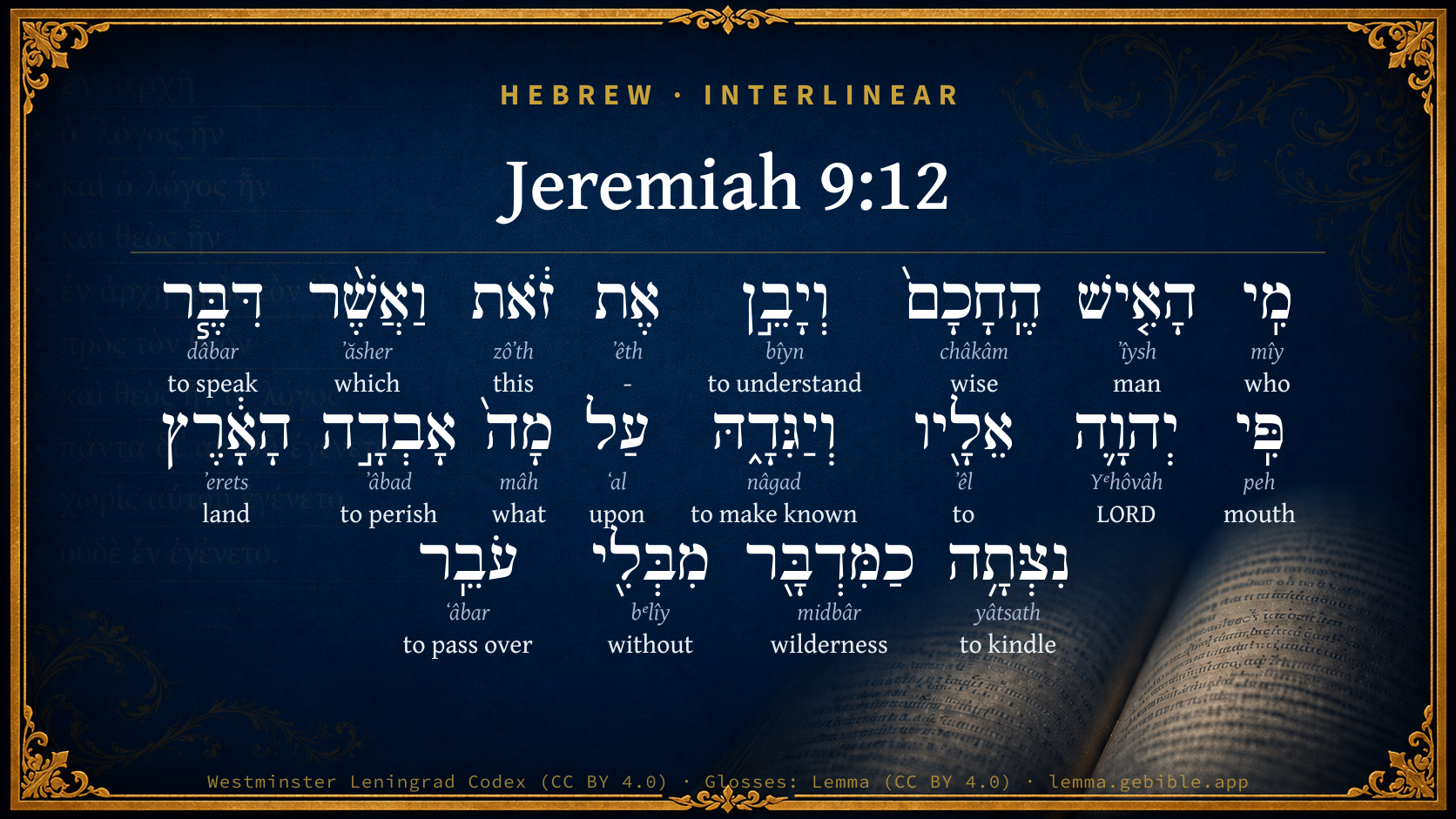
  1. מִֽי mîy H4310 “who” Particle, Interrogative
  2. הָאִ֤ישׁ ʼîysh H376 “the · man” Particle, Definite Article + Noun, Common, Masculine, Singular, Absolute
  3. הֶֽחָכָם֙ châkâm H2450 “the · wise” Particle, Definite Article + Adjective, Adjective, Masculine, Singular, Absolute
  4. וְיָבֵ֣ן bîyn H995 “and · to understand” Conjunction + Verb, Qal, Jussive, 3rd Person, Masculine, Singular
  5. אֶת ʼêth H853 “-” Particle, Direct Object
  6. זֹ֔את zôʼth H2063 “this” Pronoun, Demonstrative, Feminine, Singular
  7. וַאֲשֶׁ֨ר ʼăsher H834 “and · which” Conjunction + Particle, Relative
  8. דִּבֶּ֧ר dâbar H1696 “to speak” Verb, Piel, Perfect, 3rd Person, Masculine, Singular
  9. פִּֽי peh H6310 “mouth of” Noun, Common, Masculine, Singular, Construct
  10. יְהוָ֛ה Yᵉhôvâh H3068 “LORD” Noun, Proper
  11. אֵלָ֖יו ʼêl H413 “to · him” Preposition + Suffix, Personal, 3rd Person, Masculine, Singular
  12. וְיַגִּדָ֑הּ nâgad H5046 “and · to make known · her” Conjunction + Verb, Hiphil, Imperfect, 3rd Person, Masculine, Singular + Suffix, Personal, 3rd Person, Feminine, Singular
  13. עַל ʻal H5921 “upon” Preposition
  14. מָה֙ mâh H4100 “what” Particle, Interrogative
  15. אָבְדָ֣ה ʼâbad H6 “to perish” Verb, Qal, Perfect, 3rd Person, Feminine, Singular
  16. הָאָ֔רֶץ ʼerets H776 “the · land” Particle, Definite Article + Noun, Common, Both, Singular, Absolute
  17. כַמִּדְבָּ֖ר midbâr H4057 “like/as the · wilderness” Preposition, Determined + Noun, Common, Masculine, Singular, Absolute
  18. מִבְּלִ֖י bᵉlîy H1097 “from · without of” Preposition + Noun, Common, Masculine, Singular, Construct
  19. עֹבֵֽר ʻâbar H5674 “passing over” Verb, Qal, Participle Active, Masculine, Singular, Absolute

About this verse

These counts appear in no published source. They are computed here, from the morphology-tagged text and Lemma’s own curated glosses. What Lemma adds →

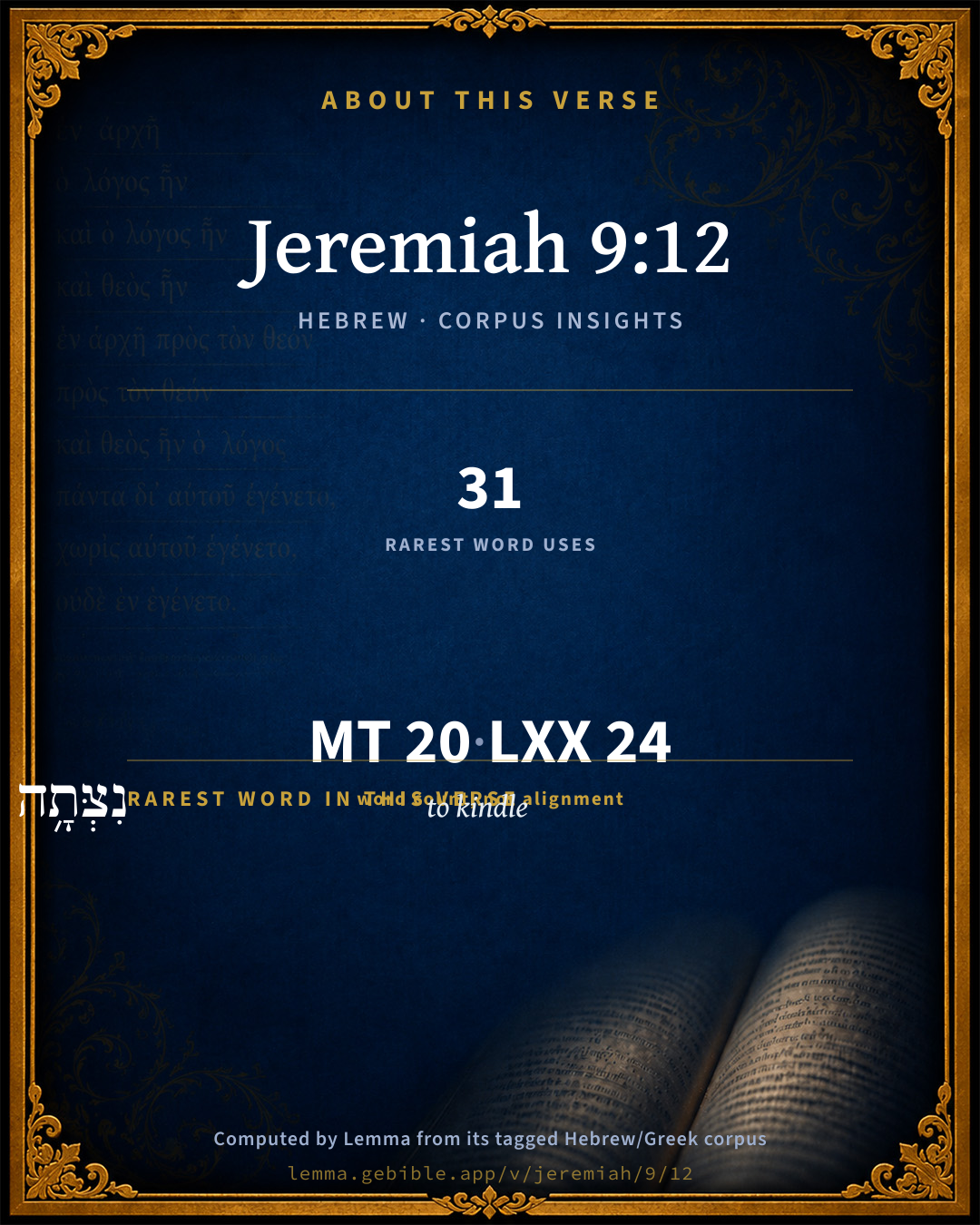
20
words
20
distinct lemmas
Prophets
section

Shared distinctive vocabulary

נִצְּתָ֥ה to kindle H3341 occurs in 28 verses of the Hebrew Bible. Also found in:

Grammatical profile

  • 6 verbs
  • 6 nouns
  • 1 adjective
  • 1 pronoun
  • 2 prepositions
  • 4 particles

Verb forms

  • וְיָבֵ֣ן Qal · Jussive
  • דִּבֶּ֧ר Piel · Perfect
  • וְיַגִּדָ֑הּ Hiphil · Imperfect
  • אָבְדָ֣ה Qal · Perfect
  • נִצְּתָ֥ה Niphal · Perfect
  • עֹבֵֽר Qal · Participle Active

Hebrew & Septuagint length

In the original languages it is 20 Hebrew tokens and 24 Greek tokens — but the two are counted differently (Hebrew bundles its prefixes and suffixes into one token; the Greek is in lemma form), so that isn’t a like-for-like length.

Cross-references

13

Topical passages linked to Jeremiah 9:12 in the Treasury of Scripture Knowledge — connected by theme and wording, ordered by reader-vote popularity; previews shown in the World English Bible.

  • Hosea 14:9 Who is wise, that he may understand these things? Who is prudent, that he may know them? For the ways of Yahweh are right, And the righteous walk in them; But the rebellious stumble in them.
  • Psalms 107:43 Whoever is wise will pay attention to these things. They will consider the loving kindnesses of Yahweh.
  • Deuteronomy 32:29 Oh that they were wise, that they understood this, That they would consider their latter end!
  • Psalms 107:34 And a fruitful land into a salt waste, For the wickedness of those who dwell in it.
  • Deuteronomy 29:22–28 The generation to come, your children who shall rise up after you, and the foreigner who shall come from a far land, shall say, when they see the plagues of that land, and the sicknesses with which Yahweh has made it sick;
  • 1 Kings 9:8–9 Though this house is so high, yet shall everyone who passes by it be astonished, and shall hiss; and they shall say, Why has Yahweh done thus to this land, and to this house?
  • Jeremiah 5:19–20 It shall happen, when you shall say, Why has Yahweh our God done all these things to us? then shall you say to them, Like as you have forsaken me, and served foreign gods in your land, so shall you serve strangers in a land that is not yours.
  • Jeremiah 16:10–13 It shall happen, when you shall show this people all these words, and they shall tell you, Why has Yahweh pronounced all this great evil against us? or what is our iniquity? or what is our sin that we have committed against Yahweh our God?
  • Jeremiah 22:8–9 Many nations shall pass by this city, and they shall say every man to his neighbor, Why has Yahweh done thus to this great city?
  • Ezekiel 14:23 They shall comfort you, when you see their way and their doings; and you shall know that I have not done without cause all that I have done in it, says the Lord Yahweh.
  • Ezekiel 22:25–31 There is a conspiracy of her prophets in the midst of it, like a roaring lion ravening the prey: they have devoured souls; they take treasure and precious things; they have made her widows many in the midst of it.
  • Matthew 24:15 "When, therefore, you see the abomination of desolation, which was spoken of through Daniel the prophet, standing in the holy place (let the reader understand),
  • Revelation 1:3 Blessed is he who reads and those who hear the words of the prophecy, and keep the things that are written in it, for the time is at hand.

Cross-references courtesy of OpenBible.info (CC BY 4.0).

Hebrew and Greek witnesses Masoretic Hebrew ↔ Greek Septuagint

The same verse in the two great witnesses to the Old Testament, shown verse-for-verse.

These are two independent witnesses, not word-aligned to each other, and the Septuagint is shown in lemma (dictionary) form.

Hebrew Jeremiah 9:12 Masoretic · Westminster Leningrad Codex

מִֽי הָאִ֤ישׁ הֶֽחָכָם֙ וְיָבֵ֣ן אֶת זֹ֔את וַאֲשֶׁ֨ר דִּבֶּ֧ר פִּֽי יְהוָ֛ה אֵלָ֖יו וְיַגִּדָ֑הּ עַל מָה֙ אָבְדָ֣ה הָאָ֔רֶץ נִצְּתָ֥ה כַמִּדְבָּ֖ר מִבְּלִ֖י עֹבֵֽר

Who is the wise man, that may understand this? and [who is] he to whom the mouth of Yahweh has spoken, that he may declare it? why is the land perished and burned up like a wilderness, so that none passes through?

World English Bible · Public Domain

Greek LXX Structure differs

In the Septuagint, Jeremiah is about an eighth shorter than the Hebrew and arranges its material differently — the Oracles Against the Nations (Hebrew chapters 46–51) appear in the middle of the Greek book, after 25:13. Because the chapter and verse boundaries do not line up, a verse-for-verse comparison with the Hebrew is not shown.

A verse-for-verse comparison isn’t shown here because the chapters and verses don’t line up. Switch to the LXX edition with the MT / LXX toggle above to read the Greek directly.

Hebrew: Westminster Leningrad Codex (CC BY 4.0). Greek: Septuagint (public domain); English from a public-domain English Septuagint. How the Septuagint differs from the Hebrew →

Targum (Aramaic paraphrase)

1

The Targum is the ancient Jewish Aramaic paraphrase of the Hebrew Scriptures — an interpretive translation, not the Hebrew text itself. Onkelos (literal) and Pseudo-Jonathan (expansive) render the Torah, and Jonathan the Prophets. Coverage is partial: where no permissively-licensed English translation exists for a verse, only the Aramaic is shown. This is verse-level text, not a word-by-word alignment to the Hebrew.

  1. Targum Jonathan Prophets (Joshua–Malachi)
    וַאֲמַר יְיָ עַל דִי שְׁבָקוּ יַת אוֹרַיְתִי דִיהָבִית קֳדָמֵיהוֹן וְלָא קַבִּילוּ לְמֵימְרִי וְלָא הֲלִיכוּ בָּהּ:

    (no public-domain English translation for this verse)

    Targum Jonathan — Aramaic: “Mikraot Gedolot” (public domain). English: “Sefaria Community Translation” (CC0 1.0 (public-domain dedication)); “London "Chaldee Paraphrase," 1871” (public domain). Text via Sefaria.

Commentary

Notes on Jeremiah 9:12 from classic Christian and Jewish commentators (each source and its license shown beneath its notes). The classic Christian expositions comment on the surrounding passage and are grouped to its opening verse, so a note may address several verses; the Jewish commentaries on the Tanakh (Rashi and others) are per-verse, so they appear only where the commentator wrote on this verse.

Lemma curates 59 commentaries, every one of them public domain or Creative Commons licensed, each selected and text-cleaned for this edition rather than reprinted as found. About our sources →

Matthew Henry's Commentary

Two things the prophet designs, in these verses, with reference to the approaching destruction of Judah and Jerusalem: - 1. To convince people of the justice of God in it, that they had by sin brought it upon themselves and that therefore they had no reason to quarrel with God, who did them no wrong at all, but a great deal of reason to fall out with their sins, which did them all this mischief. 2. To affect people with the greatness of the desolation that was coming, and the miserable effects of it, that by a terrible prospect of it they might be awakened to repentance and reformation, which was the only way to prevent it, or, at least, mitigate their own share in it. This being designed,

I. He calls for the thinking men, by them to show people the equity of God's proceedings, though they seemed harsh and severe (Jer 9:12): "Who, where, is the wise man, or the prophet, to whom the mouth of the Lord hath spoken? You boast of your wisdom, and of the prophets you have among you; produce me any one that has but the free use of human reason or any acquaintance with divine revelation, and he will soon understand this himself, and it will be so clear to him that he will be ready to declare it to others, that there is a just ground of God's controversy with this people." Do these wise men enquire, For what does the land perish? What is the matter, that such a change is made with this land? It used to be a land that God cared for, and he had his eyes upon it for good (Deu 11:12), but it is now a land that he has forsaken and that his face is against. It used to flourish as the garden of the Lord and to be replenished with inhabitants; but now it is burnt up like a wilderness, that none passeth through it, much less cares to settle in it. It was supposed, long ago, that it would be asked, when it came to this, Wherefore has the Lord done thus unto this land? What means the heat of this great anger? (Deu 29:24), to which question God here gives a full answer, before which all flesh must be silent. He produces out of the record,

1. The indictment preferred and proved against them, upon which they had been found guilty, Jer 9:13, Jer 9:14. It is charged upon them, and it cannot be denied, (1.) That they have revolted from their allegiance to their rightful Sovereign. Therefore. God has forsaken their land, and justly, because they have forsaken his law, which he had so plainly, so fully, so frequently set before them, and had not observed his orders, not obeyed his voice, nor walked in the ways that he had appointed. Here their wickedness began, in the omission of their duty to their God and a contempt of his authority. But it did not end here. It is further charged upon them, (2.) That they have entered themselves into the service of pretenders and usurpers, have not only withdrawn themselves from their obedience to their prince, but have taken up arms against him. For, [1.] They have acted according to the dictates of their own lusts, have set up their own will, the wills of the flesh, and the carnal mind, in competition with, and contradiction to the will of God: They have walked after the imagination of their own hearts; they would do as they pleased, whatever God and conscience said to the contrary. [2.] They have worshipped the creatures of their own fancy, the work of their own hands, according to the tradition received from their fathers: They have walked after Baalim: the word is plural; they had many Baals, Baal-peor and Baal-berith, the Baal of this place and the Baal of the other place; for they had lords many, which their fathers taught them to worship, but which the God of their fathers had again and again forbidden. This was it for which the land perished. The King of kings never makes war thus upon his own subjects but when they treacherously depart from him and rebel against him, and it has become necessary by this means to chastise their rebellion and reduce them to their allegiance; and they themselves shall at length acknowledge that he is just in all that is brought upon them.

2. The judgment given upon this indictment, the sentence upon the convicted rebels, which must now be executed, for it was righteous and nothing could be moved in arrest of it: The Lord of hosts, the God of Israel, hath said it (Jer 9:15, Jer 9:16), and who can reverse it? (1.) That all their comforts at home shall be poisoned and embittered to them: I will feed this people with wormwood (or rather with wolf's-bane, for it signifies a herb that is not wholesome, as wormwood is though it be bitter, but some herb that is both nauseous and noxious), and I will give them water of gall (or juice of hemlock or some other herb that is poisonous) to drink. Every thing about them, till it comes to their very meat and drink, shall be a terror and torment to them. God will curse their blessings, Mal 2:2. (2.) That their dispersion abroad shall be their destruction (Jer 9:16): I will scatter them among the heathen. They were corrupted and debauched by their intimacy with the heathen, with whom they mingled and learned their works; and now they shall lose themselves, where they lost their virtue, among the heathen. They set up gods which neither they nor their fathers had known, strange gods, new gods (Deu 32:17); and now God will put them among neighbours whom neither they nor their fathers have known, whom they can claim no acquaintance with, and therefore can expect no favour from. And yet, though they are scattered so as that they will not know where to find one another. God will know where to find them all out (Psa 21:8) with that evil which still pursues impenitent sinners: I will send a sword after them, some killing judgment or other, till I have consumed them; for when God judges he will overcome, when he pursues he will overtake. And now we see for what the land perishes; all this desolation is the desert of their deeds and the performance of God's words.

II. He calls for the mourning women, and engages them, with the arts they practise to affect people and move their passions, to lament these sad calamities that had come or were coming upon them, that the nation might be alarmed to prepare for them: The Lord of hosts himself says, Call for the mourning women, that they may come, Jer 9:17. the scope of this is to show how very woeful and lamentable the condition of this people was likely to be. 1. Here is work for the counterfeit mourners: Send for cunning women, that know how to compose mournful ditties, or at least to sing them in mournful tunes and accents, and therefore are made use of at funerals to supply the want of true mourners. Let these take up a wailing for us, Jer 9:18. The deaths and funerals were so many that people wept for them till they had no power to weep, as those, Sa1 30:4. Let those therefore do it now whose trade it is. Or, rather, it intimates the extreme sottishness and stupidity of the people, that laid not to heart the judgments they were under, nor, even when there was so much blood shed, could find in their hearts to shed a tear. They cry not when God binds them, Job 36:13. God sent his mourning prophets to them, to call them to weeping and mourning, but his word in their mouths did not work upon their faith; rather therefore than they shall go laughing to their ruin, let the mourning women come, and try to work upon their fancy, that their eyes may at length run down with tears, and their eyelids gush out with waters. First or last, sinners must be weepers. 2. Here is work for the real mourners. (1.) There is that which is a lamentation. The present scene is very tragical (Jer 9:19): A voice of wailing is heard out of Zion. Some make this to be the song of the mourning women: it is rather an echo to it, returned by those whose affections were moved by their wailings. In Zion the voice of joy and praise used to be heard, while the people kept closely to God. But sin has altered the note; it is now the voice of lamentation. It should seem to be the voice of those who fled from all parts of the country to the castle of Zion for protection. Instead of rejoicing that they had got safely thither, they lamented that they were forced to seek for shelter there: "How are we spoiled! How are we stripped of all our possessions! We are greatly confounded, ashamed of ourselves and our poverty;" for that is it that they complain of, that is it that they blush at the thoughts of, rather than of their sin: We are confounded because we have forsaken the land (forced so to do by the enemy), not because we have forsaken the Lord, being drawn aside of our own lust and enticed - because our dwellings have cast us out, not because our God has cast us off. Thus unhumbled hearts lament their calamity, but not their iniquity, the procuring cause of it. (2.) There is more still to come which shall be for a lamentation. Things are bad, but they are likely to be worse. Those whose land has spued them out (as it did their predecessors the Canaanites, and justly, because they trod in their steps, Lev 18:28) complain that they are driven into the city, but, after a while, those of the city, and they with them, shall be forced thence too: Yet hear the word of the Lord; he has something more to say to you (Jer 9:20); let the women hear it, whose tender spirits are apt to receive the impressions of grief and fear, for the men will not heed it, will not give it a patient hearing. The prophets will be glad to preach to a congregation of women that tremble at God's word. Let your ear receive the word of God's mouth, and bid it welcome, though it be a word of terror. Let the women teach their daughters wailing; this intimates that the trouble shall last long, grief shall be entailed upon the generation to come. Young people are apt to love mirth, and expect mirth, and are disposed to be gay and airy; but let the elder women teach the younger to be serious, tell them what a vale of tears they must expect to find this world, and train them up among the mourners in Zion, Tit 2:4, Tit 2:5. Let every one teach her neighbour lamentation; this intimates that the trouble shall spread far, shall go from house to house. People shall not need to sympathize with their friends; they shall all have cause enough to mourn for themselves. Note, Those that are themselves affected with the terrors of the Lord should endeavour to affect others with them. The judgment here threatened is made to look terrible. [1.] Multitudes shall be slain, Jer 9:21. Death shall ride in triumph, and there shall be no escaping his arrests when he comes with commission, neither within doors nor without. Not within doors, for let the doors be shut ever so fast, let them be ever so firmly locked and bolted, death comes up into our windows, like a thief in the night; it steals upon us ere we are aware. Nor does it thus boldly attack the cottages only, but it has entered into our palaces, the palaces of our princes and great men, though ever so stately, ever so strongly built and guarded. Note, No palaces can keep out death. Nor are those more safe that are abroad; death cuts off even the children from without and the young men from the streets. The children who might have been spared by the enemy in pity, because they had never been hurtful to them, and the young men who might have been spared in policy, because capable of being serviceable to them, shall fall together by the sword. It is usual now, even in the severest military executions, to put none to the sword. It is usual now, even in the severest military executions, to put none to the sword but those that are found in arms; but then even the boys and girls playing in the streets were sacrificed to the fury of the conqueror. [2.] Those that are slain shall be left unburied (Jer 9:22): Speak, Thus saith the Lord (for the confirmation and aggravation of what was before said), Even the carcases of men shall fall as dung, neglected, and left to be offensive to the smell, as dung is. Common humanity obliges the survivors to bury the dead, even for their own sake; but here such numbers shall be slain, and those so dispersed all the country over, that it shall be an endless thing to bury them all, nor shall there be hands enough to do it, nor shall the conquerors permit it, and those that should do it shall be overwhelmed with grief, so that they shall have no heart to do it. The dead bodies even of the fairest and strongest, when they have lain awhile, become dung, such vile bodies have we. And here such multitudes shall fall that their bodies shall lie as thick as heaps of dung in the furrows of the field, and no more notice shall be taken of them than of the handfuls which the harvestman drops for the gleaners, for none shall gather them, but they shall remain in sight, monuments of divine vengeance, that the eye of the impenitent survivors may affect their heart. Slay them not, bury them not, lest my people forget, Psa 59:11.

Matthew Henry's Commentary on the Whole Bible (1708–1710) — public domain (CC PDM 1.0). Text via the HelloAO Bible API.

Trapp's Complete Commentary

John Trapp

Jer 9:12 Who [is] the wise man, that may understand this? and [who is he] to whom the mouth of the LORD hath spoken, that he may declare it, for what the land perisheth [and] is burned up like a wilderness, that none passeth through?

Ver. 12. Who is the wise man, that he may understand this?] This who and who, denoteth a great paucity of such wise ones, as consider common calamities in the true causes of them, propter quid pereat haec terra, for what the land perisheth, and that great sins produce grievous judgments. The most are apt to say, with those Philistines, It is a chance; to attribute their sufferings to fate or fortune, to accuse God of injustice, rather than to accept of the punishment of their iniquity.

And who is he to whom the mouth of the Lord hath spoken?] q.d., Is there never a one of your prophets that will set you right herein? but the dust of covetousness hath put out their eyes, and they can better sing Placentia than Lachrymae, &c.

John Trapp, A Commentary or Exposition upon All the Books of the Old and New Testament (1647–1656) — public domain. Text from a community e-Sword module.

Joseph Benson's Commentary

Jer 9:12-13. Who is the wise man — Or, Is there not a wise man, who understands this? — Is there none of you so well acquainted with the will of God and the methods of his providence, as to be able to declare the reasons why he has given such severe instances of his anger against this land? The question implies, that there are none, or very few, that consider common calamities in the cause of them, but rather impute the divine chastisements to chance, not seeing the hand of God in them. And the Lord saith. Because they have forsaken my law, &c. — Here God himself declares the reasons of his judgments by the mouth of his prophet.

Joseph Benson's Commentary on the Old and New Testaments (1811–1818) — public domain. Text from a community e-Sword module.

Tyndale Open Study Notes

Tyndale Open Resources

9:12 It is unclear who asks these three questions. It might be the people or Jeremiah. The first two questions express frustration that the Lord’s message about the religious and political situation made no sense—the Lord’s words seemed too harsh and too extreme. The third question reveals anger that the land had been desolated. The questioner seems to ask where to find the wisdom and goodness of the Lord in what was happening.

Tyndale Open Study Notes — © Tyndale Open Resources, licensed CC BY-SA 4.0. Text via the HelloAO Bible API.

Geneva Bible (1599)

Geneva Bible translators

Meaning, that they are all without sense and understanding, and that God hath taken his spirit from them.

Geneva Bible (1599) marginal notes — public domain. Text via Bolls.life.

Jamieson, Fausset & Brown

Robert Jamieson, A. R. Fausset & David Brown

Rather, "Who is a wise man? (that is, Whosoever has inspired wisdom, Pe2 3:15); let him understand this (weigh well the evils impending, and the causes of their being sent); and he to whom the mouth of the Lord hath spoken (that is, whosoever is prophetically inspired), let him declare it to his fellow countrymen," if haply they may be roused to repentance, the only hope of safety.

Jamieson, Fausset & Brown — Commentary Critical and Explanatory on the Whole Bible (1871) — public domain (CC PDM 1.0). Text via the HelloAO Bible API.

Adam Clarke's Commentary

Verse 12. Who is the wise man] To whom has God revealed these things? He is the truly wise man. But it is to his prophet alone that God has revealed these things, and the speedy fulfilment of the predictions will show that the prophet has not spoken of himself.

Adam Clarke's Commentary on the Bible (1810–1826) — public domain. Text from a community e-Sword/MySword module.

John Calvin's Commentaries

Here the Prophet reproves more sharply the insensibility of the people, because none attended to the judgments of God; for though they were apparent, no one considered them. The question arose from astonishment; for it was like something dreadfully monstrous, that so few among the people knew that God would be the punisher of crimes so apparent to all. Had they a particle of understanding, they must have known that a dreadful calamity was nigh at hand, since they continued in so many ways to provoke God. And now that the labor of the Prophet, after having said what ought to have roused them all, had been all in vain; was not this doubly monstrous? For he had spent a long time, and had never ceased to cry; and yet all were deaf, nay, his teaching was treated with contempt.

Hence is his astonishment, when he says, Who is a wise man? he intimates that there was hardly one in a hundred whom the fear of God influenced. It must then be remembered, that the Prophet complains of the few number of those who perceived:, that it could not be but that God would shortly put forth his hand to punish the wickedness which then everywhere prevailed. But yet he exhorts all the faithful children of God to disregard the nmltitude, and to gather courage, and to make more account of God’s word than of the contumacy of them all. There are then two things in this sentence; for the question means, that few could be found among the people who were wise, and who applied their minds and thoughts to consider the miserable state of the people; but, on the other hand, he intimates that it is true wisdom in God’s faithful servants, not to despond, and not to follow the nmltitude. He then intimates that they are alone truly wise who consider God’s judgments before He openly executes them. There is a similar sentence in Psalm 107: 43; for the Prophet, after having spoken of God’s judgments, which are visible through the whole world, exclaims,

“Who is a wise man, that he may understand these things?”

as though he had said, that though the works of God, which evidence both his goodness and his judgment, might indeed be observed in every part of the world, yet that all were blind. The Prophet then by this exclamation reprobates the insensibility of men, who overlook God’s judgments, though they are apparent before their eyes. So also the same thing is meant in this place, Who is a wise man? But we must further notice the second thing, to which I have referred, namely, that all the faithful are here encouraged, as the Prophet teaches us, that this is the rule of wisdom, — to open our eyes to see God’s judgments, which are hid from the world: while others are drawn away by their lusts or sunk in their stupor, the Prophet teaches us, that we are wise, when we duly consider, as I have already said, what the Lord has made known to us in his word. Hence it follows, that all the wise men of this world are foolish, who so harden themselves, that they do not perceive in God’s word what is yet open to their eyes. Who then is a wise man, and he will understand these things?

He afterwards adds, To whom has the mouth of Jehovah spoken to declare this? He complains here that there were no prophets. He said, at the beginning of the verse, that there were none wise, because all heedlessly despised the threatenings and judgments of God: now in the second place he adds, there were none to arouse the careless people who were asleep in their sins. But by this sentence he claims authority for himself; for though he was without associates and assistants, he yet intimates that his teaching was not, on that account of less value: “Be it,” he says, (for he speaks by way of concession,) “be it, that there is no prophet to recall the people from their sins, to exhort them to repent, to terrify the ungodly: however this may be, yet the Lord has appointed me to teach and to exhort the people.” We hence see that the Prophet claims for himself full and complete authority, though he alone denounced God’s vengeance. Many indeed then boasted that they were prophets; but they were only false flatterers. When the Prophet saw that many abused the name, and did not perform the office faithfully and sincerely, he set himself in opposition to them all; as though he had said, “It is enough that the Lord has commanded me to do this; I therefore denounce on you this calamity, which ye heedlessly disregard, because false teachers deeeive you by their mischievous adulations.”

Who will declare, he says, why the land is to perish, and to be laid waste like the desert, so that there should be no inhabitant? We may apply this to two periods. For when Jeremiah spoke, the kingdom was yet standing, and, as I have said, the Jews were not so subdued as to humble themselves before God: they were therefore still indulging themselves in their sins. Now whence did this indulgence proceed, except from their prosperous condition? Yet the Prophet says that the land had perished, and justly so; but he says this, because he did not judge of the people’s state according to what it appeared then to be, but according to the judgment which he saw by the prophetic spirit was impending over them. And we may extend this farther; as though Jeremiah had said, “When God shall have so chastised this people, that there may be as it were a visible monument of celestial wrath; there shall yet be then no prophets to remind them whence these evils have proceeded.” This indeed we know was the case, when the city was partly burnt and partly demolished, and the temple pulled down: the contumacy of the people was so great, that their hearts were stone, and their minds iron. There was then a monstrous hardness in that calamity. They indeed cried for their evils; but no one perceived that God was executing what he had denounced for so many years. For Jeremiah, as we have said, exercised his office of teaching for a long time: but before he began, Isaiah had already been were out; and before Isaiah, Micah had prophesied. Though, however, threatenings had been renewed daily for a hundred years, and terrors had been announced, yet there was no one who attended.

This passage, then, may be thus explained, — That when threatenings should appear by the effect not to have been announced in vain, yet the people would even then be insensible, for no one would attend to nor consider God’s judgment: they would all indeed feel their evils, but no one would regard the hand of him who smote them, as it is said in another place. (Isaiah 9:13.) Either meaning may be allowed; but, as I think, the Prophet here deplores the hardness and contumacy of the people at that time; as though he had said, that there were none who considered God’s judgments, and that there was no prophet to rouse those who were torpid. But yet, as it has been stated, he thus intimates, that he had sufficient authority, though he had no associate or assistant; for he had been chosen by God, and had been sent to carry this message. It follows —

John Calvin's Commentaries (1540-1563) — public domain. Text from the Calvin Translation Society English edition (1840s-50s) via the Christian Classics Ethereal Library (ccel.org). Calvin's coverage is partial (roughly two-thirds of the Bible); uncommented books and verses are honest gaps, never fabricated. The 19th-century editor's footnotes and remarks are omitted so the notes are faithfully Calvin's own voice.

Ellicott's Commentary for English Readers

(12) Who is the wise man . . .?—Sage (comp. Jer_8:9) and prophet are alike called on to state why the misery of which Jeremiah speaks is to come upon the people. But they are asked in vain, and Jehovah, through the prophet, makes answer to Himself.

That none passeth through.—The English is ambiguous. “That” stands either for a relative with “wilderness” as its antecedent, or as a conjunction equivalent to “so that.” Better, and none there is that passeth through.

A Bible Commentary for English Readers, edited by Charles John Ellicott (1878–1897) — public domain. Text from a community e-Sword module.

The Cambridge Bible for Schools and Colleges

gen. ed. J. J. S. Perowne

12. Who is the wise man] meaning that there are none such found, with a hint at the would-be wise, the false prophets. Cp. Hos_14:9, where however there is no suggestion of sarcasm.

12–16. Du. and Gi. consider this passage to be condemned by prosaic wording and the vagueness or absence of metre. Co. thinks it to contain Jeremianic elements, worked up later. It certainly forms a remarkable contrast to the poetical sub-section which follows.

The Cambridge Bible for Schools and Colleges (gen. ed. J. J. S. Perowne; Cambridge University Press, 1878–1918) — public domain. Text from a community e-Sword module.

John Gill's Exposition

Who is the wise man that may understand this?.... Not the calamity, but the cause of it; a man of wisdom would inquire into it, find it out, and understand it; but the intimation is, that there was not a wise man among them, at least very few; there were scarce any that took any notice of these things, or were concerned about them:

and who is he to whom the mouth of the Lord hath spoken; and foretold this desolation and destruction; meaning a prophet:

that he may declare it; as from the Lord, namely, what follows:

for what the land perisheth, and is burnt like a wilderness, that none passeth through? that is, what were the sins of the inhabitants of the land, which brought such distress upon it, and for which it became such a ruinous heap, and like the heath in the wilderness, so that it had no inhabitant, nor even a passenger: they must be some very great and abominable iniquities that were the cause of all this.

John Gill's Exposition of the Whole Bible (1746–1763) — public domain (CC PDM 1.0). Text via the HelloAO Bible API.

Matthew Poole's English Annotations

Who is the wise man, that may understand this, viz. the ground of all these evils? q.d. Is there not a wise man among you, that will concern himself and search into the cause of all these threatened judgments, which hath provoked God to so great displeasure? See Hos 14:9. It is a question that implies there is none, or very few, that consider common calamities in the causes of them; but rather say of judgments, it is a chance, 1Sa 6:9.

Matthew Poole's English Annotations on the Holy Bible (1683–1685) — public domain. Text from a community e-Sword/MySword module.

Whedon's Commentary on the Bible

Daniel D. Whedon

12. For what the land perisheth — This is the question which is proposed for the consideration of the wise men, and should stand out: Wherefore doth the land come to ruin?

Daniel D. Whedon (gen. ed.), Commentary on the Old and New Testaments (1874–1909) — public domain. Text from a community e-Sword module.

The Pulpit Commentary

For what the land perisheth. A closer rendering would be more forcible: Wherefore hath the land perished, is it burned up like the wilderness with none that passeth through.

Vers. 12-16. The causes of national disaster.

I IT IS PROFITABLE TO INQUIRE INTO THE CAUSES OF NATIONAL DISASTER.

1. Intellectually, this is a subject of profound interest, dealing with fundamental principles and the vast issues to which they lead when working on the largest scale.

2. Morally, it is of great practical importance for the warning it supplies to all nations. The sight of terrible ruin rushing down upon a people is appalling, but the awe with which it strikes us will not have much wholesome effect till we have an intelligent appreciation of the sources from which it comes, and are thus enabled to watch them and guard against them.

II SPIRITUAL WISDOM IS REQUISITE FOR THE DISCERNMENT OF THE CAUSES OF NATIONAL DISASTER. They do not lie on the surface. No study is more difficult than that of the philosophy of history. Unless the mind is awake to spiritual facts, the inquiry will not go beyond secondary causes, or attempting more will commit injustice. The prophets needed inspiration for this as much as for the prediction of future events. No mere literary historian is fit for the work. Only a prophet can he fully equal to it, and other men can only pursue it with safety when they walk in his footsteps. Hence the immense value of the historical elements of the Old Testament to the statesman.

III THE CHIEF CAUSES OF NATIONAL DISASTER ARE MORAL. Material causes are visible on the surface, such as famine, plague, invasion, revolution. Political causes lying deeper may be easily discerned, such as diplomatic complications, class divisions, violent changes in popular sentiment. But beneath all such influences there are great moral causes.

1. These act through providence. God takes note of the conduct of nations, judges, ministers.

2. They also act directly. Luxury is enervating; injustice destroys the confidence of a people in its government, etc.

IV ONCE REVEALED, THE MORAL CAUSES OF NATIONAL DISASTER ARE SIMPLE AND INTELLIGIBLE. The prophets make these clear to us in the case of their own nation.

1. Negatively, the causes were traced to disobedience to the will of God, culpable because this was well understood before them.

2. Positively, they were found in willful stubbornness and demoralizing idolatry. God was the shield of his people. When he was forsaken they were defenseless. Nations are only secure while they are governed by the will of God, by justice and humanity. Godlessness, bearing fruit in falsehood, cruelty, and vicious lawlessness of passion, is a sure source of national ruin. The state of the public conscience is more important to a nation than that of its army.

Vers. 12-16. The affliction of God"s professed people an enigma to be explained.

I THE MYSTERY. This consists partly in the particular subjects of it, and partly in the degree to which it has gone. It is spoken of here prophetically as a future thing that has already taken place; and the problem is stated accordingly as a realization, and not a thing only conceived of. From time to time the history of Israel and Judah presents such scenes. It is by no means one of uninterrupted progress. There are backboard movements, standings still, interruptions, sharp and humiliating national disasters, and long epochs of civil warp political nonentity, or foreign captivity.

I Yet have there not been many gracious promises to the contrary!

1. On the whole, the past reverses of Israel have been retrieved, and a measure of continuous progress attained.

2. The special affliction referred to is unprecedented, and its result would almost appear to be final. The history of the Christian Church and of individual believers presents features analogous to this. The slow progress of the world"s evangelization. The comparative absence of spiritual blessing in the midst of God"s children. Their divisions, scientific skepticism, or unscientific superstition, like parasites, strangling the tree of the Church and draining away its life. Or the mystery appears in the individual Christian. His creed is orthodox, his behavior outwardly presenting little that is blameworthy; and yet worldly business is a constant series of reverses and dishonorable compromises; his influence is lost; afflictions come upon him, and he cannot bear up under them; the peace of Christ is not his; etc.

II THE POINT OF VIEW FROM WHICH IT IS TO BE REGARDED. This very important to be determined. The apostate people of God fail to realize the extent to which they have fallen, and confound the formal rites of religion with its spirit and reality. They at first attribute it to natural causes, or treat it as a temporary thing that will right itself, etc. The heathen, looking on ab extra, imagine that the Jehovah of Israel is no longer able to deliver, or that he has ceased to care for her. Here it is declared to be a judgment upon apostasy utter departure from truth and righteousness, and the sterner because of that fact. And when we look at all the circumstances of the case, this interpretation seems more probable to carry, as it were, its evidence with it. The key, therefore, is for the most part an inward one; at first, at any rate, wholly so. This it is which constitutes the main element of difficulty in the troubles of God"s people. Hence the room there must be for mistakes, and the ease with which a wholly erroneous view may be taken with superficial probability. And this suggests how large a part of the Church"s function is fulfilled in merely being a problem and a mystery to the carnal mind. When judgment begins at the house of God, it is time for all attentively to look on and inquire why it is so. Greater perils lie on the side of unfaithfulness than of mere unbelief. And in the last resort conscience must be appealed to in explanation of mysteries of reverse and trouble. Thereby God is knocking at the door of the heart both of the world and the Church. It is of the utmost importance that we settle the question between us and him.

III AN INTERPRETER WANTED. (Ver. 12) When men are at a loss, or there is radical difference of opinion, it is evident that some authority is required to decide the question. The world and its canons are by the nature of the problem ruled out of court. And the apostate is too blinded with his own sin and too callous through repeated acts and prolonged habits of wrong-doing to be trusted in the matter. At this juncture the advantage of revelation and of the prophetic office appears. So far as God is concerned, the seer speaks with the authority of direct inspiration; so far as the culprit is concerned, he occupies a representative position, and as one of those implicated, yet himself innocent, acts as general conscience. This is God"s way to raise a testimony and extract a confession from the heart of the transgressor himself, or from the midst of those upon whom his judgments fall. And the same end is accomplished now through the Spirit and the Word. The saint becomes the mouthpiece of the Savior, and the world is convinced of "sin, of righteousness, and of judgment. M.

Vers. 12-15. The inquest on the slain of Judah and Jerusalem.

I GOD DEMANDS IT.

1. For his righteousness is impugned. Men had not failed, could not fail, to notice the terrible judgments which God had sent upon Judah and Jerusalem, and, as is implied by his own declaration of their causes (Ver. 12), they had either not seen or had denied the righteousness of what had been done. This questioning of the Divine righteousness and equity is a procedure all too common still.

2. And thus the Divine hold on the loyalty of men"s hearts is threatened. For unless men regard God as righteous, just, and good, no power in the universe can make them yield him the homage of their hearts. How much of the alienation of heart in the present day may be attributed to the representations of God which a false theology has set forth! Men will not, for they cannot, love such a being as too many preachers represent God to be. They may be threatened with everlasting perdition, but it will make no difference. For God himself has given us a nature which renders impossible our yielding our hearts" homage to any one be he whom he may that our hearts do not regard as worthy of that homage.

3. But God"s supreme solicitude is for this homage of our hearts. Hence what threatens it must be intolerable to him. Therefore he seeks for vindication before the hearts of men, and demands this inquiry.

II AN UNIMPEACHABLE JURY IS IMPANELLED. It is not just any one who can be trusted to make this inquiry. The frivolous, the unthoughtful, would fail to grasp the problem involved, and the ungodly who suffered these judgments would be sure to assign them to any and every cause rather than the true one. Therefore those who are summoned to this inquest are

(1) the wise those who will intelligently consider all the facts of the case; and

(2) those "to whom the Lord hath spoken those, that is, who have been divinely enlightened, who are in sympathy with truth and righteousness. God summons such, and fearlessly demands, now as of old, the most thorough investigation into the righteousness of all his ways.

III THEY ARE BIDDEN WELL AND TRULY TRY THE CASE BEFORE THEM. He would have them so consider it that they may "understand" it in all its bearings, reasons, and ends. He tells them what he has done and what he yet will do, and what are his reasons for his conduct. He does not conceal that his judgments are tremendous, notorious, certain to excite inquiry, to be challenged, and by many to be condemned. But he appeals to the "wise," and to those "to whom the Lord hath spoken," to consider and understand what he has done. God calls not for mere credulity from any of us; he asks for no mere blind faith; but it is to a "reasonable service" he summons us, and this reasonableness he would have us consider and "understand." "I speak as to wise men; judge ye what I say:" such is his appeal.

IV AND WHEN THEY HAVE "UNDERSTOOD" THE RIGHTEOUSNESS OF GOD THEY ARE TO "DECLARE" IT. There is no greater service that can be rendered than "to vindicate the ways of God to man;" to "commend the truth to every man"s conscience in the sight of God." The believer is established, the waverer brought to decision, the sinner like as Felix, when Paul "reasoned of righteousness and judgment is made to tremble, the scorner and the atheist are silenced.

V THE EFFECTS OF THAT VERDICT WILL BE VARIED.

1. It will strike terror to the hearts of the enemies of God; for it will rob them of the comfort they had in regarding God"s judgments as unjust. Even this "drop of cold water" they may not have.

2. It will give great peace of mind to all beholders of God"s strong rule; for it will show that his rule is not strong and supreme alone, but absolutely righteous.

3. It will make God"s people "sing unto the Lord a new song," because "he cometh to judge the earth" (Psalm 96). It will assure them of the triumph of righteousness, and the utter impotency and impermanency of wrong. But let each one ask himself, "How will that verdict affect me C.

The Pulpit Commentary (1880–1919), ed. H.D.M. Spence-Jones & Joseph S. Exell — public domain. Text from a community e-Sword module.

John Wesley's Explanatory Notes

Who is - Is there not a wise man among you, that will search into the cause of all these threatened judgments.

John Wesley, Explanatory Notes Upon the Whole Bible (1754–1765) — public domain. Text via the GEBible commentary corpus.

Lesson kit

Teaching starters — assembled from the data on this page, not authored interpretation. Every prompt links to the verse data it draws on. Edit before teaching.

Jeremiah, in the Prophets, opens this verse with 20 words (20 distinct Hebrew lemmas). Its most distinctive word is yâtsath (“to kindle”). A historical commentator’s framing appears above. Read the whole chapter for the surrounding context.

Discussion questions

  1. How does “to kindle” (yâtsath) shape what this verse is saying?
  2. How does Joshua 8:8, which shares the word «to kindle», read alongside this verse?
  3. The translations on this page render this verse differently — a whole-verse word diff, not a word-by-word alignment. What might account for the different wordings?
  4. «וְיָבֵ֣ן» is a Qal Jussive verb. How does that grammatical form shape the action described?
  5. Compare how Matthew Henry's Commentary and Trapp's Complete Commentary read this verse. Where do they agree or differ?

Things to notice

Reading settings

Reading text

Shown beneath each verse's original-language words.

Old Testament
Old Testament edition

Read the OT as the Masoretic Hebrew (MT) or the Greek Septuagint (LXX).

English shown for the Greek Septuagint (in the Hebrew ↔ Greek comparison).

Comparing translations? Open the Compare panel on any verse page to stack up to four side by side.