Ecclesiastes 10:14

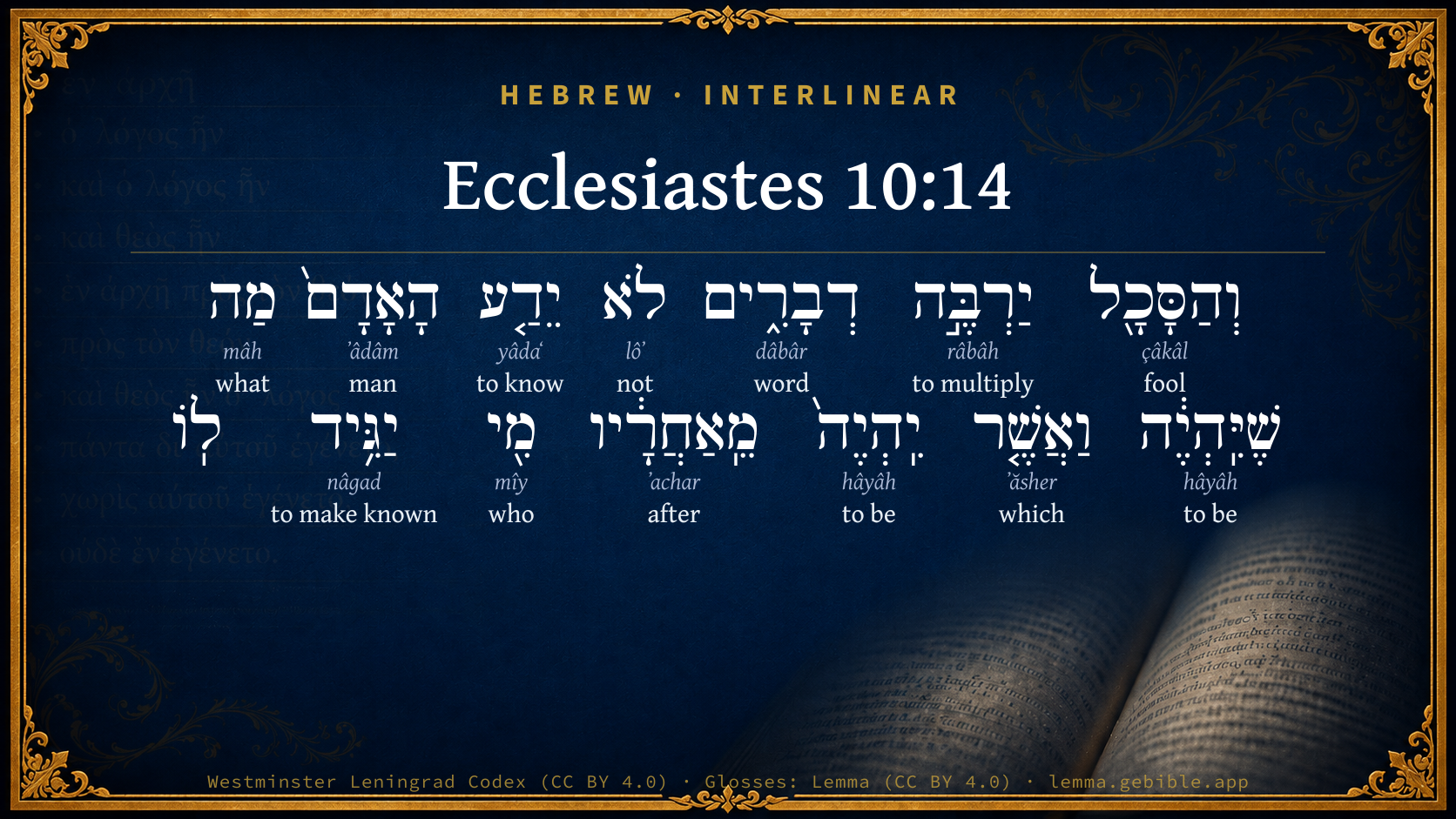
Hebrew (Westminster Leningrad Codex) Ecclesiastes 10:14 appears in the Hebrew Old Testament. The text above is from the Westminster Leningrad Codex. Each word links to its Strong’s number, a concise gloss, and parsing drawn from the Open Scriptures Hebrew Bible morphology. Click any word for its full Brown-Driver-Briggs (BDB) entry.
Download image
Cite this verse

Ecclesiastes 10:14 (World English Bible). Public Domain. Lemma interlinear Bible study tool, https://lemma.gebible.app/v/ecclesiastes/10/14.

Show BibTeX & RIS
BibTeX
RIS
English Translation
A fool also multiplies words. Man doesn't know what will be; and that which will be after him, who can tell him?
World English Bible · Public Domain
Download a study sheet

One document with this verse’s original text, its word-by-word gloss line, the meaning frame, cross-references with their text, attributed commentary, and full source and license credits — printable, and it pastes into notes with its structure intact.

This verse Autodidact and up

Study sheet (.html) Plain text (.txt)

A passage Seminary Student

Up to 50 verses in one chapter. A passage sheet keeps up to 6 commentary sources and 12 cross-references per verse, in the order this page ranks them, and says so on the sheet whenever that leaves anything out. Ask for a single verse and you get the Autodidact verse sheet above.

Everything on this page stays free to read, with no account — the sheet is a download of what is already on screen, not access to it.

Want to remove ads? Support Godless Engineer
Compare translations 3

The same verse in 3 English versions, stacked beneath the original-language interlinear above. Click any original word for its lexicon entry.

Each is an independent rendering of the whole verse — the interlinear is not word-aligned to these translations.

Highlighted words mark where these versions differ — a whole-verse word diff, not a word-by-word alignment.

  • World English Bible Public Domain
    A fool also multiplies words. Man doesn't know what will be; and that which will be after him, who can tell him?
  • King James Version Public Domain
    A fool also is full of words: a man cannot tell what shall be; and what shall be after him, who can tell him?
  • unfoldingWord Literal Text CC BY-SA 4.0
    but the fool multiplies words. Humanity does not know what will be, and that which will be after him—who will declare to him? q1

unfoldingWord Literal Text — © unfoldingWord, licensed CC BY-SA 4.0. Word-aligned USFM3 via Door43 (git.door43.org/unfoldingWord/en_ult).

Versions to compare (up to 4)

3 of 4 selected

Show all 18 translations

Every available English version of this verse, each an independent rendering of the whole verse.

  • World English Bible Public Domain
    A fool also multiplies words. Man doesn't know what will be; and that which will be after him, who can tell him?
  • Berean Standard Bible Public Domain
    Yet the fool multiplies words. No one knows what is coming, and who can tell him what will come after him?
  • Majority Standard Bible Public Domain
    Yet the fool multiplies words. No one knows what is coming, and who can tell him what will come after him?
  • King James Version Public Domain
    A fool also is full of words: a man cannot tell what shall be; and what shall be after him, who can tell him?
  • American Standard Version (1901) Public Domain
    A fool also multiplieth words: `yet' man knoweth not what shall be; and that which shall be after him, who can tell him?
  • Revised Version (1885) Public Domain
    A fool also multiplieth words: yet man knoweth not what shall be; and that which shall be after him, who can tell him?
  • Geneva Bible (1599) Public Domain
    For the foole multiplieth woordes, saying, Man knoweth not what shall be: and who can tell him what shall be after him?
  • Douay-Rheims (1899) Public Domain
    A fool multiplieth words. A man cannot tell what hath been before him: and what shall be after him, who can tell him?
  • Young's Literal Translation Public Domain
    And the fool multiplieth words: `Man knoweth not that which is, And that which is after him, who doth declare to him?'
  • Literal Standard Version CC BY-SA 4.0
    And the fool multiplies words: “Man does not know that which is—And that which is after him, who declares to him?”
  • Unlocked Literal Bible CC BY-SA 4.0
    A fool multiplies words, but no one knows what is coming. Who knows what is coming after him?
  • unfoldingWord Literal Text CC BY-SA 4.0
    but the fool multiplies words. Humanity does not know what will be, and that which will be after him—who will declare to him? q1
  • Darby Bible Public Domain
    And the fool multiplieth words: [yet] man knoweth not what shall be; and what shall be after him, who will tell him?
  • World Messianic Bible Public Domain
    A fool also multiplies words. Man doesn’t know what will be; and that which will be after him, who can tell him?
  • Webster's Bible Public Domain
    A fool also is full of words: a man cannot tell what shall be; and what shall be after him, who can tell him?
  • Free Bible Version CC BY-SA 4.0
    Fools talk on and on, however no one knows what's going to happen, so who can say what the future holds?
  • Bible in Basic English Public Domain
    The foolish are full of words; man has no knowledge of what will be; and who is able to say what will be after him?
  • JPS Tanakh (1917) Public Domain
    A fool also multiplieth words; yet man knoweth not what shall be; and that which shall be after him, who can tell him?

Literal Standard Version (2020), Covenant Press — licensed CC BY-SA 4.0. Text via the HelloAO Bible API (eBible.org). Unlocked Literal Bible (unfoldingWord) — licensed CC BY-SA 4.0. Text via the HelloAO Bible API (eBible.org). unfoldingWord Literal Text — © unfoldingWord, licensed CC BY-SA 4.0. Word-aligned USFM3 via Door43 (git.door43.org/unfoldingWord/en_ult). Free Bible Version, Dr. Jonathan Gallagher — licensed CC BY-SA 4.0. Text via the HelloAO Bible API (eBible.org).

Word by word

More ways to search: Search by grammar → Find every occurrence → Compare this word →

Practice this passage: Drill this verse → Learn its vocabulary →

וְהַסָּכָ֖ל
çâkâl
H5530
“and · the · fool”
Conjunction + Particle, Definite Article + Noun, Common, Masculine, Singular, Absolute
Part of Speech
Conjunction + Particle + Noun
Type
Common
Gender
Masculine
Number
Singular
State
Absolute
Full BDB Definition

Origin: from H5528

TWOT: 1493a

fool
  1. יַרְבֶּ֣ה râbâh H7235 “to multiply” Verb, Hiphil, Imperfect, 3rd Person, Masculine, Singular
  2. דְבָרִ֑ים dâbâr H1697 “words” Noun, Common, Masculine, Plural, Absolute
  3. לֹא lôʼ H3808 “not” Particle, Negative
  4. יֵדַ֤ע yâdaʻ H3045 “to know” Verb, Qal, Imperfect, 3rd Person, Masculine, Singular
  5. הָאָדָם֙ ʼâdâm H120 “the · man” Particle, Definite Article + Noun, Common, Masculine, Singular, Absolute
  6. מַה mâh H4100 “what” Particle, Interrogative
  7. שֶׁיִּֽהְיֶ֔ה hâyâh H1961 “who/which · to be” Particle, Relative + Verb, Qal, Imperfect, 3rd Person, Masculine, Singular
  8. וַאֲשֶׁ֤ר ʼăsher H834 “and · which” Conjunction + Particle, Relative
  9. יִֽהְיֶה֙ hâyâh H1961 “to be” Verb, Qal, Imperfect, 3rd Person, Masculine, Singular
  10. מֵֽאַחֲרָ֔יו ʼachar H310 “from · after · him” Preposition + Preposition + Suffix, Personal, 3rd Person, Masculine, Singular
  11. מִ֖י mîy H4310 “who” Particle, Interrogative
  12. יַגִּ֥יד nâgad H5046 “to make known” Verb, Hiphil, Imperfect, 3rd Person, Masculine, Singular

About this verse

These counts appear in no published source. They are computed here, from the morphology-tagged text and Lemma’s own curated glosses. What Lemma adds →

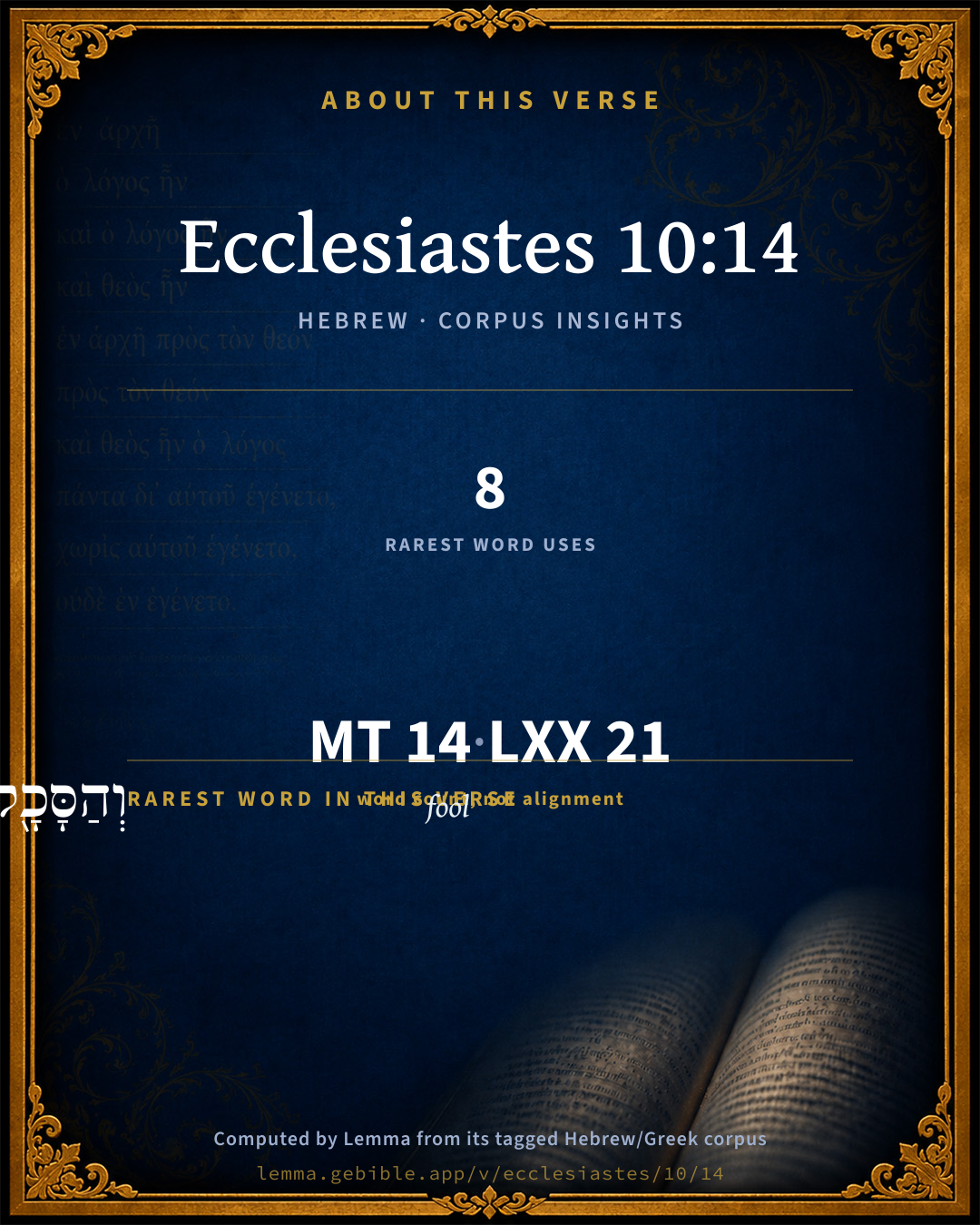
14
words
12
distinct lemmas
Wisdom
section

Notable vocabulary

The rarest word here is וְהַסָּכָ֖ל fool H5530 — appearing just 8 times in the whole Hebrew Bible.

Shared distinctive vocabulary

וְהַסָּכָ֖ל fool H5530 occurs in 6 verses of the Hebrew Bible. Also found in:

Grammatical profile

  • 5 verbs
  • 3 nouns
  • 2 prepositions
  • 4 particles

Verb forms

  • יַרְבֶּ֣ה Hiphil · Imperfect
  • יֵדַ֤ע Qal · Imperfect
  • שֶׁיִּֽהְיֶ֔ה Qal · Imperfect
  • יִֽהְיֶה֙ Qal · Imperfect
  • יַגִּ֥יד Hiphil · Imperfect

Repetition

A word recurs within this verse — often emphatic in Hebrew:

  • שֶׁיִּֽהְיֶ֔ה to be H1961 ×2

Hebrew & Septuagint length

In English translation the verse runs 22 words from the Hebrew and 24 from the Septuagint (LXX English) — closely comparable.

A rough comparison of the two English renderings, which tokenize alike — not a word-level alignment.

Word counts can differ between the Hebrew and the Greek without any difference in meaning — e.g. the Hebrew direct-object marker אֵת has no separate Greek word, and Greek often adds the article ὁ.

In the original languages it is 14 Hebrew tokens and 21 Greek tokens — but the two are counted differently (Hebrew bundles its prefixes and suffixes into one token; the Greek is in lemma form), so that isn’t a like-for-like length.

Cross-references

9

Topical passages linked to Ecclesiastes 10:14 in the Treasury of Scripture Knowledge — connected by theme and wording, ordered by reader-vote popularity; previews shown in the World English Bible.

  • Proverbs 15:2 The tongue of the wise commends knowledge, But the mouth of fools gush out folly.
  • Ecclesiastes 3:22 Therefore I saw that there is nothing better, than that a man should rejoice in his works; for that is his portion: for who can bring him to see what will be after him?
  • Ecclesiastes 5:3 For as a dream comes with a multitude of cares, so a fool's speech with a multitude of words.
  • Ecclesiastes 6:12 For who knows what is good for man in life, all the days of his vain life which he spends like a shadow? For who can tell a man what will be after him under the sun?
  • Ecclesiastes 8:7 For he doesn't know that which will be; for who can tell him how it will be?
  • James 4:13–14 Come now, you who say, "Today or tomorrow let's go into this city, and spend a year there, trade, and make a profit."
  • Job 35:16 Therefore Job opens his mouth with empty talk, And he multiplies words without knowledge."
  • Proverbs 10:19 In the multitude of words there is no lack of disobedience, But he who restrains his lips does wisely.
  • Job 34:37 For he adds rebellion to his sin. He claps his hands among us, And multiplies his words against God."

Cross-references courtesy of OpenBible.info (CC BY 4.0).

Hebrew and Greek witnesses Masoretic Hebrew ↔ Greek Septuagint

The same verse in the two great witnesses to the Old Testament, shown verse-for-verse.

These are two independent witnesses, not word-aligned to each other, and the Septuagint is shown in lemma (dictionary) form.

Hebrew Ecclesiastes 10:14 Masoretic · Westminster Leningrad Codex

וְהַסָּכָ֖ל יַרְבֶּ֣ה דְבָרִ֑ים לֹא יֵדַ֤ע הָאָדָם֙ מַה שֶׁיִּֽהְיֶ֔ה וַאֲשֶׁ֤ר יִֽהְיֶה֙ מֵֽאַחֲרָ֔יו מִ֖י יַגִּ֥יד לֽוֹ

A fool also multiplies words. Man doesn't know what will be; and that which will be after him, who can tell him?

World English Bible · Public Domain

Greek LXX Ecclesiastes 10:14 Septuagint · lemma form

καί ὁ ἄφρων πληθύνω λόγος οὐ γιγνώσκω ὁ ἄνθρωπος τίς ὁ γίγνομαι καί τίς ὁ εἰμί ὀπίσω αὐτός τίς ἀναἀγγέλλω αὐτός

A fool moreover multiplies words: man knows not what has been, nor what will be: who shall tell him what will come after him?

LXX2012 (modern English Septuagint) · Public Domain

On this verse, Keil & Delitzsch discusses the Septuagint’s reading. Read the note in Commentary ↓

Hebrew: Westminster Leningrad Codex (CC BY 4.0). Greek: Septuagint (public domain); English from LXX2012 (modern English Septuagint) (Public Domain). How the Septuagint differs from the Hebrew →

Commentary

Notes on Ecclesiastes 10:14 from classic Christian and Jewish commentators (each source and its license shown beneath its notes). The classic Christian expositions comment on the surrounding passage and are grouped to its opening verse, so a note may address several verses; the Jewish commentaries on the Tanakh (Rashi and others) are per-verse, so they appear only where the commentator wrote on this verse.

Lemma curates 59 commentaries, every one of them public domain or Creative Commons licensed, each selected and text-cleaned for this edition rather than reprinted as found. About our sources →

Trapp's Complete Commentary

John Trapp

Ecc 10:14 A fool also is full of words: a man cannot tell what shall be; and what shall be after him, who can tell him?

Ver. 14. A fool also is full of words.] A very wordy man he is, and a great deal of small talk he has: Voces susque deque effutit inanes, as Thuanus hath it, he lays on more words than the matter will well bear. {a} And this custom of his is graphically expressed by an imitation of his vain tautologies. "A man cannot tell," saith he, "what shall be after him; and what shall be after him, who can tell?" He hath got this sentence (that may well become a wise man, Ecc 6:12; Ecc 8:7) by the end, and he wears it threadbare; he hath never done with it, misapplying and abusing it to the defence of his wilful and witless enterprises. Thus the ass in the fable would needs imitate the dog, leaping and fawning in like manner on his master, but with ill success. "The lip of excellence becomes not a fool" {Pro 17:7} {See Trapp on "Pro 17:7"} {Pro 10:19; Pro 17:27 Ecc 5:3; Ecc 5:7} {See Trapp on "Ecc 5:3"} {See Trapp on "Ecc 5:7"} But empty casks, we know, sound loudest, and baser metals ring shrillest; things of little worth are ever most plentiful. History and experience tell us that some kind of mouse breedeth one hundred and twenty young ones in one nest, αλλα λεοντα, whereas the lion and elephant bears but one at once; so the least wit yields the most words, and as any one is more wise, he is more sparing of his speeches. Hesiod saith that words, as a precious treasure, should be thriftily husbanded, and warily wasted. Christians know, that for every wasted word account must be given at the great day. {Mat 12:37} {See Trapp on "Mat 12:37}

{a} Boni oratoris est sermonem habere rebus parem. - Plut.

John Trapp, A Commentary or Exposition upon All the Books of the Old and New Testament (1647–1656) — public domain. Text from a community e-Sword module.

Keil & Delitzsch

C. F. Keil & F. Delitzsch

"And the fool maketh many words: while a man yet doth not know that which shall be; and what shall be when he is no more, who can show him that?" The vav at the beginning of this verse corresponds to the Lat. accedit quod. That he who in Ecc 10:12 was named kesil is now named hassachal, arises from this, that meanwhile sichluth has been predicated of him. The relation of Ecc 10:14 to Ecc 10:14, Geier has rightly defined: Probatur absurditas multiloquii a communi ignorantia ac imbecillitate humana, quae tamen praecipue dominatur apud ignaros stultos. We miss before lo-yeda' an "although" (gam, Neh 6:1, or ki gam, Ecc 8:12); the clause is, after the manner of a clause denoting state or condition, subordinated to the principal clause, as at Psa 5:10 : "an open grave is their throat יח לשׁ, although they smooth their tongue, i.e., speak flatteringly." The lxx, Syr., Symm., and Jerome seek to rectify the tautology id quod futurum est et quod futurum est (cf. on the other hand, Ecc 8:7), for they read יה ... מה שהיה. But the second quod futurum certainly preserves by מאץ its distinguishing nearer definition. Hitzig explains: "What is done, and what after this (that is done) is done." Scarcely correctly: aharav of the parallel passage, Ecc 6:12, cf. Ecc 7:14; Ecc 9:3, requires for the suffix a personal reference, so that thus meaharav, as at Deu 29:21, means "from his death and onwards." Thus, first, the knowledge of the future is denied to man; then the knowledge of what will be done after his death; and generally, of what will then be done. The fool, without any consciousness of human ignorance, acts as if he knew all, and utters about all and everything a multitude of words; for he uselessly fatigues himself with his ignorance, which remains far behind the knowledge that is possible for man.

Keil & Delitzsch — Biblical Commentary on the Old Testament (1861–1891) — public domain (CC PDM 1.0). Text via the HelloAO Bible API. (Old Testament only.)

Tyndale Open Study Notes

Tyndale Open Resources

10:14 they chatter on and on: Fools are always talking about nothing (see 5:3; 6:11; Prov 10:19; 17:28). • no one can predict the future: The wise will not waste time in foolish talking nor suffer its consequences (see Jas 4:13-16).

Tyndale Open Study Notes — © Tyndale Open Resources, licensed CC BY-SA 4.0. Text via the HelloAO Bible API.

Jamieson, Fausset & Brown

Robert Jamieson, A. R. Fausset & David Brown

full of words-- (Ecc 5:2).

a man cannot tell what shall be-- (Ecc 3:22; Ecc 6:12; Ecc 8:7; Ecc 11:2; Pro 27:1). If man, universally (including the wise man), cannot foresee the future, much less can the fool; his "many words" are therefore futile.

Jamieson, Fausset & Brown — Commentary Critical and Explanatory on the Whole Bible (1871) — public domain (CC PDM 1.0). Text via the HelloAO Bible API.

Adam Clarke's Commentary

Verse 14. A man cannot tell what shall be] A foolish babbling man will talk on every subject, though he can say as little on the past, as he can on the future.

Adam Clarke's Commentary on the Bible (1810–1826) — public domain. Text from a community e-Sword/MySword module.

Ellicott's Commentary for English Readers

(14) A man cannot tell.—This thought occurs repeatedly in this book. (See reff.) The connection here would be better seen if the clause were introduced with “and yet.” The fool’s courageous loquacity is contrasted with the cautious silence which experience of his ignorance has taught the wise man.

A Bible Commentary for English Readers, edited by Charles John Ellicott (1878–1897) — public domain. Text from a community e-Sword module.

The Cambridge Bible for Schools and Colleges

gen. ed. J. J. S. Perowne

14. A fool also is full of words] Literally, multiplies words. The introduction of “a man” is not an idle pleonasm. The “man” is not the “fool,” but the fool forgets the limitations of human knowledge, as to what lies in the near future of his own life, or the more distant future that follows on his death, and speaks as if it all lay before him as an open scroll. The point of the maxim is like that with which we have become familiar in the region of political prediction in the words “Don’t prophesy unless you know.” Boasting of this kind, as regards a man’s own future, finds its reproof, as in the wisdom of all ages, so especially in the teaching of Luk_12:16-20; Jas_4:13-16.

The Cambridge Bible for Schools and Colleges (gen. ed. J. J. S. Perowne; Cambridge University Press, 1878–1918) — public domain. Text from a community e-Sword module.

John Gill's Exposition

A fool also is full of words,.... Or, "multiplies words" (y). Is very talkative, says the same thing over and over again; uses an abundance of waste words, that have no meaning in them; utters every thing that comes uppermost, without any order or judgment; affects to talk on every subject, whether he knows anything of it or not; and will engross all the conversation to himself, though of all in company the most unfit for it;

a man cannot tell what shall be; and what shall be after him who can tell him? what the fool is talking of; what is the drift of his discourse; or where it will end, and what he will bring it to, it is so noisy, confused, and incoherent: or no man can tell future things, or what will come to pass; nor can any man inform another of future events; and yet a fool boasts and brags of what he shall do, and what he shall have, as if he was master of the future, and knew for certain what would come to pass, which the wisest of men do not.

(y) "multiplicabit", Pagninus, Montanus; "multiplicat", Vatablus, Mercerus, Drusius, Amama, Gejerus, Rambachius, Cocceius.

John Gill's Exposition of the Whole Bible (1746–1763) — public domain (CC PDM 1.0). Text via the HelloAO Bible API.

Albert Barnes' Notes on the Bible

Full of words - Confident talking of the future is indicated rather than mere loquacity. Compare Jam 4:13.

Albert Barnes' Notes on the Bible (1834–1885) — public domain. Text from a community e-Sword/MySword module.

Haydock's Catholic Bible Commentary

Tell him. How foolish, therefore, is it to speak about every thing!

George Leo Haydock (1774–1849), Haydock's Catholic Family Bible and Commentary, 1859 edition — public domain. Excludes Psalms (Douay-Rheims chapter numbering differs from Protestant) and Deuterocanonical books (Catholic canon only).

Matthew Poole's English Annotations

Full of words; either,

1. Talkative. Or,

2. Forward to promise and brag what he will do, which is the common practice of foolish men; he is a man of words, as we use to say. Who can tell him? these words contain either,

1. A inimical representation of his folly in using vain repetitions of the same words, such as those,

a man cannot tell, & c., and who can tell, &c. Or,

2. A confutation of folly in promising or boasting of things which are wholly out of his power; for what shall be no man can either himself foreknow, or learn it from others.

Matthew Poole's English Annotations on the Holy Bible (1683–1685) — public domain. Text from a community e-Sword/MySword module.

Whedon's Commentary on the Bible

Daniel D. Whedon

14. Full of words — The readiness of “the fool” to talk, even on the most difficult and incomprehensible subjects, is a sure index of his character. The clause, A man cannot tell, etc., should be introduced by though. There are many things which one would like to know upon which profound reflection and self-examination can aid knowledge. But many would rather talk than think or study. The immediate and the remoter future are presented as being alike beyond knowledge.

What shall be — Soon, and what shall be hereafter.

Daniel D. Whedon (gen. ed.), Commentary on the Old and New Testaments (1874–1909) — public domain. Text from a community e-Sword module.

The Pulpit Commentary

A fool also is full of words. The word for "fool" here is oaks/, which implies a dense, confused thinker. Alive the word was kesil, which denotes rather the self-confidence of the dull and stupid man. Moreover the fool multiplieth words. He not only speaks foolishly, but he says too much. (cutup Ecc_5:2) It is not mere loquacity that is here predicated of the fool, though that is one of his characteristics, but, as-the rest of the verse shows, the prating of things about which he knows nothing. He talks as though he knew everything and there were no limitation to human cognition. A man cannot tell what shall be. And yet, or although, no man can really predict the future. The fool speaks confidently of such things, and thereby proves his imbecility. Instead of "what shall be," the Septuagint has, Ti tomenon kai tomenon, "What has been and what shall be;" the Vulgate, Quid ante se fuerit, "What has been before him." This reading was introduced probably to obviate a seeming tautology in the following clause, And what shall be after him, who can tell? But this clause has a different signification from the former, and presents a closer definition. The future intended may be the result of the fool"s inconsiderate language, which may have fatal and lasting consequences; or it may refer to the visitation of his sins upon his children, in accordance with the denunciation of Deu_5:9 Deu_29:20-22; or it may include the life beyond the grave. The uncertainty of the future is a constant theme; see Ecc_3:22 Ecc_6:11, 12 7:14 8:17; and compare Christ"s parable of the rich fool, (Luk_12:16-20) and St. James"s warning in his Epistle. (Jam_4:13-16)

The Pulpit Commentary (1880–1919), ed. H.D.M. Spence-Jones & Joseph S. Exell — public domain. Text from a community e-Sword module.

John Wesley's Explanatory Notes

Full of words - Forward to promise and boast what he will do, whereas none can be sure of future events, even during his own life, much more after his death.

John Wesley, Explanatory Notes Upon the Whole Bible (1754–1765) — public domain. Text via the GEBible commentary corpus.

Rashi

Rabbi Shlomo Yitzchaki (Rashi)

And the fool increases words for he was boasting that he (ibid. 24:16): “knows the thoughts of the Most High.”

a man does not know what will be to him after a while, for he went to take his pay in Midian, and he did not know that he would fall by the sword. According to its simple meaning:

the fool increases words He declares and says, “Tomorrow I will do this to so-and-so,” but he does not know what will be tomorrow.

and what will be behind him, who will tell him i.e., not only does he not know what will be after a time, but even what is present behind him, which is not in front of his eyes, but behind his back, from afar, he needs someone to tell him [what is happening].

Rashi on the Tanakh — English translations: “The Judaica Press complete Tanach with Rashi, translated by A. J. Rosenberg” (CC BY 4.0); “Pentateuch with Rashi's commentary by M. Rosenbaum and A.M. Silbermann, 1929-1934” (public domain); “The Metsudah Tanach series, Lakewood, N.J” (CC BY 4.0); and “The Book of Joshua, Metsudah Publications, 1997” (CC BY 4.0). Text via Sefaria.

Lesson kit

Teaching starters — assembled from the data on this page, not authored interpretation. Every prompt links to the verse data it draws on. Edit before teaching.

Ecclesiastes, in the Wisdom, opens this verse with 14 words (12 distinct Hebrew lemmas). Its most distinctive word is çâkâl (“fool”). A historical commentator’s framing appears above. Read the whole chapter for the surrounding context.

Discussion questions

  1. How does “fool” (çâkâl) shape what this verse is saying?
  2. Ecclesiastes 2:19 shares the word «fool» with this verse. How do the two illuminate each other?
  3. “to be” occurs 2× in this one verse. What is the effect of the repetition?
  4. These translations render this verse differently; the difference is in the English rendering, not the original. What questions does that raise?
  5. The verb «יַרְבֶּ֣ה» is Hiphil Imperfect. How does its form color the action?
  6. Reading how Trapp's Complete Commentary and Keil & Delitzsch read this verse, where do the two commentators agree and where do they part?

Things to notice

Reading settings

Reading text

Shown beneath each verse's original-language words.

Old Testament
Old Testament edition

Read the OT as the Masoretic Hebrew (MT) or the Greek Septuagint (LXX).

English shown for the Greek Septuagint (in the Hebrew ↔ Greek comparison).

Comparing translations? Open the Compare panel on any verse page to stack up to four side by side.