
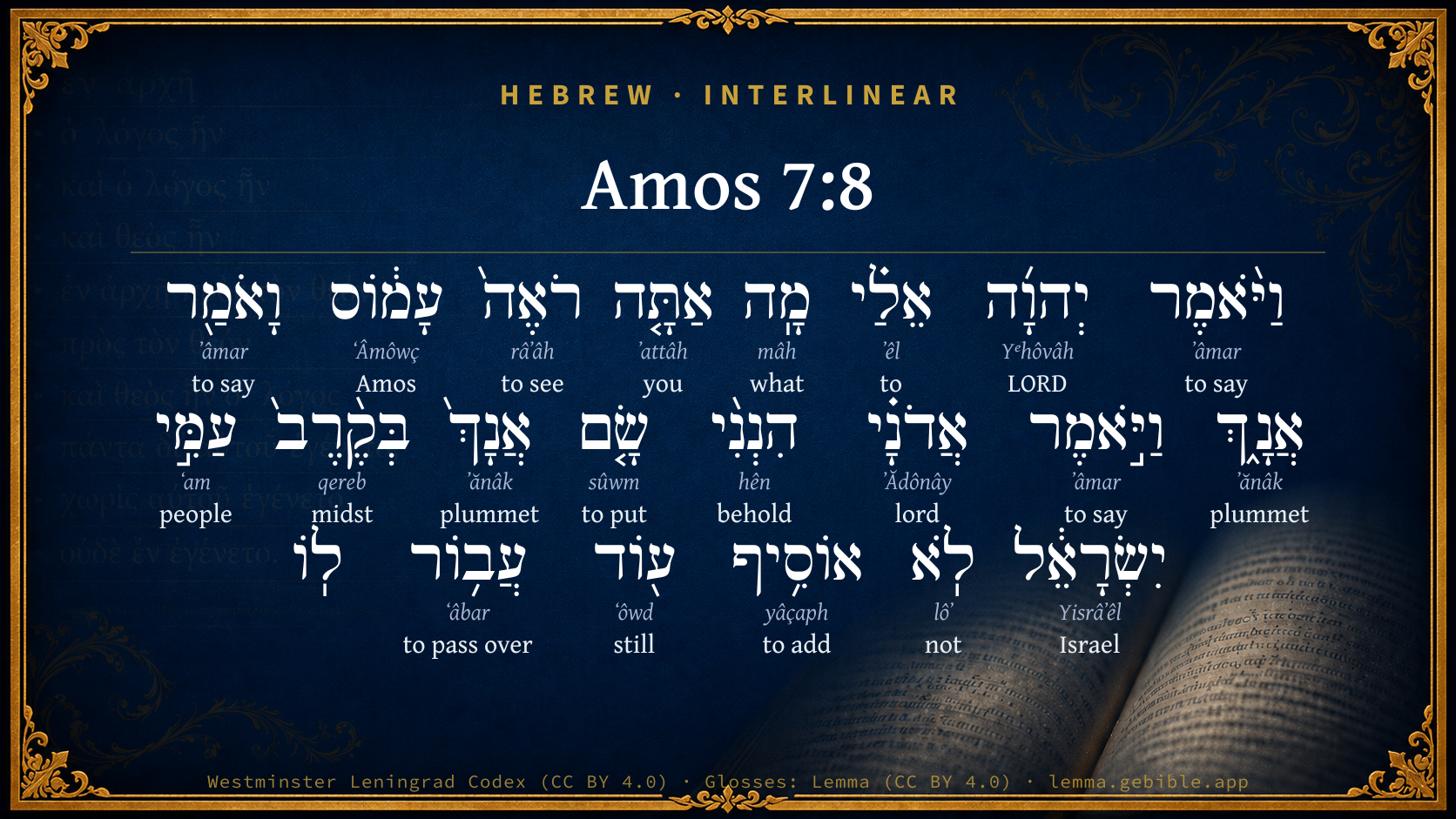
Amos 7:8

Hebrew (Westminster Leningrad Codex) Amos 7:8 appears in the Hebrew Old Testament. The text above is from the Westminster Leningrad Codex. Each word links to its Strong’s number, a concise gloss, and parsing drawn from the Open Scriptures Hebrew Bible morphology. Click any word for its full Brown-Driver-Briggs (BDB) entry.
Download image
Cite this verse

Amos 7:8 (World English Bible). Public Domain. Lemma interlinear Bible study tool, https://lemma.gebible.app/v/amos/7/8.

Show BibTeX & RIS
BibTeX
RIS
English Translation
Yahweh said to me, "Amos, what do you see?" I said, "A plumb line." Then the Lord said, "Behold, I will set a plumb line in the midst of my people Israel. I will not again pass by them any more.
World English Bible · Public Domain
Download a study sheet

One document with this verse’s original text, its word-by-word gloss line, the meaning frame, cross-references with their text, attributed commentary, and full source and license credits — printable, and it pastes into notes with its structure intact.

This verse Autodidact and up

Study sheet (.html) Plain text (.txt)

A passage Seminary Student

Up to 50 verses in one chapter. A passage sheet keeps up to 6 commentary sources and 12 cross-references per verse, in the order this page ranks them, and says so on the sheet whenever that leaves anything out. Ask for a single verse and you get the Autodidact verse sheet above.

Everything on this page stays free to read, with no account — the sheet is a download of what is already on screen, not access to it.

Want to remove ads? Support Godless Engineer
Compare translations 3

The same verse in 3 English versions, stacked beneath the original-language interlinear above. Click any original word for its lexicon entry.

Each is an independent rendering of the whole verse — the interlinear is not word-aligned to these translations.

Highlighted words mark where these versions differ — a whole-verse word diff, not a word-by-word alignment.

  • World English Bible Public Domain
    Yahweh said to me, "Amos, what do you see?" I said, "A plumb line." Then the Lord said, "Behold, I will set a plumb line in the midst of my people Israel. I will not again pass by them any more.
  • King James Version Public Domain
    And the LORD said unto me, Amos, what seest thou? And I said, A plumbline. Then said the LORD, Behold, I will set a plumbline in the midst of my people Israel: I will not again pass by them any more:
  • unfoldingWord Literal Text CC BY-SA 4.0
    Yahweh said to me, “Amos, what do you see?” I said, “A plumb line.” Then the Lord said, “Behold, I will put a plumb line among my people Israel. Never again will I spare them.

unfoldingWord Literal Text — © unfoldingWord, licensed CC BY-SA 4.0. Word-aligned USFM3 via Door43 (git.door43.org/unfoldingWord/en_ult).

Versions to compare (up to 4)

3 of 4 selected

Show all 18 translations

Every available English version of this verse, each an independent rendering of the whole verse.

  • World English Bible Public Domain
    Yahweh said to me, "Amos, what do you see?" I said, "A plumb line." Then the Lord said, "Behold, I will set a plumb line in the midst of my people Israel. I will not again pass by them any more.
  • Berean Standard Bible Public Domain
    “Amos, what do you see?” asked the LORD. “A plumb line,” I replied. “Behold,” said the Lord, “I am setting a plumb line among My people Israel; I will no longer spare them:
  • Majority Standard Bible Public Domain
    “Amos, what do you see?” asked the LORD. “A plumb line,” I replied. “Behold,” said the Lord, “I am setting a plumb line among My people Israel; I will no longer spare them:
  • King James Version Public Domain
    And the LORD said unto me, Amos, what seest thou? And I said, A plumbline. Then said the LORD, Behold, I will set a plumbline in the midst of my people Israel: I will not again pass by them any more:
  • American Standard Version (1901) Public Domain
    And Jehovah said unto me, Amos, what seest thou? And I said, A plumb-line. Then said the Lord, Behold, I will set a plumb-line in the midst of my people Israel; I will not again pass by them any more;
  • Revised Version (1885) Public Domain
    And the LORD said unto me, Amos, what seest thou? And I said, A plumbline. Then said the Lord, Behold, I will set a plumbline in the midst of my people Israel; I will not again pass by them any more:
  • Geneva Bible (1599) Public Domain
    And the Lord saide vnto me, Amos, what seest thou? And I said, A line. Then said the Lord, Beholde, I wil set a line in the middes of my people Israel, and wil passe by them no more.
  • Douay-Rheims (1899) Public Domain
    And the Lord said to me: What seest thou, Amos? And I said: A mason's trowel. And the Lord said: Behold, I will lay down the trowel in the midst of my people Israel. I will plaster them over no more.
  • Young's Literal Translation Public Domain
    and Jehovah saith unto me, `What art thou seeing, Amos?' And I say, `A plumb-line;' and the Lord saith: `Lo, I am setting a plumb-line in the midst of My people Israel, I do not add any more to pass over to it.
  • Literal Standard Version CC BY-SA 4.0
    and YHWH says to me, “What are you seeing, Amos?” And I say, “A plumb-line”; and the Lord says: “Behold, I am setting a plumb-line in the midst of My people Israel, I no longer pass over to it.
  • Unlocked Literal Bible CC BY-SA 4.0
    Yahweh said to me, “Amos, what do you see?” I said, “A plumb line.” Then the Lord said, “Look, I will put a plumb line among my people Israel. I will spare them no longer.
  • unfoldingWord Literal Text CC BY-SA 4.0
    Yahweh said to me, “Amos, what do you see?” I said, “A plumb line.” Then the Lord said, “Behold, I will put a plumb line among my people Israel. Never again will I spare them.
  • Darby Bible Public Domain
    And Jehovah said unto me, Amos, what seest thou? And I said, A plumb-line. And the Lord said, Behold, I will set a plumb-line in the midst of my people Israel: I will not again pass by them any more.
  • World Messianic Bible Public Domain
    The LORD said to me, “Amos, what do you see?” I said, “A plumb line.” Then the Lord said, “Behold, I will set a plumb line in the middle of my people Israel. I will not again pass by them any more.
  • Webster's Bible Public Domain
    And the LORD said to me, Amos, what seest thou? and I said, A plumb-line. Then said the Lord, Behold, I will set a plumb-line in the midst of my people Israel: I will not again pass by them any more:
  • Free Bible Version CC BY-SA 4.0
    And the Lord asked me, “Amos, what do you see?” I replied, “A plumb line.” And the Lord God said, “I am placing a plumb line in the midst of my people Israel. I won't ignore their sins anymore.
  • Bible in Basic English Public Domain
    And the Lord said to me, Amos, what do you see? And I said, A weighted line. Then the Lord said, See, I will let down a weighted line among my people Israel; never again will my eyes be shut to their sin:
  • JPS Tanakh (1917) Public Domain
    And the LORD said unto me: 'Amos, what seest thou?' And I said: 'A plumbline.' Then said the Lord: Behold, I will set a plumbline in the midst of My people Israel; I will not again pardon them any more;

Literal Standard Version (2020), Covenant Press — licensed CC BY-SA 4.0. Text via the HelloAO Bible API (eBible.org). Unlocked Literal Bible (unfoldingWord) — licensed CC BY-SA 4.0. Text via the HelloAO Bible API (eBible.org). unfoldingWord Literal Text — © unfoldingWord, licensed CC BY-SA 4.0. Word-aligned USFM3 via Door43 (git.door43.org/unfoldingWord/en_ult). Free Bible Version, Dr. Jonathan Gallagher — licensed CC BY-SA 4.0. Text via the HelloAO Bible API (eBible.org).

Word by word

More ways to search: Search by grammar → Find every occurrence → Compare this word →

Practice this passage: Drill this verse → Learn its vocabulary →

אֲנָ֑ךְ
ʼănâk
H594
“plummet”
Noun, Common, Masculine, Singular, Absolute
Part of Speech
Noun
Type
Common
Gender
Masculine
Number
Singular
State
Absolute
Full BDB Definition

Origin: probably from an unused root meaning to be narrow

TWOT: 129 . 1

plummet, plumb, lead-weight
  1. וַיֹּ֨אמֶר ʼâmar H559 “and · to say” Conjunction + Verb, Qal, Sequential Imperfect, 3rd Person, Masculine, Singular
  2. יְהוָ֜ה Yᵉhôvâh H3068 “LORD” Noun, Proper
  3. אֵלַ֗י ʼêl H413 “to · me” Preposition + Suffix, Personal, 1st Person, Common, Singular
  4. מָֽה mâh H4100 “what” Particle, Interrogative
  5. אַתָּ֤ה ʼattâh H859 “you” Pronoun, Personal, 2nd Person, Masculine, Singular
  6. רֹאֶה֙ râʼâh H7200 “seeing” Verb, Qal, Participle Active, Masculine, Singular, Absolute
  7. עָמ֔וֹס ʻÂmôwç H5986 “Amos” Noun, Proper
  8. וָאֹמַ֖ר ʼâmar H559 “and · to say” Conjunction + Verb, Qal, Sequential Imperfect, 1st Person, Common, Singular
  9. וַיֹּ֣אמֶר ʼâmar H559 “and · to say” Conjunction + Verb, Qal, Sequential Imperfect, 3rd Person, Masculine, Singular
  10. אֲדֹנָ֗י ʼĂdônây H136 “Lord · my” Noun, Common, Masculine, Plural, Construct + Suffix, Personal, 1st Person, Common, Singular
  11. הִנְנִ֨י hên H2005 “behold · me” Particle, Demonstrative + Suffix, Personal, 1st Person, Common, Singular
  12. שָׂ֤ם sûwm H7760 “putting” Verb, Qal, Participle Active, Masculine, Singular, Absolute
  13. אֲנָךְ֙ ʼănâk H594 “plummet” Noun, Common, Masculine, Singular, Absolute
  14. בְּקֶ֨רֶב֙ qereb H7130 “in/at · midst of” Preposition + Noun, Common, Masculine, Singular, Construct
  15. עַמִּ֣י ʻam H5971 “people · my” Noun, Common, Masculine, Singular, Construct + Suffix, Personal, 1st Person, Common, Singular
  16. יִשְׂרָאֵ֔ל Yisrâʼêl H3478 “Israel” Noun, Proper
  17. לֹֽא lôʼ H3808 “not” Particle, Negative
  18. אוֹסִ֥יף yâçaph H3254 “to add” Verb, Hiphil, Imperfect, 1st Person, Common, Singular
  19. ע֖וֹד ʻôwd H5750 “still” Adverb
  20. עֲב֥וֹר ʻâbar H5674 “to pass over” Verb, Qal, Infinitive Construct

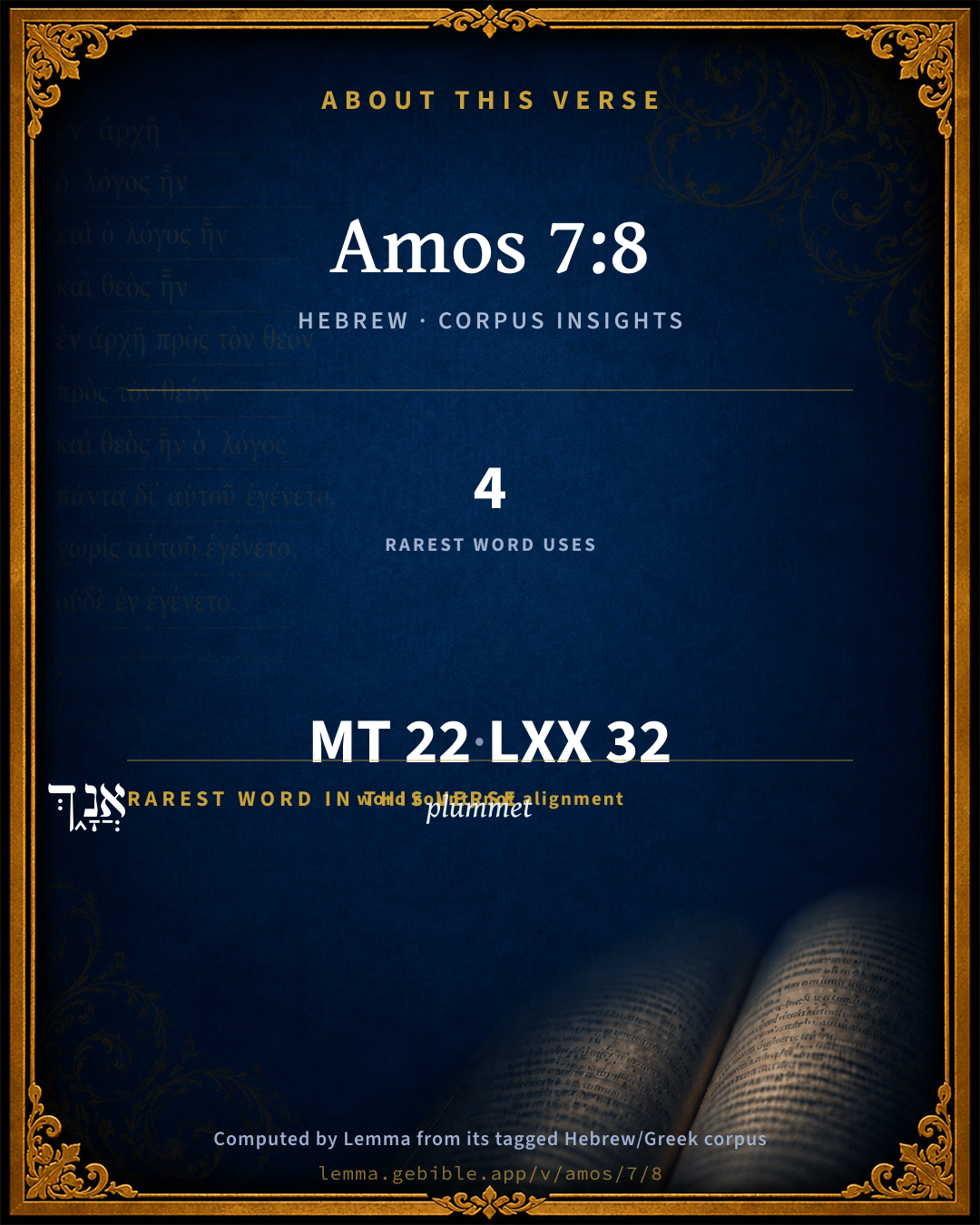
About this verse

These counts appear in no published source. They are computed here, from the morphology-tagged text and Lemma’s own curated glosses. What Lemma adds →

22
words
18
distinct lemmas
Prophets
section

Notable vocabulary

The rarest word here is אֲנָ֑ךְ plummet H594 — appearing just 4 times in the whole Hebrew Bible.

Shared distinctive vocabulary

אֲנָ֑ךְ plummet H594 occurs in 2 verses of the Hebrew Bible. Also found in:

Grammatical profile

  • 7 verbs
  • 8 nouns
  • 1 pronoun
  • 2 prepositions
  • 1 adverb
  • 3 particles

Verb forms

  • וַיֹּ֨אמֶר Qal · Sequential Imperfect
  • רֹאֶה֙ Qal · Participle Active
  • וָאֹמַ֖ר Qal · Sequential Imperfect
  • וַיֹּ֣אמֶר Qal · Sequential Imperfect
  • שָׂ֤ם Qal · Participle Active
  • אוֹסִ֥יף Hiphil · Imperfect
  • עֲב֥וֹר Qal · Infinitive Construct

Repetition

Words recur within this verse — often emphatic in Hebrew:

  • וַיֹּ֨אמֶר to say H559 ×3
  • אֲנָ֑ךְ plummet H594 ×2

Hebrew & Septuagint length

In English translation the verse runs 41 words from the Hebrew and 41 from the Septuagint (LXX English) — the same length.

A rough comparison of the two English renderings, which tokenize alike — not a word-level alignment.

Word counts can differ between the Hebrew and the Greek without any difference in meaning — e.g. the Hebrew direct-object marker אֵת has no separate Greek word, and Greek often adds the article ὁ.

In the original languages it is 22 Hebrew tokens and 32 Greek tokens — but the two are counted differently (Hebrew bundles its prefixes and suffixes into one token; the Greek is in lemma form), so that isn’t a like-for-like length.

Cross-references

10

Topical passages linked to Amos 7:8 in the Treasury of Scripture Knowledge — connected by theme and wording, ordered by reader-vote popularity; previews shown in the World English Bible.

  • Amos 8:2 He said, "Amos, what do you see?" I said, "A basket of summer fruit." Then Yahweh said to me, "The end has come on my people Israel. I will not again pass by them any more.
  • Jeremiah 15:6 You have rejected me, says Yahweh, you are gone backward: therefore have I stretched out my hand against you, and destroyed you; I am weary with repenting.
  • Lamentations 2:8 Yahweh has purposed to destroy the wall of the daughter of Zion; He has stretched out the line, he has not withdrawn his hand from destroying; He has made the rampart and wall to lament; they languish together.
  • Ezekiel 7:2–9 You, son of man, thus says the Lord Yahweh to the land of Israel, An end: the end is come on the four corners of the land.
  • 2 Kings 21:13 I will stretch over Jerusalem the line of Samaria, and the plummet of the house of Ahab; and I will wipe Jerusalem as a man wipes a dish, wiping it and turning it upside down.
  • Isaiah 28:17 I will make justice the line, and righteousness the plummet; and the hail shall sweep away the refuge of lies, and the waters shall overflow the hiding-place.
  • Micah 7:18 Who is a God like you, who pardons iniquity, And passes over the disobedience of the remnant of his heritage? He doesn't retain his anger forever, Because he delights in loving kindness.
  • Jeremiah 1:11–13 Moreover the word of Yahweh came to me, saying, Jeremiah, what see you? I said, I see a rod of an almond tree.
  • Nahum 1:8–9 But with an overflowing flood, he will make a full end of her place, and will pursue his enemies into darkness.
  • Zechariah 5:2 He said to me, "What do you see?" I answered, "I see a flying scroll; its length is twenty cubits, and its breadth ten cubits."

Cross-references courtesy of OpenBible.info (CC BY 4.0).

Hebrew and Greek witnesses Masoretic Hebrew ↔ Greek Septuagint

The same verse in the two great witnesses to the Old Testament, shown verse-for-verse.

These are two independent witnesses, not word-aligned to each other, and the Septuagint is shown in lemma (dictionary) form.

Hebrew Amos 7:8 Masoretic · Westminster Leningrad Codex

וַיֹּ֨אמֶר יְהוָ֜ה אֵלַ֗י מָֽה אַתָּ֤ה רֹאֶה֙ עָמ֔וֹס וָאֹמַ֖ר אֲנָ֑ךְ וַיֹּ֣אמֶר אֲדֹנָ֗י הִנְנִ֨י שָׂ֤ם אֲנָךְ֙ בְּקֶ֨רֶב֙ עַמִּ֣י יִשְׂרָאֵ֔ל לֹֽא אוֹסִ֥יף ע֖וֹד עֲב֥וֹר לֽוֹ

Yahweh said to me, "Amos, what do you see?" I said, "A plumb line." Then the Lord said, "Behold, I will set a plumb line in the midst of my people Israel. I will not again pass by them any more.

World English Bible · Public Domain

Greek LXX Amos 7:8 Septuagint · lemma form

καί εἶπον κύριος πρός ἐγώ τίς σύ ὁράω αμως καί εἶπον ἀδάμας καί εἶπον κύριος πρός ἐγώ ἰδού ἐγώ ἐντάσσω ἀδάμας ἐν μέσος λαός ἐγώ ἰσραήλ οὐκέτι μή προςτίθημι ὁ παραἔρχομαι αὐτός

And the Lord said to me, What see you, Amos? And I said, An adamant. And the Lord said to me, Behold, I appoint an adamant in the midst of my people Israel: I will not pass by them any more.

LXX2012 (modern English Septuagint) · Public Domain

On this verse, John Gill's Exposition discusses the Septuagint’s reading. Read the note in Commentary ↓

Hebrew: Westminster Leningrad Codex (CC BY 4.0). Greek: Septuagint (public domain); English from LXX2012 (modern English Septuagint) (Public Domain). How the Septuagint differs from the Hebrew →

Targum (Aramaic paraphrase)

1

The Targum is the ancient Jewish Aramaic paraphrase of the Hebrew Scriptures — an interpretive translation, not the Hebrew text itself. Onkelos (literal) and Pseudo-Jonathan (expansive) render the Torah, and Jonathan the Prophets. Coverage is partial: where no permissively-licensed English translation exists for a verse, only the Aramaic is shown. This is verse-level text, not a word-by-word alignment to the Hebrew.

  1. Targum Jonathan Prophets (Joshua–Malachi)
    וַאֲמַר יְיָ לִי מָא אַתְּ חָזֵי עָמוֹס וַאֲמַרֵית דִין וַאֲמַר יְיָ הָא אֲנָא עָבֵיד דִין בְּגוֹ עַמִי יִשְׂרָאֵל לָא אוֹסִיף עוֹד לְמִשְׁבַּק לְהוֹן:

    (no public-domain English translation for this verse)

    Targum Jonathan — Aramaic: “Mikraot Gedolot” (public domain). English: “Sefaria Community Translation” (CC0 1.0 (public-domain dedication)); “London "Chaldee Paraphrase," 1871” (public domain). Text via Sefaria.

Commentary

Notes on Amos 7:8 from classic Christian and Jewish commentators (each source and its license shown beneath its notes). The classic Christian expositions comment on the surrounding passage and are grouped to its opening verse, so a note may address several verses; the Jewish commentaries on the Tanakh (Rashi and others) are per-verse, so they appear only where the commentator wrote on this verse.

Lemma curates 59 commentaries, every one of them public domain or Creative Commons licensed, each selected and text-cleaned for this edition rather than reprinted as found. About our sources →

Trapp's Complete Commentary

John Trapp

Amo 7:8 And the LORD said unto me, Amos, what seest thou? And I said, A plumbline. Then said the Lord, Behold, I will set a plumbline in the midst of my people Israel: I will not again pass by them any more:

Ver. 8. Behold, I will set a plumbline] I will call them to a strict account, and show them no favour, Jer 16:3, I will now actually execute my justice which I have hitherto suspended; and pay them home for the new and the old; bringing upon them an evil, an only evil, without mixture of mercy, Eze 7:5.

I will not again pass by them any more] A metaphor from men that pass by such things as they slight and count inconsiderable; winking at small faults as not worthy to be reckoned upon. Hence, Mic 7:18, God is said to pardon iniquity and pass by transgression; as elsewhere he is said to bind them up in a bundle, to seal them up in a bag, to cast them behind his back, to remove them "as far as the east is from the west," Psa 103:12, so that he beholdeth no sin in Jacob nor perverseness in Israel, Num 22:21. The Church, privy to her own infirmities, calleth herself black, Son 1:5, but Christ calleth her fair all over, Son 4:7. She saith, God hath punished us less than our sins, Ezr 9:13. He saith, She hath received double for her sins, Isa 40:2. Too much, saith God; too little, saith she. O beautiful contention! But this is a privilege proper to the communion of saints, with whom God will not deal according to the rigour of his law (as he doth with the wicked), but according to his prerogative.

John Trapp, A Commentary or Exposition upon All the Books of the Old and New Testament (1647–1656) — public domain. Text from a community e-Sword module.

Tyndale Open Study Notes

Tyndale Open Resources

7:8 The Hebrew word translated plumb line (Hebrew ’anak) is similar to the word for groaning (’anakhah, see Isa 35:10; Lam 1:22), alluding to great suffering when God would hold Israel accountable.

Tyndale Open Study Notes — © Tyndale Open Resources, licensed CC BY-SA 4.0. Text via the HelloAO Bible API.

Jamieson, Fausset & Brown

Robert Jamieson, A. R. Fausset & David Brown

plumb-line in . . . midst of . . . Israel--No longer are the symbols, as in the former two, stated generally; this one is expressly applied to Israel. God's long-suffering is worn out by Israel's perversity: so Amos ceases to intercede (compare Gen 18:33). The plummet line was used not only in building, but in destroying houses (Kg2 21:13; Isa 28:17; Isa 34:11; Lam 2:8). It denotes that God's judgments are measured out by the most exact rules of justice. Here it is placed "in the midst" of Israel, that is, the judgment is not to be confined to an outer part of Israel, as by Tiglath-pileser; it is to reach the very center. This was fulfilled when Shalmaneser, after a three years' siege of Samaria, took it and carried away Israel captive finally to Assyria (Kg2 17:3, Kg2 17:5-6, Kg2 17:23).

not . . . pass by . . . any more--not forgive them any more (Amo 8:2; Pro 19:11; Mic 7:18).

Jamieson, Fausset & Brown — Commentary Critical and Explanatory on the Whole Bible (1871) — public domain (CC PDM 1.0). Text via the HelloAO Bible API.

Adam Clarke's Commentary

Verse 8. I will set a plumbline] I will visit them by justice without any mixture of mercy.

Adam Clarke's Commentary on the Bible (1810–1826) — public domain. Text from a community e-Sword/MySword module.

John Calvin's Commentaries

But that which follows has an important meaning: God asks his Prophet, What sees thou, Amos? It is probable that the Prophet was astonished at a thing so mysterious. When locusts were formed, and when there was a contention by fire, he might have easily gathered what God meant; for these visions were by no means ambiguous: but when God stood on a wall with a plumbline, this was somewhat more hard to be understood; and the probability is, that the Prophet was made to feel much astonishment, that the people might be more attentive to hear his vision, as we commonly apply our thoughts more to hidden things; for we coldly attend to what we think to be easily understood; but mysteriousness, or something difficult to be known, sharpens our minds and attention. I do not then doubt but that God made the Prophet for a time to feel amazed, with the view of increasing the attention of the people. What then dost thou see, Amos? A plumbline, he says: but, at the same time, he knew not what was the meaning of this plumbline, or what was its design. Then God answers, Behold, I set a plumbline in the midst of my people; that is, I fix this to be the last rule, or the final measure, and I will not add any more to pass by them As God had twice leaped over the bounds of his judgment by sparing them, he says, now that the last end was come, “I will proceed no farther,” he says, “in forgiving them: as when a wall is formed to the plumbline, that no part may, in the least, exceed another, but that there may be regularity throughout so also this shall be the last order; this measuring shall be true and just. I will pass by them no more.” This, I have no doubt, is the real meaning of the Prophet. We now also perceive the design of the other two visions to have been to prevent the Israelites from deceiving themselves by false self-flatteries, because God was kind and favorable to them. He shows that he dealt so with them, not because they were just; for God had already begun to execute his judgments on them; and the punishments with which they had been visited were strong evidences of their crimes: for God is not without reasons angry with men, especially with his chosen people. Since then they had been already smitten once and again, the Prophet proves that they were worthy of heavier punishments; and that punishments had been mild and moderated, was to be ascribed, he says, to the indulgence of God, because he was willing to forgive his people; but that the time had now come when he would no longer pardon them; for he saw that he had to do with irreclaimable obstinacy. This is the meaning.

John Calvin's Commentaries (1540-1563) — public domain. Text from the Calvin Translation Society English edition (1840s-50s) via the Christian Classics Ethereal Library (ccel.org). Calvin's coverage is partial (roughly two-thirds of the Bible); uncommented books and verses are honest gaps, never fabricated. The 19th-century editor's footnotes and remarks are omitted so the notes are faithfully Calvin's own voice.

Ellicott's Commentary for English Readers

(8) Pass by them.—In the sense of sparing. There will come a time when prayer will be of no avail. All intercessions, however passionate or eager, will be too late. The door of mercy is shut.

A Bible Commentary for English Readers, edited by Charles John Ellicott (1878–1897) — public domain. Text from a community e-Sword module.

The Cambridge Bible for Schools and Colleges

gen. ed. J. J. S. Perowne

8. what seest thou?] The question is addressed to Amos for the purpose of attaching the explanation of the symbol to the answer, which he is naturally expected to give correctly (exactly Son_8:2; Jer_1:11; Jer_1:13; Jer_24:3).

I am setting a plummet, &c.] The plummet being a test of what is perpendicular, it is a standard by which either to build up, or to pull down: Jehovah is already, He says, setting (the verb in the Hebrew is a participle) a plummet in the very midst of His people (i.e. applying to it a crucial moral test); and whatever does not conform to its standard will be destroyed: the condition of the nation is such that He will not again pass over its offences, as He has done before. For the figure, comp. Isa_28:17, “And I will make judgement the measuring-line, and righteousness the weight (plummet); and the hail shall sweep away the refuge of lies,” &c.; Isa_34:11, “He shall stretch out upon it [Edom] the measuring-line of wasteness, and the stones (plummet) of emptiness”; 2Ki_21:13, “And I will stretch over Jerusalem the measuring-line of Samaria, and the weight (plummet) of the house of Ahab,” i.e. they will be devoted to destruction.

pass by them] pardon it (the people): lit. pass over (viz. its transgressions, see Mic_7:18, Pro_19:11) for it: Son_8:2. This time no opportunity is given to Amos to intercede: before he can say anything, the final doom, I will not again any more pardon it, is pronounced irrevocably.

The Cambridge Bible for Schools and Colleges (gen. ed. J. J. S. Perowne; Cambridge University Press, 1878–1918) — public domain. Text from a community e-Sword module.

John Gill's Exposition

And the Lord said unto me, Amos, what seest thou?.... This question was put to him, the rather, since he was silent, and did not upon this vision, as the former, make any supplication to the Lord; as also, because this vision portended something of moment and importance, which he would have the prophet attend to:

and I said, a plumbline; the same word as before, and is differently rendered, as already observed. The Vulgate Latin version renders it, "a plasterer's" or "mason's trowel"; with which they lay their plaster and mortar on in building: the Septuagint, an adamant: and which, by Pliny (f), is called "anachites"; a word in sound near to this here used: the Targum renders it, "judgment": but Jarchi and Aben Ezra observe, that in the Arabic tongue it signifies lead or tin, as it does (g); and so a line with lead at the end of it;

then said the Lord, behold, I will set a plumbline in the midst of my people Israel; take an exact account of their actions, and see how they agree or disagree with the rule of the word; and in the most strict and righteous manner deal with them for their sins and transgressions, "lay judgment to the line, and righteousness to the plummet", Isa 28:17;

I will not again pass by them any more; wink at their sins, and overlook their transgressions, by not correcting and punishing for them; or will not pardon them, but inflict punishment on them. So the Targum,

"behold, I will exercise judgment in the midst of my people Israel, and I will not add any more to pardon them.''

Though some understand it of God's making such an utter end of them, that he should no more "pass through them" (h), to destroy them, having done it at once, and thoroughly.

(f) Nat. Hist. l. 3. c. 4. (g) "plumbum, sive nigrum, sive album puriusque", Camusus; "plumbum et stannum", Ibn Maruph apud Golium, col. 176. Avicenna apud Castel. col. 161. Vid. Hottinger. Smegma Oriental. l. 1. c. 7. p. 122. (h) "non adjiciam ultra pertransire eum", Montanus; "non ultra per eum transibit", some in Mercerus.

John Gill's Exposition of the Whole Bible (1746–1763) — public domain (CC PDM 1.0). Text via the HelloAO Bible API.

Albert Barnes' Notes on the Bible

Amos, what seest thou? - o: “He calls the prophet by name, as a familiar friend, known and approved by Him, as He said to Moses, “I know thee by name” Exo 33:12, Exo 33:17. For “the Lord knoweth them that are His. What seest thou?” 2Ti 2:19. God had twice heard the prophet. Two judgments upon His people He had mitigated, not upon their repentance, but on the single intercession of the prophet. After that, He willed to be no more entreated. And so He exhibits to Amos a symbol, whose meaning He does not explain until He had pronounced their doom. “The plumbline” was used in pulling down, as well as in building up. Whence Jeremiah says, “The Lord hath purposed to destroy the wall of the daughter of Zion; He hath stretched out a line; He hath not withdrawn His hand from destroying; therefore He made the rampart and wall to lament” Lam 2:8 : and Isaiah; “He shall stretch out upon it the line of wasteness” (as in Gen 1:2) “and the stone of emptiness” Isa 34:11 (as in Gen 1:2): and God said of Judah, “I will stretch over Jerusalem the line of Samaria and the plummet of the house of Ahab” 2Ki 21:13.

Accordingly God explains the vision, “Behold I will set,” that is, shortly, (literally, “am setting”) “a plumbline in the midst of My people Israel.” The wall, then, is not the emblem of Samaria or of any one city. It is the strength and defense of the whole people, whatever held it together, and held out the enemy. As in the vision to Belshazzar, the word “Tekel,” He “weighed,” was explained, “Thou art weighed in the balances and art found wanting” Dan 5:27, so God here applies the plumbline, at once to convict and to destroy upon conviction. In this Judgment, as at the Last Day, God would not condemn, without having first made clear the justice of His condemnation. He sets it “in the midst of” His “people,” showing that He would make trial of all, one by one, and condemn in proportion to the guilt of each. But the day of grace being past, the sentence was to be final. “I will not pass by them,” literally, “I will not pass over” (that is, their transgressions) “to them (as in Amo 8:2) anymore,” that is, I will no more forgive them.

Albert Barnes' Notes on the Bible (1834–1885) — public domain. Text from a community e-Sword/MySword module.

Haydock's Catholic Bible Commentary

Plaster. Septuagint, "I will no more pass over it," the adamantine wall. I will hide their faults no longer. (Haydock) --- this third vision alluded to the distress of the ten tribes, 4 Kings xv. 20. (Worthington)

George Leo Haydock (1774–1849), Haydock's Catholic Family Bible and Commentary, 1859 edition — public domain. Excludes Psalms (Douay-Rheims chapter numbering differs from Protestant) and Deuterocanonical books (Catholic canon only).

Matthew Poole's English Annotations

The Lord, who did before show Amos the emblem in landscape or vision.

What seest thou? this God asketh not as if he were ignorant what Amos saw, or as if he would be informed whether he saw aright, but it is introductory to what follows.

A plumbline; or perpendicular, to which masons first build and frame walls of houses, and by which they do at any time measure them, whether they stand upright, or any way belly out and decline.

I will set a plumbline in the midst of my people Israel; I will exactly measure my people Israel, the whole fabric of the ten kingdoms. I will take a particular view of all, and how far it is right, or how far it is out of order.

I will not again pass by them any more; I will no more forbear, but I will pull down all that is faulty, though I pull up the very foundations; and this is confirmed in what followeth.

Matthew Poole's English Annotations on the Holy Bible (1683–1685) — public domain. Text from a community e-Sword/MySword module.

The Pulpit Commentary

Amos, what seest thou? A question asked to give occasion for the explanation of the symbol, as in Jer_1:11, 13 24:3. I will set a plumb line in the midst of my people Israel. As it was built by rule and measure, so it should be destroyed. The line was used not only for building, but also for pulling down. (see 2Ki_21:13 Isa_34:11 Lam_2:8) And this should be done "in the midst" of the people, that all might be tried individually, and that all might acknowledge the justice of the sentence, which now denounced complete ruin. Pass by; so as to spare, or forgive. (Amo_8:2 Pro_19:11 Mic_7:18) The judgment is irremediable, and the prophet intercedes no more. The final conquest by Shalmaneser is here typified.

The Pulpit Commentary (1880–1919), ed. H.D.M. Spence-Jones & Joseph S. Exell — public domain. Text from a community e-Sword module.

John Wesley's Explanatory Notes

Set a plumb-line - I will exactly measure the whole ten tribes. Pass by them - I will no more forbear, but will pull down all that is faulty.

John Wesley, Explanatory Notes Upon the Whole Bible (1754–1765) — public domain. Text via the GEBible commentary corpus.

Scofield Reference Notes

C. I. Scofield

plumbline

Symbol of judgment according to righteousness.

The Scofield Reference Bible (1917 edition), notes by C. I. Scofield — public domain. Text from a community e-Sword module.

Rashi

Rabbi Shlomo Yitzchaki (Rashi)

Behold I place a plumbline—Behold I judge them with the line of strict justice.

pardon them—to wait for them for their transgressions.

Rashi on the Tanakh — English translations: “The Judaica Press complete Tanach with Rashi, translated by A. J. Rosenberg” (CC BY 4.0); “Pentateuch with Rashi's commentary by M. Rosenbaum and A.M. Silbermann, 1929-1934” (public domain); “The Metsudah Tanach series, Lakewood, N.J” (CC BY 4.0); and “The Book of Joshua, Metsudah Publications, 1997” (CC BY 4.0). Text via Sefaria.

Lesson kit

Teaching starters — assembled from the data on this page, not authored interpretation. Every prompt links to the verse data it draws on. Edit before teaching.

Amos, in the Prophets, opens this verse with 22 words (18 distinct Hebrew lemmas). Its most distinctive word is ʼănâk (“plummet”). A historical commentator’s framing appears above. Read the whole chapter for the surrounding context.

Discussion questions

  1. How does “plummet” (ʼănâk) shape what this verse is saying?
  2. How does Amos 7:7, which shares the word «plummet», read alongside this verse?
  3. What does the repetition of “to say” (3× in this one verse) do in this verse?
  4. The translations on this page render this verse differently — a whole-verse word diff, not a word-by-word alignment. What might account for the different wordings?
  5. «וַיֹּ֨אמֶר» is a Qal Sequential Imperfect verb. How does that grammatical form shape the action described?
  6. Compare how Trapp's Complete Commentary and Tyndale Open Study Notes read this verse. Where do they agree or differ?

Things to notice

Reading settings

Reading text

Shown beneath each verse's original-language words.

Old Testament
Old Testament edition

Read the OT as the Masoretic Hebrew (MT) or the Greek Septuagint (LXX).

English shown for the Greek Septuagint (in the Hebrew ↔ Greek comparison).

Comparing translations? Open the Compare panel on any verse page to stack up to four side by side.