Jeremiah 27:17

Hebrew (Westminster Leningrad Codex) Jeremiah 27:17 appears in the Hebrew Old Testament. The text above is from the Westminster Leningrad Codex. Each word links to its Strong’s number, a concise gloss, and parsing drawn from the Open Scriptures Hebrew Bible morphology. Click any word for its full Brown-Driver-Briggs (BDB) entry.
Download image
Cite this verse

Jeremiah 27:17 (World English Bible). Public Domain. Lemma interlinear Bible study tool, https://lemma.gebible.app/v/jeremiah/27/17.

Show BibTeX & RIS
BibTeX
RIS
English Translation
Don't listen to them; serve the king of Babylon, and live: why should this city become a desolation?
World English Bible · Public Domain
Download a study sheet

One document with this verse’s original text, its word-by-word gloss line, the meaning frame, cross-references with their text, attributed commentary, and full source and license credits — printable, and it pastes into notes with its structure intact.

This verse Autodidact and up

Study sheet (.html) Plain text (.txt)

A passage Seminary Student

Up to 50 verses in one chapter. A passage sheet keeps up to 6 commentary sources and 12 cross-references per verse, in the order this page ranks them, and says so on the sheet whenever that leaves anything out. Ask for a single verse and you get the Autodidact verse sheet above.

Everything on this page stays free to read, with no account — the sheet is a download of what is already on screen, not access to it.

Want to remove ads? Support Godless Engineer
Compare translations 3

The same verse in 3 English versions, stacked beneath the original-language interlinear above. Click any original word for its lexicon entry.

Each is an independent rendering of the whole verse — the interlinear is not word-aligned to these translations.

Highlighted words mark where these versions differ — a whole-verse word diff, not a word-by-word alignment.

  • World English Bible Public Domain
    Don't listen to them; serve the king of Babylon, and live: why should this city become a desolation?
  • King James Version Public Domain
    Hearken not unto them; serve the king of Babylon, and live: wherefore should this city be laid waste?
  • unfoldingWord Literal Text CC BY-SA 4.0
    Do not listen to them. Serve the king of Babylon, and live. Why should this city become a ruin?

unfoldingWord Literal Text — © unfoldingWord, licensed CC BY-SA 4.0. Word-aligned USFM3 via Door43 (git.door43.org/unfoldingWord/en_ult).

Versions to compare (up to 4)

3 of 4 selected

Show all 18 translations

Every available English version of this verse, each an independent rendering of the whole verse.

  • World English Bible Public Domain
    Don't listen to them; serve the king of Babylon, and live: why should this city become a desolation?
  • Berean Standard Bible Public Domain
    Do not listen to them. Serve the king of Babylon and live! Why should this city become a ruin?
  • Majority Standard Bible Public Domain
    Do not listen to them. Serve the king of Babylon and live! Why should this city become a ruin?
  • King James Version Public Domain
    Hearken not unto them; serve the king of Babylon, and live: wherefore should this city be laid waste?
  • American Standard Version (1901) Public Domain
    Hearken not unto them; serve the king of Babylon, and live: wherefore should this city become a desolation?
  • Revised Version (1885) Public Domain
    Hearken not unto them; serve the king of Babylon, and live: wherefore should this city become a desolation?
  • Geneva Bible (1599) Public Domain
    Heare them not, but serue the King of Babel, that ye may liue: wherefore shoulde this citie be desolate?
  • Douay-Rheims (1899) Public Domain
    Therefore hearken not to them, but serve the king of Babylon, that you may live. Why should this city be given up to desolation?
  • Young's Literal Translation Public Domain
    Ye do not hearken unto them, serve the king of Babylon, and live. Why is this city a waste?
  • Literal Standard Version CC BY-SA 4.0
    You do not listen to them; serve the king of Babylon and live! Why is this city a ruin?
  • Unlocked Literal Bible CC BY-SA 4.0
    Do not listen to them. You should serve the king of Babylon and live. Why should this city become a ruin?
  • unfoldingWord Literal Text CC BY-SA 4.0
    Do not listen to them. Serve the king of Babylon, and live. Why should this city become a ruin?
  • Darby Bible Public Domain
    Hearken not unto them; serve the king of Babylon, and live: wherefore should this city become a waste?
  • World Messianic Bible Public Domain
    Don’t listen to them. Serve the king of Babylon, and live. Why should this city become a desolation?
  • Webster's Bible Public Domain
    Hearken not to them; serve the king of Babylon, and live: why should this city be laid waste?
  • Free Bible Version CC BY-SA 4.0
    Don't listen to them. Serve the king of Babylon and live! Why should this city be destroyed?
  • Bible in Basic English Public Domain
    Give no attention to them; become servants of the king of Babylon and keep yourselves from death: why let this town become a waste?
  • JPS Tanakh (1917) Public Domain
    Hearken not unto them; serve the king of Babylon, and live; wherefore should this city become desolate?

Literal Standard Version (2020), Covenant Press — licensed CC BY-SA 4.0. Text via the HelloAO Bible API (eBible.org). Unlocked Literal Bible (unfoldingWord) — licensed CC BY-SA 4.0. Text via the HelloAO Bible API (eBible.org). unfoldingWord Literal Text — © unfoldingWord, licensed CC BY-SA 4.0. Word-aligned USFM3 via Door43 (git.door43.org/unfoldingWord/en_ult). Free Bible Version, Dr. Jonathan Gallagher — licensed CC BY-SA 4.0. Text via the HelloAO Bible API (eBible.org).

Word by word

More ways to search: Search by grammar → Find every occurrence → Compare this word →

Practice this passage: Drill this verse → Learn its vocabulary →

חָרְבָּֽה
chorbâh
H2723
“ruin”
Noun, Common, Feminine, Singular, Absolute
Part of Speech
Noun
Type
Common
Gender
Feminine
Number
Singular
State
Absolute
Full BDB Definition

Origin: from H2721

TWOT: 731d

a place laid waste, ruin, waste, desolation
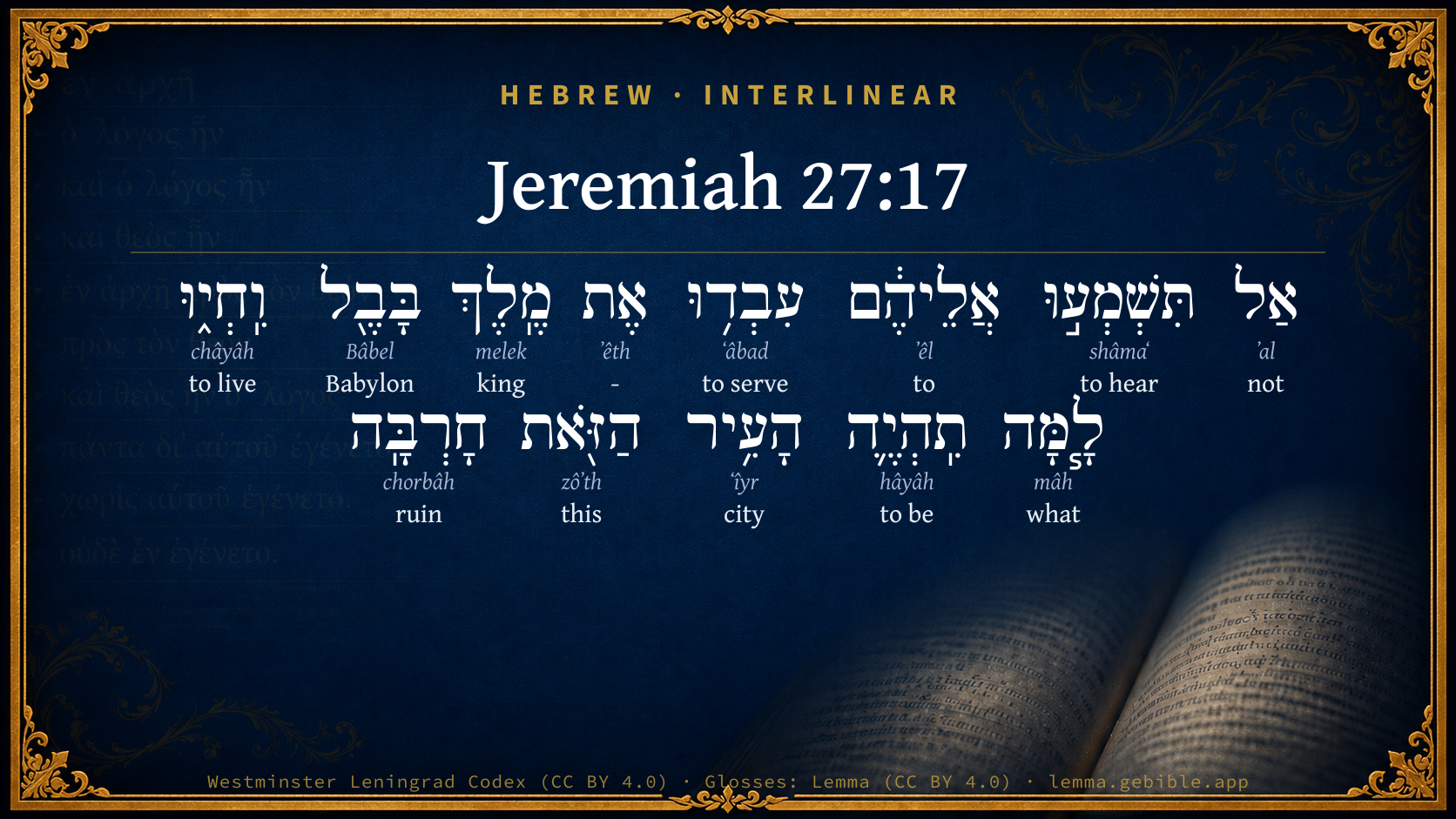
  1. אַל ʼal H408 “not” Particle, Negative
  2. תִּשְׁמְע֣וּ shâmaʻ H8085 “to hear” Verb, Qal, Jussive, 2nd Person, Masculine, Plural
  3. אֲלֵיהֶ֔ם ʼêl H413 “to · them” Preposition + Suffix, Personal, 3rd Person, Masculine, Plural
  4. עִבְד֥וּ ʻâbad H5647 “serve” Verb, Qal, Imperative, 2nd Person, Masculine, Plural
  5. אֶת ʼêth H853 “-” Particle, Direct Object
  6. מֶֽלֶךְ melek H4428 “king of” Noun, Common, Masculine, Singular, Construct
  7. בָּבֶ֖ל Bâbel H894 “Babylon” Noun, Proper
  8. וִֽחְי֑וּ châyâh H2421 “and · live” Conjunction + Verb, Qal, Imperative, 2nd Person, Masculine, Plural
  9. לָ֧מָּה mâh H4100 “to/for · what” Preposition + Particle, Interrogative
  10. תִֽהְיֶ֛ה hâyâh H1961 “to be” Verb, Qal, Imperfect, 3rd Person, Feminine, Singular
  11. הָעִ֥יר ʻîyr H5892 “the · city” Particle, Definite Article + Noun, Common, Feminine, Singular, Absolute
  12. הַזֹּ֖את zôʼth H2063 “the · this” Particle, Definite Article + Pronoun, Demonstrative, Feminine, Singular

About this verse

These counts appear in no published source. They are computed here, from the morphology-tagged text and Lemma’s own curated glosses. What Lemma adds →

13
words
13
distinct lemmas
Prophets
section

Shared distinctive vocabulary

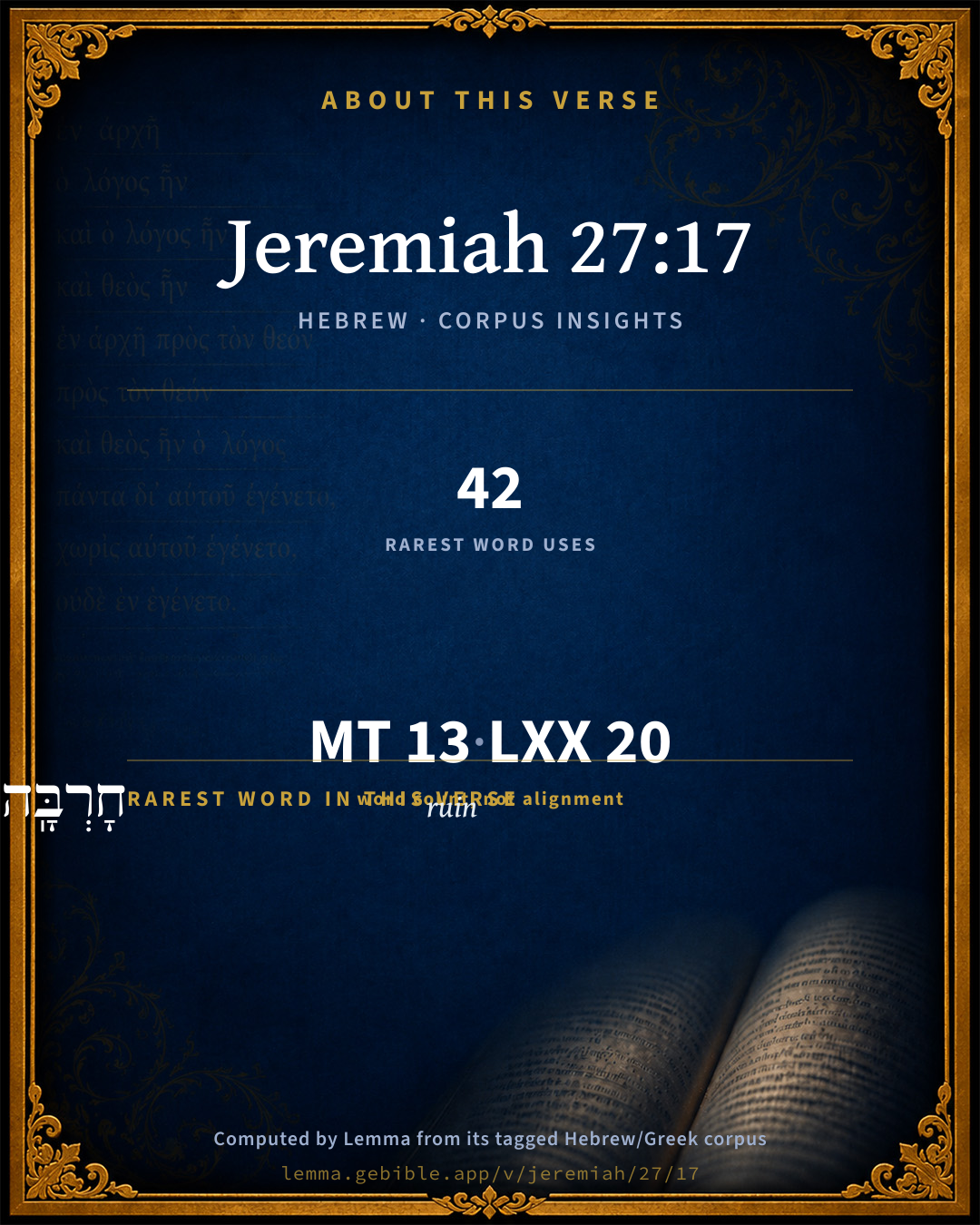
חָרְבָּֽה ruin H2723 occurs in 42 verses of the Hebrew Bible. Also found in:

Grammatical profile

  • 4 verbs
  • 4 nouns
  • 1 pronoun
  • 1 preposition
  • 3 particles

Verb forms

  • תִּשְׁמְע֣וּ Qal · Jussive
  • עִבְד֥וּ Qal · Imperative
  • וִֽחְי֑וּ Qal · Imperative
  • תִֽהְיֶ֛ה Qal · Imperfect

Hebrew & Septuagint length

In the original languages it is 13 Hebrew tokens and 20 Greek tokens — but the two are counted differently (Hebrew bundles its prefixes and suffixes into one token; the Greek is in lemma form), so that isn’t a like-for-like length.

Cross-references

4

Topical passages linked to Jeremiah 27:17 in the Treasury of Scripture Knowledge — connected by theme and wording, ordered by reader-vote popularity; previews shown in the World English Bible.

  • Jeremiah 7:34 Then will I cause to cease from the cities of Judah, and from the streets of Jerusalem, the voice of mirth and the voice of gladness, the voice of the bridegroom and the voice of the bride; for the land shall become a waste.
  • Jeremiah 27:11–13 But the nation that shall bring their neck under the yoke of the king of Babylon, and serve him, that [nation] will I let remain in their own land, says Yahweh; and they shall till it, and dwell therein.
  • Jeremiah 38:17 Then said Jeremiah to Zedekiah, Thus says Yahweh, the God of hosts, the God of Israel: If you will go forth to the king of Babylon's princes, then your soul shall live, and this city shall not be burned with fire; and you shall live, and your house.
  • Jeremiah 38:23 They shall bring out all your wives and your children to the Chaldeans; and you shall not escape out of their hand, but shall be taken by the hand of the king of Babylon: and you shall cause this city to be burned with fire.

Cross-references courtesy of OpenBible.info (CC BY 4.0).

Hebrew and Greek witnesses Masoretic Hebrew ↔ Greek Septuagint

The same verse in the two great witnesses to the Old Testament, shown verse-for-verse.

These are two independent witnesses, not word-aligned to each other, and the Septuagint is shown in lemma (dictionary) form.

Hebrew Jeremiah 27:17 Masoretic · Westminster Leningrad Codex

אַל תִּשְׁמְע֣וּ אֲלֵיהֶ֔ם עִבְד֥וּ אֶת מֶֽלֶךְ בָּבֶ֖ל וִֽחְי֑וּ לָ֧מָּה תִֽהְיֶ֛ה הָעִ֥יר הַזֹּ֖את חָרְבָּֽה

Don't listen to them; serve the king of Babylon, and live: why should this city become a desolation?

World English Bible · Public Domain

Greek LXX Structure differs

In the Septuagint, Jeremiah is about an eighth shorter than the Hebrew and arranges its material differently — the Oracles Against the Nations (Hebrew chapters 46–51) appear in the middle of the Greek book, after 25:13. Because the chapter and verse boundaries do not line up, a verse-for-verse comparison with the Hebrew is not shown.

A verse-for-verse comparison isn’t shown here because the chapters and verses don’t line up. Switch to the LXX edition with the MT / LXX toggle above to read the Greek directly.

Hebrew: Westminster Leningrad Codex (CC BY 4.0). Greek: Septuagint (public domain); English from a public-domain English Septuagint. How the Septuagint differs from the Hebrew →

Targum (Aramaic paraphrase)

1

The Targum is the ancient Jewish Aramaic paraphrase of the Hebrew Scriptures — an interpretive translation, not the Hebrew text itself. Onkelos (literal) and Pseudo-Jonathan (expansive) render the Torah, and Jonathan the Prophets. Coverage is partial: where no permissively-licensed English translation exists for a verse, only the Aramaic is shown. This is verse-level text, not a word-by-word alignment to the Hebrew.

  1. Targum Jonathan Prophets (Joshua–Malachi)
    לָא תְקַבְּלוּן מִנְהוֹן פְּלָחוּ יַת מַלְכָּא דְבָבֶל וְאִתְקַיִימוּ לְמָה תְהֵי קַרְתָא הָדָא חוּרְבָּא:

    (no public-domain English translation for this verse)

    Targum Jonathan — Aramaic: “Mikraot Gedolot” (public domain). English: “Sefaria Community Translation” (CC0 1.0 (public-domain dedication)); “London "Chaldee Paraphrase," 1871” (public domain). Text via Sefaria.

Commentary

Notes on Jeremiah 27:17 from classic Christian and Jewish commentators (each source and its license shown beneath its notes). The classic Christian expositions comment on the surrounding passage and are grouped to its opening verse, so a note may address several verses; the Jewish commentaries on the Tanakh (Rashi and others) are per-verse, so they appear only where the commentator wrote on this verse.

Lemma curates 59 commentaries, every one of them public domain or Creative Commons licensed, each selected and text-cleaned for this edition rather than reprinted as found. About our sources →

Trapp's Complete Commentary

John Trapp

Jer 27:17 Hearken not unto them; serve the king of Babylon, and live: wherefore should this city be laid waste?

Ver. 17. Hearken not unto them.] Life and death is let in by the ear. {Isa 55:3} Take heed, therefore, what ye hear.

Serve the king of Babylon.] And so long as ye may have liberty of conscience upon any reasonable terms, be content; and not, as the bird in the cage, which, because pent up, beateth herself.

John Trapp, A Commentary or Exposition upon All the Books of the Old and New Testament (1647–1656) — public domain. Text from a community e-Sword module.

John Calvin's Commentaries

It is not to be wondered at that Jeremiah said the same things so often, for, as we have seen, he had to contend with false prophets. When any one speaks, and there be no dispute and no adversary opposing him, he may calmly deal with the teachable and confine himself to a few words; but when contention arises, and opponents appear, who may seek to subvert what we say, then we must exercise more care, for they who are thus driven different ways, will not be satisfied with a few words. As, then, Jeremiah saw that the people were fluctuating, he found it necessary, in order to confirm them, to use many words; not that prolixity is in itself sufficient to produce conviction; yet there is no doubt but that Jeremiah spoke efficiently so as to influence at least some portion of the people. Besides, it was necessary to dwell more expressly on a subject not very plausible; the false prophets were heard with favor, and the greater part greedily devoured what was set forth by them; for the hope of impunity is always pleasing and sought after by the world.

But what did Jeremiah say? Serve ye the king of Babylon; that is, “No better condition awaits you than to pay tribute to the king of Babylon; be subject to his authority, and patiently endure whatever he may prescribe to you.” This was indeed a very hard speech; for subjection was not unaccompanied with reproach; besides, he bade them to surrender themselves to a most cruel enemy, as though they were to expose their life to him; and lastly, they were to risk the danger of being spoiled of all that they had. What Jeremiah taught then was very much disliked, as he thus exhorted the people to endure all things. This was, then, the reason why he had not declared in a few and plain words what God had committed to him; it was difficult to persuade the people to undergo the yoke of the king of Babylon, and to submit to his tyranny.

We hence see that there were two very just reasons why the Prophet insisted so much on this one subject, and confirmed what he might have briefly said without any prolixity; Hearken, ye to them, he says; serve ye the king of Babylon and ye shall live We must again bear in mind what we said yesterday, that patiently to humble ourselves under God’s mighty hand is the best remedy for mitigating punishment, and that in this way punishment is turned into medicine; so on the other hand, when we are like refractory and ferocious horses, whatever punishment God inflicts on us, is only a prelude to endless destruction. Let us then lay hold on this truth and constantly meditate on it, — that our punishment becomes vivifying to us, when we acknowledge God to be a righteous judge and suffer ourselves to be corrected by him. But I refer only briefly to this subject now, for I spoke of it more at large yesterday.

He adds, Why should this city be a desolation? He set before them the city in which God’s sanctuary was, and by the sight of it he tried to turn them to repentance; for it was extremely base to harden themselves against the warnings of the prophets, so as to cause the Temple of God to be demolished, and also the holy city to be reduced to a waste, in which God designed to have his dwelling, as he had said,

“This is my rest for ever.” (Psalm 132:14)

In short, he declared to the Jews that a most awful condemnation awaited them, if they suffered the city to perish through their own fault, and that they would be the authors of their own ruin, if they undertook not the yoke of the king of Babylon. It follows —

John Calvin's Commentaries (1540-1563) — public domain. Text from the Calvin Translation Society English edition (1840s-50s) via the Christian Classics Ethereal Library (ccel.org). Calvin's coverage is partial (roughly two-thirds of the Bible); uncommented books and verses are honest gaps, never fabricated. The 19th-century editor's footnotes and remarks are omitted so the notes are faithfully Calvin's own voice.

Ellicott's Commentary for English Readers

(17) Hearken not unto them.—The prophecy of the restoration of the vessels of the Temple was clearly not a mere prediction. It had been used as an incentive to rebellion. “Make one last effort,” the prophets virtually said, “and the spoiler shall be compelled to disgorge his booty.” The prophet saw that such an effort would but hasten the utter destruction of the Temple and the city.

A Bible Commentary for English Readers, edited by Charles John Ellicott (1878–1897) — public domain. Text from a community e-Sword module.

John Gill's Exposition

Hearken not unto them,.... The false prophets:

serve the king of Babylon, and live; pay homage and tribute to him; which is the way to live in your own land, and enjoy the benefits of that, and of the temple worship; which, if not, you will be utterly deprived of:

wherefore should this city be laid waste? as it certainly will, should you rebel against the king of Babylon; and as it was in a few years after, when they did.

John Gill's Exposition of the Whole Bible (1746–1763) — public domain (CC PDM 1.0). Text via the HelloAO Bible API.

Matthew Poole's English Annotations

Believe them not, but satisfy yourselves as to God’s providence with respect to you, and be content to be subject to the king of Babylon, so may you have your lives for a prey; though you be straitened as to your accommodations and plenteous and splendid way of life: if you do not, your city will certainly be laid waste; and why should you pull such a judgment upon your own heads?

Matthew Poole's English Annotations on the Holy Bible (1683–1685) — public domain. Text from a community e-Sword/MySword module.

Whedon's Commentary on the Bible

Daniel D. Whedon

17. Serve the king of Babylon — The extreme severity of this message to Jeremiah, who was charged with its delivery, was its seemingly unpatriotic character. He counselled submission to the enemy. But it was in reality the highest and purest patriotism, and he who delivered it was not only a patriot, but a hero.

Daniel D. Whedon (gen. ed.), Commentary on the Old and New Testaments (1874–1909) — public domain. Text from a community e-Sword module.

Lesson kit

Teaching starters — assembled from the data on this page, not authored interpretation. Every prompt links to the verse data it draws on. Edit before teaching.

Jeremiah, in the Prophets, opens this verse with 13 words (13 distinct Hebrew lemmas). Its most distinctive word is chorbâh (“ruin”). A historical commentator’s framing appears above. Read the whole chapter for the surrounding context.

Discussion questions

  1. How does “ruin” (chorbâh) shape what this verse is saying?
  2. Leviticus 26:31 shares the word «ruin» with this verse. How do the two illuminate each other?
  3. These translations render this verse differently. What is at stake in choosing one wording over another?
  4. The verb «תִּשְׁמְע֣וּ» is Qal Jussive. How does its form color the action?
  5. Reading how Trapp's Complete Commentary and John Calvin's Commentaries read this verse, where do the two commentators agree and where do they part?

Things to notice

Reading settings

Reading text

Shown beneath each verse's original-language words.

Old Testament
Old Testament edition

Read the OT as the Masoretic Hebrew (MT) or the Greek Septuagint (LXX).

English shown for the Greek Septuagint (in the Hebrew ↔ Greek comparison).

Comparing translations? Open the Compare panel on any verse page to stack up to four side by side.