Jeremiah 8:9

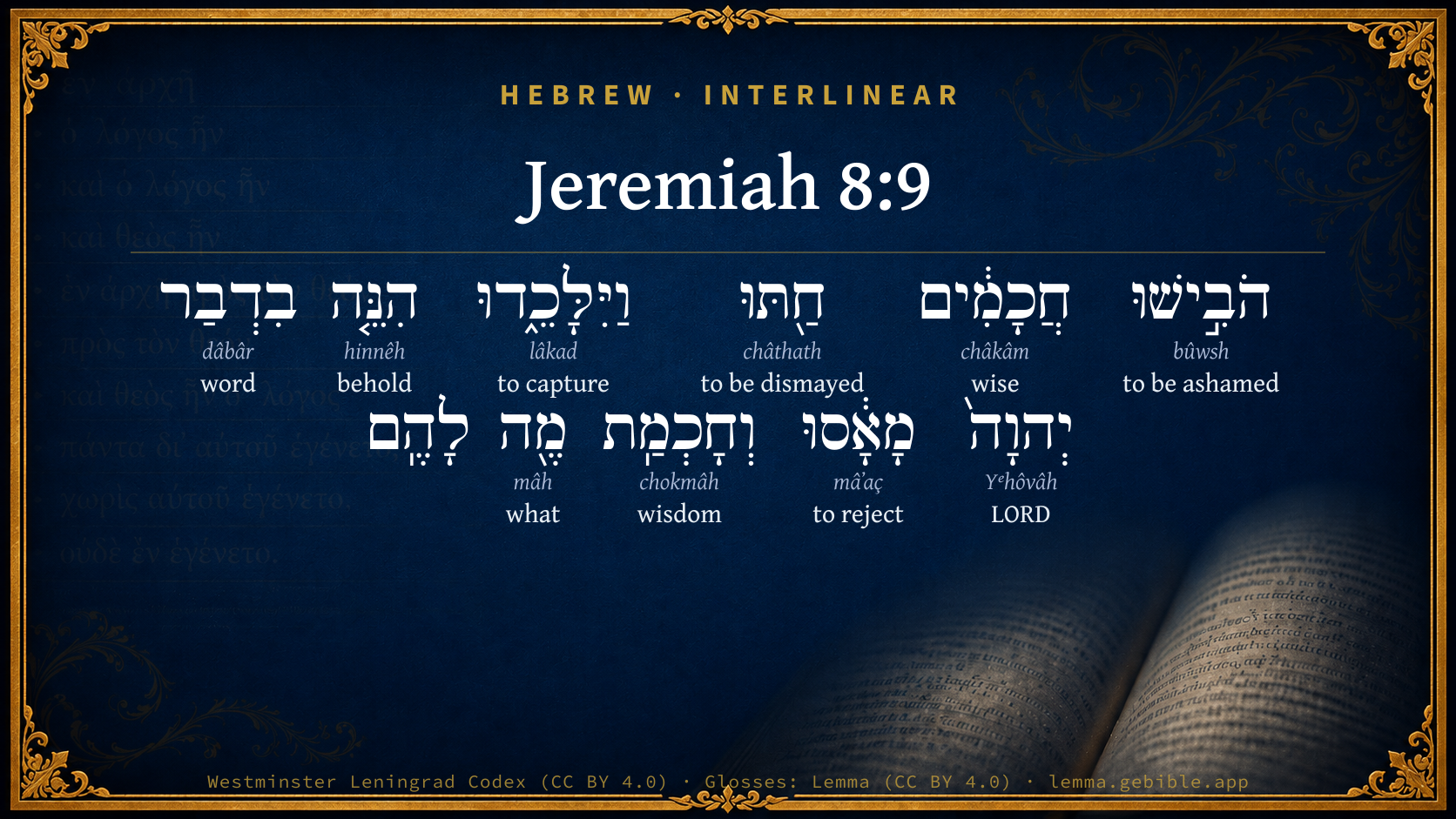
Hebrew (Westminster Leningrad Codex) Jeremiah 8:9 appears in the Hebrew Old Testament. The text above is from the Westminster Leningrad Codex. Each word links to its Strong’s number, a concise gloss, and parsing drawn from the Open Scriptures Hebrew Bible morphology. Click any word for its full Brown-Driver-Briggs (BDB) entry.
Download image
Cite this verse

Jeremiah 8:9 (World English Bible). Public Domain. Lemma interlinear Bible study tool, https://lemma.gebible.app/v/jeremiah/8/9.

Show BibTeX & RIS
BibTeX
RIS
English Translation
The wise men are disappointed, they are dismayed and taken: behold, they have rejected the word of Yahweh; and what manner of wisdom is in them?
World English Bible · Public Domain
Download a study sheet

One document with this verse’s original text, its word-by-word gloss line, the meaning frame, cross-references with their text, attributed commentary, and full source and license credits — printable, and it pastes into notes with its structure intact.

This verse Autodidact and up

Study sheet (.html) Plain text (.txt)

A passage Seminary Student

Up to 50 verses in one chapter. A passage sheet keeps up to 6 commentary sources and 12 cross-references per verse, in the order this page ranks them, and says so on the sheet whenever that leaves anything out. Ask for a single verse and you get the Autodidact verse sheet above.

Everything on this page stays free to read, with no account — the sheet is a download of what is already on screen, not access to it.

Want to remove ads? Support Godless Engineer
Compare translations 3

The same verse in 3 English versions, stacked beneath the original-language interlinear above. Click any original word for its lexicon entry.

Each is an independent rendering of the whole verse — the interlinear is not word-aligned to these translations.

Highlighted words mark where these versions differ — a whole-verse word diff, not a word-by-word alignment.

  • World English Bible Public Domain
    The wise men are disappointed, they are dismayed and taken: behold, they have rejected the word of Yahweh; and what manner of wisdom is in them?
  • King James Version Public Domain
    The wise men are ashamed, they are dismayed and taken: lo, they have rejected the word of the LORD; and what wisdom is in them?
  • unfoldingWord Literal Text CC BY-SA 4.0
    The wise ones will be put to shame, they will be dismayed and will be captured. Behold! They have rejected the word of Yahweh, so what wisdom do they have?

unfoldingWord Literal Text — © unfoldingWord, licensed CC BY-SA 4.0. Word-aligned USFM3 via Door43 (git.door43.org/unfoldingWord/en_ult).

Versions to compare (up to 4)

3 of 4 selected

Show all 18 translations

Every available English version of this verse, each an independent rendering of the whole verse.

  • World English Bible Public Domain
    The wise men are disappointed, they are dismayed and taken: behold, they have rejected the word of Yahweh; and what manner of wisdom is in them?
  • Berean Standard Bible Public Domain
    The wise will be put to shame; they will be dismayed and trapped. Since they have rejected the word of the LORD, what wisdom do they really have?
  • Majority Standard Bible Public Domain
    The wise will be put to shame; they will be dismayed and trapped. Since they have rejected the word of the LORD, what wisdom do they really have?
  • King James Version Public Domain
    The wise men are ashamed, they are dismayed and taken: lo, they have rejected the word of the LORD; and what wisdom is in them?
  • American Standard Version (1901) Public Domain
    The wise men are put to shame, they are dismayed and taken: lo, they have rejected the word of Jehovah; and what manner of wisdom is in them?
  • Revised Version (1885) Public Domain
    The wise men are ashamed, they are dismayed and taken: lo, they have rejected the word of the LORD; and what manner of wisdom is in them?
  • Geneva Bible (1599) Public Domain
    The wise men are ashamed: they are afraid and taken. loe, they haue reiected the word of the Lord, and what wisdome is in them?
  • Douay-Rheims (1899) Public Domain
    The wise men are confounded, they are dismayed, and taken: for they have cast away the word of the Lord, and there is no wisdom in them.
  • Young's Literal Translation Public Domain
    Ashamed have been the wise, They have been affrighted, and are captured, Lo, against a word of Jehovah they kicked, And the wisdom of what -- have they?
  • Literal Standard Version CC BY-SA 4.0
    The wise have been ashamed, || They have been frightened, and are captured, || Behold, they kicked against a word of YHWH, || And what wisdom do they have?
  • Unlocked Literal Bible CC BY-SA 4.0
    The wise men will be ashamed. They are dismayed and trapped. Behold! They reject Yahweh's word, so what use is their wisdom?
  • unfoldingWord Literal Text CC BY-SA 4.0
    The wise ones will be put to shame, they will be dismayed and will be captured. Behold! They have rejected the word of Yahweh, so what wisdom do they have?
  • Darby Bible Public Domain
    The wise men are ashamed, they are dismayed and taken: behold, they have rejected Jehovah's word; and what wisdom is in them?
  • World Messianic Bible Public Domain
    The wise men are disappointed. They are dismayed and trapped. Behold, they have rejected the LORD’s word. What kind of wisdom is in them?
  • Webster's Bible Public Domain
    The wise men are ashamed, they are dismayed and taken: lo, they have rejected the word of the LORD; and what wisdom is in them?
  • Free Bible Version CC BY-SA 4.0
    The wise will be shown to be foolish; they will be shocked at being caught out. Can't you see that they've rejected what the Lord says—so do they have any wisdom at all?
  • Bible in Basic English Public Domain
    The wise men are shamed, they are overcome with fear and taken: see, they have given up the word of the Lord; and what use is their wisdom to them?
  • JPS Tanakh (1917) Public Domain
    The wise men are ashamed, they are dismayed and taken; Lo, they have rejected the word of the LORD; and what wisdom is in them?

Literal Standard Version (2020), Covenant Press — licensed CC BY-SA 4.0. Text via the HelloAO Bible API (eBible.org). Unlocked Literal Bible (unfoldingWord) — licensed CC BY-SA 4.0. Text via the HelloAO Bible API (eBible.org). unfoldingWord Literal Text — © unfoldingWord, licensed CC BY-SA 4.0. Word-aligned USFM3 via Door43 (git.door43.org/unfoldingWord/en_ult). Free Bible Version, Dr. Jonathan Gallagher — licensed CC BY-SA 4.0. Text via the HelloAO Bible API (eBible.org).

Word by word

More ways to search: Search by grammar → Find every occurrence → Compare this word →

Practice this passage: Drill this verse → Learn its vocabulary →

חַ֖תּוּ
châthath
H2865
“to be dismayed”
Verb, Qal, Perfect, 3rd Person, Common, Plural
Part of Speech
Verb
Stem
Qal
Form
Perfect
Person
3rd Person
Gender
Common
Number
Plural
Full BDB Definition

Origin: a primitive root

TWOT: 784

to be shattered, be dismayed, be broken, be abolished, be afraid - (Qal) - to be shattered, be broken - to be dismayed - (Niphal) to be broken, be dismayed - (Piel) to be shattered, be dismayed, be scared - (Hiphil) - to cause to be dismayed - to dismay, terrify - to shatter
  1. הֹבִ֣ישׁוּ bûwsh H954 “to be ashamed” Verb, Hiphil, Perfect, 3rd Person, Common, Plural
  2. חֲכָמִ֔ים châkâm H2450 “wise” Adjective, Adjective, Masculine, Plural, Absolute
  3. וַיִּלָּכֵ֑דוּ lâkad H3920 “and · to capture” Conjunction + Verb, Niphal, Sequential Imperfect, 3rd Person, Masculine, Plural
  4. הִנֵּ֤ה hinnêh H2009 “behold” Particle, Demonstrative
  5. בִדְבַר dâbâr H1697 “in/at · word of” Preposition + Noun, Common, Masculine, Singular, Construct
  6. יְהוָה֙ Yᵉhôvâh H3068 “LORD” Noun, Proper
  7. מָאָ֔סוּ mâʼaç H3988 “to reject” Verb, Qal, Perfect, 3rd Person, Common, Plural
  8. וְחָכְמַֽת chokmâh H2451 “and · wisdom of” Conjunction + Noun, Common, Feminine, Singular, Construct
  9. מֶ֖ה mâh H4100 “what” Particle, Interrogative

About this verse

These counts appear in no published source. They are computed here, from the morphology-tagged text and Lemma’s own curated glosses. What Lemma adds →

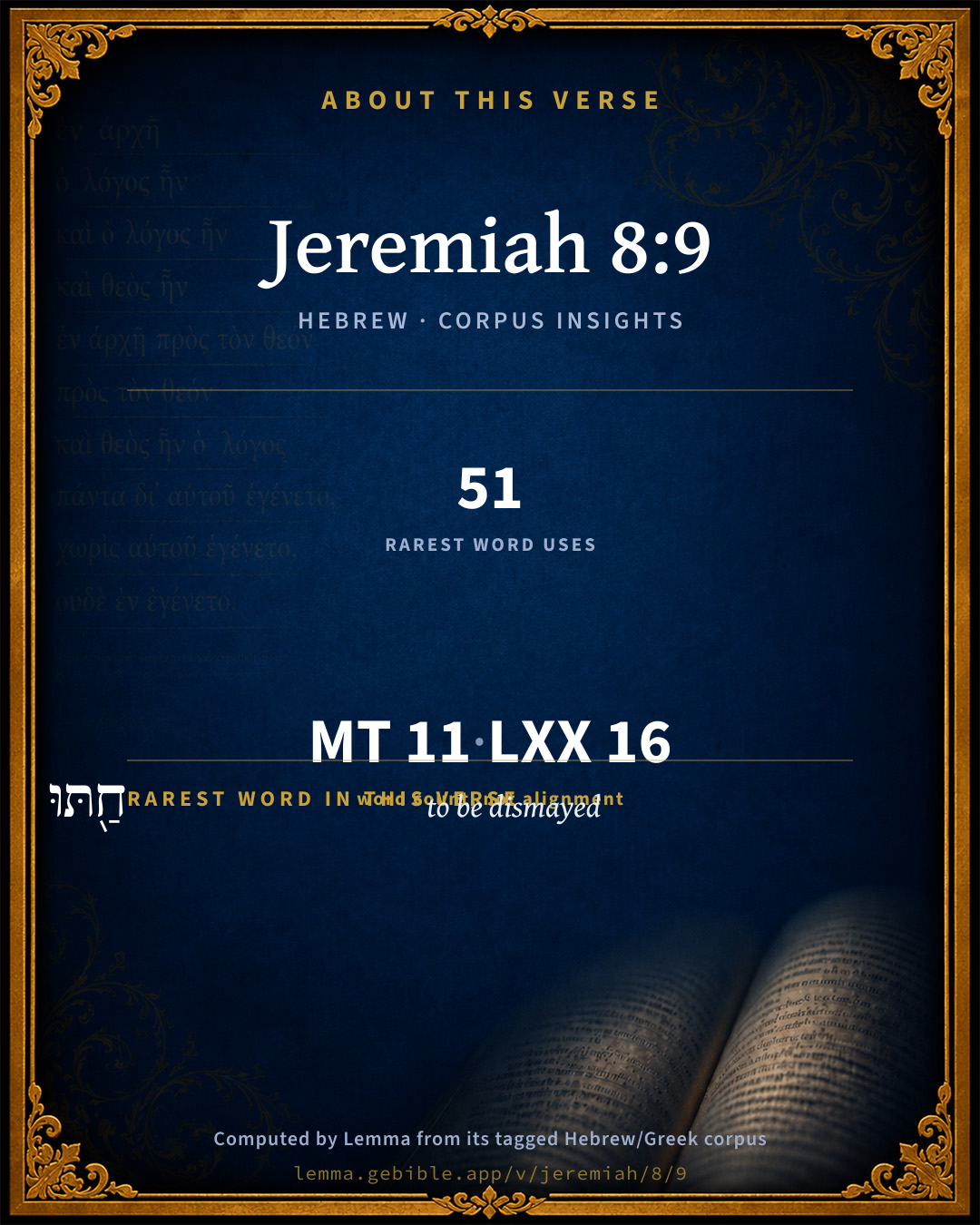
11
words
10
distinct lemmas
Prophets
section

Shared distinctive vocabulary

חַ֖תּוּ to be dismayed H2865 occurs in 45 verses of the Hebrew Bible. Also found in:

Grammatical profile

  • 4 verbs
  • 3 nouns
  • 1 adjective
  • 1 preposition
  • 2 particles

Verb forms

  • הֹבִ֣ישׁוּ Hiphil · Perfect
  • חַ֖תּוּ Qal · Perfect
  • וַיִּלָּכֵ֑דוּ Niphal · Sequential Imperfect
  • מָאָ֔סוּ Qal · Perfect

Hebrew & Septuagint length

In the original languages it is 11 Hebrew tokens and 16 Greek tokens — but the two are counted differently (Hebrew bundles its prefixes and suffixes into one token; the Greek is in lemma form), so that isn’t a like-for-like length.

Cross-references

12

Topical passages linked to Jeremiah 8:9 in the Treasury of Scripture Knowledge — connected by theme and wording, ordered by reader-vote popularity; previews shown in the World English Bible.

  • Psalms 119:98–100 Your commandments make me wiser than my enemies, For your commandments are always with me.
  • Job 5:12 He frustrates the devices of the crafty, So that their hands can't perform their enterprise.
  • Jeremiah 6:15 Were they ashamed when they had committed abomination? nay, they were not at all ashamed, neither could they blush: therefore they shall fall among those who fall; at the time that I visit them they shall be cast down, says Yahweh.
  • Deuteronomy 4:6 Keep therefore and do them; for this is your wisdom and your understanding in the sight of the peoples, who shall hear all these statutes, and say, Surely this great nation is a wise and understanding people.
  • Psalms 19:7 Yahweh's law is perfect, restoring the soul. Yahweh's testimony is sure, making wise the simple.
  • Isaiah 19:11 The princes of Zoan are utterly foolish; the counsel of the wisest counselors of Pharaoh is become brutish: how do you say to Pharaoh, I am the son of the wise, the son of ancient kings?
  • Jeremiah 6:19 Hear, earth: behold, I will bring evil on this people, even the fruit of their thoughts, because they have not listened to my words; and as for my law, they have rejected it.
  • Ezekiel 7:26 Mischief shall come on mischief, and rumor shall be on rumor; and they shall seek a vision of the prophet; but the law shall perish from the priest, and counsel from the elders.
  • 1 Corinthians 1:18–29 For the word of the cross is foolishness to those who are dying, but to us who are saved it is the power of God.
  • Isaiah 8:20 To the law and to the testimony! if they don't speak according to this word, surely there is no morning for them.
  • Jeremiah 49:7 Of Edom. Thus says Yahweh of Hosts: Is wisdom no more in Teman? is counsel perished from the prudent? is their wisdom vanished?
  • 2 Timothy 3:15 From infancy, you have known the sacred writings which are able to make you wise for salvation through faith, which is in Christ Jesus.

Cross-references courtesy of OpenBible.info (CC BY 4.0).

Hebrew and Greek witnesses Masoretic Hebrew ↔ Greek Septuagint

The same verse in the two great witnesses to the Old Testament, shown verse-for-verse.

These are two independent witnesses, not word-aligned to each other, and the Septuagint is shown in lemma (dictionary) form.

Hebrew Jeremiah 8:9 Masoretic · Westminster Leningrad Codex

הֹבִ֣ישׁוּ חֲכָמִ֔ים חַ֖תּוּ וַיִּלָּכֵ֑דוּ הִנֵּ֤ה בִדְבַר יְהוָה֙ מָאָ֔סוּ וְחָכְמַֽת מֶ֖ה לָהֶֽם

The wise men are disappointed, they are dismayed and taken: behold, they have rejected the word of Yahweh; and what manner of wisdom is in them?

World English Bible · Public Domain

Greek LXX Structure differs

In the Septuagint, Jeremiah is about an eighth shorter than the Hebrew and arranges its material differently — the Oracles Against the Nations (Hebrew chapters 46–51) appear in the middle of the Greek book, after 25:13. Because the chapter and verse boundaries do not line up, a verse-for-verse comparison with the Hebrew is not shown.

A verse-for-verse comparison isn’t shown here because the chapters and verses don’t line up. Switch to the LXX edition with the MT / LXX toggle above to read the Greek directly.

On this verse, Keil & Delitzsch discusses the Septuagint’s reading. Read the note in Commentary ↓

Hebrew: Westminster Leningrad Codex (CC BY 4.0). Greek: Septuagint (public domain); English from a public-domain English Septuagint. How the Septuagint differs from the Hebrew →

Targum (Aramaic paraphrase)

1

The Targum is the ancient Jewish Aramaic paraphrase of the Hebrew Scriptures — an interpretive translation, not the Hebrew text itself. Onkelos (literal) and Pseudo-Jonathan (expansive) render the Torah, and Jonathan the Prophets. Coverage is partial: where no permissively-licensed English translation exists for a verse, only the Aramaic is shown. This is verse-level text, not a word-by-word alignment to the Hebrew.

  1. Targum Jonathan Prophets (Joshua–Malachi)
    בְּהִיתוּ חַכִּימַיָא אִתְּבַרוּ וְאִתְאֲחִידוּ הָא בְּפִתְגָמָא דַייָ קָצוּ וְחוּלַק בְּחוּכְמְתָא לֵית לְהוֹן:

    (no public-domain English translation for this verse)

    Targum Jonathan — Aramaic: “Mikraot Gedolot” (public domain). English: “Sefaria Community Translation” (CC0 1.0 (public-domain dedication)); “London "Chaldee Paraphrase," 1871” (public domain). Text via Sefaria.

Commentary

Notes on Jeremiah 8:9 from classic Christian and Jewish commentators (each source and its license shown beneath its notes). The classic Christian expositions comment on the surrounding passage and are grouped to its opening verse, so a note may address several verses; the Jewish commentaries on the Tanakh (Rashi and others) are per-verse, so they appear only where the commentator wrote on this verse.

Lemma curates 59 commentaries, every one of them public domain or Creative Commons licensed, each selected and text-cleaned for this edition rather than reprinted as found. About our sources →

Trapp's Complete Commentary

John Trapp

Jer 8:9 The wise [men] are ashamed, they are dismayed and taken: lo, they have rejected the word of the LORD; and what wisdom [is] in them?

Ver. 9. The wise men are ashamed.] They have cause to be ashamed of their gross ignorance and folly, {Jer 8:7-8} and greater cause than ever humble Augustine had to say, Scientia mea me damnat, My knowledge undoeth me.

Lo, they have rejected the word of the Lord.] As to any holy practice, their knowledge is only apprehensive and notional, not affective and practical.

And what wisdom is in them?] q.d., None worth speaking of; they lose their civil praises, because not wise to salvation.

John Trapp, A Commentary or Exposition upon All the Books of the Old and New Testament (1647–1656) — public domain. Text from a community e-Sword module.

Joseph Benson's Commentary

Jer 8:9. The wise men are ashamed — That is, they have reason to be so, who have not made a better use of their wisdom, and reduced their knowledge to practice. They are confounded and taken — All their wisdom has not served to keep them from those courses that will issue in their ruin. They shall be taken in the same snares that others of their neighbours, who have not pretended to so much wisdom, are taken in, and filled with the same confusion. Those that have more knowledge than others, and yet provide no better than others for their own souls, have reason to be ashamed. They have rejected the word of the Lord — They would not be governed or guided in their conduct by it, would not act as it directed them, nor comply with their duty as there set forth; and what wisdom is in them? — None to any purpose: none that will yield them comfort in life, support in death, or boldness at the day of final accounts: none that will be found to their praise when God shall bring every work into judgment, how much soever it may exalt them in their own opinion in the present world.

Joseph Benson's Commentary on the Old and New Testaments (1811–1818) — public domain. Text from a community e-Sword module.

Tyndale Open Study Notes

Tyndale Open Resources

8:9-10 The phrase wise teachers is sarcastic—the Lord called their teachings foolishness and exposed their motivation as greed (cp. Job 28:28). This sin ruled the lives of the prophets and priests, making all of them frauds.

Tyndale Open Study Notes — © Tyndale Open Resources, licensed CC BY-SA 4.0. Text via the HelloAO Bible API.

Geneva Bible (1599)

Geneva Bible translators

They that seem wise, may be ashamed of their ignorance, for all wisdom consisteth in God’s word.

Geneva Bible (1599) marginal notes — public domain. Text via Bolls.life.

Jamieson, Fausset & Brown

Robert Jamieson, A. R. Fausset & David Brown

dismayed--confounded.

what wisdom--literally, "the wisdom of what?" that is, "wisdom in what respect?" the Word of the Lord being the only true source of wisdom (Psa 119:98-100; Pro 1:7; Pro 9:10).

Jamieson, Fausset & Brown — Commentary Critical and Explanatory on the Whole Bible (1871) — public domain (CC PDM 1.0). Text via the HelloAO Bible API.

John Calvin's Commentaries

He says now that the wise were ashamed, and astonished, and ensnared By which words he means, that the Jews gained nothing by their craftiness, while they arrogated to themselves wisdom, and under this pretense rejected all admonitions, and sought to be spared.

“This wisdom, “he says, “avails you nothing, for God, as it is said in another place, will take you unawares.” (Isaiah 29:14; 1 Corinthians 1:19.)

Ashamed, then, he says, are they; not that they were then ashamed; for be said before, in Jeremiah 6:15, and will state the same presently, that they were so hardened that they could not be made ashamed, nor be made to blush: but he here denounces a punishment, which was soon to overtake them; as though he had said, “Ye have now an iron front, and think that ye can elude God and his servants with impunity; but God will take you unawares, and will so shake off the masks under which you hide yourselves, that your disgrace shall be made manifest to all.” This is the meaning.

For the same purpose he says, “Ye are now secure, but God will shortly fill you with such terror, that he will make you greatly astonished ” He intimates, then, that nothing would benefit them while they took delight in their vices, and increasingly hardened themselves; for God would deprive them of their craftiness, and cast them down with terror, however secure and perverse they were now.

By the third word he sets forth the manner in which they would be treated: God would have his snares by which he would take them. He alludes to the subterfuges in which those hypocrites trust, who proudly oppose God, while they think that by their arts they can escape in this or that way, and often devise some new schemes by which they may deceive God. Hence the Prophet, alluding to their perverse cunning, says, that God would be as it were a fowler, who would ensnare them, and hold them captive.

He afterwards assigns the reason, Because they had repudiated, or despised or rejected, (for the verb means all these things,) the word of Jehovah And he uses a demonstrative particle, Behold, that they might not, as usual, make any evasions: “The thing, “he says, “is sufficiently known, and even children can be judges of your impiety, that you have rejected the word of Jehovah.” He draws hence this inference, What does wisdom avail them? or, What is their wisdom? Either of these meanings may be admitted, They were wise to no purpose, while they provoked God by their impious contempt. “I hate the wise who is not wise for himself, “is an old proverb. As then the Jews ill consulted their own benefit, by rejecting the word of God, in which their safety was involved, the Prophet justly alleges, that their wisdom availed them nothing. Others read, “What is their wisdom, “when there is no fear of God? And doubtless it ever remains a truth, that the fear of God is the beginning and the chief part of wisdom. (Proverbs 1:7; Proverbs 9:10; Psalm 111:10.) Since then they had basely despised God’s word, rightly does the Prophet ask, “What is their wisdom?” But there is a third meaning which is suitable, even this, And wisdom, what to them? So it is literally, — What is wisdom to them? He still speaks to them ironically, as though he said, “They are indeed wise, but in their own esteem; they have therefore no need of being taught: What then is wisdom to them!” The meaning is, that they were so swollen with pride that they received no instruction. How so? They refused wisdom through the false conceit with which they were inflated. Let, however, every one choose for himself; my object is to shew what I mostly approve. There will be no lecture to — morrow, as a consistory is to be held.

John Calvin's Commentaries (1540-1563) — public domain. Text from the Calvin Translation Society English edition (1840s-50s) via the Christian Classics Ethereal Library (ccel.org). Calvin's coverage is partial (roughly two-thirds of the Bible); uncommented books and verses are honest gaps, never fabricated. The 19th-century editor's footnotes and remarks are omitted so the notes are faithfully Calvin's own voice.

Ellicott's Commentary for English Readers

(9) They have rejected the word of the Lord.—The “wise men” are apparently distinguished from the scribes, probably as students of the ethical or sapiential books of Israel, such as the Proverbs of Solomon, as distinct from the Law. The reign of Hezekiah, it will be remembered, had been memorable for such studies (Pro_25:1). They, too, kept within the range of traditional maxims and precepts, perhaps with stress on ceremonial rather than moral obligations; and when the word of Jehovah came to them straight from the lips of the prophets, they refused to listen to it, and with that refusal, what wisdom could they claim?

A Bible Commentary for English Readers, edited by Charles John Ellicott (1878–1897) — public domain. Text from a community e-Sword module.

John Gill's Exposition

The wise men are ashamed,.... Of the wisdom of which they boasted, when it would appear to be folly, and unprofitable to them:

they are dismayed and taken; frightened at the calamities coming upon them, and taken as in a snare, as the wise sometimes are in their own craftiness, Job 5:13.

Lo, they have rejected the word of the Lord; sent by the prophets, which urged obedience to the law, and is the best explanation of it; but this they despised, and refused it:

and what wisdom is in them? to contemn that, which, if attended to, would have been profitable to them, and the means of making them wise unto salvation; let them therefore boast of their wisdom ever so much, it is certain there can be none in persons of such a spirit and conduct.

John Gill's Exposition of the Whole Bible (1746–1763) — public domain (CC PDM 1.0). Text via the HelloAO Bible API.

Albert Barnes' Notes on the Bible

They have rejected the word of the Lord - It became in the hands of the Soferim or scribes a mere code of ceremonial observance. Compare Mar 7:13.

Albert Barnes' Notes on the Bible (1834–1885) — public domain. Text from a community e-Sword/MySword module.

Haydock's Catholic Bible Commentary

Them. Those who understand, and do not observe the law, are not wise. (Worthington)

George Leo Haydock (1774–1849), Haydock's Catholic Family Bible and Commentary, 1859 edition — public domain. Excludes Psalms (Douay-Rheims chapter numbering differs from Protestant) and Deuterocanonical books (Catholic canon only).

Matthew Poole's English Annotations

The wise men are ashamed, they are dismayed and taken; they trusted to their refuge of lies, but when God shall bring the judgment threatened, the wisest among them will find that they shall be confounded among themselves, not knowing what to do for all their wisdom, but shall be taken with the rest, Jer 4:9; by wise men he means the scribes in the former verse. The same said of Babylon, Isa 47:10.

What wisdom is in them? or, What is wisdom to them? How can they say they are wise, when they have no fear of God, which is the beginning of wisdom, Pro 1:7; when they have no respect at all to the word of God, as to any holy practice, which is the fountain of all wisdom? Deu 4:6; Psa 19:7; 2Ti 3:15.

Matthew Poole's English Annotations on the Holy Bible (1683–1685) — public domain. Text from a community e-Sword/MySword module.

Whedon's Commentary on the Bible

Daniel D. Whedon

9. Rejected the word of the Lord — “If the light that is in thee be darkness, how great is that darkness!”

Daniel D. Whedon (gen. ed.), Commentary on the Old and New Testaments (1874–1909) — public domain. Text from a community e-Sword module.

The Pulpit Commentary

The wise men are ashamed. It is the perfect of prophetic certitude, equivalent to "the wise men shall certainly be ashamed." And why? Evidently because they have not foreseen the calamities impending ever their nation. They have preached, "Peace, peace; when there was no peace" (Ver. 11); and hence they find themselves "taken" in the grip of a relentless power from which there is no escape. What wisdom; literally, wisdom of what? i.e. in respect of what?

The Pulpit Commentary (1880–1919), ed. H.D.M. Spence-Jones & Joseph S. Exell — public domain. Text from a community e-Sword module.

Keil & Delitzsch

C. F. Keil & F. Delitzsch

Those who held themselves wise will come to shame, will be dismally disabused of their hopes. When the great calamity comes on the sin-hardened people, they shall be confounded and overwhelmed in ruin (cf. Jer 6:11). They spurn at the word of Jahveh; whose wisdom then have they? None; for the word of the Lord alone is Israel's wisdom and understanding, Deu 4:6.

The threatening in Jer 8:10 includes not only the wise ones, but the whole people. "Therefore" attaches to the central truth of Jer 8:5 and Jer 8:6, which has been elucidated in Jer 8:7-9. The first half of Jer 8:10 corresponds, in shorter compass, to what has been said in Jer 6:12, and is here continued in Jer 8:10-12 in the same words as in Jer 6:13-15. יורשׁים are those who take possession, make themselves masters of a thing, as in Jer 49:2 and Mic 1:15. This repetition of the three verses is not given in the lxx, and Hitz. therefore proposes to delete them as a supplementary interpolation, holding that they are not only superfluous, but that they interrupt the sense. For he thinks Jer 8:13 connects remarkably well with Jer 8:10, but, taken out of its connection with what precedes as we have it, begins baldly enough. To this Graf has made fitting answer: This passage is in no respect more superfluous or awkward than Jer 6:13.; nor is the connection of Jer 8:13 with Jer 8:10 at all closer than with Jer 8:12. And Hitz., in order to defend the immediate connection between Jer 8:13 and Jer 8:10, sees himself compelled, for the restoration of equilibrium, to delete the middle part of Jer 8:13 (from "no grapes" to "withered") as spurious; for which proceeding there is not the smallest reason, since this passage has neither the character of an explanatory gloss, nor is it a repetition from any place whatever, nor is it awanting in the lxx. Just as little ground is there to argue against the genuineness of the two passages from the variations found in them. Here in Jer 8:10 we have מקּטן ועד־גּדול instead of the מקּטנּםof Jer 6:13; but the suffix, which in the latter case pointed to the preceding "inhabitants of the land," was unnecessary here, where there is no such reference. In like manner, the forms הכּלם for הכלים, and עת פּקדּתם for עת־פּקדתּים, are but the more usual forms used by Jeremiah elsewhere. So the omission of the א in ירפּוּ for ירפּאוּ, as coming either from the writer or the copyist, clearly does not make against the genuineness of the verses. And there is the less reason for making any difficulty about the passage, seeing that such repetitions are amongst the peculiarities of Jeremiah's style: cf. e.g., Jer 7:31-33 with Jer 19:5-7; Jer 10:12-16 with Jer 51:15-19; Jer 15:13-14, with Jer 17:3-4; Jer 16:14-15, with Jer 23:7-8, Jer 23:5-6, with Jer 33:15-16; Jer 23:19-20, with Jer 30:23-24, and other shorter repetitions.

Keil & Delitzsch — Biblical Commentary on the Old Testament (1861–1891) — public domain (CC PDM 1.0). Text via the HelloAO Bible API. (Old Testament only.)

Rashi

Rabbi Shlomo Yitzchaki (Rashi)

Wise men were ashamed i.e., wise men like you. And what is the shame? Behold, they rejected the word of the Lord, now what wisdom have they?

Rashi on the Tanakh — English translations: “The Judaica Press complete Tanach with Rashi, translated by A. J. Rosenberg” (CC BY 4.0); “Pentateuch with Rashi's commentary by M. Rosenbaum and A.M. Silbermann, 1929-1934” (public domain); “The Metsudah Tanach series, Lakewood, N.J” (CC BY 4.0); and “The Book of Joshua, Metsudah Publications, 1997” (CC BY 4.0). Text via Sefaria.

Lesson kit

Teaching starters — assembled from the data on this page, not authored interpretation. Every prompt links to the verse data it draws on. Edit before teaching.

Jeremiah, in the Prophets, opens this verse with 11 words (10 distinct Hebrew lemmas). Its most distinctive word is châthath (“to be dismayed”). A historical commentator’s framing appears above. Read the whole chapter for the surrounding context.

Discussion questions

  1. What does “to be dismayed” (châthath) contribute to the verse as a whole?
  2. Deuteronomy 1:21 shares the word «to be dismayed» with this verse. How do the two illuminate each other?
  3. These translations render this verse differently; the difference is in the English rendering, not the original. What questions does that raise?
  4. The verb «הֹבִ֣ישׁוּ» is Hiphil Perfect. How does its form color the action?
  5. Reading how Trapp's Complete Commentary and Joseph Benson's Commentary read this verse, where do the two commentators agree and where do they part?

Things to notice

Reading settings

Reading text

Shown beneath each verse's original-language words.

Old Testament
Old Testament edition

Read the OT as the Masoretic Hebrew (MT) or the Greek Septuagint (LXX).

English shown for the Greek Septuagint (in the Hebrew ↔ Greek comparison).

Comparing translations? Open the Compare panel on any verse page to stack up to four side by side.