

Haggai 1:9

Hebrew (Westminster Leningrad Codex) Haggai 1:9 appears in the Hebrew Old Testament. The text above is from the Westminster Leningrad Codex. Each word links to its Strong’s number, a concise gloss, and parsing drawn from the Open Scriptures Hebrew Bible morphology. Click any word for its full Brown-Driver-Briggs (BDB) entry.
Download image
Cite this verse

Haggai 1:9 (World English Bible). Public Domain. Lemma interlinear Bible study tool, https://lemma.gebible.app/v/haggai/1/9.

Show BibTeX & RIS
BibTeX
RIS
English Translation
"You looked for much, and, behold, it came to little; and when you brought it home, I blew it away. Why?" says Yahweh of Hosts, "Because of my house that lies waste, while each of you is busy with his own house.
World English Bible · Public Domain
Download a study sheet

One document with this verse’s original text, its word-by-word gloss line, the meaning frame, cross-references with their text, attributed commentary, and full source and license credits — printable, and it pastes into notes with its structure intact.

This verse Autodidact and up

Study sheet (.html) Plain text (.txt)

A passage Seminary Student

Up to 50 verses in one chapter. A passage sheet keeps up to 6 commentary sources and 12 cross-references per verse, in the order this page ranks them, and says so on the sheet whenever that leaves anything out. Ask for a single verse and you get the Autodidact verse sheet above.

Everything on this page stays free to read, with no account — the sheet is a download of what is already on screen, not access to it.

Want to remove ads? Support Godless Engineer
Compare translations 3

The same verse in 3 English versions, stacked beneath the original-language interlinear above. Click any original word for its lexicon entry.

Each is an independent rendering of the whole verse — the interlinear is not word-aligned to these translations.

Highlighted words mark where these versions differ — a whole-verse word diff, not a word-by-word alignment.

  • World English Bible Public Domain
    "You looked for much, and, behold, it came to little; and when you brought it home, I blew it away. Why?" says Yahweh of Hosts, "Because of my house that lies waste, while each of you is busy with his own house.
  • King James Version Public Domain
    Ye looked for much, and, lo it came to little; and when ye brought it home, I did blow upon it. Why? saith the LORD of hosts. Because of mine house that is waste, and ye run every man unto his own house.
  • unfoldingWord Literal Text CC BY-SA 4.0
    ‘You looked for much, but behold, little! And you brought home, but I blew upon it! Because of what?’—the declaration of Yahweh of Armies. ‘Because of my house, that it desolate, but you are running, a man to his house.

unfoldingWord Literal Text — © unfoldingWord, licensed CC BY-SA 4.0. Word-aligned USFM3 via Door43 (git.door43.org/unfoldingWord/en_ult).

Versions to compare (up to 4)

3 of 4 selected

Show all 18 translations

Every available English version of this verse, each an independent rendering of the whole verse.

  • World English Bible Public Domain
    "You looked for much, and, behold, it came to little; and when you brought it home, I blew it away. Why?" says Yahweh of Hosts, "Because of my house that lies waste, while each of you is busy with his own house.
  • Berean Standard Bible Public Domain
    You expected much, but behold, it amounted to little. And what you brought home, I blew away. Why? declares the LORD of Hosts. Because My house still lies in ruins, while each of you is busy with his own house.
  • Majority Standard Bible Public Domain
    You expected much, but behold, it amounted to little. And what you brought home, I blew away. Why? declares the LORD of Hosts. Because My house still lies in ruins, while each of you is busy with his own house.
  • King James Version Public Domain
    Ye looked for much, and, lo it came to little; and when ye brought it home, I did blow upon it. Why? saith the LORD of hosts. Because of mine house that is waste, and ye run every man unto his own house.
  • American Standard Version (1901) Public Domain
    Ye looked for much, and, lo, it came to little; and when ye brought it home, I did blow upon it. Why? saith Jehovah of hosts. Because of my house that lieth waste, while ye run every man to his own house.
  • Revised Version (1885) Public Domain
    Ye looked for much, and, lo, it came to little; and when ye brought it home, I did blow upon it. Why? saith the LORD of hosts. Because of mine house that lieth waste, while ye run every man to his own house.
  • Geneva Bible (1599) Public Domain
    Ye looked for much, and lo, it came to litle: and when ye brought it home, I did blowe vpon it. And why, sayth the Lord of hostes? Because of mine House that is waste, and ye runne euery man vnto his owne house.
  • Douay-Rheims (1899) Public Domain
    You have looked for more, and behold it became less, and you brought it home, and I blowed it away: why, saith the Lord of hosts? because my house is desolate, and you make haste every man to his own house.
  • Young's Literal Translation Public Domain
    Looking for much, and lo, little, And ye brought `it' home, and I blew on it, Wherefore? -- an affirmation of Jehovah of Hosts, Because of My house that is waste, And ye are running -- each to his house,
  • Literal Standard Version CC BY-SA 4.0
    “Looking for much, and behold, little, || And you brought [it] home, and I blew on it—why?” A declaration of YHWH of Hosts, || “Because of My house that is desolate, || And you are running—each to his house,
  • Unlocked Literal Bible CC BY-SA 4.0
    “You looked for much, but behold! you have brought little home, for I blew it away! Why?” declares Yahweh of hosts. “Because my house lies in ruins, while every one of you is working on his own house.
  • unfoldingWord Literal Text CC BY-SA 4.0
    ‘You looked for much, but behold, little! And you brought home, but I blew upon it! Because of what?’—the declaration of Yahweh of Armies. ‘Because of my house, that it desolate, but you are running, a man to his house.
  • Darby Bible Public Domain
    Ye looked for much, and behold it was little; and when ye brought it home, I blew upon it. Wherefore? saith Jehovah of hosts. Because of my house that lieth waste, whilst ye run every man to his own house.
  • World Messianic Bible Public Domain
    “You looked for much, and, behold, it came to little; and when you brought it home, I blew it away. Why?” says the LORD of Hosts, “Because of my house that lies waste, while each of you is busy with his own house.
  • Webster's Bible Public Domain
    Ye looked for much, and lo, it came to little; and when ye brought it home, I did blow upon it. Why? saith the LORD of hosts. Because of my house that is waste, and ye run every man to his own house.
  • Free Bible Version CC BY-SA 4.0
    You were hoping for so much, but look, it turned out to be so little. Everything you brought home I blew away. And why was that? Because my house remains a ruin while you are preoccupied with building your own houses, declares the Lord Almighty.
  • Bible in Basic English Public Domain
    You were looking for much, and it came to little; and when you got it into your house, I took it away with a breath. Why? says the Lord of armies. Because of my house which is a waste, while every man takes care of the house which is his.
  • JPS Tanakh (1917) Public Domain
    Ye looked for much, and, lo, it came to little; and when ye brought it home, I did blow upon it. Why? saith the LORD of hosts. Because of My house that lieth waste, while ye run every man for his own house.

Literal Standard Version (2020), Covenant Press — licensed CC BY-SA 4.0. Text via the HelloAO Bible API (eBible.org). Unlocked Literal Bible (unfoldingWord) — licensed CC BY-SA 4.0. Text via the HelloAO Bible API (eBible.org). unfoldingWord Literal Text — © unfoldingWord, licensed CC BY-SA 4.0. Word-aligned USFM3 via Door43 (git.door43.org/unfoldingWord/en_ult). Free Bible Version, Dr. Jonathan Gallagher — licensed CC BY-SA 4.0. Text via the HelloAO Bible API (eBible.org).

Word by word

More ways to search: Search by grammar → Find every occurrence → Compare this word →

Practice this passage: Drill this verse → Learn its vocabulary →

חָרֵ֔ב
chârêb
H2720
“desolate”
Adjective, Adjective, Masculine, Singular, Absolute
Part of Speech
Adjective
Type
Adjective
Gender
Masculine
Number
Singular
State
Absolute
Full BDB Definition

Origin: from H2717

TWOT: 731a

waste, desolate, dry
  1. פָּנֹ֤ה pânâh H6437 “to turn” Verb, Qal, Infinitive Absolute
  2. אֶל ʼêl H413 “to” Preposition
  3. הַרְבֵּה֙ râbâh H7235 “to multiply” Verb, Hiphil, Infinitive Absolute
  4. וְהִנֵּ֣ה hinnêh H2009 “and · behold” Conjunction + Particle, Demonstrative
  5. לִמְעָ֔ט mᵉʻaṭ H4592 “to/for · few” Preposition + Adjective, Adjective, Masculine, Singular, Absolute
  6. וַהֲבֵאתֶ֥ם bôwʼ H935 “and · to enter” Conjunction + Verb, Hiphil, Perfect, 2nd Person, Masculine, Plural
  7. הַבַּ֖יִת bayith H1004 “the · house” Particle, Definite Article + Noun, Common, Masculine, Singular, Absolute
  8. וְנָפַ֣חְתִּי nâphach H5301 “and · to breathe” Conjunction + Verb, Qal, Perfect, 1st Person, Common, Singular
  9. יַ֣עַן yaʻan H3282 “because” Conjunction
  10. מֶ֗ה mâh H4100 “what” Particle, Interrogative
  11. נְאֻם֙ nᵉʼum H5002 “utterance of” Noun, Common, Masculine, Singular, Construct
  12. יְהוָ֣ה Yᵉhôvâh H3068 “LORD” Noun, Proper
  13. צְבָא֔וֹת tsâbâʼ H6635 “armies” Noun, Common, Both, Plural, Absolute
  14. יַ֗עַן yaʻan H3282 “because” Conjunction
  15. בֵּיתִי֙ bayith H1004 “house · my” Noun, Common, Masculine, Singular, Construct + Suffix, Personal, 1st Person, Common, Singular
  16. אֲשֶׁר ʼăsher H834 “which” Particle, Relative
  17. ה֣וּא hûwʼ H1931 “he” Pronoun, Personal, 3rd Person, Masculine, Singular
  18. וְאַתֶּ֥ם ʼattâh H859 “and · you” Conjunction + Pronoun, Personal, 2nd Person, Masculine, Plural
  19. רָצִ֖ים rûwts H7323 “running” Verb, Qal, Participle Active, Masculine, Plural, Absolute
  20. אִ֥ישׁ ʼîysh H376 “man” Noun, Common, Masculine, Singular, Absolute
  21. לְבֵיתֽוֹ bayith H1004 “to/for · house · his” Preposition + Noun, Common, Masculine, Singular, Construct + Suffix, Personal, 3rd Person, Masculine, Singular

About this verse

These counts appear in no published source. They are computed here, from the morphology-tagged text and Lemma’s own curated glosses. What Lemma adds →

23
words
19
distinct lemmas
Prophets
section

Notable vocabulary

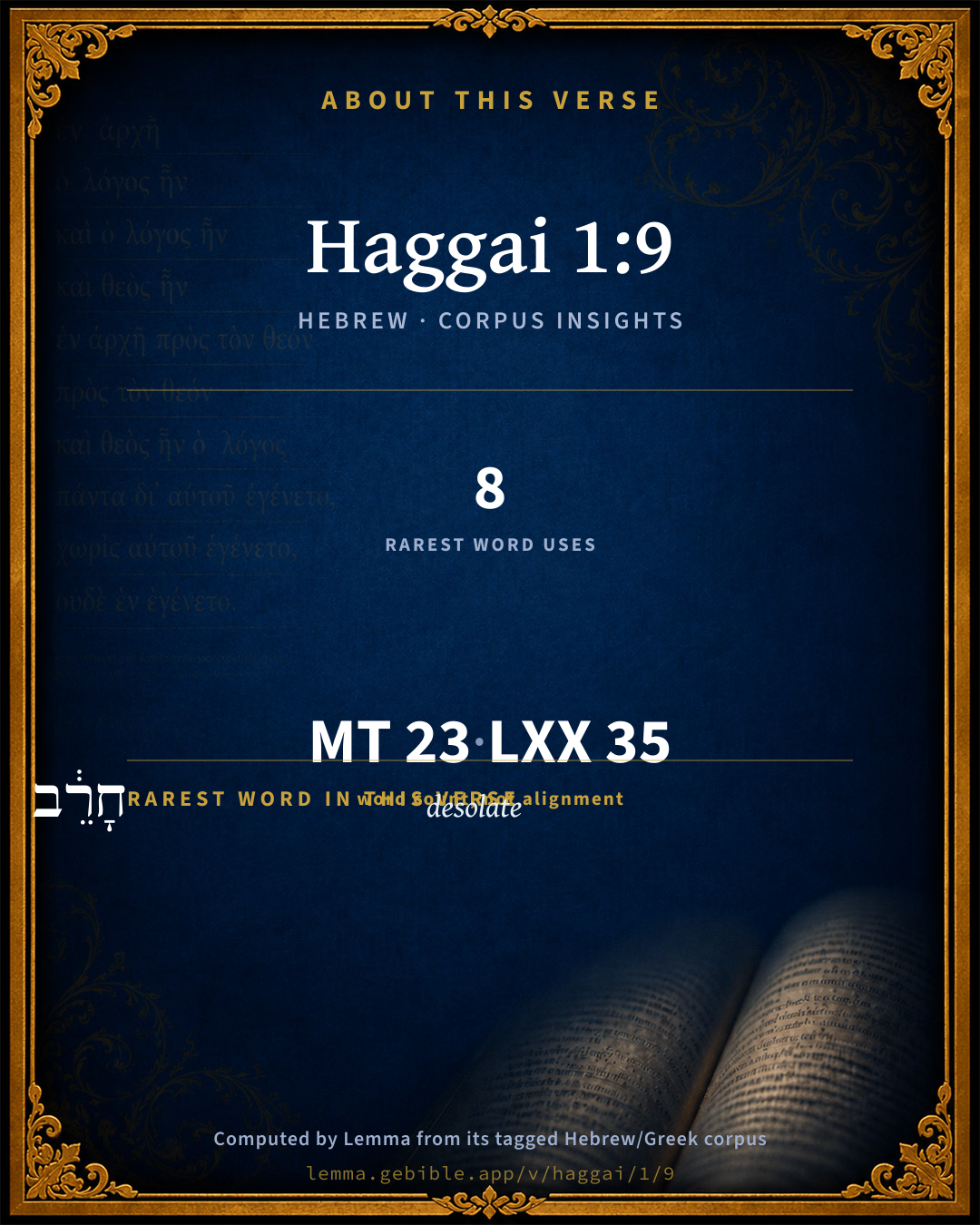
The rarest word here is חָרֵ֔ב desolate H2720 — appearing just 8 times in the whole Hebrew Bible.

Shared distinctive vocabulary

חָרֵ֔ב desolate H2720 occurs in 8 verses of the Hebrew Bible. Also found in:

Grammatical profile

  • 5 verbs
  • 7 nouns
  • 2 adjectives
  • 2 pronouns
  • 2 prepositions
  • 2 conjunctions
  • 3 particles

Verb forms

  • פָּנֹ֤ה Qal · Infinitive Absolute
  • הַרְבֵּה֙ Hiphil · Infinitive Absolute
  • וַהֲבֵאתֶ֥ם Hiphil · Perfect
  • וְנָפַ֣חְתִּי Qal · Perfect
  • רָצִ֖ים Qal · Participle Active

Repetition

Words recur within this verse — often emphatic in Hebrew:

  • הַבַּ֖יִת house H1004 ×3
  • יַ֣עַן because H3282 ×2

Hebrew & Septuagint length

In English translation the verse runs 42 words from the Hebrew and 39 from the Septuagint (LXX English) — closely comparable.

A rough comparison of the two English renderings, which tokenize alike — not a word-level alignment.

Word counts can differ between the Hebrew and the Greek without any difference in meaning — e.g. the Hebrew direct-object marker אֵת has no separate Greek word, and Greek often adds the article ὁ.

In the original languages it is 23 Hebrew tokens and 35 Greek tokens — but the two are counted differently (Hebrew bundles its prefixes and suffixes into one token; the Greek is in lemma form), so that isn’t a like-for-like length.

Cross-references

17

Topical passages linked to Haggai 1:9 in the Treasury of Scripture Knowledge — connected by theme and wording, ordered by reader-vote popularity; previews shown in the World English Bible.

  • Haggai 1:4 "Is it a time for you yourselves to dwell in your paneled houses, while this house lies waste?
  • Haggai 2:16–17 Through all that time, when one came to a heap of twenty measures, there were only ten. When one came to the wine vat to draw out fifty, there were only twenty.
  • Malachi 2:2 If you will not listen, and if you will not lay it to heart, to give glory to my name," says Yahweh of Hosts, "then will I send the curse on you, and I will curse your blessings. Indeed, I have cursed them already, because you do not lay it to heart.
  • Revelation 3:19 As many as I love, I reprove and chasten. Be zealous therefore, and repent.
  • Psalms 77:5–10 I have considered the days of old, The years of ancient times.
  • Isaiah 40:7 The grass withers, the flower fades, because the breath of Yahweh blows on it; surely the people is grass.
  • Haggai 1:6 You have sown much, and bring in little. You eat, but you don't have enough. You drink, but you aren't filled with drink. You clothe yourselves, but no one is warm, and he who earns wages earns wages to put them into a bag with holes in it."
  • Joshua 7:10–15 Yahweh said to Joshua, Get you up; why are you thus fallen on your face?
  • 2 Samuel 21:1 There was a famine in the days of David three years, year after year; and David sought the face of Yahweh. Yahweh said, It is for Saul, and for his bloody house, because he put to death the Gibeonites.
  • 2 Samuel 22:16 Then the channels of the sea appeared, The foundations of the world were laid bare, By the rebuke of Yahweh, At the blast of the breath of his nostrils.
  • 2 Kings 19:7 Behold, I will put a spirit in him, and he shall hear news, and shall return to his own land; and I will cause him to fall by the sword in his own land.
  • Job 10:2 I will tell God, 'Do not condemn me, Show me why you contend with me.
  • Isaiah 17:10–11 For you have forgotten the God of your salvation, and have not been mindful of the rock of your strength; therefore you plant pleasant plants, and set it with strange slips.
  • Malachi 3:8–11 Will a man rob God? Yet you rob me! But you say, 'How have we robbed you?' In tithes and offerings.
  • Matthew 10:37–38 He who loves father or mother more than me is not worthy of me; and he who loves son or daughter more than me isn't worthy of me.
  • 1 Corinthians 11:30–32 For this cause many among you are weak and sickly, and not a few sleep.
  • Revelation 2:4 But I have this against you, that you left your first love.

Cross-references courtesy of OpenBible.info (CC BY 4.0).

Hebrew and Greek witnesses Masoretic Hebrew ↔ Greek Septuagint

The same verse in the two great witnesses to the Old Testament, shown verse-for-verse.

These are two independent witnesses, not word-aligned to each other, and the Septuagint is shown in lemma (dictionary) form.

Hebrew Haggai 1:9 Masoretic · Westminster Leningrad Codex

פָּנֹ֤ה אֶל הַרְבֵּה֙ וְהִנֵּ֣ה לִמְעָ֔ט וַהֲבֵאתֶ֥ם הַבַּ֖יִת וְנָפַ֣חְתִּי ב֑וֹ יַ֣עַן מֶ֗ה נְאֻם֙ יְהוָ֣ה צְבָא֔וֹת יַ֗עַן בֵּיתִי֙ אֲשֶׁר ה֣וּא חָרֵ֔ב וְאַתֶּ֥ם רָצִ֖ים אִ֥ישׁ לְבֵיתֽוֹ

"You looked for much, and, behold, it came to little; and when you brought it home, I blew it away. Why?" says Yahweh of Hosts, "Because of my house that lies waste, while each of you is busy with his own house.

World English Bible · Public Domain

Greek LXX Haggai 1:9 Septuagint · lemma form

ἐπιβλέπω εἰς πολύς καί γίγνομαι ὀλίγος καί εἰςφέρω εἰς ὁ οἶκος καί ἐκφυσάω αὐτός διά οὗτος ὅδε λέγω κύριος παντοκράτωρ ἀντί ὅς ὁ οἶκος ἐγώ εἰμί ἔρημος σύ δέ διώκω ἕκαστος εἰς ὁ οἶκος αὐτός

You⌃ looked for much, and there came little; and it was brought into the house, and I blew it away. Therefore thus says the Lord Almighty, Because my house is desolate, and you⌃ run everyone into his own house;

LXX2012 (modern English Septuagint) · Public Domain

On this verse, The Pulpit Commentary discusses the Septuagint’s reading. Read the note in Commentary ↓

Hebrew: Westminster Leningrad Codex (CC BY 4.0). Greek: Septuagint (public domain); English from LXX2012 (modern English Septuagint) (Public Domain). How the Septuagint differs from the Hebrew →

Targum (Aramaic paraphrase)

1

The Targum is the ancient Jewish Aramaic paraphrase of the Hebrew Scriptures — an interpretive translation, not the Hebrew text itself. Onkelos (literal) and Pseudo-Jonathan (expansive) render the Torah, and Jonathan the Prophets. Coverage is partial: where no permissively-licensed English translation exists for a verse, only the Aramaic is shown. This is verse-level text, not a word-by-word alignment to the Hebrew.

  1. Targum Jonathan Prophets (Joshua–Malachi)
    מִתְפְּנָן אַתּוּן לְסַגִי וַהֲוֵי לִזְעֵיר מָעֲלִין אַתּוּן לֵיהּ לְבֵיתָא וַאֲנָא שָׁלַח בֵּיהּ מְאֶרְתָּא חֲלַף מָה אֲמַר יְיָ צְבָאוֹת חֲלַף בֵּית מַקְדְשִׁי דְהוּא חָרוֹב וְאַתּוּן רָהֲטִין גְבַר לְבֵיתֵיהּ:

    (no public-domain English translation for this verse)

    Targum Jonathan — Aramaic: “Mikraot Gedolot” (public domain). English: “Sefaria Community Translation” (CC0 1.0 (public-domain dedication)); “London "Chaldee Paraphrase," 1871” (public domain). Text via Sefaria.

Commentary

Notes on Haggai 1:9 from classic Christian and Jewish commentators (each source and its license shown beneath its notes). The classic Christian expositions comment on the surrounding passage and are grouped to its opening verse, so a note may address several verses; the Jewish commentaries on the Tanakh (Rashi and others) are per-verse, so they appear only where the commentator wrote on this verse.

Lemma curates 59 commentaries, every one of them public domain or Creative Commons licensed, each selected and text-cleaned for this edition rather than reprinted as found. About our sources →

Trapp's Complete Commentary

John Trapp

Hag 1:9 Ye looked for much, and, lo, [it came] to little; and when ye brought [it] home, I did blow upon it. Why? saith the LORD of hosts. Because of mine house that [is] waste, and ye run every man unto his own house.

Ver. 9. Ye looked for much, and, lo, it came to little] Spes in oculis, luctus in manibus, as Jerome here. The hope of unjust men perisheth, Pro 11:7, etiam spes valentissima, his likeliest hope, as some render it; he thinks himself sure, as Esau did of the blessing, but he only thinks so; God cuts off the meat from his mouth, Joe 1:16, takes away his corn in the time thereof, Hos 2:9, confutes him in his confidences, which prove like the brooks of Tema, Job 6:17, and serve him as Absalom’s mule did her master; his high hopes hop headless, as one phraseth it. It happens with him as with those perverse Israelites in the wilderness, made to tack about forty-two times after that they thought themselves sure of the promised land.

I did blow upon it] i.e. I dispersed it with ease. By a like phrase (for sense) God is said, Isa 25:11, to spread forth his hands in the midst of his enemies, as he that swimmeth spreadeth forth his hands to swim; and to bring down their pride, together with the spoils of their hands, with greatest facility. The motion in swimming is easy, not strong; for strong violent strokes in the water would rather sink than support. In like sort God blasted their treasure or blew their hoards hither and thither, he consumed their substance and cursed their blessings, as Mal 2:2. {See Trapp on "Mal 2:2"}

Why? saith the Lord of hosts. Because of mine house that is waste, &c.] Their sin of preferring their own private interests and self-respects before God’s work and service is here repeated, and exaggerated, as the ground and cause of all their calamities: and all little enough to bring them to a sound and serious sight and hatred of their sins. Such a deep kind of drowsiness hath surprised us, for the most part, that whereas every judgment of God should be a warning peal to repent, we be like the smith’s dog, who the harder the anvil is beaten on lieth by and sleepeth the sounder; or like the silly hen, which loseth her chickens one by one by the devouring kite, and yet, as altogether insensible of her loss, continues to pick up what lieth before her. This is to swelter and pine away in iniquity, as if nothing could awaken men, Lev 26:39, and it is threatened last of all, as worse than all their losses, captivities, &c. A lethargy is no less deadly than the most tormenting disease. Let ministers, therefore, by such forcible and quick questions as this in the text and otherwise, arouse their hearers (as they once did here their dear friends in the sweating sickness, who, if suffered to sleep, died certainly), that they may awake, and recover themselves out of the snare of the devil, &c. It is well observed by one that the devil’s particular sin is not once mentioned in Genesis, because he was not to be restored by repentance; but the sin of man is enlarged in all the circumstances. And why this? but that he might be sensible, ashamed, and penitent for his sin. They say in philosophy that the foundation of natural life is feeling; no feeling, no life; and that the more quick and nimble the sense of feeling is in a man the better is his constitution. Think the same of life spiritual, and of that hidden man of the heart, as St Peter calls him.

And ye run every man unto his own house] Or, ye take pleasure every man in his own house, q.d. Ye are all self-seekers, privatespirited persons, ye are all for your own interests; like the snail, that seldom stirs abroad, and never without his house upon his back; or like the eagle, which, when he flies highest, hath still an eye downward to the prey, that he minds to seize. In parabola oves capras suas quaerunt. In the parabole of the sheep, he seeks his sheep. They serve not the Lord Jesus Christ, but their own bellies, Rom 16:18; or if they serve Christ, it is for gain, as children will not say their prayers unless we promise them their breakfasts. In serving him they do but serve themselves upon him; as those carnal Capernaites did, Joh 6:26. Well might the apostle complain, as Php 2:21, and another since, that it is his pleasures, his profit, and his preferment that is the natural man’s trinity; and his carnal self that is these in unity. May he be but warm in his own feathers, he little regards the dangers of the house. He is totus in se, wholly drawn up into himself, and insensible of either the public good or common danger: though the waterpot and spear be taken from the bolster, yet he stirs not. Far enough from St Paul’s frame of spirit or speech, Who is offended, and I burn not? far enough from his care and cumber, anxiety and solicitude for the house of God (επισυστασις μεριμνα) and prosperity of his people, 2Co 11:28. Nothing like they are to Ambrose, who was more troubled for the state of the Church than for his own dangers. Nothing like Melancthon, of whom it is said, that the ruins of God’s house and the miseries of his people made him almost neglect the death of his most beloved children. True goodness is public spirited, though to private disadvantage; as nature will venture its own particular good for the general, so will grace much more. Heavy things will ascend to keep out vacuity and preserve the universe. A stone will fall down to come to its own place, though it break itself in twenty pieces. It is the ingenuity of saints, in all their desires and designs, to study God’s ends more than their own; to build God’s house with neglect of their own, as Solomon did; to drown all self-respects in his glory and the public good, as Nehemiah did; of whom it might be more truly said than the heathen historian (Dio) did of Cato, that he did υπεραγαπαν το κοινον, overly loved the commonwealth, and that he did - toti genitum se credere mundo, believe himself born for the benefit of mankind (Lucan).

John Trapp, A Commentary or Exposition upon All the Books of the Old and New Testament (1647–1656) — public domain. Text from a community e-Sword module.

Keil & Delitzsch

C. F. Keil & F. Delitzsch

"Ye looked out for much, and behold (it came) to little; and ye brought it home, and I blew into it. Why? is the saying of Jehovah of hosts. Because of my house, that it lies waste, whereas ye run every man for his house. Hag 1:10. Therefore the heaven has withheld its dew on your account, that no dew fell, and the earth has withheld her produce. Hag 1:11. And I called drought upon the earth, and upon the mountains, and upon the corn, and upon the new wine, and upon the oil, and upon everything that the ground produces, and upon men, and upon cattle, and upon all the labour of the hands." The meaning of Hag 1:9 is evident from the context. The inf. abs. pânōh stands in an address full of emotion in the place of the perfect, and, as the following clause shows, for the second person plural. Ye have turned yourselves, fixed your eye upon much, i.e., upon a rich harvest, והנּה־למעט, and behold the desired much turned to little. Ye brought into the house, ye fetched home what was reaped, and I blew into it, i.e., I caused it to fly away, like chaff before the wind, so that there was soon none of it left. Here is a double curse, therefore, as in Hag 1:6 : instead of much, but little was reaped, and the little that was brought home melted away without doing any good. To this exposition of the curse the prophet appends the question יען מה, why, sc. has this taken place? that he may impress the cause with the greater emphasis upon their hardened minds. For the same reason he inserts once more, between the question and the answer, the words "is the saying of Jehovah of hosts," that the answer may not be mistaken for a subjective view, but laid to heart as a declaration of the God who rules the world. The choice of the form מה for מה was probably occasioned by the guttural ע in the יען, which is closely connected with it, just as the analogous use of על־מה instead of על־מה in Isa 1:5; Psa 10:13, and Jer 16:10, where it is not followed by a word commencing with ע as in Deu 29:23; Kg1 9:8; Jer 22:8. The former have not been taken into account at all by Ewald in his elaborate Lehrbuch (cf. 182, b). In the answer given by God, "because of my house" (ya‛an bēthı̄) is placed first for the sake of emphasis, and the more precise explanation follows. אשׁר הוּא, "because it," not "that which." ואתּם וגו is a circumstantial clause. לביתו ... רצים, not "every one runs to his house," but "runs for his house," ל denoting the object of the running, as in Isa 59:7 and Pro 1:16. "When the house of Jehovah was in question, they did not move from the spot; but if it concerned their own house, they ran" (Koehler). In Hag 1:10 and Hag 1:11, the curse with which God punished the neglect of His house is still further depicted, with an evident play upon the punishment with which transgressors are threatened in the law (Lev 26:19-20; Deu 11:17 and Deu 28:23-24). עליכם is not a dat. incomm. (Hitzig), which is never expressed by על; but על is used either in a causal sense, "on your account" (Chald.), or in a local sense, "over you," after the analogy of Deu 28:23, שׁמיך אשׁר על ראשׁך, in the sense of "the heaven over you will withold" (Ros., Koehl.). It is impossible to decide with certainty between these two. The objection to the first, that "on your account" would be superfluous after על־כּן, has no more force than that raised by Hitzig against the second, viz., that super would be מעל. There is no tautology in the first explanation, but the עליכם, written emphatically at the commencement, gives greater intensity to the threat: "on account of you," you who only care for your own houses, the heaven witholds the dew. And with the other explanation, מעל would only be required in case עליכם were regarded as the object, upon which the dew ought to fall down from above. כּלא, not "to shut itself up," but in a transitive sense, with the derivative meaning to withhold or keep back; and mittâl, not partitively "of the dew," equivalent to "a portion of it," but min in a privative sense, "away from," i.e., so that no dew falls; for it is inadmissible to take mittâl as the object, "to hold back along with the dew," after the analogy of Num 24:11 (Hitzig), inasmuch as the accusative of the person is wanting, and in the parallel clause כּלא is construed with the accus. rei. ואקרא in Hag 1:11 is still dependent upon על־כּן. The word chōrebh, in the sense of drought, applies strictly speaking only to the land and the fruits of the ground, but it is also transferred to men and beasts, inasmuch as drought, when it comes upon all vegetation, affects men and beasts as well; and in this clause it may be taken in the general sense of devastation. The word is carefully chosen, to express the idea of the lex talionis. Because the Jews left the house of God chârēbh, they were punished with chōrebh. The last words are comprehensive: "all the labour of the hands" had reference to the cultivation of the soil and the preparation of the necessities of life.

Keil & Delitzsch — Biblical Commentary on the Old Testament (1861–1891) — public domain (CC PDM 1.0). Text via the HelloAO Bible API. (Old Testament only.)

Tyndale Open Study Notes

Tyndale Open Resources

1:9 I blew it away: The Lord destroyed the harvest because the people’s priorities were wrong—they thought only of themselves rather than of God. • says the Lord of Heaven’s Armies: The “God-as-speaker formula,” which often closes a prophecy (1:13; 2:8, 17, 23), verified Haggai’s message as the sure word of God.

Tyndale Open Study Notes — © Tyndale Open Resources, licensed CC BY-SA 4.0. Text via the HelloAO Bible API.

Geneva Bible (1599)

Geneva Bible translators

And so bring it to nothing.

Geneva Bible (1599) marginal notes — public domain. Text via Bolls.life.

Jamieson, Fausset & Brown

Robert Jamieson, A. R. Fausset & David Brown

Ye looked for much--literally "looked" so as to turn your eyes "to much." The Hebrew infinitive here expresses continued looking. Ye hoped to have your store made "much" by neglecting the temple. The greater was your greediness, the more bitter your disappointment in being poorer than ever.

when ye brought it home, I did blow upon it--even the little crop brought into your barns I dissipated. "I did blow upon," that is, I scattered and caused to perish with My mere breath, as scattered and blighted corn.

mine house . . . his own house--in emphatic antithesis.

ye run--expressing the keenness of everyone of them in pursuing their own selfish interests. Compare "run," Psa 119:32; Pro 1:16, contrasted with their apathy about God's house.

Jamieson, Fausset & Brown — Commentary Critical and Explanatory on the Whole Bible (1871) — public domain (CC PDM 1.0). Text via the HelloAO Bible API.

Adam Clarke's Commentary

Verse 9. Ye looked for much] Ye made great pretensions at first; but they are come to nothing. Ye did a little in the beginning; but so scantily and unwillingly that I could not but reject it.

Ye run every man unto his own house.] To rebuild and adorn it; and God's house is neglected!

Adam Clarke's Commentary on the Bible (1810–1826) — public domain. Text from a community e-Sword/MySword module.

John Calvin's Commentaries

Here the Prophet relates again, that the Jews were deprived of support, and that they in a manner pined away in their distress, because they robbed God of the worship due to him. He first repeats the fact, Ye have looked for much, but behold little It may happen that one is contented with a very slender portion, because much is not expected. They who are satisfied with their own penury are not anxious though their portion of food is but scanty, though they are constrained to feed on acorns. Those who are become hardened in enduring evils, do not seek much; but they who desire much, are more touched and vexed by their penury. This is the reason why the Prophet says, Ye have looked for much, and, behold, there was but little; that is, “Ye are not like the peasants, who satisfy themselves with any sort of food, and are not troubled on account of their straitened circumstances; but your desire has led you to seek abundance. Hence ye seek and greedily lay hold on things on every side; but, behold, it comes to little.”

In the second place he adds, Ye have brought it home. He farther mentions another kind of evil—that when they gathered wine, and corn, and money, all these things immediately vanished. Ye have brought it home, and I have blown upon it. By saying that they brought it home, he intimates that what they had acquired was laid up, that it might be preserved safely; for they who had filled their storehouses, and wine-cellars, and bags, thought that they had no more to do with God. Hence it was that profane men securely indulged themselves; they thought that they were beyond the reach of danger, when their houses were well filled. God, on the contrary, shows that their houses became empty, when filled with treasures and provisions. But he speaks still more distinctly—that he had blown upon them, that is, that he had dissipated them by his breath: for the Prophet did not deem it enough historically to narrate what the Jews had experienced; but his purpose also was to point out the cause, as it were, by the finger. He therefore teaches us, that what they laid in store in their houses did not without a cause vanish away; but that this happened through the blowing of God, even because he cursed their blessing, according to what we shall hereafter see in the Prophet Malachi.

He then adds, Why is this? saith Jehovah of hosts. God here asks, not because he had any doubts on the subject, but that he might by this sort of goading rouse the Jews from their lethargy,—“Think of the cause, and know that my hand is not guided by a blind impulse when it strikes you. You ought, then, to consider the reason why all things thus decay and perish.” Here again is sharply reproved the stupidity of the people, because they attended not to the cause of their evils; for they ought to have known this of themselves.

But God gives the answer, because he saw that they remained stupefied—On account of my house, he says, because it is waste God here assigns the cause; he shows that though no one of them considered why they were so famished, the judgement of his curse was yet sufficiently manifest, on account of the Temple remaining a waste. And you, he says, run, every one to his own house. Some read, You take delight, every one in his own house; for it is the verb רצה, retse, which we have lately noticed; and it means either to take pleasure in a thing, or to run. Every one, then, runs to his house, or, Every one delights in his house. But it is more suitable to the context to give this rendering, Every one runs to his house. For the Prophet here reminds the Jews that they were slow and slothful in the work of building the Temple, because they hastened to their private houses. He then reproves here their ardor in being intent on building their own houses, so that they had no leisure to build the Temple. This is the hastening which the Prophet blames and condemns in the Jews.

We may hence learn again, that they had long delayed to build the sanctuary after the time had arrived: for, as we have mentioned yesterday, they who think the Jews returned in the fifty-eighth year, and that they had not then undergone the punishment denounced by Jeremiah, are very deluded; for they thus obscure the favor of God; nay, they wholly subvert the truth of the promises, as though they had returned contrary to God’s will, through the permission of Cyrus, when yet Isaiah says, that Cyrus would be the instrument of their promised redemption. (Isaiah 45:1.) Surely, then, Cyrus must have been dead before the time was fulfilled! and in that case God could not have been the redeemer of his people. Therefore Eusebius, and those who agree with him, did thus most absurdly confound the order of time. It now follows—

John Calvin's Commentaries (1540-1563) — public domain. Text from the Calvin Translation Society English edition (1840s-50s) via the Christian Classics Ethereal Library (ccel.org). Calvin's coverage is partial (roughly two-thirds of the Bible); uncommented books and verses are honest gaps, never fabricated. The 19th-century editor's footnotes and remarks are omitted so the notes are faithfully Calvin's own voice.

Ellicott's Commentary for English Readers

(9) Ye looked for much.—Literally, There has been a turning about for much.

I did blow upon it—scil., for the purpose of dispersing it. Even the little that was brought into the garner was decimated by God’s continued disfavour.

A Bible Commentary for English Readers, edited by Charles John Ellicott (1878–1897) — public domain. Text from a community e-Sword module.

The Cambridge Bible for Schools and Colleges

gen. ed. J. J. S. Perowne

9. Ye looked for much, &c.] Lit. to look (there was looking) for much, and (it came) to little! Emphatic as ver. 6, where see note. A double blight and curse had come upon them. They had looked for much, had expected a plentiful harvest, and perhaps the appearance of the crops had warranted the expectation. But when they came to gather it in they found the actual yield but little, less even perhaps than they had originally sown. Pusey quotes the seed of a homer shall yield an ephah, i.e. one tenth of what was sown, Isa_5:10. And when this little was brought home into the garner, even that melted away by mildew or waste or loss. God did but blow upon it with the breath of His displeasure, and lo it was gone, as though instead of solid grain it had been chaff of the summer threshingfloor.

and ye run, &c.] while ye run, R. V., with eager zeal and interest to build and adorn it. See ver. 4. The word run is used in the same figurative way in Psa_119:32; Pro_1:16.

9–11. Having pointed out in ver. 8 the way of amendment and prosperity, the prophet resumes in these verses the expostulation of vv. 4–6, and again insists upon the depressed condition of the people and its cause.

The Cambridge Bible for Schools and Colleges (gen. ed. J. J. S. Perowne; Cambridge University Press, 1878–1918) — public domain. Text from a community e-Sword module.

John Gill's Exposition

Ye looked for much, and, lo, it came to little,.... They looked for a large harvest, and very promising it was for a while; but in the end it came to little; it was a very small crop, very little was reaped and gathered in: or, "in looking", ye looked "to increase" (x); your substance; had raised expectations of making themselves and families by their agriculture, and by their plantations of vines and olives, and by their trade and merchandise; and it dwindled away, and came to little or nothing; their riches, instead of being increased, were diminished:

and when ye brought it home, I did blow upon it; when they brought into their barns or houses the produce of their land, labour, and merchandise, which was but little, the Lord blew a blast upon that little, and brought rottenness and worms into it, as Jarchi; so that it was not a blessing to them, but a curse. So the Targum interprets it,

"behold, I sent a curse upon it:''

or, "I blew it away" (y); as any light thing, straw or stubble, or thistle down, are blown away with a wind; so easily can the Lord, and sometimes he does, strip men of that little substance they have; riches by his orders make themselves wings, and flee away; or he, by one providence or another, blows them away like chaff before the wind:

Why? saith the Lord of hosts; what was the cause and reason of this? which question is put, not on his own account, who full well knew it; but for their sakes, to whom he speaks, that they might be made sensible of it; and in order to that to introduce what follows, which is an answer to the question:

because of mine house that is waste; which they suffered to lie waste, and did not concern themselves about the rebuilding of it: this the Lord resented, and for this reason blasted all their labours:

and ye run every man unto his own house; were very eager, earnest, and diligent, in building, beautifying, and adorning their own houses; taking care of their own domestic affairs; sparing no cost nor pains to promote their own secular interest; running in all haste to do any thing and everything to increase their worldly substance; but sat still, were idle and slothful, careless and negligent, about the house of God and the affairs of it.

(x) "ad rem augendam", Grotius. (y) "exsufflo illud", Vatablus; "efflo illud", Junius & Tremellius; "difflo", Piscator; "difflavi", Drusius, Cocceius.

John Gill's Exposition of the Whole Bible (1746–1763) — public domain (CC PDM 1.0). Text via the HelloAO Bible API.

Albert Barnes' Notes on the Bible

Ye looked - , literally “a looking;” as though he said, it has all been one looking, “for much,” for increase, the result of all sowing, in the way of nature: “and behold it came to little,” i. e., less than was sown; as Isaiah denounced to them of old by God’s word, Isa 5:10. “the seed of a homer shall yield an ephah,” i. e., one tenth of what was sown. “And ye brought it home, and I blew upon it,” so as to disperse it, as, not the wheat, but the chaff is blown before the wind. This, in whatever way it came to pass, was a further chastisement of God. The little seed which they brought in lessened through decay or waste. Why? saith the Lord of hosts. God asks by his prophet, what He asks in the awakened conscience Psa 39:11. “God with rebukes chastens man for sin.” Conscience, when alive, confesses for “what” sin; or it asks itself, if memory does not supply the special sin. Unawakened, it complains about the excess of rain, the drought, the blight, the mildew, and asks, not itself, why, in God’s Providence, these inflictions came in these years? They felt doubtless the sterility in contrast with the exceeding prolificalness of Babylonia, as they contrasted the “light bread,” Num 21:5. the manna, with Num 11:5. the plenteousness of Egypt. They ascribed probably their meagre crops (as we mostly do) to mere natural causes, perhaps to the long neglect of the land during the captivity. God forces the question upon their consciences, in that Haggai asks it in His Name, in whose hands all powers stand, “saith the Lord of host.” They have not to talk it over among themselves, but to answer Almighty God, “why?” That “why?” strikes into the inmost depths of conscience!

Because of My house which is waste, and ye run - literally, “are running,” all the while, “each to his own house” They were absorbed in their material interests, and had no time for those of God. When the question was of God’s house, they stir not from the spot; when it is of their own concerns, they run. Our Lord says, Mat 6:33. “Seek ye first the kingdom of God and His righteousness, and all these things shall be added unto you.” Man reverses this, seeks his own things first, and God withholds His blessing.

“This comes true of those who prefer their own conveniences to God’s honor, who do not thoroughly uproot self-love, whose penitence and devotion are shewn to be unstable, for on a slight temptation they are overcome. Such are they who are bold, self-pleasing, wise and great in their own eyes, who do not ground their conversation on true and solid humility.”

(Cyr.) “To those who are slow to fulfill what is for the glory of God, and the things whereby His house, the Church, is firmly stayed, neither the heavenly dew cometh, which enricheth hearts and minds, nor the fruitfulness of the earth; i. e., right action; not food nor wine nor use of oil. But they will be ever strengthless and joyless, unenriched by spiritual oil, and remain without taste or participation of the blessing through Christ.”

Albert Barnes' Notes on the Bible (1834–1885) — public domain. Text from a community e-Sword/MySword module.

Matthew Poole's English Annotations

Ye, O Jews, you toiled, and were at great cost, as Hag 1:6.

Looked for much; expected, hoped, promised yourselves a great increase, a plentiful harvest.

And, lo, it came to little; but you saw, discerned, and were sensible that it answered not expectation; all dwindled into a very little, you were losers by all, went backward still.

I did blow upon it: had your little been as the righteous man’s little, you might have lived on it, and rejoiced in it; but it had not such a blessing upon it; it was blasted, and so was weak, and empty, and heartless, it profited little.

Because of mine house that is waste; all this curse on your estate and labour was for your ungodly neglect of my house, leaving it waste.

Ye run; did with eagerness carry on your own particular buildings, spared not care or cost for them; you stir not a foot about my house, you run with greatest earnestness about your own.

Every man to his own house, domestic affairs and concerns, in which not one or two, or some few, but every one is culpable, scarce any free from this fault.

Matthew Poole's English Annotations on the Holy Bible (1683–1685) — public domain. Text from a community e-Sword/MySword module.

The Pulpit Commentary

He shows the real cause of the calamities that had befallen them. Ye looked for much, and, lo, it came to little. Emphatic infinitive, as in ver. 6. "To look for much, and behold! little." They fixed their expectations upon a rich harvest, and they reaped less than they had sown. (Isa_5:10) And when they had stored this miserable crop in their barns, I did blow upon it; or, did blow it away (ejxefu>shsa, Septuagint), dissipated it as if it were mere chaff, so that it perished. Doubtless, as Dr Pusey observes, they ascribed the meagreness of their crops to natural causes, and would not see the judicial nature of the infliction. The prophet brings the truth home to their conscience by the stern question, Why? And he answers the question for them, speaking with God"s authority. Because of mine house that is waste. The reason already given in ver. 4, etc., is repeated and enforced. And (while) ye run. Ye are indifferent to the miserable condition of the house of God, while ye haste with all diligence to your own houses for business or pleasure, being entirely absorbed in worldly interests, or eager only to adorn and beautify your own habitations. Or, your zeal is all expended on your own private dwellings.

The Pulpit Commentary (1880–1919), ed. H.D.M. Spence-Jones & Joseph S. Exell — public domain. Text from a community e-Sword module.

John Wesley's Explanatory Notes

Came to little - But it answered not the expectation. I did blow - I blasted it. Ye run - You with eagerness carry on your own particular buildings.

John Wesley, Explanatory Notes Upon the Whole Bible (1754–1765) — public domain. Text via the GEBible commentary corpus.

Rashi

Rabbi Shlomo Yitzchaki (Rashi)

You looked for much Until now, you expected to bring much from the field, but you brought little.

and I will blow into it I will bring upon it a plague of decay and worms.

and I will blow an expression like (Isa. 54:16) “Who blows on a charcoal fire.”

Rashi on the Tanakh — English translations: “The Judaica Press complete Tanach with Rashi, translated by A. J. Rosenberg” (CC BY 4.0); “Pentateuch with Rashi's commentary by M. Rosenbaum and A.M. Silbermann, 1929-1934” (public domain); “The Metsudah Tanach series, Lakewood, N.J” (CC BY 4.0); and “The Book of Joshua, Metsudah Publications, 1997” (CC BY 4.0). Text via Sefaria.

Lesson kit

Teaching starters — assembled from the data on this page, not authored interpretation. Every prompt links to the verse data it draws on. Edit before teaching.

Haggai, in the Prophets, opens this verse with 23 words (19 distinct Hebrew lemmas). Its most distinctive word is chârêb (“desolate”). A historical commentator’s framing appears above. Read the whole chapter for the surrounding context.

Discussion questions

  1. What does “desolate” (chârêb) contribute to the verse as a whole?
  2. How does Leviticus 7:10, which shares the word «desolate», read alongside this verse?
  3. What does the repetition of “house” (3× in this one verse) do in this verse?
  4. These translations render this verse differently. What is at stake in choosing one wording over another?
  5. «פָּנֹ֤ה» is a Qal Infinitive Absolute verb. How does that grammatical form shape the action described?
  6. Compare how Trapp's Complete Commentary and Keil & Delitzsch read this verse. Where do they agree or differ?

Things to notice

Reading settings

Reading text

Shown beneath each verse's original-language words.

Old Testament
Old Testament edition

Read the OT as the Masoretic Hebrew (MT) or the Greek Septuagint (LXX).

English shown for the Greek Septuagint (in the Hebrew ↔ Greek comparison).

Comparing translations? Open the Compare panel on any verse page to stack up to four side by side.