
1 Samuel 1:8

Hebrew (Westminster Leningrad Codex) 1 Samuel 1:8 appears in the Hebrew Old Testament. The text above is from the Westminster Leningrad Codex. Each word links to its Strong’s number, a concise gloss, and parsing drawn from the Open Scriptures Hebrew Bible morphology. Click any word for its full Brown-Driver-Briggs (BDB) entry.
Download image
Cite this verse

1 Samuel 1:8 (World English Bible). Public Domain. Lemma interlinear Bible study tool, https://lemma.gebible.app/v/1-samuel/1/8.

Show BibTeX & RIS
BibTeX
RIS
English Translation
Elkanah her husband said to her, Hannah, why weep you? and why don't you eat? and why is your heart grieved? am I not better to you than ten sons?
World English Bible · Public Domain
Highlights Full analysis ↓
Download a study sheet

One document with this verse’s original text, its word-by-word gloss line, the meaning frame, cross-references with their text, attributed commentary, and full source and license credits — printable, and it pastes into notes with its structure intact.

This verse Autodidact and up

Study sheet (.html) Plain text (.txt)

A passage Seminary Student

Up to 50 verses in one chapter. A passage sheet keeps up to 6 commentary sources and 12 cross-references per verse, in the order this page ranks them, and says so on the sheet whenever that leaves anything out. Ask for a single verse and you get the Autodidact verse sheet above.

Everything on this page stays free to read, with no account — the sheet is a download of what is already on screen, not access to it.

Want to remove ads? Support Godless Engineer
Compare translations 3

The same verse in 3 English versions, stacked beneath the original-language interlinear above. Click any original word for its lexicon entry.

Each is an independent rendering of the whole verse — the interlinear is not word-aligned to these translations.

Highlighted words mark where these versions differ — a whole-verse word diff, not a word-by-word alignment.

  • World English Bible Public Domain
    Elkanah her husband said to her, Hannah, why weep you? and why don't you eat? and why is your heart grieved? am I not better to you than ten sons?
  • King James Version Public Domain
    Then said Elkanah her husband to her, Hannah, why weepest thou? and why eatest thou not? and why is thy heart grieved? am not I better to thee than ten sons?
  • unfoldingWord Literal Text CC BY-SA 4.0
    And Elkanah, her husband, said to her, “Hannah, why do you weep? And why do you not eat? And why is your heart bad? I not better for you than ten sons?”

unfoldingWord Literal Text — © unfoldingWord, licensed CC BY-SA 4.0. Word-aligned USFM3 via Door43 (git.door43.org/unfoldingWord/en_ult).

Versions to compare (up to 4)

3 of 4 selected

Show all 18 translations

Every available English version of this verse, each an independent rendering of the whole verse.

  • World English Bible Public Domain
    Elkanah her husband said to her, Hannah, why weep you? and why don't you eat? and why is your heart grieved? am I not better to you than ten sons?
  • Berean Standard Bible Public Domain
    “Hannah, why are you crying?” her husband Elkanah asked. “Why won’t you eat? Why is your heart so grieved? Am I not better to you than ten sons?”
  • Majority Standard Bible Public Domain
    “Hannah, why are you crying?” her husband Elkanah asked. “Why won’t you eat? Why is your heart so grieved? Am I not better to you than ten sons?”
  • King James Version Public Domain
    Then said Elkanah her husband to her, Hannah, why weepest thou? and why eatest thou not? and why is thy heart grieved? am not I better to thee than ten sons?
  • American Standard Version (1901) Public Domain
    And Elkanah her husband said unto her, Hannah, why weepest thou? and why eatest thou not? and why is thy heart grieved? am not I better to thee than ten sons?
  • Revised Version (1885) Public Domain
    And Elkanah her husband said unto her, Hannah, why weepest thou? and why eatest thou not? and why is thy heart grieved? am not I better to thee than ten sons?
  • Geneva Bible (1599) Public Domain
    Then sayd Elkanah her husband to her, Hannah, why weepest thou? and why eatest thou not? and why is thine heart troubled? am not I better to thee then ten sonnes?
  • Douay-Rheims (1899) Public Domain
    Then Elcana her husband said to her: Anna, why weepest thou? and why dost thou not eat? And why dost thou afflict thy heart? Am not I better to thee than ten children?
  • Young's Literal Translation Public Domain
    And Elkanah her husband saith to her, `Hannah, why weepest thou? and why dost thou not eat? and why is thy heart afflicted? am I not better to thee than ten sons?'
  • Literal Standard Version CC BY-SA 4.0
    And her husband Elkanah says to her, “Hannah, why do you weep? And why do you not eat? And why is your heart afflicted? Am I not better to you than ten sons?”
  • Unlocked Literal Bible CC BY-SA 4.0
    Elkanah her husband always said to her, “Hannah, why do you weep? Why do you not eat? Why is your heart sad? Am I not better to you than ten sons?”
  • unfoldingWord Literal Text CC BY-SA 4.0
    And Elkanah, her husband, said to her, “Hannah, why do you weep? And why do you not eat? And why is your heart bad? I not better for you than ten sons?”
  • Darby Bible Public Domain
    And Elkanah her husband said to her, Hannah, why weepest thou? and why eatest thou not? and why is thy heart grieved? Am not I better to thee than ten sons?
  • World Messianic Bible Public Domain
    Elkanah her husband said to her, “Hannah, why do you weep? Why don’t you eat? Why is your heart grieved? Am I not better to you than ten sons?”
  • Webster's Bible Public Domain
    Then said Elkanah her husband to her, Hannah, why weepest thou? and why eatest thou not? and why is thy heart grieved? am not I better to thee than ten sons?
  • Free Bible Version CC BY-SA 4.0
    “Hannah, what are you crying for?” her husband Elkanah would ask. “Why don't you eat? Why are you so upset? Aren't I better to you than ten sons?”
  • Bible in Basic English Public Domain
    Then her husband Elkanah said to her, Hannah, why are you weeping? and why are you taking no food? why is your heart troubled? am I not more to you than ten sons?
  • JPS Tanakh (1917) Public Domain
    And Elkanah her husband said unto her: 'Hannah, why weepest thou? and why eatest thou not? and why is thy heart grieved? am not I better to thee than ten sons?'

Literal Standard Version (2020), Covenant Press — licensed CC BY-SA 4.0. Text via the HelloAO Bible API (eBible.org). Unlocked Literal Bible (unfoldingWord) — licensed CC BY-SA 4.0. Text via the HelloAO Bible API (eBible.org). unfoldingWord Literal Text — © unfoldingWord, licensed CC BY-SA 4.0. Word-aligned USFM3 via Door43 (git.door43.org/unfoldingWord/en_ult). Free Bible Version, Dr. Jonathan Gallagher — licensed CC BY-SA 4.0. Text via the HelloAO Bible API (eBible.org).

Word by word

More ways to search: Search by grammar → Find every occurrence → Compare this word →

Practice this passage: Drill this verse → Learn its vocabulary →

יֵרַ֣ע
yâraʻ
H3415
“to tremble”
Verb, Qal, Imperfect, 3rd Person, Masculine, Singular
Part of Speech
Verb
Stem
Qal
Form
Imperfect
Person
3rd Person
Gender
Masculine
Number
Singular
Full BDB Definition

Origin: a primitive root

TWOT: 917

(Qal) to tremble, quiver
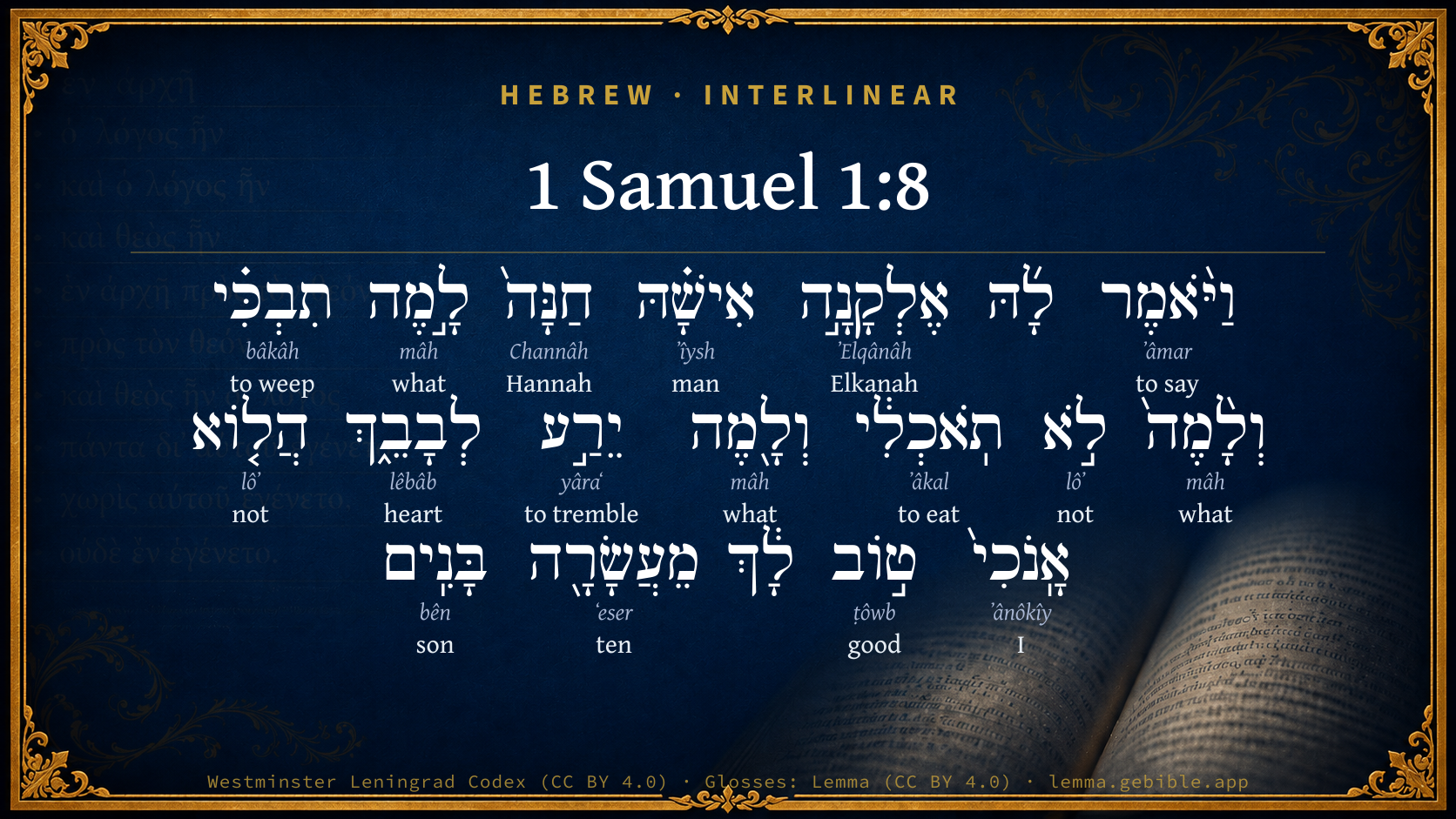
  1. וַיֹּ֨אמֶר ʼâmar H559 “and · to say” Conjunction + Verb, Qal, Sequential Imperfect, 3rd Person, Masculine, Singular
  2. אֶלְקָנָ֣ה ʼElqânâh H511 “Elkanah” Noun, Proper
  3. אִישָׁ֗הּ ʼîysh H376 “man · her” Noun, Common, Masculine, Singular, Construct + Suffix, Personal, 3rd Person, Feminine, Singular
  4. חַנָּה֙ Channâh H2584 “Hannah” Noun, Proper
  5. לָ֣מֶה mâh H4100 “to/for · what” Preposition + Particle, Interrogative
  6. תִבְכִּ֗י bâkâh H1058 “to weep” Verb, Qal, Imperfect, 2nd Person, Feminine, Singular
  7. וְלָ֨מֶה֙ mâh H4100 “and · to/for · what” Conjunction + Preposition + Particle, Interrogative
  8. לֹ֣א lôʼ H3808 “not” Particle, Negative
  9. תֹֽאכְלִ֔י ʼâkal H398 “to eat” Verb, Qal, Imperfect, 2nd Person, Feminine, Singular
  10. וְלָ֖מֶה mâh H4100 “and · to/for · what” Conjunction + Preposition + Particle, Interrogative
  11. לְבָבֵ֑ךְ lêbâb H3824 “heart · your” Noun, Common, Masculine, Singular, Construct + Suffix, Personal, 2nd Person, Feminine, Singular
  12. הֲל֤וֹא lôʼ H3808 “not” Particle, Interrogative + Particle, Negative
  13. אָֽנֹכִי֙ ʼânôkîy H595 “I” Pronoun, Personal, 1st Person, Common, Singular
  14. ט֣וֹב ṭôwb H2896 “good” Adjective, Adjective, Masculine, Singular, Absolute
  15. מֵעֲשָׂרָ֖ה ʻeser H6235 “from · ten” Preposition + Adjective, Cardinal number, Masculine, Singular, Absolute
  16. בָּנִֽים bên H1121 “sons” Noun, Common, Masculine, Plural, Absolute

About this verse

These counts appear in no published source. They are computed here, from the morphology-tagged text and Lemma’s own curated glosses. What Lemma adds →

19
words
14
distinct lemmas
Historical
section

Notable vocabulary

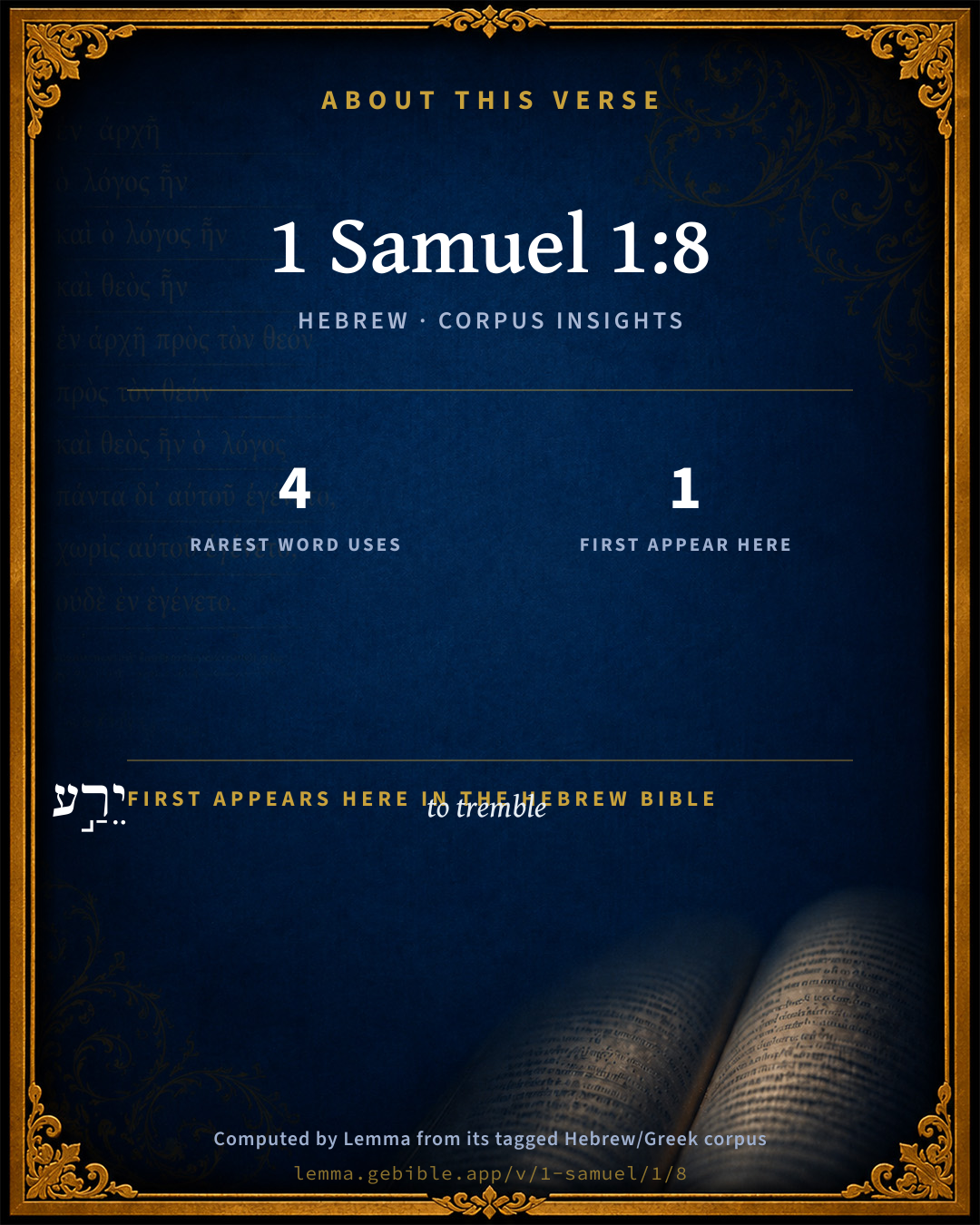
The rarest word here is יֵרַ֣ע to tremble H3415 — appearing just 4 times in the whole Hebrew Bible.

First appearance in Scripture

This word makes its first canonical appearance in the Hebrew Bible here:

  • יֵרַ֣ע to tremble H3415

Shared distinctive vocabulary

יֵרַ֣ע to tremble H3415 occurs in 4 verses of the Hebrew Bible. Also found in:

Grammatical profile

  • 4 verbs
  • 5 nouns
  • 2 adjectives
  • 1 pronoun
  • 2 prepositions
  • 5 particles

Verb forms

  • וַיֹּ֨אמֶר Qal · Sequential Imperfect
  • תִבְכִּ֗י Qal · Imperfect
  • תֹֽאכְלִ֔י Qal · Imperfect
  • יֵרַ֣ע Qal · Imperfect

Repetition

Words recur within this verse — often emphatic in Hebrew:

  • לָ֣מֶה what H4100 ×3
  • לֹ֣א not H3808 ×2

Hebrew & Septuagint length

In English translation the verse runs 30 words from the Hebrew and 51 from the Septuagint (LXX English) — the Septuagint runs noticeably longer here. See the side-by-side →

A rough comparison of the two English renderings, which tokenize alike — not a word-level alignment.

Word counts can differ between the Hebrew and the Greek without any difference in meaning — e.g. the Hebrew direct-object marker אֵת has no separate Greek word, and Greek often adds the article ὁ.

Cross-references

10

Topical passages linked to 1 Samuel 1:8 in the Treasury of Scripture Knowledge — connected by theme and wording, ordered by reader-vote popularity; previews shown in the World English Bible.

  • Ruth 4:15 He shall be to you a restorer of life, and sustain you in your old age, for your daughter-in-law, who loves you, who is better to you than seven sons, has borne him.
  • Job 6:14 "To him who is ready to faint, kindness should be shown from his friend; Even to him who forsakes the fear of the Almighty.
  • Isaiah 54:6 For Yahweh has called you as a wife forsaken and grieved in spirit, even a wife of youth, when she is cast off, says your God.
  • Psalms 43:4 Then I will go to the altar of God, To God, my exceeding joy. I will praise you on the harp, God, my God.
  • John 20:13 They told her, "Woman, why are you weeping?" She said to them, "Because they have taken away my Lord, and I don't know where they have laid him."
  • John 20:15 Jesus said to her, "Woman, why are you weeping? Who are you looking for?" She, supposing him to be the gardener, said to him, "Sir, if you have carried him away, tell me where you have laid him, and I will take him away."
  • 1 Thessalonians 5:14 We exhort you, brothers, admonish the disorderly, encourage the fainthearted, support the weak, be patient toward all.
  • 2 Samuel 12:16–17 David therefore begged God for the child; and David fasted, and went in, and lay all night on the earth.
  • 2 Kings 8:12 Hazael said, Why weeps my lord? He answered, Because I know the evil that you will do to the children of Israel: their strongholds will you set on fire, and their young men will you kill with the sword, and will dash in pieces their little ones, and rip up their women with child.
  • Isaiah 54:1 Sing, barren, you who didn't bear; break forth into singing, and cry aloud, you who did not travail with child: for more are the children of the desolate than the children of the married wife, says Yahweh.

Cross-references courtesy of OpenBible.info (CC BY 4.0).

Hebrew and Greek witnesses Masoretic Hebrew ↔ Greek Septuagint

The same verse in the two great witnesses to the Old Testament, shown verse-for-verse.

Here the Septuagint runs noticeably longer than the Hebrew — LXX2012 (modern English Septuagint) 51 words vs World English Bible 30. A rough length comparison of the two English translations, not a word-level alignment — read both below.

These are two independent witnesses, not word-aligned to each other, and the Septuagint is shown in lemma (dictionary) form.

Hebrew 1 Samuel 1:8 Masoretic · Westminster Leningrad Codex

וַיֹּ֨אמֶר לָ֜הּ אֶלְקָנָ֣ה אִישָׁ֗הּ חַנָּה֙ לָ֣מֶה תִבְכִּ֗י וְלָ֨מֶה֙ לֹ֣א תֹֽאכְלִ֔י וְלָ֖מֶה יֵרַ֣ע לְבָבֵ֑ךְ הֲל֤וֹא אָֽנֹכִי֙ ט֣וֹב לָ֔ךְ מֵעֲשָׂרָ֖ה בָּנִֽים

Elkanah her husband said to her, Hannah, why weep you? and why don't you eat? and why is your heart grieved? am I not better to you than ten sons?

World English Bible · Public Domain

Greek LXX 1 Samuel 1:8 Septuagint · lemma form

καί εἶπον αὐτός ελκανα ὁ ἀνήρ αὐτός αννα καί εἶπον αὐτός ἰδού ἐγώ κύριος καί εἶπον αὐτός τίς εἰμί σύ ὅτι κλαίω καί ἵνα τίς οὐ ἐσθίω καί ἵνα τίς τύπτω σύ ὁ καρδία σύ οὐ ἀγαθός ἐγώ σύ ὑπέρ δέκα τέκνον

And Helkana her husband said to her, Anna: and she said to him, Here am I, my lord: and he said to her, What ails you that you weep? and why do you not eat? and why does your heart strike you? am I not better to you than ten children?

LXX2012 (modern English Septuagint) · Public Domain

Hebrew: Westminster Leningrad Codex (CC BY 4.0). Greek: Septuagint (public domain); English from LXX2012 (modern English Septuagint) (Public Domain). How the Septuagint differs from the Hebrew →

Targum (Aramaic paraphrase)

1

The Targum is the ancient Jewish Aramaic paraphrase of the Hebrew Scriptures — an interpretive translation, not the Hebrew text itself. Onkelos (literal) and Pseudo-Jonathan (expansive) render the Torah, and Jonathan the Prophets. Coverage is partial: where no permissively-licensed English translation exists for a verse, only the Aramaic is shown. This is verse-level text, not a word-by-word alignment to the Hebrew.

  1. Targum Jonathan Prophets (Joshua–Malachi)
    וַאֲמַר לָהּ אֶלְקָנָה בַּעֲלָהּ חַנָה לְמָה אַתְּ בַּכְיָא וּלְמָה לָא תֵיכְלִי וּלְמָה בָּאֵישׁ לִיךְ לִיבֵּךְ הֲלָא רְעוּתִי טָבָא לִיךְ מַעֲשְׂרָא בְּנִין:

    (no public-domain English translation for this verse)

    Targum Jonathan — Aramaic: “Mikraot Gedolot” (public domain). English: “Sefaria Community Translation” (CC0 1.0 (public-domain dedication)); “London "Chaldee Paraphrase," 1871” (public domain). Text via Sefaria.

Commentary

Notes on 1 Samuel 1:8 from classic Christian and Jewish commentators (each source and its license shown beneath its notes). The classic Christian expositions comment on the surrounding passage and are grouped to its opening verse, so a note may address several verses; the Jewish commentaries on the Tanakh (Rashi and others) are per-verse, so they appear only where the commentator wrote on this verse.

Lemma curates 59 commentaries, every one of them public domain or Creative Commons licensed, each selected and text-cleaned for this edition rather than reprinted as found. About our sources →

Trapp's Complete Commentary

John Trapp

1Sa 1:8 Then said Elkanah her husband to her, Hannah, why weepest thou? and why eatest thou not? and why is thy heart grieved? [am] not I better to thee than ten sons?

Ver. 8. Hannah, why weepest thou?] Children should not be desired too passionately, because they are certain cares, but uncertain comforts. Sir Thomas Moore’s wife was mightily desirous of "a boy," - that was her word, - and she had one that proved a fool: and saith her husband, You were never quiet till you had a boy; and now you have one that will be all his life a boy.

Am not I better to thee than ten sons?] Than those ten sons of Peninnah, saith Lyra, following the Hebrews.

John Trapp, A Commentary or Exposition upon All the Books of the Old and New Testament (1647–1656) — public domain. Text from a community e-Sword module.

Joseph Benson's Commentary

1Sa 1:8. Am not I better to thee than ten sons — Oughtest thou not to value my love to thee more than the having as many sons as Peninnah hath; who would willingly change conditions with thee? In Elkanah here we have an example of a most excellent husband; who patiently bore with the insolent humour of Peninnah, and comforted dejected Hannah with words full of tender affection.

Joseph Benson's Commentary on the Old and New Testaments (1811–1818) — public domain. Text from a community e-Sword module.

Geneva Bible (1599)

Geneva Bible translators

Let this suffice thee, that I love thee no less, than if thou hadst many children.

Geneva Bible (1599) marginal notes — public domain. Text via Bolls.life.

Adam Clarke's Commentary

Verse 8. Am not I better to thee than ten sons?] TEN, a certain for an uncertain number. Is not my especial affection to thee better than all the comfort thou couldst gain, even from a numerous family?

Adam Clarke's Commentary on the Bible (1810–1826) — public domain. Text from a community e-Sword/MySword module.

Ellicott's Commentary for English Readers

(8) Than ten sons.—Merely a round number to express many. The simple narration evidently came from Hannah, who, no doubt, in after years loved to dwell on her past sorrowful life, contrasted with her present strange blessedness as mother of the Restorer of the people.

A Bible Commentary for English Readers, edited by Charles John Ellicott (1878–1897) — public domain. Text from a community e-Sword module.

The Cambridge Bible for Schools and Colleges

gen. ed. J. J. S. Perowne

8. better to thee than ten sons] Cp. Rth_4:15.

The Cambridge Bible for Schools and Colleges (gen. ed. J. J. S. Perowne; Cambridge University Press, 1878–1918) — public domain. Text from a community e-Sword module.

John Gill's Exposition

Then said Elkanah her husband to her, Hannah, why weepest thou?.... Since it was a time of rejoicing, as every festival was, especially at the ingathering of the fruits of the earth:

and why eatest thou not? since they were at a feast, and she had the best part and portion of the provision:

and why is thy heart grieved? to such a degree that she could neither eat nor drink:

am not I better to thee than ten sons? which, as Jarchi says, Peninnah had borne to him; his meaning is, that the share she had in his love and affections ought to have been esteemed by her more than if she had ten or many children by him; and it suggests that Peninnah would have been glad to have such a share in his affections as Hannah had; and it would have been more eligible to her, than to have borne him so many children as she had.

John Gill's Exposition of the Whole Bible (1746–1763) — public domain (CC PDM 1.0). Text via the HelloAO Bible API.

Matthew Poole's English Annotations

Oughtest thou not to value my hearty love to thee, more than the having of as many sons as Peninnah hath? She would willingly change conditions with thee.

Matthew Poole's English Annotations on the Holy Bible (1683–1685) — public domain. Text from a community e-Sword/MySword module.

Whedon's Commentary on the Bible

Daniel D. Whedon

8. Better… than ten sons — There is greater good in matrimonial concord than in mere fruitfulness. — Grotius.

Daniel D. Whedon (gen. ed.), Commentary on the Old and New Testaments (1874–1909) — public domain. Text from a community e-Sword module.

John Wesley's Explanatory Notes

Ten sons - Oughtest thou not to value my hearty love to thee, more than the having of as many sons as Penninah hath? She would willingly change conditions with thee.

John Wesley, Explanatory Notes Upon the Whole Bible (1754–1765) — public domain. Text via the GEBible commentary corpus.

Rashi

Rabbi Shlomo Yitzchaki (Rashi)

Am I not better to you. Don't I love you more dearly.

Than ten sons. That Penina has borne to me.

Rashi on the Tanakh — English translations: “The Judaica Press complete Tanach with Rashi, translated by A. J. Rosenberg” (CC BY 4.0); “Pentateuch with Rashi's commentary by M. Rosenbaum and A.M. Silbermann, 1929-1934” (public domain); “The Metsudah Tanach series, Lakewood, N.J” (CC BY 4.0); and “The Book of Joshua, Metsudah Publications, 1997” (CC BY 4.0). Text via Sefaria.

Radak

Rabbi David Kimhi (Radak)

Am I not: It is like the Targum [Yonatan], "Is not my wish better to you" - meaning to say, "Is not my wish towards you and my love for you better to you than ten sons?" But some explain, "Am I not better to you than I am to the ten sons I have from Peninah" - meaning to say, I love you more than I love my sons. And he said this because Peninah had ten sons. But according to our explanation, the reason for [the word], "ten," is by way of a general (figurative) count - as in (Leviticus 26:26), "and ten women will bake"; "than ten rulers" (Ecclesiastes 7:19); "seven times like your sins" (Leviticus 26:21); "seven times does a righteous one fall" (Proverbs 24:16); and that which is similar to them.

Radak on the Tanakh — English translations: “Sefaria Community Translation” (CC0 1.0 (public-domain dedication)); “Eliyahu Munk, HaChut Hameshulash” (CC BY 4.0); “Rabbi Mike Feuer, Jerusalem Anthology” (CC BY 4.0); and “R. David Kimhi on the first book of Psalms, Translated by R.G. Finch, London, 1919” (public domain). Text via Sefaria.

Lesson kit

Teaching starters — assembled from the data on this page, not authored interpretation. Every prompt links to the verse data it draws on. Edit before teaching.

1 Samuel, in the Historical, opens this verse with 19 words (14 distinct Hebrew lemmas). Its most distinctive word is yâraʻ (“to tremble”). The Greek Septuagint runs longer here. A historical commentator’s framing appears above. Read the whole chapter for the surrounding context.

Discussion questions

  1. How does “to tremble” (yâraʻ) shape what this verse is saying?
  2. This is the first place “to tremble” appears in Scripture (first appears here). What does its debut here establish?
  3. How does 2 Samuel 20:6, which shares the word «to tremble», read alongside this verse?
  4. What does the repetition of “what” (3× in this one verse) do in this verse?
  5. The Septuagint runs longer here than the Hebrew. What might account for the difference?
  6. These translations render this verse differently; the difference is in the English rendering, not the original. What questions does that raise?
  7. «וַיֹּ֨אמֶר» is a Qal Sequential Imperfect verb. How does that grammatical form shape the action described?
  8. Compare how Trapp's Complete Commentary and Joseph Benson's Commentary read this verse. Where do they agree or differ?

Things to notice

  • 1 word makes its first canonical appearance in Scripture here.
  • These translations choose different wording for 10 words in this verse.
  • “what” occurs 3× in this single verse.
  • 14 distinct Hebrew lemmas span 19 words in this verse.

Reading settings

Reading text

Shown beneath each verse's original-language words.

Old Testament
Old Testament edition

Read the OT as the Masoretic Hebrew (MT) or the Greek Septuagint (LXX).

English shown for the Greek Septuagint (in the Hebrew ↔ Greek comparison).

Comparing translations? Open the Compare panel on any verse page to stack up to four side by side.