
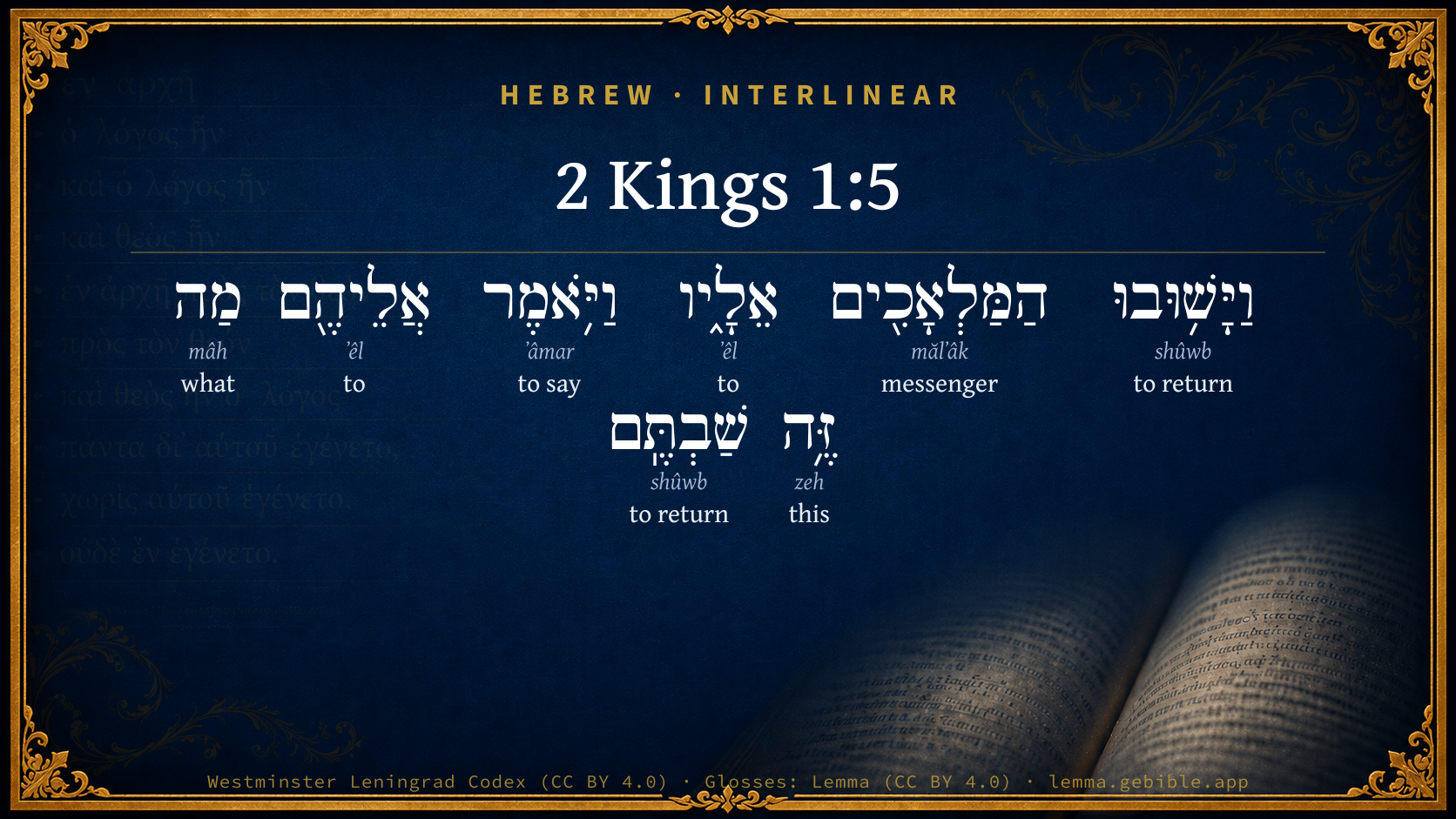
2 Kings 1:5

Hebrew (Westminster Leningrad Codex) 2 Kings 1:5 appears in the Hebrew Old Testament. The text above is from the Westminster Leningrad Codex. Each word links to its Strong’s number, a concise gloss, and parsing drawn from the Open Scriptures Hebrew Bible morphology. Click any word for its full Brown-Driver-Briggs (BDB) entry.
Download image
Cite this verse

2 Kings 1:5 (World English Bible). Public Domain. Lemma interlinear Bible study tool, https://lemma.gebible.app/v/2-kings/1/5.

Show BibTeX & RIS
BibTeX
RIS
English Translation
The messengers returned to him, and he said to them, Why is it that you have returned?
World English Bible · Public Domain
Download a study sheet

One document with this verse’s original text, its word-by-word gloss line, the meaning frame, cross-references with their text, attributed commentary, and full source and license credits — printable, and it pastes into notes with its structure intact.

This verse Autodidact and up

Study sheet (.html) Plain text (.txt)

A passage Seminary Student

Up to 50 verses in one chapter. A passage sheet keeps up to 6 commentary sources and 12 cross-references per verse, in the order this page ranks them, and says so on the sheet whenever that leaves anything out. Ask for a single verse and you get the Autodidact verse sheet above.

Everything on this page stays free to read, with no account — the sheet is a download of what is already on screen, not access to it.

Want to remove ads? Support Godless Engineer
Compare translations 3

The same verse in 3 English versions, stacked beneath the original-language interlinear above. Click any original word for its lexicon entry.

Each is an independent rendering of the whole verse — the interlinear is not word-aligned to these translations.

Highlighted words mark where these versions differ — a whole-verse word diff, not a word-by-word alignment.

  • World English Bible Public Domain
    The messengers returned to him, and he said to them, Why is it that you have returned?
  • King James Version Public Domain
    And when the messengers turned back unto him, he said unto them, Why are ye now turned back?
  • unfoldingWord Literal Text CC BY-SA 4.0
    And the messengers returned to him. And he said to them, “What this, you have returned?”

unfoldingWord Literal Text — © unfoldingWord, licensed CC BY-SA 4.0. Word-aligned USFM3 via Door43 (git.door43.org/unfoldingWord/en_ult).

Versions to compare (up to 4)

3 of 4 selected

Show all 18 translations

Every available English version of this verse, each an independent rendering of the whole verse.

  • World English Bible Public Domain
    The messengers returned to him, and he said to them, Why is it that you have returned?
  • Berean Standard Bible Public Domain
    When the messengers returned to the king, he asked them, “Why have you returned?”
  • Majority Standard Bible Public Domain
    When the messengers returned to the king, he asked them, “Why have you returned?”
  • King James Version Public Domain
    And when the messengers turned back unto him, he said unto them, Why are ye now turned back?
  • American Standard Version (1901) Public Domain
    And the messengers returned unto him, and he said unto them, Why is it that ye are returned?
  • Revised Version (1885) Public Domain
    And the messengers returned unto him, and he said unto them, Why is it that ye are returned?
  • Geneva Bible (1599) Public Domain
    And the messengers returned vnto him, to whome he said, Why are ye nowe returned?
  • Douay-Rheims (1899) Public Domain
    And the messengers turned back to Ochozias. And he said to them: Why are you come back?
  • Young's Literal Translation Public Domain
    And the messengers turn back unto him, and he saith unto them, `What `is' this -- ye have turned back!'
  • Literal Standard Version CC BY-SA 4.0
    And the messengers return to him, and he says to them, “What [is] this—you have turned back!”
  • Unlocked Literal Bible CC BY-SA 4.0
    When the messengers returned to Ahaziah, he said to them, “Why have you returned?”
  • unfoldingWord Literal Text CC BY-SA 4.0
    And the messengers returned to him. And he said to them, “What this, you have returned?”
  • Darby Bible Public Domain
    And the messengers returned to him; and he said to them, Why have ye returned?
  • World Messianic Bible Public Domain
    The messengers returned to him, and he said to them, “Why is it that you have returned?”
  • Webster's Bible Public Domain
    And when the messengers turned back to him, he said to them, Why have ye now returned?
  • Free Bible Version CC BY-SA 4.0
    The messengers returned to the king, and he asked them, “Why have you come back?”
  • Bible in Basic English Public Domain
    And the men he had sent came back to the king; and he said to them, Why have you come back?
  • JPS Tanakh (1917) Public Domain
    And the messengers returned unto him, and he said unto them: 'Why is it that ye are returned?'

Literal Standard Version (2020), Covenant Press — licensed CC BY-SA 4.0. Text via the HelloAO Bible API (eBible.org). Unlocked Literal Bible (unfoldingWord) — licensed CC BY-SA 4.0. Text via the HelloAO Bible API (eBible.org). unfoldingWord Literal Text — © unfoldingWord, licensed CC BY-SA 4.0. Word-aligned USFM3 via Door43 (git.door43.org/unfoldingWord/en_ult). Free Bible Version, Dr. Jonathan Gallagher — licensed CC BY-SA 4.0. Text via the HelloAO Bible API (eBible.org).

Word by word

More ways to search: Search by grammar → Find every occurrence → Compare this word →

Practice this passage: Drill this verse → Learn its vocabulary →

הַמַּלְאָכִ֖ים
mălʼâk
H4397
“the · messengers”
Particle, Definite Article + Noun, Common, Masculine, Plural, Absolute
Part of Speech
Particle + Noun
Type
Common
Gender
Masculine
Number
Plural
State
Absolute
Full BDB Definition

Origin: from an unused root meaning to despatch as a deputy

TWOT: 1068a

messenger, representative - messenger - angel - the theophanic angel
  1. וַיָּשׁ֥וּבוּ shûwb H7725 “and · to return” Conjunction + Verb, Qal, Sequential Imperfect, 3rd Person, Masculine, Plural
  2. אֵלָ֑יו ʼêl H413 “to · him” Preposition + Suffix, Personal, 3rd Person, Masculine, Singular
  3. וַיֹּ֥אמֶר ʼâmar H559 “and · to say” Conjunction + Verb, Qal, Sequential Imperfect, 3rd Person, Masculine, Singular
  4. אֲלֵיהֶ֖ם ʼêl H413 “to · them” Preposition + Suffix, Personal, 3rd Person, Masculine, Plural
  5. מַה mâh H4100 “what” Particle, Interrogative
  6. זֶּ֥ה zeh H2088 “this” Pronoun, Demonstrative, Masculine, Singular
  7. שַׁבְתֶּֽם shûwb H7725 “to return” Verb, Qal, Perfect, 2nd Person, Masculine, Plural

About this verse

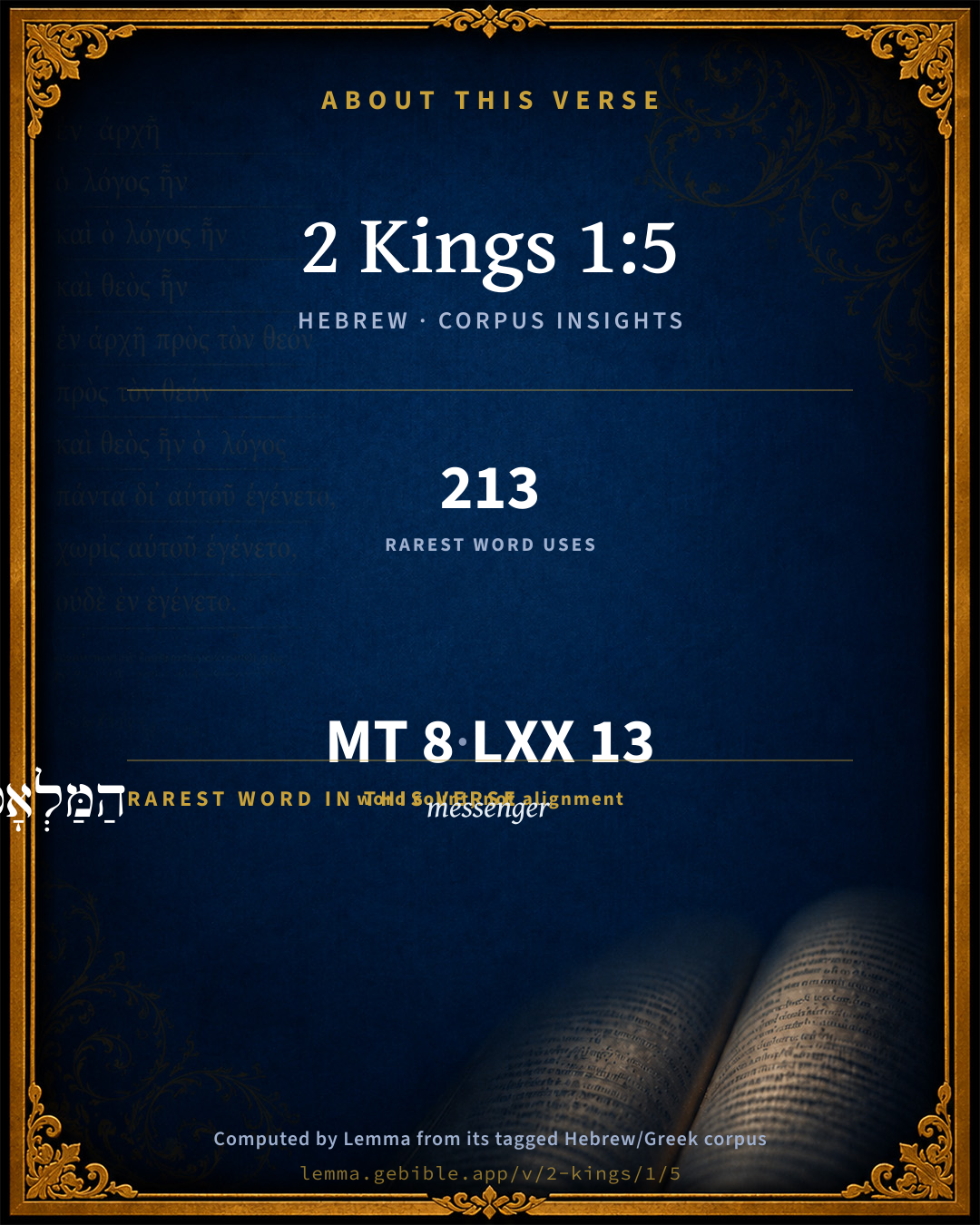
These counts appear in no published source. They are computed here, from the morphology-tagged text and Lemma’s own curated glosses. What Lemma adds →

8
words
6
distinct lemmas
Historical
section

Grammatical profile

  • 3 verbs
  • 1 noun
  • 1 pronoun
  • 2 prepositions
  • 1 particle

Verb forms

  • וַיָּשׁ֥וּבוּ Qal · Sequential Imperfect
  • וַיֹּ֥אמֶר Qal · Sequential Imperfect
  • שַׁבְתֶּֽם Qal · Perfect

Repetition

Words recur within this verse — often emphatic in Hebrew:

  • וַיָּשׁ֥וּבוּ to return H7725 ×2
  • אֵלָ֑יו to H413 ×2

Hebrew & Septuagint length

In English translation the verse runs 17 words from the Hebrew and 15 from the Septuagint (LXX English) — closely comparable.

A rough comparison of the two English renderings, which tokenize alike — not a word-level alignment.

Word counts can differ between the Hebrew and the Greek without any difference in meaning — e.g. the Hebrew direct-object marker אֵת has no separate Greek word, and Greek often adds the article ὁ.

In the original languages it is 8 Hebrew tokens and 13 Greek tokens — but the two are counted differently (Hebrew bundles its prefixes and suffixes into one token; the Greek is in lemma form), so that isn’t a like-for-like length.

Hebrew and Greek witnesses Masoretic Hebrew ↔ Greek Septuagint

The same verse in the two great witnesses to the Old Testament, shown verse-for-verse.

These are two independent witnesses, not word-aligned to each other, and the Septuagint is shown in lemma (dictionary) form.

Hebrew 2 Kings 1:5 Masoretic · Westminster Leningrad Codex

וַיָּשׁ֥וּבוּ הַמַּלְאָכִ֖ים אֵלָ֑יו וַיֹּ֥אמֶר אֲלֵיהֶ֖ם מַה זֶּ֥ה שַׁבְתֶּֽם

The messengers returned to him, and he said to them, Why is it that you have returned?

World English Bible · Public Domain

Greek LXX 2 Kings 1:5 Septuagint · lemma form

καί ἐπιστρέφω ὁ ἄγγελος πρός αὐτός καί εἶπον πρός αὐτός τίς ὅτι ἐπιστρέφω

And the messengers returned to him, and he said to them, Why have you⌃ returned?

LXX2012 (modern English Septuagint) · Public Domain

Hebrew: Westminster Leningrad Codex (CC BY 4.0). Greek: Septuagint (public domain); English from LXX2012 (modern English Septuagint) (Public Domain). How the Septuagint differs from the Hebrew →

Targum (Aramaic paraphrase)

1

The Targum is the ancient Jewish Aramaic paraphrase of the Hebrew Scriptures — an interpretive translation, not the Hebrew text itself. Onkelos (literal) and Pseudo-Jonathan (expansive) render the Torah, and Jonathan the Prophets. Coverage is partial: where no permissively-licensed English translation exists for a verse, only the Aramaic is shown. This is verse-level text, not a word-by-word alignment to the Hebrew.

  1. Targum Jonathan Prophets (Joshua–Malachi)
    וְתָבוּ אִזְגַדַיָא לְוָתֵיהּ וַאֲמַר לְהוֹן מָא דֵין תַּבְתּוּן:

    (no public-domain English translation for this verse)

    Targum Jonathan — Aramaic: “Mikraot Gedolot” (public domain). English: “Sefaria Community Translation” (CC0 1.0 (public-domain dedication)); “London "Chaldee Paraphrase," 1871” (public domain). Text via Sefaria.

Commentary

Notes on 2 Kings 1:5 from classic Christian and Jewish commentators (each source and its license shown beneath its notes). The classic Christian expositions comment on the surrounding passage and are grouped to its opening verse, so a note may address several verses; the Jewish commentaries on the Tanakh (Rashi and others) are per-verse, so they appear only where the commentator wrote on this verse.

Lemma curates 59 commentaries, every one of them public domain or Creative Commons licensed, each selected and text-cleaned for this edition rather than reprinted as found. About our sources →

Trapp's Complete Commentary

John Trapp

2Ki 1:5 And when the messengers turned back unto him, he said unto them, Why are ye now turned back?

Ver. 5. Why are ye now turned back?] Re infecta, as he thought; but they returned unto him with heavy tidings, as 1Ki 14:6. "An evil man seeketh only rebellion, therefore a cruel messenger shall be sent against him." {Pro 17:11}

John Trapp, A Commentary or Exposition upon All the Books of the Old and New Testament (1647–1656) — public domain. Text from a community e-Sword module.

Joseph Benson's Commentary

2Ki 1:5. He said, Why are ye now turned back? — Before you have been at Ekron: which he knew by their quick return. To avoid a repetition, we have no account given of the prophet’s meeting them, other than what they give of it themselves at their return.

Joseph Benson's Commentary on the Old and New Testaments (1811–1818) — public domain. Text from a community e-Sword module.

Jamieson, Fausset & Brown

Robert Jamieson, A. R. Fausset & David Brown

the messengers turned back--They did not know the stranger; but his authoritative tone, commanding attitude, and affecting message determined them at once to return.

Jamieson, Fausset & Brown — Commentary Critical and Explanatory on the Whole Bible (1871) — public domain (CC PDM 1.0). Text via the HelloAO Bible API.

Ellicott's Commentary for English Readers

(5) Turned back unto him.—Unto Ahaziah, as the Syriac and Vulgate actually read. Literally, And the messengers returned unto him, and he said, &c. Though Elijah was unknown to the envoys, such a menacing interposition would certainly be regarded as’ a Divine warning, which it was perilous to disregard.

Why are ye now turned back?—Why have ye returned? with emphasis on the “Why.”

A Bible Commentary for English Readers, edited by Charles John Ellicott (1878–1897) — public domain. Text from a community e-Sword module.

The Cambridge Bible for Schools and Colleges

gen. ed. J. J. S. Perowne

5. And when the messengers turned back unto him, he said] More literally with R.V., And the messengers returned unto him and he said. The pronoun refers to the sick king in Samaria. They could only have gone a little way on their journey, and their early reappearance caused him some surprise.

‘The errand is soon done. The messengers are returned ere they go. Not a little were they amazed to hear their secret message from another’s mouth, neither could they choose but think: He that can tell what Ahaziah said, what he thought, can foretell how he shall speed. We have met with a greater god than we went to seek. What need we inquire for another answer?’ (Bp Hall’s Contemplations).

Why are ye now turned back?] To accord with the previous clause, render with R.V., Why is it that ye are returned?

The Cambridge Bible for Schools and Colleges (gen. ed. J. J. S. Perowne; Cambridge University Press, 1878–1918) — public domain. Text from a community e-Sword module.

John Gill's Exposition

And when the messengers turned back unto him,.... To Ahaziah king of Israel, as they did as soon as Elijah was gone from them; concluding from his habit, his gravity, and the authority with which he spoke, that he was a prophet of the Lord, and especially from his knowledge of them, and of what they were sent about:

he said unto them, why are ye now turned back? for, by the time they had been gone, he knew they could never have been at Ekron and returned.

John Gill's Exposition of the Whole Bible (1746–1763) — public domain (CC PDM 1.0). Text via the HelloAO Bible API.

Haydock's Catholic Bible Commentary

Messengers. They were perhaps citizens of Accaron, who had extolled the sagacity of their god, but were totally unacquainted with Elias. Yet as he shewed his knowledge of secret things, by telling them what they were going about, (Salien) and spoke with such assurance, (Haydock) they thought proper to return, lest they should incur a similar punishment. (Menochius)

George Leo Haydock (1774–1849), Haydock's Catholic Family Bible and Commentary, 1859 edition — public domain. Excludes Psalms (Douay-Rheims chapter numbering differs from Protestant) and Deuterocanonical books (Catholic canon only).

Matthew Poole's English Annotations

Before you have been at Ekron; which he easily knew by their quick return.

Matthew Poole's English Annotations on the Holy Bible (1683–1685) — public domain. Text from a community e-Sword/MySword module.

The Pulpit Commentary

And when the messengers turned back; rather, when the messengers returned; i.e. when they reached the presence of Ahaziah, he perceived at once that they could not have been to Ekron and come back in the time. He therefore inquired of them, Why are ye now turned back? "Why have ye not completed your journey?

Vers. 5-16.

Fire from heaven.

Ahaziah"s messengers were intercepted by Elijah. They brought back to Ahaziah the fearless prophet"s announcement of his doom. Elijah"s message was God"s message. He began it by "Thus saith the Lord." The statement that Ahaziah would surely die was in reality the sentence of him who knows the future of every life, and in whose band is the breath of every human being, be he peasant or be he king. But such a terrible sentence had not brought Ahaziah to his senses. He does not begin to set his house in order. He does not prepare to meet his God as a guilty but penitent sinner. No; but when the messengers tell him of the strange interruption they bad met with, recognizing at once from their description that it was Elijah the Tishbite who had stopped them, he is filled with anger and defiance. He has defied God when in health; now he defies him from a bed of sickness. He sends forth a captain with a company of fifty men to lay hold upon the prophet. It was not the first time Elijah"s life had been threatened by royal sinners. When a man is fearless in rebuking sin, he must expect the hatred of impenitent sinners. Smooth words may win a fleeting popularity, but the friendship of this world is enmity against God. Popularity is dearly bought that is obtained at the sacrifice of truth, of conscience, and of duty. But Elijah"s life is safe in the hands of the Master whom he serves. Once before God had vindicated his own honor and Elijah"s faithfulness by sending fire from heaven to consume his sacrifice. In a similar manner now he defends Elijah and punishes his enemies. The incident is one which presents some difficulties. The study of it suggests many useful lessons.

I FIRE FROM HEAVEN IS AN ACT OF JUSTICE. It may appear to some that these first two captains and their fifties were hardly dealt with. Some one may say, "It was their duty to obey. They were only executing the king"s orders. They were not responsible for the message which they brought from the king to Elijah. It was hard, then, that they should suffer for doing that which it was their duty to do." These are very plausible statements. Let us examine them a little more closely. Let us remember that man is not a mere machine. Every man has an immortal soul, coming from God, going back to God, and accountable to God for its actions. There is such a thing as individual personal responsibility. No external circumstances, no position in life, can ever take away that responsibility. These captains and their men were bound to do their duty to their king. Yes; but not in defiance of the Law and power of God. Where the will of man or the word of man comes into conflict with the will or Word of God, then it is the duty of every human being to say, "We ought to obey God rather than men" These officers and soldiers were really encouraging Ahaziah in his guilt. They knew that he was an idolater. They knew that he was a worshipper of Baal. They knew that the man whom he was sending them to arrest was a servant of the most high God, and his foremost living prophet. They knew of the sentence which had already been pronounced against Ahaziah. Yet here, at his bidding, they go forth as the instruments of his defiance against the living God. They were sharers in his guiltparticipes criminis. They were personally guilty before God. We can never shift our own responsibility on to the shoulders of others. It did not make Adam"s guilt less that he accused Eve, or Eve"s guilt less that she accused the serpent. They were intelligent beings, with the power of free choice. Our plain duty is, if we are in any position or business which requires us to violate the Law of God, at once to give it up. God says, "Them that honor me I will honor." Moreover, they had already been warned of the sin and danger of resisting God. They knew how the prophets of Baal had been slain. They knew how Elijah"s prophecy in other words, God"s sentence against Ahab had come true, that where the dogs licked the blood of Naboth, there they would lick the blood of Ahab, and they knew that a similar doom was foretold against Jezebel. Yet in spite of all these warnings they went forth against the prophet of God. So the sinner has many warnings. How often God"s Word and God"s messenger have called him to repentance! Perhaps by sickness and suffering he has had reminders of approaching death. By sudden bereavement he has been reminded that "in such an hour as ye think not the Son of man cometh." Let him beware of turning a deaf ear to the warning voice. "See that ye refuse not him that speaketh." Further, when we are considering the justice of this fire from heaven, let us remember that the life of God"s most useful servant was at stake. It is pretty certain that Ahaziah, when he sent for Elijah, wanted to take his life. It is pretty certain also that, had Elijah gone with either of the first two captains, his life would have been in danger. It was only after the third time of sending that God said to Elijah, "Be not afraid of him." It was only then, perhaps, that Ahaziah realized the uselessness of fighting against God. We hold by the principle that life should not be recklessly sacrificed. But if we are disposed to speak of this incident as reckless sacrifice of life, let us remember what hundreds of lives have been imperiled and sacrificed more than once, even for the sake of a single British subject. No right-minded person would condemn the sending forth of soldiers many of them to certain death in such a case as that of Abyssinia, where the lives of British subjects were in danger, or that of the attempted rescue of General Gordon. Before we can cherish a suspicion of injustice against the dealings of God, let us be sure that we have fight and reason on our side. A full examination of all the circumstances will generally banish even such a suggestion from our minds. But, then, there are many cases where we cannot possibly understand or know all the circumstances. In such a case, is it not the only course we can take to bow in submission to the all-wise will of God? "Shall not the Judge of all the earth do right?" For all these reasons I conclude that the fire which came down from heaven upon these soldiers was an act of justice.

II FIRE FROM HEAVEN IS AN ACT OF NECESSITY. More than one reason has already been suggested why this fire from heaven was necessary. It may have been necessary in defense of the prophet"s life. It may have been necessary in vindication of the power and honor of God; for it took place at a time of almost universal idolatry and Baal-worship on the part of Israel. This, however, we may be sure of, that, whether we can see the necessity for it or not, fire from heaven is necessary, or God would not send it. There are three uses, which fire serves in the natural world, for which analogies may be found in the spiritual world. These are purifying, destroying, and testing. We need the cleansing fires to purify us in the spiritual life. Perhaps we are becoming too worldly, too much engrossed with the things of this life, laying up for ourselves treasures upon earth. Perhaps we are making an idol of some earthly object of our affection. Perhaps we are becoming spiritually proud. Perhaps we compare ourselves favorably with others, and think how much better we are than they. Then our heavenly Father may think it wise to purify us from such dross as this. And so he calls us to pass through the furnace of affliction, or adversity, or sickness. Thus he humbles us. Thus he keeps us mindful that we are but dust. Thus he keeps us mindful of our dependence upon him. Then the destroying fire is needed in the moral and spiritual world, as well as in the natural world. It was a necessary part of the Divine government that Sodom and Gomorrah should be destroyed. They were a moral plague-spot. The festering limb must be cut off if the body is to be saved. So also Herculaneum and Pompeii were destroyed when they too became a center of moral degradation and corruption. Would it be any wonder, would it be any injustice, if the fire of God would come down from heaven and burn up some of the moral plague-spots of modern times? Would not the world be vastly the better if the gambling-hells and drinking-hells and hells of immorality were burnt up in one vast conflagration? And if they are spared, and if the moral corrupters of others are spared, will it be any better for them in that day when "the fearful, and unbelieving, and the abominable, and murderers, and whoremongers, and sorcerers, and idolaters, and all liars, shall have their part in the lake which burneth with fire and brimstone: which is the second death"? Then there is the testing fire. This also is necessary in the spiritual world. "Wherein ye greatly rejoice," says the Apostle Peter, "though now for a season, if need be, ye are in heaviness through manifold temptations, that the trial of your faith, being much more precious than of gold that perisheth, though it be tried with fire, might be found unto praise and honor and glory at the appearing of Jesus Christ". (1Pe_1:6, 1Pe_1:7) If there were no trials and difficulties, there would be no test, no proof of our faith. And then the time is coming when the fire the searching, testing fire of God"s judgment shall try every man"s work of what sort it is. If our life is built up on Christ, then out of the purifying fire it will come clearer and brighter, from the destroying fire it will suffer no harm, and from the testing fire it will come forth to honor and glory. "Then shall the righteous shine forth as the sun in the kingdom of their Father". (Mat_13:43)

III FIRE FROM HEAVEN IS NOT INCONSISTENT WITH THE DIVINE MERCY. Here we may consider a difficulty which some have raised. When Jesus, on his way to Jerusalem, passed through a village of the Samaritans, the people there would not receive him, "because his face was as though he would go to Jerusalem." The disciples, in anger, asked him if they should command fire to come down from heaven, as Elijah did, and consume them. The answer of our Savior was, "Ye know not what manner of spirit ye are of. For the Son of man is not come to destroy men"s lives, but to save them". (Luk_9:51-56) Now, the question which some have asked is this Does not Christ here condemn the action of Elijah? A careful study of the narrative before us would at once dispose of such a question as that. It is said here, "The fire of God came down from heaven." Even if this were not stated, it is obvious that Elijah of himself had no power to bring down fire from heaven, unless with God"s sanction and assistance. But a great many commentators and preachers, who would not go the length of saying that Christ condemned Elijah, seem to suggest that he condemned his spirit, as unsuited to gospel times. Even for this suggestion I do not think there is any warrant. Our Savior condemned the disciples for a spirit of vindictiveness and revenge, which probably was intensified by the feeling of prejudice and animosity which existed against the Samaritans. He also stated that he was not come to destroy men"s lives, but to save them. His work, then, was one of salvation. But those who rejected his salvation were certainly to perish. More than once Christ in the clearest manner teaches this. "Except ye repent, ye shall all likewise perish." He foretells the doom of Jerusalem. He foretells the terrible agony of lost souls, who shall go away into everlasting fire; "there shall be the wailing and the gnashing of teeth." The action of retributive justice, therefore, is perfectly consistent with mercy toward the sinner. The consuming fire may be part of a merciful and loving purpose toward the world at large. In the particular case before us, we see that mercy was exhibited as well as justice. The third captain, who showed a humble spirit, and apparently some regret at the work he had to do, was mercifully spared the fate, which had fallen upon the other two. While we speak of the consuming fire of God"s justice, we would speak also of mercy for the penitent, of forgiveness, full and free, for every anxious soul, for every returning wanderer. "Believe on the Lord Jesus Christ, and thou shalt be saved. C.H.I

The Pulpit Commentary (1880–1919), ed. H.D.M. Spence-Jones & Joseph S. Exell — public domain. Text from a community e-Sword module.

John Wesley's Explanatory Notes

Why, &c. - Before you have been at Ekron: which he knew by their quick return.

John Wesley, Explanatory Notes Upon the Whole Bible (1754–1765) — public domain. Text via the GEBible commentary corpus.

unfoldingWord translationNotes

Door43 World Missions Community

When the messengers returned to Ahaziah

After meeting with Elijah, the messengers returned to the king instead of going to Ekron. (See: Assumed Knowledge and Implicit Information)

Is it because there is no God in Israel that you sent men to consult with Baal-Zebub, the god of Ekron?

This rhetorical question is asked as a rebuke for consulting Baal-Zebub. This may be written as a statement. This is irony because they are definitely aware of the God of Israel. See how you translated a similar question in 2 Kings 3:3. AT: "You fools! You know there is a God in Israel, but you were acting as though you did not know when you sent men to consult Baal-Zebub, the god of Ekron!" (See: Rhetorical Question)

you will not come down from the bed to which you have gone up

When King Ahaziah was injured, he was placed in a bed. Yahweh said that he will never become well and be able to get out of the bed. See how you translated this statement in 2 Kings 3:4. AT: "you will not recover and you will not get up from the bed on which you are lying" (See: Assumed Knowledge and Implicit Information)

unfoldingWord translationNotes — © Distant Shores Media and the Door43 World Missions Community, licensed CC BY-SA 4.0. Source: git.door43.org/Door43/en_tn.

Lesson kit

Teaching starters — assembled from the data on this page, not authored interpretation. Every prompt links to the verse data it draws on. Edit before teaching.

2 Kings, in the Historical, opens this verse with 8 words (6 distinct Hebrew lemmas). Its most distinctive word is mălʼâk (“messenger”). A historical commentator’s framing appears above. Read the whole chapter for the surrounding context.

Discussion questions

  1. What does “messenger” (mălʼâk) contribute to the verse as a whole?
  2. “to return” occurs 2× in this one verse. What is the effect of the repetition?
  3. These translations render this verse differently. What is at stake in choosing one wording over another?
  4. The verb «וַיָּשׁ֥וּבוּ» is Qal Sequential Imperfect. How does its form color the action?
  5. Reading how Trapp's Complete Commentary and Joseph Benson's Commentary read this verse, where do the two commentators agree and where do they part?

Things to notice

Reading settings

Reading text

Shown beneath each verse's original-language words.

Old Testament
Old Testament edition

Read the OT as the Masoretic Hebrew (MT) or the Greek Septuagint (LXX).

English shown for the Greek Septuagint (in the Hebrew ↔ Greek comparison).

Comparing translations? Open the Compare panel on any verse page to stack up to four side by side.