
Isaiah 41:22

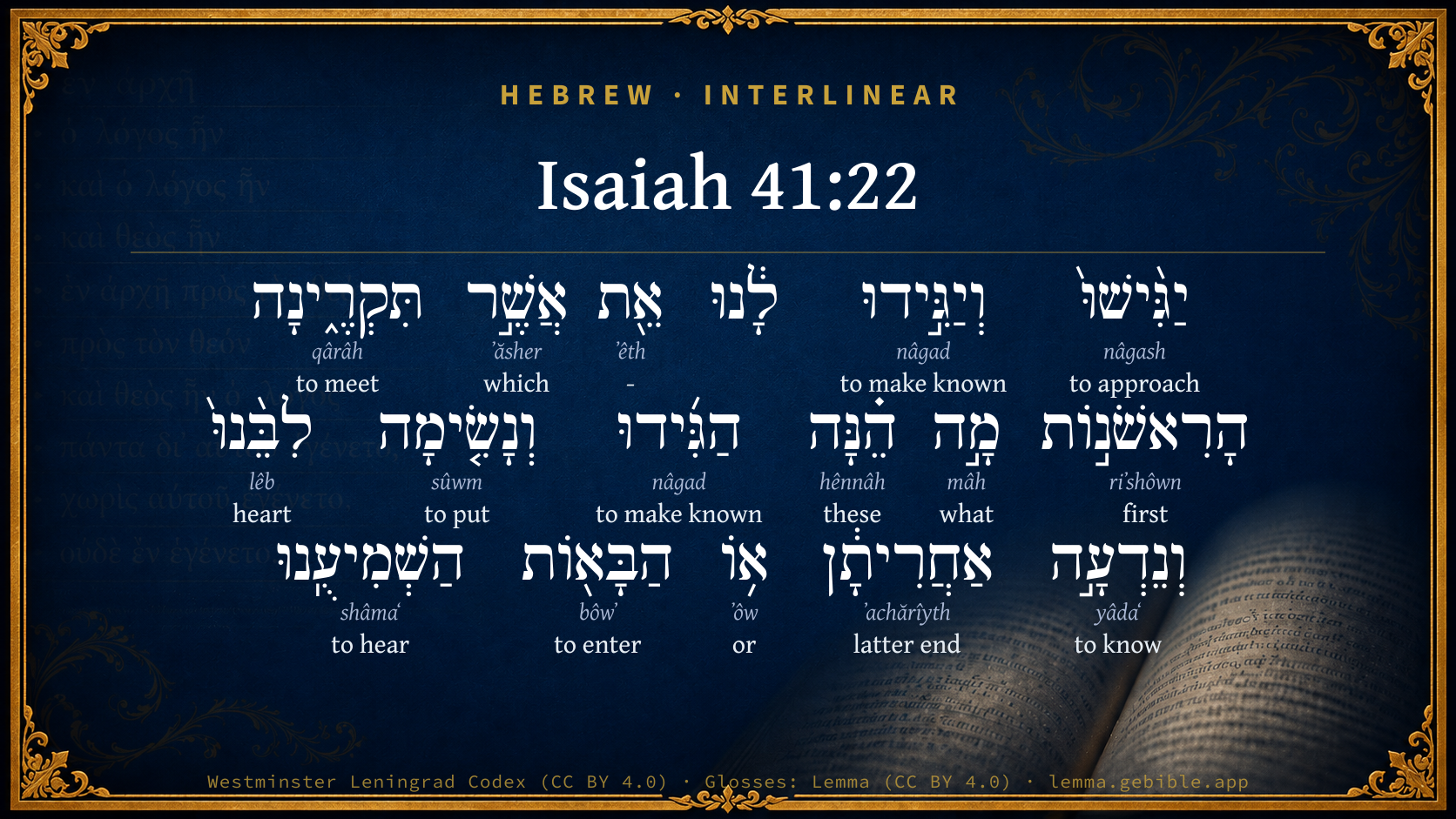
Hebrew (Westminster Leningrad Codex) Isaiah 41:22 appears in the Hebrew Old Testament. The text above is from the Westminster Leningrad Codex. Each word links to its Strong’s number, a concise gloss, and parsing drawn from the Open Scriptures Hebrew Bible morphology. Click any word for its full Brown-Driver-Briggs (BDB) entry.
Download image
Cite this verse

Isaiah 41:22 (World English Bible). Public Domain. Lemma interlinear Bible study tool, https://lemma.gebible.app/v/isaiah/41/22.

Show BibTeX & RIS
BibTeX
RIS
English Translation
Let them bring forth, and declare to us what shall happen: declare you the former things, what they are, that we may consider them, and know the latter end of them; or show us things to come.
World English Bible · Public Domain
Download a study sheet

One document with this verse’s original text, its word-by-word gloss line, the meaning frame, cross-references with their text, attributed commentary, and full source and license credits — printable, and it pastes into notes with its structure intact.

This verse Autodidact and up

Study sheet (.html) Plain text (.txt)

A passage Seminary Student

Up to 50 verses in one chapter. A passage sheet keeps up to 6 commentary sources and 12 cross-references per verse, in the order this page ranks them, and says so on the sheet whenever that leaves anything out. Ask for a single verse and you get the Autodidact verse sheet above.

Everything on this page stays free to read, with no account — the sheet is a download of what is already on screen, not access to it.

Want to remove ads? Support Godless Engineer
Compare translations 3

The same verse in 3 English versions, stacked beneath the original-language interlinear above. Click any original word for its lexicon entry.

Each is an independent rendering of the whole verse — the interlinear is not word-aligned to these translations.

Highlighted words mark where these versions differ — a whole-verse word diff, not a word-by-word alignment.

  • World English Bible Public Domain
    Let them bring forth, and declare to us what shall happen: declare you the former things, what they are, that we may consider them, and know the latter end of them; or show us things to come.
  • King James Version Public Domain
    Let them bring them forth, and shew us what shall happen: let them shew the former things, what they be, that we may consider them, and know the latter end of them; or declare us things for to come.
  • unfoldingWord Literal Text CC BY-SA 4.0
    “Let them bring forth and declare to us what will happen. The former, what they? Let them declare, and let us set to our heart, and let us know their end. Or the coming, make us hear.

unfoldingWord Literal Text — © unfoldingWord, licensed CC BY-SA 4.0. Word-aligned USFM3 via Door43 (git.door43.org/unfoldingWord/en_ult).

Versions to compare (up to 4)

3 of 4 selected

Show all 18 translations

Every available English version of this verse, each an independent rendering of the whole verse.

  • World English Bible Public Domain
    Let them bring forth, and declare to us what shall happen: declare you the former things, what they are, that we may consider them, and know the latter end of them; or show us things to come.
  • Berean Standard Bible Public Domain
    “Let them come and tell us what will happen. Tell the former things, so that we may reflect on them and know the outcome. Or announce to us what is coming.
  • Majority Standard Bible Public Domain
    “Let them come and tell us what will happen. Tell the former things, so that we may reflect on them and know the outcome. Or announce to us what is coming.
  • King James Version Public Domain
    Let them bring them forth, and shew us what shall happen: let them shew the former things, what they be, that we may consider them, and know the latter end of them; or declare us things for to come.
  • American Standard Version (1901) Public Domain
    Let them bring forth, and declare unto us what shall happen: declare ye the former things, what they are, that we may consider them, and know the latter end of them; or show us things to come.
  • Revised Version (1885) Public Domain
    Let them bring them forth, and declare unto us what shall happen: declare ye the former things, what they be, that we may consider them, and know the latter end of them; or shew us things for to come.
  • Geneva Bible (1599) Public Domain
    Let them bring foorth, and let them tell vs what shall come: let them shew the former things what they be, that wee may consider them, and knowe the latter ende of them: either declare vs things for to come.
  • Douay-Rheims (1899) Public Domain
    Let them come, and tell us all things that are to come: tell us the former things what they were: and we will set our heart upon them, and shall know the latter end of them, and tell us the things that are to come.
  • Young's Literal Translation Public Domain
    They bring nigh, and declare to us that which doth happen, The first things -- what they `are' declare ye, And we set our heart, and know their latter end, Or the coming things cause us to hear.
  • Literal Standard Version CC BY-SA 4.0
    They bring [them] near, and declare to us that which happens, || Declare the first things—what they [are], || And we set our heart, and know their latter end, || Or cause us to hear the coming things.
  • Unlocked Literal Bible CC BY-SA 4.0
    Let them bring us their own arguments; have them come forward and declare to us what will happen, so we may know these things well. Have them tell us of earlier predictive declarations, so we can reflect on them and know how they were fulfilled.
  • unfoldingWord Literal Text CC BY-SA 4.0
    “Let them bring forth and declare to us what will happen. The former, what they? Let them declare, and let us set to our heart, and let us know their end. Or the coming, make us hear.
  • Darby Bible Public Domain
    Let them bring them forward, and declare to us what shall happen: shew the former things, what they are, that we may give attention to them, and know the end of them; -- or let us hear things to come:
  • World Messianic Bible Public Domain
    “Let them announce and declare to us what will happen! Declare the former things, what they are, that we may consider them, and know the latter end of them; or show us things to come.
  • Webster's Bible Public Domain
    Let them bring them forth, and show us what shall happen: let them show the former things, what they are that we may consider them, and know the latter end of them; or declare to us things to come.
  • Free Bible Version CC BY-SA 4.0
    “Let them come and tell us what's about to happen. Let them explain the things of the past, so that we can think about them and discover the final outcome. Or they can tell us about the future.
  • Bible in Basic English Public Domain
    Let the future be made clear to us: give us news of the past things, so that we may give thought to them; or of the things to come, so that we may see if they are true.
  • JPS Tanakh (1917) Public Domain
    Let them bring them forth, and declare unto us the things that shall happen; the former things, what are they? Declare ye, that we may consider, and know the end of them; or announce to us things to come.

Literal Standard Version (2020), Covenant Press — licensed CC BY-SA 4.0. Text via the HelloAO Bible API (eBible.org). Unlocked Literal Bible (unfoldingWord) — licensed CC BY-SA 4.0. Text via the HelloAO Bible API (eBible.org). unfoldingWord Literal Text — © unfoldingWord, licensed CC BY-SA 4.0. Word-aligned USFM3 via Door43 (git.door43.org/unfoldingWord/en_ult). Free Bible Version, Dr. Jonathan Gallagher — licensed CC BY-SA 4.0. Text via the HelloAO Bible API (eBible.org).

Word by word

More ways to search: Search by grammar → Find every occurrence → Compare this word →

Practice this passage: Drill this verse → Learn its vocabulary →

תִּקְרֶ֑ינָה
qârâh
H7136
“to meet”
Verb, Qal, Imperfect, 3rd Person, Feminine, Plural
Part of Speech
Verb
Stem
Qal
Form
Imperfect
Person
3rd Person
Gender
Feminine
Number
Plural
Full BDB Definition

Origin: a primitive root

TWOT: 2068 , 2068e

to encounter, meet, befall, happen, come to meet - (Qal) - to encounter, meet - to befall - (Niphal) - to encounter, meet (without pre-arrangement) - to chance to be present - to come to meet - (Hiphil) to cause to meet, appoint - to build with beams - (Piel) to lay the beams of, furnish with beams
  1. יַגִּ֨ישׁוּ֙ nâgash H5066 “to approach” Verb, Hiphil, Imperfect, 3rd Person, Masculine, Plural
  2. וְיַגִּ֣ידוּ nâgad H5046 “and · to make known” Conjunction + Verb, Hiphil, Imperfect, 3rd Person, Masculine, Plural
  3. אֵ֖ת ʼêth H853 “-” Particle, Direct Object
  4. אֲשֶׁ֣ר ʼăsher H834 “which” Particle, Relative
  5. הָרִאשֹׁנ֣וֹת riʼshôwn H7223 “the · first” Particle, Definite Article + Adjective, Adjective, Feminine, Plural, Absolute
  6. מָ֣ה mâh H4100 “what” Particle, Interrogative
  7. הֵ֗נָּה hênnâh H2007 “these” Pronoun, Personal, 3rd Person, Feminine, Plural
  8. הַגִּ֜ידוּ nâgad H5046 “make known” Verb, Hiphil, Imperative, 2nd Person, Masculine, Plural
  9. וְנָשִׂ֤ימָה sûwm H7760 “and · to put” Conjunction + Verb, Qal, Cohortative, 1st Person, Common, Plural
  10. לִבֵּ֨נוּ֙ lêb H3820 “heart · our” Noun, Common, Masculine, Singular, Construct + Suffix, Personal, 1st Person, Common, Plural
  11. וְנֵדְעָ֣ה yâdaʻ H3045 “and · to know” Conjunction + Verb, Qal, Cohortative, 1st Person, Common, Plural
  12. אַחֲרִיתָ֔ן ʼachărîyth H319 “latter end · their” Noun, Common, Feminine, Singular, Construct + Suffix, Personal, 3rd Person, Feminine, Plural
  13. א֥וֹ ʼôw H176 “or” Conjunction
  14. הַבָּא֖וֹת bôwʼ H935 “the · entering” Particle, Definite Article + Verb, Qal, Participle Active, Feminine, Plural, Absolute
  15. הַשְׁמִיעֻֽנוּ shâmaʻ H8085 “hear · us” Verb, Hiphil, Imperative, 2nd Person, Masculine, Plural + Suffix, Personal, 1st Person, Common, Plural

About this verse

These counts appear in no published source. They are computed here, from the morphology-tagged text and Lemma’s own curated glosses. What Lemma adds →

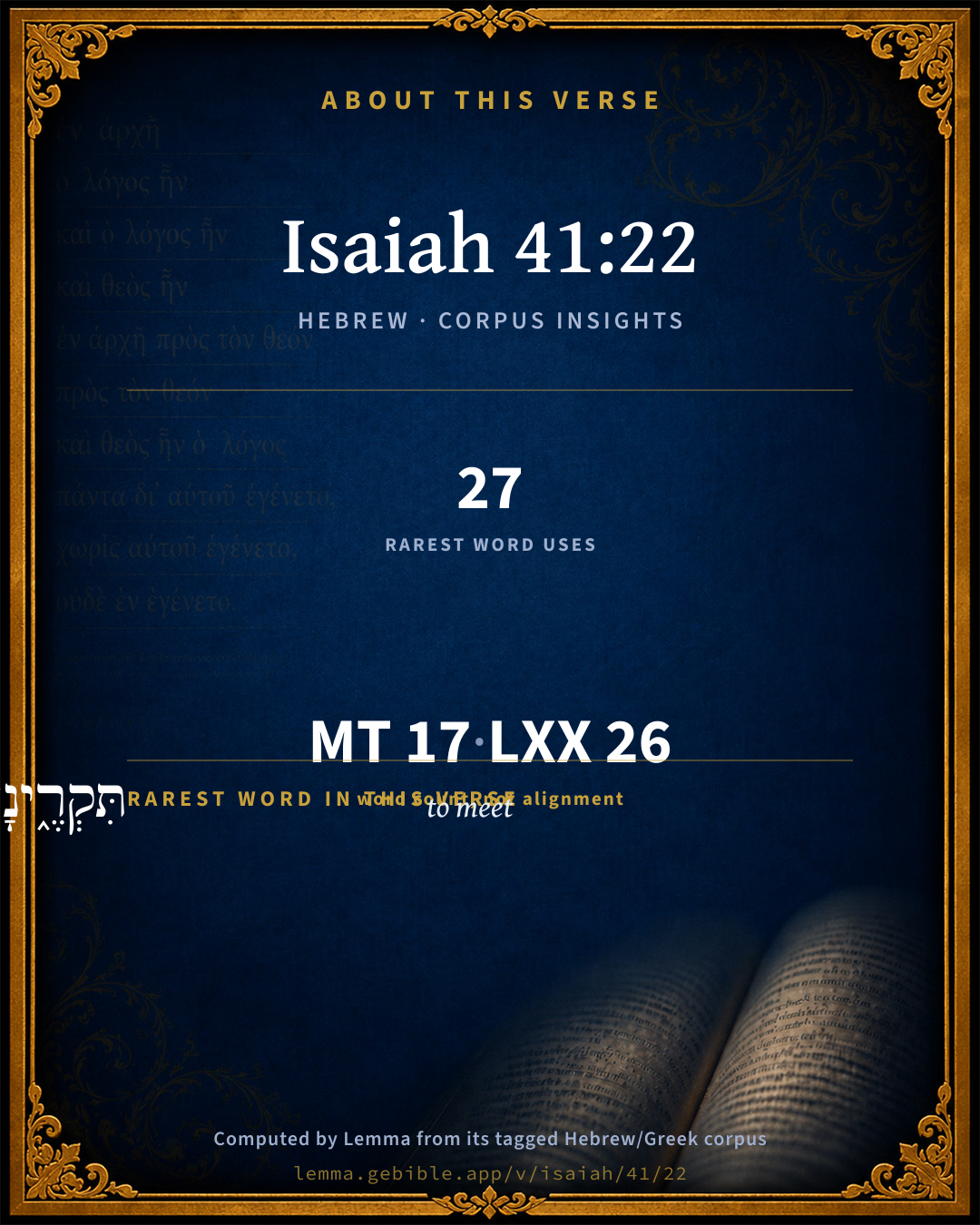
17
words
15
distinct lemmas
Prophets
section

Shared distinctive vocabulary

תִּקְרֶ֑ינָה to meet H7136 occurs in 27 verses of the Hebrew Bible. Also found in:

Grammatical profile

  • 8 verbs
  • 2 nouns
  • 1 adjective
  • 1 pronoun
  • 1 preposition
  • 1 conjunction
  • 3 particles

Verb forms

  • יַגִּ֨ישׁוּ֙ Hiphil · Imperfect
  • וְיַגִּ֣ידוּ Hiphil · Imperfect
  • תִּקְרֶ֑ינָה Qal · Imperfect
  • הַגִּ֜ידוּ Hiphil · Imperative
  • וְנָשִׂ֤ימָה Qal · Cohortative
  • וְנֵדְעָ֣ה Qal · Cohortative
  • הַבָּא֖וֹת Qal · Participle Active
  • הַשְׁמִיעֻֽנוּ Hiphil · Imperative

Repetition

A word recurs within this verse — often emphatic in Hebrew:

  • וְיַגִּ֣ידוּ to make known H5046 ×2

Hebrew & Septuagint length

In English translation the verse runs 37 words from the Hebrew and 40 from the Septuagint (LXX English) — closely comparable.

A rough comparison of the two English renderings, which tokenize alike — not a word-level alignment.

Word counts can differ between the Hebrew and the Greek without any difference in meaning — e.g. the Hebrew direct-object marker אֵת has no separate Greek word, and Greek often adds the article ὁ.

In the original languages it is 17 Hebrew tokens and 26 Greek tokens — but the two are counted differently (Hebrew bundles its prefixes and suffixes into one token; the Greek is in lemma form), so that isn’t a like-for-like length.

Cross-references

8

Topical passages linked to Isaiah 41:22 in the Treasury of Scripture Knowledge — connected by theme and wording, ordered by reader-vote popularity; previews shown in the World English Bible.

  • Isaiah 45:21 Declare you, and bring [it] forth; yes, let them take counsel together: who has shown this from ancient time? who has declared it of old? Haven't I, Yahweh? and there is no God else besides me, a just God and a Savior; there is no one besides me.
  • Isaiah 44:7 Who, as I, shall call, and shall declare it, and set it in order for me, since I established the ancient people? and the things that are coming, and that shall happen, let them declare.
  • Isaiah 46:10 declaring the end from the beginning, and from ancient times things that are not [yet] done; saying, My counsel shall stand, and I will do all my pleasure;
  • Isaiah 48:14 Assemble yourselves, all you, and hear; who among them has declared these things? He whom Yahweh loves shall perform his pleasure on Babylon, and his arm [shall be on] the Chaldeans.
  • Isaiah 42:9 Behold, the former things have happened, and new things do I declare. Before they spring forth I tell you of them.
  • Isaiah 43:9–12 Let all the nations be gathered together, and let the peoples be assembled: who among them can declare this, and show us former things? let them bring their witnesses, that they may be justified; or let them hear, and say, It is truth.
  • John 13:19 From now on, I tell you before it happens, that when it happens, you may believe that I AM.
  • John 16:14 He will glorify me, for he will take from what is mine, and will declare it to you.

Cross-references courtesy of OpenBible.info (CC BY 4.0).

Hebrew and Greek witnesses Masoretic Hebrew ↔ Greek Septuagint

The same verse in the two great witnesses to the Old Testament, shown verse-for-verse.

These are two independent witnesses, not word-aligned to each other, and the Septuagint is shown in lemma (dictionary) form.

Hebrew Isaiah 41:22 Masoretic · Westminster Leningrad Codex

יַגִּ֨ישׁוּ֙ וְיַגִּ֣ידוּ לָ֔נוּ אֵ֖ת אֲשֶׁ֣ר תִּקְרֶ֑ינָה הָרִאשֹׁנ֣וֹת מָ֣ה הֵ֗נָּה הַגִּ֜ידוּ וְנָשִׂ֤ימָה לִבֵּ֨נוּ֙ וְנֵדְעָ֣ה אַחֲרִיתָ֔ן א֥וֹ הַבָּא֖וֹת הַשְׁמִיעֻֽנוּ

Let them bring forth, and declare to us what shall happen: declare you the former things, what they are, that we may consider them, and know the latter end of them; or show us things to come.

World English Bible · Public Domain

Greek LXX Isaiah 41:22 Septuagint · lemma form

ἐγγίζω καί ἀναἀγγέλλω σύ ὅς συνβαίνω ἤ ὁ πρότερος τίς εἰμί εἶπον καί ἐπιἵστημι ὁ νοῦς καί γιγνώσκω τίς ὁ ἔσχατος καί ὁ ἐπιἔρχομαι εἶπον ἐγώ

Let them draw near, and declare to you what things shall come to pass; or tell us what things were of old, and we will apply our understanding, and we shall know what are the last and the future things:

LXX2012 (modern English Septuagint) · Public Domain

Hebrew: Westminster Leningrad Codex (CC BY 4.0). Greek: Septuagint (public domain); English from LXX2012 (modern English Septuagint) (Public Domain). How the Septuagint differs from the Hebrew →

Targum (Aramaic paraphrase)

1

The Targum is the ancient Jewish Aramaic paraphrase of the Hebrew Scriptures — an interpretive translation, not the Hebrew text itself. Onkelos (literal) and Pseudo-Jonathan (expansive) render the Torah, and Jonathan the Prophets. Coverage is partial: where no permissively-licensed English translation exists for a verse, only the Aramaic is shown. This is verse-level text, not a word-by-word alignment to the Hebrew.

  1. Targum Jonathan Prophets (Joshua–Malachi)
    יִתְקָרְבוּן וִיחַווּן לָנָא יַת דְעַרְעִינָנָא קַדְמֵיתָא מַה אִינוּן הֲווֹ וּנְשַׁוֵי לִבְּנָא וְנֵדָע סוֹפְהוֹן אוֹ דַעֲתִידִין לְמֵיתֵי בַּסְרוּנָא:

    Let them approach, and show us what shall happen unto us; Let them declare the former things what they were, that we may consider and know their event: or declare unto us the things that shall come.

    Targum Jonathan — Aramaic: “Mikraot Gedolot” (public domain). English: “Sefaria Community Translation” (CC0 1.0 (public-domain dedication)); “London "Chaldee Paraphrase," 1871” (public domain). Text via Sefaria.

Commentary

Notes on Isaiah 41:22 from classic Christian and Jewish commentators (each source and its license shown beneath its notes). The classic Christian expositions comment on the surrounding passage and are grouped to its opening verse, so a note may address several verses; the Jewish commentaries on the Tanakh (Rashi and others) are per-verse, so they appear only where the commentator wrote on this verse.

Lemma curates 59 commentaries, every one of them public domain or Creative Commons licensed, each selected and text-cleaned for this edition rather than reprinted as found. About our sources →

Trapp's Complete Commentary

John Trapp

Isa 41:22 Let them bring [them] forth, and shew us what shall happen: let them shew the former things, what they [be], that we may consider them, and know the latter end of them; or declare us things for to come.

Ver. 22. Let them bring forth, and show what shall happen.] By such arguments as these, Cleanthes in Cicero {a} testifieth, though himself were a heathen, that the deity might he known. And whereas it may he objected that the Delphic devil had foretold things to come, it is answered, that the devil cannot foretell all future things, nor anything infallibly, and of himself; but either as it is revealed unto him by God, as was Ahab’s fall at Ramoth Gilead; or as he foreseeth it in the causes, signs, or prophecies of Holy Scripture, wherein he is not a little skilled.

{a} Lib. ii. De Nat. Deorum.

John Trapp, A Commentary or Exposition upon All the Books of the Old and New Testament (1647–1656) — public domain. Text from a community e-Sword module.

Jamieson, Fausset & Brown

Robert Jamieson, A. R. Fausset & David Brown

what shall happen--"Let them bring near and declare future contingencies" [HORSLEY].

former things . . . the latter end of them--show what former predictions the idols have given, that we may compare the event ("latter end") with them; or give new prophecies ("declare things to come") (Isa 42:9), [MAURER]. BARNES explains it more reconditely, "Let them foretell the entire series of events, showing, in their order, the things which shall first occur, as well as those which shall finally happen"; the false prophets tried to predict isolated events, having no mutual dependency; not a long series of events mutually and orderly connected, and stretching far into futurity. They did not even try to do this. None but God can do it (Isa 46:10; Isa 44:7-8). "Or . . . things to come" will, in this view, mean, Let them, if they cannot predict the series, even predict plainly any detached events.

Jamieson, Fausset & Brown — Commentary Critical and Explanatory on the Whole Bible (1871) — public domain (CC PDM 1.0). Text via the HelloAO Bible API.

Ellicott's Commentary for English Readers

(22) The former things.—Not, as the Authorised Version suggests, the things of the remote past, but those that lie at the head, or beginning of things to come—the near future. Can the false gods predict them as the pledge and earnest of predictions that go farther? Can they see a single year before them? We note that the challenge exactly corresponds to Isaiah’s own method of giving “signs” that his words are not idly spoken (Isa_7:10-14; Isa_38:7-8). The other meaning is maintained, however, by some critics as more in harmony with Isa_43:18. The things “for to come” lie, as it were, in the middle future, the “hereafter” of Isa_41:23, in the more remote. All are alike hidden from the gods of the heathen oracles.

A Bible Commentary for English Readers, edited by Charles John Ellicott (1878–1897) — public domain. Text from a community e-Sword module.

The Cambridge Bible for Schools and Colleges

gen. ed. J. J. S. Perowne

22. bring them forth and shew] It is assumed that the “strong arguments” must be predictions.

the former things] i.e. “things past” (from the standpoint of the speaker) as opposed to things still future (things to come). The expression (hâ-rî’shônôth) occurs with great frequency in the first part of this prophecy. Sometimes the stress lies on the event, sometimes on the prediction; but in reality the phrase includes both ideas—“past events as predicted.” So here the challenge is to produce past predictions which have been already verified by the event. There is no ground whatever for the view of Delitzsch and others that in this verse hâ-rî’shônôth refers to events still future, but in the immediate future, as opposed to the more remote future (“things to come”). See G. A. Smith, Exposition, p. 121, note.

the latter end of them] their issue. Sense and parallelism are undoubtedly improved if (with Duhm) we transpose the last two clauses, reading the closing lines thus:

the former things, what they are do ye announce, that we may lay it to heart; or the coming things let us hear, that we may know their issue.

The Cambridge Bible for Schools and Colleges (gen. ed. J. J. S. Perowne; Cambridge University Press, 1878–1918) — public domain. Text from a community e-Sword module.

John Gill's Exposition

Let them bring them forth,.... Not their reasons, as before, but their gods; let them cause them to come nigh, let them appear in court, and speak for themselves, when their worshippers have said all they can in defence of their deity:

and show us what shall happen: what shall come to pass hereafter; and by that prove their divinity; for none but God can foretell things to come with certainty; for everything else but what comes from God, by his prophets, is all conjecture, ambiguous, uncertain, mere juggle, trick, and deception, as were the oracles of the Heathens; but what is clearly and plainly foretold, and agreeably to the prediction comes to pass, is a proof of deity, and as such is here challenged. The "us" here, and the "we" in the following clauses, either design God, and the Christians, the true worshippers of him; or rather the three divine Persons in the Godhead, Father, Son, and Spirit, the one true God, in opposition to the gods of the Heathens. The Targum renders it,

"what shall happen to us:''

let them show the former things what they be: either what were before the creation of the world, as Jarchi; what were purposed, decreed, and determined so early to be done; or let them write, or inspire their prophets to write, a history of the creation, and of the transactions of former times, as Moses did, under the inspiration of God; or let them show what things before predicted by them have come to pass, agreeably to their predictions; or rather "the first things, which may be, show" (y); what will first or presently come to pass, that show unto us if you can:

that we may consider them, and know the latter end of them; or, "and we will set our hearts upon them" (z); weigh them well in our minds, and diligently and attentively consider them, how and in what manner it is foretold they shall come to pass, and take notice and observe the issue of them, and whether the event answers to the prediction: or "declare us things for to come"; which are at a great distance; tell us not only what shall be done in the present age, but onward to the end of the world.

(y) "priora quid ipsa, nuntiate", Montanus; "piora quaenam sint indicate", Piscator. (z) "et ponemus cor nostrum", V. L. Pagninus, Montanus.

John Gill's Exposition of the Whole Bible (1746–1763) — public domain (CC PDM 1.0). Text via the HelloAO Bible API.

Albert Barnes' Notes on the Bible

Let them bring them forth - Let the idols, or the worshippers of idols, bring forth the evidences of their divine nature and power. Or more probably it means, ‘let them draw near or approach.’

And show us what shall happen - None but the true God can discern the future, and predict what is to occur. To be able to do this, is therefore a proof of divinity to which God often appeals as a demonstration of his own divine character (see Isa 44:7-8; Isa 45:3-7; Isa 46:9-10). This idea, that none but the true God can know all things, and can with certainty foretell future events, is one that was admitted even by the pagan (see Xen. Cyr. i. ‘The immortal gods know all things, both the past, the present, and those things which shall proceed from each thing. It was on this belief also that the worshippers of idols endeavored to sustain the credit of their idol-gods; and accordingly, nearly all the reputation which the oracle at Delphi, and other shrines, obtained, arose from the remarkable sagacity which was evinced in predicting future events, or the skillful ambiguity in which they so couched their responses as to be able to preserve their influence whatever might be the result.

Let them show the former things what they be - The idea in this passage seems to be, ‘Let them foretell the entire series of events; let them predict in their order, the things which shall first occur, as well as those which shall finally happen. Let them not select merely an isolated and unconnected event in futurity, but let them declare those which shall have a mutual relation and dependency, and whose causes are now hid.’ The argument in the passage is, that it required a far more profound knowledge to predict the serges of events as they should actually occur; to foretell their order of occur rence, than it did to foretell one single isolated occurrence. The latter, the false prophets of the pagan often undertook to do; and undoubtedly they often evinced great sagacity in it. But they never undertook to detail minutely a series of occurrences, and to state the order in which they would happen. In the Scriptures, it is the common way to foretell the order of events, or a series of transactions pertaining often to many individuals or nations, and stretching far into futurity. And it is perfectly manifest that none could do this but God (compare Isa 46:10).

Or declare us things for to come - Declare any event that is to occur; anything in the future. If they cannot predict the order of things, or a series of events, let them clearly foretell any single event in futurity.

Albert Barnes' Notes on the Bible (1834–1885) — public domain. Text from a community e-Sword/MySword module.

Matthew Poole's English Annotations

Let them; either the idols; or, which is all one, the idolaters in the name and by the help of their idols.

What shall happen; all future events; which he divides into two sorts in the following clause, the former and the latter, as we shall see.

Let them show the former things; which is not to be understood of such things as are past, for such things might easily be known by men from history, much more by the devils who possessed and acted in their idols; but of such things as should shortly come to pass, which may be better discerned than those things which are yet at a great distance. So he propounds the easiest part first. Let us try whether they can foretell those things which are even at the door, and if so we will try them further. Let them tell us what things shall happen, and in what order, which first, and which last.

That we may consider them, Heb. and we will set our heart to it; we will allow the argument its due weight, and either fairly answer it, or give up our cause against idols.

And know; that we may know, or let us know by their information.

The latter end of them; the consequence of them, whether the events did answer to their predictions, or what things happened next after those former things.

Declare us things for to come, to wit, hereafter, or after a long time; which limitation may be easily gathered, both from the opposition of this clause to the former, and from the next following clause, where it is so limited and explained.

Matthew Poole's English Annotations on the Holy Bible (1683–1685) — public domain. Text from a community e-Sword/MySword module.

Whedon's Commentary on the Bible

Daniel D. Whedon

22, 23. Let them… show us what shall happen — The main challenge is, as to the power of idols to foretell events. But — either as if disgusted with such a proposition, or as if the false prophets, in their usual way, did attempt to answer by isolated, unintelligible statements, though this is not intimated — the whole thing was at once quashed by the virtual question. “Do ye know any thing at all — past, present, or future?” The conclusion is shown in the next verse.

Daniel D. Whedon (gen. ed.), Commentary on the Old and New Testaments (1874–1909) — public domain. Text from a community e-Sword module.

The Pulpit Commentary

Let them... show us what will happen. God claims that the power of predicting the future is his own inalienable prerogative. He defies the idol-gods and their votaries to give any clear prediction of future events. No doubt the claim to possess the power was made very generally among the idolatrous nations, who almost universally practised divination, and in many case s possessed oracles. But it was a false claim, based upon fraud and cunning, which deceived men as often as dependence was placed upon it (Herod., 1:53, 91) and landed them in misfortune. The former things... things for to come. Some commentators regard "the former things" as things actually past beginnings of history, for instance, which to the heathen nations were wrapped in darkness" (Kay); but it seems better, on the whole, to understand (with Vitringa, Stier, Hahn, Cheyne, and Delitzsch) by "the former things" those in the immediate future, by "things for to come" those about to happen in remoter times.

The former are, of course, much the easier to predict, since they fall to some extent within the domain of human foresight; the latter are more difficult; but the idol-gods are challenged to produce either the one or the other. What they be. A definite and clear statement is required to preclude such vague and ambiguous utterances as the heathen oracles delighted to put forth. That we may consider them (or, lay them to heart), and know the latter end of them; i.e. compare them with the event, when the time comes.

The Pulpit Commentary (1880–1919), ed. H.D.M. Spence-Jones & Joseph S. Exell — public domain. Text from a community e-Sword module.

John Wesley's Explanatory Notes

Them - The idols. Former things - Such things as should shortly come to pass. The latter end - Whether the events answer to their predictions.

John Wesley, Explanatory Notes Upon the Whole Bible (1754–1765) — public domain. Text via the GEBible commentary corpus.

J. A. Alexander on Isaiah

Joseph Addison Alexander

“They shall bring forward (or let them bring forward) and show forth to us the (things) which are to happen; the former things, what they were, show forth, and we will get our heart (apply our mind, or pay attention to them), and know their issue; or (else) the coming (events) make us to hear.” The prescience of future events is here appealed to as a test of divinity. (Compare Deu 18:22; Jer 28:9, and Isa 43:12 below). They are required to demonstrate their foreknowledge, either by showing that they had predicted something, or by doing it now. The whole idea which the text conveys is that of two contending parties at a judgment-seat. ‘They’ means the party of the false gods and their worshippers, ‘who’ that of Jehovah and His people.

Joseph Addison Alexander, The Prophecies of Isaiah (1846–1847; New York: Scribner, 1870–1878) — public domain. Text from a community e-Sword module.

Rashi

Rabbi Shlomo Yitzchaki (Rashi)

Let them present Let those who deny the Torah ([mss., K’li Paz:] the nations) present their prophets and their soothsayers.

and tell us what will happen in the future.

the first things that were before the Creation of the world, and concerning what was created and what they are. (Other editions: The incidents that have already begun, what will be their end.)

or the coming events in the future, let us hear, and we will see if there is any substance to them, that their words will come true.

Rashi on the Tanakh — English translations: “The Judaica Press complete Tanach with Rashi, translated by A. J. Rosenberg” (CC BY 4.0); “Pentateuch with Rashi's commentary by M. Rosenbaum and A.M. Silbermann, 1929-1934” (public domain); “The Metsudah Tanach series, Lakewood, N.J” (CC BY 4.0); and “The Book of Joshua, Metsudah Publications, 1997” (CC BY 4.0). Text via Sefaria.

Ibn Ezra

Rabbi Abraham ibn Ezra

Let them bring forth, their idols.

The imperative produce is addressed to those Israelites, who did not trust in God, but worshipped idols even in Babylon; they are told to produce (ריבכם) their cause, that is, their evidence, to show which is the righteous side. The imperative shew הגידו is addressed to the idols.

Ibn Ezra on the Tanakh — English translations: “Sefaria Community Translation” (CC0 1.0 (public-domain dedication)); “Yalkut, Sifsei Chachomim Chumash, Metsudah Publications, 2009” (CC BY 4.0); and “Commentary of Ibn Ezra on Isaiah - trans. by M. Friedlander, 1873” (public domain). Text via Sefaria.

Lesson kit

Teaching starters — assembled from the data on this page, not authored interpretation. Every prompt links to the verse data it draws on. Edit before teaching.

Isaiah, in the Prophets, opens this verse with 17 words (15 distinct Hebrew lemmas). Its most distinctive word is qârâh (“to meet”). A historical commentator’s framing appears above. Read the whole chapter for the surrounding context.

Discussion questions

  1. What does “to meet” (qârâh) contribute to the verse as a whole?
  2. Genesis 24:12 shares the word «to meet» with this verse. How do the two illuminate each other?
  3. “to make known” occurs 2× in this one verse. What is the effect of the repetition?
  4. The translations on this page render this verse differently — a whole-verse word diff, not a word-by-word alignment. What might account for the different wordings?
  5. The verb «יַגִּ֨ישׁוּ֙» is Hiphil Imperfect. How does its form color the action?
  6. Reading how Trapp's Complete Commentary and Jamieson, Fausset & Brown read this verse, where do the two commentators agree and where do they part?

Things to notice

Reading settings

Reading text

Shown beneath each verse's original-language words.

Old Testament
Old Testament edition

Read the OT as the Masoretic Hebrew (MT) or the Greek Septuagint (LXX).

English shown for the Greek Septuagint (in the Hebrew ↔ Greek comparison).

Comparing translations? Open the Compare panel on any verse page to stack up to four side by side.