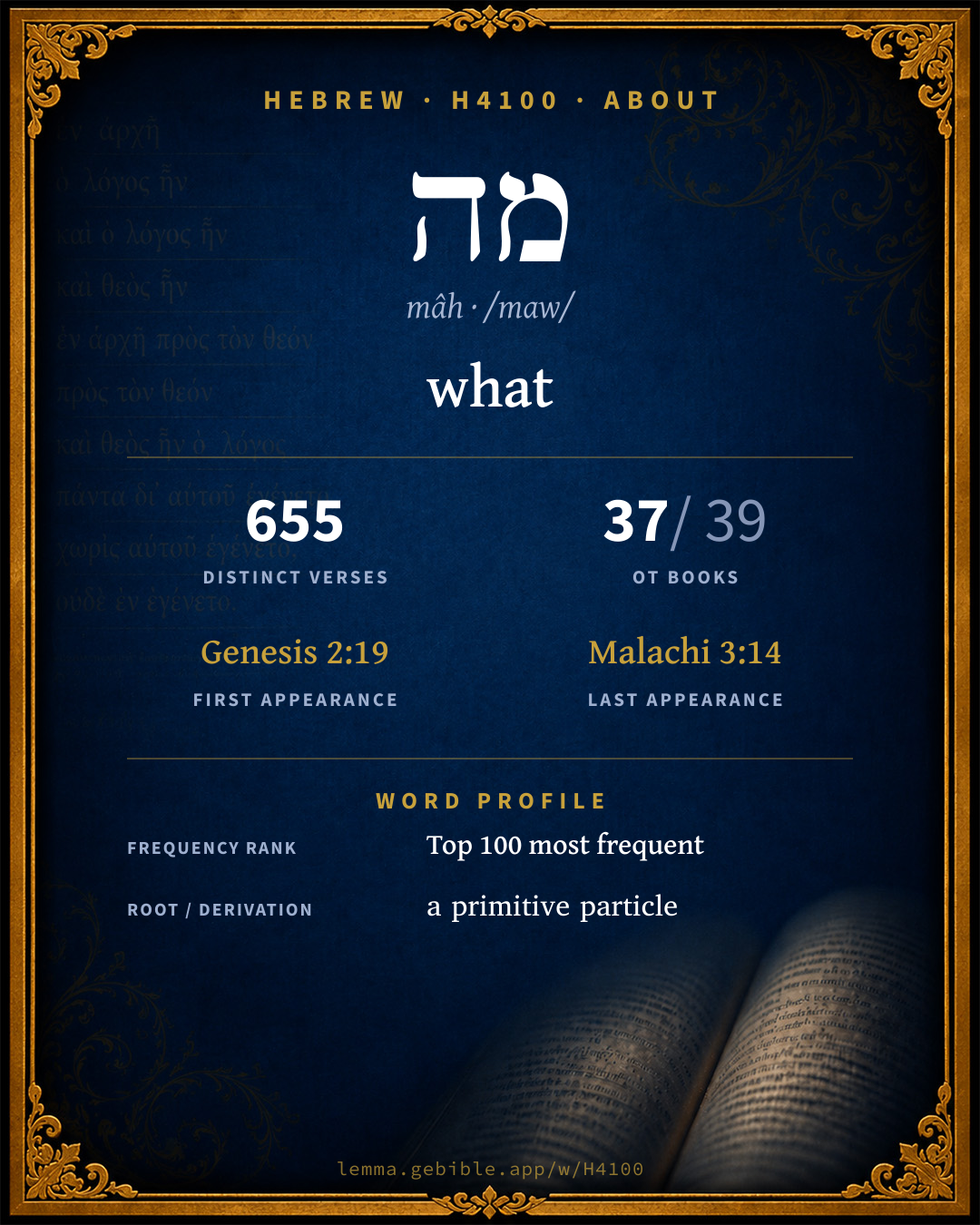
מָה
what
also: how, of what kind fuller range ↓
Full lexicon entry — Brown-Driver-Briggs (BDB)
From Brown-Driver-Briggs (BDB)
Where this word appears
Grammar key — what these labels mean
Part of speech
- Particle
- A short function word — article, negation, interrogative, the sign of the direct object, and the like.
Every verse where H4100 appears in the Book of Genesis — 56 distinct verses. Click any verse to open its interlinear word-by-word view. Verse text shown in the World English Bible for context — . Each verse’s Hebrew form is shown with its reference; the English is not keyword-highlighted, since the data carries no word-level English alignment. Use “Compare translations” on any verse to read it across multiple English versions. This concordance covers the Hebrew Bible; Septuagint (Greek Old Testament) occurrences are not indexed here.
Genesis
- Genesis 2:19 מַה ptcl inter Out of the ground Yahweh God formed every animal of the field, and every bird of the sky, and brought them to the man to see what he would call them. Whatever the man called every living creature, that was its name.
- Genesis 3:13 מַה ptcl inter Yahweh God said to the woman, "What is this you have done?" The woman said, "The serpent deceived me, and I ate."
- Genesis 4:6 לָ֚/מָּה וְ/לָ֖/מָּה prep + ptcl inter conj + prep + ptcl inter Yahweh said to Cain, "Why are you angry? Why has the expression of your face fallen?
- Genesis 4:10 מֶ֣ה ptcl inter Yahweh said, "What have you done? The voice of your brother's blood cries to me from the ground.
- Genesis 12:18 מַה לָ֚/מָּה ptcl inter prep + ptcl inter Pharaoh called Abram, and said, "What is this that you have done to me? Why didn't you tell me that she was your wife?
- Genesis 12:19 לָ/מָ֤ה prep + ptcl inter Why did you say, 'She is my sister,' so that I took her to be my wife? Now therefore, see your wife, take her, and go your way."
- Genesis 15:2 מַה ptcl inter Abram said, "Lord Yahweh, what will you give me, seeing I go childless, and he who will inherit my estate is Eliezer of Damascus?"
- Genesis 15:8 בַּ/מָּ֥ה prep + ptcl inter He said, "Lord Yahweh, how will I know that I will inherit it?"
- Genesis 18:13 לָ֣/מָּה prep + ptcl inter Yahweh said to Abraham, "Why did Sarah laugh, saying, 'Will I really bear a child, yet I am old?'
- Genesis 20:9 מֶֽה וּ/מֶֽה ptcl inter conj + ptcl inter Then Abimelech called Abraham, and said to him, "What have you done to us? How have I sinned against you, that you have brought on me and on my kingdom a great sin? You have done deeds to me that ought not to be done!"
- Genesis 20:10 מָ֣ה ptcl inter Abimelech said to Abraham, "What did you see, that you have done this thing?"
- Genesis 21:17 מַה ptcl inter God heard the voice of the boy. The angel of God called to Hagar out of the sky, and said to her, "What ails you, Hagar? Don't be afraid. For God has heard the voice of the boy where he is.
- Genesis 21:29 מָ֣ה ptcl inter Abimelech said to Abraham, "What do these seven ewe lambs which you have set by themselves mean?"
- Genesis 23:15 מַה ptcl inter "My lord, listen to me. What is a piece of land worth four hundred shekels of silver between me and you? Therefore bury your dead."
- Genesis 24:31 לָ֤/מָּה prep + ptcl inter He said, "Come in, you blessed of Yahweh. Why do you stand outside? For I have prepared the house, and room for the camels."
- Genesis 25:22 לָ֥/מָּה prep + ptcl inter The children struggled together within her. She said, "If it be so, why do I live?" She went to inquire of Yahweh.
- Genesis 25:32 וְ/לָ/מָּה conj + prep + ptcl inter Esau said, "Behold, I am about to die. What good is the birthright to me?"
- Genesis 26:10 מַה ptcl inter Abimelech said, "What is this you have done to us? One of the people might easily have lain with your wife, and you would have brought guilt on us!"
- Genesis 27:20 מַה ptcl inter Isaac said to his son, "How is it that you have found it so quickly, my son?" He said, "Because Yahweh your God gave me success."
- Genesis 27:37 מָ֥ה ptcl inter Isaac answered Esau, "Behold, I have made him your lord, and all his brothers have I given to him for servants. With grain and new wine have I sustained him. What then will I do for you, my son?"
- Genesis 27:45 לָ/מָ֥ה prep + ptcl inter until your brother's anger turn away from you, and he forgets what you have done to him. Then I will send, and get you from there. Why should I be bereaved of you both in one day?"
- Genesis 27:46 לָ֥/מָּה prep + ptcl inter Rebekah said to Isaac, "I am weary of my life because of the daughters of Heth. If Jacob takes a wife of the daughters of Heth, such as these, of the daughters of the land, what good will my life do me?"
- Genesis 28:17 מַה ptcl inter He was afraid, and said, "How dreadful is this place! This is none other than God's house, and this is the gate of heaven."
- Genesis 29:15 מַה ptcl inter Laban said to Jacob, "Because you are my brother, should you therefore serve me for nothing? Tell me, what will your wages be?"
- Genesis 29:25 מַה וְ/לָ֖/מָּה ptcl inter conj + prep + ptcl inter It happened in the morning that, behold, it was Leah. He said to Laban, "What is this you have done to me? Didn't I serve with you for Rachel? Why then have you deceived me?"
- Genesis 30:31 מָ֣ה ptcl inter He said, "What shall I give you?" Jacob said, "You shall not give me anything. If you will do this thing for me, I will again feed your flock and keep it.
- Genesis 31:26 מֶ֣ה ptcl inter Laban said to Jacob, "What have you done, that you have deceived me, and carried away my daughters like captives of the sword?
- Genesis 31:27 לָ֤/מָּה prep + ptcl inter Why did you flee secretly, and deceive me, and didn't tell me, that I might have sent you away with mirth and with songs, with tambourine and with harp;
- Genesis 31:30 לָ֥/מָּה prep + ptcl inter Now, you want to be gone, because you sore longed after your father's house, but why have you stolen my gods?"
- Genesis 31:32 מָ֥ה ptcl inter With whoever you find your gods, he shall not live. Before our relatives, discern what is yours with me, and take it." For Jacob didn't know that Rachel had stolen them.
- Genesis 31:36 מַה מַ֣ה ptcl inter ptcl inter Jacob was angry, and argued with Laban. Jacob answered Laban, "What is my trespass? What is my sin, that you have hotly pursued after me?
- Genesis 31:37 מַה ptcl inter Now that you have felt around in all my stuff, what have you found of all your household stuff? Set it here before my relatives and your relatives, that they may judge between us two.
- Genesis 31:43 מָֽה ptcl inter Laban answered Jacob, "The daughters are my daughters, the children are my children, the flocks are my flocks, and all that you see is mine: and what can I do this day to these my daughters, or to their children whom they have borne?
- Genesis 32:27 מַה ptcl inter He said to him, "What is your name?" He said, "Jacob."
- Genesis 32:29 לָ֥/מָּה prep + ptcl inter Jacob asked him, "Please tell me your name." He said, "Why is it that you ask what my name is?" He blessed him there.
- Genesis 33:15 לָ֣/מָּה prep + ptcl inter Esau said, "Let me now leave with you some of the folk who are with me." He said, "Why? Let me find favor in the sight of my lord."
- Genesis 37:10 מָ֛ה ptcl inter He told it to his father and to his brothers. His father rebuked him, and said to him, "What is this dream that you have dreamed? Will I and your mother and your brothers indeed come to bow ourselves down to you to the earth?"
- Genesis 37:15 מַה ptcl inter A certain man found him, and behold, he was wandering in the field: and the man asked him, saying, "What are you looking for?"
- Genesis 37:20 מַה ptcl inter Come now therefore, and let's kill him, and cast him into one of the pits, and we will say, 'An evil animal has devoured him.' We will see what will become of his dreams."
- Genesis 37:26 מַה ptcl inter Judah said to his brothers, "What profit is it if we kill our brother and conceal his blood?
- Genesis 38:16 מַה ptcl inter He turned to her by the way, and said, "Please come, let me come in to you:" for he didn't know that she was his daughter-in-law. She said, "What will you give me, that you may come in to me?"
- Genesis 38:18 מָ֣ה ptcl inter He said, "What pledge will I give you?" She said, "Your signet and your cord, and your staff that is in your hand." He gave them to her, and came in to her, and she conceived by him.
- Genesis 38:29 מַה ptcl inter It happened, as he drew back his hand, that behold, his brother came out, and she said, "Why have you made a breach for yourself?" Therefore his name was called Perez.
- Genesis 39:8 מַה ptcl inter But he refused, and said to his master's wife, "Behold, my master doesn't know what is with me in the house, and he has put all that he has into my hand.
- Genesis 42:1 לָ֖/מָּה prep + ptcl inter Now Jacob saw that there was grain in Egypt, and Jacob said to his sons, "Why do you look at one another?"
- Genesis 42:28 מַה ptcl inter He said to his brothers, "My money is restored! Behold, it is even in my sack." Their hearts failed them, and they turned trembling one to another, saying, "What is this that God has done to us?"
- Genesis 43:6 לָ/מָ֥ה prep + ptcl inter Israel said, "Why did you treat me so badly, telling the man that you had another brother?"
- Genesis 44:4 לָ֛/מָּה prep + ptcl inter When they had gone out of the city, and were not yet far off, Joseph said to his steward, "Up, follow after the men. When you overtake them, ask them, 'Why have you rewarded evil for good?
- Genesis 44:7 לָ֚/מָּה prep + ptcl inter They said to him, "Why does my lord speak such words as these? Far be it from your servants that they should do such a thing!
- Genesis 44:15 מָֽה ptcl inter Joseph said to them, "What deed is this that you have done? Don't you know that such a man as I can indeed divine?"
- Genesis 44:16 מַה מַה וּ/מַה ptcl inter ptcl inter conj + ptcl inter Judah said, "What will we tell my lord? What will we speak? Or how will we clear ourselves? God has found out the iniquity of your servants. Behold, we are my lord's bondservants, both we, and he also in whose hand the cup is found."
- Genesis 46:33 מַה ptcl inter It will happen, when Pharaoh summons you, and will say, 'What is your occupation?'
- Genesis 47:3 מַה ptcl inter Pharaoh said to his brothers, "What is your occupation?" They said to Pharaoh, "Your servants are shepherds, both we, and our fathers."
- Genesis 47:8 כַּ/מָּ֕ה prep + ptcl inter Pharaoh said to Jacob, "How many are the days of the years of your life?"
- Genesis 47:15 וְ/לָ֥/מָּה conj + prep + ptcl inter When the money was all spent in the land of Egypt, and in the land of Canaan, all the Egyptians came to Joseph, and said, "Give us bread, for why should we die in your presence? For our money fails."
- Genesis 47:19 לָ֧/מָּה prep + ptcl inter Why should we die before your eyes, both we and our land? Buy us and our land for bread, and we and our land will be servants to Pharaoh. Give us seed, that we may live, and not die, and that the land won't be desolate."
About this entry
At a glance — auto-summarized from this page’s data, not written by a person. Every figure links to its source below. This summary describes the numbers; it doesn’t interpret them.
“what” is the headline sense of the Hebrew word מה (mâh). It first appears in Genesis 2:19. It turns up in 655 verses across 37 books, one of the most common footprint. It also covers “how” and “of what kind”, alongside “what” — see its full sense range. From the same root come מא, מדוע and מדי. See the sense tree, 655-verse concordance, and the renderings breakdown below.
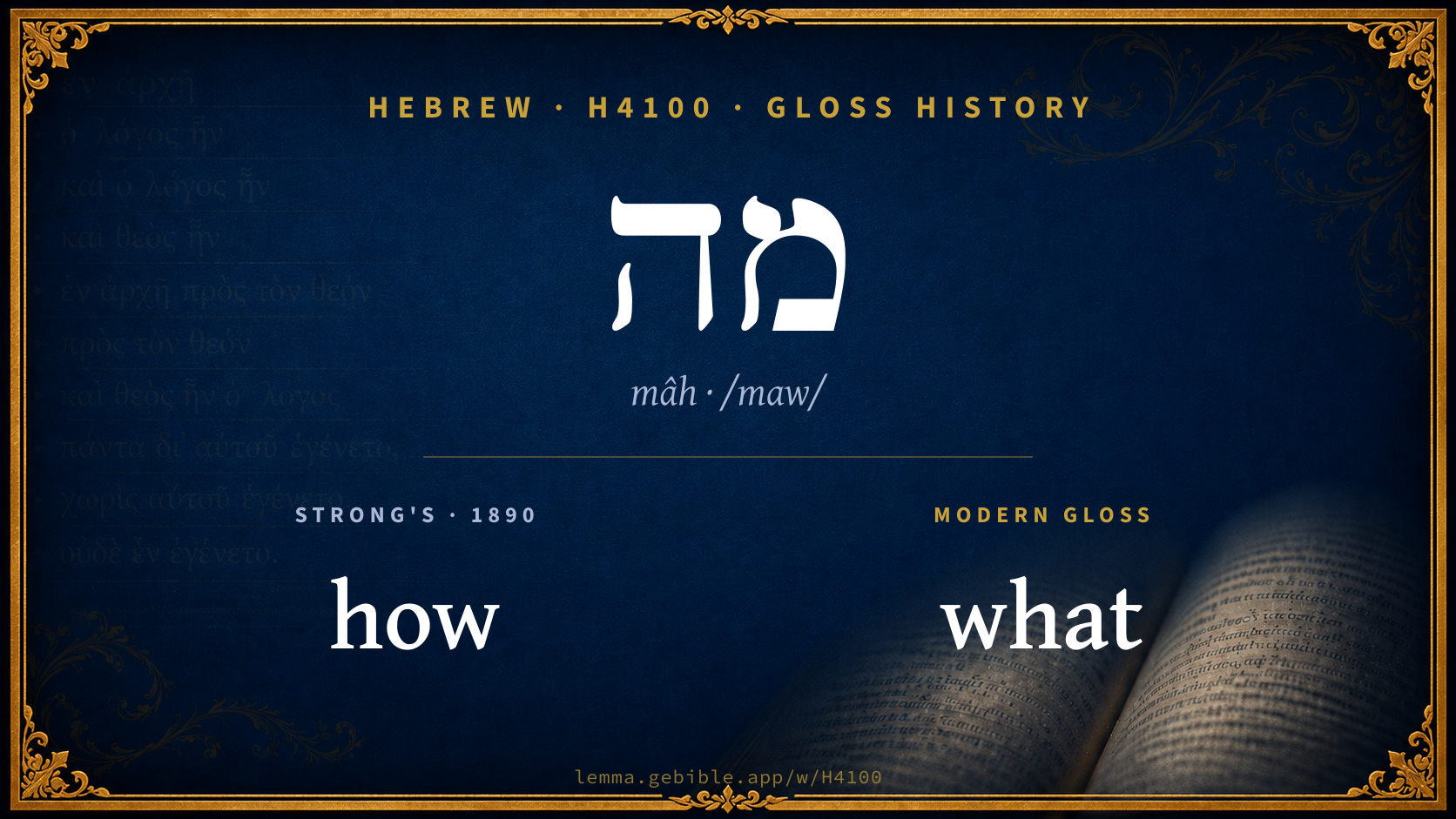
Gloss history
Strong's 1890 vs modern scholarship
About this word
Strong's H4100 catalogs a Hebrew word from the Hebrew Old Testament.
These counts are not copied from any lexicon or concordance. They are computed here, from the morphology-tagged Hebrew Old Testament. What Lemma adds →
- 655
- distinct verses
- The word appears in 655 distinct verses.
- 37 / 39
- OT books
- The word appears in 37 of 39 Old Testament books.
- #66
- by frequency
- Top 100 most frequent Hebrew words (rank 66 of 8,640 Hebrew words by occurrence).
View all 655 occurrences in the concordance →
By section of the Old Testament
By traditional corpus
Conventional, traditional groupings — biblical authorship is debated, so this is a traditional corpus grouping, not an authorship claim. Each share is this word’s portion of its verses in that division of the Hebrew canon. Each figure is a share of the word’s 655 distinct verses.
- Prophets (Nevi'im) 328 verses · 50%
- Writings (Ketuvim) 208 verses · 32%
- Torah (Pentateuch) 119 verses · 18%
How translations render this word
Counts come from each version’s own published word-to-Strong’s tagging or interlinear alignment — an approximate guide to how each version renders this word, not a word-level alignment the data otherwise carries. Because each total is that version’s own tagged count, the per-version totals vary from one another and need not match the appearance or distinct-verse counts above. These counts may also differ from a printed concordance because Lemma counts each distinctly tagged rendering and does not collapse phrase taggings into a single head-word total. This is a fixed set of word-tagged versions (KJV, ASV, BSB, ULT) and does not change with the reading translation you choose elsewhere. Each version’s license is shown beside its name below (and on Sources).
- King James Version: What 5×, How 4×, Wherefore 2×
- American Standard Version: What 4×, How 3×, Wherefore 3×
- Berean Standard Bible: What 342×, Why 196×, How 86×
- unfoldingWord Literal Text: What 413×, Why 195×, How 63×
King James Version Public Domain
Renders H4100 across 26 tagged occurrences — most commonly:
Plus 15 renderings that appear only once — usually multi-word phrases or single function words the recovered tagging swept in, not distinct renderings. Not rendered by a distinct English word in 1 further occurrence.
American Standard Version Public Domain
Renders H4100 across 26 tagged occurrences — most commonly:
Plus 12 renderings that appear only once — usually multi-word phrases or single function words the recovered tagging swept in, not distinct renderings.
Berean Standard Bible Public Domain
Renders H4100 across 704 tagged occurrences — most commonly:
Plus other, less common renderings. Plus 33 renderings that appear only once — usually multi-word phrases or single function words the recovered tagging swept in, not distinct renderings. Not rendered by a distinct English word in 46 further occurrences.
unfoldingWord Literal Text CC BY-SA 4.0
Renders H4100 across 765 tagged occurrences — most commonly:
Plus other, less common renderings. Plus 25 renderings that appear only once — usually multi-word phrases or single function words the recovered tagging swept in, not distinct renderings.
17 senses and sub-senses in the full BDB
What do BDB’s symbols mean?
BDB uses these scholarly abbreviations:
| Symbol | Meaning |
|---|---|
| 𝔊 | the Septuagint (the ancient Greek translation, LXX) |
| 𝔙 | the Vulgate (the Latin translation) |
| 𝔖 | the Syriac version (the Peshitta) |
| 𝔗 | the Targum (the Aramaic translation) |
| ψ | the Psalms |
| √ | root (the underlying root or stem) |
| ‖ | parallel passage (a synonymous or contrasted parallel) |
| † | the dagger: every passage where the word occurs is cited |
The 17 senses and sub-senses the full Brown-Driver-Briggs lexicon distinguishes for this word, in lexicon order (not ranked by frequency), with BDB’s own verbatim wording and sub-sense lettering. Shown in Hebrew script with BDB’s own scholarly abbreviations. The condensed entry is in the Lexicon Entry tab. See also the Forms in the corpus table below.
- 1. interrog. what?
- a. in a direct question, before either verbs or nouns Gn 4:10 מֶה עשׂית what hast thou done? 15:2 מה־תתן־לי what wilt thou give me? Ex 3:13 מַה־שְּׁמוֹ, 12:26; 13:14 and so very often: מַה־הִיא Zc 5:6; מה אלה Zc 1:9; מָה אַתָּה רֹאֶה Je 1:11; Am 7:8 +; Jl 4:14 מה אתם לי; Ju 18:8 מה אתם vid. Comm., v 24 מה לי עוד what have I still? Is 21:11 מה־מלילה what (= how much) of the night (is past)? = as what? (qualem?) Hg 2:3 (cf. מִי Am 7:2); to express surprise, Jb 9:12 who shall say to him, מה תעשׂה what doest thou? 22:13 Ec 8:4; Is 45:9, 10; sq. כִּי, Gn 20:10 מה ראית כי עשׂית what hadst thou in view, that thou hast done, etc.? 31:36 Ex 16:7 וְנַחְנוּ מָה כִּי and what are we, that …? 32:21 Nu 22:28; Hb 2:18, etc. Note in partic.—(a) מָה is followed sometimes by a subst. in appos. (against Arabic usage, which does not permit this: WAG. ii. § 170), so that it becomes virtually an adj.: מַה־בֶּצַע what profit …? Gn 37:26 ψ 30:10 Mal 3:14; Is 40:18 מַה־דְּמוּת, Mal 1:13 ψ 89:48 זְכָר־אֲנִי מֶה חָ֑לֶד (inverted for מַה חֶלֶד אָ֑נִי) remember (of) what (short) duration I am, Ec 1:3; 5:10, 15; 6:8, 11 (Da § 8, R. 2 Köiii. 23 f.); as exclam., ψ 89:48b (?) Jb 26:14. And with the subst. idiom. at the end (in Arabic preceded then by مِنْ: WAG. ii. § 49. 7), 1 S 26:18 ומַה־בידי רעה and what is there in my hand, evil? 20:10 (vid. 3), 2 S 19:29; 24:13; 1 K 12:16; Je 2:5 מה־מצאו אבותיכם בי עָוֶל, Ec 11:2 Est 6:3. (b) מַה־זֶּה what, now? 1 S 10:11, contr. מַזֶּה †Ex 4:2 (זֶה 4 c); Gn 3:13 מַה־זֹּאת עָשִׂיתָ; 12:18; 29:25 מַה־זֹּאת עָשִׂיתָה לִּי; similarly 26:10; 42:28 +, either what, now, hast thou done? or what is this that thou hast done? (vid. זֶה 4 d). (c) מַה־לְּךָ what to thee? i.e. what aileth thee? or what dost thou want? Gn 21:17 מַה־לָּךְ הָגָר; Jos 15:18; 2 S 14:5; 1 K 1:16; 2 K 6:28; Ez 18:2 (accents); sq. כִּי, Ju 18:23 מה־לך כי נזעקת, Gn 20:9 (cf. 1 S 11:5 מה לעם כי יבכו), Is 22:1 מַה־לָּךְ כִּי עָלִית (cf. τί παθὼν τοῦτο ποιεῖς;), ψ 114:5; without כִּי Is 3:15 (cf. Qor 57:8, 10); with a ptcp., Jon 1:6 what is it to thee as a sleeper? (accus.: Da § 70a cites Qor 74:50), Ez 18:2 (if אתם be treated as strengthening לכם). (d) מַה־לְּךָ (לִי) פֹה = what hast thou (have I) here? Ju 18:3; 1 K 19:9; Is 22:16; 52:5. (e) in the genit., Jer 8:9 וְחָכְמַת־מֶה לָהֶם, and wisdom of what (= what kind of wisdom) is theirs? Nu 23:3 (v. infr. 3). e.g. Genesis 4:10
- b. often in an indirect question, as after ראה, Gn 2:19 to see מה־יקרא־לו what he would call it, 37:20 וְנִרְאֶה מה־יהיו חלֹמֹתיו to what his dreams will come, Nu 13:19f.; Hb 2:1; הִכִּיר Gn 31:32; ידע 39:8; Ex 2:4 לדעת מה־יֵּעָשֶׂה לו, 16:15; 32:1; Jb 34:4; שׁמע Nu 9:8 וְאשׁמעה מה־יצוה י׳ (cf. ψ 85:9), 2 S 17:5; פֹּרַשׁ Nu 15:34; שׁאל 1 K 3:5; 2 K 2:9; הֵבִין Jb 6:24; 23:5: Nu 13:18 וראיתם את הארץ מה היא, ψ 39:5 Is 41:22 הראשׁנות מָה הֵנָּה הַגִּידוּ.—In some such cases it approximates in meaning to the simple rel., as Jer 7:17; 33:24; Mi 6:5, 8; Jb 34:33. e.g. Genesis 2:19
- c. = of what kind? (Germ. was für ein …?), with an insinuation of blame, or reproach, or contempt: Gn 37:10 מה החלום הזה what is this dream which thou hast dreamt? 44:15 Jos 22:16 Ju 8:1; 15:11; 20:12 1 S 29:3 מָה הָעִבְרִים האלה, 1 K 9:13 מה הערים האלה אשׁר נתתה לי, 2 K 9:22; 18:19. e.g. Genesis 37:10
- d. מה is often used in questions to which the answer little, or nothing, is expected, and it thus becomes equivalent to a rhetorical negative (cf. הֲ b, מִי f c): (a) Gn 23:15 land worth 400 shekels …, מה היא what is it? (i.e. it is something quite insignificant), 27:37 Ju 8:3 ומה־יכלתי עשׂות ככם, 14:18 Ho 9:5; 10:3 ψ 30:10; 56:5; Jb 15:9; 16:6; 21:21; 22:13, 17; La 2:13; Ct 5:9 מַה־דּוֹדֵךְ מִדּוֹד what is thy beloved (more) than a(nother) beloved? ‖ לא, 1 K 12:16 מַה־לָּנוּ חֵלֶק בְּדָוִד וְלֹא־נַחֲלָה בְּבֶן יִשַׁי (2 S 20:1 אֵין־לָנוּ חֵלֶק וג׳), Jb 16:6. (b) sq. כִּי (כִּי 1 f), Gn 20:9; 37:26 מַה־בֶּצַע כִּי נַהֲרֹג what profit (is it) that we should slay him? Ex 16:7 Nu 16:11 Hb 2:18 2 K 8:13 what is thy servant, the dog, that he should do, etc.? and often in poetry, as ψ 8:5 מָה אנושׁ כי תזכרנו what is man that thou rememberest him? Jb 6:11 מַה־כֹּחִי כִּי אֲיַחֵל, v 11b; 7:17; 15:12f, 14; 16:3; 21:15 + (cf. מִי f b). Hence, (c) in the formula of repudiation, or emphatic denial, (וְלָכֶם) מַה־לִּי וָלָךְ what is there (common) to me and to thee? i.e. what have I to do with thee? †Ju 11:12; 2 S 16:10 מה לי ולכם, 19:23; 1 K 17:18; 2 K 3:13; 2 Ch 35:21; cf. Jos 22:24; 2 K 9:18, 19; rather differently, without וְ, †Je 2:18 מה לך לדרך מ׳ what is there to thee with reference to the way to Egypt? Ho 14:9 מַה־לּוֹ לַעֲצַבִּים, cf. ψ 50:16 (לְסַפֵּר); with את, †Je 23:28 מַה־לַתֶּבֶן אֶת־הַבָּר beside (or in comparison with) the wheat? cf. τί ἐμοὶ (ἡμῖν) καὶ σοί; Mt 8:29 Mk 5:7 Jn 2:4; and Arabic مَا لِى وَلَهُ e.g. Genesis 23:15
- e. = whatsoever (cf. מִי g): (a) Ju 9:48 מה אתם ראיתם עשׂיתי מהרו עשׂו כמוני, lit. what do you see (that) I have done? hasten, and do like me (= whatever ye see, etc.), 2 S 21:4 מה אתם אמרים אעשׂה לכם, Jb 6:24; with the apod. introd. by וְ, 1 S 20:4 מה תאמר נפשׁך ואעשׂה לך; Est 5:3 מַה־ בַּקָּשָׁתֵךְ … וְיִנָּתֵן לָךְ, v 6; 7:2; 9:12; hence in the late and strange idiom of Ch., it sinks twice almost to the rel. what, 1 Ch 15:13 כי לְמַבָּרִאשׁוֹנָה לא אתם because ye were not (employed) for what was at first (on the former occasion), J etc., 2 Ch 30:3 לְמַדַּי according to what was sufficient (= in sufficient numbers), cf. Est 9:26. (b) מַה־שֶּׁ- (late: frequently in Mishn., etc.), whatever, what (cf. מִי אֲשֶׁר, מִי g end): †Ec 1:9 מַה־שֶּׁהָיָה הוּא שֶׁיִּהְיֶה, lit. what is that which hath been? it is that which shall be (= whatever hath been, it is that which shall be), v 9 3:15, 22; 6:10; 7:24; 8:7; 10:14. e.g. Judges 9:48
- 2. Used adverbially:
- a. as an interrogative: (a) how? especially in expressing what is regarded as an impossibility, Gn 44:16 מַה־נִּצְטַדָּ֑ק how shall we justify ourselves? Nu 23:8(×2) 1 S 10:27 מַה־יּשִׁעֵנוּ זֶה, 2 K 4:43; Jb 9:2; 25:4(×2) 31:1 I made a covenant with my eyes, וּמָה אֶתְבּוֹנֵן עַל ב׳ and how should I look upon a maid? (𝔊 οὐ, 𝔙 non), Pr 20:24 וְאָדָם מַה־יָּבִין דַּרְכּוֹ; in an indirect question, Ex 10:26; ψ 39:5 אֵֽדְעָה מֶה־חָדֵל אָ֑נִי; מַה־זֶּה how, now? (in surprise), Gn 27:20 מַה־זֶּה מִהַרְתָּ לִמְצֹא בְּנִי, Ju 18:24; 1 K 21:5; 2 K 1:5. (b) why? Ex 14:15 מַה תִּצְעַק אֵלַי, 17:2(×2) 2 K 6:33; 7:3 ψ 42:6 מַה־תִּשְׁתּוֹחֲחִי עלי, Jb 15:12 +; Ct 8:4 I adjure you מַה־תָּעִירוּ וּמַה־תְּעוֹרֲרוּ, why will ye stir up, etc.? (i.e. do not: ‖ אִם 2:7; 3:5).—The transition from the interrog. to the neg., to which in Heb. there is an approx. (especially 1 K 12:16 [cf. 2 S 20:1] Jb 6:5; 31:1; Ct 5:8; 8:4), is in Arabic complete, مَا being there used constantly in the sense of not (cf. WalkerHbr. xii. 244 ff.; Köiii. 478). e.g. Genesis 44:16
- b. as an exclam., how …! with adjectives and verbs, Gn 28:17 מַה־נּוֹרָא הַמָּקוֹם הַזֶּה how dreadful is this place! 38:29 Nu 24:5 מַה־טֹּבוּ אֹהָלֶיךָ, Is 52:7 ψ 3:2 מה רבו, 8:2 מה אדיר, 21:2; 36:8, etc., Ct 4:10(×2); 7:2; ironically, 2 S 6:20; Je 2:33, 36; Jb 26:2, 3. e.g. Genesis 28:17
- 3. Indef. pron. anything, aught, Nu 23:3 וּדְבַר־מַה־יַּרְאֵנִי וְהִגַּדְתִּי לָ֑ךְ and he will shew me the matter of aught, and I will tell thee (= if he shew me … I will, etc., Dr§ 149), 1 S 19:3 וְרָאִיתִי מָה וִהִגַּדְתִּי לָ֑ךְ = and if I see aught, I will, etc., 20:10 אוֹ מַה־יַּעַנְךָ אָבִיךָ קָשָׁה if perchance thy father shall answer thee aught that is harsh (order, 1 a a), 2 S 18:22 וִיהִי־מָה אָרוּצָה־נָּא but let there happen what may (lit. aught), I will run, v 23 (cf. Jb 13:13 וְיַעֲבֹר עָלַי מָה), v 29 וְלֹא יָדַעְתִּי מָה (cf. Pr 9:13), Pr 25:8. Cf. Köiii. § 65. e.g. Numbers 23:3
- 4. With preps.:
- a. בַּמָּה9, בַּמֶּה19 wherein? Ex 22:26; Ju 16:5; 1 S 14:38 (indirect question; We בְּמִי); and so according to the various senses of בְּ: whereby? Gn 15:8; Ex 33:16; Mal 1:2, 6, 7; 2:17; 3:7–8; wherewith? 1 S 6:2 2 S 21:3 Mi 6:6; by what means? Ju 16:5 וּבַמֶּה נוּכַל לוֹ; at what (worth)? Is 2:22; for what? 2 Ch 7:21 (‖ 1 K 9:8 על־מה). e.g. Exodus 22:26
- b. יַעַן מֶה †Hg 1:9 because of what? e.g. Haggai 1:9
- c. כַּמָּה, כַּמֶּה, proposes the like of what? (Arabic كَمْ, Syriac ܟܡܳܐ ); hence (a) how much? how many? כַּמָּה יְמֵי וגו׳ Gn 47:8; 2 S 19:35; ψ 119:84 Jb 13:23; עַד כַּמֶּה פְעָמִים 1 K 22:16 (= 2 Ch 18:15); כַּמָּה how often? Jb 21:17 (i.e. how seldom!); in an indirect question, how much? Zc 2:6(×2). As an exclamation, Zc 7:3 as I have done זֶה כַמֶּה שָׁנִים now (זֶה 4 i), how many years! ψ 78:40 כַּמָּה how often! (b) for how long? ψ 35:17 כמה תראה, Jb 7:19. e.g. Genesis 47:8
- d. לָ֫מָּה, לָמָ֫ה (לָמָ֫ה mostly before the gutturals א, ה, ע, and י׳ [i.e. אֲדֹנָי], but twice besides, ψ 42:10; 43:2; לָ֫מָּה also occurs before gutt., in five places noted by Mas. on ψ 43:2, viz. 1 S 28:15; 2 S 2:22; 14:31; ψ 49:6 Je 15:18, and before ח †Gn 4:6; 2 S 14:13; 24:3; Ec 2:15), לָ֫מָה †Jb 7:20, לָ֫מֶה †1 S 1:8(×3), for what reason? why? Gn 4:6 למה חרה לך why art thou angry? 24:31, etc.; often strengthened by זֶה (זֶה 4 e), Gn 18:13; 32:30 (= Ju 13:18) למה זה תשׁאל לשׁמי, 33:15; Ex 2:20; 5:22; 17:3, etc., Je 6:20; 20:18 +; Gn 25:22 אם כן למה־זה אנכי if so, why, then, am I? (why do I continue to live?); = to what purpose (sq. לִ pers.), Gn 27:46 למה לי חיים, Is 1:11; Je 6:20 Am 5:18 למה זה לכם יום י׳, Jb 30:2; in an indirect question, 1 S 6:3 Dn 10:20. Note especially (a) in expostulations, Gn 12:18 למה לא הגדת לי why didst thou not tell me, etc.? v 19; 29:25; 31:27; 42:1; 43:6; 1 S 21:15; 22:13; 24:10; ψ 22:2; 44:24, 25; 74:1, 11 + often; (b) with an impf., often deprecating, or introducing rhetorically, the reason why something should, or should not, be done, why should …? 1 S 19:5, 17; 20:8 but to thy father (emph.) למה זה תביאני, why shouldst thou bring me? 20:32 למה יומת מה עשׂה why should he be put to death? 2 S 13:26; 16:9; 20:19; 2 K 14:10, etc.: in such cases, it approximates in meaning to lest (cf. Ph. CIS i. 2, 21 לָםָ יסגרינם אלנם ne tradant eos dii), and is in 𝔊 often rendered by μήποτε, as Gn 27:45 למה אשׁכל why should I be bereaved, etc.? Ex 32:12 למה יאמרו מצרים Ne 6:3 ψ 79:10; 115:2; Ec 7:16, μή, Jer 40:15, ἵνα μή, Gn 47:19; 2 S 2:22; 2 Ch 25:16; Ec 5:5; 7:17, or ὅπως μή, Jo 2:17 (in 1 S 19:17; 2 S 13:26, paraph. by εἰ μή); and, connected with the foreg. sentence by אשׁר, or שֶׁ, in late, or dial., Heb. it actually has that meaning, Dn 1:10 אֲשֶׁר לָמָּה יִרְאֶה lest he see, Ct 1:7 שַׁלָּמָ֫ה אֶהְיֶה lest I become (so in Aramaic דִּי לְמָה Ezr 7:23, דִּילְמָא 𝔗, Syriac ܕܰܠܡܳܐ, both regularly = lest). e.g. Psalms 42:10
- e. עַד־מָה (ψ 4:3 עַד־מֶה) until when? how long? †Nu 24:22 (aposiop.), ψ 4:3; 79:5; 89:47; in indirect qu., ψ 74:9 (cf. עד אנה, עד מתי). e.g. Psalms 4:3
- f. עַל־מָה, and עַל־מֶה, upon what? Jb 38:6; 2 Ch 32:10; upon what ground? wherefore? Nu 22:32 עַל־מָה הִכִּיתָ אֶת־אֲתֹנְךָ, Dt 29:23 (cf. 1 K 9:8; Je 22:8), Is 1:5; Je 8:14; 9:11; 16:10; Ez 21:12; ψ 10:13 Jb 13:14 (probably dittogr. from v 13); על־מה־זה Ne 2:4. In an indirect question, Jb 10:2 הוֹדִיעֻנִי עַל מַה־תְּרִיבֻנִי, Est 4:5 לָדַעַת מַה־זֶּה וְעַל־מַה־זֶּה. e.g. Job 38:6
Senses from the full Brown-Driver-Briggs lexicon (Brown, Driver, Briggs; Oxford 1906 — public domain), digitized via Sefaria, supplemented by the OpenScriptures HebrewLexicon (CC BY 4.0). Full attribution on Sources.
Word origin
rarely מָה־ (e.g. Gn 31:43; Jos 22:16; Ju 8:1), מַה־, מַה·, מֶה, מַ· (†Ex 4:2; Is 3:15; Mal 1:13; 1 Ch 15:13; 2 Ch 30:3), מָ (only in מָהֵם †Ez 8:6 Kt., Qr. מָה הֵם)—on the distinction in the use of these forms, see Ges§ 37—pron. interrog. and indef. what? how? aught; used of things, as מִי of persons (Aramaic ܡܳܐ, מָא, Arabic مَا; prob. apoc. from a longer form with n or nt, Assyrian minû (DlHWB 417 f.), Ethiopic ምንት: ment; cf. WCG 123 ff. Köii. 368):—
— Brown-Driver-Briggs (Oxford 1906, public domain), digitized via Sefaria, supplemented by the OpenScriptures HebrewLexicon (CC BY 4.0). See Sources.
Origin: a primitive particle
Jastrow Dictionary
A second Hebrew/Aramaic lexicon for comparison, covering Aramaic and post-biblical (Talmudic, Targumic, Midrashic) usage that the biblical-Hebrew BDB does not. Matched by lemma rather than by Strong’s number, so a lemma may carry more than one Jastrow headword (shown separately below), and the entries cover usage well beyond the Bible.
מָה
- (b. h.)
- 1. something; anything. Num. R. s. 14; Tanḥ. Ḥayé 3, v. בְּלִימָה.
- 2. what? which? Ḥull. 89ᵃ (play on הא̇מ̇נ̇ם א̇ל̇ם̇, Ps. LVIII, 2) מה א̇ומ̇נ̇תו … כא̇ל̇ם̇ which is the best policy for man in this world? Let him act as if he were mute (keep silence). B. Mets. 63ᵃ, a. e. מה לו הן מה לי דמיהן what are they to me and what their equivalent, i.e. what difference does it make whether the purchased objects or their equivalent be delivered?; Y. Yoma V, 43ᵃ bot. מה ביניהן ומה בין דמיהן. B. Bath. 32ᵇ; 31ᵃ מה (לי) לו לשקר what motive could he have to tell a lie? Ib., a. e. מה לי לשקר במקום עדים וכ׳ we do not apply the principle that we believe a defendant because he has no motive to lie, where witnesses are on hand; a. v. fr.—מה … אף what …?, even so, i.e. as … so. Gitt. 23ᵇ מה אתם … אף וכ׳ as you (Num. XVIII, 28) refers to Israelites, so must your delegate be an Israelite. Sabb. 133ᵇ מה הוא … אף וכ׳ as He is gracious and merciful, so be thou &c.; a. fr.—מה … לא כל שכן, v. כָּל.—מה … אינו דין, v. דִּין II.—מה ל־ … שכן … תאמר what has this to do with …? In this case …, whereas &c., i.e. it is different with … because &c. Kidd. 4ᵇ מה ליבמה שכן … תאמר וכ׳ the case of a Y’bamah is different, because she can neither be acquired by means of a document, whereas this (an ordinary woman) &c.; a. fr.—מָה נַפְשְׁךָ (in Babli mostly: מִמָּה נפשך; abbr. ממ"נ) whatever be thy opinion (from whatever opinion thou start), i.e. whichever side you take, at all events. Y. Ber. I, 2ᵇ מ׳ נ׳ אם וכ׳ at all events (he has offended); if it was day-time when the first stars (on Friday evening) were visible, it was day-time when the first stars (on Sabbath evening) were visible &c.; Sabb. 35ᵇ חייכ חטאת ממ"נ must bring a sin-offering at all events (whether you consider twilight a part of the day or a part of the night). Ib. 34ᵃ (in Chald. dict.) מה נפשך אי וכ׳ whichever side you take, if twilight is day &c. Erub. 10ᵃ גדולה … למה לי ממ"נ אי וכ׳ what reason was there for saying ‘large …’? In either case (it is incorrect), if it be to permit the use of the larger court &c. Ḥull. 29ᵃ ממ"נ אי מחצה וכ׳ in either case (the slaughtering is ritually correct); if you adopt the opinion that an exact half is to be considered as if it were the larger portion &c.; a. v. fr.—Ib. 78ᵇ מה אם נפשך, v. נֶפֶשׁ.—בַּמֶּה a) wherewith? B. Bath. 10ᵇ במה תרום וכ׳ whereby can the horn of Israel be lifted up? Sabb. II, 1; a. fr.—b) in what case? במה דברים אמורים (abbr. בד"א), v. אָמַר I.—לָמָּה wherefore? Ber. 3ᵃ תחלת … סימנא למה לי what need is there for a sign for the beginning of the first watch? M. Kat. 28ᵃ ל׳ נסמכה וכ׳ why is the account of the death of Miriam attached to &c.?; a. fr.—לַמֶּה to what?, whereto? Kidd. 40ᵇ ל׳ צדיקים נמשלים what are the righteous to be compared to?—ל׳ הדבר דומה, v. דָּמָה; a. fr.—V. לָמָה. e.g. Psalms 58:2
- 3. (relat.) which, what. Pes. 88ᵇ מה שקנה עבד וכ׳ whatever the slave acquires belongs to the master. Ber. I, 1 כל מה שאמרו וכ׳ for whatever act the scholars designated the time ‘up to midnight’ &c.; a. v. fr.
מָה ²
- ch. same (v. מָא). Targ. II Sam. XVIII, 23. Targ. Ex. XXXIII, 21; a. v. fr.—Snh. 65ᵇ; Gen. R. s. 11, v. גּוּבְרָא. Y. Ned. VI, end, 40ᵃ מה שבקית תמן what (prominent men) I left there (in Palestine); Y. Snh. I, 19ᵃ top (corr. acc.) [Ib. מה מודע לי, read מאן.]—Y. Gitt. I, 43ᵈ מה אנן קיימין what do we stand at, i.e. what is the case before us? Y. Dem. I, 21ᵈ bot. מה אפשר דר׳ וכ׳ what? is it possible that &c.? i.e. it is impossible that &c.; ib. מה ר׳ ז׳ מיכול וכ׳ it is impossible that R. Z. should eat &c. Y. Sabb. XIV, 14ᶜ מה ביניהון wherein do they differ?, v. בֵּין. Ḥull. 34ᵃ, a. e. מה נפשך, v. preced.; a. v. fr.—מָהִיא = מה היא, how is it? Y. Sabb. l. c.
A Dictionary of the Targumim, the Talmud Babli and Yerushalmi, and the Midrashic Literature (Marcus Jastrow; London, Luzac, 1903) — Public Domain. Digitized via Sefaria. Digitized via Sefaria. Full attribution on Sources.
Forms in the corpus
The 118 distinct written forms H4100 takes in the Hebrew Bible, most frequent first — each parse links to that state’s occurrences in the concordance. Hebrew forms include their vowel points and cantillation, so a single lemma takes many written forms.
| Form | Parsing | Example | Uses |
|---|---|---|---|
| מַה | Particle, Interrogative | Amos 4:13 | 222 |
| וּ/מַה | Particle, Interrogative | Ecclesiastes 1:9 | 40 |
| מָֽה | Particle, Interrogative | Amos 7:8 | 35 |
| לָ֥/מָּה | Particle, Interrogative | Ecclesiastes 7:17 | 28 |
| מָ֣ה | Particle, Interrogative | Deuteronomy 6:20 | 27 |
| לָ֤/מָּה | Particle, Interrogative | Exodus 2:20 | 26 |
| לָ֣/מָּה | Particle, Interrogative | Deuteronomy 5:25 | 22 |
| מָ֥ה | Particle, Interrogative | Daniel 12:8 | 22 |
| מֶ֣ה | Particle, Interrogative | Ecclesiastes 2:12 | 18 |
| מַֽה | Particle, Interrogative | Ecclesiastes 8:4 | 18 |
| מָה | Particle, Interrogative | Ezekiel 17:12 | 17 |
| מֶה | Particle, Interrogative | Exodus 32:1 | 12 |
| מָ֤ה | Particle, Interrogative | Ezekiel 16:30 | 10 |
| לָ/מָּה | Particle, Interrogative | Amos 5:18 | 9 |
| לָ֛/מָּה | Particle, Interrogative | Genesis 44:4 | 8 |
| מָ֖ה | Particle, Interrogative | Ezekiel 12:9 | 8 |
| וּ/מַֽה | Particle, Interrogative | 2 Chronicles 25:9 | 7 |
| לָ֚/מָּה | Particle, Interrogative | Exodus 5:4 | 7 |
| מָ֚ה | Particle, Interrogative | Deuteronomy 10:12 | 7 |
| וּ/מָ֣ה | Particle, Interrogative | Job 31:14 | 6 |
| לָ֧/מָּה | Particle, Interrogative | Exodus 5:15 | 6 |
| מֶ֥ה | Particle, Interrogative | Deuteronomy 29:24 | 6 |
| מֶֽה | Particle, Interrogative | Ecclesiastes 2:22 | 6 |
| מָ֛ה | Particle, Interrogative | Exodus 12:26 | 6 |
| בַּ/מֶּ֖ה | Particle, Interrogative | 1 Samuel 6:2 | 5 |
| וְ/לָ֤/מָּה | Particle, Interrogative | 1 Samuel 6:6 | 5 |
| וְ/לָ֥/מָּה | Particle, Interrogative | Ezekiel 18:31 | 5 |
| וּֽ/מַה | Particle, Interrogative | Job 15:12 | 5 |
| לָ/מָ֤ה | Particle, Interrogative | Exodus 5:22 | 5 |
| לָֽ/מָּה | Particle, Interrogative | 2 Samuel 18:22 | 5 |
| בַּ/מֶּ֣ה | Particle, Interrogative | Exodus 22:27 | 4 |
| לָ/מָ֣ה | Particle, Interrogative | Psalms 10:1 | 4 |
| לָ/מָ֥ה | Particle, Interrogative | Genesis 27:45 | 4 |
| לָ֭/מָּה | Particle, Interrogative | Job 19:22 | 4 |
| מֶ֤ה | Particle, Interrogative | 1 Samuel 20:1 | 4 |
| בַּ/מֶּ֥ה | Particle, Interrogative | Malachi 1:6 | 3 |
| וְ/לָ֖/מָּה | Particle, Interrogative | Genesis 4:6 | 3 |
| וְ/לָ֧/מָּה | Particle, Interrogative | Ecclesiastes 2:15 | 3 |
| וְ/לָ֨/מָּה֙ | Particle, Interrogative | 1 Samuel 9:21 | 3 |
| וּ/מֶ֤ה | Particle, Interrogative | Jeremiah 16:10 | 3 |
| וּ/מָ֥ה | Particle, Interrogative | Esther 9:26 | 3 |
| וּ/מָֽה | Particle, Interrogative | Esther 9:26 | 3 |
| כַּ/מֶּ֥ה | Particle, Interrogative | 1 Kings 22:16 | 3 |
| לָ/מָּה֩ | Particle, Interrogative | Daniel 1:10 | 3 |
| לָ֖/מָּה | Particle, Interrogative | Ecclesiastes 7:16 | 3 |
| מֶ֨ה | Particle, Interrogative | Deuteronomy 29:24 | 3 |
| מָ֔ה | Particle, Interrogative | Exodus 16:7 | 3 |
| מָ֗ה | Particle, Interrogative | 2 Kings 7:3 | 3 |
| מָ֧ה | Particle, Interrogative | 2 Kings 18:19 | 3 |
| מָה֙ | Particle, Interrogative | 2 Chronicles 32:10 | 3 |
| לְ/מַ | Pronoun, Relative | 2 Chronicles 30:3 | 2 |
| בַּ/מָּ֣ה | Particle, Interrogative | Malachi 1:2 | 2 |
| בַּ/מָּ֥ה | Particle, Interrogative | Genesis 15:8 | 2 |
| וְ/לָ/מָ֤ה | Particle, Interrogative | Numbers 20:4 | 2 |
| וְ/לָ/מָּה | Particle, Interrogative | Genesis 25:32 | 2 |
| וְ/לָ֣/מָּה | Particle, Interrogative | Job 10:18 | 2 |
| וּ/מֶ֖ה | Particle, Interrogative | 1 Kings 14:14 | 2 |
| וּ/מֶֽה | Particle, Interrogative | Genesis 20:9 | 2 |
| כַּ֭/מָּה | Particle, Interrogative | Job 7:19 | 2 |
| לָ/מָ֪ה | Particle, Interrogative | Psalms 42:9 | 2 |
The 60 most common forms are shown; 58 rarer forms follow in the full concordance.
Same root — word family
Other BDB entries built from the same root as H4100, grouped by Strong’s listed origin. These share a root / origin per the lexicon — not necessarily a shared meaning. Each links to that word’s own entry.
Derived from this word
- מא mâʼ H3964 what
- מדוע maddûwaʻ H4069 why
- מדי madday H4078 what is enough, sufficiency, enough
- מה mâh H4101 whatever
- מהה mâhahh H4102 to delay
- מי mîy H4310 who
- מן mân H4478 manna
- מתלאה mattᵉlâʼâh H4972 weariness
Proper names from this root
People and places named from this root — a name, not an additional meaning of the word.
Compare all same-root words → Showing 4 of 10 — not the complete family. 1 of the same-root words is a proper name (a person or place). They share a root, not necessarily a meaning.
Septuagint verse parallels
This word appears in 623 verses that also exist in the Greek Old Testament (Septuagint), out of the 655 Hebrew verses it occurs in. You can read those verses in Greek by switching the Old Testament edition to the Septuagint.
Read these verses in the Septuagint
- Genesis 2:19
- Exodus 2:4
- Leviticus 25:20
- Numbers 9:7
- Deuteronomy 5:25
- Joshua 4:6
- Judges 1:14
- Ruth 1:11
- 1 Samuel 1:8
- 2 Samuel 1:4
- 1 Kings 1:16
- 2 Kings 1:5
This is a verse-level parallel only — the same verses exist in both the Hebrew and Greek Old Testaments. No word-level Hebrew↔Greek correspondence is claimed: the data carries no such alignment, so no Greek word is shown as this Hebrew word’s translation. Coverage is not total — the Septuagint omits the deuterocanon and renumbers the Psalms, so some Hebrew verses have no direct Greek parallel.