
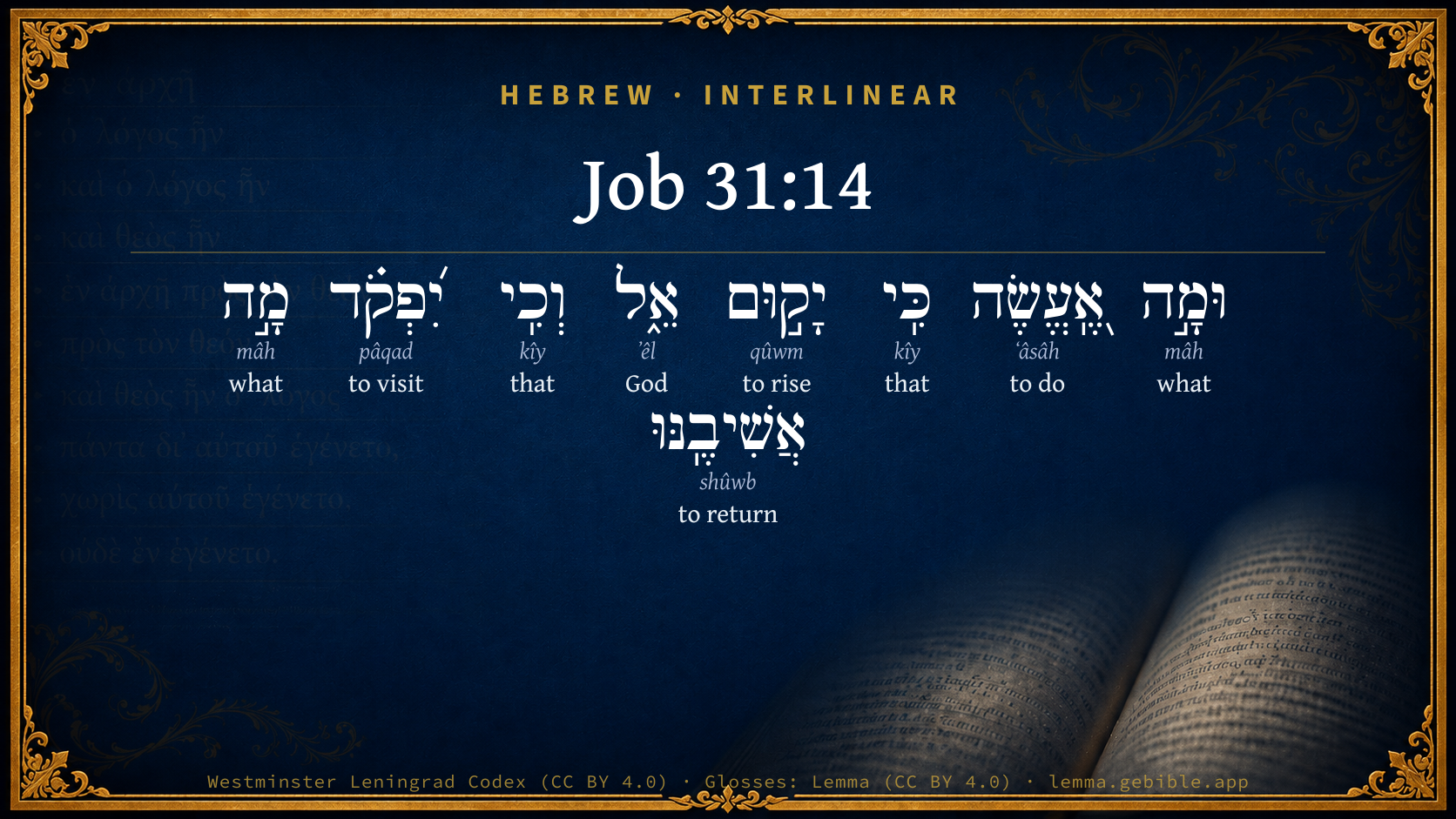
Job 31:14

Hebrew (Westminster Leningrad Codex) Job 31:14 appears in the Hebrew Old Testament. The text above is from the Westminster Leningrad Codex. Each word links to its Strong’s number, a concise gloss, and parsing drawn from the Open Scriptures Hebrew Bible morphology. Click any word for its full Brown-Driver-Briggs (BDB) entry.
Download image
Cite this verse

Job 31:14 (World English Bible). Public Domain. Lemma interlinear Bible study tool, https://lemma.gebible.app/v/job/31/14.

Show BibTeX & RIS
BibTeX
RIS
English Translation
What then shall I do when God rises up? When he visits, what shall I answer him?
World English Bible · Public Domain
Download a study sheet

One document with this verse’s original text, its word-by-word gloss line, the meaning frame, cross-references with their text, attributed commentary, and full source and license credits — printable, and it pastes into notes with its structure intact.

This verse Autodidact and up

Study sheet (.html) Plain text (.txt)

A passage Seminary Student

Up to 50 verses in one chapter. A passage sheet keeps up to 6 commentary sources and 12 cross-references per verse, in the order this page ranks them, and says so on the sheet whenever that leaves anything out. Ask for a single verse and you get the Autodidact verse sheet above.

Everything on this page stays free to read, with no account — the sheet is a download of what is already on screen, not access to it.

Want to remove ads? Support Godless Engineer
Compare translations 3

The same verse in 3 English versions, stacked beneath the original-language interlinear above. Click any original word for its lexicon entry.

Each is an independent rendering of the whole verse — the interlinear is not word-aligned to these translations.

Highlighted words mark where these versions differ — a whole-verse word diff, not a word-by-word alignment.

  • World English Bible Public Domain
    What then shall I do when God rises up? When he visits, what shall I answer him?
  • King James Version Public Domain
    What then shall I do when God riseth up? and when he visiteth, what shall I answer him?
  • unfoldingWord Literal Text CC BY-SA 4.0
    then what would I do if God arose? Or if he visited, how would I answer him?

unfoldingWord Literal Text — © unfoldingWord, licensed CC BY-SA 4.0. Word-aligned USFM3 via Door43 (git.door43.org/unfoldingWord/en_ult).

Versions to compare (up to 4)

3 of 4 selected

Show all 18 translations

Every available English version of this verse, each an independent rendering of the whole verse.

  • World English Bible Public Domain
    What then shall I do when God rises up? When he visits, what shall I answer him?
  • Berean Standard Bible Public Domain
    what will I do when God rises to judge? How will I answer when called to account?
  • Majority Standard Bible Public Domain
    what will I do when God rises to judge? How will I answer when called to account?
  • King James Version Public Domain
    What then shall I do when God riseth up? and when he visiteth, what shall I answer him?
  • American Standard Version (1901) Public Domain
    What then shall I do when God riseth up? And when he visiteth, what shall I answer him?
  • Revised Version (1885) Public Domain
    What then shall I do when God riseth up? and when he visiteth, what shall I answer him?
  • Geneva Bible (1599) Public Domain
    What then shall I do when God standeth vp? and when he shall visit me, what shall I answere?
  • Douay-Rheims (1899) Public Domain
    For what shall I do when God shall rise to judge? and when he shall examine, what shall I answer him?
  • Young's Literal Translation Public Domain
    Then what do I do when God ariseth? And when He doth inspect, What do I answer Him?
  • Literal Standard Version CC BY-SA 4.0
    Then what do I do when God arises? And when He inspects, || What do I answer Him?
  • Unlocked Literal Bible CC BY-SA 4.0
    what then would I do when God rises up to accuse me? When he comes to judge me, how would I answer him?
  • unfoldingWord Literal Text CC BY-SA 4.0
    then what would I do if God arose? Or if he visited, how would I answer him?
  • Darby Bible Public Domain
    What then should I do when ùGod riseth up? and if he visited, what should I answer him?
  • World Messianic Bible Public Domain
    what then will I do when God rises up? When he visits, what will I answer him?
  • Webster's Bible Public Domain
    What then shall I do when God riseth up? and when he visiteth, what shall I answer him?
  • Free Bible Version CC BY-SA 4.0
    what would I do when God came to judge me? How would I reply if he investigated me?
  • Bible in Basic English Public Domain
    What then will I do when God comes as my judge? and what answer may I give to his questions?
  • JPS Tanakh (1917) Public Domain
    What then shall I do when God riseth up? And when He remembereth, what shall I answer Him?

Literal Standard Version (2020), Covenant Press — licensed CC BY-SA 4.0. Text via the HelloAO Bible API (eBible.org). Unlocked Literal Bible (unfoldingWord) — licensed CC BY-SA 4.0. Text via the HelloAO Bible API (eBible.org). unfoldingWord Literal Text — © unfoldingWord, licensed CC BY-SA 4.0. Word-aligned USFM3 via Door43 (git.door43.org/unfoldingWord/en_ult). Free Bible Version, Dr. Jonathan Gallagher — licensed CC BY-SA 4.0. Text via the HelloAO Bible API (eBible.org).

Word by word

More ways to search: Search by grammar → Find every occurrence → Compare this word →

Practice this passage: Drill this verse → Learn its vocabulary →

About this verse

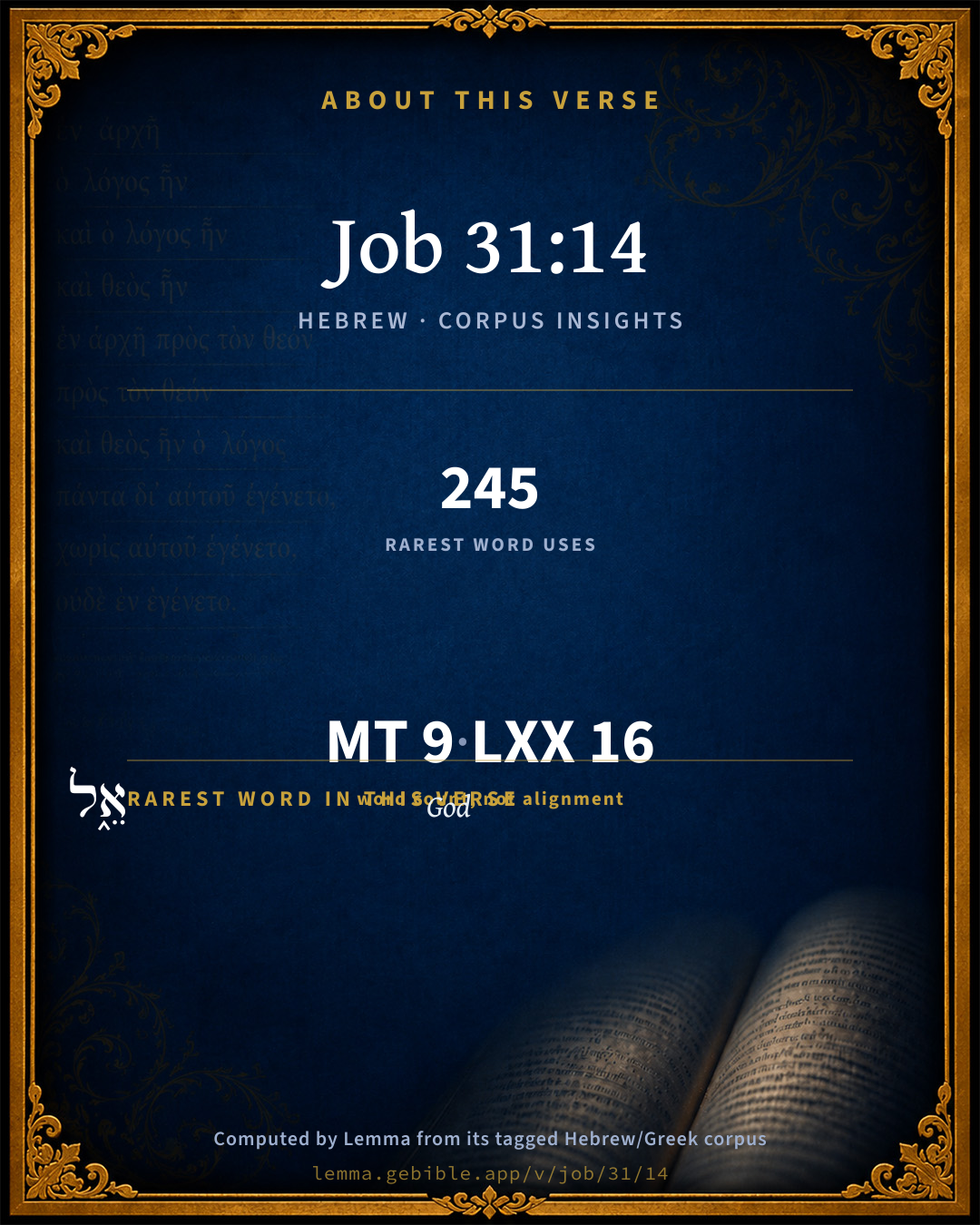
These counts appear in no published source. They are computed here, from the morphology-tagged text and Lemma’s own curated glosses. What Lemma adds →

9
words
7
distinct lemmas
Wisdom
section

Grammatical profile

  • 4 verbs
  • 1 noun
  • 2 conjunctions
  • 2 particles

Verb forms

  • אֶֽ֭עֱשֶׂה Qal · Imperfect
  • יָק֣וּם Qal · Imperfect
  • יִ֝פְקֹ֗ד Qal · Imperfect
  • אֲשִׁיבֶֽנּוּ Hiphil · Imperfect

Repetition

Words recur within this verse — often emphatic in Hebrew:

  • וּמָ֣ה what H4100 ×2
  • כִּֽי that H3588 ×2

Hebrew & Septuagint length

In English translation the verse runs 17 words from the Hebrew and 25 from the Septuagint (LXX English) — the Septuagint runs noticeably longer here. See the side-by-side →

A rough comparison of the two English renderings, which tokenize alike — not a word-level alignment.

Word counts can differ between the Hebrew and the Greek without any difference in meaning — e.g. the Hebrew direct-object marker אֵת has no separate Greek word, and Greek often adds the article ὁ.

In the original languages it is 9 Hebrew tokens and 16 Greek tokens — but the two are counted differently (Hebrew bundles its prefixes and suffixes into one token; the Greek is in lemma form), so that isn’t a like-for-like length.

Cross-references

16

Topical passages linked to Job 31:14 in the Treasury of Scripture Knowledge — connected by theme and wording, ordered by reader-vote popularity; previews shown in the World English Bible.

  • James 2:13 For judgment is without mercy to him who has shown no mercy. Mercy triumphs over judgment.
  • Psalms 9:12 For he who avenges blood remembers them. He doesn't forget the cry of the afflicted.
  • Psalms 9:19 Arise, Yahweh! Don't let man prevail. Let the nations be judged in your sight.
  • Psalms 10:12–15 Arise, Yahweh! God, lift up your hand! Don't forget the helpless.
  • Psalms 44:21 Won't God search this out? For he knows the secrets of the heart.
  • Zechariah 2:13 Be silent, all flesh, before Yahweh; for he has roused himself from his holy habitation!"
  • Romans 3:19 Now we know that whatever things the law says, it speaks to those who are under the law, that every mouth may be closed, and all the world may be brought under the judgment of God.
  • Job 9:32 For he is not a man, as I am, that I should answer him, That we should come together in judgment.
  • Job 10:2 I will tell God, 'Do not condemn me, Show me why you contend with me.
  • Psalms 7:6 Arise, Yahweh, in your anger. Lift up yourself against the rage of my adversaries. Awake for me. You have commanded judgment.
  • Psalms 76:9 When God arose to judgment, To save all the afflicted ones of the earth. Selah.
  • Psalms 143:2 Don't enter into judgment with your servant, For in your sight no man living is righteous.
  • Isaiah 10:3 What will you do in the day of visitation, and in the desolation which shall come from far? to whom will you flee for help? and where will you leave your glory?
  • Hosea 9:7 The days of visitation have come. The days of reckoning have come. Israel will consider the prophet to be a fool, And the man who is inspired to be insane, Because of the abundance of your sins, And because your hostility is great.
  • Micah 7:4 The best of them is like a brier. The most upright is worse than a thorn hedge. The day of your watchmen, Even your visitation, has come; Now is the time of their confusion.
  • Mark 7:2 Now when they saw some of his disciples eating bread with defiled, that is, unwashed, hands, they found fault.

Cross-references courtesy of OpenBible.info (CC BY 4.0).

Hebrew and Greek witnesses Masoretic Hebrew ↔ Greek Septuagint

The same verse in the two great witnesses to the Old Testament, shown verse-for-verse.

Here the Septuagint runs noticeably longer than the Hebrew — LXX2012 (modern English Septuagint) 25 words vs World English Bible 17. A rough length comparison of the two English translations, not a word-level alignment — read both below.

These are two independent witnesses, not word-aligned to each other, and the Septuagint is shown in lemma (dictionary) form.

Hebrew Job 31:14 Masoretic · Westminster Leningrad Codex

וּמָ֣ה אֶֽ֭עֱשֶׂה כִּֽי יָק֣וּם אֵ֑ל וְכִֽי יִ֝פְקֹ֗ד מָ֣ה אֲשִׁיבֶֽנּוּ

What then shall I do when God rises up? When he visits, what shall I answer him?

World English Bible · Public Domain

Greek LXX Job 31:14 Septuagint · lemma form

τίς γάρ ποιέω ἐάν ἔτασις ἐγώ ποιέω ὁ κύριος ἐάν δέ καί ἐπισκοπή τίς ἀπόκρισις ποιέω

what then shall I do if the Lord should try me? and if also he should at all visit me, can I make an answer?

LXX2012 (modern English Septuagint) · Public Domain

Hebrew: Westminster Leningrad Codex (CC BY 4.0). Greek: Septuagint (public domain); English from LXX2012 (modern English Septuagint) (Public Domain). How the Septuagint differs from the Hebrew →

Commentary

Notes on Job 31:14 from classic Christian and Jewish commentators (each source and its license shown beneath its notes). The classic Christian expositions comment on the surrounding passage and are grouped to its opening verse, so a note may address several verses; the Jewish commentaries on the Tanakh (Rashi and others) are per-verse, so they appear only where the commentator wrote on this verse.

Lemma curates 59 commentaries, every one of them public domain or Creative Commons licensed, each selected and text-cleaned for this edition rather than reprinted as found. About our sources →

Trapp's Complete Commentary

John Trapp

Job 31:14 What then shall I do when God riseth up? and when he visiteth, what shall I answer him?

Ver. 14. What then shall I do when God riseth up, &c.] Job considered that he had a Master in heaven, Col 4:1; that there is one higher than the highest, Ecc 5:8, with whom there is no respect of persons, but whereever any deal proudly, God is above them, Exo 18:11. These and the like humbling considerations, and not any placability or natural courteousness, made him deal thus fairly and kindly with his servants; how much more, then, with his wife and children!

And when he visiteth, what shall I answer?] Job looked to be visited, and called to an account of his household government. It is a good saying of a heathen, Ita vivamus, &c., Let us so live as those that must render an account of all we do (Cic. 4 in Verr.). And that which the ruffian in Seneca scoffeth at in the sober young man is true of the godly in a sense more divine, Ita laborat, ita ludit, ita coenat, ita potat, ita loquitur, ita vivit, ut qui Ephemeridas patri est approbaturus; that is, he so laboureth, so sporteth, so eateth, so drinketh, so speaketh, so liveth, as he that must approve his day books to his father. Job was not to learn that there is a way of upright walking in our houses, so as God will come to us, if our houses be rightly ordered, Psa 101:2, and we shall look him in the face with comfort; for it is called there a perfect way, in opposition to hypocrisy. Now uprightness hath boldness.

John Trapp, A Commentary or Exposition upon All the Books of the Old and New Testament (1647–1656) — public domain. Text from a community e-Sword module.

The Biblical Illustrator

Joseph S. Exell

Job_31:14

What then shall I do when God riseth up?

The great question

1. Jobs mind was deeply impressed with a sense of his own responsibility. There is a natural inclination in the mind of man to diminish the sense of responsibility. In most transactions of life men frequently evince a desire to escape as much as possible from personal responsibility. There are responsibilities arising out of the very conformation of the society in which we live, that cannot be avoided. It never can be a matter of choice with us, whether we shall be responsible to God, and in the sight of God. The very nature of our relation to God implies responsibility, and the very character of God, in reference to that relationship, also implies responsibility. The responsibility of man to God reaches to the whole of mans moral being.

2. Jobs conviction that there is a day coming in which God will arise. As a Sovereign, making inquisition, and holding a grand assize in which the universe should be concerned. And God will visit. That term is often used in the sense of visitation for the purpose of punishment. God will arise as the legislator of the universe--as the promulgator of a law which has been universally violated, and which has not exercised its restraining influence upon the hearts of men because their allegiance had departed. Of necessity there must be vindication. Either the justice of God must fail, or there must be a vindication. As the law of God reaches to the minutest details of human existence and of human conduct, the vindication must reach every personal interest, the details of every individual life. And the Lord must visit as an avenger; for vindication implies vengeance. The God whose own arm hath brought salvation, shall be the God who shall visit in the way of vengeance. Job asks, When He visiteth, what shall I answer Him? Should not we ask the same question? What will the man of this world, of pleasure, and of gain, answer? Realise the necessity for finding some answer. There is but one answer. There is nothing to do but to cling to the Cross of Jesus. (George Fish, LL. B.)

The great account

The subject brought before us here is our personal responsibility; that everyone must give account of himself to God. Nothing is hid from the all-seeing eye of Jehovah, that searcheth the heart and the reins, and looketh at the motive, the object, the spirit, in which the man acts.

I. Mans responsibility. We must all give account to God, not merely masters, but servants also; and we must give account in all the transactions of everyday life. Every man has time, talents, opportunities, gifts; every man has a certain station, every man has a certain amount of influence; and we are all responsible for the right use before God. Not one of you can help this influence going forth upon those around you; not one of you can avoid the things you do, telling, in one way or another, upon those with whom you have intercourse. You must do good, or you must do evil. This responsibility we need to face, for it is one that presses always.

II. The way of meeting this responsibility. Two things are spoken of here.

1. What shall we do? Regarding ourselves as responsible to God, what shall we do when He rises in judgment? Shall we not fear to face a holy God? Shall we hide ourselves from God, in order to elude His searching eye? That surely is a vain consideration. Shall we resist His summons? Surely that too is vain.

2. What shall we answer? Shall we say that we have not broken one of Gods commandments? Shall we, like the Pharisee, compare ourselves with others? Shall we begin to make excuse? Shall we plead Gods mercy? The careless cannot meet God. Nor can the formalist; nor the hypocrite and pretender. The two great things we require to be experimentally acquainted with, are repentance and faith towards the Lord Jesus Christ. Believe on the Lord Jesus Christ, and you are delivered at once from the power of the law, and all the accusations of Satan, because Jesus has conquered him, and you also win the victory through faith in Him. (John W. Reeve, M. A.)

The final judgment and ground of acquittal

I. The certainty of a day of visitation and reckoning.

1. This is indicated by the testimony of conscience. Conscience is the vicegerent of the Almighty. It discriminates between virtue and vice, attaching to either their respective awards.

2. By a reference to the moral economy of man, or the economy of Gods dealings towards man.

3. The certainty of a day of visitation is fully unfolded in the Book of God.

II. The ground upon which an answer is to be prepared to the question in our text. Classify the Christian community into four compartments.

1. There are some who have no answer prepared. This is a fact of undoubted certainty.

2. Others prepare an answer on a self-righteous principle. They plead obedience to the requirements of Gods law.

3. Others confide in the uncovenanted mercy of God.

4. But some take higher ground, and are preparing their answer in reference to the righteousness of Christ Jesus our Lord. This is the only plea which will bear inspection, the only foundation for the exercise of mercy. (Adam Gun, A. M.)

The day of visitation

Although Job appears to have taken an undue estimate of his own righteousness, and certainly adhered to his own integrity with a blamable tenacity, yet his scrupulous conscientiousness is greatly to be admired. The smallest act of injustice or oppression, nay, even of neglect, towards the meanest slave or household servant, was viewed by Job as a sin against God, and one for which God would hereafter call him to account!

I. The occasion contemplated. When God will rise up, and when He will visit in judgment.

1. He appears now, as it were, indifferent to the affairs of men.

2. A day is coming when He will arise and visit. It is the day of death. It is the day of punishment. It is the day of judgment.

3. The certainty of its approach. Accountability seems almost an instinct in man. The day of judgment must come--there is no escape from it.

4. Yet most persons believe and act as if they believed it not. How surprising is the indifference of professed believers!

II. The important inquiry respecting this solemn event. When He visiteth, what shall I answer Him?

1. There is individuality in this question; it is the souls soliloquy. Not what shall this man do; but what shall I do?

2. It is, what shall I do? But the time for action is then over. Can I escape and hide myself? Can I evade or deceive? Can I contend with Him?

3. It is, what shall I answer? Various are the excuses with which men satisfy their consciences now, but they will avail nothing then. The following will have nothing to answer,--vicious men and dissipated. Men who have neglected their souls. Self-satisfied formalists. The spiritual professor who has not departed from secret sin. There will be one who can answer--the poor, penitent, humble, believing disciple of Jesus. (F. Close, A. M.)

The Biblical Illustrator, edited by Joseph S. Exell (c. 1880s–1900s) — public domain. Text from a community e-Sword module.

Geneva Bible (1599)

Geneva Bible translators

If I had oppressed others, how should I have escaped God’s judgment.

Geneva Bible (1599) marginal notes — public domain. Text via Bolls.life.

Jamieson, Fausset & Brown

Robert Jamieson, A. R. Fausset & David Brown

Parenthetical; the reason why Job did not despise the cause of his servants. Translate: What then (had I done so) could I have done, when God arose (to call me to account); and when He visited (came to enquire), what could I have answered Him?

Jamieson, Fausset & Brown — Commentary Critical and Explanatory on the Whole Bible (1871) — public domain (CC PDM 1.0). Text via the HelloAO Bible API.

The Cambridge Bible for Schools and Colleges

gen. ed. J. J. S. Perowne

14. when God riseth up] i. e. to judge, as the expression “visiteth” in the next clause suggests.

The Cambridge Bible for Schools and Colleges (gen. ed. J. J. S. Perowne; Cambridge University Press, 1878–1918) — public domain. Text from a community e-Sword module.

John Gill's Exposition

Did not he that made me in the womb make him?.... And her also, both his manservant and maidservant: these were made, by the Lord as Job was, and in a like place and manner as he himself; though parents are the instruments of begetting children, and of bringing them into the world, God is the Maker of men, as at the beginning, and all are alike made by him, in whatsoever rank, condition, and circumstance of life, whether masters or servants; and they are all fabricated in the same shop of nature, the womb of a woman:

and did not one fashion us in the womb? that is, he who is the one God, according to Mal 2:10; God is one in nature and essence, though there are three Persons in the unity of the Godhead; and this one God, Father, Son, and Spirit, is the Creator of all men and things; hence we read of "Creators", Ecc 12:1; and, though one God makes the bodies and creates the souls of men now as at the first, and all are formed and fashioned by him, high, low, rich and poor, bond and free; and they have all the same rational powers and faculties of soul, Psa 33:15; as well as the same curious art and skill are employed in forming and fashioning their bodies and the members of them, in the lower parts of the earth, in their mother's womb; yea, they are fashioned "in one womb" (h), as the words will better bear to be rendered according to the position of them in the original and the accents; not indeed in the same identical womb, but in a like one: there are two words in the original here, both translated "womb"; the one signifies the "ovarium", in which the conception is made; the other designs the "secundine", in which the fetus is wrapped or covered; for so it may be rendered, "did he not cover us?" &c. (i); though Jarchi, Aben Ezra, Ben Gersom, and others, interpret it of the one God as we do: Job's reasoning is, that seeing he and his servants were equally the workmanship of God, and both made in the womb by him, and curiously fashioned alike, and possessed of the same rational powers, it would be unreasonable in him to use them ill, who were his fellow creatures; and should he, he might expect the Maker of them both would highly resent it. Macrobius (k), an Heathen writer, gives a remarkable instance of the care heaven, as he expresses it, has of servants, and how much the contempt of it is resented thereby; and reasons much in the same manner concerning them as Job does here, that they are men, though servants; are of the same original, breathe in the same air, live and die as other men.

(h) , Sept. "in utero uno", Munster; so Beza, Drusius, Michaelis. (i) Saturnal. l. 1. c. 11. (k) Vid. Hackman. Praecidan. Sacr. p. 193.

John Gill's Exposition of the Whole Bible (1746–1763) — public domain (CC PDM 1.0). Text via the HelloAO Bible API.

Albert Barnes' Notes on the Bible

What then shall I do when God riseth up? - That is, when he rises up to pronounce sentence upon people, or to execute impartial justice. Job admits that if he had done injustice to a servant, he would have reason to dread the divine indignation, and that he could have no excuse. “I tremble,” said President Jefferson, speaking of slavery in the United States “when I remember that God is just!” Notes on Virginia.

And when he visiteth - When he comes to inspect human conduct. Umbreit renders it “when he punishes.” The word visit is often used in this sense in the Scriptures.

Albert Barnes' Notes on the Bible (1834–1885) — public domain. Text from a community e-Sword/MySword module.

Matthew Poole's English Annotations

When God riseth up, to wit, to plead the cause of the oppressed against the oppressor, and to execute judgment, as this phrase is used, Psa 68:1; Zec 2:13, and elsewhere. I used my servant like one who was also myself a servant, and had a Master in heaven, Col 4:1, to whom I was to give an account of my carriage to my servant and to all men.

When he visiteth, i.e. when he shall call me to his tribunal, and severely examine all my actions, and particularly the cause between me and my servant, what apology shall I make for myself?

Matthew Poole's English Annotations on the Holy Bible (1683–1685) — public domain. Text from a community e-Sword/MySword module.

Whedon's Commentary on the Bible

Daniel D. Whedon

14. Riseth up — To judgment: such is the divine indignation at the contemplation of man’s cruelty to man. Stephen in the hour of martyrdom saw the Son of man standing on the right hand of God.

Daniel D. Whedon (gen. ed.), Commentary on the Old and New Testaments (1874–1909) — public domain. Text from a community e-Sword module.

The Pulpit Commentary

Vers. 14, 15. What then shall I do when God riseth up? Job regards God as the Avenger and Champion of all the oppressed. If he had been harsh and cruel to his dependants, he would have provoked God"s anger, and God would assuredly "rise up" one day to punish. What, then, could he (Job) do? What but submit in silence? When he visiteth, what shall I answer him? There could be no valid defence. The slave was still a man, a brother God"s creature, equally with his master. Did not he that made me in the womb make him? and did not one fashion us in the womb? God "hath made of one Mood all nations of men," and all individual me, "to dwell on the face of the earth". (Act_17:26) All have rights in a certain sense, equal rights. All are entitled to just treatment, to kind treatment, to merciful treatment. Job is before his age in recognizing the substantial equality of the slave with the freeman, which otherwise was scarcely taught by any until the promulgation of the gospel. (see 1Ti_6:2 Phm_1:16)

The Pulpit Commentary (1880–1919), ed. H.D.M. Spence-Jones & Joseph S. Exell — public domain. Text from a community e-Sword module.

Rashi

Rabbi Shlomo Yitzchaki (Rashi)

then what will I do etc. I took this to heart, and when He visits, what will I answer Him?

Rashi on the Tanakh — English translations: “The Judaica Press complete Tanach with Rashi, translated by A. J. Rosenberg” (CC BY 4.0); “Pentateuch with Rashi's commentary by M. Rosenbaum and A.M. Silbermann, 1929-1934” (public domain); “The Metsudah Tanach series, Lakewood, N.J” (CC BY 4.0); and “The Book of Joshua, Metsudah Publications, 1997” (CC BY 4.0). Text via Sefaria.

Lesson kit

Teaching starters — assembled from the data on this page, not authored interpretation. Every prompt links to the verse data it draws on. Edit before teaching.

Job, in the Wisdom, opens this verse with 9 words (7 distinct Hebrew lemmas). Its most distinctive word is ʼêl (“God”). The Greek Septuagint runs longer here. A historical commentator’s framing appears above. Read the whole chapter for the surrounding context.

Discussion questions

  1. What does “God” (ʼêl) contribute to the verse as a whole?
  2. James 2:13 shares this passage’s theme. How do the two illuminate each other?
  3. “what” occurs 2× in this one verse. What is the effect of the repetition?
  4. Compared with the Hebrew, the Septuagint runs longer here. What questions does that raise?
  5. These translations render this verse differently; the difference is in the English rendering, not the original. What questions does that raise?
  6. The verb «אֶֽ֭עֱשֶׂה» is Qal Imperfect. How does its form color the action?
  7. Reading how Trapp's Complete Commentary and The Biblical Illustrator read this verse, where do the two commentators agree and where do they part?

Things to notice

Reading settings

Reading text

Shown beneath each verse's original-language words.

Old Testament
Old Testament edition

Read the OT as the Masoretic Hebrew (MT) or the Greek Septuagint (LXX).

English shown for the Greek Septuagint (in the Hebrew ↔ Greek comparison).

Comparing translations? Open the Compare panel on any verse page to stack up to four side by side.