Isaiah 14:32

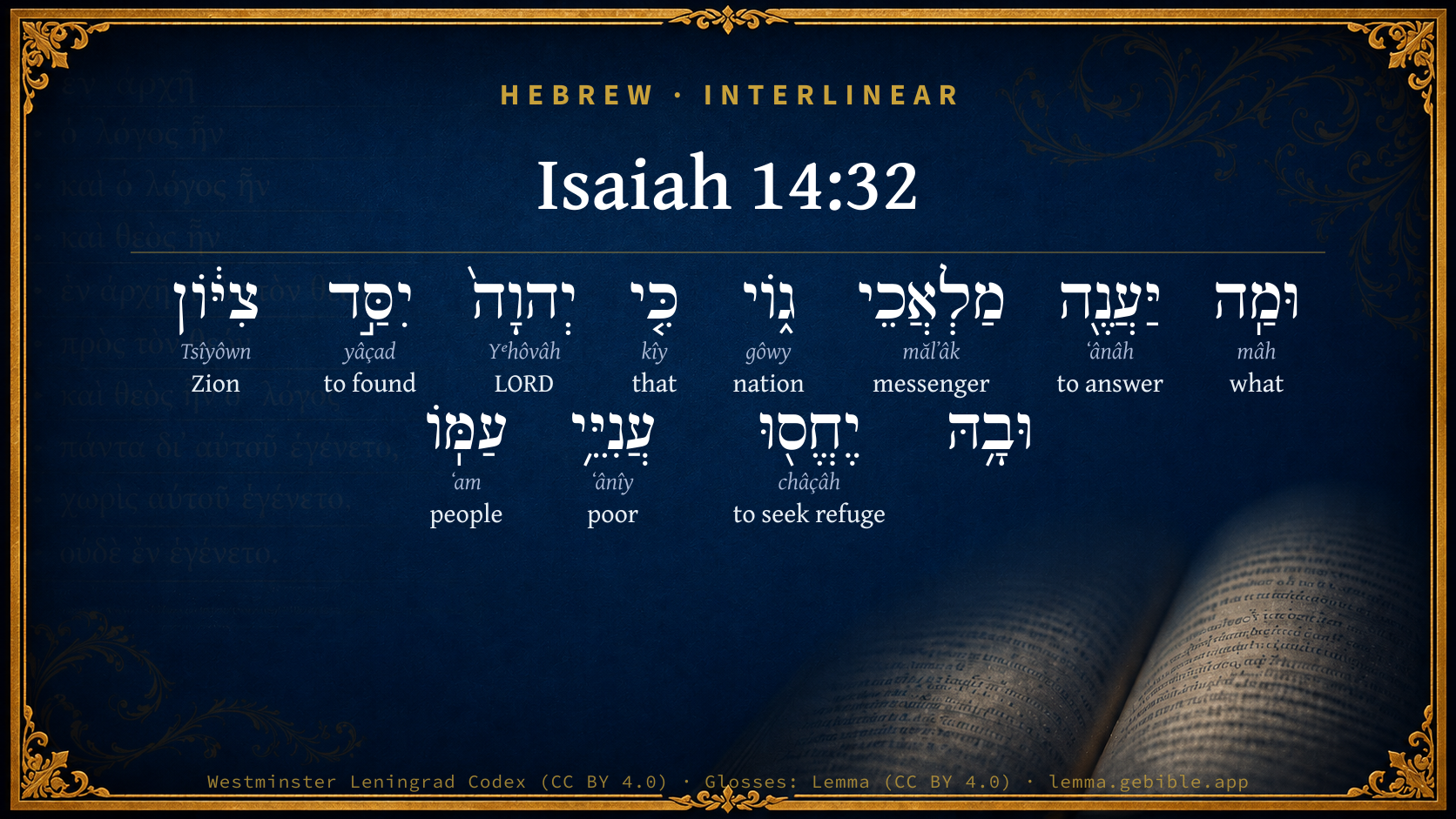
Hebrew (Westminster Leningrad Codex) Isaiah 14:32 appears in the Hebrew Old Testament. The text above is from the Westminster Leningrad Codex. Each word links to its Strong’s number, a concise gloss, and parsing drawn from the Open Scriptures Hebrew Bible morphology. Click any word for its full Brown-Driver-Briggs (BDB) entry.
Download image
Cite this verse

Isaiah 14:32 (World English Bible). Public Domain. Lemma interlinear Bible study tool, https://lemma.gebible.app/v/isaiah/14/32.

Show BibTeX & RIS
BibTeX
RIS
English Translation
What then shall one answer the messengers of the nation? That Yahweh has founded Zion, and in her shall the afflicted of his people take refuge.
World English Bible · Public Domain
Download a study sheet

One document with this verse’s original text, its word-by-word gloss line, the meaning frame, cross-references with their text, attributed commentary, and full source and license credits — printable, and it pastes into notes with its structure intact.

This verse Autodidact and up

Study sheet (.html) Plain text (.txt)

A passage Seminary Student

Up to 50 verses in one chapter. A passage sheet keeps up to 6 commentary sources and 12 cross-references per verse, in the order this page ranks them, and says so on the sheet whenever that leaves anything out. Ask for a single verse and you get the Autodidact verse sheet above.

Everything on this page stays free to read, with no account — the sheet is a download of what is already on screen, not access to it.

Want to remove ads? Support Godless Engineer
Compare translations 3

The same verse in 3 English versions, stacked beneath the original-language interlinear above. Click any original word for its lexicon entry.

Each is an independent rendering of the whole verse — the interlinear is not word-aligned to these translations.

Highlighted words mark where these versions differ — a whole-verse word diff, not a word-by-word alignment.

  • World English Bible Public Domain
    What then shall one answer the messengers of the nation? That Yahweh has founded Zion, and in her shall the afflicted of his people take refuge.
  • King James Version Public Domain
    What shall one then answer the messengers of the nation? That the LORD hath founded Zion, and the poor of his people shall trust in it.
  • unfoldingWord Literal Text CC BY-SA 4.0
    And what will one answer the messengers of a nation? That Yahweh has founded Zion, and the poor of his people will take refuge in it.

unfoldingWord Literal Text — © unfoldingWord, licensed CC BY-SA 4.0. Word-aligned USFM3 via Door43 (git.door43.org/unfoldingWord/en_ult).

Versions to compare (up to 4)

3 of 4 selected

Show all 18 translations

Every available English version of this verse, each an independent rendering of the whole verse.

  • World English Bible Public Domain
    What then shall one answer the messengers of the nation? That Yahweh has founded Zion, and in her shall the afflicted of his people take refuge.
  • Berean Standard Bible Public Domain
    What answer will be given to the envoys of that nation? “The LORD has founded Zion, where His afflicted people will find refuge.”
  • Majority Standard Bible Public Domain
    What answer will be given to the envoys of that nation? “The LORD has founded Zion, where His afflicted people will find refuge.”
  • King James Version Public Domain
    What shall one then answer the messengers of the nation? That the LORD hath founded Zion, and the poor of his people shall trust in it.
  • American Standard Version (1901) Public Domain
    What then shall one answer the messengers of the nation? That Jehovah hath founded Zion, and in her shall the afflicted of his people take refuge.
  • Revised Version (1885) Public Domain
    What then shall one answer the messengers of the nation? That the LORD hath founded Zion, and in her shall the afflicted of his people take refuge.
  • Geneva Bible (1599) Public Domain
    What shall then one answere the messengers of the Gentiles? That the Lord hath stablished Zion, and the poore of his people shall trust in it.
  • Douay-Rheims (1899) Public Domain
    And what shall be answered to the messengers of the nations? That the Lord hath founded Sion, and the poor of his people shall hope in him.
  • Young's Literal Translation Public Domain
    And what doth one answer the messengers of a nation? `That Jehovah hath founded Zion, And in it do the poor of His people trust!'
  • Literal Standard Version CC BY-SA 4.0
    And what does one answer the messengers of a nation? That YHWH has founded Zion, || And the poor of His people take refuge in it!
  • Unlocked Literal Bible CC BY-SA 4.0
    How will they respond to the messengers of that nation? “Yahweh has founded Zion, and in her the afflicted of his people will find refuge.”
  • unfoldingWord Literal Text CC BY-SA 4.0
    And what will one answer the messengers of a nation? That Yahweh has founded Zion, and the poor of his people will take refuge in it.
  • Darby Bible Public Domain
    And what shall be answered to the messengers of the nation? That Jehovah hath founded Zion, and the afflicted of his people find refuge in it.
  • World Messianic Bible Public Domain
    What will they answer the messengers of the nation? That the LORD has founded Zion, and in her the afflicted of his people will take refuge.
  • Webster's Bible Public Domain
    What shall one then answer the messengers of the nation? That the LORD hath founded Zion, and the poor of his people shall trust in it.
  • Free Bible Version CC BY-SA 4.0
    What will be the answer given to the messengers from that nation? “The Lord was the one who laid the foundations of Zion, and that's where his suffering people will be kept safe.”
  • Bible in Basic English Public Domain
    What answer, then, will my people give to the representatives of the nation? That the Lord is the builder of Zion, and she will be a safe place for the poor of his people.
  • JPS Tanakh (1917) Public Domain
    What then shall one answer the messengers of the nation? That the LORD hath founded Zion, and in her shall the afflicted of His people take refuge.

Literal Standard Version (2020), Covenant Press — licensed CC BY-SA 4.0. Text via the HelloAO Bible API (eBible.org). Unlocked Literal Bible (unfoldingWord) — licensed CC BY-SA 4.0. Text via the HelloAO Bible API (eBible.org). unfoldingWord Literal Text — © unfoldingWord, licensed CC BY-SA 4.0. Word-aligned USFM3 via Door43 (git.door43.org/unfoldingWord/en_ult). Free Bible Version, Dr. Jonathan Gallagher — licensed CC BY-SA 4.0. Text via the HelloAO Bible API (eBible.org).

Word by word

More ways to search: Search by grammar → Find every occurrence → Compare this word →

Practice this passage: Drill this verse → Learn its vocabulary →

יֶחֱס֖וּ
châçâh
H2620
“to seek refuge”
Verb, Qal, Imperfect, 3rd Person, Masculine, Plural
Part of Speech
Verb
Stem
Qal
Form
Imperfect
Person
3rd Person
Gender
Masculine
Number
Plural
Full BDB Definition

Origin: a primitive root

TWOT: 700

(Qal) to seek refuge, flee for protection - to put trust in (God), confide or hope in (God) (figuratively)
  1. וּמַֽה mâh H4100 “and · what” Conjunction + Particle, Interrogative
  2. יַּעֲנֶ֖ה ʻânâh H6030 “to answer” Verb, Qal, Imperfect, 3rd Person, Masculine, Singular
  3. מַלְאֲכֵי mălʼâk H4397 “messengers of” Noun, Common, Masculine, Plural, Construct
  4. ג֑וֹי gôwy H1471 “nation” Noun, Common, Masculine, Singular, Absolute
  5. כִּ֤י kîy H3588 “that” Conjunction
  6. יְהוָה֙ Yᵉhôvâh H3068 “LORD” Noun, Proper
  7. יִסַּ֣ד yâçad H3245 “to found” Verb, Piel, Perfect, 3rd Person, Masculine, Singular
  8. צִיּ֔וֹן Tsîyôwn H6726 “Zion” Noun, Proper
  9. עֲנִיֵּ֥י ʻânîy H6041 “poor of” Adjective, Adjective, Masculine, Plural, Construct
  10. עַמּֽוֹ ʻam H5971 “people · his” Noun, Common, Masculine, Singular, Construct + Suffix, Personal, 3rd Person, Masculine, Singular

About this verse

These counts appear in no published source. They are computed here, from the morphology-tagged text and Lemma’s own curated glosses. What Lemma adds →

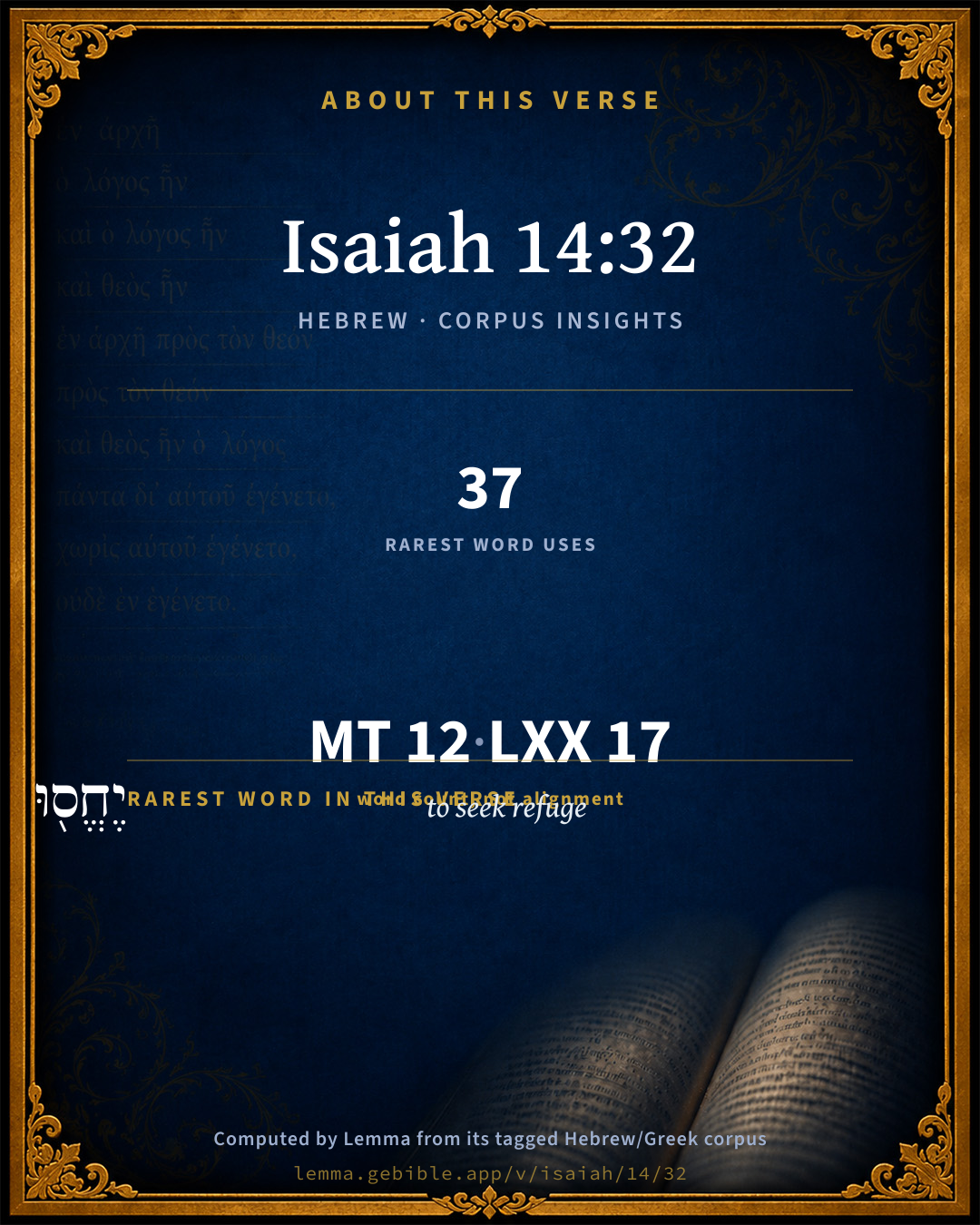
12
words
11
distinct lemmas
Prophets
section

Shared distinctive vocabulary

יֶחֱס֖וּ to seek refuge H2620 occurs in 36 verses of the Hebrew Bible. Also found in:

Grammatical profile

  • 3 verbs
  • 5 nouns
  • 1 adjective
  • 1 preposition
  • 1 conjunction
  • 1 particle

Verb forms

  • יַּעֲנֶ֖ה Qal · Imperfect
  • יִסַּ֣ד Piel · Perfect
  • יֶחֱס֖וּ Qal · Imperfect

Hebrew & Septuagint length

In English translation the verse runs 26 words from the Hebrew and 26 from the Septuagint (LXX English) — the same length.

A rough comparison of the two English renderings, which tokenize alike — not a word-level alignment.

Word counts can differ between the Hebrew and the Greek without any difference in meaning — e.g. the Hebrew direct-object marker אֵת has no separate Greek word, and Greek often adds the article ὁ.

In the original languages it is 12 Hebrew tokens and 17 Greek tokens — but the two are counted differently (Hebrew bundles its prefixes and suffixes into one token; the Greek is in lemma form), so that isn’t a like-for-like length.

Cross-references

25

Topical passages linked to Isaiah 14:32 in the Treasury of Scripture Knowledge — connected by theme and wording, ordered by reader-vote popularity; previews shown in the World English Bible.

  • Psalms 87:5 Yes, of Zion it will be said, "This one and that one was born in her;" The Most High himself will establish her.
  • Psalms 102:16 For Yahweh has built up Zion. He has appeared in his glory.
  • Psalms 87:1 His foundation is in the holy mountains.
  • Zephaniah 3:12 But I will leave in the midst of you an afflicted and poor people, and they will take refuge in the name of Yahweh.
  • James 2:5 Listen, my beloved brothers. Didn't God choose those who are poor in this world to be rich in faith, and heirs of the Kingdom which he promised to those who love him?
  • Isaiah 25:4 For you have been a stronghold to the poor, a stronghold to the needy in his distress, a refuge from the storm, a shade from the heat, when the blast of the awesome ones is as a storm against the wall.
  • Psalms 102:28 The children of your servants will continue. Their seed will be established before you."
  • Isaiah 4:6 There will be a pavilion for a shade in the daytime from the heat, and for a refuge and for a shelter from storm and from rain.
  • Isaiah 28:16 therefore thus says the Lord Yahweh, Behold, I lay in Zion for a foundation a stone, a tried stone, a precious corner -[stone] of sure foundation: he who believes shall not be in haste.
  • Isaiah 39:1 At that time Merodach Baladan the son of Baladan, king of Babylon, sent letters and a present to Hezekiah; for he heard that he had been sick, and was recovered.
  • Isaiah 44:28 Who says of Cyrus, [He is] my shepherd, and shall perform all my pleasure, even saying of Jerusalem, She shall be built; and of the temple, Your foundation shall be laid.
  • Zechariah 11:11 It was broken in that day; and thus the poor of the flock that listened to me knew that it was the word of Yahweh.
  • 2 Samuel 8:10 then Toi sent Joram his son to king David, to Greet him, and to bless him, because he had fought against Hadadezer and struck him: for Hadadezer had wars with Toi. [Joram] brought with him vessels of silver, and vessels of gold, and vessels of brass:
  • 2 Kings 20:12–19 At that time Berodach-baladan the son of Baladan, king of Babylon, sent letters and a present to Hezekiah; for he had heard that Hezekiah had been sick.
  • Psalms 132:13–14 For Yahweh has chosen Zion. He has desired it for his habitation.
  • Proverbs 18:10 The name of Yahweh is a strong tower: The righteous run to him, and are safe.
  • Isaiah 11:4 but with righteousness shall he judge the poor, and decide with equity for the humble of the earth; and he shall strike the earth with the rod of his mouth; and with the breath of his lips shall he kill the wicked.
  • Isaiah 12:6 Cry aloud and shout, you inhabitant of Zion; for great in the midst of you is the Holy One of Israel!"
  • Isaiah 37:9 He heard say concerning Tirhakah king of Ethiopia, He is come out to fight against you. When he heard it, he sent messengers to Hezekiah, saying,
  • Isaiah 37:32 For out of Jerusalem shall go forth a remnant, and out of Mount Zion those who shall escape. The zeal of Yahweh of Hosts will perform this.
  • Isaiah 54:11 you afflicted, tossed with tempest, and not comforted, behold, I will set your stones in beautiful colors, and lay your foundations with sapphires.
  • Zechariah 11:7 So I fed the flock of slaughter, especially the oppressed of the flock. I took for myself two staffs. The one I called "Favor," and the other I called "Union," and I fed the flock.
  • Matthew 16:18 I also tell you that you are Peter, and on this rock I will build my assembly, and the gates of Hades will not prevail against it.
  • Matthew 24:15–16 "When, therefore, you see the abomination of desolation, which was spoken of through Daniel the prophet, standing in the holy place (let the reader understand),
  • Hebrews 12:22 But you have come to Mount Zion, and to the city of the living God, the heavenly Jerusalem, and to innumerable hosts of angels,

Cross-references courtesy of OpenBible.info (CC BY 4.0).

Hebrew and Greek witnesses Masoretic Hebrew ↔ Greek Septuagint

The same verse in the two great witnesses to the Old Testament, shown verse-for-verse.

These are two independent witnesses, not word-aligned to each other, and the Septuagint is shown in lemma (dictionary) form.

Hebrew Isaiah 14:32 Masoretic · Westminster Leningrad Codex

וּמַֽה יַּעֲנֶ֖ה מַלְאֲכֵי ג֑וֹי כִּ֤י יְהוָה֙ יִסַּ֣ד צִיּ֔וֹן וּבָ֥הּ יֶחֱס֖וּ עֲנִיֵּ֥י עַמּֽוֹ

What then shall one answer the messengers of the nation? That Yahweh has founded Zion, and in her shall the afflicted of his people take refuge.

World English Bible · Public Domain

Greek LXX Isaiah 14:32 Septuagint · lemma form

καί τίς ἀποκρίνω βασιλεύς ἔθνος ὅτι κύριος θεμελιόω σιων καί διά αὐτός σώζω ὁ ταπεινός ὁ λαός

And what shall the kings of the nations answer? That the Lord has founded Sion, and by him the poor of the people shall be saved.

LXX2012 (modern English Septuagint) · Public Domain

On this verse, Adam Clarke's Commentary discusses the Septuagint’s reading. Read the note in Commentary ↓

Hebrew: Westminster Leningrad Codex (CC BY 4.0). Greek: Septuagint (public domain); English from LXX2012 (modern English Septuagint) (Public Domain). How the Septuagint differs from the Hebrew →

Targum (Aramaic paraphrase)

1

The Targum is the ancient Jewish Aramaic paraphrase of the Hebrew Scriptures — an interpretive translation, not the Hebrew text itself. Onkelos (literal) and Pseudo-Jonathan (expansive) render the Torah, and Jonathan the Prophets. Coverage is partial: where no permissively-licensed English translation exists for a verse, only the Aramaic is shown. This is verse-level text, not a word-by-word alignment to the Hebrew.

  1. Targum Jonathan Prophets (Joshua–Malachi)
    וּמַה יְבַסְרוּן אִזְגַדֵי עַמְמַיָא אֲרֵי יְיָ שַׁכְלֵיל צִיוֹן וּבָהּ יִתְרַחֲצוּן חֲשִׁיכֵי עַמָא:

    And what good news will they tell the messengers of the nations? That the Lord hath founded Zion, and the poor of His people shall trust in it.

    Targum Jonathan — Aramaic: “Mikraot Gedolot” (public domain). English: “Sefaria Community Translation” (CC0 1.0 (public-domain dedication)); “London "Chaldee Paraphrase," 1871” (public domain). Text via Sefaria.

Commentary

Notes on Isaiah 14:32 from classic Christian and Jewish commentators (each source and its license shown beneath its notes). The classic Christian expositions comment on the surrounding passage and are grouped to its opening verse, so a note may address several verses; the Jewish commentaries on the Tanakh (Rashi and others) are per-verse, so they appear only where the commentator wrote on this verse.

Lemma curates 59 commentaries, every one of them public domain or Creative Commons licensed, each selected and text-cleaned for this edition rather than reprinted as found. About our sources →

Trapp's Complete Commentary

John Trapp

Isa 14:32 What shall [one] then answer the messengers of the nation? That the LORD hath founded Zion, and the poor of his people shall trust in it.

Ver. 32. That the Lord hath founded Zion.] Not Hezekiah, but Jehovah hath done it.

John Trapp, A Commentary or Exposition upon All the Books of the Old and New Testament (1647–1656) — public domain. Text from a community e-Sword module.

The Biblical Illustrator

Joseph S. Exell

Isa_14:32

What shall one then answer the messengers of the nation?

--

Gods work in founding Zion

The kingdom of Judah was low and broken; foreign invasions and intestine divisions had made it so. In this state of things God takes notice of the joy and triumphing of the Philistines. To take them off from their pride and boasting He lets them know that from the people whom they despised their desolation was at hand, though they seemed to be perplexed and forsaken for a season (Isa_14:29-31).

I. There is AN INQUIRY. What shall one answer, etc. They come to make inquiry after the work of God among His people, and it is fit that an answer be given to them. Two things are observable in this interrogation.

1. The nations about will be diligently inquiring after Gods dispensations among His people. There are certain affections and principles that are active in the nations, that will make them restless, and always put them upon this inquiry. The people of God, on one account or other, shall be in all seasons a separated people. No sooner, then, is any people, or portion of them, thus dedicated to God, but all the nations about, and those amongst them not engaged in the same way with them, instantly look on them as utterly severed from them, having other ways, ends, and interests than they; being built up wholly on another account and foundation. They reckon not of them as a people and a nation. The conclusion they make concerning them is, that of Haman (Est_3:8).

(1) They are full of enmity against them.

(2) A second principle, whereby they are put upon their inquiries, is fear. They fear them, and therefore will know how things stand with them, and what are the works of God amongst them (Hab_3:7; Psa_48:1-6). Fear is solicitous and inquiring; it will leave nothing unsearched, unlooked into; it would find the inside and bottom of everything, wherein it is concerned. Though the more it finds, the more it is increased; yet the greater still are its inquiries, fearing more what it knows not than what it knows.

2. The issues of Gods dispensations amongst His people shall be so evident and glorious, that everyone, anyone, though never so weak, if not blinded by prejudice, shall be able to give a convincing answer concerning them to the inquiries of men.

II. THERE IS THE RESOLUTION GIVEN OF THE INQUIRY. Hereof are two parts--

(1) What God hath done.

(2) What His people shall, or ought to do. Wrap up at any time the work of God and the duty of His people together, and they will be a sufficient answer to any mans inquiry after the state of things among them.

1. The great design of God in His mighty works and dispensations is the establishment of His people, and their proper interest, in their several generations. To make this clear some few things are previously to be considered--

(1) The proper interest of the people of God is to glorify Him in their several places, stations, and generations: none of us are to live unto ourselves.

(2) God is the only proper and infallible judge, in what state and condition His people will best and most glorify His name, in their several generations.

(3) Providential dispensations are discoveries of the wisdom of God in disposing of the condition of His people, so as they may best glorify Him. These things being premised, it is easy to give light and evidence to the assertion laid down.

2. It is the duty of Gods preserved remnant, laying aside all other aims and contrivances, to betake themselves to the work of God, founding Zion, and preserving the common interest of His people. God hath founded Zion, and the poor of the people shall trust therein, or betake themselves unto it. We are apt to wander on hills and mountains, everyone walking in the imagination of his own heart, forgetting our resting place. When God was bringing the power of the Babylonian upon His people, the prophet Jeremiah could neither persuade the whole nation to submit to his government, nor many individuals among them to fall to him in particular. And when the time of their deliverance from that captivity was accomplished, how hardly were they persuaded to embrace the liberty tendered! (J. Owen, D. D.)

Gods care for His people

1. The great things God doth for His people are, and cannot but be, taken notice of by their neighbours (Psa_126:2).

2. Messengers will be sent to inquire concerning them. Jacob and Israel have long been a people distinguished from all others, and dignified with uncommon favours; and therefore, some for goodwill, others for ill-will, and all for curiosity, are inquisitive concerning them.

3. It concerns us always to be ready to give a reason of the hope that we have in the providence of God, as well as in His grace, in answer to everyone that asks it, with meekness and fear.

4. The issue of Gods dealings with His people shall be so manifestly glorious that anyone, everyone, shall be able to give an account of them to those that inquire concerning them. (M. Henry.)

The Church founded for a refuge

At first sight the prediction which closes the fourteenth chapter of Isaiah seems of temporary interest only, and to speak of judgments which within a very few years were destined to fall upon one of the most inveterate enemies of Gods ancient people; and yet I cannot but think those commentators right who, following the opinion of divers of the fathers of the Church, have found in the passage an allusion to the Gospel and Church of Christ.

I. That the prophecy would be one of PRESSING AND IMMEDIATE INTEREST TO THE CONTEMPORARIES OF THE PROPHET is obvious from the manner in which it is ushered in: In the year that King Ahaz died was this burden (or, as we should nowadays say, this denunciation of wrath) against the Philistines. After bidding the inhabitants of Palestine howl for the judgments that were impending, Isaiah, speaking as he was moved by the Holy Ghost, makes the inquiry and gives the answer of the text. It was usual for neighbouring nations, who were friends and allies, to send ambassadors, and congratulate each other on success. When, therefore, the coming triumph over the Philistines should be known abroad, and the envoys of friendly states should inquire of Judah into the circumstances of his success, let this answer, said the prophet, suffice: that the Lord hath founded Zion, and the poor of His people shall trust in it.

II. No one can read that promise and not feel that it was INTENDED TO HAVE AN AMPLER SCOPE for its fulfilment than in the personal security of a handful of Jewish peasants; the whole turn of expression is redolent of Gospel times. Such words were never fully verified till Christ, the Son of David, had founded the Christian Church, and made His gracious offer to a world enslaved in the most cruel of all bondage: Come unto Me, all ye that labour and are heavy laden, and I will give you rest. (F. E.Paget, D. D.)

The Churchs heavenly origin and beneficent mission

I. The Lord hath founded Zion; THIS IS THE GUARANTEE OF HIS LOVE AND HER STABILITY. The strongest, most fundamental title of protection is creation. Even among ourselves, no one frames an object to destroy it; he who makes, makes that he may preserve. And if this be so in human nature, shall there be nothing to compare with it in the Divine? God, indeed, who is eternal, can require no successor to whom to devise His purposes of love; but all the claims that the thing framed can have on Him who framed it, hold with tenfold force when the object is not, as in our humbler works, the mere apposition of pre-existing materials, in which nothing is ours except the order of arrangement, but is itself, alike in matter and in form, the direct offspring of His own inexhaustible power and goodness.

1. Behold, then, how as His own God loved the world; how as not only His own, but His own in pain and anguish, and endeared to His inmost heart as such, God hath loved His Church. He spoke to bid the one, He died to make the other, exist.

2. In this Church of His is His own honour pledged. He hath not covenanted with the world that now is to immortalise it; but He has passed His own word for the perpetuity of His Church. Nothing so framed was ever framed to perish; He has infused into it His own Spirit, and His Spirit is life.

3. Is not the Church in its ultimate perfection set forth as the very reward of all the sorrows of its Lord; and shall He be defrauded of His recompense?

4. There is more than creation to bind the Church to Christ, more than promise, more than reward; there is communion, oneness, identification. A man may desert his child; he cannot desert himself. With such a union there can be no separation; if Christ be immortal, the Church is so; when He dies she shall perish, but not till then.

II. The poor of her people shall trust in it--or, as the margin has it, shall betake themselves unto it: THIS IS ONE PURPOSE OF THE CHURCHS MISSION UPON EARTH--the care, the teaching, the education, the guidance of the poor. (W. Archer Butler, D. D.)

God the Protector of His Church

We tell our Lord God that if He will have His Church, He must keep it Himself, for we cannot do it; and it is well for us that we cannot, else we should be the proudest asses under heaven (M. Luther.)

.

The Biblical Illustrator, edited by Joseph S. Exell (c. 1880s–1900s) — public domain. Text from a community e-Sword module.

Joseph Benson's Commentary

Isa 14:32. What shall one then answer the messengers of the nation — At the same time that “the prophet sees, as it were, a thick cloud, coming from the north, darkening the heavens, an emblem of the calamity coming from that quarter on the Philistines, he sees the messengers of that nation, as in a common danger, going to the king of Judah, and deliberating concerning the common safety. While he beholds the first he turns his discourse to the Philistines, and excites them to lamentation: but observing the second, he teaches the Jews what answer they should give to the messengers of that nation on this occasion:” see Jer 47:2, and Vitringa. What shall a Jew say in that day, when not only the Philistines, but even the Jews themselves, shall fall by the hands of one and the same enemy? That the Lord hath founded Zion, &c. — They shall give them this answer, That although Zion at present be in a very distressed and deplorable condition, and seems to be forsaken by her God, yet she stands upon a firm foundation, and God, who first founded her, will again restore and establish her; and his poor, despised people, shall resort to her, as to a strong and sure refuge. This verse seems evidently to be added, to express the very different condition of God’s people from that of the Philistines, in the events of the Babylonian invasion: that, whereas the Philistines should be irrevocably destroyed thereby, and no remnant of them should be left, as was said Isa 14:30; God’s people, though they should be sorely scourged, and carried into captivity, yet should be strangely preserved, and, after some years, delivered, and restored to their own land; whereby it would appear that Zion stood upon a sure foundation, and although it was grievously shaken, yet it could not be utterly and finally overthrown.

Joseph Benson's Commentary on the Old and New Testaments (1811–1818) — public domain. Text from a community e-Sword module.

The Preacher's Complete Homiletical Commentary

Joseph S. Exell (gen. ed.)

A MEMORABLE ANSWER

Isa_14:32. What shall one answer? &c.

Translators and interpreters differ as to whether the answer in this verse was intended to be given by or to the messengers of the nations; as to the nations whose messengers are here spoken of; and as to the time when they came on their errand. Adopting the view which represents them as coming to Jerusalem to congratulate Hezekiah after the marvellous deliverance of that city from the Assyrians (chap. Isa_37:36-38), we remind you—

I. That the wonders of God’s love to His Church often surprise strangers as well as friends. For the deliverances wrought for her are often—

1. Surprisingly seasonable, e.g., the over throw of the Egyptian host in the Red Sea, when everything seemed to favour Pharaoh and to be against Israel (Exo_15:13-15); the deliverance of Jerusalem from Sennacherib.

2. Astonishing because brought about by unlikely means. Who could have anticipated the manner of the deliverance of Jerusalem on this occasion? [Give other examples.]

3. Astonishing because vouchsafed in spite of great provocations and unworthiness. Every such deliverance is a work of grace as well as of power.

II. In such times of deliverance friends and enemies alike wonder at the secure foundations on which the Church is built. The literal Zion was a marvel of architecture (Psa_48:13), and in this respect it was a worthy symbol of the Church [1027]

1. The strength and stability of the spiritual Zion is guaranteed by the character and resources of the Builder: “The Lord hath founded Zion.”

2. Therefore we should not fear the might of any of the adversaries that come up against her (H. E. I., 1246–1251).

[1027] See notes to outline: THE DUTY OF GLADNESS, chap. Isa_12:6.

III. The stability and security of Zion are sources of delighted satisfaction to the humblest of her inhabitants: “The poor of His people shall trust in it.” They know they are under the guardianship of One who is “mighty to save,” and who encircles the least as well as the greatest in the arms of His love. Their consciousness of poverty and weakness leads them to rest in Him with an undivided trust, and they thus attain unconsciously to the blessedness of those whose trust is in God only, the peace which rests on the only foundation that cannot be moved.—Samuel Thodey.

Mark what the text affirms, “The Lord hath founded Zion;” this is the guarantee of His love and of her stability: “the poor of His people shall trust in it,” or, as the margin has it, “shall betake themselves unto it;” this is the one purpose of her Divine mission upon earth—the care, the teaching, the education, the guidance of the poor.

I. THE SECURITY OF THE CHURCH.

1. The strongest, most fundamental title to protection is creation. Even among ourselves no one frames an object in order to destroy it; he who makes, makes that he may preserve. Thus is creation in itself a presumptive title to protection; and it is abundantly plain that the strength of such a bond will ever increase with the cost of the object produced. In one sense the whole material universe cost its Creator nothing, for its production was to Him a thing of infinite ease; but this cannot be said of the Church. He spoke to bid the one, He died to make the other exist. When He beholds His Church, He sees in it the monument of His own inexpressible sorrows; He feels this offspring of His Divine agonies drawn closer to His eternal heart by the thought of all it cost to give her being.

2. In this Church of His is His own honour pledged. He hath not covenanted with the world that now is to immortalise it; but He has passed His own word for the perpetuity of His Church (Mat_16:18; Isa_60:20-21).

3. The Church, in its ultimate perfection, is set forth as the very reward of all the sorrows of its Lord. To “see of the travail of His soul and be satisfied” is His destined crown; this “joy set before Him” was that which enabled Him to “endure the cross, despising the shame.” (See also Eph_5:25-27.) Shall He be defrauded of His recompense?

4. There is more than creation to bind the Church to Christ, more than promise, more than reward; there is communion, oneness, identification. A man may desert his child; he cannot desert himself. Even though the Redeemer could forget His espoused bride; even though He could deny His plighted promise; yea, though He could abandon His own reward, He cannot abandon His own body (1Co_12:27; Eph_1:23; Eph_5:30). With such a union there can be no separation; if Christ be immortal, the Church is so; when He dies she shall perish, but not till then.

II. THE MISSION OF THE CHURCH. “The poor of His people shall trust in it.” The Church of Christ is one vast institute for the benefit of the poor. The poor were the special objects of Christ’s solicitude and tenderness, and they have been, and should be, the special objects of the Church’s care. Even in her worst days she has had an open hand for the poor. She should ever follow the example of her Lord in caring for their temporal needs. But it is in the doctrine she preaches, and the way she preaches it, that the Church is indeed the poor man’s consoler [1030]William Archer Butler, M.A.: Sermons, Doctrinal and Practical, Second Series, pp. 227–237.

[1030] It is in meeting his sorrow with tidings of glory to come, in brightening the gloom of his humble home with the hallowed light of eternity, in soothing his days of hard and heavy toil with her peaceful Sabbaths, in watching over his bed of sickness with a patience as unwearied as if his poor chambers were gorgeous with gilded ceilings and silken tapestry; it is in these things that the Church carries on that loveliest attribute of Her Lord, “Thou hast been a strength to the poor, a strength to the needy in his distress.”—Archer Butler.

The Preacher's Complete Homiletical Commentary (gen. ed. Joseph S. Exell; Funk & Wagnalls, c. 1892) — public domain (pre-1929). A full-Bible homiletical/sermon-outline anthology covering 65 of 66 books (2 John is absent from the source module). Text from a community e-Sword module.

Keil & Delitzsch

C. F. Keil & F. Delitzsch

To understand Isa 14:32, which follows here, nothing more is needed than a few simple parenthetical thoughts, which naturally suggest themselves. This one desire was the thirst for conquest, and such a desire could not possibly have only the small strip of Philistian coast for its object; but the conquest of this was intended as the means of securing possession of other countries on the right hand and on the left. The question arose, therefore, How would Judah fare with the fire which was rolling towards it from the north? For the very fact that the prophet of Judah was threatening Philistia with this fire, presupposed that Judah itself would not be consumed by it.

And this is just what is expressed in Isa 14:32 : "And what answer do the messengers of the nations bring? That Jehovah hath founded Zion, and that the afflicted of His people are hidden therein." "The messengers of the nations" (maleacē goi): goi is to be taken in a distributive sense, and the messengers to be regarded either as individuals who have escaped from the Assyrian army, which was formed of contingents from many nations, or else (as we should expect pelitē in that case, instead of mal'acē) messengers from the neighbouring nations, who were sent to Jerusalem after the Assyrian army had perished in front of the city, to ascertain how the latter had fared. And they all reply as if with one mouth (yaaneh): Zion has stood unshaken, protected by its God; and the people of this God, the poor and despised congregation of Jehovah (cf., Zac 11:7), are, and know that they are, concealed in Zion. The prophecy is intentionally oracular. Prophecy does not adopt the same tone to the nations as to Israel. Its language to the former is dictatorially brief, elevated with strong self-consciousness, expressed in lofty poetic strains, and variously coloured, according to the peculiarity of the nation to which the oracle refers. The following prophecy relating to Moab shows us very clearly, that in the prophet's view the judgment executed by Asshur upon Philistia would prepare the way for the subjugation of Philistia by the sceptre of David. By the wreck of the Assyrian world-power upon Jerusalem, the house of David would recover its old supremacy over the nations round about. And this really was the case. But the fulfilment was not exhaustive. Jeremiah therefore took up the prophecy of his predecessor again at the time of the Chaldean judgment upon the nations (Jer 47:1-7), but only the second strophe. The Messianic element of the first was continued by Zechariah (Zech 9).

Keil & Delitzsch — Biblical Commentary on the Old Testament (1861–1891) — public domain (CC PDM 1.0). Text via the HelloAO Bible API. (Old Testament only.)

Tyndale Open Study Notes

Tyndale Open Resources

14:32 The Lord has built Jerusalem: God was fully willing and capable of defending Judah, and he did not want the kingdom to make alliances with nations such as the Philistines to protect themselves from the invading Assyrians.

Tyndale Open Study Notes — © Tyndale Open Resources, licensed CC BY-SA 4.0. Text via the HelloAO Bible API.

Geneva Bible (1599)

Geneva Bible translators

Which shall come to inquire of the state of the Church.

They shall answer that the Lord doth defend his Church, and them that join themselves thereunto.

Geneva Bible (1599) marginal notes — public domain. Text via Bolls.life.

Jamieson, Fausset & Brown

Robert Jamieson, A. R. Fausset & David Brown

messengers of the nation--When messengers come from Philistia to enquire as to the state of Judea, the reply shall be, that the Lord . . . (Psa 87:1, Psa 87:5; Psa 102:16).

poor-- (Zep 3:12).

LOWTH thinks it was delivered in the first years of Hezekiah's reign and fulfilled in the fourth when Shalmaneser, on his way to invade Israel, may have seized on the strongholds of Moab. Moab probably had made common cause with Israel and Syria in a league against Assyria. Hence it incurred the vengeance of Assyria. Jeremiah has introduced much of this prophecy into his forty-eighth chapter.

Next: Isaiah Chapter 15

Jamieson, Fausset & Brown — Commentary Critical and Explanatory on the Whole Bible (1871) — public domain (CC PDM 1.0). Text via the HelloAO Bible API.

Adam Clarke's Commentary

Verse 32. The messengers of the nation - "The ambassadors of the nations"] The Septuagint read גוים goyim, εθνων, plural; and so the Chaldee, and one MS. The ambassadors of the neighbouring nations, that send to congratulate Hezekiah on his success, which in his answer he will ascribe to the protection of God. See 2Ch 32:23. Or, if גוי goi singular, the reading of the text, be preferred, the ambassadors sent by the Philistines to demand peace. - L.

The Lord hath founded Zion] Kimchi refers this to the state of Zion under Hezekiah, when the rest of the cities of Judea had been taken, and this only was left for a hope to the poor of God's people: and God so defended it that Rabshakeh could not prevail against it.

The true Church of God is a place of safety; for as all its members are devoted to God, and walk in his testimonies, so they are continually defended and supported by him. In the congregations of his people, God dispenses his light and salvation; hence his poor or humble ones expect in his ordinances the blessings they need.

Adam Clarke's Commentary on the Bible (1810–1826) — public domain. Text from a community e-Sword/MySword module.

Ellicott's Commentary for English Readers

(32) What shall one then answer . . .?—The words obviously imply that the prophet either had received, or expected to receive, a message of inquiry from the Philistines, and that this is his answer. It seems not improbable, indeed, that the series of prophecies that follow were delivered in answer to such inquiries. The fame of the prophet had spread beyond the confines of Israel, and men of different nations came to Jerusalem to consult him. So Jeremiah’s oracles are delivered to the ambassadors who came to propose an alliance against Nebuchadnezzar in the time of Zedekiah (Jer_27:3). Commonly, however, the words are referred to the embassies of congratulation, which came with plans of new alliances after the destruction of Sennacherib’s army (2Ch_32:23).

That the Lord hath founded Zion.—This is the answer to all such inquiries. Zion stands firm and safe in the protection of Jehovah. The “poor” (obviously those of Isa_14:30) shall trust (better, shall find refuge) in it. (Comp. Isa_28:16.) They need no foreign alliances, no arm of flesh.

A Bible Commentary for English Readers, edited by Charles John Ellicott (1878–1897) — public domain. Text from a community e-Sword module.

The Cambridge Bible for Schools and Colleges

gen. ed. J. J. S. Perowne

32. The oracle ends, in a manner characteristic of Isaiah, with a piece of practical advice to the political leaders of the state. Some words have probably dropped out of the first half of the verse.

the messengers of the nation] are no doubt Philistine envoys endeavouring to negotiate an alliance with Judah. They are probably to be regarded as actually waiting in Jerusalem while the court deliberates on the expediency of joining the rebellion. The prophet’s answer is unhesitating.

that the Lord hath founded Zion] A leading principle of Isaiah’s later ministry; see on ch. Isa_8:18, Isa_28:16, and General Introduction, pp. xxxvi, lxii.

the poor of his people …] Better as R.V., in her shall the afflicted of his people take refuge.

The Cambridge Bible for Schools and Colleges (gen. ed. J. J. S. Perowne; Cambridge University Press, 1878–1918) — public domain. Text from a community e-Sword module.

Albert Barnes' Notes on the Bible

What shall one then answer - The design of this verse is obvious. It is to show that Judea would be safe from the invasions of the Philistines, and that God was the protector of Zion. For this purpose the prophet refers to messengers or ambassadors who should be sent for any purpose to Jerusalem, either to congratulate Hezekiah, or to form an alliance with the Jews. The prophet asks what answer or information should be given to such messengers when they came respecting their state? The reply is, that Yahweh had evinced his purpose to protect his people.

Of the nation - Of any nation whose ambassadors should be sent into Judea.

That the Lord hath founded Zion - That he is its original founder, and that he has now shown his regard for it by protecting it from the Philistines. It would be safe from their attacks, and Yahweh would thus show that he had it under his own protection. The Septuagint renders this, ‘And what shall the kings of the Gentiles then answer? That the Lord hath founded Zion.’ The scope of the passage is the assurance that Zion would be safe, being founded and preserved by Yahweh; and that the Philistines had no cause of triumph at the death of Ahaz, since God would still be the protector of his people. The doctrine established by this passage is, that in all the changes which take place by the death of kings, princes, magistrates, and ministers; and in all the revolutions which occur in kingdoms, the enemies of the people of God have no cause for rejoicing. God is the protector of his church; and he will show that he has founded Zion, and that his people are safe, No weapon that is formed against his people shall prosper, and the gates of hell shall not prevail against his church.

Shall trust in it - In Zion. It was a strongly fortified city, God was its protector, and in times of calamity his people could betake themselves there in safety. In this strong place the most weak and defenseless - the poorest of the people, would be safe. In the church of God, the poor are the objects of as deep regard as the rich; the humble, the meek, the weak, the feeble, are there safe, and no power of an enemy can reach or affect them. God is their defender and their friend; and in his arms they are secure.

Albert Barnes' Notes on the Bible (1834–1885) — public domain. Text from a community e-Sword/MySword module.

Haydock's Catholic Bible Commentary

Nations. Surprised that Ezechias should escape, while the power of the Philistines was overturned so easily; or when the king sent ambassadors to his allies, to announce the defeat of Sennacherib by the angel. All confessed that this was an effect of the divine protection towards Sion. (Calmet)

George Leo Haydock (1774–1849), Haydock's Catholic Family Bible and Commentary, 1859 edition — public domain. Excludes Psalms (Douay-Rheims chapter numbering differs from Protestant) and Deuterocanonical books (Catholic canon only).

Matthew Poole's English Annotations

What shall one then answer the messengers of the nation? what shall a Jew say to the people of other nations, who shall either be sent or come to inquire concerning the state of Zion in that day, when not only the Philistines, but even the Jews themselves, shall fall by the hands of one and the same enemy?

Nation is put collectively for nations, as gate and city for gates and cities in the foregoing verse. They shall give them this answer, That although Zion at present be in a very distressed and deplorable condition, and seems to be forsaken by her God; yet she stands upon a firm foundation, and God, who first founded her, will again restore and establish her, and his poor despised people shall resort to her, as to a strong and sure refuge.

Matthew Poole's English Annotations on the Holy Bible (1683–1685) — public domain. Text from a community e-Sword/MySword module.

Whedon's Commentary on the Bible

Daniel D. Whedon

32. What… answer — What answer shall be given to the messengers of the nation — The ambassadors sent from a nation, (גוי, goi, collection of peoples.) From what nation, what people? There is no article, and no indication as to any nation meant. It may be intended to be indefinite. Any people may send to know what is the outcome to Israel from surrounding complications, from Philistine revolts or restiveness under subjection; or from dreaded Assyrian invasions. The answer is the most important part of the passage, and that is always the same; the same now, that it was to Rabshakeh in his argument with Hezekiah’s servants against trusting Jehovah, (Isa_36:4-10,) and in effect the same as this text has it, namely: That Jehovah has founded Zion, and that in it the afflicted of his people shall seek refuge. They shall trust in Jehovah, and never be moved. This is the answer which may be given to inquiries made from any quarter.

Daniel D. Whedon (gen. ed.), Commentary on the Old and New Testaments (1874–1909) — public domain. Text from a community e-Sword module.

The Pulpit Commentary

What shall one then answer, etc.? What answer shall be made to the Philistine ambassadors, when they come to Jerusalem and entreat for aid? Simply this that God has founded and will protect Zion, and that the poor and weak among God"s people whether Jews or Philistines had better betake themselves to the shelter of the "city of the great King.

Ver. 32. No sure refuge but Zion.

When danger threatens men commonly invoke human aid in Egypt, fly to Assyria think to be safe if some great king, or powerful statesman, or important country, will take them under protection. But every such refuge is untrustworthy. States prove themselves" braised reeds" in the time of trouble, "piercing the hand which leans on them". (2Ki_18:21) Princes disappoint expectation, and show that "there is no help in them". (Psa_146:3) Statesmen find it inconvenient to redeem the pledges which they have given, and turn a deaf car to the appeals for aid addressed to them. But the ear of God is always open to men"s cries. They may appeal with confidence to him either in

I THE EARTHLY ZION, his holy mountain, the "city set upon an hill", (Mat_5:14) in which he has promised that there shall dwell his presence forever. The Church of God, founded upon the sure rock of faith in Christ, is a refuge from the assaults of doubt and unbelief, from the wiles of Satan, from the seductions of evil men. When the great army of unbelief advances, like a smoke from the north (ver. 31), and threatens to obscure the whole world with the dark mantle of agnosticism, marshalling its hosts with military precision, so that "there is not one straggler at the rendezvous," let men remember one thing, "The Lord hath founded Zion, and the poor of his people may trust in it" (ver. 32). The poor of his people, such as feel themselves "wretched, and miserable, and poor, and blind, and naked", (Rev_3:17) may find in the Church of Christ the Church with which he continues always, "even unto the end of the world a refuge, a defense, a rallying-point, from which they may defy the dark host of their enemies. Against the Church the gates of hell shall not prevail. Her Lord is her Defender, and will give her victory over all her foes. The Lord"s people may safely trust in her. Or, if this does not suffice, if (as happens to men in some moods) every earthly stay seems vain, they may go "boldly to the throne of grace", (Heb_4:16) and address themselves directly to God in

II THE HEAVENLY ZION the "heaven of heavens the sphere where he sits enthroned above angels and archangels, yet from which he is ever lending an attentive ear to the cry of all his creatures. The earthly Zion is but a temporary abiding-place for individuals; the heavenly Zion is alone their true home. In the heavenly Zion alone are they wholly safe saved, garnered, gathered in, secure forever. There is the throne of God and of the; (Rev_22:1) there is "the river of the water of life, clear as crystal"; (Rev_22:1) there is the tree of life," with its "twelve manner of fruits," and its leaves which are "for the healing of the nations". (Rev_22:2) The earthly Zion is but a type of the heavenly; it is on the heavenly that our thoughts should rest, our minds dwell, our spirits stay themselves. (Col_3:1-3)

Zion a safety for the poor.

Take Zion as a type of Christ"s Church in all the ages. It should be a shelter for the poor in the following five senses which may be attached to the word.

I In the sense of the ignorant.

II In the sense of the meek.

III In the sense of the yoking.

IV In the sense of the persecuted.

V In the sense of the doubting.

Every age is, in one form or another, a troublous age for all earnest souls. The Church is ever the abiding earth-shelter, type and suggestion of that soul-rest in God which the poor in every sense may always find. R.T.

The Pulpit Commentary (1880–1919), ed. H.D.M. Spence-Jones & Joseph S. Exell — public domain. Text from a community e-Sword module.

John Wesley's Explanatory Notes

What - What shall a Jew say to the people of other nations, who shall inquire concerning the state of Zion, when not only the Philistines, but even the Jews themselves, shall fall by the hands of the same enemy? That - They shall give them this answer, That although Zion at present be in a very distressed condition, yet she stands upon a firm foundation, and God who first founded her, will restore her, and his poor despised people shall resort to her, as to a strong refuge.

John Wesley, Explanatory Notes Upon the Whole Bible (1754–1765) — public domain. Text via the GEBible commentary corpus.

J. A. Alexander on Isaiah

Joseph Addison Alexander

“And what shall one answer (what answer shall be given to) the ambassadors of a nation? That Jehovah has founded Zion, and in it the afflicted of His people shall seek refuge.” The meaning of the last clause is too clear to be disputed, viz. that God is the protector of His people. This is evidently stated as the result and sum of the whole prophecy, and as such is sufficiently intelligible. It is also given, however, as an answer to ambassadors or messengers, and this has given rise to a great diversity of explanations, which seems to show that the expression is indefinite, as the very absence of the article implies, and that the whole sense meant to be conveyed is this, that such may be the answer given to the inquiries made from any quarter. Of all the specific applications, the most probable is that which supposes an allusion to Rabshakeh’s argument with Hezekiah against trusting in Jehovah. But this seems precluded by the want of any natural connection with Philistia, which is the subject of the previous context.

Joseph Addison Alexander, The Prophecies of Isaiah (1846–1847; New York: Scribner, 1870–1878) — public domain. Text from a community e-Sword module.

Scofield Reference Notes

C. I. Scofield

trust

(See Scofield "Psa 2:12")

The Scofield Reference Bible (1917 edition), notes by C. I. Scofield — public domain. Text from a community e-Sword module.

Rashi

Rabbi Shlomo Yitzchaki (Rashi)

And what shall the messengers of a nation announce What shall the messengers of Israel, who go to bring news, announce in the days of Hezekiah? This is what they shall announce: The Lord has founded in Zion; He has set up therein a fitting and powerful king; the Lord is with him.

and therein shall the poor of His people shelter themselves Even from the ten tribes they would come there, as is related in II Chron. (30:6), “Hezekiah sent messengers throughout the border of Israel, to return to the Holy One, blessed be He.

Rashi on the Tanakh — English translations: “The Judaica Press complete Tanach with Rashi, translated by A. J. Rosenberg” (CC BY 4.0); “Pentateuch with Rashi's commentary by M. Rosenbaum and A.M. Silbermann, 1929-1934” (public domain); “The Metsudah Tanach series, Lakewood, N.J” (CC BY 4.0); and “The Book of Joshua, Metsudah Publications, 1997” (CC BY 4.0). Text via Sefaria.

Ibn Ezra

Rabbi Abraham ibn Ezra

ומה יענה מלאכי גוי And what shall each of the messengers of the nation answer? That the Lord hath founded Zion, and therefore Assyria cannot conquer it; when the nations shall enquire, what has become of Jerusalem, the messengers will give this answer to those that have sent them.

Ibn Ezra on the Tanakh — English translations: “Sefaria Community Translation” (CC0 1.0 (public-domain dedication)); “Yalkut, Sifsei Chachomim Chumash, Metsudah Publications, 2009” (CC BY 4.0); and “Commentary of Ibn Ezra on Isaiah - trans. by M. Friedlander, 1873” (public domain). Text via Sefaria.

Lesson kit

Teaching starters — assembled from the data on this page, not authored interpretation. Every prompt links to the verse data it draws on. Edit before teaching.

Isaiah, in the Prophets, opens this verse with 12 words (11 distinct Hebrew lemmas). Its most distinctive word is châçâh (“to seek refuge”). A historical commentator’s framing appears above. Read the whole chapter for the surrounding context.

Discussion questions

  1. How does “to seek refuge” (châçâh) shape what this verse is saying?
  2. How does Deuteronomy 32:37, which shares the word «to seek refuge», read alongside this verse?
  3. The translations on this page render this verse differently — a whole-verse word diff, not a word-by-word alignment. What might account for the different wordings?
  4. «יַּעֲנֶ֖ה» is a Qal Imperfect verb. How does that grammatical form shape the action described?
  5. Compare how Trapp's Complete Commentary and The Biblical Illustrator read this verse. Where do they agree or differ?

Things to notice

Reading settings

Reading text

Shown beneath each verse's original-language words.

Old Testament
Old Testament edition

Read the OT as the Masoretic Hebrew (MT) or the Greek Septuagint (LXX).

English shown for the Greek Septuagint (in the Hebrew ↔ Greek comparison).

Comparing translations? Open the Compare panel on any verse page to stack up to four side by side.